



Abstract
This article draws attention to a seldomly studied use of organizational space and examines how bathroom graffiti-writing produces a liminal community of care and kind motivating within a Finnish university. I explore an empirical case in which graffiti-writers of a specific bathroom, the “motivation bathroom,” have become informally organized around a shared cause without ever meeting or getting to know each other. Conceptualizing bathrooms as solitary liminal spaces, I examine how various forms of communitas are embedded in the “motivation bathroom” graffiti and how this experience of togetherness enables the graffiti-writers to sustain their shared message of care and kind motivating. The study advances the research on smaller scale organizational liminal spaces and proposes that future management and organizations studies would benefit from a wider use of the concept of communitas. The article also joins the emerging stream of micro-level material studies of work and organizing.
Keywords
In the spring of 2016, when I was a brand new PhD student in a new university living in a new city, I stumbled upon a graffitied bathroom in my university's campus. This simple happenstance event, then, ended up initiating years of puzzlement and wonder in me. The mere existence of bathroom graffiti was of course nothing to write home about; like anyone else who has ever used public or semipublic bathrooms, I certainly had previously seen a plethora of such graffiti. Indeed, bathroom graffiti are so common that there is a whole area of research that focuses on them: latrinalia studies. These studies reveal us that bathroom graffiti are characteristically free and uninhibited self-expressions that cover multitude of mostly unconnected topics, such as humor, insults, love, music, personal advice, politics, racism, religion, sex, and social media (Bartholome & Snyder, 2004; Green, 2003; Islam, 2010; Marine et al., 2021; Otta et al., 1996; Schreer & Strichartz, 1997; Trahan, 2016). While bathroom graffiti may form loose conversation chains around a single topic (e.g. Islam, 2010), most latrinalia studies identify ten or more individual themes in their empirical material. Bathroom graffiti are communicative acts (Islam, 2010) that, like all the other types of graffiti, embed new meanings to the spaces they have been inscribed to (David, 2007). Depending on the attitudes of the space's proprietor, they either are removed as soon as possible (e.g. Watson, 1996) or alternatively allowed to become (semi)permanent features of the space (e.g. Bartholome & Snyder, 2004).
The presence of bathroom graffiti itself was rather unremarkable; however, what was expressed in them certainly gave me a pause. As it was, the bathroom graffiti I had come across was nothing one would have expected based on the insights from the previous latrinalia studies or, indeed, common knowledge. Instead of offering a plentiful assortment of “innermost thoughts, desires, fantasies, hatreds, and philosophical attitudes” (Bartholome & Snyder, 2004, p. 86), all of these graffiti either conveyed a variation of a single shared message of care and kind motivating, or alternatively commented on this message. Examples of the graffiti I first witnessed in this bathroom include a slightly worn out SOMEONE IS THINKING ABOUT YOU WITH A ♥ written with a narrow black felt-tip pen; a small You’re lovely as you are. written with a ballpoint pen; a similarly small EVERYTHING IS ALRIGHT! written with a pencil; a blue Stop for a while—take a breath—the life will carry ♥ written partly in cursive, partly non-cursive; and a MOTIVATION BATHROOM THE BEST BATHROOM ♥ written with a pencil, pertinently capturing the shared message of these peculiar bathroom graffiti.
Feeling that there could be a mystery to be solved here (Alvesson & Kärreman, 2007), I begun to photograph the bathroom graffiti once a semester until I was unable to access the space due to the COVID-19 pandemic. While over the years some graffiti faded away and new appeared, the shared message of care and kind motivating intriguingly kept on being emulated and reiterated in the newer graffiti of the “motivation bathroom.” The continued maintenance of this message seems particularly poignant when taking into account that all of this was occurring in a university building. Previous studies have shown that university students at all levels experience doubt, uncertainty, and emotional turmoil during their time in academia (e.g. Hay & Samra-Fredericks, 2016; Hawkins & Edwards, 2015; Irving et al., 2019). In Finland, nationwide student health and wellbeing surveys reveal that mental health issues have become increasingly common among university students in the 2000s (Saari & Villa, 2016). The results of the latest survey indicate that university students display proportionally more symptoms of anxiety and depression than the adult population with one in three of the student body suffering from these symptoms (Finnish Institute for Health and Welfare, 2021). Within this context, the constant (re)production of caring and kindly motivating graffiti becomes even more intriguing. What is it that drives and enables the generations of graffiti-writers to maintain their shared message even though years go by and people change? In other words, how are they able to informally organize and work together in such a manner within the university, in this unlikeliest of all spaces?
In this article, I investigate the mystery of the “motivation bathroom” by conceptualizing it as an organizational liminal space (e.g. Shortt, 2015). The article begins with an overview of liminal spaces, after which I zoom into a related concept of communitas. Based on the previous studies, here liminal spaces are understood to be organizational “no man's lands” (Dale & Burrell, 2008) inconspicuously tucked in-between the dominant spaces of an organization (Shortt, 2015) and marked by the momentary suspension of everyday norms, rules and expectations (Turner, 1974, 1982). Communitas, then, is defined as a strong yet fleeting sense of unity or togetherness (e.g. Hawkins & Edwards, 2017; Toraldo et al., 2019) that allows people to organize and work together (Turner, 2012), and as the act of “doing” community, of creating and maintaining community (Bathurst & Cain, 2013, p. 204). Following the literature review, I return to the methodological choices of the study briefly described in this introduction. I then zoom into the curious case of the “motivation bathroom,” after which I discuss how its graffiti-writing is connected to the concepts of liminal space and communitas. I conclude the article with a discussion of its contributions and its connection to the other micro-level material studies of work and organizing.
Literature Review: Liminal Communities
Liminal Spaces: What and Where Are They?
Liminality has become an increasingly popular concept in various fields of social sciences, including management and organizations research. Originally developed to depict the ambiguous in-between state experienced during rites of passage (van Gennep, 1909/1960), liminality is nowadays used to capture all kinds of “in-between situations and conditions characterized by the dislocation of established structures, the reversal of hierarchies, and uncertainty about the continuity of tradition and future outcomes” (Horvath et al., 2015, p. 2). In management and organizations studies, an increased interest towards and usage of liminality stems from the concept's capability to capture the complexity, fluidity, and temporality of contemporary work and organizing (Söderlund & Borg, 2018; Tagliaventi, 2020). For example, liminality has been found as a suitable framework to explore change in organizations (Howard-Grenville et al., 2011) consulting (Czarniawska & Mazza, 2003), identity work (Chen & Reay, 2021), innovation and creativity (Swan et al., 2016), management learning (Hawkins & Edwards, 2015), project (Eklinder Frick et al., 2020) and temporary work (Tempest & Starkey, 2004), as well as organizational crises (Powley, 2009), among others.
Likewise, liminal spaces originally referred to various physical spaces in which rituals took place, but are nowadays understood more broadly as spaces that are, in one manner or other, “betwixt and between” spaces (e.g. Thomassen, 2015). Anthropologist Victor Turner (e.g. 1969/2017, 1974, 1982), who was a key figure in developing liminality towards its broader, present-day definitions and uses, described liminal spaces as “framed spaces set off from the routine world” (1979, p. 467) that provided “homes for anti-structural visions, thoughts, and ultimately behaviors” (1974, p. 293). Here anti-structure refers to Turner's social structure—anti-structure framework which depicts the processes of social world. Anti-structure is a societal state during which the normal, day-to-day cultural and social processes of the predominant state (i.e. social structure) are momentarily suspended (e.g. Turner, 1979, p. 465). For Turner, liminality was a component of anti-structure and he argued that “in this gap between ordered world almost anything may happen” (1974, p. 13), or “even should, happen” (1979, p. 465). Liminal spaces, then, are physical manifestations of this gap between ordered world.
In management and organizations research, liminal spaces represent one of the main research themes studied by the researchers making use of the concept of liminality (Söderlund & Borg, 2018). Somewhat paradoxically, however, most of these studies do not actually investigate any kind of physical spaces (e.g. Chen & Reay, 2021; Czarniawska & Mazza, 2003; Eklinder Frick et al., 2020; Hawkins & Edwards, 2015; Howard-Grenville et al., 2011; Powley, 2009; Swan et al., 2016). Instead, in them, liminal spaces are abstract, cognitive, or metaphorical spaces occupied by an individual or a wider collective experiencing an organizational phenomenon depicted as liminal. Accordingly, much of the existing organizational liminal space literature follows the mainstream tradition of management and organizations research that privileges the social, while implicitly depicting built environments and other physical locations as mostly inconsequential settings for what is considered worthwhile of scholarly attention (Taylor & Spicer, 2007).
Still, there are some management and organizations studies that do examine physical spaces in and around organizations as liminal spaces. In these studies, the analyzed liminal spaces vary from larger scale spaces, such as various spaces and modes of commuting (Wilhoit, 2017), physical spaces of a temporary organization (Toraldo et al., 2019) and retreat-like work environments in an archipelago (Vesala & Tuomivaara, 2018, 2019), to smaller scale spaces, such as corridors, doorways, elevators, stairways and, indeed, bathrooms (Iedema et al., 2010; Pöyhönen, 2018; Shortt, 2015). Overall, these studies depict liminal spaces as highly ambiguous in-between spaces that, due to the momentary suspension of normal organizational routines and structures, can be creative, reflexive, unsettling, and even change-inducing experiences for those who inhabit them (e.g. Daniel & Ellis-Chadwick, 2016; Johan et al., 2019; Shortt, 2015; Sturdy et al., 2006; Vesala & Tuomivaara, 2018).
As the present research focuses on an individual bathroom space, insights from the studies examining liminal spaces of a smaller scale are particularly valuable. These often ignored organizational spaces can be conceptualized as liminal spaces not only because they are literally in-between the more dominantly used spaces (e.g. offices, meeting rooms, and staffrooms), but also because they do not entail similar strong social meanings that would guide interpretation and behavior. As Shortt (2015) argues, liminal spaces are “in direct comparison to dominant spaces; those spaces that are defined by mainstream uses, that characteristically have clear boundaries and where the practices within them are interwoven with social expectation, routines and norms” (p. 634). While the planned use of various organizational in-between spaces is typically quite clear, these spaces contain a heightened possibility of using them in unplanned ways. For example, corridors are meant to be used to move from one dominant organizational space to other but they can also be spaces for informal, spontaneous conversations (Dixon, 1997; Iedema et al., 2010), momentary hiding places from the corporate gaze (Shortt, 2015), and spaces in which to subtly resist the hierarchical bureaucracy otherwise present in the everyday spaces of an organization (Zhang & Spicer, 2014). As Dale and Burrell (2008) put it, liminal spaces are “no man's lands” in and around organizations.
Communitas: Power That Makes People Organize and Work Together
While liminality and liminal spaces have been embraced by management and organizations researchers, the related concept of communitas is still less utilized in the studies of work and organizing. Developed by Turner, communitas is another component of his anti-structure and refers to a strong sense of equality and comradeship (e.g. Turner, 1969/2017, 1974). For Turner, communitas was a positive force that enabled “the mutual confrontation of human beings stripped of status role characteristics—people, ‘just as they are,’ getting through to each other” (Turner, 1979, pp. 470–471). While Turner thought that the experience of communitas frequently arouse from liminality, he also highlighted that liminality in turn may not necessarily evoke communitas. Instead, he stated that “liminality may imply solitude rather than society, the voluntary or involuntary withdrawal of an individual from a social-structural matrix.” (Turner, 1974, p. 52)
More recently, Turner's wife and collaborator Edith Turner stated that “communitas is togetherness itself” and described it as a power that “makes people able to organize and work together” (2012, p. 4). Both Turners emphasized in their works that the experience of communitas is spontaneous and fleeting; it either disappears or soon develops a structure (e.g. Turner, 1969/2017; Turner, 2012). Victor Turner made a distinction between three types of communitas: spontaneous (or existential) communitas, normative communitas, and ideological communitas. While spontaneous communitas refers to a transient personal experience of togetherness, normative communitas is the experience of spontaneous communitas organized into a social system with its organizational habits, structures, and rules of behavior (Turner, 1969/2017; Turner, 2012). Ideological communitas, in turn, refers to various utopian models that aim to describe how humans could coexist in harmony based on the experience of spontaneous communitas (Turner, 1969/2017).
While rare, there are some management and organizations studies that mention, even utilize, the concept of communitas. In these studies, communitas has been defined as “a sense of fellowship or togetherness” (Hawkins & Edwards, 2017, pp. 205–206), as “a sense of collective unity” (Toraldo et al., 2019, p. 618) and as an “intense community spirit and solidarity created during the conditions of social equality, arising as people experience liminal spaces together” (Nicholson et al., 2017, p.50). Overall, these definitions are in line with those of anthropology and especially capture the elusive spontaneous communitas. Some of these studies additionally mention normative communitas (Meira, 2014; Nicholson et al., 2017) or otherwise bring up that communitas is fleeting and easily develops its own norms and structure (e.g. Concannon & Nordberg, 2018).
Likewise, the findings of these studies reflect the idea that communitas is the power that enables people to organize and work together (Turner, 2012). Previously, communitas has been found to enhance commitment to corporate social responsibility activities (Nicholson et al., 2017), as well as to improve strategy work (Concannon & Nordberg, 2018; Johnson et al., 2010). Furthermore, communitas has been considered to be a power that enables non-hierarchical forms of leadership (Bathurst & Cain, 2013; Parris & Peachey, 2013; Pöyhönen, 2018) and a glue that holds volunteers together as they work towards their shared goals (Toraldo et al., 2019; Turner, 2012). Toraldo and colleagues (2019) in particular have delved deeper into the concept of communitas in their study of volunteer work at music festival. They argue that while some volunteers truly experienced communitas while working at the festival, both managers and workers also attempted to utilize discourse of communitas instrumentally in order to assert control over others. Edith Turner (2012, pp. 17–18), then, would refer this latter example of communitas at work as false or forced communitas. She argued that while communitas can arise within work environments, it cannot be deliberately manufactured for organizational purposes.
In addition to the already discussed definitions, Bathurst and Cain (2013) offer an interesting take on communitas in the context of leadership and authenticity. Namely, they argue that communitas “represents the ongoing act of doing community, of creating community through the adoption of a reflexive and open stance that invites community and engagement” (Bathurst & Cain, 2013, p. 204, italics in original). Here they highlight that community can refer to both formalized groupings of people with shared interests, such as organizations, as well as to informal and spontaneous social gatherings, such as happenstance meetings of people in a street or a corridor.
Delanty (2013), then, calls these latter types of social gatherings liminal communities. He argues that “everyday life offers many examples of small groups which can be seen as embodying community” (Delanty, 2013, p. 142), elaborating that these communities are typically temporary and often arise from liminal spaces of the late modern life, such as airport lounges, cafés, commuting trains, and shopping centers. While not communities in any traditional sense, liminal communities are nevertheless constituted and sustained by a certain kind of sociation between people who “may not recognize each other personally and may be on quite different trajectories” (Delanty, 2013, p. 142). While Delanty perceives contemporary communities as mainly constructed in communicative processes that occur increasingly in mediated forms, he argues that liminal communities are typically sustained by a shared liminal situation. They can, however, become communicative if something unusual happens, such as in the case of a liminal community of commuters who experienced a train disaster together (Delanty, 2013).
For the present article, the notion of liminal communities is intriguing. However, such communities arise from liminal spaces that are experienced together, whereas the liminal space studied here is most definitely a solitary space. After all, public and semipublic bathrooms are not only liminal spaces but also rare spaces of transient anonymity and privacy (e.g. Islam, 2010). As such, the mystery of the “motivation bathroom” needs to be teased out a bit more.
Methodology
As indicated in the introduction, this study emerged from what van Maanen (1988, p. 77) describes as an unplanned, almost random, happenstance. In all simplicity, I just happened to discover a curious, hiding-in-a-plain-sight type of phenomenon that was particularly intriguing when taking its context of university into consideration. While I did not plan to study the peculiar graffiti I found in 2016, I was intrigued enough to photograph them so that I could return to them later on. At this point, I knew nothing about previous latrinalia studies, but I still was aware that graffiti often disappear from the surfaces to which they have been inscribed due to their association with dirt, decay, and vandalism (e.g. Cresswell, 1992; David, 2007; Watson, 1996). An informal conversation with a cleaner revealed that the university has instructed the cleaning staff to remove all the graffiti they find. Later visits to the bathroom showed that while there were indeed some signs of cleaning taking place in the space, these efforts were not vigorous enough to completely remove all the graffiti. Additionally, new graffiti kept on appearing to replace the ones that disappeared from the space.
Initially, I found the bathroom graffiti I stumbled upon unusual because they all either communicated a variation of the same message of care and kind motivating or alternatively commented on this message. This observation of out-of-ordinariness then was confirmed through an examination of the existing latrinalia literature (Bartholome & Snyder, 2004; Green, 2003; Islam, 2010; Marine et al., 2021; Otta et al., 1996; Schreer & Strichartz, 1997; Trahan, 2016). I began to seriously contemplate what was happening in this unassuming organizational space when I realized that the aforementioned newer graffiti mostly emulated and reiterated the message of the older graffiti.
While familiarizing myself with the graffiti literature, I came to realize that my decision to photograph the graffiti had led me to utilize one of the most common documentation methods used in these studies (e.g. Bartholome & Snyder, 2004; David, 2007; Marine et al., 2021), the other one being recording the graffiti by hand (e.g. Green, 2003; Islam, 2010; Schreer & Strichartz, 1997). Photography and other forms of visual research have also become increasingly popular in management and organizations research over the last two decades (e.g. Davison et al., 2012; Meyer et al., 2013; Pink, 2007; Rose, 2001; Shortt, 2015; Stanczak, 2007; Vince & Warren, 2012; Warren, 2002). Meyer and colleagues (2013, p. 505) argue that different types of visuals can be used, among other things, as field notes to document the researcher's perspective on a studied phenomenon in a particularly rich way. The photographs I took readily captured both the evolution of the graffiti and the space. Moreover, they allowed me to conclude that each documented text-based graffito was written by different people based on the differences in handwriting. Overall, I observed the graffiti for 40 months and took 97 photographs of them. I documented a total of 95 individual graffiti, of which 89 were text-based graffiti and six were drawings. Some of the photographs, and details of these photographs, are presented in the findings section. As the first photographs (spring 2016) were taken with a different camera than the following sets of photographs, the colors appear in them slightly differently. All the included photographs are unedited.
In order to examine each individual graffito more closely, I first transcribed the graffiti from the photographs into a Microsoft Excel workbook (e.g. Green, 2003; Marine et al., 2021). Initially, I organized the graffiti by date, as this helped me to track the changes that had happened in-between the data collection sessions. In particular, I tracked the lifecycles of each graffito, taking note when they first appeared to the space and whether or not they faded or disappeared over the years. While some graffiti indeed disappeared, there was always enough new graffiti that the total amount of them remained around the same from semester to semester (average = 52). As most of the graffiti were inscribed consecutively due to the narrowness of the suitable surface, it was natural to furthermore organize them top-down based on their location on the graffitied surface. This helped me to examine each graffito's discursive function (Islam, 2010); that is, whether the graffiti were individual statements or parts of conversation chains (e.g. use of arrows, clear contextual link, etc.). Most of the graffiti were what Islam (2010) refers as inciting statements: they addressed their audience, but did not invite direct responses. Overall, the data contained six conversation chains.
In addition to examining the lifecycles and discursive function of the graffiti, I also categorized them by their content. As most of the graffiti centered around the shared message of care and kind motivating, they were rather similar content-wise. More precisely, 71 of text-based graffiti were connected to this overall theme, whereas 18 of them fell into miscellaneous latrinalia category (e.g. names of the members of a Korean boyband). As previously discussed, the graffiti connected to the overall theme of care and kind motivating either conveyed their own variation of this message (n = 59) or commented on it (n = 12). The first type of graffiti can be divided into three subcategories: graffiti constructing a positive sense of self (n = 41, e.g. BELIEVE in your own strength! You’re a light ♥), graffiti offering words of solidarity (n = 14, e.g. impossible is only an opinion) and graffiti restoring the shared message after dissenting/questioning graffiti (n = 4, e.g. You are enough). Similarly, the commenting graffiti can also be divided into three subcategories: graffiti dissenting with or questioning the shared message (n = 5, e.g. I’m not unique wtf), general positive comments about the space and/or other graffiti (n = 5, e.g. MOTIVATION BATHROOM THE BEST BATHROOM) and help-seeking questions (n = 2, e.g. I’M AGAIN A BIT LOST TODAY—NOTHING FEELS LIKE ANYTHING—WHAT TO DO?)
Typically, the analysis of latrinalia remains at the level of identifying graffiti themes/categories from the data which are then reported through frequency tables (e.g. Bartholome & Snyder, 2004; Green, 2003; Otta et al., 1996; Schreer & Strichartz, 1997). Here, however, I wanted to understand what was enabling and driving the “motivation bathroom” graffiti-writers to maintain their shared message in this solitary liminal space. I, therefore, examined both the photographs and the identified categories further, posing the data such questions as how do the physical aspects of the space enable or constrain the “motivation bathroom” graffiti-writing? How are the existing graffiti treated by the newer graffiti-writers and by the cleaning staff? Where do the new graffiti appear? How are the words of solidarity participating in the maintenance of the shared message of care and kind motivating? How about the graffiti constructing a positive sense of self? What is the role of the rare dissenting and/or questioning graffiti in all of this, and why do they always prompt such responding graffiti that restore the shared message of the “motivation bathroom”? By asking these questions, I was able to produce a thick description of the “motivation bathroom” and its characteristics. Furthermore, they led me to consider the graffiti-writing of the “motivation bathroom” through not only the concept of liminal space, but also communitas and its varieties.
Findings: The Case of the “Motivation Bathroom”
In the following four sections, I explore the graffiti-writing of the “motivation bathroom.” First, I set the scene of the “motivation bathroom” by describing its location, physical characteristics and the related cleaning policies. Second, I describe how the constant emulation and reiteration of the words of solidarity participate in the construction of the shared message of the “motivation bathroom” over the years. Third, I zoom into the largest individual group of graffiti present in the “motivation bathroom” and examine how these graffiti compose a positive sense of self for the observers. Finally, in the fourth section I show how the graffiti-writers of the “motivation bathroom” have developed implicit rules and norms for their graffiti-writing.
Writing Graffiti in an Inconvenient Space
Situated in the near vicinity of a cafeteria and some of the biggest auditoriums in the whole campus, the multi-stall bathroom that contains the “motivation bathroom” is used by a large number of students and staff alike every day due to its convenient location. As such, it is particularly opportune space for spotting bathroom graffiti. But the thing is, this bathroom is not particularly favorable for any kind graffiti-writing. Its door is dark grey; so dark that one might be able to write a graffito on it with a silver-colored permanent marker, but it is probably fair to say that most of us do not have such pens readily available for spontaneous doodling in university bathrooms. The dark blue tiles of the walls, then, are even less suitable surface for graffiti-writing. These are probably conscious choices—while there are no explicit signs that forbid graffiti in this bathroom (Watson, 1996), the formal attitude towards graffiti is negative, given that the cleaning staff has been instructed to wipe all the graffiti away as soon as possible. “If not, there will be more of them,” a cleaner told to me when I inquired the university's policy upon the topic. Curiously, neither the lack of easy surfaces nor the cleaning policy have ceased the graffiti-writing in this bathroom.
Let us now look at the doorframe of the bathroom which, by and large, is a standard doorframe consisting of three sections. To visualize it a bit, the outermost section of the doorframe is the widest with a width of four centimeters, the innermost is the next one with a width of two centimeters and the middle section is only about a centimeter wide. Not an exceptionally narrow doorframe, but most definitely rather a narrow surface for graffiti-writing. The doorframe is, however, painted white. Furthermore, it has been constantly covered with mostly text-based graffiti written by numerous hands with various types of pens (such as pencils, ballpoint pens and felt-tip pens in multitude of colors) for years. How so, one might ask, given the aforementioned cleaning policy? (Figure 1).
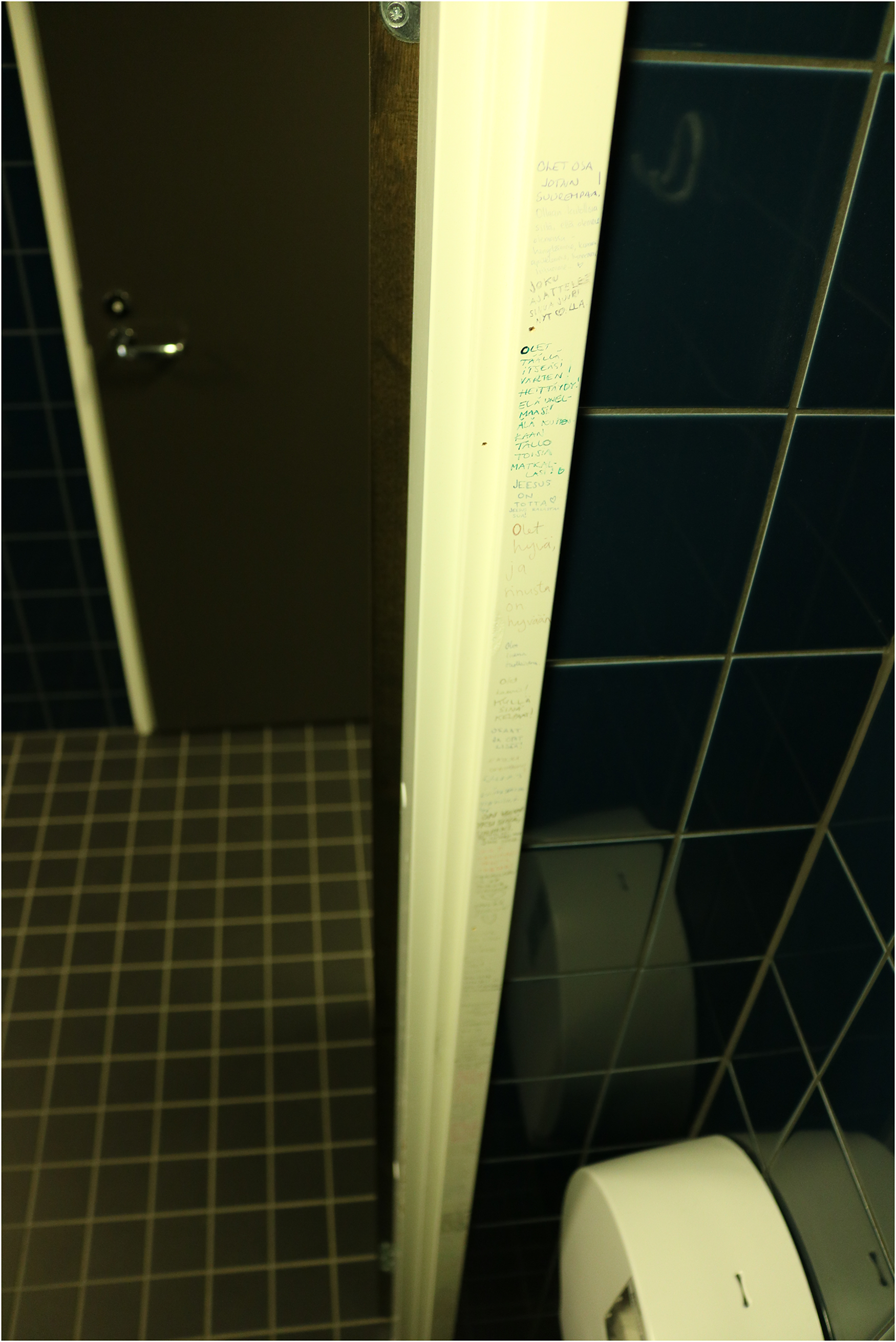
The “Motivation Bathroom” (Spring 2016).
It would be tempting to suggest that the cleaning staff might be secretly in on it, but too tight work schedules are a more likely reason for the continued existence of some of these graffiti. The photographs I’ve taken of the graffiti over the years show how the graffiti created with pens containing water-based ink (such as felt-tip pens) gradually fade away, whereas the scratched graffiti or the ones made with more durable pens (such as pencils or ballpoint pens) remain longer on the doorframe, suggesting that the surface is perfunctorily yet regularly wiped out with a damp cloth. At times this activity has even had a rather creative effect on the doorframe, as for instance the time when water-based inks of three graffiti flared into black, green and pink splashes not unlike an abstract watercolor art piece. For a while, these splashes gave their own accidentally artistic touch to the bathroom before they, too, faded away (Figure 2).
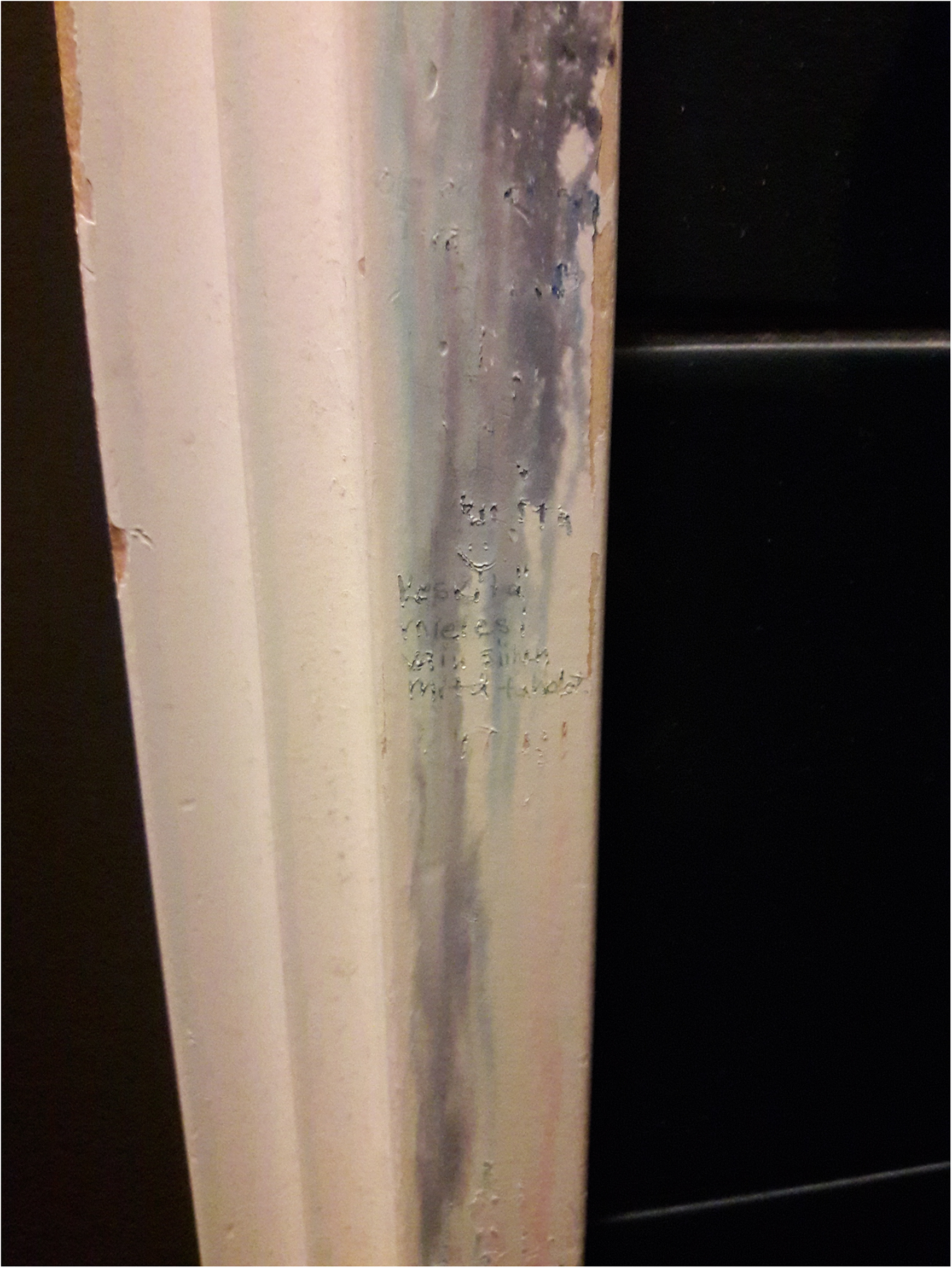
Splashes of black, green and pink; traces of “Focus your mind solely on what you want” (Spring 2018).
And indeed, where there are graffiti, more will soon appear.
The Ongoing Construction of the Shared Message of the “Motivation Bathroom”
By the time I first stumbled upon this bathroom in the spring of 2016, the widest outermost section of the doorframe was already almost fully covered with graffiti. At the very first glance, the pinks and the reds and the greens of the graffiti written with felt-tip pens popped out; likewise, the many hearts here and there on the doorframe, some of which were parts of text-based graffiti, whereas others were individual drawings. But the more I delved into the actual texts inscribed to the doorframe, the more curious I got. A slightly worn out SOMEONE IS THINKING ABOUT YOU WITH A ♥ in four lines, written with a narrow black felt-tip pen; a compact You will survive ♥ in two lines; a small EVERYTHING IS ALRIGHT! written with a pencil; a bit bigger You will find your purpose ♥ written with a red felt-tip pen around the midsection of the doorframe; a slightly worn out Nothing is as bad as it seems right now =) in seven lines, written with a ballpoint pen; a penciled THERE IS A PLACE FOR YOU IN THIS WORLD just above a large heart drawing; a blue LOVE IS ALL AROUND US in five lines, written with a narrow felt-tip pen; a penciled MOTIVATION BATHROOM THE BEST BATHROOM ♥ in four lines, pertinently capturing the caring and motivational content of the other graffiti. While these types of bathroom graffiti are not totally unheard-of, they certainly do not habitually dominate the whole wall (or the doorframe, for that matter) of a bathroom. As previously discussed, typically bathroom graffiti cover a multitude of topics, from which personal advice graffiti are only one possible category (Bartholome & Snyder, 2004; Green, 2003; Schreer & Strichartz, 1997; Trahan, 2016). In this bathroom, however, there was a distinct shared message of care and kind motivating that was reproduced or commented on—in one way or another—in all the graffiti in spring 2016 (Figure 3).
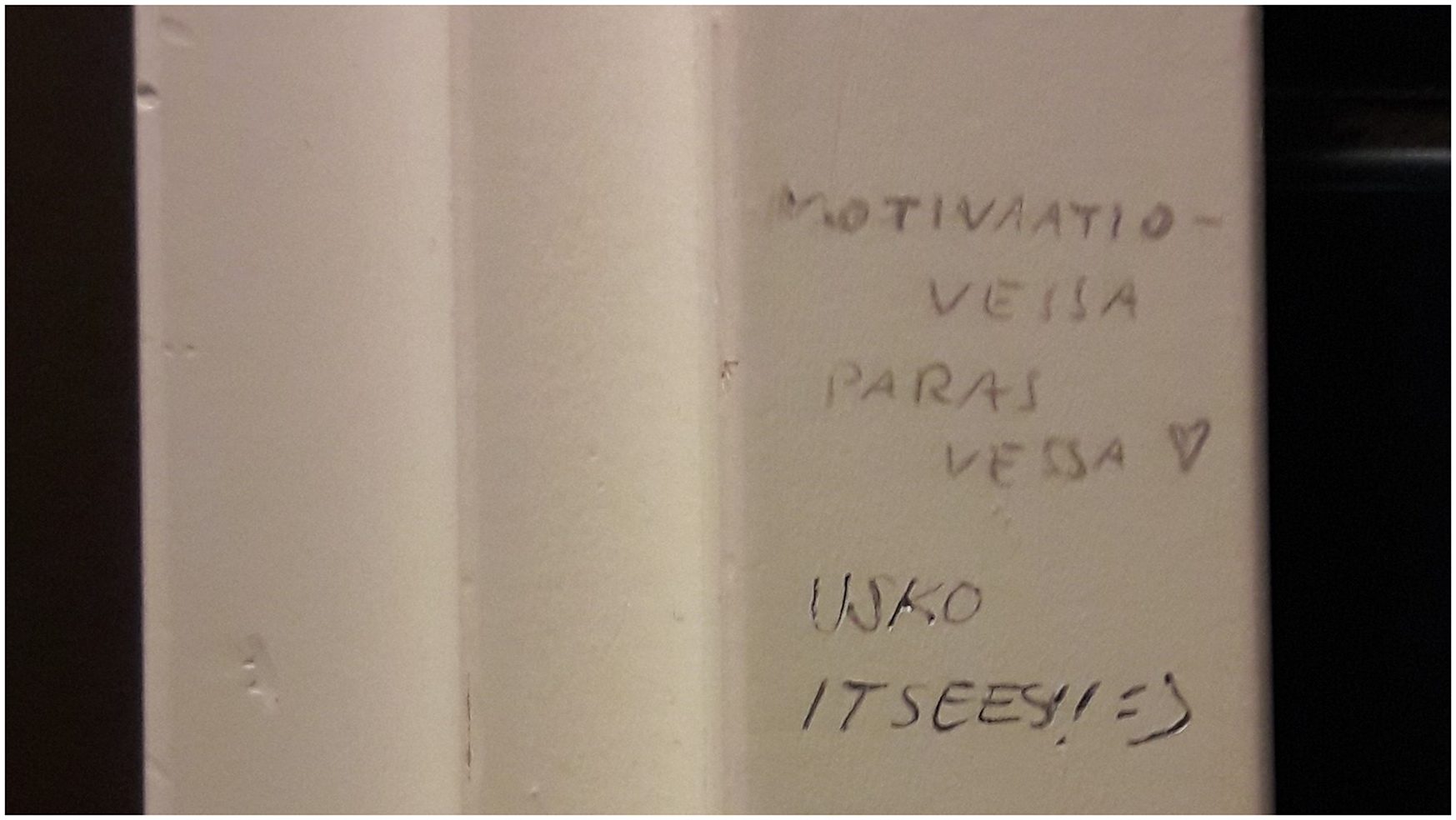
“MOTIVATION BATHROOM THE BEST BATHROOM ♥” and “BELIEVE IN YOURSELF! :)” (Spring 2017, detail).
Many of these graffiti gradually vanished from the doorframe due to years of daily cleaning. For example, the red You will find your purpose ♥ first faded into pink, and then fully disappeared by the spring of 2018. This, however, did not affect the overall number of the graffiti that much, as new graffiti kept on appearing to the “motivation bathroom.” Intriguingly, writers of new graffiti never covered the existing graffiti, not even those that were rendered into unreadable remnants of color. Instead, the graffiti-writers began to utilize the narrower innermost and middle sections of the doorframe, in addition to filling the rare blank spots on the outermost section. Even more remarkably, these new graffiti kept on with the caring and motivational content of the older graffiti, emulating and reiterating the already established shared message of the “motivation bathroom.” A penciled Ordinary is enough :) in three lines, written on a rare blank spot in-between the older graffiti; a miniscule impossible is only an opinion written in all lowercase letters on the innermost section; a black Everybody has their own strengths written with a felt-tip pen high up on the outermost section; a small WONDERFUL SMILE ♥ written with a narrow green felt-tip pen on the innermost section. These graffiti, then, are only examples of such newer inscriptions in and through which the construction of the “motivation bathroom” keeps on going (Figure 4).
“WONDERFUL SMILE ♥” on the innermost section; “YOU ARE GOOD ENOUGH!” on the outermost section (Autumn 2017, detail).
Over the years, some graffiti that do not reiterate or comment on the shared message of the “motivation bathroom” have appeared on the doorframe. Examples of these miscellaneous graffiti include the names of the members of a Korean boyband, a couple of religious graffiti, and a somewhat random Happy Holidays! greeting. Still, these types of graffiti are markedly outnumbered by the typical “motivation bathroom” graffiti; for those with minds more number-oriented, miscellaneous graffiti take up only 20 % of all observed text-based graffiti (13%, if we perceive the boyband as a single entity). More importantly, the topics covered in these graffiti are so random that their presence does not appear to disturb the ongoing construction of the “motivation bathroom” in any way. They simply exist in the bathroom for the time being.
Constructing a Positive Sense of Self for the Observers
In all points of time, the most distinctive characteristic of the “motivation bathroom” is the substantial number of graffiti that, seemingly without prompting, provide positively-oriented answers to fundamental existential questions “who am I?” and “how should I act?” (Brown, 2022) for the anonymous observers of the graffiti. These graffiti take up 47% of all the text-based graffiti; 59% if not taking into account the previously described miscellaneous graffiti. In any case, the “who you are” and “how you should act” graffiti both visually and symbolically dominate the graffitied doorframe of the “motivation bathroom.”
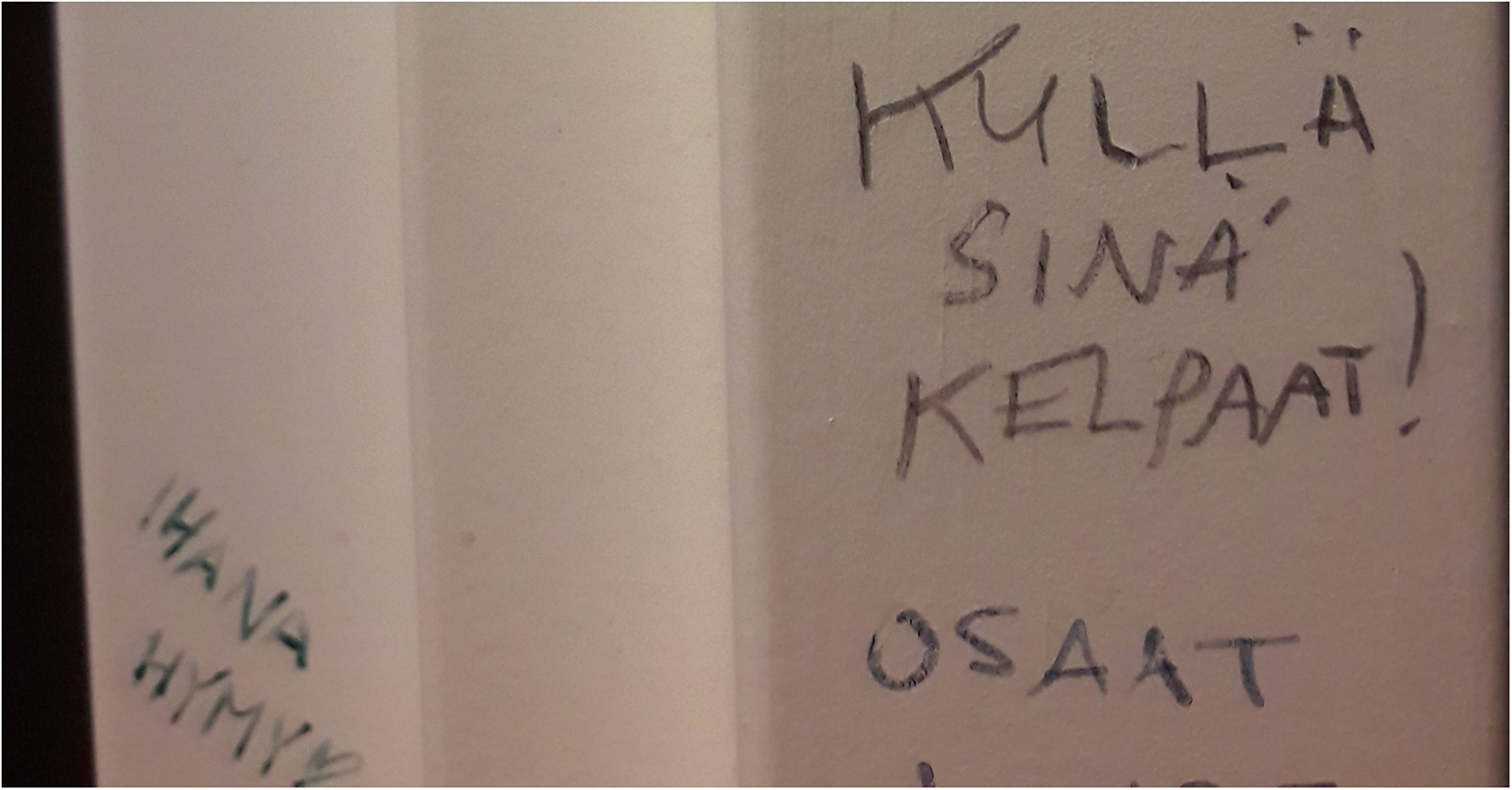
Let us begin with the “who you are” graffiti, of which some are very simple as they merely describe the observer of the graffiti with a positive adjective. A compact You’re beautiful! in two lines, written in cursive with a narrow black felt-tip pen; a similarly small You’re lovely as you are. written right above it with a ballpoint pen; a slightly larger penciled You are strong. in three lines around the midpoint of the doorframe; a pink YOU’RE VALUABLE! written in all capital letters, followed by four hearts. Other graffiti portray the observer as capable and more than what they themselves believe. An all capital letters YOU’RE CAPABLE AND WILL LEARN MORE! written with a ballpoint pen; a large You’re good and capable of goodness in six lines, written in cursive with a pencil; a small, slightly misspelled YOU’RE WISER THAN YOU BELIEVE written in the narrow innermost section of the doorframe; a compact You’re stronger than what you think written with a ballpoint pen on the spot where YOU’RE VALUABLE! used to be prior fading away. Yet other graffiti vaguely connect the observer to an abstract and unseen community. A ballpoint pen graffito in the topmost part of the doorframe declares YOU’RE PART OF SOMETHING BIGGER! and a graffito written with a narrow red pen, using such a force that some of the letters have scratched the surface of the white paint underneath, proclaims YOU’RE IMPORTANT AND BELOVED TO THE WORLD (Figure 5).
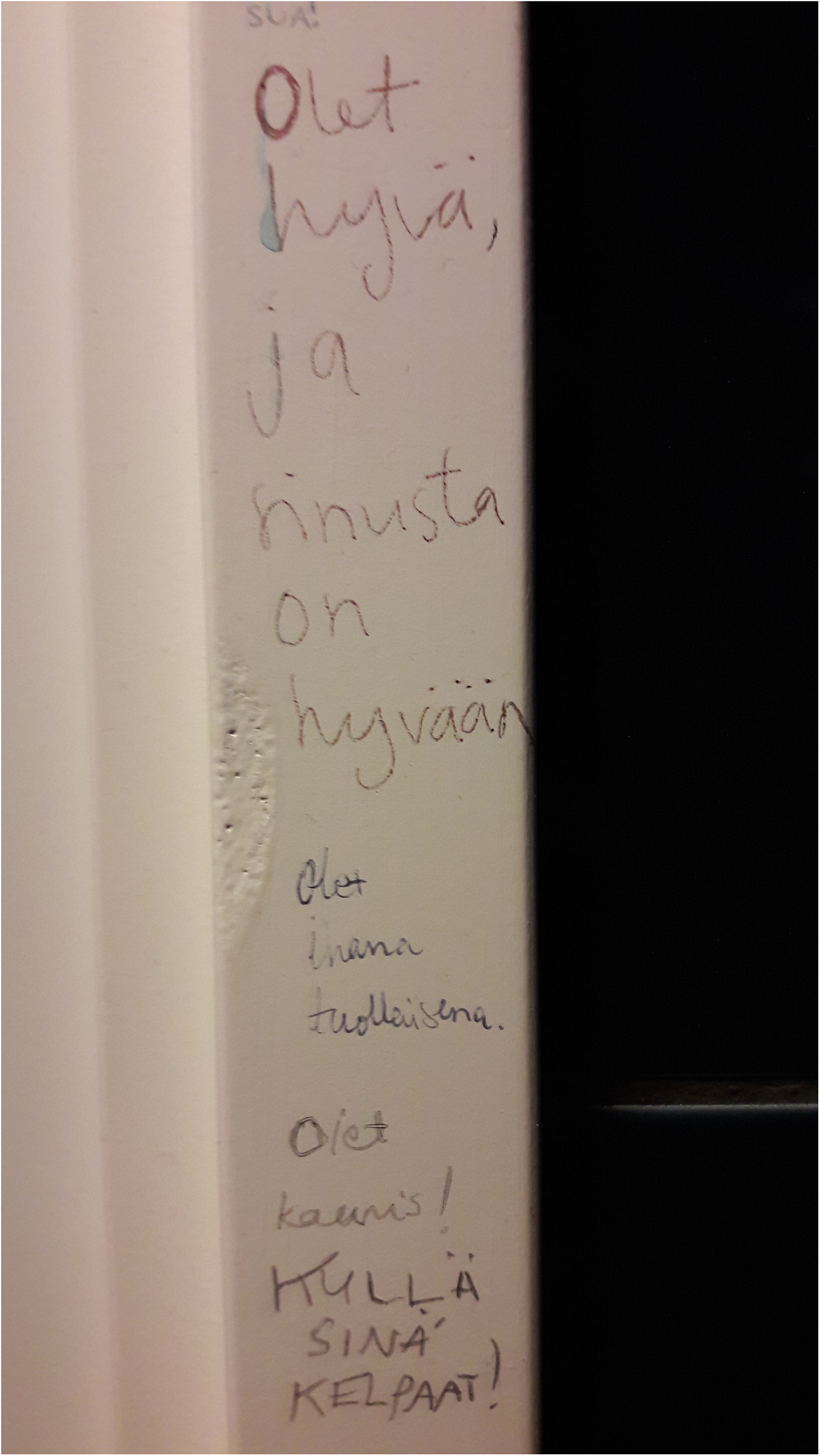
“You’re good and capable of goodness,” “You’re lovely as you are,” “You’re beautiful!” and “YOU ARE GOOD ENOUGH!” (Spring 2017).
Moving on to the “how you should act” graffiti, some of these encourage the observer to focus on their future, whereas others advocate for being in the moment. On one hand, a compact Focus your mind solely on what you want. in four lines, written with a narrow green felt-tip pen with such a force that the surface underneath has been partly scratched; a miniscule, slightly misspelled Make your dreams come true—you can do it! written with a narrow black felt-tip pen on the middle section of the doorframe; all capital letters NEVER GIVE UP! written uncommonly in English on the innermost section in the later years of the “motivation bathroom.” On the other, a penciled ENJOY, THERE IS NO RUSH! that has remained on the doorframe all this time; a rare Let's be grateful for our existence—the way we breath, experience, think, feel, move…♥ written in first-person plural with a ballpoint pen; a Fall in love with the ordinary days of life—enjoy the moment! written on the topmost part of the doorframe, where a dark blue BELIEVE in your own strength! You’re a light ♥ used to be prior fully fading away in a year. Other graffiti in turn advice that the observer should treat both themselves and others with kindness. A partly scratched LOVE YOURSELF AND SPREAD LOVE AROUND YOU! :) written with a black ballpoint pen; a long YOU’RE HERE FOR YOURSELF! INDULGE! LIVE YOUR DREAM! BUT DON’T TRAMBLE OTHERS ON YOUR WAY! ♥ in thirteen lines, written with a leaky yet surprisingly durable green pen; a small be merciful to yourself ♥ written in all lowercase letters with a ballpoint pen; a slightly misspelled Your labor input is replaceable your body and mind are irreplaceable SO REST SUFFICIENTLY written on the innermost section of the doorframe with a narrow black felt-tip pen (Figure 6).
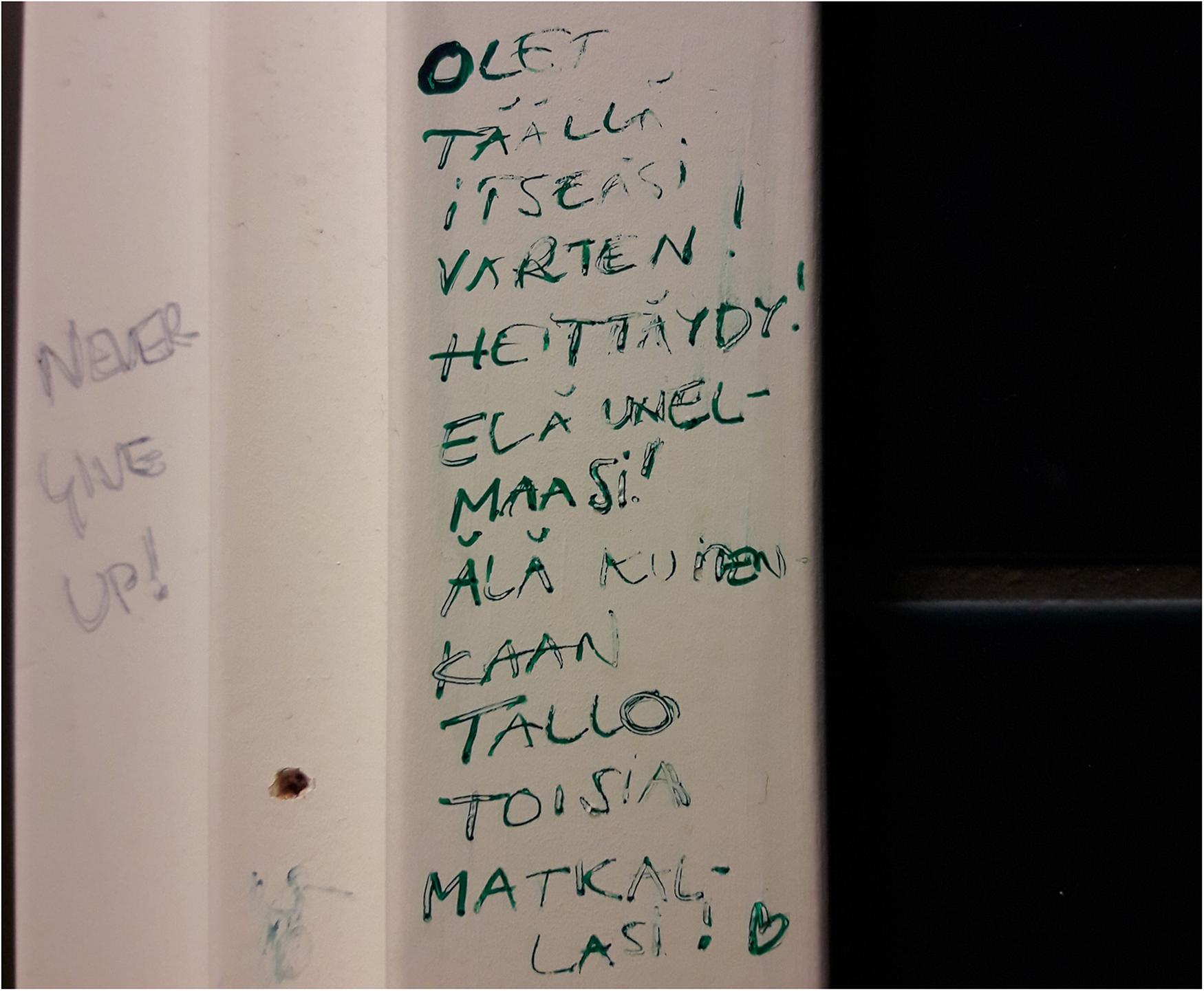
“NEVER GIVE UP!” on the innermost section; “YOU’RE HERE FOR YOURSELF! INDULGE! LIVE YOUR DREAM! BUT DON’T TRAMBLE OTHERS ON YOUR WAY! ♥” on the outermost section (Autumn 2018, detail).
Altogether, these graffiti compose a positive sense of self for the observers by nurturing their sense of self-esteem (Dutton et al., 2010). They encourage the observers to perceive themselves as capable, significant, and worthy which are all characteristics of a high self-esteem (e.g. Pierce & Gardner, 2004). They furthermore advocate that the observers should adopt a caring attitude towards themselves and others, as well as encourage them to be both hopeful about their future and enjoy the moment. Moreover, given their highly positive tone and content, these graffiti also participate in the greater creation and maintenance of the shared message of care and kind motivating.
The Development of Implicit Rules and Norms for Graffiti-Writing
In-between autumn 2017 and spring 2018, a graffito stating YOU’RE NOT ALONE appeared in the “motivation bathroom.” Written on the innermost section of the doorframe with a ballpoint pen, there is nothing particularly remarkable about this graffito in itself; content-wise, it is very much in the line with most of the graffiti inscribed to this bathroom. By the next autumn, however, it had incited a responding graffito that was something different: a compact alarming to hear when in a bathroom written in five lines, embellished with an arrow pointing towards the preceding graffito. This graffito is not only a fitting example of the quintessentially witty bathroom graffiti humor (e.g. e.g. Bartholome & Snyder, 2004; Green, 2003; Trahan, 2016), but also a rare comment that questions—even ridicules—the shared message of the “motivation bathroom.” Later on, another small graffito, written with a narrow black felt-tip pen, showed up to state: It's only Myrtle :) Similarly equipped with an arrow, this graffito makes a reference to a fictional ghost character from the Harry Potter series called Moaning Myrtle, who spends her afterlife in a bathroom at the Hogwarts Castle. While not the most pleasant person, Myrtle is not a threat for the series’ characters and as such this graffito playfully communicates that there is no reason to be alarmed, simultaneously dampening the effect of the questioning graffito (Figure 7).
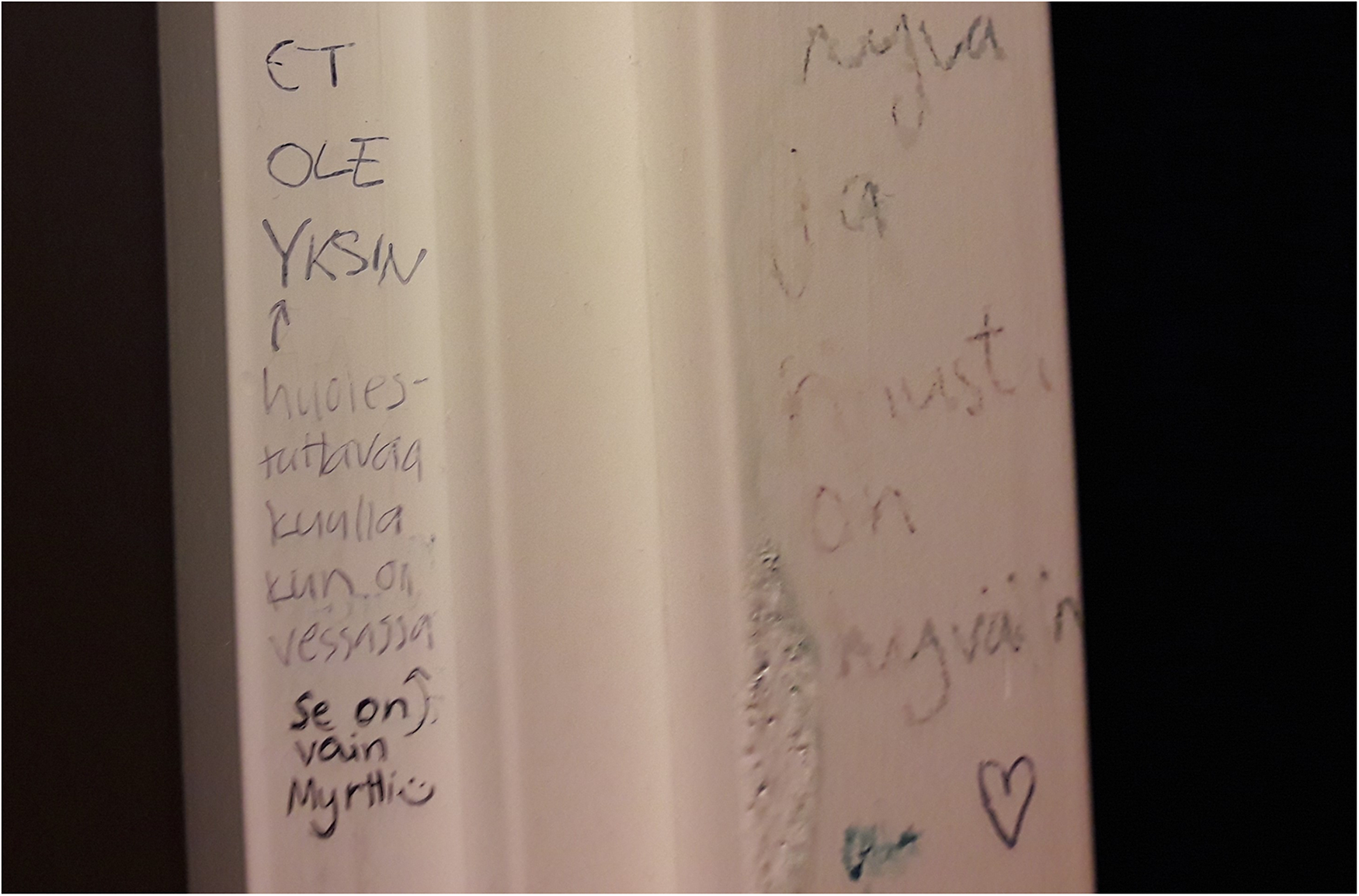
“YOU’RE NOT ALONE,” “[arrow] alarming to hear when in a bathroom” and “[arrow] It’s only Myrtle :)” on the innermost section; a worn out “You’re good and capable of goodness” on the outermost section (Autumn 2019, detail).
This conversation chain containing a typical “motivation bathroom” graffito, a questioning or dissenting graffito, and a graffito that restores the overall tone is not the only one in this bathroom; in fact, it is merely the newest, and the most playful, one. Already present in the spring of 2016, and still fully readable in the autumn of 2019, a similar conversation chain begins with a THERE IS ONLY ONE YOU, UNIQUE. graffito written with a pencil, and is closely followed by a contesting I’m not unique wtf graffito written with a narrow black pen, which is then followed by a tone-restoring You are enough. graffito written in cursive with a pencil. By the autumn of 2018, another conversation chain had also appeared to the doorframe: a “how you should act” graffito encouraging its observers to REMEMBER TO SMILE! in two lines, written with a narrow dark blue felt-tip pen; followed by a somewhat dissenting graffito recommending not to smile UNLESS YOU DON’T FEEL LIKE SMILING!!! written with a narrow black felt-tip pen; followed by a graffito encouraging to Smile anyways :) written with a similar pen, yet in a different handwriting and containing a very different message for the observers of the graffiti. Written with a light green felt-tip pen that was partly faded away already in spring 2016, an older dissenting graffito in turn appeared to contest the whole message of the “motivation bathroom” by stating EVERYTHING IS S*** DO NOT […]. This graffito then was followed by a rather disparaging response SHUSH, LIFE IS GREAT written with a ballpoint pen and equipped with an arrow; content-wise yet again restoring the shared message of the “motivation bathroom” (Figure 8).
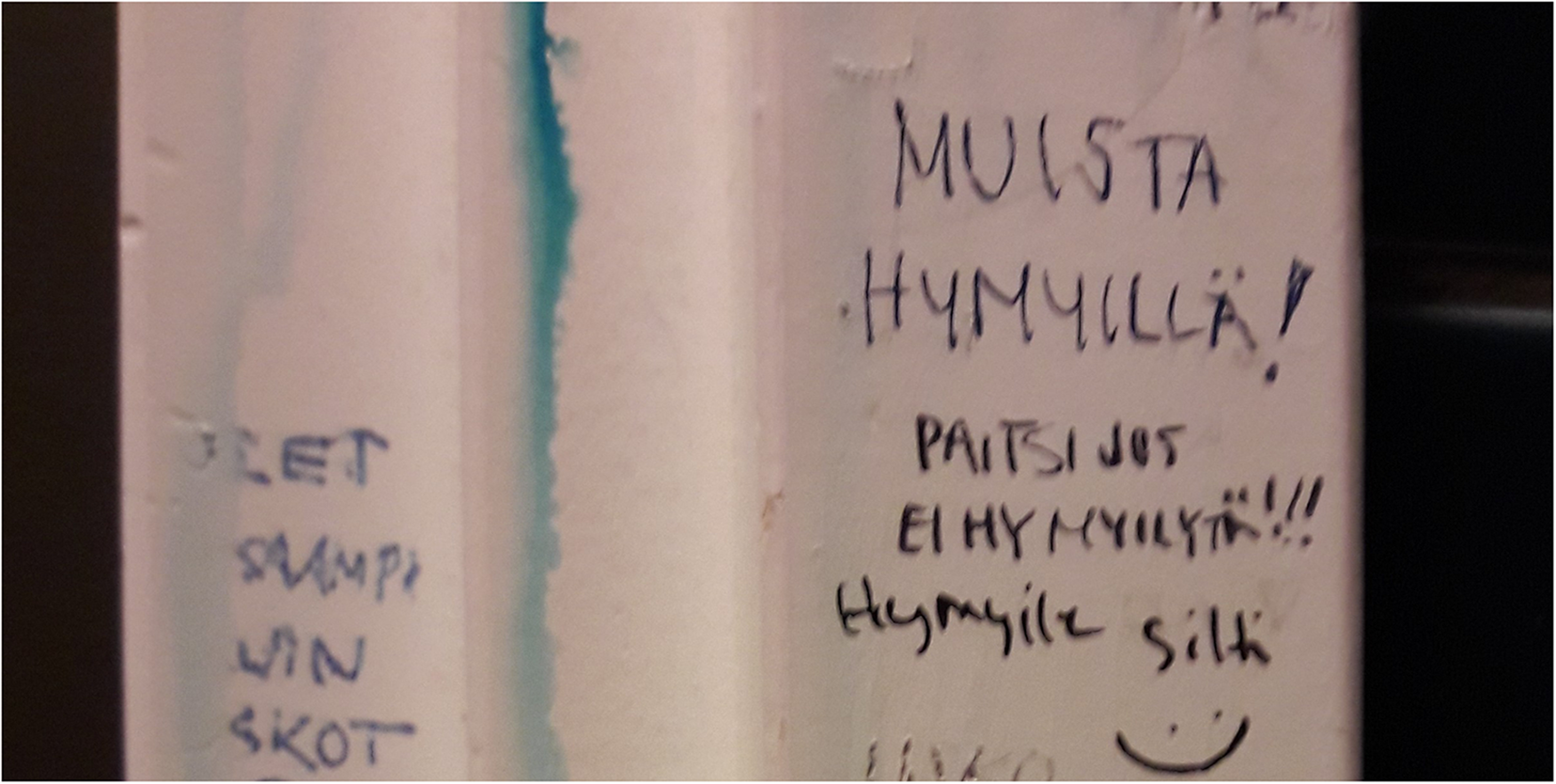
A worn out “YOU’RE WISER THAN YOU BELIEVE” on the innermost section; “REMEMBER TO SMILE!,” “UNLESS YOU DON’T FEEL LIKE SMILING!!!” and “Smile anyways :)” (Spring 2018, detail).
While the emulation and reiteration of the previous content in graffiti-writing is the primary mechanism through which the “motivation bathroom” gets (re)produced, these conversation chains show that dissenting voices are discouraged in this bathroom. That is, every time someone writes a graffito that questions something stated in a preceding “motivation bathroom” graffito, a responding graffito soon appears to restore the shared message in a more or less rebuking manner. Together, these responses and the typical “motivation bathroom” graffiti constitute implicit norms and rules for the content of graffiti-writing: while the typical “motivation bathroom” graffiti showcase what has over the years become appropriate and desirable content for graffiti-writing in this bathroom, the graffiti that respond to the rare questioning or dissenting graffiti indicate what is deemed to be inappropriate and unwelcome. Interestingly, like with all the other graffiti, none of the questioning or dissenting graffiti have ever been covered or otherwise altered—another unspoken rule that guides the graffiti-writing in the “motivation bathroom.”
Discussion: Communitas, Liminal Space, and the “Motivation Bathroom”
Above, I examined the characteristics of the “motivation bathroom” and the particular mode of graffiti-writing that has developed within its walls. I began by zooming into the attributes of the space itself, after which I examined how the constant reiteration of the words of solidarity and the graffiti constructing a positive sense of self together create and maintain the shared message of care and kind motivating. Finally, I showed how the graffiti-writers of the “motivation bathroom” have over the years developed implicit rules and norms for their graffiti-writing. Next, I discuss how the concepts of liminal space and communitas are connected to the ongoing graffiti-writing of the “motivation bathroom.”
Graffiti-Writing as “Doing” Community in a Liminal Space
The “motivation bathroom” is a quintessential liminal space; a space in which university members, both students and staff alike, are momentarily suspended between the hustle and bustle of their daily lives in academia. It is an organizational “no man's land” (Dale & Burrell, 2008) inconspicuously tucked in-between the dominant spaces of an organization (Shortt, 2015) and marked by the momentary suspension of everyday norms, rules, and expectations (Turner, 1974, 1982). From this suspension of the ordinary, communitas often arises (e.g. Turner, 1974, 2012) and the experience of this “intense community spirit and solidarity” (Nicholson et al., 2017, p. 50) certainly could shed light on what is happening in the “motivation bathroom.” Indeed, both the content of the graffiti—the shared message of care and kind motivating—as well as the continued practice of graffiti-writing itself indicate that the writers experience some sort of community feelings and solidarity towards each other. I will tease this notion out a bit more later on.
The issue is, however, that organizational bathrooms are actually the rare sort of liminal spaces that do not naturally evoke communitas. Quite the contrary, public and semipublic bathrooms in general embody anonymity and privacy (e.g. Islam, 2010), and as such they offer rare moments of brief retreats from others instead of implying community. In a sense, they remind those liminal spaces to which religious recluses withdraw in order to be away from the secular world (Turner, 1974). Naturally, organizational bathrooms are occupied for a much shorter time, but nevertheless, they too are experienced alone. Communitas, then, can only arise from such liminal spaces that are experienced together (e.g. Nicholson et al., 2017).
Due to the very same conditions of anonymity and privacy that make them solitary liminal spaces, public and semipublic bathrooms are very opportune spaces for clandestine graffiti-writing. Indeed, previous latrinalia studies suggest that the free and uninhibited nature of bathroom graffiti stems from these conditions; within bathrooms graffiti-writers can express their innermost attitudes, wishes, and thoughts safely without the fear of public judgment (e.g. Islam, 2010; Schreer & Strichartz, 1997). Islam (2010, p. 248) even refers public and semipublic bathrooms as “the converse of Bentham's panopticon” to describe their special characteristics. As a result, most graffitied bathrooms contain a plethora of mostly unconnected self-expressions that can be humorous, raunchy, and controversial (e.g. Bartholome & Snyder, 2004; Marine et al., 2021; Trahan, 2016), as described in the introduction.
It cannot be over-emphasized how abnormal the “motivation bathroom” is in terms of bathroom graffiti-writing. With the exception of few miscellaneous graffiti that appeared over the years, every graffito of the “motivation bathroom” is connected to each other and they all address a single theme. Vast majority of the graffiti written to this space communicate their writers’ shared message of care and kind motivating. It is this notion of communication that explains how an inconspicuous bathroom space, a solitary liminal space, has become able to convey the experience of communitas between people, who might never know or even meet each other. After all, graffiti can be perceived as communicative acts (Islam, 2010) that make walls “speak” on their writers’ behalf (de Vaujany & Vast, 2014); they physically preserve those innermost attitudes, wishes, and thoughts once expressed in anonymity and privacy. As such, the “motivation bathroom” (or indeed any graffitied space) is also a communicative space in which social interaction simply occurs in a mediated form, in and through the graffiti and the space upon which they have been written on. Even though occupied alone, graffiti as space-altering communicate acts allow the users of the “motivation bathroom” to experience this liminal space together which in turn makes the experience of communitas possible.
The observation that the “motivation bathroom” is a communicative space furthermore connects to Delanty's (2013) theorization of contemporary communities, given that he perceives such communities as mainly constructed in communicative processes that occur increasingly in mediated forms. From this perspective, the graffiti-writing of the “motivation bathroom” can be seen as an act of “doing” community (Bathurst & Cain, 2013). The community created and maintained in and through these graffiti, then, is a “thin” community of strangers who express support and solidarity to each other, as well as provide a sort of social identity in the form of the “who you are” and “how you should act” graffiti. Arising from a liminal space, the “motivation bathroom” community certainly features characteristics of a liminal community with the exception that such communities are typically sustained by a shared liminal situation instead of any form of communication (Delanty, 2013). The “motivation bathroom” community, by contrast, is communicative in its organization and composition and as such it actually reminds virtual communities (e.g. Delanty, 2013; Wellman, 2001). However, where virtual communities are only constrained by the Internet access, the “motivation bathroom” community is created and maintained solely in and through the graffiti of the studied liminal space.
Ultimately, the “motivation bathroom” community is perhaps best characterized as a liminal community that has gone through an unusual happening and consequently now has “more reality than a consciousness of communality” (Delanty, 2013, p. 142). Where in Delanty's (2013) example a liminal community of commuters experienced a train disaster together and subsequently begun to interact verbally, here the “unusual” happening is the genesis of the ongoing emulation and reiteration of the shared message of care and kind motivating. At some point of time prior to my knowledge of this space, the initial graffiti-writers chose, one by one, to deviate from typical bathroom graffiti-writing and begun to construct the shared message and the implicit norms and rules of the “motivation bathroom.” This unusual happening, then, was the starting point of the creation and maintenance of the “motivation bathroom” community.
Varieties of Communitas in the “Motivation Bathroom”
As discussed, the “motivation bathroom” graffiti are capable of mediating the experience of communitas due to their communicative nature, but do these graffiti also suggest that their writers indeed experience communitas? If going by Bathurst and Cain's (2013) definition of communitas as the act of “doing” community, then the observation that the graffiti-writing of the “motivation bathroom” creates and maintains a liminal community alone reveals that the graffiti-writers do experience a form of communitas. However, here I also want to examine the “motivation bathroom” graffiti through the lenses of Turner's three communitas: spontaneous communitas, normative communitas, and ideological communitas.
First, by definition, spontaneous communitas is both elusive and personal and consequently, it is generally difficult to appraise whether or not something embodies this transient experience of togetherness (e.g. Turner, 2012). This is particularly true when it comes to the “motivation bathroom” and its graffiti; due to their anonymity and time that has passed, it is outside of this research's scope to track the graffiti-writers down in order to ask from them if they felt anything like spontaneous communitas within this liminal space.
However, I would like to propose that an experience of spontaneous communitas could be what drives the continued graffiti-writing within the “motivation bathroom.” The graffiti-writers certainly express solidarity to each other (Nicholson et al., 2017) and the overall tone of their communication does seem to implicate toward a transient experience of a sense of collective unity (Toraldo et al., 2019), fellowship and togetherness (Hawkins & Edwards, 2017). It is possible that when encountering the “motivation bathroom” graffiti, some of the users of this space experience spontaneous communitas and this experience, then, has prompted certain part of them to participate and write their own graffito of care and kind motivating. From this perspective, the graffiti themselves can be seen as signs of spontaneous communitas; they are small physical marks that can be perceived as preserving this elusive, yet powerful feeling that allows people to get organized and work together.
Second, aspects of normative communitas are easier to recognize from the graffiti-writing of the “motivation bathroom.” Namely, the existence of implicit norms and rules reveals that, under the influence of time, the graffiti-writers have developed a sort of social system with its own habits and rules of behavior (Turner, 1969/2017; Turner, 2012) that apply to the act of graffiti-writing in this liminal space. As previously described, the graffiti-writers are guided by both the existing “motivation bathroom” graffiti, which showcase what kind of new content is appropriate and desirable, and by the restoring graffiti, which indicate what kind of content is deemed inappropriate and unwelcome.
The restoring graffiti are particularly interesting, as they specifically rebuke such rare graffiti that question or dissent the shared message of care and kind motivating. Like all the graffiti-writers, the writers of questioning and dissenting graffiti are protected by the conditions of anonymity and privacy and therefore they cannot be directly punished for their oppositional words, but nevertheless, the restoring graffiti clearly communicate that their opinions do not belong to the “motivation bathroom.” The restoring graffiti thus reveal that normative communitas of the “motivation bathroom” is such that actively discourages questioning and dissenting voices. Notwithstanding its characteristics, I argue that the presence of normative communitas is what enables the persistence of the graffiti-writing of the “motivation bathroom,” as it informs future graffiti-writers on how to maintain the shared message of care and kind motivating.
Finally, if we take another look at the content of the “motivation bathroom” graffiti, we can observe ideological communitas in the studied liminal space. Especially the “how you should act” graffiti contains clear implications of a shared understanding of how humans could, or even should, coexist in harmony (Turner, 1969/2017). More precisely, these graffiti tell their observers how the graffiti-writers believe people should act in their everyday lives in order to be caring and good to themselves and others.
Through their shared message of care and kind motivating, the “motivation bathroom” graffiti furthermore connect to a wider conversation in which a greater emphasis on self-care, self-love, and wellbeing are advocated especially in various social media platforms. While often criticized for having become frivolous and overly commercialized, the roots of the current self-care movements are in the Black feminist philosophy in which self-care is advocated as a radical act of taking care of oneself and one's community (e.g. Zuckerwise, 2024). While the “motivation bathroom” graffiti mostly fall into the less radical, social media type of self-care communication, they nevertheless reveal a certain type of ideological communitas that the graffiti-writers indicate they aspire for. The graffiti-writers’ ideological communitas, then, is particularly poignant when taking into account the wider spatial context in which it is put into words—as previously brought forth, one in three of Finnish university students suffer from symptoms of anxiety and depression (Finnish Institute for Health and Welfare, 2021).
Altogether, there are several types of communitas present in the “motivation bathroom” graffiti. I argue that while the shared message of care and kind motivating is a reflection of specific type of ideological communitas, normative communitas guides the graffiti-writers in how to maintain this message and their community. Furthermore, I propose that the experience of spontaneous communitas is what, in the first place, drives the individual graffiti-writers to participate into the creation and maintenance of the liminal community of the “motivation bathroom.” While the “motivation bathroom” is a solitary liminal space, its graffiti allow all the users of this space to experience the space together.
Conclusions
In this article, I have investigated the mystery of the “motivation bathroom” and its graffiti through the concepts of liminal space and communitas. Like any research, the study has its limitations. First, due to the inherent anonymity of their activities, the “motivation bathroom” graffiti-writers could not be tracked down and interviewed for the purposes of this research. Consequently, the graffiti-writers’ intentions and experiences could only be conjectured based on what they had chosen to write on the doorframe of the “motivation bathroom.” Second, as the shared message of care and kind motivating was already established by the time I first stumbled upon this space, this study cannot answer to questions such as when the graffiti-writing of the “motivation bathroom” originally begun.
Nevertheless, the article contributes to our understanding of the roles that the smaller scale physical liminal spaces play in everyday organizational lives (see also Iedema et al., 2010; Pöyhönen, 2018; Shortt, 2015). In particular, this study examines the relation between these spaces and the experience of communitas. It presents an intriguing case in which recurring human action (i.e. bathroom graffiti-writing) with a solitary liminal space has altered the space in ways that allow its users to experience the space together, thus making the experience of communitas possible. Due to the years of ongoing graffiti-writing, the “motivation bathroom” space is no longer only a liminal space, but also a communicative space in which graffiti-writers are creating and maintaining their own secret community of care and kind motivating.
In addition to advancing the studies of organizational liminal spaces, this article also extends our knowledge of how the concept of communitas can be used in management and organizations research. While communitas is still rarely utilized by management and organizations researchers (cf. Bathurst & Cain, 2013; Concannon & Nordberg, 2018; Nicholson et al., 2017; Pöyhönen, 2018; Toraldo et al., 2019; Vesala & Tuomivaara, 2018), this study suggests that a wider use of the concept could help us better understand what enables people to become informally organized in the ways as the graffiti-writers of the “motivation bathroom” have done. Indeed, the “motivation bathroom” provides a fascinating glimpse into the human capacity for becoming organized around shared causes, even in such socio-spatial contexts in which one would not expect such organizing to take place. The graffiti-writers of the “motivation bathroom” never meet each other or get to know each other, yet they still continue to work together in order to maintain their caring and kindly motivating community as the years go by. In this study, I showcase how both normative and ideological communitas are present in the graffiti-writing of the “motivation bathroom” and propose that spontaneous communitas is what drives this activity. I furthermore examine the “motivation bathroom” graffiti-writing as an act of “doing” a liminal community (Bathurst & Cain, 2013; Delanty, 2013).
Beside the above-summarized contributions to the organizational liminal space and communitas literature, this article also demonstrates how studying the smallest, easily ignored aspects of organizational life can be a fruitful exercise for advancing our understanding of what happens in and around organizations. Therefore, this research joins the recent micro-level material studies of work and organizing that argue for paying attention to the smallest details of organizational life, as they are capable of shedding light on the “big” topics of organizational analysis, such as culture, identity, labor processes and motivation (e.g. Shortt et al., 2014, p. 300; Shortt & Izak, 2021). In this particular study, an examination of bathroom graffiti led to the uncovering of an ongoing social-spatial construction of a “thin” community of strangers who, in the context of Finnish academia, support and encourage each other solely through the act of graffiti-writing. Indeed, as Islam notes, “organizations are full of data-rich areas easily overlooked by scholars” which “contain novel and interesting information, novel because seldom studied, and interesting, because they have managed to flourish, even in secrecy.” (Islam, 2010, p. 258)
Footnotes
Declaration of Conflicting Interests
The author declared no potential conflicts of interest with respect to the research, authorship, and/or publication of this article.
Funding
The author received no financial support for the research, authorship, and/or publication of this article.
