Abstract
Collaborations addressing grand challenges seek social impact; whether such social innovations will endure beyond initial enthusiasm is a major issue. Over the last decade, Social Impact Bonds (SIBs) emerged to diffuse globally as a new form of cross sector collaboration to finance solutions for social problems. Crucially, SIBs rely on intermediary organizations to coordinate and govern relations across diverse actors with competing and conflicting interests and values. How an intermediary goes about this work has significant effects on whether the collaboration achieves the desired social impact and whether it endures. In this article, we examine the intermediary work that enables such a cross-sector collaboration by analyzing two of the first completed SIBs in Continental Europe. Our findings identify three main types of interweaving intermediary work of aligning, stitching, and knotting, that are supported by three distinct forms of institutional infrastructure (ideational, operational, and relational respectively) providing a significant contribution to the analysis of cross-sector collaboration by connecting intermediary work to institutional infrastructure.
Keywords
Introduction
Cross-sector collaborations are increasingly considered a necessary and valuable way of addressing many socio-economic problems (Bode et al., 2019; Bryson et al., 2015; George et al., 2016; Logue, 2019; Selsky & Parker, 2005). Considerable research demonstrates the challenges of such organizational configurations (Clarke & Crane, 2018; Mair et al., 2015; Stadtler & Karakulak, 2020). These challenges include aligning the interests of diverse stakeholders (Babiak & Thibault, 2009; Cabral et al., 2019; Clarke & MacDonald, 2019; Le Ber & Branzei, 2010), achieving mutual agreement and prioritization of the focal problem (or solution) (Parmigiani & Rivera-Santos, 2011), as well as building shared governance and coordination models using common resources (Ansari et al., 2013; Gray & Purdy, 2018; Steurer, 2013). In meeting these challenges rules and governing processes may be borrowed from nearby domains of activity (Raviola & Norbäck, 2013), or new (and shared) languages and systems of meaning created to achieve consensus on problem definition and to mediate between conflicting rationales (Gray & Purdy, 2018; Reay & Hinings, 2009). At other times, new forms of meta-governance or hybrid regulation may be created (Steurer, 2013; Westley & Vredenburg, 1997), or entirely new organizations established to manage or coordinate a problem or shared resource or deliver different intermediary services (Clayton et al., 2018; Fan & Zietsma, 2017; Logue & Grimes, 2022a; O’Mahony & Bechky, 2008).
Often in such inter-organizational settings, to develop, broker, and structure the relations in the interstitial space, intermediary organizations assist actors in negotiating new forms of meaning and ways of working (Furnari, 2014; Giudici et al., 2018; Lingo & O’Mahony, 2010). Doing so is often problematic, as actors in a collaborative process “bring with them various institutional affiliations” as well as “institutionalized rules and resources” (Phillips et al., 2000, p. 29), generating institutional complexity (Greenwood et al., 2011; Kraatz & Block, 2008; Meyer & Höllerer, 2016). How an intermediary goes about managing such complexity may have significant effects on whether the collaboration is successful and achieves the desired social impact. Before a collaboration can develop into a possible proto-institution (Lawrence et al., 2002), relational and material infrastructure needs to be created if configurations or collaborative arrangements addressing social problems are to endure, a central task for any intermediary organization that is implicit, yet under examined.
In this paper we explore how one intermediary organization sought to govern and sustain relations in a cross-sector collaboration pursuing social impact. We ask: How do intermediaries work to navigate and manage complexity in a cross-sector collaboration? What type of institutional infrastructure is designed in the process? We explore these questions by examining the recent global phenomenon of Social Impact Bonds (SIBs). SIBs are a device for the collaborative design, funding and provision of social services, across government, private and non-profit sectors (for a detailed overview, see OECD, 2016). A SIB is coordinated by an inermediary organization and a new form of interorganizational design (Cunha et al., 2022). In a SIB, private investors supply the capital necessary to develop and provide social services in a specific public policy field. If these services—commonly delivered by non-profit organizations or social enterprises—result in improved social outcomes (as verified by independent assessors using predetermined impact targets), investors receive success payments (i.e., original investment and a percentage return) from a government agency.
Our paper is structured as follows. We begin by reviewing existing literature on intermediary work to provide insights into inter-organizational collaboration viability. We present a case study of one such intermediary organization, analyzing its activities and relational efforts across two of the first completed SIBs in continental Europe. The findings focus on this role in bringing together the diverse actors needed to address complex problems and generate social innovation (Bode et al., 2019; Clarke & Crane, 2018). Our findings reveal two conceptual layers to the empirical story: first, there are three main types of interweaving work undertaken by the intermediary (aligning, stitching, knotting); second, different forms of institutional infrastructure are associated with this intermediary work (ideational, operational, and relational). Our contributions theorize intermediary work as a distinct form of social-symbolic work (Lawrence & Phillips, 2019), thus extending understandings of institutional infrastructure at the inter-organizational level.
Theoretical Orientation
Cross-sector collaborations frequently entrain actors from rather different institutional domains; hence, they are characterized by institutional plurality and complexity (Dunn & Jones, 2010; Greenwood et al., 2011; Kraatz & Block, 2008; Meyer & Höllerer, 2010; Smets & Jarzabkowski, 2013). A wealth of literature on cross-sectoral collaboration shows that such arrangements pose both opportunities and difficulties for agential organizing and management (Bryson et al., 2015; Fan & Zietsma, 2017; O’Mahony & Bechky, 2008). Opportunities to innovate arise by learning about and borrowing ideas from other domains (Besharov & Smith, 2014; Phillips et al., 2000; Tracey et al., 2011) or creating new hybrid practices (Mair et al., 2015). However, difficulties involved in managing such collaborations tend to be the focus of the literature (Babiak & Thibault, 2009; Clarke & Crane, 2018; Clarke & Fuller, 2010; Clarke & MacDonald, 2019; Le Ber & Branzei, 2010). These difficulties include aligning stakeholders’ interests (O’Mahony & Bechky, 2008), achieving mutual prioritization of a problem (or solution) (Parmigiani & Rivera-Santos, 2011), and building shared governance and coordination models bridging common resources or problems (Ansari et al., 2013; Fan & Zietsma, 2017; Steurer, 2013).
Intermediary organizations strive to position their agency as connecting and managing different stakeholders, developing consensus and formalizing relational channels across diverse groups. These intermediaries are regularly described as brokers (Fleming & Waguespack, 2007; Lingo & O’Mahony, 2010), network orchestrators or administrators (Giudici et al., 2018; Reypens et al., 2019) or sometimes as boundary organizations (O’Mahony & Bechky, 2008; Star, 2010). Some intermediary organizations have a permanent governance role coordinating and delivering members’ benefits or resolving conflicts (Jay, 2013; Paquin & Howard-Grenville, 2013), while others may be independent, gathering and connecting resources (and thus actors), integrating ideas and distributing value amongst participants, including themselves. For instance, music producers broker work across artists, musicians, studios and record labels (Lingo & O’Mahony, 2010). In Bangladeshi villages, an NGO operating as an intermediary organization worked to develop market architecture and to legitimate new actors, diffusing alternative definitions of practices (Mair et al., 2012).
In international development projects, there are examples of where a partner-created intermediary organization actually weakened cross-sector collaboration (Stadtler & Karakulak's, 2020) by “filling out” and dominating an interstitial space to stabilize inter-organizational relations. In this example, an intermediary's frustration with the complexity and slow pace of stakeholders’ participation led them to “step in to enable progress toward the collaboration's goals,” essentially “usurping the partners” responsibilities’ and weakening relational structures (Stadtler & Karakulak, 2020, p. 377). Existing studies also highlight intermediary strategies for dealing with conflict, coordination, and complexity in different collaborative conditions. Bryson et al. (2015) suggest a potential need for “structural ambidexterity” of intermediaries and brokers to manage and respond to the changing tensions in such collaborations over time. In some cases, these may include invoking membership sanctions, exclusions, or coercive behavior via contractual obligations. Such responses are not available however where collaborators are freely chosen or engaged through commissions or fee-for-service arrangements.
The previous paragraphs refer to agency-centered interventions rather than institutional features. The concept of institutional infrastructure, introduced by Hinings et al. (2017), includes the cultural, structural, and relational foundations that shape and guide exchange. Originally proposed at the level of organizational fields, the concept describes “the features that bind a field together and govern field interactions” (Hinings et al., 2017, p. 163). Included in this definition are such elements as collective interest organizations, regulators, and governance bodies, as well as cognitive and discursive templates, categories, and norms (Hinings et al., 2017). Over time, different types of institutional infrastructure may be elaborated (Hinings et al., 2017), often forming sets of interlocks that enable and maintain governance mode(s) and social controls of entire fields (Raynard et al., 2021) or enable the development, partitioning and consolidation of relations and activities in sub-fields (Faulconbridge & Muzio, 2021). Institutional infrastructure may also be created and elaborated by actors across multiple fields, especially when it comes to navigating and understanding social and environmental issue fields, whose complexity emanates from transcending single field boundaries (Buchanan et al., 2023). Buchanan et al. (2023) examine the role of institutional infrastructure in supporting settlement constellations amongst organizations in different fields, and show how such settlements, with varying degrees of stringency, provide “a “generalized sense of order and certainty” (Fligstein & McAdam, 2011, p. 10).
This focus on the role of institutional infrastructure in providing coherency and enabling exchange within fields, across fields (especially issue fields), and the role of organizations in producing and elaborating such varied infrastructure, connects to a growing line of inquiry on the role and process by which institutional infrastructure is cultivated at an organizational level to enable exchange amongst diverse organizations (Gatignon & Capron, 2023; Gegenhuber et al., 2023; Logue & Grimes, 2022; Lucas et al., 2022). Many recent studies have begun to consider the role of organization's producing measurement and certification systems and their strength and stringency to have desired impact (Lucas et al., 2022), to organizations producing platform structures and rules to attract, funnel, and govern vast numbers of organizations and individuals into solving complex social problems, over time, and at pace (Gegenhuber et al., 2023). Logue and Grimes (2022) for example, show how a platform organization, seeking to build relations and activity across public, private, and community actors in civic crowdfunding collaborations, designed institutional infrastructure. It did so in terms of boundaries, bridges, and blueprints, to address temporal challenges of legitimacy, participation, and governance, to ensure the platform delivered social impact in the immediate and longer term. As designing institutional infrastructure may be particularly important for securing and embedding resources to provide longer term viability for a collaboration, locking in stakeholder commitment, or creating the relational structures required to manage shared resources over the longer term is an advantage. While this is a growing line of inquiry at this level of analysis, less considered thus far is the specific role of intermediary organizations in producing and elaborating institutional infrastructure. The concept of institutional infrastructure supporting governance arrangements in cross sector collaborations provides an opportunity to reveal the implicit and overlooked work of intermediaries in cultivating institutional infrastructure and how this resulting infrastructure in cross-sector collaborations enables, shapes, or contributes to enduring success.
Empirical Design
Research Context
SIBs have emerged globally as an innovative mechanism for financing a variety of social programs, offering novel ways to channel financial streams from capital markets to third sector organizations for social purposes, while minimizing risk to public finances (Schinkus, 2015). Social impact bonds are outcomes-based contracts. They use private funding from investors to cover the upfront capital required for a provider (often a non-profit organization) to set up and deliver a social service. The service is designed to achieve measureable outcomes specified by the commissioner (in many cases, the government). The investor is only repaid if these outcomes are achieved. Social impact bonds are therefore different from traditional government contracts in that they focus on outcomes (rather than inputs, activities, and outputs), and they involve a third-party investor. The first impact bond, created in 2010 was implemented to reduce reoffending rates in the United Kingdom at Peterborough prison. Since then social impact bonds have emerged across a range of social service areas, such as supporting children on the edge of the social care system, helping homeless people find sustainable housing, and helping integrate refugees into society.
To develop and execute a SIB requires efforts from many different actors as well as an intermediary to organize and coordinate them. Little is known about how intermediary work is conducted, how negotiations play out, or how social impact and returns are decided (McHugh et al., 2013). The actors, roles, and activities required for a SIB to function are generally considered to be (a) an intermediary organization that contracts with (b), the government (or a state agency) for the delivery of social programs to the benefit of constituents; (c) a non-profit social service provider contracted by the intermediary to deliver the program and to work with beneficiaries; (d) a private investor that provides upfront capital to the intermediary in anticipation of being repaid investment and return by the government if the program undertaken meets performance targets; (e) an independent assessor who verifies, by the end of the program period, whether predetermined impact targets have been met; in many cases (f), there is also an independent process evaluator to assess a focal SIB arrangement. The intermediary plays a pivotal role within the SIB arrangement, not just in mediating between the interests of the other major actors involved but by often acting as the initiator of a SIB and as the broker in raising capital, selecting and managing service providers, retaining the evaluator, and contracting the independent assessor.
Organizational Case Study
Our organizational case study is that of the intermediary Juvat (from Latin: “it works”), that describes itself as an organization whose aim is promoting impact-oriented initiatives and thus enhancing the quality of social service delivery. The intermediary is a spin-off of the philanthropic family foundation Benckiser Stiftung Zukunft 1 , based in Germany. The intermediary was involved in two of the first SIBs to be initiated and completed in Continental Europe. We examine its efforts across the first SIBs in Austria and Germany. These multiple locations reduce the explanatory power of national contextual factors or the characteristics of different social problems in the relative success of the ventures.
The intermediary was a driving force in establishing the SIBs, proposing them to the state actors, with the initial set-up work and contract negotiations between the intermediary and the government agencies in both instances taking over one and a half years. The first SIB, Youth with Perspective, based in Augsburg, Germany, focused on tackling youth employment in an urban area. It was the first SIB launched in Continental Europe, as well as among the earliest to be completed globally. The intermediary worked with the Bavarian State Ministry of Labor, Social Affairs, and Integration as outcome payer, which contracted four social service providers specializing in youth and education support, as well as engaging three private-sector foundations and one institutional investor. The second SIB, Perspective:Work, was situated in Upper Austria and focused on counselling as well as training and then creating employment opportunities for women who were victims of domestic violence. This intermediary worked with the Austrian Federal Ministry of Labor, Social Affairs, and Consumer Protection as outcome payer, contracting two non-profit service providers with longstanding experience in providing safe accommodation and intensive counselling, by partnering with five private-sector foundations as investors. 2 A summary of each SIB is available in Appendix 1.
Data Collection
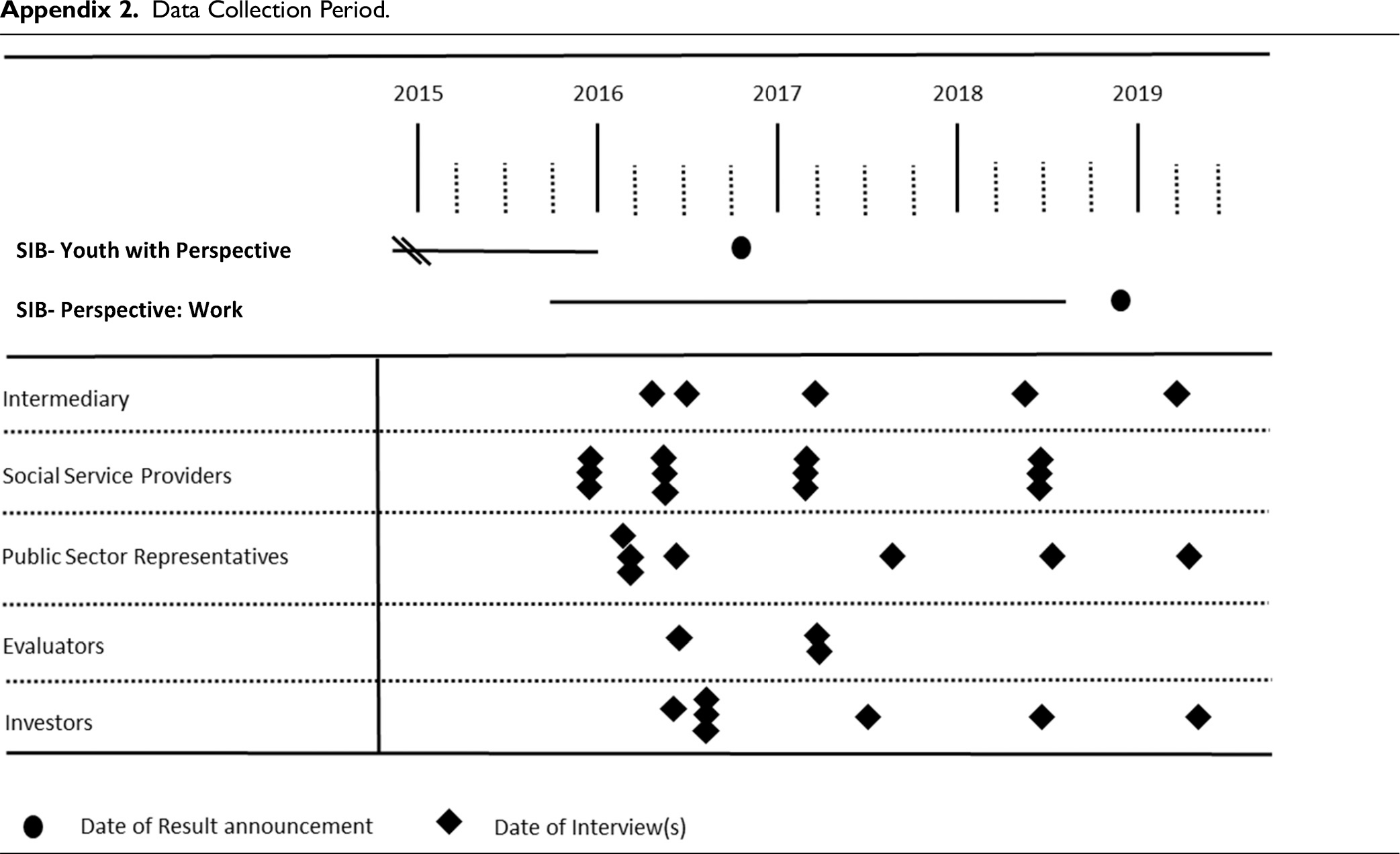
With a firm focus on the role of the intermediary in managing cross-sector collaboration, we opted for an in-depth study and qualitative methodology. One author secured initial access to the intermediary and sites in his role as academic process-evaluator for one of the SIBs. 3 . Initially, we gathered secondary data about the intermediary and each SIB from media, press releases, policy papers, government reports, and online sources. These provided a comprehensive overview of the intermediary and the broader context of the collaborations. Second, we conducted 31 semi-structured interviews with all stakeholders, including five with members of the intermediary. We interviewed the head and project manager of the intermediary organization; the head of responsible departments and the project managers of the respective State Ministries; the directors of the social service providers; fund managers from the group of investors; the verifier and the process evaluators. The semi-structured interviews were tailored for each stakeholder and were conducted at multiple points during the term of the SIB, as illustrated in Appendix 2. The tailoring of each interview was around the framing of the different roles involved at each stage of the SIB, yet the topics of interest remained consistent. Hence, we developed interview manuals for every round of interviews, which comprised key themes related to each lifecycle phase of a Social Impact Bond (namely initiation, implementation, project completion, and look back) and adapted them to the respective stakeholder perspective. The key themes have centered on roles, responsibilities, assessment of the instrument, processes, operational issues, communication, learnings, review, and outlook. We consequently asked what worked and what did not work, what was changed or kept constant. Moreover, we steadily encouraged all respondents to reflect on their role and motivation, the processes and technical elements of the SIB arrangement and their assessment of the potential and possible pitfalls of Social Impact Bonds.
We conducted specific follow-up interviews with the intermediary upon completion of the SIBs to gain further insights and validate initial findings. The interviews were conducted in several rounds over the duration of the two SIBs (over 29 h in total), and were recorded and transcribed, resulting in over 455 pages of material.
Data Analysis
Our research questions guided the broad themes of the semi-structured interviews as well as coding and analysis. We used an inductive theory-building approach, iterating between data, existing literature, and theory to conceptualize the case at hand (Langley, 1999; Van Maanen et al., 2007).
We operationalized our research question by initially searching for, and building on, patterns of content-related issues. Two authors read the interview data for the German SIB, followed by the Austrian one, specifically looking for insights and comments on the challenges of developing and executing such cross-sector collaboration (and how to overcome governance challenges). They were careful to note if and how collaboration was changing over time, as well as noting any substantive differences in intermediary work across each SIB. This was then discussed with the broader authorship team. In doing so, we identified three distinct phases in the lifecycle of a SIB arrangement (for temporal bracketing, see Langley, 1999). Three authors then returned to the interview data and examined in more detail what was occurring in each of these phases. The selecting and categorizing of statements from interviews with informants resulted in several first-order codes, which we then clustered to form second-order themes (Gioia et al., 2013). As an iterative procedure this required going back and forth between the primary data sources, first-order codes, emerging second-order themes and eventual aggregate theoretical constructs. Regular author meetings were held during this time to discuss points of difference or ambiguity. For each temporal bracket, our analytical procedure refined a system of categories identifying the intermediary work in each phase. We then re-read our description of each phase, focusing on how governance challenges and conflict were addressed, which revealed that different forms of institutional infrastructure were being designed in support of the different types of intermediary work. Figure 1 demonstrates the data and coding structure.
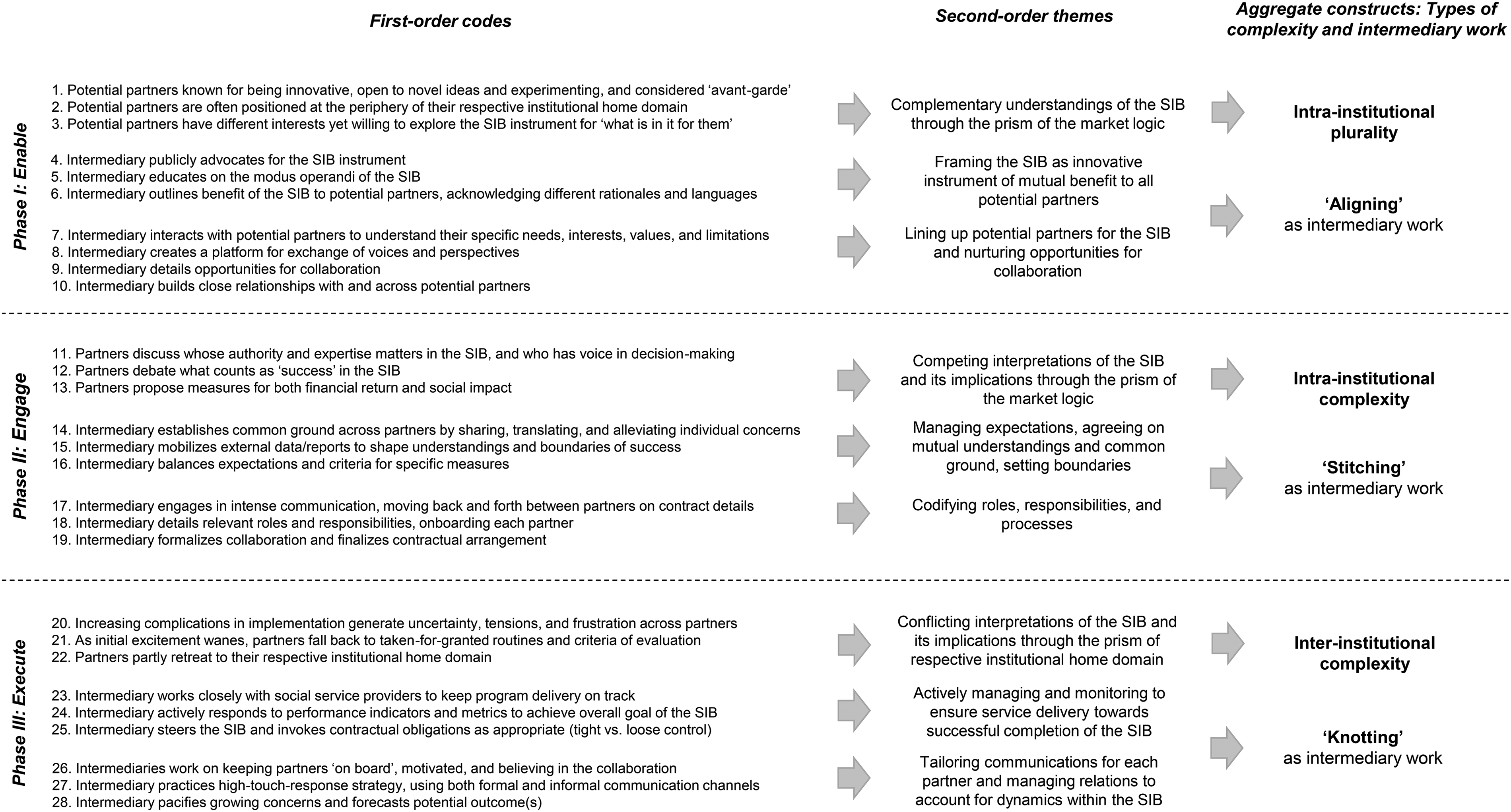
Data structure and coding.
Findings
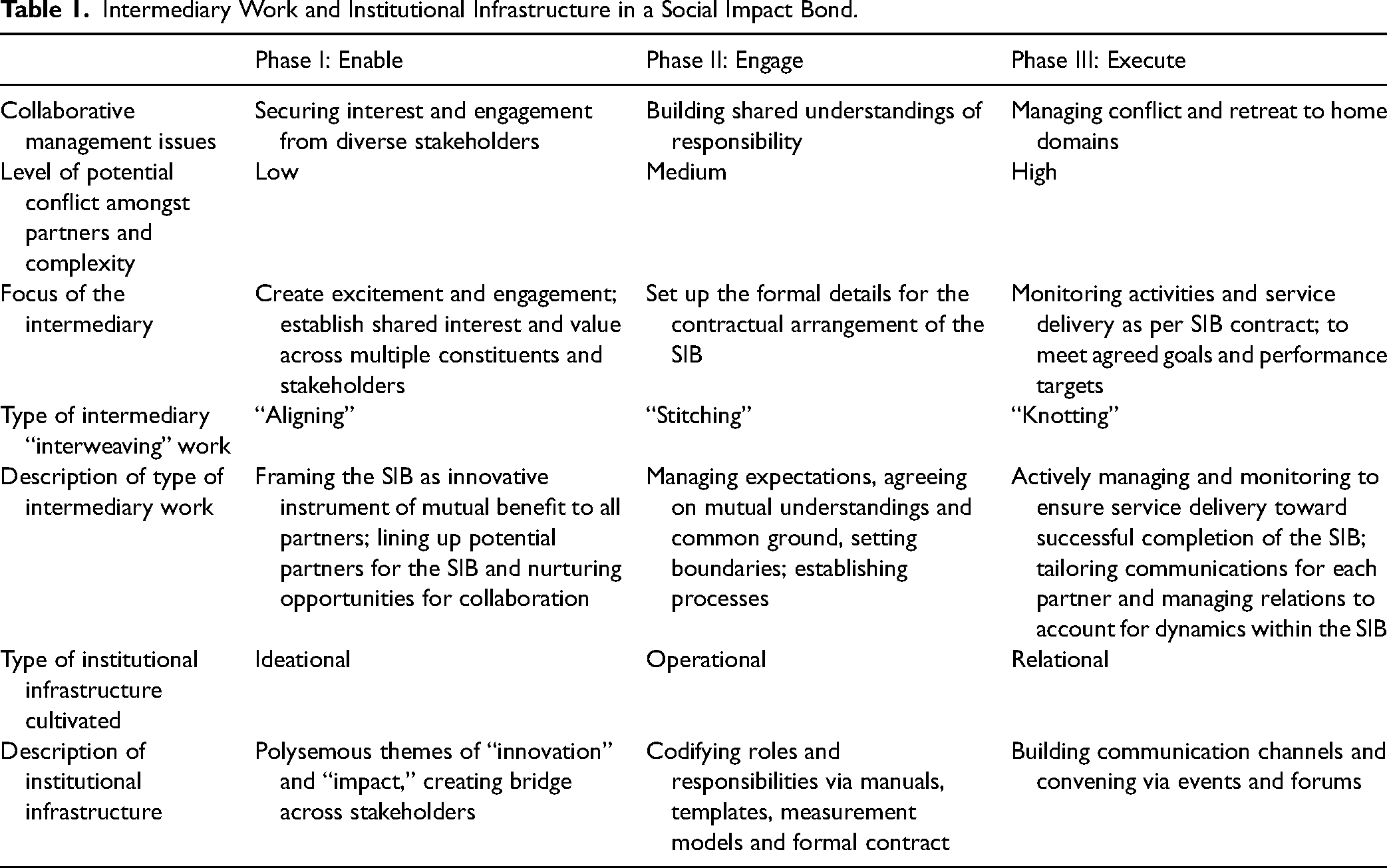
Bringing together diverse stakeholders into a relatively stable and sustainable arrangement takes much effort by the intermediary, changing substantially as the collaboration evolves and new challenges arise. In our findings, we identify three distinct phases in the processes of a SIB, labelling them “enabling,” “engaging,” and “executing.” Each of these had three rather different foci for the intermediary. These phases are evident in interviewee accounts as well as mirroring the development, negotiation, setup, and implementation of the SIB as a novel contractual arrangement for the parties involved. To address these successfully, three different types of intermediary interweaving work were needed, which we labelled as “aligning,” “stitching,” and “knotting.” We describe the associated institutional infrastructure that is designed to support of the different types of intermediary work, as summarized in Table 1.
Intermediary Work and Institutional Infrastructure in a Social Impact Bond.
Enabling Phase: “Aligning” as Intermediary Work Designing Ideational Infrastructure
In this initial phase, the intermediary is entrusted (by the state) with establishing the SIB arrangement and so takes a leading role in identifying potential interested parties. What was initially perplexing is the apparent ease with which the selected, yet diverse, stakeholders readily aligned with the general idea. Accounts suggested that this was because of the higher order societal contribution pursued: “Everyone involved […] wishes that something positive […] eventuates from this” (Government GER) which “makes a crucial difference for engagement” (Intermediary AUT). The low level of conflict in this phase occurs because the intermediary works to ensure that while each stakeholder sees something slightly different in the SIB, they see overall interests as aligning with their “home” values in this new arrangement. For example, for the government stakeholders, the intermediary stresses accountability for the efficient and effective use of public funds. The state […] only pays if there is success […]. You have to understand that this is public funds, and that public authorities manage taxpayers’ money. (Intermediary) Given the dramatic budget situation, we saw this […] as a chance to try—to test—something new, without having to gather the necessary funds immediately. (Government AUT)
In this way, the intermediary plays a crucial role in reinforcing the complementarity of divergent interests, which we label “aligning” intermediary work. We had very constructive discussions with everyone, including all the pros and cons, to get a feeling […] what this thing can do for all of us. (Intermediary) When all the actors get together […] there were moments in which you realize that there are sitting exactly those at the same table who usually don’t—and now have to deal with this topic […]. Each actor has to play his or her specific role, of course […]. But then you realize, at some point […] that there is shared appreciation that, yes, we all act in concert. (Intermediary)
While the stakeholders may feel that the SIB aligns with their home values, the intermediary designs ideational infrastructure to secure this initial engagement further; that is, it works with stakeholders to develop framings of a SIB explaining away potential inconsistencies. Engagement is described as necessarily “innovative” and “avant-garde,” as seen in stakeholders’ accounts. I think of social impact bonds as an innovative instrument or concept of financing in order to address pressing social problems. (Investor GER) I tend to think that all actors involved have been part of the avant-garde in their respective field of activity […]. They have worked in an outcome-oriented and innovative manner, and therefore had a common denominator to start with. (Process evaluator GER) To be involved from beginning to end, and to autonomously conceptualize large parts of the project—this is certainly a novelty for all of us. (Government AUT)
Terms such as “innovation,” “pioneering,” “thinking outside the box,” “experimenting,” or “exploration” (all notions used by our informants) serve as a polysemous frame to govern the collaborative arrangement and to create stickiness amongst stakeholders. The ideational infrastructure of innovation and impact is pushed forcefully by the intermediary during the initiation and establishment of the SIB contract as exactly the discursive and rhetorical prerequisite “that enables such collaboration” (Intermediary). In fact, the official media release for the project describes the Government's strong “commitment to trying out innovative approaches in the area of social policy through the use of social impact bonds” (Juvat, 2013, p. 1). Building close relationships with and between partners as well as providing a platform for the exchange of voices and perspectives are key features aligning intermediary work. Polysemous framing supports this by providing a discursive bridge and ideational infrastructure across diverse stakeholders with divergent interests.
Engaging Phase: “Stitching” as Intermediary Work Designing Operational Infrastructure
In the second phase, once potential participants have been recruited and expectations are sufficiently aligned, comprehensive SIB contract negotiations commence, led by the intermediary. In this phase, the potential for conflict amongst stakeholders increases as the discussions touch upon and often question vested interests. Difficult decisions must be made about what counts as social value, impact, and return in a way that can be incorporated into a formal agreement. I definitely think that a social impact bond is indeed a contractual arrangement that ties together the three sectors […]. All the things you do together enhance mutual understanding, that I am sure about as well, that starts, for instance, with a shared language—well, each of the partners has a rather particular language, and here you have to connect them in the first place […]. I have a suggestion for you: here in Munich, go to a social pedagogue, a banker, and any civil servant, and then you will know after five seconds what I am talking about. (Government GER)
While general social objectives and program are broadly agreed, identifying the target group of beneficiaries’ exact characteristics proved increasingly problematic for the intermediary defining, operationalizing, and precisely measuring success. For example, while the government and the investors tend to suggest more objective indicators to quantify the social impact achieved, social enterprises preferred a more holistic assessment, including qualitative dimensions. Internally, success will be exclusively measured whether there actually is securing subsistence for 75 women. The Ernst & Young report is, so to say, the report of success—but there is obviously also success defined rather differently. (Government AUT) There is no way I can measure what the value of a disabled person now finding a job is; I just don’t know, and I don’t want to know in financial terms—or is a handicapped person with employment worth more than an elderly person with a room in a nice foster home, or a disadvantaged kid that now gets some education? (Investor GER) It is always difficult to define success, as for us working with these 100 juveniles was in itself a significant success […]. But the state cannot take such a position, they have to define targets and measures which they consider appropriate. (Social service provider GER)
What is striking in setting up contractual arrangements is the emerging realization of a trade-off between the continued strong belief in the SIB as an adequate platform for collaboration (given the polysemous framing) and competing interpretations of the implications of the SIB. As the ideational infrastructure appears insufficient to keep collaboration on track the initial “win-win-win” façade shows its first cracks. As conflict starts dominating the negotiations around the measurement of social impact, return on investment, risk distribution, cost-effectiveness, funding conditions and quality of service delivery, the pivotal intermediary role of bringing together diverse stakeholders in a more enduring way becomes evident. Conflict of interest also in determining the return […]. Which target do I set and how realistic is its achievement from the perspective of the various stakeholders? What do I as investor expect as financial return, and is it possible to get that? (Investor AUT) The linking pin is the intermediary who is in touch and has a contractual agreement with everyone. We are, so to say, the spider in the cobweb that integrates all actors. (Intermediary) The intermediary is the one who is, at the beginning, something like the catalyst, who eventually forms something concrete out of all the different components. (Investor AUT)
The efforts of the intermediary are essential in maintaining collaboration of all partners, clarifying details and mobilizing data, managing expectations, and generally creating common ground across differences. We describe this as “stitching” together stakeholder interests in a formal contractual arrangement. A central task is to keep the different parties together, despite potential disagreement; to calm tensions and alleviate concerns while also integrating interests, with the goal of formalizing and legitimizing a SIB contract that defines specific roles and activities as well as structuring relations between all involved. Practically, this means that this is the one who brings everyone to the same table and moderates the entire process […] who builds the entire structure and mediates between parties […] in case there is conflict or tension. (Process evaluator GER)
In this phase, the material operations of the SIB require an institutional infrastructure for stitching work. Careful safeguarding of roles and relationships requires intense (re-)negotiation led by the intermediary. There were moments where we had the impression that we need to, let's say, once more make it clear what this approach entails from our point of view, and what it implies for the entire design of the contract […] also in the context of anticipating implementation […]. One certainly encounters the moment in which you say, yes, now we need to bring back the big picture and together again develop a shared understanding of what we wish to achieve. (Intermediary) If you think of this as a network structure, then the intermediary is the one in the middle who knows everything, who can decide everything, who is in charge. (Social service provider GER)
To bind stakeholders together, roles and responsibilities have to be codified more strongly in the formal contract. There is also the task of developing measurement models and templates, including, in this case, an auditing form and package of pre-assessment forms for selecting SIB participants. In addition, there is the development of an impact measurement model with several simple metrics to guide common understanding of progress. Processes were put in place, including quarterly meetings and reporting requirements, with a SIB Forum being established to provide updates every six months. Some of this operational infrastructure, such as the auditing forms, impact metrics and operational processes, was sufficiently generic to be borrowed as it was not context specific. This operational infrastructure, including the material contract, provided stronger bonds and means of governance across the diverse stakeholders.
Executing Phase: “Knotting” as Intermediary Work and Relational Infrastructure
In both SIBs the execution phase started in a rather unspectacular manner. Although the first few months were by far the longest period of observation, there was little to report: the SIB contractual arrangement was firmly set and the pre-financing by the investor accomplished; expectations by the government were in writing and the social service providers were busy working with the respective beneficiaries, with the intermediary regularly checking in to monitor progress and keep program delivery on track. There was little to no direct interaction between the parties involved. The operational infrastructure worked well for the governance of the collaboration.
Over the years of implementation, as the initial excitement waned and complications arose, the contractual partners seemed to gradually fall back into their familiar taken-for-granted routines and evaluation criteria. In both SIBs, challenges in implementation and service delivery generated uncertainty and often frustration. In response, the ideational infrastructure of the SIB weakened, such that the operational infrastructure was unable to prevent conflict and governance challenges. I am truly convinced that the most severe conflict, the largest potential for conflict, across all actors and episodes, originates from these certain moments in which the appreciation for the other side is partly missing or gets lost […] as everyone, in his or her ‘world’ – and of course also us – interprets the project from a very particular perspective and has particular perceptions and ideas which need to be debated again in the end. (Intermediary)
For instance, in both SIBs, investors complained about a low risk-return ratio, given the high risk of default comparted to substantial envisaged cost-savings for the government through the prevention of future poverty and social disadvantage. They proposed a more reasonable split of savings; government refused this to avoid any suggestion that private sector actors were making profits at the expense of society. If the state realizes savings of 25%, and they only grant the portion of three, four, or five percent to investors, then this is not a proper or fair distribution at all. (Investor GER) As mentioned, we wanted to be part of this […]. We were generous. But keyword ‘learning’: next time 1% interest will not be enough for us anymore, next time a set-up of all-or-nothing will not be satisfactory. (Investor AUT)
In this phase, the intermediary engaged in what we label as “knotting” intermediary work, as it tried to keep stakeholder relations bound together as tightly as possible, focused on overall project goal and agreed targets. [It has been] a fairly focused and intense work in project design and implementation which obviously partly changes once the project is kicked-off, as you take on a more moderating, coordinating role. (Intermediary)
Yet intermediaries remain mindful of limits to their accountability and the temporality of their central position in this collaboration. The dominant role, I would say, clearly remains with the state; they are still the last instance and have the final say in all matters. (Intermediary)
In the execution phase, the intermediary initially relied upon operational infrastructure to proactively monitor outcomes (via performance indicators and metrics), frequently reminding partners of higher-order goals while invoking contractual obligations when appropriate. For example, the issue of the integration of social and financial returns became a major and controversial subject again. And here I insist to say, for a second SIB to come: ‘Folks, this is now put down in writing, this is firmly agreed, and whoever is not willing to stick to it is not on board, no further debate. (Intermediary)
As emphasized in many accounts, a central operational instrument functioned as an elaborate reporting regime aiming to manage both the project and the expectations of the partners involved. The regime sought to ensure that the intermediary was able to maintain a balance between the tight control of operations and a certain degree of flexibility, necessary to meet the agreed social impact targets. Despite this, the operational infrastructure and agreed-upon reporting was insufficient for the governance of the collaboration and for maintaining success. In the contract, there might be mentioned ‘adequate reporting’—but what that then looks like in practice, in order to be useful for all, that needs quite some time. (Social service provider AUT)
In knotting stakeholders together and navigating conflict, the intermediary designed what we describe as relational infrastructure. Tailoring communication for each partner and managing delicate relationships between them to account for unfolding dynamics were important infrastructural components of knotting intermediary work in the execution phase. The intermediary invested much energy in keeping partners on board, remaining motivated and believing in the collaboration. In our cases, the intermediary practiced a high-touch response strategy to pacify growing concerns and to anticipate potential outcomes. Well, the multiple problems were relatively obvious, and that this might lead to the social impact bond being unsuccessful in the strictest sense of the word, that was also clear relatively soon. That's what the intermediary indeed communicated again and again. (Investor AUT)
The intermediary developed new relational channels for communication, including new forms of checking in, where the verifier pre-assessed and checked cases during the contract execution phase outside of formal agreements, intensively utilizing the SIBs Forum for more discussions, making phone calls and personal visits to open communication channels and strengthen personal relationships. Seriously, how he [the intermediary] commuted back and forth between Munich, Linz, and Vienna for a two-hour meeting, just because we wanted to clarify something, seriously, unbelievable indeed […]. Whenever there were questions to address—there was a response how to correctly proceed within no time. (Social service provider AUT)
Relational infrastructure was crucial in managing the execution of the SIBs, especially when signs started to emerge that outcomes might not be achieved. Stakeholders worked together to understand how the SIB could still be considered a success, or at least publicly framed as a success, when results were released. In the following, we will discuss these findings in terms of a wider theoretical contribution to understanding intermediary work in cross-sector collaborations, and the role of institutional infrastructure in governing such collaborations.
Discussion
Hitertoo, the role an intermediary plays in a novel financial instrument addressing complex and cross-sectoral social problems has been has been under examined. The role is crucial, funding innovative services for entrenched issues, such as youth unemployment, or aiding women who are victims of domestic violence gain employment. Our study of an intermediary involved in developing and executing two instances of globally diffusing SIB templates is a significant contribution to analysis of cross-sector collaboration. In addition to shedding light on agential intermediary work, we also contribute to research on institutional infrastructure (Hinings et al., 2017) by highlighting the role institutional infrastructure plays not only in field level governance (as initially proposed) but also in organizing inter-organizationally. We conceptualize the ideational, operational, and relational forms that institutional infrastructure may take, providing opportunity for insights into how the innovations supported in a SIB, or the organizations involved, may endure.
The Role of Intermediary Work in Collaborative Management
In our findings, we identify three distinct types of interweaving work that the intermediary engages in—aligning, stitching, and knotting—in managing and governing inter-organizational collaboration. Aligning diverse stakeholders, in combination with stitching and knotting efforts, emphasizes the differences (and constraints) in organizationally resolving issues of collaborative management. The weaving metaphor reflects how the intermediary stitches together shared understandings, responsibilities and expectations, while knotting strives normatively to bind the collaborators tightly together to manage conflicts and the potential retreat of participants to home domains, their values, norms, and practices.
Our focus on intermediary work extends current theorizing on types of social-symbolic work in several ways. First, existing theorizing focuses on three types of work as occurring at different levels of analysis and foci of the self, organization, and institution (Lawrence & Phillips, 2019). Lawrence and Phillips (2019) propose that organizational work focuses on efforts to construct organizations, potentially involving strategy work, boundary work, and technology work. As such, intermediary work is not comprehensively captured in their existing typology of different forms of organizational work; indeed, we observe that intermediary work may involve forms of boundary work as identified by Lawrence and Phillips (2019). We suggest that inter-organizational levels of analysis and interstitial spaces also need consideration in such typologies.
Intermediary work, as well as being agential, intercedes between organizations and institutions by constructing and managing relational structuring designs for inter-institutional and inter-organizational collaborations. Interstitial spaces need relational structuring through the type of interweaving work suggested by our findings. Our findings also suggest the need to consider how intermediary work, or other types of work for that matter, may require design that both sequences temporally and spatially. For example, in our study, the non-profit service provider engaged in organizational boundary work and strategy work as a response to the interweaving work occurring in the SIB.
Designing Institutional Infrastructure in Inter-Organizational Settings
Intermediary social-symbolic work designs institutional infrastructure for collaboration between dissimilar organizations for mutual benefit. Their social-symbolic work fosters institutional infrastructure. In understanding how inter-organizational collaborations may endure or achieve success currently disjointed literatures require bridging. The conceptual value of institutional infrastructure is not only at the field level but also at the inter-organizational level of analysis, suggesting opportunities to investigate its micro and meso foundations further.
This directly extends the work on the elements of institutional infrastructure as originally proposed by Hinings et al. (2017), such as cognitive and discursive templates, events, regulators and verifiers, categories, and norms, need to be considered as interlocking if they are to govern a particular field successfully or address a particular problem (Raynard et al., 2021). As Logue and Grimes (2022) recently noted, different elements of institutional infrastructure assist in responding to different organizational problems and we extend the original conceptualization by showing the value of distinguishing how such elements may cohere to provide ideational, operational, and relational infrastructure. Ideational infrastructure supports the aligning work of an intermediary, generating and securing a higher order understanding of a collaboration (via a polysemous theme) in a way that not only locks in participation but also enables variation in interpretation by stakeholders. Operational infrastructure is designed to support the stitching work of an intermediary, formalizing interactions and showing participants how to interact. Relational infrastructure then supports the knotting work of an intermediary, providing communication channels and means to manage conflict. By considering how the various pieces and building blocks of institutional infrastructure available are made to connect and cohere into a high order purpose (of providing ideational, relational, or operational) infrastructure, it provides opportunity to further understand why some cross sector collaborations or settlements (Buchanan et al., 2023) may endure, especially when it comes to addressing complex social and environmental issues.
For the types of infrastructure we have identified, each one relies on, and sustains, the other; they are mutually beneficial and reinforcing. This further extends the original conceptualization of institutional infrastructure by Hinings et al. (2017) by considering and noting the consequences of the sequencing in the elaboration of different types of infrastructure. While we observe specific sequencing in the types of infrastructure designed, from ideational, to operational, to relational, the sequencing might well be different in other settings; for instance, when stakeholders are more familiar with each other or have previous collaborative experience (i.e., when there is an existing design or more readily built relational infrastructure). Future research may explore how the emergence of infrastructure occurs in alternative arrangements (for instance, in public-private partnership projects) or when responding to different social or environmental problems. In innovation ecosystems and entrepreneurial start-up literature, while there is also increased attention to the variety of intermediary service providers (Clayton et al., 2018) less consideration is given to the infrastructure they cultivate. It is this that governs exchange and expectations in the broader field in terms of standards, norms, benchmarks etc., shaping the direction and vitality of an ecosystem (Ritala & Almpanopoulou, 2017).
In the past, SIBs have been specific instruments designed to generate social impact in one-off collaborations with mixed results. The findings suggest potential translational effects for those who participate in them. Infrastructure designed in the SIB, such as social categories, language, metrics, or calculative device, may be translated by participating stakeholders into home domains. Hence, ideational, operational, or relational infrastructure in a collaboration or project is a potential source of wider translation into the fields of participating stakeholders. It is important to examine the innovative infrastructure work produced by intermediaries for generating impact at organizational, field, and societal levels. Institutional infrastructure may be designed at inter-organizational and project levels and, even in temporary settings, intermediary work will need to design means of governing and stabilizing exchange amongst diverse stakeholders that lack a history of working together. The institutional infrastructure developed creates stability and trust, enabling exchange amongst diverse stakeholders. In securing participation and resources, ensuring that collaboration endures, it is not just the degree or volume of its elaboration (Hinings et al., 2017; Logue, 2019) but how it interlocks and coheres that is significant. In highlighting this aspect, we contribute to studies showing the role of institutional infrastructure across multiple levels of analysis: at the field level, in locking in meta-routines for field-level maintenance and governance (Raynard et al., 2021); at the national level, in making social change difficult (Claus et al., 2021); at the sub-field level, in enabling a sub-field's development, emergence, and bounding (Faulconbridge & Muzio, 2021); at the organizational level, in connecting to stakeholders and garnering legitimacy for new ventures (Logue & Grimes, 2022), suggesting potential for future research bridging levels of analysis.
Concluding Remarks
As with any study, ours is not without limitations. Our empirical investigation is drawn from one intermediary working across two SIBs, out of hundreds of SIBs now occurring globally, with a variety of intermediaries involved. Globally, performance results emerging from these contractual arrangements are mixed (Maier & Meyer, 2017); the social innovation may not necessarily lead to sustained social impact or the mobilization of greater capital for impact investing, as initially desired (Hehenberger et al., 2019). Our focus on intermediary work shifts attention to the necessary work involved in developing designs for governing a cross-sector collaboration, as demands for such collaborations grow in response to grand challenges. For the future, further research and theorizing exploring intermediary designs for collaborative management and governance for different types of institutional infrastructures should increase success in addressing social or environmental problems associated with these grand challenges.
Footnotes
Declaration of Conflicting Interests
The authors declared no potential conflicts of interest with respect to the research, authorship, and/or publication of this article.
Funding
The authors received no financial support for the research, authorship, and/or publication of this article.

Notes
Summary of Social Impact Bonds Delivered by Intermediary.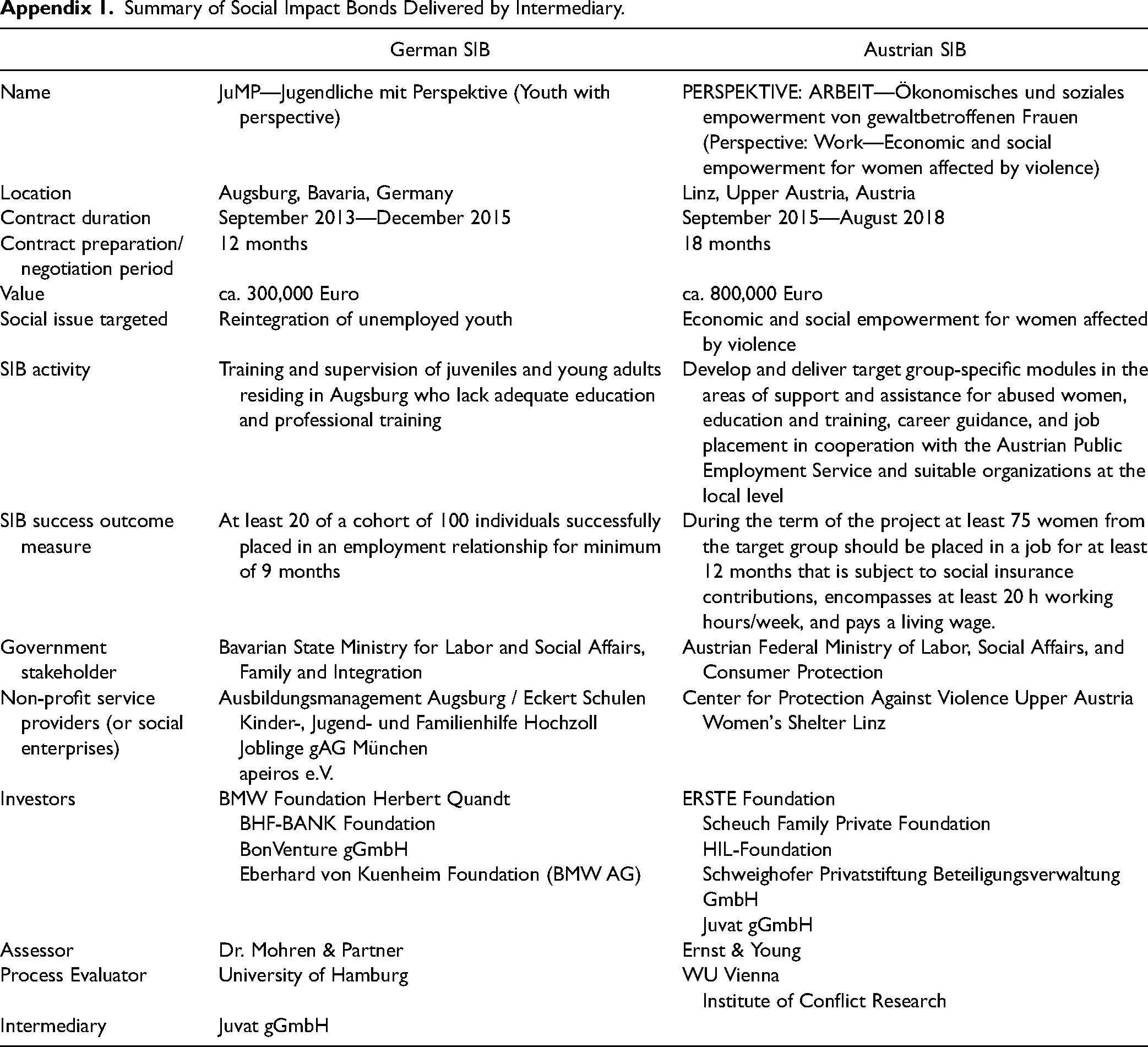
German SIB
Austrian SIB
Name
JuMP—Jugendliche mit Perspektive (Youth with perspective)
PERSPEKTIVE: ARBEIT—Ökonomisches und soziales empowerment von gewaltbetroffenen Frauen (Perspective: Work—Economic and social empowerment for women affected by violence)
Location
Augsburg, Bavaria, Germany
Linz, Upper Austria, Austria
Contract duration
September 2013—December 2015
September 2015—August 2018
Contract preparation/ negotiation period
12 months
18 months
Value
ca. 300,000 Euro
ca. 800,000 Euro
Social issue targeted
Reintegration of unemployed youth
Economic and social empowerment for women affected by violence
SIB activity
Training and supervision of juveniles and young adults residing in Augsburg who lack adequate education and professional training
Develop and deliver target group-specific modules in the areas of support and assistance for abused women, education and training, career guidance, and job placement in cooperation with the Austrian Public Employment Service and suitable organizations at the local level
SIB success outcome measure
At least 20 of a cohort of 100 individuals successfully placed in an employment relationship for minimum of 9 months
During the term of the project at least 75 women from the target group should be placed in a job for at least 12 months that is subject to social insurance contributions, encompasses at least 20 h working hours/week, and pays a living wage.
Government stakeholder
Bavarian State Ministry for Labor and Social Affairs, Family and Integration
Austrian Federal Ministry of Labor, Social Affairs, and Consumer Protection
Non-profit service providers (or social enterprises)
Ausbildungsmanagement Augsburg / Eckert Schulen Kinder-, Jugend- und Familienhilfe Hochzoll
Joblinge gAG München
apeiros e.V.Center for Protection Against Violence Upper Austria
Women's Shelter Linz
Investors
BMW Foundation Herbert Quandt
BHF-BANK Foundation
BonVenture gGmbH
Eberhard von Kuenheim Foundation (BMW AG)ERSTE Foundation
Scheuch Family Private Foundation
HIL-Foundation
Schweighofer Privatstiftung Beteiligungsverwaltung GmbH
Juvat gGmbH
Assessor
Dr. Mohren & Partner
Ernst & Young
Process Evaluator
University of Hamburg
WU Vienna
Institute of Conflict Research
Intermediary
Juvat gGmbH
Data Collection Period.