



Abstract
Multiple institutional logics can create problematic tensions—and synergies catalyzing innovation. This study examines when and how organizational hybridity—the interaction between logic incompatibility and centrality—fosters innovation. Survey and expert evaluation data from 318 social ventures (SVs) supported a mediated moderation model. Perceived centrality of social–market logics exerts opposite moderating effects: Centrality amplifies the inverted U-shaped relationship between logic incompatibility and social innovation, an effect that entrepreneurial orientation (EO) partially mediates. However, centrality weakens the inverted U-shaped relationship between incompatibility and EO. These findings provide nuanced, novel insights into hybrid organizing and social innovation, highlighting the unique trade-offs SVs face.
Keywords
Organization research has paid increasing attention to the dynamics of hybridity, defined as the combination of “core organizational elements,” such as forms, rationales, and identities, that “would not conventionally go together” (Battilana et al., 2017, p. 212). A central locus of hybridity arises when organizations navigate multiple institutional logics 1 —macro-level material practices, cultural symbols, and belief systems that shape organizational cognition and action (Friedland & Alford, 1991; Thornton et al., 2012). Yet multiple logics often provide conflicting prescriptions, posing significant challenges across fields and sectors. Members may interpret organizational reality differently and struggle to reconcile competing priorities, which can escalate into overt and, at times, irresolvable conflicts. Such tensions can generate instability and turmoil that ultimately impede innovation and performance (see Battilana et al., 2017).
Despite these risks, some organizations blend logics in complementary ways that foster synergy and innovation (Logue et al., 2025; Raynard, 2016; Smets et al., 2015). In these cases, actors may (re)frame contradictions and pursue productive “both-and” or “more-than” approaches that transform tensions into opportunities for creative problem-solving (Putnam et al., 2016; Smith & Lewis, 2022). This process allows actors to synthesize insights from diverse knowledge domains and combine ideas and practices in novel ways (Bertels & Lawrence, 2016; Dalpiaz et al., 2016; Jay, 2013; Malhotra et al., 2025; Stephan et al., 2019; Vickers et al., 2017). In sum, competing prescriptions from plural logics can stymie organizations but also empower them to strategically draw on diverse sources of knowledge and legitimacy for innovation.
However, “conflicting findings on the consequences of multiple logics” (Besharov & Smith, 2025, p. 667) highlight a significant gap in the literature, raising critical questions about the innovation implications of hybridity. It remains unclear how, when facing the same field- and societal-level logics, variations in organizations’ responses to hybridity translate differently into innovation. To reconcile the varied implications of hybridity, scholars have called for quantitative investigations that capture its heterogeneous nature, explain how internal tensions vary across organizations, and clarify when and how these tensions produce divergent outcomes (Battilana et al., 2017; Litrico & Besharov, 2019; Mair et al., 2015; Shepherd et al., 2019; Williams et al., 2023; Wry & York, 2017). To answer this call and advance theory, this research asks: When and how does organizational hybridity foster or hinder innovation?
Drawing on the logic multiplicity framework, I theorize hybridity as the interactive effect of logic incompatibility—the extent to which plural logics imply contradictory courses of action—and centrality—the degree to which one or multiple logics are integral to organizational functioning (Besharov & Smith, 2014). Incompatibility challenges the assumption that logics are inherently contradictory, illuminating potential synergies between logics in fueling innovation (Gümüsay et al., 2020; Vermeulen et al., 2016). Centrality is “central” and “fundamental” to hybrid organizing, as it affects the impact of incompatibilities between logics and which logics actors will prioritize (Stevenson et al., 2024, p. 1). Hybridity is multidimensional, and the effects of one dimension on organizational outcomes depend on another (Litrico & Besharov, 2019; Shepherd et al., 2019). Theorizing their interaction, rather than treating the two dimensions separately, offers insight into how rival logics vying for dominance at the organizational core can intensify internal conflicts in practice (Besharov & Smith, 2014). It offers a more comprehensive account of hybridity and the nuanced tensions it can generate than past research has recognized. Building on this, I posit logic centrality moderates the effect of incompatibility on innovation.
Despite prior theorization, the mechanisms and processes through which hybridity shapes innovation remain underexplored (Battilana et al., 2017; Besharov & Smith, 2025). Hybridity requires organizations to mobilize knowledge and resources across competing logics, shaping how organizations interpret environments, prioritize goals, and pursue novel solutions (Logue et al., 2025; Malhotra et al., 2025; Pache & Santos, 2013). I propose that entrepreneurial orientation (EO)—organizations’ strategic posture toward innovativeness, proactiveness, and risk-taking (Lumpkin & Dess, 2001; Miller, 1983)—serves as a particularly relevant mediating mechanism connecting hybridity and innovation. EO is central in entrepreneurship and innovation studies (Anderson et al., 2015). It enables organizations to mobilize knowledge, adapt to complex environments (Rosenbusch et al., 2013), and drive innovation (see Rauch et al., 2009, for a meta-analysis). By examining both the interaction between logic centrality and incompatibility and the mediating role of EO, this study advances more integrative explanations for the divergent empirical findings on hybridity and innovation. Figure 1 presents the theoretical framework.
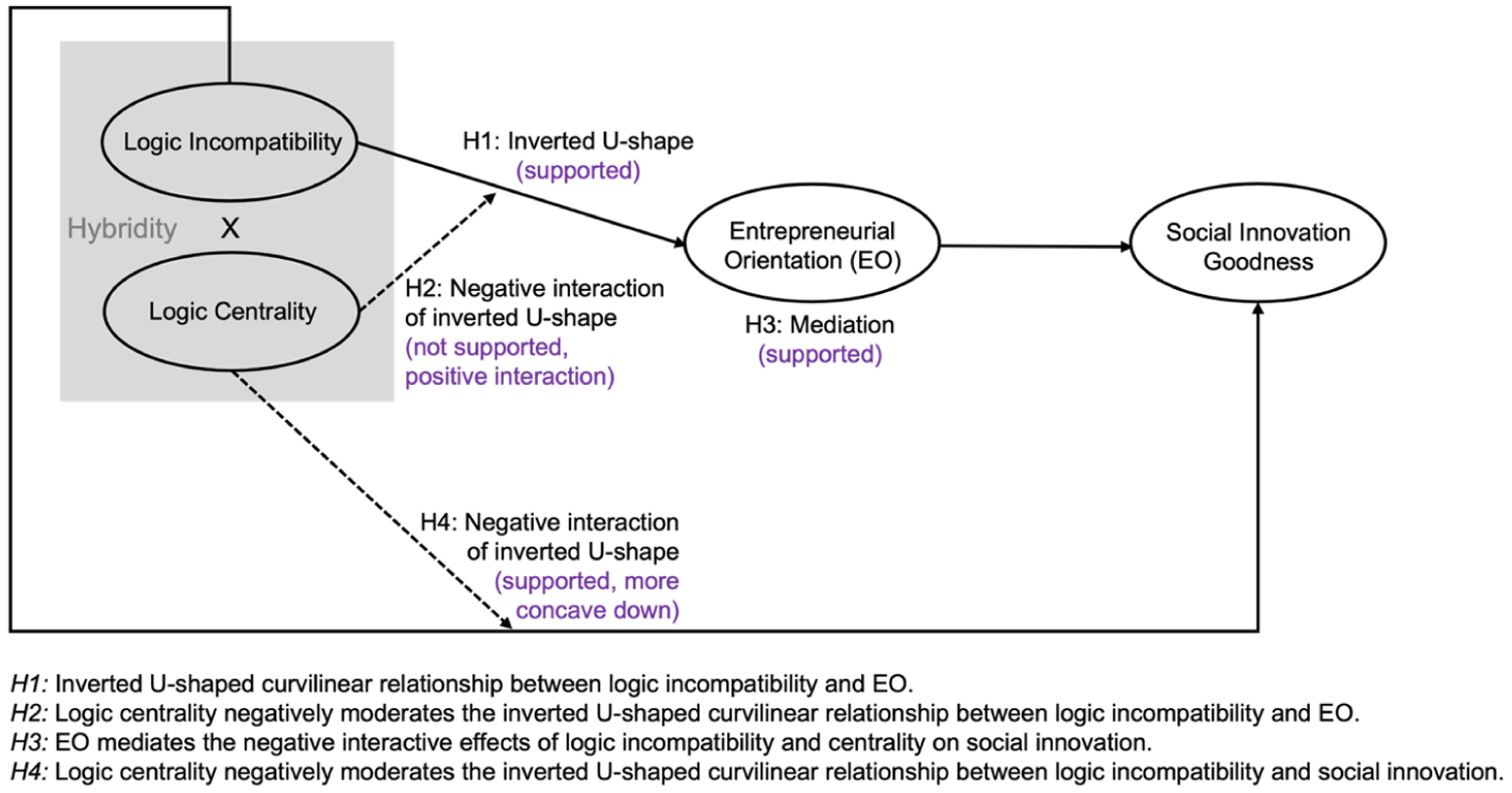
Diagram of theoretical argument.
I tested the proposed theory using social ventures (SVs), a prominent form of hybrid organization that combines charitable and business imperatives in pursuit of a social mission (Austin et al., 2006; Battilana & Lee, 2014; Moss et al., 2011). Using structural equation modeling (SEM) and mediation analyses, I examined how SVs perceive and navigate the incompatibility and centrality of social–market logics in shaping social innovation 2 —that is, the creation or adoption of novel solutions and ideas (e.g., models, services) to address social issues that generate benefits for society at large (Phills et al., 2008; Tracey & Stott, 2017). Three program officers evaluated the goodness 3 (Burt, 2004; Rhee & Leonardi, 2018) of social innovation ideas reported by leaders of 318 U.S. SVs. I focused on goodness because novel solutions must be “value-added” (Crossan & Apaydin, 2010, p. 1155) and “valuable and useful” (Woodman et al., 1993, p. 293); a novel idea becomes a social innovation only when relevant stakeholders recognize and affirm its social value (van der Have & Rubalcaba, 2016).
This study advances theory on hybrid organizing by specifying how the interaction between logic incompatibility and logic centrality jointly shapes divergent organizational dynamics and outcomes. Extending prior works on hybridity (e.g., Besharov & Smith, 2014, 2025; Gümüsay et al., 2020; Stevenson et al., 2024), I theorize and empirically test a mediated moderation model showing that hybridity is fundamentally conditional: the effects of internal tensions depend on how central competing logics are to organizational identity and action.
In doing so, I challenge the zero-sum assumptions that advancing one goal (e.g., social mission) inevitably comes at the expense of another (e.g., market demands; Ebrahim et al., 2014; Wry & Zhao, 2018). Instead, I show perceived social–market tensions can be productive up to a point, and the same tensions do not exert parallel effects across outcomes. Specifically, high centrality weakens the inverted U-shaped effect of logic incompatibility on EO (i.e., makes it less concave-down), while simultaneously amplifying the same curvilinear effect on social innovation (more concave-down). Under high centrality, then, logic incompatibility’s effect on EO is lessened, but its effect on social innovation is amplified. Thus, increasing logic centrality involves making a trade-off between EO and social innovation for SVs. In addressing this trade-off, this paper moves beyond the social–business performance trade-offs that have been the focus of past research (e.g., Battilana et al., 2015; Doherty et al., 2014; Shepherd et al., 2019).
Finally, as societies increasingly look to social innovation to address grand societal challenges and wicked problems they face (Bacq et al., 2019; Beckman et al., 2023; Logue et al., 2025; Shepherd & Patzelt, 2025), this study deepens our understanding of social innovation’s drivers and mechanisms within SVs. I show that moderate tension between logics can function as a catalyst for social innovation and that hybridity shapes social innovation both directly and indirectly through EO. This mediated pathway clarifies when and how organizations can translate institutional tensions into social innovation, positioning it as “the product of agentic, situated dynamics” shaped by macro-institutional forces (van Wijk et al., 2019, p. 887).
Theoretical Grounding
SVs, Hybridity, and Social Innovation
Researchers have become increasingly interested in how organizations innovate to create social value in response to persistent and intractable societal challenges (Bacq et al., 2019; Logue et al., 2025; Seelos & Mair, 2020; van Wijk et al., 2019). Organizations may create or adopt new solutions to complex social challenges that benefit people beyond the innovators themselves (Tracey & Stott, 2017), such that “society as a whole rather than … private individuals” primarily benefits (Phills et al., 2008, p. 39). Social innovation can take many forms, such as new products, technologies, interventions, services, programs, campaigns, business models, fundraising methods, or combinations thereof. Research shows that social innovation can promote environmental sustainability, improve access to education and healthcare, and foster social mobility and inclusive economic opportunities (see van der Have & Rubalcaba, 2016).
Growing research highlights the critical role of SVs—mission-driven organizations that engage in revenue-generating activities to drive social impact (Saebi et al., 2019)—in advancing social innovation. SVs that undertake social innovations take varied forms, including B Corps (e.g., Gehman & Grimes, 2017); social enterprises (e.g., Battilana et al., 2015); and traditional donative nonprofits, which face growing pressures of marketization (e.g., Logue et al., 2025). In pursuing dual social and economic objectives, SVs often grapple with competing logics, which make them an ideal context for studying hybridity (Battilana & Lee, 2014). Recent works have focused on the conditions under which SVs cope with the tensions associated with hybridity to generate novel solutions for social problem-solving (see, e.g., Ciambotti et al., 2025). The next section reviews the hybrid organizing literature to contextualize SVs and social innovation.
Organizational Hybridity: Challenges and Opportunities for Innovation
As organizations increasingly contend with hybridity, numerous studies have documented the persistent challenges in balancing competing demands from plural logics (see Battilana et al., 2017). Members may struggle to identify with their organization and develop a collective identity, particularly when members come from diverse social and professional backgrounds (Battilana & Dorado, 2010; Bertels & Lawrence, 2016). Internal politics and entrenched power structures compound these challenges (Besharov & Smith, 2014; Waeger & Weber, 2019). Disagreements may arise over goals, priorities, and strategic decisions, leading to tensions that manifest as mission drift—where an organization’s actions deviate from its core identity—and difficulties in sustaining hybridity (Ebrahim et al., 2014; Grimes et al., 2019). Prolonged conflict can escalate into disruption and turbulence, ultimately stifling innovation and impeding positive performance.
Yet, some organizations navigate contradictions and make strategic choices in pursuit of innovation (Seo & Creed, 2002). For instance, Reay and Hinings (2009) showed how physicians and health authorities collaboratively managed the tensions between market and professional care logics in a manner that led to better ways of healthcare service delivery. Jay (2013) found that tensions among state, market, and civil society logics within a cross-sector partnership, despite introducing ambiguity in performance evaluation, spurred novel solutions in energy efficiency. Similarly, Vickers et al. (2017) revealed that SVs developed health innovations by integrating public, private, and civil society logics—promoting knowledge sharing, fostering an innovative culture, and cultivating collaborative partnerships among diverse stakeholder groups.
From a knowledge-based view, organizations facing conflicting logics often seek out and assimilate diverse knowledge to mitigate tensions and enhance problem-solving (Stephan et al., 2019; Vickers et al., 2017), which typically leads to recombinatory innovation (see Xiao et al., 2022). Moreover, the coexistence of multiple logics shapes the accessibility, application, and value of critical external resources that support innovation (Bertels & Lawrence, 2016). Consequently, organizations navigating hybridity can choose to embrace these challenges via strategic framing (Smith & Besharov, 2019), intentionally engage with different logics (Kraatz & Block, 2008), and harness their productive tensions to fuel innovation (Battilana et al., 2015).
To explain the divergent implications of hybridity, accumulating research emphasizes that how actors interpret multiple logics and integrate them into their core is key (Battilana et al., 2017). Members’ perceptions and sensemaking processes regarding opposing yet interrelated tensions shape both the amount and quality of attention devoted to certain issues (Grimes et al., 2019) and the nature of organizational action (Gümüsay et al., 2020; Miron-Spektor et al., 2018; Pamphile, 2022). For instance, based on six case studies of Australian SVs, Malhotra et al. (2025) found that those effectively integrating multiple logics perceived the presence of plural logics as opportunities to leverage. These SVs actively engaged with multiple logics through shared spaces and practices and allocated resources to support them in ways that fostered innovation and coherence in organizational strategy. In contrast, SVs struggling with hybridity regarded multiple logics as obstacles to overcome. These SVs exhibited confusion in prioritizing logics, passively followed them as isolated practices, and allocated resources competitively rather than complementarily.
To nuance when and how hybridity yields innovation, it is essential to characterize how different actors understand the complex interplay of multiple logics differently. Besharov and Smith’s (2014) framework offers a useful typology for capturing the relationship between plural logics along two key spectra: (in)compatibility and centrality. These dimensions have informed recent scholarship exploring variations in hybridity (e.g., Gümüsay et al., 2020; Raynard, 2016).
Heterogeneity in Hybridity: (In)Compatibility and Centrality in Constituent Logics
(In)Compatibility
Compatibility—the degree to which logics provide “consistent and reinforcing” prescriptions for action—sharply affects hybridity (Besharov & Smith, 2014, p. 367). While earlier research assumed multiple logics coexist in unresolvable conflict (Friedland & Alford, 1991; Thornton et al., 2012), recent works have suggested actors may discursively (re)construct constituent logics as interdependent (Raynard, 2016; Smith & Besharov, 2019). The synergistic fusion of logics can foster innovation and improve social and business performance (Birkinshaw et al., 2014; Smets et al., 2015; Stephan et al., 2019). For instance, Malhotra et al. (2020) found workers harmonized family–profession logics as they developed compatible ways of enacting logics for organizational change. Members of SVs may perceive complementarity in social–market logics, using business practices and market mechanisms as means to creating sustainable social impact (Logue et al., 2025; Malhotra et al., 2025). Collectively, these studies show that logic (in)compatibility is contextually contingent, and trade-offs are socially constructed.
Centrality
Organizations also differ in the degree to which a single or multiple logics constitute their core identity and functioning, which complicates how tensions between logics are felt and managed (Raynard, 2016; Stevenson et al., 2024). In high-centrality organizations, more than one logic has roughly equal influence on decisions, and members balance multiple logics in core features to create a unified blend. By contrast, in low-centrality organizations, a single logic dominates key decisions and operations, and other logics manifest in peripheral activities. Empirical research has examined how organizations prioritize or integrate multiple logics in their core activities in diverse contexts such as scientific commercialization (Abootorabi et al., 2024) and banking (Gümüsay et al., 2020). Likewise, SVs differ in the extent to which they revolve around both social and market logics in core features such as mission (Litrico & Besharov, 2019), structure (Binder, 2007), hiring and socialization (Battilana & Dorado, 2010), governance mechanism (Mair et al., 2015), and discursive and practical action (Bertels & Lawrence, 2016).
(In)Compatibility × Centrality
The logic multiplicity typology (see Besharov & Smith, 2014, Figure 1, p. 372) indicates that (in)compatibility and centrality jointly determine varying levels of conflict through an interaction effect. Among actors shaped by similar levels of logic incompatibility, the level of internal conflict differs because of logic centrality: Actors with higher centrality tend to experience greater internal conflict than those with lower centrality. This is because “when internal conflicts arise in low centrality organizations, differences can be resolved in favor of the dominant logic, limiting escalation and intractability” (Besharov & Smith, 2014, p. 372). By contrast, higher centrality causes multiple rival logics to vie for dominance, with no clear ordering between them. As a result, the core of the organization is continually disputed, hence amplifying the stress in conflicting logics. Thus, I theorize that their interaction generates distinct and theoretically consequential dynamics for hybrid organizing.
Hypotheses Development
I propose that the effects of logic incompatibility and centrality on social innovation are both mediated and moderated. First, hybridity creates both opportunities and challenges, but the organizational processes that convert competing logics into productive outcomes like innovation are not clear or well understood. I argue that EO offers a particularly compelling mechanism in hybrid contexts, as hybridity shapes entrepreneurial activity (Saebi et al., 2019) and EO is essential to innovation (Rauch et al., 2009). Extensive research has shown that EO enables organizations to adapt to institutional demands and foster innovation and performance (Lumpkin & Dess, 2001; Miller, 1983). Second, as actors may “combine multiple logics in productive and unproductive ways” (Malhotra et al., 2025, p. 291), incompatible logics will activate EO and foster innovation in an inverted U-shaped manner. This is a dynamic consistent with rich empirical observations that moderate internal conflict is most optimal to innovation (De Dreu, 2006; Razinskas, 2023). Moreover, since high centrality amplifies the stress from conflicting logics (Besharov & Smith, 2014), centrality should moderate the effect of incompatibility on EO and social innovation.
The Interactive Effect of Logic Incompatibility and Centrality on EO
EO reflects an organization’s “sustained pattern of entrepreneurial behavior” and activity (Covin & Wales, 2019, p. 5), such as program development (Coombes et al., 2011). EO has three core dimensions: innovativeness, proactiveness, and risk-taking (Covin & Slevin, 1989; Lumpkin & Dess, 1996). Organizations with high EO (pro)actively experiment with new ideas, tolerate risks and uncertainty, and engage in constant trial-and-error innovation processes.
Two lines of research lay the groundwork for hybridity and EO. First, the environmental complexity perspective (Mintzberg, 1979) suggests that competing institutional claims require actors to monitor diverse information and resources (Child, 1972). Contingent on the amount and diversity of information available, organizations are likely to adjust their EO to the requirements of the external environment to leverage the opportunities for improving EO (see Rosenbusch et al., 2013, for a meta-analysis of the mediating role of EO) and performance (Covin & Slevin, 1989; Miller, 1983). Second, extensive research has highlighted the considerable impact of plural institutional forces on social entrepreneurial activity (see Saebi et al., 2019, for a systematic review), such as commercialization (Dimitriadis et al., 2017) and innovation creation (Smith & Besharov, 2019). Collectively, these perspectives suggest hybridity is closely related to EO.
I propose that logic incompatibility relates to EO in an inverted U-shaped fashion. When logics are highly compatible—offering mutually reinforcing and coherent prescriptions for action—internal conflict is minimal or absent (Besharov & Smith, 2014). While this stability supports consistent routines and a unified identity (Binder, 2007), it may suppress the dissent and diverse feedback necessary for adaptive thinking and creative problem-solving (De Dreu & West, 2001). In low-conflict settings, members may become complacent, lacking the motivation to challenge the status quo or reconfigure strategies in response to evolving, multiplex demands (Farh et al., 2010). The absence of healthy conflict may inhibit experimentation and risk-taking, leading to inertia, limited information search or exchange, and low performance (De Dreu, 2006).
Excessive logic incompatibility leads to competing expectations about appropriate goals and priorities, causing repeated clashes over mission, strategy, power, resources, and identity (Besharov & Smith, 2014). In the microfinance organization BancoSol in Bolivia, differences between staff from banking and social work backgrounds led to polarization and identity schisms (Battilana & Dorado, 2010). Serious contestation from rival institutional demands can trigger distrust, turmoil, crises, high turnover, and poor decisions (see Battilana et al., 2017), hence impeding EO. Moreover, managing competing logics to sustain hybridity demands substantial internal coordination and effort (Smith & Besharov, 2019), which may divert critical organizational attention, energy, and managerial resources away from entrepreneurial activity.
By contrast, when logic incompatibility is moderate, actors may use a “both-and” or “more-than” approach to accept competing demands and creatively transcend the contradiction (Putnam et al., 2016; Smith & Lewis, 2022). They will leverage the disparate demands of logics to engage in external collaboration and search for novel information (Logue et al., 2025; Malhotra et al., 2025; Stephan et al., 2019; Vickers et al., 2017). Actors may elaborate on task-relevant arguments and consider alternative courses of action to address disagreements, all of which can foster organizational learning (Bledow et al., 2009; Farh et al., 2010; Jehn, 1995). Taken together, internal conflict promotes EO up to a point, beyond which escalating friction and emotional strain may reduce an organization’s search, entrepreneurial posture, and risk tolerance.
Although logic incompatibility is generally positively correlated with internal conflict, as centrality increases, the relationship becomes more complex (Besharov & Smith, 2014; Raynard, 2016). Since high centrality amplifies the tensions triggered by conflicting logics, I expect centrality to strengthen the curvilinear effect of incompatibility on EO. That is, left of the peak of the inverted U curve, higher centrality will intensify the positive link between incompatibility and EO when conflict from incompatible logics is still emerging. Compared to those dominated by a single logic, organizations where both logics are highly central will encounter more constructive conflict, which stimulates search, adaptability, and divergent thinking (De Dreu & West, 2001) that enable the joint pursuit of multiple logics (Malhotra et al., 2020; Smets et al., 2012). Hence, high-centrality organizations can adjust their EO more effectively, yielding a more positive relationship between incompatibility and EO than that in low-centrality ones.
However, once the effect of logic incompatibility on EO turns negative, similar levels of logic incompatibility will create more “unproductive” conflict in high-centrality organizations than that in low-centrality ones. When multiple logics vie for dominance, the organizational core is continually disputed, amplifying tensions among conflicting logics. As incompatibility increases, such conflict becomes harder to resolve (Besharov & Smith, 2014; Gümüsay et al., 2020), diminishing members’ willingness to share ideas, search information, tolerate risks, and solve problems proactively and collaboratively (Bledow et al., 2009; De Dreu, 2006). Members may struggle to integrate divergent perspectives and lose sight of shared goals (Farh et al., 2010). These detrimental dynamics will dampen the development of EO, resulting in a steeper inverted U-shaped relationship between incompatibility and EO under high centrality. I hypothesize:
Organizational Hybridity and Social Innovation: The Mediating Role of EO
A substantial body of innovation studies has suggested that EO is a key driver of organizational innovation (see Rauch et al., 2009). From a knowledge-based view, EO strengthens the advantages of knowledge resources by improving the ability of organizations to search for new opportunities and exploit diverse information for innovation (Wiklund & Shepherd, 2003). Consistent with H1 and H2, I expect the link between hybridity and innovation to operate through EO. This view aligns with the meta-analysis finding that EO serves as a critical mediator enabling organizations to blend information to cope with environmental complexity (Rosenbusch et al., 2013). Extensive SV studies also have shown that competing institutional demands can stimulate novel approaches to balancing disparate needs (Logue et al., 2025; Smith & Besharov, 2019). Without EO, organizations may struggle to reap the constructive potential of hybridity to integrate diverse knowledge for innovation.
Finally, the interaction of logic (in)compatibility and centrality should be related to social innovation, much as it would be to EO. The recombinatory innovation literature emphasizes that organizations search for information and engage in exploration and exploitation, particularly when driven to reconcile hybrid logics (see Xiao et al., 2022). On the left side of the inverted U curve, higher-centrality organizations will experience greater beneficial conflict, enabling them to integrate diverse information and insights for innovation. Once the effect of incompatibility on innovation turns negative, higher centrality will exacerbate tensions between conflicting logics that hinder innovation. Thus, I expect a stronger inverted U-shaped relationship between incompatibility and social innovation in organizations where both logics are highly central.
As Figure 1 reflects, the level of centrality accorded to multiple logics moderates the curvilinear effect of logic incompatibility on EO, which then gives rise to social innovation. EO partially mediates the interactive effect of logic incompatibility and centrality on social innovation. In this way, my argument offers a novel perspective on the relationship between organizational hybridity and social innovation by specifying a critical moderation effect, as well as identifying a new mediating mechanism, which jointly explain when and how plural logics shape social innovation.
Methods
Sample, Participants, and Procedure
To ensure diverse representation of SVs, I recruited U.S. SVs from three sources: (a) 501(c)(3) nonprofits registered with the Internal Revenue Service (IRS), (b) social enterprises affiliated with the Social Enterprise Alliance (SEA), and (c) B Corps certified by B-Lab. This manuscript primarily draws data from the second survey of a two-study project. I employed a two-study approach with no participant overlap between studies to develop and validate the social–market hybridity scale using independent samples. Participants in the second survey received a $15 gift card and a customized benchmarking report as incentives for participation.
IRS Nonprofit Organizations
Following prior research (e.g., Dimitriadis et al., 2017), I recruited nonprofits across nine issue categories—including environment and community development—that were founded within the past 5 years and had a minimum annual revenue of $100,000. This yielded 8,464 eligible nonprofits, from which I drew a random sample of 2,000. I mailed invitations to complete the survey to 1,765 organizations with valid addresses, accompanied by a preaddressed envelope and a cover letter in November 2017. Across paper and online formats, 4 I received 345 responses, of which 213 were complete and valid, resulting in a 62% completion rate and a 20% overall response rate (see Online Appendix I for more details).
Social Enterprises and B Corps
I mailed invitations to all organizations affiliated with the SEA (N = 228) and certified B Corps with a benefit corporation structure (N = 220). Of the 448 invitations sent, 38 were returned as undeliverable, leaving 410 valid invitations. A total of 186 organizational leaders initiated the online survey, with 105 providing complete, valid responses (completion rate = 57%, response rate = 45%).
The final sample consisted of 318 SVs, with a median online completion time of 27 min and a mean of 40 min. All retained cases were complete across key variables. Most respondents were executive directors (n = 224, 71%), with an average tenure of 7.35 years (SD = 7.10), indicating strong organizational knowledge. Statistical tests revealed no evidence of nonresponse biases between responding and nonresponding organizations (see Appendix I).
Operationalization of Social Innovation: Social Innovation Goodness
In both organizational and social innovation research, scholars consistently have highlighted two defining characteristics of (social) innovation: novelty and usefulness (Amabile, 1988; Crossan & Apaydin, 2010; Phills et al., 2008; Tracey & Stott, 2017; Woodman et al., 1993). Similarly, Van der Have and Rubalcaba’s (2016) systematic review of 173 studies revealed that, despite definitional diversity and conceptual ambiguity across fields and disciplines, social innovation invariably involves two core dimensions: novelty and social value. Building on this understanding, I focus on the value-added dimension by evaluating the goodness of a proposed solution—defined as its perceived usefulness and potential to effectively address a salient social problem. 5 Compared to novelty, I argue that goodness is theoretically and practically more meaningful, as it captures the degree to which innovations contribute to social value creation.
Although the term social innovation remains contested, scholars generally agree that novelty serves as a means to the end of creating social value (Phills et al., 2008; Weerawardena & Mort, 2012). Novelty alone is insufficient, as many seemingly innovative ideas may generate unintended harm, reproduce inequities, or reinforce entrenched structural barriers (Lawrence et al., 2014; Seelos & Mair, 2012). In contrast, goodness captures the intrinsic merit of an idea: its feasibility, its fit with pressing social needs, and its potential to generate positive social value. Focusing on goodness also aligns with the core, overarching mission of SVs, which is not to innovate for innovation’s sake or maximize the number of innovations, but to produce useful solutions that improve social conditions or contribute to systemic change (Phillips et al., 2015).
During the survey, participants were asked to describe the most representative innovation their organization had created in the past 3 years to address local community problems, using a definition of social innovation (Phills et al., 2008). This followed Amabile’s (1996) open-ended approach in providing observable responses available to appropriate judges for assessment.
While soliciting diverse stakeholder insight is valuable in evaluating social innovations (Beckman et al., 2023), this study employed an expert evaluation approach (Burt, 2004; De Dreu, 2006). I engaged program officers from three U.S.-based philanthropic foundations, recognized agents of institutional entrepreneurship and social change (Quinn et al., 2014). These officers possess deep domain knowledge and evaluative expertise developed through “specialist lateral career paths” and close community engagement (Drayton, 2006, p. 86). Their perspectives provide a reasonable frame of reference, as they understand the operations in the social impact sector, and they have the responsibility to reward innovation, serving as sources of normative isomorphism and rationalization (DiMaggio, 1991; Hwang & Powell, 2009). Their broader understanding of collective social benefit, research acumen, and influence on funding and policy decisions position them as capable stakeholders well-suited to assess social innovations (Milley et al., 2018). Each evaluator received a U.S. $1,000 honorarium (Appendix II has further details).
Following Rhee and Leonardi (2018), each program officer was asked, “If this social innovation were well-implemented, how much would it contribute to addressing this particular social problem and/or generate tangible community impact?” The answer scale ranged from 0 (“no contribution or too short or simple to rate”) to 10 (“the highest contribution”). The construct (composite) reliability of the variable was 0.707, which was satisfactory.
Appendix III presents the top three ideas that received the highest ratings among all ideas submitted. An analysis of these good ideas suggests that they typically contained actionable plans to target a specific social challenge, and if well implemented, would benefit multiple stakeholder groups. All demonstrated tangible impact or potentially positive community change. The first idea was an initiative designed to address several problems that had resulted in a new community of practice to benefit multiple groups of beneficiaries. The second idea concerned the delivery of food to senior citizens living in government-subsidized housing. During the 2 years of its implementation, the program had expanded significantly, from serving 75 seniors to serving 300 seniors. The third idea was a fundraising plan for constructing a new building for a large grocery store. If well implemented, this idea would have multiple benefits for local communities, including improving food equity, job creation, social service provision, and community spirit.
Organizational Hybridity: Interaction Between Logic Incompatibility and Centrality
I used the social–market hybridity scale (Fu, 2024) to measure incompatibility and centrality. Developed and validated via two studies of different SV samples, this scale integrates Besharov and Smith’s (2014) logic multiplicity framework with Dees et al.’s (2001) social enterprise spectrum (see Appendices IV and V). For incompatibility, I used six items to evaluate the degree of conflict in the coexistence of social and market logics each aspect (e.g., workforce composition, beneficiaries, organizational mission) creates within an organization on a 7-point Likert scale, so higher values represented lower perceived compatibility. For centrality, I used four items to assess the extent to which both logics are core to organizational operations on a 4-point scale. Along this scale on a continuum anchored by different logics on either side, centrality is the highest in the middle when both logics are dominant and lowest on either end when the social or market logic is prioritized (see Appendix VI for variable recoding).
Common goodness of fit (GOF) indicators of confirmatory factor analysis (CFA) models are
Mediator: EO in SVs
Although the EO construct is well established in innovation research (Rauch et al., 2009), prior studies have largely focused on the business sector (Morris et al., 2011). Addressing this gap, Helm and Andersson (2010) adapted the firm-level EO scale (e.g., Covin & Slevin, 1989; Miller, 1983) to develop a 10-item instrument for SVs. This scale offers three key advantages. First, it was created using a random sample of nonprofits, ensuring language suited to the social impact sector. Second, its validity was confirmed through rigorous expert review and statistical testing. Finally, it has been validated across diverse contexts in subsequent studies of SVs (e.g., Choi et al., 2021; Fu, 2022). Respondents evaluated their organization’s innovativeness, proactiveness, and risk-taking orientations on an 1 to 8 scale. I allowed the three factors to load onto one latent EO factor and the residual errors to covary within the same factor. Results suggested good GOF of the CFA model (see Appendix VII) and the construct’s reliability (α = .85).
Control Variables
I included four variables to capture the more “objective,” material practices of organizational hybridity (e.g., Mair et al., 2015). For revenue source, I asked each respondent to indicate the percentage of their organization’s income from the sales of services or products (market logic) and philanthropic sources such as donations and grants (social logic) from 0% to 100%, respectively. For workforce composition, paid employee size (market logic) evaluated the total number of full-time and part-time employees using an ordinal scale (1 = fewer than 10, 2 = 11 to 50, 3 = 51 to 100, 4 = 101 to 500, 5 = more than 500). Using the same scale, volunteer size (social logic) evaluated the total number of volunteers in the previous year.
In line with the knowledge-based view of innovation (see Xiao et al., 2022), I included four other variables that may shape organizations’ ability or motivation to recombine knowledge, including organizational age and size (Rosenbusch et al., 2013; Wiklund & Shepherd, 2003). First, as learning orientation better contributes to innovation in older organizations (Damanpour, 1992), I controlled for organizational age in years. Second, I controlled for organizational size based on revenue on an 8-point scale. Third, I controlled for legal status (1 = nonprofit, 0 = for-profit). Hybrids often take varied legal forms, which may influence their dynamics and priority. Based on leaders’ self-reports, 245 (77%) were registered as nonprofits, and 73 (23%) were registered as for-profits. Finally, I measured tacit or explicit knowledge sharing using a 7-point scale (1 = never to 7 = daily; Bock et al., 2005; Choi et al., 2010). Organizations’ capacity to effectively exchange information, expertise, skills, and insights are crucial for fostering learning, collaboration, and innovation—particularly for those navigating the complexities of multiple logics (Stephan et al., 2019; Vickers et al., 2017). The scale showed excellent reliability (α = .89) and validity (see Appendix VIII). Together, these controls account for factors that shape the diversity and depth of knowledge available for recombination, as well as the capacity to blend knowledge. Table 1 presents the descriptive statistics and correlations of all variables.
Descriptive Statistics and Pairwise Correlations.
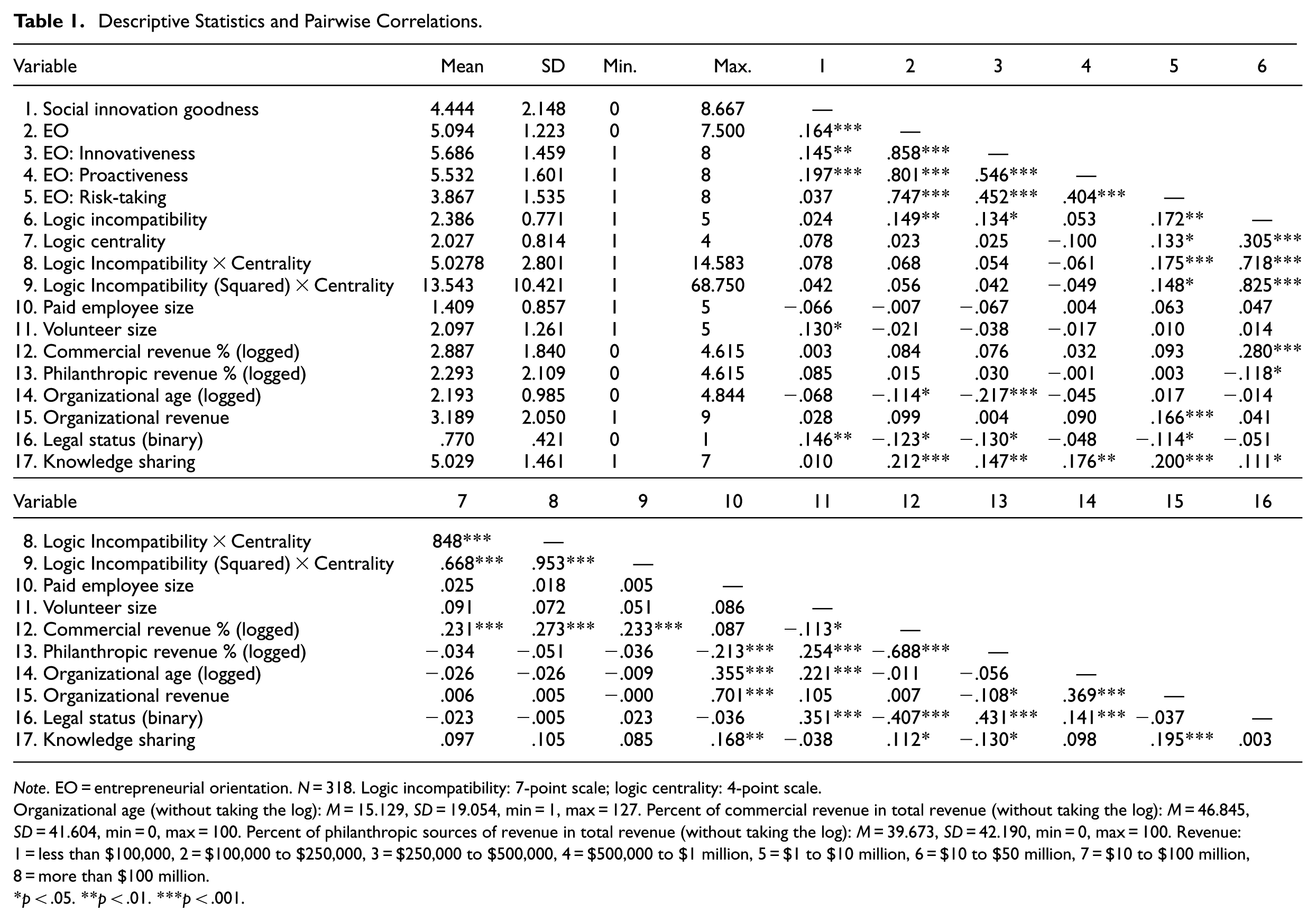
Note. EO = entrepreneurial orientation. N = 318. Logic incompatibility: 7-point scale; logic centrality: 4-point scale.
Organizational age (without taking the log): M = 15.129, SD = 19.054, min = 1, max = 127. Percent of commercial revenue in total revenue (without taking the log): M = 46.845, SD = 41.604, min = 0, max = 100. Percent of philanthropic sources of revenue in total revenue (without taking the log): M = 39.673, SD = 42.190, min = 0, max = 100. Revenue: 1 = less than $100,000, 2 = $100,000 to $250,000, 3 = $250,000 to $500,000, 4 = $500,000 to $1 million, 5 = $1 to $10 million, 6 = $10 to $50 million, 7 = $10 to $100 million, 8 = more than $100 million.
p < .05. **p < .01. ***p < .001.
SEM Model Specifications
Since I obtained the constructs from two different data sources, respondents’ self-reports and program officers’ independent evaluation, common method bias was minimal in this research (Podsakoff et al., 2012). EO, social innovation goodness, and knowledge sharing were specified as measurement models. Given the good GOF of the CFA model for the hybridity scale, I derived the predicted factor scores of logic incompatibility and centrality for each SV, which allowed me to create squared and interaction terms to test the moderation of U-shaped relationships (see Haans et al., 2016) in SEM using maximum likelihood optimization.
Results
The SEM indicated good model fit: χ2 = 477.286, df = 314,
SEM Results for Hypothesized Model.
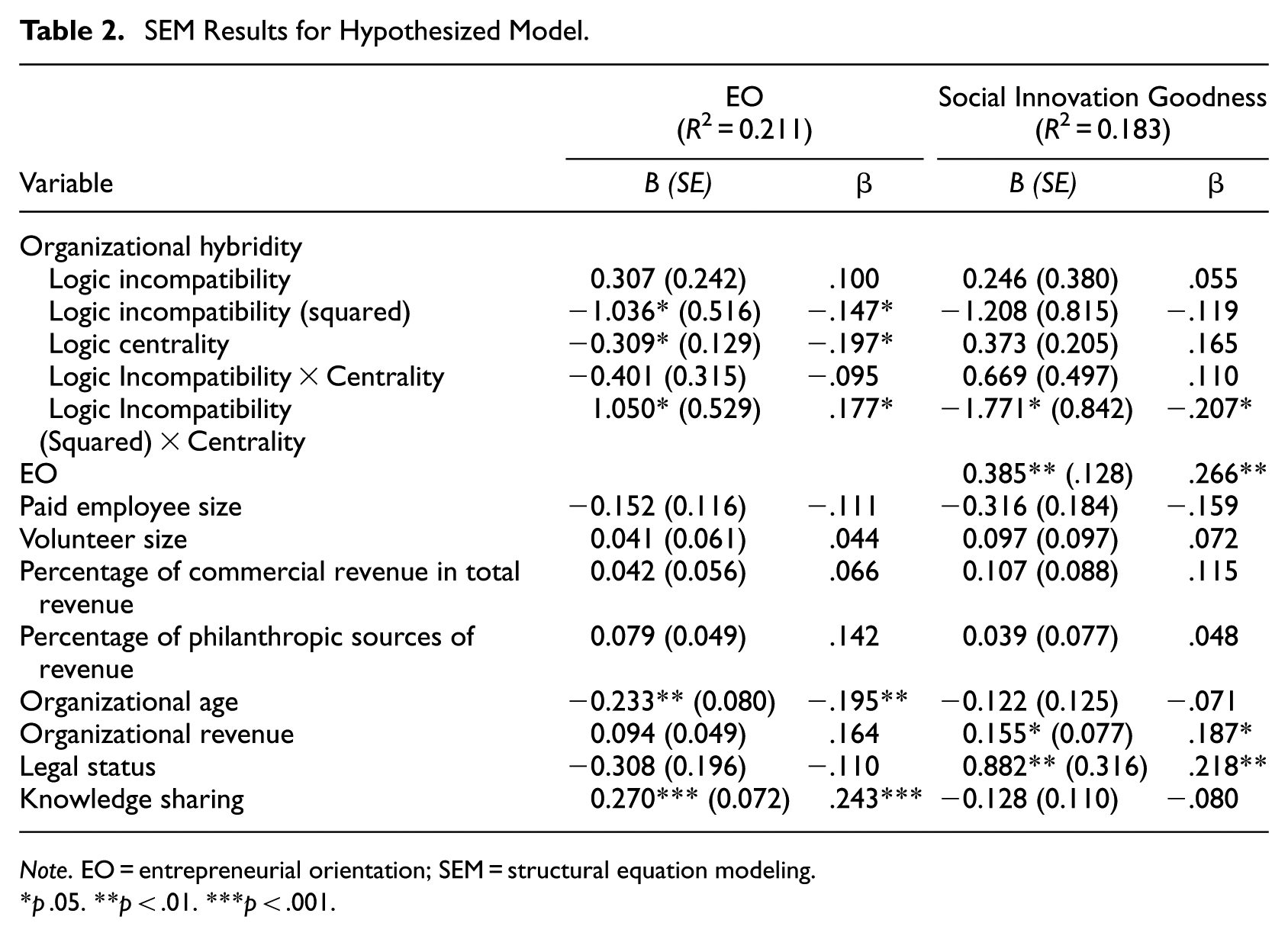
Note. EO = entrepreneurial orientation; SEM = structural equation modeling.
p .05. **p < .01. ***p < .001.
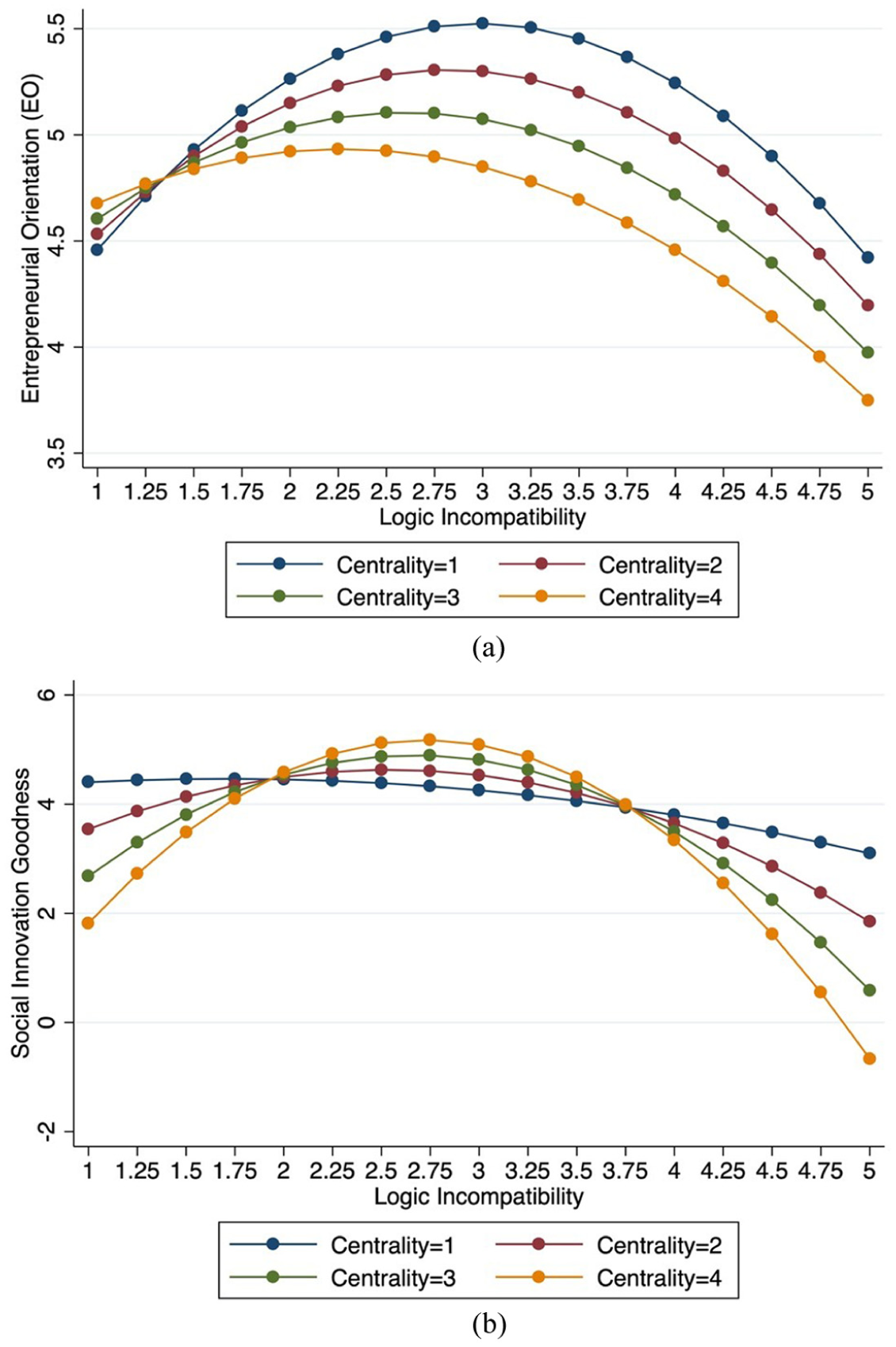
Visualization of the moderated relationship. (a). The approximate inflection points for EO are as follows: logic incompatibility = 3 for low-centrality organizations (centrality = 1), 2.75 for moderately low-centrality organizations (centrality = 2), 2.5 for moderately high-centrality organizations (centrality = 3), and 2.25 for high-centrality organizations (centrality = 4). The range for logic incompatibility was from 1 to 5. (b). The approximate inflection points for social innovation goodness are as follows: logic incompatibility = 1 for low-centrality organizations (centrality = 1), 2.25 for moderately low-centrality organizations (centrality = 2), 2.5 for moderately high-centrality organizations (centrality = 3), and 2.75 for high-centrality organizations (centrality = 4). The range for logic incompatibility was from 1 to 5.
To test H3, I used the bootstrapping method (Preacher & Hayes, 2004) to generate confidence intervals based on 5,000 random samples. Results revealed that hybridity (i.e., the interaction between logic incompatibility [squared] and centrality) had a significant indirect effect on social innovation through EO (β = .320 [0.028, 0.800], p = .031), supporting H3. Appendix IX reports results from two additional tests that further corroborated the mediating role of EO.
Robustness Check
I conducted a series of robustness checks and sensitivity analyses to rule out alternative explanations and causal mechanisms, thereby improving the robustness of findings.
Sensitivity Analysis
I used (a) the mean score and (b) the principal component scores of the program officers’ evaluations of social innovation ideas as the outcome variables. SEM results are consistent with the results tested using the measurement model (see Appendix X), hence supporting my key findings irrespective of how innovation was measured in SEM models.
Alternative Paths and Models
I evaluated the hypothesized model relative to several plausible alternative models when (a) three innovativeness, proactiveness, and risk-taking factors do not commonly load onto a singular, second-order EO factor; and (b) perceived hybridity mediates the relationship between EO and social innovation. SEM results showed that my hypothesized model was superior to both alternative models examined (see Appendix XI).
Textual Effects
It is possible that the textual features of innovation descriptions (e.g., length and linguistic style) may influence expert evaluations through impression management (Parhankangas & Renko, 2017). To address this concern, I used the Linguistic Inquiry and Word Count (Pennebaker et al., 2015) to assess five linguistic and psychological features (e.g., emotional tone, analytical thinking, authenticity) in the innovation narratives. SEM results showed that none of these variables was significantly related to the evaluated goodness of innovations, and their inclusion did not alter the hypothesized relationships (see Appendix XII).
Individual Effect
To rule out potential biases from each program officer (e.g., based on their background, experience, affiliation), I created the standard z-score for each idea from each officer based on the average of each officer’s evaluation of all ideas (i.e., their own baseline). SEM results showed similar patterns of hypothesized relationships (see Appendix XIII).
Hybridity as Ordinal Variable
I operationalized hybridity as an ordinal variable, reflecting the different levels of internal conflict associated with the four ideal types (Besharov & Smith, 2014; see Appendix VI). Organizations were coded as follows: 1 = dominant SVs with no conflict, 2 = aligned SVs with minimal conflict, 3 = estranged SVs with moderate conflict, and 4 = contested SVs with extensive conflict. SEM analyses using this ordinal variable (see Appendix XIV) confirmed an inverted U-shaped relationship between the degree of internal conflict and social innovation, providing further support for the robustness of the study’s findings.
Discussion
Research on hybrid organizing has gained significant traction over the past three decades, particularly in relation to plural institutional logics (see Battilana et al., 2017). Given the prevalence of hybridity and its powerful influence, scholars have pressed for more systematic quantitative studies and granular theorizing into its implications (Litrico & Besharov, 2019; Mair et al., 2015; Shepherd et al., 2019; Short et al., 2009; Williams et al., 2023). This research deepens our understanding of when and how hybridity shapes divergent organizational outcomes by theorizing and testing the complex relationships among logic incompatibility, centrality, EO, and social innovation. The results provide valuable insights into the boundary conditions and dynamics of social innovation, contributing to a more refined and rigorous understanding of “how, why, and with what consequences” hybrid organizations balance multiple logics, and thus of the trade-offs of a range of choices (Wry & York, 2017, p. 437).
Findings from a diverse sample of SVs revealed three key insights. First, SVs perceiving a moderate level of social–market incompatibility exhibit greater EO and generate better social innovations than those at both extremes. This finding challenges the dominant assumption that hybridity forces zero-sum trade-offs between competing orientations (e.g., Ebrahim et al., 2014; Wry & Zhao, 2018). Instead, bounded tension stimulates creative synthesis, collaborative problem-solving, and effective knowledge recombination. Institutional contradictions may serve as constructive forces in spurring actors to engage with external actors, seek diverse inputs, and blend knowledge for innovation (Jay, 2013; Logue et al., 2025; Malhotra et al., 2025; Stephan et al., 2019). However, extensive conflict from incompatible logics may impede entrepreneurial and innovation activity, by creating cognitive overload and coordination costs that impair information processing and stymie collaboration (De Dreu, 2006; Farh et al., 2010).
Second, my results show EO partially mediates the interactive effect of incompatibility and centrality on social innovation. Understanding this mechanism clarifies how institutional tensions from hybridity can lead to innovation. Third, centrality moderates the inverted U-shaped relationships in opposite ways, reflecting distinct direct effects and indirect effects via EO. Contrary to my expectations that centrality would amplify the effect of incompatibility, I found that SVs balancing both logics equally are less sensitive to variations in logic incompatibility in EO, but they experience more pronounced shifts in social innovation. Thus, SVs face a unique trade-off between EO and social innovation when they make plural logics more or less central. Together, these patterns point to an instance of inconsistent (MacKinnon et al., 2007) or competitive mediation (Zhao et al., 2010), whereby logic centrality stabilizes EO while simultaneously heightening the stakes for generating good social innovations.
Reconciling the Opposing Moderating Effects of Logic Centrality
Logic centrality exerts paradoxical effects, simultaneously constraining and catalyzing social innovation through competing pathways. When social and market logics are both strongly emphasized, their coexistence becomes routinized and taken for granted, making their differences less salient as a source of entrepreneurial action. In such cases, hybrid arrangements (e.g., strategies, structures) may become institutionalized (Greenwood et al., 2011) through daily practices and consistent routines such as collaborative formalization (Ramus et al., 2017), paradoxical frames, and guardrails (Smith & Besharov, 2019). This normalization may reduce the cognitive tension that typically triggers risk-taking, opportunity-seeking, and entrepreneurial action. Consequently, the stimulating effect of “healthy conflict” diminishes, attenuating the inverted U-shaped effect of perceived logic incompatibility on EO.
At the same time, high logic centrality intensifies organizations’ dual accountability to both social and market demands. In pursuing social innovation, SVs must reconcile divergent performance criteria and evaluation standards by balancing both social legitimacy and financial viability (Battilana & Lee, 2014; Ebrahim et al., 2014; Pache & Santos, 2013). The heightened negotiation between logics creates structural and cognitive strain, which amplifies trade-offs between maintaining internal coherence and generating valuable social innovation. Accordingly, logic centrality strengthens the curvilinear relationship between incompatibility and social innovation. As both logics gain salience, even small increases in perceived incompatibility can propel organizations either toward productive synthesis or toward paralyzing fragmentation.
These opposite moderating effects stem from the contrasting main effects of centrality: It positively predicts social innovation but negatively relates to EO (see Appendix IX Models 2 and 3). SVs prioritizing a single social logic act more entrepreneurially, but those integrating plural logics more deeply may generate fewer but more valuable innovations. High centrality may exacerbate internal conflicts that limit experimentation, yet this heightened focus may channel attention toward more deliberate search and effective recombination to achieve dual goals. This pattern underscores that although EO and social innovation are positively related, they are driven by distinct mechanisms, warranting deeper examination. Factors that limit entrepreneurial activity, such as logic centrality, may simultaneously foster innovation. Entrepreneurial activity or pursuing risk-laden innovations does not necessarily yield useful innovation (Hult et al., 2004; Rauch et al., 2009; Woodman et al., 1993). As scholars caution, innovation is not a panacea, and novelty alone does not ensure positive social impact (Seelos & Mair, 2012). My findings reinforce this distinction, suggesting SVs must innovate in ways that are ethically grounded, contextually appropriate, and socially purposeful (Beckman et al., 2023; Lawrence et al., 2014).
Collectively, the differential role of centrality on EO versus social innovation challenges prevailing assumptions that social–market tensions produce parallel effects across outcomes. It highlights the conditions under which social–market trade-offs are needed and beneficial, highlighting that trade-offs are conditional and outcome-specific rather than uniform. By identifying logic centrality as a key boundary condition in simultaneously stabilizing strategic orientation and intensifying innovation pressures, this research extends theorizing on the central role of logic centrality in shaping the nuanced dynamics of hybrid organizing (Stevenson et al., 2024). It enriches theoretical understanding of how organizations navigate competing elements and explains when configuring hybridity differently generate divergent outcomes.
Contributions to Hybrid Organizing Research
This study advances research on hybrid organizing in two ways. First, it theorizes and empirically delineates the joint effects of two foundational dimensions of hybridity—logic incompatibility and centrality (Besharov & Smith, 2014, 2025)—on social innovation. Prior research has largely treated these dimensions in isolation, emphasizing either the tensions arising from logic incompatibility (Raynard, 2016; Smets et al., 2015; Vermeulen et al., 2016) or the integrative potential associated with logic centrality (Litrico & Besharov, 2019; Shepherd et al., 2019). By contrast, my findings underscore nuanced and divergent patterns that would remain obscured and hidden in research focusing only on one dimension or their main effects alone. By explicating their interactive effects, this research helps reconcile previously mixed findings regarding the divergent implications of hybridity (e.g., Battilana & Dorado, 2010; Bertels & Lawrence, 2016; Jay, 2013). It opens up a new path of research for understanding how varied interplay of hybrid logics shapes innovation, thereby fostering theoretical clarity and precision.
Second, by uncovering the opposite moderating effects of logic centrality, this study underscores its complex, paradoxical role in shaping how hybridity unfolds in practice. High centrality can limit risk-taking and entrepreneurial action, but the same integrative structure can also foster elaboration and negotiation among conflicting logics, which are necessary for effective exploration and meaningful recombinative innovation. Thus, centrality operates as both a stabilizing force that buffers organizations from conflicting logics for EO and a destabilizing force that amplifies trade-offs in social innovation. This duality further highlights hybridity as a dynamic equilibrium between differentiation and integration (Smith & Lewis, 2022; Smith & Tracey, 2016) and its nature as a double-edged sword: as both a source of contradiction to be managed and a source of creative synergies necessary for long-term impact (Smith & Besharov, 2019). This study advances a nuanced and refined theory of hybrid organizing, shedding novel insights into when and how different configurations of hybridity shape diverse organizational behavior and outcomes (Besharov & Smith, 2014, 2025; Malhotra et al., 2025).
Taken together, these findings suggest that trade-offs are not only an active feature of hybrid organizing processes but also an outcome of hybrid organizing. Perceived incompatibility between social and market imperatives can be productive to a point, demonstrating that social–market tensions are not always harmful and hence do not always lead to zero-sum trade-offs. This challenges the common assumption that pursuing a social mission necessarily requires sacrificing profit (e.g., Ebrahim et al., 2014; Wry & Zhao, 2018). Whereas prior research has primarily focused on trade-offs between social and financial performance (Battilana et al., 2015; Doherty et al., 2014; Shepherd et al., 2019), this study highlights previously underexamined trade-offs between EO and social innovation, showing how hybridity generates tensions that can be differentially productive across strategic orientations and innovation outcomes.
Contributions to Social Innovation Research
This study illuminates the antecedents, mechanisms, and boundary conditions that shape social innovation. While much prior research has focused on innovation in business settings (Crossan & Apaydin, 2010), this study addresses a critical gap by examining dynamics of social innovations—an area that remains undertheorized and understudied (Bacq et al., 2019; Tracey & Stott, 2017). I offer a novel, theoretically grounded account of when and how hybridity affects the generation of good social innovations. Moderate incompatibility generates productive tension for innovation, while logic centrality determines whether trade-offs are amplified in practice. This perspective highlights the institutional dimension of social innovation (Bertels & Lawrence, 2016; Dacin et al., 2010; Phillips et al., 2015), illustrating how it emerges from macro-level dynamics beyond micro- and meso-level factors (van Wijk et al., 2019).
Moreover, my findings reveal that EO partially mediates the link between hybridity and social innovation as a key behavioral mechanism. By fostering proactive, opportunity-seeking, and risk-taking behaviors, EO provides a critical pathway for organizations to translate institutional tensions productively into innovation rather than paralysis or turmoil. However, inconsistent mediation exposes a deep paradox: The very hybrid arrangements that sustain hybridity can also dampen its innovation potential by heightening trade-offs. When multiple logics occupy the organizational core, the integration afforded by centrality may limit flexibility and adaptability in enacting new opportunities or taking risks. This paradox invites future research to explore how organizations dynamically recalibrate the balance between differentiation and integration as they engage in social innovation.
Practical Implications
This research offers practical guidance for organizations seeking to leverage hybridity to affect key outcomes (Shepherd et al., 2019). First, the findings suggest perceived hybridity—how members interpret the interplay of multiple institutional logics—exerts great influence on innovation. This underscores the critical role of collective sensemaking in shaping outcomes. Moreover, a moderate level of incompatibility between social and market logics is most conducive to innovation (see Figure 2 for estimated inflection points). To cultivate this productive middle ground, leaders may adopt mindset-shaping strategies (Grimes et al., 2019), communication discourse (Ocasio et al., 2015), or strategic (re)framing (Logue et al., 2025; Malhotra et al., 2025; Smith & Besharov, 2019) to promote coherent narratives that acknowledge both contradiction and complementarity between multiple logics (Smith & Lewis, 2022).
Research on the microfoundations of institutional analysis also illuminates strategies for enacting moderate logic compatibility through individual agency, sensemaking, and context interpretation (Powell & Colyvas, 2008). When logics are perceived as overly compatible—which raises the risk of complacency, conformity, or groupthink—leaders might hire people with diverse backgrounds, who are advocates of distinct logics, to introduce cognitive pluralism and productive conflict (Battilana & Dorado, 2010). When logic incompatibility becomes paralyzing, leaders can foster cohesion through emotional work (Sadeh & Zilber, 2019) and closer social networks and socialization practice (Malhotra et al., 2020; McPherson & Sauder, 2013).
Second, the contingent relationship between logic incompatibility and centrality highlights a strategic trade-off in hybrid organizing: low centrality positions SVs to prioritize entrepreneurial activities, whereas high centrality shifts attention toward the development of social innovations. This pattern suggests a temporal dynamic. At early stages, emphasizing one dominant logic—typically the social mission—can help organizations cultivate focused EO and engage deeply with a specific problem domain. This may involve extensive research on what the social problem really is, its root cause, and the ecosystem of stakeholders involved (Beckman et al., 2023; Tracey & Stott, 2017). At later stages, however, integrating dual social–market logics becomes essential for creating socially valuable innovations. Achieving this balance may require selective coupling of core elements (Pache & Santos, 2013) or adopting guardrails (e.g., formal structures, leadership expertise, stakeholder relationships) that enable coherence while harnessing the productive tensions of hybridity for innovation (Smith & Besharov, 2019).
Limitations and Future Research
This research has limitations that present directions for future research. First, it focused on the (in)compatibility and centrality of market-social logics in U.S. SVs. Given the contextual contingency of hybridity, the findings have limited generalizability. Future research should examine hybridity in diverse national contexts, sectors, and fields (e.g., professional-market logics in healthcare agencies). There is also a need to add nuance to these findings by exploring other conceptual dimensions that specify how multiple logics relate to one another, such as locus of integration (Litrico & Besharov, 2019) and jurisdictional overlap (Raynard, 2016).
Measuring organizational innovation remains “a key empirical challenge” because it is multidimensional (Crossan & Apaydin, 2010) and “ultimately subjective and context-dependent” (Rhee & Leonardi, 2018, p. 1199). Evaluating social innovation is inherently difficult due to the involvement of multiplex stakeholders with conflicting demands, competing scales of scope, diverse forms of value, and the socially constructed nature of both the problems and solutions (Lawrence et al., 2014; Milley et al., 2018). Especially in organizations that are navigating dual logics, efforts to assess social value are fraught with tensions about what to measure, who gets to define success, and what trade-offs must be made during the process (Rawhouser et al., 2019).
The key findings of this study provide a useful foundation for developing a framework to guide future research on hybrid organizing and social innovation. Table 3 begins this work by presenting the questions addressed here and the questions suggested for future research.
Critical Issues, Questions, and Directions for Future Research.
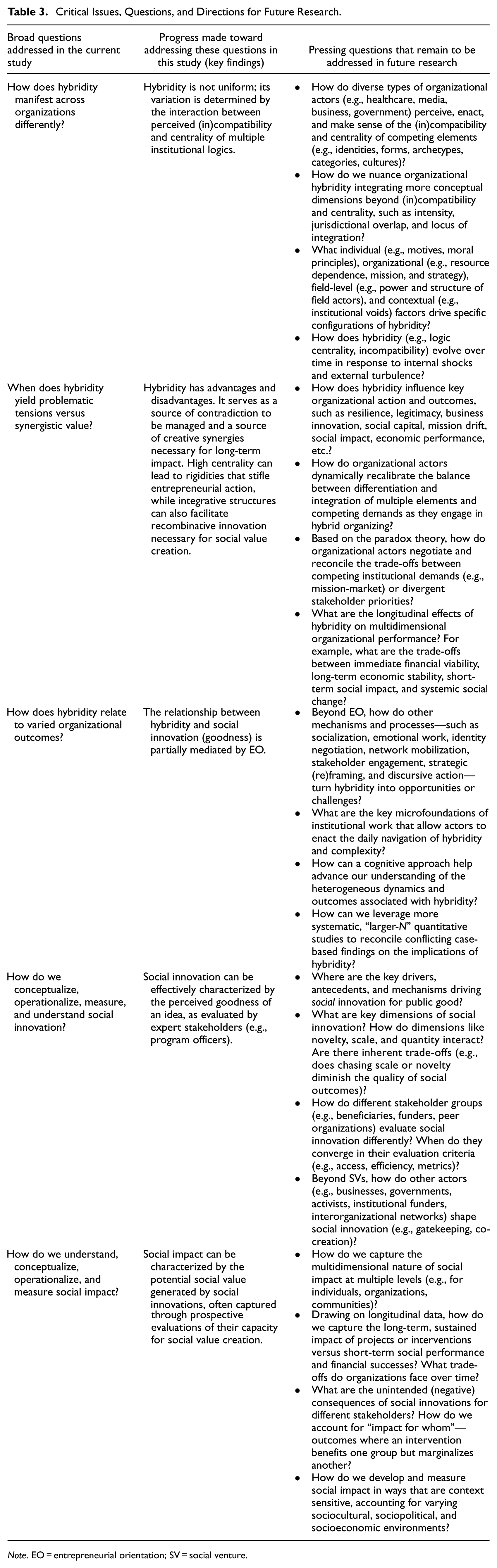
Note. EO = entrepreneurial orientation; SV = social venture.
This research focuses on social innovation as a specific form of organizational innovation. Future research could examine the generalizability of my hypotheses in broader innovation contexts, such as how firms navigate corporation-business logics to drive innovation and increase profitability. I recognize that social innovation assessments are deeply embedded in distinct socio-historical contexts and rarely straightforward (Dacin et al., 2010; Tracey & Stott, 2017). Outcomes may manifest across varying time horizons and scales—from short-term outputs to long-term outcomes and systematic impacts (Ebrahim & Rangan, 2014)—and may reflect more instrumental, market-based outcomes or democratic and participatory forms of value creation (Beckman et al., 2023; Lawrence et al., 2014). This research may be subject to the social desirability biases in respondents’ self-reports of their organization’s most representative social innovations. While this focus likely reduced the inclusion of impractical or unrealistic innovations, it may have excluded failed or marginal innovations, examples that could hold important insights for organizational learning and knowledge creation (Seelos & Mair, 2012). My reliance on program officers as key experts in evaluation also imposes limitations. I do not recommend this approach for all studies or for social innovation evaluation. Incorporating evaluations from other external stakeholders, such as those from beneficiaries and community members, may enhance understanding of how hybridity influences social innovation.
Significant opportunities also exist to develop a deeper understanding of the dynamics of social innovation by studying both the quality and quantity of innovation. Beyond a single representative social innovation, scholars might investigate organizations’ propensity to innovate by considering the total number of innovations created or adopted within a given period (i.e., organizational innovativeness). This approach may “provide accurate data about structural requirements for innovation” rather than “arbitrarily select only one or a few innovations” (Damanpour, 1988, p. 562), thereby providing critical insights in fostering organizations’ ability to survive and thrive in complex environments (see Hult et al., 2004).
In summary, this study’s focus on social innovation goodness allows for a more substantive assessment of the depth, potential value, and social impact of individual innovations, rather than placing undue emphasis on novelty or sheer number, both of which can bias evaluations toward easily countable outputs or trial innovations of unknown significance. Future research could examine other dimensions of innovation (e.g., novelty, scale) or the total number to identify their distinct drivers and organizing dynamics (Crossan & Apaydin, 2010).
Finally, several methodological details warrant further investigation. For instance, the survey instructions did not explicitly define the midpoint value “4.” Some respondents may have interpreted it as indicating that neither logic is prioritized, nor that both logics are equally important. This seems unlikely, given the nature of SVs, however. 7 Moreover, although I tested and ruled out several alternative models (see Appendix XI), future research could extend my theoretical framework by examining the conditions under which EO fosters organizational hybridity and/or social innovation. Future research could use a longitudinal approach (Litrico & Besharov, 2019; Ramus et al., 2017) to examine how hybridity dynamically evolves, shedding light on the differential drivers, nuanced processes, and divergent outcomes over time.
Conclusion
The prevalence of hybridity in organizational life has sparked growing scholarly interest in how organizations navigate competing institutional logics and the implications for action and performance (see Battilana et al., 2017). Yet, despite advances in documenting the structural and operational variation of hybridity, little is known about when and how hybridity relates to key dynamics and outcomes. This study deepens theoretical and empirical understanding of how organizational hybridity influences entrepreneurial and innovation outcomes in the context of SVs and social innovation. It explores generalizable theoretical mechanisms linking logic incompatibility, centrality, EO, and social innovation. In theorizing the interactive effect of logic incompatibility and centrality on key organizational dynamics, this research lays the groundwork for future studies on the implications of hybridity. By elucidating the nonlinear effect of logic incompatibility and the competing moderating effects of logic centrality, this study invites rethinking of the conditional effects of trade-offs across outcomes. Understanding these contingencies can inform both scholars and practitioners seeking to harness hybridity as a source of productive action, sustained innovation, and meaningful social impact.
Supplemental Material
sj-pdf-1-etp-10.1177_10422587261435951 – Supplemental material for A Blessing in Disguise: Logic (In)Compatibility, Centrality, and Social Innovation in Hybrid Social Ventures
Supplemental material, sj-pdf-1-etp-10.1177_10422587261435951 for A Blessing in Disguise: Logic (In)Compatibility, Centrality, and Social Innovation in Hybrid Social Ventures by Jiawei Sophia Fu in Entrepreneurship Theory and Practice
Footnotes
Acknowledgements
The author is deeply grateful for the constructive feedback and insightful suggestions provided by the anonymous reviewers and by the editor, Dr. Trenton Williams, whose encouragement, vision, and guidance have been invaluable throughout the review process. Additionally, the author would like to thank Drs. Michelle Shumate, Noshir Contractor, Edward (Ned) Smith, Klaus Weber, Shipeng Yan, and participants of the 2019 Academy of Management Journal Paper Development Workshop (Lisbon, Portugal), 2019 Third Workshop on Responsibility, Sustainability, and Social Entrepreneurship: The Cutting-Edge of Hybrid Organizations, the Work and Organization Studies Group of the Massachusetts Institute of Technology, and Annenberg Networks Network of the University of Southern California for their guidance and constructive comments on earlier drafts of this manuscript.
For Dr. Ned Smith, whose guidance inspired me to ask meaningful research questions and to pursue answers with diligence, patience, and integrity. For Khalil Fong, whose creative works have been an essential part of my professional and personal journey. Your resilience and kindness have been a profound gift to the world.
Declaration of Conflicting Interests
The authors declared no potential conflicts of interest with respect to the research, authorship, and/or publication of this article.
Funding
The authors disclosed receipt of the following financial support for the research, authorship, and/or publication of this article: The Decision, Risks, and Management Sciences Division of the National Science Foundation (SES-1730079), Northwestern University’s The Graduate School Graduate Research Grant, a Northwestern University School of Communication dissertation grant, and Rutgers School of Communication and Information startup funds supported this research.
This paper is a winner of the 2017 National Science Foundation Doctoral Dissertation Research Improvement Grant and the 2020 Best Student Paper Award of the Communication, Digital Technology, and Organizing Division of the Academy of Management. This paper is part of the author’s dissertation research, which was the winner of the 2020 Gabriel G. Rudney Memorial Award for Outstanding Dissertation Research of the Association for Research on Nonprofit Organizations and Voluntary Action, winner of the 2019 W. Charles Redding Dissertation Award of the Organizational Communication Division of the International Communication Association, and the winner of the 2019 Gerald R. Miller Outstanding Doctoral Dissertation Award of the National Communication Association.

Supplemental Material
Supplemental material for this article is available online.