



Abstract
This study examines how a new leader reshapes the negative legacy of a previous leader to influence employee identification during radical organisational change. Drawing on a longitudinal study in one of the world’s oldest airlines, we analyse the organisational discourse surrounding a radical transformation spanning the tenures of two successive Chief Executive Officers (from now on CEO). Our findings show how the first CEO’s coercive discourse of “responsibilisation” led to resistance and conflict, ultimately leading to his departure. Subsequently, the second CEO reframed the negative discursive legacy of the previous CEO into an aspirational identity for the organisation. Our findings elaborate on the conditions these discourses provided for employee identification. We discuss the implications of our study for the literature on leadership legacies and provide new insights into leaders’ restorative use of discourse in the context of organisational change.
Introduction
I would rather be a coach on a team that wants to win and is willing to make the necessary sacrifices. This bus is mentally on its way to a bloody grope in the last hole in the rock. (CEO I in the staff magazine after announcing his resignation)
As our opening quote illustrates, there are instances where a leader's attempt to implement a radical change plan may falter, leading to a tendency to attribute the failure to employees. Radical change in this context involves profound shifts in an organisation's fundamental philosophy or core identity, often manifested through changes in strategic direction or the reconfiguration of strategic relationships (Huy, 1999). Existing research has shown that the ability of leaders to effectively orchestrate dynamic and purposeful radical organisational change depends significantly on their discursive skills, as well as their perceived expertise and credibility in articulating proposed changes (Sasaki et al., 2020; Sorsa & Vaara, 2020; Vaara & Monin, 2010). For example, radical visions of the future can be perceived as a threat to an organisation's established identity and associated sense of belonging, often provoking resistance from employees who seek to protect the legacies of the past (Brown & Humphreys, 2006; Parker, 2000; Wasserman & Frenkel, 2011; Ybema, 2004). While pursuing change through coercive and authoritative discourse may appear to be a quick fix, it often comes at a significant cost (Zawadzki & Jensen, 2020). In contrast, the use of positive and aspirational discourse can promote identification by not only addressing individuals’ need for recognition and self-esteem (Anteby, 2008; Fraher & Gabriel, 2014). At the same time, aspirational discourses can introduce new power dynamics within the organisation (Thornborrow & Brown, 2009).
However, there remains a significant gap in our understanding of the strategies adopted by new leaders when they inherit a negative discursive legacy from their predecessors. Leader legacies are often perceived as enduring imprints that are materially manifested and perpetuated within organisations through their presence in corporate headquarters or museums (e.g., Nissley & Casey, 2002). These tangible manifestations of legacies are distinct from narrative and discursive legacies (Hatch & Schultz, 2017), which can be used strategically as catalysts for change (Suddaby et al., 2010). Existing research on leader legacies has predominantly emphasised their historical value in the context of organisational change and how they anchor individuals to shared goals (Basque & Langley, 2018; Hatch & Schultz, 2017; Ravasi & Schultz, 2006; Schultz & Hernes, 2013; Walsh & Glynn, 2008). In contrast, the phenomenon of negative legacies left by past leaders has received considerably less attention. This emerging body of work has elucidated how organisations may attempt to conceal or reconstruct an undesirable legacy to strengthen or renew identification (Aeon & Lamertz, 2021; Anteby & Molnár, 2012; Coraiola & Derry, 2020; Hampel & Dalpiaz, 2023).
We argue that inheriting a negative legacy in the context of radical change is a particularly complex challenge. The new leader must establish legitimacy to lead in a situation where organisational members’ identification is already being challenged by the transformative processes themselves. For example, radical change within well-established organisations can be extraordinarily complex due to deeply entrenched power dynamics that have evolved over decades (Greenwood & Hinings, 1996). At the same time, the leader is expected to somehow address the complex, negative legacy inherited from the predecessor in order to ensure members’ identification with the change. The processes of (dis)identification with leader legacies during organisational strategising deserve more attention, as they potentially elaborate how discourse travels and translates between contexts where strategising takes place (Seidl & Whittington, 2014).
Our study then addresses the following question: how does a negative leader legacy shape the discourse of the new leader and subsequently influence employee responses? To answer this research question, we embark on a longitudinal study of a radical organisational change that unfolded over the tenures of two successive CEOs. Our empirical material comes from an ideal context for studying such complexity, namely, one of the world's oldest airline companies. This transformation was characterised by significant employee layoffs and a major restructuring effort aimed at reducing costs and changing the collective bargaining agreements that secure employees’ employment contracts. Our research methodology is based on a real-time, longitudinal, and exploratory research project, incorporating a range of sources such as interviews, news articles, magazines and reports that captured the communication surrounding the change initiative from the beginning of CEO I's tenure to the departure of CEO II. Using a discursive perspective, our analysis reveals the dynamic interplay between managerial discourses and employee responses over this extended period.
Our findings highlight how CEO I employed a discourse of “responsibilisation” as an attempt to coerce employee compliance through public blame, eventually characterising the organisation as having no winners. His discourse ultimately sparked explicit resistance and conflict that culminated in CEO I's departure. Subsequently, the new CEO sought to transform the negative legacy into a new aspirational identity for the organisation, encapsulated by the phrase “an international winning team.” However, while the new identity embraced aspirational materials, it also introduced boundaries for identification, manifested in the form of a new professionalism that served as an emblem of legitimate membership within the redefined organisational community.
Our contribution addresses the dynamics of radical change and discursive legacies as recursive power struggles (Vaara & Monin, 2010) from two main perspectives. First, we illustrate how CEOs can strategically engage in discursive reconstruction efforts to reframe and reinterpret existing negative leadership legacies. This process involves the restorative transformation of past unfavourable narratives into new, more favourable narratives, thereby influencing collective perceptions of recent events. Second, we examine the central role of CEO change discourses in shaping employee identification. We show how these discourses serve to both exclude and include members, signalling the degree of alignment between individual members and the evolving organisational identity. This process highlights the complex interplay between discursive strategies and employees’ sense of belonging. We also highlight some unexplored avenues for understanding the significance of legacies in the context of organisational change.
Theoretical Framework
Radical Change and Discursive Legacies
Radical change often places significant expectations on the shoulders of CEOs who are tasked with revitalising the organisation. Despite the contemporary emphasis on the dynamic discursive skills of leaders, many leaders were trained in an era when change was predominantly viewed through the lens of stage models. These stage models typically assume the authority and power of CEOs and managers, and their approach to change management relies on rather static and coercive power dynamics. The expectation was that change management would lead to individual compliance with management goals (Cummings et al., 2016). Stage models did not emphasise organisations as evolving historical entities but rather as structures where the past could simply be preserved unchanged.
Coercive discourses and mobilisation of fear and anxiety continue to play a role in radical change (Vuori & Huy, 2015). From a discursive perspective, a sense of imminent threat can be heightened by framing concerns about efficiency and internal organisational issues as the only viable solutions (Hardy & Thomas, 2014). Immediate crisis rhetoric, such as “burning platform” rhetoric, often incorporates such discourse (Heracleous et al., 2020). Managers may also diminish or even ridicule employees’ achievements (Rintamäki & Alvesson, 2023), while at the same time trying to force them to adapt to changes.
Since the late 1980s, the management literature has undergone a notable shift in focus towards positive, participatory, consensus-seeking, and future-oriented change discourses (Alvesson & Kärreman, 2007; Alvesson & Willmott, 2002; Willmott, 1993). This change is deeply intertwined with the symbols, meanings, and value statements that shape the identification of organisational members (Pratt, 2000). Consequently, aspirational change discourses focus on envisioning a better future, emphasising ideals and intentions rather than specific behaviours (Ybema, 2004, 2010). This approach may involve introducing members to an idealised organisational self or presenting ambitious goals without delving into detailed strategies for achieving them (Logemann et al., 2019).
Research on aspirational discourse has also recognised that the revitalisation of organisational legacies has the potential to preserve the best aspects of an organisation (Walsh & Glynn, 2008, p. 272). Legacies then play a central role in organisational identification, extending their impact beyond mere temporal constraints. Previous studies have shown how leaders can create a sense of continuity and collectiveness by actively remembering the importance of their founding figures (Basque & Langley, 2018) or by using the past to rejuvenate organisational goals. For example, Hatch and Schultz (2017) describe how Carlsberg revived its historic slogan “Semper Ardens” on two occasions, each time for a different purpose: product development and identity renewal. Sasaki et al. (2020) explored how managers strategically manoeuvred through the past during periods of change in long-established organisations, highlighting the need for discursive strategising on the part of leaders. This body of research suggests that leaders can effectively use the past as a wellspring for future construction, providing cues for continuity and fostering collective identification, even in the midst of radical change.
However, previously mentioned research on leadership legacies has focused primarily on the positive aspects of how past legacies are acknowledged. A stream of studies has further examined how new leaders can have the capacity to deliberately misinterpret or conceal negative legacies (Anteby & Molnár, 2012), strategically use legacies to bolster managerial authority and employee identification in times of change (Aeon & Lamertz, 2021), promote collective forgetting as a means of facilitating change (Foroughi & Al-Amoudi, 2020), or even turn past legacies into arenas of discursive conflict (Ybema, 2014). As legacies offer a fruitful platform for studying power dynamic and strategising in organisations, we turn our attention to their impact on employee identification.
Discursive Legacies and Employee (Dis)identification
Radical change does not just lead to a significant and far-reaching redistribution of resources and power; it inherently requires a paradigm shift that challenges the fundamental assumptions held by members of an organisation (Greenwood & Hinings, 1996; Huy, 1999). Consequently, such change tends to complicate the process of identification, which can be described as an individual's perception of unity with, or a deep sense of belonging to, an organisation, where one's identity becomes intertwined with that of the organisation(s) to which one belongs (Ashforth & Mael, 1989). To develop this identification with an organisation, individuals must wrestle with questions such as “Who am I?” and “Who are we?.” In this context, organisational identification becomes a relational process through which people gradually define themselves and their relationships with others. They not only articulate this definition to others but also use it as a guiding framework not only in their professional lives but also in a broader context (Pratt, 2000).
Many studies have devoted considerable effort to exploring the reasons for employees’ resistance to, or compliance with, management change initiatives that seek to align their sense of belonging with desired goals. The alignment of identity is often rooted in the cultural heritage of the organisation, “expressed through distinctive practices and tangible artefacts that are perceived as legacies of a shared history” (Ravasi & Schultz, 2006, p. 447). The long existence of an organisation conveys a sense of prestige, competence and legacy, leading employees to feel responsible for preserving such a legacy (Aeon & Lamertz, 2021, pp. 587–588). This phenomenon is particularly pronounced in well-established organisations where members of the community are bound together by shared memories of past events.
Resistance manifests itself when management initiatives challenge or seek to eliminate long-standing and valued elements. These elements may be deeply rooted in the organisation's aesthetics and physical spaces (Brown & Humphreys, 2006; Wasserman & Frenkel, 2011) or revolve around perceptions that the past is not being properly acknowledged as new identities are perceived as fabricated (Llewellyn & Harrison, 2006). Resistance may also arise from managerial interventions that disrupt implicit power dynamics within the organisation, often rooted in historical hierarchies. Parker (2000) provided an illustration of how long-serving employees who lacked the formal qualifications emphasised in the change relied on their long tenure as a source of authority. For long-serving members, nostalgia often serves as a primary source of identification, and resistance arises when attempts are made to change this implicit order (Ybema, 2004).
Nostalgic narratives can then serve as a means of resistance. Individuals often idealise past legacies and achievements to express their dissatisfaction with ongoing change (Brown & Humphreys, 2006). Employees may simultaneously resist managerial discourse while maintaining their identification with the organisation or may navigate the contradictions, weaknesses, and gaps inherent in alternative identities and partially accept them (Meriläinen et al., 2004). Particularly in long-established organisations, resistance can be expressed through shared humour and irony and these acts of remembering can function as a form of power (Ybema, 2004). In addition, new managerial discourses can be resisted if they are perceived as overly ambitious and grandiose (Pratt, 2000).
The past then plays a central, but often contested, role in shaping identification within established organisations. For example, sudden scandals can disrupt organisational legacies and associated identification dynamics (Eury et al., 2018), forcing leaders to engage in discursive reconstruction, especially when the past is tainted by irresponsible acts (Hampel & Dalpiaz, 2023). To better understand how recent negative leader legacies influence new leaders’ discourse and, consequently, employee identification, we now move to the empirical part of our study.
Methods
Context and Data Sources
The radical change studied took place in one of the oldest airlines in the world. It is a listed company, and most of its shares are still owned by the state. At the beginning of 2000, the company was experiencing economic difficulties due to increased competition and several setbacks that the entire aviation industry was facing worldwide. A radical structural change was then initiated, which lasted for a decade.
The company appointed a new CEO (CEO I; 2006–2009) who came to the airline business from the retail sector with a strong brand management background. He initiated a major strategic change in the company, described as a cost efficiency strategy. CEO I was frequently interviewed in the media and wrote personal blogs on the company website, publicising the internal disputes that arose from his change initiatives. His efforts to change the contractual environment and collective bargaining agreements that guaranteed employee benefits in the industry led to several disputes with employees. CEO I announced his resignation in 2009 giving way to CEO II (2010–2013), who continued the structural change.
CEO II was recruited from a successful telecommunications and information technology company. He was perceived as having strong operational and international experience, having led business restructurings in global environments. He continued the cost efficiency strategy with an explicit focus on improving the company's situation and renewing its identity yet maintaining a focus on employee benefits and contracts. However, the situation remained unstable. CEO II announced his resignation in 2012, saying that the new opportunity was too lucrative to turn down.
These CEO departures were something unforeseen in the company. Unforeseen were also the acts of challenging the long-standing power of the labour unions and significant cuts and downsizing. Among these CEOs, approximately 3000 jobs (approximately 30% of the total number of employees) left the company through various arrangements. During both CEO changes, there were strikes and significant layoffs.
Data Collection
We collected the data as part of a large longitudinal research project that initially focused on corporate environmental and social responsibility. The first author immersed herself in the company's activities for three periods of four to five days spread out over two years as well as other times intermittently. During these periods, she conducted semistructured interviews, collected written and electronic documentary materials and toured several units in some of the company's facilities.
Semistructured interviews. In the project, we collected 45 interviews, 33 of which were performed by the first author for the purposes of this study. We used a purposeful sampling strategy supplemented by snowball sampling. The excluded twelve interviews focused exclusively on environmental issues and the management of externalities in the aviation industry. We had a contact person who facilitated access for us and gave us initial suggestions and lists of names of people to consider interviewing. Potential employee participants were identified in the interviews, and we also performed our own searches for suitable candidates based on their positions and visibility in the company's written and electronic materials. The names of the participants were not disclosed. The interviews began after CEO I's resignation, and we finished the interviews just before CEO II announced his resignation. We interviewed top managers and middle managers, union representatives (the majority of whom worked as employees), cabin crews, pilots, technicians, service personnel, engineers, marketing personnel, research analysts and professionals from health and training services.
Initially, we used a loose thematic structure focusing on corporate responsibility and stakeholder relations, organisational collaboration, strategy work and knowledge sharing. However, our interviews were influenced by the ongoing disputes in the firm, something that we were not fully aware of at the beginning of the project. In particular, the word “responsibility” occasionally raised emotions and was framed in terms of leadership, changes and ongoing disputes. We therefore allowed people to speak freely, and during the process, we extended our data gathering to include union leaders as well because the disputes centred on employment contracts. The length of the interviews varied considerably (51–141 min) and all interviews were tape-recorded and transcribed verbatim.
Written and electronic materials. We also collected various communication materials. First, we collected corporate responsibility and annual reports (2006–2012) to form a coherent picture of the structural changes. We also systematically collected staff magazines (2009–2012) to capture the official leader discourse and changes within it, CEO I's blog texts, which he actively wrote during his tenure, and press releases and news media articles on the change efforts in a more sporadic fashion covering the years between 2006 and 2012. These data helped us contextualise the change, gave us access to leaders’ discourses and helped us to triangulate insights with the interview materials (Table 1).
Research Material.
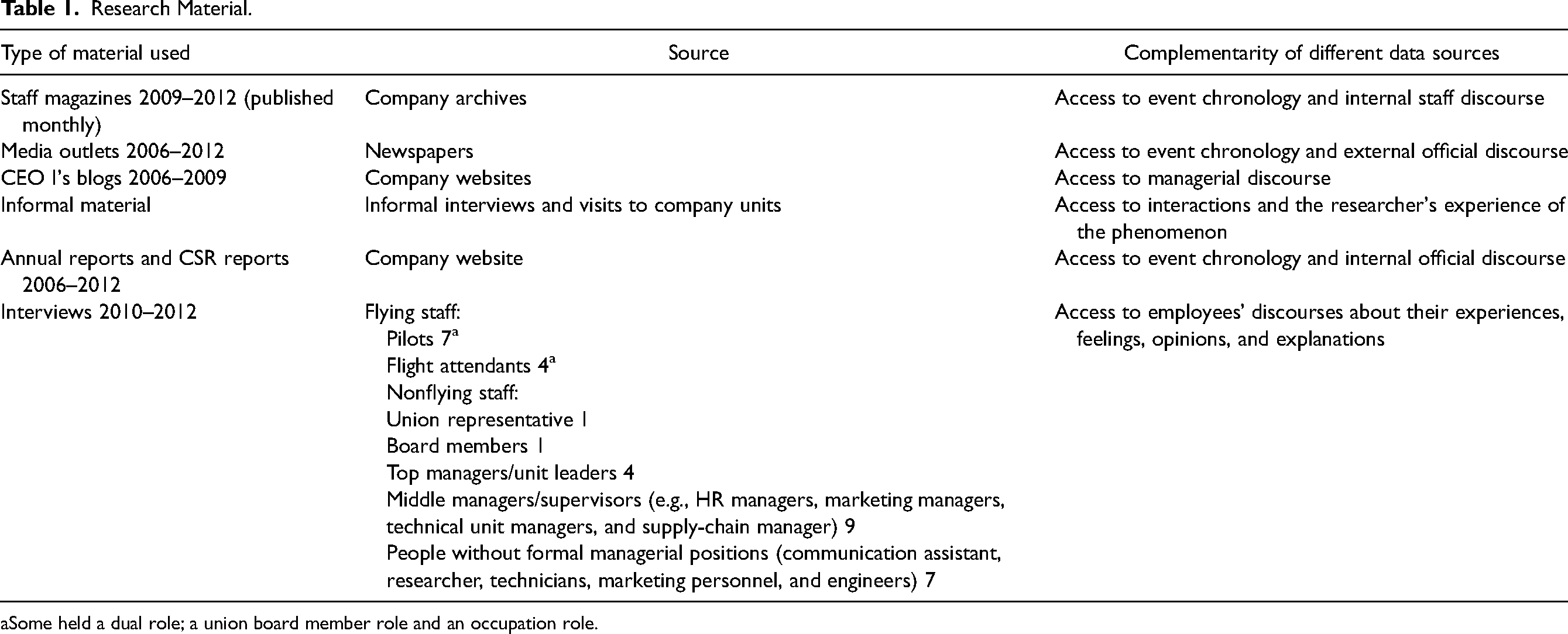
Some held a dual role; a union board member role and an occupation role.
Data Analysis
Our data analysis proceeded iteratively through three main stages: temporal bracketing, analysis of managerial discourses, and analysis of the relationship between managerial discourses and employee responses expressed through (dis)identification.
In the first stage, we created a visual map (Langley, 1999) of activities to understand the distinct changes in the company. This visual map drew on public materials (press releases, corporate responsibility reports), field notes and internal communication materials (e.g., staff magazines and blog texts). It detailed key events such as CEO changes and the internal and external processes that led to them, major layoffs and strikes, and strategic efforts to change the structure of the company. This helped us to build a picture of the main crises and challenges and what had influenced the way people interacted, as the change had already begun before we entered the company. The visual map (timeline of key events) is illustrated in Figure 1.
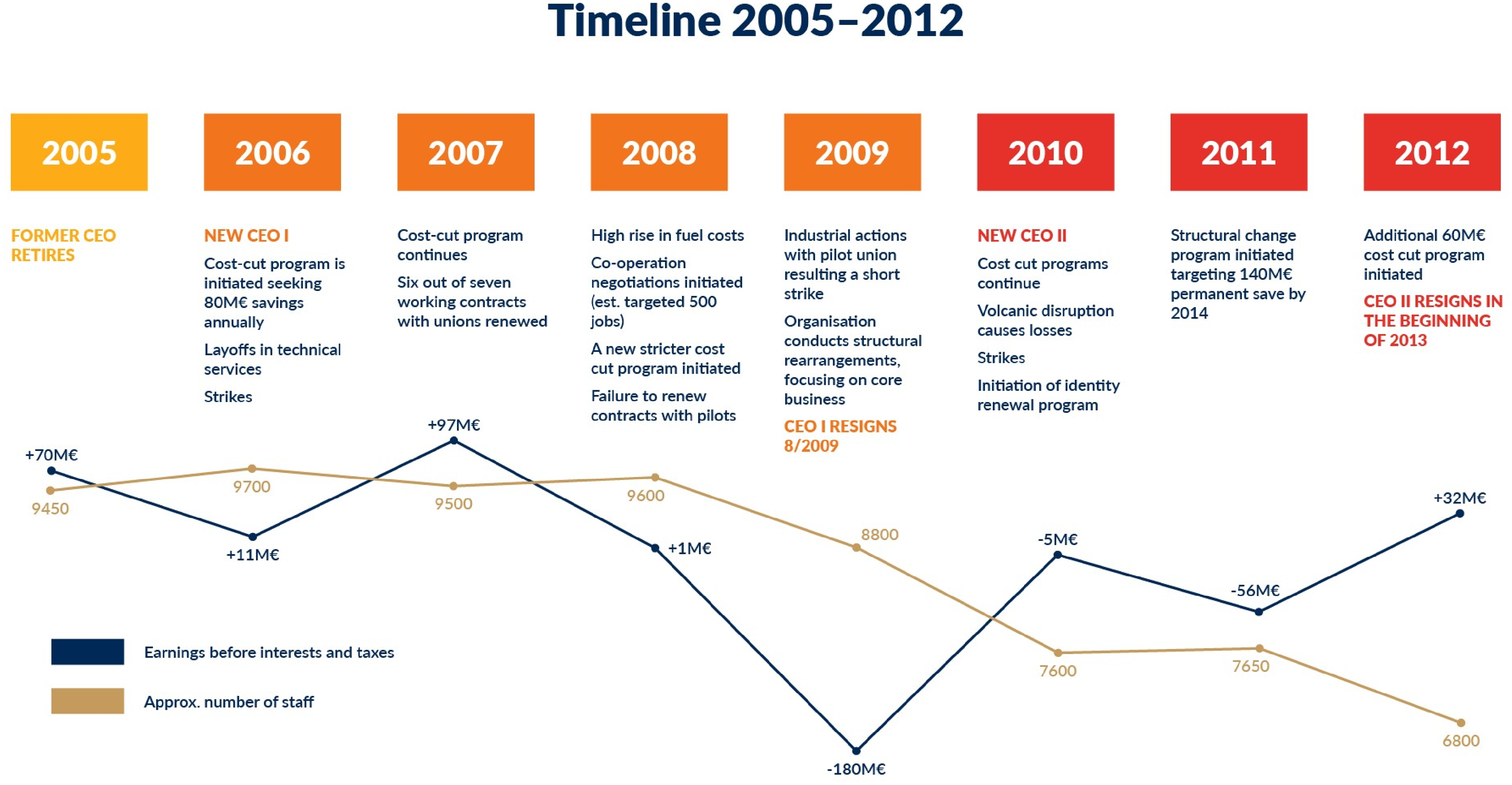
Timeline of the main events.
In the second stage, we analysed the CEO's change discourses within the company (see Table 2). We focused on employee magazines, press releases, CEO I's blog, and editorials in staff magazines and reports that communicated the firm's ‘official’ strategy discourses. We carefully analysed two periods, the last year of CEO I (who initiated the change process) and the first year of CEO II. We focused on the vocabulary used to communicate change by analysing three linguistic means—vocabulary, metaphors and rhetoric—which are commonly studied as part of change discourses (Logemann et al., 2019; Sorsa & Vaara, 2020). We then extended the analysis to a longer period to look for patterns in CEO communication. We argue that this analysis is crucial for understanding not only periodic change but also changes in discursive material over time.
Comparison of CEOs’ Discourses.
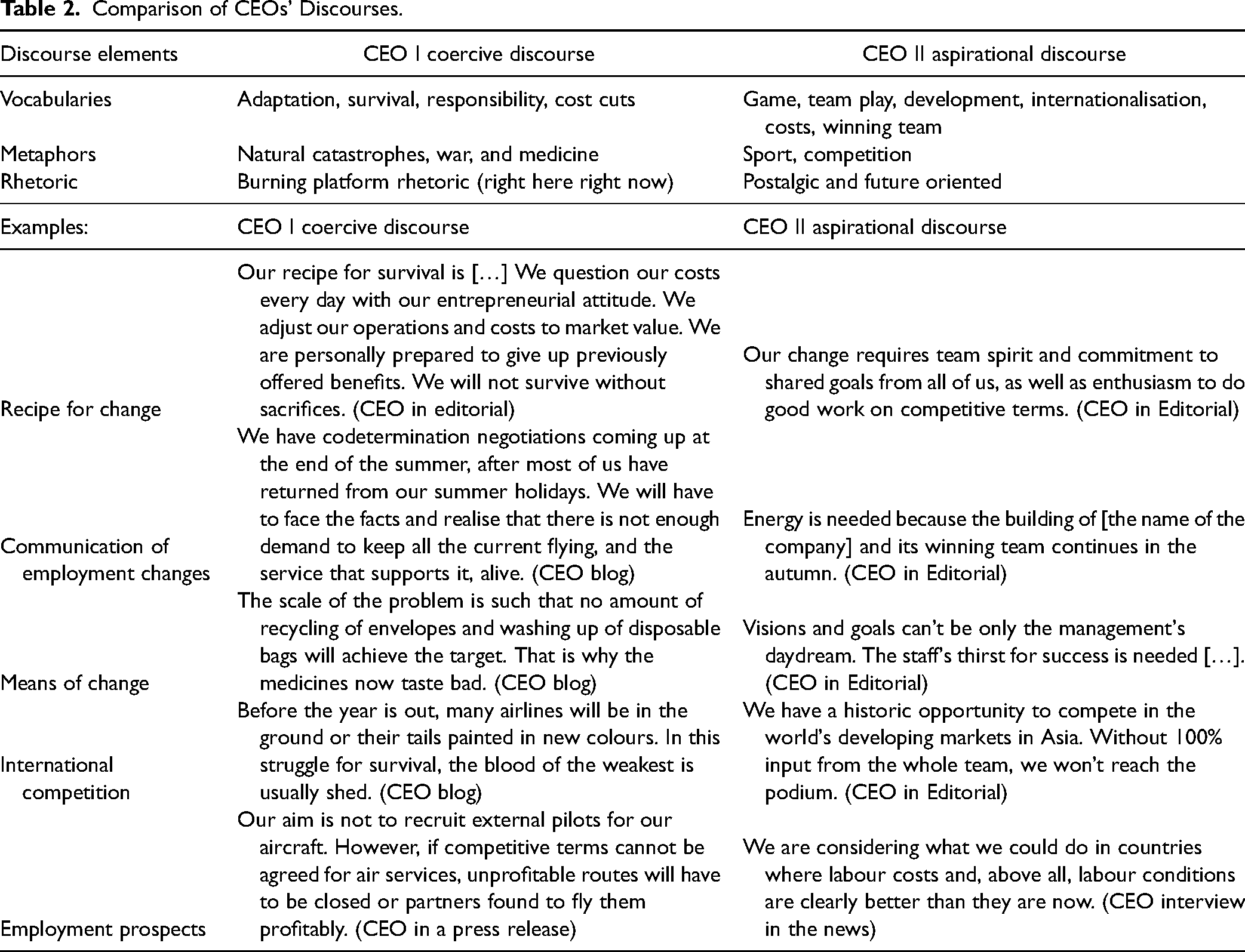
CEO I used “burning platform” rhetoric (Heracleous et al., 2020), framing change as a struggle for survival with “no alternative.” He frequently used threatening scenarios alongside war and natural disaster metaphors, particularly towards the end of his tenure, to describe the situation of the company and to point the finger at specific groups of employees and the damage they were causing. His discourse resembled a nationally known way of management, known in the country's popular language as “management by the devil” (see Risberg et al., 2003; Vuori & Huy, 2015). We referred to this discourse as “responsibilisation,” as it invoked how employees, especially professional groups, should take more responsibility for the organisation's prospects. Ultimately, the CEO I stormed out of the organisation, leaving the relationship between the upper echelons and some employee groups extremely inflamed. When CEO I announced his resignation, he wrote in his farewell letter to employees that he would “rather be a coach in a team that wants to win, even if that team is not in a company as well known and large as the airline.”
The farewell letter became the cornerstone of CEO II's identity renewal discourse and the spread of the “winning team” metaphor. His new aspirational discourse was future-oriented, promoting both skills and knowledge, through the use of English and sports metaphors. After its introduction, the new winning team slogan soon gained the prefix “international.” We called the discourse “professionalisation” because it emphasised how the idea of being part of the winning team required professional people to operate in a global environment and to have the skills to do so.
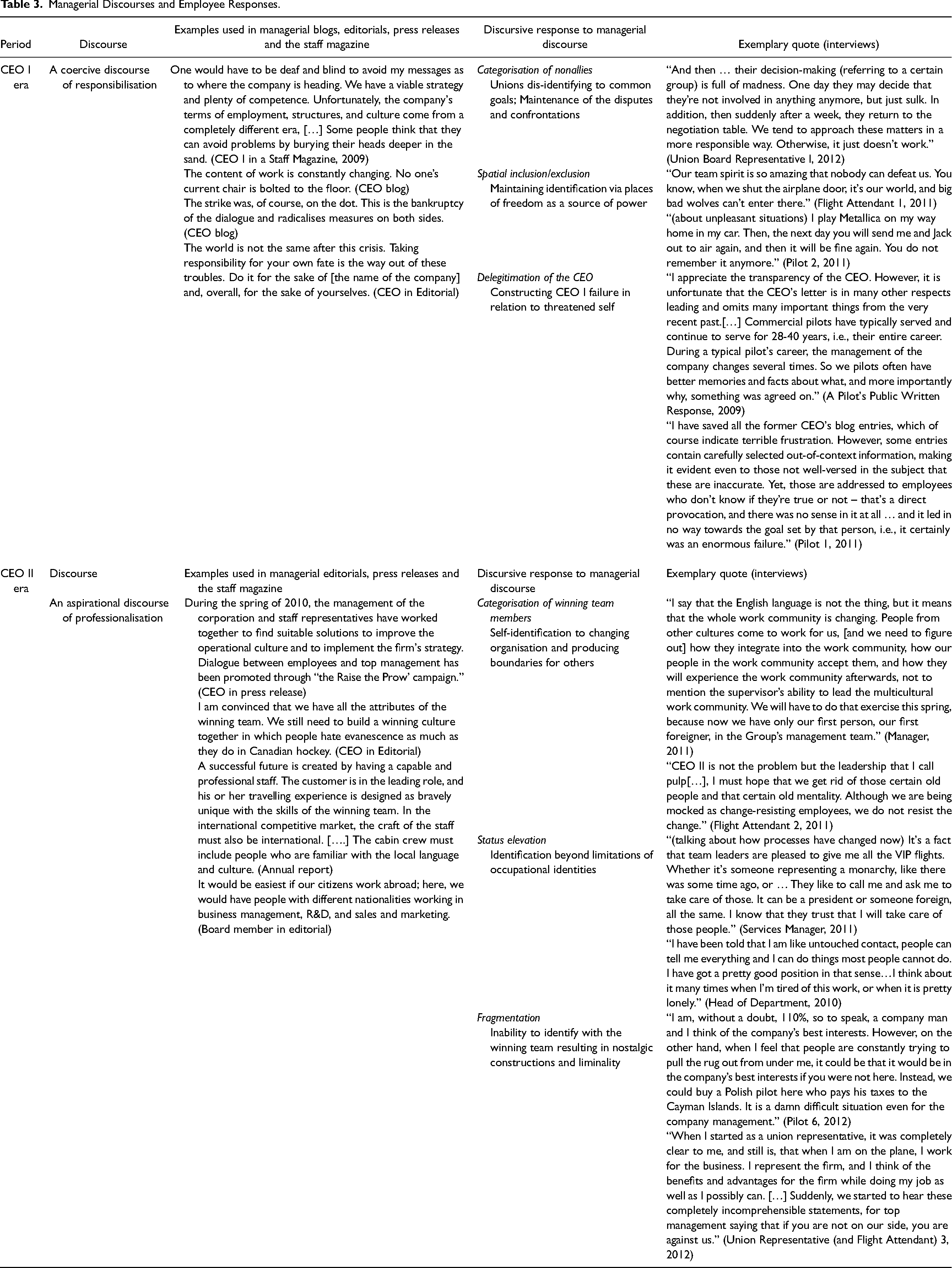
In the third stage, we focused on the interview material and asked empirically: How do people discursively respond to and reproduce managerial discourses in relation to their sense of self? We coded the reconstructions of responsibilitation and professionalisation discourses using a rough binary division to organise the data, namely, support (identifying with and supporting management goals) and defence (perceiving management communication as a threat). Thematic responses focused on organisational culture (norms, history, and artefacts), power relations (implicit and explicit organisational hierarchy, gender, and status dynamics), responsibility to staff (redundancies, war on staff, fear of low-cost airlines, staff development, and working practices), social valuation (leader legitimacy and firm image) and change programmes (new identity and strategy work).
Although the CEO I had already left the company, his legacy and the discourse of responsibility persisted in employees’ responses, especially among the flying staff. However, disidentification with CEO I’s vision did not mean disidentification with the employees’ own vision of the company. Employees’ responses to the CEO I discourse were mostly expressed from a collective standpoint through categorisation of potential allies and enemies, spatial inclusion and exclusion, referring to narrated material spaces where their identification was not threatened, and finally, employees enforced their own identification by delegitimising the CEO, implying that the CEO I was not really fit to run the company.
The discursive responses to CEO II’s discourse were more ambiguous, as was the discourse of professionalisation itself. His discourse was reproduced more from an individual perspective. People identified with the discourse and the company through the categorisation of winning team members (what are the boundaries for someone to claim such membership) and through status elevation (constructing a gap between one’s self-identity and one’s profession). Finally, we reconstructed a fragmented response that indicated nostalgic constructions and a sense of self-alienation (Beech, 2011). Table 3 presents the results of Stage 3 of the analysis.
Managerial Discourses and Employee Responses.
This analysis was by no means a straightforward process but evolved over time. We had to return to the data several times, read new theoretical material and rearrange our findings.
Findings
The findings are composed of two interconnected parts. In the first section, we present the CEO I discourse and employees’ responses to it. The second section follows a similar logic, first introducing the CEO II discourse and employees’ responses to that discourse. As will be shown, the discourses differ significantly from one another, as do employee responses.
CEO I: Employee Responsibilisation
At the beginning of the change initiated by CEO I, the company was said to have entered a new era. CEO I used rhetoric that sought to challenge the prevailing employee benefits. The burning platform rhetoric mobilised by CEO I created a sense of immediate crisis that was expected to motivate people to support change. Moreover, such a discursive move excluded the possibility of nostalgic constructions and a return to the past because, according to CEO I, “there is nothing to go back to” (Staff Magazine, 2009).
The cost-cutting strategy, based on cutbacks and redundancies, was designed to reverse the company's negative performance. According to the management discourse, the organisational threat was not only external but also internal; the number of employees was too high, and their salaries were an unbearable cost for the company. The aim was to reduce costs by 100 million euros, 70% of which were to be achieved through redundancies and reductions in personnel costs. These radical redundancies were unprecedented in the company’s long history.
The CEO used vivid language, particularly in his blog, where he wrote quite openly about the difficulties the company was facing from an early stage. It was the first time a CEO of a major company in the country had done so. The CEO blog was often a source for journalists to quote his views. The blog activity was not only easily accessible to employees but also provided a platform for the CEO to share and disseminate his views on disputes between top management and employees. The following is an example of CEO discourse that backfired in the form of explicit opposition from the pilots. Do the pilots want to apply the “I want it all now” approach at the expense of other employees, – or are you able to see the longer-term interests of your own workplace and the future of the whole company? If [the company] does not manage to improve its cost efficiency, we could soon have an airline whose size and networks have been reduced to a fraction of its current holdings. This would be a sad end for [country] and not least for the pilots, for whom the search for a job abroad could easily become a chain of temporary contracts in this highly turbulent industry. The pilots would now have a unique opportunity to have a collective bargaining history if they read the signs of the times and understood the severity of the crisis we were facing. (CEO Blog, 2009)
Responsibilisation targeted everyone, but especially pilots and cabin crews, necessitating salary cuts. A sense of urgency was often used by the CEO I, instructing people to adopt a “more entrepreneurial spirit” and not to act in a way “they would regret.” The CEO argued that in the worst case, the company's stakeholders would have to bear the consequences of higher prices and irresponsible employee behaviour possibly resulting in the loss of a national airline. This threat was widely reported in the national media, with headlines such as “Five-star Hilton hotel not good enough for pilots,” portraying the pilots as greedy and spoiled groups (Daily Newspaper, 7.4.2009).
At the end of 2009, the situation with important employee groups grew unbearable and CEO I announced his resignation, citing difficulties with staff in implementing the necessary changes.
Employees’ Responses to the Responsibilisation Discourse
The categorisation of nonallies was a discursive response to a perceived threat. It was mobilised by union representatives, even though the CEO I had resigned. The situation developed when some unions issued a joint statement reminding pilots that they enjoyed benefits that other groups did not. Accordingly, the unions publicly claimed that the pilots’ industrial action was putting the jobs of other categories of workers at risk. The disputes centred on who was acting responsibly, which had become important in demonstrating one's importance to the company. Older generations (a group of workers) are fighting for their cause, and others are fighting for their cause too, so to speak. In addition, then some couldn’t care less. It's such a heterogeneous orchestra. (Union Representative I, 2012) They said, you know, that we shouldn’t work with the old ticket office women. If we go with them, they are not well equipped for the real fight. (Union Representative II, 2012)
Categorisation mobilised occupation, gender, or age to explain a group's insignificance in the struggle for survival. In addition, knowledge of the high-risk environment and responsible behaviour were rationalised as a quality of certain occupational groups that others lacked. The discursive strategy was a means of constructing similarities and differences, but in a negative way—one's own group status was perceived as more valuable than that of others. Accordingly, other unions and groups were portrayed as lacking strategic planning or the ability to truly mobilise, thus not being worthy allies. This discourse then built on a defensive vocabulary of identification and importance.
Airlines are indeed a context in which occupational differences (status, tasks, and pay) are significant. Union membership is high and unions have traditionally played an important role in the construction of hierarchies between different groups of workers (Hopkins, 1998). Established occupational identities have traditionally been notable in the industry, and the idea of elite/nonelite workers has long influenced employee relations. Airline pilots are an example of unionised elite males: their training and apprenticeship programmes parallel the lengthy training associated with other elite occupations. These status differences were then reproduced as reasons for noncooperation. (Interviewer): “Why wouldn't you work with pilots?” (Respondent): “Well, because of salary issues. The differences in our salaries are so significant.” (Union Representative III, 2012)
Although differences in pay and benefits between professional groups had existed for decades, CEO I's discourse had made the differences clear. This wage gap then led to struggles between the union group leaders (who were also employees of the company), and an obstacle for change.
Spatial inclusion/exclusion was another discursive response used to construct “safe places” among the flight crew. The perceived threat to identify from the CEO I discourse was translated into the construction of a safe physical space, and the aircraft became a source of such power and security. The aeroplanes were constructed to provide a means for flight personnel to engage with their team and their authentic identity. This was constructed in an environment that was perceived by employees as “familiar” and offered them a sense of freedom, exemplified by a pilot below: I have always said it to flight attendees – when they complain about the firm and how it did this and that – that hey, the moment we shut the airplane door, what the day will be like is only up to us. It does not matter at all what sort of crap the CEO writes in his blogs. (Pilot 5, 2012)
Brown and Humphreys (2006) showed how “place” can be used as a resource in efforts to develop, promote and protect employees’ preferred versions of themselves. Spaces also have identity-relevant boundaries that determine what can happen within the bounded space. Although management changed working hours and reorganised working practices, particularly for the cabin crew, aircraft were under the command of the flight crew. The aircraft served a mental and social function of identification: sharing this space in isolation maintained existing identities and hierarchies and practices by defining who had legitimate power in a particular space. The cockpit is reserved for pilots and is neither accessible nor visible to passengers. For pilots in particular, the space reinforced the value and status of their professional identity through their perceived freedom and being with their mates. In this way, spatial power became meaningful for self-identification through fantasising and nostalgia after the threat was constructed by CEO I. One of the greatest things in this occupation is flying and being with your workmates. Flying as a performance is so cool. In addition, one gets to do it together with your mate. Even though the firm would try to pull us in a string or find all sorts of solutions, they can never take away how much fun we have in the cockpit and how we work. They can never take that away. (Pilot 2, 2011)
The delegitimation of the CEO was a discursive means of protecting self-esteem and particularly occupational identification. CEO I's failure was linked to his lack of strategic ability to manage employees who knew more about aviation than he did. The CEO's conception of the company led some employees to leave the company when it seemed to be on the verge of collapse. In the example below, an employee explains why he left during CEO I's reform (and returned during CEO II’s), using the phrase “shirt shop” to underline how the manager did not have the competence to run an airline. He (CEO I) brought a knife to a gunfight, I think; he came from a shirt shop. All the development programmes were stopped. (Technical Manager, 2011)
Interestingly, the public communication strategy chosen by CEO I was different from personal contact with him. CEO I was occasionally described as nice and attentive in personal encounters, whereas the coercive and authoritarian discourse was perceived more as part of his public role as CEO. CEO I had specifically attacked the pilots’ collective agreements, and the pilots perceived CEO I's communication as provocative, mocking and dismissive, which they considered a sign of managerial incompetence. To protect their interests and maintain their identification, the pilots eventually adopted a strategy of not negotiating with management after their public vilification. There are probably few people who can say that our former CEO was an unpleasant person to meet face to face, nothing bad to say about him in that sense. However, his blog reveals a very different person. Before he resigned, he tried to organise all sorts of briefings and discussions with us pilots. I had this feeling (laughter) that it was such a shame, like why can’t we work this out? However, then you sit down for a while and read the blog posts and remember, oh yeah, that's why it doesn’t work. Then, in the last discussion session, we just went and listened to what he said and then we left as a gang, but we didn’t say anything. (Pilot 4, 2012)
Resistance to managerial discourse is an ambiguous and complex process; on the one hand, participants wanted things to move forward. On the other hand, the public defamation of pilots’ identities and the leaking of bargaining issues had become such a significant experience that it overrode the interest in resolving the situation in more personal encounters. The silence contributed to the pilots’ collective sense of unity while leaving the CEO alone after his efforts to cooperate. After this event, CEO I announced his resignation.
CEO II: Differentiation Strategy and Professionalisation of Employees
Although CEO II continued the change and cost-cutting strategy and implemented tougher cost-cutting measures, he adopted a different type of discourse: aspirational visions to be fulfilled. Accordingly, burning platform rhetoric was replaced by a future orientation, war rhetoric was replaced by competition and sports metaphors, and the rhetoric of national advantage was replaced by internationalisation. Threats were more about international competition, and words such as recruitment, dialogue, future, team, vision, and career programmes were added to the organisational vocabulary. For example, the English language and slogans such as “peace of mind,” “magical moments,” and “designed for you” started to appear as part of the identity renewal discourse.
Most importantly, CEO II renewed CEO I's farewell discourse as a cornerstone of the new organisational identity. CEO II's discourse did not challenge CEO I's assertion that the organisation did not consist of a team of winners but rather translated it into a projected future identity of how they were to become one. This aspirational rhetoric was based on the realisation of the organisation’s potential for change. The renewal of our identity is about much deeper issues than a new logo or the colour scheme of the aircraft. It's about how we work and how we develop our customer service so that we can offer our customers a safe and peaceful experience in the midst of this increasing cacophony. I believe we have what it takes to succeed. The professional staff, the modern fleet and our extensive route network provided us with a solid foundation on which to build our international success story. […] Therefore, as an international winning team, we must find ways to become a successful airline. (CEO in the Staff Magazine, 2010)
The discourse of professionalisation emphasised that professionals were forwards-looking and knew that to continue to do a good job, they needed to update their knowledge, acquire new skills, and stay ahead of the competition. However, this new rhetoric featured a risk for current employees that highly qualified people were not necessarily already working for the company. The discourse thus implicitly targeted the long-standing (older and less educated) workforce in the organisation, recalling that “the average age of staff was 44 years. 30% were over 50 and 7% were under 30” (Annual Report, 2011). Thus, the opportunity to be part of the new winning team was there, but whether one had the skills to be a member in the future team was another matter.
The increased focus on customer service highlighted that most customers were from abroad and that their needs might be outside the skills of the current workforce. Whether international and the emphasis on increasing the cultural diversity of the company meant people with an international mindset, people of a different nationality or simply less expensive labour compared to the majority of the workforce was not explicitly discussed. We have challengers here at home, but the international competition is getting tougher and tougher. That is why the winning team has to be international. (CEO in the Staff Magazine, 2010)
CEO II also initiated extensive staff training programmes, including a mentoring programme and leadership training. The new strategy and identity renewal were communicated in strategy workshops, and new members were recruited from outside the company. At the same time, structural changes to reduce the size of the company continued.
Employees’ Responses to the Professionalisation Discourse
The categorisation of (non)winning team members emerged as an ambiguous response to the managerial discourse of professionalisation. It reinforced the identification of nonflying employees who perceived the CEO II discourse as an attempt to change existing and longstanding power relations. However, it was also used to question whether those who disseminated it qualified as winning team members themselves, elaborated more below.
First, previous confrontations between workers and management were translated into support for the discourse of professionalisation, particularly in the sense that group resistance should not determine the future of all members. The employment hierarchy that had previously prevailed in the airline industry was now being resisted by nonflying staff. In this organisation, there are kings and queens, followed by princes and princesses. There has been a cultural hierarchy of employees here for decades, and this is now supposed to change. (Unit Manager, 2011)
Some perceived that the purpose of the professionalisation discourse was to target those who had worked in the company for decades without any experience outside the company. For example, the metaphor of a “sheltered job” was associated with nonprofessionals because real professionals do not need “shelter.” Identification with the new winning team was further strengthened by making a distinction between nostalgic constructions and those who continued to live in the past. You know, some people are like “my father and even my grandfather used to work here, and even then things were done the same way”. In addition, somehow these people seem to think that they are here now and they will be here forever… I think it is a bit like the civil servant mentality; you know that regardless of whether you do anything or whether anything changes, you will always have a job and you will retire from here. (Manager 7, 2011)
Second, those who had the desired skills and identified strongly with their peers questioned whether top management could demand skills they might lack. This categorisation strategy was not aimed at CEO II but at long-standing members of the top management team who had also worked with CEO I. The rhetoric of international competence was then used against its proponents by pointing out the shortcomings and gaps in the managers’ CVs. The rhetoric of the winning team was then interpreted to mean everyone, regardless of hierarchical position. The problem is that people have been able to move from baggage control to the top management team. Additionally, in our unit, we have managers without proper degrees. I mean, you know, it [the degree] alone is not going to make somebody competent, but if you have it, at least in the specific management positions in this kind of large, listed company… I think it is a requirement to have at least some kind of university degree. (Pilot 7, 2012)
Status elevation discourse was most often used as a form of identification by those who wanted to break the bonds of occupational identity and perceived union control and seek new identification from nonoccupational circles. For some, engagement with the discourse of aspirational change offered opportunities to emphasise their importance and their willingness to implement the new strategy. The professional discourse emphasised the empowerment of people in the organisation, and some interpreted it to mean that organisational roles were no longer limited to occupations, conceptualising it as a future-oriented “breath of fresh air.” The new discourse was laden with the expectation that the change would result in a more up-to-date, modern, and effectively run organisation. The new CEO's culture is based on a coaching style of leadership. He may already have models and a framework for how to do things, but he doesn’t want to say the leadership framework is this, deal with it, bam bam bam. He might do that because he has done a lot of training in previous companies, but the point is that we learn it ourselves, we learn it together and then we commit to it. In addition, believe in it. Therefore, I think that has been a dramatic change here. (Manager 4, 2011)
Occupational positioning did not fit well with the holistic international winning team. As a result, some employees began to try to break away from the norms of their professional group. On some occasions, their unionised colleagues excluded them from social media. In an interview with a flight attendant (not a union member) who supported the goals of top management, we asked who would look after her interests during the changes and in the future, and she replied, “Me.” She went on to explain why she continued to work during the strikes. I do not identify with my colleagues. Interviewer: Ah, okay, with whom then? Mmm … with the management … Like, I thought it was natural to keep working [during the strike] because I am not a member of the union. Not that I had to keep working, but I wanted to. However, another reason was that I look at this activity through an economic lens. I do not use flight attendant lenses. I am not always thinking about what kind of benefits I am losing, but I look at it a bit from a management point of view… I read business magazines and I am interested in business life. I do not approve of the kind of strikes we have had. (Flight Attendant 4, 2012)
The purpose of this identification was not only to enhance one's status but we interpreted it also as part of one's survival strategy. Some perceived that the unions did not offer protection and security; in contrast, they sought protection and security by aligning themselves with management goals and visions. However, status elevation did not emerge at all among pilots, the only “true elite occupation” (Hopkins, 1998).
Fragmentation was used to describe how identities were shifting and how nostalgic constructions were confronted with ambivalent selves. The change had been chaotic, and despite the commitment generated by the CEO II discourse, the transition to the new and uncertain was not easy. This led to comparisons of the current and former CEOs’ leadership discourses. CEO I had an explicit agenda, whereas CEO II's discourse was perceived as ambivalent.
The previous management style of the CEO I was referred to as occasional shouting. However, some employees perceived that the shouting did not threaten their employment in the company whereas the new aspirational discourse and management style were something they could not grasp. In the CEO II discourse, meanings were ambivalent, and employees did not know how to respond or identify with such a style. I’ve had a kind of experience, a kind of image, you know, honestly, that it's like talking about the right things in the right terms and maybe at the right time, but it doesn’t truly show up in the way people are treated. It shows up as different treatment than in an organisation where people might shout their heads off, but here, it seems to be slightly more subtle. It's a bit like ignoring, not telling, you know, a kind of belittling, which is much harder to perceive on a mental level, much harder to understand than that sort of thing where you're being shouted at, oh! You’ve done it wrong again. [This new CEO II style] It's crueler, I think. (Middle Manager, 2012 aviation services)
Fragmentation is related to “in-between” identities (Beech, 2011). The fragmented constructions played a pivotal role in fostering a sense of insecurity within the evolving postalgic rhetoric. For example, a pilot aptly captured the sentiment, expressing, “I consider myself a steadfast company man, but the constant upheavals have left me feeling somewhat schizophrenic” (Pilot 6). The gradual erosion of employees’ power and the evocation of past images intensified the need to safeguard one's threatened sense of self.
Nostalgia emerged as a distinct and cherished source of identity, and the formation of a new, triumphant team identity failed to offer avenues for meaningful identification. This is evident in the words of an individual with a thirty-five-year tenure in the company, highlighting the challenge of establishing a cohesive sense of self in the face of organisational flux. Until the beginning of 2000, our strategy was to transport people and hopefully their luggage (laughter) from place A to place B. Then, suddenly, with magic tricks, we were expected to adopt a leadership and knowledge management system and understand values, visions, strategy, etc. Many new things and complex words. Our poor [former deputy CEO before the radical change] was so confused. He asked me what these new systems meant, and I drew a diagram of how things were connected. In addition, then he asked me, “What should I do?” I said, “Dear [former deputy CEO], it would be enough if you did it once, but it would be great if you said it twice a year in the board meeting so that we understand whether we have the skills and competence for this and that.” (Specialist, HR Services)
Nostalgia provided opportunities for ironic reminders that it used to be the employees who ran the company due to the top management lacked strategic courage or skills. In particular, the aspirational rhetoric was complex for those who had worked in the company for a long time and lacked some of the signifiers that the aspirational discourse expected from the winning team members. Their source of power and esteem in the firm had come from their tenure, not from their university degrees or international work experience (see also Parker, 2000). The nostalgic appreciation of the past served to demarcate phases of personal power, leaving uncertainty about whether to embrace a new identity.
Discussion
We have examined how a new leader can reconstruct the negative legacy of the former leader to influence employee identification within organisations undergoing radical change. Using a longitudinal analysis within an established airline, we closely examined the complex interplay between managerial discourses and employee responses. Our findings revealed a remarkable shift in managerial discourse from CEO I's coercive rhetoric to CEO II's aspirational rhetoric. Notably, both CEOs pursued identical overarching change goals, differing primarily in the language and conditions that fostered employee identification. In addition, our study has shown how leaders can transform past leader's negative legacy into new sources of meaning within the organisational context.
Our findings make two main contributions. First, we highlight the central importance of the discursive reconstruction of negative leader legacies. While previous research has often focused on the positive aspects of leader legacies as symbolic resources in the discourse of managerial change (Basque & Langley, 2018; Hatch & Schultz, 2017; Schultz & Hernes, 2013; Walsh & Glynn, 2008), our findings show how negative legacies can also function as discursive resources for new CEOs. This finding is consistent with the work of Hampel and Dalpiaz (2023), who illustrate how leaders can restore members’ beliefs and reconstruct organisational identity after a period of irresponsibility. Accordingly, their study suggested that leaders can reconcile conflicting interpretations of the past to show how inconsistency can actually move the organisation forward.
Our study moves these remarks forward by exemplifying how leaders can engage in “restorative discourse reconstruction.” This process does not focus directly on past conflicts but involves the purification of past meanings through intertextual references and the introduction of a new claim with the aim of redefining the organisation's memory of past conflicts. We suggest that the purpose of restorative discourse in radical change is not to return to “the way things were” but to restore the conditions that make the organisation attractive and worth identifying with.
Our second contribution explores these attractive conditions in more detail. The new aspirational materials introduced by management generated highly ambivalent identification. For some, this led to self-distancing from dominant group identities and a shift towards the identification proposed by management (status elevation). Aspirational discourse was further mobilised as an attempt to reshape traditional power dynamics among employees (categorisation of winning team members) and at the same time, led to a sense of liminality among individuals due to a difficulty in identifying with the new materials (fragmentation). In the latter case, in particular, the question arose as to whether and how one's sense of self as a historical product and as an employee of the organisation could be adjusted or transformed in response to the changing organisation. More specifically, the new aspirational identity embodied qualities that were beyond the reach of certain employees of the organisation.
Accordingly, we find that (dis)identification processes related to the history and legacies of the organisation during change (Aeon & Lamertz, 2021; Coraiola et al., 2023) are then attempts to (re)construct one's value and worth in the changing organisation with the discursive materials one can access. Nostalgic constructions take place particularly because simultaneous managerial distancing from discourses associated with past power dynamics and the introduction of future-oriented aspirational identities can create a mismatch between individuals and the organisation, regulating identification and signalling who belongs to the evolving organisation (Alvesson & Kärreman, 2007). Similarly, aspirational and postalgic (Ybema, 2010) responses can take place among those who perceive that the past has little to offer for one's identification. As Gieryn (1983) observed, the ability to adopt language influences one's sense of belonging. In the context of the organisational change we studied, this ability was hindered by the introduction of identity elements that require material verification and qualities or skills that existing members could not possess (e.g., nationality). We therefore find that aspirational identities are not mere managerial fantasies (cf. Llewellyn & Harrison, 2006). As our findings show, past and present aspirations recursively reconstitute the organisation and who they are (Vaara & Monin, 2010).
Our study further introduces future research prospects. An interesting aspect of the change process was that the company's nearly 100-year history was not mobilised much as an asset in top management's change efforts. The reason fo this could be that the past represented a source of power and resistance for employees, which the change initiative sought to unravel. In addition, CEOs coming from outside the company may have had limited access to a variety of historical material that could have been used as a rhetorical resource to pursue the change. The potential tensions arising from the employment of history as a rhetorical resource warrant further investigation in order to better understand situations where legacies are potentially considered as a disadvantage for change.
Furthermore, while our study highlights the use of restorative discourse in change, its implications for the ethics of memory in organisations require further exploration. Our findings suggest that the legacies of former leaders in organisational memory work particularly to construct morally appropriate or inappropriate behaviour. A detailed examination of how this process unfolds over time would be vital to better understand the role of legacies in organisational conceptions of ethics and morality.
Our study naturally features limitations. The cultural context, characterised by the nature of binding collective agreements and the power dynamics embedded within them, undoubtedly gave our case study a particular flavour because hiring and firing are not easy processes in the country. Thus, resistance in our data was not only a strategy used by workers but also by top management when they attempted to change the existing and established power relations of unions and employees. Notably, however, our aim was to make analytical generalisations. Similar dynamics have been identified, albeit partially, in the context of organisational change in different cultural settings (Huy et al., 2014; Pratt, 2000).
Another aspect to consider is our conceptualisation of legacy, which does not necessarily align with definitions that suggest lasting influence across generations. Instead, we have adopted a perspective that explores legacy in more recent and temporal fashion, how widely a leader's narrative is embraced and disseminated by other actors (e.g., Bomberg, 2021). Despite these limitations, we believe that our research provides a compelling foundation upon which future studies can build.
Conclusions
This study explored how new leaders can discursively and strategically reframe negative legacies to influence employee identification in organisations undergoing profound change. We have shown how a new leader can transform negative legacies into new sources of meaning within the organisational context. However, there may be limits to this process in terms of employee identification. We found that the introduction of future-oriented aspirational identities alongside the distancing of past legacies can create a person-organisation misfit that regulates identification and signals membership of the changing organisation. In conclusion, our research provides a foundation for future studies by highlighting the complexities involved in reshaping organisational discourses during change. These complexities offer new avenues for further exploration and investigation, including the ethical dimensions of remembering and forgetting in organisations and the challenges faced by new leaders as they grapple with negative legacies in long-standing organisations.
Footnotes
Author's Note
Virpi Sorsa is also affiliated with Aalto University School of Business, Finland.
Declaration of Conflicting Interests
The authors declared no potential conflicts of interest with respect to the research, authorship, and/or publication of this article.
Funding
The authors disclosed receipt of the following financial support for the research, authorship, and/or publication of this article: The research has been funded by The Finnish Work Environment Fund (109344) and the Finnish Funding Agency for Technology and Innovation (40170/10).
