




Abstract
The conventional perspective on institutional voids as mere absences has recently faced criticism. Recent research suggests that voids are instead sites of contestation between institutions. However, understanding the specifics of this and how informal voids function in such contestations requires deeper investigation. We combine insights from the institutional voids and political theory literatures to reconceptualise informal voids as spaces of attempted institutional remaking which occurs through three key activities - developing new norms, devising legitimate political interventions and negotiating new rules. We present data from 123 interviews to demonstrate these three activities. This evidence enables us to challenge two assumptions in the voids literature and to demonstrate how an informal void (as reconceptualised) functions at the nexus of health and urban development in England. This study has implications for investigating informal voids as active social spaces, where actors attempt to remake contested social spaces through three core types of activity.
Keywords
Introduction
Legitimacy in many institutions is degrading, as is evidenced by low or declining levels of trust, due in part to people viewing traditional actors as being ineffective at, or uninterested in, solving the problems that matter to them (NatCen Social Research, 2019; OECD, 2022; Edelman, 2023). People are responding by creating alternative ways to identify viable solutions to complex problems such as climate change or health crises. Understanding what happens when formal institutions (laws, regulations, systems and rules) and related actors (the government, government departments and organisations) are no longer seen as having appropriate answers for critical social and/or environmental issues is crucial to our understanding of what our institutions will look like in the future, and how actors may attempt to remake them. The institutional voids literature provides us with the most relevant lens from which to understand why and how actors are turning away from existing institutions, and to investigate actors attempted remaking.
Examining the complex relationship between different institutions has generated important insights into voids, understood as an ‘absence or underdevelopment of institutions that enable and support market activity’ (Doh et al., 2017, p. 293). Predominantly investigating formal voids, understood as lack of or underdevelopment of regulatory institutions (Doh et al., 2017), such as within legal systems or capital markets (e.g., Inoue et al., 2013) in non-Western countries (Bothello et al., 2019), the institutional voids literature demonstrates the importance of voids on the strategic choices of firms (Khanna et al., 2005), and/or functioning of markets (Mair & Marti, 2009). Thus, we know a great deal about how markets function, what opportunities exist for firms and how they make strategic choices when formal institutions within non-Western countries are viewed as underdeveloped.
Informal institutions, understood as a society's norms, moral values and belief systems (Webb et al., 2020), and the operation and impact of voids within them, have received much less attention to date. This has resulted in calls for more detailed research into what they are and how they function (Doh et al., 2017). Understanding how they function is important, given that recent research suggests informal institutions may in fact be more important than formal institutions in shaping and regulating behaviour within relevant social spheres (e.g., Holmes et al., 2013). Within this small sub-set of the literature, is a growing view that voids are not describing an absence within institutions, but rather a contestation between them. Mair et al. (2012) were the first, and still the most in-depth articulation of voids not as an absence within institutions, but as intermediate outcomes of conflict and contradiction happening at the interfaces of multiple institutional logics. This view of institutional voids not as empty places but as sites of contestation is shared within the field of political theory. Institutional voids within this literature are depicted as places where the rules and norms of a policy space are yet to be agreed or are being fundamentally challenged (Hajer, 2003). Specifically, political theory views voids as explicitly comprised of both content (e.g., climate change) and procedural components (e.g., climate change regulations) (Crivits et al., 2018), where formal institutions are deemed as lacking the efficacy and legitimacy to provide solutions to critical issues such as climate change and public health crises. Thus, new spaces are created where a wider range of actors are considered as legitimate voices in debates over appropriate rules and norms to help create viable solutions to these critical issues (Hajer, 2003).
Our main theoretical contribution is in bringing insights from political theory (Hajer, 2003; Crivits et al., 2018) together with the management literature on institutional voids (e.g., Mair et al., 2012), to create a much extended and nuanced conceptualisation of informal institutional voids as spaces of ‘attempted’ institutional remaking. We articulate informal institutional voids as active social spaces, rising out of existing and often conflicting institutions, where the logics, their supporting structures, and actors traditionally associated with these arrangements, face persistent challenges in their ability to devise meaningful solutions to issues at the nexus of these institutions. New or reframed social spaces to address these concerns are inhabited by more diverse and widely dispersed actors, where new norms, rules and political interventions are negotiated and developed in an effort to create solutions more appropriate to and benefitting the wider group. Reconceptualising informal voids as the attempted remaking of contested social spaces enables us to better conceptualise, and thus investigate, the ways in which many societies around the world are increasingly trying to solve complex problems (e.g., health crises, climate crises, structural injustice) when those who would traditionally have the answers are deemed to respond inappropriately. In other words, voids are created where traditional decision makers, ways of thinking and the structures that support this thinking have lost much of their legitimacy, and other actors take over in the search for more appropriate solutions.
This main theoretical contribution is further developed by 123 interviews with 132 senior decision makers within urban development in England, who discussed how health is viewed and incorporated within urban development. These interviews were conducted as part of the TRUUD 1 project. Similar to the process undertaken by Calvard et al. (2023), our first round of analysis for this data set suggested the presence of an informal void at the interface of health and urban development. We (the authors) dug deeper into this dataset in a second phase of analysis with two research questions and an abductive analysis approach (e.g., Timmermans & Tavoy, 2012) to investigate our extended conceptualisation of informal voids. Our data provides details of how the often-conflicting domains of health and urban development (Le Gouais et al., 2023) operate at the interface, and how actors (sometimes unintentionally) attempt to reshape the interface to better suit their needs. It also provides detail on the three types of activity within the extended conceptualisation of informal voids (developing new norms, devising political interventions and negotiating new rules) as attempted by actors within urban development in England. We find evidence of actor involvement in developing norms and devising political interventions, and while our data demonstrates that actors want to negotiate rules, they are often blocked, leading to inertia. These activities add up to an (often unintentional) attempted remaking of the contested space at the interface of urban development and health.
Within the detail of the three types of activity, we also respond to recent calls for examining the possible influences of informal institutional voids in addressing complex social and environmental issues in Western contexts (see Doh et al., 2017; Bothello et al., 2019). We show evidence of informal voids operating in these contexts and depart from existing studies by challenging two common depictions of voids: one, markets as ‘end goals’ in rectifying voids (Bothello et al., 2019); and two, rather than sources of strategic opportunities (Doh et al., 2017), voids sometimes lead to inertia.
Literature Review: Conceptualising Informal Institutional Voids as Spaces of ‘Attempted Remaking’
Institutional Voids
The institutional voids literature is a third distinct strand of institutional theory, largely focused on problems within institutions for market functioning. Connected by the idea of institutional complexity (Greenwood et al., 2011), it sits alongside the two other strands: institutional work that continues the embedded agency debate (Smets & Jarzabkowski, 2013) and institutional logics that focuses on the macro-level belief systems that influence cognitions and decision making (McPherson & Sauder, 2013).
To understand voids, we must first remind ourselves of the key components of institutions. ‘Institutions comprise regulative, normative, and cultural-cognitive elements that, together with associated activities and resources, provide stability and meaning to social life’ (Scott, 2013, p. 56). Combined, these three elements provide social stability and meaning that enable predictability in social exchange (Scott, 2013). Formal institutions focus on the regulative structures that establish rules and procedures, i.e., legislation and regulation (Meyer & Rowan, 1991). Informal institutions, however, focus on ideology and culture, i.e., a society's norms, moral values, and belief systems that define the codes for socially acceptable behaviours (Bruton et al., 2010). Institutional voids therefore may exist in regulatory, normative and cognitive elements of institutions. We will return to this issue when discussing the political theory literature.
According to the institutional voids literature, the concept ‘institutional void’ was first used by Khanna and Palepu (1997) to explain how inadequate institutional rules and their weak enforcement can generate uncertainty, inhibit participation in markets and limit growth in non-Western countries. It was defined as poor functioning or absence within institutions that increase the transaction costs within markets (Mair & Marti, 2009).
Taking a different view, Mair et al. (2012) provide an important and rare rethinking of voids as interfaces between different institutional logics. They explicitly reject the earlier view of institutional voids as spaces ‘empty of specific institutions’ (Mair et al., 2012, p. 820). Instead, they acknowledge institutional plurality and see voids as ‘the intermediate outcome of conflict and contradiction among’ different institutional logics such as the ‘local political, community, and religious spheres’ (Mair et al., 2012, p. 820). Their work responded to the fact that while formal institutions may have been viewed as ‘missing’, these issues were simply dealt with in informal settings instead. Thus, there was no gap in the engagement on complex social issues, but that these were happening through informal institutions, rather than formal, as might be expected in other jurisdictions. This view of voids not as empty places, but as the ‘collision’ of social spheres attempts to reveal how the particular arrangement of logics, supporting structures and actors results in negative, and in some cases unintended consequences for particular groups, such as women excluded from market activity (e.g., Mair et al., 2012). Not only does this view help to build a bridge to other strands of institutional theory literature through the explicit recognition of institutional complexity (e.g., Greenwood et al., 2011) but enables a more nuanced and empirically robust view of the relationship between formal and informal institutions.
While more recent contributions have articulated voids not as empty places, they do however continue to view voids as places where something is missing (Webb et al., 2020), such as access to education (Koch, 2022), rather than as sites of contestation. Thus Mair et al.'s conceptualisation is needed to further articulate how voids function, if we take seriously the view that they are not absences of some kind. Combining this with the view that informal institutions as potentially more important than formal institutions in shaping and regulating behaviour (e.g., Holmes et al., 2013), it is critical to understand the small but growing body of literature on informal institutional voids. Thus, the next section provides a brief overview of informal institutions and informal institutional voids, demonstrating two key assumptions within the institutional voids literature that we challenge later in the paper.
Informal Institutions and Informal Institutional Voids
Informal institutions are often attributed to Scott (2005) as ‘enduring systems of shared meanings and collective understandings that, while not codified into documented rules and standards, reflect a socially constructed reality that shapes cohesion and coordination among individuals in a society’ (e.g., Holmes et al., 2013, p. 533). Despite being referred to within the literature for decades, there have been persistent concerns with the vagueness of what is meant by ‘informal institution’ and calls for further delineation (e.g., Kostova et al., 2020), with researchers only more recently focusing attention on how they function (Andrews et al., 2022; Berrone et al., 2022). Where further detail is provided on what is meant by informal institutions, the discussion often includes one or more of three key components: one, the ‘content’ of an informal institution, such as culture, norms and/or values (e.g., Chizema & Pogrebna, 2019); two, how the ‘content’ is moved in and between social spaces such as through networks (e.g., Onuklu et al., 2021); and three, the practices or mechanisms that support/challenge and thus shape the ‘content’, such as conflict resolution (Brandl et al., 2022).
Informal institutional voids are principally associated with informal or soft structures of institutions, and they specify the absence or underdevelopment or contestations of normative and cognitive components of institutions (Doh et al., 2017; Mair et al., 2012). An informal institutional void is the inability of norms, values, and beliefs and their localised representations to facilitate stable, efficient, and effective transactions (Webb et al., 2020). Informal voids do not necessarily suggest an absence of norms, values, and beliefs in a society, but rather a suppression of the informal institutions that support stable, efficient, and effective market activities (Thornton & Ocasio, 2008).
A limited number of studies have thus far sought to understand the role, characteristics and operationalisation of informal institutions and informal institutional voids. The findings of those studies are beginning to challenge some of the core assumptions of voids presented in the institutional voids literature, such as one, voids can create strategic opportunities for firms and intermediaries and two, such opportunities can best be realised using market-based approaches (i.e., seeing market as the end goal).
The institutional voids literature claims that voids provide strategic opportunities to firms through market-based approaches (Mair & Marti, 2009; Mair et al., 2012; Garrone et al., 2019). However, recent evidence suggests two ways in which this may not be true in all cases. One, in pursuit of realising strategic opportunities provided by institutional voids, firms may in fact exacerbate voids and undermine formal institutions (Brandl et al., 2022; Becker-Ritterspach et al., 2019). For instance, entry of multinational corporations can create institutional voids by undermining existing informal institutions (Brandl et al., 2022) or exposing the inadequacy of formal institutions to monitor and regulate the impacts of multinational corporations in communities (Becker-Ritterspach et al., 2019). Two, it is argued that firms can address social problems under some favourable conditions using the strategic opportunities provided by institutional voids (Onuklu et al., 2021; Puffer et al., 2010; Preuss et al., 2022). However, recent evidence suggests that informal institutions may amplify institutional voids and social problems (Dieleman & Boddewyn, 2012; Narooz & Child, 2017). Dieleman and Boddewyn (2012) demonstrate how informal institutions such as political ties and mutual dependence can be (mis)used by businesses to take advantage of regulatory voids. Their study shows how political ties with the policymakers and government decision-makers can help the local businesses to take undue advantage. The greater valence given to informal institutions (e.g., particularism, personal networks, and social and political ties) also implies an expectation that formal institutional rules and procedures will not be applied equally to everyone and that cultivating a special relationship with policymakers is necessary and normal (Narooz & Child, 2017), even in Western contexts (Beveridge, 2012). Voids may therefore not always provide strategic opportunities to firms and when such opportunities are provided, they may not always be used to improve but exacerbate social problems.
The second core assumption of the institutional voids literature that has only much more recently come under question is that market-based approaches and/or market development can be used to solve or fill voids related to social/environmental issues (Bothello et al., 2019). Market-based approaches may in fact undermine the positive role of informal institutions (e.g., social capital) in addressing social issues (Banerjee & Jackson, 2016). Informal institutions can address social problems such as poverty or inequality in the absence/underdevelopment of formal institutions, however, the assumption that markets provide a solution to these social problems is being challenged but has yet to be investigated empirically. It would therefore be inappropriate to assume that inclusion in market activities and market-led approaches necessarily lead to solving social/environmental issues (Banerjee & Jackson, 2016).
In summary, the literature indicates that (informal) institutional voids are not empty spaces, but sites of contestation that may provide strategic opportunities for actors and may be solved by the creation or enhancement of market mechanisms. While these two solutions are increasingly being questioned, more evidence is needed to understand the role of strategic opportunities and markets as solutions for informal voids. Work within political theory supports the notion of voids as spaces of contestation and helps to extend and enrich our view of informal institutional voids.
Institutional Voids Within Political Theory Literature
Work in political theory views voids as explicitly comprised of both content and procedural components (Crivits et al., 2018). Voids grow where formal institutions have been unable to resolve crucial social/environmental problems to the satisfaction of stakeholders ‘in a manner that is perceived to be both legitimate and effective’ (Hajer, 2003, p. 176). Often in ‘new’ policy spaces, such as climate change, voids are inhabited by diverse groups of actors, where political power is widely dispersed and the legitimacy of actors representing formal institutions to make decisions is significantly constrained (Hajer, 2003).
Hajer (2003) examines three aspects of policy analysis in the ‘new’ and ‘changing’ context of policymaking: polity, knowledge, and intervention. He argues that Western countries are going through an era when transnational, polycentric networks of governance have brought a new spatiality to policymaking where decision-making is dispersed across several stakeholders, and the authority of traditional scientific expertise is eroded by a lack of trust. He argues that an institutional void does not refer to state institutions that have become redundant or where there is no longer any logic to institutional behaviour, but rather it signifies the emergence of new political spaces and discourses in which ‘actors not only deliberate to get to favourable solutions for particular problems but while deliberating they also negotiate new institutional rules, develop new norms of appropriate behaviour and devise new conceptions of legitimate political intervention’ (Hajer, 2003, pp. 175–176). These three areas delineate the core of what occurs within sites of contestation, providing better opportunities to understand and research voids. Interestingly, this work is reminiscent of two of Scott's (2013) three elements of institutional isomorphism - regulative and normative. It is possible to argue that actors in Hajer's view might reasonably be seen as challenging the legitimacy of the regulative and normative components of institutions where they see the institution as not providing appropriate solutions. In this way, we might further link insights from management views of voids more directly with those from political theory.
According to Hajer (2003), the three areas (developing new norms, devising political intervention and negotiating new rules) develop where solutions for pressing problems are not found within the boundaries of traditional (formal) institutions. This is exacerbated by the growing trend for scientific expertise to be negotiated rather than simply accepted, and governments no longer accepted as the sole actor to intervene in policy making. The question of who has the legitimate right to decide on the way forward in spaces of complex problems is raised, with wide ranging, heterogeneous actors having captured some (but not equal amounts) of the power traditionally held by formal actors. Taken together, these conditions result in fewer and less explicit rules (i.e., bureaucracy) according to which decisions would be made.
Thus, informal institutional voids are spaces of negotiation that arise in areas where the generally accepted rules and norms (e.g., Scott, 2013) are being challenged, and where the responsibility for ‘solving’ the challenge is dispersed among a broad range of actors, rather than a discrete group, such as a national government department (Hajer, 2003). Incorporating these insights from political theory with Mair et al. (2012) can provide additional clarity on what is meant by informal institutional voids as sites of attempted institutional remaking. Rather than absent or underdeveloped spaces where components critical to the functioning of that space (e.g., markets) are missing, informal institutional voids are rich, complex social spaces, often at the nexus of different institutions, where existing arrangements are deemed ineffective in solving critical and often dynamic issues. Informal voids are created around the need to solve a core issue(s), but where the rules or processes on how to achieve this, the norms and values that underpin the issue(s), and the legitimacy of particular actors to make decisions about the issue(s) are unclear and require debate. Figure 1 shows the combined insights from the (informal) institutional voids literature from management and political theory.
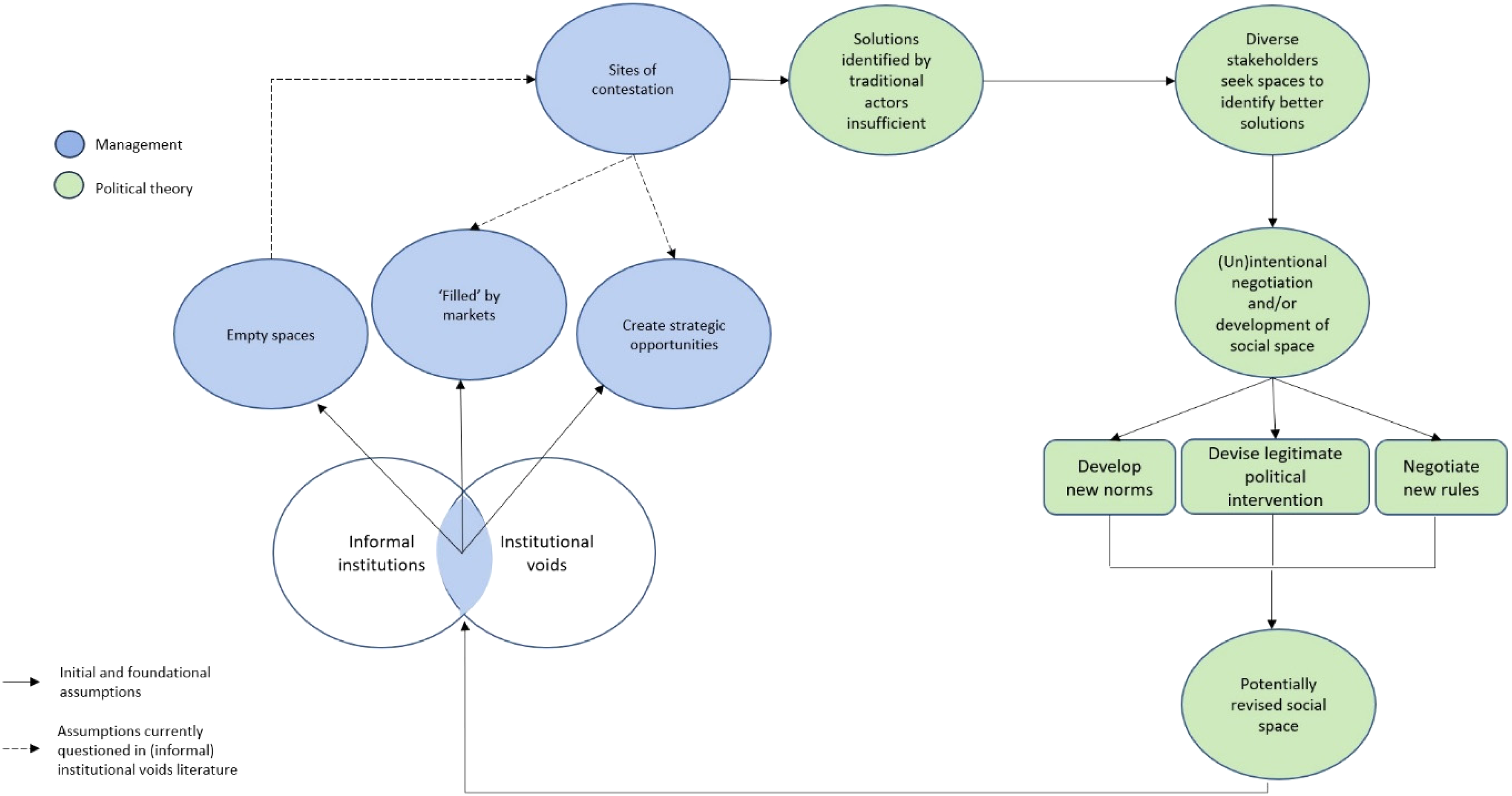
Contribution 1 – Conceptual model of informal institutional voids combining management and political theory literature.
Literature Summary: Reconceptualisation of Informal Institutional Voids
In linking these threads from management and political theory literature together, our main theoretical contribution is to the institutional voids literature in management. We deepen and extend the conceptualisation of informal institutional voids by characterising them as social spaces where actors are engaged in an attempted remaking of a challenged social space. Informal institutional voids are active social spaces, rising out of existing and often conflicting institutions, where the logics, their supporting structures and actors traditionally associated with the institutions, face persistent challenges to their ability to devise meaningful solutions to issues at the nexus of these institutions. New or reframed social spaces to address these concerns are inhabited by more diverse and widely dispersed actors, where new norms, rules and political interventions are negotiated and developed in an effort to create solutions more appropriate to and benefitting the wider group.
Using the foundation of our more detailed conceptualisation of informal voids, we posed the following research questions:
Through what activities do actors (un)intentionally attempt to navigate voids as sites of contestation? How do actors, faced with an informal void at the interface of health and urban development, attempt to engage in the three core activities?
Using our data, we answer the first research question by providing details of how the often-conflicting domains of health and urban development (Le Gouais et al., 2023) operate at the interface, and how actors (often unintentionally) attempt to reshape the interface to better suit their needs. We answer the second research question by discussing examples of the three types of activity within the extended conceptualisation of voids: developing new norms, devising political interventions and negotiating new rules.
Methods
Data Collection
Similar to Calvard et al. (2023), data were collected as part of TRUUD - a large transdisciplinary research project on better integration of health outcomes in urban development decision-making. Within TRUUD, the team collected rich qualitative data through 123 semi-structured interviews with 132 senior urban development actors between May 2021 and October 2021. Semi-structured interviews were used to uncover in-depth, nuanced and somewhat hidden insights (e.g., Ritchie & Lewis, 2003) into the interface of two complex systems: health and urban development. Through seven disciplinary specific sub-teams of researchers, we investigated the interplay of these two systems with a wide range of actors across the system of urban development (Le Gouais et al., 2023). One of the findings from this data set indicated the presence of an informal void (or contested space at the interface of health and urban development). The coauthors then engaged in a second phase of analysis on this data set, targeting all data relevant to what characterises this informal void and how it functions.
Sampling
Our purposive sample was identified through two inclusion criteria: one, influence within urban development as determined by formal position, place in the decision making process and centrality within the system; and two, understanding of urban development, as evidenced by authorship of relevant reports, papers and other media, and recommendations by urban development insiders. Our initial sample database was created through rigorous desk-based searching activities, literature reviews, stakeholder mapping exercises, contacts within the urban development industry, and a related pilot project. This activity resulted in 500+ names across the many components of urban development (e.g., national government, local councils, developers, real estate investment, land control, etc.). We narrowed to 10 starting names for each of the seven sub teams through discussion based on the evidence collected, team expertise and number of recommendations. We then adopted a snowballing technique (Handcock & Gile, 2011) to identify additional actors across the urban development system (see Table 1). We stopped inviting additional participants to interview when we reached ‘meaning saturation’ (Hennink et al., 2017; Hennink & Kaiser, 2022). 2
Summary of Interview Participants.
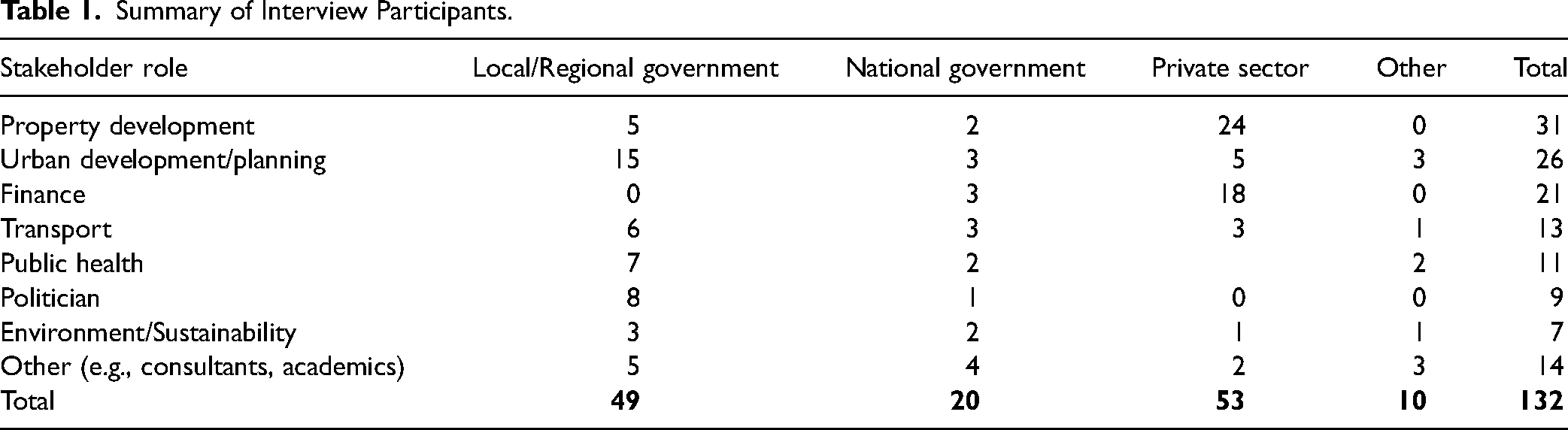
The average length of the interviews was 56 min, with a range of 45–78. Although the current paper draws on the overall data set from 132 interviewees, it focuses on data related to informal institutions and informal institutional voids.
Data Analysis
We used an iterative, abductive approach to data analysis (e.g., Timmermans & Tavory, 2012), conducted in two phases following Braun and Clarke's guidance on template thematic analysis (e.g., 2006). This combination was employed in the first phase of data analysis, resulting in evidence of informal voids. It was then used again in the more targeted and in-depth second phase of analysis of informal voids, leading to the identification of three aggregate theoretical dimensions forming the basis for this paper.
Abductive analysis is a creative process used to examine how the data support existing insights, as well as how the data may call for modifications in existing understandings (Kennedy & Thornberg, 2018). This approach requires researchers to constantly traverse between data and theories, making comparisons and interpretations in the search for patterns and the best possible explanations (Thornberg, 2012). In both phases of data analysis, we iteratively moved between the data and the relevant theories, literatures, and previously compiled conceptual frames. We also moved back and forth between the various phases of data analysis by immersing ourselves in the data, and by using theory-driven deductive reasoning (Sala & Pratt, 2023).
Phase one - the overall data analysis conducted as part of the TRUUD project - began with a small book of deductive codes (Braun & Clarke, 2006) identified through a rigorous interdisciplinary analysis of ten core thematic areas of relevance 3 and resulting eight research questions. Members of each seven interview sub-teams conducted line-by-line coding of their own interview transcripts in NVivo 12. All potentially new codes inductively derived from the data were discussed during the weekly coding meetings to determine their novelty to the code book, with discussion often including reference back to raw quotes and context of such as justification for proposing the new code. Proposed codes and categories were discussed until agreement was reached as to whether to drop, merge, split (Grodal et al., 2021) or accept the code/category for addition to the code book. Updated versions of the code book were sent out following the weekly meeting to be used in subsequent analysis for that week. This happened over the course of three months. Double coding was conducted to determine overall agreement with how the raw data was coded between researchers of different disciplines working to a common set of research questions and phenomena. This qualitative assessment demonstrated a sufficient ‘consensual interpretation of the data’ (O’Connor & Joffe, 2020, p. 5).
The 123 interviews resulted in a total of more than 300 codes grouped into 22 relevant categories, with one key finding relating to significant contestations between the worldviews and application of existing institutional structures. Given that the coauthors had the institutional voids literature and related theories “ready-to-hand” (Heidegger [1927] 1996), we saw this finding as evidence of the presence of an informal void, and subsequently decided to further investigate this by re-immersing ourselves into the same data set while also attempting to build on existing theories and insights (Walsh et al., 2023) on (informal) voids from management and political theory literatures.
For our phase 2 analysis, we followed in the footsteps of Calvard et al. (2023) by going back into a previously created data set to further investigate a more specific set of questions. In our case - the functions and mechanisms of the previously identified informal void. We started our analysis in the second phase by taking guidance from the previously compiled conceptual frame (Figure 1). Our prior conceptual understanding set parameters as to what we were initially looking for, which prevented the discovery of findings irrelevant to our two research questions. We then iteratively used empirical insights from the data that were meaningful to our interviewees and insights from the extant literatures, which enabled us to one, challenge some of the existing assumptions on institutional voids and two, (re)conceptualise how actors, faced with contestations between health and urban development, may deal with informal institutional voids.
Similar to phase one, the phase two data analysis process incorporated an iterative, abductive approach (e.g., Timmermans & Tavory, 2012) and Braun and Clarke's (2006) guidance on framework style thematic analysis, but where there were three differences: one, the analysis was conducted by one of the sub-teams (the current authors); two, double coding was no longer necessary; and three, rather than the ten concept areas, the second phase relied on literature discussing (informal) institutional voids found in management and political theory. Figure 2 shows our data analysis framework in the second phase.
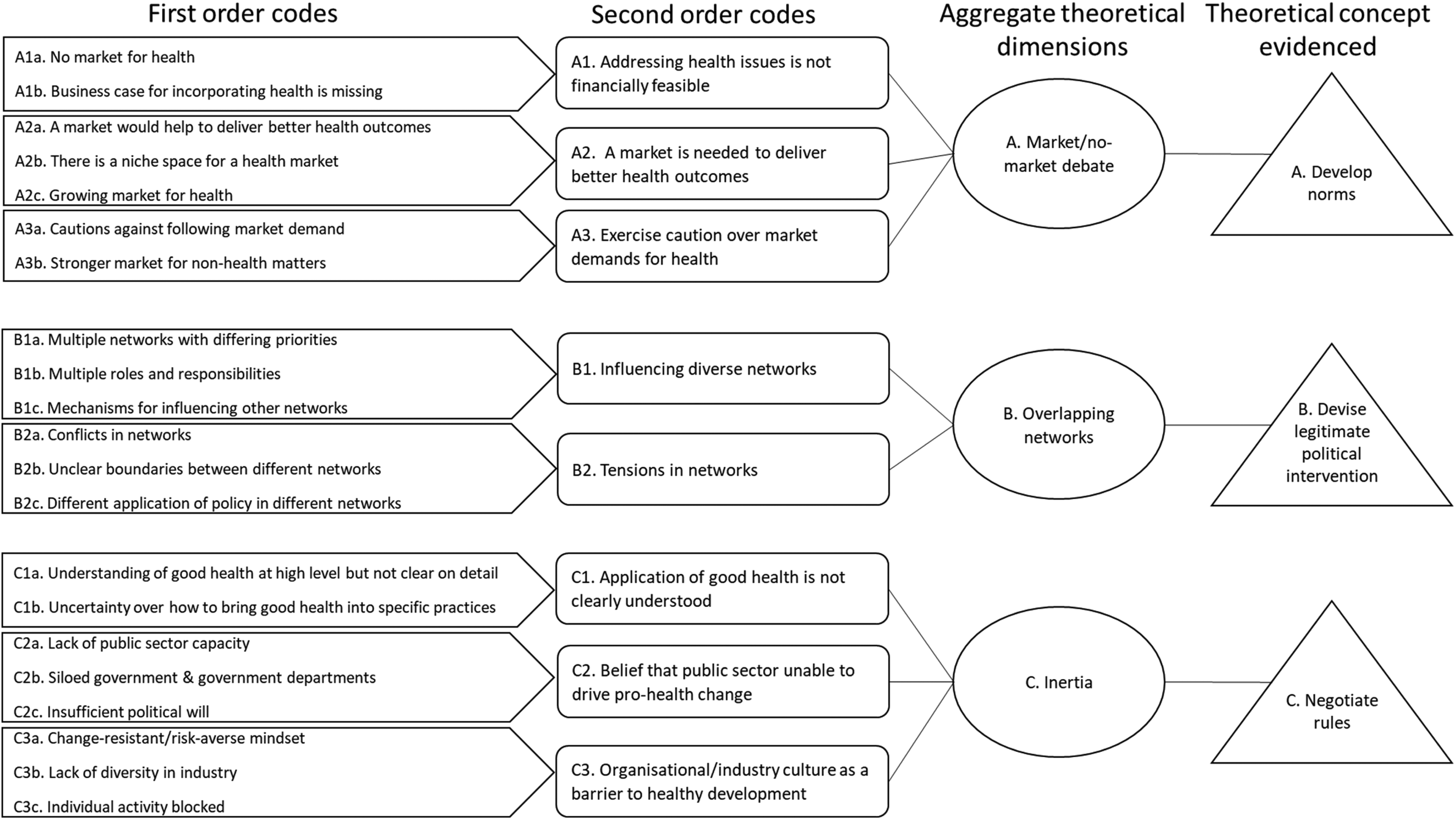
Data analysis framework.
The data analysis approach in phase two was operationalised through two stages of iterative coding, both relying more heavily on the analytical move ‘asking questions’ (Grodal et al., 2021). One, having looked further into the (informal) institutional voids literature to familiarise ourselves with current conceptualisations within both management and political theory (e.g., Timmermans & Tavoy, 2012), we used an open (re)coding process similar to Corbin and Strauss (2014), on the full data set to answer our first research question—through what activities do actors (un)intentionally navigate voids as sites of contestation? This enabled us to use the specific lens of the institutional voids literature to further identify the character and nuance of voids. The open (re)coding process began by revisiting each transcript for any data relevant to informal institutions and/or voids as informed by our theoretical investigations of the management and political theory literature on (informal) institutional voids. Each piece of data was thematically coded into an open code book. The code book was developed by iteratively interrogating the transcripts and deductive codes to determine fit, with existing codes, modification and subsequent merging of codes to incorporate similar data, codes that need to be dropped (Grodal et al., 2021).
The first author conducted the coding to ensure consistency, and regularly discussed the developing code book with the second author. At this stage of analysis, the discussion focused on such things as whether the proposed codes fit the raw data, how the proposed codes related to others previously identified, how these codes related to the research question and the extent to which the codes fit existing theoretical conceptions of informal institutional voids (e.g., Timmermans & Tavoy, 2012). The open codebook was developed through an ongoing process of interrogation of the transcripts and regular discussion over the course of two months. For instance, this resulted in codes such as ‘no market for health’ (A1a in Figure 2) and ‘understanding of good health at high level but not clear on detail’ (C1a in Figure 2). We also began to derive second order concepts within the latter stages of the open coding, as clusters of related codes became more apparent. This process was also iterative, moving back and forth between first order codes and supporting raw data to proposals for second order codes. We engaged in similar types of discussion, but this time at the level of category, rather than code, and which lasted for a further month beyond open (re)coding. This resulted in second order codes including ‘addressing health issues is not financially feasible’ (A1 in Figure 2) and ‘application of good health is not clearly understood’ (C1 in Figure 2).
We then moved into a second stage of coding, where in addition to ‘asking questions’, we also used the analytical move ‘developing/dropping working hypotheses’ (Grodal et al., 2021). Starting with our second research question—how do actors, faced with an informal void at the interface of health and urban development, attempt to engage in the three core activities? — we explicitly compared the second order codes with our developing theoretical work on institutional voids. For instance, theoretical insights into voids as sites of contestation (Mair et al., 2012), and development of norms as one type of activity in this contested space (Hajer, 2003), combined with the second order codes in A1-A3 of Figure 2 enabled us to tell a richer story about the nuance of how norms are being developed around the market/no-market debate. In this way, we were able to integrate insights from political theory literature (Hajer, 2003) on the three core activities within voids, with empirical support from the interviews on how this core activity functions and that led to challenging the assumption within the institutional voids literature in management, that markets are an endpoint or solution to voids.
Combining insights from the literature, the data, and the specific research questions posed in this way, enabled much richer and more nuanced insights into what occurs within informal institutional voids.
Findings and Analysis
Analysis of our interview data, collected from senior professionals working within the urban development industry in England, provides evidence of an informal void existing at the interface of health and urban development. This void is not an empty space, but one full of contestation where actors are (un)intentionally attempting to remake the space into one that better suits their own agendas. Their attempted remaking incorporates the three core activities discussed in political theory literature — developing new norms, devising new conceptions of legitimate political intervention and negotiating new rules (Hajer, 2003). The data to follow demonstrates one example for each of these core activities. Linked to Figure 2, the remainder of this section provides detailed evidence of one example for each of the three core activities.
A. Developing New Norms—Debate on Health as a Legitimate Market
The debate over whether there should be a market for health within the urban development industry is evidence of the first core activity within voids —developing new norms (Hajer, 2003). In particular, we focus on the debate around the norms associated with whether a market for health is a legitimate and useful way to promote health within urban development practice. The institutional voids literature in management often indicates that markets or market-based mechanisms are a solution to voids, whether articulated as absences (Khanna & Palepu, 1997) or as sites of contestation (Mair et al., 2012). Our data, however, does not indicate a clear link between the resolution of voids and markets.
Up until quite recently, it was accepted that profit for profit's sake on the basis of things like land valuation was an acceptable and legitimate goal for urban development projects. However, pressures around urgent issues such as climate change and the need for healthier urban spaces particularly brought on through Covid-19 are bringing norms of the need for higher quality, healthier development into conflict with an expectation of highest possible profit. ‘…it's only been in the last two years that we’ve touched how health and wellbeing is even a topic of conversation’. ES5 – Innovation and Energy Consultant. ‘…when you meet with a contractor and he tells you well darling, this is the way we’ve always done it, you think well actually I’m not your darling and you could probably think about different ways of doing it … the construction industry's really dynamic and people are not aware of how much they’re influencing people's lives. They’re not delivering a product, it's where people are going to live, this is where kids are going to grow. You know it's such a massive importance in a lot of people's lives that you know if you kind of keep that in mind, perspectives will change but it's hard sometimes I’ll say … Yes we all need to make a profit and that's absolutely right but how are we making the profit. That also matters.’ O2 – Senior Project Manager of a multinational management consultancy.
This increasingly contested normative space at the intersection of health and urban development is shaping what is deemed a legitimate ‘use’ of health within the practice of different urban development professions. Attempted remakings of the normative space often centre around whether potential customers care enough about health to pay more for it in the design of urban spaces and thus making it valuable enough for developers to do so, or whether it is appropriate and/or possible to monetize health.
On the first point, the debate is rather binary. Some participants describe a niche and growing market for health within urban development. They talk about customers as looking for and prepared to pay for ‘health’—for instance healthier living and working spaces (A2 in Figure 2). ‘I think it's becoming more and more important because we’ve seen studies of how people that have assets that have better ratings [e.g., BREAM] get or are able to charge more money and more rent, so it's certainly something that is becoming a mainstream with all the companies’. ES5 - Innovation and Energy Consultant ‘So we were seeing [health] quite heavily demanded by some of the more top tier clients like the banks and stuff like that, they wanted clean air, they wanted a good space for their staff to work in… So, you know, if you’re going to move into somewhere that's got clean air then accept that they’re going to look after your health then you’ll get a premium for it, people will pay more money. ES3 - Urban planner & sustainability expert.
‘With these low traffic neighbourhood demonstrations and trials, people get very unhappy when you impinge on what they see as their rights to drive whenever they like, wherever they like, park their car wherever they feel like…’ T6 – Transport Planner.
‘There is only a certain amount of time for everyone to deal with the scheme and if health gets ignored then it gets ignored and if it drops off the bottom of the interest table because people are interested in all these other things first then it can go down the pecking order a bit’. PD11 – A senior figure at a global real estate services company.
The debate around monetization is however much more nuanced. Norms around the extent to which it is useful and appropriate to monetize health in aid of a market for health demonstrated attempts to understand and reshape the contested normative space. The current dominant norm of profitability is represented by statements such as taken-for-granted assumptions of health as a part of the balance sheet. Those representing this part of the normative space often do not challenge their own or other norms, confident in the ‘rightness’ of their statements. ‘In a developer's spreadsheet, those [pro-health initiatives] are, essentially, costs and the more you can squeeze them, then the better your bottom line looks. And, if you’re being hammered on affordable housing by a local authority demanding an awful lot as the price of planning permission, then you have more incentive to squeeze your costs elsewhere’. PD21 – A senior property development consultant.
Others are much more thoughtful about the impact of a market for health and the subsequent monetization of such on urban development practice (A3 in Figure 2). For instance, some reinforce the norm of monetization in general, but challenge the usefulness of doing so on health issues. ‘Throwing monetary figures at things doesn’t really work in the transport sector because transport infrastructure costs so much money but saying that you’ll save X amount of money is always a drop in the ocean compared to the amount that they’re already spending year on year. So understanding how much money people are spending is important for understanding how big a number seems to them when you’re saying that they’re saving this amount or that amount. So the monetary thing is an issue’. T7 – Founder of a transport consultancy.
‘So you could have something which was a fabulous [healthy] scheme but actually it's going to marginalise a significant number of people that are typical voters, and therefore potentially have a significant electoral impact, and in which case it doesn’t happen. Because people don’t want to lose something that they’ve got, road space, parking, whatever it might be. And as a consequence you know even if it's a scheme that's particularly strongly aligned with [health] policy and has great data to back it up, that decision will not be taken, or the decision will be taken not to progress that’. T8 – Former Local Government Officer and Founder of a transport consultancy.
‘…part of the problem is that there's so few [healthy] schemes now that we've put into poor places for the reasons I explained earlier [i.e., in those areas there is low demand for healthy environment or poor understanding of health issues in general], so the developments in the private sector and the city centre generally speaking are for young healthy mostly white folk and so nobody really cares about that as an issue there’. P8 – Policymaker/Civil Servant.
Others still thought through the impacts of shifting health norms on the market place, but without questioning norms around the role of demand in doing so.
‘So I think the shift will take a little bit of time and it will be driven by demand. It will be people demanding you know, I don’t want to go into a shop that is not healthy. I don’t want to be in a hotel that is not healthy and the same that happened with ratings. Like when you’re buying a house you know what your electric bills are going to look like. People will soon start demanding how healthy is this house. You know what ratings it has, was the off-gassing is or does it have any electro-magnetic fields or you know was the orientations or what is the comfort levels, humidity levels and I think at some point there will be rules that those ratings will need to be provided whether you’re renting or buying a house and you know’. ES5 – Innovation and Energy Consultant.
Thus, for many decision makers, the contestation in this space means that they no longer feel comfortable with, or that it is acceptable to, rely on the existing dominant norm of profitability above all else. Pressures for health, along with general agreement of the need for healthier spaces results in many different attempts to understand and shape the normative space at the interface of health and urban development. The market for health is therefore not seen as a straightforward or desirable response to the informal void for most participants. Similar to Banerjee and Jackson (2016), many participants question the positive benefits of a ‘health’ market and rather wonder about the extent to which it may undermine positive and meaningful action on health.
B. Devising Legitimate Political Interventions Through Overlapping Networks
The void at the intersection of health and urban development also demonstrates a significant amount of work to convince others of, and have some control over, the developing shape of contestations within the void. This is evidence of the second core activity within voids —devising legitimate political interventions (Hajer, 2003). In particular, we show evidence of actors trying to navigate diverse views within the different networks of the urban development industry, and how those actors who span multiple networks are able to create new sources of power and influence over the way forward. Work in this area is often more intentional than the normative work, as actors seek to engage and intervene with others in ways that best support their own agendas. As such, networks are a key tool used in attempts to remake the contested space.
Those who considered themselves somewhat more successful in shaping the way forward for health in urban development practice believe it is through securing roles across multiple networks. In so doing, this extends the reach of the actor, and of their ability to intervene in shaping the political landscape around health in their part of the industry (B1 in Figure 2). ‘My role is actually fairly unique, both in ((city)) and nationally… So my role is co-funded by the ((public health directorate)) for ((city)) and the ((placemaking directorate))… So, we’re fairly unique, as you’re probably aware most planning policy teams either recruit consultants in to do appraisal etc, or there is a planning officer in the team responsible for leading on it… I speak fluent planning and I speak semi-fluent health, Public Health, I know what a cohort is, and I understand what Public Health people are talking about a lot of the time. It's nice, I can often translate between the planners and the health people’. ES3 – Urban planner & sustainability expert. ‘My range of roles is not just as a developer, I crossover into public sector in the roles charitable work and so forth and obviously the considerate parts for that all vary.’ PD19 – Executive Chairman of a large real estate company.
‘…you have to work with so many different people. You know, planning, urban design, transport, economic development, leadership, senior leadership within the organisation, members. You have to work effectively with community development, employment and skills, so there's a raft of multidisciplinary services that you need to be linked in with…and also funding is key, so nothing can happen without the money, so wherever your funding sources coming from externally. Then the next layer, once you’ve done internally, is the community, stakeholders, businesses, partners. Then there's statutory stakeholders, the next layer, so Environment Agency, Homes England, ((Combined authority)), the services and then beyond that there's kinda, you know, government big scale schemes. So again, a raft, array of different and diverging partners and stakeholders to unlock delivery’. UDP25 – Local Government, Urban Development.
It also requires an understanding and ability to navigate conflicting priorities.
‘… in ((County A)) where there was a real cultural difference between the planners and Public Health where the attitude was from the planners that what Public Health wanted was effectively social engineering and that it is not their job to be shaping places to be healthier for people and that really they’re focussed on economic value and amenity and get the issues around litter and noise pollution but don’t really get the wider issues around the health benefits of green and blue space, active travel or healthy living environments and the food environment’. PH4 – Public Health Consultant.
In navigating these different networks with diverse actors and often competing priorities, the most influential actors attempt to use three types of engagement devices to exert influence on others to get things done: a)‘bridges and brokers’, where bridges overlap networks and use broader knowledge to influence decisions, and where brokers make changes happen by bringing people and ideas together; b) ‘proxies’, where individuals seek to generate indirect influence by working with a close network connection to the ‘real’ target; and c) ‘utilising champion/role model’, where bold and/or radical actors stick to the decision they have made and who bring different internal organisational and external organisational factors together in a systems way to try and create sometimes slow burning momentum. Bridge/broker: ‘Urban regeneration generally is about market failure, otherwise you don’t need practitioners like me, and that generally means public sector wading in to support whatever it is and it generally means that you have to have a fairly transparent relationship between the public sector and the private sector and that is quite hard to do and I am fluent in both, uniquely actually’. PD21 – A senior property development consultant. Proxy of others: ‘…so you’re looking always for, who is the person I want to influence? Who do they listen to and how do I package the message so that they may receive it from that source? How do I make sure they receive it well and then how do they know what it is they need to do next?’. T4 – Founder of a transport consultancy firm. Utilising champion/role model: I’ve been training offices in other authorities around the country and also developing a national version of this design tool that I developed for ((City A)) because there's a demand and interest for a version that isn’t ((City A)) specific which will be published shortly, and I think that maybe what's missing in those other places is that they don’t have somebody within the organisation doing the systems change that I was doing in ((City A)). So, you need someone [like me] in each of those places who is working with the community advocates. Working with the intelligence and data team. Working with the politicians. Working with the designers. Training people up. Working across all these different decision-making processes to get enough of a momentum of things start heading in the right direction’. T7 – Founder of a transport consultancy.
C. Negotiating New Rules and Resulting Inertia
The third core activity identified as existing within informal voids is that of negotiating new rules (Hajer, 2003). Our data indicates that rather than creating strategic opportunities as found within the management literature on institutional voids (Doh et al., 2017), the combination of normative work on a market for health and uses of networks for political intervention are as yet in sufficient flux as to mean actors are not confident to negotiate new rules and practices. This is creating inertia when it comes to incorporating health outcomes in urban development policy and practice. The participants are very interested in, and are seeking new rules to shape their practice, but are struggling for three reasons: one, they are uncertain how to apply ‘good health’ in practice (C1 Figure 2); two, they do not believe the public sector can drive pro-health change (C2 Figure 2); and three, industry culture is a barrier to healthy development (C3 Figure 2). In other words, while most urban development actors want to see new rules and practices developed, they struggle to see how and where this might happen. They do not know who to trust in negotiating the contestation between health and urban development. So rather than creating/providing strategic opportunities for organisations and actors, this contestation is resulting in inertia.
Inertia in new rule making is first driven by a rich understanding of health and the importance of including health in urban development practice in general, but with confusion over the pathways through which urban development activities could improve health outcomes. ‘I think it's that word. ‘Health’ is too broad – that's what I’m struggling with. It's about breaking ‘Health’ down – it would be breaking that word down – exactly what I just said about environmental sustainability, climate change, community connections. I think ‘Health’ is too broad ‘cause I can’t grab it. It's too big because it embraces so many different elements’. PD22 – A senior local housing manager
‘…[health] we think is important…to invest to try to enact social outcomes. We do have three social goals…One is to invest two and a half billion in social infrastructure between now and 2025, another is to invest in projects that support social mobility, and another is to create social value through our investments where we have asset management responsibilities….what I would say is that whilst we have our goals…how [will] we deliver against those goals?… so, yes, it's important and health and well-being and ensuring that we don’t negatively impact, and that we try to positively impact our stakeholder groups…we just can’t set out the framework of exactly how we’re going to do that’. F18 – Fund Manager of a private financial services company.
Which in turn leads to a wide range of interpretations of what a ‘healthy place’ should look like.
‘Because there’ll be some in society who think a healthy place is basically an open meadow and there are others that think it's a well-designed pair of houses, there are different definitions … the lack of a common view as to what it looks like allows people to kind of come up with their own interpretations. At which point they can just build a 5,000-home housing estate and one small play park in the middle of it and say ‘look it's healthy’’. UDP2 – A senior official in a government department.
Attempts to derive or negotiate rules in such contested spaces are problematic, particularly as informal voids come into being in large part due to a lack of trust in more traditional rule makers’ ability to solve the contestations creating the void (Hajer, 2003; Mair et al., 2012). Many actors sitting outside traditional rule making bodies thus struggle to see how they can drive the necessary, in this case, pro-health change.
‘[Health]'s a UK Government requirement. The challenge of that is that actually the UK Government has no capacity to enforce or measure those standards, and people kind of know that, so people under less scrutiny than a big PLC may not do it’. PD14 – A senior investor/property developer.
‘…the structures and the financial envelope that combined authorities work within is quite influential, and it's quite clear the type of areas in which the government wants combined authorities to make decisions… I would say combined authorities have been given powers which track those of the Homes and Communities Agency, but they, on the whole, don’t really have the capacity or the money to put those into effect’. P6 – Systems expert and policymaker.
Even actors within traditional rule making bodies question the ability to negotiate rules in the contested space, as vested interests and existing structures create substantive obstacles to the negotiation of new rules necessary to navigate the informal void.
So quite often, to be quite frank, not very good developments get through and this is probably a countrywide issue as well, because there are very few local authorities who have the resources to potentially risk a challenge and I know that, for example, the ((location)) in ((city)), the original ((job title)) of ((company)) on that site ((company)) lost and it cost them £250,000 and that's a lot of money for a local authority. So I think, in the planning sphere, there is quite a high level of risk around that and so developers tend to be quite powerful and they get what they want and they’ll also play local authorities off against each other and they’ll go, oh well, if you don’t want it we’ll go to ((town a)) or we’ll go to ((town b)) or wherever and cities want development and they want that, new jobs and new houses and whatever in the city centre’. T6 – Transport Planner.
Given that rules are often outcomes of normative and political work (e.g., Scott, 2013), and that the nature of voids is that they are contested spaces (Mair et al., 2012), negotiating new rules in this space is difficult because it relies on some agreement having already been reached as to the new way forward. If not, the contested space continues to operate along existing rules according to previously agreed priorities.
‘Thinking of working with [local council] and other local authorities, in an age of austerity they are stretched and sat at their desks trying to their work. What they don’t wanna do is go, ‘I have to sit here and think about a whole new way of doing something when I could do it the way that I have been doing it and get it off my desk in five minutes’. O3 – A senior third sector actor.
The public sector, especially the local councils, seemed to have limited ability to push for legal reforms. The local councils have a lot of competing priorities, and all their services have pressure to deliver, despite a lack of resources. Despite having the power and authority to engage in the negotiation of new rules, these bodies fell back on current practice which is resulting in at best ‘business as usual’ and at worst, a vicious circle of inertia. ‘And there can be this problem with [local council] wanting to make a decision in case they’re blamed for making the decision. So of course, all they do is just push everything down the road, because if they make a decision, they’re worried that's it. So, it's the worst of every single world because they’re not making decisions. Doesn’t matter if it's the wrong one, they’re just not doing anything’. PD15 – Senior Manager at a global real estate services company
The same pattern was found outside traditional rule making bodies, where the ‘rules of the game’ (Scott, 2013) and thus the place for negotiating new rules, were confounded by the culture of urban development industries. For example, when asked about who had the final say on the inclusion of health within a project, private sector organisations often defer to their client. ‘The client has to be a major influence because, at the end of the day, they pay us, they’re the ones who commission us’. T1 – Senior Transport Consultant, Third sector. ‘I think it would tend to be our client who's paying us money … I try and instil in our own engineers that they’re kind of conscious of who is responsible for the genesis of this building in the first place and who's responsible for appointing us to the project in the first place, which is our client and so if there's a decision which we’re struggling to make, then probably the first and last say on that is the client. It's kind of how do you want us to decide this. We’re not sure what you want. Or we’re not sure the right way to approach this. We’ve got all of these different parameters and we can tell you these numbers or we can tell you this experience that we’ve had on this other project and but actually we need you to make a call on it.’ ES3 – Urban Planner & sustainability expert.
‘Lack of diversity in the industry, I think, meant that you’ve got one single worldview being hammered out, really, across the UK. Certainly, almost no consideration for groups like children and parents trying to get their kids to school or older people. There was almost zero consideration for those groups over the last 70 years’ T3 – Transport Planner.
‘Something that I’m finding, and I’m fighting it as much as I can, is it's a really biased industry. You need to be a white middle-aged man to be listened to. If you’re an immigrant, if you’re a female, if you’re young then you know nothing’. O2 – Senior Project Manager of a multinational management consultancy.
Those outside privileged categories (e.g., white, male, middle-aged) struggle or are unable to access important decision-making space due to bias within the industry. Thus, they are blocked from spaces in which new rules can be negotiated.
What these different examples of inertia show is that not only are voids not always creating strategic opportunities (e.g., Brandl et al., 2022), but that negotiating new rules (Hajer, 2003) may not be a given in informal voids depending on how new it is as a site of contestation. Actors clearly sought opportunities to negotiate new rules, but often struggled or were blocked from doing so due to the three main reasons demonstrated.
Discussion
In our findings, we provide evidence of informal voids as active spaces of contestation. We show evidence of the three types of activity theorised to exist within voids – developing norms, negotiating rules and devising political interventions. In particular, we find evidence of the development of new normative spaces through the example of the debate on a market for health, and of actors devising legitimate political interventions through the example of networks. Our analysis did provide evidence of actors wanting to negotiate new rules; however, it demonstrated a vicious circle of inertia where attempts at negotiating rules are blocked and/or discouraged. Thus, while providing evidence to support the revised conceptualisation of informal voids (Figure 1), our data also challenges two common depictions in the management literature of markets as solutions to voids and of voids as creating strategic opportunities (Garrone et al., 2019; Mair & Marti, 2009; Mair et al., 2012) (Figure 3). We also respond to calls for research on (informal) voids in Western contexts (Doh et al., 2017; Bothello et al., 2019). In this section, we explore the implications for the management literature on institutional voids as we theoretically extend and deepen the view of institutional voids as sites of contestation. We then also explore the implications of our data for demonstrating this extended conceptualisation. We conclude by outlining the implications for practice.
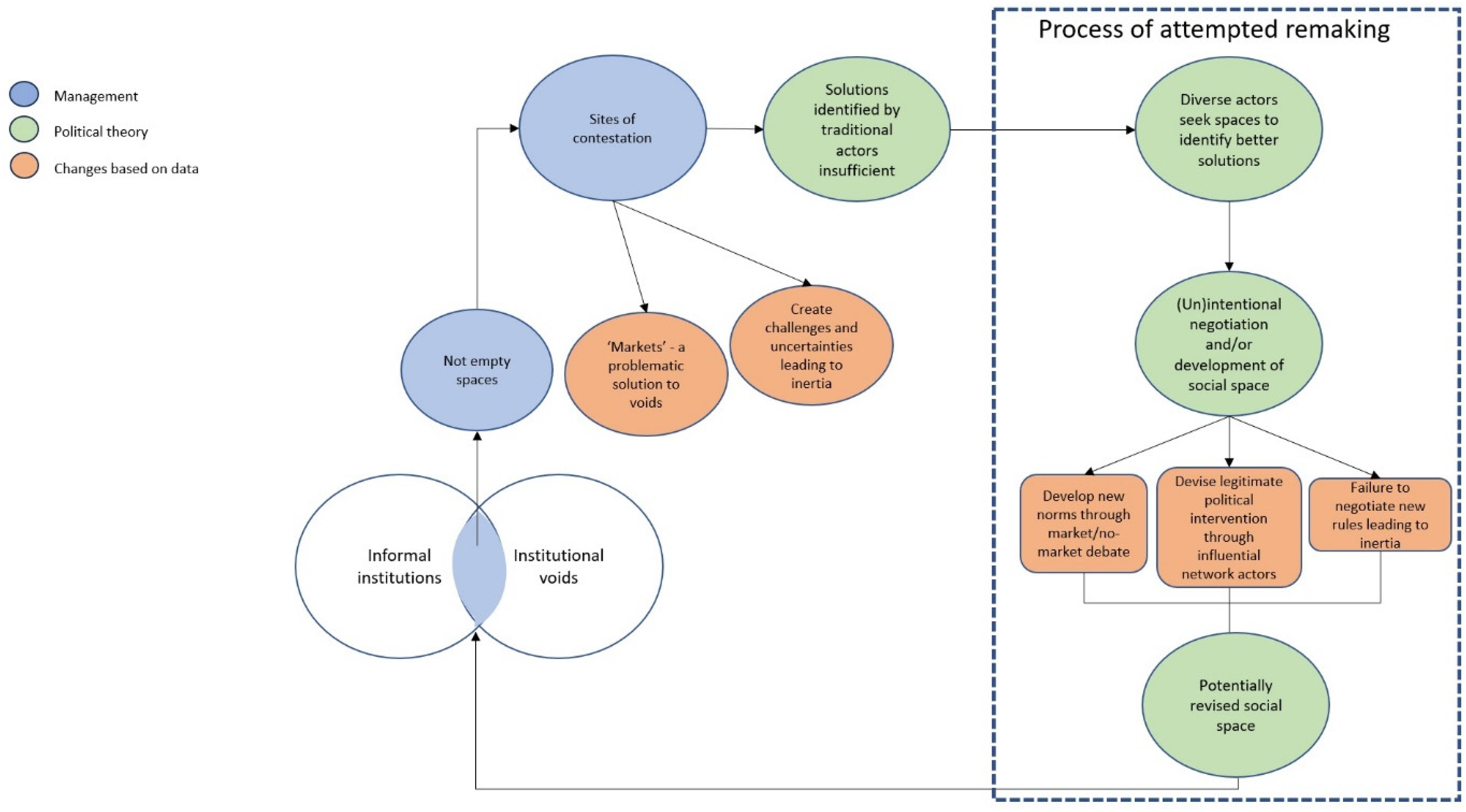
Contribution 2 - Revised model of informal institutional voids based on data.
Theoretical Implications: Informal Institutional Voids as Sites of Attempted Remaking
To date, the understanding of voids within the management literature has focused much more on ‘absences’ within institutions (e.g., Khanna & Palepu, 1997), rather than the active and creative work being done to remake institutions into more relevant and appropriate social spaces. In contrast, our study is among the first to see (informal) voids as active, full spaces (e.g., Mair et al., 2012; Doh et al., 2017). It is the first to bridge the gap with political theory literature by incorporating Hajer's (2003) three key activities that actors undertake in such voids (political theory), with Mair et al.'s (2012) view of voids as sites of contestation (management literature). Bringing these works together has enabled us to enrich the conceptualisation of informal voids as spaces of attempted institutional remaking. We define voids as social spaces created/redefined by more diverse, widely dispersed actors who (sometimes unintentionally) negotiate and develop new norms, legitimate political interventions and rules in an effort to understand and address complex societal issues (Hajer, 2003). Actors are engaged in the attempted remaking of social spaces so as to improve the legitimacy of decision making and institutional arrangements that affect them and their peers in the resolution of these issues. Thus, such voids often exist at the nexus of different institutions and arise due to contestations between them (Mair et al., 2012).
Our extended conceptualisation of voids (Figure 1) is supported and further extended by our qualitative data. Our data supports this extended conceptualisation, by demonstrating examples of how the three activities within such voids are currently being negotiated and developed by senior actors at the interface of health and urban development within England. The data builds on our extended conceptualisation by enabling us to challenge two common assumptions of voids in the management literature: markets as endpoints and voids as creating strategic opportunities. The combination of our theoretical and empirical contribution is depicted in Figure 3.
There has been an (often implicit) assumption, based on a view of voids as absences, that the way to fill or fix a void is through the creation of a market and/or market mechanisms. In some cases, this assumption makes more sense given that the outcome needing fixing is market exclusion (e.g., Mair et al., 2012). However, in others, the assumption is often linked to the need to fix mechanisms associated with weak or inefficient formal institutions related to markets (e.g., Hoskisson et al., 2005). In this way, the creation of the market or market mechanism is problematically viewed as an end point because it is the solution to the problem of the ‘missing’ institutional components (Bothello et al., 2019). In contrast, our findings identify that rather than being seen as a viable solution, a market for health is increasingly challenged as an idea that no longer suits the objectives of the ‘health in urban development’ space. This is in line with previous empirical work that shows markets may not lead to solving social problems, instead market-led approaches may undermine the positive role informal institutions play in addressing such problems (Banerjee & Jackson, 2016). Given that our reconceptualisation of voids and subsequent empirical support demonstrates there is no gap to fill, the idea that voids require solutions to fill or fix them becomes moot. Rather our reconceptualisation of voids shows that they are in fact their own solution, as it is within the voids where actors work (unintentionally) to revise or remake institutions in ways better suited to their needs. It would be interesting to further investigate how power dynamics associated with negotiation within voids are spread among these actors, and the extent to which multiple and disparate voids are able to capture more attention for their own needs.
Our work also calls into question the assumption that voids create strategic opportunities for firms. Again, associated with voids as absences, the extant literature often talks about gaps in institutions that create opportunities for niche markets to develop when firms fill or utilise the void (e.g., Young & Makhija, 2014). While it is certain to be the case that some actors find strategic opportunities created by voids (e.g., Onuklu et al., 2021), our data does not support this, nor does it support the concern that firms might misuse voids to their own advantage (Dieleman & Boddewyn, 2012). Our data shows something altogether different. Many actors instead find it difficult to navigate the interface between health and urban development and to identify who they should legitimately trust when seeking information or a clear decision on health issues. They struggle with ‘business as usual’ mindsets that mean change feels near impossible. Extending our view of informal voids as active and creative social spaces with a wide array of disparate actors also means that a wide array of potential solutions, better or worse evidenced, are present in the disparate parts of urban development. This means that paradoxically, the deliberation and negotiation over the norms, rules and potential solutions are resulting in inertia, as participants feel stymied by insufficient evidence and too many ‘tools’. It is likely that inertia is common in earlier stages of voids in which new voices join the debate, and actors seek to sort through the many ideas being brought to the fore. Therefore, future research could usefully investigate common patterns found at earlier and later stages in the development of voids, with an eye to helping move actors through to more concrete stages of remaking.
In addition to the challenge of markets as solutions to voids and to voids as strategic opportunities, our work has implications for the legitimate contexts in which institutional voids work takes place. The institutional voids literature has recently been critiqued for using vocabularies that privilege Western institutions and presenting Western developed countries as having well-functioning institutional arrangements, while non-Western developing countries are portrayed as having dysfunctional institutions (Dar, 2018; Bothello et al., 2019). Consequently, there have been calls to study (informal) voids in Western contexts (Doh et al., 2017; Bothello et al., 2019). Our work responds to this call and provides rare evidence of voids in a Western country context to demonstrate the need for context-neutral depictions of voids. We agree with recent critiques that countries around the world, whether in developing, developed, or other forms of economic development, can and do have voids in both formal and/or informal institutions (Bothello et al., 2019; Webb et al., 2020).
Our work complements the limited empirical work that suggests that informal institutional voids can play a critical role in driving complex social issues in both Western (Beveridge, 2012) and non-Western (Mair et al., 2012) contexts, such as when societal norms allow for the exclusion of specific groups from market participation (Mair et al., 2012; Khoury & Prasad, 2016), or when limited trust diminishes transacting through relational contracts (De Soto, 2006). We demonstrate that voids exist in rich institutional environments within a developed country, among the ‘presence’ rather than ‘absence’ of formal institutions (Santangelo & Meyer, 2011). These voids exist where formal institutions are not compatible with the ‘informal’ institutions at play (Mair et al., 2012). The (informal) void we presented in the paper demonstrates a case of ‘absent presence’ where many health-related policy tools are available, yet change is difficult due to those tools leading to uncertainty in terms of how to apply good health in practice, lack of trust in the public sector and a non-supportive industry culture not conducive to making pro-health changes.
Overall, our work provides for a deeper and more nuanced understanding of voids as sites of contestation, where actors engage in (often unintentional) attempted remakings of social spaces. These findings help us to challenge some of the key assumptions within the voids literature, and thus have implications for how we understand the nature of voids within the management literature.
Practical Implications: Understanding Agency in Informal Institutional Voids
Our work highlights practical implications for policy makers. The ongoing debate on whether ‘markets’ should play a role in improving health outcomes is a positive force that can inform policies. Evidence suggests that urban development policies endorsing a ‘market for health’ logic also tend to support a ‘monetisation of health benefits’ approach to justify this logic (Pineo et al., 2020; Carmichael et al., 2020). Our work indicates that such an approach is less likely to achieve improved health outcomes, as market demand and/or monetary value for non-health-related matters often outweigh that for health-related concerns. The monetisation of health benefits may not always be possible due to the complex pathways through which health may lead to better economic outcomes, at least in the short term (Bates et al., 2023). We argue that policymakers should prioritise health outcomes, irrespective of whether there is market demand or a business case (i.e., monetisation of health benefits). Without such prioritisation, urban development actors may not contribute to health improvement or may deliver very little, leading to inertia, especially in the absence of a market or business case, as demonstrated in our paper. Additionally, we argue that policies should highlight the wider, long-term social, economic and environmental benefits of improved health (Bates et al., 2023) to encourage people to demand more pro-health developments, regardless of whether there are immediate and/or measurable economic benefits.
Our research also has implications for actors navigating the complexities of urban development systems. Actors within this context often face the daunting challenge of maneuvering through diverse networks with competing priorities. While there are many challenges associated with managing competing priorities, numerous actors and organisations within the urban development system are fervently committed to instigating pro-health changes and contributing to positive initiatives. Our data on devising legitimate political interventions (one of the three core activities in voids) identified three engagement devices (i.e., leveraging bridges and brokers, utilising proxies and tapping into the power of role models) that actors were successfully using to influence the shape of health work within urban development, especially where they lacked direct authority. We believe that actors, particularly those with aspirations for positive change, can benefit from incorporating these devices to create a conducive environment for health intervention and discussion, if not immediate action. We encourage actors not to be disappointed by the lack of hard outcomes (Peeters et al., 2023) or immediate actions from these engagement devices. Instead, they should see these as part of a process to generate slow-burning momentum needed to make changes in the long run (see Provan & Milward, 2001). One recent example of this is the idea of ‘20-min neighbourhoods’ or ‘15-min cities’ (where everyone can meet most of their daily needs within a short walk or wheel from home), which has been gaining momentum for several years and is currently being implemented in major international cities (TCPA, 2023). The idea was first developed by people passionate about active traveling who then partnered with senior decision-makers in charge of big cities to implement it (Jafari et al., 2023).
Limitations
Similar to many other qualitative studies, the findings of our research are constrained by their generalisability. The individuals we interviewed were chosen based on their involvement with and/or understanding of urban development practices in England. While our paper draws on a substantial sample (132 participants) from different segments of the urban development system, further research is required to comprehend the broader perspectives of the numerous urban development practitioners in other Western contexts. Secondly, we used a purposive sampling of senior urban development actors, an approach that may have led to biased responses and provided us with a ‘specific’ viewpoint on urban development practices and health issues in England, potentially differing from the perspectives of ‘less experienced’ urban development practitioners. We attempted to mitigate this bias by gathering data from a diverse range of urban development actors across various sectors. Lastly, the examples we presented to illustrate how informal voids, as sites of contestation (Mair et al., 2012), contribute to inertia in incorporating health into urban development practices in England were derived solely from one type of data, i.e., interviews. Future research should therefore aim to assess, expand, or challenge our findings by incorporating different types of data from diverse Western contexts.
Conclusion
The increased institutional complexity that arises in voids (as reconceptualised), where actors attempt to remake institutions in ways that better suit their needs, is a force to be embraced. The heterogeneity of discussion and debate about how we govern for many and varied complex issues (e.g., climate change or health crises) provides us with the opportunity to experiment with how we manage these at a societal level. The debate over rules, norms and interventions within voids creates a more diverse range of legitimate institutional responses through their co-production with a much broader group of societal actors. Voids therefore provide us with not only a broader range of what is possible in managing the complex issues we currently face, but also enable us to better anticipate and respond to future issues. Therefore, informal institutional voids may well act as the sandpit in which our future and more formal institutional arrangements are identified, tried and tested.
Footnotes
Acknowledgements
We would like to thank colleagues from the TRUUD consortium who provided valuable feedback on a presentation of an earlier draft of the paper. We also thank TRRUD colleagues Professor Sarah Ayres, Dr Andrew Barnfield, Professor Nick Pearce, Dr Geoff Bates, Dr Anna Le Gouais, Dr Rosalie Callway, Daniel Black, Professor Kathy Pain, Dr Heeseo Rain Kwon, Sian Peake-Jones, Dr Caglar Koksal and Professor Cecilia Wong, who, along with us, collected and initially analysed the data used in the paper. Our deep thanks go to Associate Editor Professor Karan Sonpar for his valuable feedback on the previous versions of the paper and to the anonymous expert reviewers for their constructive comments and suggestions. Finally, we are grateful to Dr Juliette Summers, Professor Oliver Mallet, Professor Iain Davies and Professor Nancy Harding for their thoughtful comments on the final two versions of the paper.
Declaration of Conflicting Interests
The authors declared no potential conflicts of interest with respect to the research, authorship, and/or publication of this article.
Funding
The authors disclosed receipt of the following financial support for the research, authorship, and/or publication of this article: This work was supported by the UK Prevention Research Partnership (award reference: MR/S037586/1), which is funded by the British Heart Foundation, Cancer Research UK, Chief Scientist Office of the Scottish Government Health and Social Care Directorates, Engineering and Physical Sciences Research Council, Economic and Social Research Council, Health and Social Care Research and Development Division (Welsh Government), Medical Research Council, National Institute for Health Research, Natural Environment Research Council, Public Health Agency (Northern Ireland), The Health Foundation and Wellcome.
