



Abstract
Human resource (HR) experts are continuously confronted with paradoxical tensions, which they need to navigate to benefit the HR function and the organization. Because the members of the top management team (TMT) are important stakeholders for the HR function, the HR executives’ effective navigation involves visibilizing paradoxes and trickling them up during interactions with the TMT. However, how HR executives (as low-powered organizational actors compared to their peers) visibilize tensions for TMT members is less understood from either the paradox literature or the HR scholarship perspectives. In this interview study, we use a court jester prompt as a narrative generator to explore HR executives’ reflections on using techniques to visibilize tensions within the overarching paradox of social and business interests. Our findings enrich the literature on paradox salience and provide examples of what we term jesting techniques on cognitive (e.g., exaggerating,), emotional (e.g., expressing feelings), and behavioral (e.g, reordering) levels.
Introduction
Human resource (HR) experts are continuously confronted with paradoxical tensions in their work (O’Brien & Linehan, 2014). These tensions are embedded in the nature of employment management (Aust et al., 2015; Keegan et al., 2019) and relate to the necessity of attending to both social and business interests (i.e., people vs. profit; Legge, 1978), strategic and operational concerns (Keegan et al., 2018); or differentiation and integration strategies (Keegan et al., 2018). As the literature has suggested, many tensions HR experts face are or become paradoxical because they are contradictory, interrelated, and tend to persist over time (Aust et al., 2015; Keegan et al., 2019; Smith & Lewis, 2011). One of the most prominent and persistent paradoxes constitutes social and business interests (Aust et al., 2015; Keegan et al., 2019; Legge, 1978). This paradox lies at the heart of HR experts’ work and results from divergent stakeholder interests, such as improving shareholder returns but also ensuring employee well-being (Beer et al., 2015).
Defensive responses to paradoxes, such as aligning with one pole (e.g., business interests), may provide temporary relief (Jarzabkowski et al., 2013). However, this approach may be less advisable for HR experts. Specifically, HR experts aligning with business-centered interests could face a threat to their credibility among employee stakeholders. As a result, their actions may be met cynically (Sheehan et al., 2014). An HR expert who aligns with employee interests may also face a threat to their credibility, as HR function may lose strategic impact and business capability (Sheehan et al., 2014). Thus, ignoring one paradox pole intensifies its pull and leads to further defensive responses, threatening organizational success (Schad et al., 2016). Consequently, and in line with paradox research (Schad et al., 2016), HR experts should effectively navigate tensions to strategically respond to paradoxes and create value for both HR function and organizations (Keegan et al., 2019).
Importantly, for HR executives (i.e., senior HR and organizational development experts with direct access to the Chief Executive Officer (CEO) and top management team (TMT) members), paradox navigation likely involves trickling up HR paradoxes in interaction with TMT members. Many HR-related paradoxes, including the paradox of social and business interests, result from diverging stakeholder interests (Beer et al., 2015), with HR executives often being situated between TMTs and employees (Sheehan et al., 2014). Thus, TMTs, including the CEO, play a vital role in navigating HR paradoxes (Aldrich et al., 2015; Boada-Cuerva et al., 2019; Brandl & Pohler, 2010). For HR executives, TMTs are the most important constituents influencing decisions regarding people management (Boada-Cuerva et al., 2019; Trullen & Valverde, 2017). However, whereas these paradoxes are likely salient for HR executives: i.e., consciously perceived, articulated, and experienced, for CEOs and TMTs, HR-related paradoxes may remain latent: i.e., “dormant, unperceived, or ignored” (Smith & Lewis, 2011, p. 390). Given that TMTs frequently face quick decision-making pressures to move the organization forward, they often perceive paradoxical tensions (including those related to people management) as frustrating and ignore them (Smith, 2014) by marginalizing, silencing, and overlooking stakeholders (Jarzabkowski et al., 2018).
Because strategically responding to paradoxes is not possible in the state of latency (Jarzabkowski et al., 2018), HR executives need to visibilize paradoxes for the TMT and CEO: i.e., draw attention to tensions by making them a topic in specific social interactions (Knight & Paroutis, 2017; Tuckermann, 2019). Literature on how actors visibilize paradoxes to others is scarce. However, Tuckermann (2019) explored how hospital board members visibilized tensions during organizational change by introducing an alternative view or arguing a particular view with factual references. Knight and Paroutis (2017) investigated TMT practices intended to make tensions salient for lower-level managers (i.e., trickled them down). Practices included diversifying techniques (i.e., diverging from existing systems and interests) and consolidating practices (i.e., reinforcing existing systems and interests).
Although illuminating, the limited research on visibilizing paradoxes for other actors on the same or lower organizational levels can only partially apply to HR executives who may need to trickle up paradoxes to TMTs. Specifically, although views of TMT members on the HR function differ (e.g., more strategic vs. more administrative; Brandl & Pohler, 2010), HR executives often operate from low-powered positions (compared to other executives) and are perceived as a less critical function (Enns & McFarlin, 2003; Legge, 1978; Trullen & Valverde, 2017). Whereas powerful actors can influence others more easily, actors with less power and lower status, such as HR executives, may need different techniques to effectively visibilize paradoxical tensions to TMTs (Enns & McFarlin, 2003). For example, HR executives are more likely to use techniques such as ingratiation (e.g., putting the target at ease), inspirational appeals (e.g., appealing to target values), and more informal influencing opportunities involving interactions rather than official documents or emails (Enns & McFarlin, 2003; Trullen & Valverde, 2017). Paradox scholarship additionally extends these techniques by pointing to the roles of humor, playfulness, and emotions in visibilizing paradoxes while interacting with others (Bednarek et al., 2017; Jarzabkowski & Lê, 2017; Pradies, 2023).
This study builds on paradox scholarship and the literature on HR executive–TMT interactions. It uses data from 24 interviews with HR executives to explore how they use jesting techniques in the context of the overarching paradox of social and business interests. Jesting techniques are defined as techniques that use methods such as humor, emotions, and inverted conventional logic “to perform a systematic challenging of organizational doxa, the taken-for-granted, unquestioned truths underpinning the functioning of an organization” (Clegg et al., 2022, p. 549) and to trickle up paradoxical tensions in the context of power imbalances (i.e., by individuals with less power [i.e., HR executives] to actors with more power [i.e., TMT members]). Consequently, our research question is: What jesting techniques can HR executives use to visibilize paradoxes for the TMT and CEO and when are these techniques suitable? We provide three major contributions. First, we use the figure of a court jester—a wise person from medieval times who used provocation and irritation to invert conventional logic (Anderson & Warren, 2011; McMaster et al., 2005; Otto, 2015) and who thus highlighted paradoxes for others (Clegg et al., 2022). Using this narrative generator, we contribute to the growing research on different routes to paradox salience (Clegg et al., 2022; Jarzabkowski & Lê, 2017; Pradies, 2023) and expand the repertoire of techniques by jesting approaches. Our method is similar to the methodological approach of Brandl and colleagues (2019), who analyzed the decoupling processes based on an expert's reflections in the HR field. Using the figure of the court jester, we invite our interviewees to reflect on their own role as HR executives in their interactions with TMT members and to talk about specific situations and constellations.
Second, we contribute to the paradox literature by identifying organizational actors’ techniques to trickle up experienced paradoxical tensions by visibilizing them to more powerful organizational members. Although researchers have explored how paradoxes are visibilized among peers and trickled down to line managers (Knight & Paroutis, 2017; Tuckermann, 2019), scholars have called for additional research on how other organizational actors can visibilize paradoxes (Knight & Paroutis, 2017) and what role power dynamics may play in this process (Berti & Simpson, 2021).
Third, considering that TMTs have been largely absent stakeholders in the HR literature (Boada-Cuerva et al., 2019), we contribute to this literature by identifying a repertoire of techniques that HR executives may potentially use when interacting with TMTs to perform the deviant innovator role (Legge, 1978). In contrast to a conformist innovator role, which is associated with accepting the dominant organizational values and goals (Guest & King, 2004; Legge, 1978), HR executives acting as deviant innovators challenge the dominant values and goals set. There is limited empirical research regarding the deviant innovator role (for an exception, see Aldrich et al., 2015; Buckley & Monks, 2004; Galang & Ferris, 1997; Guest & King, 2004). Importantly, given that there are risks related to the execution of the deviant innovator role, such as the necessity to leave the organization (Buckley & Monks, 2004; Caldwell, 2001; Guest & Woodrow, 2012; Legge, 1978), research has indicated that enactment of the deviant innovator role occurs seldom, and requires fertile ground and particular techniques (Buckley & Monks, 2004). Our study provides empirical insights using HR executives’ reflections on whether the deviant innovator role is primarily a fictional figure invented and proposed by the HR literature, in much the same way as the HR generalist (Brandl et al., 2019). Thus, we explore whether and when this role can be enacted via jesting techniques during interactions with TMTs in the context of paradoxical tensions.
Theoretical Background
TMTs as Important Stakeholders in Navigating HR Paradoxes
The necessity to address the competing interests of various stakeholders (such as CEO, TMT, and employees) lies at the heart of HR experts’ work, making it inherently paradoxical (Keegan et al., 2018). The nature of HR experts’ work can lead to stakeholder overload (Caldwell, 2011) and paradoxical tensions such as strategy versus operation, differentiation versus integration, or people-centered versus business-centered interests (Aust et al., 2015; Boxall, 2007; Keegan et al., 2018, 2019). Paradoxes are defined as “contradictory yet interrelated elements of organization that seem logical in isolation but inconsistent and oppositional in conjunction and yet persist over time” (Jarzabkowski et al., 2013, p. 245). We focus specifically on the paradox of social and business interests, which we broadly define as a paradox occurring between high production levels, financial performance, and management goals (i.e., business interests) versus employee well-being, ideas of fairness, and consideration for employees’ goals and needs (i.e., social interests). The paradox of social and business interests has been demonstrated to be prevalent, reoccurring (Keegan et al., 2019; Legge, 1978), and challenging (Van de Voorde, 2009). In addition, this paradox frequently arises during HR- and TMT-level decision-making and often relates to organizational change, downsizing, or cost-cutting (Collings et al., 2021).
The literature on paradoxical tensions in organizations has indicated that whether a paradox has positive or negative consequences depends on how decision-makers navigate paradoxical tensions (Jarzabkowski & Lê, 2017). Because TMTs (including CEOs) are important stakeholders for HR executives (Beer et al., 2015; Boada-Cuerva et al., 2019; Brandl & Pohler, 2010), effectively navigating HR paradoxes may require involving TMTs. First, TMTs are the key decision-makers in areas with people management consequences (Boada-Cuerva et al., 2019). For example, business strategy decisions (e.g., expanding in new markets or downsizing a business line) clearly impact the design and implementation of respective HR policies and practices (Jackson et al., 2014). Second, because TMTs allocate financial, time, or human resources, they decide on implementing and evaluating HR practices at different stages of their adoption (Boada-Cuerva et al., 2019). Thus, the TMT often approves and implements the HR function's orchestrated initiatives (Beer et al., 2015; Guest & Bos-Nehles, 2013). Third, the TMT's attitudes toward the HR function define the HR executive's practical influence in the organization (Brandl & Pohler, 2010; Caldwell, 2011). Specifically, when the CEO is willing to delegate HR-related tasks and perceives the HR function as competent to execute those tasks, the HR function may exert greater influence (Brandl & Pohler, 2010). Consequently, it is vital for HR executives to effectively interact with TMTs when navigating paradoxes.
However, whereas social and business interests paradoxes may be salient for HR executives: i.e., consciously perceived, articulated, and experienced (Jarzabkowski et al., 2018; Keegan et al., 2019), they may be latent for TMTs: i.e., “dormant, unperceived, or ignored” (Smith & Lewis, 2011, p. 390). Paradox research has indicated that actors may intentionally invisibilize paradoxes to make them disappear from interactions (Tuckermann, 2019). Specifically, because paradoxes challenge rational, linear logic, they are experienced as both emotionally and cognitively threatening (Lewis, 2000)—which is also true for TMTs (Smith, 2014). As TMTs are expected to demonstrate quick decision-making, they undergo pressure for consistency rather than encouragement to engage with the paradox or to allow it to surface in the interaction (Smith, 2014). Because individuals, including the TMT's subordinates, strongly prefer consistency (Cialdini et al., 1995), they may negatively evaluate their seemingly inconsistent leaders (Cha & Edmondson, 2006). Consequently, the ability to visibilize paradoxes (i.e., to draw attention to paradoxical tensions by making them a topic in specific social interactions; Knight & Paroutis, 2017; Tuckermann, 2019) becomes an essential competency for HR executives.
In the context of paradoxical tensions, the HR literature has identified supporting navigating paradoxes in organizations as an important competency for HR experts (Branicki et al., 2022). This may involve visibilizing paradoxical tensions to other actors, including TMTs. Legge's (1978) concept of deviant innovators can explain what visibilizing paradoxical tensions to TMTs may mean in practice. Specifically, Legge (1978) argued that HR experts may apply two strategies in the organization to exert influence: conformist innovator and deviant innovator. Conformist innovators attempt to demonstrate the link between their activities, competencies, and organizational goals within the existing framework. In contrast, deviant innovators attempt to change existing organizational ends by “gaining acceptance for a different set of criteria for the evaluation of organizational success” (Legge, 1978, p. 85). As deviant innovators, HR experts are expected to make the organization aware of the difference in values between different stakeholders (e.g., employees vs. organization), even if this means acting against the organizational imperative of profit maximization (Guest & Woodrow, 2012). For example, in a paradox of social and business interests, HR executives can enact a deviant innovator role by visibilizing the paradox (e.g., making the paradox's pole “people” a topic in a specific interaction at a board meeting or in a one-on-one setting with the CEO).
However, researchers have argued that in practice, HR experts seldom adopt a deviant innovator role (Aldrich et al., 2015; Caldwell, 2003; Legge, 1978) and that adoption of this role requires fertile ground in terms of work environment, support, and set of values (Buckley & Monks, 2004). For example, Buckley and Monks (2004), in their interview study with Irish HR experts, found that although HR experts may attempt to enact a deviant innovator role, organizations might not be receptive enough to their ideas for them to be able to exert influence this way. As a result, HR experts taking on the role of deviant innovators may have to find a new employer more open to such techniques. Indeed, it could be argued that the deviant innovator, as invented and proposed by the HRM literature, in much the same way as the figure of the HR generalist as suggested by Brandl et al. (2019), could be a fictional reality or a myth. In this study, we explore techniques that HR executives use to enact deviant innovator roles and what fertile ground for such techniques is required (i.e., what conditions must be present) for them to be used by HR executives.
Techniques HR Executives Use to Trickle Up Paradoxical Tensions to TMTs
Although visibilizing paradoxes to TMTs is required to navigate HR-related paradoxes, HR executives need specific techniques to be effective. First, as research exploring HR executives–TMT relationships has repeatedly confirmed, HR executives tend to hold low-power positions in organizations (Sheehan et al., 2014). Multiple reasons emerge for their low status, including the inability to prove the impact of HR initiatives on the bottom line (Legge, 1978), a lack of business competence (Sender et al., 2021), and reputation for being non-essential to the organization's day-to-day functioning (Trullen & Valverde, 2017). Qualitative research conducted with HR executives reflecting on their interactions with the TMT has indicated that HR executives face challenges when expressing their opinions in these settings. For example, they consider TMT members to be very bright, money- and status-motivated individuals with strong egos who think “they know everything” (Pritchard, 2010, p. 183).
From a paradox perspective, this power imbalance in HR executive–TMT interactions plays an important role. Specific techniques for visibilizing paradoxes may be necessary because, in settings where power is concentrated, the other parties have limited power to challenge the widespread view (e.g., in board meetings with the CEO). Indeed, paradoxes are likelier to remain latent as the less-powerful party is less inclined to draw attention to the paradox's ignored pole (Berti & Cunha, 2023; Hargrave & Van de Ven, 2017). Berti and Simpson (2021) have argued that if individuals have low power (e.g., lack of control over resources), they are more likely to feel stuck and paralyzed by the paradox because of impossible choices. Such situation may lead to pragmatic paradoxes, dysfunctional situations that lead to a depletion of organizational capabilities (Berti & Cunha, 2023) in contrast to generative paradoxes when “tensions that can be harnessed and leveraged as a force for change and renewal” (e Cunha et al., 2023, p. 455). Thus, the current discussion in paradox literature indicates that individuals with low agency will feel paralyzed by paradox. However, HR executives, even though they often have lower power in TMT settings, are not entirely powerless. In addition, we argue that specific techniques and fertile ground may be required for visibilizing paradoxes in situations of power imbalance.
Indeed, some limited research has postulated that HR executives use specific influence tactics: actions “to change the attitudes, beliefs, or behaviors of target individuals” (Van Knippenberg et al., 1999, p. 807). For example, due to their low-power status in attempts to gain commitment to various goals, HR executives may be more likely to use symbolic actions (i.e., less direct, more subtle behaviors; Galang & Ferris, 1997) and soft tactics such as ingratiation (e.g., putting the target at ease) or inspirational appeals (i.e., appealing to target values and ideals). Such tactics are preferable to hard influence tactics that leave individuals less freedom surrounding complying with requests (Enns & McFarlin, 2003; Ferris & Judge, 1991; Galang & Ferris, 1997; Trullen & Valverde, 2017). These tactics correspond to other organizational actors’ role expectations of HR experts. Role expectations define expected behaviors (i.e., what HR experts should or should not do) given their main constituencies (Gao et al., 2016; Katz & Kahn, 1978). For example, research has indicated that when voicing their opinions, HR experts are expected to influence others in a soft, nondirective manner (Caldwell, 2003).
From the paradox theory perspective, growing research has indicated that techniques making paradoxes salient include both cognitive, rational approaches (demonstrating an alternative view or arguing a particular view with factual references; Knight & Paroutis, 2017; Tuckermann, 2019) and techniques going beyond rational approaches such as humor, playful interactions (Beech et al., 2004; Jarzabkowski & Lê, 2017), irony (Gylfe et al., 2019), ridiculousness (Clegg et al., 2022) and emotions (Pradies, 2023). For example, Jarzabkowski and Lê (2017), who observed board meetings for implementing a new strategy, found that humor brought attention to the paradox, thus visibilizing it. Pradies (2023) showed that, in a veterinary-work context, involving emotions invited a personal connection to paradoxical tensions, rendering the paradox salient.
Thus, both HR literature and paradox scholarship have pointed to the effective use of jesting techniques, which we define as techniques that use methods such as humor, emotions, and inverted conventional logic “to perform a systematic challenging of organizational doxa, the taken-for-granted, unquestioned truths underpinning the functioning of an organization” (Clegg et al., 2022, p. 549) and to trickle up paradoxical tensions in the context of power imbalances (i.e., by individuals with less power [i.e., HR executives] to actors with more power [i.e., TMT members]). Thus, in this explorative research, we address the following research question: What jesting techniques can HR executives use to visibilize paradoxes for the TMT and CEO and when are these techniques suitable?
Methods
Data Collection
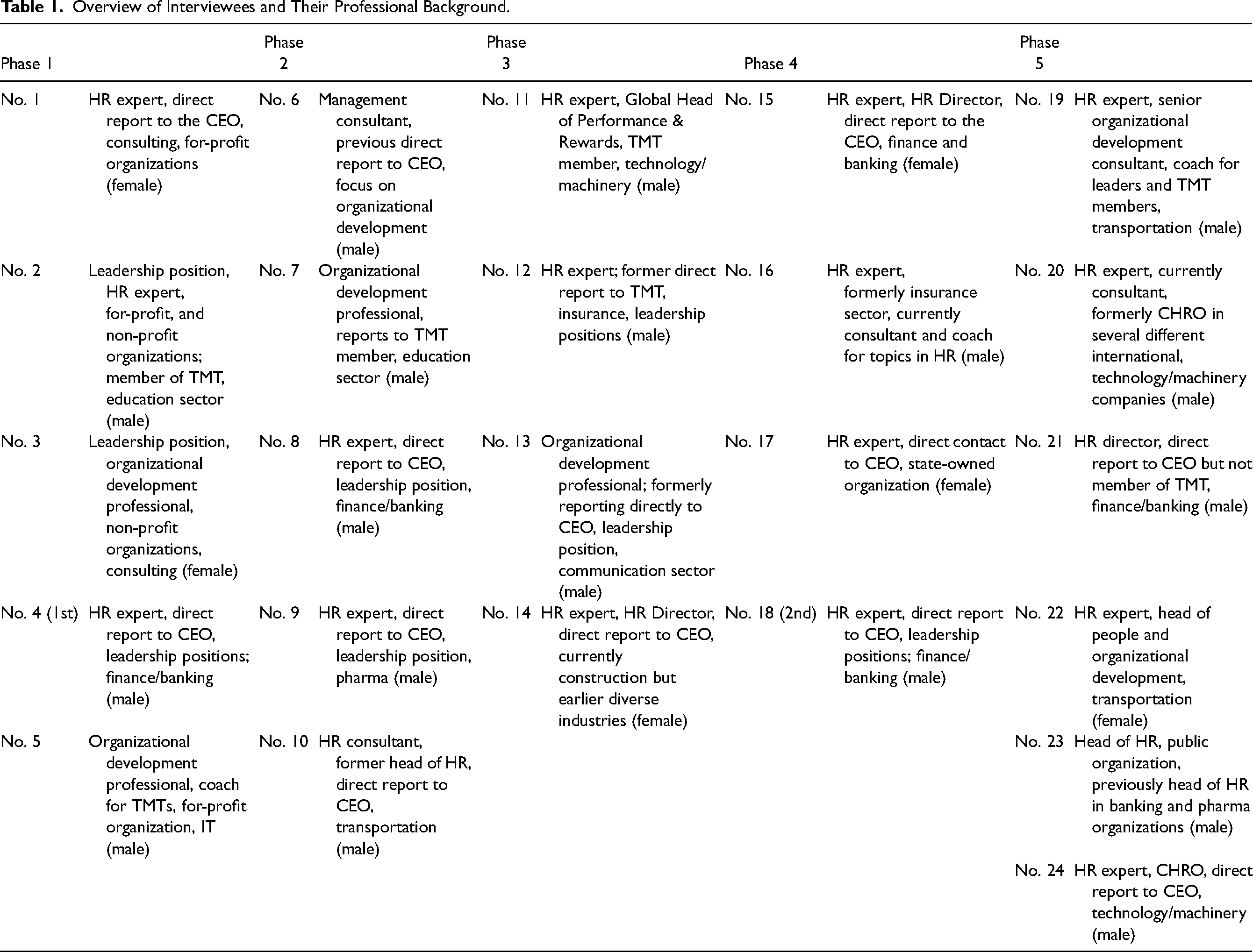
The primary data collection method utilized in this study is a semi-structured interview to generate HR executives’ reflections on their interactions with the CEO and TMT members. We conducted 24 interviews with 23 senior HR- and organizational development experts (one person was interviewed twice). We gained access to interviewees through personal contacts—including a professional HR association. Data collection was conducted in five phases (see Table 1). The sample included six female and 17 male HR executives working in Switzerland in mostly multinational enterprises in a variety of industries. Because we were interested in the interaction between HR executives and TMTs, we focused on senior HR experts at an executive level with direct access to the TMT and CEOs. The above ratio of female to male HR respondents at the executive level mirrors what many authors have found elsewhere (Reichel et al., 2010; Wright, 2008). Consequently, our analysis cannot provide findings that are representative of HR experts in general. With a selected group of HR executives, the focus is on a specific group and their experience-saturated reflections.
Overview of Interviewees and Their Professional Background.
Our study is admittedly a small-scale study with regard to sample size (Hennink & Kaiser, 2022; Tight, 2023). However, several other factors affect the number of participants required for a study to achieve theoretical saturation, such as the quality of the data, the nature of the topic, and the amount of useful information obtained from each participant (Morse, 2000). Consequently, a small sample size does not necessarily invalidate a study as long as a relatively cohesive sample has been chosen (Tight, 2023). This is the case in our study.
In the broadest sense, our approach shows similarities to action research, which Eden and Huxham (1996) describe as “researchers working with members of an organization over a matter which is of genuine concern to them and in which there is an intent by the organizational members to take action based on the intervention” (p. 527). However, in contrast to Lüscher and Lewis (2008), whose action research study featured so-called “sparring” with members of management, we focus on HR executives’ reflections on their own role. We therefore focus in our methodological approach during the data collection phase on “moments of dialogue” (Lüscher & Lewis, 2008; p. 224; see also Gustavsen, 2001, p. 25) between a research subject and a researcher.
The interview protocol was divided into five thematic blocks: (a) Professional background and career; (b) Invitation to reflect on one's organizational role and experiences using the court jester metaphor; (c) Reflection on the HR function: possibilities and limitations; (d) The role of humor in these experiences; (e) Follow-up questions and open discussions. The longest interview lasted about two hours; the shortest, one hour. All interviews were conducted digitally and, with interviewees’ consent, were recorded and transcribed. In the following description, we indicate the interview number in parentheses (see Table 1).
Jiménez and Orozco (2021) recommended that qualitative researchers consider an interview as a series of prompts for interviewees to discuss specific topics related to the primary research interest rather than a list of questions. Our main prompt was to think about the extent to which the court jester figure inspires interviewees to reflect on their roles in interactions with the CEO (i.e., the king or queen) and with other audiences (i.e., the court). Thus, from a methodological point of view, the court jester functioned as a narrative generator and appeared helpful for the following reasons: First, the court jester could serve as a useful metaphor to reflect on techniques that HR executives use in visibilizing paradoxes to others. The court jester represents a wise individual (de Vries, 1990) with deep insight (McMaster et al., 2005) who dared to present different perspectives and helped the king recognize distortions of reality (de Vries, 1990). Court jesters could address problems arising from insufficient reflexivity (Alvesson & Spicer, 2012; Otto, 2015) and strengthen the bottom-up information flow to management (Otto, 2015). The paradox literature has identified this metaphor's powerful role in visibilizing paradoxes for researchers (Clegg et al., 2022). The court jester's “unifying trait is exposing or rendering salient the persistent contradictions of organization, paradoxically providing a space for critique, often through humor” (Clegg et al., 2022, p. 548). Thus, using the court jester metaphor helped generate insights into situations where HR executives visibilized paradoxes to TMTs. Importantly, while introducing the figure of the court jester in the interview situation we allowed our respondents to develop their own image of a jester so that the space was created for experiences and narratives of the HR executives to encourage “moments of dialogue” between interviewee and researcher (Lüscher & Lewis, 2008, p. 224).
Second, given that HR executives face challenges during TMT interactions and from their role expectations (Caldwell, 2003), the court jester metaphor offers helpful insight into generating specific jesting techniques, which may be effective for individuals with lower power status. For example, the court jester used humor, operated within an allowed range of attack (Douglas, 1999), and had official legitimacy to question authority without subverting it (Douglas, 1999; McMaster et al., 2005; Plester & Orams, 2008). The message was delivered in a way that implied the messenger's stupidity—using exaggeration and caricature rendered the jester harmless (De Vries, 1990). Thus, the jester's specific techniques may absorb resistance that could result from strong statements challenging authority (McMaster et al., 2005).
Third, we were particularly interested in interviewees’ reflections on their roles via concrete examples and empirical anecdotes from their everyday working lives. Using the court jester metaphor to describe a person's role is not exactly flattering and can be provocative and irritating. Thus, we used the prompt to spark reflection on the court jester figure and generate narratives on appropriate techniques. This approach fulfilled the golden rule of qualitative interviews: allowing participants to talk (Seidman, 2006). Importantly, the interviewees could distance themselves from the court jester image or embrace it when describing their interactions with TMT. Our initial interviews revealed that interviewees frequently used the court jester metaphor, which helped generate stories and examples of interactions between HR managers and TMTs. The following quote illustrates this effect: I have, and this is very interesting, I have used the term “court jester” in my work, and I said, to a certain degree, I am a court jester because it has to be my goal to be able to say anything, also use critique, without fearing that something could happen to me. (4)
Consequently, after realizing that the narrative generator worked successfully in Phase 1 of the data collection, we continued using the court jester metaphor in subsequent interviews.
Data Analysis
We explored the paradox of social and business interests, which we defined broadly as two contrasting aspects of an HR executive's work: (a) ensuring high levels of production, financial performance, cost-effectiveness, and management goals (business interests) and (b) simultaneously ensuring employee well-being, ideas of fairness, and consideration for employee needs (social interests). In the first data analysis stage, we identified narratives in which interviewees referred to social and business interests. Because our interviewees needed to perceive tensions between social and business interests as salient, we followed Jarzabkowski et al.'s (2018) approach—looking for language and emotional indications in respondents’ own words (e.g., “yet,” “but,” “problem,” and “alternative”). We identified multiple examples of conflicting social and business interests, which are excerpted below:
I am actually confronted with the challenge, yes, on the one hand, to represent the employee interest, that is, the well-being of individual employees, which can sometimes also be in conflict with the team configuration, and on the other hand, yes, of course, that the numbers must be brought and taken into consideration. (22)
We were on a buying spree, or we had planned to buy. At certain times, there were 60 acquisition projects going on at the same time. … These projects actually looked good financially, economically, and business-wise, but where you had to say from the people perspective and then also especially from the cultural perspective, it just didn’t make sense. (18)
Overall, the paradox of social and business interests was demonstrated in numerous facets and was especially salient to HR executives during organizational change (e.g., business expansion, downsizing, and new leadership team recruitment). For example, HR executives were caught between focusing on the TMT's individual needs (e.g., financial performance leading to higher individual compensation) and the organization's collective goals and interests (e.g., ensuring long-term employment). Another tension along business and social interests arose because HR executives strived to ensure fair practices and equal treatment. However, from a business perspective—especially in the short term—an approach opposing fairness principles might be warranted (e.g., different compensation for a specific employee group). Similar tensions arose in interviews regarding short-term business goals (e.g., cost efficiency) and employee interests regarding (costly) development programs and fostering employability.
Dismissing people—this “what” cannot be changed; that is the fact. But the “how” can perhaps still be influenced. Do you want people to be more or less satisfied with the exit package, or do you want everyone to have a job again afterward? And then you no longer had the golden super package but also needed a lot of money to set up internal courses, [so we could] really address the topic of employability. (14)
Using identified tensions of social and business interests, we analyzed the interview transcripts and the social interaction situations described therein. Accordingly, we identified and coded the techniques mentioned by the HR executives as having been used to visibilize tensions.
Results
We have identified three different types of techniques HR executives used to draw attention to paradoxical tensions in interactions with TMT members. These jesting techniques visibilize paradoxes through (a) behavioral changes (reordering, questioning and verbalizing), (b) thought stimuli (exaggeration and using images), or (c) emotional expressions or the conscious avoidance of emotional aspects (expressing feelings and objectification).
Visibilizing Paradoxes Through Behavioral Jesting Techniques
Interviewees reflected on behavioral jesting techniques they adopted to create space during discussions, primarily in collective settings (e.g., board meetings), to visibilize the paradox. Notably, when describing behavioral techniques, interviewees interfered in the decision-making process by reordering, questioning, and verbalizing rather than providing content-related input (e.g., HR perspective on a given issue).
Reordering
The following quote illustrates why providing space to voice different opinions in collective settings (e.g., board meetings) is essential: “You have to be able, if you recognize something as bullshit, to address it as bullshit in a decent way. It is about not succumbing too quickly to groupthink.” (21) Making paradoxes visible in decision-making situations could avoid “succumbing too quickly.” To visibilize paradoxical tensions, HR executives apply various techniques that we summarized under the heading of reordering. For example, an HR executive, who accompanied a restructuring process involving people and business tensions, indicated the following: “I then redirect the discussion in management decision-making bodies; I turn the tables. I would then say, ‘Maybe you already know what you want?’ And then I let all voice their opinions.” (5)
The sequential order of those voicing opinions in a meeting can convey information regarding hierarchy and less-powerful stakeholders. “If you, as the boss, say relatively early on what you think is the right assessment, then the likelihood of things turning out completely differently is very low. Simply because you are the boss.” (21). To break up this hierarchical order in meetings, an HR executive (9) suggested that everyone write their ideas and opinions before voicing them at a TMT meeting. Each person was then encouraged to contribute their opinion or read aloud what they had written. This example referred specifically to complying with COVID-19 protections for employees and addressing individual employees’ special needs/fears while maintaining business operations.
HR executives also reported using reordering techniques by changing the level of a discussion (i.e., bringing it to a meta-level) or reversing the agenda's temporal order. These approaches also aimed to disrupt conventional processes and make the paradox between social and business goals the discussion topic. In the following quote, the HR executive (12) reflected on a meeting discussing organizational change toward agility and flexibility and how he broke with convention during the discussion. “We didn’t do [the meeting] the way we are used to: that is, first the concept with the PowerPoint slides and then transferring that into practice. We did it the other way around.” (12)
Different interviewees described how their behavior ensured that a meeting's hierarchical order was, at least, temporarily interrupted. As a result, they set the stage for the paradox's pole to grow visible. For example, an HR executive in a “super difficult” discussion loaded with tensions indicated that he used his personal weakness with technology to reorder the discussion and put the tension-loaded topic first: I have a bit of a reputation for being awful at technology. Right? Because of my poor use of technology, rather than having the most difficult topic last, I put the most difficult topic first. I took it off, and we started, and everyone was fine. And then they did laugh, right? Yeah, because that's what I do with technology. I screw it up. (11)
In this example, an HR executive purposefully exposed his weakness in order to change the agenda of the meeting. Specifically, he wanted to discuss the most difficult, tension-loaded topic first because he believed that board members would be more open and responsive to opposing views at the beginning of the meeting. Thus, using his weakness with technology as an excuse, he created space so that different views on the tensions could be voiced and discussed.
Questioning and Verbalizing
In rapid growth and expansion situations, the business vs. people tension grew evident. HR executives indicated the necessity to visibilize the paradox's pole by asking naïve questions. This jesting technique disrupted the discussions but also allowed others to perceive the HR executives as naïve. Interviewees, however, perceived this form of naiveté as a strength. Several respondents recalled board meeting discussions, with one pole of the paradox being silenced. On numerous occasions, they interfered by asking a seemingly naïve question: HR is often perceived as not really this “hard function,” such as finance, and thus, you can ask a naïve question: “I am not sure whether I understand what we are trying to do here. Can someone please explain it to me?” Even if I have a pretty good idea of what we are trying to do, I can ask this naïve question. (17)
Such strategies can also be perceived as going backward in the discussion, which may generate irritation and opposition from decision-makers who want to “have the problem solved” as soon as possible. However, as the interviewees indicated, temporary suspensions in the discussion can be fruitful. HR executives interrupted discussions by verbalizing implicit assumptions. As Interviewee 22 expressed, “This is not actually a provocation; it is rather calling a spade a spade.” These roles resemble those of a moderator in a discussion, which, as multiple interviewees underscored, fit the HR function. An HR executive involved in an IT organization's change process reflected on his approach during a one-on-one discussion with the CEO: I also asked questions that you don’t ask so directly. I do not use words that people typically use. So, I’m not talking about performance. I’m not talking about transformation; I’m not talking about ROI; I don’t need all that slang. Rather, when I talk about return on investment, that is, I’m talking about what we get back. (13)
However, most respondents described more subtle techniques in their narratives than directly addressing problems or questioning decisions. The following interviewee described how “the mirror can be held up” (in a metaphorical sense) more subtly:
Then I ask moderation-wise, “OK, I am a bit unsettled listening to you. I had the impression that we want to achieve this and that as a company. Practically, we are talking about something else.” And with that, I give them a chance to realize where they stand right now. And then I ask the question, “Why does the other topic seem more tempting to you?” And there is a short silence. And this naturally creates something like a confrontation. They notice that I am, in fact, holding up a mirror. (19)
To point out the unintended consequences of cutting costs for training and development, Interviewee 21 discussed the importance of asking questions and questioning decisions in bilateral conversations with the CEO (i.e., without an audience). When there is a 10-min break, that happens from time to time, and personally, I often just ask a question. Sometimes I say quite suggestively, “Are you sure about that? I’ve seen what the bank's decision is in this area or in which direction it's going. Are you sure that this is a good way to go?” (21)
Visibilizing Paradoxes Through Cognitive Jesting Techniques
In contrast to techniques that change behaviors in a discussion or meeting, cognitive techniques utilize content-related input. In terms of jesting techniques, interviewees reflected on interrupting the discussion process through exaggeration or the use of images to persuasively draw others’ attention to inconsistencies and paradoxes.
Exaggeration
Business expansions were common situations where business and social interest tensions arose. HR executives used exaggeration or—as Interviewee 16 expressed—“distortion” to take a confrontational position and visibilize one pole of the paradox.
In one example related to business expansion through a takeover in another country, the HR executive visibilized the people side of the paradox using exaggeration: “Then, at some point, I said to the CEO, ‘If you buy another business now, we won’t have any more people. I can’t send the apprentices there.’” (10) Of course, trainees cannot be sent to foreign locations to build up the business abroad. Here, the HR executive is exaggerating to point out the personnel problem in implementing the expansion strategy. Interestingly, interviewees perceived exaggeration as an act of courage. In the next example, the HR executive faced the CEO with potential people-related consequences of his actions: “And then at some point I told him, ‘You have a problem there….’ So, my colleagues said, ‘You can’t tell him that.’ And I said, ‘Why not?’” (15)
Using Images and Analogies
Interviewees reported that using images and analogies effectively conveyed unwelcomed messages, which made the people pole of the people vs. profit paradox visible when the TMT seemed to silence it. And then I voice my opinion. And if I do that, when I do that, in a rather discreet way and in a socially acceptable way, then everything is also fine. There is, I think, a saying by Max Frisch [a Swiss playwright and novelist; the authors] that one should not wrap the truth around the other person's head like a wet towel but hold it out like a coat so that one can slip into it. (21)
For example, many interviewees mentioned using analogies as a safe way of introducing additional factual arguments into a discussion. For example, in a board meeting context, the interviewee visibilized the silenced pole of the paradox related to risk by using a cat analogy: “I used a picture of a cat [to illustrate the risks]. That [the board] should smell the cat even if the cat sneaks quietly around the corner.” (15) In another example, the interviewee reflected on a situation where business (cost reduction) and social interests (employees’ needs) tensions arose in response to workspace allocation after the Covid-19 pandemic (in the context of an educational organization) with using an analogy:
Uh, yes, that's the question. How to get it right now with the different demands, etc. And then it was discussed, and it always remained in this narrow core, so that you do it the way you’ve always done it and try to make it a little better. And then, at some point, it occurred to me, yes, why don’t we do it like Amazon? Yes, you have a large warehouse where it is clear beforehand, via computer, where there is space, and then what comes in goes where there is space and not where it belongs. And then this suggestion was in the room. (7)
In addition to mental analogies, interviewees reported using physical drawings as an effective tool to subtly visibilize a paradox's pole and redirect the discussion. In the following example, the interviewee emphasized the importance of drawings and sketches in discussions with TMTs on a cultural change project. The business side opted for a radical change in performance management (i.e., the introduction of forced rankings in performance evaluation in response to external pressures in a state-owned organization), and the HR executive pointed to the people pole of the paradox (i.e., the negative consequences for employees’ motivation): A long table, and everyone was sitting there. And I was able to take the focus away for a moment. I got up from the table, and the focus was on him [CEO] and me. And the drawing was easy. Quickly, in five strokes, he was able to see the problem. I could sketch the error without having to say it verbally. (17)
Instead of verbalizing her criticism and, thus, confronting the decision-maker directly, she drew a sketch that the decision-maker and everyone present could follow.
Visibilizing Paradoxes Through Emotional Jesting Techniques
Interviewees recognized the vital role emotions play in visibilizing paradoxical tensions. They built up emotions (expressing/allowing feelings) or reduced the situation's emotional load (objectification) to allow other perspectives to emerge.
Expressing/Allowing Feelings
Assuming the temporal role of an entertainer may help with visualizing tensions. First, humor creates a calm atmosphere, allowing an opposing pole of a paradox to be viewed with less frustration. For example, “That should be so that you laugh at yourself. And that can then also give others the feeling. ‘Ah yes, I’ve experienced that too.’” (12) Second, with humor, some less-welcomed messages can be better conveyed: “Well, with humor I can say things where normally you would be angry with me. But I don’t attack you directly. I say it in a friendly way, and I say it in such a way that you can laugh about it.” (16) Amusing remarks in stressful situations make the situation more flexible and manageable, showing that difficulties are not so overwhelming as to grow out of control.
Study interviewees interfered in discussions by relieving the situation's emotional load or building up emotions to make particular voices more salient. In either case, emotions served as powerful tools for HR executives. For example, an HR executive in an insurance company wanted to highlight the people pole of the paradox regarding apprenticeship programs in a situation of potential budget cuts. He purposefully recorded employees’ personal stories to make the paradox's people pole more emotionally loaded and salient to the TMT: “We collected 350 heartfelt stories from the apprentices. … And these 350 stories had an incredible cultural effect because we could then add heart [to the story] for those people involved.” (12)
In several examples, interviewees took up temporal roles to either trigger strong emotions or provide relief. This temporal role involved taking themselves less seriously and demonstrating an ability to laugh at themselves and their weaknesses. Notably, they used these techniques strategically to create a calm, relaxed atmosphere, which fostered openness to both poles of the paradox in the discussion. In the following interview extract, the interviewee reflected on humility's role. “Maybe it's not taking yourself so seriously. … It's also important somehow to still enjoy being with people, talking, and learning something. So, I’m also very interested in understanding. What moves them? What are they doing?” (14)
The following quote illustrates a powerful tool to deliberately use emotions to draw attention to one pole of the paradox in the context of deciding on a major investment in the banking sector, which was important for the CEO from the perspective of ego and individual benefits. HR executive is in a situation where the interests between business (here understood as management interests) and people used emotions: I look after the interests of the company and not the interests of management. I once said that to a member of the board. … Then I was basically kicked out of the office. We then calmed down again. Of course, he didn’t appreciate it at all. “No, you must represent my interests. I am the company.” But that wasn’t, in fact, the case. But, well, I had crossed the line. That had to be straightened out. That was very emotional. (18)
The HR executive placed the relationship with the executive at stake to visibilize tension. The interviewee above described an attempt at “appropriate disrespect.” This technique was unpleasant for the counterpart; it was disturbing and unexpected. The CEO's emotional reaction (expelling the interviewee from the office) helped this HR executive realize that he had crossed a line and had exhausted his scope for criticism in the relationship.
Objectification
To make paradoxes visible to others, HR executives brought specific data into play, assuaging emotions and enabling a factual, objective discussion. The interviewees elaborated on using data with different examples. In one case, an HR executive interfered during a discussion on an emotionally loaded topic involving conflicting stakeholder demands (people vs. profit) in an organizational change. In this case, the HR executive brought data to the decision-making situation to loop the discussion back to the content level and reduce the heightened emotions. He reflected then on this experience in the following quote: Yes, there are moments when you have to and can do that [bring numbers and facts]. So, the HR function, in principle, has to learn to work with facts and data. I think that's important. Much more than is often done. (8)
In another example, the interviewee reflected on a discussion with the TMT regarding a situation in which resources were lacking and budget costs were exceeded. He specifically refrained from offering solutions and used data to help the TMT recognize both the people and business poles of the paradox: “Last year, you recruited ten top talents for your division. What did you do with them? You have 12% fluctuation—why not 11? And I’m going to calculate exactly how much that one percent is costing you.” (10)
Although data can be beneficial sometimes, interviewees also recognized limitations, especially if (as in the following example) the CEO has already decided what to do. In this situation, there was a bottom-up need for cultural change, which the CEO refused to deal with on principle. In this case, the HR executive concluded, “Even if I were to bring the facts from the other side [of the argument], due to the principles of belief, they would simply be disregarded.” (8)
Fertile Ground for Jesting Techniques
During the interviews, the interviewees also reflected on the conditions constituting a fertile ground favoring the use of certain techniques in the interaction with the CEO or TMT and thus creating the opportunity to draw attention to paradoxes. First, exercising jesting techniques requires a stronger focus on organizational goals and their significance for the specific situation than on one's own status. The following quotes illustrate how attention can be drawn from the ego and status of the HR executive to impact greater organizational goals: “That's incredibly satisfying, isn’t it? To know that we are helping patients [in the pharma sector]. And that's actually the motivation. So that's the overarching meaning and sense.” (9); “It is not about making myself important or making myself visible. It is just about impact.” (21)
Several interview partners underlined the role of trust between HR executives, TMT members, and the CEO as a foundation for using jesting techniques. “My experience shows that trust is very important. What I can say to a CEO, if I can openly share my opinion, requires mutual trust” (4). Notably, HR executives using jesting techniques needed to differentiate themselves from other critical voices so the CEO and TMT would consider them trustworthy. “There are enough people who criticize CEOs from a distance …, but I think a CEO has to be able to really rely on his direct reports.” (21)
The trust TMTs place in HR executives is related to the competence they bring to the discussions. HR expertise is crucial—as are business understanding and the ability to contribute beyond discussions. “So, how should I say it? HR expertise is the entry ticket. That's why I sit at the table; but, of course, I’m not only contributing with HR tasks, but we try to manage the business together.” (9)
In addition, this trust relates to HR's specific role in TMTs, where CEOs are unlikely to consider HR executives as threats. I am not in competition with anyone on the board. … There are very few HR professionals who become CEOs. Very few make it. This has benefits and disadvantages, but I am not in competition with my peers or the CEO. (8)
Jesting techniques require specific skills and, above all, courage. As Interviewee 20 explained, Skill-wise, you just have to master the HR craft, and you have to be able to read people well, have a good sense of what is tolerable and what is not—how can you tell it—and also have the courage to do it. (20)
Several interviewees reflected on situations in which they had the courage to bring a certain topic to the table in contrast to other participants at TMT meetings. “There were the 15 most important people in it and me. … No one else would have dared to ask that question [but I did]. Afterward, they all patted me on the shoulder and said: Wow, you were brave.” (10)
However, courage depends on several factors, of which the most crucial are (a) the relationship with and personality of the CEO: “We had a new CEO—that's when the courage becomes small. The bottom line is that it depends on the CEO.” (20); (b) the atmosphere and the person's status and acceptance: “There was also a lot of laughter, critical things could be said in a familiar circle, nothing went out, and the person who said it knew, ‘I am protected, nothing can happen to me per se.’” (24); and (c) the HR executive's personality and self-awareness: I didn’t really see it as that scary. I’m not someone who lets himself be intimidated so quickly. … In the worst case, he doesn’t like it or thinks, “What does she want?” But I could live with something like that. (15)
Discussion
This study has aimed to explore HR executives’ jesting techniques to visibilize social and business paradoxical tensions for TMTs and CEOs. Focusing specifically on jesting techniques, we contribute to growing research on different routes to paradox salience. Whereas cognitive and emotional (or affective) routes to paradox salience have already received research attention from paradox researchers (Pradies, 2023), we enrich the literature by providing examples of behavioral jesting techniques. HR executives reflected on several examples of using these techniques (reordering, questioning, and verbalizing) to create space for visibilizing a silenced pole of the paradox. Importantly, rather than providing additional input into the discussion to explicitly visibilize tensions, these techniques potentially created space for emerging paradox salience. By reordering, verbalizing, and questioning beliefs (Pradies et al., 2021), on different occasions, HR executives have attempted to foster “reframing tensions to bring to the surface their paradoxical nature” (Smith, 2014, p. 1,594). In addition, through behavioral techniques, HR executives facilitated the input of others while assuring plurality and “a multiplicity of views in contexts of diffuse power” (Smith & Lewis, 2011, p. 390). This factor has been found necessary for making paradoxes salient (Smith & Lewis, 2011) and corresponds to what has been identified in the literature as encouraging or strengthening weaker voices (Chreim et al., 2013; Huq et al., 2017).
Regarding behavioral techniques, HR executives seemed to interrupt the hierarchical order, allowing lower-status individuals to be heard during collective decision-making. The role of status and power has been identified as a significant gap in paradox research (Berti & Simpson, 2021; Huq et al., 2017; Wenzel et al., 2019). Although status differences are inevitable in workplace settings, HR executives reflected on using behavioral techniques to create a temporary indifference to status, allowing opportunities in decision-making under a new order regime. As Huq et al. (2017) contended, “[p]rotecting the paradox requires sophisticated managerial skill to identify and work with status imbalances in a nuanced way” (p. 534). Consistent with Vásquez et al.'s (2016) study, we found that the jesting techniques used by HR executives constituted disruption and created moments of disorder.
Regarding cognitive jesting techniques, HR executives reflected on providing mostly HR-related professional knowledge to visibilize one pole of the paradox via exaggeration, images, and analogies. Visualizations, such as drawings and mental images that we identified in our research, have been recently recognized as a powerful means to make others understand paradoxical tensions (Pradies et al., 2023). Emotional jesting techniques involve ways of increasing a discussion's emotional load or reducing emotions through relief to potentially increase the paradox's salience. Paradox scholars found that emotions not only help to make paradoxes salient but also foster ownership of the paradox, and drive respective actions (Pradies, 2023). Our findings, aligning with previous studies (Knight & Paroutis, 2017; Pradies, 2023; Tuckermann, 2019), point to cognitive and emotional routes for visibilizing paradoxes. For example, Pradies et al. (2021) demonstrated how individuals fostered a state of emotional calm and evenness to allow other actors to work through paradoxes.
In addition, we complement previous research on the essential roles of humor and playful interactions in keeping a paradox open (Beech et al., 2004; Jarzabkowski & Lê, 2017). Given that paradox theory has previously focused mainly on individual cognition and emotion (Sparr et al., 2022), the findings on HR executives’ techniques respond to recent calls in the paradox literature for more research on navigating paradoxical tensions in relational settings (Keller et al., 2020; Knight & Paroutis, 2017; Pamphile, 2022; Pradies et al., 2021).
Our findings also extend previous research on techniques HR executives may use in interactions with key stakeholders—TMTs and CEOs—and expand the repertoire of standard influence tactics of HR executives (Galang & Ferris, 1997; Trullen & Valverde, 2017). Our study indicates that these techniques are not just about “symbolic politics” (Brandl et al., 2019, p. 93) but rather about influencing decision-making by visibilizing paradoxes for the CEO or TMT members. Thus, while Brandl et al. (2019, p. 86) concluded that “the designated purpose of human resource experts is to design rules and ensure their implementation in cooperation with other managers,” our study shows that some HR executives also consider it their role to question rules, broaden horizons in decision-making situations and point out one-sided perspectives. While considering several essential conditions (e.g., trust, competence, and courage), our interviewees recalled different occasions on which they used jesting techniques. In their view, on some occasions, they successfully exerted influence from a low-power position in both board meetings and one-on-one exchanges with the CEO. Indeed, the ability to influence others effectively is one of the most crucial qualities of executives, irrespective of formal authority (Enns & McFarlin, 2003). Because of the position of lower power (neither competing with the TMT or CEO nor aspiring to become the CEO), interviewees could use specific techniques, such as naïve questions or exaggeration. These techniques can be irritating, provoking, and disturbing for the audience. It seems, nevertheless, that the expectations of interviewees’ roles (Caldwell, 2003; O’Brien & Linehan, 2014) were compatible with these techniques, at least to a certain degree. Such techniques demonstrate lateral-influence skills that become increasingly important with the spread of flattened hierarchies in organizations (Enns & McFarlin, 2003).
In attempts to visibilize paradoxes to TMTs, HR executives assumed the deviant innovator rather than conformist innovator role (Legge, 1978), demonstrating independence and encouraging TMTs to embrace new perspectives. However, researchers have argued that, in practice, HR experts’ enactment of the deviant innovator role requires fertile ground in terms of responsiveness and support (Buckley & Monks, 2004). Adopting the deviant innovator role may involve risks. Indeed, several studies have found that HR experts rarely take on this role (Buckley & Monks, 2004; Caldwell, 2001; Guest & Woodrow, 2012; Legge, 1978). Our research suggests that HR executives may, at least temporarily, be able to enact the deviant innovator role in certain conditions by employing subtle techniques (e.g., questioning, verbalizing, reordering). In addition, our results indicate the critical role of emotions (expressing or allowing feeling) in assuming the deviant innovator role. Research has indicated that HR experts are expected to stand by the emotional display rules and “wear a ‘mask of professionalism’” (O’Brien & Linehan, 2014, p. 1,270). However, our study on HR executives points to instances of intentional breaking of ranks by behaving in a way that potentially lowers professionalism (e.g., by asking naïve questions or using humor) or challenges the boundaries of accepted behavior (e.g., by reordering). Importantly, the findings on conditions constituting fertile ground for jesting techniques indicate what may be required for HR executives to enact the deviant innovator role. In addition to previous research highlighting the significance of shared values (Buckley & Monks, 2004), our results highlight the traits of HR executives, such as a commitment to results rather than status, courage, HR knowledge, and the trusting relationship that exists between HR executives and other members of the TMT, especially the CEO.
A key features of our study include the explorative, interview-based design and the use of the court jester figure. In organizational research, various examples can be found of how fictional narratives and characters provide ideas and a legitimate basis for developing organizational theories (De Cock & Land, 2006; Holt & Zundel, 2017; Phillips, 1995; Śliwa et al., 2013). The narrative generator of the figure of the court jester naturally allowed us to trigger reflections and narratives on power differentials in collective settings and explore the repertoire of various jesting techniques. However, although attention has been paid to the role of metaphors and analogies in theory development (Cornelissen & Durand, 2014; Kornberger & Mantere, 2020; Shepherd & Sutcliffe, 2015), few researchers have included reflections on the methodological use of these in empirical organizational research. One notable exception is Taber (2007), who referred to the classic “Images of Organization” (Morgan, 2006). In Taber's “metaphor elicitation” approach, interviewees were asked to describe their experiences, perceptions, and attitudes about organizational phenomena using metaphors (e.g., machines, organisms). In our study, we asked our interviewees to use the metaphorical figure of the court jester to reflect on their experiences as HR executives, paying particular attention to the relationship between HR and leadership. Similarly, Cunliffe (2022) argues for making theory-building more human (i.e., offering ideas, insights, and unfinished narratives that resonate and are open to reinterpretation and retheorizing by others). We invited—and provoked—HR executives to reflect on their organizational role with the court jester metaphor. Having generated narratives in this way, we can contribute to further theory-building about organizational paradoxes and how to make them visible.
Limitations and Future Research
This study has several limitations that also offer opportunities for future research. The first limitation relates to the generalizability of our findings. Specifically, we focused on HR executives with direct access to TMTs and CEOs. Thus, our results should be interpreted in the context of senior HR executives. Although HR executives may often have less power than their peers (Enns & McFarlin, 2003; Legge, 1978; Trullen & Valverde, 2017), compared to other HR roles (e.g., HR business partners), they still enjoy a greater status and power, which may facilitate the use of jesting techniques. Research on power differences within HR function is limited and we encourage future research look into the tactics employed by HR experts in various roles and at different levels. Second, methodologically, we used the court jester metaphor as an invitation to reflect upon HR executives’ roles. Although the results indicate that this approach proved effective in generating narratives about jesting techniques, HR executives may have recalled more unusual and rare techniques than those commonly reported in previous studies (Galang & Ferris, 1997; O’Brien & Linehan, 2014; Trullen & Valverde, 2017). Admittedly, such an interventive approach in an interview situation is in contrast to methods that present the researcher as objective and neutral or that treat the researcher's influence as bias or unintended effect, a limitation that Lüscher & Lewis (2008) have already pointed out in relation to their action research approach on working through paradox.
Third, although we tried to shed light on HR executives’ techniques, our interview data material does not necessarily point to the actual effectiveness of those techniques, given that we could not observe the actual paradox salience for the TMT and CEO. As recommended in the paradox and methodological literature (Jarzabkowski et al., 2018; Schaefer & Alvesson, 2020), other scholars (e.g., Knight & Paroutis, 2017; Tuckermann, 2019) have used ethnographical data and identified moments of paradox salience: e.g., during board meetings. Indeed scholars have argued that paradox salience requires repeated interactions (Jarzabkowski & Lê, 2017; Tuckermann, 2019). Unfortunately, this is not possible with our data and thus represents an opportunity for future research. Nonetheless, our method seems to be appropriate, given that our primary focus was on the techniques used by HR executives in attempt to visibilize tensions and trickle them up to others. Whereas HR executives could reflect on these techniques and their intentional use, TMTs and CEOs may not be aware of such attempts.
Fourth, exploring how TMTs and CEOs react to HR executives’ attempts to visibilize paradoxical tensions constitutes another promising opportunity for future research. Specifically, paradox scholarship has indicated that salience is only the first step toward effectively navigating paradoxes. When actors experience salience, they tend to react to paradoxes with confusion and defensiveness (Jarzabkowski et al., 2013; Lewis, 2000). Thus, future research could use ethnographical data to explore how higher-status members react to lower-status members’ attempts to visibilize paradoxes via jesting techniques. Our interviewees suggested that jesting techniques require courage and may be consequential for individuals who dare to use them (Clegg et al., 2022) and for the HR function (Legge, 1978). For example, some identified techniques, such as asking naïve questions or using humor, may undermine an HR executive's credibility, which HR scholarship has identified as key to success (Aldrich et al., 2015). Just as the court jester is a paradoxical figure, the HR executive appears to need a paradoxical identity and the ability to use diverse, sometimes contradictory, techniques to exert influence. Future research could explore how HR executives, using a fool's techniques but remaining sane, integrate various techniques simultaneously while interacting with higher-status organizational members.
Footnotes
Acknowledgments
We are grateful for feedback received at earlier stages of the project from Professor Boris Previšić and Sreten Ugričić, University of Lucerne.
Declaration of Conflicting Interests
The authors declared no potential conflicts of interest with respect to the research, authorship, and/or publication of this article.
Funding
This work uses data from project supported by Swiss National Science Foundation under grant SNSF CRSK-1_190248.
