




Abstract
In this paper, we demonstrate how performing and belonging paradoxes act as triggers, mitigators and amplifiers for each other in moment-by-moment interaction. We show how expressing a performing paradox as part of group practice triggers belonging tensions, particularly when there is a strong expectation towards a uniform value-base. We further demonstrate how a familiar performing paradox at the organization level is constructed to mitigate the belonging tensions through latency. This leads to an amplification dynamic where a paradox that is more socially appropriate is reinforced in order to cope with a more interactionally problematic one. Our results speak to research on the intertwined nature of paradoxical tensions and the relationship between latency and salience in working through paradox. Our study advocates for developing a more systematic approach for studying the interactional foundations of organizational paradox and offers ethnomethodological conversation analysis as one means to achieve improved understanding in this domain.
Keywords
Introduction
Paradoxes refer to contradictory yet interdependent elements that persist over time and permeate organizational life (Lê & Bednarek, 2017; Smith & Lewis, 2011). Recently, there has been a move towards understanding organizational paradoxes as being constructed in interaction and enacted in everyday practice, represented in the practice perspective to paradox (e.g. Bednarek, Paroutis, & Sillince, 2017; Jarzabkowski & Lê, 2017; see Lê & Bednarek, 2017 for a useful characterization). In this view, organizations are seen as inherently paradoxical, framing paradox ‘as part of the unremarkable everyday of actors getting on with their work’ (Lê & Bednarek, 2017, p. 496; also Seidl, Lê, & Jarzabkowski, 2021). More specifically, focus is placed on the practices through which paradoxes are constructed and how people respond to them during the course of interaction (Abdallah, Denis, & Langley, 2011; Bednarek et al., 2017; Hatch & Ehrlich, 1993; Martin, 2004). When viewed from this perspective, paradoxes and their responses are deeply interconnected, feeding into each other through repeating cycles (Smith & Lewis, 2011; Jarzabkowski, Lê, & Van de Ven, 2013; Lüscher & Lewis, 2008). Furthermore, while temporary resolutions might be achieved, the inherent contradictions resurface yet in another context (Abdallah et al., 2011; Tuckermann, 2019).
Following this perspective, we examine how groups cope with paradoxes collaboratively, with interactional practices (e.g. Tuckermann, 2019; also Golden-Biddle & Rao, 1997). When viewed through this perspective, paradox becomes something that both influences and is influenced by interaction. As Tuckermann (2019) aptly notes, it is the logic of interaction itself that determines whether paradoxical thought enters an encounter or whether it is hidden out of sight. Both paradox saliency and latency are thus effortful achievements and ways of responding to paradox; one aiming towards explicit, both/and approaches and the other avoiding paralysis through concealing or displacing the tension (Seidl et al., 2021; Tuckermann, 2019; also Cuganesan, 2017).
In this study, we undertake an ethnomethodological conversation analysis (EMCA) (Garfinkel, 1967/1984; Heritage, 1984, 2008) to ask: Why and how are phenomena constructed as paradoxical in particular interactional settings? We investigate a nonprofit organization that aims to balance between idealistic and pragmatic goals in their daily practice. Ashforth and Reingen (2014, p. 479) define this paradox as one where ‘organizational members as a whole endorse one set of values or goals as more righteous and just’ . . . ‘while the latter remains necessary for organizational health and survival’ (see also Battilana, Sengul, Pache, & Model, 2015; Sharma & Bansal, 2017; Smith, Gonin, & Besharov, 2013). These types of considerations have been noted to particularly surface performing and belonging paradoxes where the former arise from conflicting organizational objectives and the latter from identity conflicts of individuals and groups (Maier, Meyer, & Steinbereithner, 2016; Smith & Lewis, 2011).
Our results demonstrate the inherently intertwined nature of these two paradoxes, responding to the growing calls to examine how paradoxical tensions act as ‘triggers, mitigators, or amplifiers’ for one another (Sheep, Fairhurst, & Khazanchi, 2017, p. 482; also Jarzabkowski et al., 2013; Lê & Bednarek, 2017). In our case, performing paradoxes triggered belonging paradoxes as the fact that the group members flexibly argued for either polarity of the performing paradox conflicted with the expectation of the group being uniformly positioned on the side of idealistic values. Interestingly, the group then constructed the organization-level performing paradox between funders’ requirements and the organization’s social mission in order to reframe the group-internal value tensions to exist between the organization and external actors. Hence, while the group was able to work through the performing paradox with salience, it needed to cope with the related belonging paradox through latency and constructed a well-known paradoxical tension as an interactional resource in this effort.
These findings speak to the emerging understanding of coping with paradoxical tensions with latency, and offer a novel perspective to ‘deparadoxization’ (Seidl et al., 2021) or ‘invisibilizing’ (Tuckermann, 2019) process by showing that a paradox itself can serve in this function. Our research further demonstrates the crucial role of the interactional context in determining which paradoxes become amplified and which are coped with latency (advancing Seidl et al., 2021; Tuckermann, 2019; also Cuganesan, 2017). As a whole, our research informs the growing research on the interactional foundations of organizational paradox (Lê & Bednarek, 2017; Putnam, Fairhurst, & Banghart, 2016; Seidl et al., 2021; Tuckermann, 2019) through demonstrating how intertwined paradoxes unfold in moment-by-moment interaction and introducing EMCA as a ‘new way of seeing’ paradoxes as inherently bound with interaction (answering calls by Bednarek, Cunha, Schad, & Smith, 2021).
EMCA as an Approach for Understanding Paradox in Interaction
Ethnomethodological conversation analysis (EMCA) fits together naturally with the practice perspective to paradox as it can be seen as one of the domains of practice-based research in organizations (Miettinen, Samra-Fredericks, & Yanow, 2009). Like all practice-based research, EMCA views people’s everyday actions as consequential for and explanative of social life (Feldman & Orlikowski, 2011; Miettinen et al., 2009). To be more precise, EMCA studies suggest that institutions, structures and organizations are reproduced or ‘talked into being’ (Heritage & Clayman, 2010) moment by moment through social actions in everyday encounters (Llewellyn & Spence, 2009). The regularities of these kinds of actions are a shared interest to EMCA studies and other practice-based research (Llewellyn & Spence, 2009).
Despite the appreciation for everyday actions, the empirical research on paradox even in the practice stream has predominantly examined intentional efforts to successfully navigate paradoxical tensions in organizations (cf. Jarzabkowski et al., 2013; Lüscher & Lewis, 2008; Pradies, Tunarosa, Lewis, & Courtois, 2021) and utilized interviews for unveiling meaning-making on paradox (cf. Bednarek et al., 2017; Lempiälä & Vanharanta, 2018; Pradies et al., 2021; Sheep et al., 2017). This has maintained the focus of paradox scholarship on the individual or organizational level, investigating the different cognitive, emotional, managerial and discursive approaches through which paradoxes are responded to (cf. Jarzabkowski et al., 2013; Lewis, 2000; Lüscher & Lewis, 2008). Paradox research on naturally occurring interaction is, thus, still scarce and has focused on examining incidents of humour and irony as indicators of organizational contradiction (e.g. Hatch 1997; Hatch & Ehrlich, 1993; Jarzabkowski & Lê, 2017). In these studies, researchers have used these particular interactional situations as a way to catch and bracket paradoxical tensions, in other words, to select passages of interaction where the construction of paradox is examined (cf. Hatch & Ehrlich, 1993).
While this line of research has revealed interesting insights, it has limitations in terms of its ability to shed light on the range of interactional responses to paradox in organizational settings. When studies use particular cues (like humour) to locate paradoxes, they are likely to find certain types of interactional processes linked with the selection. The insight is also likely limited in its ability to shed light on the interactional function of paradox, as the logic of explanation is contrary (treating interaction as something that facilitates navigating paradox and not the other way around). While this does not detract from the value of the existing studies, it demonstrates the need to complement existing scholarship with more systematic investigation of interaction. EMCA offers one promising way for this. In EMCA one would not use researcher-selected cues to sample or bracket interactional events, but rather search for discussion where members orient to contradictory yet interrelated elements in various ways. These interactional events are then examined as sequences, that is, as courses of social action (such as asking or disagreeing) implemented through successive turns of talk and/or bodily conduct (Schegloff, 2007). Such systematic analysis of the local logic of interaction enables a more varied and subtle set of interactional practices to be observed.
EMCA also holds potential for better capturing such novel understanding in our theorizing. Currently, the terminology used to discuss paradox tends to be grounded in researcher-led conceptualizations (cf. Lewis, 2000; Poole & Van de Ven, 1989; Smith & Lewis, 2011), which have been scarcely modified based on empirical research (see Bednarek et al., 2017; Jarzabkowski et al., 2013; Lempiälä & Vanharanta, 2018 for empirical modifications). Overall, the perspective of organizational members has rarely been prioritized in this sense (Schad et al., 2016; Sheep et al., 2017). Consequently, while the deeply intertwined nature of organizational paradoxes is recognized (Jarzabkowski & Lê, 2017; Tuckermann, 2019), much of the concepts that are used in theorizing paradox have been developed to make analytical distinctions between types and levels of paradox and their responses (cf. Smith & Lewis, 2011; Schad, Lewis, Raisch, & Smith, 2016). EMCA can offer a way to complement existing conceptualizations through prioritizing the perspective of the organizational members.
In EMCA focus is placed on the members’ own everyday methods (ethno-methods) to make sense of what others’ actions mean and to make their own actions understandable for others (Francis & Hester, 2004; Garfinkel, 1967/1984; Heritage, 1984). This focus makes EMCA studies distinctive compared to approaches that seek to explain observed regularities (and irregularities) in interaction with individual motives, features of personality, historical processes, or discourses (Francis & Hester, 2004; Heritage, 1984; Llewellyn, 2008; Llewellyn & Spence, 2009; Rawls, 2008). In EMCA, analysis is grounded in the structured nature of social interaction. For example, a particular social action invites a type of action that is an intelligible pair for it, such as a question invites an answer (Heritage, 1984). If an appropriate pair is not provided, people typically treat the situation as needing explanation, i.e. being accountable (Robinson, 2016). Overall, the meaning of an utterance cannot be known only by looking at it since every utterance is both sensitive to what has happened before and creates context for what happens after (Heritage, 1984). As the structures are participants’ accomplishments, it also means that the analysis highlights the participants’ perspective, which needs to be observed in actual interaction (Sacks, 1984).
This offers a grounded perspective for examining different types of paradoxes in the practice of organizational actors – and finding language able to reflect this practice. For example, it offers a novel way of approaching belonging paradoxes as EMCA emphasizes the notion of identity as an interactionally constructed phenomenon. Identity is seen as a person’s active display of belonging to a certain category that has associated characteristics (Antaki & Widdicombe, 1998). The focus of research is on those displays of identity categories that are invoked by the participants themselves and acknowledged in the ongoing interaction (Antaki & Widdicombe, 1998). The ability for organizational members to enact identities is, then, connected to the social context. While paradox research recognizes identities as fluid and contextual, empirical examinations have still focused on individually maintained identities and (particularly managerial) efforts to cultivate integrated identities in contexts where conflicting requirements are present (cf. Andriopoulos & Lewis, 2009; Gotsi, Andriopoulos, Lewis, & Ingram, 2010). Alternatively, belonging paradoxes tend to be discussed on the meso-level as clashes between groups and to operate on a more structural level (Ashforth & Reingen, 2014; Cuganesan, 2017; Jarzabkowski & Lê, 2017; Smith & Berg, 1997; Smith & Lewis, 2011). With EMCA it is possible to complement this research with a perspective that demonstrates identity as socially and collaboratively constructed, and foregrounds the participants’ categories in theorizing.
Methods
Research setting
The paper focuses on a Nordic nonprofit organization. The organization provides temporary employment and coaching for long-term unemployed individuals (called ‘clients’ in the organization). During the time of data collection, the organization employed a total of 12 staff members, called coaches. The organization has four sources of financing, three of which are categorized as public funding. The majority of the staff members’ salaries are covered with public project funding, which involves a target percentage of clients to find their own employment (or education) after their employment period in the project. Another source of public funding comes in the form of pay subsidies – salaries covered with public funding – and a small portion of clients receive compensation for rehabilitative work activities from a local municipality. The organization also gains a minor income from small-scale businesses they operate.
Being heavily dependent on scarce and complex public funding puts the organization in a position where they continuously need to consider optimizing their operations in terms of resource use and effectiveness. Simultaneously, the organization is a part of the employment services of a welfare state with profound social goals that include inclusiveness and meeting the individual needs of the clients. Hence, while the organization’s social mission is characterized by idealistic goals and values, simultaneously pursuing pragmatic goals enables both short-term and long-term survival. Not only is acquiring and effectively using resources necessary to keep the organization afloat, streamlining processes and thinking strategically about their activity are frequently discussed as offering structure and effectiveness for their operations. The paradox between idealistic and pragmatic goals is thus cross-cutting in the organization.
Data collection
In this paper, we focus on the coaches’ meetings related to developing a new coaching model to be included in a project funding application. In these meetings, the coaches discuss the future of their operation and strategies for its funding. In this discussion, the different drivers for the organization’s work became particularly explicit.
The primary data includes audio-recordings of eight planning meetings between the coaches (approximately nine hours in total) supplemented with documents used in the meetings and field notes written during the meetings (and completed within 48 hours after the meetings). In EMCA, recordings are considered necessary, because interviewees and observers cannot describe, write down or recall all the details that are treated as relevant by the participants (Heritage, 1984). While video-recordings would have offered added richness, our participants only agreed to be audio-recorded, which necessitated us to focus our analysis on verbal interaction (which we believe worked well for our research question). EMCA analysis of recordings is a work-intensive process and requires focusing on a rather small dataset; no elements of the recorded interaction can be left without close analysis, as all the details are seen as potentially relevant for the participants (Heritage, 1984).
In addition to the close analysis of our primary data, we built an overall understanding of the organization’s operations with the help of a larger dataset collected between December 2014 and November 2016. This dataset includes interviews with the coaches and clients (36 in total), observations and recordings of coaches’ internal meetings and meetings with their collaborators (37 in total) and observations of coaches’ work with clients (30+ hours in total). This dataset and the numerous informal discussions with the coaches and clients enabled us to gain a deep understanding of the organizational context, which was especially helpful when crystallizing the polarities of the paradox.
The process and methods of analysis
Our analytical process proceeded through several rounds, progressing from data-driven EMCA analysis towards more theoretically informed analysis regarding organizational paradox.
We began our analytical process by reading the meeting transcripts from the perspective of the following, broadly defined questions: (a) what is presented as the purpose of developing the new coaching model? and (b) what is presented as justifying the plans or laying groundwork for them? Using the Atlas.ti program for qualitative coding, we identified systematically the various justifications stemming from, for example, the coaches’ expectations of clients and experiences of (un)employment, educational materials and practical arrangements in the organization. When analysing the different justifications, we became interested in how the coaches often brought into discussion the requirements of external funding sources in relation to their justifications for conducting their work as they wanted and what they felt was most valuable for their clients. The two sides were often presented as conflicting while interdependent; the former complicating the latter while still being necessary for its realization. This data-driven observation resonated with discussion on organizational paradoxes in nonprofits (e.g. Ashforth & Reingen, 2014; Battilana et al., 2015; Bruneel, Moray, Stevens, & Fassin, 2016). In the EMCA research process, this type of data-driven general observation often serves as the first step of analysis (Francis & Hester, 2004).
To explore this potential paradox further, we systematically collected all the cases in which the coaches referred to the requirements of external stakeholders related to securing funding. The collection included 28 cases. The second author wrote a preliminary description of each case by depicting: (a) what the coaches were doing when they mentioned the requirements of external stakeholders, (b) what was justified with these requirements, (c) what other justifications were utilized and what was the relationship between the different justifications, and (d) how the discussion proceeded after the demands and requirements were mentioned.
After these preliminary descriptions, the first and second authors continued the analysis in numerous iterative rounds. First, we set out to understand what topics (if any) the funding-related external requirements were constructed as being in relation with. All topics were collected together and, through principles of open and axial coding, we identified the second polarity as ‘social mission’ – while labelling the first polarity ‘external requirements’. The coding trees (modelled after Corley & Gioia, 2004) for both polarities are presented in Figures 1 and 2.
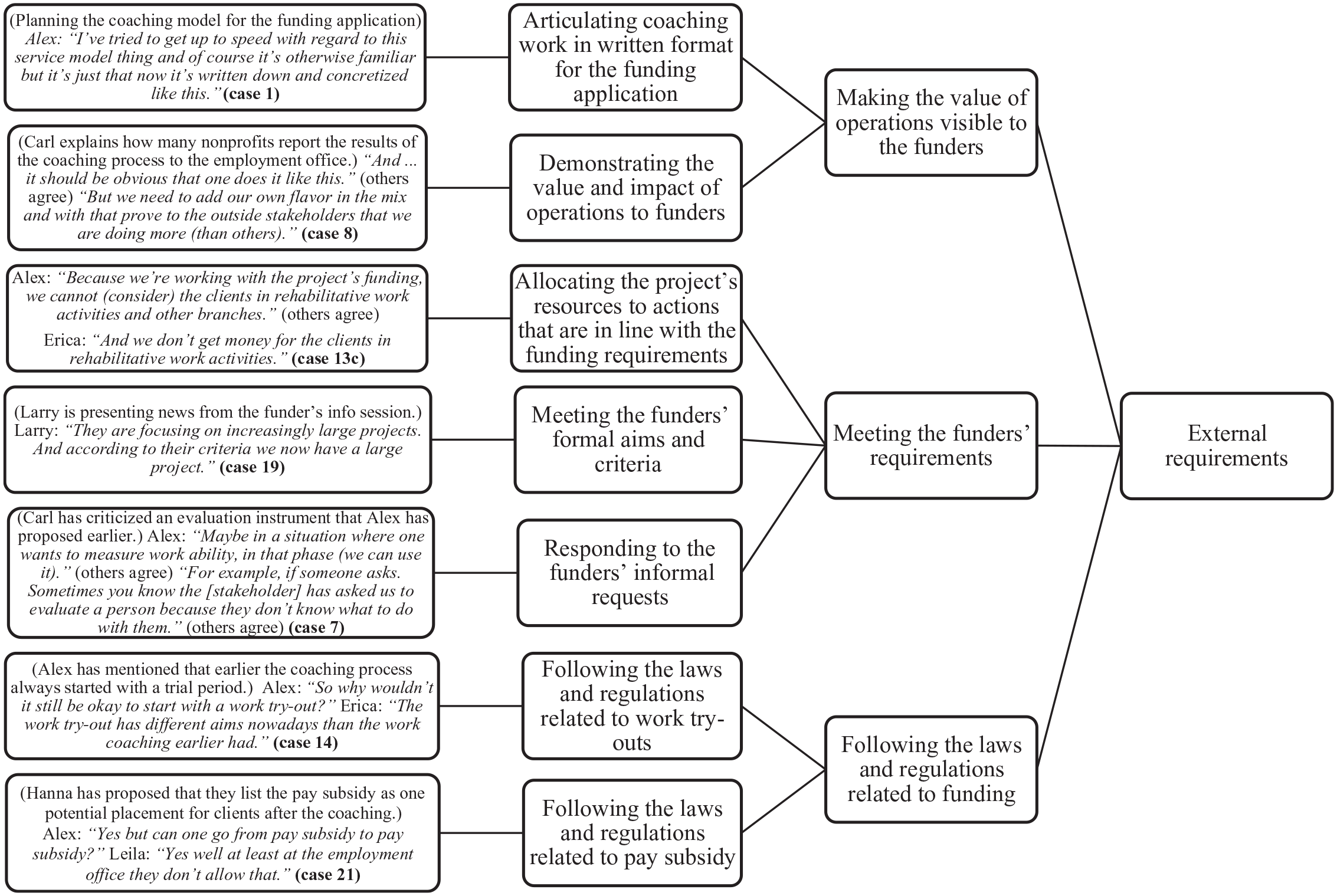
‘External Requirements’ Polarity.
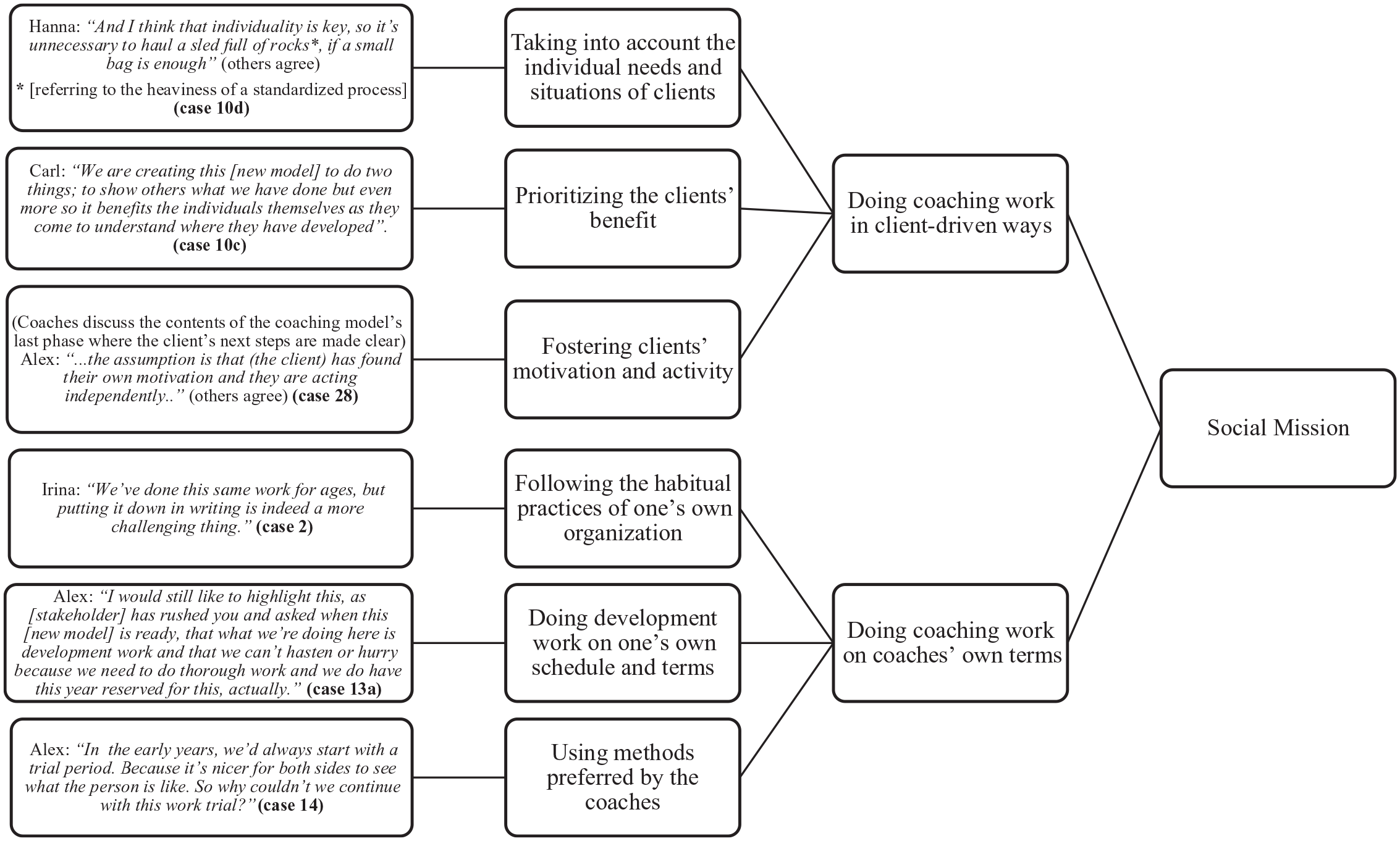
‘Social Mission’ Polarity.
Next, we set out to analyse how the participants talked the paradox into being. Following the principles of EMCA (Francis & Hester, 2004), we focused on the coaches’ own methods of producing the relationship between the social mission and external requirements in a juxtaposed, yet interrelated, manner. To be able to pay attention to all potentially relevant details, we transcribed the cases utilizing Jefferson’s (2004) transcription symbols (see Appendix A). Using both the recordings and the transcriptions in the original language of the participants, we analysed each case individually and paid attention to the non-lexical elements, such as laughter and tone of voice, as well as the selection of words: for example, the utilization of coordinating conjunctions and particles expressing contrastive relationships, extreme case formulations (Pomerantz, 1986), affective expressions (Lindström & Sorjonen, 2013) and categorizations of oneself and others (Antaki & Widdicombe, 1998). Based on the analysis, we excluded four cases in which the meeting participants discussed requirements of external stakeholders without relating them to other aspects of the work.
In order to understand the interactional context in which the paradox was talked into being, we analysed each case as a sequence and, thus, the ways in which each utterance is linked with others to be recognized and treated as different social actions (Schegloff, 2007). We identified where in the sequence the construction of the polarities occurred, for example, whether it was a proposal, an accepting or rejecting response or a justifying response to a rejection of the proposal. After having described in detail how and when the paradox was constructed in each individual case, we analysed the similarities and differences between the cases. This analysis yielded four categories of talking the paradox into being, which are presented in Appendix B. While in two of these categories the paradox was addressed briefly and unproblematically (categories 1 and 2), the other two (3 and 4) involved more elaborate discussion and tensioned presentation of the paradox. When examined more closely, we found that in these categories the paradox appeared to be used as an interactional resource. As this observation appeared as particularly novel and interesting, we decided to focus our investigation on these categories (categories 3 and 4 in Appendix B).
As our last step, the first and the third author undertook a round of analysis to examine the discussion at the beginning of the interactional sequences of categories 3 and 4 to better understand what happened prior to the construction of the paradox between social mission and external requirements used as an interactional resource. We discovered that the members, in fact, constructed a related, yet distinct, paradox between the social mission and efficiency and effectiveness in the group’s operations. While the first polarity is the same in both paradoxes, the second polarity (illustrated in Figure 3) differs from external requirements in that it stems from the internal needs of the group.
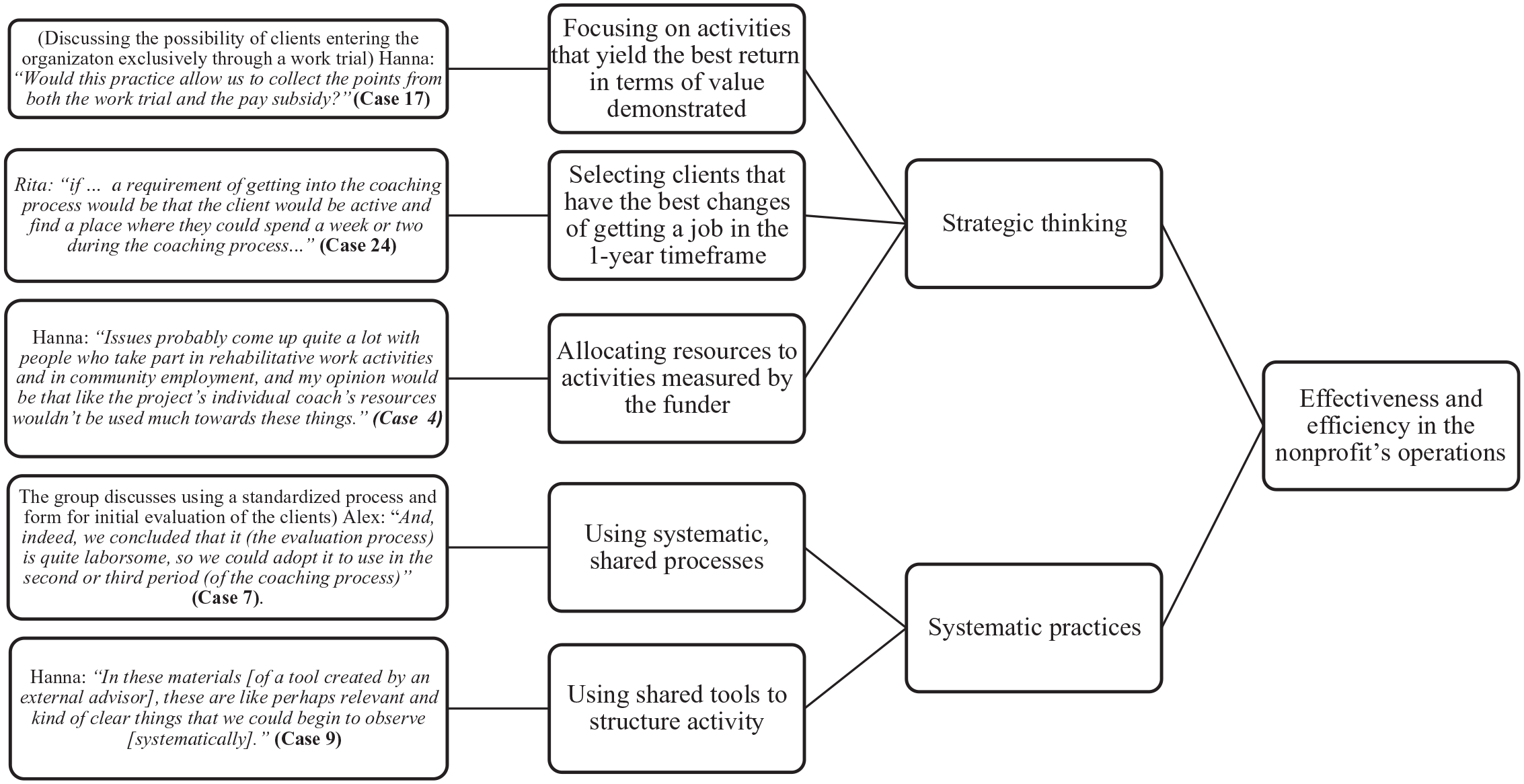
‘Efficiency and Effectiveness’ Polarity.
When inspected together, the two paradoxes appeared as different positionings of an overarching paradox between idealistic vs pragmatic goals. Here, idealistic goals include considerations of inclusiveness, meeting the individual needs of the clients and valuing the individual work practices of the employees. The pragmatic goals, on the other hand, include considerations of financial viability, effectiveness of used resources and standardization of processes. The first paradox, used as an interactional resource, operates on an organizational level and was constructed to exist between the organization and an external party, while the second paradox was constructed internally at the group level. This is illustrated in Figure 4.
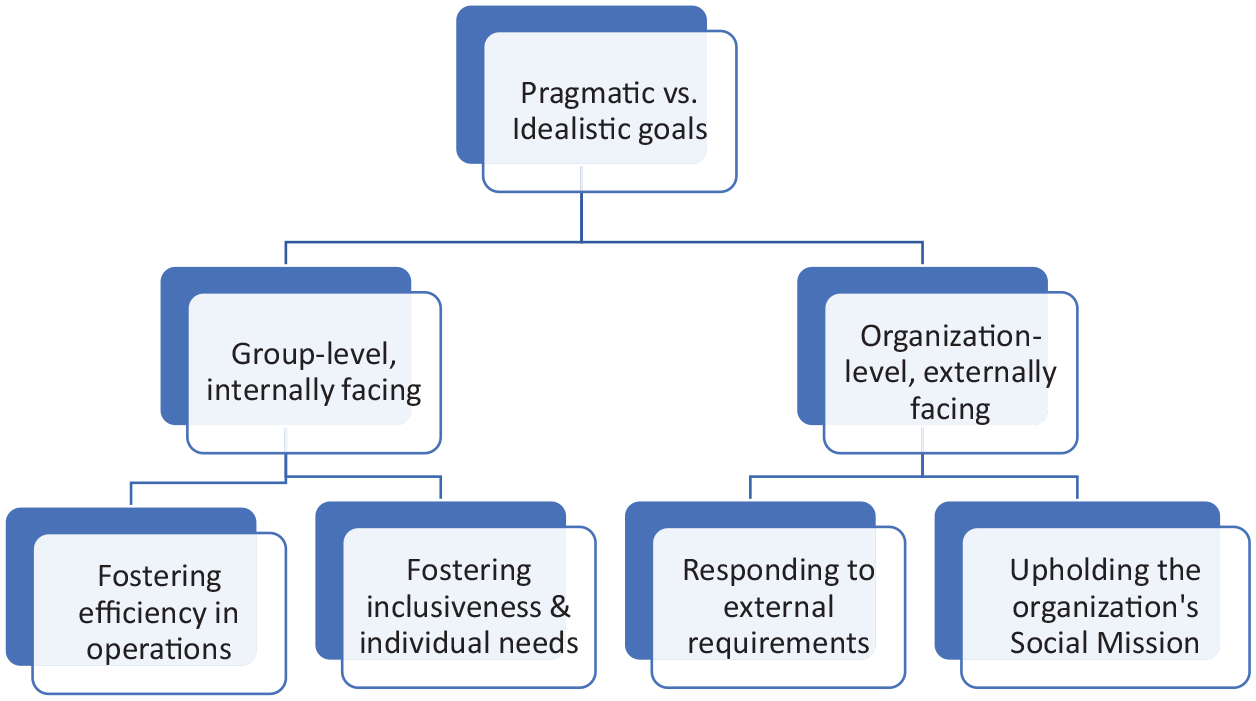
The Paradox Between Pragmatic and Idealistic Goals (encompassing the two positionings of the performing paradox).
Findings: Paradox as an Interactional Resource
In the following, we discuss the two categories of cases (3 and 4) where discussion over pragmatic goals generated more elaborate and emotional discussion and triggered interactional complexity. Both of the categories involved treating group members’ alignment with pragmatic goals as problematic and displacing the resulting belonging tension by constructing the paradox between external requirements and social mission as an interactional resource.
Although the analysis is based on the original recordings in the native language, we present only the idiomatic translations in English because of restricted space. The original transcriptions are available from the authors. The names used are pseudonyms.
Foregrounding social mission in one’s identity category
The interaction sequ
We next present this sequence in detail in Extract 1.
Extract 1 takes place during Meeting 1. The coaches present are Alex (A), Hanna (H), Erica (E), Irina (I) and Leila (L) and they are discussing the division of tasks between different coaching roles in the new coaching model, and how the two different client groups, pay subsidy clients and rehabilitative clients, should be served. As mentioned above, the funds from an external project grant are directed towards the former – individuals who are expected to find their own independent employment after spending one year with the organization. This grant is a major source of income for the organization, paying for most of the coaches’ salaries and general expenses. The latter client group, rehabilitative clients, are people whose ability to work is weakened and hence require additional support while the organization only receives a small compensation from the municipality for working with them. The role of the rehabilitative clients is linked to the paradox between pragmatic vs idealistic goals in the nonprofit’s operations: On the one hand, serving them is important for inclusivity while problematic for effectiveness, that is, reaching the goal of independent employment after one year.
We present Extract 1 in three parts. We join the extract at a point where Alex has stated that the tasks they listed for the individual coaches so far sound similar to what he has done earlier in a similar position, and continues to list more concretely what these tasks were: helping with housing, income support, debt counselling and health issues. We see the end of the list on lines 1–3.
In Extract 1a, we can see from line 6 onwards that Hanna treats Alex’s statement of his tasks in a previous position as a proposal of what they could include as the coach’s tasks and argues against Alex’s proposal in a way that begins to construct the performing paradox. In her argument, Hanna refers to two categories of clients, which are connected to the responsibilities of the coach. She refers to the first category explicitly by stating that the tasks Alex mentioned are relevant services for the clients of rehabilitative work activities (lines 7–10). As her turn is designed to disalign with Alex’s turn by beginning with ‘but’ (line 6), Hanna implies that there is another category of client for whom the listed services are not relevant: those that are directly targeted by project funds. She constructs the latter client category in relation to a distinct way of categorizing the coach, who is responsible for this client group, ‘the project’s individual coach’ (line 14). In this way she emphasizes the close linkage of the coach with the project and continues to construct the project’s coach as someone who has ‘resources’ (line 15). With resources she refers to time and suggests that in her opinion the resources would not be used toward ‘these things’ (lines 13–16) listed by Alex.
Thus, Hanna begins constructing the performing paradox: she indicates that there is a tension between two categories of clients and that one of these categories is more tightly connected with effective use of resources (pragmatic goals). Simultaneously, the other group of clients becomes constructed as aligning with the side of inclusiveness (idealistic values) as the support measures that Alex lists in the very beginning of Extract 1a represent a wider variety of social support. This alignment becomes more explicit as the construction of the performing paradox progresses (in Extract 1b), although already here Hanna explicitly talks of a ‘harsh division’ between the two categories of client.
With her argumentation, Hanna becomes aligned with pragmatic goals as she implies that the group should allocate their resources more effectively. More specifically, she begins a line of argumentation that insinuates that they are obliged to allocate the project’s resources to the client group specified by the project funding. Already when presenting this argument, she treats her disagreeing response as a delicate action by delaying it with some preparatory turn elements ‘at this point I’d like to say one thing that erm like hmm .mt (1.8)’ (lines 6–7) and designing her response cautiously in conditional ‘my opinion would be’ (line 13). In Extract 1b, we see how Hanna treats not only her action of disagreeing but the contents of her argument as problematic.
In Extract 1b, Hanna constructs an identity category of a coach who is driven by idealistic values and positions herself into that category. She continues to argue for not including the activities needed by the rehabilitative clients to the coaches’ tasks, and comments that directing resources to that client group ‘takes away from me and my people’. As she is doing this, however, she begins to distance herself from the act of prioritizing resources by displaying strong negative emotion towards engaging in such discussion. She begins to do this by expressing the emotional strain she experiences ‘talking like this’ (line 74): she utilizes negative adjectives intensified with an extreme case formulation (Pomerantz, 1986) ‘totally awful’ (line 62) and an affective interjection ‘phew it’s terrible’ (line 71). She also highlights idealistic values by talking of ‘her people’, (line 68), indicating that her clients are personally important to her and that she is taking actions to protect them, even though she simultaneously terms herself as ‘selfish’ (line 64).
Hanna’s intense way of describing her unease towards her own argumentation related to the strategic use of project funds is especially interesting at this point of the sequence: other coaches have already agreed with Hanna’s argument from line 17 onwards, that is, immediately after her utterance. From social action’s point of view, Hanna’s display of her stance treats arguing for pragmatic goals as accountable, that is, needing explanation, in this meeting context (Robinson, 2016). Here, we begin to see the construction of a belonging paradox interlinked with the performing paradox: Hanna’s interactional work to foreground an identity category aligned with idealistic values indicates the problematic nature of her initial argumentation in this particular meeting context.
Constructing distance to pragmatic goals is further intensified by the coaches together. Throughout her commentary, Hanna has implicitly implied the subordinate nature of the coaches with respect to the project. After her emotional account, this subordinate nature is explicated in Alex’s and Erica’s agreeing responses. Alex states that they need to ‘allocate the work contribution’ in relation to the project’s viewpoint (lines 77, 79, 82) and Erica presents an agreeing argument utilizing an explicit categorization ‘we are the project’s employees’ (line 78). Interestingly, the project has now been constructed as holding the power over the coaches, despite the fact that it is the group itself that is in the process of designing what this project should look like.
Through addressing the project in this manner, the voice of the funding party is brought to the meeting interaction and the resource prioritizations are connected to their imperative. With this, the coaches position themselves as primarily adhering to idealistic values, and the source of the need to make prioritizations between the two client groups is displaced as being rooted in the funder’s requirements. This becomes particularly visible in lines 82–99 where Alex and Hanna argue that due to the requirements of the funding party they cannot ‘make visible any other measures than those that promote job search’ (lines 95–97). By stating that this is ‘so harsh and cold’ (line 100) and directly after referring to health, housing [and] ‘things of the social side’ (lines 102–103) and the fact that they are related to the employment goal, Hanna constructs the group as understanding the value of a more inclusive social mission. As she continues stating that ‘those we cannot get’ (line 104), she further constructs the group as having their hands tied in terms of the tension they face. Finally, Hanna acknowledges that the ‘things of the social side’ are, indeed, ‘the main part of our work’ (lines 109–110) and establishes an identity category of a coach who is primarily driven by idealism rather than a strategic agent making choices on fund allocation. Any strategic choices are required by the project, which is constructed as a resource holder in its own right. In this way, the group dissolves the belonging paradox and strengthens shared understanding of what the group considers valuable and important. In Extract 1c, we see how the group then moves on in their discussion on the repositioned performing paradox.
In the extract, Hanna and Erica present a vision (in the form of an if-statement) where the funder would allocate ‘proper compensation’ for the activities supporting a more inclusive social mission (lines 117–129). This future vision is tied to the ability of the group to make the link between the social activities and employment goals visible to the funding party (lines 117–124). In this way, the group moves to discussing the performing paradox in a manner wherein the complementary nature of the repositioned polarities is recognized. After this, Erica concludes that ‘but at this moment’ they are ‘the project’s employees’ and thus ‘have the responsibility to take care of only the clients of the project’ while others agree. Erica thus restates the argument that Hanna presented in lines 6–16 with the polarity linked with pragmatic goals now constructed as the funder’s requirements. After this, the group concludes the discussion.
Displacing a disagreement regarding social mission
In all cases of this category, the group discusses differing perspectives on how their social mission would be best achieved. The sequence begins with one of the meeting participants making a proposal or presenting a plan of action regarding formalizing processes (cases 5, 6, 7, 9) or requiring stronger personal initiative on the part of the clients (cases 22, 24, 25). Another participant(s) then disagrees with the proposer more or less explicitly, pointing out the redundant and rigid nature of the proposed process (cases 5, 9), its perceived harmfulness to clients and coaches (cases 6, 7), or the inability of the organization or its clients to undertake the suggested actions (cases 22, 24, 25). After this there are two alternative ways in which the sequence evolves.
In the first alternative, the proposer defends their proposal by either claiming that it serves the need to make the organization’s work visible to their funders (cases 5, 6 and 9), or that the process would be implemented only if required by external stakeholders (case 7). Simultaneously, the proposer presents funders’ requirements as mutually reinforcing with maintaining meaningful work processes for the coaches. The proposers also begin their turns with ‘and’ statements that imply alignment with the objections presented by the other coaches. For example, in case 6 where a proposal on standardizing client processes is made, Alex responds to Hanna’s criticism of how they should not ‘do things just to check boxes’ but rather undertake activities that are ‘important from the perspective of the individual’, by stating that: ‘and then, indeed, still we’ll do enough to make, like, visible those things and document what we have done for the benefit of the client’.
In the second alternative, the person who responds to the proposal rejects it by pointing out that the proposed activities are not realistic for their clients. Without going deeper into explaining their disagreeing argument, they appeal to regulatory requirements (cases 24, 25) or the funder’s official objectives (case 22) that potentially prevent the realization of the proposal. In the cases belonging to this alternative sequence, the funder’s requirements and inclusiveness are constructed as opposing.
We demonstrate this in detail with the help of Extract 2.
Extract 2 takes place in Meeting 6 where the following coaches are present: Alex (A), Rita (R), Hanna (H), Leila (L), Vanessa (V) and Irina (I). Before the extract begins, the coaches have expressed that the project’s main goal is, due to funders’ requirements, that clients enrol into education or have a job after the coaching period ends and have continued to list other potential legitimate positions. During this discussion, Rita has made a proposal to integrate business collaborators to provide on-the-job training opportunities for their clients and the group has started to discuss how it should be noted down. Before they have reached an agreement on the formulation, Rita makes a further proposal, which we see at the beginning of Extract 2a.
In Extract 2a, Rita makes a proposal that clients would be required to locate a place for a job trial (lines 1–8). We see indications that the proposal might meet rejection already in the cautious way in which it is presented: Rita formulates the proposal as an interrogative ‘would it be too . . . brutal’ (line 1–2). Although a preferred response to a proposal as a social action is acceptance (see Houtkoop, 1987), by utilizing the word ‘brutal’, Rita displays recognition of the potential problems related to the proposal from the clients’ perspective. This way the proposal implies cross-cutting preferences (Schegloff, 2007, pp. 76–78) and gives an easy opportunity for the other coaches to reject it by confirming this brutality. The other coaches do respond by treating the proposal as problematic. First, it is followed by a long silence (line 9), which in itself indicates that the response is dispreferred (Heritage, 1984). Second, the coaches verbalize their hesitation; Hanna checks her understanding of the proposal (line 10) and then answers repeatedly ‘it is’ (lines 13–14) confirming the brutality and Leila describes the proposed method as ‘a shock’ for clients (line 12). This indicates disagreement among the coaches as to whether and how the proposal advances their social mission.
Rita partly acknowledges the disagreeing responses by stating that ‘for some it surely is like that’ (line 18). However, she keeps explaining her proposal (from line 23 onwards) and makes a conclusion that the proposed method would ‘exclude a lot of people but then again it could give a boost to things in a sense’ (lines 40–41). This justification acknowledges the problematic nature of the proposal related to inclusiveness towards their most vulnerable clients while highlighting the effectiveness for the clients that would be selected for the coaching process. At this point, the group is essentially discussing their interpretations of what social mission looks like and how it can be achieved: Rita, Hanna and Leila present differing views towards what is good for the clients and what can be required from them, and they can be seen becoming positioned on opposing sides of idealistic and pragmatic goals.
Although Rita further explains the proposal (during lines 23–41), it still does not receive the other coaches’ support. So far, we have shown how the coaches have built disagreement over the interpretation of their social mission, in other words what is beneficial for their clients, while discussing the proposal. In so doing, they have been constructing a performing paradox between a more inclusive and a more restrictive interpretation of the goals of their social mission while beginning to surface a belonging paradox in the form of a group-internal disagreement. Now we move to demonstrating how the participants displace the conflict to be situated between them and external requirements.
In Extract 2b, between lines 95 and 107, the coaches continue debating what the proposed method means from the clients’ perspective: whether it is about their ‘general demonstration of initiative’ (lines 95–96) or coaching them to ‘hang in there’ and to ‘give more of oneself’ (line 102). By highlighting the clients’ perspective, the coaches foreground idealism in their shared focus.
Then, Alex’s utterance in lines 115–116 shifts the focus to the requirements of external parties: whether this kind of arrangement would be the kind of ‘a further placement’ required by the employment authorities. By further suggesting that implementing Rita’s proposal might no longer be allowed by authorities (lines 124–125), Alex starts to shift attention from the differing opinions of the group members to requirements of outside stakeholders. In this line, he continues to state that ‘all good ideas are usually nixed with some legislation’ (lines 128–131), with which he distances himself further from the rejection he is presenting. Here, the polarity linked with pragmatic goals becomes constructed as the funder’s requirements. He implies that Rita’s proposal in itself is ‘good’ while unwise and shifting external requirements (as implied by his question of whether it is still legal to do as Rita proposes), prevent the group from taking action. Producing the utterance with laughter and utilizing an extreme case formulation (Pomerantz, 1986), ‘all good ideas’, Alex also highlights the shift in framing the situation as non-serious, complaining about the requirements that constrain their operation. This formulation of the situation is responded to as recognizable by others (lines 130, 132, 133), by emphasizing one’s own matching stance (line 134), and by sharing an illustrative case of how legislation has halted their ideas before (starting from line 136). Through these actions, the belonging paradox becomes diluted and the coaches move on to continue their planning activities with enacted coherence among the group.
Discussion
Our study has presented an ethnomethodological examination of how paradoxes of performing and belonging unfold in an intertwined manner, answering growing calls to investigate the interactional foundations of organizational paradox (Seidl et al., 2021; Sheep et al., 2017; Tuckermann, 2019). The depicted process raises important insights as to how organizational actors tie ongoing paradoxical tensions together as our data demonstrates how performing and belonging paradoxes act as ‘triggers, mitigators or amplifiers’ for each other in moment-by-moment interaction (Sheep et al., 2017, p. 482; see also Lê & Bednarek, 2017). We summarize our findings below and discuss their contributions to paradox theory.
Summary of findings
Our cases all begin with the construction of a performing paradox where group members need to make choices between pragmatic and idealistic goals. While participants actively present arguments from both sides, whenever a comment or proposal aligns with pragmatic goals, it is treated as problematic in the group interaction. Either the group member themself would pause and express discomfort in voicing such opinions, or the group would avoid addressing a value disagreement along idealistic vs pragmatic fault lines. In other words, the performing paradox triggers a belonging paradox related to the legitimate identity categories (Extract 1) or the shared value-base of the group (Extract 2).
What happens next in the interaction sequence is particularly interesting. In both cases, the polarity of the performing paradox aligned with pragmatic goals is collaboratively redefined as external requirements. In Extract 1, this happens by emphasizing the subordinate nature of the coaches to the project they are currently designing, and consequently introducing the voice of the funder into the meeting interaction while connecting the resource prioritizations to their imperative. In Extract 2, disagreeing opinions regarding social mission are framed as serving the requirements of the funding party, hence displacing the disagreement to take place between the group and an external party. In both types of cases, agency on decision-making is framed as being held by an external party through the construction of an organization-level performing paradox; the group is associated with upholding idealistic goals while the external party is presented as requiring the consideration of pragmatic goals. This enables the group to dilute the belonging tension without explicitly discussing it and to work through the performing tension.
These findings are summarized in Figure 5.
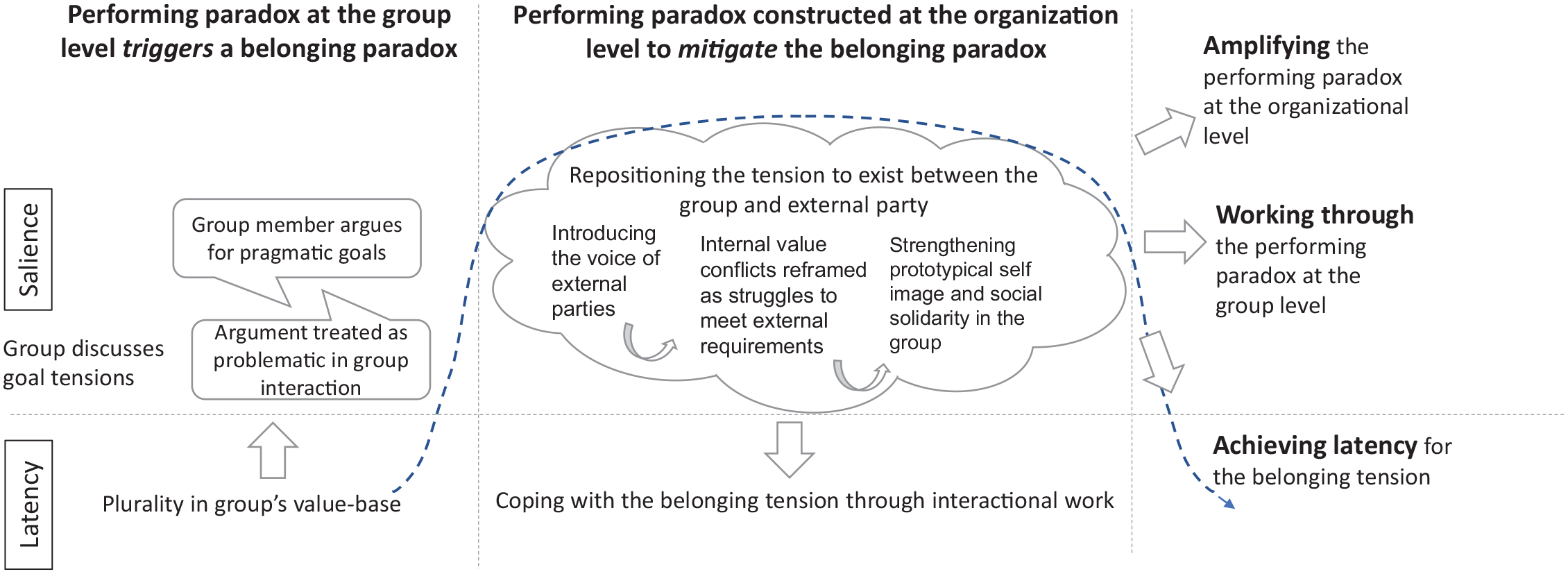
Summary of Findings: Paradox as an Interactional Resource.
Paradoxes as triggers: performing paradoxes surface problematic value plurality in the group
Our study demonstrates how performing paradoxes can trigger belonging tensions, contributing to understanding the intertwined nature of organizational paradox in practice (Jarzabkowski et al., 2013; Lê & Bednarek, 2017; Sheep et al., 2017). In our case, this happened as the fact that the group members flexibly argued for either polarity of the performing paradox conflicted with the expectation of the group being uniformly positioned on the side of idealistic values. In other words, expressing the performing paradox as part of group practice carried problematic implications for the way the group viewed itself in terms of its identity and values. This self-image did not appear to reflect the plurality of values in the group and was rather ‘prototypical’ in nature, that is, an abstracted image that ‘maximizes similarities within and differences between groups’ (Hogg & Terry, 2000, p. 124). Not only were value differences between group members hidden from view, but this was also the case for individual paradoxical frames. This dynamic becomes particularly obvious in Extract 1 where a group member problematizes her position on strategic allocation of resources after other members have already agreed with it, and how the group collaboratively distances this position from the identity category linked with pragmatic values.
These findings speak to research that has found that individual paradoxical frames are likely to not be surfaced if the social context is not supportive of such expressions (Pradies et al., 2021; Tuckermann, 2019). Our results indicate that despite the potential establishment of paradoxical frames (Andriopoulos & Lewis, 2009; Smith & Tushman, 2005) on the individual level, the ability for organizational members to ‘do’ such frames in their organizational practice is a different challenge. Our study offers an explanation for this phenomenon through the inherently intertwined nature of performing and belonging paradoxes. Since the discussion related to goals appears inseparable from the identity categories linked to the positions taken, the group needs to also be comfortable with expressing value tensions at the group and individual level in order to express paradoxical frames. This appears to be particularly challenging in a group with a strong expectation towards a uniform value-base. While a group with a shared understanding of paradoxical values and identities would be likely to discuss performing and belonging paradoxes in an intertwined manner (cf. Andriopoulos & Lewis, 2009), in our case belonging tensions were hidden from view with interactional work.
Our findings further indicate that group-internal belonging paradoxes may be particularly challenging to surface and work through explicitly. We see aligned observations in a few existing studies (cf. Ashforth & Reingen, 2014; Smith & Berg, 1997; also Lüscher & Lewis, 2008) where tensions at the group level are externalized (though the process has not been previously theorized from the perspective of belonging tensions). Our findings thus call for further research on belonging paradoxes at the group level (currently scarce, cf. Schad et al., 2016) as well as their intertwined nature with performing paradoxes. We caution against conceptualizing the two paradoxes at different levels of organizational life, in particular positioning belonging paradoxes ‘at the meso-level, . . . arising from different divisional and group memberships, loyalties and identities’ (Jarzabkowski & Lê, 2017, p. 435; see also Ashforth & Reingen, 2014; Smith & Berg, 1997; Smith & Lewis, 2011). When examined in the nuances of everyday interaction, both performing and belonging paradoxes are similarly embedded in group interaction.
Paradoxes as mitigators: reinforcing one paradox to achieve latency for another
Our study also demonstrates how one paradox can be made salient to mitigate another that is coped with through latency. In our case, the commonly recognized, organization-level performing paradox between funders’ requirements and the organization’s social mission (cf. Battilana et al., 2015; Smith et al., 2013) acted as an interactional resource that helped achieve latency for the belonging paradox at the group level. Personal value conflicts or tensions in the group’s value-base were reframed as struggles to meet external requirements, hence feeding into the prototypical self-image and setting aside value conflicts within the group. Interestingly, it simultaneously created an amplification dynamic for the performing paradox at the organization level; the latter was reinforced as tensioned in order to avoid explicitly addressing the former. These findings offer a novel perspective on the ‘invisibilizing’ (Tuckermann, 2019) or ‘deparadoxization’ (Seidl et al., 2021) process where a paradoxical tension is ‘made latent by moving it to a place where it is less troublesome’ (Seidl et al., 2021, p. 9). We show that a paradox itself can serve in this function while the extant research has mainly focused on moving the tension to different arenas or perspectives.
Importantly, this indicates that paradoxes may be surfaced in the form that is most appropriate in the interactional setting, which offers a novel perspective for considering what determines when and why latency is chosen over salience (answering to Seidl et al., 2021). Our study emphasizes the fact that the most visible paradoxes may not be the most problematic and joins the calls by Seidl and colleagues (2021) and Tuckermann (2019) to perceive effortful latency as a necessary response to avoid paralysis in organizations (also Czarniawska, 2005). We should note, however, that while displacing paradox appears an important resource for avoiding paralysis, it does not mean that it would be conducive to accepting paradox. In our case, it enabled bypassing discussion on the plurality of values within the group while amplifying a stereotypical tension the group has little agency to change.
In revealing this dynamic, our study offers further depth for thinking about the intertwined nature of paradoxes and their responses (Jarzabkowski et al., 2013; Lê & Bednarek, 2017; Sheep et al., 2017). It is notable that the need to cope with the belonging paradox through latency had consequences for how the performing paradox was presented in the group context. This exemplifies the complexity that characterizes interdependencies between paradoxes (Farjourn, 2010; Smith, Jarzabkowski, Lewis, & Langley, 2017); the responses of one paradox not only impact its construction but also that of interlinked paradoxes. Furthermore, it demonstrates how latency can be part of the explanation for salience, offering a complementary dimension for the salience-focused dynamic equilibrium approach (cf. Smith & Lewis, 2011).
Finally, the role of external parties in constructing the performing paradox at the organizational level is interesting; group members avoid identifying as a strategic agent making choices on fund allocation and allocate decision-making power to the absent party to make decisions over the undecidable (cf. Seidl, 2021). In fact, we see at least some of the difficulty associated with the decision-making in terms of the original performing paradox as a collaborative performance, directed at the presentation of self in a valued manner in the group context (Goffman, 2002). This raises an interesting question: may choices regarding performing paradoxes be presented as more tensioned and painful, reinforcing the much-discussed paradox between social mission and funders’ demands, in order to preserve appropriate identities in this context?
Towards an interactional approach to paradox
While there has been an increasing recognition in the field of paradox research of the need to better understand the interactional foundations of organizational paradox (Lê & Bednarek, 2017; Pradies et al., 2021; Seidl et al., 2021; Sheep et al., 2017; Tuckermann, 2019), there is still a notable scarcity of studies that examine how and why paradoxes are constructed and responded to in interaction. In particular, we need more insight into the plurality of interactional mechanisms that underlie organizational paradox to complement the existing research that is mainly focused on humour. While the existing studies are undoubtedly right in identifying humour as an interactional mechanism for dealing with paradox, stating that it is a ‘key means through which actors construct paradox’ appears overly bold, considering that it has been the basis of sampling of the studied interaction (Jarzabkowski & Lê, 2017, p. 438; see also Hatch 1997; Hatch & Ehrlich, 1993). In our findings, in fact, humour played a minor role whereas the interactional sequence itself appeared consequential to the responses available to the actors. The detailed discussion of these response paths is not the focus of this paper, but it does point to the fact that paradoxes are deeply intertwined with the logic of everyday interaction.
In order to improve understanding of how and why paradoxes are constructed with particular practices and in particular situations, an interactional approach to organizational paradox should be more systematically developed. Currently, interactional practices are predominantly discussed as altering or entrenching structural or cognitive responses (cf. Bednarek, 2017; Jarzabkowski & Lê, 2017; Jarzabkowski et al., 2013; Martin, 2004) while we lack vocabulary for conceptualizing the type of in-the-moment, intertwined ways of responding to paradox our study sheds light on. It would be important to develop our conceptualizations to better distinguish between structural, interactional and cognitive approaches as this would enable more complete and rigorous depictions of their interplay in living with organizational paradox. Responding to recent calls for interdisciplinary approaches in paradox research (Bednarek et al., 2021), our study has introduced EMCA as a potential tool for advancing such an approach. We hope that future research finds this useful in efforts to establish an interactional approach to paradox.
Footnotes
Appendix
Categories of constructing the paradox by interaction sequence.
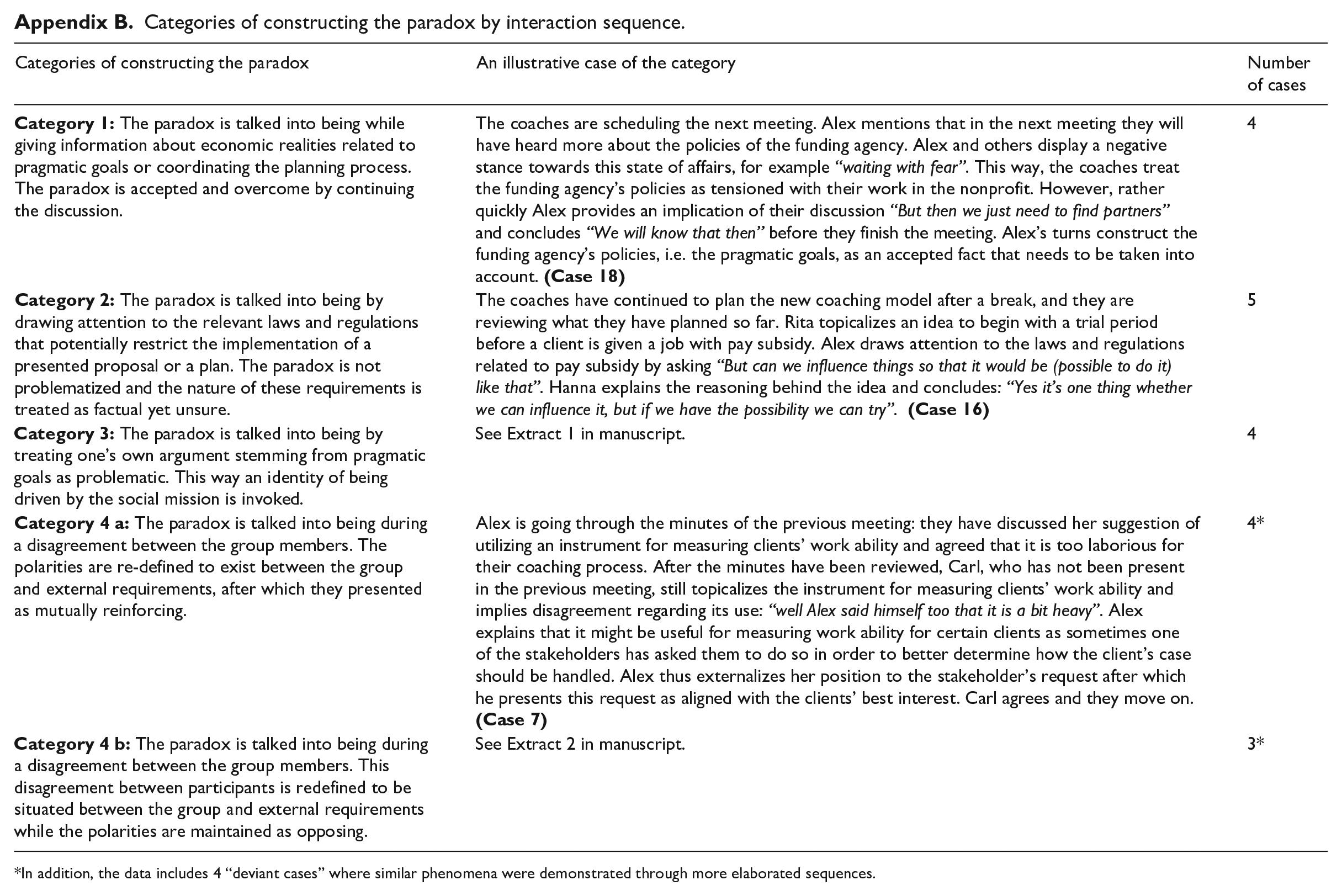
| Categories of constructing the paradox | An illustrative case of the category | Number of cases |
|---|---|---|
| The coaches are scheduling the next meeting. Alex mentions that in the next meeting they will have heard more about the policies of the funding agency. Alex and others display a negative stance towards this state of affairs, for example “waiting with fear”. This way, the coaches treat the funding agency’s policies as tensioned with their work in the nonprofit. However, rather quickly Alex provides an implication of their discussion “But then we just need to find partners” and concludes “We will know that then” before they finish the meeting. Alex’s turns construct the funding agency’s policies, i.e. the pragmatic goals, as an accepted fact that needs to be taken into account. |
4 | |
| The coaches have continued to plan the new coaching model after a break, and they are reviewing what they have planned so far. Rita topicalizes an idea to begin with a trial period before a client is given a job with pay subsidy. Alex draws attention to the laws and regulations related to pay subsidy by asking “But can we influence things so that it would be (possible to do it) like that”. Hanna explains the reasoning behind the idea and concludes: “Yes it’s one thing whether we can influence it, but if we have the possibility we can try”. |
5 | |
| See Extract 1 in manuscript. | 4 | |
| Alex is going through the minutes of the previous meeting: they have discussed her suggestion of utilizing an instrument for measuring clients’ work ability and agreed that it is too laborious for their coaching process. After the minutes have been reviewed, Carl, who has not been present in the previous meeting, still topicalizes the instrument for measuring clients’ work ability and implies disagreement regarding its use: “well Alex said himself too that it is a bit heavy”. Alex explains that it might be useful for measuring work ability for certain clients as sometimes one of the stakeholders has asked them to do so in order to better determine how the client’s case should be handled. Alex thus externalizes her position to the stakeholder’s request after which he presents this request as aligned with the clients’ best interest. Carl agrees and they move on. |
4* | |
| See Extract 2 in manuscript. | 3* |
In addition, the data includes 4 “deviant cases” where similar phenomena were demonstrated through more elaborated sequences.
Acknowledgements
The authors wish to warmly thank the editors and anonymous reviewers for their most valuable and constructive comments. We also extend our thanks to the reviewers and participants of the AoM 2019 conference for their feedback on the early-stage version of this paper.
Funding
The author(s) disclosed receipt of the following financial support for the research, authorship, and/or publication of this article. This work was supported by the Emil Aaltonen Foundation; the Finnish Work Environment Fund and the Academy of Finland (grant number 317046).
