



Abstract
This study focuses on family owner–nonfamily CEO relational practices and what these relational practices constrain and potentiate in family firm CEO succession. Our main contribution is developing a constructionist relational practice perspective and approach as an alternative to the entitative view that dominates the family business literature. We illustrate the relational practice perspective through our dialogically structured inquiries with family owners and nonfamily CEOs. We co-develop practical wisdom on how family owner–nonfamily CEO relational practices can construct stuckness in organizing or, conversely, open up new possibilities to go on depending on (i) the way the family owner and nonfamily CEO “handle” equivocality and tension they continuously (re)produce through their relational practices and (ii) the way they enact “relational balancing” to equilibrate their relation in the making in terms of value/self-worth maintenance by involving other actors, such as board members, management team members, or a coach.
Keywords
Introduction
Family business, like most management and organization literature, is dominated by entitative thinking (Dachler & Hosking, 1995; Hosking, 2011; Hosking & Morley, 1991). This view constructs self and other (e.g., a family member and a nonfamily member), or person and world (e.g., a family business member and the family firm), as relatively stable, bounded, and separate entities (Hosking, 2011, 2016). The bounded, separately existing person mentally constructs, influenced by but separate from “the outside,” knowledge or sense about how other/world “really is” in relation to or in interaction with other separate, self-existing persons that do the same (Bouwen & Hosking, 2000; Hosking, 2011, 2016). Constructing is thus viewed as individual mind acts by knowing persons who possess mind contents, knowledge, personality traits, goals, abilities, etc., as properties from which to act and influence, assuming individual human agency. Entitative thinking understands relations based on the properties and behaviors possessed by the interacting self and other and looks at what influence these relations have on some outcome variable (Dachler & Hosking, 1995). Processes happen within (intrapersonal), and processes and relations occur between independently existing entities (e.g., interpersonal) (Hosking, 2011, 2016).
This entitative thinking is very much present in the family business literature. For example, the family/nonfamily differentiation is typically constructed as a hard dichotomy (in contrast to a soft relational unity) (e.g., Hiebl & Li, 2020; Morris et al., 2010; Tabor et al., 2018). And the family member (e.g., the family owner) and the nonfamily member (e.g., the nonfamily CEO) come together as separate, self-existing entities, with their distinctive agentic characteristics (in contrast to inseparable and co-emergent), among whom a relation with particular characteristics exists (in contrast to the “how” of relating) (e.g., Waldkirch, 2020).
Because of this entitative view, family business research and practice essentially overlook ongoing relational practices or ways of relating (Bouwen, 2001, 2010; Hosking, 2011, 2016; Lambrechts et al., 2009) that co-construct self and other, person and world, and relations as local relational realities or “forms of life,” always in the making (Dachler & Hosking, 1995; Hosking, 2011). However, centering relational practices, relational realities they make, and what these relational practices/realities “constrain and potentiate, and how we might “go on together” (Wittgenstein, 1953) to ‘live a good life’” (McNamee, 2009; McNamee & Hosking, 2012, p. xv), is critical in the family business domain for several reasons.
First, to use Hosking and Bass’s (2001, p. 365) metaphor, some relational practices are “like a whirlpool being stuck in the same place instead of being able to flow on in new directions.” Indeed, some relational practices can construct stuckness in world/organization and relations making in terms of disconnecting, disengaging, energy-draining ways of relating, closing new possibilities for jointly moving forward. Or conversely, some relational practices can generate productive flow in the sense of connecting, engaging, energy-giving ways of relating, opening up new possibilities to go on together (Bouwen & Hosking, 2000; Camargo-Borges & Rasera, 2013; Gergen, 2009; Hosking, 2011, 2016; Lambrechts et al., 2009; Shotter, 1993, 2004). Therefore, family business researchers and practitioners interested in family business organizing/making (in contrast to the family business) and (facilitating or opening up) transformative possibilities must understand how relational practices are more likely to construct stuckness or productive flow.
Second, if we are to embrace the call from the family business domain to focus more on “relational dynamics” (Tabor et al., 2018; Quarchioni et al., 2022) and on how things become in unfolding processes (e.g., Dawson & Hjorth, 2012; Jaskiewicz et al., 2020; Murphy et al., 2019)—reflecting a shift from an ontology of being toward an ontology of becoming (Chia, 1995) and moving away from static, fixed, already-finished, and self-existent entities and their characteristics—we need a processual, relational practice alternative that can open up and explicate the “how” of ongoing relating (Hosking, 2011) in which family business relational realities (e.g., family owner and nonfamily CEO, and family owner–nonfamily CEO relations) are co-constructed. This article aims to develop and extend such a relational practice perspective, show what it can mean to do empirical work from this orientation, and suggest how doing relational practices research can evoke reflexivity and help to actualize new generative possibilities in family business organizing or world-making.
In this study, we ask, in the CEO succession context of private family firms, how family owner–nonfamily CEO relational practices (re)construct particular relational realities or possible ways of “going on.” Family businesses are an essential and pervasive form of organizing throughout the world (Astrachan & Shanker, 2003), and nonfamily members often, and increasingly, assume the formal CEO position (Arteaga & Menéndez-Requejo, 2017; Huybrechts et al., 2013; Miller et al., 2014; Van Helvert-Beugels et al., 2020; Waldkirch, 2020), enacting a “very critical form of leadership” (Miller et al., 2014, p. 566). More so, CEO succession, whether within the family (intrafamily) or in the case of a nonfamily CEO, is often considered vital to the company's survival and future performance (Blumentritt et al., 2007; De Massis et al., 2008). However, failed CEO successions are all too common (Daspit et al., 2016; Miller et al., 2003). An entitative perspective dominates the literature on nonfamily CEO succession, echoing the work on CEO succession in the family business (e.g., Le Bretton-Miller et al., 2004; Long & Chrisman, 2014) and general management literature (e.g., Ma et al., 2015). It places a strong emphasis on (i) the individual attributes of nonfamily CEOs and family owners as separate, bounded entities, (ii) characteristics of family owner–nonfamily CEO relations as fixed and (having to be) formally governed, and (iii) nonfamily CEOs’ performance effects. Although this literature provides us with interesting insights, it tells us little about ongoing family owner–nonfamily CEO relational practices “as the ongoing production site of relational realities (constructions of self/other and relations)” always in the making (Hosking, 2016, p. 225).
Family owner–nonfamily relational practices are relationally vibrant because of high interdependence and ambiguity. Nonfamily CEOs are hired when an owner–CEO wants to let go of the CEO role, and next-generation family members lack the competencies or motivation, or do not represent the best choice to lead the family firm (Blumentritt et al., 2007; Miller et al., 2014). However, family owners (ex-family CEOs) who are financially and emotionally deeply invested in their firms (Cannella & Shen, 2001) typically do not leave upon a nonfamily CEO's arrival but remain closely involved and very influential. A complicated mutual helping situation arises, which is inherently unbalanced and ambiguous (Schein, 2009). When a nonfamily CEO is asked to help the family firm create success, they are granted value by the family owner. In turn, the nonfamily CEO depends on the family owner's support to grow into the CEO role. The family owner, who primarily identifies strongly with their firm and former CEO role, typically wants to stay closely but differently involved, performing a new influential role in relation to the nonfamily CEO. Initially, neither the nonfamily CEO nor the owner knows what to expect of the other and how to construct their world and relation in the making (Schein, 2009).
This study's main contribution is developing and extending a relational practice perspective grounded in relational constructionism (Bouwen, 2001, 2010; Gergen, 1994, 2009; Hosking, 2011; Hosking & Morley, 1991; Lambrechts et al., 2009; McNamee & Hosking, 2012; Shotter, 1993, 2012a) and highlighting the strengths of relational practice research in opening up new avenues for empirical and practical understanding. It is an alternative to the entitative view dominating family business literature. We not only challenge the entitative representations in prevailing family business research on descriptive grounds but also argue that the entitative approach does not sufficiently help to improve processes of organizing in practice. A constructionist relational practice approach may be helpful because it goes beyond detached, clinical description toward participative co-inquiry, implying reduced distinctions between “us” (academics) and “others” (practitioners). It seeks to improve the relational practices that constitute organizing by doing inquiries with others (rather than doing research on or about others) (Hosking, 2011), otherwise referred to as “withness”-thinking (vs. “aboutness” thinking) (Shotter, 2006). Indeed, we actively co-constructed, as co-inquirers (Heron & Reason, 1997; Lambrechts et al., 2011; Shotter, 2010), with seven pairs of family owners and nonfamily CEOs, reflexivity and new understandings in learning groups of family owners, nonfamily CEOs, the mix of both, and individual in-person inquiries, adding to the continuously ongoing reality construction. From this co-inquiry process emerged that family owner–nonfamily CEO relational practices can construct stuckness in world/organization and relations making, or conversely, open up new possibilities to go on depending on (i) the way the family owner and nonfamily CEO “handle” equivocality—different, simultaneous viewpoints on a situation—and tension they continuously (re)produce through their relational practices and (ii) the way they enact “relational balancing” to equilibrate their relation in the making in terms of value/self-worth maintenance by involving other actors, such as board members, management team members, or a coach.
Nonfamily CEO Succession: The Dominance of an Entitative Perspective
We now turn to studies that illustrate the entitative view on nonfamily CEO succession as a contrast to the relational practice perspective we will develop. Some studies (e.g., Anderson & Reeb, 2003), using an incentive argument based on classical agency theory (Jensen & Meckling, 1976), suggest that nonfamily CEOs harm firm performance. Within that logic, they are assumed to be self-serving agents who may act opportunistically, as there is a considerable chance that their interests and goals are misaligned with those of the owners/principals. The interests and goals of the owner, seen as the knowing and powerful subject in the relation, are privileged relative to those of the nonfamily CEO, seen as the to-be-known object. In this view, costly monitoring (e.g., by boards of directors with independent directors) and incentives are needed to curtail and prevent opportunistic behavior on the part of the nonfamily CEO. Stewardship theory (Davis et al., 1997; Hernandez, 2012), also using an incentive argument, in turn, predicts that nonfamily CEOs are beneficial for firm performance, as it assumes that nonfamily CEOs are other-serving and trustworthy stewards (Blumentritt et al., 2007) whose interests are most likely aligned with those of the owners, the latter again being seen as the most important/principal (subject) in the relation. Accordingly, empowerment (e.g., through job design) is prescribed to support CEOs’ search for personal growth and achievement. Agency theory and stewardship theory are reflective of entitative thinking. These theories assume particular types of relations as a given, as fixed, and base their understanding of relations solely on assumed static personal properties or given states of interacting individuals. Furthermore, relations are typically considered only from the point of view of the owner or principal as the most important (or subject) in the relation; owners (have to) govern given relations to attain knowledge about and influence/control over nonfamily CEOs as objects (e.g., Dachler & Hosking, 1995; Hosking, 2011).
Moreover, other studies (e.g., Bennedsen et al., 2007; Bloom & Van Reenen, 2007; Chang & Shim, 2015; Pérez-González, 2006; Villalonga & Amit, 2006) that are illustrative of the entitative view have shown, based on an ability argument, that nonfamily CEOs are generally more beneficial to firm performance than family CEOs because they are selected from a larger pool of managerial talent in the labor market and therefore tend to be more qualified in terms of education and experience. However, preconceived notions of bifurcation bias (i.e., asymmetric treatment, favoring family over nonfamily members) make it less than evident for family businesses to attract highly qualified nonfamily managers (Fang et al., 2022; Tabor et al., 2018).
Moreover, the work of behavioral agency theorists (e.g., Gómez-Mejía et al., 2007) also suggests that nonfamily CEOs are likely to outperform because they are assumed to be more rational and less preoccupied with family socioemotional priorities such as preserving family control (Miller et al., 2014); priorities that are captured under the concept of socioemotional wealth (SEW), that is, the stock of affect-related, nonfinancial value that the family derives from the firm (Gómez-Mejía et al., 2007). Looking at personality traits, Kelleci et al. (2019) find that nonfamily CEOs’ personality traits differ significantly from those of family CEO-owners. While a nonfamily CEO is typified as a shapeshifter, a family CEO-owner is portrayed as strong-willed and less trusting, suggesting that these traits may affect the relation between the two. Moreover, when nonfamily CEOs’ personality is characterized by being controlling, outspoken, caring, and independent-minded, a negative effect on family firm performance is observed, while being democratic has a positive impact. In their study on governance conditions governing the given relation between family owners and nonfamily CEOs, Miller et al. (2014) show that nonfamily CEOs only lead to superior firm performance when they do not have to share power with influential family co-CEOs, who may be preoccupied with SEW objectives, and are monitored by multiple major family owners who are more effective than a single owner at monitoring and curbing managerial opportunism.
This entitative thinking is also evident in studies into successful nonfamily CEO engagements (Blumentritt et al., 2007; Hall & Nordqvist, 2008). These studies show that successful nonfamily CEOs are not only competent business people but also possess family awareness or cultural competence, “an understanding of the family's goals and meanings of being in business” (Hall & Nordqvist, 2008, p. 58), which helps them to live up to the expectations of the owning family and gain their trust, impacting (their effectiveness for) the organization. Blumentritt et al. (2007), moreover, argue that “strong” boards with independent directors, understood as “outside” relations/influences, can govern the family owner–nonfamily CEO relation by acting as a “buffer” between the owning family and the nonfamily CEO, encouraging the family directors to speak with one clear family voice and supporting the nonfamily CEO to execute the strategic plan as approved by the board. Remarkably, these studies suggest that it is mainly the nonfamily CEO who must be able to build a satisfactory trusting relation with the family owner, with relationship building seen as an important individual attribute of the nonfamily CEO necessary to succeed in the family firm. Again, the owner is treated primarily as the person who has, based on their ownership role, the primary responsibility for installing appropriate governance conditions to govern the given relation with the CEO adequately.
Several studies recognize the positive effect of close and trusting relations between family owners and nonfamily managers on various family business outcomes (Hiebl & Li, 2020; Waldkirch, 2020), and this on the individual, group, and organizational levels (Waldkirch, 2020), thus seen as existing separately from each other. For example, such close relations endow nonfamily CEOs with greater job satisfaction (e.g., Morris et al., 2010) and organizational commitment (Davis et al., 2010), which benefit their and the family firm's performance. The importance of good relations between family owners and nonfamily managers is also recognized in studies on family business advising (Quarchioni et al., 2022; Van Helvert-Beugels et al., 2020). Van Helvert-Beugels et al. (2020) highlight the role of advisory boards in alleviating tensions between a family owner and a nonfamily CEO, and Quarchioni et al. (2022) show that a content strategy advisor can first empower a nonfamily CFO to then promote openness to change in a family CEO, improving strategy discussions between the two. Thus, while family business researchers pay attention to relations and the influences “outside” actors (e.g., advisors) can have on them, the focus remains on the coming together of bounded individuals as separately existing entities having a relation in contrast to how ways of relating can generate stuckness or productive flow in relational realities. Thus, for us, relational practices are the starting place through which selves and relations are continuously co-created (Gergen, 2009; McNamee, 2012).
The above shows that entitative thinking dominates family business research to construct self, other/world, and relations. In the next section, we develop a relational, processual alternative that allows noticing other possibilities hitherto unnoticed: relational practices and how these construct relational realities. We use theory not as “a preconceived idea to which reality must correspond,” explaining and predicting the reality as it is, but as a way to guide us “towards being responsive to crucial features in our surroundings that we might otherwise miss” (Shotter, 2012a, p. 133).
A Relational Practice Perspective: An Alternative
The relational practice perspective we develop here is grounded in relational constructionism, a variant of social constructionism that centers “the relational” in construction (Gergen, 2009; Hosking, 2011; McNamee, 2012; McNamee & Hosking, 2012; Shotter, 2012a). Since Kenneth Gergen's groundbreaking work on human science as social construction (Gergen, 1982), many researchers from different angles—often as co-inquirers with practitioners or clients—have contributed to the “unfolding dialogue” (Gergen, 2020, p. 4) of a processual-relational constructionist orientation to practice. Indeed, linked contributions have been made from psychology (Gergen, 1994, 2009, 2015), organizational psychology (e.g., Bouwen, 1998, 2001; Bouwen & Hosking, 2000; Dachler & Hosking, 1995; Hosking, 2011, 2016; Hosking & Morley, 1991; Lambrechts et al., 2009; Steyaert & Van Looy, 2010), communication (e.g., McNamee, 2012; Pearce, 2007; Shotter, 1993, 2012a), therapy (e.g., Anderson, 1997; McNamee, 2009), organization and management (e.g., Cunliffe, 2001, 2002a, 2002b, 2008), entrepreneurship (e.g., Hjorth & Steyaert, 2004; Hjorth et al., 2015), leadership (Uhl-Bien, 2006), and relational research on social change and organization (e.g., Madsen et al., 2018; McNamee et al., 2020; McNamee & Hosking, 2012).
Our particular brand in a variety of constructionisms (Holstein & Gubrium, 2008) builds most on Wittgenstein (1953)'s work on “language games” and “forms of life,” postmodernist accounts of organizing in which micropractices are seen as (re)constitutive of always emergent social realities which we call “individuals” and “organizations” (Chia, 1995; Gergen & Thatchenkery, 2004), and accounts that exemplify the relational turn in constructionism centering relational processes or relational practices through which self and realities are constantly in-the-making (Bouwen, 2001; Cunliffe, 2008; Gergen, 1994, 2009; Hosking, 2011, 2016; Lambrechts et al., 2009; McNamee & Hosking, 2012; Shotter, 1993, 2012a).
The constructionist relational practice view we advance centers and gives ontology to ongoing relational practices (Bouwen, 2001, 2010; Lambrechts et al., 2009), in which self, other, and relations are continuously co-constructed as relational realities (Hosking, 2011). Relational practices are viewed as ways of relating co-enacted through words and deeds by at least two actors (Bouwen, 2001, 2010; Lambrechts et al., 2009). By mutually enacting relational practices, actors do things to each other; they continually position each other in specific ways, trying “to create a sense of place” (Cunliffe, 2001, p. 354), co-creating particular differences in perspectives and power (e.g., Bouwen & Taillieu, 2004; Dachler & Hosking, 1995), constantly co-constructing person (self), world (other), and their relations. We prefer to use the term “relational practices” (Bouwen, 2001, 2010; Lambrechts et al., 2009) rather than “relational processes” (Hosking, 2011), “joint action” (Shotter, 2010), or “co-action” (Gergen, 2009), because the relational practice term emphasizes “practicing together,” the actual doing with and to each other, and what this doing together makes, that is, constraints or potentiates in terms of relational realities (Bouwen, 2010; McNamee, 2009; McNamee & Hosking, 2012). From this viewpoint, organization is portrayed as a continuous performance through relational practices—as organizing or world-making (Gergen, 2015). Language (also that of the researcher) is treated not as a way of representing or mirroring an outside reality as it is but “as an activity of mutual creation and influence” (Austin, 1962; Bouwen, 1998, p. 305). Language thus has ontology (Cunliffe, 2002a); it is reality constituting (Gergen & Thatchenkery, 2004).
The relational practice perspective does not view self as a self-contained, cognizing individual/entity (separated from others as “not self”) that mentally construes reality influenced by but independent of “outside,” pre-existing social influences, as is thought in social constructivism (e.g., Bruner, 1990; Moscovici, 1988; Vygotsky, 1978). Instead, self is seen as a relational being (Gergen, 2009) continually “becoming” through ongoing and particular relational practices and relations with particular other(s) (Hosking, 2011). Self-other is viewed not as a dichotomy but as a relational unity; inseparable and co-emergent (Hosking, 2012). This also implies not one monological self but many dialogical selves (thus possibilities) (Sampson, 1993) and multiple ways of being with others. Persons’ specificity is seen not as “possessive individualism” (Sampson, 1993) but as emergent through different relational practices, different relations in the making, participating in some similar but also some different ongoing worlds (McNamee, 2019). Thus, with our constructionist relational practice orientation, we move beyond cognitive-individualistic, social constructivist thinking styles that center independent selves as knowers/meaning-makers whom (a) (re)negotiate their identities/meanings in social interaction (i.e., “symbolic” interactionism: Blumer, 1969; Mead, 1934), or (b) (ideally) come together into consensus-seeking and truth-seeking dialogue (vs. monologue) for “achieving not only instrumental mastery over the empirical world [as it is] but mutual understanding with his or her fellow human beings [inter-subjective consensus]” (i.e., theory of communicative rationality/action: Habermas, 1996; Weinberg, 2008, p. 25, italics in the original), or (c) are influenced by an outside social world that “imprints or forces its powers of construction” onto them (Berger & Luckmann (1966)'s treatise in a sociology of knowledge; McNamee & Hosking, 2012, p. xv).
Within a constructionist relational practice account, relational practices always do history (Hosking, 2011). Preceding world-making, or the active historical relational context, is always partly actualized in the reality-constituting relational practices actors co-produce. This ongoing actualization is the source of new possibilities but also constrains what can follow (Hosking, 2011; Lambrechts et al., 2009). Meaning is always emergent and resides in the ongoing relational practices and realities actors co-create (Bouwen, 2010). It follows that relational practices derive their significance from the particular relational realities or “forms of life” (Wittgenstein, 1953) they create and sustain, opening up or closing down new possibilities to go on (Bouwen & Hosking, 2000).
The quality of relational practices can construct stuckness in world/organization and relations making, or conversely, productive flow (Bouwen & Hosking, 2000; Hosking, 2011, 2016; Lambrechts et al., 2009). As introduced earlier, stuckness embodies disconnecting, disengaging, energy-draining ways of relating, closing off new possibilities for moving forward together. In contrast, productive flow incorporates connecting, engaging, energizing ways of relating, opening up new opportunities to go on together (Bouwen & Hosking, 2000; Camargo-Borges & Rasera, 2013; Gergen, 2009; Hosking, 2011, 2016; Lambrechts et al., 2009; Shotter, 1993, 2004). Particular quality of relational practices (re)construct particular relational realities. Co-enacting high-quality relational practices can provide a way out of stuckness or keep the ongoing relational reality productively flowing, or “sound,” continually opening up new possibilities. Indicators of high quality (without seeking to be exhaustive) include opportunities for
“being involved and responsive and open to others and otherness” (Hosking, 2016, p. 239; Shotter, 2006), “power to” other—multiple voices can be raised, heard, and included (Bouwen & Hosking, 2000); space is opened up for new ways of relating and for multiple, simultaneous local relational realities “(as forms of life, not individual subjectivities) to co-exist and be appreciated as different but equal” (Hosking, 2011, p. 58) (in contrast to one voice or one reality dominating, one-sidedness, “power over” other, exclusion); mutual, reflexive questioning of the relational reality in the making and one's part in it, self-inquiry, careful listening, not judging but suspending own judgment, becoming open to what may be learned from self, others and otherness in the actual situation, otherwise referred to as dialoguing (Hosking, 2011; Isaacs, 1996; Lambrechts et al., 2011; McNamee, 2012; Schein, 2009) (in contrast to mutual judging, imposing, unreflexive relating); open mutual questioning and contradicting (Argyris & Schön, 1978; Bouwen, 2010; Bouwen & Hosking, 2000); mutual validation of the value (or self-worth) actors claim while relating (Goffman, 1959, 1967; Rijsman, 1997, 2008), making relational practices and relations in the making feel mutually fair and equitable (Schein, 2009) (in contrast to mutually invalidating the value or voice of others and otherness).
Co-enacting and sustaining these kinds of opportunities are known to be associated with developing and experiencing joint authorship and co-ownership of ongoing efforts (Shotter, 2004), generating mutual engagement and mutually energizing and rewarding activities (Bouwen, 2010; Lambrechts et al., 2009), working through possible tensions in a flexible way (Bouwen & Taillieu, 2004), allowing for deep and systemic learning and transformation (Argyris & Schön, 1978; Bouwen & Hosking, 2000).
Mutually validating the value of others and otherness while relating (Goffman, 1959, 1967; Rijsman, 1997, 2008) makes the ongoing relational reality productively flowing. This idea is conducive to further deepening our relational practice perspective. While relating, persons claim value or self-worth and work to enhance or at least maintain their claimed value, and while so doing, they expect that others work to reciprocate positively by enhancing or affirming their claimed self-worth (Goffman, 1959; Schein, 2009). Reciprocating positively makes ongoing relational practices, and relations feel mutually fair and equitable (Schein, 2009). However, relating is fragile: There is always the possibility that actors do not reciprocate as desired and expected, and “if actors cannot interact to sustain their sense of being affirmed, they will resist” (Manning, 2008, p. 682). Persons might feel embarrassed, insulted, or confused, resulting in withdrawal, negation, anxiety, and defensiveness. Failure to reciprocate by not acknowledging or in some other way putting down the value claimed by the other person makes relating feel inequitable and unfair (Goffman, 1959; Rijsman, 1997, 2008; Schein, 2009), which creates forms of stuckness or “resistance” in relation building and world-making. Note that value or self-worth is not conceptualized here as a fixed property of an isolated individual but as dialogic (Sampson, 1993) and relational (Gergen, 2009), co-created through ongoing relational practices.
Returning to our introduction and literature review, it is clear that a constructionist relational practice perspective that takes relational practices as the starting point, as outlined here, is missing from the family business literature. As a result, despite recognizing the practical, beneficial role of close relations between family owners and nonfamily managers (as they come together as bounded individuals), the family business literature largely ignores the “how” of relating and what this how co-creates.
Research Work From a Relational Practice Stance: Knowing With
From a relational practice perspective, knowledge is treated not as a dead thing that can be transferred from one container or mind to another container or mind but as always co-enacted and ongoing (Orlikowski, 2002) through particular relational practices (re)actualizing particular “local” relational realities (Bouwen, 2010; Hosking, 2011). In other words, knowledge is always situated in an evolving context or community of practice (Wenger, 1998) of actors as relating locals (Hosking, 2011), who continuously co-enact (and keep alive) “their” knowledge (and taken-for-granteds) through their engaged activities and relational practices (Bouwen, 2010; Shotter, 2010).
Doing research then means co-participating and co-knowing in ongoing processes (Bouwen, 1998; Cunliffe, 2001; Shotter, 2006)—the ongoing local reality construction or organization in the making. Or, in the words of Bouwen (2010): “As a scholar, or actor of any kind, I can only commit to a participatory engagement if I wish to know, to act and to co-construct the organization-in-the-making” (p. 31). The scholar becomes another actor, another voice, with their specificity (Sampson, 1993), joining and adding to the ongoing processes of world-making of the organizational actors. Any scholarly activity can thus be seen as a relational practice with a particular quality (see above) co-produced by scholars and organizational actors involved. From a relational practice perspective, the researcher's contribution usually involves creating opportunities with actors for reflexive learning or dialoguing. This, not as a research method to discover “what is” and develop distant knowledge “about” others/otherness, leaving others unmoved (Shotter, 2006), but as a relationally engaged way to open up new possibilities and generative ways of being in relation, moving others (Hosking, 2011, 2016; Shotter, 2006). There is thus no separation between inquiry and intervention/change (Bouwen, 1998, 2010). In this sense, the researcher co-develops with the actors practical knowing (McNamee, 2012), “principles informed by engagement in the details of lived experience that facilitate joining with others to produce change” (Cronen, 2001, p. 14).
For this study, we rely on a collaborative, participatory research project (Coghlan & Brydon-Miller, 2014; Reason & Torbert, 2001), “Learning how to build lasting relationships between family owners and nonfamily CEOs” (official project name), that has been ongoing from July to October 2013. We co-performed this inquiry with seven pairs of family owners and nonfamily CEOs, the director of a noncommercial Family Business Center (established by a Belgian employers’ organization), and the managing director of an HR consultancy firm. The seven pairs were from seven Belgian private family businesses operating in four sectors: construction, manufacturing, logistics, and decoration. Three companies are first-generation family businesses, three are second generation, and one third generation. Five firms are 100% family-owned, one 95%, and one 93%. The companies employ between 42 and 573 employees.
Several pairs had contacted the Family Business Center director because they experienced tension-ridden relations and struggled with their ongoing process of relating. They felt a great need to talk with peers and scholars, share experiences, and learn from others’ perspectives. They approached the Center's director, given his strong reputation for initiating learning opportunities with trusted academics and business experts to benefit the regional family business ecosystem. To accommodate their request, the Family Business Center director contacted the HR consultancy firm's managing director and us to co-create learning opportunities with the family firm participants to open up new possibilities. As scholars, we saw our role as facilitating the learning process and documenting the co-constructions that emerged during these learning moments. We decided to organize five learning groups: two learning groups with family owners, two learning groups with nonfamily CEOs, and one final, mixed learning group with both the owners and their respective nonfamily CEOs. In addition to the learning groups, we offered participants the opportunity to engage in individual, in-person inquiries with us and with the HR consultancy firm's managing director to further explore their experiences in detail and deepen reflexivity on the relational reality in the making and one's part in it (Hosking, 2011; McNamee, 2012; Shotter, 2010).
Each learning group lasted 3h and took place at the site of the Family Business Center. With each group, discretion and confidentiality were emphasized to stimulate frankness. For documentation purposes and with permission, we digitally recorded and transcribed all the learning groups, which resulted in 219 pages of transcripts. Most participants knew each other personally from prior encounters at joint activities, such as network events and workshops, often organized at the Family Business Center, which many see as a safe learning place. Moreover, participants consider us trusted advisors based on our track record of collaborative projects where we have supported these and many other family firms concerning their critical challenges (e.g., governance, organizational learning, and radical innovation). This helped them open up to us and each other about intimate, positive, and negative aspects of their relational practices (re)constructing their particular relational realities in the making.
We chose to work with learning groups because we wanted to encourage a dialogical-reflexive practice (Cunliffe, 2002a; Hosking, 2011; McNamee, 2012; Schein, 2009; Shotter, 2010) of participants as co-inquirers (Lambrechts et al., 2011) to develop practical knowledge “from within” their ongoing experiences (Shotter, 2006) concerning a common challenge (Härnsten & Holmstrand, 2014; Heron & Reason, 1997; Reason & Torbert, 2001): finding ways of being-in-relation that open up possibilities to jointly move forward instead of creating stuckness in the new-organization-in-the-making. To that end, participants were invited to share with others in the group their experiences, examples, and stories that “moved” or “touched” them (Shotter, 2010) and inquire into these experiences together. We first gently asked the participants to attentively listen to each other's stories, to suspend any form of judgment, and to hold back in asking questions until everyone finished their story; essentially a dialogue format (Isaacs, 1996), learning together how to open up to others and otherness. We did not interrupt except when someone did start asking questions. We then invited them “to park” these questions so everyone could tell their story first.
As such, we ensured everyone's voice could be raised, heard, and included on their terms. Calmness and connection emerged. Participants indicated to each other that they felt many similarities in each other's stories. They then went deeper into questions and ideas that were triggered by the stories. We continuously kept a sharp eye on the level of reciprocity enacted in the ongoing relational practices constituting the learning groups. For example, if someone did begin to dominate the conversation, we appreciated their input and invited others to contribute their experiences so that the conversation went “back and forth” as much as possible. This way, the participants and we attempted to co-produce high-quality relating, co-constructing productive flowing (see above for relational quality indicators).
The first learning group with the owners and the nonfamily CEOs, respectively, shaped the design of the second learning group with the owners and the nonfamily CEOs, respectively, in terms of issues that they, as “locals,” considered to be important (Van der Haar & Hosking, 2004) and wanted to inquire into more deeply. In the first learning group, we used open and circular questions to encourage probing deeper into relational practices and world-making. Example questions are: “Can you tell us more about crucial interactive moments, key learning events, incidents, or turning points with regards to your mutual relationship-building process; moments or experiences that moved you?”, “Can you illustrate further?”, “What was so special about it?”, “Why is that important to you?”, “What did you/the other party do and why?”, “How did you feel?”, “How do you think the owner/the nonfamily CEO was feeling in this situation?”, “How do you think the owner/the nonfamily CEO was perceiving this situation?”, “How did you/the other party react?”, and “How do you see the future?”
On a flip chart, we wrote several emerging issues that participants found important, “moving” or “touching” (Shotter, 2010), and that they wanted to explore in greater depth. In the second learning groups, we invited the participants to explore these issues more deeply. Having the owners and their nonfamily CEOs in the same room during the final mixed learning group allowed us to encourage lively reflexive conversation within and between the pairs, which deepened the learning. Family owners and nonfamily CEOs could directly reflect on and inquire into each other's perspectives and frame and reframe their experiences and understandings of their world-in-the-making, which opened up possibilities for new, more constructive ways of being or going on in relation.
In addition to participating in the learning groups, all participants took part in the individual, personal inquiries we offered to foster further exploration and reflexivity. These conversations took place at the participants’ company locations and lasted between an hour and a half and 3 hours. We guaranteed complete anonymity and discretion to stimulate openness. For documentation purposes and with permission, we digitally recorded the interviews and transcribed them verbatim, which resulted in 454 pages of transcripts. In these conversations, we used similar open and circular questions as in the learning groups. We also zoomed in further on issues that emerged as important during the learning groups. These individual inquiries allowed participants to make and deepen the meaning of their ongoing particular relational reality and to position themselves in the ongoing relational practices (Bouwen, 1998) “by making disorderly moments rationally visible, by describing them from within the event itself” and by bringing “into view the character of the social negotiations, conflicts and struggles involved in the production, reproduction and transformation of our current social orders” (Shotter, 1993, p. 60). From a relational practice perspective, the learning groups and the personal inquiries are situated in the stream of ongoing relational practices that contribute to new organizing-in-the-making (Bouwen, 1998; Cunliffe, 2001; Shotter, 2006). Besides co-learning at the content level, they produce co-learning at the relational, processual level, that is, how to co-create connecting, engaging, and energy-giving conversations that open up new possibilities; learnings that can be taken “home” and actualized anew in their practice domains.
In the upcoming findings part of our article, we combine the stories told during the various reflexive sessions into thick accounts and illustrate episodes of organizing in terms of actual relational practices among the involved actors and how these (re)construct particular relational realities. We do this by inserting vignettes that illustrate which actors are involved from which perspective, who is included/excluded through what kind of activity, the task actors are working on, how actors are relating with what quality of relating, evolutions in relational practices, and emerging “outcomes” in terms of creating stuckness in the new-organization-in-the-making, or conversely, opening up new possibilities to go on. In doing so, we bring “to mind the concrete details of actually remembered experiences—how particular events, expressions, etc., have ‘touched’ or ‘moved us’” (Shotter, 2010, p. 35) and document these ongoing processes of relating and knowing (Bouwen, 1998).
We determined the specific writing format of the vignettes with the research participants based on the question, “When would the write-up of the research continue to advance reflexivity and learning, not only for us, as academics, but also for you and other owners, nonfamily CEOs, practitioners?” With this question, we wanted to promote reflexivity, co-ownership of the learning material, and a broadening of the community that could benefit from the research in terms of stimulating new inquiries and possibilities (Madsen et al., 2018; McNamee & Hosking, 2012; McNamee et al., 2020). In conversing about this question, the importance emerged to appreciate and juxtapose as much as possible the voice of the family owner and the voice of the nonfamily CEO, continuously shaping each other, about their relational practices and co-constructed relational realities as voiced “in their words” during the learning groups and individual inquiries. Our academic voice would be one of the voices shaped by our relational practices with the research participants and our participation in various other academic and practitioner communities.
We then introduced the idea of working with multivoice or polyphonic accounts (e.g., Cunliffe, 2002a, 2002b; Dawson & Hjorth, 2012; Gergen & Gergen, 2010; Letiche, 2010; Madsen et al., 2018; Shotter, 2008), in which the owner's and nonfamily CEO's voice is featured, to bring to light the “how” of their co-constructed relational reality in its richness and nuance. Participants also embraced this idea because it allows lived relational practices to be “written down” in a way that embodies the tone of voice (i.e., the feelings) of family owners and nonfamily CEOs regarding these practices.
Although in this way, we promoted a form of co-authorship or dialogical writing (in contrast to monological authorship where only one voice is speaking) (Letiche, 2010; Shotter, 2008), we took creative license, endorsed by the participants, in designing the vignettes. From the transcripts of the learning groups and in-person inquiries, we selected quotes that were most illustrative of the relational practices that the family owner and the nonfamily CEO constructed together, building their relational reality. This resembles building “composite vignettes” (e.g., Johnston et al., 2023), weaving together quotes of multiple voices to convey the main finding(s) constructed with the research participants in a way that makes voices sound and heard.
Following Shotter (2012b), we aimed to design vignettes that readers could “move” in their social contexts. Since the original learning groups and in-person inquiries in 2013, there have been ongoing interactions with the research participants, and we have been expanding the research project to other interested practitioners. Specifically, the vignettes and the insights around them have been used by the first two authors in collaboration with the family business center as learning materials in several new learning groups and conversations with owners and nonfamily CEOs. Although family business environments have changed drastically over the years, we continue to witness the relevance and generativity of this learning material: the vignettes and insights “resonate” with practitioners, prompting reflexivity about one's relational practices and encouraging new possibilities in ways of relating in their practice domains.
Family Owner–Nonfamily CEO Relational Practices: Handling Equivocality and Relational Balancing
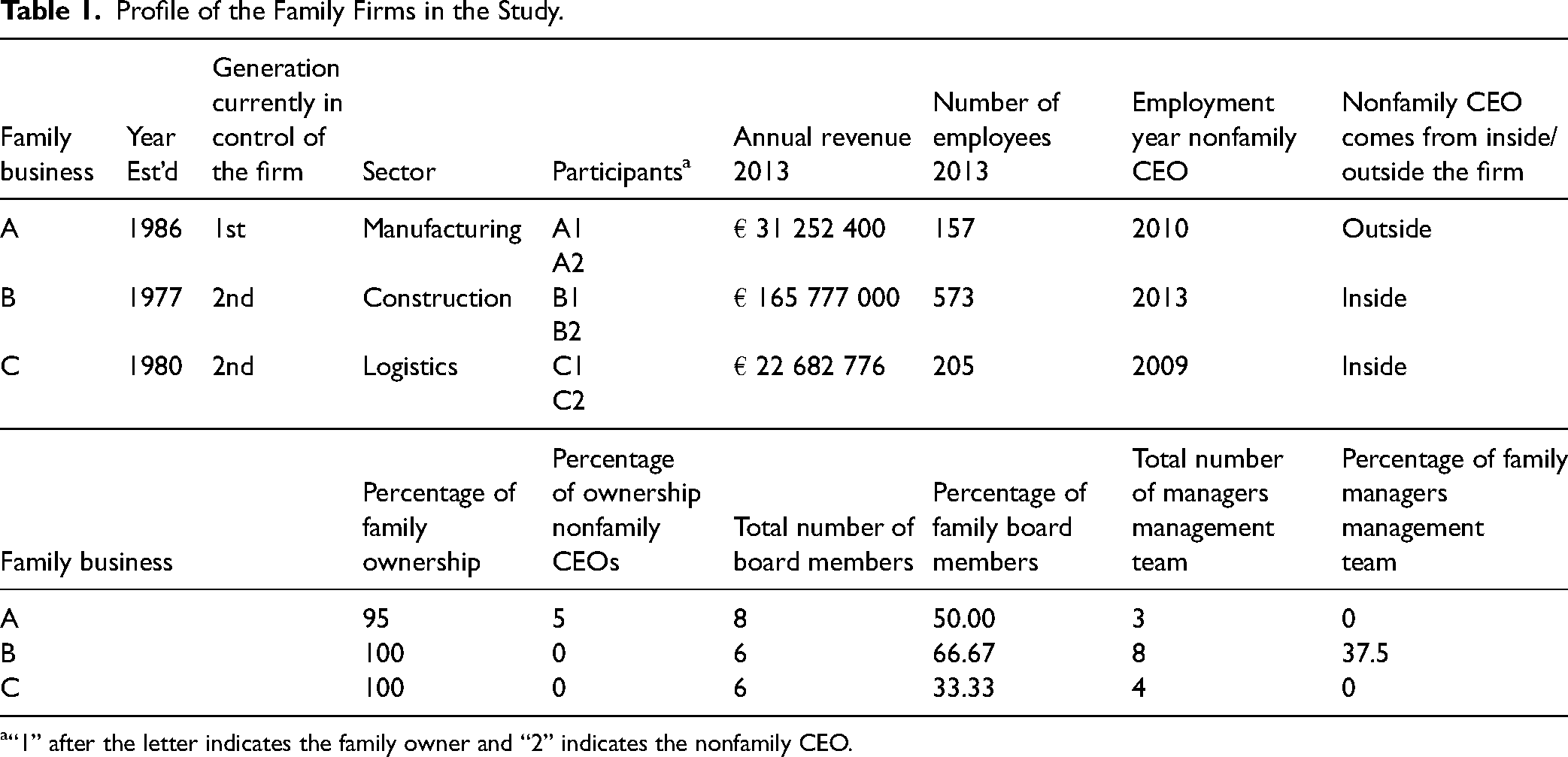
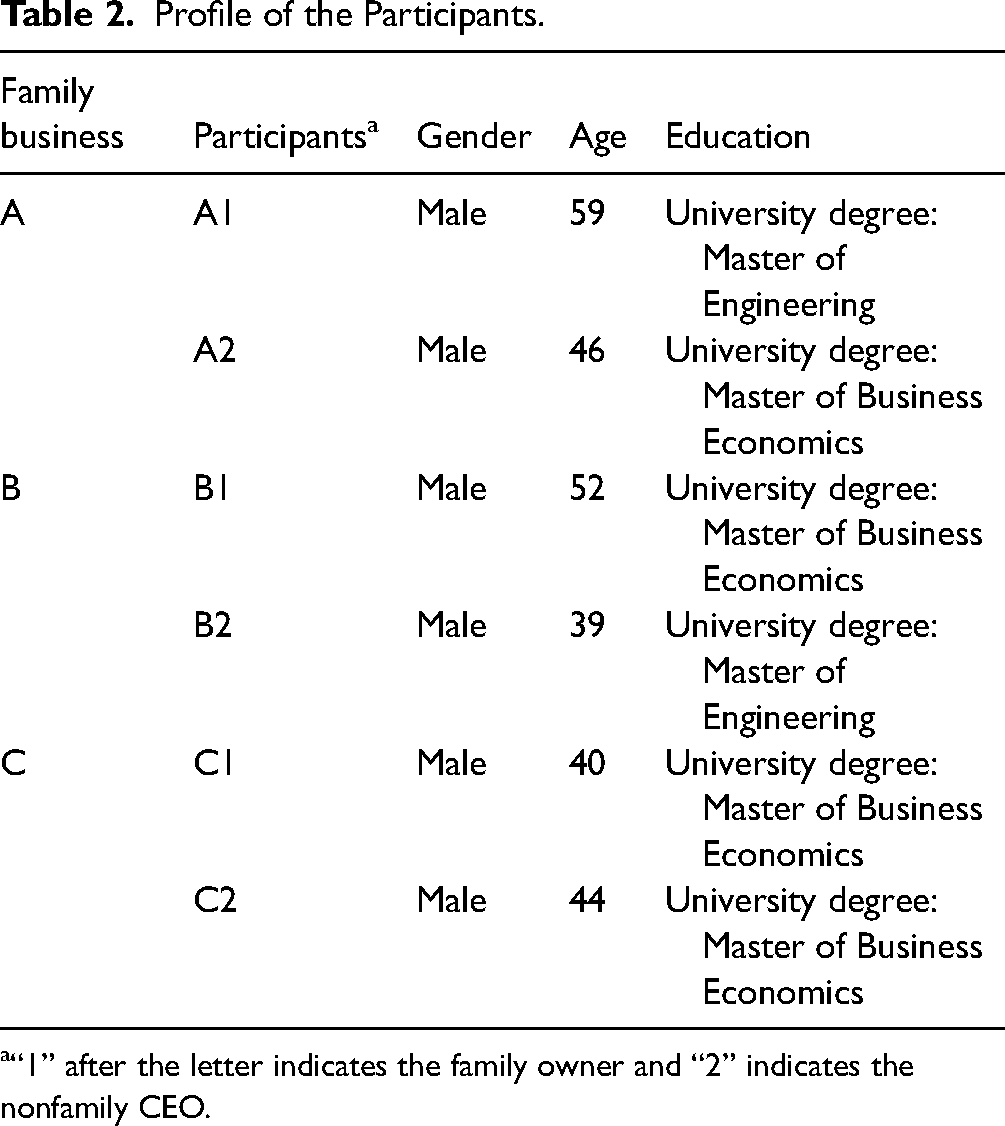
This findings section focuses on the accounts of three cases (family firms A, B, and C). We purposefully selected these cases (Patton, 2002) because the family owners and nonfamily CEOs narrated very articulately and illustratively about the relational practices that shaped their relational realities, providing rich learning material (Bernard, 2002; Patton, 2002; Stake, 2000). Table 1 provides additional context information on the firms. Table 2 presents each participant's profile.
Profile of the Family Firms in the Study.
a“1” after the letter indicates the family owner and “2” indicates the nonfamily CEO.
Profile of the Participants.
a“1” after the letter indicates the family owner and “2” indicates the nonfamily CEO.
We will now illustrate, case by case, vignette by vignette, how family owner–nonfamily CEO relational practices can construct stuckness in relation formation and world/organization making, or conversely, open up new possibilities and new possible ways of going on in relation depending on (i) the way the family owner and nonfamily CEO “handle” equivocality—different, simultaneous viewpoints on a situation—and tension continuously (re)produced through their relational practices and (ii) the way they enact “relational balancing” to equilibrate their relation in the making in terms of value/self-worth maintenance by involving other actors, such as board members, management team members, or a coach.
Case A
Case A is a first-generation manufacturing family firm founded by the owner (A1) in 1986. At the time of the participatory research project, the nonfamily CEO (A2) had worked in the family firm for 3 years. The nonfamily CEO had been hired from outside the family firm. The owner's three sons were members of the board of directors, together with the owner, the nonfamily CEO, and three external board members.
The first vignette, unfolding around the pace of implementing the co-formulated strategic plan, shows how the owner and the nonfamily CEO had been co-creating stuckness in their ongoing relational reality by handling in a particular way their different viewpoints, or their “otherness,” on the preferred mode of doing things, and how, at a particular time, they opened up new possibilities to move forward together:
The vignette shows that the owner felt frustrated because the nonfamily CEO did things differently than he would have. In contrast, the nonfamily CEO was struck by the controlling way the owner related to him. Initially, neither of the actors felt that their perspective was validated by the other—the nonfamily CEO did not feel trusted by the owner, and the owner did not feel heard by the nonfamily CEO—constructing unproductive tension and stuckness in relation building and organization making. It was only when the nonfamily CEO made the tensions explicit, and the owner reciprocated positively by accepting to go into conversation about their differences in doing things, that the ongoing relational reality became “unstuck” and productively flowing again (A2: “…we dared to talk the issue over. Expressing the feeling that ‘either there is trust or we stop’ produced trust”; A1: “Well, these things create conflict. But we talked it through”). Or in other words, the actors succeeded in co-creating a relational practice with a higher relational quality, where space was opened up for careful listening and inquiring into the other and otherness, which validated both actors.
However, as mentioned in the relational practice perspective above, relating is fragile and constantly evolving. Further in time, the family owner and the nonfamily CEO recreated stuckness in their relation and organization-making, as illustrated in the second vignette, which unfolds around new strategic partnerships for the firm. In this vignette, it becomes clear that this time also other actors play an important part in their stuckness:
This vignette illustrates how the nonfamily CEO's seeking and receiving support from external board members to enhance the value he can claim vis-à-vis the owner and the family (A2: “…to extend my personality a bit”)—which we call “relational balancing” on the part of the nonfamily CEO—goes hand in hand with the owner and his sons feeling their claimed value, their sense of being, their voice, put down or not acknowledged by not only the nonfamily CEO but also the external board members (A1: “Dad, we are at board meetings basically for decoration only; we have no real voice. And I, too, was frustrated by that for a long time”). This relational practice constructs a relational reality where voices are increasingly polarized, where some voices (here: nonfamily CEO and external board members) are felt to dominate and control the interaction at the expense of others (here: owner and family), where other and otherness is mutually not inquired into, leading to stuckness in relation and organization formation.
As the family owner persistently felt invalidated and wanted to restore and maintain value vis-à-vis the nonfamily CEO, strengthening his voice, he took the initiative of working with a coach specialized in facilitating emotional-relational dynamics; an act of “relational balancing” on the part of the owner. This initiative was well-received by the nonfamily CEO, who also sensed that the situation was becoming increasingly untenable. The nonfamily CEO also welcomed the coach to balance his ongoing relation with the owner. The coach invited the family owner and the nonfamily CEO into joint dialogical-reflexive relational practices to open up new possibilities to relate in different, more inclusive, reflexive, non-judgmental, and connected ways to move out of stuckness toward a sound, productively flowing relational reality.
The coach invited the actors to closely examine their relational reality and one's part in it. He invited them to share their perspective and story in the most concrete and illustrated way possible, shifting from vague statements to clarity. He asked them to suspend their judgments (versus immediately jumping in) to slow down, take a step back, and really listen to each other's stories before inquiring into them to increase understanding. When the coach saw the actors interrupting each other, he intervened to remind them to suspend judgments in favor of hearing their voices properly, encouraging the actors to relate to each other differently in terms of co-enacting “power to” (rather than “power over”) each other's voice. Thus, the goal was not consensus building but becoming responsive and open to otherness in a way that was rewarding enough for the owner and the nonfamily CEO to open up possibilities for their otherness to co-exist and be appreciated as different but of equal value. The third vignette of this case illustrates that (re)balancing their relating with the help of the coach can be evocative in moving both actors to relate with each other differently:
But further down the road and in the eyes of the owner, it was the coach himself that upset the precarious balance in relating between the owner and the nonfamily CEO by strengthening the CEO's voice and pushing the owner toward decisions he did not want to take on the possible sale of the firm, thereby frustrating the owner and pulling the ongoing relation out of balance:
This vignette clearly illustrates what can happen when a coach oversteps the boundaries of his process facilitation role. By focusing on content issues and taking a substantive stand that favors a particular direction from a particular actor and by constructing “power over” (instead of “power to”) how the process goes on (A1: “You cannot revoke the decision to sell the firm”), taking ownership of the process away from the owner and the nonfamily CEO, the coach limited (instead of opened up) new possibilities to go on in relation (dominance instead of equal voices; A1: “He kept telling me to put myself in A2's shoes…”). By being seen as taking the side of the CEO, the coach increased the latter's value while putting down the value of the owner, thus disequilibrating the family owner–nonfamily CEO relational practice, recreating stuckness in further relation building and world-making.
Case B
Case B is a second-generation construction family firm founded by the owner's (B1) father in 1977. At the time of the participatory research project, the nonfamily CEO (B2) had officially been working as the CEO of the family business for 6 months. The nonfamily CEO had been promoted from inside the family firm. Before, since 2007, he had been leading a subsidiary of the family firm and was given complete freedom; the family owner barely interfered. When the family owner saw his success, he hired him as the CEO of the focal parent firm. Although the nonfamily CEO had been promoted, after some time, he felt as if he had been degraded.
The first vignette of Case B shows, very similar to the first vignette of Case A, how the owner and the nonfamily CEO had been failing for some time to handle their different perspectives (or otherness) constructively, in their case regarding the speed and manner of transfer of the formal CEO position and about whether the owner should still attend the weekly management team meetings, thereby creating unproductive tensions and preventing their relational reality from flowing productively:
In this vignette, the nonfamily CEO expresses that he wanted to take over faster than the owner was willing to let go; the latter, in contrast, felt that the process of taking over by the CEO and his letting go was going too quickly. From a relational practice perspective, both actors initially sought to increase or at least maintain their claimed value or voice. Still, they did so in a one-sided, disconnected, nonattuned way vis-à-vis each other. Illustrative is the moment when the nonfamily CEO felt that his voice was excluded and disregarded by the owner, who had not consulted him on a decision, making the CEO feel devalued and dominated (B2: “…he went over my head, and I was so pissed. I really felt that as an attack on my self-worth”). Similar to Case A, what moved them out of stuckness and opened up new possibilities for moving forward more productively, was that they engaged in a joint reflexive-dialogical conversation. They reflexively paid attention—in a mutually open, concrete, and illustrated way—to how they related with each other and how these relational practices at times constructed “resistance” in relation formation (you did this, which made me feel this way). They opened up space with each other to allow each other's voices to be heard and listened to carefully, allowing for future world-making that is acceptable and desirable for both, equilibrating their relating in terms of claimed value (B2: “I went to him and we had a good conversation. I told him how I felt because of his actions. He understood; he also said that it was not easy for him”; B1: “I understand him and I told him I will try to hold back but you know, it is hard to let go…”). It seems that it is precisely this respecting of the value of the other (allowing the different voices to resonate truly) that enables the actors to mutually enhance and sustain the value they claim for themselves and to handle their otherness in a more viable and productive way.
However, further in time, the fragility of relation formation and organization-making also became apparent in this case. Specifically, the family owners had withheld important financial information from the nonfamily CEO. When the external board members discovered this during a board meeting, they did not dare to confront the owners, whereas the CEO expected them to do just that:
This second vignette illustrates how the nonfamily CEO felt invalidated by the owners for withholding financial information and by the external board members for not questioning and objecting to this action by the owners. From a relational practice perspective, the owners had excluded the voice of the nonfamily CEO, and the latter had expected the external board members to counter this action by expressing support for him, thus reaffirming his sense of being, his sense of value, thereby balancing the ongoing family owner–nonfamily CEO relational practice and relation. However, that expected relational rebalancing did not transpire. In response, the nonfamily CEO went to other actors, the firm's accountants, and formulated with them new interaction rules (“From now on, all accountants report directly to me”), rebalancing his self-worth in relation to the owner and preventing similar incidents from recurring in the future.
Case C
Case C is a second-generation logistics family firm founded by the owner's (C1) father in 1980. At the time of the participatory research project, the nonfamily CEO (C2) had officially been working as the CEO of the family firm for 4 years. The nonfamily CEO had been promoted from inside the family firm. Before, since 2006, he had been leading a subsidiary of the firm. Like Case B, he was given much freedom to lead this subsidiary, while the firm's owner barely interfered. When the family owner experienced difficulties in leading the focal parent firm on his own, he decided he needed help and formally appointed the nonfamily CEO. As in Case B, however, after the nonfamily CEO started working in the focal parent firm, ways of relating became unbalanced, generating stuckness in relation and organization formation:
Viewed from a relational practice perspective, the owner and the nonfamily CEO initially failed to mutually enhance or maintain the value they claimed vis-à-vis each other. The nonfamily CEO expresses that he felt invalidated by an overcontrolling owner who dominated or suppressed his voice, preventing him from fully growing into his CEO role; he wanted more autonomy (C2: “the owner…is like a shadow…he is continually interfering with my autonomy and holding me back…”). The owner, in turn, was figuring out how to maintain his value or voice in the new relational reality where he was no longer the CEO but still wanted to be influential; he was also searching for a new role to play. Similar to Cases A and B, both actors struggled to constructively handle their high interdependence and otherness to move forward jointly. It was not until the nonfamily CEO made it very clear to the owner that he wanted to see their ways of relating with each other change (C2: “Either we are going to relate differently, or it stops now”) and the owner reciprocated positively (C1: “…he was right. Then, it became clear to me: This is not working, not for myself, not for the firm, not for my CEO…”) that they could start to move out of stuckness. They began to explore their perspectives mutually and started sharing what they expected from each other going into the future, constructing more two-sidedness in relating (C1: “We had a conversation and he made clear that he was not happy; he had written a one-pager, and I said: “Yes, I understand but I also have my one-pager”). Sensing the fragility of their relating, they immediately decided to have a coach, the same coach as in Case A, to help them reattune and rebalance their ongoing relation, opening up new possibilities for more inclusive ways of relating:
Similar to the other two cases, when actors allow their voices to really sound, to be amplified with each other, so to speak, co-constructing “power to” instead of “power over” the other and otherness, new space is opened up to go on more productively (C2: “Now, I feel that our working relationship has improved because the owner effectively started to let go a bit more,” C1: “…jointly learn how we should interact with each other”). The coach helped by inviting both actors to jointly recognize and inquire into their high interdependence to enact new but complementary roles while maintaining self-worth. He encouraged the owner and the nonfamily CEO to further clarify expectations concerning each other's future roles and induced them to involve each other as learning partners. Similar to how the coach intervened in Case A, he invited the actors into joint reflexive dialogues encouraging them to reflexively question their ongoing relational reality and their parts in it, not judging but suspending their judgment (C1: “He held the mirror and asked questions stimulating us to not be defensive or attack but to inquire more deeply into things together”), so that they could become open to what could be learned from self, other and their relational practices.
For a time, things continued to go well for the owner and the nonfamily CEO, who had found a new élan together. Meanwhile, they had stopped working with the coach. However, time passed, and the quality of their relational practices deteriorated again, with the owner's voice clearly dominating the ongoing relational reality, recreating unproductive tensions and stuckness. This is illustrated in the following vignette, which unfolds around the management team's attention to operational issues like unpaid invoices and truck trailers being in repair for a long time:
The vignette shows how the owner, in essence, was taking over the voice of the nonfamily CEO, asking the latter “to transfer my message to the rest of the team” (C1). When the owner felt that the nonfamily CEO was not delivering his message to the management team as he wanted, he went over the CEO's head directly to the MT members to let his voice be heard or validated. These ways of relating with the MT members and the nonfamily CEO negated the voice of the nonfamily CEO, who felt increasingly frustrated with the owner, who, in his eyes, constructed “power over” (vs. “power to”) the others and otherness. The moment the called-away manager apologizes for the owner's actions when rejoining the meeting with colleagues and the CEO is an additional indication that relating was perceived to be of low quality. This relational reality created frustration on the part of the CEO, “compromising his leadership,” making him feel stuck in relation building and organization making. When it is sensed that there is no longer a possibility for dialogue, for learning from others and otherness (C2: “I have to bite my lip because arguing about it is not changing anything”), it becomes difficult to change the relational reality and to find new, mutually satisfying ways to go on in relation.
Discussion and Future Possibilities
This article has developed and expanded a relational practice perspective (e.g., Bouwen & Hosking, 2000; Hosking, 2011, 2016; Lambrechts et al., 2009). It demonstrated from this lens a form of multivoice, participatory, collaborative research with practitioners capable of evoking reflexivity and new generative possibilities in family firm organizing and researching. Specifically, in the context of CEO succession, we co-inquired into how family owner–nonfamily CEO relational practices re(construct) particular relational realities or possible ways of “going on.”
The reader has noticed many similarities across the cases, mirroring what all participants experienced during the learning groups. The owners and the nonfamily CEOs build an ever-moving, fragile relational reality (of self, other, and relations) through the quality of relational practices they co-enact, at times involving “third” others to balance their ongoing focal relating (“relational balancing”), repeatedly moving in or out balance in terms of voice/value maintenance, opening up, or closing down possibilities.
Co-creating high-quality relational practices, generating productive flow in contrast to constructing stuckness (“whirlpool”-metaphor), relational balancing, handling equivocality—and their concrete, practical embodiments as voiced by family owners and nonfamily CEOs in the vignettes—are in a constructionist relational orientation more than theoretical concepts and research data. Instead, in terms of “practical implications,” they are practical resources (Camargo-Borges & Rasera, 2013; Gergen, 2009; McNamee, 2012; McNamee et al., 2020; Shotter, 2012a) pointing toward “future possibilities rather than past facts…bring[ing] previously unnoticed aspects or our activities imaginatively to light” (Shotter, 2012b, p. 254). As such, they can be actualized anew in conversations, interactions, and activities in all practice domains (including academia), empowering ways of relating that connect, engage, and energize, opening up new possibilities for co-creating flourishing organizational realities. This shift from detached, clinical description toward developing practical theory through participative co-inquiry with practitioners may also lessen the theory-practice divide in family business research (Astrachan et al., 2021) and beyond (Lambrechts et al., 2011).
The relational practice perspective and research approach have the potential to vitalize research on family owner–nonfamily manager relational dynamics (Tabor et al., 2018; Quarchioni et al., 2022) and unfolding processes of becoming (e.g., Dawson & Hjorth, 2012; Jaskiewicz et al., 2020; Murphy et al., 2019) as called for in the family business domain that to date has been thinking primarily entitatively instead of processual-relationally. Dominant entitative thinking in the extant literature on family business succession (e.g., Chua et al., 2003; Le Breton-Miller et al., 2004; Long & Chrisman, 2014; Mitchell et al., 2009; Sharma et al., 2003) and nonfamily managers (e.g., Hiebl & Li, 2020; Tabor et al., 2018), leads to treating the family business, the family owner and the nonfamily CEO, the external advisor, the board of directors, etc., as separate, relatively stable, self-contained entities possessing own properties (e.g., traits, goals, abilities) between which relations with their characteristics exist.
Indeed, while focusing mainly on nonfamily CEO performance effects (e.g., Anderson & Reeb, 2003; Bennedsen et al., 2007; Bloom & Van Reenen, 2007; Chang & Shim, 2015; Fang et al., 2022; Miller et al., 2014; Pérez-González, 2006; Tabor et al., 2018; Villalonga & Amit, 2006), the literature has focused primarily on properties of family owners, nonfamily CEOs, and their relations, often assuming—from an overly theoretical view—fixed (agency or stewardship) relations that must be formally governed. The literature has also acknowledged that close relations between family owners and nonfamily managers are beneficial for nonfamily CEOs’ and family firms’ performance (e.g., Blumentritt et al., 2007; Hall & Nordqvist, 2008; Hiebl & Li, 2020; Waldkirch, 2020), and that “outside” influences in the form of advisors can ease tensions between a family owner and nonfamily CEO (Van Helvert-Beugels et al., 2020) or can empower a nonfamily CFO and promote openness to change in a family CEO so that they can have better strategy discussions (Quarchioni et al., 2022). However, the focus remains on the coming together of bounded individuals as separately existing entities having a relation in contrast to how ways of relating can generate stuckness or productive flow in ongoing relational realities. Thus, while the extant family business literature provides us with interesting insights, it does not allow us to fully appreciate (Shotter, 2012a) ongoing family owner–nonfamily CEO relational practices “as the ongoing production site of relational realities (constructions of self/other and relations)” always in the making (Hosking, 2016, p. 225). Failed CEO successions are all too common (Daspit et al., 2016; Miller et al., 2003), and the entitative view does not direct our attention to what is “really working” or is making a difference (or not) in ongoing reality-constituting relational practices.
In contrast to the entitative perspective, the relational practice perspective decenters individual agency. Instead, it foregrounds the agency or ontology of relating—the ways relational practices (re)construct particular relational realities (people, worlds, and organizations), thereby opening up or closing down possibilities to go on (e.g., Bouwen & Hosking, 2000; Hosking, 2011). We described relational practices by their particular qualities (e.g., including vs. excluding voices, “power to” vs. “power over,” equal vs. dominance relations). We illustrated how, depending on whether or not the family owner and the nonfamily CEO could both maintain value or self-worth, relational practices could construct stuckness in world/organization making or conversely open up new possibilities to go on (e.g., Bouwen & Hosking, 2000; Hosking, 2011, 2016; Lambrechts et al., 2009). From a relational reading, forms of “resistance” are often expressions of actors whose voices are not (yet) being included, heard, or appreciated (Bouwen, 2010; Hosking, 2006) and who, thus, cannot (yet) maintain positive value and actualize their so much desired membership in and ownership of the new-organization-in-the-making. In the words of Hosking (2006), “when one reality attempts to impose itself on another, resistance might well be the locally rational response” (p. 63).
We illustrated how family owner–nonfamily CEO relational practices constructed stuckness in relation and organization-making, or conversely, opened up new possibilities depending on the way the actors “handled” equivocality—different, simultaneous viewpoints on a situation—and tension continuously (re)produced through their relational practices. Since, from a relational practice perspective, no social reality (self/other and relations) is assumed to exist in its bounded essence but continuously becomes through relational practices, equivocality and tension are not fixed givens that have to be treated as “problems to be solved” indefinitely but are instead seen as ongoing “relational developmental tasks” that have to be handled constructively in an evolving effort of productive mutual attunement (e.g., Lambrechts et al., 2011) that may never reach a final state. That is, both actors continuously face the challenge of handling equivocality (or maybe better “equivocalizing”) in their further relating to balance their ongoing relations in terms of claimed value vis-à-vis the other and opening up possibilities for jointly moving forward in relation.
The relational practice perspective constructs a rich understanding of equivocality that differs significantly from the more prevalent entitative, cognitive, constructivist approaches. The latter often use the language of sensemaking (or meaning-making or sharing)—by separate, bounded cognizers making sense of how the reality really is (Van der Haar & Hosking, 2004)—where sensemaking is considered equivalent to reducing equivocality towards some sort of shared sensemaking status, cognitive consensus or univocality (one meaning) needed for coordinated action or organizing (Weick, 1995; Weick et al., 2005; see also Maas et al., 2001). In contrast, as seen from a relational practice perspective and as demonstrated in the empirical material, shared sensemaking or shared meanings are not a prerequisite to negotiating some way forward that is satisfactory to the various actors. On the contrary, in a relational reading, equivocality is treated as otherness, difference, or multiple equal voices, in line with its original Latin root aequivocus, “of identical sound, of equal voice, of equal significance.” Reducing equivocality would then mean reducing equally important voices in ongoing relations of exclusion and dominance (constructing “power over”), closing down possibilities to go on, and creating forms of stuckness or resistance in relation formation and world or organization making. Instead, what does appear to be a necessary condition to keep the ongoing relational reality productively flowing, or move out of stuckness, is co-enacting high-quality relational practices. In particular, space is opened up or kept open to go on productively when actors allow their voices to really sound, to be amplified with each other (instead of reducing voices to univocality, one shared meaning of how things really are), co-constructing “power to” instead of “power over” the other and otherness (Hosking, 2011), allowing for multiple voices to co-exist as different but equally valid (mutual maintenance of value or self-worth). The relational practice perspective thus adds a relational alternative to the ongoing, usually cognitivist debate surrounding shared meanings as a necessary condition for organized action (Weick et al., 2005).
Moreover, the relational practice perspective adopted in this study contributes to a different and refreshed view of CEO succession as a complex emergent relational context in which self, other, and relations are ongoingly constructed in reality-constituting relational practices. CEO succession is conceived as a dynamic constellation of relational practices through which the focal actors (in this study: the family owner and the nonfamily CEO) co-become together with other “third” actors. In particular, we illustrated how the family owner and the nonfamily CEO engaged in “relational balancing” to handle equivocality and tension, and to equilibrate their relation in the making in terms of self-worth maintenance by involving other actors, such as board members, management team members, or a coach. Our empirical material showed how the relational practices between family owners, nonfamily CEOs, and these third parties were very impactful in terms of either helping negotiate some way forward without needing shared sensemaking or, conversely, creating stuckness in organization-making—depending on their quality (e.g., opening up vs. closing down the possibility for the voice of the owner and the voice of the nonfamily CEO to co-exist as different but equal).
Given the importance of relational balancing by involving “third” actors, it would be fruitful to invite third actors as direct participants in future collaborative, participatory research to allow their voices to be heard and listened to, adding to the emergent co-constructions. This would increase the multivoicedness of the inquiry or learning process and emergent accounts, and could provide different rich understanding and possibilities among all participants. Indeed, third actors are differently involved in the organization in the making, have their specificity (Sampson, 1993), and co-become, in this research with family owners and nonfamily CEOs, and therefore it would also be enriching to allow their voices to sound about the relational reality in the making. In this line of thinking, it would also be worthwhile for future research to pay additional attention to how “informal others” (e.g., the next generation)—that the participants in this particular research project did not bring up—co-shape family owner-nonfamily CEO relational practices and “co-become.” That is, actors are the emergent dialogical products of many different relational practices, different relationships in the making, and different voices, which they constantly embody (Sampson, 1993).
The context of the applicability of our theorization goes beyond reality-constituting family owner–nonfamily CEO relational practices in the family firm context of CEO succession. Our approach can address ways of relating and how these construct particular relational realities (Hoksing, 2011) in various contexts ranging from dyadic to multi-actor settings. Indeed, every emergent, dynamic, developmental context of organization-in-the-making where actors are thrown back on each other to move forward jointly can be inquired into in terms of relational practice qualities and what these particular “doings” with each other constrain and potentiate. Examples are transformational change work (Bouwen, 1998; Camargo-Borges & Rasera, 2013; Hosking, 2011), novelty creation (Shotter, 2008), entrepreneuring as organization creation (Hjorth et al., 2015), team learning (Edmondson et al., 2001), strategic decision making (Eisenhardt, 1999), multistakeholder collaboration for social learning and sustainability (Bouwen & Taillieu, 2004), and stakeholder enrollment in new venture emergence (Mitchell et al., 2021). Although more research is needed, a possible boundary condition of our insights may be that the process of relating allows for co-creating a kernel of commonality early on that can be held and reactualized in jointly moving forward through relational practices (e.g., Case A, first vignette: “We both want the same thing for the organization”). This boundary condition would be in line with recent research on dialogue (broadly understood there as the pragmatic-interactive use of language) in entrepreneurship (Mitchell et al., 2021).
Our constructionist relational practice perspective conceives organizing as continually in the making through an ongoing relational webbing of reality-constituting relational practices (Bouwen, 2010; Lambrechts et al., 2009; Hosking, 2011). These relational micropractices, which can differ in terms of content/task and relational quality, and evolve (see our cases), are seen as constitutive of always emergent relational realities which we call “organizations” (Chia, 1995; Gergen & Thatchenkery, 2004). This idea aligns with Ford and Ford (1995, p. 560)'s view that “the macrocomplexity of organizations is generated, and changes emerge through the diversity and interconnectedness of many microconversations.” This article has focused on family owner–nonfamily CEO relational practices and how these are more likely to construct stuckness or productive flow, closing down or opening up new possibilities to go on together, respectively. Building on our insights, collaborative systemic relational practices research with multiple stakeholders (e.g., organization members, customers, suppliers, community leaders, etc.) would be a fruitful research endeavor (Schein, 2015). This type of participative systemic research would center attention on the dynamic interconnectedness or relational webbing of relational practices and its consequences, focusing not only on how to keep the ongoing relational reality productively flowing but also on other institutionalized forms of value creation.
For example, interesting future research could examine how webbings of relational practices are related to organizational performance. Consistent with our relational constructionist perspective, we conceive of organizational performance as a social construction (March & Sutton, 1997) that does not exist outside relational practices of varying quality that shape that performance. Given the insights developed in this article and the literature leaving little doubt that collaborative capacity to co-create the future (e.g., Barrett & Fry, 2005; Cooperrider, 2012; Senge, 1990) and transformational organizational change (e.g., Bouwen, 1998; Camargo-Borges & Rasera, 2013; Hosking, 2011; Lambrechts et al., 2009) require high-quality relational practices, we propose that high-quality relational practices are necessary for enduring organizational performance (see also Carmeli & Tishler, 2004). In the long run, we expect that webs of high-quality relational practices—embodying connecting, engaging, and energy-giving—must dominate to build a sustainable competitive advantage. Organizational performance will be harmed if dynamic constellations of low-quality relational practices—embodying disconnecting, disengaging, and energy-draining—persist for extended periods.
The report presented here is open to multiple voices and is related to the relational practices jointly constructed by us, the researchers, the family owners, and the nonfamily CEOs (Bouwen, 1998; Cunliffe, 2001, 2002b; Shotter, 2006), adding to ongoing local relational realities in the making. The relational practice perspective allowed us to notice and made us responsive to reality-constituting relational practices that “might otherwise pass us by” (Shotter, 2014, p. 321). “Striking” vignettes illustrated and resonated with our relational practices reading. They may also resonate with you, the reader.
Footnotes
Acknowledgments
We thank JMI Associate Editor Sabina Siebert and the anonymous reviewers for their developmental comments and assistance in developing this article. We are deeply grateful to the family owners and nonfamily CEOs who allowed us to co-participate and co-know in ongoing processes of organization-in-the-making. We would also like to express our gratitude to Koen Hendrix, the director of the Family Business Expertise Center of the Belgian employers' organization VKW Limburg, and Liesbeth Vandenrijt, managing director and partner of the HR consultancy firm Motmans & Partners. Their contributions were critical to this research. We especially acknowledge professors emeriti Felix Corthouts and René Bouwen for their continuous inspiration and support.
Declaration of Conflicting Interests
The author(s) declared no potential conflicts of interest with respect to the research, authorship, and/or publication of this article.
Funding
The author(s) received no financial support for the research, authorship, and/or publication of this article.
