



Abstract
What drives the entrepreneurial imagination of unknown client markets? Based on a multi-case study of tech entrepreneurs operating out of Boston, this study examines this under-researched question. Findings suggest that tech entrepreneurs imagine unknown client markets in increasingly sophisticated ways, starting from envisioning primary users of the product, to considering multiple parallel client populations, to imagining interdependent client groups using the product in complementary ways. This evolution in thinking seems to be driven by product utility gaps - perceived gaps between the range of product uses and client constellations in which the product can create value. Importantly, at an early stage of the entrepreneurial process, these product utility gaps do not result from market feedback, but from ongoing reciprocal imagination of client markets and underutilized product value. Findings inform research on entrepreneurial imagination and opportunity idea formation, and the strategizing of business ecosystem relationships.
Introduction
Entrepreneurs specializing in innovative high-tech products often face a paradox: As first or early movers in commercializing a new technology they often face little competition, yet the client market they target typically does not exist yet (McDonald & Eisenhardt, 2020). This paradox not only poses a challenge when communicating value propositions to resource holders (Aldrich & Fiol, 1994), but it can make identifying client markets a daunting task. Entrepreneurs therefore rely a lot on imagination which, in this context, is about the narrative construction of potential future worlds within which their product can create value (Beckert, 2021; Garud et al., 2014; Roundy, 2021). Interestingly, whereas the importance of imagination in the business world in general (Beckert, 2021; Wenzel et al., 2020) and in entrepreneurial processes in particular (e.g., Roundy, 2021; Wood & McKinley, 2010, 2020) has been captured quite well theoretically in recent years, our empirical understanding of what is driving entrepreneurial imagination is still limited (see e.g., Elias et al., 2022). This study is designed to make an empirical contribution to this important emerging research stream, with a special focus on tech entrepreneurship.
In general, Wood and McKinley (2010) argue that entrepreneurs engage in an ongoing iterative process of developing and revising ‘opportunity ideas’, in terms of envisioning futures that may or may not become opportunities, i.e., situations that are desirable for creating and appropriating value (Alvarez & Barney, 2007). Envisioning client markets for new products is part of this process. Wood and McKinley (2010) argue that peer and market feedback are major drivers of revising ideas. Wood and Williams (2014) further argue that entrepreneurs apply certain principles when evaluating opportunity ideas, such as environmental cues (e.g., technological change), opportunity properties (e.g., novelty) and individual factors (e.g., individual knowledge and emotional orientation) (see also Williams & Wood, 2015). However, especially tech entrepreneurs face the additional challenge that at an early stage of the entrepreneurial process real market feedback is absent and oftentimes markets for their new product do not even exist yet, which limits their own knowledge of potential market demands and the value of peer feedback. At the same time, tech entrepreneurs often share an optimism around the transformative potential of new technology, which affects how they perceive the value of their products (Dushnitsky, 2010). This study thus takes a closer look at how tech entrepreneurs envision value creating opportunities especially in terms of identifying client markets, and how they revise opportunity ideas. The question is: How do tech entrepreneurs initially envision unknown client markets and what is driving changes in client market imagination prior to market testing?
Based on an inductive multi-case study of tech entrepreneurs in Boston, I find that tech entrepreneurs’ imagination of unknown client markets is driven by what I call the ‘product utility gap’, i.e., the perception of a gap between the range of product uses and client constellations in which the product can create value. By client constellation I refer to the availability of different types of clients taking an interest in various aspects of the product or service. The product utility gap drives tech entrepreneurs to imagine client markets in increasingly sophisticated ways. First, they envision which single client population can make the best use of their products. Later, they expand their imagination by envisioning multiple client populations using their product in parallel. Based on that, entrepreneurs then think of interconnecting different client populations making complementary use of their product. This sophistication in imagination is driven by what new technology can do rather than by how new technologies may fit existing demands. As a result, tech entrepreneurs are capable of imagining not only new client markets but entire new ecosystems of value creation in terms of sets of businesses making use of – and adding value to – products and services in complementary ways (Adner, 2017; Jacobides et al., 2018). Importantly, findings indicate that this early-stage evolution of client market imagination is not driven by market feedback but by product value imagination as an interrelated, yet distinct imaginary process.
My findings have important implications for understanding the entrepreneurial process especially in high-tech domains. Findings contribute to empirical research on entrepreneurial imagination (Elias et al., 2022; Kier & McMullen, 2018) by specifying how tech entrepreneurs envision client markets. More specifically, findings inform research on opportunity idea formation prior to the actual mobilization of opportunities (Wood & McKinley, 2010, 2020). Findings indicate that tech entrepreneurs not simply ‘revise’ opportunity ideas but often interconnect them into more complex imaginary worlds of value creation, driven by perceived product utility gaps. This has important implications not only for entrepreneurship research, but also for our understanding of how businesses envision and strategize business ecosystems.
The Entrepreneurial Imagination of Client Markets
Imagination is central to how opportunities are created and pursued in the entrepreneurial process (Elias et al., 2022; Hjorth & Reay, 2022; Sarasvathy, 2002). Imagining potential futures is critical in order to guide investments and decision-making in uncertain and turbulent environments (Beckert, 2021; Thompson & Byrne, 2022). Entrepreneurial imaginativeness (Shepherd et al., 2021) and underlying entrepreneurial beliefs (Luksha, 2008) are critical in how entrepreneurs construct their environment and their positioning in it.
However, entrepreneurial imagination does not happen randomly. Rather it is part of an ongoing iterative process of envisioning future worlds in which new products and services can create value (Roundy, 2021; Wood & McKinley, 2010). Processes of imagination thus produce and are embedded in so-called ‘imaginaries’, in terms of cognitive frameworks that legitimize certain actions rather than others (see e.g., Jessop, 2010). In other words, entrepreneurial imagination involves the envisioning of linkages between products, markets, stakeholders and other dimensions. Interlinked imaginaries allow entrepreneurs to develop ‘theories of value creation’ (Manning, 2022), which can not only guide future choices but also help rationalize past decisions. Entrepreneurial imagination is therefore linked to sense-making processes entrepreneurs continuously engage in to justify what they are doing towards themselves and others (Clarke & Holt, 2009; Elias et al., 2022; Garud et al., 2014; Wood & McKinley, 2010).
In order to envision potential futures that ‘make sense’, entrepreneurs and established organizations often employ various tools of ‘future-making’, including forecasting and scenario planning (Beckert, 2021; Wenzel et al., 2020). However, given very limited reliable information about the future on the one hand and an overwhelming number of possibilities of action on the other hand, recent studies have begun to better understand major principles based on which entrepreneurs imagine futures of value creation for their products (see e.g., Elias et al., 2022). In their seminal paper, Wood and McKinley (2010) make the fundamental point that entrepreneurs constantly evaluate the viability of the futures they imagine for their ideas based on feedback from relevant peers. Those peers, including other entrepreneurs, but also funders and entrepreneurship support organizations (Spigel, 2017), shape the ways entrepreneurs think about the future. For example, Wood and Williams (2014) argue that entrepreneurs apply certain criteria in evaluating opportunity ideas, which are in part reproduced in the ecosystem within which they operate (Spigel, 2017). For example, entrepreneurs learn to evaluate the feasibility of opportunity ideas by environmental factors, such as technological change and timing, the novelty of products, their own prior experience, etc. (Williams & Wood, 2015). This becomes important not least in constructing appealing narratives for venture capitalists and other support organizations (Fisher et al., 2016; Lounsbury & Glynn, 2001; Zott & Huy, 2007).
One central dimension of entrepreneurial imagination is the envisioning of target client markets. However, we know surprisingly little about the principles based on which entrepreneurs imagine clients for their products especially in situations when such markets do not exist yet. When identifying target markets, two dominant frameworks are typically used to assist businesses in general and entrepreneurs in particular. On the one hand, the conventional industry framework focuses on identifying potential clients by identifying companies offering similar products who might compete for the same clients (Baker, 1984; Porter, 1980; White, 1981). Accordingly, McDonald and Eisenhardt (2020) find that entrepreneurs often compare their offerings with substitute products when creating their business models. Market segmentation strategies are based on this principle as they guide entrepreneurs in identifying market segments, e.g., based on product features or geographical areas, where competition for clients may be lower than in other segments (Kotler & Keller, 2016). On the other hand, target market identification may be guided by the more recent concept of business ecosystems, which have been defined as sets of businesses contributing to the creation of value for various clients in complementary ways (Adner, 2017; Jacobides et al., 2018; Williamson & DeMeyer, 2012). Ecosystems typically reach beyond industry boundaries as they build on complementary rather than just competitive relationships. One important example of ecosystems are software platforms whose value for users increases with the range of applications they run (Jacobides et al., 2018). Within this context, startups may develop value propositions for the entire ecosystem (system level strategy), or align their value proposition with that of other ecosystem participants (component level strategy) (Hannah & Eisenhardt, 2018).
However, while industry and ecosystem frameworks certainly assist entrepreneurs in envisioning client markets, especially tech entrepreneurs, who focus on the commercialization of new technologies, are often confronted with the challenge that neither industries nor ecosystems pre-exist to accommodate their products. Instead, their new technologies may – or may not – help co-create new industries and ecosystems (Hannah & Eisenhardt, 2018; Williamson & DeMeyer, 2012), provided that their products will be accepted by early adopters (Chiesa & Frattini, 2011). However, tech entrepreneurs face a dual challenge: on the one hand, innovators often fail to reach the right early adopters because they misjudge the timing of commercialization and/or the actual market needs (Chiesa & Frattini, 2011). Even very established and successful companies, such as Apple, have repeatedly struggled to target the right early adopters for new technologies (Colby, 2019). On the other hand, unlike established innovators, tech entrepreneurs face the additional challenge of liability of newness (Stinchcombe, 1965) since their new venture lacks legitimacy, compared to established firms, among potential clients and stakeholders. Therefore, envisioning clients who might appreciate their product is a daunting task for many tech entrepreneurs. We thus need to better understand how tech entrepreneurs imagine client markets that do not exist yet. The findings of this study can contribute to this understanding. Next, I introduce the empirical context.
Data and Methods
I conducted an inductive qualitative case study to examine how tech entrepreneurs envision target clients in nascent markets. Specifically, I use a multi-case design (Yin, 2014) that seeks to build robustness by examining similar cases (Eisenhardt, 1989). However, my goal is not to ‘generalize’ findings in a statistical sense but to promote ‘analytical generalization’ (Yin, 2014), i.e., I aim to stimulate theorizing by relating concrete empirical findings to more abstract inductive categories (Tsang, 2014). Especially, I seek to contribute to our understanding of how entrepreneurs add sophistication in their imagination of unknown client markets.
Concretely, I use data from founding teams of 14 startups, 6 of which I had the chance to study for a longer time period based on multiple rounds of data collection. Most of the startups can be characterized as ‘tech startup’ since their products or services are heavily based on advanced technology. Table 1 provides an overview of all the startups I studied along with core information about their products and business idea, as well as the geographical market focus. Most startups focused on U.S. markets when I studied them. However, one focuses on China (C3), one on India (C10) and one on Vietnam (C12). Table 1 further indicates how many interviews were conducted and when they took place. This is particularly relevant for those cases in which multiple rounds of interviews were conducted. All the data have been anonymized, i.e., actual venture names have been replaced, for the purpose of the study to ensure confidentiality.
Overview of Startups Selected for This Study.
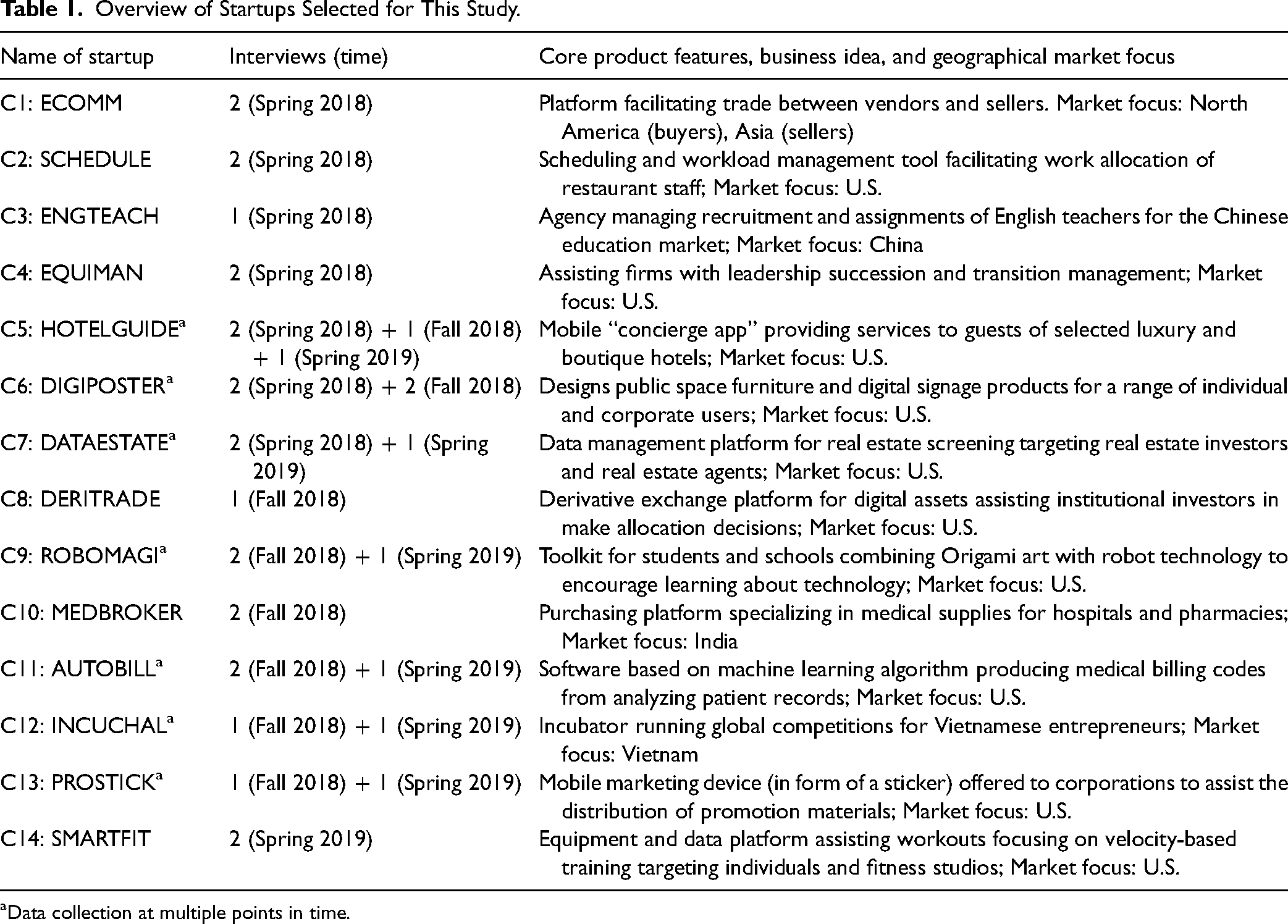
Data collection at multiple points in time.
The selection of startups for this study was based on my prior contacts with an incubator in Boston, U.S. The incubator specializes in supporting entrepreneurs that focus on innovative technologies. All the startups included in this study had been accepted into the program of this incubator at that time. The incubator provides training and office space and supports international entrepreneurs with visas that allow them to work and live in the U.S.
The study is based on data that was collected by teams of MBA students between Spring 2018 and Spring 2019 as part of a Strategy course across three consecutive semesters. Each startup was first selected jointly by the manager of the incubator and myself, and then assigned to a team of three or four MBA students who would jointly collect data on the startup, including interviews with the founder or founding team. Some startups were studied for multiple semesters (see Appendix). The students were collecting data under my supervision. They were provided with interview guidelines (see Appendix) and basic instructions on how to best conduct semi-structured interviews. They also helped with transcribing the interview data.
Data collection is based on three main sources: interviews, archival data and participation in events involving the entrepreneurs. Overall, 32 interviews of 30–60 min in length were conducted. With most startups at least two interviews were conducted, mainly with the founder. Each interview was conducted in a way that allowed for retrospective reflection of the entrepreneurial process, covering several themes, such as the development of the product itself, the formation of the entrepreneurial team and the process of target client identification (see guideline in Appendix). In the case of six startups, multiple rounds of interviews were carried out in consecutive semesters, whereby questions were added specifically to inquire about changes in venture formation and market positioning. In terms of archival data, websites and business press on the ventures were screened for important information on product features in particular. In addition, several entrepreneurs were invited to events to present their ideas and engage in discussions with students and myself. These events also provided important insights into how entrepreneurs went about marketing their products and which challenges they faced.
The actual data analysis going into this study was done solely by myself after all the data was collected. The specific objective of understanding client market imagination among tech entrepreneurs goes beyond the initial reports written and submitted by MBA students. For the purpose of this study, as detailed next, a secondary analysis of data was conducted by myself to examine how tech entrepreneurs imagine target client markets.
In a first step, various statements made by the entrepreneurs about their target markets and target clients were put in a temporal order, in line with the narrative the entrepreneurs shared in the interviews. For example, entrepreneurs would often say things like ‘First we were targeting X as our potential clients. Only later we discovered that our primary client might be Y’. In this storyline, the focus on X as a client precedes a shifting focus onto Y. In cases where I had interviews available that were conducted with the same entrepreneur at multiple points in time, the elapsed time between those interviews would give further indication about potential shifts in thinking about target clients. For example, in one case, an entrepreneur would initially introduce their startup as a business-to-business (B2B) startup and only in a follow-up interview, half a year later, switch to a business-to-business-to-consumer (B2B2C) framing. In any case, whether retrospectively or through multiple interviews, this study focuses on the evolution of client market imagination within a time period of typically 1–2 years in early venture formation, prior to the market testing of new products with any client groups.
In a second step, I analyzed major perspectives entrepreneurs employed to talk about value creation, including narratives about product uses, users and clients. After separately coding for these different perspectives, I then examined linkages between them in the entrepreneurial narratives. In some cases, for example, entrepreneurs would imagine multiple uses of the product by the same clients, in other cases they would associate multiple uses with different clients. I also noticed that most of the entrepreneurs would choose product uses and users as the main starting point for talking about value creation. When asked about their target clients, they would often admit that they first did not think of clients at all, but only later made connections between product uses and potential client benefits.
In a third step, I conceptualized an inductive process model of client market imagination based on three layers or building blocks adding sophistication in the imagination process. Each building block specifies certain ways in which the perception of product uses feeds into client market imagination. At the same time, each building block stimulates a new quality of thinking of products and clients, as indicated by new building blocks adding onto established ones. I describe and discuss the elements of this process model in detail below. In addition, I argue based on my data, that the ‘product utility gap’, i.e., the perception of a gap between the range of product uses and client constellations in which the product can create value, is a major driving force in client market imagination in general and the formation of different building blocks of imagination in particular. Following the empirical section, I discuss in more detail how these dynamics unfold and what can be learned for future research on entrepreneurial imagination.
Findings
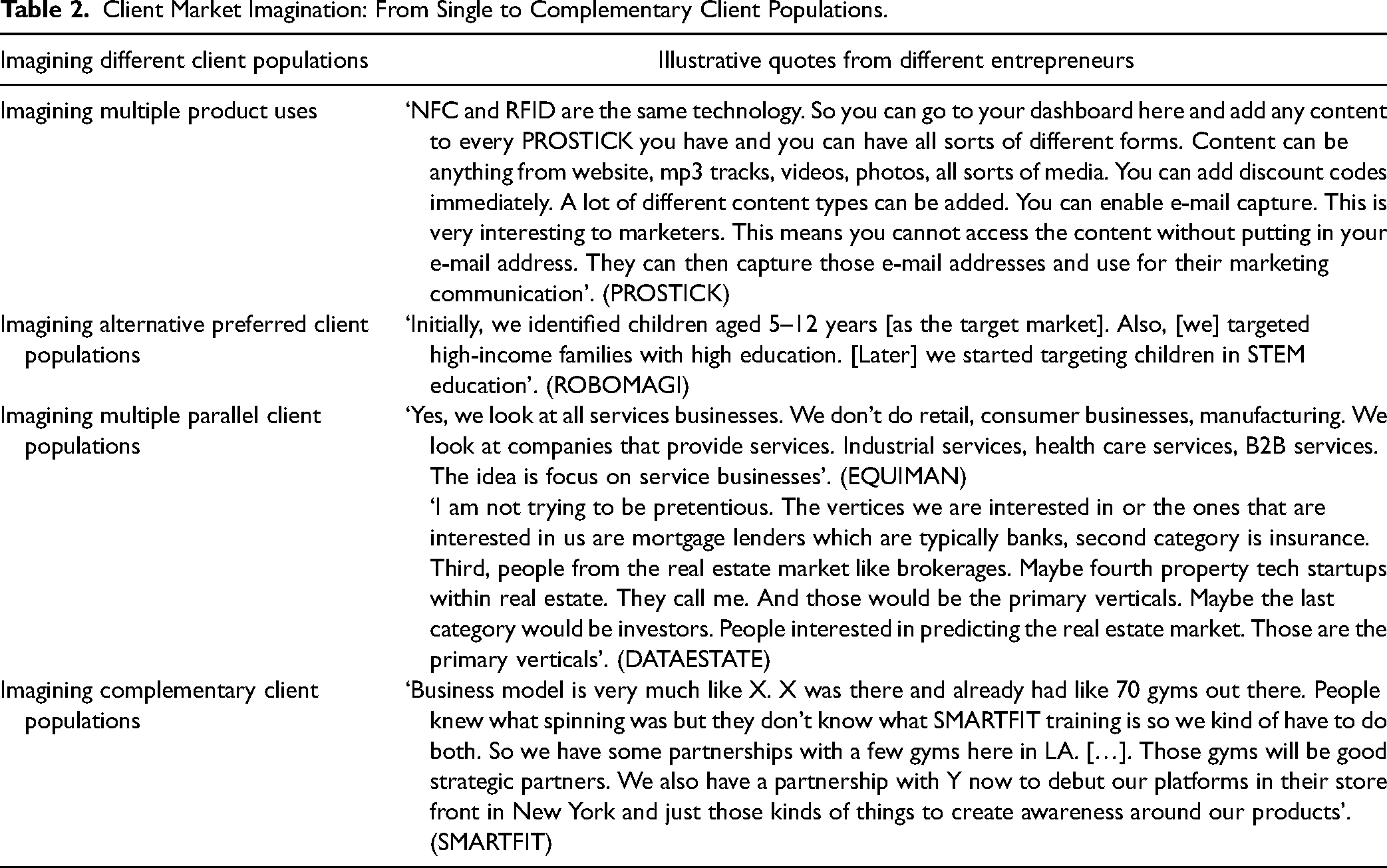
Next, I present key empirical findings. For this purpose, I primarily refer to four lead cases (based on 13 interviews) with ‘power quotes’ in the main text to establish my main argument, while providing additional ‘proof quotes’ from across cases as further evidence in Table 2 (see also Pratt, 2009). One purpose of using lead cases is to establish an easy-to-follow narrative to reconstruct the incremental thinking process of these four entrepreneurs. I thereby focus on similarities in terms of core principles by which entrepreneurs added sophistication in their imagination of target clients. Three of the four lead cases are based on multiple rounds of data collection, which assisted my understanding of the evolution of their client market imagination. The fourth lead case is based primarily on retrospective storytelling by the entrepreneur.
Client Market Imagination: From Single to Complementary Client Populations.
The first lead case is HOTELGUIDE. This new venture has designed a cloud-based hospitality platform to offer independent boutique hotels a service that integrates with a hotel's property management service. It is designed to give hotel guests ‘tailor-made’ recommendations on what to do (and when), where to eat, and what to see, as well as directions to whichever destination the guest chooses. The founding team is composed of one former travel columnist, who worked for a large broadcasting channel, and a former New York investment banker.
The second lead case is DIGIPOSTER. This new venture builds on the concept of ‘smart cities’ and has roots in the MIT Media Lab. Its products include a public bench with a charging station and a digital signpost, which provides advertising opportunities for individuals and companies. The founding team has a background in architecture, graduating from Harvard and MIT, and a shared interest in smart infrastructure. For this project a project manager working for DIGIPOSTER was interviewed whose main task was to develop the business model.
The third lead case is AUTOBILL. This venture is focused on increasing the efficiency and accuracy of the medical billing coding process of hospitals by developing a machine learning engine that reads through patient records and recommends billing codes for insurance companies based on the text found within the patient record. The founder, who also developed the main algorithm, has a background in software engineering. The current team also includes a medical physician who is familiar with the specifics of medical coding in the United States.
The fourth lead case is MEDBROKER. This venture is about developing a business-to-business purchasing platform, specializing in medical supplies and devices, and targeting hospitals and pharmacies. It is designed for the Indian context. The founding team is Indian, consisting of a serial entrepreneur, a former employee of the World Health Organization and a purchasing expert who has worked with multiple manufacturers and distributors in the United States.
Next, I examine the evolution of imagination of client markets especially across the four lead cases, with additional evidence from other cases (see Table 2).
Imagining Multiple Product Uses
One central finding in the data is that what drives client market imagination is the imagination of product utility, i.e., the various ways in which products can be used, as well as product utility gaps, i.e., the perception of a gap between the range of product uses and client constellations in which the product can create value. By client constellation I mean the availability of different types of clients taking an interest in various aspects of the product or service. One critical starting point – and continuous reference point – in client market imagination is the imagination of product uses. Importantly, rather than thinking of one major product utility, the entrepreneurs in this study would typically think of multiple product uses and benefits. In some cases, these uses would be associated with benefits for particular clients. In other cases, different uses are envisioned more ‘freely’ without associating them with particular client needs.
In the case of HOTELGUIDE, the entrepreneur initially explained in the interview the many benefits that he perceives the app would have for hotel guests, including reservations, mobile check ins, keyless entry. All these proposed uses and potentially value-generating mechanisms are derived from the technological capabilities of the product itself. “As a hotel digital amenity, you get access to 24/7 chat, reservations, content, mobile check in, keyless entry. So, all these cool things packed into one mobile product. There are so many advantages for you as a guest staying only at that hotel that you get through HOTELGUIDE. It's positioning us as a different agent since we are the hotel's digital amenity.” (Founder, HOTELGUIDE)
In other cases, such as DIGIPOSTER and AUTOBILL, the entrepreneurs made distinctions between ‘primary’ and ‘secondary’ uses of their product. This distinction would play an important role in how these entrepreneurs would later conceptualize the relationships with different (interrelated) clients. This is because categorizing product uses into primary and secondary allows entrepreneurs to envision potential user interdependencies and complementarities.
For example, in the case of DIGIPOSTER, the entrepreneur envisioned, on the one hand, to sell the ‘bench’ itself, i.e., the hardware that displays content for different clients in urban spaces. On the other hand, the venture was planning to generate revenue from selling reports based on user data accumulated over time. This value creation strategy is based on the data storing and processing properties of the user interface and software behind the hardware product. “So they buy the bench and if interested in data there's a subscription fee so we can provide the data reports to them. […] I think what sets us apart from competition is that we can provide data that is easily consumable. It's easy to just have that report and show it to anyone and it's very easy to understand […]. “(Project Manager, DIGIPOSTER)
This quote also suggests that especially the secondary use – producing easily consumable reports – was not initially associated with any client group. Instead, this additional value-creating feature would stay ‘latent’ in the entrepreneur's imagination creating a ‘product utility gap’ which would continue to drive client market imagination (see below).
Similarly, in the case of AUTOBILL, the entrepreneur made a distinction between the primary product – the automated medical bills – and a potential secondary product and technology use based on the accumulated data of patients. More specifically, the entrepreneur described how their software will be able to track trends across and specific to particular patients. The data from that can assist health predictions and be potentially turned into secondary products. “AUTOBILL would provide the complete set of codes which describe the patient. We would be able to see macro and micro trends. We could see heart failure rise nation-wide and provide guidance on why or how to change that. We could watch patterns and trends within a single patient's medical history to predict that they may have heart failure in 6 or 12 months. […] We can track what interventions were prescribed, and what the outcome of the treatment was, tracking which interventions work best. We can see a sick man who has all of the same characteristics as a group of healthy men, but the additional characteristic is that he smokes. […] The possibilities are endless.” (Founder, AUTOBILL)
Again, as the interviewee suggests, ‘the possibilities are endless’ when it comes to the potential utility of tracking a patient's history through the AUTOBILL product package. This, however, also implies that it was initially unclear to the entrepreneur which client(s) might benefit from these ‘endless possibilities’.
To sum up, before trying to identify potential client markets, the interviewed entrepreneurs would typically engage in a process of imagining potential uses of their products and services, without necessarily thinking of specific users. Importantly, interviews suggest that the imagination of product uses would continue quite independently from thinking of particular clients. This parallel process allowed entrepreneurs to always think of product uses beyond whatever client population they were thinking of at any point in time. In turn, this would generate product utility gaps that could stimulate an increasing sophistication in client market imagination. Next, I elaborate about the latter in greater detail.
Imagining Alternative Preferred Client Populations
All the entrepreneurs that were interviewed described the identification of target clients as difficult. Importantly, this process would typically start with imagining one major client for the product. This strategy largely follows the logic of matching the utility of the product with a client group that could benefit from the product the most in the imagination of the entrepreneur. For example, the founder of DIGIPOSTER was initially eager to identify the client for the signposts they were developing. The following quote illustrates that: “Actually we are still trying to figure out who exactly the client is and who the sign is for. I think the sign can benefit a lot of people and I don’t think the answer is very straight forward yet.” (Project Manager, DIGIPOSTER)
In a variation of that, the interviewed entrepreneurs would experiment with envisioning various target clients before switching to alternative clients with a greater promise of success. For example, the founding team of MEDBROKER initially targeted pharmacies with their procurement service. Doing an analysis of industry conditions, they discovered that the range of products needed by pharmacies may be too low and thus their bargaining power too high. Against that background they shifted their emphasis to hospitals as alternative clients with a potentially greater demand for various products they could provide: “Initially we did not start off with hospitals, [but] with pharmacies. For pharmacies, as I told you in our previous conversation, we started off with about 700 pharmacies in one city and about 5,000 products, and that is enough for pharmacies. But now we moved to working with hospitals, they need more products. Our aim is to have 20,000 products by the end of this year, and partner with so many suppliers to get to the 20,000 mark and to get more hospitals starting next year. Right now we are only working with 4 hospitals in southern India, but then we have the target that we should be working with at least 20 hospitals.” (Founder, MEDBROKER)
Importantly, this approach to identifying target clients typically implies that whoever is selected as the primary target is unlikely to make full use of new product offerings. In other words, focusing on a single preferred client group implies the persistence of a product utility gap. The interviewed entrepreneurs initially perceived this as a necessary trade-off – between the benefits of securing at least one primary client group even if a product utility gap remains vs. the risk of not finding a primary client group at all. However, interviews also suggested that the perceived product utility gap – or the perceived opportunity to make better use of the product – would continue to drive entrepreneurial imagination of client markets beyond single preferred clients.
Imagining Multiple Parallel Client Populations
Over time, entrepreneurial imagination shifted from trying to identify alternative major target client groups to identifying multiple parallel client groups who could make use of the product. This shift in thinking may seem incremental at first, but it marks an important milestone in allowing entrepreneurs to think of potential product demand beyond a single client group, thus narrowing the perceived product utility gap.
The case of MEDBROKER nicely illustrates this shift. Whereas initially, the founder of MEDBROKER was struggling to determine who the major client group might be, later on, the founder moved away from this constraint in opening up to multiple parallel client markets: “Customers are hospitals, pharmacies, non-governmental organizations in India. All those people who procure domestic medical supplies and international medical supplies. They might need medical supplies in 1 or 6 months, or in one year, because sometimes they need capital equipment also, like an echocardiographic machine. There are different types of medical supplies, disposables, medical devices, and medical equipment, non-governmental organizations who are involved in patient care. Ok, so these are our customers.” (Founder, MEDBROKER)
In a similar way, the AUTOBILL founder started thinking of multiple ‘end-users’ of the software they developed. This example nicely illustrates how entrepreneurial imagination of client markets is driven by perceived product utility rather than the perception of existing client demands. The example also illustrates how imagining multiple parallel client groups narrows the perceived product utility gap, without closing it entirely. In fact, the founder makes clear that the technology is capable of much more than just ‘billing’ hospitals and insurance companies: “By keeping the software between healthcare provider and insurance company separate, we are able to increase our overall number of ‘end-users’. That said, the downstream is not the end goal. The technology is capable of doing much more than just billing. The technology is capable of many different kinds of codes and can actually power searches to help you find patients who could suffer [from particular conditions] later on.” (Founder, AUTOBILL)
The imagination of multiple client markets, in turn, triggered a process of considering how and to what extent different potential client demands may be interrelated. At a very basic level, the founder of AUTOBILL for example considered how their product could align interests of both hospitals and insurance companies in ‘accurate billing’, preventing both undercharging and overcharging and facilitating smoother transactions in the industry: “We believe it is in the hospitals’ best interests to not overcharge, and not undercharge. Our goal is that our introduction into the market will normalize things for both hospitals and insurers, both sides. Once we sell to insurance companies, it will be in the hospitals’ best interest to not overcharge, because we will spot it and that will delay their reimbursements […]. We want to push our product to both hospitals and insurers, as it is in both of their best interests to be accurate.” (Founder, AUTOBILL)
However, beyond potential technical interdependencies of different client groups, entrepreneurs also started imagining how their product could generate synergistic value by serving different clients at the same time. In other words, rather than just imagining how different clients could individually benefit from the product, their potential joint benefit became a more central aspect in client market imagination, as detailed next.
Realizing Joint Benefits for Interconnected Clients
As entrepreneurs increasingly considered multiple, potentially interconnected client groups making use of their product(s), their imagination and understanding of value creation would put greater emphasis on interdependencies and complementarities.
One example of this is DIGIPOSTER's identification of two distinct customer groups – municipalities who purchase signs, and advertisers who purchase content space on these signs. Along with this differentiation comes a growing awareness of how different clients and their roles interrelate in making the business model work. In this specific case, for example, DIGIPOSTER's founder would qualify municipalities as ‘enablers’ as opposed to advertisers as ‘clients’: “We have two customer groups since we launched. […] On the one hand we target municipalities but they’re more of an enabler as opposed to a client, but we [need them] [to generate] revenue from the signs. [..] The advertisers are the second target market.“ (Project Manager, DIGIPOSTER)
In terms of value creation, the interests of municipalities and advertisers are interlinked, and this interlinkage is key to DIGIPOSTER's business model: municipalities benefit from a wide range of uses of DIGIPOSTER signs by different advertisers. In turn, each advertiser benefits from the purchase of these signs by a significant number of municipalities.
Another good example of the increasing sophistication of client market imagination is HOTELGUIDE. Across several interviews with the entrepreneur, I observed a shift in thinking about the business model of HOTELGUIDE. According to the founder, they first approached it by thinking of themselves as a Business-to-Business (B2B) company, with hotels as their main customers. Later, they thought of themselves more as a Business-to-Consumer (B2C) company developing services for hotel guests. Eventually, they arrived at the realization that they might be a Business-to-Business-to-Consumer (B2B2C) company since their value proposition depends on the coordination of interests between hotels, hotel guests and HOTELGUIDE: “We are actually B2B2C. Our product has always been for the end consumer. Even though we are selling to hotels, those are using our product for the guests. Like the toys industry, you are producing toys for kids, but then you sell them to parents. So, we started with the idea of B2B, but it's actually more important to be B2B2C. Now it's not that we are making products for hotels, but we are always focusing on the guests and […] we are acquiring guests through B2B and B2C. (Founder, HOTELGUIDE)
Based on this more integrated thinking of value creation, the HOTELGUIDE founder was also able to specify the utility of its product – the mobile app – for both hotels and guests. More specifically, joint utility would be increased by ‘semi-customizing’ the products for both hotels and guests in a modular fashion. This allows more hotels to join the platform, and more guests to benefit from the participation of multiple hotels. The founder explains it this way: “[You need to] think about clients (hotels) and users (guests). There are two different acquisition strategies. On the client side, […] we are not only trying to pitch, sell and create this relationship with hotels, but also we are trying to upsell these hotels [to users]. HOTELGUIDE is a pretty modular product, so we can […] make restaurant reservations for you (guests), you can have mobile checking, keyless entry, and audio guides. Once you are on the platform, we are creating more and more opportunities to continue to engage with clients and users, [and thereby] increase revenue.” (Founder, HOTELGUIDE)
In sum, findings suggest that the interviewed entrepreneurs engaged in increasingly sophisticated client market imagination – from imagining alternative preferred target clients to imagining interconnected client populations that jointly benefit from the product. Thinking of potential product utility beyond any particular client thereby serves as an important driving force. At the beginning, in particular the capacity of products to serve multiple client groups would fuel client market imagination. Over time, the quality of product use, including synergistic utility across multiple client groups, would become increasingly important. This demonstrates that client market imagination is reciprocally interlinked with the imagination of product utility across clients. At the same time, entrepreneurs would continue to think of product utility beyond obvious client needs, thus fueling client market imagination as a continuous process.
Discussion: How Product Utility Gaps Drive Client Market Imagination
Prior studies have suggested that one main purpose of entrepreneurial imagination is to reduce complexity by creating potential future worlds of value creation which link new products, markets and stakeholders in congruent ways (Beckert, 2021; Roundy, 2021; Wood & McKinley, 2010). As part of it, resulting imaginaries both include and exclude possibilities of value creation and thus assist decision-making and sensemaking under conditions of uncertainty (Beckert, 2021; Manning, 2022). While my findings in part confirm the importance of imagination for sensemaking, they also suggest that imagination can be quite fragmented and that such fragmentation allows entrepreneurs to imagine worlds of value creation without excluding possibilities.
Specifically, my findings suggest that tech entrepreneurs imagine product uses and client markets in loosely coupled ways, whereby their imagination of product uses typically ‘exceeds’ their imagination of client markets. I call this the ‘product utility gap’, i.e., the perception of a gap between the range of product uses and client constellations in which the product can create value. However, as entrepreneurs continue to expand their imagination of product uses, their imagination of client markets also becomes increasingly sophisticated – gradually shifting from a search for primary client groups to envisioning complementary sets of clients. In other words, I observe a continuous interplay between client market imagination and perceived product utility gaps. Next, I discuss this dynamic in greater detail.
First, and most fundamentally, client market imagination and the perception of product utility are intertwined, yet not identical processes. Importantly, findings suggest that the perception of product utility does not seem to be driven by perceived client demand, but rather the other way around. Interviews suggest that tech entrepreneurs tend to perceive a range of product uses beyond whoever they imagine as potential clients at any point in time. For example, the founders of DIGIPOSTER, AUTOBILL and HOTELGUIDE imagine various services they could provide by analyzing big data, without having a particular client in mind. This generates a ‘product utility gap’, which, in turn, drives further client market imagination. This finding deviates from the common perception that entrepreneurs imagine worlds within which their products can create value (Beckert, 2021; Roundy, 2021), since their imagination of ‘product value’ seems to exceed their imagination of ‘client needs’. However, my findings are in line with other studies suggesting that in particular tech entrepreneurs see a transformative potential in the technology they develop and market to potential clients (Dushnitsky, 2010). In other words, tech entrepreneurs may perceive a potentially market-generating value in their product that is not constrained by any existing – or imagined – client market. That said, findings also suggest that tech entrepreneurs adjust their perception of product utility to their evolving imagination of client markets. On the one hand, envisioning particular clients inspires them to imagine particular product uses that may be specific to these clients (see below). On the other hand, changes in client market imagination also change the ‘product utility gap’, i.e., the perception of (additional) product uses that may not be fully exploited by any given client constellation.
Second, findings suggest that the way tech entrepreneurs imagine product uses also changes over time, specifically as their imagination of potential client markets becomes more sophisticated. As I detail below, entrepreneurs initially think of product utility primarily in quantitative terms, i.e., in terms of the accumulation of uses benefitting various clients. The case of MEDBROKER is a good example. Their initial client imagination is guided by the question of which organizations – hospitals, pharmacies etc. – could benefit from their procurement services the most. However, as soon as entrepreneurs begin to entertain the idea of serving multiple client groups in parallel, this quantitative thinking is replaced by imagining (additional) product utility in more qualitative terms. For example, in the case of MEDBROKER, rather than just imagining how clients individually benefit from the service, the entrepreneur increasingly engaged in thinking of each client group as member of a new evolving ecosystem, in which both hospitals and pharmacies could mutually benefit from using MEDBROKER as preferred supplier, e.g., by negotiating special deals. Similarly, the HOTELGUIDE founder would increasingly perceive ‘network effects’ benefitting both hotels and guests who get to share access to the same service platform and client pool, e.g., by being able to improve their own value proposition vis-à-vis those who are not users of the platform.
Based on these two fundamental observations, I now discuss more specifically three layers of interplay between perceived product utility and client market imagination that, in conjunction, contribute to an increasing sophistication of the latter. Figure 1 illustrates these three layers. Importantly, these layers should not be seen as ‘phases’ but as dynamic building blocks in the imagination of client markets over time. This is because even with increasing sophistication, basic dynamics of imagination remain relevant. For example, imagining multiple product uses (and users) is a fundamental building block (Layer 1) that continues to drive client market imagination. Next, I discuss these dynamics in greater detail.
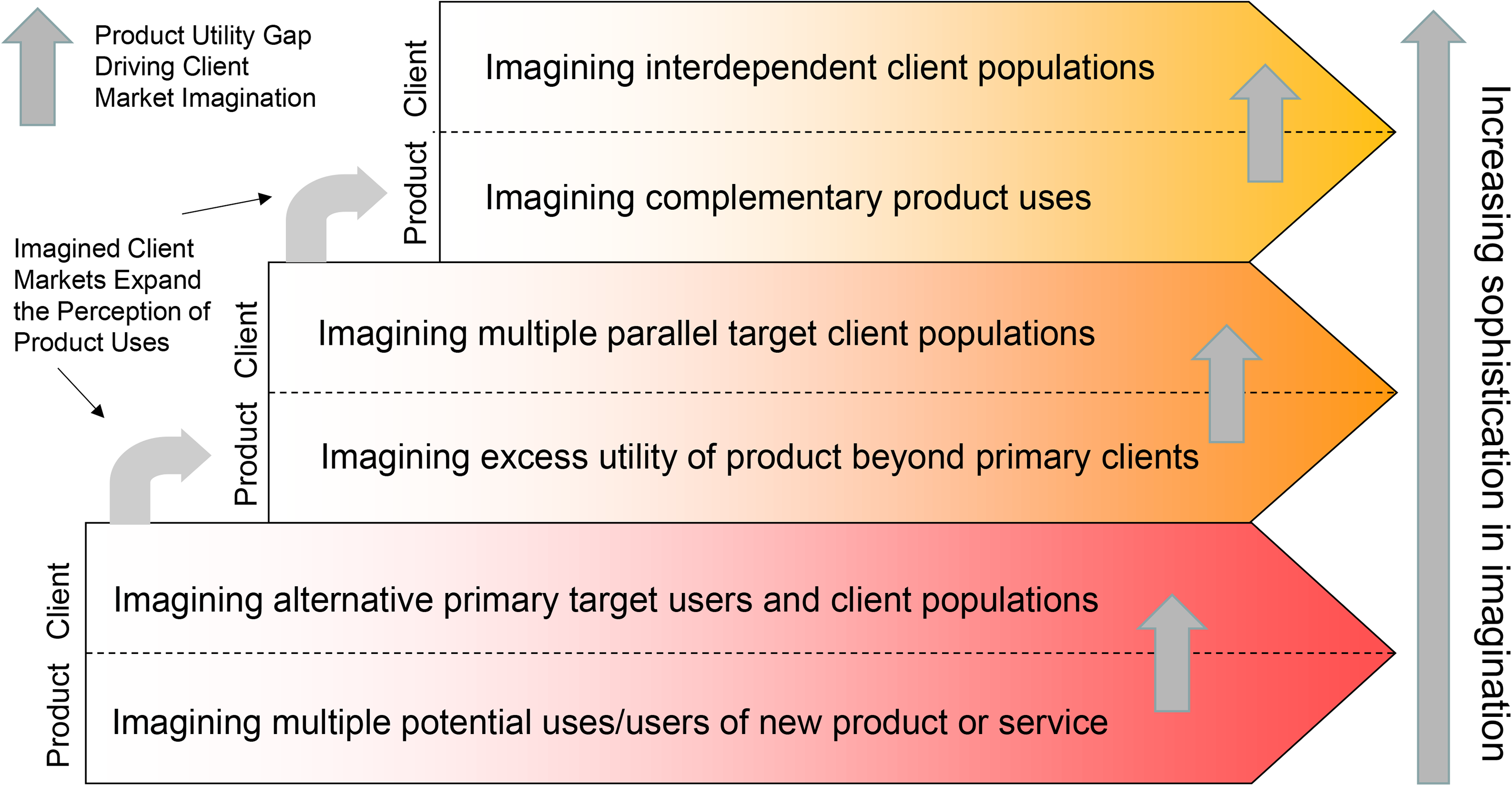
Building blocks in entrepreneurial client market imagination.
One key driver of the most basic building block in client market imagination (bottom layer in Figure 1) is the imagination of multiple potential uses and users of the product or service. For example, the founder of DIGIPOSTER from the start imagined that the posters could be useful in providing space for information and advertising in cities, as well as in becoming a source of data collection. The founder of AUTOBILL imagined his automatic coding service as a way to improve medical billing for various potential users, including hospitals and insurance companies. Importantly, the process of envisioning a range of uses and users remains only loosely coupled with the imagination of particular client groups. Because of this, however, the imagination of product utility from the start also creates a ‘product utility gap’, in terms of a perceived need to identify clients who can actually make use of the product and generate revenue. At the beginning, as indicated by the bottom layer of Figure 1, the initial product utility gap leads entrepreneurs to consider alternative primary target users and client populations. For example, the founder of MEDBROKER initially considered pharmacies to be the primary target for their procurement services. Later on, they switched to imagining hospitals as their primary target.
Now, interestingly, instead of pragmatically ‘adjusting’ the imagined product utility to whoever is perceived as the main client, I find that, on the contrary, entrepreneurs maintain a vision of product uses that exceeds imagined client needs. In other words, instead of minimizing the product utility gap, entrepreneurs choose to maintain or even widen that gap to further stimulate their thinking. For example, rather than customizing or narrowing the utility of procurement services to either hospitals or pharmacies, the founder of MEDBROKER would continue to imagine a product utility that exceeds the need of any particular client group. Likewise, the HOTELGUIDE founder would continue to see a product utility that goes beyond the specific needs of either hotels or hotel guests as potential target clients. This persistence to keep thinking about product utility beyond any single client type is a key driving force in client market imagination.
The continuous gap between what entrepreneurs imagine the value of products to be and the imagination of what any particular client group would need, i.e., the perceived excess utility of the product or service beyond primary clients, eventually leads to a qualitative jump in imagination – from imagining alternative primary clients (bottom layer) to imagining multiple parallel target client populations (middle layer). For example, the founder of MEDBROKER shifted from imagining either pharmacies or hospitals as primary clients to imagining pharmacies and hospitals as target clients. Similarly, in the case of HOTELGUIDE, the entrepreneur initially switched back and forth between considering their service to be B2B – serving hotels – or B2C – serving hotel guests, before eventually framing their service to be B2B2C – serving both hotels and hotel guests. Yet again, this shift in thinking would temporarily ‘narrow’ the product utility gap, but not close it entirely. On the contrary, the prospect of serving multiple client populations would trigger new ways of thinking about product uses, thus ‘widening’ the product utility gap again and stimulating new ways of thinking about clients.
More specifically, findings suggest that as entrepreneurs started considering serving multiple client populations in parallel they would start thinking more deeply about complementary product uses, which, again, triggered a new quality in imagining clients. Whereas previously entrepreneurs would mainly think about adding potential client groups (middle layer), their new focus on complementarities would help them see client populations as potentially interdependent (upper layer). For example, in the case of HOTELGUIDE, the founder increasingly thought of the B2B2C model as a potential ecosystem in which new hotel clients benefit from having access to an exclusive pool of guests sharing an interest in particular hotels, while, at the same time, new individual users benefit from accessing similar kinds of hotels along with customized services. However, as indicated above, client market imagination does not ‘stop’ here. For example, in the case of HOTELGUIDE, the entrepreneurs continued to imagine additional product uses, e.g., based on the opportunity to analyze big data on hotel service preferences. In other words, the very basic dynamic of perceiving product utility gaps continues to drive client market imagination. Thus, unlike suggested by previous studies (Beckert, 2021; Roundy, 2021), the imagined world within which products can create value is never ‘complete’ but remains open-ended, thus also leaving room for adjustments and additions over time.
Implications for Future Research
My findings have important implications for understanding the entrepreneurial process especially in high-tech domains. First, I contribute to empirical research on entrepreneurial imagination (Elias et al., 2022; Kier & McMullen, 2018) by specifying how tech entrepreneurs envision client markets. Especially, my findings inform research on opportunity idea formation prior to the actual mobilization of opportunities (Wood & McKinley, 2010, 2020). Second, my findings contribute to research on business ecosystems (Jacobides et al., 2018) by elaborating important mechanisms by which entrepreneurs strategize and think about nascent ecosystem relationships.
First, this study contributes to the growing research on drivers and processes of imagination in the entrepreneurial process (Elias et al., 2022; Hjorth & Reay, 2022; Sarasvathy, 2002; Shepherd et al., 2021). Specifically, this study corresponds with prior studies observing that entrepreneurial imagination is an ongoing iterative process of envisioning future worlds in which new products and services can create value (Roundy, 2021; Wood & McKinley, 2010). However, this study also deviates from prior understandings of entrepreneurial imagination in important ways.
Prior studies would mainly emphasize that feedback from potential clients, stakeholders and support organizations drives entrepreneurial imagination (see e.g., Wood & McKinley, 2010). In addition, the work by Wood and Williams (2014) and Williams and Wood (2015) suggests that ‘exogenous factors’, such as environmental cues and the knowledge of the entrepreneur, can be important drivers. While these aspects are certainly important, my study shows that what drives increasingly sophisticated imagination is in part the imagination process itself. The very fact that tech entrepreneurs imagine in parallel how products can be used (independent of any specific clients) and how clients can benefit from their products triggers an ‘endogenous process’ of imagination. Product-centered and client-centered imagination are thereby loosely coupled. Future studies need to better understand the dynamic of ‘exogenous’ and ‘endogenous’ stimulation of entrepreneurial imagination. Also, while this study focused entirely on tech entrepreneurs, who are typically optimistic about the utility of their products even if markets are unknown (Dushnitsky, 2010), future studies need to further examine drivers of entrepreneurial imagination in less tech-driven domains. For example, studies on social mission-driven entrepreneurship indicate that social entrepreneurs often create narratives of making the world a better place beyond the specific benefits of their particular products and services (see e.g., Manning & Bejarano, 2017). Such larger narratives may play a role in how social mission-driven entrepreneurs imagine how their products and services serve various beneficiaries in interconnected ways.
In this respect, my findings also inform ongoing research on where entrepreneurial opportunities come from. Aside from the ongoing conversation about whether opportunities are ‘created’ or ‘discovered’ (Alvarez & Barney, 2007; Garud & Giuliani, 2013), Wood and McKinley (2010) made the important point that prior and parallel to this, entrepreneurs develop and revise ‘opportunity ideas’, in terms of envisioning futures that may or may not become opportunities. This study adds to our understanding of the formation of opportunity ideas by suggesting that tech entrepreneurs seem to develop parallel opportunity ideas about (i) how their products can be used in general, and (ii) how particular clients could benefit from their product. Both questions (i) and (ii) are interlinked, but in a loosely coupled way. In particular, findings suggest that opportunity ideas type (i) tend to exceed opportunity ideas type (ii). At the same time, ideas type (ii) may feed back into an expansion of ideas type (i).
My findings also have important implications for examining the relationship between opportunity ‘creation’ and ‘discovery’. Whereas prior studies have emphasized a fundamental contrast between the constructivist notion of ‘creation’ – and ‘idea formation’ – and the more objectivist notion of ‘discovery’ (Alvarez & Barney, 2007; Wood & McKinley, 2010), my findings suggest that in particular the process of product-centered opportunity idea formation independent of potential clients – type (i) – creates an opportunity space for the ‘discovery’ of new client-serving opportunities – type (ii). In other words, if indeed entrepreneurs engage in loosely coupled product-centered and client-centered opportunity idea generation, processes of ‘creating’ and ‘discovering’ opportunities may be much more interlinked than previously understood. In addition, findings suggest that opportunity ideas do not just ‘evolve’, but become more sophisticated over time. Whereas at the beginning tech entrepreneurs tend to focus on who could be served based on their imagination of product utility, later on the question of how in particular multiple interconnected clients could benefit from the product becomes more central. This suggests that we may need a more nuanced understanding of ‘opportunity ideas’ that co-evolve with product uses and client constellations entrepreneurs envision over time. Future research needs to better understand these dynamics. For example, to what extent is the increasing sophistication of opportunity idea formation path-dependent vs. open-ended, based on the loose coupling of product-centered and client-centered imagination?
Second, my findings have important implications for research on business ecosystems, which are typically understood as sets of businesses contributing to the creation of value for various clients in complementary ways (Adner, 2017; Jacobides et al., 2018; Williamson & DeMeyer, 2012). Even though recent studies have further developed our understanding of what business ecosystems are and where they occur (Jacobides et al., 2018), as well as how businesses and entrepreneurs strategize participation in such ecosystems (Hannah & Eisenhardt, 2018), we still know relatively little about how entrepreneurs envision new potential ecosystems. This study can contribute to this understanding.
On the one hand, findings suggest that entrepreneurs start thinking about complementary value creation – one core element of business ecosystems – once they consider serving multiple different client groups in parallel, rather than just one primary client group. This finding parallels the idea in network research that entrepreneurs gain certain exploitative opportunities once they develop relationships with multiple businesses that are unconnected themselves (Burt, 1992). However, rather than just ‘playing them off against each other’, as implied in the concept of ‘tertius gaudens’ (Burt, 1992), or connecting them for joint innovation and other mutual benefits, as implied in the idea of ‘tertius iungens’ (Obstfeld, 2005), in this study, entrepreneurs start thinking about complementary ways of serving each client, which can be a key building block in forming business ecosystems (Jacobides et al., 2018). On the other hand, this study indicates that one key driver in thinking about complementary client relationships are what I called ‘product utility gaps’. In relational ecosystem terms, product utility gaps can be represented as complementary client ‘positions’ in the emerging ecosystem that need to be filled. In other words, my findings indicate that one key element in the entrepreneurial imagination of ecosystem relationships is the envisioning of additional product uses which motivate entrepreneurs to either think of connecting already envisioned clients with new clients or of adding new product utility dimensions to ‘pre-imagined’ client relationships. This finding may not only inform research on nascent ecosystem formation but also help understand how strategic ecosystem actors may deepen and expand existing ecosystem relations over time, e.g., based on product innovation.
This study also has limitations which future studies need to address. For example, whereas this study focused on tech entrepreneurs in Boston, future studies could expand the empirical scope by comparing entrepreneurial strategies of envisioning client markets across different industries and geographies. One could imagine that being located in an urban entrepreneurial hub, like Boston, provides a larger set of cognitive templates for entrepreneurs to use as they envision their client markets than in less urban areas. Likewise, as mentioned above, findings of this study may apply in particular to those entrepreneurial domains, such as tech entrepreneurship and social mission-driven entrepreneurship, in which entrepreneurs share a relentless optimism about the larger impact and importance of their products. Future studies need to examine how this compares to more ‘grounded’ entrepreneurship, e.g., in agriculture or business services, where target markets may be more specific from the very beginning. Also, while this study focused on imagination at a very early stage of the entrepreneurial process, future studies should look into how this compares to imagination at a later stage which may be more influenced by actual market feedback. At the same time, how and to what extent is later-stage imagination influenced by early-stage imagination? Finally, and related to this, this study focused on entrepreneurs that are supported by a university venture development center. Future studies could further examine potential differences in the evolution of client market imagination between entrepreneurs that receive support vs. entrepreneurs lacking access to support infrastructures.
This study also has some interesting policy implications, in particular for entrepreneurship support organizations. Educating entrepreneurs about market and client selection as part of their business model development is an important aspect of entrepreneurship support. However, my findings suggest that the delivery of such education and training should be aligned with the evolution of thinking of entrepreneurs. For example, confronting entrepreneurs very early with the concept of business ecosystems or the idea of complementary client markets may fail to reach entrepreneurs’ minds simply because they may not be initially ready to receive and fully process this information. However, as their product and client imagination progress, entrepreneurs come to grips with the limitations of single primary client markets, and they may open up to imagining how to best serve multiple client markets in parallel. In turn, teaching entrepreneurship in schools could benefit from a shift from prescriptive teaching of ‘business models’ to awareness-building around how entrepreneurs actually learn to build business models around their products, and which principles they use to develop their thinking.
In conclusion, this study has explored how tech entrepreneurs gradually develop a more sophisticated understanding of unknown target client markets through imagination of how their products could generate value. The perceived utility gap between potential product uses and their materialization within any perceived client constellation serves as an important driving force for imaginative world-building. Findings further our understanding of entrepreneurial imagination and sense-making, and have important policy and practice implications.
Supplemental Material
sj-docx-1-jmi-10.1177_10564926231178208 - Supplemental material for Closing the Product Utility Gap: How Tech Entrepreneurs Imagine Unknown Client Markets
Supplemental material, sj-docx-1-jmi-10.1177_10564926231178208 for Closing the Product Utility Gap: How Tech Entrepreneurs Imagine Unknown Client Markets by Stephan Manning in Journal of Management Inquiry
Footnotes
Acknowledgments
I would like to thank the handling editor Karen Patterson for her very encouraging and developmental support which was critical in advancing this paper towards publication. I would also like to thank Madeleine Rauch, Stanislav Vavilov and the organizers and participants of a research seminar at ISM Business School in Vilnius, Lithuania, for very valuable feedback on earlier versions of the paper. Finally, I would like to express heartfelt thanks to the entrepreneurs who participated in the study and my MBA students at University of Massachusetts Boston (Spring 2018, Fall 2018, Spring 2019) for conducting interviews with these entrepreneurs which became an important inspiration and data source for this study.
Declaration of Conflicting Interests
The author(s) declared no potential conflicts of interest with respect to the research, authorship and/or publication of this article.
Funding
The author(s) received no financial support for the research, authorship and/or publication of this article.

Supplemental Material
Supplemental material for this article is available online.
References
Supplementary Material
Please find the following supplemental material available below.
For Open Access articles published under a Creative Commons License, all supplemental material carries the same license as the article it is associated with.
For non-Open Access articles published, all supplemental material carries a non-exclusive license, and permission requests for re-use of supplemental material or any part of supplemental material shall be sent directly to the copyright owner as specified in the copyright notice associated with the article.
