



Abstract
Silence in management and organization studies has been predominantly understood as something negative. However, recent examples have highlighted silence as a positive element in learning and organizing. We contribute to prior literature on positive silence and multimodality by arguing silence can operate as a semiotic mode that mobilizes resources for meaning-making. Ten team meetings in a financial organization in Europe were investigated. Visual ethnography was mobilized to gather data through interviews, observations, and photographs. Our analysis identified two types of silence—transcendental and material—that both function through three mechanisms to resemiotize meaning. A framework is presented to situate silence in relation to verbal and visual modes. Three contributions are made to studies on silence and multimodality: extended conceptualizations of silence, silence as a semiotic mode in itself, and methodological pathways for studying silence. In addition, practical implications for team meetings and silence in the workplace are discussed.
Introduction
Silence in management and organization studies has been predominantly understood as something negative: not being able to speak up, withholding information, or keeping silent about unethical practices, for instance (e.g., Morrison & Milliken, 2003). Furthermore, by treating silence predominantly as either something with negative implications or as the absence of communication (e.g., Van Dyne et al., 2003), with relative ease, we might overlook the constructive impact of silence (Vu & Fan, 2022). As Ephratt (2022, p. 1) claims, silence “does not constitute a homogeneous means of expression: it is not shapeless and void of content.” Thus, while often overlooked, there is a nascent body of knowledge suggesting we ought to revisit our understanding of silence (Bigo, 2018; de Vaujany & Aroles, 2019; Van Dyne et al., 2003; Vu & Fan, 2022).
For instance, de Vaujany and Aroles (2019) draw on Merleau-Ponty's phenomenology to illustrate how silence can give rise to learning and configurations of new work practices. Furthermore, Vu and Fan (2022, p. 319) mobilize Buddhist thought to reveal how silence “has agency that ‘voices’ in various ways with rich registers and different sounds.” We now know how silence, as a configuration of generative practices, can bring about positive outcomes in the workplace, and we contribute to this body of knowledge by revisiting our understanding of silence in team meetings.
Building on the above, in team meetings silence has often been conceptualized as something negative (e.g., Lee et al., 2023); for instance, silence as a sign of inadequate competencies to contribute (Debray & Spencer-Oatey, 2019; Lindquist et al., 2020), lack of psychological safety (O’Donovan et al., 2020), or as an opposite to knowing (Raven & El Sawy, 2012). In a way, then, it seems that silence in team meetings has been implicitly understood as somewhat ineffective. Yet, as Cohen et al. (2011, p. 92) elucidate, non-verbal elements such as lighting, space, and refreshments seem to have a positive impact on meeting effectiveness. This, then, begs us to ask, is silence in team meetings always a bad thing; if not, what kinds of impact might it have? To this end, in this paper, we ask the following research question:
How does silence function in the context of team meetings in relation to verbal and visual communication, and with what outcomes?
Here, we understand silence as “unarticulated verbal signifiers chosen by the addresser, that is, the speaker (holding the floor) as a verbal means of expression (in place of particular articulated speech) signifying meaningful content” (original emphasis) (Ephratt, 2022, p. 308). Furthermore, we investigated 10 team meetings in a European financial organization by drawing on research on multimodality (Meyer et al., 2018). By doing so, this paper argues that silence could also be understood as a semiotic mode (as per Adler & Kohn, 2021) and, consequently, capable of resemiotization (i.e., translating meanings across modes) (Iedema, 2001).
In other words, we depart from treating silence as the absence of communication by elucidating how meaning emerges from the relationship between verbal, visual, and silence modes. While prior research has highlighted the generative impact of visual artefacts and communication (e.g., Boxenbaum et al., 2018), our findings provide new insights in this setting. Namely, silence operates together with verbal and visual modes to allow new ideas, thoughts, and consensus to emerge (as hinted at in Mengis & Eppler, 2009). With this, we contribute to the growing body of literature on multimodality in organizations by highlighting the importance of silence as a semiotic mode (Meyer et al., 2018). More specifically, with our findings we make three critical contributions to the literature on silence. First, we extend conceptualizations of silence with transcendental and material dimensions; second, we illustrate how silence can be understood as a semiotic mode in itself; and third, we also make methodological inroads by showing how silence can be investigated.
The rest of the paper is structured as follows: Next, we cover literature on silence in organization and management studies, after which we describe the research context and the methodology devised for this study. We then discuss the findings in detail, and in the discussion section, we illustrate how our findings from this study contribute to the extant body of knowledge on visual artefacts and silence. Finally, the concluding section along with implications for theory and practice marks the end of the paper.
Silence in the Workplace: What Do We Know So Far?
Prior research focusing on silence has illustrated diversity in terms of both philosophical standpoints (Dawson, 2003; Forrest, 2013) and outcomes of silence. For instance, Belanoff (2001, p. 421) discusses the connection between silence and reflections: “If we reflect all the time, we’re looked upon as deranged; if we never reflect, we’re automatized.” Similarly, Dauenhauer (1976, p. 63) divides silence further into three different types: intervening (e.g., between words), fore-and-after (e.g., to give way to differing thoughts), and deep silence (e.g., meditation). Further diversifying conceptualizations of silence, Valle's (2019) meta review proposed 10 categories of silence that move from the external toward the internal.
Given the diversity and nuances in research on silence, it is somewhat surprising that in management and organization studies focus seems to have been predominantly on the negative aspects of silence (e.g., silencing, being silenced) (see Morrison & Milliken, 2000, 2003). It has to be pointed out, however, that both streams of research are important and a quick search on Web of Science reveals that especially during the last five years the number of publications has been steadily increasing.
Furthermore, negative aspects of silence have been predominantly discussed in relation to employer–subordinate relations, power in organizations, and knowledge sharing. Conversely, silence from a more positive vantage point has been investigated in the context of spatial aspects of work and interpersonal configurations. Below, we will cover literature on silence in management and organization studies to make a case for devoting more attention to the positive impact silence might have in terms of multimodality and interpersonal communication. In essence, while prior literature has shown silence to be a self-defensive response and silencing as a form of power (i.e., an individual's action or reaction), we argue there is space to treat silence as one of the semiotic modes in interpersonal and multimodal configurations.
The Dark Side of Silence in Organizations
Silence as something oppressive or with negative implications (e.g., Chou & Chang, 2020; Morrison & Milliken, 2000, 2003) has received considerable attention in management and organization studies. That is to say, employees do not speak up for individual reasons (e.g., Chou & Chang, 2020), and similarly, organizational practices can prevent individuals from speaking up (e.g., Morrison & Milliken, 2000). However, as Van Dyne et al. (2003, 1363) elucidate, silence should not be understood as the polar opposite to voice as their conceptual framework suggests how proactive silence can support collaboration, while defensive silence is used to avoid harm. Similar findings were reported by Milliken et al. (2003) who found that employees remain silent about organizational issues to avoid being perceived negatively as this might have negative implications for relationships. Such a stance was further elaborated in Milliken and Morrison (2003, p. 1567) as a need to devote more attention to studying the psychological impact of employees not being able to voice their work-related concerns. More recently, Dong et al.'s (2022) study found that ageism can lead to employee silence by way of alienation, and consequently, Shaukat and Khurshid's (2022) findings reveal how employee silence can result in burnout and/or increased employee turnover.
As Kish-Gephart et al. (2009) discuss, negative silence can happen in three different ways. First, remaining silent can be a psychological reaction (e.g., an individual suddenly becoming silent when they realize their manager is about to burst in anger) (LeDoux, 1996); second, silence can be a proactive act in the sense that an individual has learned from past experiences when and around who to remain silent (Van Dyne et al., 2003); and third, over time, silence can become habituated (Morrison & Milliken, 2000; Morrison & Rothman, 2009). As such, silence is deeply intertwined with power especially in instances where remaining silent has become the de facto way of responding to situations.
In their study on how organizational factors influence silence, Wang and Hsieh (2013, p. 797) report how a strong ethical environment in an organization “does have a cross-level influence on employee silence,” thus suggesting that both individual and organizational levels influence whether or not employees feel they can speak up. Furthermore, Sheriff (2000) elucidates how silence is also a cultural practice; that is to say, silence can also be customary in certain cultural and geographical settings (see also Rothwell & Baldwin, 2007). Having said that, and in line with Kish-Gephart et al. (2009), we acknowledge that silence as an act carried out by individuals should not be treated in binary fashion.
Positive Silence in Organizations
Approaching silence from a more positive perspective, prior research in management and organization studies has focused predominantly on diversifying conceptualizations and outcomes of silence while also drawing attention to the interpersonal dimension. For instance, Vu and Fan (2022, p. 308) discuss silence as an ability “to attend to the complexities of organizational life, presenting a departure from the negative or unconstructive connotations of ‘silence,’” and van de Berg (2022) offers a somewhat complementary view to silence as a healing act:
“But silence was also a place for healing, as I began to experience the protective silence offered by the online sisterhood, and in the silence offered by colleagues who bore with me, colleagues who accepted ups-and-downs in my functioning, who did not ask intrusive questions. More of this silence needs to be intentional—a non-judgmental space where those who hurt can weather the storms in their lives and regain strength.”
Above, silence is not something consciously practiced by managers and employees alike, but instead it is seen as an interpersonal way of relating to others, giving them the space that they need at any given point in time. Similar stance is observed in Blackman and Sadler-Smith (2009, p. 570) who view silence as not only preceding speech, but “it is implicit in talk, is a canvas for the encoding and decoding of non-verbal communication, presages meaning, and punctuates the ‘spaces’ between talk.” Thus, to be silent seems to hold generative potential while to be silenced is a manifestation of internal or external use of power (Blackman & Sadler-Smith, 2009, p. 573).
As Waistell (2018, p. 222) describes, silence is not the absence of words but a culturally constituted active performance: “discourse and silence are co-constitutive, inextricably interrelated and on a continuum with each other.” To illustrate this, Molina-Markham's (2014) study on Quakers illustrates how silence precedes decision-making in meetings. While in some contexts silence is culturally ingrained, Waistell (2018) suggests organizations could consciously explore how silence could become an organizational routine.
Thus, while literature on the dark side of silence in management and organization studies has predominantly focused on silence as a psychological response and silencing as an act of power, studies looking at the positive aspects of silence point at theoretical and conceptual diversity. In other words, silence is not only an individual's coping response, but it can also be understood as an interpersonal way of relating to others. Similarly, silence seems to hold performative capabilities in relation to words and actions. Given the above, and how prior literature on silence in team meetings seems to have understood it as something relatively counterproductive (e.g., Debray & Spencer-Oatey, 2019; Lee et al., 2023; O’Donovan et al., 2020), there is room to question the underlying assumptions on silence in team meetings (as per Alvesson & Sandberg, 2013). More specifically, building on Meyer et al. (2018), could we treat silence as one of the semiotic modes?
Silence as a Semiotic Mode of Communication
Above, we raised a question whether silence could be understood as a semiotic mode; that is to say, likening it to verbal and visual signs as “socially shaped resources of meaning making” (Kress, 2010 in Meyer et al., 2018, p. 392). As Rescher (1998, p. 91 in Ephratt, 2022, p. 2) posits, conscious silence is “communicatively meaningful,” and as Ephratt (2022, p. 2) continues, silence “is used together with or alongside speech (words) to convey messages, for emotional sharing, for activating the other, and as an aesthetic means.” Thus, silence, if treated as a semiotic mode akin to the verbal and the visual, does not operate in isolation but in relation to other modes (Meyer et al., 2018, p. 412). To further explicate how silence can be understood as a semiotic mode, Table 1 expands Meyer et al.'s (2018, p. 395) comparison between the verbal and the visual mode.
Silence as a Semiotic Mode (Adapted From Meyer et al., 2018).
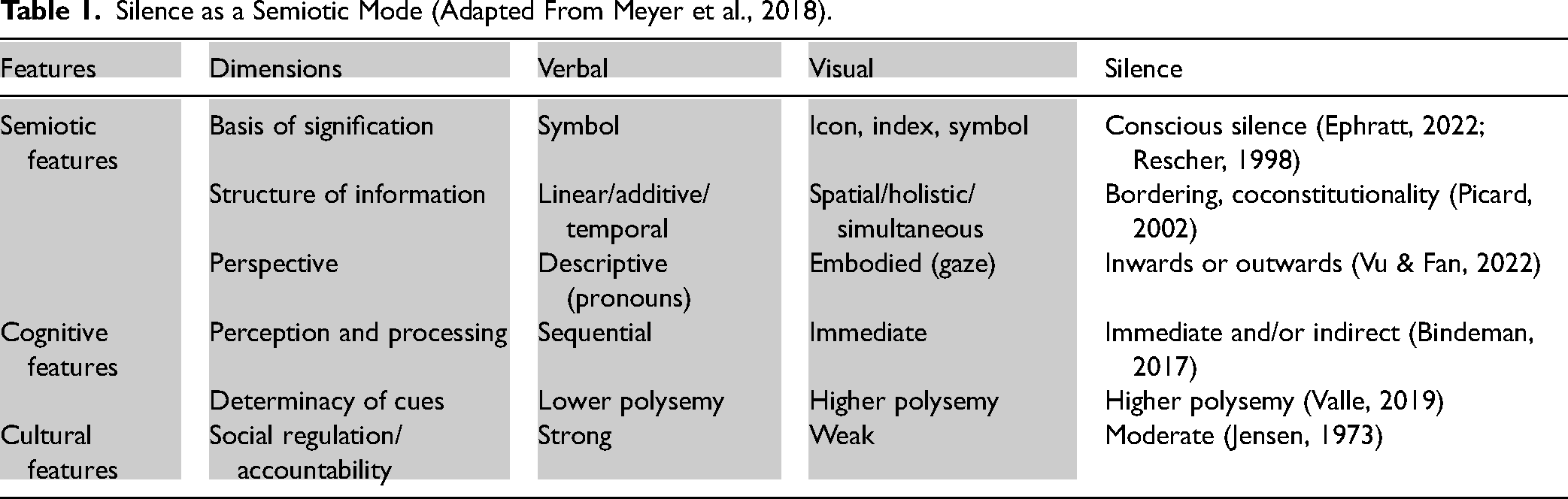
Thus, with Table 1, we wish to draw attention to treating silence as a semiotic mode instead of seeing it as an empty container (as per Vu & Fan, 2022). First, starting with the semiotic features, for silence to act as a semiotic mode, it needs to be done consciously. As such, silence has the potential to structure information through bordering (i.e., following or preceding another mode) or coconstituting (i.e., drawing attention to another mode). Moreover, this comes close to Blackman and Sadler-Smith's (2009) conceptualization of silence as being inextricably linked with tacit knowing. In addition, while Meyer et al. (2018, p. 395) posit how verbal modes use pronouns and visual modes notions of embodiment to signify perspectives, silence, however, can operate either as an inward (e.g., reflecting or withdrawing as per Travis, 2004) or outward (e.g., allowing or urging another person to communicate as per Martyres, 1995).
Second, cognitive features focus on how information is processed and whether it has few or many interpretations. Here, perceiving silence is immediate but also indirect in the phenomenological sense of relating oneself to other people (e.g., Merleau-Ponty, 1962). In other words, silence is processed both immediately (by responding with one of the semiotic modes) and indirectly through interaction (i.e., learning to understand what silence means to the other person). Building on this, and similarly to the visual mode, silence as a mode lacks “grammar” that makes it open to the other person's “interpretational predispositions” (Meyer et al., 2018, p. 396).
Finally, discussing verbal and visual modes in the Western context, Meyer et al. (2018, p. 396) argue that the verbal mode is highly regulated (as in what can be said and in what contexts) while the visual is less so due to its seemingly more frivolous status. In terms of silence, then, there seem to be formal social settings where silence plays a role (e.g., Western wedding traditions, Buddhism, and meditative silence) and, simultaneously, instances where silence is open for multiple interpretations (e.g., silence between friends or romantically involved partners, workplace, and public spaces and interaction between strangers).
To conclude, drawing on a diverse range of studies on silence in and outside organization and management studies, this literature review has highlighted two critical notions. First, management and organization studies seem to have approached silence from a rather binary perspective (silence as positive or negative) and as an individual's psychological response to something they experience, and second, by questioning the previous assumptions in the literature, make a case for understanding silence as a semiotic mode. That is to say, silence is not only an individual's action or reaction, but also a coconstitutive and interpersonal semiotic mode that operates in relation to other modes. With this vantage point in mind, we now turn to describing how we studied silence in team meetings.
Methodology
Data for this study was initially collected for the purposes of studying visual templates (see Appendix) for knowledge sharing purposes in team meetings in a financial organization based in Europe. The first author collected data by observing and interviewing 10 teams in real-life meetings. All teams were provided with the same task (i.e., who are the stakeholders you need to take into account when you project yourself implementing your work program for the coming year?). To generate comparable data, five of the teams were provided with a visual template and guidelines on how to utilize it, and the other five teams were given no instructions on how they could use the template. However, after the data collection phase was completed, the first author contacted the second author to discuss the findings, and through our conversation, we realized the data could potentially enable us to “think differently, instead of legitimizing what is already known” (Foucault, 1985, p. 9 in Alvesson & Sandberg, 2013, p. 52). In other words, we turned our attention to blank spots in the interview transcripts—moments of silence. To this end, this study set out to explore the following research question: How does silence function in the context of team meetings in relation to verbal and visual communication, and with what outcomes?
Thus, data for this study was initially collected by taking inspiration from visual ethnography (Pink, 2007) and multimodal research (e.g., Kress, 2010). More specifically, in line with the practice approach to the visual, focus was on investigating how visual templates participate in creating meaning in team meetings: “the practice approach is interested in what visual artifacts actually ‘do’” (Meyer et al., 2013, p. 511). Then, by way of problematization (Alvesson & Sandberg, 2013), we revisited the data by analyzing it from the perspective of silence by employing the Gioia methodology (Gioia et al., 2013) that is well suited for exploring emergent phenomena. However, before describing how we analyzed the data, we will now turn to describing how the data was initially collected and in what kind of a setting.
Data Collection and Context
As mentioned above, this study focused on knowledge sharing practices among 10 teams working in a financial organization in Europe. The teams were responsible for different functions in the organization, and the focus in the meetings we investigated revolved around annual work programs and stakeholder management. More specifically, the purpose of the meeting was to plan the activities for the upcoming year and stakeholder mapping was conducted to better understand the actors that might hold decision-making power with regards to the annual work program being developed. To this end, the teams were provided with the same task while five teams received, in addition, a visual template supporting the meeting's agenda, and to be able to investigate how the participants engaged with the template, multimodal data was collected.
The meetings lasted approximately 30 minutes, after which each participant filled out a brief questionnaire followed by a focus group interview with all participants present. Focus group interviews lasted approximately 20–25 minutes, and they were conducted in English by the first author. Consent was acquired from the participants to record the interviews, which were transcribed verbatim afterwards. In terms of the teams’ demographics, the 55 participants we studied represented diversity in terms of gender (34 women, 21 men), age (from 23 to 58 years), nationality (15), work experience (from 1 to 31 years), and tenure in the organization (from 1 to 19 years). In addition, the first author took photographs (Figures 1 and 2) during the meetings to document moments and situations considered as surprising with regards to how people interacted with each other and the visual template (Suchar, 1997 refers to this as a shooting script). Table 2 summarizes what kind of data was collected for this study.
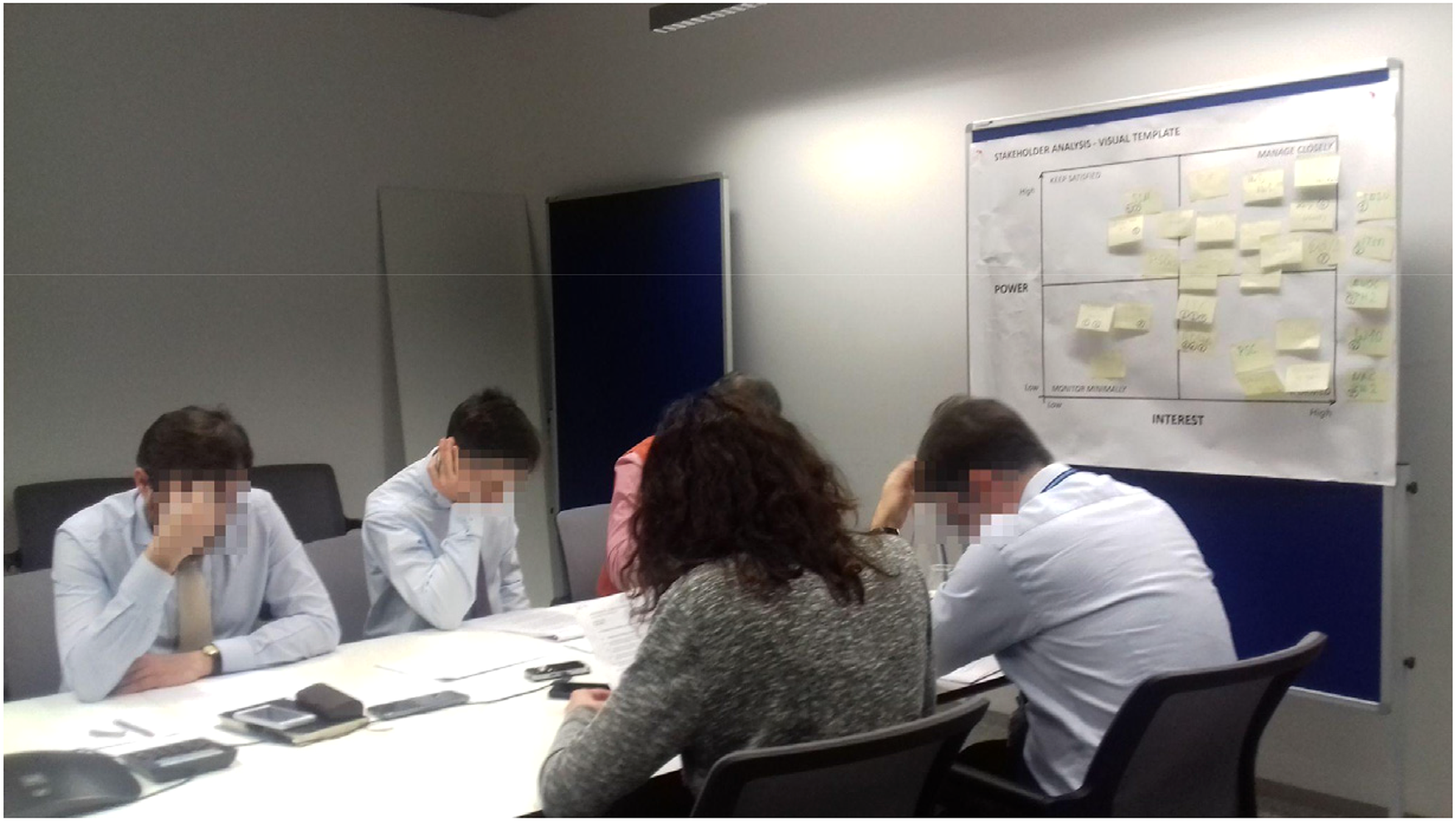
Participants experiencing a moment of silence as they are focusing on their notes. See the online article for the color version of the figure.
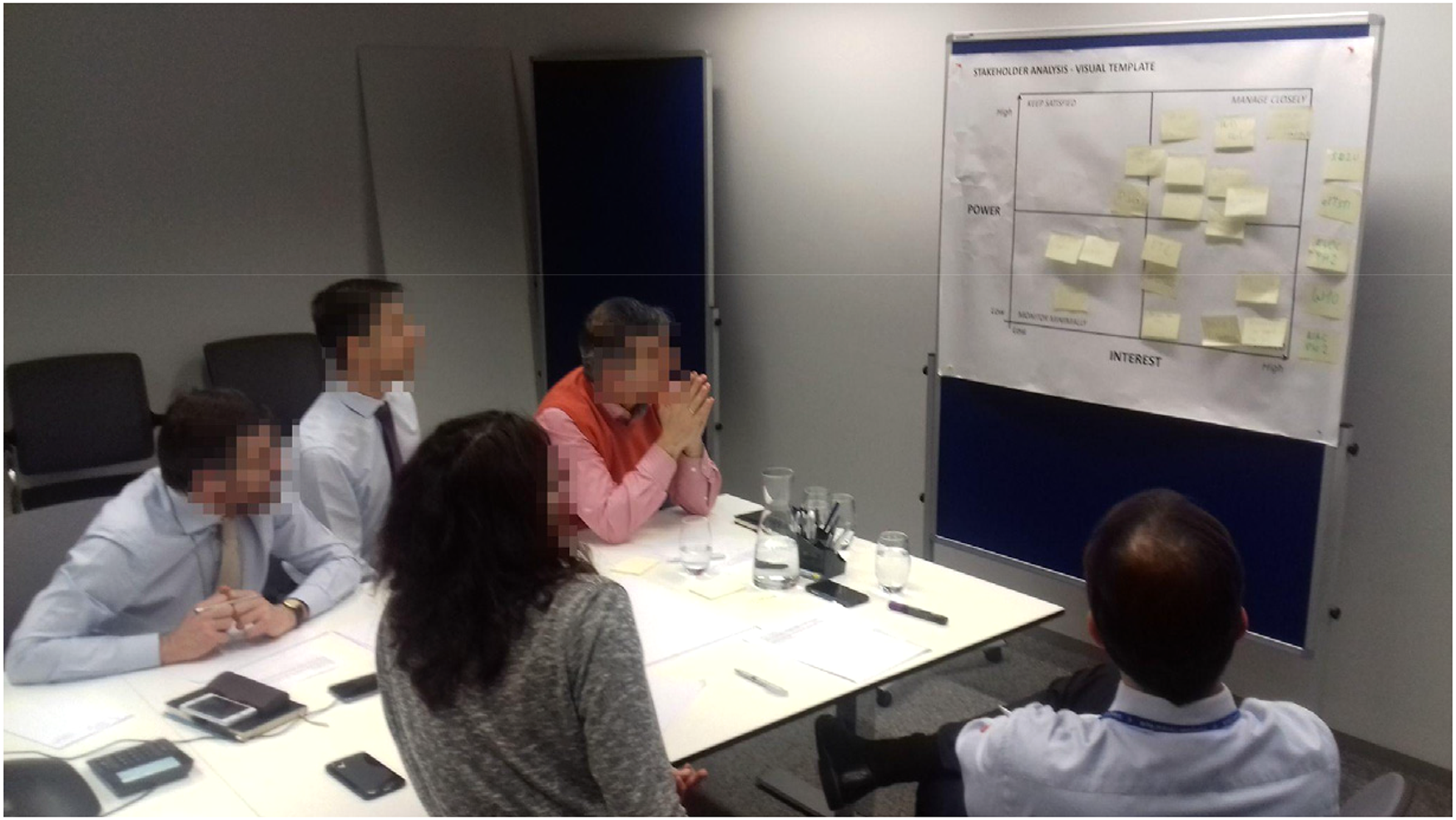
A moment of silence as the participants focus on the visual template. See the online article for the color version of the figure.
Different Types of Data Collected for This Study.
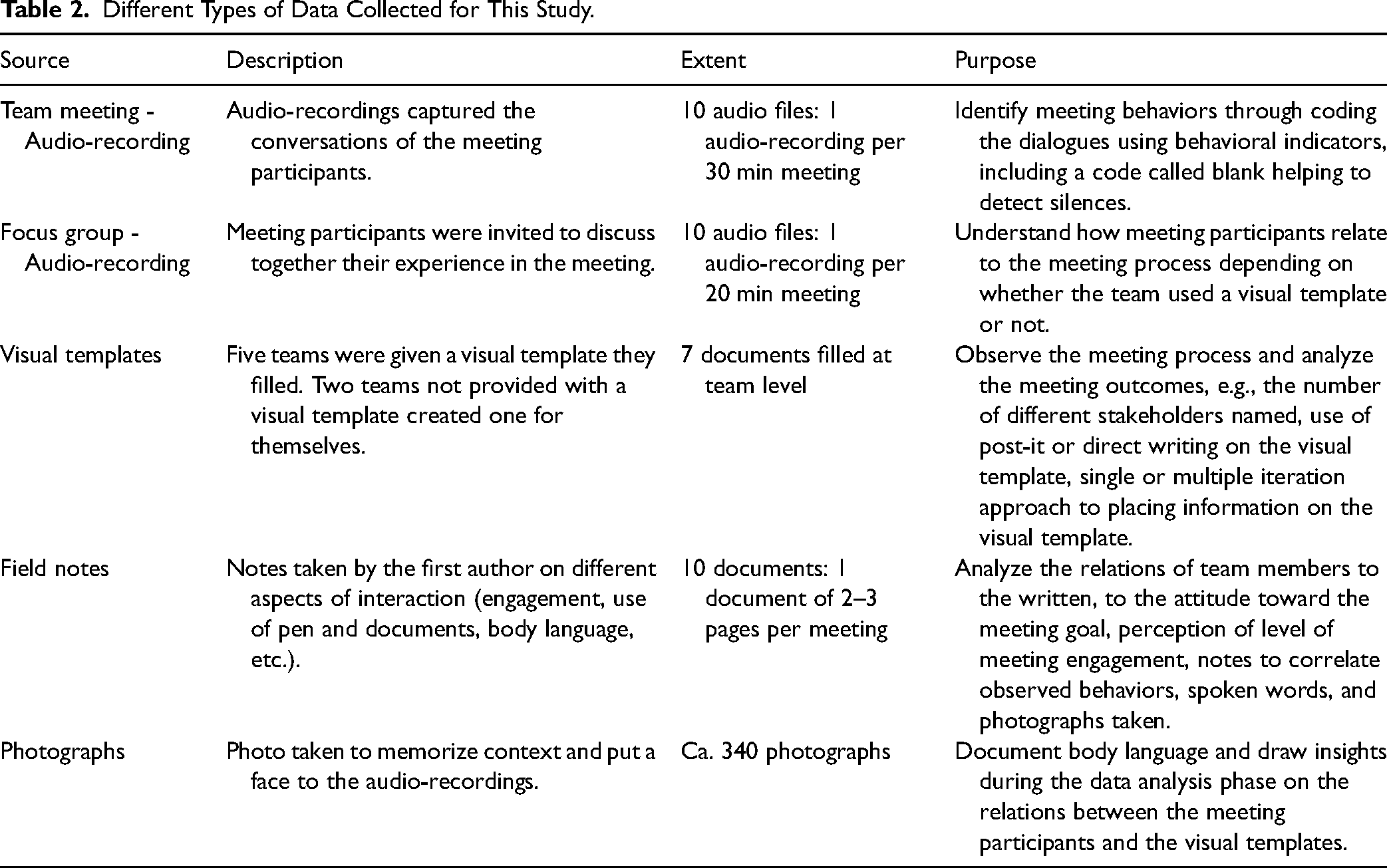
In short, verbal data in this study focuses on talk during the team meetings, while visual data consists of the visual templates as well as photographs of the team meetings. Acknowledging that semiotic modes do not work in isolation (as per Höllerer et al., 2018; Kress, 2010), we initially organized the data into what Comi et al. (2019, p. 102) refer to as the multimodal table. In essence, this approach enabled us to analyze how the meetings progressed, but from the perspective of different modes (and their combination). By doing so, the interview transcripts enabled us to see when the moments of silence emerged, which then led us back to the notes and photographs the first author had created. Here, it was important to “see” how moments of silence looked like during the meeting (Figures 1 and 2).
Data Analysis
We utilized the Gioia methodology (Gioia & Chittipeddi, 1991; Gioia et al. 2013; Gioia & Pitre, 1990) as the basis of our data analysis. However, since the Gioia methodology focuses on “trying to use their [informants’] terms, not ours, to help us understand their lived experience” (Gioia et al., 2013, p. 19), we analyzed instances of silence in relation to other modes. That is to say, given that modes do not exist in isolation, we looked at how each moment of silence was connected to either visual or verbal modes. In total, we identified 104 instances of silence throughout the team meetings. Furthermore, for each instance of silence, we mobilized other types of data we collected (interviews, field notes, visual templates, and photographs) to better understand how silence “looked like” from multiple perspectives.
Data categorization followed the Gioia methodology: first order concepts, second order themes, and aggregate dimensions (e.g., Gioia et al., 2013). To begin the analysis process, the first author went through the data by first identifying moments of silence in the data set. From here, a total of 152 statements surrounding situated silence were utilized to generate 40 first-order concepts. Next, both authors engaged with the data by analyzing and discussing the first-order concepts to see how they could be collapsed into more manageable categories that we could analyze. In the end, the number of first-order concepts was reduced from 40 to 18.
Somewhat alongside this stage, and in line with the Gioia methodology, we went back to extant literature on silence to move toward second order themes. The purpose here is to understand what pre-existing theories and concepts might help us “describe and explain the phenomena we are observing” (Gioia et al., 2013, p. 20). In essence, we engaged with literature to see what concepts might explain the emergence of silence as well as what kind of implications silence has. For instance, silence as ideation was also prevalent in de Vaujany and Aroles’s (2019) study on makerspaces, Vu and Fan (2022, p. 319) highlighted the sense-making aspect of silence (i.e., “reflexivity, self-decentralization, and transformation”), and Belanoff (2001) touched upon the analytical potential silence has. Thus, based on this stage of the analysis process, six second-order themes were crafted.
Finally, aggregate dimensions helped us explain the different faces of silence. In essence, the findings show what are the antecedents of silence, what gives rise to silence in team meetings, how silence relates to the verbal and the visual mode, and what kind of implications silence has in team meetings. Table 3 visualizes how the analysis process moved from data to theoretical insights.
Data Analysis Process for This Study.
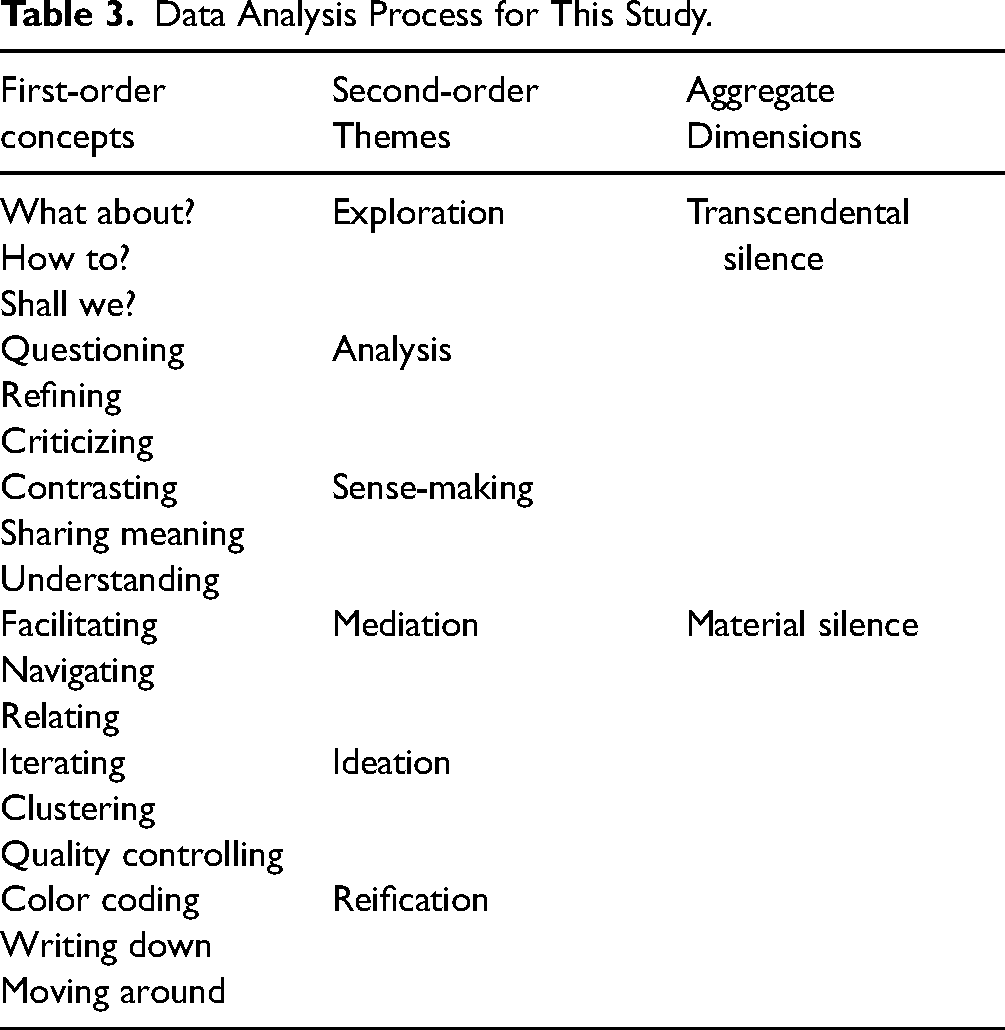
Above, the findings are presented in a sequential fashion only for the sake of clarity. In the next section, we further elaborate on the findings by dissecting silence in co-creation meetings before synthesizing the findings through the theoretical framework we crafted based on the analysis process described above.
Findings
As mentioned above, from our data analysis we identified two types of silence—transcendental and material—that both have three mechanisms through which they operate in relation to verbal and visual modes of meaning making. While the former relies on exploration, analysis, and sense-making, the latter draws on ideation, reification, and mediation. In this context, we understand transcendental silence as a means to consolidate meaning from other modes through resemiotizing fragmented and decontextualized meaning into commonly shared meanings of structure and order (echoing Meyer et al., 2018). Material silence, on the other hand, resemiotizes new meaning (in line with Comi & Vaara, 2022) by way of allowing meaning from other modes to be exposed into reflections and scrutiny. Next, we will discuss transcendental and material silence separately, after which we bring them together through a framework that illustrates how the six mechanisms, and two types of silence are interrelated.
Transcendental Silence
Exploration
During the meetings, the teams were utilizing the visual template as a means to explore the topic in question from several perspectives. While the template enabled the participants to establish a broad understanding of the context and the task's complexities, silence, as a way to pause, seemed to result in moving from complexity to simplicity and from a broad context to positionality (i.e., understanding how the different stakeholders could be aligned). Quite curiously, then, exploration was enabled in teams by allowing it to momentarily stop in moments of silence.
For instance, the data shows how exploration often gave rise to silence as the participants were trying to navigate the complexities of the task. In the excerpt below, team W3's meeting illustrates how silence gave rhythm to exploring tasks and commonalities related to different projects in which the team was involved.
[00:01:42] W3, speaker 1: (Project 10) too? Okay. (Project 10), and we put another one.
(Project 10). And then what's another one?
[00:01:52] W3, speaker 2: Um, (Project K).
[00:01:53] W3, speaker 1: Ah, (Project K). That's the one. That was basic.
[00:01:57] W3, speaker 3: Okay. So I think we have enough, maybe, for the–
[00:02:01] W3 speaker 1: Yes, we have five tasks. And we’ll see how far we go. Um, how do we do it?
[00:02:11] W3, speaker 4: No, we need to find the interested people, right? The people involved. And, stakeholders.
[00:02:19] W3, speaker 2: So, shall we just brainstorm on each of them? I see some commonalities that with (Project K), (Project 10), and (Project E) we’ll have the end impact in all business units, so in a way there's all business units involved, in a way.
[00:02:34] W3, speaker 1: So this is area users. We’re gonna list them and we’ll see–uh, business, area users. I mean we have NN management. Of course, this is one, NN.
Above, the team members were taking stock of all the stakeholders relevant to the project as well as how several of their projects had commonalities between them. Here, verbalized questions and action prompts seemed to trigger silence. In the first silence above, the team is figuring out how the projects are related to each other, while in the next silence focus has shifted toward task and stakeholder alignment. The third silence, then, seems to serve as an impetus toward ideating, and the final moment of silence triggers further exploration. In a way, silence manifests capabilities to converge when other modes are used to diverge.
Exploration giving rise to silence was also present in team W4's meeting, as the following excerpt reveals:
[00:23:01] W4, speaker 4: Okay. What else do we have? Chart of accounts, NN, [crosstalk] within to monitor minimally.
[00:23:09] W4, speaker 6: What about other teams in our division? ‘Cause it happened that we are just a reporting team here. So we could also place, uh, other teams as, uh,-
[00:23:19] W4, speaker 4: As stakeholders.
Above, the visual template helped the team to explore their position vis-à-vis other teams, and the silences in between seemed to serve as moments for focusing on exploration. That is to say, during the moments of silence the team members were looking at the visual template to digest new information.
Analysis
Here, silence tended to emerge after a moment of intense interaction or, conversely, when there was a moment of lack of new ideas or a drop in the intensity of the conversation. In a way, silence was used to question, refine, or criticize what has already been said or added to the visual template. Existing information was internalized to make sure what was added to the template could be validated. For this mechanism to be mobilized, participants of a team that showed higher level of trust seemed to allow themselves to retreat in their inner thought processes and check in on themselves whether more can be found and thus contribute to group interaction:
[00:12:50] W1, speaker 3: Units NN are not always—They are—they are a stakeholder upon request. If they have a major role, yeah that impacts the budget, but that would be relevant to any other business idea in Unit NN.
[00:13:00] W1, speaker 2: Oh yeah, true.
[00:13:02] W1, speaker 3: Yeah. They are not by default, the stakeholder.
[00:13:07] W1, speaker 5: I think we are covered there.
It appears that the ability to allow silence to emerge in the team might correlate with the overall level of trust in the team as well as with confidence in the individual and collective ability of the team to solve the task (i.e., craft the annual work program and its stakeholder mapping). The field observations and the coding of the audio-recordings seemed to show that the teams that expressed most doubt about their understanding of what they had to do were those that spoke without almost any interruption and, at the end of the meeting, did not seem to have arrived at an outcome the team deemed as satisfactory. Thus, the analysis mechanism of silence operated as a means to validate information or what had already been agreed upon and especially by relying on trust within the team. Silence, then, transformed meanings from other modes in two ways: sedimenting prior claims or exposing them to scrutiny so they could be eventually confirmed.
Sense-Making
Moments during which silence spoke to the visual template highlighted sense-making processes in action. Information gathered in the template was contrasted with prior knowledge and information, meanings held by individuals were shared to reach common ground, and what others had shared was understood. In essence, sense-making mechanism of silence was mobilized for two purposes: first, to resolve potential conflicts in terms of how the participants understood what was shared through other modes, and second, to create mutual understanding when sharing individually held meanings. In the excerpt below, team W3 was engaged in a discussion on defining the stakeholders.
[00:05:54] W3, speaker 1: Money comes from vendors. Let's put—Can I mention, where we need to put NN1, NN2, and NN3, because its through the, probably the one play a key role in one, than another one. Then, NN1, NN2.
[00:06:17] W3, speaker 4: But here, but here it says, “Who has a stake in the planning of your work?”
[00:06:22] W3, speaker 1: Yes. Uh–
In the moments before the silence, the team was discussing stakeholders more broadly, and after a moment of collective silence, one of the participants was pointing at the visual template by asking a clarifying question regarding the stakeholder definition criteria. In the first part, it seems that the team was describing stakeholders based on their prior experiences, and it was only after silence that they went back to the template to see how their stakeholder criteria could be defined. Here, silence seemed to have transformed individual meanings into a commonly shared one.
Material Silence
Mediation
Mediation refers to the mechanism through which new meaning was created by way of facilitating, navigating, and relating. For instance, due to the template's structured nature, teams could facilitate the creation of new meaning and, similarly, utilizing the template for navigating new meaning as well as relating that to what already existed in the template. Here, purpose was to configure meaning through creating structures. In the excerpt below, for instance, the team members are shown organizing their tasks:
[00:15:11] W1, speaker 3: Okay, I think we have something like 15 min to—you do the magic.
[00:15:18] W1, speaker 3: Do you want maybe to take care of that?
[00:15:20] W1, speaker 4: Okay
[00:15:21] W1, speaker 3: I have the list here. Yeah, we have all the lists, so we can just now do the ranking.
[00:15:28] W1, speaker 4: So, shall we go with, uh, like, um, top-down approach?
In the beginning, one of the team members suggested one possible course of action by asking their colleague to fill in the template. More specifically, the team wanted to move from listing the stakeholders toward ranking them in a priority order. Similar event took place in team W3's meeting where, toward the end of the meeting, they started ranking the projects in order of priority, thus giving them a sense of agency when planning their future activities:
[00:07:45] W3, speaker 3: But this is the same for us, though? [laughs] So it's all right. So did somebody watch how many when we started?
[00:07:57] W3, speaker 1: Yes—how do we do—Yes, yes. Uh, a good idea. We have 10 min, just want to do a quick analysis.
[00:08:03] W3, speaker 2: We could start with NN because they are the most important, and then we go to the others?
[00:08:07] W3, speaker 1: Yes, that's a good idea.
Here, importance seemed to be a decisive factor the team used to rank the projects, thus highlighting how the visual template served as a vehicle for organizing thoughts. It has to be pointed out, however, that “importance” or any other ranking criteria were based on perceptions; that is to say, it is not about validating the criteria or treating them as fixed, but instead focus here is on understanding how the visual template mediated interaction between the participants. Thus, through silence, the teams were able to unify strands of meaning into commonly agreed upon structures.
Ideation
Generating ideas through silence emerged through iterating, clustering, and controlling for quality. More specifically, by moving between the visual and the silent mode, teams were able to make abstract ideas more concrete. Silent moments thus enabled clustering, for instance, to emerge as illustrated in the following excerpt:
[00:04:28] W2, speaker 1: But still I would say in terms of power maybe a bit below NN.
[00:04:33] W2, speaker 2: Below NN. Yeah.
[00:04:24] W2, speaker 1: Yeah. Maybe it's the easiest because we would then have a chance to move them around if I just write them down.
[00:04:47] W2, speaker 5: That and the other ones in there.
Silences in between were able to generate new insights in the form of understanding how different stakeholders relate to each other and how their relations could be further altered in the template during the meeting. Thus, ideation worked here in two levels: first, generating insights on who or what could be identified as stakeholders, and second, understanding that these relations are not fixed, but dynamic. Furthermore, silence enabled the team members to generate new insights not only on the stakeholders’ relationality, but also regarding the motivations of each stakeholder. In such instances, organizing the stakeholders into the visual template and engaging in more detailed discussions regarding each stakeholder allowed the teams to utilize silence as a means to collectively pause around meaningful insights:
[00:10:21] W5, speaker 3: Keeping them satisfied means sort of keeping good relation. What's important, what's the main importance for that stakeholder.
[00:10:28] W5, speaker 1: That's what our boss says.
[00:10:37] W5, speaker 3: -Or, just keep them informed, that we don’t have any immediate interaction with them on the work-planning yet? But, it's good that they are sort of in the loop. The time, money to
[00:10:52] W5, speaker 1: But, how is high power and the –
[00:10:55] W5, speaker 3: No, this is interest power-
[00:10:56] W5, speaker 1: And, low interest-
This kind of ideation could be understood as framing procedures instead of coming up with new ones. Here, silence operates as a sequencing element by separating frames from each other.
Reification
The reification mechanism of silence gave impetus for other modes to move from individually held meaning toward collectively symbolized meaning. This was done through color coding, writing down, and moving objects around in the visual template. That is to say, through silence, teams could make abstract concrete by utilizing silence as a sort of generative element. This was enabled by silence transforming abstract concepts such as power and success into color-coded and structured shared meaning. In other words, silence was mobilized to process information about abstract concepts so it could be transformed into a collectively shared visual structure. For instance, in the excerpt from team W3 below, the team is discussing notions of power and success.
[00:18:20] W3, speaker 1: Put NN there also, and NN2, they have power, you know. It's crucial for success, huh? So we need to monitor closely?
[00:18:34] W3, speaker 4: Do we need to split NN into two? I know NN [crosstalk] resources and I know NN manager. [crosstalk]
[00:18:40] W3, speaker 3: Maybe we can just put some color here.
Before the silence, the team focused on verbalizing elements that needed to be evaluated, namely, power and success. While such concepts are abstract, after the silent moment the team was making them more concrete through spatial organizing (“splitting”), mentioning actual people, and utilizing colors. In this case, reification focused on stakeholders external to the team, but in the excerpt below, team W5 illustrates how reification also operates in the team's internal matters:
[00:00:50] W5, speaker 1: In fact the four of us are-are the team members. Yeah, team members.
[00:00:59] W5, speaker 2: Who else and it's the uh, probably the NN also as stakeholder, I guess?
[00:01:13] W5, speaker 4: Participant 3: Yeah-yeah.
Above, the team was discussing who are the stakeholders and during the discussion they reflected on their own role as stakeholders. Here, the visual template enabled them to engage in a dialogue whether they, too, should be included as stakeholders, and the moments of silence are seen as reinforcing this process. As such, reification through silence advanced in a sequential manner and so that each moment of silence affirmed what was discussed previously.
Synthesis
Above, we have discussed both transcendental and material silence from the perspective of resemiotization—how meaning is transferred from one mode to another (Iedema, 2001, 2003). Namely, what kind of meaning is resemiotized, how, and for what purposes. Furthermore, our findings elucidate how transcendental silence was utilized to explore, analyze, and make sense of meaning generated through other modes, material silence gave rise to ideate, reify, and mediate new meaning in conjunction with verbal and visual modes. These processes are visualized in Figure 3.
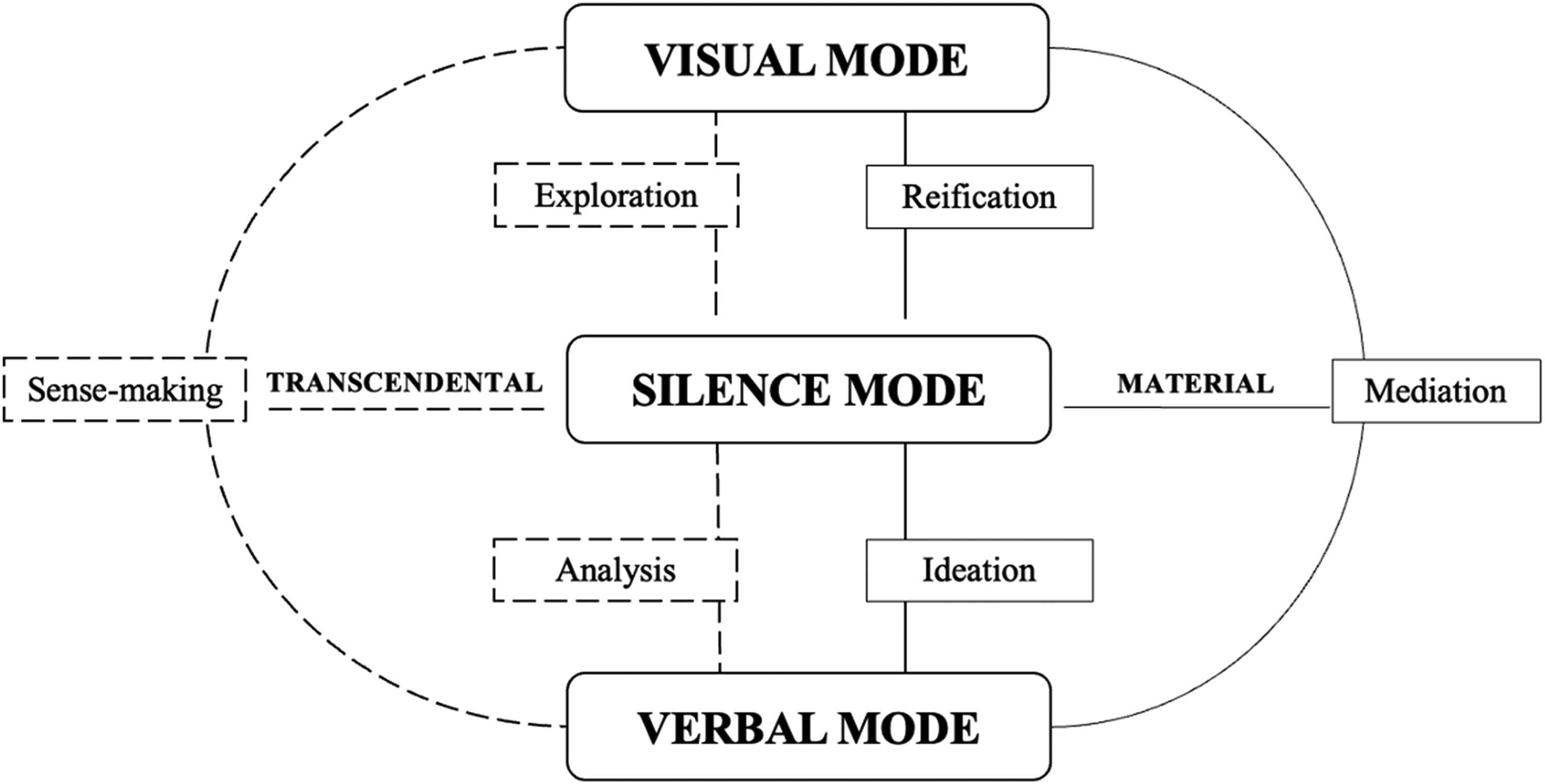
Silence as a semiotic mode.
First, as prior literature has described (Boxenbaum et al., 2018; Quattrone et al. 2021), visual and verbal modes contribute to negotiating shared meanings, and our findings illustrate how silence is an integral part of such processes through the three mechanisms described above. Silence as a mode, then, consolidates meaning by enabling individual and collective sensemaking within the team. In other words, silence can resemiotize complex, fragmented, and decontextualized meanings into collectively shared meaning through which structure, order, and simplicity can emerge.
Second, the intersection between material silence and verbal and visual modes broadens signification from a monologue into a dialogue. As Quattrone et al. (2021, p. 1211) write, “[v]isual artefacts … are useful not because of the significations they embody, but because of the very signification work they demand and for the possibilities for action they offer.” As our data illustrates, action and visual templates were always inextricably intertwined with silence, and by treating silence as a semiotic mode, we may start to see different functions of silence emerge. More importantly, and in line with multimodality, our findings draw attention to silence as manifesting at the interpersonal level. That is to say, silence is not only an action taken by an individual but based on our findings there are important meaning-making implications when we understand silence as a semiotic mode.
To conclude, silence can have both transcendental and material characteristics when looking at how individuals engage with each other and other semiotic modes. While in this study half of the teams were provided with a visual template and the other half was not, both categories experienced moments of silence, but those teams that used a visual template seemed to experience moments of silence more often. This, we believe, hints at two implications: First, while silence is indeed present even without the intensive or conscious use of different modes, conveying and creating new meaning across modes seem to require silence; second, moments of silence serve also as individual vantage points during which what is being said or visualized can be internalized. Thus, silence, while enacted at the individual level, has interpersonal implications especially in the context of team meetings.
Discussion and Conclusion
In this study, we have explored how silence operates with verbal and visual modes of communication. More specifically, we investigated 10 team meetings in a major European financial organization to better understand how silence emerges and for what purposes. To this end, based on our findings, we developed two types of silence, namely, transcendental and material silence. By doing so, we contribute to management and organization studies on silence (de Vaujany & Aroles, 2019; Vu & Fan, 2022) and multimodality (e.g., Alcadipani & Islam, 2017; Boxenbaum et al., 2018; Lefsrud et al., 2020; Meyer et al., 2018; Zilber, 2017) by suggesting silence to be a mode on its own as well as by way of further diversifying conceptualizations of silence. Furthermore, both types of silence engage in resemiotization through three mechanisms (transcendental silence—exploration, analysis, and sense-making, and material silence—mediation, ideation, and reification), thus drawing attention to silence as a semiotic mode on its own.
Building on the above, prior research (e.g., Ewenstein & Whyte, 2009; van der Hoorn, 2020) has made theoretical inroads in explaining how the visual mode, through collaboration, can give rise to novel or consolidated meanings. Similarly, as Nicolini et al. (2012) posit, objects perform at least three functions in cross-disciplinary collaboration: They support collaboration, enable individuals to work across boundaries, and create foundations for activities (see also Zanin et al., 2020). In this light, our findings extend prior research by elucidating on the critical role silence plays in terms of individual and collective coherence toward the verbal and the visual mode. Silence, as was shown earlier, should not be understood as moments between meaning-making but as an integral element in how different modes are configured for generating new meaning. With this, we also draw attention to further diversifying our current understanding of silence. In Vu and Fan (2022) and de Vaujany and Aroles (2019), for instance, compelling accounts have been provided in terms of seeing silence as a positive or generative phenomenon in management and organization studies, and in this study, we hope to have shown how silence is also a semiotic mode capable of meaning-making through six mechanisms and two types of silence.
More specifically, when we account for silence in interpersonal relationships and material configurations, we start to see how visual and verbal modes can give rise to silence and vice versa. In other words, to be silent can be understood as a form of collaboration with others, materials, physical spaces, and oneself. Similarly, silence could be understood as the space “beyond” words yet inextricably intertwined with words. Silence is the space to express oneself with more than words, with memories we host in our bodies, hopes we inject in our relations, with ideas we draw on templates, and with the state of mind we embody in the collective field (e.g., Kuhling et al., 2003).
For collaboration to emerge, silence is also a necessary component to help individuals relate to each other and the visual artefact (e.g., Belanoff, 2001; Dawson, 2003), and visual artefacts can give rise to generative silence. Similarly, Stefanini et al. (2020) found that excessive coordination between team members in health operations resulted in more mistakes, thus pointing at the positive implications of silence in collaboration (see also Verouden et al., 2016). Prior literature has highlighted how visual artefacts are mobilized to convey meaning (Ewenstein & Whyte, 2009; Meyer et al., 2018; Quattrone et al., 2021) as well as utilized to demarcate boundaries (Comi & Vaara, 2022), and similarly theoretical inroads have been made in terms of how different communicative modes work together to generate new meaning (e.g., Meyer et al., 2018). Findings from this study contribute toward increasing our understanding of how silence as a semiotic mode operates in conjunction with verbal and visual modes.
Theoretical Contributions
As hinted at in the introduction part of this study, our study has made three crucial contributions. First, we extend prior literature on silence (de Vaujany & Aroles, 2019; Vu & Fan, 2022) by focusing on team meetings. By doing so, we have discussed transcendental and material silence and how these two aspects of silence suggest that silence could be treated as a mode of its own. In other words, silence is not only an individual's action or response to an action, but it can also be treated as one of the “socially shaped resources of meaning making” (Meyer et al., 2018, p. 392) in interpersonal settings. Here, we have identified six mechanisms through which silence as a semiotic mode participates in resemiotizing (Iedema, 2001) meaning across modes. While silence can trigger the emergence of new meaning (material silence) by way of mediation, ideation, and reification, at the same time transcendental silence—through exploration, analysis, and sense-making—helps in seeing meaning conveyed through verbal and visual modes from a novel perspective. This, we believe, contributes to answering Vu and Fan's (2022, p. 322) call for studying “the hidden dynamics of silence as a way to enrich understanding of our everyday organizational lives.”
Second, and building on the above, our findings illustrate how multimodal research ought to pay more attention to silence or, as Quattrone et al. (2021) elucidate: “[b]oth the visible characteristics of artefacts and the invisible possibility spaces they offer may have equally important organizing properties and drive individual and collective actions.” Thus, for modes to be mobilized to carry out different functions, we also ought to be looking at silence as a mode of its own. Consequently, studying silence also raises peculiar methodological questions. While in this study we used the Gioia methodology to investigate silence in relation to other modes, multimodal research could benefit from developing methods that are well suited for studying silence. Prior research has already investigated sounds (Pinch & Bijsterveld, 2012), scents (Islam et al., 2016), and posthumanism (Huopalainen, 2022), and one way forward would be to build on these existing research trajectories.
Third, another promising avenue, in line with Quattrone et al. (2021), would be to fine-tune existing multimodal methodologies for being more sensitive toward silence. For instance, studies employing audiovisual data could analyze silences, audio recorded interviews could be complemented with researcher's notes on silent moments during the interview, and finally ethnographic studies could focus on documenting silence in the field notes. Nonetheless, after attuning oneself to be more sensitive toward silence's relevance, not taking silence or silent moments into account seems like, paradoxically, something is being left out. Furthermore, while in this study we have focused on the generative power of silence in team meetings, taking silence into account when crafting methodologies could focus more on notions of effectiveness and whether silence is always golden in team meetings.
For instance, in line with Lee et al.'s (2023) study on employee silence in team meetings, post-meeting interviews could be conducted individually so as to further explore moments during which the participants understood moments of silence similarly and when there were discrepancies. Such an approach lends itself also to added sensitivity as individual interviews can ensure participants can acknowledge moments during which they felt they might have been silenced. By the same token, another interesting methodological implication arising from our study is that experiments could shed light on whether some silences are more effective than others in terms of decision-making and meeting outcomes, for instance. Yue et al.'s (2019) study found that cooperation within teams outperforms competition in uncertain situations, thus leading us to speculate that under certain conditions silence might have detrimental impact on effectiveness and outcomes.
Thus, while findings from our study provide compelling evidence on the positive impact silence has in the context of team meetings, further inquiries should take into account in their methodological decisions how silence (both positive and negative) as well as its antecedents and outcomes could be investigated. As prior literature on silence in management and organization studies has shown, silence is a complex phenomenon yet relatively underexplored, which is why our findings should be utilized as inspiration for crafting methodologies that treat silence not as a space in between but as a semiotic mode capable of mobilizing “socially shaped resources” (Meyer et al., 2018, p. 392).
Implications for Practice
As Vu and Fan (2022, p. 310) posit, silence opens up “an emancipatory space for alternative paths of thinking.” Realizing that silence carries this potential in the context of team meetings at work is of high value for professionals concerned with encouraging multiple paths of thinking to broaden the inputs of their teams. Rogelberg and Kreamer (2019, p. 5) go as far as proposing that meetings are held in silence “to capitalize on the critical, unique, and important ideas of…employees in an effective and efficient way.” In addition, managers could benefit from being more aware of the ways teams seem to be able to explore, analyze, and make sense through transcendental silence. Teams at work need to become more acquainted with the positive impact of combining visual artefacts and material silence to better mediate their conversations as it would help them with generating new ideas and reify their knowledge.
Limitations and Further Research
Like any other scientific inquiry, our study, too, has certain limitations that can be perceived as opportunities for future investigations. First, more research is required to explore the antecedents and outcomes of silence in relation to other modes of communication. In this study, we focused on the positive contributions of silence, and we also acknowledge that moments of silence can also have detrimental implications. In addition, duration of silence could also be something explored further. While we did not take into account differences in how long silence lasted, it would be nonetheless interesting to explore, for instance, whether and for what purposes silence lasts longer at any given point during a meeting. Second, our focus was on team meetings in the financial sector in Europe, which is why other cultural and professional contexts could be investigated. While we believe our findings to have theoretical relevance also outside the European context, at the same time it should be acknowledged that our findings provide a culturally framed vantage point to silence. At the same time, some of the teams received more instructions on how to utilize the visual template, thus prompting us to ask whether some conditions are more conducive to positive silence than others. Third, we join prior research on silence in management and organization studies (de Vaujany & Aroles, 2019; Vu & Fan, 2022) by calling for more nuanced approaches to silence. Anecdotally, our data revealed moments of individual and collective silence (i.e., individuals focusing on their own thoughts or collectively to something external), which is why it would be interesting to explore further the individual, interpersonal, and collective dimensions of silence. Furthermore, more studies are needed to better understand the theoretical and conceptual underpinnings of silence as a semiotic mode. To conclude, in this paper, we have contributed toward granulating our understanding of silence as a phenomenon, and much work still needs to be done if we are to better understand silence in a world filled with signs, symbols, and texts.
Footnotes
Appendix
Acknowledgments
The authors wish to thank Associate Editor Sabina Siebert and two anonymous reviewers for their insightful comments and guidance throughout the peer review process.
Declaration of Conflicting Interests
The author(s) declared no potential conflicts of interest with respect to the research, authorship, and/or publication of this article.
Funding
The author(s) received no financial support for the research, authorship, and/or publication of this article.
