



Abstract
What does it mean for an organization “to exist”? Building upon the philosophical notion of ontologies as theories of existence, I outline a theory of organizational ontology supported by the premise that organizations contain implicit existential conventions that provide their members with an understanding of what their joint existence is. This study aims to answer two questions. First, what constitutes an organizational ontology? Second, how can this be accessed and represented? Using a methodology informed by cultural interpretation, I ground this study empirically in ethnographic fieldwork at a not-for-profit organization devoted to teaching math to “left behind” children.
Keywords
There is growing interest in management research for examining the underlying ontologies (i.e., the theories of what it means to exist) of organizations (Kuronen & Huhtinen, 2017; Lips-Wiersma & Mills, 2014; Pelly, 2017; Salovaara & Statler, 2019). It has been argued that organizational ontologies can differ in content and temporality, being based on more static or dynamic conceptions of existence (Pelly, 2017). Among others, ontological states can be of emergence, development, or stasis (Kuronen & Huhtinen, 2017, p. 55). Moreover, researchers in our field have addressed the question of whether and how divergent organizational ontologies can be bridged (Pelly, 2017) and have made the case that disclosing ontological assumptions offers us a better understanding of organizations and their members (Lips-Wiersma & Mills, 2014; Salovaara & Statler, 2019).
However, the fundamental question of how to access and represent an organizational ontology remains unanswered. To attempt to answer it, I outline the constituent elements of a theory of organizational ontology, which I draw mostly from two literatures: the management research tradition of studying the unseen, tacit, or implicit foundations of organizations (Corley & Gioia, 2004; Schein, 1985; Selznick, 1957; Thornton & Ocasio, 2008; Weick, 1985, 1993), and the philosophy discipline of ontology, which is dedicated to studying the nature and categories of existence, being, and reality (Bédard, 1995, 2004; Bunge, 1999; Dardel, 1954).
This article aims to answer two questions: (1) what constitutes an organizational ontology? and (2) how can we access and represent this? Its contribution is thus twofold. For the theoretical contribution (pertaining to question 1), I review perspectives in management research, philosophy, sociology, and anthropology to outline the constituent elements of a theory of organizational ontology. For the methodological contribution (question 2), I build upon organizational ethnography methods (Pratt, 2015; Rosen, 2013; Van Maanen, 1988) and on the cultural interpretation proposition (Geertz, 1973; Turner, 1974) to develop an interpretive approach to accessing and representing organizational ontologies.
Following this introduction, the article is structured into the following sections: an interdisciplinary review that supports the outlining of elements of a theory of organizational ontology; the description of a methodology based on the cultural interpretation of ethnographic data; the presentation of the case study (Abacus, a pseudonym for the studied organization); the findings that constitute an interpretation of Abacus's ontology; and a concluding section that discusses the findings' validity and generalizability as well as the article's contributions to theory and practice.
Theoretical Proposition: A Theory of Organizational Ontology
Management Research of the Unseen, Tacit, or Implicit Organizational Foundations
Management research has a long tradition of studying the unseen, tacit, or implicit organizational aspects that, nevertheless, are deemed fundamental because they guide collective action. The current emergence of an organizational ontology literature (Kuronen & Huhtinen, 2017; Lips-Wiersma & Mills, 2014; Pelly, 2017; Salovaara & Statler, 2019) can be thus considered as part of a much longer tradition, which I briefly revisit here.
For instance, Edgar Schein’s (1985) proposition of basic assumptions of a culture refers to implicit beliefs and ways of thinking about the world that are held by members of an organization but not commonly articulated. They comprise beliefs about fundamental human nature, social relationships, time, and the use of space, which ultimately function as cognitive frames “tell[ing] group members how to perceive, think about, and feel about things” (Schein, 1985, p. 31). Philip Selznick (1957) noted long ago that organizations “become infused with value as they come to symbolize the community's aspirations [and] its sense of identity” (p. 19). A culture's basic assumptions, as articulated by Schein (1985), thus contain existential aspects that coincide with those also ascribed to organizational identity, which refers to an implicit sense of “who we are as an organization” (Corley & Gioia, 2004, p. 173). As another example, Karl Weick's (1985, 1993) notion of cosmology in sensemaking theory also addresses the deeply entrenched existential conventions in organizations. In Weick's proposition, cosmology stands for the “ultimate macro perspective, directed at issues of time, space, change, and contingency as they relate to the origin and structure of the universe” (Weick, 1993, p. 633). By framing collective perceptions of reality, cosmologies thus inform organizations’ behavior and decision-making.
In broader terms, the premise—typically borrowed or adapted from sociology and anthropology—of members of organizations “enact[ing] their particular worlds through social interaction” (Rosen, 2013, p. 46) is common to major domains of organizational theory. This is, as seen, the case for organizational identity, but also for institutional logics, which can be defined as the “socially constructed, historical patterns of material practices, assumptions, values, beliefs, and rules by which individuals produce and reproduce their material subsistence […] and provide meaning to their social reality” (Thornton & Ocasio, 2008, p. 804). The emergence of patterns of interaction is also fundamental in Niklas Luhmann’s (1995) comprehensive theory of social systems, which emphasizes the role of interactions between communication and action to structure human systems. Therefore, in distinct manners and equipped with their own terminologies, these management research streams join the goal of “uncover[ing] the invisible assumptions that generate social structures” (Bradbury & Lichtenstein, 2000, p. 557). Management research hence shares with other social sciences the assumption that there are implicit existential conventions that, as Anthony Giddens (1991) explains, provide a shared “framework of reality” (p. 36) to a human group, determining how individuals should respond to specific situations.
In addition to framing behavior and decision-making, management research also discloses another additional fundamental function of implicit existential aspects of organizations: to nourish the senses of affiliation (i.e., shared identities) that eventually become tied to intersubjective impulses for preserving organizations. Hence, in different ways and to different extents, an organization engenders and depends on the preservation of a kind of collective self, hence metaphorically becoming a macro-organism of sorts, equipped with its worldviews, intentions, and self-preservation impulses. Borrowing again from Selznick (1957), his discussion of the “basic identity” of institutions provides an early explanation of the relation between the emergence of an intersubjective sense of identity and the collective impulse for its preservation: “In both personality and institutions, ‘self-preservation’ means more than bare organic or material survival. Self-preservation has to do with the maintenance of basic identity, with the integrity of a personal or institutional ‘self’” (p. 142).
Such an immediate connection between the implicit existential aspects of an organization and a collective impulse for its preservation—or, antithetically, to its collapse—is captured in Weick’s (1993) “cosmology episode” concept, which “occurs when people suddenly and deeply feel that the universe is no longer a rational, orderly system” (p. 633). At this moment, a social system can become unable to withstand an environmental change (Luhmann, 1995, p. 11). A cosmology episode can also be related to a failure of what Giddens (1991, p. 38) calls ontological security (i.e., the trust in the existential anchors of reality that provide a sense of continuity in the events in life, carrying one through occasional transitions, crises, and high-risk situations). Moreover, in anthropology, cosmology usually refers to a broader ensemble of cultural conventions that provides a rich and mostly unquestionable explanation of the world (Sahlins, 1985, p. xv)—or, in Bourdieusian (1994, p. 164) parlance, a system of arbitrary meanings that becomes naturalized as a social order.
The Early Signs of an Emergent Literature on Organizational Ontology
These arguments made by Weick (1993), Giddens (1991), Sahlins (1985), and Bourdieu (1994) agree in their claim that a sense of the world that becomes “disordered” is equivalent to a failure of shared existential conventions that should accommodate the events of life. They thus imply that the deeply entrenched existential conventions of a group (organizations included) do not remain confined to an inner, intimate space within the individuals who belong to it. Instead—and concurring with management research conceptualizations of basic assumptions, organizational identity, and institutional logics—these implicit existential conventions are projected out as an explanation of the world and therefore determine how to respond appropriately to various situations in life.
I hence posit that management research already comprises streams of literature built upon the common premise that organizations contain implicit existential conventions (i.e., theories of existence) that fulfill three interconnected functions: providing their members with an understanding of what their joint existence is; equipping them with frames of reference for behavior and decision-making; and sustaining a collective sense of preservation. I also argue, however, that this premise remains between the lines or peripheral at best. Indeed, none of these streams of literature explicitly focuses on the study of the theories of existence of organizations. I thus argue that a more thorough outlining of a theory of organizational ontology can equip management research with more adequate means to examine the implicit existential conventions of organizations. Consequently, I posit that, by more precisely dealing with the question of what does it mean for an organization to exist, the nascent organizational ontology research literature constitutes an important addition to the longstanding management research of unseen, tacit, or implicit foundations of organizations.
Organizational ontology research hence aims at “questioning or discussing the fundamental nature of ‘being’ [in one organization] that works in the background, making everything possible” (Kuronen & Huhtinen, 2017, p. 51). It examines distinct organizational ontologies that may be explained through metaphors such as games, flows, trees, and rhizomes (Kuronen & Huhtinen, 2017; Salovaara & Statler, 2019). It also investigates how distinct organizational ontologies comprise diverse perceptions of time and space and how they sustain distinct conceptions of existence (Kuronen & Huhtinen, 2017), which eventually generates ontological divergencies among organizations (Pelly, 2017, p. 390).
Nevertheless—and despite the considerable seminal progress—this nascent literature does not yet provide a clear perspective either of what constitutes an organizational ontology or of how to access it. To address these crucial but unanswered questions, I seek theoretical support from the discipline of ontology in philosophy, which studies the existential conventions that structure human existence, consciousness, and functioning.
Learning from the Discipline of Ontology
Etymologically, ontology refers to the knowledge of being or the study of existence. 1 In philosophy, ontology emerged as the branch of metaphysics devoted to studying the essence of what it means for a being to be. Mario Bunge (1999) defines it as “[t]he serious secular version of metaphysics. The branch of philosophy that studies the most pervasive features of reality, such as real existence, change, time, chance, mind, and life” (p. 200). Renée Bédard (1995) clarifies that “ontology aims to reveal the essential aspects of a being, the peculiar characteristics of reality or activity that may distinguish it from the traits that are incidental or contingent. […] It is the foundation of the legitimacy of a creature, a thing, or an activity” (pp. 40-41, my translation). Consequently, ontology's objects of analysis are the categories, forms, and accounts of existence. It inquires into the meanings humans ascribe to their experiences and to the “theories of being” they hold (Palmer & Dunford, 1996, p. 695).
Ontology's fundamental precept is that everyone needs a theory of existence to determine their “way of living in the world, of orienting oneself in the midst of things, of seeking an answer in the quest for the self.” Without it, one can neither “know ‘where’ his [or her] ‘I’ is” nor “distinguish what was from what will be and from what goes to make up the present” (Dardel, 1954, pp. 33–42). To know what one is therefore depends on knowing what one is not. Consequently, ontologies are inescapably relational: understanding one's existence necessarily comprises some knowledge of how one relates to the diverse aspects of their existence (i.e., to things that are not them). Bédard (2004, p. 23) provides a concise—yet extremely effective—framework of four fundamental relations one holds to his or her existence (or world): the relations to oneself, to the other, to nature, and to the holy, sacred, or unknown. One hence exists by being in relation to the various aspects of one's existence, which supports the argument that ontologies are inherently relational and, therefore, it should comprise the understanding of who the others are, as well as recognizing our shared understanding of how the natural world (broadly framed as an external environment or the concrete realm of existence) and the supernatural world (i.e., what belongs to the realm of the sacred, divine, or unknown) are constituted.
Extending this precept from the individual level to the organizational level can thus constitute the basis of a theory of organizational ontology.
Outlining a Theory of Organizational Ontology
Building upon the reviewed perspectives in management research, philosophy, sociology, and anthropology, I define organizational ontology as the implicit existential conventions that provide the members of an organization with a shared understanding of what it means to exist for that organization.
The proposition of a theory of organizational ontology hence depends on the premise that organizations contain implicit existential conventions that, as discussed, fulfill the three interrelated functions of (1) providing their members with an understanding of what their joint existence is, (2) equipping them with behavioral and decision-making frames of reference, and (3) maintaining a collective sense of preservation.
These three functions are essential organizing attributes that also specify how ontologies play vital roles to form and maintain organizations. Moreover, they reinforce the notion that organizational ontologies are fundamentally intersubjective, for they shape the shared perceptions of the members of an organization. An organizational ontology thus “emerges from the collective want of the social system” (Kuronen & Huhtinen, 2017) and should, therefore, provide the enabling conditions for individuals to form common assumptions about their organizational reality and to act accordingly. Furthermore, if Weick’s (1993) cosmology episodes can be considered as events of ontological failure, the premise that organizations have ontologies can be extended to support the argument that organizations without a minimally consistent ontology are unlikely to survive. In other words, as a corollary to the premise that organizations have ontologies, having an ontology is a condition sine qua non for an organization to exist over time. Going full circle, I argue that the self-preservation impulses that emanate from an organizational ontology sustain the efforts of an organization's members to protect that very ontology. Otherwise said, the existence of self-preservation impulses ultimately puts organizational members at the service of the organizational ontology.
Finally, to examine the constituent elements that make up an organizational ontology, I build upon the argument that ontologies are intrinsically intersubjective and relational because they include a conception of how members of an organization “relate to the world” (Salovaara & Statler, 2019, p. 150). In more instrumental terms, as presented next, the methodology adopted in this study should provide access to the components of the implicit existential conventions that define how the members of one organization perceive the relation their organization has to itself and to other aspects of its existence.
Methodology: Ethnography and Cultural Interpretation
As theory-building research, this article relies on the strength of ethnography to gain an in-depth understanding of a single case. Ethnographies produce extensive descriptions of overlapping social phenomena, and organizational ethnographies capture the rich and unique features of organizational existence (see, for instance, the bibliography compiled by Yanow & Geuijen, 2009). As such, they are suitable for supporting the development of organizational theory (Azevedo, 2020; Hatch & Yanow, 2003; Rosen, 2013; Van Maanen, 1979, 1988, 2010) and have been used to study organizational ontology (Kuronen & Huhtinen, 2017; Pelly, 2017). Moreover, to build an interpretation of the ontology of the studied organization, this article relies on the cultural interpretation proposition (Geertz, 1973; Turner, 1974), which is a well-established method of inquiry in cultural anthropology.
As is often the case in an ethnographic investigation, new themes emerged from the fieldwork and caused the very focus of the research to evolve. The fieldwork started with a broader research interest in the expansion of a not-for-profit organization, Abacus, a pseudonym for a North American not-for-profit organization devoted to reducing exclusion by teaching math to children. During the fieldwork, my attention was drawn to Abacus members’ concerns about preserving a certain philosophy that they could not articulate. This pattern encouraged me to investigate theories of existence and to seek theoretical support from other fields of study, such as those treated by the discipline of ontology. As such, this study aims to answer questions that emerged from the field, going from the phenomenon to theory—and not the other way around.
The Hermeneutics of Cultural Interpretation
Clifford Geertz's proposition of cultural interpretation “has sought to refocus anthropology away from emulating the natural sciences and seeking causal explanations and to reintegrate it with the humanities through the study of cultural meaning from the native point of view” (Mumford, 1986, p. 62). Cultural analysis, he argued, should not be “an experimental science in search of law but an interpretive one in search of meaning” (Geertz, 1973, p. 5). The search for cultural meaning thus became a fundamental precept in symbolic anthropology—a branch of cultural anthropology that constitutes both an empirical practice of cultural interpretation and a collection of theoretical perspectives typically associated with the works of Clifford Geertz, Victor Turner, David Schneider, and Mary Douglas, among others.
In methodological terms, cultural interpretation proposes that studying cultures is analogous to deciphering texts: “The culture of a people is an ensemble of texts, […] which the anthropologist strains to read over the shoulders of those to whom they properly belong” (Geertz, 1973, p. 452). Indeed, management researchers employing this approach (e.g., Azevedo, 2020; Hatch & Yanow, 2003; Rosen, 2013) treat organizational cultures as symbolic systems to be deciphered (Linstead & Grafton-Small, 1992, p. 338). Cultural interpretation “rests on a foundation of carefully collected ethnographic data [and] involves the ability to describe what the researcher has heard and seen within the framework of the social group's view of reality” (Fetterman, 1998, p. 18). It thus constitutes a form of hermeneutics (Maranhão, 1986; Mumford, 1986) based on the inductive understanding of complex descriptions treated, for instance, as thick descriptions (Geertz, 1973) or social dramas (Turner, 1974).
The etymology of hermeneutics (Greek: hermeneutikos, hermēneutēs) refers to interpretation and, in its classic sense, was concerned with interpreting legends, stories, and other texts. The modern connotations of the term derived from its usage in theology, which was adapted and extended in hermeneutic philosophy and, later, used extensively in literary criticism. In management research, hermeneutics became associated with methodologies involving interpretation and subjectivity (Salovaara & Statler, 2019, p. 150). The basic principle of hermeneutics remains tied to understanding an ensemble of texts or other human creations with particular attention to the original context, authorship, and purpose. This suggests an understanding spiraling around and beyond the original subject to build a more complete and coherent knowledge.
Data Collection
This article is supported empirically by data collected at Abacus. As later established in more detail, this organization provided a particularly suitable field in which to study organizational ontologies because, during the data-collection period, its members were notably concerned about preserving their organization's values, which encouraged me to join their exploration of what these values were.
The data collection followed the typical “ethnographic techniques of fieldwork whereby activities were observed and documented” (Bourne & Forman, 2014, p. 72). The collection generated a primary dataset, or a “consultable record” (Geertz, 1973, p. 30), by which the otherwise “unwritten behavior, beliefs, values, rituals, oral traditions, and so forth, [became] fixed, atomized, and classified as data of a certain sort” (Van Maanen, 1988, p. 95).
The fieldwork lasted seven months and comprised observations, interviews, photographic documentation, and document collection. Aiming to investigate intangible organizational qualities generating patterns of behaviors (Bradbury & Lichtenstein, 2000, p. 557), it mainly relied on observations, both naturalistic (e.g., observing training sessions, math classes, and meetings) and participative (e.g., formal interactions during training sessions and classes, or informal interactions at lunchtime, waiting times, and other breaks). At the end of each day of fieldwork, I reviewed and consolidated handwritten notes and added contextual information. When unable to type up my consolidated notes, I audio-recorded more complete descriptions of my observations and experiences that day. Eventually, I typed up all my observation notes and transcribed all my recordings, generating an ethnographic fieldwork journal of 272 pages. This journal constituted the most important part of the primary dataset, containing descriptive notes (i.e., objective accounts of my observations each day) complemented with occasional theoretical notes (possible insights about how to explain, understand, or categorize the observations). I kept more subjective notes about my feelings and emotional attitudes toward the fieldwork experience (Michailova et al., 2014; Van Maanen, 2010) as a separate personal diary (explained in more detail later, when acknowledging methodological limitations).
As additional data, I conducted 26 open-ended, individual interviews (ranging from 47 to 93 min long), which were audio-recorded and transcribed. Conversations with students were not audio-recorded, but the notes generated from these were incorporated into the fieldwork journal. I also collected documents that Abacus used either internally or to communicate with other parties and, when possible, I photographed objects, settings, and situations that I believed were significant to understanding the organization. Finally, reinforcing my immersion in the context of those whom I was studying (Pratt, 2015, p. 342), I accepted the invitation to volunteer as a classroom teaching assistant during my last two months at Abacus, which, by “get[ting] within the everyday lives of those studied [and] feel[ing] the pressures” they face (Van Maanen, 2010, p. 339), helped me to better understand the experience of being a member of Abacus.
Data Treatment
I used qualitative software (Atlas.ti) to support a recursive thematic content-coding of the data (Edmondson & McManus, 2007, p. 1160). The software allowed me to code excerpts and parts of observation notes, interview transcriptions, documents, and images. Consecutive rounds of consolidation generated a final list of 146 codes. The data treatment allowed me to assign different kinds of relations to various codes, including affiliation, possession, causality, similarity, opposition, and inconsistency. The visual representation of these relations generated first-order models, which are compilations of facts of an ethnographic investigation (Van Maanen, 1979, p. 540) that could, to a certain extent, be arranged based on categories, hierarchies, or relations between primary codes according to a specific issue (e.g., a question, activity, process, set of actors, physical location, or temporal distribution). Second-order models were formed by interconnecting, combining, arranging, and contrasting first-order models. This work was supported—as illustrated later—by hermeneutic, syllogistic, and semiotic arguments. The second-order models ultimately form theories that can explain patterns in the data (Van Maanen, 1979, p. 541) to potentially depict implicit dispositions and support their interpretation with a view to making them explicit. Finally, I also note that the data collection and the coding of the primary data kept a purely descriptive nature, while the composition of first- and second-order models has been gradually directed by the effort to answer the research questions.
Methodological Limitations 2
As noted by its most influential proponent, Geertz, the practice of cultural interpretation comprises “enormous difficulties […], methodological pitfalls to make a Freudian quake, and some moral perplexities as well” (1973, pp. 452–453). Here, I will briefly explain how, in this study, I tried to mitigate three significant methodological risks associated with cultural interpretation based on ethnographic fieldwork.
First, because emotions inevitably lurk in the work of ethnographers (Pelly, 2017, p. 399; Van Maanen, 2010, p. 338), ethnographers should remain attentive to how their subjective biases interfere with observations and analyses. As a precaution, I kept a personal diary during the fieldwork, which served me in at least two ways: (1) writing down the surprises, concerns, frustrations, and other emotionally charged events I experienced helped me maintain the peace of mind required to be attentive and empathetic when conducting observations and interviews; and (2) on occasion, the diary notes allowed me to understand how my own emotions (sometimes unrelated to the fieldwork) could create biases, such as emphasizing a particular aspect of an observation or prioritize one avenue for investigation over another (Van Maanen, 2010).
A second challenge associated with ethnographic data gathering is the tendency of informants 3 to provide a rhetorically rearranged, more socially acceptable version of the facts. In addition to the occasional lying, evading, and deceiving in objective terms (Van Maanen, 1979, p. 544), informants frequently, even if involuntarily, distort the accounts they provide. As arguments are always embedded within micro-political organizational contexts, informants often use the opportunity of talking to a researcher as a chance to polish and rehearse narratives. In other words, people tend to tell the researcher (and arguably themselves) a certain version of the facts that helps them sleep better at night. The discrepancies between discourse and action—what is said versus what is done—make quotations from interviews particularly treacherous. Hence, the need of contrasting interview data with extensive observational data (Bourne & Forman, 2014, p. 77). Without a broader contextual, hermeneutical understanding of what has been said and why (including some knowledge of what is factually false and why), researchers may take interview quotations as a sort of hard data when they are not.
Finally, interpretations are metaphorical representations that go beyond description, being always at risk of containing some misinterpretations. To mitigate this risk, one can confront the proposed interpretation with some sort of reality-check (Fetterman, 1998, p. 18). I employed this practice in two ways: (1) by discussing the findings with informants throughout the process, thus creating what Van Maanen (1979, p. 549) called continuous testing of theories in the field; and (2) by presenting, when exiting the field (Michailova et al., 2014), a comprehensive interpretation to the members of the organization in an interactive session to gauge how accurate or meaningful the interpretation was for them.
Case Study: Abacus and Its Partnership Programs
Abacus was founded by a young mathematician who wanted to try new methods of teaching children who were struggling to learn mathematics. When I conducted the fieldwork, the organization was active in about a dozen locations. Its headquarters counted 15 strongly motivated staff members who developed material, promoted fundraising, fine-tuned their teaching methods, coordinated volunteers, communicated with the various stakeholders, and trained teachers and volunteers. The ultimate objective of teaching the children was in the hands of a small army of up to 100 volunteers, teachers, and individual tutors. Abacus's initial, centralized model was reaching its limits, and the organization started to establish partnership programs conducted by third parties, including other not-for-profits, schools, and small groups of tutors. Initially, it was just one-on-one [tutoring] after school, and we recruited, trained, and managed all the volunteers. […] Then the program was introduced in the classrooms […], and now we train teachers as well, and it's very, very resource-intensive, we only manage 17 schools. […] It takes a lot of our resources. So, we thought that the only way we could disseminate this program […] is that if […] we almost pass it off to a partner, and have that partner running their own implementation with our support. The partners will purchase materials, they will pay for training, […] they will really recruit their own volunteers, they will propose that to their own School Board, do their own organizational policies, and will manage all the communication. […] We don’t want to get involved in it, except maybe for some consultation of things that have been working for us. [A3]
4
Abacus offered affordable training, consulting, written guidelines, and workbooks to the partners, from whom they expected a set of specific commitments: We expect that they really will be partners, [and] that they give the needed resources to it. They are not doing us any favor; […] it is really a sort of 50-50 deal. [We expect them to] agree to a set of criteria […]: that they agree with the philosophy, that they agree to be recognized as partners, that they agree to share the results, that they agree, if they are remote enough, to act as a training ground for others, […] and that they don’t use our name to promote a business. [A3]
Fruitful partnerships should thus allow headquarters to focus its resources on developing materials and promoting its pedagogical method. As indicated by the first criterion in the quotation above, the direction of Abacus believed that a successful partnership depended on agreeing with their philosophy and accepting their beliefs: If you walk into [a classroom] expecting a third of the class to fail, [then] a third of the class will fail. This is why acceptance of our beliefs is so important. [A3]
Teachers and tutors thus play the make-or-break role of infusing the classrooms with Abacus's beliefs: If a teacher does not believe in his or her heart that their students can be successful, there is no point in starting an [Abacus] program. It will inevitably fail [S2]; or
Don’t force a teacher to do that if he doesn’t believe it. Start with the ones that volunteer. Teachers can kill anything if they don’t want to do it. [A2]
All things considered, Abacus faced the substantial challenge of transitioning from a single, standalone structure to a network of partner projects, sometimes thousands of kilometers apart. Notably, many at the headquarters voiced concerns about ensuring that their values and practices could be transferred to the various projects. They often expressed apprehension about preserving the pedagogy they had carefully developed and, more importantly, about protecting what they called the Abacus philosophy, which interestingly remained mostly unarticulated and bore no relation to any explicit value system (e.g., statements of values, mission, or vision). As I advanced in the fieldwork, it became clear that understanding the real nature of their concerns depended on digging deeper into their conception of who they were (i.e., their organizational ontology) and why they were so protective about certain existential conventions.
Findings: An Interpretation of Abacus's Ontology
In this section, I present a series of findings that, together, compose an interpretation of Abacus's ontology: (1) a proposition of Abacus's declared and transcendent philosophies; (2) the characterization of Abacus's ontology as structured by a missionary mandate; (3) the interpretation of some of its constituent elements; and (4) a representation of Abacus's ontology as a battleground.
Abacus's Philosophy
What informants referred to as the philosophy of Abacus
5
generated a first-order model containing the five cross-field confirmed codes
6
illustrated here:
Math is a vehicle to reach children: “Mathematics could be this vehicle for reaching children that otherwise are neglected or forgotten about. So, it did inspire me.” [A2] Abacus teaches math to every child: “When you allow the weakest students to succeed in class, in front of their peers, a thing that never happened before: they can put up their hands, they can come to the board, they can do the same questions as their peers.” [A1] Success in math reinforces confidence and enthusiasm: Abacus “is a program designed to build math foundations. […] It's very different from other methods because it's based on building self-confidence. […] There is nothing like success [in math] to build confidence.” [P2] Full development depends on confidence and enthusiasm: “Passion, excitement, enthusiasm are important things in the learning process. […] You just harvest an unbelievable excitement [that] opens up their brains. There is a kind of reorganization that goes on in the brains of these kids.” [A1] It is a crime to leave a child behind: “It has to be based on these principles. If you believe that you should take responsibility for the entire class [and that] it is a crime to leave children behind, that's what you have to do. But, of course, if you believe that [it] is correct to just teach one-third of the class, then you may carry on with what we have been doing.” [A1] - if (a) Success in math reinforces confidence and enthusiasm and (b) Abacus teaches math to every child then (a + b) equals Abacus is a vehicle to teach math to every child; - if (c) Success in math reinforces confidence and enthusiasm and (d) Full development depends on confidence and enthusiasm then (c + d) equals success in math allows full development; - if (a + b) Abacus is a vehicle to teach math to every child and (c + d) success in math allows full development and then (a + b + c + d) equals Abacus is a vehicle for the full development of every child; and - if (a + b + c + d) Abacus is a vehicle for the full development of every child and (e) It is a crime to leave a child behind then (a + b + c + d + e) equals Abacus saves every child from not being fully developed (i.e., from the crime of being left behind). Or, simply, Abacus saves every child.
Once the codes were established, four syllogisms (i.e., deductive arguments that draw a conclusion from two premises) allowed them to be concatenated (see
Figure 1
) as follows:
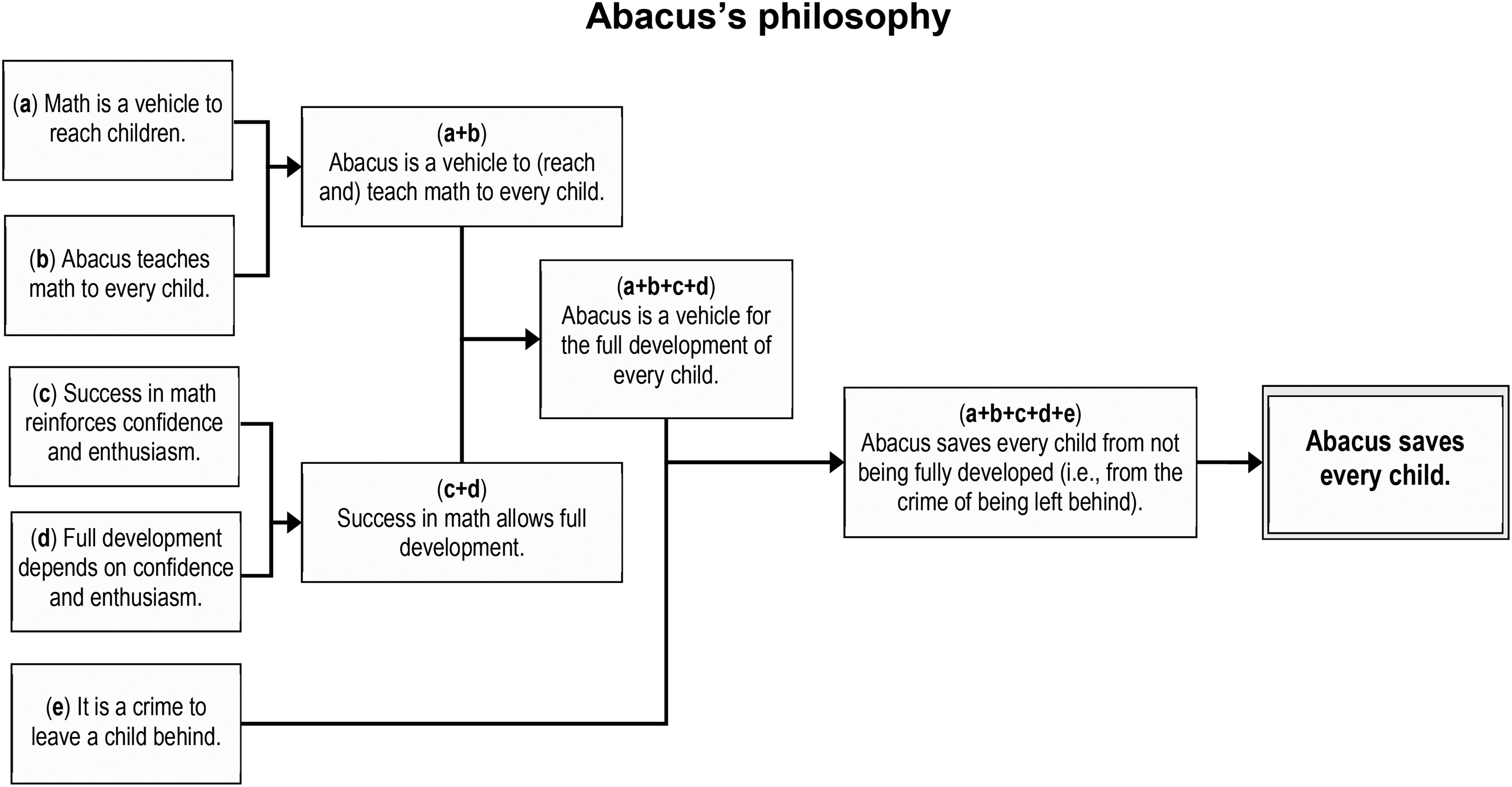
Abacus's philosophy.
Interestingly, once disclosed, it became possible to identify previously unnoticed manifestations of the “Abacus saves every child” philosophy in the primary data: So by accepting or understanding that all these children have potential, [and] by giving the educators and tutors the tool to be able to reach these children, you could save these little individuals a lot of disillusionment, a lot of pain in their minds [A3]; and
I had an experience when I tutored boys […] in the hospital. […] They made conceptual progress but also started to recover quicker and their motor skills changed. I didn’t believe that until the doctors were telling me the same thing. It's almost unbelievable. How can you develop motor skills just because you are learning fractions? But it's quite obvious: the kids are totally excited about doing the exercises and they concentrate on it and have to focus on the elements that are in the pages and draw the results. […] They are also using all parts of their brains because they are also trying to remember; they are counting on their fingers; they are trying to see patterns and trying to guess what the next step will be. They are using a lot of different skills. I’m sure that the demand to exercise all those parts together actually allows the brain to reorganize itself. [A1]
The analysis of images also supported the notion of saving every child. For instance, the code raising hands ( Figure 2 , combining parts of pictures in documents published by Abacus and taken during in-class observations) showed children waving their arms to participate in the class and answer the tutors’ and teachers’ questions.
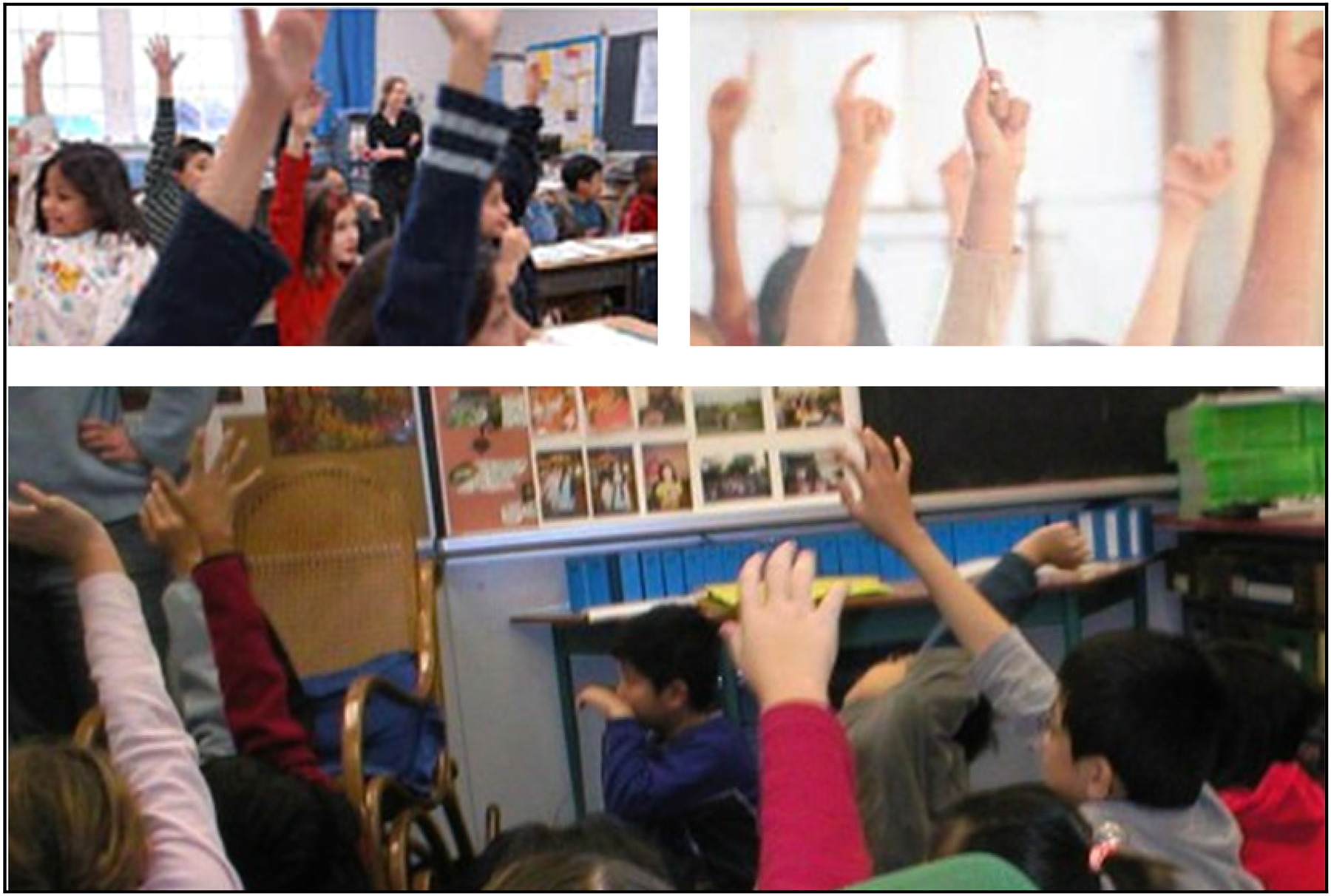
Raising hands as semiotics for “Abacus saves every child” [from G7, 16, 29].
Informants also related the mass participation of children to the salvation of a class. They described the emotional experience of harvesting enthusiasm from the entire class (which I also experienced when assisting teachers in the classroom) as a major motivation for their engagement. On occasion, they reported that such experiences were powerful enough to convince resistant, skeptical teachers to join in. In this context, the semiotics 7 for images coded as raising hands supports the notion of saving all children, who put up their hands and wave in response to the instructor's offer of salvation.
Transcending Abacus's Philosophy
The re-examination of primary data enriched the proposition of Abacus saves every child with four additional codes that enlarged its social justice aspirations:
Success in math transfers to other areas: “Children [who] are immigrants and don’t have English as a first language may feel very insecure. And when you are not confident in math, it transfers to everything. So that [Abacus's] math has this huge, powerful component with transferences to all areas.” [P3]; and “I can guarantee that […] a class that uses [Abacus] may also be able to, for instance, learn to read much faster than an equivalent class without [Abacus]. Because there is the same principle; you have to be able to concentrate, […] to look at the correct part of a page, to see what changes, what stays the same; you have to be able to extend a pattern. […] They already have done that with another language which is math.” [A1] Abacus inspires people to see the beauty in math: “Kids can become very excited about the beauty of math too […] to transfer this excitement to the concepts of math; to play the game; to play with numbers, to solve puzzles.” [A1]; and “I do see beauty in math now. I see how beautiful patterns are. It transformed me too. And it transforms other teachers.” [P2] Abacus can save communities: “And [Abacus] may be used in that way in order to build a sense of community. It's better for everyone. If you don’t care about your community, you will get graffiti on the walls. [Abacus] may be very powerful.” [P2]; and “Other people in the school, like volunteers, parents, caretakers, and the whole community may become part of [Abacus], so that everyone progresses together. There is no unmovable rock.” [P2] Abacus can change the world: “Then, it would be wonderful if it could be embraced in the whole of North America, and then we could be looking at, it could be the case, that we bring that to the developing world.” [A3]; and “Everyone here, and that's why it works so well, believes that this is the way to help children and to change the world. It's only this belief in what we are doing that brings everyone here together.” [A2]
Finally, the ultimate extension of Abacus can save communities is Abacus can change the world:
The integration of these codes into an enlarged perspective of Abacus's philosophy (Figure 3) brings it beyond Abacus saves every child.
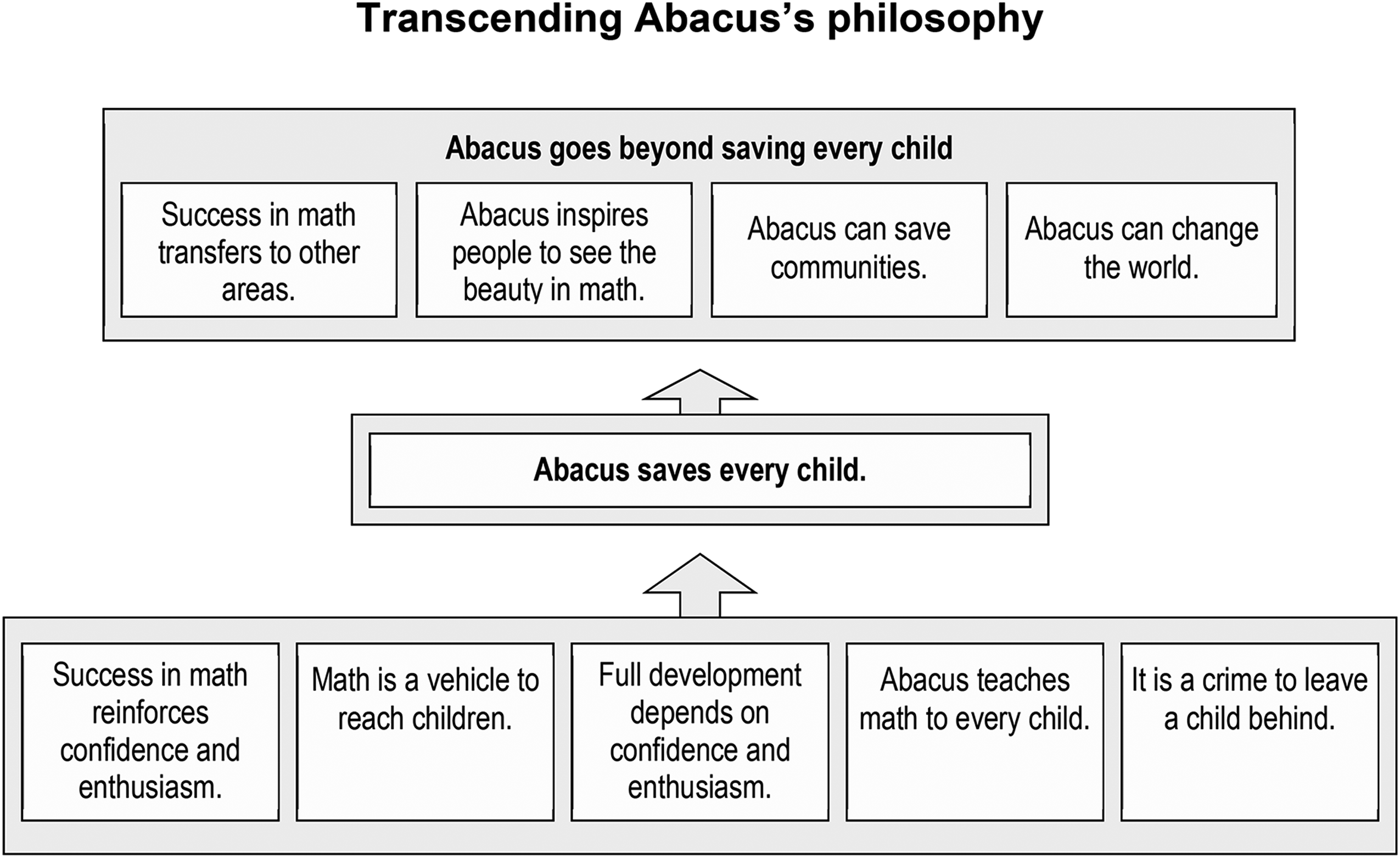
Transcending Abacus's philosophy.
As a result, the broader philosophy of Abacus can change the world reveals Abacus’ intention of reducing exclusion and building more socially just societies, which transcends the aim of its innovative pedagogy and even the salvation of children. It invites the question of what consequences specific organizational ontologies can have on businesses and industries, as well as on societies at large. It should also be noted that, as this enlarged formulation was only implicitly shown in primary data, it indicates a gradual incursion into the realm of interpretation.
Abacus members’ devotion to their cause concurs with the classic formulation of a calling, whereby individuals place “a solemn obligation to seek their calling and to make whatever sacrifices might be required to diligently and faithfully fulfill [their] duties” (Bunderson & Thompson, 2009, p. 33). Collectively, a shared calling provides some structure to Abacus's organizational ontology.
Abacus's Theory of Existence as Structured by a Missionary Mandate
In the interpretation I propose, Abacus's ontology is structured by an inspiring mission that goes beyond its observable material reality and that pervasively guides its members. The strong cohesion among Abacus's members emanates from its mission, and the organization is ultimately propelled by a missionary impulse to spread beyond its boundaries and actively search to convert others to its mission.
This definition enlarges the notion that organizations develop impulses of self-preservation. Beyond the fear of extinction, Abacus aspires to grow to connect to others and spread its revelatory experiences. As its members pursue this expansion, they aim to build a utopian universalism. Their mission becomes their raison d’être and gives them resilience for it provides them with unity and direction.
Abacus thus becomes its mission. This study also suggests, however, that the ontological intention of saving every child might also put the organization at risk. A crucial challenge for Abacus is maintaining the balance between self-preservation and expansion. If taken too far, the impulse to spread the mission could gain precedence over preservation, weakening the organization. Indeed, Abacus's fast growth might very objectively compromise the dissemination of its core values. For instance, an informant who worked as a teaching assistant at a satellite project, after six weeks on the job, was not aware of the existence of anything that he perceived as Abacus's philosophy: I see no philosophy or specific principles or values in it. And I may be wrong. The only thing I can see, looking at it objectively, is that whoever set it up had a specific intent. The intent was: “Let's teach kids how to do fractions.” And they are entirely successful at it. […] It may be much more than that, but I do not see it, not from my point of view. [P3]
This absence of a homogeneous cohesion indicates that adherence to a single organizational ontology should not be taken for granted. Moreover, it corroborates the concerns of Abacus members and their insistence on partners embracing their philosophy. Without it, the mission is lost and Abacus risks being reduced to just an effective teaching method, which is not bad but certainly falls short of its ambitions.
A closer Look at Some Constituent Elements of Abacus's Ontology
The notion that Abacus's ontology is structured by a devotion to spreading its mission opened up ways to investigate the interpretation of its ontology. Guided by the framework of four ontological relations provided by Bédard (2004), second-order models were generated as interpretations of the four ontological relations.
Abacus's self-conception is of an organization that builds a better world by pursuing the altruistic mission of saving all children. Their members envisage a path leading to a future of enlightened freedom where all people will be saved and will become able to see the beauty in math and in all other domains of human knowledge. By responding to this calling, Abacus's members enjoy a strong sense of cohesion and are capable of making sacrifices to remain loyal to their founder's passionate leadership: When you let all the children attain the same level and they do things just because of the intellectual pleasure of discovering it, schools may become children's paradise. And I’m sure it will change our social relations; it will change even the foundations of our economy. That's my passion. [A1]
The relation Abacus–the others reveals an interesting perspective. For Abacus, the others are those who have not joined their ranks. Abacus's missionary project implies that as many as possible must jump on board and be saved by becoming part of we-Abacus. The others are essentially formed of two categories. The first is the non-converts, who are yet to be contacted and converted, unless they deviate and become part of the second category: the enemies. Repeated accounts of non-converts being gained through soft-conversion—i.e., employing emotional arguments or experiences—typically portray how they join Abacus's ranks: I think that when teachers see [the children participating] they become converts, they almost become [Abacus] evangelists. […] They really go out and talk about their conviction because they’ve seen the kids that are jumping out of their seats wanting to answer a question. And children that are normally in a seat in a corner, scribbling on a piece of paper, get out of their place and go to the board to answer questions. [A3]
Those who, because of ideological differences, skepticism, ignorance, or other reasons, resist the soft-conversion, can still be won round through the hard-conversion of objectively communicated evidence. [Abacus] must have data to show [that it] makes a difference, […] to show it with hardcore data, statistically. That's how the [educational administration] would understand and fund it. [S2]
Indeed, as mathematicians who are emotionally moved by the experience of saving the children, those at the core of Abacus can swing between soft and hard arguments when enlisting others to their mission. However, if despite all efforts, a non-convert continues to resist, it is often explained as the result of the enemies’ influence: [Most] math education research is pseudoscientific; [it] is largely financed by book publishers. And people on the boards of education, [educational administration], and so on are using it as if it was in fact scientific. They really believe it and they rely on it as research. […] But fortunately, teachers do not pay much attention to it. Neither do parents. [A1]
In other words, book publishers are enemies; members of boards of education and the like should be converted; and converted teachers and parents are allies. Therefore, the relation between Abacus and the others reflects its mission and portrays a world where some are good, some may be converted, and some are under the influence of evil forces. Moreover, by evoking the imagery of evangelists and converts in their discourse, Abacus's mission occasionally assumes the colors of a messianic cause.
The relation Abacus–nature depicts a view of an abstract or mathematic-conceptual nature that lies behind what we can see and that will be gradually revealed.
8
Moreover, just as one becomes able to see the beauty in math, they will become able to see the beauty in nature: We have robotized our population to see just a tiny part of nature and not to appreciate its beauty: all the incredible symmetries, connections, and relations that almost transcend the human imagination when you start seeing it. And that's the reason [why] many scientists become spiritualized. You realize that there is a kind of intelligence in the world that is deeper than the human intelligence. And kids can appreciate it; they love it. [A1]
From this perspective, nature exists neither to be dominated nor perceived as a threat. Instead, it is a complex, quasi-divine system that should be deciphered and illuminated in a quest for conceptual beauty, harmony, and enlightenment.
Finally, we come to the relation Abacus–the holy, the sacred, or the unknown. The unknown could be seen as the mathematical conception of nature to be deciphered and shared across the whole of humankind. This collective illumination would allow humanity to appreciate the magnificent beauty of a superior logic-mathematical perspective or, perhaps, as in the last quote, to “realize that there is a kind of intelligence in the world that is deeper than the human intelligence.”
Moreover, the proposed interpretation has already revealed what is most sacred to Abacus: the children. Borrowing from the Roman poet Juvenal (Decimus Junius Juvenalis), “Maxima debetur puero reverentia” (“The greatest respect is due to the child”; Satires, XIV, 47, c. 110 A.D.). The children inspire and give Abacus purpose, they who must be saved, who can redeem humanity. Each child is sacred, but the most sacred children are the poorest, the weakest, the most forgotten about, the immigrant children, and those from the disadvantaged parts of the world.
Abacus's Ontology Interpreted as a Battleground
As articulated by the interpretation of its four ontological relations, Abacus's theory of existence is structured by a deep missionary intention of promoting inclusion that involves moral duties of personal sacrifice and permanent vigilance (Bunderson & Thompson, 2009, p. 41). This perspective supports additional interpretations. In particular, some elements inscribed in Abacus's ontology evoke a religious battle based on Renaissance chivalric values: faith in a cause, affiliation to a group, the importance of loyalty, cohesion, and honor, a myth about a future to be conquered, and the passionate predisposition to fight enemies.
Building upon this imagery, Abacus's organizational ontology can be presented as an action map locating its allies, enemies, arsenal, and possible moves. This diagram ( Figure 4 ) comprises primary data codes representing actors, actions, arguments, and potential strategic movements. I call this representation Abacus's battleground, and I have taken the liberty of placing Juvenal's adage over the battlefield as a motto of their faith and a reminder of the cause they fight for.
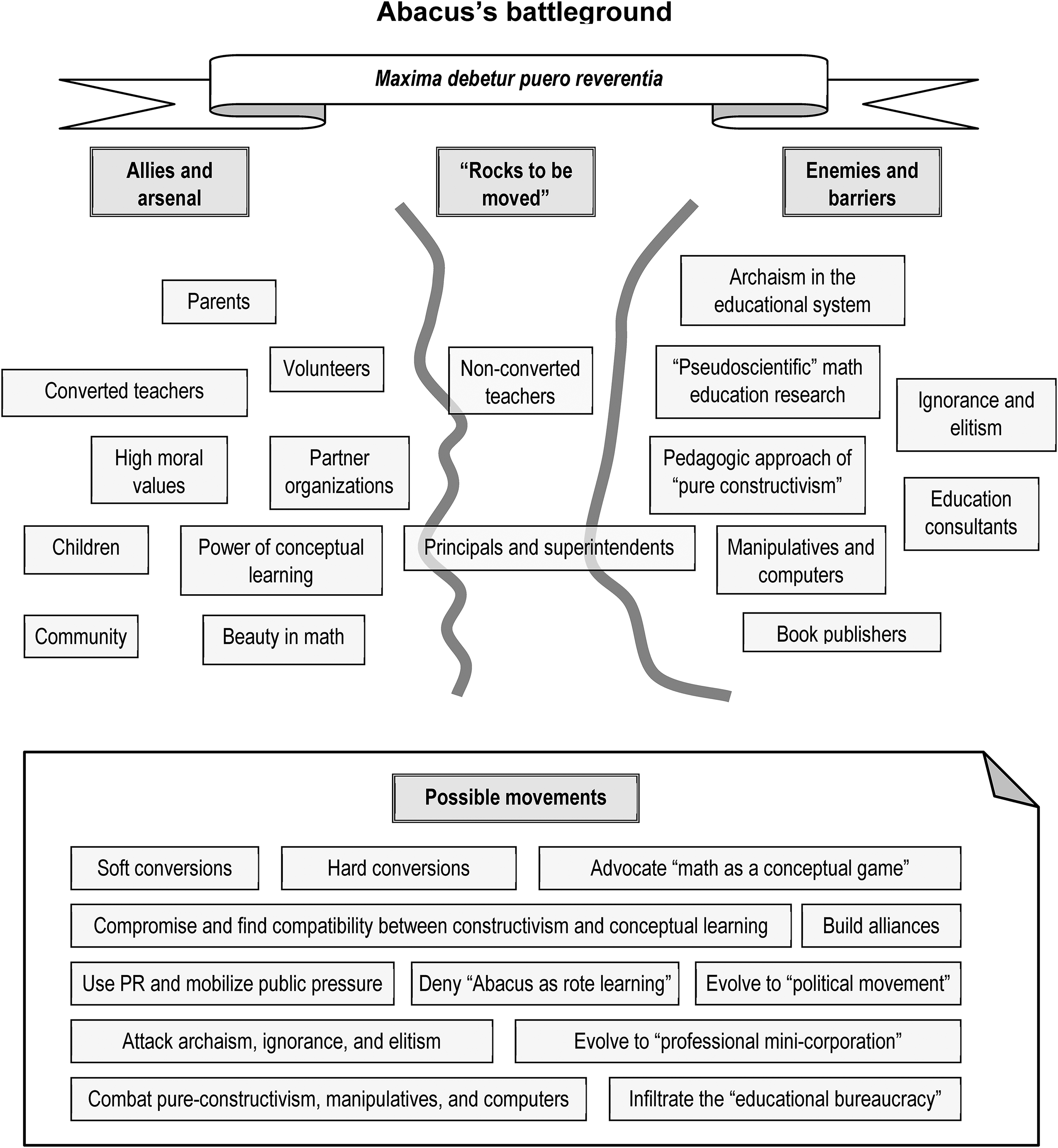
Abacus's battleground.
This system regroups codes in four categories: (1) allies and arsenal: perceived as components and resources of the we-Abacus subsystem; (2) enemies and barriers: the subdivision of the others subsystem positioned against Abacus; (3) rocks to be moved: transient elements between the others and we-Abacus subsystems; and (4) possible movements: potential courses of actions envisaged by we-Abacus. Structured by its fundamental mission, Abacus's repertoire of possible strategic movements encompasses open confrontations, compromises, and defensive moves (e.g., respectively: attacking archaism, ignorance, and elitism; proposing compatibility between constructivism and conceptual learning; and denying Abacus as rote learning). Concurring with the notion that organizational ontologies are inherently relational, this interpretation reinforces the argument that ontologies necessarily comprise conceptions of who the others are.
This interpretation sheds additional light on how Abacus interacts with its context. The organization emerged from the action of individuals who were critical of an education system composed of schools that, by applying mainstream pedagogical methods, committed the “crime of leaving children behind.” Abacus is hence devoted to confronting and transforming this system (i.e., its surrounding context). This also highlights the risk of a certain organizational Manichaeism, that is, a pervasive inclination to classify all actors and institutions along a spectrum ranging from good to bad. This tendency emerges, for instance, from the portrait of the newly converted teacher, symbolized by a transient character who joins Abacus's phalanxes after having been touched by its mission: Sometimes a teacher opts out, but after observing other classes, receiving better students from previous classes or something, he decides to come back and join it. A teacher [who] is a nightmare for us sometimes becomes our very good ally [A2]; and
Sometimes we get a convert. A teacher who does not want to do it and after becomes an enthusiast. [P2]
Finally, interpreting Abacus's theory of existence as a battleground allows some pieces of primary data to be reinterpreted as reinforcements of—or pleas for—devotion to their noble cause. I call some of these letters to the battlefield ( Figure 5 ) because they endorse a battle worth fighting. These messages, from those who are seen as sacred in Abacus's ontology, are treated with reverence, proudly displayed within the organization, and very much trusted: “I trust a story from a teacher more than I trust research at this point. [And I trust] even more a story told by a child” [A1].

Example of a letter to the battlefield [G17].
Sent to those at the forefront of the battleground and shared between Abacus's trenches and the headquarters, these letters openly restate, in the imperative, their missionary mandate: “Be good math tutors to other classes like you did for our class” [G17].
Discussion and Conclusion: Validity, Generalizability, and Contributions to Theory and Practice
I open this final section by discussing the validity and the possible generalizability of the proposed interpretation of Abacus's ontology. I proceed to discuss how this article advances management research on organizational ontology, and I conclude by commenting on how it contributes to managerial practice.
Validity and Generalizability of the Proposed Interpretation
The accuracy of an interpretation cannot be objectively demonstrated, but some validation can be gained by testing it against the “social group's view of reality” (Fetterman, 1998, p. 18). Intending to do so, I presented my interpretation to Abacus's headquarters staff as a feedback session, framed as a four-hour-long workshop. It took place four months after the end of the fieldwork and became a way for me to give back to those who opened their doors to my research and gave me their valuable time and attention. I prepared the versions of the findings I had at that time to present to them. In the worst case, the absence of resonance among participants and a session dominated by long faces would indicate a missed target. I also took the time to address more managerial and strategic matters that Abacus was facing at that time.
Geertz (1973) noted that “coherence cannot be [a] test of validity for a cultural interpretation” and that “nothing has done more to discredit [it] than the construction of impeccable depictions of formal order in whose actual existence nobody can quite believe” (pp. 17-18). Indeed, the treatment of fieldwork data generated some models that seemed to contain contradictions. I presented some of them during the feedback workshop and, although not all apparent contradictions could be resolved, the participants actively proposed possible explanations that deepened our understanding of the organization. Overall, the participants—including some who I came to trust for their forthrightness—recognized their organization in the proposed interpretation. Some said it stood for what they “felt but could not say in words,” and one program coordinator described the research and feedback discussion as “a kind of organizational psychoanalysis.” Nevertheless, when preparing the presentation, I was concerned about the possible negative connotations of the images of a battleground and of a missionary mandate but, much to my relief, these were accepted without visible unease. The interpretation moved the audience emotionally and even brought tears to the eyes of some of them. I perceived the predominant responses as excitement, reinforced enthusiasm, and self-recognition in rational and emotional terms. For me, the presentation and ensuing discussion were a mutually gratifying end to the fieldwork. (And they kindly excused my metaphoric license of depicting them as anachronistic crusaders.)
As for possible generalizations, I maintain that the proposed interpretation is specific to Abacus and, to a certain extent, even dependent on the accidents of ethnographic incursions (Van Maanen, 1979, p. 539). In the proposed interpretation, Abacus's existence is perceived as a battlefield (i.e., through the metaphor of war), which could arguably also fit other organizations since, in a broader sense, there is always a fight or a struggle of sorts. But any possible analogy or extension should be considered cautiously. Nevertheless, for an ontology “is about what we view the world to be [as well as about] what kind thereof” (Kuronen & Huhtinen, 2017, p. 51, emphasis in the original), a battle could be one possibly generalizable type, as also could be games, flows, trees, and rhizomes (Kuronen & Huhtinen, 2017; Salovaara & Statler, 2019). The current interpretation could thus be one possibility within a typology of ontologies.
Moreover, although the feedback workshop provided some validation to the proposed interpretation among members of Abacus's headquarters, one should not assume that a single, homogeneous ontology exists throughout the entire organization. In fact—as in the case of a newly socialized teaching assistant working for a satellite project who was unaware of anything he could perceive as Abacus's philosophy—there is evidence that not all members of Abacus share the exact same ontology.
Contribution to Management Research
The growing research interest in organizational ontology (Kuronen & Huhtinen, 2017; Lips-Wiersma & Mills, 2014; Pelly, 2017; Salovaara & Statler, 2019) motivated this effort to outline the constituent elements of a theory of organizational ontology and to develop a method capable of accessing and representing it. This study thus contributes to the nascent management research on organizational ontology by providing a more extensive conceptual basis to study it (informed by philosophical studies of ontology) as well as a specific methodology (based on ethnography fieldwork and on the cultural interpretation tradition). Therefore, by opening the black box of what constitutes an organizational ontology and of how to access it, this article provides forthcoming studies with novel conceptual and methodological possibilities. Pertaining to extant research, by equipping researchers with a more systematic and comprehensive understanding of how the implicit existential conventions of organizations are perceived by their members, this study allows a more fine-grained revisitation of how organizational ontologies vary in their temporalities and states (Kuronen & Huhtinen, 2017), of what happens to their constituent elements when distinct ontologies meet (Pelly, 2017), and of how ontologies evolve and how different versions of an ontology may coexist within the same organization. Moreover, it also opens avenues of inquiry to investigate the new questions evoked throughout the paper, notably, those related to the instances of ontological failures, to organizational ontologies being non-homogeneous, to the relation between organizational ontologies and explicit value systems, to possible typologies of ontological configurations, and to the consequences of distinct organizational ontologies to industries and societies.
Furthermore—and adding to the management research tradition of studying the unseen, tacit, or implicit foundations of organizations (Corley & Gioia, 2004; Schein, 1985; Selznick, 1957; Thornton & Ocasio, 2008; Weick, 1985, 1993)—although concurring with the premise that implicit foundations of organizations cannot be objectively described, the proposed conceptualization and methodology rely on the tradition of cultural interpretation and on its deep roots in the practice of ethnographic research to produce meaningful representations supported by metaphorical images (e.g., a battle or a Balinese cockfight; Geertz, 1973, Chapter 15). By so doing, this article provides management research with more precise means to treat the implicit existential conventions of organizations and contributes with more nuanced and dynamic perspectives to access the implicit existential foundations of organizations. It does not presuppose, however, that what is implicitly shared is hidden and fixed, but it accepts a certain degree of plasticity by assuming that some of it can be revealed and made conscious—on a par with Bourdieu's (1994, p. 164) possible mechanisms of denaturalizations of social orders. In particular, this study suggests that an organization's ontology emerges as it begins to fulfill three interconnected functions: providing members with a shared understanding of what their organizational existence is, equipping them with behavioral and decision-making frames of reference, and sustaining a collective sense of preservation.
Conversely, the investigation of Abacus's organizational ontology also suggests that the division between implicit and explicit is not clear-cut but a transition across grey areas. As such, it challenges Giddens's (1991) argument that ontologies necessarily remain “unproven and unprovable” (p. 36). Instead, the perspective adopted in this study—informed by symbolic anthropology—reinforces the notion that treating the ideational as part of an empirical reality does not require the adoption of a strictly subjectivist conception of human existence in which the symbolic remains inaccessible: “[i]deas are not, and have not been for some time, unobservable mental stuff. They are envehicled meanings, the vehicles being symbols [that are] intersubjective, thus public, thus accessible to overt and corrigible plein air explication” (Geertz, 1980, p. 135).
Indeed, when exposed to the symbolisms of the interpretation generated from the ethnographic study, the members of Abacus could profit from the reflexive opportunities unleashed by the incursions into the liminal space between explicit and implicit, conscious and unconscious, overt and tacit. Therefore, by purposefully aiming at revealing parts of an organizational ontology that other conceptual and methodological perspectives could deem inaccessible, the investigation of implicit existential foundations of organizations constitutes a kind of organizational psychoanalysis that can support conscious action taken by their members.
Contribution to Practice
I kept in touch with some of the informants after the feedback workshop, which marked my fieldwork exit (Michailova et al., 2014). About a year later, a director at Abacus told me over the phone that the workshop helped them to gain awareness of some issues she came to consider crucial, notably: the danger of having their values diluted by fast growth, the reason they intuitively put so much importance on the propagation of what they called their philosophy, and the importance of avoiding open confrontation with those perceived as opponents (mitigating the consequences of what I labeled organizational Manichaeism). She updated me on a number of developments, including the decision, in her words, to “be more strategic” and to rein in the impulse of trying to reach as many children as possible as fast as possible. Instead, they decided to devote more time and resources to a manageable number of partnerships. She explained to me that they have adjusted their goals and sought to build a more robust “extended core” before tackling new peripheries. I understood these measures as a course correction to secure Abacus’ self-preservation by taming the excesses of its ontological missionary impulse.
This study hence corroborates the argument that disclosing an ontology can provide a more comprehensive understanding of an organization (Lips-Wiersma & Mills, 2014; Salovaara & Statler, 2019), including other not-for-profit organizations fighting exclusion. Of particular value to practitioners, the effort to access and represent an organization's ontology can allow managers and members of organizations to verify if it concurs with adopted explicit value systems, and can provide them with a better basis from which to infer whether inward and outward strategic moves should be embraced or resisted and why. Moreover, disclosing deeply ingrained existential organizational foundations can be crucial because—as in the Confucian saying, “the water that carries the boat can also capsize and sink it”—an ontology provides intersubjective guidance for collective behavior but may also carry the seeds of self-destruction for an organization.
To conclude, I consider that this study indicates that the further development of a theory of ontology will advance our understanding of organizations, will open novel management research possibilities, and will be useful to managerial practice. Furthermore, despite the inherent challenges of ethnographic interpretative endeavors, my experience at Abacus convinces me that systematic research efforts and methodological discipline can produce meaningful representations of organizational ontologies.
Footnotes
Acknowledgments
I would like to express my deepest thankfulness and esteem to the good people of Abacus for receiving me and offering me their time, patience, and confidence. This article profited tremendously from the constructive assessments and comments made by the editor, Sabina Siebert, and the two anonymous reviewers. My warmest thanks go to them, and also to Frances Westley, Jan Jorgensen, Henry Mintzberg, Andy Gates, Alan Chanlat, Heidi Reed, Natalia Vershinina, Christian Vögtlin, Emma Avetisyan, Yuliya Shymko, Vincenzo Buffa, Thomas Roulet, Andy Crane, Stephen Gates, and Thibaut Bardon for their valuable comments to earlier versions of the article.
Declaration of Conflicting Interests
The author(s) declared no potential conflicts of interest with respect to the research, authorship, and/or publication of this article.
Funding
The author(s) disclosed receipt of the following financial support for the research, authorship, and/or publication of this article: This work was supported by the J.W. McConnell Family Foundation.
