




Abstract
Company leaders are frequently confronted with highly uncertain and risky situations for which they are often ill-prepared, and consequently, in which they often panic. Based on an exploratory case study of extreme rock climber Alexander Honnold, we have developed propositions that help decision-makers to learn to avoid panic in crises. Our findings suggest that gradual exposure to incrementally more challenging tasks by adjusting individual learning goals allows decision-makers to leverage existing skills, and to develop their physical, mental and emotional states simultaneously. Deliberate confrontation with the challenges that may trigger panic through real-life simulation and imagination helps decision-makers to retrain and transform triggers for panic responses, and to build systemic confidence. This organic and holistic growth provides decision-makers with the simultaneous preparation and mastery of their physical, mental, and emotional states to ensure the lightness and calmness necessary not to panic when facing a crisis.
Any Reason to Panic?
“Our world is dominated by the extreme, the unknown, and the very improbable” (Taleb, 2007, p. xxxii). Indeed, company leaders and decision-makers are increasingly operating in an environment that is rapidly changing in ways that are unexpected. While such events may be the source of pleasant and welcome surprises, others may have dramatic and potentially life-threatening consequences. When exposed to such crises, managers are often required to respond quickly to avoid significant damage to or even termination of their organization. If we only look at the past decades, we have seen financial crises, a global pandemic, wars, and environmental disasters, requiring many leaders to “make life-or-death decisions under conditions of deep uncertainty” (Lodge & Boin, 2020, p. 1). Scholars in a wide range of disciplines have explored how leaders anticipate and respond to such events and activities of great uncertainty and risk (Ansell & Boin, 2019; Boin et al., 2018; Dyson & ‘t Hart, 2013; Weick & Sutcliffe, 2015). Whereas risk is defined as a situation for which outcomes can be determined with some probability, scholars studying company leaders and decision-makers operating in uncertain situations have put forward theoretical propositions and frameworks ranging from rational choice models to better understand social and economic behaviors (Ansoff et al., 1976); to search processes that guide the decision-making in entrepreneurial and exploratory processes (March, 1991; Mintzberg & McHugh, 1985; Sarasvathy, 2001, 2007; Sarasvathy et al., 2014); behavioral economic models that study the boundaries and limitations of rational economic decision-making in conditions of uncertainty (Kahneman & Tversky, 1979; Thaler, 1980), and dual-mode models that explore automatic-affective and deliberative-cognitive systems in crisis decision-making (Ansell & Boin, 2019; Dijksterhuis & Aarts, 2010; Fiske & Taylor, 2007).
However, an underestimated influence of uncertain situations, especially when bad decisions and responses can have severe consequences, is an individual's feeling or sense of panic that can cripple optimal decision-making in such circumstances (Kayes, 2004; Maitlis & Sonenshein, 2010; Weick, 1993). Indeed, while many leaders and decision-makers assume that the role of management is to control the environment through rigorous planning and skillful intervention (Taleb, 2007), and that “luck can be tamed by actors’ wills” (Liu & De Rond, 2016, p. 31), when the unexpected does happen “we are all the more likely to become so paralyzed that we cannot survive the experience” (Coutu & Weick, 2003, p. 85). When challenged by unexpected and survival-threatening crises, decision-makers become overwhelmed, and often panic and freeze with inaction (Dyson & ‘t Hart, 2013; Goodson et al., 2020). For example, when asked about September 15, 2008, the day Lehman Brothers filed for Chapter 11 bankruptcy protection, former Lehman executives especially recall the chaos, fear, and panic this announcement caused amongst them (Egan, 2018). Despite the frequent and many potential causes for such panic attacks amongst company leaders and decision-makers, there is still limited research that explores what it takes not to panic in the face of uncertainty and risk, and when the consequences of crises are threatening one's very survival.
The aim of our paper is to explore how decision-makers can avoid panic in severe crisis-like events. We develop and propose approaches that decision-makers can apply in their workplace to help avoiding panic when confronted with highly uncertain and risky environments, and situations characterized by serious or severe consequences. In order to develop such approaches, we focus on a unique setting and draw from the experience of a unique person about whom a wealth of data is available in ways that are rarely found in other settings, and whose pursuit it has been precisely to avoid panic in situations that are extremely dangerous and potential sources for panic attacks. We focus on extreme sports as the research context for our study, and on the experience and responses developed by Alexander (Alex) Honnold, the world's leading free solo climber in particular. Free soloing is the most dangerous and risky form of rock climbing whereby the climber is climbing up rocks and big walls without ropes or any other protection equipment. The risks of free solo climbing are potentially lethal, and unfortunately, many practitioners of the sport do not survive. According to Conroy and Blunt Gonzalez (2019), there are also great uncertainties in such free solos. Honnold himself has mentioned several of such uncertainties experienced in his career, such as stepping into a foothold that cut his shoe almost in half, grabbing rocks that fall off the cliff one is climbing, or being attacked by scorpions, bats, or bees when entering his hand in a crack.
Based on Bacharach's (1989) proposition of theory building, we posit a set of key questions that focus on the preparedness of Alex Honnold when it comes to mastering panic in situations of great uncertainty and certain risks. We focus on Honnold in particular, since he is both considered among the best free climbers in the world, but also since his thinking and actions have been documented widely in the past few years, in ways that the data available for him are truly unique. Mindful of the limitations of using a single case study, Honnold truly represents a case so unique that other data is difficult to obtain in similar ways and therefore of value in analyzing (Siggelkow, 2007). Using this rich data, we focus on how he defines and knows his threshold with which he decides when he is ready for a free soloing ascent, and how far he pushes his climbing boundaries. For this reason, we use a chronological order research format exploring how his climbing ascents have evolved in grades of difficulty, with his latest free soloing ascent of El Capitan, an 884-m high big wall, being described as the ultimate climb or the “moon landing of free soloing” (Tommy Caldwell in Synott, 2019, p. 33).
By using Alexander Honnold and his free soloing climbing ascents as our research context, we immerse in actions, processes, changes, and progressions from which an aliveness and active imagery emerge that is rare in studies about decision-makers and company leaders, and that provides an alternative approach or perspective to study and understand them (Dutton, 2003; Wolfe et al., 2005). We take a micro-foundational perspective and propose to leaders and decision-makers approaches that help them to control for panicking in highly uncertain and risky environments and situations. By doing so, we contribute to the scholarly works that have explored how individuals operating in extreme contexts focus primarily on coping and avoidance strategies, and that is “in dire need of theoretical and empirical rigor, and conversations across disciplines” (Hällgren et al., 2017, p. 113). Our findings of how Honnold approaches his climbing adventures and pushes his climbing boundaries also contribute to the works of scholars who have studied how practitioners prepare for, and respond to high-risk situations, crises, and disasters (Ansell & Boin, 2019; Boin et al., 2018). Lastly, our digging into the whys and hows of Honnold's actions, the inductive nature of our study, and the richness of our findings could serve as a precursor for theory building (Glaser & Strauss, 1967).
We start our paper by disentangling our study's key concepts including panic, uncertainty, and risk, and provide a table with definitions of other important terms. We then introduce our research questions that shape the framework of this study and guide us in our choice and review of relevant scholarly works and research. We explain why we chose to conduct our research within the context of sport and we outline our methodological approach that is qualitative in nature, and with data collected from presentations and interviews with and about Alexander Honnold. Following our findings of Honnold's preparation and execution of his free solo ascents, we discuss and explore these findings through a managerial lens. By doing so, we develop approaches for individuals operating in highly uncertain and risky environments without sliding into panic mode. In our concluding part, we discuss future research paths, and our “lessons learnt” from conducting research in a non-managerial context.
Panicking in the Face of Great Uncertainty, Risks, and Severe Consequences
Operating in Highly Uncertain and Risky Environments
Company leaders and decision-makers face all kinds of unpredictable challenges that are of an urgent nature and that can have severe consequences for themselves, their organizations, and their different stakeholders (Ansell & Boin, 2019; Coutu & Weick, 2003). They operate in a world that is rapidly changing, and that has become increasingly complex, uncertain, and precarious. The COVID-19 pandemic and Russia's invasion in Ukraine in 2022 are adding to the many crises (e.g., September 11 attacks in the US, Icelandic volcano eruptions, swine flu pandemic, Hurricane Katrina, Deep Water Horizon oil spill, and Fukushima Daiichi nuclear meltdown) that have been outlined and discussed amongst scholars studying crises and crisis management (Boin et al. 2018, 2021; Dyson & ‘t Hart, 2013). Crises are characterized by their threat to aspects such as safety, security, and health; their association to a sense of urgency due to pressure or lack of time to act; and by their high degree of uncertainty “to both the nature and the potential consequences of the developing threat” (Dyson & ‘t Hart, 2013, p. 397). In light of the numerous crises, “[m]any leaders do not have the cognitive or organizational means to tame the deep uncertainty that comes with crises. They do not have an effective approach to recognizing new risks and grasping the dynamics of these unfolding events” (Ansell & Boin, 2019, p. 1080). This could come as a surprise when considering that even “everyday problems escalate to disaster status very quickly when people don't respond appropriately to signs of trouble” (Coutu & Weick, 2003, p. 86).
It has been suggested that recognizing, understanding, and responding to situations and events of great risk and uncertainty requires mindful organizing (Weick & Putnam, 2006; Weick & Sutcliffe, 2001, 2007). Weick and Sutcliffe (2007) describe mindful organizing as examining failures, understanding better causes and effects, building resilience to manage unexpected events, relying more on expert knowledge, and resisting oversimplifications. Interestingly, while mindful organizing is proposed as an important mechanism to detect unpredictable events, and to develop or imagine corresponding actions, it is precisely panic that might conflict with one's ability to be mindful. Indeed, when a crisis with potentially life-threatening consequences materializes, it may result in such intense negative emotions, including panic that they act as a cognitive “tax,” draining the energy needed to engage in mindful thinking and organizing (Bazerman et al., 1998; Easterbrook, 1959). As a result, people may either fall prone to some sort of paralysis (D’Aveni, 1989), or resort to habitual responses that are often insensitive to the new specificities of the situation, and which lie at the origin of the panic (Staw, 1981; Weick, 1990). The proposal to use mindful organizing in situations that have catastrophic potential might therefore become impossible because of the panic that prevents one from doing so.
Neuroscientists have shown that mental rehearsals affect cognitive processes such as motor control and memorizing, and increase states of flow (Csikszentmihalyi, 1990). It is these states of flow in which seemingly paradoxical mechanisms such as automate behaviors and high alertness can co-exist and synergize for individuals to be able to merge action and awareness that helps them to do the right thing (Kotler & Wheal, 2017). Weick and Putnam (2006) describe a similar synergy amongst individuals characterized by very high levels of proficiency and expertise. These advanced experts “do not solve problems or make decisions, they do what works” (Weick & Putnam, 2006, p. 284). They act “arationally” or in ways by which their deliberations are based “on intuition and the know-how to see patterns in situations without decomposing them into component features” (Dreyfus & Dreyfus, 1986, p. 36). Such an arational approach with the focus on doing what works resembles somewhat a pragmatic response to crisis-like situations that have catastrophic potential. According to scholars studying responses to existential crises, leaders following a pragmatist approach “forego dominant principles and base their actions on a mixture of reasoning and feedback” (Boin & Lodge, 2020, p. 2). The instant interplay of actions, feedback and adjustment can provide the flexibility, adaptability, and speed needed to anticipate and respond to the urgencies and uncertainties that characterize crises (Ansell & Boin, 2019).
With these processual responses in mind, can leaders and decision-makers train and prepare for activating them when facing severe crisis like situations that have catastrophic potential? So far, business scholars have focused the preparation of managers and MBA-students on dealing with corporate reputation damage in crises, regulatory requirements, and communicating with various crisis actors (Boin et al., 2018). How can company leaders and decisions makers manage their fears in crises without panicking? How do managers know that they are ready for positions in which they are likely to be the person who has to make the right decisions in situations of great uncertainty and risk? We address these questions by developing and proposing approaches that decision-makers can apply in their workplace to help to avoid panic when confronted with highly uncertain and risky environments, and situations characterized by serious or severe consequences. Before doing so, however, we want to provide a better understanding of the widely used concept of panic.
Panic
Our review of definitions of the term panic revealed that there seem to be almost as many definitions and descriptions of forms of panic and their symptoms as there are professional areas and scientific disciplines in which the notion of panic plays a key role. Numerous scholarly works have focused on collective panic, and have defined the latter as an “acute fear reaction” (Quarantelli, 1954, p. 267) provoked by an immediate and potential threat to the bodily self, and/or a feeling of possible entrapment, collective powerlessness and individual aloneness or isolation (Quarantelli, 1954, 1999, 2001). In this paper, however, our focus is on individual panic, which can be experienced or expressed at closely interrelated levels including the mental or psychological level, the (neuro) physiological level, and the behavioral level (Steimer, 2002). The emotional center responsible for this feeling is situated in the amygdala in the limbic system of the brain. The limbic system is located between the spinal cord through which all sensory information enters the brain in form of electric signals, and the rational center in which rational, logical thinking takes place. Thus, any situation creates an autonomic emotional reaction that acts largely unconsciously and is therefore out of one's control. When the amygdala associate sensory information with fear, they will project stimuli to different brain areas that mediate different fear responses depending on the context (Steimer, 2002).
Panic reactions can be of either a passive or an active nature. The body releases corticoids such as cortisol and cortisone, and adrenaline and noradrenaline causing an increase in heart rate, blood pressure, breathing rate, muscle tension, and alertness (Nolen-Hoeksema et al., 2009). American physiologist Walter Cannon described in the 1920s the acute stress reaction better known as the fight-or-flight response (Cannon, 1994). Over time, these two options have been expanded to fight, flight, and freeze as some of the main human acute stress responses (Bracha, 2004; Zeigler-Hill & Shackelford, 2020). In the panic fight modus, the person stays and faces the fear-causing situation with often unconscious and intuitive actions aimed to eliminate the panic source (Nolen-Hoeksema et al., 2009). In a panic flight to a highly threatening situation, the panicking individual has lost all self-control over the fear in a similar way as the panic fight modus, but instead of confronting the panic source, aims to run away from it. Reactions and decisions made in such a panic fight or flight mode are not only done impulsively and hastily (Janis, 1993), but they are also often irrational (Berns, 2008). Panicking and extreme fear can influence judgments about the frequency of various risks, “because emotions activate tendencies to reproduce the same cognitive appraisals that initially produced the emotion” (Nolen-Hoeksema et al., 2009, p. 404). In other words, when panicking, one appraises “subsequent circumstances as uncertain and uncontrollable and thus sees future risks as more likely” (Nolen-Hoeksema et al., 2009, p. 404). The implications of these dynamics are resistance to change and the holding on to the status quo.
A less studied panic reaction or adaptive defensive stress response is panic freezing. According to Noordewier et al. (2020), freezing can occur in response to physical and social threats. Physiological effects include reduced or impaired body motion, reduced heart rate, and increased muscle tonus (Hagenaars et al., 2014). Freezing is “thought to facilitate perceptual and attentional processes aimed at identifying cues for appropriate action” (Noordewier et al., 2020, p. 1890). Researchers have found that the more individuals are confronted with threats, the less likely they freeze (Ly et al., 2017; Noordewier et al., 2020). Notwithstanding the ability to change some of the consequential behavioral patterns of panic attacks, panic flights and freezing can jeopardize crisis responses or paralyze crisis reactions. In the following Table 1, we summarize the different panic reactions in our overview of all the other key concepts and terms we have discussed so far.
Key Terms and Definitions.
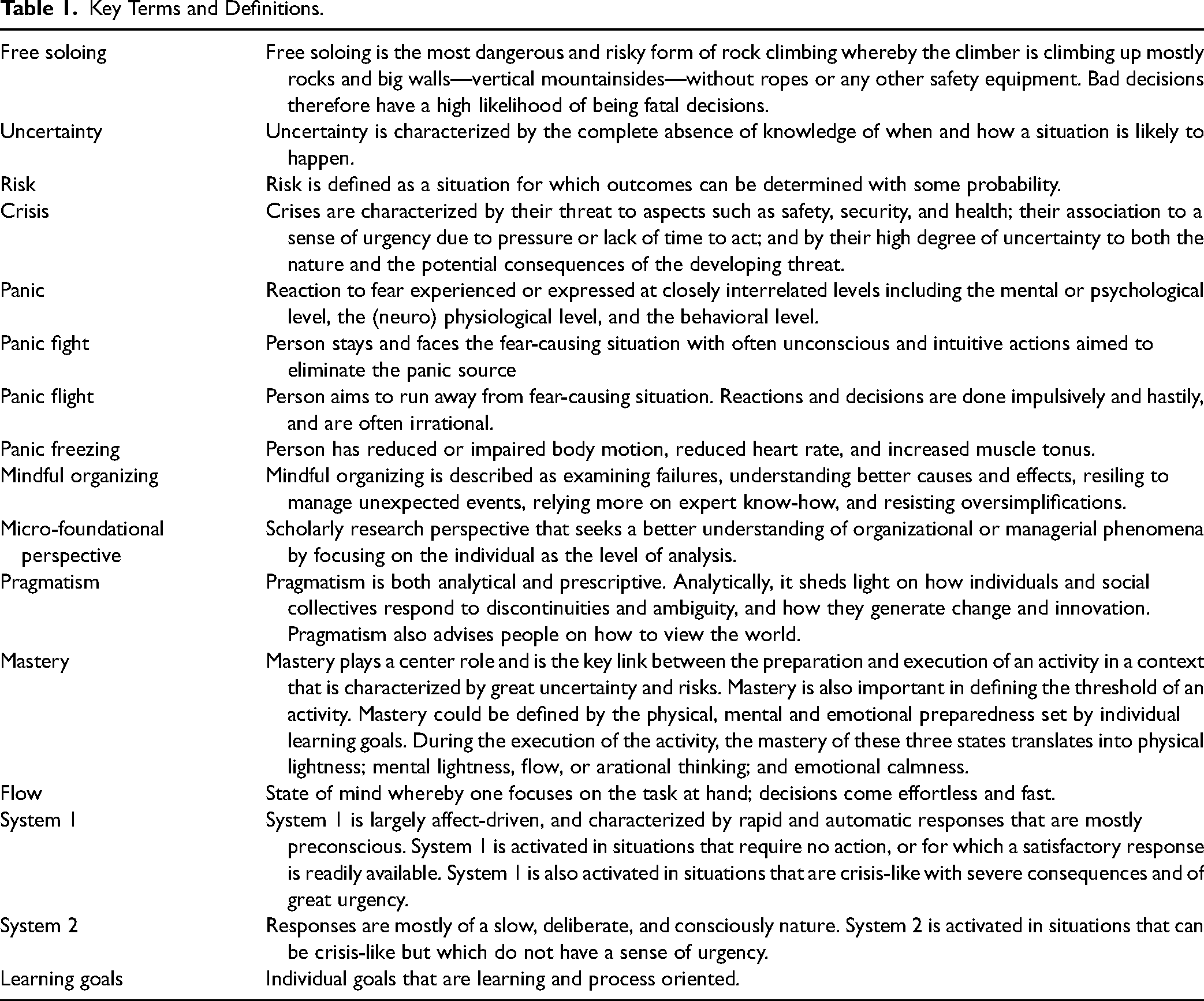
For Alex Honnold, the above-described panic responses or reactions when free soloing a big wall like El Capitan are not an option. Once free soloing a wall, the only way out is to keep moving upward and making it to the top. When hanging on his fingertips or resting on his toes on a big wall, the impacts of panic in structuring his decision-making process are very likely lethal. By studying extreme athlete and leading free solo climber Alexander Honnold, we develop and posit approaches for decision-makers to master modes of panicking when confronted with situations and events of great uncertainty and risks, and with severe consequences.
Methodology
The aim of our paper was to explore what it takes not to panic in the face of severe crisis-like events that are characterized by great uncertainty, risks, and severe consequences. As a suitable method for our analysis, we conducted a longitudinal, retrospective, exploratory inductive study within extreme sports (Gioia et al., 2012). Extreme sports as a research context is an effective setting to “guide researchers in analyzing, and managers in running, organizations” (Wolfe et al., 2005, pp. 183–184). Our focus is on the experience of a single athlete, Alexander Honnold. Alexander Honnold is the world's leading free solo climber. Free soloing is the most dangerous and risky form of rock climbing whereby the climber is climbing up mostly rocks and big walls—vertical mountainsides—without ropes or any other safety protection equipment. Bad decisions have a high likelihood of being fatal decisions, and the sport, unfortunately, counts several high-profile and talented climbers that have died while free-soloing. Honnold is regarded by many of his peers as one of the best free solo climbers in the world, and he has many repeated experiences of making high-risk ascents. Our decision to focus on the experience of a single person stems from the unique collection of data that is available about the phenomenon of our interest, and the rarity of alternative opportunities for equivalent data quality (Siggelkow, 2007). The data included interviews with himself and friends, detailed videos of preparation, and execution of free climbing and brain scans. More importantly for this paper, while he often insists that he feels fear, too many other climbers and observers Honnold has become the embodiment of fearlessness (MacKinnon, 2016). When exposed to images that solicit fear, scans of Honnold's brain have shown remarkably low activation of the amygdala in comparison with ordinary people, and even with other thrill seekers. Even though there is no proof of this condition to have been different prior to him building his climbing experiences, doctors assume that this low activation of the amygdala is the result of extensive training (MacKinnon, 2016). Finally, achieving an ability to avoid panic has been an explicit objective for Honnold, which he has termed “mastery.”
We used a chronological order research format exploring how his climbing ascents have evolved in grades of difficulty, with his latest free soloing ascent of El Capitan being described as the “ultimate climb” (Synott, 2019). Based on Bacharach's (1989) proposition of theory building and Alexander Honnold's free climbing ascents as our research vehicle, we posed a set of initial key questions with which we framed our data collection and analysis, and developed our propositions for leaders and decision-makers facing uncertainties and risks with severe consequences:
How does Honnold prepare for a free soloing ascent and its uncertainties and risks to avoid panic?
How does Honnold manage his fears and panic in the preparation and execution of an ascent?
When does Honnold know that he is prepared and ready for a free soloing ascent and may not panic?
How does Honnold define and know his threshold, and how far he can push his climbing boundaries?
Data Collection
We collected data from different sources covering the period from 2007 to 2017. We chose 2007 as the starting point for this study because in this year Honnold climbed his first major “big walls,” the Freerider, Astroman and The Rostrum, and the Salathe Wall in Yosemite Park, California. Our main data sources were video interviews with, and speeches by Honnold, supplemented with video interviews with experts, friends, and colleagues of Honnold, secondary data from the popular press, and Oscar-winning documentary Free Solo (describing and accompanying Honnold during the preparation and ascent of El Capitan in 2017). The following Table 2 provides details about the interviews and presentations including interviewing partners, settings, duration, and the coding used throughout the subsequent sections.
Interviews With and About Alexander Honnold.
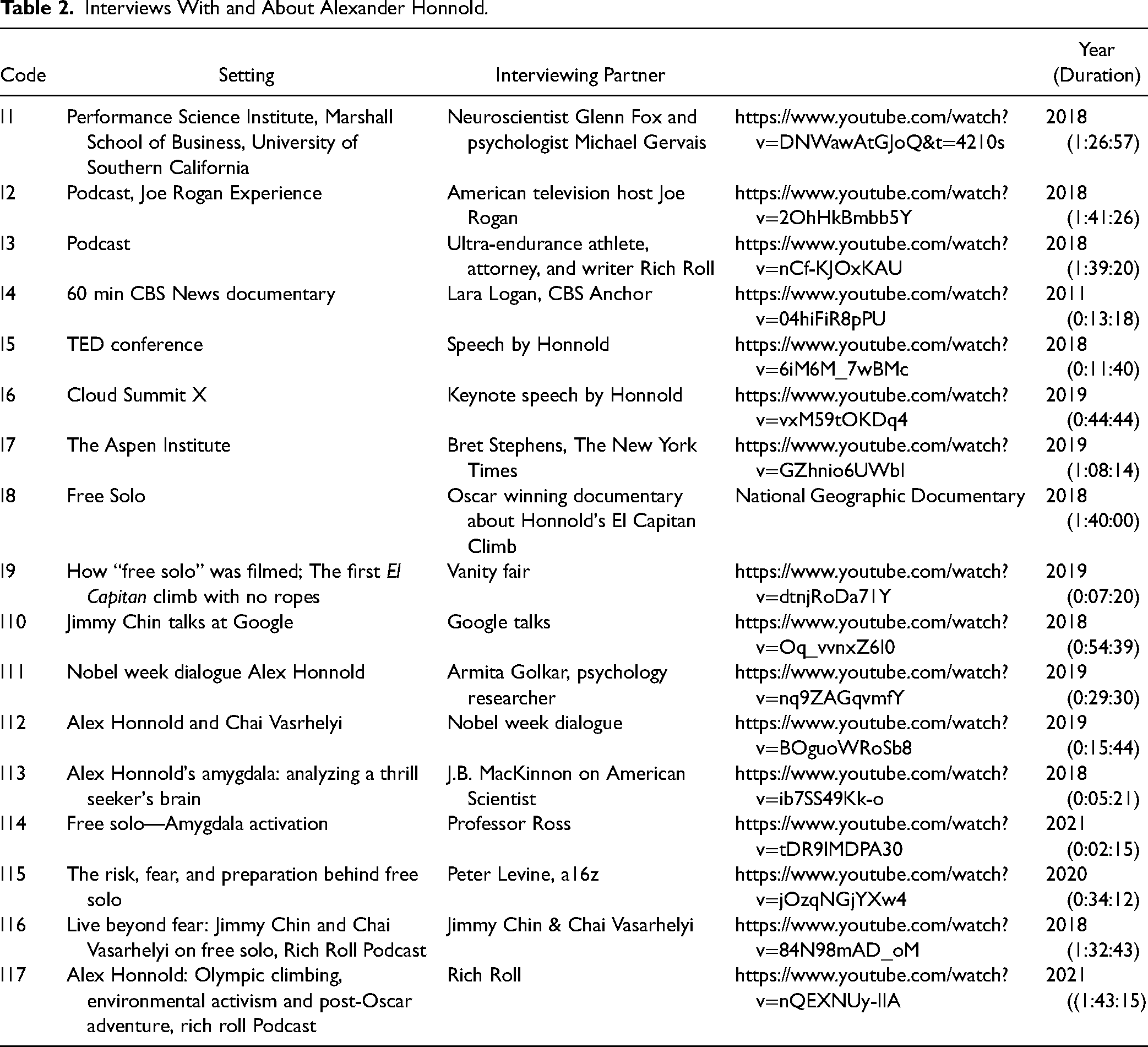
The main audio-visual material that we quoted in the findings included a range of interviews Honnold gave to academic audiences, business communities, and the press (Interviews 1–7). Our initial search included different online video material publically available on YouTube. Being freely available and accessible on the internet meant that we did not need to seek permission to use and analyze the videos that we used in our study. In accordance with ethical standards for analyzing secondary data, we acknowledged throughout our paper the ownership of all the videos we used (Tripathy, 2013). Thus, all data sources and data we used in our study are fully transparent and accessible to the reader.
In the first round, we scanned for videos under the category of “Alexander Honnold,” and “Alexander Honnold and free soloing.” Among them, as we were looking for his own words, we were able to identify a large number of key videos in which Honnold was interviewed, and/or gave speeches about his free soloing career. Amongst those videos, we searched for keywords such as “fear,” “panic,” “risk(s),” and “uncertaint(y)ies” to identify interviews and presentations in which Honnold addressed or responded to the same questions we would have asked Honnold in a personal interview with him. We found across the various videos (Interviews 1–7) interviewers asking precisely the questions that we would have wanted to ask as well, and that provided rich empirical data for our research questions (Q1–4). We also identified and used a number of video interviews (Interviews 8–17) about Honnold conducted with his friends, colleagues, and experts with which we were able to confirm many of Honnold's responses, statements, and explanations from our main video interviews (Interviews 1–7). As suggested by Brod et al. (2009), we stopped adding more videos when we agreed that there were no new perspectives on our research questions and that all aspects we wanted to explore had been covered. In preparation for the analysis, we transcribed the videos into text. This involved more than 7 hours of video, recorded between 2011 and 2020.
Data Analysis
In line with the exploratory and qualitative nature of our study, in a first step, we conducted an inductive analysis of our data. We analyzed independently all data from our sources to identify repeatedly appearing topics used to describe Honnold's free soloing approach and climbing career, and addressing our four key research questions. When we disagreed with our respective analyses, we iterated and went back to the videos to clarify our analyses until we agreed and consented to one interpretation. We coded data from the interviews manually and independently in order to understand not only the coded terms but also their context in the text. Through a cut-and-paste approach, text segments were “carved out of their context in such a way that they retain[ed] meaning” (Tesch 1992, p. 117), and then re-contextualized into appropriate themes. We identified 11 themes that emerged from the data including “why free soloing,” “goal setting,” “free solo preparation,” “uncertainty,” “fear,” “risk,” “death,” “mind and mentality,” “execution,” “threshold and readiness,” and “El Capitan.” We re-read the texts and independently re-reviewed them to double-check for consistency with the 11 themes. The analysis was done in an iterative process in order to refine and understand the different themes emerging from the data (Glaser & Strauss, 1967). In the following Table 3, we aggregated these themes into five key categories presented in random order and illustrated by quotes from our data.
Categories and Quotes.
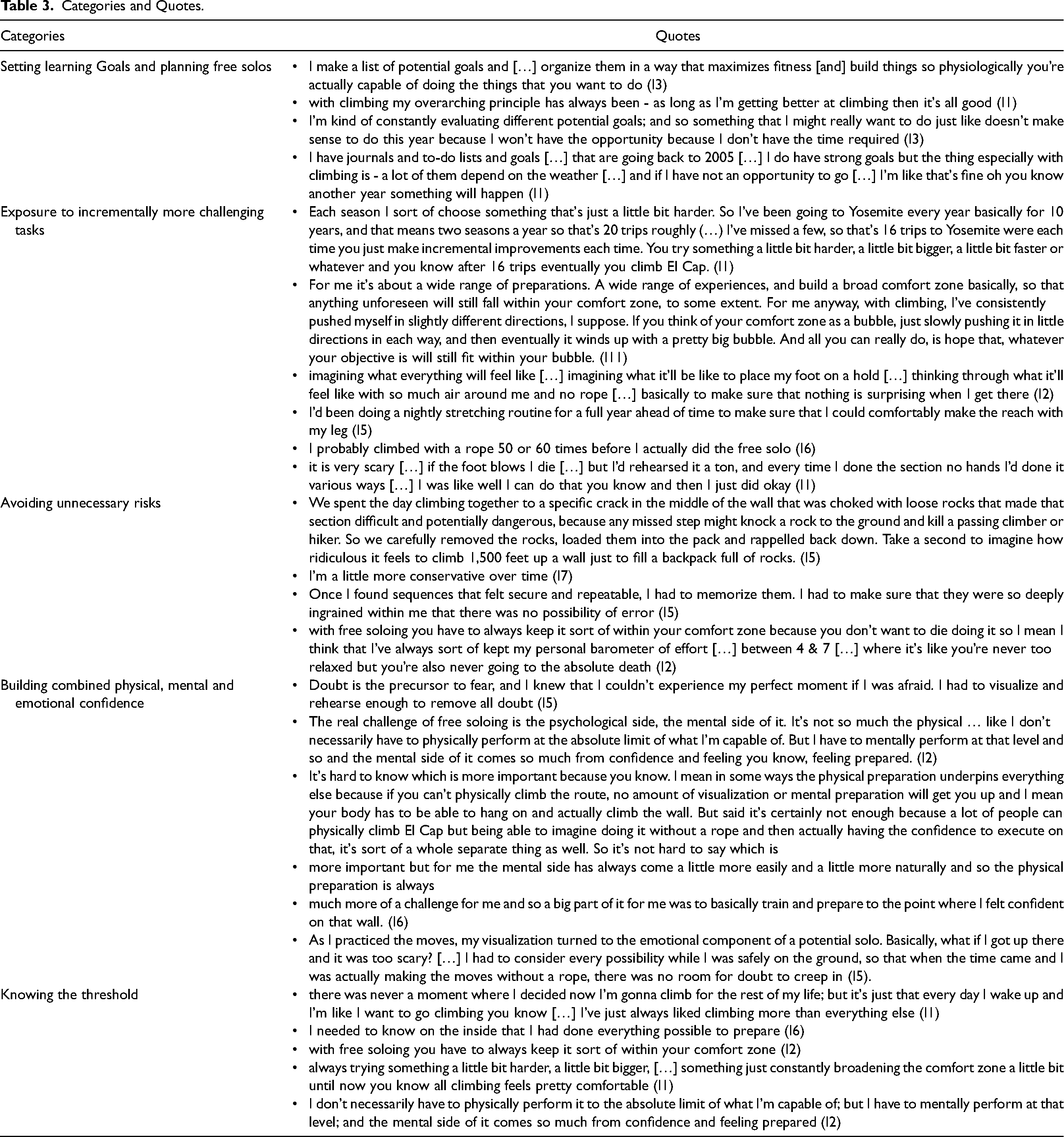
In a second step, we searched and analyzed in these 11 themes for words related to the concept of panic including fear, freezing, flight, anxiety, stress, etc. In a cut-and-paste approach, we carved out these words with their text segments and then re-contextualized them into appropriate actions. These actions built the basis for our findings section in which we present and discuss how and why Honnold does not panic in the face of severe crisis-like events and situations during his free-soloing ascents on big walls. In order to produce robust results, we re-read all the material and singled out and coded text segments with direct quotes from Honnold with those of the actions that were evoked in each text segment. We classified each text segment by the source, the date, and the action that was mentioned in the segment. The selection of text segments and their coding was done by both researchers independently; then compared and discussed to enhance the consistency of the data interpretation.
The primary benefit of using an inductive approach is to minimize any restriction from the imposed methodology by allowing research findings to emerge from the data (Fereday & Muir-Cochrane, 2006). Hence, the 11 themes emerged inductively from the analysis and were not driven by theory or previous hypothesizing. By using Alexander Honnold and his free soloing climbing ascents as our research vehicle, we immerse in actions, processes, changes, and progressions from which an aliveness and active imagery emerge that are rare in management studies, and that provides an alternative approach or perspective to study and understand managerial phenomena (Dutton, 2003; Wolfe et al., 2005).
Findings
The Becoming of a Free Soloing Climber
Born in Sacramento, California in 1985, Alexander Honnold started to climb frequently in a gym when he was around 10 years old (Honnold, I5). For the first decade, he trained mostly indoors and was considered part of the first generation of indoor climbers (Honnold, I3/I5). Learning to climb in a gym meant that Honnold had trained extensively in his technique and physical strength, developing his footwork and strong fingers before making the transition to the outdoors and the big walls in Yosemite Park, California (I3). Big wall climbers and free solo climbers before and at the time when he gradually started to free solo represented “more old school, big mountain adventure dudes” (Honnold, I3). These big wall “dudes” were often nicknamed by outsiders and their own peers dirtbags, living a nomadic and hippie-like lifestyle. For Honnold, this lifestyle “was never my scene.” For Honnold climbing was always more about performance than lifestyle (Honnold, I3). That said, Honnold considers himself physically not as gifted or as strong as many other climbing colleagues—in particular those climbers who are part of the upcoming younger generations (Honnold, I3).
Over the years, Honnold developed into a very well-respected climber within the climbing community and beyond. By 2008, he had repeated most of the existing free soloing routes in Yosemite and started to explore and develop new free solo routes in Yosemite and around the world. One of the reasons for Honnold to free solo has been the ability to climb faster, as less gear is needed for the ascent (Honnold, I1). Climbing big walls with ropes means carrying ropes of around 5 to 10 kg, wearing a harness with clips and other hardware attached, and bringing food and water. This can end up in a vicious circle by which the extra weight slows down the climber so much, that the climber needs even more gear, and food and water; and the climber ends up spending several days climbing a big wall (Honnold, I1). For big walls such as El Capitan—a vertical granite rock “wall” of about 3000 ft (900 m) from base to summit in Yosemite, being lighter means the climbing can be physically less arduous and exhausting. However, while one can climb faster and lighter, free soloing is potentially heavier on the mind. “Free soloing plays out more in the mind […], staying calm and performing at your best when you know that any mistake could mean death requires a certain kind of mindset” (Honnold, I5). In several interviews, Honnold describes this mindset as a strive for mastery (Honnold, I3), and a true control over the role fear and panic play in this mastery: With free-soloing, obviously I know that I’m in danger, but feeling fearful while I’m up there is not helping me in any way, […] It's only hindering my performance, so I just set it aside and leave it be. (Honnold, I6)
Lastly, there have also been the aspects of privacy and lack of pressure that attracted Honnold to free soloing. Free soloing “has always been so private” (Honnold, I1) without the external pressures of not being able to bail out of a project or an ascent. “The thing with soloing is that walking to the base of El Cap takes ten minutes from the road […] basically you stroll over, you look at the wall and if I decided not to do it I would stroll back in my van and go back to bed” (Honnold, I1).
Planning Free Solos
In several interviews, Honnold explains how in the early days he had been criticized by his climbing friends for “not thinking big enough.” Instead, each climbing season he had chosen free solo ascents that were “just a little bit bigger, a little bit harder, a little bit faster” than previous ascents. Setting himself goals that were learning and process-oriented allowed him to make small, but consistently incremental improvements and progress with each free solo tour (Honnold, I1, I7). For Honnold, ascending successfully El Capitan and other major big walls has been due to the decision to attempt slowly and gradually more challenging and complex free solos ascents. Honnold uses a journal in which he “meticulously” records goals, future projects, and potential ascents (Honnold, I3). He organizes this “to-do-list” in a way that maximizes his physical fitness and mental strength (Honnold, I3). In all his planning, Honnold acknowledges that much of the successful completion of a free solo tour depends on factors such as weather - which he cannot control. In cases when such factors prevent him from executing his planned free solo tour, Honnold “does not get wound up.” Instead, he moves the project to another moment (Honnold, I3). Other surprises such as loose rocks, the presence of animals and insects, or the malfunctioning of muscles or clothing can only be controlled to a certain extent. Therefore, much of Honnold's preparation was to be ready for the climbs, by physically and mentally preparing for them as much as possible, and turning some of the surprises from panic-inducing triggers into manageable situations: Years ago, when I first mentally mapped out what it would mean to free solo Freerider, there were half a dozen of pitches where I was like, ‘Oh that's a scary move and that's a really scary sequence, and that little slab, and that traverse. […] There were so many little sections where I thought ‘Ughh—cringe.’ But in the years since, I’ve pushed my comfort zone and made it bigger and bigger until these objectives that seemed totally crazy eventually fell within the realm of the possible. (Honnold in Synnott, 2018, p. 5)
Honnold started planning to free solo El Capitan in 2009, just 1 year after Honnold had successfully ascended Half Dome, another big wall in Yosemite Park. However, when I stared up [at El Capitan] in the valley, it was like oh my god, it's not happening; but then each year thereafter I’d look at it and be like oh no not this year; but I was definitely thinking about it sort of in the back of my mind all the time for years and years; and then it wasn't until sort of the year and a half before I actually did it that I started being more conscientious about it. (Honnold, I3)
It was all the free solos in those 8 years prior to his El Capitan ascent that built up his confidence and shaped his belief that he was capable of free soloing El Capitan: It had taken me that long to wrap my head around it and I wouldn't have been able to start physically preparing and actually training and memorizing holds and doing all that stuff if I didn't believe that it was possible; and it has sort of taken me eight years to believe that it was possible. (Honnold, I3)
Only once this belief and certainty was well established and matured in his mind, did Honnold start preparing concrete steps toward the free soloing of El Capitan. As outlined in the following subsection, however, the preparation for El Capitan was very different from his preparation of his early big wall-free solos.
Preparing for Uncertainties and Risk at El Capitan
As illustrated by his successful and record-speed free solo ascent in 2008 of Half Dome—another granite vertical wall in Yosemite—Honnold's preparation in the early years of free soloing was very different from his preparation thereafter. It was less rigid and planned through. In retrospect, Honnold admits: The problem, though also the allure, was that it was too big [Half Dome]. I didn't really know how to prepare for a potential free solo. So I decided to skip the preparations and just go up there and have an adventure. I figured I would rise to the occasion, which, unsurprisingly, was not the best strategy. (Honnold, I5)
In particular, in the final part of his Half Dome adventure, the lack of preparation was replaced by luck: Between the summit and me laid a blank slab of granite. There were no cracks or edges to hold on to, just small ripples of texture up a slightly less than vertical wall […]. I carefully balanced my way upward […]. But then I reached a foothold that I didn't quite trust […] I doubted that my foot would stay on if I weighted it. I considered a foot further to the side, which seemed worse. I switched my feet and tried a foot further out. It seemed equally worse. I started to panic […] My mind was racing in every direction. I knew what I had to do, but I was too afraid to do it. I just had to stand up on my right foot. And so after what felt like an eternity, I accepted what I had to do and I stood up on the right foot, and I didn't slip, and so I didn't die. (Honnold, I5)
Honnold recalls that the night after the Half Dome ascent he drew a frowny face in his climbing journal and commented “do better?” (Honnold, I5). Even though his record-speed free solo ascent of Half Dome was celebrated by the climbing community and the media as a major climbing achievement, Honnold was disappointed and dissatisfied with his performance: I knew that I had gotten away with something. I didn't want to be a lucky climber. I wanted to be a great climber. I actually took the next year or so off from free soloing, because I knew that I shouldn't make a habit of relying on luck […] I didn't achieve mastery. I was hesitant and afraid, and it wasn't the experience that I wanted. (Honnold, I5)
Therefore, after his Half Dome ascent in 2008, Honnold started to change the preparation process for his free solos to better manage and prepare for the uncertainties and risks that come with free soloing big walls such as El Capitan.
While Honnold was thinking about the possibility of free soloing El Capitan since 2009, his more focused preparation started around one and a half years prior to the actual ascent. The right physical preparation for free soloing a big wall such as El Capitan is a basic requirement or prerequisite for a successful climb. According to Honnold, “physical preparation underpins everything else because if you can't physically climb the route, no amount of visualization or mental preparation will get you up” (Honnold, I6). However, from a physical strength point of view, El Capitan and the route Honnold chose was not the most challenging ascent amongst the big walls in Yosemite Park. Amongst the 15 to 20 free climbing routes (climbs with no equipment but with a securing rope) that exist on El Capitan, Honnold chose the Freerider as his free solo tour, a route that is considered one of the easier free climbing ascents (Honnold, I7). For Honnold, all it mattered was to free solo El Capitan regardless of the climbing grade in free climbing or fully equipped mode.
Without the rope, Honnold was able to include some changes to the Freerider route, as there were no ropes or protection bolts that dictated his way up. Honnold recalls his first preparatory climbs with a rope: I started broadening my search quite a bit and swinging out far to the side of where you would normally climb with the rope […] I started searching with a much broader eye swinging all over the wall looking for other variations […] finding a couple of ways to go around sections of the normal route that I felt safer doing. (Honnold, I7)
According to Honnold, the route he chose could be broken down into one-third of the ascent being relatively easy, one-third moderate, and one-third very hard (Honnold, I3). The latter part included the “Boulder problem,” requiring the hardest physical moves of the route (Honnold, I5). This climbing challenge is at around 600 m above the ground. The moves included long pulls between handholds with edges smaller than the width of a pencil and facing downward; followed by a karate kick of the left foot to secure support to the inside of an adjacent corner. According to Honnold, this karate kick was a maneuver that required a high degree of precision and flexibility, enough so that I’d been doing a nightly stretching routine for a full year ahead of time to make sure that I could comfortably make the reach with my leg. (Honnold, I5)
During the preparation period, Honnold climbed El Capitan with a rope approximately 50 to 60 times (Honnold, I6). He rehearsed every move hundreds of times. He tried out many moves in different ways, and he only ticked off a move when he felt that the move could be perfectly executed (Honnold, I1). During his preparation climbs, he took notes and pictures with his phone of holes and key places to help him remembering and memorizing them later (I6). In interviews, he recalls how he knew all the holes on the ascent—in particular those that mattered on the more difficult sections (Honnold I3). He also marked certain key holes with chalk to find them easier during the actual ascent (Honnold, I1). Throughout the climbs, he cleaned numerous holes and grips with a brush. With his friend Conrad Anker, Honnold removed loose rocks in the middle section (Honnold, I3). With the practice climbs, the physical strength training, and the preparation of the route “it felt more and more comfortable” (Honnold I6). However, despite feeling physically comfortable and prepared, for Honnold, it was still another level to be mentally ready for executing the ascent without a rope (Honnold, I2). In his mental preparation, however, meditation and mindfulness techniques did not play a role (Honnold, I3). Instead, Honnold focused often on visualizing the routes by: letting my mind wander […] and just sort of think my way through certain sequences or all imagining what it’ll feel like […] but I mean a lot of it is just daydreaming you know; thinking about how happy you’ll be when you grab the final hold of a hard sequence; or like how amazing it’ll be to get onto the summit; or conversely thinking about how terrible it would be to blow the left foot and slip off the last move and fall from 2,500 feet [762m]. (Honnold, I3)
In one interview, Honnold estimated that when thinking about all of what could go right or wrong, his focus on positive aspects is between 60% to 70% and 20% to 30% of the time he thinks about negative aspects (Honnold, I1). Much of his visualization was of an informal, unstructured nature, and not planned. Instead, the thoughts and images came often spontaneously in moments of resting and in his spare time (Honnold, I2): what I need is a lot of free time where I am cutting vegetables for my dinner and then I start to think about a certain section of the route and then I’m able to just sit down and think about it for five or ten minutes and then sort of remember that I’m supposed to be cutting vegetables and go back to what I was doing. (Honnold, I6)
Ensuring that he would get enough “empty time” and “open space” in the preparation process, Honnold stopped emailing and erased his social media accounts (Honnold, I2, I6). Freeing up time was an important means to him to “just sit around and think about things […] I could process like in my own terms, in my own time” (Honnold, I2).
Managing Fears
For Honnold “fear is like a good friend; if the fear is still around, you know it is too early to free solo a route” (Klingenhöfer, 2019, p.2). In Honnold's visualizations, emotions such as fear played an equally important role in actions and events, and their consequences: I sort of imagine what everything will feel like; imagining what it’ll be like to place my foot on a hold […] thinking through what it’ll feel like with so much air around me and no rope you know just that basically to make sure that nothing is surprising when I get there. (Honnold, I2)
Visualization was about feeling the texture of each hold in my hand and imagining the sensation of my leg reaching out and placing my foot just so. I’d imagine it all like a choreographed dance thousands of feet up. (Honnold, I5)
The visualizing of feelings such as being scared or fearful was particularly important in his mental preparation. Imagining and addressing these fears in his rehearsals and preparatory climbs helped him to eliminate all doubts: Basically, what if I got up there and it was too scary? What if I was too tired? What if I couldn't quite make the kick? I had to consider every possibility while I was safely on the ground, so that when the time came and I was actually making the moves without a rope, there was no room for doubt to creep in. Doubt is the precursor to fear, and I knew that I couldn't experience my perfect moment if I was afraid. I had to visualize and rehearse enough to remove all doubt. (Honnold, I5)
Honnold understood early on in his free soloing career the importance of being beyond any doubt. During the ascent of Moonlight Buttress in 2008—Honnold's first free solo of a major big wall route—he recalls how “I was 100 percent certain I would not fall off and that certainty is what kept me from falling off” (Honnold, I4). Honnold's mental certainty is the bedrock for his focus during free solos. In particular, in very difficult sections of an ascent Honnold focuses solely on the moment and his next move (Klingenhöfer, 2019). Honnold described this state of climbing as being on autopilot, whereby his moves are executed slowly and controlled (Honnold, I2, I3).
Knowing the Threshold and When It Is Time to Free Solo El Capitan
As outlined earlier, during each climbing season, Honnold chose free climbing routes and free solo ascents that would allow him to make small but consistently incremental improvements and progress at each tour (Honnold, I1, I7): I spent more time intentionally going out and climbing lots and lots of routes […] some without a rope, some with a rope, like all different combinations; but always trying something a little bit harder, a little bit bigger, a little bit you know, something just constantly broadening the comfort zone a little bit until climbing it feels pretty comfortable. (Honnold, I1)
His focus hereby had been on slowly and gradually moving to more challenging and complex ascents. While keeping some elements of difficulty constant or even easier in his climbs, he pushed himself out of his comfort zone during other challenges; for example, climbing during hot parts of the day, or with cameramen around him, or in any other new condition that could widen his skillset in varied conditions. Using a daily journal in which he recorded not only goals and future projects, but also reflected and described his previous climbing experiences allowed him to identify weaknesses and areas for improvement (Honnold, I3). Honnold's awareness and acknowledgment of the importance of external factors such as weather conditions, and their impact on the success or failure of a route added to his critical self-reflection that was the basis for his improvements and development as a free soloist (Honnold, I3). One early morning in the fall of 2016, Honnold started his free solo attempt at El Capitan. About 275m up on the wall, however, he was stuck in a foothold, and doubt took over. He decided to stop, took a rope from the filming crew, and rappelled down. It was pretty cold and I didn't trust my feet because I couldn't feel my toes well. I got up to a certain position, got scared, and started cheating, by pulling on the protection bolts with my fingers. Part of that was because my foot was still swollen from an ankle injury and conditions weren't quite perfect. But basically I just wasn't ready yet. (Honnold in Ray, 2019, p. 6)
From this moment, Honnold had to wait until the next climbing season in 2017, and in preparation, he climbed many other routes, kept his physique, climbed back to the point where had stumbled in the fall of 2016, and kept mentally preparing for the final ascent. On the morning of June 3, 2017, Honnold knew that he was finally ready as all the work and preparation was done: “I just knew I was ready, my shoes were perfectly broken in, my skin was good, I was confident I had just worked on everything” (Honnold, I3). Honnold not only felt ready physically but also mentally. Many uncertainties had been turned into more predictable or “knowable” situations and any imperfections would be inside a zone that he would be able to deal with confidence. The morning of the ascent I didn't feel, you know, particularly great. Like I was kind of tired […], which is fine because I was still very, very fit, and I was still ready […]. But that morning, it was like a little bit overcast, a little bit cloudy, so it stayed sort of humid and warmer during the night. So when I started climbing, it felt really muggy and warm and like I was hoping that it would be clear and crisp and right and cool morning, yeah. But um but, it just wasn't and so part of me is like: oh these aren't perfect conditions. But I’m like: who cares, you know, because like I’ve climbed on the route in so many different conditions, I was like: it can be 10 degrees warmer, it can be slightly more humid, like it doesn't that doesn't matter. […] I mean part of me just knew that if I wait another week, it was in June 3rd when I did it, and so the temperatures are only getting hotter right and the season was kind of winding down and uh and I mean I just knew I was ready. (Honnold, I1)
He started the climb and finished it without experiencing fear or panic at any moment. In his own words, “it didn't feel scary at all. It felt as comfortable and natural as a walk in the park” (Honnold, I5). While the world marveled over the achievement, Honnold felt mostly satisfied that he had been able to do so, while having able to eliminate fear and panic.
Discussion
Our findings of Honnold's free soloing El Capitan outline how the notion of mastering, i.e., the physical, mental and emotional preparedness is the key element that makes Honnold respond to avoid panic in a context that is characterized by great uncertainty and risks—as illustrated in Figure 1 below.
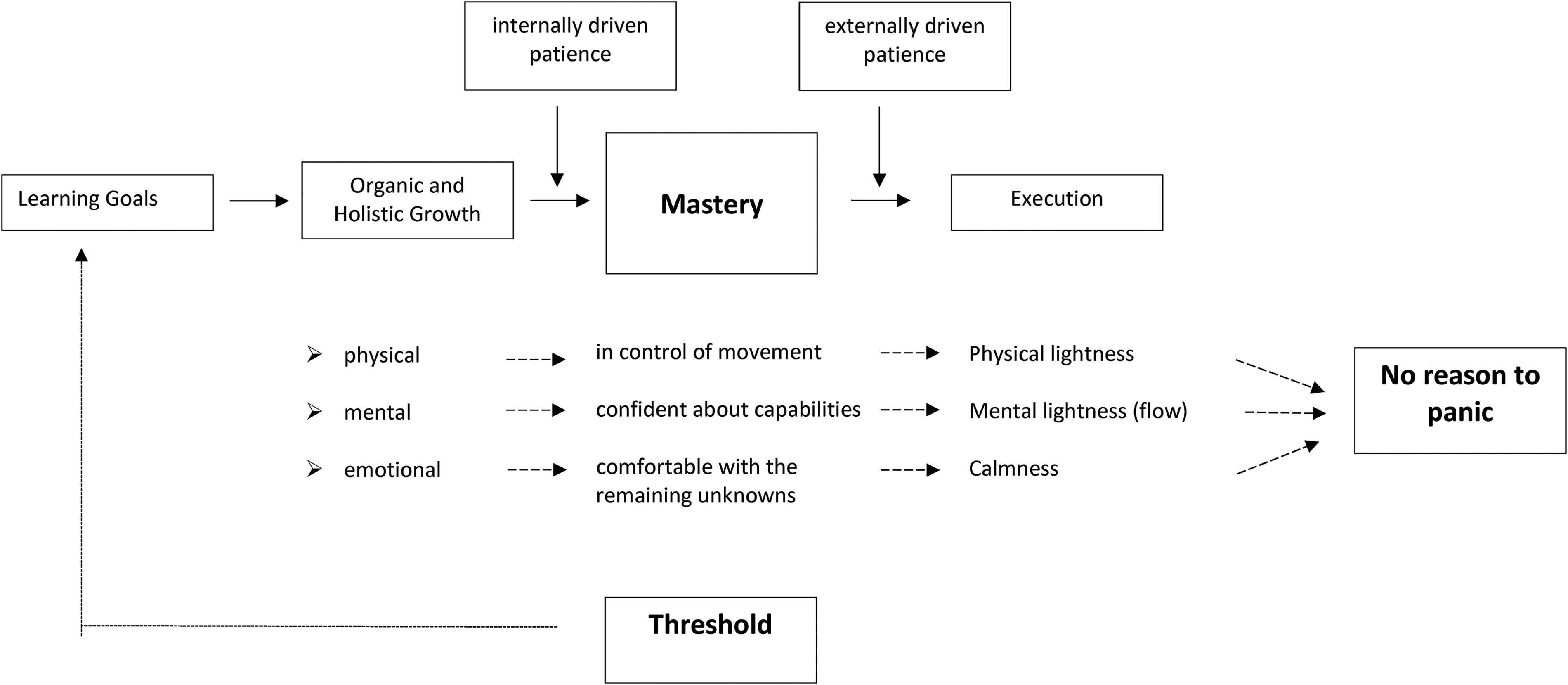
A path to avoid panic.
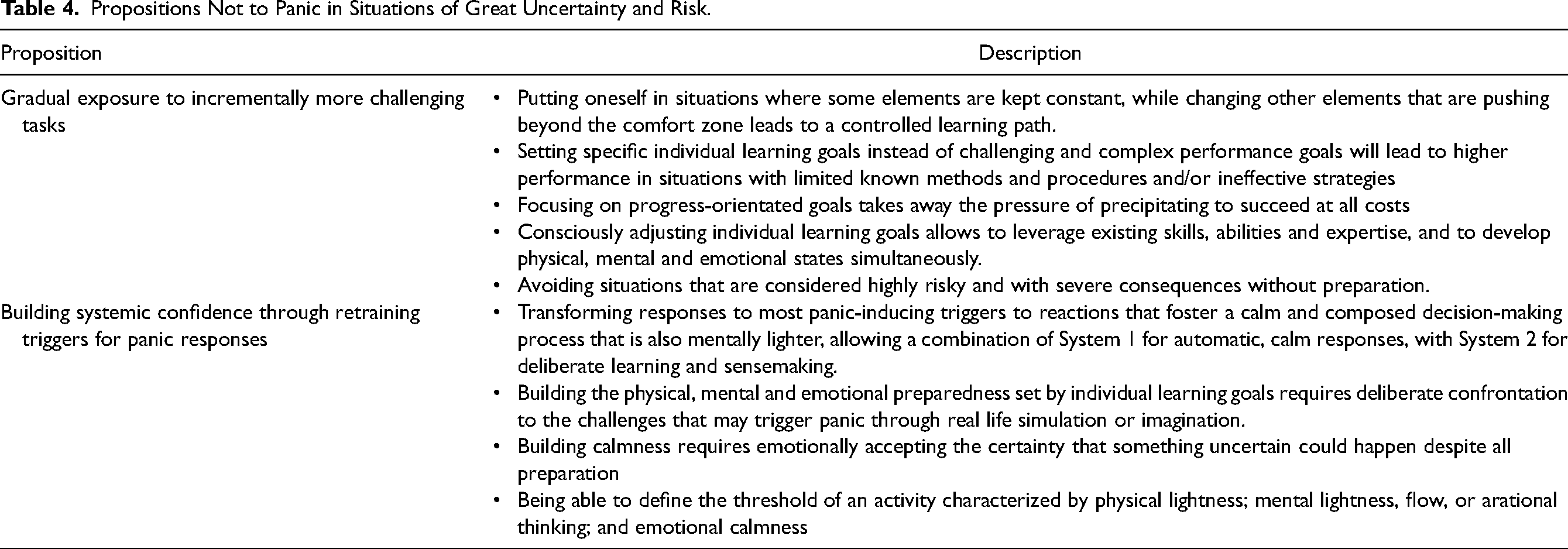
This mastery is achieved by working with individual learning goals. As illustrated in the case of Honnold, the continuous adjustment of such learning goals allows for developing both organically and holistically (Seijts & Latham, 2005). Organic and holistic growth are the cornerstones of our propositions to avoid panic in situations of great uncertainty and risk. The following Table 4 provides an overview of our propositions that are discussed in more detail throughout this section.
Propositions Not to Panic in Situations of Great Uncertainty and Risk.
Organic Growth: Gradual Exposure to Incrementally More Challenging Tasks
A first element to highlight is Honnold's prudence and vigilance in not getting into severe crisis-like situations in the first place. In contrast to the leaders and decision-makers who assume that they can control and tame their environment (Liu & De Rond, 2016; Taleb, 2007), Honnold accepted the continuously changing environmental challenges he faced in his climbing projects (e.g., weather conditions), and adapted accordingly. This adaptability and flexibility were driven by gradually exposing himself to incrementally more challenging tasks.
He set himself individual goals that were learning and process-oriented, and that built on each other gradually and organically to achieve mastery and build confidence. While traditionally motivational theorists have argued that highly challenging and stretching individual performance goals act as anchors for professional development and personal growth (Schweitzer et al., 2004), Honnold was hesitant to rely solely on such grand performance goals and was even criticized by externals for such an attitude. In contrast to managers who panic because they are overwhelmed by trying to achieve their performance objectives at all costs (Dyson & ‘t Hart, 2013; Goodson et al., 2020), Honnold's focus on individual learning goals helped him to develop gradually and progressively and prepared him better for the uncertainties and risks that come with his climbing projects (Seijts & Latham, 2005).
In addition to being gradual, Honnold's learning was also very methodical. Using his journal, Honnold was greatly attentive to every detail in the preparation and execution of his free solos, describing and evaluating every ascent, and making adjustments to be implemented in the next climb. Such a constant interplay of activities, feedback, reflections, and adjustments that encourages and fosters flexibility and adaptability simultaneously trains arational and pragmatic decision-making found by scholars in leaders’ successful responses to crisis-like situations that have catastrophic potential (Lodge & Boin, 2013; Ansell & Boin, 2019).
The methodical and gradual learning also helped Honnold not to make success and failure an obsession during the learning journey. This took away the pressure on Honnold of having to achieve performance goals or meet the expectations set by others, and let him approach his growth with patience. In the business world, Honnold's “no big deal” attitude toward success and failure could easily be misinterpreted by managers as not caring to succeed or lacking ambition. Wanting to prove those managers wrong often means pushing one's limits too far, taking risks that may result in creating the very panic situations that diminish the chances of achieving ambitious objectives at all costs. Such responses or reactions are a set-up for failure (Manzoni & Barsoux, 1998).
It could be argued, that because of the “heavy” gradual and methodical approach in the preparation that Honnold can become “light” during the execution of an ascent. When executing a free solo ascent, Honnold detaches himself from everything—literally speaking. Everything is reduced to the movement of his body. He focuses solely on the moment and his next move (Klingenhöfer, 2019). According to Weick and Putnam (2006), this reluctance to complexify and conceptualize allows for greater clarity, lightness, and calmness of the mind. Such a psychological state of flowing allows for the flexibility, adaptability, and improvisation needed when “figuring out what must be done while figuring out what is possible to do” (Ansell & Boin, 2019, p. 1093). Automate behaviors and high alertness can co-exist and synergize for individuals to be able to merge action and awareness in critical moments of uncertainty and potential panic (Csikszentmihalyi, 1990; Kotler & Wheal, 2017).
Holistic Growth: Confronting and Retraining Responses to Physical, Mental, and Emotional Triggers for Panic Responses
An important starting point of Honnold's confidence mentioned above is his feeling of physical preparedness. For him, there is no doubt that, in order to feel confident, one must first be able to physically do the climb. Much of his confidence in his free solo climbs comes from first climbing a route safely with ropes annulling the sense of urgency. Honnold's preparedness for El Capitan meant having minimized all eventualities and uncertainties while accepting the certainty that something uncertain could happen. Enacting potential crises and training “what if” crisis-like scenarios allowed for emergent learning and creative problem-solving, and the development of skill sets “that can be useful in responding to novel and uncertain situations” (Ansell & Boin, 2019, p. 1096).
Once physical confidence is achieved, a lot of work goes into the mental preparation and the deliberate mental confrontation of panic-inducing situations. In line with scholars studying dual process or dual system models in regards to thinking and decision-making processes (Kahneman, 2011; Kownatzki et al., 2013; Stalk, 1998), this suggests establishing new interactions of Honnold's System 1 and System 2 cognitive processes. System 1 cognitive processes reveal “a routine stimulus that requires no action or for which a satisfactory response is readily available.” As a result, System 1 is largely affect-driven and characterized by rapid and automatic responses (Dyson & ‘t Hart, 2013, p.405). System 2 cognitive processes, on the contrary, are energy-consuming, deliberate, and active thinking, among others to address stimuli for which no satisfactory response is readily available. While for most people that would face situations experienced by Alex Honnold as full of triggers that are far from routine, requiring them to switch to the energy-consuming System 2 of thinking, Honnold can climb “lighter” as even the surprises fall in the space that can be covered by System 1. Once Honnold faces an unforeseen, crisis-like situation that could have severe consequences for him, and that does fall out of routine decision-making, he can still rely on the more deliberate, but also more energy-consuming System 2. This was the case in his first attempt to free solo El Capitan, when he was suddenly scared about a particular move with one of his feet that was previously injured. He was able to take his time to deliberate on the situation, draw upon his experience and his understanding of how any sense of fear could have serious implications for the continuation of his ascent, and then take the (for a climber unusual) decision to turn back down. When it comes to crisis-like situations with severe consequences and of great urgency, scholars of the dual system would argue that Honnold has already transformed the responses to most panic-inducing triggers to reactions that foster a calm and composed decision-making process that is also mentally lighter. This allows a combination of System 1 for automatic, calm responses, with System 2 for deliberate learning and sensemaking (Dyson & ‘t Hart, 2013).
Managerial Implications
Our analysis of Honnold's approach to dealing with potentially fatal risks and uncertainties offers some valuable lessons for individuals facing similar situations, whether it be in private, public, professional, or any other setting. A first lesson is that, even though the general public tends to see people like Alex Honnold as reckless risk seekers, the majority of his time is spent eliminating risk and potential uncertainties, or turning them into envisioned optionality. Alex Honnold's ability to face life-threatening situations is not an inborn state, but the result of disciplined practice and preparation. Throughout the practice journey, he does face situations that do not feel comfortable and the trial-and-error that comes with such experiences makes him stronger each time. The aspiration, which seemed daunting at first, is cut into smaller parts, with explicit milestones that make the learning process manageable and less overwhelming. When he finally faced the situation that otherwise would have potentially lead him to experience crisis and panic (as he did when first climbing Half Dome), it was a long path of trial-and-error, mental and physical preparation, that made him ascend El Capitan with calm and confidence. For people in organizations facing crisis-like situations, this means that getting the ability to avoid panic can be learned through practice. Even though the uncertainty does not fully go away, the stimuli crisis-like situations generate are no longer triggers for panic; they rather become a set of decisions and reactions that can be executed with calm and confidence. Taking time to identify specific action points and milestones as to how to acquire the ability needed to respond effectively in crises, and then practicing to achieve these intermediary goals is the way to avoid panic in such situations. Specific crisis training is not what Honnold would consider optional; for him, it is a must. If it is a must to him, then why wouldn't it be for decision-makers in crisis situations?
While organizational theorists have highlighted how high-risk or reliability organizations such as nuclear power plants and aircraft-carrier flight decks frequently simulate and train crisis-like situations and scenarios (Schulman, 1993; Weick & Roberts, 1993), we rarely hear about such activities at an individual level amongst company leaders and decision-makers (Barling & Cloutier, 2016; Goldman, 2006; King et al. 2016; Lovelace et al., 2007). Consequently, they lack either the physical and/or psychological preparedness, and/or the emotional maturity to know their limitations and limits, so that they do not panic in situations of great uncertainty and risk. Using Weick's terminology, these decision-makers and leaders fail to “imagine” situations of great uncertainty (Weick, 2005). Regardless of whether this failure of imagining is due to a lack of ability or willingness, Weick's examples of such failures (e.g., 9/11, NASA's second shuttle disaster) show how their consequences can be as brutal as for any climber not imagining for a free solo.
A second important element is that the simultaneous pursuit of physical and mental comfort in new and uncertain situations is a pursuit of its own for Honnold. It is the sense of mastery as he calls it himself, that subsequently turns into the necessary self-confidence that he falls back on when new and uncertain situations present themselves to him. This mastery is very much how he sees his role as a professional climber; almost as something that is intrinsically “part of the job.” For Honnold, the antidote to panic is the self-confidence that comes with such mastery. Interestingly, the mastery is the manifestation of humility, and not a replacement for it. The mastery is not to be a result of self-encouragement or hubris. Instead, it is the consequence of having physically or mentally faced such a wide variety of challenges during his preparation that the occurrence of an uncertain event would fall within the scope of skills and mindset needed to “rise to the occasion”—as Honnold calls it. It is precisely for this reason that he forces himself to be in new and uncertain situations, and to train himself in advance. Humility is the starting point of his learning, and instead of resting on his laurels, he searches for gaps in his skills to build mastery. The self-confidence is also specific to the challenge at hand, and not self-confidence in general. As Honnold himself has suggested, he would be terrified to sing in public, and he used to feel very uncomfortable speaking in public. Both, in public speaking as well as preparing for free-solo climbs, self-confidence only came with practice. Managers aiming to achieve mastery should therefore assume that, by default, there is still a lot to learn. Even a decade of experience in a stable market environment can still be useless when markets turn sour. Keeping this humility as a starting point for learning, and a proactive search to learn skills useful in crisis-like situations is therefore important. For example, with a looming downturn mid-2022, several seasoned investors warn their younger colleagues that they may not be ready for what's to come: “If you are under 34 years old, you have never invested in your career in a rising rate environment or a down market environment. […] You’ve worked for me for 10 years and I still don't know if you are a good investor” (Gara et al., 2022). For managers looking to avoid panic in uncertain situations, it is important to create the conditions that can lead to self-confidence ex-ante, just for the sake of being a good and prepared manager. Using simulations of crises, cases, deliberate imaginations (“what if” scenario-planning), discussions with people that have faced crisis-like situations, and sensemaking from actual practice can prepare decision-makers for such situations.
A third element is the attention Alex Honnold pays to the holistic combination of physical, mental, and emotional preparation. As he says himself, overcoming the physical difficulty of free solo climbing is not any different from the practice and preparation that many professional athletes go through. What sets apart the extreme sports of the free-solo climbing type kind is precisely the necessity to be able to face potentially life-threatening situations. Deliberately imagining both the positive and negative emotions that can potentially pop up during climbing, and how to deal with them is an explicit part of his preparation in addition to the physical preparation. While the literature emphasizes mindfulness when in high-risk situations, panic can inhibit the very mindful responses needed to respond effectively to such situations. What our analysis of Alex Honnold shows is that mindfulness at the moment requires mental and emotional preparation and training before the actual occurrence of such events. It is only then that panic is avoided and that mindful response can be developed. During the execution of the activity, the mastery of these states translates into physical lightness; mental lightness, flow, or arational thinking; and emotional calmness. These elements allowed Honnold to ascend El Capitain in a smooth and perfectly executed sequence of moments, making the climb almost like a walk in the park. These elements can also provide the basis for decision-makers and leaders to face crisis situations without panic.
Conclusions
The last 2 decades have produced numerous highly disruptive global events including the dot-com bubble in 2000, the financial crisis in 2008, and the COVID-19 pandemic in 2020. These events and the handling and responses by company leaders and decision-makers have illustrated how unprepared they have been for the uncertainties and risks with which they were confronted (Ansell & Boin, 2019). Studying the world's leading extreme rock climber Alexander Honnold and his free soloing ascents has allowed us to develop and propose approaches that decision-makers can apply in their workplace to help to avoid panic when confronted with highly uncertain and risky situations and events characterized by serious or severe consequences.
With our propositions for decision-makers to avoid panic when in such severe crisis-like situations, we have contributed to crisis management research and extended scholarly works of extreme contexts that are limited to coping and avoidance strategies and practices. A review of the scholarly and consulting works about the lessons learnt from the financial crisis in 2008 and the pandemic that started in 2019 indicates that propositions by and for business leaders and decision-makers are large of an organizational, technical, and process oriented nature. Business leaders are advised to be more open and transparent in crises, focus more on adapting and communicating strategy alignments, protect the culture and foster a shared purpose, put in place stronger resilience plans, revise supply chains, and “keep faith with the future” (Bryce et al., 2020; Carey et al., 2009, p. 4; Wilson, 2020). Our framework shows that avoiding panic through mastering different states and building confidence is an individual learning process. While decision-makers and company leaders cannot know about all unknowns, they can learn to react to these unknowns without panic.
Footnotes
Declaration of Conflicting Interests
The author(s) declared no potential conflicts of interest with respect to the research, authorship, and/or publication of this article.
Funding
The author(s) received no financial support for the research, authorship, and/or publication of this article.
