




Abstract
Emerging economies are often characterized by pervasive institutional changes and resultant institutional voids. In the absence of strong formal institutions, firms rely on informal institutions to fill these voids. This article argues that the process of sensemaking for firms in turbulent environments is continuous and dependent on cyclical adjustments connecting performance via a feedback loop to scanning and interpretation. Far from being a one-time occurrence, environmental sensemaking is a process operating in accord with continuous environmental changes. This study’s findings derive from an in-depth analysis of a Russian pharmaceutical firm and an Indian telecommunications firm, and demonstrate that entrepreneurs make sense and gain legitimacy through political connections. The study further finds that improvements in institutional environments reduce the salience of political networks, thereby creating a choice for firms to rely on formed market mechanisms or continue along the path of political connections that evolve to public–private partnerships.
Keywords
Introduction
The fast-paced integration of emerging countries into global trade creates the need for continuous institutional adjustments. These institutional changes can create organizational maladjustment—a tension that pushes organizations to reestablish congruence with the new environment (May, Stewart, & Sweo, 2000; Sheng, 2017). Organizational fit in the environment is dependent on strategic sensemaking (Thomas, Clark, & Gioia, 1993), entailing measures of scanning, interpretation, action, and performance. This process allows organizations to adapt and gain competitive advantage in the midst of upheaval and high-entry barriers (Nigam & Ocasio, 2010; Sheng, 2017), thereby reestablishing the equilibrium of organizational legitimacy in the environment.
The purpose of this article is to explore the mechanics behind strategic sensemaking in emerging markets through analysis of firms in Russia and India, which has been overlooked in previous literature. Unlike previous cross-sectional studies of strategic sensemaking that offer single-level analyses of sensemaking processes (Kennedy, 2008; Sheng, 2017; Thomas et al., 1993), we aim to demonstrate the perpetual nature of sensemaking through a detailed analysis of firms in continuously developing institutional environments. Furthermore, we argue that political networking plays an important role in strategic sensemaking in countries with higher uncertainties in the environment. However, as institutions develop, the need for and legitimacy of political connections dissipate, thus forcing adjustments in sensemaking processes that persist through the continuous developments in the business environment.
Literature on emerging markets and strategies abounds; however, the informality of institutions, networks, and practices is an under-researched area (Narooz & Child, 2017). Researchers encounter methodological barriers, including the need to manage the unwelcoming attitudes of respondents and pressures to work across different disciplines, when conducting research in emerging markets. Furthermore, it is challenging to integrate these informalities into disciplinary research, as well as gather and present inconvenient facts about politics, business, economy, and society (Ledeneva, 2012; Michailova & Liuhto, 2000). Moreover, the absence of and inconsistencies in data, and extreme difficulty in gaining access to organizations in emerging economies, contribute further to preventing a thorough investigation (Alexander & Smith, 2018; Hoskisson, Eden, Lau, & Wright, 2000). Nonetheless, we attempt to provide in-depth detail of the mechanics of organizational sensemaking and political connections of a Russian pharmaceutical firm and an Indian telecommunications corporation to demonstrate their paths of achieving competitiveness.
Strategic Sensemaking and Political Connections
Strategic Sensemaking and Dynamic Environments
Sensemaking in business studies is associated with Karl Weick’s (1995) book on sensemaking in organizations, based on earlier research in this field (e.g., Daft & Weick, 1984; Weick, 1979, 1993). Sensemaking is the creation of situational awareness and understanding in conditions of high complexity or uncertainty to make decisions (Maitlis & Christianson, 2014; Sheng, 2017; Snowden, 2008). Sensemaking is focused on two main questions: “what’s the story here?” and “now what should I do?” (Weick, Sutcliffe, & Obstfeld, 2005). There are three broad levels of analysis: the individual level, which explores intersubjective processes among actors; the organizational subsystem level of generic subjectivity of typified actors and actions; and the macro analysis level, which explores isomorphism within an institutional environment (Blegind Jensen, Kjærgaard, & Svejvig, 2009; Maitlis & Christianson, 2014). This study is oriented toward discussion of the latter-explored macro-level sensemaking processes (see, for example, Kennedy, 2008; Klein, Wiggins, & Dominguez, 2010; Sheng, 2017; Thomas et al., 1993) that relate to organizational-level strategic choices rather than the initially developed individual-level sensemaking (Weick, 1988, 1995). The same way individuals make sense of new or changed environments through established processes, organizations also must adjust to new or changed environments, whether these are due to entering a market for the first time or institutional upheaval (Newman, 2000).
Although studying organizational performance, Thomas et al. (1993) highlighted the lack of empirical research into macro-discipline sensemaking and its strategic implications. Since then, notable papers on macro sensemaking have included a study of health care sector reforms through the process of sensemaking (Nigam & Ocasio, 2010), the formation of new markets around new institutional forms (Kennedy, 2008), the convergence of public programs at the national level, followed by divergence at the local level (Persson, 2013), and the ways multinational enterprise (MNE) subsidiaries engage in identity construction and institutional building (Clark & Geppert, 2011). Mouzas, Henneberg, and Naudé (2008) used the network perspective to demonstrate that network insight can lead to competitive advantage within a business network, as well as for the business network itself. Klein et al. (2010) demonstrated that organizational sensemaking is a far more complex process than individual sensemaking because it poses additional coordination requirements and offers additional ways for sensemaking to break down. More recently, Sheng (2017) demonstrated that organizational sensemaking (macro or strategic, hereon referred to sensemaking) and combinative capabilities together form dynamic capabilities responsible for innovative competitiveness. However, there are two major weaknesses in the literature on strategic sensemaking—first, the literature is sparse, and second, the literature fails to thoroughly investigate and consolidate the sensemaking processes. We argue that it is not only individuals and groups that engage in sensemaking processes, but rather, organizations are also guided by management to make sense of dynamic environments, which is reflected in strategic choices. This is especially pertinent in developing countries where the environment is prone to institutional voids (McCarthy & Puffer, 2016; Palepu & Khanna, 1998).
This article attempts to develop the literature on sensemaking in emerging markets by empirically demonstrating that sensemaking requires political connections for optimal firm performance in emerging economies. To best empirically demonstrate the effects of political connections on the strategic sensemaking processes of organizations in highly dynamic environments, we adapted the behavior of firms in line with the model proposed by Thomas et al. (1993) on strategic sensemaking. Building on the works of Gioia and Chittipeddi (1991), Milliken (1990), and Weick (1979), this model depicts four steps that organizations adopt in making sense of the environment: scanning, interpretation, action, and performance. Scanning involves a search for information in the external environment to identify important factors that might affect the organization—that is, gathering relevant information. Interpretation involves attending to and ascribing meaningful labels to the gathered information. The goal is to devise ways to use the information for understanding and action. The process of action involves using the gathered and interpreted information to make significant alterations to organizational practices. Finally, performance involves assessing the effectiveness of the scanning, interpretation, and actions taken (Hindle, Klyver, & Jennings, 2009; Thomas et al., 1993). Does this theory stand in the context of emerging markets, where institutional imperfections are rife and the business environment is prone to dramatic changes? This question is relevant because the dynamism of institutional changes is ever increasing, and the prominence of developing markets can no longer be ignored (Doh, Rodrigues, & Saka-Helmhout, 2017).
Developing Institutional Environments and Political Networking
Supporting institutions underpinning emerging markets are often unstable and underdeveloped compared with the strong institutional frameworks that guide markets in the developed world (Ahlstrom & Bruton, 2010; Luo & Zhang, 2016). The high economic and political uncertainty, lack of skilled talent pools, and general lack of functioning institutions pose challenges for firms in undertaking productive activities in these markets, otherwise known as institutional voids (Khanna & Palepu, 2006; Khoury & Prasad, 2016). The lack of normative institutions—such as established industry norms, business practices, technological standards, and industrial code of practices—can also impose powerful constraints on the strategic decision making of firms from emerging markets (Puffer & McCarthy, 2007). During the process of sweeping restructuration, when formal institutions, such as the regulatory framework, are developing, firms rely on cognitive behavior to make sense of the new and changing environment (Estrin & Prevezer, 2011).
Studies on developing country firms have tended to dwell primarily on the way in which institutional voids govern firms in adopting a network-based strategic approach. This perspective is popular in analyzing the development of firms in transition economies because of the lack of formal institutions that facilitate firm growth and shared access to tangible and intangible assets, among others (Danis, Chiaburu, & Lyles, 2009; Puffer & McCarthy, 2007).
Although political networking substitutes for formal regulatory structures and enhances competitive advantage, efficiency, and performance (Govorun, Marques, & Pyle, 2016; Peng & Luo, 2000), those firms that face the drawbacks of newness and unconnectedness, as well as outsiders, have significant difficulties competing with connected firms (Luo, 1997; Oezcan & Guenduez, 2015). The seemingly advantageous effects of political networking expand into gaining insider information, opening up resources that are otherwise unavailable, and increasing opportunity recognition (Gu, Hung, & Tse, 2008). An investigation into the innovativeness of emerging market firms by Kotabe, Jiang, and Murray (2017) indicated that political networking helps overcome resource constraints and organizational disadvantages in innovation. In sum, connections with all levels of government are necessary to gain critical resources and increase firm value (Ahlstrom, Bruton, & Liu, 2000; Faccio, 2006).
As shown above, the literature on emerging markets has tended to highlight the prevalence of political networking and the access to resources that these connections provide. This article explores firm behavior during the phases of institutional building in relation to the role of political networking. We demonstrate the ways in which political connections greatly enhance sensemaking mechanisms and provide competitiveness for firms that are deeply linked to the government.
Research Methodology
Research Design
Because of the lack of pertinent empirical research on firms in emerging markets and their political connections, we adopted grounded theory methodology (Glaser & Strauss, 1967). The investigation used this approach to develop a grounded understanding of how firms in developing countries utilize political connections to circumvent uncertain institutional environments rather than test preconceived hypotheses derived from existing theory. Grounded theory methodology provides a systematic procedure to collect, synthesize, analyze, and conceptualize rich qualitative data for the purpose of furthering theoretical development or theory construction (Glaser, 1978, 2017). Grounded theory methodology allows the researcher to conduct empirical qualitative research efficiently and effectively via cogent analysis of empirical data (Glaser, 1992; Strauss & Corbin, 1994). As postulated by Glaser and Strauss (1967), a major contribution of grounded theory analysis lies in articulating a flexible yet logically consistent set of data collection and analytic procedures that other researchers from multiple sites can utilize to check their intuitions about the data, working with the same information to study the process in real-time. Thus, grounded theory analysis provides potential for greater generalizability (Glaser & Strauss, 1967). As political influence and processes are often covert in nature, grounded theory analysis based on rich interview data was one of the best possible ways to gain a deeper understanding of the sensemaking strategy of firms from emerging markets and external variables such as political connections that influence it. The research method was chosen for a number of reasons. First, grounded theory methodology allows researchers to be simultaneously involved in data collection and analysis phases to make analytic sense of the data (Glaser, 1992; Strauss & Corbin, 1990). Second, the approach provides a means of correcting errors and creating analytic codes from large quantities of interview data to identify patterned relationships within (Pidgeon & Henwood, 2004). Third, the methodology also provides the potentiality to generate new empirically testable theory from the conceptualizations of the interview data (Charmaz, 2006; Rennie, 2000). To address the central research question, two firms from two emerging country contexts were studied to capture the holistic view of the impact of political connections on the sensemaking process of firms in uncertain institutional environments.
Sample Firm Selection
Sample firms for this research study were obtained from two technology-intensive industries in the emerging countries Russia and India. To depict the way firms adapt to the uncertain institutional environment in emerging countries, we chose Biotec from the Russian pharmaceutical industry and the Centre for Development of Telematics (C-DOT) from the Indian telecommunications industry. We chose Biotec and C-DOT, from two diverse industries, for several reasons. The pharmaceutical industry in Russia is one of the fastest growing industries in the world and is driven by technology and innovation. The industry is also fully privatized and considered one of the key strategic sectors in the Russian economy. Hence, the pharmaceutical industry provides an interesting context to investigate the influencing forces of political connections for a strategically important transition economy firm (Freund & Oliver, 2016; Frynas, Mellahi, & Pigman, 2006). The Indian telecommunications industry is one of the key sectors for the economic development of India (Bremmer, 2014; Rahman, 2006). Evolving from a small and ineffective telephone network during the protectionist regime to the third-largest telecommunications network in the world, from the liberalization regime onward (Singh & Sharma, 2011), the Indian telecommunications industry provides an important backdrop to examine the driving forces of political networking. Despite the two idiosyncratic emerging economy contexts, the two chosen firms from dissimilar industries exhibit commonalities in their strategic choices to maintain political connections, thereby further enhancing the robustness of this study’s findings.
Established in 1991 as a supplier of medicine, Biotec has emerged as one of the largest vertically integrated pharmaceutical companies in Russia. The company is within the top five government contractors for the supply of medicines, with around a 3% share in a highly competitive market, where the top manufacturers each hold below a 9% share (Deloitte CIS, 2017). C-DOT was established in 1984 as an autonomous research and development organization. The key achievement of this public organization was to provide telecommunication services within the reach of India’s mass population.
Data Collection
We collected the data primarily through face-to-face, semi-structured interviews. As observed by Klein and Myers (1999), semi-structured interviews offer significant flexibility in discussing a subject matter and seeking further clarification from the informants by asking questions that were not predefined. Through visiting the company’s headquarters, data from Biotec were collected over the period 2014-2015 by interviewing three senior managers and four middle-level managers. The managers were actively involved during the period in which key strategic choices were made by the company via political resources. The interviewees were assured of the confidentiality and anonymity of data delivery. For C-DOT, interviews were conducted with top and middle-level managers. A total of 10 interviews were conducted with the executive director, the head of technology transfer, a divisional manager, and other managers. Each interview lasted 60 to 90 min and was audio recorded with the permission of the interviewees. We aimed to enhance the internal validity of the primary data by addressing observed discrepancies in the data and discussing these with the respective participants for further clarification and validation. For data triangulation, we also analyzed further archival materials, such as company annual reports, industry reports, company and industrial websites, and academic journals. This documentary evidence in various forms enabled us to cross-validate the information obtained from the participants and enhance construct validity by overcoming the limitations of employing only one method (Baxter & Jack, 2008; Jick, 1979).
Data Analysis
To begin the grounded theory analysis, we employed an open-ended analytic process on the interview transcripts by going through sentence by sentence to identify ideas and text to code (Strauss & Corbin, 1998). The qualitative analysis software, NVivo, facilitated the systematic nature of the data analysis. Through in-depth open coding and using the constant comparison method (Glaser, 2017), which provides the basis for delineating central themes in data, we identified common statements or ideas and grouped these into first-order codes (Locke, 2001). At this stage, we used in vivo codes (i.e., terms and descriptions used by the interview informants) when possible, and descriptive codes when in vivo codes were unavailable. Each researcher independently generated the codes from the transcripts. Through a recursive procedure, we tested the first-order codes (see Figure 1) to ensure their fit against the primary data. We identified several first-order codes. In the second phase of analysis, we used axial coding (Strauss & Corbin, 1998) to identify the relationships between and among the first-order codes and to consolidate the first-order constructs into second-order theoretical themes to advance the analysis to a higher level of abstraction. By comparing the first-order codes with the core concepts of sensemaking and political networking literature, we developed five larger second-order themes around the political networking/connections in the institutional environment dynamics that related closely to the strategic sensemaking approaches used by Biotec and C-DOT.
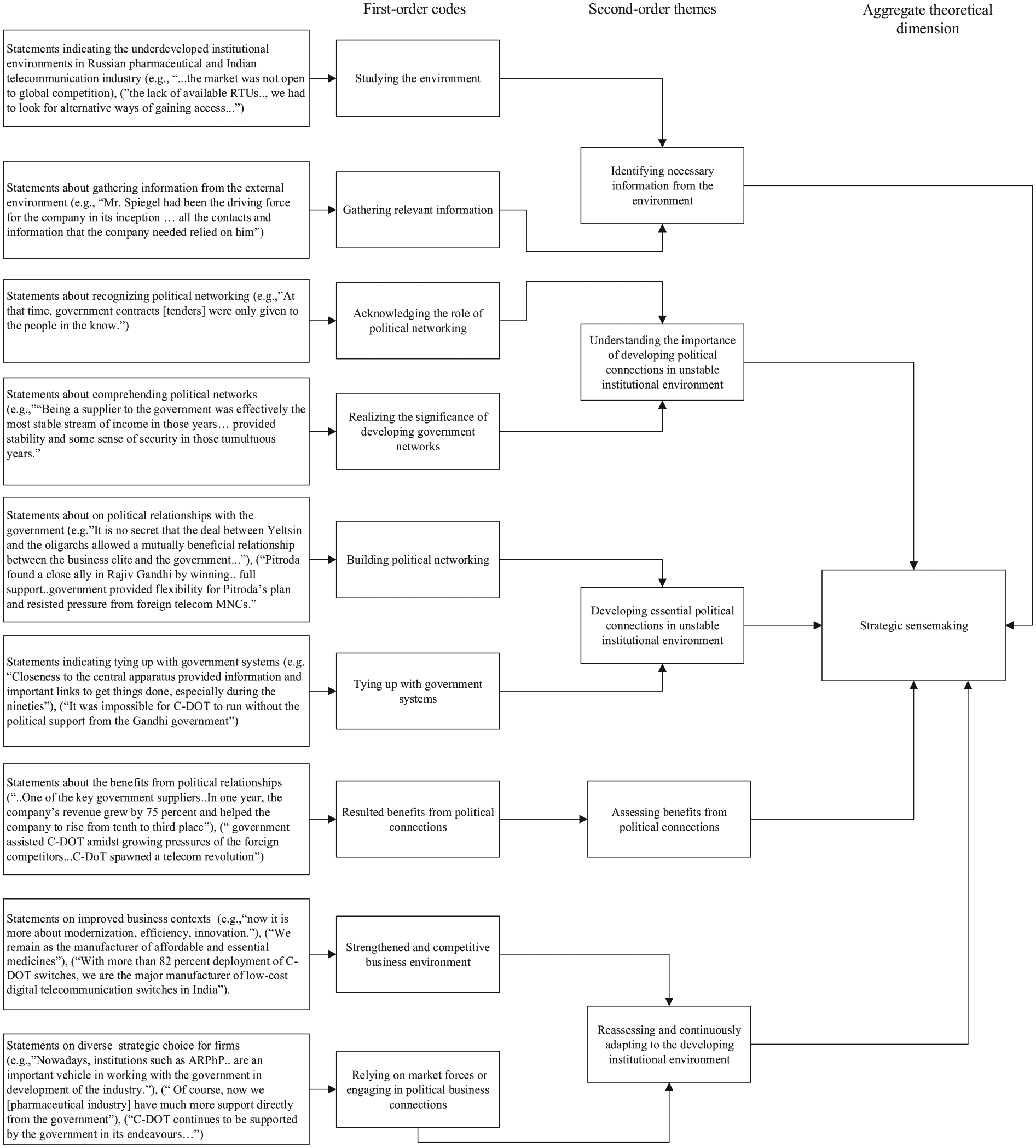
Data structure.
Findings: Biotec
During its change from a planned to a market economy in the 1990s, Russia underwent wholesale changes in the rules that govern the relationship between the state and private sector, and between firms and individuals (Johnson, Kaufmann, McMillan, & Woodruff, 2000; Newman, 2000). The transition from a planned to a market economy destroyed virtually all major institutions, thereby creating an institutional upheaval (Newman, 2000) and resultant institutional voids (Aslund, 2009; Yeltsin, 2000). The wholesale changes were forced on an institutional setting that was shaped during 70 years of socialist rule, in which even institutions of the “ancient” regime survived and acquired new meaning. An example is the strong collectivist tradition of Tsarist Russia, whereby households and communities (obshchina or mir) played a central role in the voluntary union of people, which combined the pursuit of common goals with the self-emancipation of the individual (Gokhberg & Kuznetsova, 2011; Kalantaridis, 2007). Most of the 1990s saw only weak formal institutions and the continuation of informal institutions from the Soviet system, thereby fostering corruption (Puffer, McCarthy, & Jaeger, 2016). An unprecedented wave of neoliberalism forged a new system of privatized businesses and saw the collapse of the centralized public distribution system (Balashov, 2012; Boettke, 1993).
Scanning and Interpretation
The beginning of the transition period caused the collapse of the value chain of the functioning pharmaceutical industry, as institutes and firms struggled to survive in the new unsupported environment. Earlier, the Soviet state disintegration led to the disruption of trade between the “bulk substance” manufacturing enterprises located in Russia and the finished goods pharmaceutical companies in the newly separated countries. Financial constraints, asset stripping by management, and opening up to foreign direct investment and imports were among the key factors driving the decline of domestic manufacturing (Balashov, Zhiglyavskaya, & Zabolotnaya, 2009; Chibilyaev, 2011; Dorofeev, 1995; Sidorov, 2008). As a Biotec executive stated, The difficulties were multiplied by the lack of available RTUs [ready-to-use medicines] as the majority of these medicines were produced in COMECON [Council for Mutual Economic Assistance] countries that supplied us with RTUs in return for our substances. As you know, COMECON fell apart during the Soviet disintegration . . . Thus, we had to look for alternative ways of gaining access to suppliers from those countries and locally.
In the Russian context, the perestroika years wrought large-scale institutional changes that forced firms to keep track of what was occurring in the institutional environment and the possible consequences (Ledeneva, 2012; Newman, 2000). Effectively, the scanning process of sensemaking originated prior to the Russian transition of the 1990s.
The future of government-led research institutes, and especially staff working for the state, was uncertain after the breakup of the Soviet command and control economy. Hence, it was no surprise that some staff who wished to maintain the scientific progress and commercialize knowledge decided to establish their own enterprises, including Biotec. The company owes its rapid success and competitiveness to the chairperson of the board of directors, Boris Spiegel. In 1991, the deputy director of the Russian Research Institute of Agricultural Biotechnology registered a private company that aimed to fix the broken supply chain of medicines and related products to hospitals and the military. Biotec’s senior executive stated, Mr. Spiegel had been the driving force for the company in its inception . . . all the contacts and information that the company needed relied on him. At that time, government contracts [tenders] were only given to the people in the know.
From the outset, Biotec was characterized as a paternalistic, entrepreneurial firm. The vast majority of the decision making was in the hands of Mr. Spiegel. This way the firm avoided internal conflicts and inefficiencies, as it was a large enterprise operating as a decisive and mobile entrepreneurial-style organization. The firm valued and emphasized a collectivist orientation culture based on trust and long-term networks, especially with the central apparatus.
In the early Russian transition, the value chain disruption, new market-oriented reforms, and lack of experience in the market economy forced firms to evaluate what had occurred and determine the options available. This stage of the development of markets can be rationalized as sensemaking (Hindle et al., 2009; Thomas et al., 1993; Weick, 1995). The reforms were managed by politicians—commonly known as chinovniki (people in power). To best make sense of the environment and adapt quickly to maximize resources, it was essential for businesses to create and maintain svyazi (connections) with chinovniki: Being a supplier to the government was effectively the most stable stream of income in those years. The only way you could keep abreast of the changes was through “svyazi” in policymaking . . . This provided stability and some sense of security in those tumultuous years.
Biotec founders essentially realized that uncertainty was the new norm during the transition, and the only certainty stemmed from the central apparatus, which was responsible for the development of the industry and the economy. Thus, the obvious way to survive and prosper was to follow the core competencies of the firm—working together as a key supplier for the state. To remain competitive, the management and expansion of connections seemed to be the only feasible option. This strategic choice not only provided information but assisted with access to lucrative privatization auctions (Hedlund, 2001; Stiglitz, 1999), the ability to bypass red tape (Tonoyan, Strohmeyer, Habib, & Perlitz, 2010), and access to resources (Black & Tarassova, 2003; Rutland, 2013).
Action
If the goal of organizations is to maximize shareholders’ value, the decision makers of organizations should take necessary actions to reach this goal. Through the process of scanning and interpretation, most large and successful organizations in Russia in the 1990s took measures to establish political presence through ill-defined boundaries between private and public property (Guriev & Rachinsky, 2005; Levin & Satarov, 2000): Oligarchs of the 1990s held two-thirds of all large businesses in Russia; the business sphere of the elite was not only in the financial and natural resource sectors, but in media and other strategic sectors. It is no secret that the deal between Yeltsin and the oligarchs allowed a mutually beneficial relationship between the business elite and the government. A lot of decision making in Russia was in consultation with the oligarchs. As a consequence, large companies were part of politics and the reforms.
In 1995, before the first waves of the transition, Mr. Spiegel, based on his prior position in the central apparatus, became an advisor to the chairperson of the State Duma on social issues, Gennady Seleznev. The speaker and businessman became friends, which had an immense effect on the performance of the business in the 2000s. As stated by a senior manager of Biotec, Closeness to the central apparatus provided information and important links to get things done, especially during the 1990s.
During uncertain/weak formal institutions, there is a strong reliance on informal institutions, such as networks (Peng, 2003; Puffer, McCarthy, & Boisot, 2010). It was imperative for Biotec to maintain links to the high-ranking civil servant to gain information and bypass red tape, and more importantly, to access the country-wide medicinal distribution programs that began rolling out in the 1990s. As the country liberalized, foreign investors were eager to enter the untapped Russian markets. As a result of its connections, Biotec was able to gain access to information about the foreign firms that wished to establish operations in Russia. Foreign operators were equally eager to cooperate with the “recommended” Russian firm. Thus, Biotec invested in prepackaging, packaging, and market distribution of a mostly foreign medicines plant, called MFPDK Biotec. The “arrangements” were beneficial for all parties involved: the government gained investment and interest from foreign companies; foreign firms gained stable access to the Russian market. For Biotec, it served as a business growth venture: The packaging facility was a necessary and temporary step in working together with foreign firms. It was beneficial for us in gaining the necessary know-how, technologies, and formulas, as well as the ability to sell much-needed foreign medicines. For our partners, it was an entrance to the developing Russian market and gaining the “local” label for the products. Besides, foreigners needed a local well-integrated enterprise, especially in the first unstable years to try out the markets.
Performance
The financial crisis of 1998 gave Russian manufacturers an edge over imported medicines, as local manufacturers were able to produce and distribute cheaper nonbranded generics (Balashov, 2012; Trofimova, 2006). By diversifying the economy, the administration intended to boost the export of goods other than raw materials, replacing these with Russian-made items and stimulating the high-tech sector (Yegorov, 2009). Import substitution was intended to divert capital from the raw material sector to the processing industries and attract foreign direct investment (Bevan, Estrin, & Meyer, 2004): The crisis [1998 Russian financial crisis] crippled the Russian economy, and it became apparent to the government that they needed to create basic self-sufficiency in the pharmaceutical industry [along with several other strategic sectors]. Being one of the key government suppliers, we had to adjust the strategy of our company to import substitution, which would result in greater growth potential.
In light of government direction, Biotec established the first pure production facility in 2001, called Biodez, which specialized in the production of disinfectants, and had a strategic domestic position. Only in 2005 did the government introduce a new program of additional medicinal supply (DLO). The investments made that year amounted to US$1.7 billion—6 times that of the previous year (Balashov, 2012): Biotec finally got rewarded in 2005 when the DLO program was introduced. In one year, the company’s revenue grew by 75% and helped the company to rise from tenth to third place in the suppliers’ market . . . Mr. Spiegel was the curator of this program.
Given that Biotec held Volga Federal District under its control, the company experienced around a 75% growth rate in 2005. In 2006, the company reached production growth rates of 17%, as well as growth in exports. In 2009, Biosintez (a Biotec subsidiary) was awarded the “Fastest Growing Exporter” by the Ministry of Trade and Industry, and in 2010 and 2011, the company received the title of “Best Exporter,” followed by “Best Exporter to the Commonwealth of Independent States” in 2012 and 2013. In 2012, the value of the exports of Biosintez reached around US$10 million, 15.3% of total revenue. A large part of the exports were substances to countries such as China, Germany, France, Spain, and Switzerland (Petrukhina, 2014; Pharmacevticheskii vestnik, 2014).
Feedback Loop of Biotec
Improvements in Russia’s institutional environment in the 2000s decreased the prevalence of political networking, as regulative and normative institutions replaced uncertainty (Puffer et al., 2016). The various institutional changes that occurred in Russia created a more transparent, secure, and inclusive business environment, thereby reducing the entry barriers: In the 1990s, “who you know” was indispensable in growth . . . From [the early] 2000s, the boundaries between business [markets] and politics became clearer . . . Although the administrative resource [political networks] is still prevalent among the largest companies, now it is more about modernization, efficiency, innovation.
Associations and lobby groups replaced the need for informal networking as the country moved toward more arms-length relations (Govorun et al., 2016; Klarin & Ray, 2019): Nowadays, institutions such as ARPhP [Association of Russian Pharmaceutical Producers], Union of Pharmaceutical and Biomedical Clusters, and Association of International Pharmaceutical Manufacturers are an important vehicle in working with the government in development of the industry.
As of the early 2010s, the government has been committed to supporting several “priority” industries that include the military-industrial complex, shipbuilding, aircraft, machinery, metallurgy, engineering production, chemical production, pharmaceuticals, forestry, light manufacturing, information technology, and agriculture (Ministry of Industry and Trade of the Russian Federation, 2017). The government is adamant about creating an innovative culture through various programs, including stimulation of innovative activities of state-owned corporations, direct funding of innovative small- and medium-sized enterprises (SMEs), fiscal stimulation of innovative business activity, development of overall competition level, development of public–private partnership models and mechanisms, removal of state overregulation of high-tech business, creation of “competence centers” to generate and commercialize knowledge, pilot projects in Russian regions, and formation of industry clusters and technology platforms (Gokhberg & Kuznetsova, 2011). In the pharmaceutical industry in 2009, the Ministry of Health introduced a “Strategy of Development of the Pharmaceutical Industry of the Russian Federation to 2020” (“Strategy 2020”), which aims to consolidate the state of the Russian pharmaceutical industry: Of course, now we [pharmaceutical industry] have much more support directly from the government . . . The Council for the Development of the Pharmaceutical and Medical Industry is quite a proactive body that provides us a voice to the government, considering our products are strategic vital and essential medicines . . . Some of our import-substitution projects have received support [subsidies and tenders] over the past several years.
The prevalence of institutions that reduced the need for political networking, as well as the introduction of strategic development roadmaps, provided firms with the ability to choose between retaining links to the central apparatus or engaging in activities not pegged to the strategic course of the country (Gerasimenko, 2012; Gokhberg & Kuznetsova, 2011). The performance of Biotec through closely following the government programs with connections to the central apparatus provided a niche for the company in government purchase programs and low-cost generics that fit the vital and essential drugs list supported by the government. The company chose a path of strategic government engagement and maintained close contacts and connections with the central government. The decision makers of the company assessed the competitiveness of the company in the performance stage of sensemaking, fed the information through the learning loop to the scanning and interpretation phase, and continued the cycle of government collaboration. Thus, the sensemaking process remained a continuous assessment of the environment and application, thereby ingraining political networking into the sensemaking and legitimacy of the organization in the market: We remain a manufacturer of affordable and essential medicines; for us, a large part of income comes from government tenders. Thus, for the foreseeable future, we see government contracts as our company’s priority.
Thus, Biotec has strived to compete on its merits, with government cooperation. Modernization and low-priced medicines have helped the company remain one of Russia’s leading exporters. As the industry aims to raise the domestic pharmaceutical manufacturing capacities underlined by Strategy 2020, successful companies such as Biotec are keen to adjust to the new challenges in the institutional framework. As such, Biotec aims to introduce an Interregional Biomedical Center of Vocational Education on Biosintez territory, which would provide training for biomedical and pharmaceutical industries. The first funds and efforts began in 2014. The company is steadfast in its plan to work closely with the government and follow the developments of the institutional environment to be able to adapt and gain competitive advantages (Biosintez, 2013; Pharmacevticheskii vestnik, 2014): Boris Isakovich [Mr. Spiegel] is still part of our company [chairperson] and is part of the Council for the Development of the Pharmaceutical and Medical Industry and he believes in the future of the Russian pharmaceutical industry as competitive and self-sufficient. The government in collaboration with industry representatives is instrumental in developing this competitiveness.
This demonstrates the path dependencies of the political connections of Biotec in navigating the institutional upheavals of the Russian transition. Biotec relied on and chose to continue relying on political connections to sustain competitive advantage by aligning its strategies with the strategic direction of the Russian development. Political connections played a crucial role in gaining this strategic direction in the early 1990s, serving as a sensemaking instrument. The “what’s the story here?” and “now what?” of sensemaking is clearly demonstrated in the political affiliations that the company has followed since its inception.
Findings: C-DOT
The Indian economy has evolved through three major policy regimes: licensing/protectionism (1947-1965), deregulation (1980-1990), and globalization (1991 onward) (Balakrishnan, Das, & Parameswaran, 2017; Madsen, Saxena, & Ang, 2017). In the protectionist regime, infamously known as the License Raj era, all aspects of the economy were controlled by the state, and licenses were required by firms to invest and develop. Moreover, licenses were given to a select few firms by the government to establish and run businesses. The limited liberalization period witnessed a shift in government policies and new measures to enhance local industries’ competitiveness. Finally, the globalization phase saw the adoption of wide-ranging economic reforms in the country (Gupta, 2005; Kapila, 2009).
With the Industrial Policy Resolution adopted by the Indian parliament in 1948, a number of industries—including the telecommunications sector—were subject to regulation and control by the central government (Makkar & Makkar, 2017; McDowell & Mody, 1997). This created institutional absences and weaknesses in the telecommunications industry, with profound deficiency in the supply side compared with demand, financial constraints, and an absence of domestic market players. The adoption of a new Industrial Policy Statement in 1991 forged competition from privatized businesses (Chandra, 2015; Reenu & Sharma, 2015). The following section illustrates the way an Indian telecommunications organization achieved competitive advantage by relying on political networking during institutional changes in the Indian economy.
Scanning and Interpretation
During the protection and licensing regime (1950-1984), the Indian economy was governed by bureaucracy and control mechanisms, which resulted in a protected and uncompetitive market, with few incentives to undertake innovation (Panagariya, 2008). The telecommunications industry of India was no exception. It was marked by a small and ineffective telephone network because of the government monopoly, which provided the government with the exclusive right to establish telephone exchanges (Pritish & Saxena, 2015). According to C-DOT’s former executive director, Earlier major market share was reserved for the French multinational Alcatel only and the market was not open to global competition.
Telecommunications service was classified as a luxury, recognized as an item of consumption by the elite class, and assigned diminutive priority. In terms of resource allocation, the sector received only 3% of the national budget, compared with higher support for education, health, and other infrastructural sectors (Dossani, 2002). This state-led model of the telecommunications sector encouraged political relationships and bureaucracy between government enterprises, such as Indian Telephone Industries and a handful of other domestic telecommunications equipment manufacturers. Hence, the industry was undercapitalized and not prioritized (Mani, 1989).
In the vast and underserviced rural parts of India, telephone service was nonexistent, as the rural population had access to only 10% of direct telephone exchange lines. A handful of multinational corporations (MNCs) monopolized the market, with expensive switches that were unsuitable for India’s tropical climate (Mani, 1989; Srinivasan, 2010). For much of this period, the telephone network of India remained ineffective in providing quality service to users, and with a national tele-density rate (telephone lines per 100 inhabitants) of only 0.3%, India lagged behind other low-income countries across Asia and Africa (O’Neill, 2003; Ray & Ray, 2010; Saha, 2004). Customers experienced poor service quality and long waiting lists for telecommunications service installation because of the triple constraints of highly priced electromagnetic foreign exchanges, mismatch between products designed for foreign urban traffic and Indian requirements, and lack of capacity for designing domestic telecommunications equipment (Malerba & Mani, 2009; Mani, 2005).
From the early 1980s, the government realized the need for deregulation and some liberalization of the Indian economy (Pradhan, 2011; Siddiqui, 2015). Several sectors, including telecommunications, became priorities (Sinha, 2001), and the Indian government started to view telephone service as a necessity, shifting from a luxury to a common utility. The focus was to use telecommunications production and access as a socioeconomic development tool for India. Thus, the Sarin Committee was formed by the then Indian Prime Minister Indira Gandhi to implement the modernization of Indian telecommunications. The committee also considered the viability of establishing a factory to manufacture electronic telephone exchanges to introduce digital switching technology. This announcement from the committee attracted the attention of several groups, including the Telecom Research Council (TRC) in India and Wescom in the United States. Sam Pitroda, an Indian-born technocrat who accomplished extraordinary success in the U.S. telephony and computing industry, was interested in entering the Indian telecommunications sector with a vision to improve its archaic telephone system and extend digital telecommunications access to the most remote villages of India (Mishra, 2016; Tahiliani, 2016): The returning of Pitroda to India with his ambitious plans and detailed information to improve the telecommunications infrastructure was pivotal for the founding of C-DOT.
Pitroda developed the idea to modernize the telecommunications industry through establishing a government-sponsored institute—C-DOT. The idea of C-DOT was to discover a cost-efficient way to deliver the benefits of telecommunications to India’s underprivileged rural population (Lal, 2017; Ray & Ray, 2010). As observed by a C-DOT senior manager, having grasped the scale and required capital intensity, Pitroda realized the importance of fostering relationships with Indian government officials to access resources. As a result of the weak private property regime, extensive bureaucracy, and government-led modernization, it was imperative to use government connections to gain access to the program. As noted, Pitroda was actively searching for an opportunity to enter the highly bureaucratic telecommunications sector. As you know, at that time the market was heavily regulated with a high level of government control over getting licenses. Pitroda utilized some of his connections to present his idea to the government by lobbying through the parliament.
Pitroda envisioned three core aspects of strategy that C-DOT was to adopt in achieving the modernization of India’s telecommunication system: (a) product strategy—the commonality of hardware and software to keep the costs low; (b) process strategy—capital sensitive and labor intensive so that initial investments were low; and (c) organizational culture—open, nonhierarchical, and egalitarian culture that was less bureaucratic to attract young Indian talent to technology careers. Pitroda eventually wrote to the then Prime Minister Indira Gandhi to express his interest in working with the government to help develop a modern telecommunications system.
Action
By using contacts with a minister of parliament and with Dr. Meemamsi—the ex-head of R&D at TRC—Pitroda sought to work with the Indian government officials. Dr. Meemamsi was a close friend of Rajiv Gandhi—the eldest son of the then Prime Minister Indira Gandhi. Rajiv Gandhi acted as the general secretary of the ruling Congress Party at the time. These links created an opportunity for a meeting with the then Prime Minister Gandhi and several other senior civil servants, including the minister of finance, the minister of technology, and chief ministers of several Indian states. During this meeting, Pitroda highlighted the high correlation between tele-density and wealth around the world, and the importance of rural telecommunications services, and argued for abandoning foreign-made electromechanical switching, which was ill suited to Indian conditions, and instead developing an indigenous “state-of-the-art digital switching system” through local research to improve affordable telecommunications services. Pitroda emphasized using local talent, instead of relying on partnerships with other multinationals, including Alcatel, Ericsson, Siemens, AT&T, and NEC, thereby significantly saving costs of telecommunications equipment (by up to 50%). Pitroda also argued that bringing telecommunications development to India through indigenous technology would result in telephone service accessibility in both urban areas and villages, where more than 75% of India’s population lived. The service would help spur economic development, particularly in the rural sector; stimulate the growth of the local manufacturing base and ancillary industries; and create educational opportunities. To accomplish this aim, Pitroda particularly focused on attaining government support and reducing red tape.
However, multinationals, such as Alcatel and others, strongly opposed the Pitroda proposal to develop indigenous switching technology, arguing that India would waste substantial amounts of money because such a project required considerable R&D investments. Despite existing deals with Alcatel, the then prime minister—urged by her son Rajiv Gandhi—agreed to fund a feasibility study. C-DOT was finally established as an autonomous R&D organization to reform the telecommunications sector in August 1984 and was allocated US$35 million over 36 months to build low-cost modern exchanges (Nayak, 2018; Pitroda & Chanoff, 2015). According to C-DOT’s former head of technology transfer: Well, I guess changes have been very dramatic in the sense that, before liberalization was initiated, as far as the telecom sector of India was concerned, it was a much-protected area where the objectives had been to bring in Alcatel technology. Now, one needs to go back to what C-DOT’s mission was when we first started. The mission at the time was to develop India’s own switching technology and develop a set of switching systems and products for the Indian digital network and gradually upgrade the same toward international standards. This respondent continued: “In 1984, a completely new style of management was introduced by Pitroda and C-DOT was formed with massive investments.”
For example, Pitroda ensured that the organizational culture of C-DOT was open, less hierarchical, and egalitarian, which was a stark contrast to many other Indian organizations. C-DOT management canceled the norm of keeping track of employee attendance, and also initiated flexible work hour contracts. Employees were further encouraged to share new ideas with top management without following the bureaucratic process.
Pitroda was appointed the principal advisor of C-DOT. As a senior manager observed: Mr. Pitroda found a close ally in Rajiv Gandhi by winning his friendship, trust, and full support . . . It was impossible for C-DOT to run without the political support from the Gandhi government . . . The government provided flexibility for Pitroda’s plan and resisted pressure from foreign telecom MNCs.
Performance
The Indian economic crisis of the early 1990s marked the beginning of the globalization phase, in which macroeconomic reform policies removed restrictions, abolished licensing regulations, and opened up the economy to international trade and investment (Mukherji, 2009). The Indian government intended to create a more competitive environment in certain sectors, including telecommunications. As the prevailing development policies shifted away from inward protectionist policies to an approach that emphasized export-led growth, the role of telecommunications infrastructure became vital to economic development (Nayak, 2018; Petrazzini, 1996).
Within a year of forming the organization, C-DOT designed the first product, the electronic private automatic branch exchange (EPABX) system, with smaller capacity (Mani, 2005). In the simplest terms, a telephone exchange or switch is used in a telephone network to establish calls. Almost 70% of local Indian EPABX manufacturers signed technology collaboration arrangements with C-DOT, instead of outsourcing from Western manufacturers. C-DOT entered the digital public switching system by designing rural automatic exchange (RAX) for small-to-medium-size villages. Adding to the accessibility, affordability, and robustness of rural telephony, the switches were able to function in India’s difficult environment with irregular power supply, without requiring sophisticated peripheral equipment, such as a dust-free environment receptacle or air-conditioning (Ray & Ray, 2010). The functionality of C-DOT switches in the Indian atmosphere was described as follows: Well, as it is, we are providing the bare minimum facilities, so there is no question of raising the frills or cosmetic factors of C-DOT switches. We basically provide essential telephone service, which is reliable on a digital switching platform. Our RAXs do not require any air-conditioned environments and our medium-high capacity exchanges do not require any elaborate infrastructure to ensure lower costs of the switches.
The switches were manufactured in India according to the global standard and were modular in architecture to ensure utmost flexibility in design, installation, upgrade to higher configurations and maintenance. Moreover, with the distinctive features of withstanding wide temperature fluctuations (−20°C to 50°C), straightforward installation with fault-tolerance, and simple connectivity to diverse network requirements through software changes, the RAX switches were ideal for rural applications to provide instantaneous telephone connections. The RAX switches received acceptance in a niche market segment, and C-DOT captured more than 90% of the rural switching capacity by 1999 (Agur, 2018; Saha, 2004).
In the subsequent years, C-DOT progressively increased in scale and sophistication by introducing cost-effective, high-capacity switches, such as main automatic exchange (MAX), private automatic branch exchange (PABX), and EPABX. With the liberalized foreign direct investment policies, an increasing number of Western telecommunications manufacturers entered the industry (Saith & Vijayabaskar, 2005). During a period when C-DOT was 2 years behind schedule to develop the MAX switches, the Indian government faced enormous pressures from AT&T, Ericsson, Siemens, and Philips. These multinational equipment manufacturers’ lobbied the prime minister’s office to gain access to the Indian digital switching market by conducting joint R&D. As observed by a C-DOT manager, The government assisted C-DOT amidst growing pressures from the foreign competitors and difficulties faced by the company in delivering the required products on time.
It was from this government support for C-DOT that low-priced public call offices and subscriber trunk dialing booths were seen throughout the country, leading to the exponential growth of the industry and telecommunications network access. Furthermore, C-DOT has been successful in developing a strong telecommunications equipment manufacturing industry and quality vendor base, licensing the technology to local, private manufacturers. As observed by one divisional manager, We have a vendor base of more than 600 manufacturers in India for the supply of components, assembly line to the various manufacturers. Any vendor has to first go for vendor verification processes, and then we give certification to that company and add it to our list. So, our manufacturers can only take components from the approved vendors. C-DOT not only transferred the core technology to the vendors, but also helped them in process improvement, prototype development, training, procurement, quality approval, and certification procedure . . . and that way quality of the network components and equipment improved. It was an integrated growth for both vendors and C-DOT, leading to an innovation ecosystem. Mr. Pitroda’s C-DOT spawned a telecom revolution through the infrastructure and regulatory framework in India.
Consequently, C-DOT provided the much-required thrust to the sector and founded the backbone for a nationwide digital telecommunications network. RAX switches have also been successfully exported to other markets, including Indonesia, Vietnam, Russia, Nepal, Bangladesh, Ghana, Thailand, and Uganda (Itty, 2017; Saha, 2004). C-DOT has further demonstrated expertise in designing next-generation telecommunications networks and software solutions. By 2017, nearly 50% of Indian network capacity was controlled by C-DOT (C-DOT, 2017; Nayak & Maclean, 2013).
Feedback Loop of C-DOT
Beginning from the mission of providing telephone access for subscribers through cost-effective digital switching systems, C-DOT has grown to the level of a national center for R&D excellence in telecommunications technology. Since its inception 32 years ago, C-DOT has become the R&D arm of the Indian Department of Telecommunications and has emerged as a center of excellence in telecommunications (C-DOT, 2016; Department of Telecommunications, 2014). As described by a manager, With more than 82% deployment of C-DOT switches in India, we are the major manufacturer of low-cost digital telecommunication switches in India. With all the support we have been receiving from the government, especially in various high-end projects of national importance, C-DOT will strive to maintain its national relevance.
The institutional changes that occurred in the Indian economy—from being a protected market in the licensing regime to an open and competitive market in the globalization regime—created a more competitive environment for the market players (Chittoor & Aulakh, 2015; Chittoor, Aulakh, & Ray, 2015; Mukherji, 2009; Sharmelly & Ray, 2018). Current institutional shifts in the telecommunications industry toward the Vision 2020 program, established by the Indian Planning Commission to prioritize development of the telecommunications sector (Samita, 2012), have created new challenges with which telecommunications equipment manufacturers must comply. Hence, through adapting to institutional shifts, C-DOT has evolved toward developing advanced products from a purely hardware development center. C-DOT has diversified into developing wireless and satellite communications, mobile cellular systems, asynchronous transfer mode, wireless broadband, next-generation networks, and a range of telecommunications software, such as intelligent networks, network management systems, and data clearing houses. In addition to developing advanced telecommunications switches and network systems, C-DOT has also advanced processes for indigenous manufacturing of the switches in India, and enabled establishment of a strong pool of manufacturing and a quality vendor base.
C-DOT is committed in its plan to work closely with the government and continues to maintain its national relevance. The company provides strategic direction on technological development and is profoundly engaged in telecommunications policy planning. C-DOT is further entrusted by the Indian government with designing and developing strategically important national projects, such as central monitoring systems for telecommunications security, law-enforcement monitoring functions, and secure networks for strategic government applications. As observed by a senior manager, C-DOT continues to be supported by the government in its endeavors . . . This has helped to foster socioeconomic development and transparency in governance, and decrease the digital divide between rural and urban parts of India.
Analysis and Discussion
The discontinuities of the regimes in both countries (the transition from the protectionist License Raj era in India and the fast-paced Russian transition from a planned to a market economy) created institutional instabilities (Marquis & Raynard, 2015; Palepu & Khanna, 1998), given which the previous value networks were ineffective—see, for example, Boettke (1993) for Russia and Majumdar (2004) for India—forcing a restructure. The scanning phase of the sensemaking process involved evaluating the situation and comprehending the course of action in the interpretation phase.
We found that Biotec and C-DOT engaged in five specific types of activities (second-order themes) that aggregate to the strategic sensemaking process of the two firms. Table 1 provides quotations from the data that illustrate each of these activities along with the corresponding first-order codes. The first sensemaking activity we found, “identifying necessary information from the environment” aggregates the two first-order codes “studying the environment” and “gathering relevant information.” The second sensemaking activity “understanding the importance of developing political connections in unstable institutional environment” aggregates the two first-order codes “acknowledging the role of government networking” and “realizing the significance of developing government networks,” respectively. Our analysis reveals that both Biotec and C-DOT started by studying the institutional environments closely and collecting information to identify the necessary information from the environment prone to institutional voids due to the transition of the regimes in Russia and India. Boris Spiegel from Biotec, for example, studied the new market-oriented reforms in the early Russian transition, which was largely managed by politicians or chinovniki (people in power), and determined the way to create political connection after understanding the role of political networking to circumvent bureaucracies and access resources for Biotec. Similarly, during the limited liberalization of the Indian economy, Sam Pitroda studied the highly bureaucratic and government-controlled Indian telecommunications sector and found ways to develop political networking to enter the industry and establish the Indian Telecommunications Institute.
Data Exemplars of First- and Second-Order Constructs.
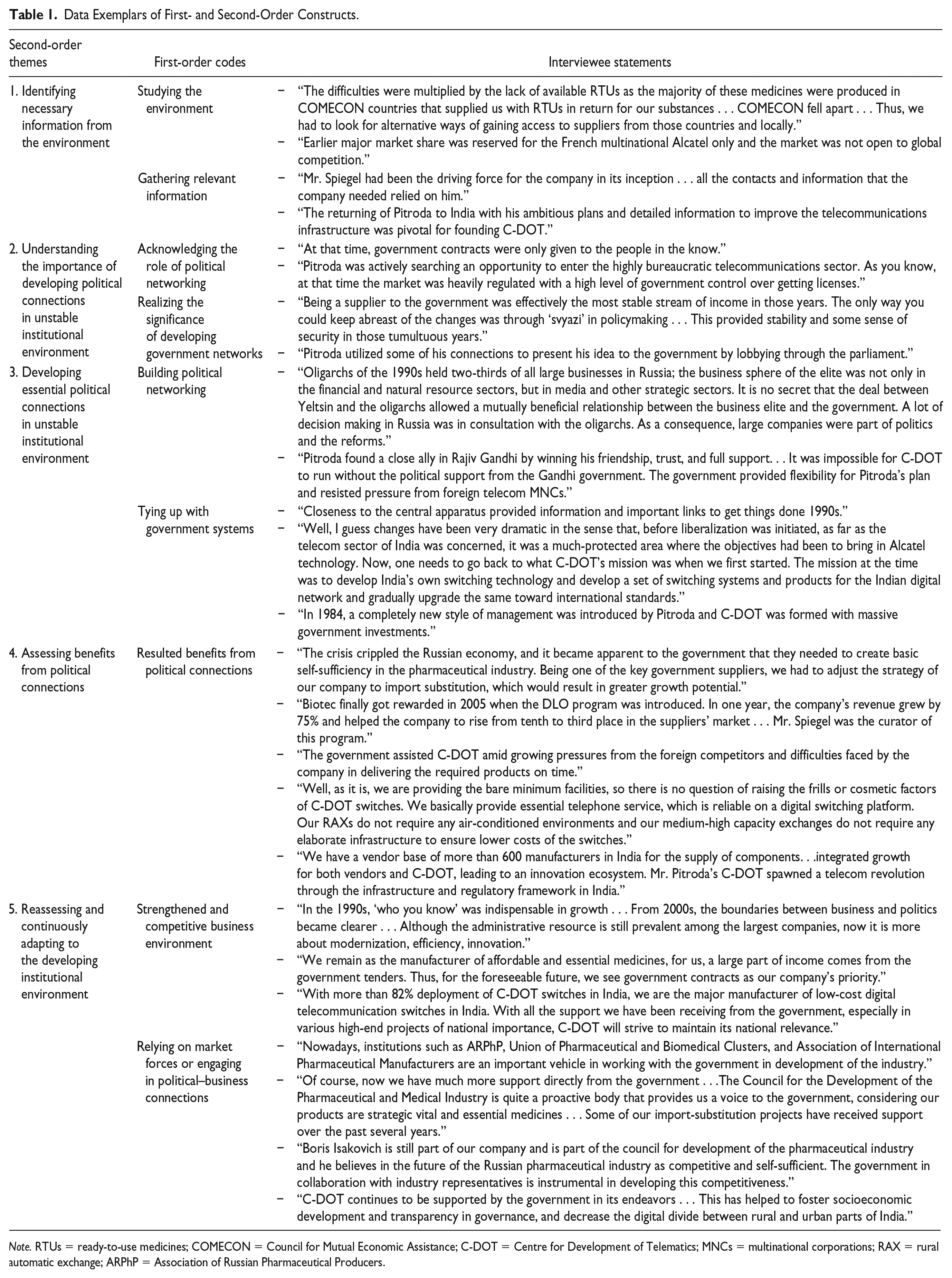
Note. RTUs = ready-to-use medicines; COMECON = Council for Mutual Economic Assistance; C-DOT = Centre for Development of Telematics; MNCs = multinational corporations; RAX = rural automatic exchange; ARPhP = Association of Russian Pharmaceutical Producers.
In sum, the institutional discontinuities resulted in a lack of laws and regulations, let alone enforcement of these (Black & Tarassova, 2003; Newman, 2000). When managing or intending to break through in the midst of unfamiliar, chaotic, and often volatile conditions, the most effective means of coping is to disregard the pace of change and complexity and focus instead on what is deemed most important to organizational survival (May et al., 2000). In such circumstances, the conditions and changes are created and administered by the central apparatus that controls the state—the political realm. Governments oversee the legislative, executive, and judicial branches that create and maintain organizational environments (Aslund, 2009; Ledeneva, 2012). Where there are institutional voids and performance is dependent on the supreme mechanisms, connections to the central apparatus are often imperative to make sense of the environment and gain a foothold in the playing field (Mann, 2014; Wales, Shirokova, Sokolova, & Stein, 2016). Thus, the observation and recognition process of the value of connections is deemed as scanning and interpretation in this article.
The action of creating linkages and leveraging connections is dependent on the level of connectedness with the central apparatus. From the empirical data, the third sensemaking activity we detected was the deliberate building of political connections. The second-order theme labeled “developing essential political connections in unstable institutional environment” aggregates two first-order codes: “building government networking” and “tying up with government systems.” We found that based on prior position in the central apparatus, Boris Spiegel applied and further developed political relationships for Biotec. Moreover, Sam Pitroda utilized his connections in parliament and developed a relationship with Rajiv Gandhi—the eldest son of the then-prime minister of India—which was imperative to establishing C-DOT.
Indeed, it has been shown that the most supported firms are those that create the strongest linkages to the central apparatus (Chen, Ding, & Kim, 2010; Fisman, 2001; Guriev & Rachinsky, 2005). The situation is even better when board members or the firm’s decision makers are part of the political domain (Faccio, 2006), which creates a number of advantages, including access to information (Danis et al., 2009); the ability to effectively deal with red tape (Black & Tarassova, 2003); access to various resources, including capital (Li, Meng, Wang, & Zhou, 2008); security from external forces, including hostile takeovers and organized crime (Gans-Morse, 2013); access to government procurement programs and tenders (Boubakri, Cosset, & Saffar, 2008); and a general enhanced level of competitiveness (Kotabe et al., 2017).
Performance is directly dependent on the action of attaching the organization to the higher levels of the decision-making authority of the state. “Assessing benefits from political connections” was identified as the fourth sensemaking activity (second-order theme) from the data exemplars in Table 1, aggregating the first-order code “resulted benefits from political connections.” Biotec, for instance, was able to grow the company’s revenue by 75%, which improved the company’s position from 10th to third place in the market, and became recognized as the best exporter of pharmaceutical products. C-DOT, on the contrary, was able to initiate a telecom revolution in India with indigenously made C-DOT switches and captured 50% of Indian network capacity.
The model of scanning, interpretation, action, and performance (Hindle et al., 2009; Thomas et al., 1993) is clearly insufficient to demonstrate the causal directions of sensemaking over time. We argue that, in emerging economies and less-developed countries, the pace of change is continuous, thereby creating a need for constant adaptation to the environment and to maintain legitimacy of organizational position within the dynamic environment (Khoury & Prasad, 2016). Our analysis of sensemaking and the facilitating role of connections indicated the reassessment and adaptation embodied in the feedback loop that extends from performance evaluation to the scanning and interpretation phases of sensemaking.
We expanded on the four-step model of strategic sensemaking by Thomas et al. (1993) by adding the feedback loop from performance to scanning and interpretation, as shown in Figure 2. As transition progresses, firms engage in a continuous cycle of sensemaking to adapt accordingly to the changing environment. The fifth activity we observed was the purposeful way that Biotec and C-DOT re-evaluated the dynamic institutional environments and adapted strategies in response to the changes. The second-order theme labeled “reassessing and continuously adapting to the developing institutional environment” aggregates two first-order codes: “strengthened and competitive business environment” and “relying on market forces or engaging in political–business connections.” As observed from the supporting data in Table 1, industry associations, such as ARPhP, Council for the Development of the Pharmaceutical and Medical Industry, and lobby groups replaced the institutionalized political networking with the improvements in the Russia institutional environment in the 2000s. C-DOT, on the contrary, has emerged as the central arm for R&D excellence in telecommunications technology and diversified into developing advanced switches and network systems to adapt to the competitive telecommunication market landscape in the globalized regime of 1991 onward.
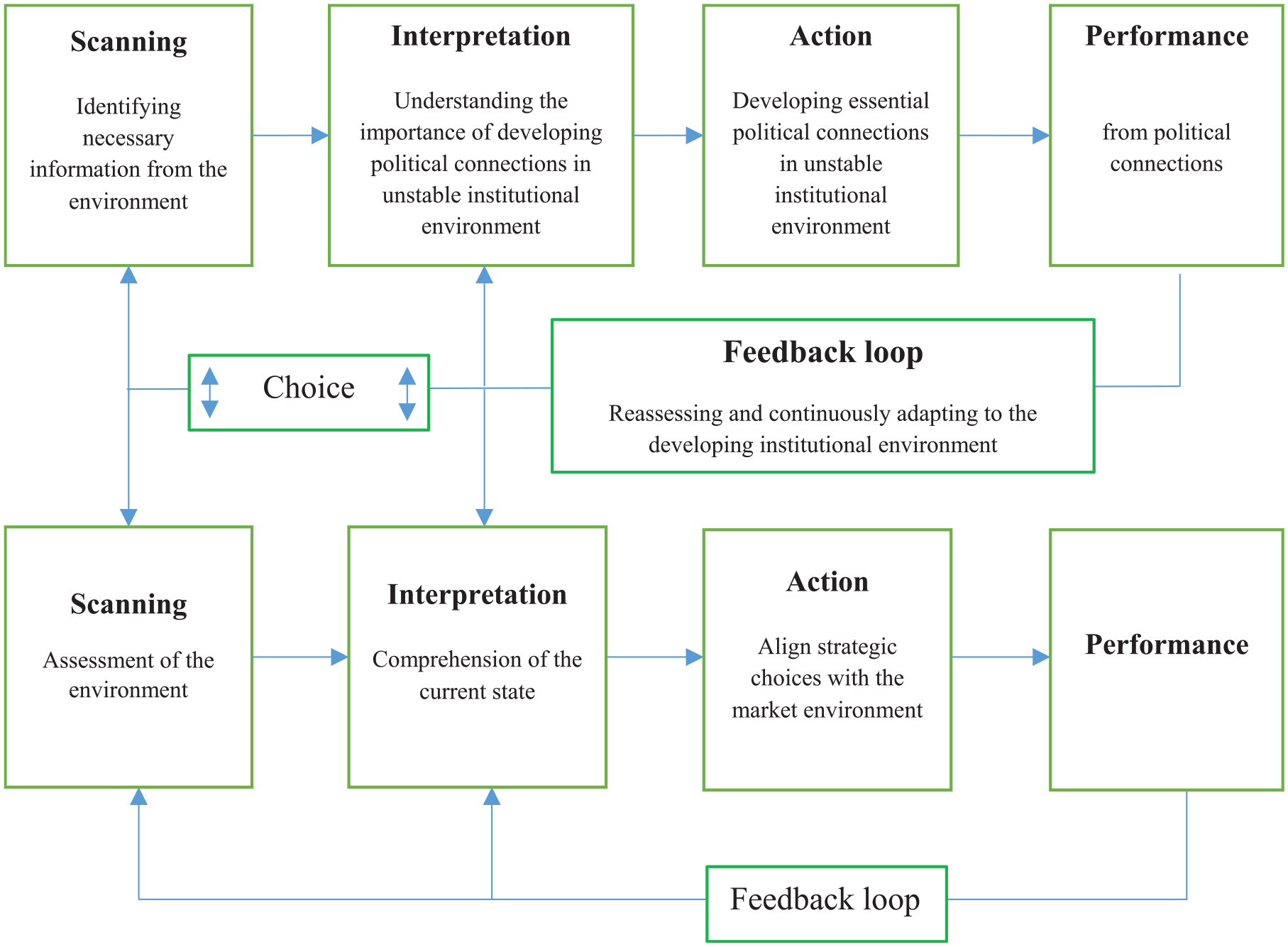
Strategic sensemaking processes and the role of political networking.
The growth of emerging economies is accompanied by strengthened institutional regimes that support private property rights and encourage investments through more stable business environments (Kim & Song, 2017; Meyer & Peng, 2016). Strengthened institutions create a level playing field for new entrants, thereby reducing the salience of political networking and allowing for evolution into legitimate public–private partnerships (Govorun et al., 2016; Vertakova & Plotnikov, 2013). Nevertheless, firms and industries that are deemed strategically important to the government maintain these networks through the aforementioned partnerships (Bychkova, Chernysh, & Popova, 2015; Chen et al., 2010), as observed from the continuous and ongoing support for Biotec and C-DOT from the Russian and Indian governments, respectively.
Conclusion
This article moves beyond single-level or cross-sectional approaches of the strategic sensemaking model (Rouleau & Balogun, 2011; Sheng, 2017; Thomas et al., 1993) to offer a detailed empirical enquiry into the stages of strategic sensemaking in the unstable emerging market context. We argue that the process of strategic sensemaking is continuous and very much dependent on cyclical adjustments connecting the performance part of strategic sensemaking via the feedback loop to scanning and interpretation. Far from being a one-time occurrence, strategic or environmental sensemaking is a process that runs in accord with the continuous environmental changes. This process is best observed in emerging countries, where the liberalization of markets creates complexities that force organizational adjustments (Bamiatzi, Bozos, Cavusgil, & Hult, 2016; Marquis & Raynard, 2015) through environmental sensemaking processes. The second major contribution of this study is to integrate political networking to the strategic sensemaking process in environments where the institutional changes are transformational, radical, and fundamentally alter the environment at its core (Greenwood & Hinings, 2010; Kostova & Hult, 2016; Newman, 2000). The study aims to demonstrate how political connections become an integral part of the equation for firms that aim to gain a competitive advantage in changing institutional environments. Finally, the third major contribution is to demonstrate that there is a negative correlation between the formal institutional environment and the prominence of political networks; that is, strengthening the formal institutional environment results in weakening the relevance of political networks.
This research holds a number of important implications for practitioners, decision makers, and researchers. Practitioners may find this research useful insofar as comprehending the nature of a business environment that is so unstable that it requires informal networks to maintain understanding and legitimacy, as in the dynamic environments that characterize emerging markets. Informal networks are not only prevalent in the interorganizational and personal spheres, but with the ultimate decision makers. Often, those organizations that manage to maintain these links with decision makers are protected by high-entry barriers imposed on outsiders. Decision makers should devote more attention to these practices and ideally seek to separate the locus of politics from business to create opportunities for outsiders and enhance competition. As indicated by the literature and practice, a well-functioning business environment that rewards firms for their efficiencies and competitiveness is far more beneficial to the economy than an environment that relies on informal networks. Finally, this article extends research into the highly contentious context of the overembeddedness of politics in business. Through extensive analysis of two emerging market firms, this research demonstrates the feedback loop from performance back to scanning and interpretation that consequently drives action, according to the newly introduced institutional changes in dynamic environments. The process is not repetitive—as institutions develop and lower the requirement of informal institutions, such as networking, there remain avenues for legitimate political–business relations. Thus, firms have a further strategic choice to either follow close collaboration or engage in specialization within the improved market environments.
Several limitations and unanswered questions warrant further discussion. First, the study relied on a cross-sectional design and self-reported data. A cross-sectional design prevents causal inferences. Although our data were obtained despite the aforementioned difficulties in conducting research in this highly important field from senior management in high-context environments, there may be concerns over possible undetected common method bias. These limitations require further research using longitudinal designs that employ more objective methods. Second, the data were collected from two firms in two emerging countries. Further research should generalize or negate these findings in other contexts from further samples. Finally, we have solely examined the prominence of political networks in the strategic sensemaking processes. Further research should investigate whether other types of networks, such as inter-firm relationships, aid in the sensemaking processes.
Footnotes
Declaration of Conflicting Interests
The author(s) declared no potential conflicts of interest with respect to the research, authorship, and/or publication of this article.
Funding
The author(s) received no financial support for the research, authorship, and/or publication of this article.
