



Abstract
Values are pivotal to institutions. Although prior research has mostly highlighted their positive effects, values also have a “dark” side, which we illuminate by looking at cases in which values perpetuate societal grand challenges, such as corruption or climate change. Societal deliberation plays an important role in efforts to change such values. In this essay, we explore how institutional scholars can produce insights that support societal deliberation on values that perpetuate grand challenges. We develop a framework on how institutional scholars can support such deliberation by analyzing (1) which alternative values are attainable and (2) how dominant values create trade-offs. By using this framework, institutional researchers can take a middle position between activist research on values, which jeopardizes the independence of research, and detached research on values, which loses the connection to practical concerns.
Introduction
Values are pivotal to institutions: they generate meaning and bonds to institutions and enable and constrain practices. Values-focused institutionalists define values as collective “beliefs about the things that are worth having, doing, and being” (Kraatz & Flores, 2015, p. 356). Values “carry a normative weight” and “people experience values as moral imperatives and use them to judge the world, each other, and themselves” (Kraatz et al., 2020, p. 477).
Although prior research has mostly highlighted their positive effects, values “also have a dark side that cannot be ignored” (Kraatz et al., 2020, p. 497). Specifically, as a result of their centrality to institutions, values can perpetuate societal grand challenges—the complex, uncertain, and evaluative problems that societies face (Ferraro et al., 2015). For example, in Sicily, the traditional value of “respect” for the Mafia helped perpetuate the highly institutionalized practice of paying protection money to Mafiosi (Vaccaro & Palazzo, 2015). Similarly, the value of professional expertise, which insulated chemists in academia and in the industry from outsiders who “just don't understand” (Howard-Grenville et al., 2017, p. 552), reinforced highly institutionalized practices connected to the grand challenge of chemical pollution. These examples show that values can perpetuate grand challenges such as poverty, climate change, or corruption and point to “an obvious need (and opportunity) for research” on the dark side of values (Kraatz et al., 2020, p. 497).
Tackling grand challenges may require that societies change their values. For example, overcoming the practice of paying protection money in Sicily only became possible because activists fostered changes in the values of the locals who started to associate such payments with a lack of “dignity” (Vaccaro & Palazzo, 2015, p. 1079). Similarly, the first steps toward reducing chemical pollution and transitioning to green chemistry were only possible because a small group of chemists triggered changes in the values of their peers toward the alternative value of “human, ecological, and societal well-being” (Howard-Grenville et al., 2017, p. 551). However, changing the values that underpin an institution is difficult because actors tend to regard values and practices associated with these institutions as immutable (Deephouse & Suchman, 2008; Vaccaro & Palazzo, 2015, p. 1077).
One important way in which societies can change their values is through deliberation (Fishkin, 2009; Habermas, 1996; Marti & Scherer, 2016). Although values are often expressed intuitively, there is also room for deliberation (Haidt, 2012; Pizarro & Bloom, 2003). Haidt (2012, p. 55) shows that other people “can do for us what we cannot do for ourselves: they can challenge us, giving us reasons and arguments […] that sometimes trigger new intuitions.” Indeed, deliberation can help explain something that intuitions cannot: “that morals evolve” (Bloom, 2010, p. 490). In this paper, we ask: How can institutional scholars produce insights that support societal deliberation on values that perpetuate grand challenges? Institutional research on values is well-positioned to produce insights that matter for societal deliberation because values are a “boundary object” that has meaning in both the scientific community and in society more broadly and can therefore help span the “stubborn gap between the worlds of theory and practice” (Kraatz et al., 2020, p. 496).
To answer our central question, we develop a framework that outlines two pathways through which institutional scholars can support societal deliberation on values that perpetuate grand challenges. The first pathway involves identifying which alternative values are attainable and which are not. To do so, scholars analyze how values interact with other elements of social reality, such as cognitive or regulative elements. The second pathway involves understanding the trade-offs around dominant values. To do so, scholars analyze how dominant values influence the distribution of benefits and burdens within society. We draw on the work of Mair et al. (2016) and Whiteman and Cooper (2016) to illustrate these two pathways.
Our essay has important implications for the role of institutional researchers in society. The framework we develop builds on the idea that societies, not researchers, should judge which values should guide different areas of social life. Researchers can support societal deliberation on values but do not decide on behalf of society what values are right and wrong. We take a middle position between activist research on values, which jeopardizes the independence of research (Burawoy, 2005), and detached research on values, which loses the “connection to the practical concerns that originally motivated” research on values in the first place (Thacher, 2015, p. 317). We hope that this middle position will help alleviate the “uneasiness” that management researchers experience around “values-laden implications” (Etzion & Gehman, 2019, p. 489).
Values, Institutions, and Societal Deliberation
In this section, we make three interrelated points to outline the theoretical background on which we base the framework we develop in the next section. First, we show that values underpin institutions and thereby influence social practices. Second, we show that, because values are a key part of institutional contexts, values can perpetuate grand challenges and spur societal efforts to problematize and change these values. Third, we show that societal deliberation is key to efforts to change values that perpetuate grand challenges. Figure 1 illustrates these three points.
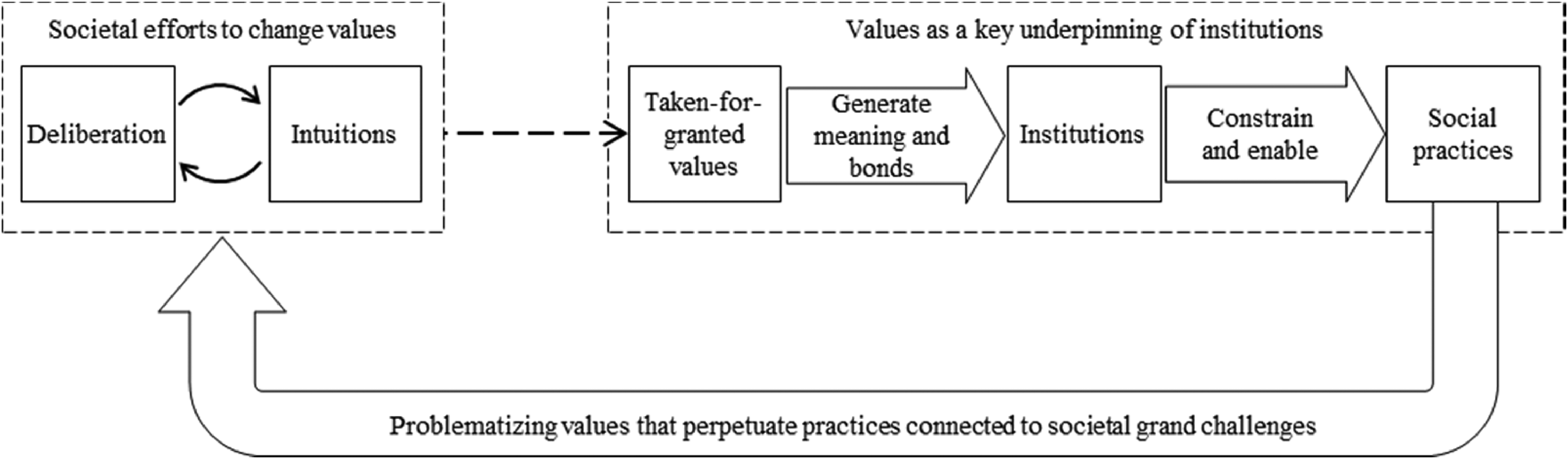
How values perpetuate grand challenges and how actors respond.
Values as a Key Underpinning of Institutions
Research on values can advance our understanding of the relationships between institutions and actors. Specifically, values-focused institutionalism suggests that values are essential to institutions because of two properties.
First, taken-for-granted values generate meaning and bonds to institutions (see Figure 1). Values hold the potential to make actors’ lives appear meaningful and “infuse” their practices with a purpose (Kraatz et al., 2020). According to Selznick (1957), institutions serve “as vehicles for the realization of substantive values” and provide “a response to ‘human needs’ of a more distinctly psychological and existential variety” (Kraatz, 2020, p. 487). Values bond humans to societal institutional structures that influence their choices. Actors who identify with the values that are ingrained in society's institutional structures feel more connected to those structures and are more likely to align their agency choices with them (Fan & Zietsma, 2017; Zietsma & Toubiana, 2018).
Second, values constrain and enable social practices (see Figure 1). Values play a key “role in motivating and directing action” (Kraatz et al., 2020, p. 485). At the microlevel, values influence the behavior of individual actors. For example, Dashwood (2014) shows that values shape managers’ worldviews and identities and can thereby influence whether managers behave responsibly or not. At the meso level, values affect organizational behavior. For instance, in their study on decoupling in banks, Haack et al. (2012) demonstrate that the practice of decoupling was abandoned when bank employees started to enact values to which banks initially aspired only ceremonially. At the macro level, values enacted in an institutional context shape entire organizations. For example, Matten and Moon (2008) argue that whether firms make their corporate social responsibility explicit or keep it implicit depends on the values that dominate the institutional context.
Problematizing Values that Perpetuate Societal Grand Challenges
Although values often play a positive role, they also have a “dark side” that institutional researchers have not sufficiently acknowledged (Kraatz et al., 2020, p. 497). To illuminate this dark side, we focus on societal grand challenges. As a key motivator of social practices, values can end up perpetuating societal grand challenges. For example, as already mentioned, the traditional value of “respect” for the Mafia perpetuated the highly institutionalized practice of paying protection money (Vaccaro & Palazzo, 2015), while the value of professional expertise reinforced highly institutionalized practices connected to the grand challenge of chemical pollution (Howard-Grenville et al., 2017). These examples indicate that grand challenges are evaluative by “cutting across jurisdictional boundaries, impacting multiple criteria of worth and revealing new concerns even as they are tackled” (Ferraro et al., 2015, p. 364, our emphasis). Grand challenges are always infused with multiple values and these values serve as a common reference point when different actors interact in relation to these challenges (Risi, 2022).
To overcome grand challenges, the actors concerned may problematize dominant values and advocate alternative values. That values can become the object of critique reflects the fact that values always have distributive implications. In some cases, values are institutionalized collective beliefs that serve the interests of many groups. Selznick (1992, p. 37) refers to precisely such cases when he argues that a “moral order” emerges from “problem-solving by human communities.” He notes that value-laden terms such as “murder” or “betrayal” are “outcomes of collective problem-solving […] and […] point to important truths regarding human nature and the requirements of group life” (Selznick, 1992, p. 129). Values, however, can also emerge as a “solution” that helps resolve the “problems” of specific groups to the detriment of other groups. For example, when Indo-Aryan people invaded India around 1000 BCE, they succeeded in institutionalizing the value of “purity” to reinforce a caste system that allowed them to suppress the local population (Harari, 2014). Such values are more likely to become problematized as actors realize that they perpetuate the grand challenges actors face.
To problematize dominant values and institutionalize alternative values, actors need to influence the values of other actors. For example, to tackle the practice of paying protection money, the activists in the study of Vaccaro and Palazzo (2015) tried to influence the values of consumers, entrepreneurs, students, the police, and civil society at large. To understand how actors can influence the values of other actors, it is necessary to comprehend how societal deliberation can lead to changes in values.
Why Societal Deliberation can Influence Values
At different points in time, moral psychologists have argued that societal efforts to change values depend on either intuitions or deliberation. In the second half of the 20th century, rationalist approaches dominated moral psychology (Haidt, 2012; Sonenshein, 2007). The assumption underlying these approaches was that actors faced with questions relating to values make moral calculations and draw on philosophical principles (e.g., Kohlberg, 1969). At the beginning of the 21st century, moral psychology shifted from highlighting the role of deliberation to highlighting the role of intuitions (Haidt, 2003). Haidt (2001, p. 815), for example, put forward a “social intuitionist model of moral judgment” that took a stance against rationalist approaches to moral psychology. According to this model, intuitions influence the values of actors more strongly than deliberation does. Haidt (2012) concluded that people search for arguments in line with their intuitions and, importantly, that even when these arguments are disproved, they hardly ever change their intuitions. On that basis, Haidt (2001) has shown that intuitions shape deliberation.
Since then, many moral psychologists have realized that both intuitions and deliberation influence societal efforts to change values. This insight emerged because, in the context of groups, deliberation can become critical. Haidt acknowledged the possibility of “reasoned persuasion”; that is, the attempt to justify an “already-made moral judgment to others” (Haidt, 2001, p. 818). Experiments have shown that reasoned persuasion can change the values of actors (Haidt, 2012; Pizarro & Bloom, 2003). Haidt (2012, p. 55) concludes that other people “can do for us what we cannot do for ourselves: they can challenge us, giving us reasons and arguments […] that sometimes trigger new intuitions.” Given that values are always tied to emotions, reasoned persuasion is not merely about “providing logically compelling arguments,” but also involves “triggering new […] intuitions in the listener” (Haidt, 2001, p. 818). Reasoned persuasion closes the loop between deliberation and intuitions: intuitions shape deliberation, but in collective contexts, deliberation may also shape intuitions (see Figure 1).
Reasoned persuasion is not all that common; however, it is consequential. Haidt (2003) estimates that less than one percent of all moral judgments will involve in-depth reasoning. Nevertheless, as Pizarro and Bloom (2003) point out, even if deliberating on values is relatively rare, a short episode of deliberation can change the course of one's moral “autopilot” for a long time after that. Bloom (2010, p. 490) argues that models focusing only on intuitions “cannot explain one of the most interesting aspects of human nature: that morals evolve.” Notably, according to Singer (2011, p. 191), the “process of overcoming […] early prejudice […] involves our ability to reason”—in other words, it is a process of reasoned persuasion.
Over the last 200 years, values have been evolving in many parts of the world and, as a result, the “circle of moral concern” (Singer, 2011, p. 191) has become broader. For example, slaves have become part of the circle of moral concern and, as a result, slavery has been reduced (but see Crane, 2013 on modern slavery). Another example is that the “situation of women and of homosexuals changed radically” for the better in some parts of the world, which Rorty (1999, p. 246) describes as one of “the most lasting and significant moral achievements of the twentieth century.” More recently, the view that animals enjoy certain rights has gained traction in parts of the Western world (Singer, 2015).
Overall, research in moral psychology shows that while values are often expressed intuitively, there is also room for deliberation. Deliberation can help societies rethink values to make them serve the interests of more groups. Although deliberation does not overcome power relations (Edward & Willmott, 2008; Mouffe, 1999), it mitigates the effects of existing power relations because deliberation requires that actors develop justifications that take into account the views and interests of other actors (Fishkin, 2009; Forst, 2012; Habermas, 1996). Having established the importance of deliberation on values, we next explore how institutional scholars can generate insights that support such deliberation.
Developing Insights that Support Societal Deliberation on Values
We outline two pathways through which institutional scholars can develop insights that support societal deliberation on values that perpetuate grand challenges. Figure 2 illustrates our framework.
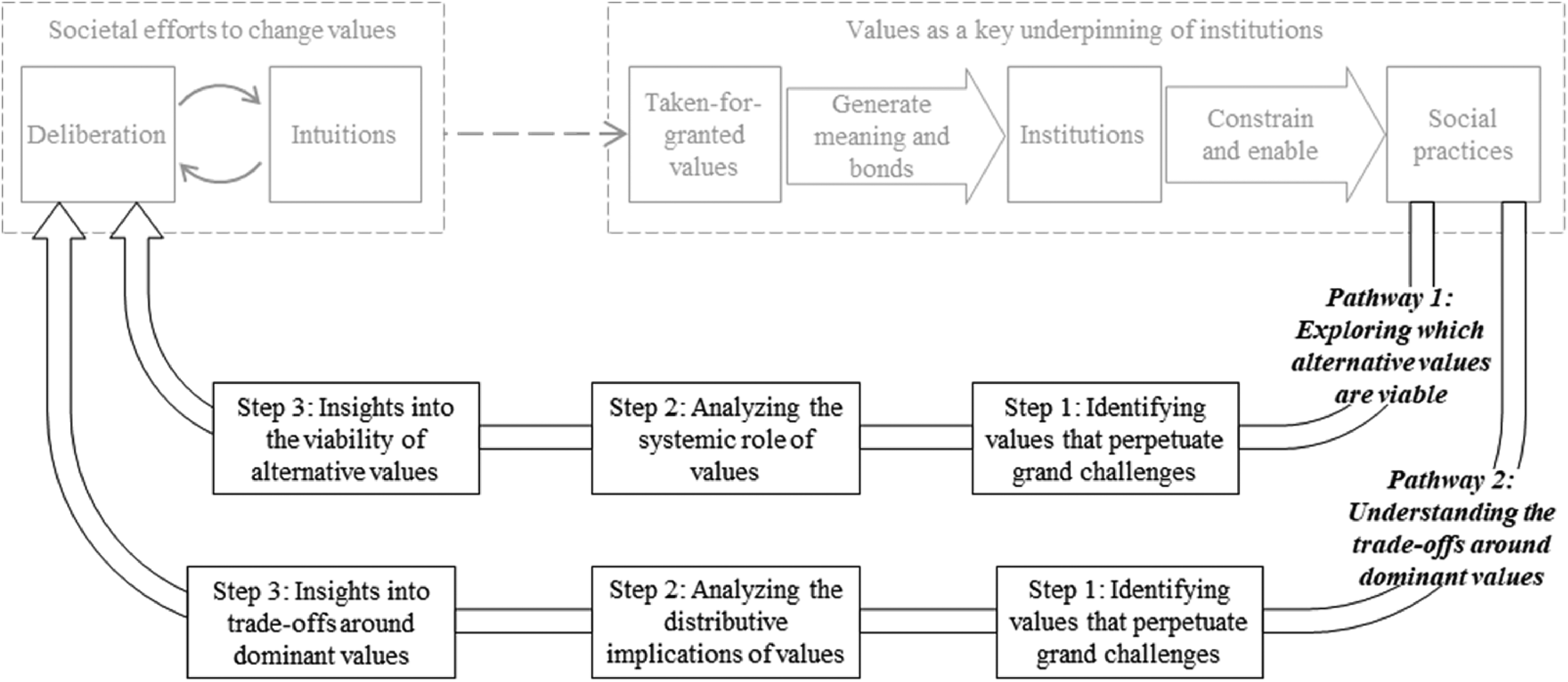
Two pathways toward scholarly insights that support societal deliberation on values.
Exploring Which Alternative Values are Attainable
In the first pathway, scholars support societal deliberation on values by providing insights into the attainability of alternative values. Such insights matter because even if actors are willing to attain a value, they may not be able to do so because of social dynamics that lie outside their control. For example, coordination problems or mistrust may undermine the attainability of alternative values even if actors are willing to realize them. Exploring the attainability of alternative values thus means investigating the social dynamics that determine whether willing actors are able to attain specific alternative values.
To illustrate this pathway, we use a case study by Mair et al. (2016). This study draws on interviews and observations to investigate how a nongovernmental organization (NGO) called Gram Vikas successfully confronted social inequality in rural Indian villages by building water and sanitation infrastructure. The NGO initially contacted local elites, which rank high in the Indian caste system. By demonstrating to these elites how human waste from the households of lower castes ended up in the water that everybody used for drinking and washing, the NGO persuaded elites that all households would have to be included in the new water and sanitation infrastructure. Through this approach, the NGO managed to provide members of the lower castes with access to clean water and safe sanitation and established governance systems for the new water and sanitation infrastructure that included members from all castes. The NGO thereby helped transform existing social structures that contributed to social inequality.
Identifying values that perpetuate grand challenges
In Step 1 of our framework, institutional scholars identify values that perpetuate grand challenges (see Figure 2). To that end, they examine whether any particular institutionalized practices contribute to a particular grand challenge and, if so, whether these practices are guided by certain dominant values. In this step of our framework, institutional scholars also identify alternative values to the dominant ones. Dominant values often compete with alternative values (Greenwood et al., 2011). Although dominant values are shared by most actors within a specific social context, alternative values are held only by a few actors. In line with the definition of Kraatz and Flores (2015, p. 356), alternative values highlight novel things worth having, such as “alternatives to alcohol” (Hiatt et al., 2009, p. 647), novel things worth doing, such as practices inspired by a new honor code (Gehman et al., 2013), and novel things worth being, such as being a Mafia-free society (Vaccaro & Palazzo, 2015).
The study by Mair et al. (2016) helps illustrate Step 1 of our framework. Mair et al. (2016, p. 2021) focus on the caste system, an institution that is both dominant and “central to entrenched inequality in India.” The value of purity helps explain the divide between different social groups in India (Dehghani et al., 2016; Haidt, 2012; Haidt & Joseph, 2004). Values that “define and prescribe what is clean and what is dirty” matter because they “delimit judgment about objective reality, provide scripts for behavior and interaction, and act as evaluative devices that govern daily life” (Mair et al., 2016, p. 2024). Purity provides a God-given justification for the fundamental inequality between castes. According to this belief, people belong to a certain caste and can only change caste affiliation through reincarnation. The segregation between different castes is not restricted to unequal obligations and rights but also extends to spatial separation. For example, superior castes are convinced that they will risk their purity and superiority if they use the same water sources as inferior castes. Table 1 summarizes the key aspects of the study by Mair et al. (2016).
Overview of the Two Case Studies That Illustrate Our Framework.
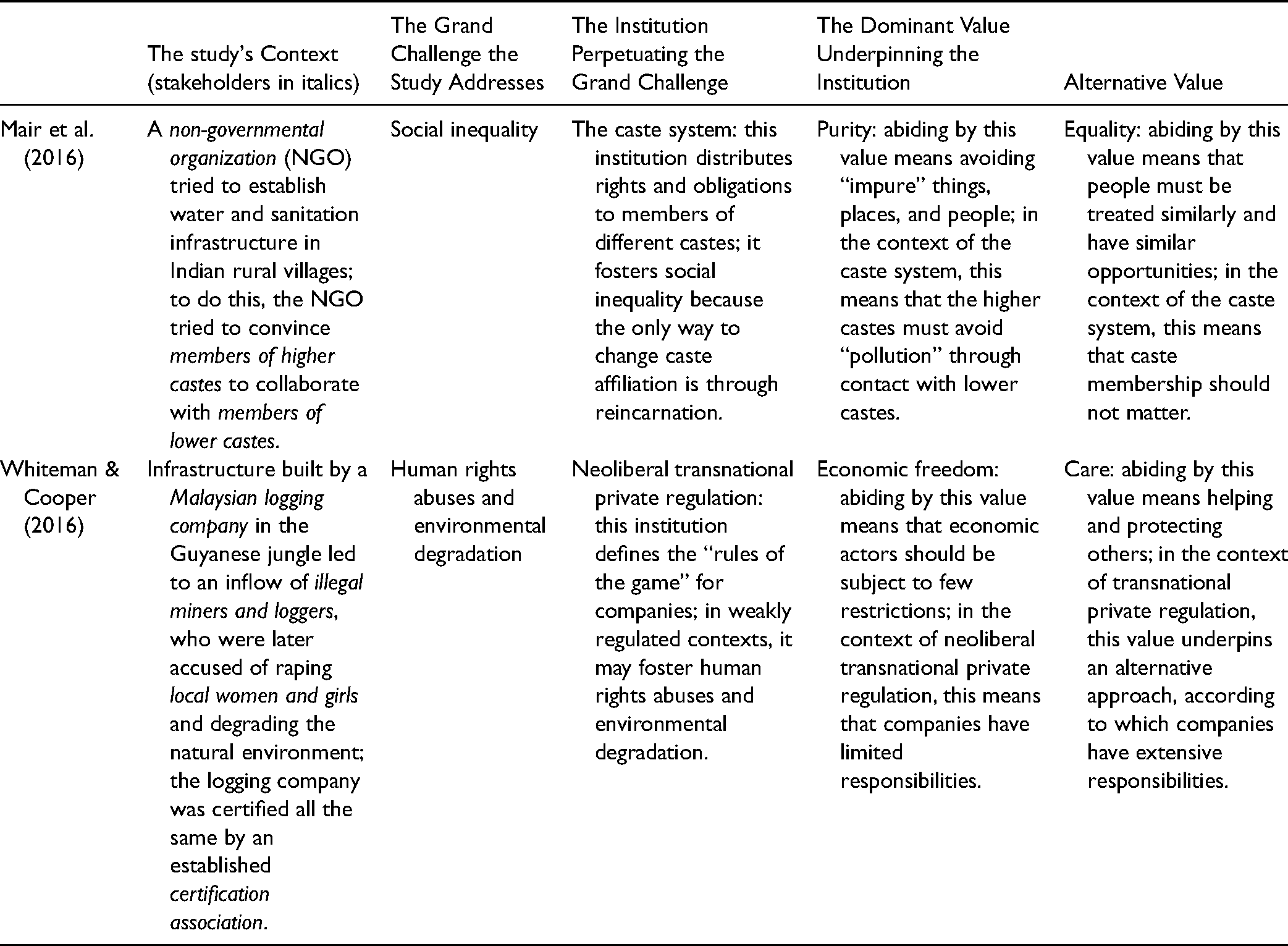
Mair et al. (2016) identify purity as a key value that perpetuates the grand challenge of social inequality in India and explore how a group of actors tried to change this value. They focus in particular on the work of Gram Vikas, an NGO that since 1991 has tried “to provide every household in a village—regardless of the social category to which the household belongs—with piped drinking water and a separate toilet and bathing room” (Mair et al., 2016, p. 2026). This NGO has an explicit normative agenda. Although the water and sanitation program is at the forefront of this agenda, the NGO's ultimate aim is to overcome the deeply rooted inequalities that result from the caste system and affect the well-being of numerous people in many Indian villages. More specifically, the NGO tried to convince local elites to join an inclusive water and sanitation program that included all castes. Through these programs, the organization promoted the novel value of equality in rural Indian villages, while undermining the caste institution and the underlying value of purity.
Analyzing the systemic role of values
Step 2 of our framework requires that institutional scholars analyze the systemic role of the values that perpetuate grand challenges. This step is necessary because values do not exist in isolation but are connected to other elements of social reality. In addition to the normative pillar, of which values are a component, institutions also contain cultural-cognitive and regulative elements (Scott, 2014). These different institutional elements are “autonomous and ‘loosely coupled’” and frequently exhibit “ongoing (and often deep) tensions between them” (Kraatz et al., 2020, p. 477). We agree with Kraatz and Flores (2015, p. 356) that while “values are real and consequential [this] is not to say that they are the only things that matter.” Analyzing the systemic role of values enables researchers to clarify how values interact with other elements of social reality (such as other values, cultural-cognitive beliefs, or regulations). Researchers can thereby explore the degree to which changes in dominant values might destabilize the entire structure.
The study by Mair et al. (2016) illustrates Step 2 of our framework. A unique insight that can be gained from their study is that the value of purity imposes spatial boundaries between people so that members of lower castes do not “contaminate” members of higher castes. As we explained, members of higher castes believe that their “purity” would be tainted if they used the same water sources as members of lower castes. The NGO Gram Vikas pointed out to local elites that if water programs do not include 100 percent of households, some families will continue polluting the water that everybody drinks. As Mair et al. (2016, p. 2033) point out, including even the poorest families in the NGO's water and sanitation programs meant that members of the higher castes would no longer have to “drink Dalit [i.e., the lowest caste's] shit.” Mair et al. (2016) used a systemic analysis of values to show that the value of purity stood in a conflict-laden relationship with modern hygiene practices.
Drawing on their account of how values interact with other parts of social reality, Mair et al. (2016) show how the NGO Gram Vikas exploited the conflict between specific values and modern hygiene practices to convince local elites to participate in socially inclusive water sanitation programs. Indeed, to ensure full participation, the NGO demanded that each village sponsored participatory decision-making processes that involved all castes. In a nutshell, Mair et al. (2016) show how the NGO mobilized modern hygiene practices to advance the value of equality in rural Indian villages.
Insights into the attainability of alternative values
In Step 3 of our framework, we focus on how the systemic analysis of values can promote deliberation on values. When discussing values, an important objection may be that some values are not attainable. In this view, “normative arguments risk being simply pipe dreams—diverting, but in the end making little difference” (Black, 2008, p. 137). This is a valid objection. If values are solutions to collective problems (Selznick, 1992), some of these solutions may simply not work and thus not be desirable ideals to strive for. Institutional scholars can explore whether some values—particularly “precarious values” (Kraatz et al., 2010, p. 1521)—are attainable or not. Empirical evidence on how and why it has been possible to replace “problematic” values with certain alternative values in specific contexts can help support arguments against the objection that the pursuit of these alternatives is a “pipe dream.” Actors who engage in societal deliberation on values could use these insights to convince skeptics that it is possible to displace dominant values that are problematic and replace them with alternatives that help overcome grand challenges.
Institutional scholars can derive such insights through their systemic analysis of values (Step 2). Understanding how values are connected to other elements of social reality enables scholars to explore whether it is possible to mobilize these other elements to effect a shift from dominant values toward alternative values. Put differently, by viewing values as embedded within broader social reality, institutional scholars will be able to question the taken-for-grantedness of dominant values and derive insights into which alternative values can be feasibly attained.
The study by Mair et al. (2016) helps illustrate Step 3 of our framework. A key question on how to improve lives in the rural areas the study examines is whether inequality is surmountable or not. Many actors in Indian society believe that it is not possible to abolish the caste system (Banerjee et al., 2015; De Haan, 2004) and, by extension, social inequality. Through their systemic analysis of values, Mair et al. (2016) show how the alternative value of equality relates to a broader demand for clean water and how an NGO used the connection between equality and access to a water sanitation program to convince local elites of the benefits of this alternative value. In the context of societal deliberation on values, the insights gained from this empirical study could be used by actors who try to change the values that perpetuate the grand challenge of social inequality. These actors could use this insight to show that although the value of equality may not resonate with many local people initially, it is systematically connected with clean water: an issue that most people appreciate. By showing such connections, actors who engage in societal deliberation on values may motivate other actors to endorse values that the latter initially did not consider attainable. In sum, the study by Mair et al. (2016) outlines how institutional scholars could derive insights that stimulate societal deliberation on values.
Understanding the Trade-Offs Around Dominant Values
In the second pathway of our framework, scholars support societal deliberation on values by developing insights into the trade-offs around dominant values. Dominant values influence the distribution of benefits and burdens within society—often benefitting more powerful actors and burdening weaker actors. To help change these values, researchers can make explicit the trade-offs around dominant values and thereby help society rethink which values should guide various areas of public life.
To illustrate this pathway, we use the ethnographic study by Whiteman and Cooper (2016) on a multinational Malaysian forestry company that operated in the rain forest of Guyana, a small South American country. Whiteman and Cooper (2016) document how this company's operations led to grave human rights violations and environmental degradation. For example, the company built roads into parts of the jungle that were not previously accessible, enabling illegal miners and loggers to enter the jungle. Later, both the illegal miners and loggers and some of the logging company's employees were accused of raping local women and girls and degrading the natural environment. Despite the grave human rights violations and environmental damage, the forestry company received certification by the Forest Stewardship Council (FSC), which helped it expand its market and gain legitimacy. Whiteman and Cooper (2016) use this case to problematize decoupling that involves transnational private regulation schemes, such as the FSC.
Identifying values that perpetuate grand challenges
Again, identifying the dominant values that perpetuate specific grand challenges is the starting point of the second pathway of our framework (Step 1 in Figure 1). Whiteman and Cooper's study (2016) illustrates this step (see Table 1). The authors examine the institution of transnational private regulation, which defines the “rules of the game” for companies. Specifically, Whiteman and Cooper (2016) focus on the neoliberal variant of transnational private regulation. The authors used their case study of the Malaysian forestry company whose operations led to human rights violations and environmental degradation to argue that neoliberal transnational private regulation may perpetuate societal grand challenges in weakly regulated contexts.
Neoliberal transnational private regulation builds on the value of economic freedom (Friedman, 2002; Hayek, 1944). Private regulation schemes such as the FSC are rooted in the neoliberal idea of “free trade” (Bartley, 2007, p. 312). The value of economic freedom is central to the institution of neoliberal transnational private regulation because it is this neoliberal value that shapes “the trajectory of institution building” and promotes “the rise of private regulatory forms” (Bartley, 2007, p. 310). Economic freedom stresses that restrictions on any economic activity should be limited. In the context of transnational private regulation, upholding this value often means that companies are not held responsible for the indirect or unforeseeable negative consequences of their activities. This dominant value competes with the alternative value of caring and therefore helping and protecting others (Gilligan, 1982; Kittay, 1999). In the context of transnational private regulation, upholding the value of care means that companies have extensive responsibilities, which include actively gathering information about the actual and potential consequences of their actions (Young, 2006).
Analyzing the distributive implications of values
Step 4 of our framework involves analyzing the distributive implications of values. This analysis aims to map how values influence the distribution of benefits (such as material goods or status) and burdens (such as hard work and risks) within society (Rawls, 1971). To grasp the distributive implications of values in all their facets, researchers pay particular attention to the interests of vulnerable and disadvantaged groups that are often invisible (Alvesson & Willmott, 1992). For example, management decisions based on the value of profit maximization have consequences for different stakeholders, including vulnerable and weak stakeholders. Importantly, the question of whether a value ultimately benefits or burdens a group depends on the specific context, so it is not possible to generalize the results of such analyses. For example, a value that helps solve problems in some countries may contribute to problems in another country. The distributive implications of values may depend, among other things, on the level of economic development in society (Cunningham, 2000; Khan et al., 2007). In sum, this step suggests that researchers explore the distributive implications of particular values in particular contexts.
The paper by Whiteman and Cooper (2016) illustrates how scholars can analyze the distributive implications of values. Whiteman and Cooper (2016) show that neoliberal transnational private regulation, which builds on the value of economic freedom, has far-reaching implications for the distribution of benefits and burdens within the Guyanese jungle. The suffering of local populations that Whiteman and Cooper (2016) detailed in their study highlights an important distributive implication of the value of economic freedom, which underpins neoliberal transnational private regulation. Although this implication is specific to this context, the insight gained from their analysis suggests that neoliberal transnational private regulation may have similar distributive implications in other countries with weak regulation. By contrast, in countries with stronger regulation, the value of economic freedom may not have such negative implications because functioning governments tend to promote responsible business behavior (Campbell, 2007).
Although the analysis by Whiteman and Cooper (2016) identifies some of the distributive implications of the value of economic freedom, it is not exhaustive. In response to that paper, Greenwood et al. (2017) pointed out further important distributive implications of this value. In their response, Greenwood et al. (2017, p. 96) argue that extending the scope of responsibility, which follows from the value of care, could mean that “organizations would be encouraged to hide past indiscretions instead of explicitly acknowledging and learning from past mistakes.” Such limits to organizational learning may create more victims in the future because companies did not learn from the past. Furthermore, Greenwood et al. (2017) argue that extending the scope of responsibility could lead companies to become overly cautious and forego business opportunities that would have created jobs. The arguments that Greenwood et al. (2017) put forward highlight the importance of examining the full range of distributive implications of the value of economic freedom in the context of transnational private regulation.
Insights into trade-offs around dominant values
In Step 5 of our framework, researchers utilize the findings of distributive analyses of values to advance societal deliberation on values. After conducting such analyses, institutional scholars can develop insights into the trade-offs around dominant values. Gaining insights into these trade-offs requires empirically demonstrating how dominant values will benefit certain groups but, at the same time, burden others. Such trade-offs may affect various societal groups in different countries (Pogge, 2008) or generations (Slawinski & Bansal, 2015). Insights into such trade-offs can inform societal deliberation on values and guide efforts to replace a dominant value with an alternative value.
To illustrate Step 5 of our framework, we draw again on the paper by Whiteman and Cooper (2016). Our starting point is that the governing bodies of organizations concerned with transnational private regulation often involve different stakeholders with different views on how particular regulations should evolve (Bartley, 2007; Mena & Waeger, 2014; Reinecke, 2010). For example, in their study of the self-regulatory body of a fair trade organization, Reinecke and Ansari (2015) show that different stakeholders engaged in deliberation to determine the minimum prices that local farmers should receive for their goods. This deliberative process enabled stakeholders to “‘flag up’ issues of concern that require special attention” (Reinecke & Ansari, 2015, p. 874), including concerns about how neoliberal transnational private regulation could harm specific actors. This is where the trade-offs that Whiteman and Cooper (2016) highlight become relevant. Whiteman and Cooper (2016) show that transnational private regulation is not universally beneficial: while specific regulations may benefit some actors, they may harm others. Indeed, Whiteman (2010, p. 329) notes that she sent reports of her “research to the government, media, and non-governmental organizations, to share findings that have relevance to the public debate on these issues.”
Actors involved in transnational private regulation could mobilize the insights that Whiteman and Cooper (2016) have gained to argue that the value of care would underpin transnational private regulation more effectively than the value of economic freedom does. On this basis, actors could push for an alternative approach to transnational private regulation. This approach would build on the value of care and thus extend the scope of social responsibility that companies have. Such an approach would be in line with the argument of philosopher Iris Marion Young that powerful actors, such as companies, contribute to injustices through their widespread activities and should, therefore, “take responsibility for altering [… their operations] to avoid or reduce injustice” (Young, 2004, p. 379). At the same time, companies have the moral responsibility to “acquire more specific knowledge” (Young, 2004, p. 372) of the causes of injustice and are expected “to contribute to organized efforts to correct them” (Young, 2004, p. 387). Overall, actors involved in transnational private regulation can use insights from research into the trade-offs around dominant values to argue that the alternative value of care should underpin that institution.
Discussion and Conclusion
We started this essay by arguing that values are one of the key underpinnings of institutions because they generate meaning and bonds to institutions and enable and constrain social practices. As a result of their centrality to institutions, values can perpetuate societal grand challenges. To address this “dark” side of values, societal actors may engage in deliberation to rethink values that perpetuate grand challenges. Institutional research can provide insights that support societal deliberation on values because values are a “boundary object” (Kraatz et al., 2020, p. 496) that matters to both the scientific community and society at large. Specifically, our framework suggests that institutional scholars can support societal deliberation on values by shedding light on (1) which alternative values are attainable and (2) how dominant values create trade-offs. Overall, these two pathways can help span the “stubborn gap” (Kraatz et al., 2020, p. 496) between research and practice.
Our framework builds on the idea that societies, not researchers, should judge what values ought to guide different areas of social life. Values evolve over time (Selznick, 1992). In this evolution, episodes in which societies explicitly deliberate on values are brief but consequential: By involving all societal actors, societal deliberation can change values so that they better reflect the experiences and interests of all societal actors. In our framework, researchers support societal deliberation on values but do not decide on behalf of society what values are right and wrong. This stance is in line with the views of philosophers such as Forst (2017), who argue “that research can only play a supporting role for societal deliberation on normative ideas because neither social scientists nor philosophers can decide on society's behalf about which normative ideas are right” (Marti, 2018, p. 1350).
Our framework takes a middle position between activist and detached research on values by outlining how institutional researchers can provide insights that support societal deliberation on values. Activist research on values describes cases in which researchers actively promote certain values; this approach, however, jeopardizes the independence of research and the production of intersubjectively reproducible knowledge (Burawoy, 2005). Detached research, by contrast, describes the approach of treating values merely “as data” (Thacher, 2015, p. 322); such research, however, loses the “connection to the practical concerns that originally motivated” research on values (Thacher, 2015, p. 317). In our essay, we take a middle position: we maintain the connection to practical concerns by highlighting that research on values matters because values may perpetuate grand challenges, but also argue that researchers should merely support a deliberative process in which societal actors are in the lead. We hope that our framework helps alleviate the “uneasiness” that “values-laden implications” (Etzion & Gehman, 2019, p. 489) can cause among management scholars.
We presented the three steps of each pathway in an integrated way, but researchers may decide to divide the labor between these three steps. Steps 1 and 2 of each pathway concern the “core” research process in which institutional scholars analyze data and search for patterns. By contrast, Step 3 of each pathway concerns outreach activities that academics could pursue to engage with broader society. Individual researchers or teams of researchers may go through all the steps; that is, conduct research on values and then contribute to societal deliberation on values. Alternatively, given that researchers have different skills and inclinations, some could focus exclusively on the empirical parts of the framework (Steps 1 and 2), while others could build on these insights and use them to inform the broader public (Step 3). By outlining these possibilities, we hope that our essay will inspire values-focused institutional research to produce new insights that matter for societal deliberation on values.
Footnotes
Acknowledgments
The authors thank editor Pablo Martin de Holan, section editor Kamal Munir, and three reviewers for their excellent guidance throughout the review process. The authors also benefited from feedback on earlier versions of this article by Eva Boxenbaum, Corinna Frey, Pursey Heugens, Dennis Jancsary, Andreas Scherer, Marc Ventresca, and Christopher Wickert. The authors thank Artemis Gause for the language editing.
Declaration of Conflicting Interests
The author(s) declared no potential conflicts of interest with respect to the research, authorship, and/or publication of this article.
Funding
The author(s) received no financial support for the research, authorship, and/or publication of this article.
