




Abstract
There is consensus about the existence of an academic–practitioner gap in management studies. However, views diverge about the width of the gap and the possibility to bridge it. By introducing diffusion theory into the debate, this article shows the gap is not static, but widens or closes over time. We reconceptualize the academic–practitioner gap as consisting of two different diffusion cycles, one in practice and one in academia. Depending on the shape and timing of these cycles, the academic–practitioner gap is either large or small. Our conceptual analysis based on diffusion theory reveals an undiscussed yet important cause of the academic–practitioner gap, namely, divergent diffusion cycles for academia and practice. This analysis also helps to resolve the paradoxes of academic–practitioner interaction which have been suggested in the literature. For practice, this suggests that interventions proposed to bridge the gap may only work at specific points in time.
Introduction
The academic–practitioner gap has been probed in various special journal issues, papers, and symposia (Bansal et al., 2012; Fincham & Clark, 2009; Hodgkinson, 2001; MacIntosh et al., 2017; Pettigrew & Starkey, 2016; Ployhart & Bartunek, 2019; Rynes, 2007; Rynes et al., 2001; Tsui, 2013). There are concerns that this gap leads to research that is not useful for practice and that important questions do not make it on to the academic research agenda (Empson, 2013; Kieser et al., 2015; Ployhart & Bartunek, 2019). Research into the academic–practitioner gap has begun to shed light on why the gap exists (Bartunek & Rynes, 2014), but opinions differ on how wide the gap is (De Frutos-Belizón et al., 2019). Some argue the gap is too wide to be bridged (Kieser & Leiner, 2009), while others argue the gap can be overcome (Vermeulen, 2007). We propose that the co-existence of these two opposing views can be reconciled by a dynamic view of the academic–practitioner gap. Current research assumes the gap is static. Even though authors have hinted at dynamics (Bartunek & Rynes, 2014), there is still little understanding of when the gap occurs and what the determinants are of the width of the gap (Augier & March, 2007).
In this article, we propose a temporal view to explain that the gap may be wide or narrow depending on when practice and academia get interested in a certain phenomenon. To this end, we use diffusion theory to research the gap. Practices diffuse across industries over time and tend to follow an S-shaped curve pattern as they gain acceptance (Chandler & Hwang, 2015). Conversely, the diffusion of research tends to follow an inverted U-shaped curve as scholarly interest in a phenomenon rises initially but then declines as it becomes better understood (Abrahamson & Fairchild, 1999; Glynn & Raffaelli, 2010). This suggests academics and practitioners can have a different level of interest in a phenomenon over time. As we discuss later, the better diffusion curves align, the greater is the opportunity for academics to work with practitioners and for practitioners to seek out the findings of academic research. However, when the cycles of academic and practitioner interest commence at different times, the effectiveness of academic–practitioner interaction will be constrained. Building on the extant literature, which has taken a static perspective to the underlying conditions causing the gap, we argue that a dynamic perspective must also be incorporated into the discussion. A major contribution of this study is that it is the first to incorporate such a temporal perspective to help understand the width of the academic–practitioner gap.
This perspective contributes to our understanding of the gap in a number of ways. First, the literature has not yet addressed the issue of when the gap is wide or narrow. This question was first raised by Augier and March (2007), but still awaits an answer. In considering this question we discover a new cause for the gap, namely, different diffusion processes in academia and practice. Second, our analysis helps to solve existing paradoxes in the literature by showing that they become less paradoxical when taking into account the dynamics of diffusion. Finally, this is relevant because our analysis shows that efforts by academics or practitioners to bridge the gap may only be successful at specific points in time.
After a brief review of the literature on the academic–practitioner gap, we discuss the implications of the different diffusion curves. We work through three scenarios: simultaneous diffusion of a topic in research and practice, diffusion in practice preceding diffusion in academia, and diffusion in academia preceding diffusion in practice. In the discussion, we highlight new insights from this analysis. We close with some limitations and boundary conditions of our arguments.
The Academic–Practitioner Gap
There is extensive agreement among academics as to the existence of an academic–practitioner gap. Literature on the academic–practitioner gap has focused on whether academic research provides useful insights for practitioners (e.g., Kieser & Leiner, 2012; Varadarajan, 2003), and considers how scholars and practitioners might work together to improve usefulness (e.g., Bartunek & Rynes, 2014; Birkinshaw et al., 2016; Gulati, 2007b; Vermeulen, 2007). There has been extensive discussion as to the underlying causes of the gap and how it can be resolved (refer to Kieser et al., 2015 and De Frutos-Belizón et al., 2019 for a comprehensive review of the literature).
One approach holds that academic findings are not effectively translated into a format that managers can understand. Described as a popularization (Kieser et al., 2015) or “lost in translation” (Shapiro et al., 2007) issue, those outlining this position have highlighted factors such as the inability of practitioners to understand (Bartunek & Rynes, 2014; Kieser & Leiner, 2009; MacIntosh et al., 2017), access (Aguinis et al., 2012; Birkinshaw et al., 2016; Gopinath & Hoffman, 1995; Hambrick, 1994; Moshonsky et al., 2014), or apply scholarly research (Anderson et al., 2017; Delios, 2016; Markides, 2007; McGuire, 1986; Odiorne, 1966). Authors following this line of thought suggest that greater emphasis needs to be paid to translating findings into formats that practitioners can access and apply (Birkinshaw et al., 2016; Shapiro et al., 2007).
A second school of thought focuses on the idea that topics interesting for practitioners do not get on the research agenda. This has been termed a lack of collaborative research (Kieser et al., 2015) or “lost before translation” (Shapiro et al., 2007) problem. This perspective shows that practitioners’ problems (Choudhury, 1986; Kieser & Nicolai, 2005; Markides, 2007; Nicolai & Dautwiz, 2010; Thomas & Tymon, 1982) demand specific and often immediate solutions that are not provided by the more generalized, conceptual nature of academic research (Augier & March, 2007; McGahan, 2007; Weick, 2001). It is therefore possible for academic research, which operates in the self-referencing arena of scientific publications (Hambrick, 1994; Kieser et al., 2015), to overly refine a problem into new, sub-problems over time. Often research loses focus on the practitioner’s problem to which it might apply (Kieser & Nicolai, 2005). Those arguing this perspective stress that the solution lies in conducting collaborative research projects in conjunction with practitioners (Bartunek, 2011; Starkey & Madan, 2001; Vermeulen, 2007; Wells & Nieuwenhuis, 2017) or to actively define research questions around practical frameworks (Shepherd & Gruber, 2020).
These two schools of thought appear to be applicable at different moments in time. Useful collaborative research means getting the topics that are of concern to practitioners on academics’ research agendas at a time when these agendas are being shaped. If academics’ research streams are already well-developed there will be less opportunity to redirect their interests to new, practically relevant topics (Hambrick, 1994). Similarly, making the results of existing academic research accessible to practitioners can only occur after that research is finished, but if practitioners feel it is no longer a problem there will be little value in translating it (Shapiro et al., 2007). Hence, the two schools of thought refer to two different academic–practitioner gaps that are present at different points in time. Unfortunately, much of the literature seems to imply that there is only one gap, and strategies to bridge it should work regardless of where practitioners or academics are with their thinking. From diffusion theory (Chandler and Hwang, 2015), however, we know that both practice and academia go through various stages in their development and application of new ideas. This suggests that the gap is not static but may widen or narrow over time, depending upon whether practice and academia are on parallel diffusion curves or not. We propose that the literature on the academic–practitioner gap needs to incorporate a temporal perspective. Using diffusion theory to study the academic–practitioner gap would therefore yield new insights. Our approach reconceptualizes “the” gap as two diffusion processes that may or may not converge at different times. In doing so we also respond to the still unanswered call of Augier and March (2007) to study the role time plays in the gap between research and practice.
In the next section, we first discuss how diffusion theory explains the evolution of management practices across organizations. Next, we study how research into phenomena diffuses across the academic community. This provides the building blocks for an analysis of how the two diffusion cycles interact.
Diffusion Theory
Diffusion of Practices
Despite organizations’ efforts to differentiate themselves from other organizations, practices tend to diffuse across an industry in a way that causes organizations’ behaviors to become increasingly similar over time (Fiol & O’Connor, 2003; Rogers, 2003). However, studies have shown that organizations do not implement management practices simultaneously (Chandler, 1990; Kogut, 1991; Teece, 1980). Consequently, which organizations choose to adopt a given practice and when they do so changes as the practice proceeds through the diffusion process. We follow Chandler and Hwang’s (2015) conceptualization of the diffusion process that builds on and extends previous contributions that discussed conditions of early versus late adoption (refer to Fligstein, 1985; Meyer & Rowan, 1977; Tolbert & Zucker, 1983) The left column in Table 1 summarizes the diffusion process in practice.
Diffusion in Practice and Research.
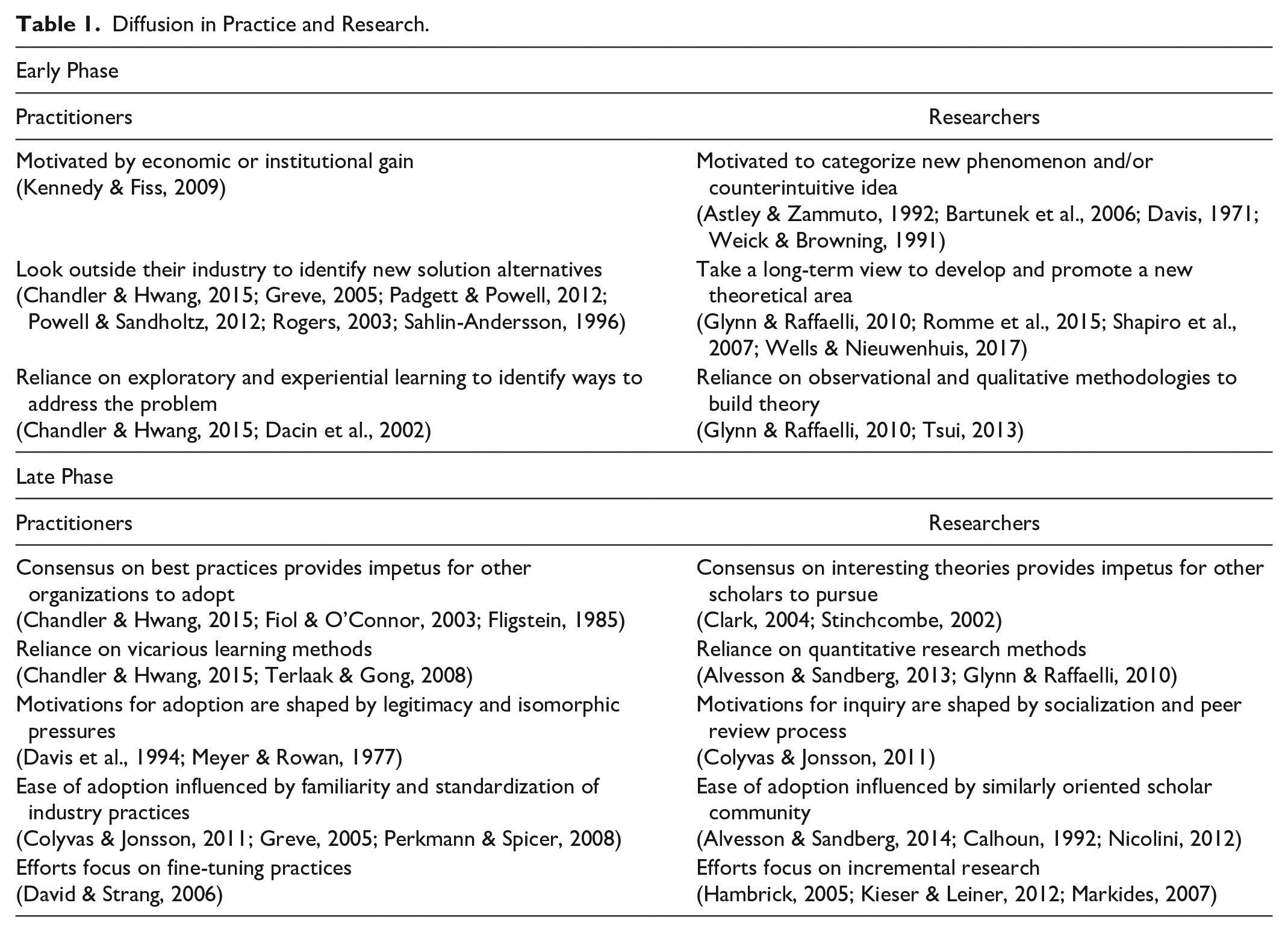
Early adopters are typically motivated by potential economic or institutional gains (Kennedy & Fiss, 2009) that create the incentive to experiment with new ideas and practices (Dacin et al., 2002). However, the newness of innovative ideas and processes means that few, if any, organizations in any given industry have developed ways of successfully identifying and implementing them. As a result, early adopter organizations are forced to identify and take inspiration from sources that lie outside of their industry (Dacin et al., 2002). This process involves exploratory and experiential learning in order to shape the new practice into a workable form (Chandler & Hwang, 2015; Powell & Sandholtz, 2012). Because these practices are in a somewhat unproven state early in the diffusion cycle, their efficacy may not be sufficiently evident to other organizations. Consequently, adoption across the industry is slow since the benefits of that practice are not readily understood (Rogers, 2003).
Once early adopters have formulated a general model for how to implement the practice and have demonstrated its value, a commoditized template for adoption becomes available for follower organizations later in the diffusion cycle (Suddaby & Greenwood, 2001). Such “best-practice consensus” (Chandler & Hwang, 2015, p. 1459) provides sufficient evidence of economic and legitimacy gains for remaining organizations in the industry to adopt the practice (Fiol & O’Connor, 2003; Haunschild & Miner, 1997). This changes the learning requirements of organizations. Early organizations must invest in experiential learning processes in order to make sense of and develop the new practice while later organizations will take advantage of vicarious learning based on the examples of early adopters (Chandler & Hwang, 2015). As practices become common in more and more organizations, standardization, and familiarity with the practice ease adoption in an industry (Colyvas & Jonsson, 2011; Perkmann & Spicer, 2008). Such institutionalization solidifies the new practice within the industry, making organizations less open to alternative practices. However, as late adopter organizations begin to implement these practices they begin to encounter narrower, managerial challenges in adapting the practice to their specific contexts and efforts tend to be directed at fine-tuning practices (Ansari et al., 2010). This may require them to employ specialized consulting assistance (David & Strang, 2006). The practice diffusion process has been depicted as an S-curve, with minimal adoption early in the life of a practice and a high level of adoption late in the practice (Chandler & Hwang, 2015).
Diffusion of Research
As suggested by the literature, research themes diffuse among academics over time (Abrahamson & Fairchild, 1999; Alvesson & Sandberg, 2011; Glynn & Raffaelli, 2010). The right column in Table 1 summarizes the literature about diffusion of research. New research themes emerge through the need to explain phenomena that are not suitably explained by current theory. What makes them interesting, and hence attractive to scholars, is the fact that they describe the underlying processes behind causal relationships (Sutton & Staw, 1995) in a manner that challenges existing interpretations (Weick, 1999; Whetten, 1989) rather than simply embellishing them (Weick, 1995). Interesting theories deny assumptions of a given audience (Davis, 1971), often by presenting counterintuitive findings that create new streams of research (Bartunek et al., 2006). This motivates academics to start research projects, and their first step is normally to start categorizing the new phenomenon or counterintuitive idea (Weick & Browning, 1991). Academics who identify new theories must often take a long-term research view (Shapiro et al., 2007; Wells & Nieuwenhuis, 2017) since they will need to resort to exploratory methodologies, such as grounded theory and qualitative studies, to successfully categorize the new phenomena. Linkages to existing theory may serve as the starting point for the development of new theory, but truly new phenomena require observational theory-building methodologies (Glynn & Raffaelli, 2010; Tsui, 2013) that enable scholars to move beyond the explanatory power of extant theories (Eisenhardt, 1989; Glaser & Strauss, 1965; Glaser & Strauss, 1967).
As a novel theory is vetted through a peer-review process and a consensus about relevant research questions emerges (Clark, 2004), it draws interest from other academics who can explore it more deeply to understand the boundary conditions that affect it (Stinchcombe, 2002). Scholars’ methodological focus now turns to large-scale, quantitative empirical studies that look at more fine-grained aspects of the theory (Glynn & Raffaelli, 2010). As the theory becomes more accepted into the broader management literature and fundamental precepts of the theory are better understood, socialization and peer review processes shape the motivations of researchers in this later phase (Colyvas & Jonsson, 2011). Research becomes more incremental, engaged by an increasingly specialized group of scholars (Alvesson & Sandberg, 2013) who investigate narrower and more incremental implications of the broader theory (Bansal et al., 2012; Fincham & Clark, 2009; Kieser & Nicolai, 2005). Research around a given theory often follows an inverted U-shaped curve; the increased interest in the theory occurring during the early phase is often followed by diminished activity at the end of the late phase (Abrahamson & Fairchild, 1999; Benders & van Veen, 2001; Glynn & Raffaelli, 2010). These conditions are summarized in Table 1.
The different diffusion processes of research and practice help to explain why in some cases the academic/practitioner gap exists and in other cases, it does not. In the following section, we develop three possible scenarios, namely, simultaneous diffusion cycles in research and practice as compared to instances where the inverted U-shaped curve of theory diffusion shifts to either the left or right relative to the S-curve of practice diffusion.
Figure 1 summarizes our arguments graphically. It depicts the practitioner diffusion curve (the “Adoption in practice” S-shaped curve) and the academic diffusion curves (the inverted U-shaped curves). In the case of simultaneous diffusion, the upward slopes of the practitioner and academic curves start around the same time suggesting the opportunity for collaborative research. When research precedes practice the inverted U-shaped curve of academic diffusion takes off before the diffusion in practice does (the academic diffusion curve shifts to the left). In this case, collaborative research is less likely, but academic knowledge may be translated to practice once the S-curve takes off. When practice precedes research, the upward slope of the S-curve starts before the upward slope of the academic diffusion curve (the academic diffusion curve shifts to the right). Organizations will have adopted best practices before academics have studied the phenomenon. This provides minimal opportunities for both collaborative research and translated knowledge. In the next section, we will analyze these three scenarios in more depth.
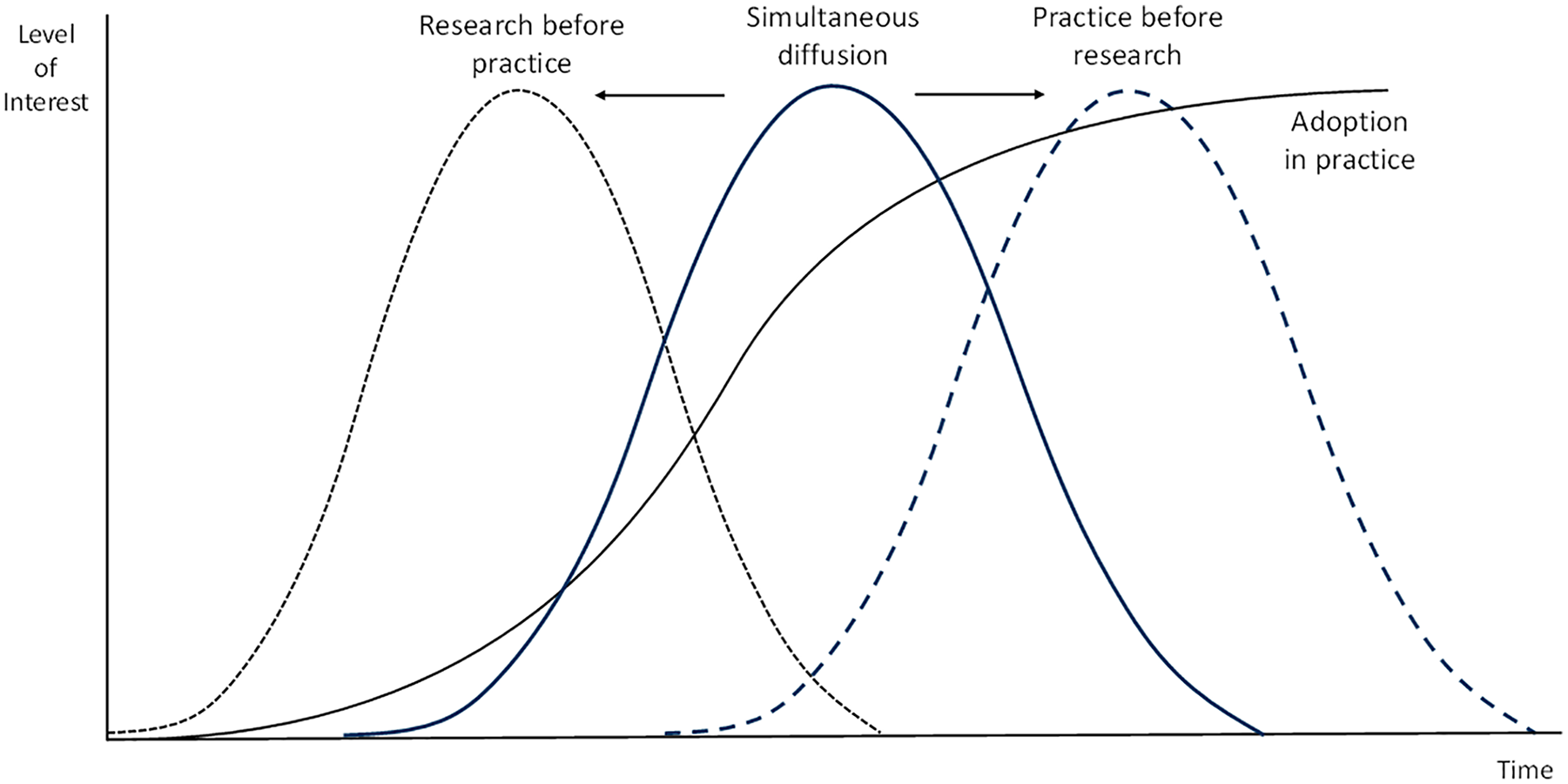
Diffusion curves.
A Temporal Approach to the Academic–Practitioner Gap
In this section, we analyze how our conceptualization of the diffusion processes for practice and research helps to understand the academic–practitioner gap. There are cases where collaborative opportunities appear to be overlooked by scholars or useful research is not embraced by practitioners. We show that these may be explained by our temporal perspective. The overlapping S- and inverted U-shaped curves described earlier suggest that there are zones of opportunity where collaborative research or translation of research findings have the greatest chance to flourish. Although there will always be differences between academics and practitioners that exacerbate the gap, such as differing languages and logics (Astley & Zammuto, 1992; Bartunek, 2007; Bartunek & Rynes, 2014; Kieser & Leiner, 2009), we suggest that the degree of alignment between the two diffusion cycles determines the width of the academic–practitioner gap. In turn, this determines the extent to which the collaboration or translation can effectively take place. The following three sections show how application of diffusion cycle logic helps explain this. We also provide empirical examples for each scenario that illustrate how the different scenarios can be found in current areas of research and practice. These examples were chosen due to their applicability to phenomena that are of interest in today’s world: interorganizational collaboration (Langley et al., 2019; Williams et al., 2019), talent management (Rajagopalan, 2020), and networks/ecosystems (Doh et al., 2019; Ganco et al., 2020).
Simultaneous Research and Practice Diffusion
In cases where practitioners and academics simultaneously discover a new phenomenon, the practice and theory diffusion curves overlay one another and the academic–practitioner gap is narrow (i.e., the center of Figure 1). This situation provides several opportunities for research-practice interaction. As new phenomena emerge practitioners should welcome access to existing academic research since they are willing to look outside of their industries for solutions (Chandler & Hwang, 2015; Greve, 2005). But, if that phenomenon has also recently emerged to academics, there is not a sufficient body of empirical knowledge for scholars to translate for practitioners. However, since practitioners and academics are both in the exploration phase of their cycles, they should be willing to collaborate. Scholars who are relying on observational and qualitative methodologies to build theory (Glynn & Raffaelli, 2010; Tsui, 2013) will get the benefit of access to data that are helpful in their efforts to categorize the phenomenon, while practitioners will get the benefit of external sources of information and research that sheds light on the gains that can be had by implementing the phenomenon.
As a practice is adopted by increasing numbers of organizations later in the diffusion cycle, they become more focused on implementing existing best practices (Chandler & Hwang, 2015; Fiol & O’Connor, 2003; Fligstein, 1985). At this time scholars have been studying the phenomenon for a sufficient period of time and can provide the vicarious insights and external validation that late adopting practitioners require to support their implementation of the related practice. In addition, academics have moved on to large-scale (quantitative) research (Alvesson & Sandberg, 2013; Glynn & Raffaelli, 2010), the results of which may help practitioners to show the legitimacy of adopting a new phenomenon. Hence, practitioners may be willing to participate in large-scale data gathering by academics. All this suggests that, when the two cycles occur simultaneously, collaboration may take place in the early phase to jointly explore a phenomenon, in a later phase to gather large-scale data, and finally to translate research findings at the end of the diffusion cycle. At one point in time, the simultaneity may cease to exist when researchers have finished their theory development and practitioners have adopted the new phenomenon.
Example
We can illustrate these dynamics using the case of alliance capability. Strategic alliances offer benefits that organizations acting individually cannot achieve (Kale & Singh, 2009). However, success in these relationships requires organizations to develop the appropriate capabilities (Heimeriks & Duysters, 2007; Kale & Singh, 2007). Organizations had an increasing need to minimize the high potential for failure they had been experiencing (Futrell et al., 2001; Gulati et al., 2012); leading them to more specifically focus their efforts on improving their internal capabilities.
In the late 1990s organizations began to experiment with alliance capability mechanisms (e.g., Chesbrough & Teece, 1996; Harbison & Pekar, 1998; Sims et al., 2001) or brought in resources from outside their industry (e.g., Futrell et al., 2001; Klee, 2004). Academic articles on alliance capability began to emerge at a similar time (e.g., Callahan & MacKenzie, 1999; Spekman et al., 1996; Spekman et al., 1998). Early academic studies tended to reflect collaboration with practitioners in the form of case studies (e.g., Dyer et al., 2001; Huxham & Vangen, 2000; Lavie, 2004; Parise & Casher, 2003) or studies requiring a high level of interaction with practitioners through field interviews to better operationalize the alliance capability construct (e.g., Draulans et al., 2003; Heimeriks & Duysters, 2007; Kale et al., 2001).
Organizations’ implementation of alliance capability mechanisms gained momentum during the 2000s; practitioners’ adoption of alliance capability mechanisms increased from 38% in 2002 to 54% in 2007 and 2009 and finally to 80% in 2011 (Duysters et al., 2012). Much of this reflected vicarious learning of best practices that occurred through the emergence of a professional association in 1998 (i.e., The Association of Strategic Alliance Professionals). Moreover, this adoption by organizations was complemented by the development of both political, technical, and cultural work types (Perkmann & Spicer, 2008), such as an ISO standard (Reference number ISO 44001:2017(E)) and publication of various best practice guides and handbooks (e.g., Watenpaugh et al., 2013). This increased the legitimacy and eased the adoption of alliance capability mechanisms. Among academics, methodology transitioned from qualitative studies in the early phase to more narrowly focused, quantitative studies in the later phase (e.g., Kale & Singh, 2007; Sarkar et al., 2009; Schilke, 2007; Schreiner et al., 2009; Sluyts et al., 2011). The number of capability studies decreased by the middle of the 2010 decade; in fact, the publication of two review articles during that time (i.e., Niesten & Jolink, 2015; Wang & Rajagopalan, 2015) suggests that theory in this area was reaching a consolidation point. However, during this later phase there were a variety of instances where scholars presented their findings to practitioners through articles, books, or teaching (e.g., de Man, 2013; Dyer et al., 2004; INSEAD Executive Education, 2018; Spekman et al., 2000; Wharton Executive Education, 2011). At this time, the 80% adoption rate (Duysters et al., 2012) shows a high level of adoption: many companies have implemented similar alliance capability mechanisms.
Various other cases have been documented where collaborative research has effectively been employed early in the emergence of a phenomenon (refer to Bartunek, 2007; Romme et al., 2015; Starkey et al., 2009 for examples). For example, Wells and Nieuwenhuis (2017) describe how academics and practitioners who identified an opportunity that “did not exist anywhere in the world” (2017, p. 51) collaboratively developed findings in the area of micro-factory retailing in the automobile industry that were able to inform both theory and practice going forward. Also, recent initiatives such as those suggested by the Chartered Association of Business Schools and the British Academy of Management (Collinson, 2018) strive to unite practitioners and scholars in collaboratively addressing current “grand challenges.” Similarly, other scholars have noted that translation of academic findings is effective late in the practice diffusion cycle when those findings either explain or synthesize an important phenomenon in a new or operational way (Birkinshaw et al., 2016) or help organizations deal with specific aspects of implementation complexity (Braam et al., 2007; David & Strang, 2006).
Practice-before-research Diffusion
If we consider the implications of the two cycles commencing at different times, we can see how the academic–practitioner gap widens. When scholars come upon a new theoretical insight after practitioners have begun to institutionalize it (i.e., the inverted U-shaped curve shifts to the right relative to the S-curve of practice as in Figure 1) we see a different set of behaviors suggesting reduced opportunities for collaboration and translation. Once early adopter practitioners gain consensus on best practices, they will have less inclination to engage in collaborative research since they have already explored alternatives outside their industry (Chandler & Hwang, 2015; Fiol & O’Connor, 2003; Fligstein, 1985). This presents fewer opportunities for academics, who are only beginning to explore the phenomenon (Astley & Zammuto, 1992; Bartunek et al., 2006), to find willing collaborative practitioners to share in observational, exploratory research (Glynn & Raffaelli, 2010; Tsui, 2013). Consequently, the academic–practitioner gap widens, leaving little opportunity for collaborative research. Depending upon the length of the respective curves and extent of the shift, it is also likely that translation becomes more difficult. Even where academic findings can provide revelations for practitioners, they likely come too late if practices have already become formalized within organizations and institutionalized across most of the industry (Colyvas & Jonsson, 2011; Greve, 2005). While there certainly can be situations where research can inform practice later in its diffusion cycle, for example, for late adopters, those should become more random since practitioners’ needs have become more focused on fine-tuning (David & Strang, 2006) and, hence, less likely to be what scholars are studying (Kieser & Nicolai, 2005).
Example
The misalignment of the two diffusion cycles caused by the rightward shift of the theory diffusion cycle implies some themes may not be picked up by academics at all. Even when a theme is finally picked up, it may still not have an impact in practice. One example of practice becoming so set in its ways that academic evidence arrives too late to change practice is in the area of employee selection, the identification and application of knowledge and skills needed for a job in order to make effective hiring decisions (Dipboye, 1994; Ryan & Tippins, 2004; Schmitt & Chan, 1998; Weyland, 2011). Organizations have used unstructured job interviews to meet their hiring needs for decades, if not centuries, and, for some organizations, this may be the only selection process they use, despite inherent issues such as interviewer bias (Dipboye & Johnson, 2013) or the inability to assess person-organization fit (Cable & Judge, 1997). Over the course of time, such interviews became highly familiar and, hence legitimized, by virtue of the large numbers of organizations using the practice (Colyvas & Jonsson, 2011; Rynes, Colbert, et al., 2002). As a result, organization members have had little reason to rethink this practice. In the 1970s scholars began to publish large amounts of research pointing to the negative effects of bias and stereotyping on interviewing (refer to Dipboye, 1994 for a summary of this research). Although this and similar research at that time began to show why more behaviorally oriented interviewing techniques, such as structured interviews asking how a candidate acted in prior situations, were necessary to counteract such tendencies (Ployhart et al., 2017), industry has tended to ignore this information in favor of less valid practices (Ryan & Tippins, 2004; Rynes, Brown, et al., 2002).
There are many reasons why this occurs. Practitioners often identify newly emergent phenomena before academics do (Booker et al., 2008; Ployhart et al., 2017). Once a practice has entered the late phase of the diffusion cycle, organizations tend to stick with common practices that have become legitimized and institutionalized (Colyvas & Jonsson, 2011; Perkmann & Spicer, 2008). In the case of selection, Human Resource (HR) personnel note that it takes too much effort to go against the conventional wisdom or to challenge the industry’s legal environment to consider changes, indicating there are strong isomorphic pressures to adhere to familiar practices (Rynes, Brown, et al., 2002; Rynes, Colbert, et al., 2002). Such forces serve to make prevailing practices self-reinforcing, despite the existence of “scientist-practitioner” boundary spanners from the Society for Industrial/Organizational Psychology (SIOP; Hays-Thomas, n.d.) who work to apply scientific findings to applied environments. Moreover, when there is insufficient belief across the industry of the economic benefits of more scientific selection, aside from a few industry-leading organizations (refer to Bock, 2015 for one such example), there is not sufficient groundswell to investigate other options. Once organizations have institutionalized a practice there is less need to look outside their industry for insights on the practice (Chandler & Hwang, 2015); even when scientifically sound selection processes emerged late in the practitioner diffusion cycle they had already been outcompeted by the isomorphic pressures that supported use of existing practices (Rynes, Colbert, et al., 2002).
Research-before-practice Diffusion
In this section, we discuss situations where scholars come upon a new theoretical insight before practitioners have begun to explore it (i.e., the inverted U-shaped curve shifts to the left relative to the S-curve as in Figure 1). Scholars are continually looking for new challenges that will stimulate their interest and efforts, but these do not necessarily depend upon the needs expressed by practitioners (Banks et al., 2016). When they identify a new theoretical insight ahead of practitioners, it is likely practitioners have not yet encountered the related business problems. This compromises academics’ ability to conduct collaborative research due to the dearth of interested partner organizations. In essence, the academic–practitioner gap widens, making it more difficult to define collaborative research projects. However, by the time that practitioners begin to recognize and embrace the phenomenon, scholars will have accumulated extensive research and insights about it, which should be highly beneficial to early adopter organizations looking outside their industry (Chandler & Hwang, 2015; Greve, 2005) since they provide guidance on how to address the phenomenon. Moreover, the accumulated academic insights will still be valuable for late adopter organizations looking for validation and legitimacy. As a result, the academic–practitioner gap narrows at that point in time.
Example
One such area where academia has invested efforts ahead of practice is in the network-level interactions of organizations. Networks have been defined as an organization’s set of enduring and strategic relationship ties with other organizations (Gulati et al., 2000). This perspective holds that organizations’ economic actions operate amid a context of relationships that consequently influence the decision-making of individual actors in that network (Granovetter, 1985; Laumann et al., 1978). These relationships can occur at individual (Burt, 2004) or organizational levels (Gulati, 2007a).
During the early phase of the diffusion cycle, scholars must resort to observational and qualitative methodologies to build theory (Tsui, 2013), and this is what occurred for network theory. Research in network theory gained momentum among scholars beginning in the 1970s with inquiry into the properties of dyadic ties (Granovetter, 1973). This early theory-building work was highly observational and exploratory. By the end of the 1980s consensus emerged on interesting theories. In particular, the debate between the structural holes approach (emphasizing the usefulness of having gaps in a network; Burt, 1988) and the closure approach (emphasizing the usefulness of not having gaps in a network; Coleman, 1990) provided an impetus for scholars to pursue research in this area. It spawned many papers (for a review, refer to, Borgatti et al., 2009), and led to a similarly oriented community of scholars that worked in this area. Following the research diffusion cycle, research methodology shifted to large-scale empirical studies that investigate incremental aspects of network behavior (e.g., Adner & Kapoor, 2010; Adner & Kapoor, 2016; Chandler et al., 2013; Demirkan & Demirkan, 2012; Kapoor & Lee, 2013; Pierce, 2009; Ritala et al., 2009).
Among practitioners, awareness of network management gained prominence after scholarly articles appeared. While some of the early published academic articles were based on observations of the networks at large, early adopter organizations such as Walmart and IBM (e.g., Iansiti & Levien, 2004; Moore, 1993), those scholars did not engage in collaborative research with those organizations but relied on observational or secondary sources for gathering data about the networks. An early attempt to popularize the concept using the label of “ecosystem” instead of network (Moore, 1993) was largely ignored in practice for many years. Nevertheless, influenced by market developments organizations’ interest in networks/ecosystems has grown in recent years as reflected in various CEO studies (e.g., IBM, 2018).
Since practitioners’ focus on network/ecosystem management occurred after scholars had moved along their theory diffusion cycle, scholars have decreasing needs to collaborate with organizations now grappling with managing their own network. Consistent with the theory diffusion cycle, most recent academic work on networks has become dependent on large datasets, which makes it harder for practitioners to interest scholars in collaboration, especially since academics and journals are oriented toward quantitative studies (Alvesson & Sandberg, 2013; de Leeuw et al., 2019; Glynn & Raffaelli, 2010). On the other hand, scholars are beginning to translate their findings for practitioners, who still are in the exploratory phase of their diffusion cycle and, hence prone to look outside their industry for ideas (Chandler & Hwang, 2015; Greve, 2005). For an example of a book that translates the theory of networks for practitioners, refer to Greve et al. (2014).
Another example of research being ahead of practice can be found around the recent attention in practice for behavioral economics and nudging. Nudging is rooted in research carried out by, among others, Nobel Prize winners Daniel Kahneman and Richard Thaler, dating back to the 1970s and 1980s (e.g., Kahneman & Tversky, 1979; Russell & Thaler, 1985). Both have since written popular books about this topic (Kahneman, 2011; Thaler & Sunstein, 2009). Insights from that research are now used in practice on an increasing scale (e.g., Davenport, 2009; Goldstein et al., 2008). One of the reasons for this may be that this research was translated by Kahneman and Thaler themselves. This enabled managers to make use of the insights from their research. Of course, the attention coming with a Nobel Prize is also helpful since it may very well alert a broader public to relevant insights and hence break through strong isomorphic pressures in organizations.
Discussion
Considering the academic–practitioner gap through a diffusion perspective offers a number of new insights. Our first contribution is that diffusion theory helps explain when the gap occurs and when it is wide or narrow. Our new conceptualization of the gap as existing of two different diffusion curves enables us to show that the times at which each curve starts affect the width of the academic–practitioner gap. The more the two curves start simultaneously and move at the same speed, the more they converge and the narrower the gap. The use of diffusion theory to study the academic–practitioner gap therefore adds to our understanding of the nature of the gap and provides a conceptual lens that explains changes in the gap over time. In doing so we also find a new reason for the gap, namely, the different diffusion cycles of ideas in respectively academia and practice. This reason may add to our understanding of the gap and adds to a call for searching for such reasons put forth by Kieser et al. (2015).
Second, our findings help to reframe existing debates in the literature. For example, our analysis solves some of the paradoxical tensions of academic–practitioner relationships that are identified in the literature (Bartunek & Rynes, 2014). These paradoxes can exist because of the temporal nature of the gap. For example, some authors believe research and practice can never meet (Kieser & Leiner, 2009), whereas others believe that a fruitful interaction is possible between them (Bartunek, 2011; Romme et al., 2015; Wells & Nieuwenhuis, 2017). A collaborative researcher working early in the simultaneous diffusion scenario may be an example of the latter position, whereas a researcher that works late in the practice-before-research diffusion scenario on large-scale statistical studies aimed at refining concepts may be an example of the former position. They face different conditions in what academia requires and what practice requires. Similarly, the paradoxical tension that rigor and relevance can be both compatible and incompatible (Bartunek & Rynes, 2014) may be understood by using a temporal perspective. As our case on alliance capability shows, there is a period where rigor and relevance are compatible, namely, when the first large-scale studies took place. At that time some managers were looking for empirical evidence to convince their CEOs and peers to invest in building up an alliance capability while simultaneously some researchers were looking for data to do large-scale performance studies. Later, the highly refined studies were interesting for academics but not for most managers who had adopted standard alliance best practices. Rigor and relevance had become incompatible. Taking a temporal perspective helps to understand such paradoxical tensions.
Similarly, the causes of the gap as identified in the “lost in” and “lost before” translation approaches (Amara et al., 2019; Shapiro et al., 2007) may vary in relevance over time depending on the diffusion cycles. The “lost in translation” approach is more relevant when research is ahead of practice and in the later phase of simultaneous diffusion cycles. Further analysis from a temporal perspective of the causes suggested by the “lost in” and “lost before” translation approaches will shed more light on the question when academics and practitioners grow apart.
A third contribution from our analysis is that there is no such thing as “the academic” or “the practitioner.” This addresses the observation by Augier and March (2007) that the question for who the knowledge and research is relevant must be considered. Across the diffusion cycle, different people and different organizations are involved, and each of them faces different conditions. Practitioners that are early movers in a specific area have different knowledge needs and hence look for different input from academia than late movers. However, knowledge that is too late for one set of practitioners may be right on time for another. For example, for many late movers “old” knowledge may still be relevant; by incorporating such knowledge in executive education programs academics may still put that knowledge to use for late movers. The focus in much of the academic–practitioner research, however, is on state-of-the-art knowledge. More attention for the way in which late moving practitioners may profit from research could provide a more balanced view of how big the gap really is. Similarly, some researchers prefer to work on emerging themes whereas others choose to focus on incremental research. For example, the literature suggests senior researchers to be more inclined to endure the risks of early involvement than untenured researchers, who need more certainty that their work gets published (Shapiro et al., 2007). The latter may eschew early phase work and prefer to focus on incremental research. Hence, at any one point in time, the gap may be experienced quite differently by different groups. That also implies that proposals to bridge the gap should take such differences into account in order to be effective.
Implications for Bridging the Gap
Our analysis has consequences for proposals to bridge the gap. One insight is that the effectiveness of these proposals will depend on getting the timing and the target audience right. Even in the ideal case of simultaneous diffusion, some proposals may not work in all phases. A call for more collaborative research can be useful in the early phases when a phenomenon emerges in practice and is simultaneously recognized by academics. It is less likely to interest managers once a best practice is established. Similarly, better translation of research has the best chance of reaching practice when research is ahead of practice and the diffusion in practice of a phenomenon is in the early upswing. In that case, there is sufficient academic knowledge to translate and companies are still looking for legitimacy of implementing that phenomenon outside of their industry. A general call for better translation of research is less likely to be effective at other points in time. Without an understanding of where a phenomenon is located on the two diffusion cycles, proposals to bridge the gap are likely to be ineffectual. Such proposals should therefore be more precise and specify when, under which conditions, and for whom they will work. There may even be times where the conditions are such that bridging the gap may be very difficult. Whether it makes sense to invest in bridging the gap in that case, needs to be considered carefully. A temporal perspective gives insight into the conditions that need to be met for proposals to bridge the gap to be effective.
A second insight is that efforts to address the academic–practitioner gap should focus on ensuring that the two diffusion cycles start simultaneously or on bringing the two diffusion cycles closer together when either research or practice precedes the other one. To ensure a simultaneous start requires more structured interaction between the two sides to signal to each other what their current questions are (Rajagopalan, 2020). Academic–practitioner symposia and meet ups may play a role here. Others have proposed to use classroom interaction with executives as a mechanism for research to pick up on emerging issues in practice (Gulati, 2007b; Tushman & O’Reilly, 2007).
When research is ahead of practice different mechanisms may be necessary to bring research and practice closer together. An example of this might be increasing the amount of funding for translation of research towards a broader audience (Collinson, 2018). Separate funds may also be made available to promote research in areas where practice is ahead of science. Such “catch-up funding” may bring the two diffusion cycles closer together. Based on input from organizations, funding agencies could make funding available for researchers who want to catch up with practice in a certain area. These funds may be targeted at more senior staff as they may be more inclined to move into a new area than non-tenured scholars. Such a process would ensure more alignment between research and practice. The case of research being ahead of practice seems more difficult to address. Boundary spanners such as Industrial PhDs and similar initiatives may be one example here (Pettigrew, 2001; Salipante & Aram, 2003; Tushman & O’Reilly, 2007), with a practitioner working part-time in academia to find a solution for an issue her company is struggling with.
Limitations and Boundary Conditions
In arguing for a temporal perspective on the academic–practitioner gap, we have assumed that management practices are static. The literature, however, has found that management practices may change over time (Ansari et al., 2010; Benders & van Veen, 2001; Nicolai & Dautwiz, 2010). Our conclusions may change if we take these changes into account. For example, if a practice changes so substantially that it is almost reinvented, this may imply that a new round of collaborative research makes sense during the diffusion process. Future refinement of the temporal perspective should consider the ways in which practices change, as well as how such inflection points can best be identified.
Second, our analysis may seem deterministic. Practice shows that even at times when the academic–practitioner gap is broad, collaboration or translation may still prove beneficial. The acceptance of behavioral economics and nudging concepts, for example, indicates that two Nobel Prize winners engaging in translation of ideas can have a substantial impact on practice. On the other hand, studies have found that very few preeminent scholars have managed to achieve such notoriety among practitioners (Aguinis et al., 2012). Exceptional individuals or exceptional economic circumstances may be conditions that lead to bridging the gap, even when researchers or practitioners would not otherwise be inclined to collaborate. It would be an interesting question for further research to study the counterfactuals, that is, the conditions that lead to collaboration even when our analysis predicts this would be difficult.
We also identified two boundary conditions of our approach. First, we base our findings on phenomenon driven research aimed at theorizing (Ployhart & Bartunek, 2019). Whether our findings also hold for other types of research, like conceptual research, remains to be investigated. In addition, pure applied research that may occur in business schools (Prado-Gascó et al., 2020) may not follow the diffusion cycles we propose. Such research may focus more on the first half of the inverted U-shape curve of diffusion in academia, but not the second half. Alternatively, it may be highly focused on solving the issue of a specific organization and, as a consequence, not diffuse to other practitioners or academics. A similar effect may occur with consultancies that develop new approaches for a particular client. Second, studies of S-curve diffusion tend to suffer from a bias towards innovators and neglect organizations that do not adopt a new phenomenon (Dedehayir et al., 2017). It also has a bias towards successful phenomena (Shepherd & Gruber, 2020). The study of how academia interacts with non-innovative organizations, non-adopting organizations, and less successful practices may provide a different picture of the academic–practitioner gap.
Footnotes
Declaration of Conflicting Interests
The author(s) declared no potential conflicts of interest with respect to the research, authorship, and/or publication of this article.
Funding
The author(s) received no financial support for the research, authorship, and/or publication of this article.
