




Abstract
Understanding what ties precarious workers to online organizations and what makes them drift away is a key issue in today’s digitalized world. In this article, we present a study of a blog portal developed for commercial purposes and show how professional and amateur bloggers engage in this emerging online community and organization. We develop new understandings of dynamic relationships between boundaries, roles and identities, and offer an analysis of how identities are (re)constructed in interaction with others in fluid online spaces. We theorize boundary work as a form of identity work, elucidate how roles influence the way individual and collective identity constructions are intertwined, and highlight the importance of emotions in conformist and resistant identity work online. Our study has broader implications for understanding identities in the age of technology and precarity.
Introduction
While it is well established that “identities are implicated in almost everything that happens in and around organizations” (Brown, 2015, p. 20), due to digitalization and the changing nature of work, our understandings of identities and how to study them are being put to the test. The Internet is full of “fluid” social collectives, communities, and organizations that constitute non-physical environments for social interaction (Bullingham & Vasconcelos, 2013; Dobusch & Schoeneborn, 2015; Fayard & DeSanctis, 2010). Online spaces such as blog communities where people engage with each other for pleasure, professional development, and income are a timely example of the changing context where identities are constructed. These developments give rise to questions about relationships between boundaries, roles, and identities online. We suggest that shedding light on these relationships offers insights into the nature of the identity work of precarious workers who operate outside of established organizations and professions today (Petriglieri et al., 2019).
Dynamic relationships between boundaries, roles, and identities in online spaces have passed unnoticed in management and organization research. In this article, we study how boundaries are formed, roles emerge, and identities are constructed. Our empirical focus is on a lifestyle and fashion blog portal for young women that was established by a media corporation. This portal hosts a large selection of blogs written by both professionals and amateur audience-contributors. A weblog or “blog” is a website journal intended for general public consumption; bloggers post content on a regular basis and readers and viewers comment. Blogs form clustered networks of interconnected texts, visual images, and videos that are referred to as the “blogosphere” (Schmidt, 2007). Blog communities emerge in and through platforms that connect bloggers to readers, viewers, and other bloggers. Membership in these online communities is fluctuating, ambiguous, and at times contested (cf. Dobusch & Schoeneborn, 2015; Fayard & DeSanctis, 2010).
In developing new understandings of relationships between boundaries, roles, and identities, we synthesize insights from earlier research that remains in many ways disparate and fragmented. Our assumption is that boundaries are distinctions that establish categories of various kinds (Lamont & Molnár, 2002). We view them as composite: organizations operate within multiple sets of co-existing boundaries (Hernes, 2004). By boundary work we refer to the ways those associated with an organization or community build mental, social, and symbolic boundaries related to it through talk, writing, and visual images (Gieryn, 1983, 1995; Lamont & Molnár, 2002; Riesch, 2010). By roles as boundary objects, we understand roles to be vehicles that mediate meanings constructed in relational interactions between people, while being themselves subject to ongoing (re)construction (Järventie-Thesleff & Tienari, 2016; Simpson & Carroll, 2008, p. 43; Star & Griesemer, 1989). Mediation refers here to translation and interpretation of meanings across boundaries, domains of knowledge, and between actors (Simpson & Carroll, 2008). In this view, roles are emergent intermediaries in identity construction processes; they are not linked to stable positions within a social structure or system.
Further, we conceive identities as people’s subjectively construed understandings of who they were, are, and desire to become (Brown, 2015). While the language of identity has become ubiquitous in organization and management studies (Brown, 2018; Knights & Clarke, 2017), it is increasingly popular to view self-identities as evolving constructions that are worked on to establish a sense of coherence and distinctiveness in the face of ambiguity and uncertainty (Alvesson & Willmott, 2002; Collinson, 2003; Sveningsson & Alvesson, 2003). Such identity work is a fundamentally relational process where people construct their sense of self in and through interaction with others (Kenny et al., 2011). They engage with a variety of emotions that offer resources for identity work (Ahuja et al., 2019; Coupland et al., 2008; Kuhn, 2009).
Our premise in this article is that the contexts where we work on our identities are changing. While researchers have conceived roles as predetermined positions defined by organizational expectations (Stryker & Burke, 2000) and have long assumed that our identities are tied to the organizations for which we work (Brown, 2018), we are now advised to study “identity construction without a solid organizational foundation” (Barley et al., 2017, p. 112). While there has been extensive study of self-identities in online spaces (Bullingham & Vasconcelos, 2013; Feher, 2019), research has failed to make sense of the reciprocal connections and mediation between people and the communities and organizations they help create and maintain online. We study in-depth how interaction between the social world driven by the media corporation and the lifeworlds of bloggers gives rise to distinct roles in the blog community. We consider how these roles mediate the identity work of bloggers.
We argue that the meanings and emotions attached to roles as boundary objects influence the way individual and organizational identities are intertwined in fluid online spaces. Our study has broader significance as it offers a new understanding of how people associate with online communities or fail to do so. Our findings help people who grapple with precarious online work to make better sense of themselves and their experiences by disentangling their emotions with the help of roles that emerge in these spaces. The remainder of the article is structured as follows. Next, we outline our conceptual framework. We then share our empirical materials and analyses and offer our main findings. Finally, we discuss these findings, pinpoint our contributions, and suggest ideas for future research.
Boundaries, Roles and Identities Online: Towards New Understandings
Despite burgeoning interest in identities on the one hand, and new forms of organizing and work on the other, a conceptual framework building on dynamic relationships between boundaries, roles, and identities to study (re)construction of self-identities in online spaces is missing. Developing such an understanding is important in the context of the fluid forms of organizing enabled by technology and characterized by precarity and contingent work (Barley et al., 2017; Petriglieri et al, 2019). An increasing number of people are encouraged or forced to engage with online communities for professional development and income as well as for pleasure.
Boundaries and Roles as Boundary Objects
Lamont and Molnár (2002) define boundaries as distinctions that establish categories of objects, people, and activities. Boundaries act as “tools by which individuals and groups struggle over and come to agree upon definitions of reality” (p. 168). Kreiner, Hollensbe and Sheep (2006) maintain that boundaries “both enable and constrain how domains are connected and interrelated” (p. 1319). Boundaries also refer to “those differences that come to demarcate distinctions between actors” in and across domains (Corporaal, 2018, p. 8). Addressing organizational boundaries and boundaries in organizations, Hernes (2004) suggests that different kinds of boundaries emerge and are reproduced through interactions, and points out that most boundaries are “invisible” or blurred. Following Hernes (2004), we focus on social boundaries that tie the online community together and distinguish it from other communities and on mental boundaries that relate to different views on its “repertoire of ideas, terminologies and beliefs” (p. 16).
To understand how boundaries (and roles and identities) emerge and develop, we draw on the concept of boundary object. Star and Griesemer (1989, p. 393) define them as objects that “inhabit several intersecting social worlds [. . .] and satisfy the informational requirements of each of them.” Boundary objects are “both plastic enough to adapt to local needs and the constraints of the several parties employing them, yet robust enough to maintain a common [e.g. organizational] identity” (p. 393). Burman’s (2004, p. 370) suggestion that “boundary objects offer a site or medium for the negotiation of identity and difference” helps develop our understanding of boundaries, roles, and identities in online spaces. Boundary objects can be concrete or abstract. A map is a concrete example of a boundary object that connects various groups of people who may use it differently (Star & Griesemer, 1989, p. 408). It acquires particular meanings in different contexts and it can be a site of contestation as well as consensus and agreement. Strategy tools such as SWOT (strengths, weaknesses, opportunities, threats) analysis (Spee & Jarzabkowski, 2009, p. 228) and theories that are subject to multiple interpretations in academic fields and disciplines (Simpson & Carroll, 2008, p. 36) can also be understood as boundary objects. In online spaces, we argue, boundary objects are abstract in that they emerge in interaction between actors and evolve constantly.
How can roles be understood as boundary objects then? Role theory was first based on a theatrical metaphor to explain the predictability of human behavior in relation to particular “scripts” and “parts” in social relations (Biddle, 1986). A duality of roles and identities is often implied where role is considered to be external to the individual and linked to specific positions within a social structure or system (such as manager and subordinate or teacher and student), even to temporary positions (Bechky, 2006), while identity represents internalized expectations and the meanings associated with particular roles (Stryker & Burke, 2000). However, the concept of role is neglected to the extent that it has “dropped off the lexicon” of theory on identities in organizations (Alvesson et al., 2008, p. 22). A reason for this may be the fixed and static nature of the role concept, reflecting the widely held assumption that roles remain relatively stable over time even when identities are in flux (Järventie-Thesleff & Tienari, 2016). This is a major shortcoming for studying fluid online spaces.
Simpson and Carroll (2008) urge us to rethink the concept of role in social inquiry. They contend that roles can be conceived as emerging boundary objects that acquire their boundary or intermediary status by virtue of being positioned simultaneously within several “different worlds or domains of knowledge.” In our study, these domains relate to the social world driven by the media corporation and the lifeworlds of bloggers. Hence roles are not stable; they are subject to ongoing (re)construction. Simpson and Carroll (2008) challenge traditional dualist thinking in that they recognize roles to be emergent intermediaries in identity construction processes. Building on Simpson and Carroll’s (2008) work, Järventie-Thesleff and Tienari (2016) demonstrate how emerging roles contribute to the development of self-identities in organizations. They argue that roles co-evolve with identities, and that roles and identities impact each other over time.
Drawing on these insights in a study of business executives who set out to do a doctoral thesis, Järventie-Thesleff et al. (2016) show how roles of conformist, skeptic, and critic emerged for them in the interaction between the corporate world and academia. Meanings attached to these roles mediated the construction of their professional identities, which evolved from an identity of a business executive with academic interests to an academic with business understanding. This study exemplifies how people give meaning to various aspects of their selves while (re)constructing roles in interaction with others. In this thinking, the analytical difference between role and identity is retained by theorizing roles as intermediaries that emerge in the interaction between knowledge domains and carry different meanings (Simpson & Carroll, 2008). Identities, in turn, consist of subjective meanings and experiences that address questions such as “Who am I?” and “How should I act?” (Alvesson et al., 2008) that are formed through interaction in and across domains.
Identity Work, Emotions, and Boundary Work
Roles as boundary objects mediate identity work (Järventie-Thesleff & Tienari, 2016); they act as carriers of meanings that help negotiate identities in specific settings. Snow and Anderson (1987, p. 1348) defined identity work as the “range of activities that individuals engage in to create, present, and sustain personal identities that are congruent with and supportive of the self-concept.” Sveningsson and Alvesson (2003, p. 1165) argued that identity work “refers to people being engaged in forming, repairing, maintaining, strengthening, or revising the constructions that are productive of a sense of coherence and distinctiveness.” As such, identity work is about efforts to construct a more or less coherent sense of self in relation to others (Kenny et al., 2011). However, identity work is not always about finding resolution. Sometimes it is unresolved, and about “continuing struggles which do not achieve a secure sense of self” (Beech et al., 2016, p. 506).
Järventie-Thesleff and Tienari (2016) build on the conceptualization of roles as boundary objects in their study of interaction between the knowledge domains of a multinational company and the various management consultancies that assisted in an attempted strategic organizational transformation. They show how, by carrying different meanings, roles function as mediators of identity work for organizational members whose task was to coordinate interaction between these domains. Järventie-Thesleff and Tienari (2016) demonstrate how roles emerge and evolve in interaction between knowledge domains and how they mediate identity work by acquiring different meanings over time. However, these authors do not address how boundaries and (talk about) emotions figure in this identity work.
A growing number of contributions suggest that identity work involves emotions and emotional talk (Winkler, 2018). Emotions are not only signals of what is important for individuals (Humphrey et al., 2015, p. 754), but discursive resources that can be mobilized in, and for, identity work (Ahuja et al., 2019; Coupland et al., 2008; Kuhn, 2009). For example, talk about emotions offers people ways to navigate discrepancies between their “ideal selves” and their lived experiences at work (Ahuja et al., 2019). In the absence of clear organizational membership, contingent workers such as professional and amateur bloggers likely experience “stark emotional tensions encompassing both the anxiety and fulfillment of working in precarious. . .conditions” (Petriglieri et al., 2019, p. 124). Emotions give meaning to their experiences of interactions with others and thus help (re)construct their senses of self. The significance of emotions, then, is accentuated in online spaces where people may feel less inhibited by organizational norms on their expression.
Finally, in order to understand the dynamics between boundaries, roles, and identities, we elaborate on the notion of boundary work, and consider it a form of identity work. The concept “scientific boundary-work” was introduced by Gieryn (1983), who studied how scientists “define ‘science’ by attributing characteristics that spatially segregate it from other territories in the culturescape” (Gieryn, 1995, p. 440). By boundary work he understands efforts by actors to establish, expand, reinforce, or undermine boundaries. Gieryn (1995) shows how boundary work becomes a “rhetorical game of inclusion and exclusion” and elucidates how it is used to make sense of and influence “historically changing allocations of power, authority, control, credibility, expertise, prestige, and material resources among groups and occupations” (p. 406). Riesch (2010, p. 456) suggests that the concept of boundary work emphasizes “exclusive and demarcating aspects of boundaries,” while Jones (2010, p. 728) posits that it is a way to gain authority and control over activities and actors. Corporaal (2018) broadens the notion of boundary work and defines it as “the socio-symbolic processes through which actors (re)negotiate or (re-)configure boundaries to achieve either greater integration or differentiation between actors” (p. 10). However, boundary work is often an ambivalent experience for the actors involved (Azambuja & Islam, 2018).
Boundary work encompasses different kinds of boundaries and it can take different forms. According to Hernes (2004), boundaries can operate as ordering devices, distinctions, and thresholds. For the purposes of our study, thresholds are particularly relevant as they help elucidate the fluidity of (the boundaries of) the online community and organization. Social boundaries act as thresholds in the sense that new members of the community “find it more or less easy to be socially accepted” (Hernes, 2004, p. 16). Mental boundaries, in turn, “reflect the extent to which the repertoire of ideas, terminologies and beliefs is accessible” to them (p. 16). Low thresholds signify a higher degree of exchange with the environment and they lead to a higher degree of “malleability” of boundaries (Hernes, 2004, p. 16). In online communities, thresholds can be low and boundaries malleable, porous, and fluid so that people can join in and drop out with relative flexibility (Dobusch & Schoeneborn, 2015). Rather than a binary (people are either in or out), membership in online communities is a continuum where different ways to relate to the community are possible. Boundary work is thus of particular interest in understanding how individuals work on their identities in relation to the community and organization online.
Conceptual Framework for Studying Online Spaces
Brown (2015, p. 31) argues that “different organizational contexts vary in the scope, resources and encouragement they offer people as they fashion their identities.” Online spaces such as blog communities exemplify how technology gives rise to fluid forms of organizing where organizational boundaries are negotiated and membership and actorhood is time and again reinstated (cf. Dobusch & Schoeneborn, 2015). In blog communities, the same people may represent content-providers (producers) and audiences (consumers or users) more or less simultaneously. Hence it is crucial to develop a shared sense of “we-ness” in these communities (Fayard & DeSanctis, 2010). The formation of a collective (or organizational) identity is a key component of organizationality, and instances of “language use” are the main site where this identity is formed online (Dobusch & Schoeneborn, 2015).
Internet, digital, or online self-identities have been actively studied in fields such as information systems science. It is argued that online environments provide users with the potential to present and perform different identities. Bullingham and Vasconcelos (2013) elucidate how people choose to project given identities when they engage with others online, and show how they express identities in particular ways and adopt specific personae in doing so (see also e.g. Vaast, 2007). This literature has established that it is important for people to attempt to fit in online communities: while they are “keen to re-create their offline self online,” they also engage in “editing facets of self” (Bullingham and Vasconcelos, 2013, p. 101). As such, research has focused on the relationship between offline and online identities and the ways in which anonymity influences identity construction online. It is also argued that performing online identities can differ across geographical regions and cultures (Feher, 2019) and that their meaning may vary among different groups in society (Kennedy, 2006). However, this literature stops short in making sense of the reciprocal connections and mediation between people and the communities and organizations they help create and maintain online.
We argue that in online spaces, the doings and sayings (language use) of actors constitute the interaction through which they come to negotiate boundaries between knowledge domains in relation to the doings and sayings of other actors. 1 Roles as boundary objects are subject to ongoing reconstruction in these relational processes. The different meanings and emotions attached to roles mediate the boundary work whereby actors define, enact, and shift boundaries between themselves and the organization (primarily social boundaries), and between themselves and other members of the community (primarily mental boundaries). Boundary work plays out as inferences concerning similarities and differences when people seek to define and redefine who they are (not), that is, their identity work. Our conceptual framework (see Figure 1) is based on a synthesis of extant literature. It helps elucidate the dynamic relationships between boundaries, roles, and identities. Next, we show its usefulness in a study of an online blog community established by a media corporation.
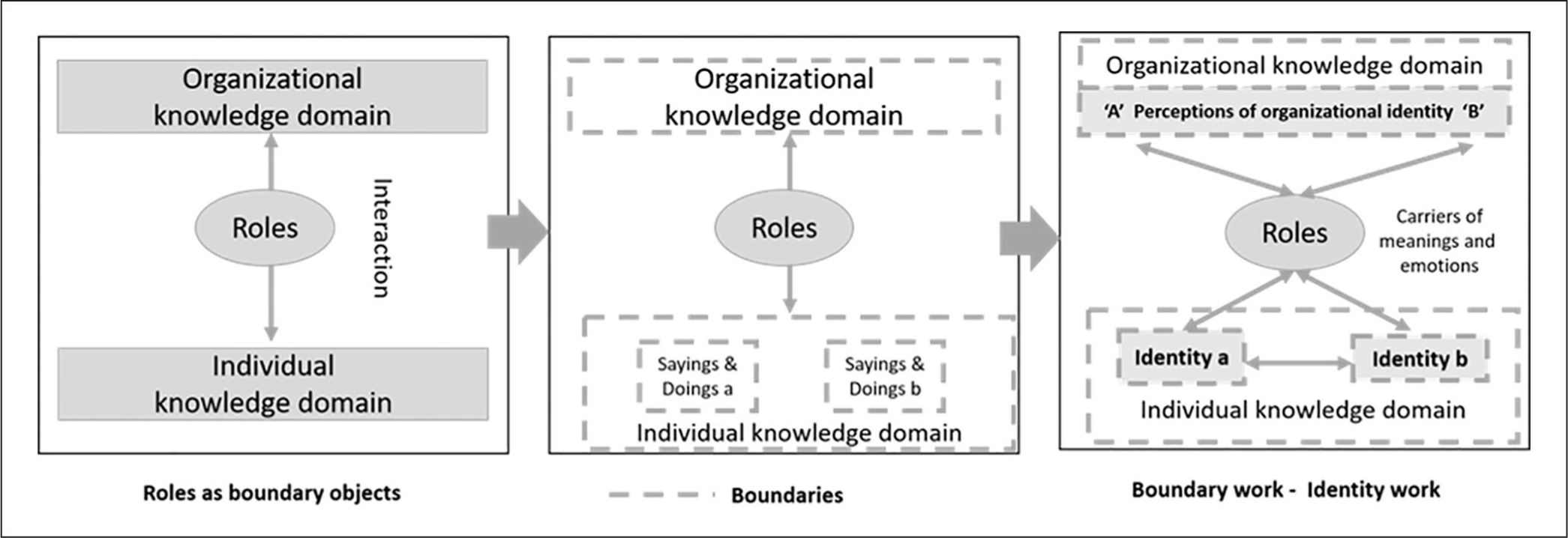
Conceptual framework.
Research Design
Companies experiment with the opportunities that blogs and bloggers provide for their content production, business models, and branding (Huang et al., 2007). Our example is a Nordic online magazine set up by a media corporation in the form of a blog portal. It hosts a large selection of blogs produced by professionals (editors and paid freelance bloggers), reader-bloggers (non-paid amateur audience-contributors), and advertisers. This blog portal is an example of a media product based on open content production and earning logic driven by online advertising. For reasons of confidentiality, we refer to this lifestyle and fashion portal targeted at women in their 20s as “Maxi.” It was founded when the publisher, a media corporation with a long history in magazine publishing, added a new online product to its portfolio. We use the terms online magazine, portal, site, and platform as synonyms.
Our empirical materials comprise (a) data obtained online following netnographic principles and (b) personal interviews in the Maxi community. Netnography refers to ethnographic fieldwork carried out in online environments (Kozinets, 2015). The first author, who as a woman in her late 20s was part of the target audience of Maxi, spent a year “lurking” on the site (Beaulieu, 2004). She logged onto Maxi daily, and sometimes spent hours there when she spotted interesting discussions. She identified herself as a researcher but acted as “someone who is part of an activity on the internet” without “making explicit/overt contributions to it” (Beaulieu, 2004, p. 160). The first author followed how different types of bloggers presented themselves and worked on their sense of inclusion and exclusion with (and within) the emerging blog community. She paid attention to how bloggers linked posts to one another and how they commented on each others’ posts. Maxi allowed anonymity, and the first author noticed that approximately 50 percent of the comments in the threads she followed were given anonymously, without registering in Maxi. We considered these comments to be representative of the Maxi audience and thus beyond the focal blog community.
In order to generate more empirical materials about bloggers’ identity work, the first author interviewed professional freelance bloggers and reader-bloggers that she “recruited” through comment sections in their blogs. She also interviewed members of the editorial team, the brand managers, and the digital and development directors at the media corporation. The first author had a thematic list of questions for the interviews (personal background, interest in and relationship with Maxi, and examples and stories of experiences), but she allowed the discussions to flow freely in the direction each interviewee took it. This allowed all interviewees to elaborate on themes they found important. Interviews with freelance bloggers and reader-bloggers were conducted in cafés and restaurants. Interviews with editorial team members, managers, and directors were conducted at the media corporation premises. All interviews were recorded and transcribed verbatim by the first author.
Reliance on one-off, retrospective interviews with individuals has its limitations in terms of tracking shifts in how people work on their self-identities (van Grinsven et al., 2020). We analyze materials based on both observations of online activity and interviews, and triangulate these in order to develop a comprehensive understanding of boundaries, roles, and identities online. We rely on abductive reasoning in our analysis and theorizing. Abduction emphasizes researchers’ familiarity with the relevant literature(s) as a starting point in the research (Tavory & Timmermans, 2014). However, this familiarity allows researchers to recognize the limits of existing explanations when confronting data with theory. Developing the conceptual framework detailed earlier was part of our abductive research process. A synthesis of insights from different literatures was (part of) the outcome of our research process rather than its starting point.
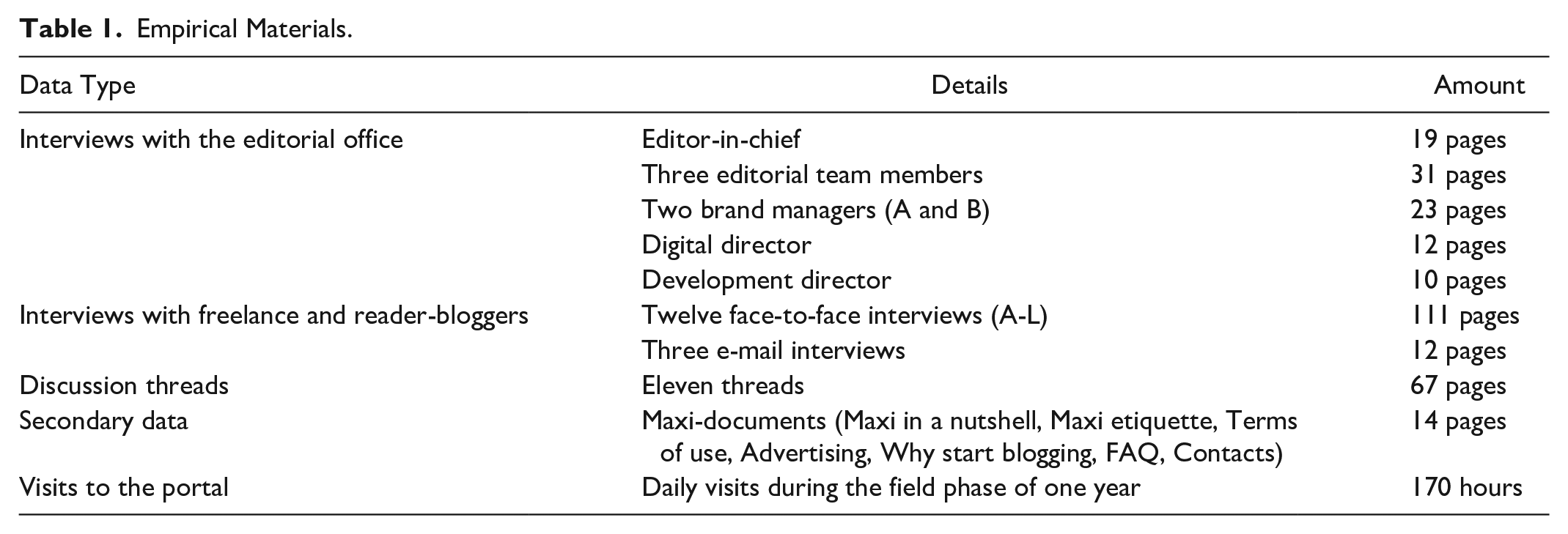
Our analysis of the empirical materials (listed in Table 1) proceeded iteratively through three main stages. First, we explored how Maxi was positioned in the product and brand portfolio of the publisher (media corporation) and how the portal was set up and managed. We also sought to understand what kind of identity the publisher and editors sought to create for Maxi. Second, we focused on the way our focal research participants (professional freelance bloggers and reader-bloggers) interacted between domains: the publisher-driven social world and their lifeworlds as bloggers. With our focus on roles as boundary objects, and drawing from earlier research on the mediation of content in blogging (Huang et al., 2007; Pihl & Sandström, 2013), we developed an initial coding scheme based on three types of content: narrative (talk on producing written entries in a given style), commercial (mediating commercial messages), and branded (disseminating brand meanings). We found examples of how each content form was mediated between domains. This enabled us to develop an understanding of roles as boundary objects construed in and through interaction between domains and actors (Järventie-Thesleff & Tienari, 2016).
Empirical Materials.
We discerned from the materials how processes related to mediation of narrative content constructed the role of narrative stylist, which was characterized by distinct narrative styles and a degree of (dis)obedience to the rules and expectations set by the publisher (media corporation). In turn, processes related to mediation of commercial content constructed the role of commercial intermediary, which was characterized by willingness or reluctance to allow adverts in connection with blog posts and to make use of promotional materials (products and services) from companies in exchange for “testing” and endorsing them. Finally, processes related to mediation of branded content constructed the role of brand protagonist, which was characterized by varying degrees of interest in engaging in self-branding and in developing Maxi as a brand. These three roles were not predetermined in an organizational position (such as editor, professional freelance blogger, or reader-blogger), but emerged and evolved as boundary objects through the mediation of content between the lifeworlds of individual bloggers and the publisher-driven social world.
Third, we returned to our categorization based on different forms of content. Extracts from our interviews and online discussion threads helped specify various role-related meanings and emotions. These contributed to potential identity constructs, which were engendered by meanings and emotions related to role-specific interaction. We discerned two contrary, yet interlinked identity constructs for bloggers: (a) aspiring professional, which was built on enhancing the opportunity to develop various professional aspects of all roles (boundary objects) and exhibited a sense of conformity in relation to Maxi (Collinson, 2003); and (b) critical free-thinker, which emphasized individualistic interaction related to the various roles (boundary objects) and a skeptical and even resistant stance on the commercial dimensions of the platform (Collinson, 2003). Bloggers engaged in identity work in which they attached various alternating emotions and meanings to the emerging roles. We analyzed how they talked about overlaps between aspects of individual and organizational identities, and explored how they constructed an identity for Maxi as a blog community and an organization. By focusing on aspects of Maxi that were foregrounded by bloggers, two contrasting identities for the organization emerged: (a) a “sisterly,” warm and friendly community and (b) an inward-oriented and hierarchical commercial community. Figure 2 summarizes our data structure and analytical process. Next, we present our key findings.
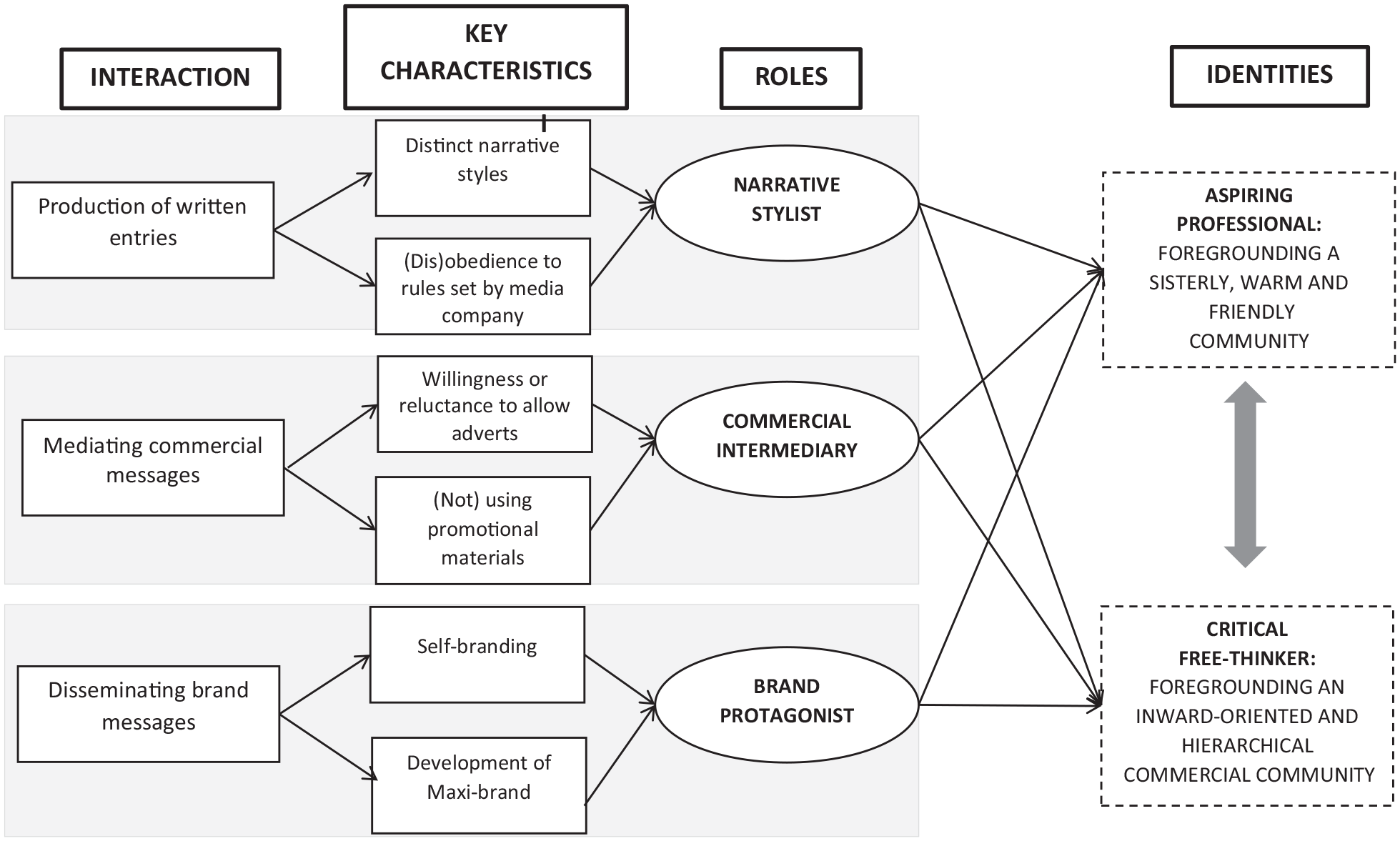
Data structure and analytical process.
Findings
Publisher-driven Social World: Organizing Maxi as a “Sisterly” Community
At the time of the launch, Maxi’s editorial team consisted of four members: an editor-in-chief, a managing editor, and two producers. They all worked full-time for the media corporation and wrote their own blogs. They invited ten established bloggers—who already had a wide following for their lifestyle and fashion blogs on other sites—to join the portal on a freelance basis. These professional bloggers received monetary compensation for the content they produced regularly for Maxi. Apart from the editorial team and the professional bloggers, any audience member could set up a blog at the Maxi site. The most popular reader-bloggers were to be rewarded on an ad hoc basis. Advertisers, too, could buy a blog spot to endorse their products and hire a blogger to update it.
Maxi was established because there was no “home” online (in this Nordic language) for women in their 20s. There was demand for a “sisterly community” where young women could get together to discuss topics of mutual interest. The media corporation wanted to attract young, modern, and outspoken women as both contributors and readers. The editorial team highlighted the co-created aspects of the Maxi platform where blogging, discussion threads, and magazine-like articles appeared on a single site. They wanted Maxi to be approachable and friendly. However, this was to be spiced with some “edge.”
Each professional freelance blogger was given their own Maxi title and responsibilities such as fashion editor, music editor, or opinion editor. Apart from these professionally crafted and themed blogs, all user-generated blogs were to be treated equally on the Maxi site. They appeared in the same blog stream as official Maxi blogs. All those who wanted to start a blog were required to register and adhere to the Maxi-etiquette, which defined the terms of use for the site. They were expected to regularly update their blogs. They were also expected to write their blogs in a specific style that is “accessible to their target audience” of women in their 20s.
Maxi quickly attracted several thousand audience-contributors. However, the number of active amateur bloggers who uploaded content regularly remained relatively small. All users were able to follow all blogs, “like” individual posts, and comment on them. The individual blog posts that were most read, liked, and commented on appeared under “most read posts” on the portal. Editors regularly picked out reader-blogs that they labeled “Maxi-recommended content.” Reader-bloggers were to be endorsed to boost wider discussion and interest on the site.
Roles as Boundary Objects
Our attention was drawn to how content and style were mediated between the individual reader-bloggers and the blog platform that is the Maxi site. We could discern how specific roles emerged as boundary objects in the mediation of narrative, commercial, and branded content between the two domains of knowledge (Simpson & Carroll, 2008). First, the role of narrative stylist was constructed through a process related to mediation of narrative content. This role was characterized by a search for a distinct blogging style and journalistic conventions, and a (varying) degree of obedience to rules and expectations set by the media corporation. The role of narrative stylist enabled learning and personal development as a member of the Maxi community: Having a place where I can reveal my thoughts to others enhances my creativity. It is like a diary, but if I was only writing at home, with pen and paper, I would easily end up producing meaningless texts. . .. I really enjoy it when I can challenge myself to develop my thoughts into a form that is comprehensible to others. (Blogger G)
This role was characterized by the way bloggers reflected their own lifeworlds in the narrative content and style they produced. “Our bloggers write about things that they find interesting and about how they experience things,” editorial team member A told us. The emerging role was (re)produced by the mediation of bloggers’ mundane life experiences, but with a particular style. The narrative stylist role emerged in the interaction between the publisher-driven social world (Maxi) and the lifeworld of the individual bloggers by mediating narrative content. It served as a conveyor of various meanings and emotions related to writing.
Second, the role of commercial intermediary, which was characterized by willingness or reluctance to accept advertisements in connection with one’s blog posts and to obtain access to promotional products and events, was constructed through a process related to mediation of commercial content. Advertisers’ blog spots appeared alongside reader-bloggers, and advertisers could thus benefit from their sense of “authenticity” (Pihl & Sandström, 2013). Advertisements were placed between blog spots and they appeared as pop-ups before blogs could be accessed. From the perspective of the media corporation and its clients (advertisers), positive meanings were attached to advertising and endorsing products in connection with blogging. The role of commercial intermediary thus became available to all bloggers. In the same spirit, they could use the platform to promote their own professional activities, for example by referring to articles they had written for other sites.
When you compare my blog with the sponsored blogs that are hosted by companies. . . I kind of dislike all that, but somehow as a journalist it is really easy for me to promote my own stuff. It’s pretty much the same thinking anyway. It doesn’t feel like marketing. (Blogger H)
While some bloggers were excited about the opportunities that engaging with commercial messages could bring them, others associated the Maxi portal and the role of commercial intermediary with a sense of betrayal. They found it hard to accept that the revenue logic of the portal was based on income from advertising and, in particular, on taking advantage of the “free labor” of reader-bloggers.
Third, the role of brand protagonist was constructed by a process related to mediation of branded content, which was characterized by interest in self-branding (or taking distance from it) and in contributing to building the Maxi brand by mediating content. Our materials include a lot of reflection on the Maxi brand, the brands of the products and services advertised, and branding oneself as a blogger. The role of brand protagonist took shape in interaction where bloggers sought to brand themselves in and through the Maxi community and brand. This role served as a conveyor of various meanings and emotions related to branding activities. A producer reflects as follows: The most read blogs are by those bloggers who have branded themselves best, intentionally or unintentionally. People know what they get when they click on these links. If the objective in blogging is to attract readers and comments, well, that is best done by branding yourself either by content or style. (Editorial team member B, comment in a discussion thread)
To conclude, roles in the emerging Maxi blog community were not predetermined in organizational positions. Instead, they emerged and evolved as boundary objects (Simpson & Carroll, 2008) that mediated content across social boundaries (Hernes, 2004) of the lifeworlds of individual bloggers and the social world driven by the media corporation. Roles were located in-between the two domains where they facilitated the emergence of identities and mediated the identity work of the bloggers. Roles helped construct mental boundaries (Hernes, 2004) between different self-identities.
Boundary Work as a Form of Identity Work
In our analysis we recognized two main self-identity constructs that we call aspiring professional (conformist identity) and critical free thinker (resistant identity). These identities were constituted by differences in the meanings and emotions attached to the roles of narrative stylist, commercial intermediary, and brand protagonist. The boundaries between the knowledge domains were continuously (re)negotiated in and through identity work.
Conformist identity work
The identity of aspiring professional was constructed by attaching, combining, and emphasizing particular meanings and emotions related to the roles that served as boundary objects. For example, ascribing meanings regarding self-development and learning to the role of narrative stylist contributed to formation of a conformist identity. This happened through excitement and joy, and a sense of overcoming uncertainty and insecurity. “I’m a bit insecure as a person and producing text is sometimes difficult for me,” blogger C told us. “My blog is a place where I can practice it.”
The blogging self was to a significant extent conditioned by reactions from readers, other bloggers, and Maxi editors. Receiving feedback indicated recognition and contributed to identity work as bloggers made sense of their selves as members of the community. “I like to get feedback on my texts. And the threshold for me to like and to comment [on other blogs] is lower here on the Maxi site, I wonder why?” (Comment in a discussion thread). Blogging also offered a means for reader-bloggers to develop their writing skills and learn to express themselves clearly and engagingly for the community. “I like to write, but I’m still very insecure when I publish my texts. But I want to write more. I want to get more practice, and my blog is a good platform for me to do that” (Blogger A). The fact that bloggers were expected to update their blogs on a regular basis—and present the self in a particular style—offered them an opportunity to become more confident in crafting texts and presenting the self to others.
Maxi attracted amateurs as well as freelance journalists and communication students who wanted to gain experience and visibility, to develop professionally, or to build their personal brand and eventually make a living in blogging. The following interviewee wrote a blog as a hobby on the Maxi site and used Maxi as a platform to produce personal narrative content in a form that differed from her work as a journalist: Writing is a natural way for me to express myself. I sit in front of my computer a lot. However, I am not able to express myself as much as I would like in my job as a journalist. I especially enjoy writing columns, and I feel that blogging is in many ways similar to that. I’m also a devoted diary writer, and I consider my blog a sort of public diary. (Blogger L)
The identity work of the aspiring professional was also influenced by excitement with the possibility of becoming acknowledged as an official Maxi blogger. Bloggers sought to gain recognition both from the editorial team and other members of the community, to be compensated for their writing, and to have an “official Maxi blogger label” attached to their site. Bloggers told us that by focusing on a certain theme they hoped to eventually get recognition and call themselves specialists in this area. An editorial team member reflected on this: “Perhaps the platform feels somehow more professional than a random blog somewhere out there in the blogosphere.”
Meanings and emotions related to roles of commercial intermediary and brand protagonist contributed to constructing the identity of aspiring professional. Material aspects of identity work were connected to the role of commercial intermediary in particular. Some bloggers were asked by companies to “test” products and write about them. They were asked to attend functions and parties with corporate representatives and celebrities. The idea of gaining material and reputational benefits from the role of commercial intermediary thus contributed to construction of an aspiring professional identity: Sometimes I think, maybe because I am a professional writer, that I might be able to sell someone the content I produce. For example, when I got pregnant, I thought maybe I could sell a pregnancy blog to a parenting magazine and make it a part of my profession. (Blogger L)
The role of brand protagonist attracted particular meanings and emotions. “Having a blog on the Maxi site enables us to get invitations and to get some visibility,” blogger I contends. “Through visibility you get opportunities to do stuff in the name of collaboration.” The idea of making oneself into a brand, or the feeling of pride in being able to support the Maxi brand, together with the thrill of earning money by blogging were attached to the role of brand protagonist.
Every now and then I dwell on the topic of self-branding. But I do not have a certain style, no postings about anything clever. It is all about me and my life. So, in the end I decided that hey, here I am. This is what my blog is like, this is how my life is. So maybe I did manage to brand my blog! (Blogger D in a discussion thread)
Positive meanings attached to the roles and the construction of the aspiring professional identity overlapped with the targeted organizational identity of Maxi as a “sisterly community” that is friendly and open. “It’s so easy to let off steam and write in the Maxi blog, just babble, because there are so many others who do the same “ (Comment in a discussion thread). Openness and variety were important for many: “For me, the best thing is that you can find all sorts here. You can look at shoes and then move on to reading about elections.” This created a sense of connection: “My maiden voyage into Maxi was all about fashion and beauty. . .but for some reason I came back. Perhaps it was because when I dug deeper I found blog spots where the stuff really resonated with me, blogs that discuss a lot of issues beyond high heels and all that” (Comment in a discussion thread).
One blogger who works as a journalist described identifying with the Maxi community as the core reason she produced content without compensation: “Now that I’ve started blogging at Maxi it would feel weird to leave and set the blog up on an independent platform. I do have a relationship with Maxi I guess, a bond” (Blogger H). These connections and “bonds” were also noted by the editorial team: It is awesome when people use phrases like “Maxi-etiquette” or “member of Maxi.” It is great to see your thoughts and ideas become a reality. And when you see that it matters to people, you feel like “yesss”! (Editorial team member A)
The editorial team sought to bolster Maxi’s identity by describing it as “versatile and multifaceted – shallow and intellectual at the same time” and by highlighting how they envisioned the Maxi identity and how content on the portal should look. The open-mindedness and welcoming atmosphere in Maxi were highlighted by using words such as “sisterly love,” as an editorial team member did in our interview: “It’s a warm and encouraging place where you can have a dialogue over both the best lipstick brands and the current political climate.”
Resistant identity work
The aspiring professional identity could also be contested by attaching meanings and emotions of doubt and depreciation to roles that emerged in interaction between the publisher-driven social world and the lifeworld of bloggers. The identity construction of critical free thinker was upheld by attaching opposing meanings and negative emotions to the roles of narrative stylist, commercial intermediary, and brand protagonist. For example, negative emotions such as frustration in connection with the role of narrative stylist were often related to the assumed curation practices of Maxi editors. Reader-bloggers expected to be acknowledged by having their blogs recommended, and when this did not happen, they expressed frustration and disappointment. This was frequently discussed among reader-bloggers: If they think that “hey, this thing is really good,” they could highlight it on the front page to show that there are good posts among the amateur ranks, too, something that others might want to check out. (Comment in a discussion thread)
Whereas meanings related to professional development and making money attached to all three roles contributed to the identity of the aspiring professional, doubts attached to the same roles contributed to construction of the critical free-thinker identity: It is so quasi-professional. I think it is simply too much that you call yourself a specialist in the area you are covering if you have been blogging for let’s say two years. But if you get paid and you have done it for ten years, it’s a different story. If you blog for a couple of years, receive some gifts and invitations to parties, you are not a professional, you remain an amateur. (Blogger F)
The editorial team offered training events to bloggers, guiding them towards specific narrative content and style. For some bloggers, these guidelines and the feeling of being guided towards “the correct Maxi style” were welcome. However, this practice was also contested, contributing to a resistant identity. This happened as some bloggers attached emotions such as doubt to the roles of narrative stylist and brand protagonist, as in the following quote: The editors have arranged training and networking events for bloggers. The theme of one of those sessions was writing. I felt rebellious, as I write long pieces without too many pictures or other catchy stuff. I realize it may be a problem in blogging. But I still believe that people want to read a really good story. The writing guidelines were something that the participants in the event objected to a lot: that we should write some of the words in our texts in bold, use short sentences, lots of pictures, catchy titles, a lot of subtitles and all that. (Blogger L)
In addition, instrumental meanings related to doing business, attached to the role of commercial intermediary, seemed to run against the principles of many bloggers. These aroused strong feelings of distaste, thereby contesting the identity available to them as Maxi community members.
I thought I’d just leave Maxi because the platform, the adverts, and many other things there don’t represent what I want to promote. That makes me feel anxious and put off. I’m writing stuff for the publisher for free, think about that! (Blogger I in a discussion thread)
Anxiety was evident in how some bloggers talked about the “coercive pressure” to brand themselves in particular ways to get the attention needed and be considered a community member. Also, “if I write a blog under the banner of a media company, I feel that if I had something to criticize about the company, I wouldn’t be able to publish it,” blogger K maintained. “This is the case for me now, even if I know that Maxi tries to establish itself as an independent medium.” For some bloggers, the brand protagonist role mediated a sense of detachment and drifting away from Maxi. “New bloggers are welcomed and they are given space, but you get the feeling that to operate here you should brand yourself,” blogger A reflected in a discussion thread.
The organizational identity of Maxi as a “sisterly,” warm, and friendly community was contested. Opposing meanings and negative emotions attached to the three roles contributed to portraying Maxi as inward-oriented, hierarchical, and overly commercial. Referring to the editorial team’s alleged “policy of money making,” a reader-blogger snapped in a discussion thread: “I can promise you that if you start writing blogs with dollar signs in your eyes, I’m out of here.” Many reader-bloggers came to see Maxi as something very different from the “sisterly community” envisioned by the editorial team: Hmm. . .all in all, I feel that there were just too many advertisements, too much of everything. Too much of this hipster-like feeling and atmosphere. The whole thing started to look very childish. That is one of the reasons why I decided to leave. And yes, too much of this inward-oriented cronyism. . .patting each other’s backs. (Blogger B)
When the editorial team failed to promote and compensate the posts of some bloggers, they felt that they were not getting enough positive feedback on their work and aspirations. They took distance from Maxi, which again contributed to an identity for the Maxi organization that was far removed from what was intended by the editorial team.
The most valuable blogs shine on the front page, they are recommended, and they seem to be listed in some order of superiority. The word “most” irritates me. . .the most discussed, the most liked. . .. Are bloggers placed in the “most” category some kind of winners? I suppose this is no competition, but sometimes it feels like it is! (Blogger A in a discussion thread)
Emotions such as disappointment related to roles of commercial intermediary and brand protagonist seemed to contribute to the emergence of an organizational counter-identity. “Maxi is still somewhat blurred to me. I get the feeling that this is a small, hierarchical, and inward-oriented community,” blogger D commented in a discussion thread. This illuminates how distance is taken from the community and organization. In some cases, meanings attached to different roles constructed a resistant identity that resulted in withdrawal from Maxi. Two of our interviewees decided to leave Maxi altogether. They were disappointed with the feeling of being an outsider in a seemingly welcoming community and angry about its “overly commercial” nature.
In summary, meanings and emotions attached to roles that emerged in the interaction between domains contributed to two main self-identity constructs in Maxi: aspiring professional (conformist identity) and critical free thinker (resistant identity). On the one hand, individuals constructing conformist identities tended “to be preoccupied with themselves as valued objects in the eyes of those in authority, subordinating their own subjectivity in the process” (Collinson, 2003, p. 536). On the other, people expressed their discontent with the interaction in the community through their resistant selves (ibid.). These two self-identity constructs were not mutually exclusive. Our analysis indicates that given individuals could base their identity work on different and even opposing meanings and emotions over time. Individuals could straddle conformity and resistance, further contributing to the fluidity of the online community as an organization.
Discussion
Our aim in this article has been to shed light on dynamic relationships between boundaries, roles, and identities in an online organization. We have developed a conceptual framework for exploring the (re)construction of self-identities in online spaces and offered a novel way of studying how identities are worked on in interaction with others. In a study of a blog portal that was developed for commercial purposes, we have elucidated how bloggers engage in and relate to this emerging online community and organization. This article makes three main contributions: (a) we theorize boundary work as identity work, (b) we show how conceptualizing roles as boundary objects sheds light on the entanglement of individual and collective identities in online spaces, and (c) we elucidate how roles mediate identity work by acting as carriers of meanings and emotions.
Contributions
First, we contribute to research on identities and identity work in organizations (Brown, 2015; 2017) by showing how boundary work can be understood as a form of identity work in the online community. Building on the work of Simpson and Carroll (2008), we operationalize the notion of roles as boundary objects, and following Järventie-Thesleff and Tienari (2016), we explore how roles co-evolve with identities. We understand identity work as dynamic and relational processes that take place in interaction with others (Kenny et al., 2011) and elucidate how social and mental boundaries are an integral part of these processes (Hernes, 2004). In our study, boundary work was primarily about constructing boundaries based on mutual stances and understandings of interaction between the publisher-driven social world and the lifeworlds of individual bloggers. Attaching different meanings and emotions to emerging roles contributed to the construction of boundaries around similar understandings of the interaction. This mediated the emergence of conformist and resistant identities (Collinson, 2003). (Aspiring) Community members could be engaged in different types of identity work by drawing on various meanings and emotions carried by the roles. Conformist and resistant identities were not mutually exclusive but represent extremes of a continuum.
The fluidity of the online community is significant here. The studied community operated within multiple sets of co-existing social and mental boundaries with low thresholds (Hernes, 2004). This led to a high degree of malleability of the community as an organization. Our analysis indicates that the construction of shared understandings of interaction (boundary work) played out as inferences concerning similarities and differences when people sought to define who they are (identity work). Boundaries were (re)drawn around shared understandings of the nature of interaction between domains and among actors. They demarcated various stances on interaction. Boundary work referred to the way those associated with the online community built social and mental boundaries around mutual understandings of the nature of interaction within this community (Corporaal, 2018). Roles as boundary objects emerged and evolved in interaction between the domains. By attaching different and at times alternating meanings and emotions to the emerging roles, potential identity constructs became available for those concerned, that is, roles mediated their identity work.
In earlier research, there are some indications that boundary work can be understood as a form of identity work. In their study of migrant Muslim businesswomen in The Netherlands, Essers and Benschop (2009) focused on boundaries between some established identity categories and argued that the different ways in which identity categories operate together constitute the identity work of entrepreneurial women. These authors presented boundary work as the building of boundaries in and across relatively fixed identity categories such as gender, religion, and entrepreneurship. Our study extends the understanding of boundary work as a form of identity work to circumstances and communities where identity categories are not fixed, but where categories are formed—and boundaries are negotiated—through meanings and emotions attached to various emerging roles. In conformist and resistant identity work, the online organization studied, and its emerging identity were both reconstructed and contested, in some cases more or less simultaneously (Brown, 2017, p. 309).
Second, we contribute to literature on organizational identity and the discussion on “cross-level” identities (Ashforth et al., 2011; Kreiner et al., 2006) by shedding light on how individual and collective identities are related in online spaces. The earlier reflections lead us to argue that emerging roles (understood as boundary objects) influence the way individual and collective identity construction intertwine. Studies on identities tend to focus on a particular level of analysis (considering individual, group, or organizational identity as distinct phenomena) and have often failed to engage in identity research across levels (Ashforth et al., 2011; Kreiner et al., 2006). Our study suggests that in fluid online communities, shared identity is under continuous construction (Dobusch & Schoeneborn, 2015). This is done by references to the collective (defining how the self belongs to the collective), creating a sense of mutual belonging (building shared histories as well as understandings of the present and future), and negotiating a situated understanding of how things are done (developing shared styles of interaction and ways to manage relationships; Fayard & DeSanctis, 2010). The online organization and its identity, then, is built upon the expressed self-identities of those who associate with it.
In our study, those bloggers who constructed the self-identity of an aspiring professional typically viewed the community as “sisterly,” warm, and friendly—as something with which they wanted to identify. In contrast, those who worked on the self-identity of a critical free thinker tended to view the community as inward-oriented, hierarchical, overly commercial, and dis-identified from it. For them, the sense of community was accompanied by competition, the sense of collaboration was conditioned by hierarchy, the sense of openness turned into inward-orientation, and the sense of self-expression was enmeshed with self-branding and disturbed by blatant commercialism. Attaching different meanings and emotions to the emerging roles contributed to different individual identity constructs that tied bloggers to the community or led them to drift away from it. The mental and social boundaries around knowledge domains, and around doings and sayings of individual actors, enclosed understandings and stances on interaction. Hence with the different and alternating meanings and emotions carried by the roles the “organizational identity” of the online blog community also remained in flux.
Third, we contribute to research on identities and emotions (Winkler, 2018) by elucidating how roles mediate identity work by acting as carriers of emotions in online spaces. We found that the way bloggers attached different meanings to emerging roles in the online community is to a significant extent an emotional process. This helps to further understand its fluidity. In their study, Järventie-Thesleff and Tienari (2016) elucidated how roles were subject to ongoing reconstruction in continuously evolving relational processes and showed how roles gave stimuli to identity work over time. However, they did not discuss the emotional nature of the stimuli. We have shown how the way bloggers constructed boundaries and worked on their identities was influenced by positive and negative emotions attached to and carried by emerging roles.
The identity of an aspiring professional was constituted by attaching positive emotions of joy in learning to the role of narrative stylist and excitement to the role of brand protagonist and commercial intermediary. Emerging roles helped socially validate these identity constructions (Ashforth & Schinoff, 2016). The aspiring professional conformed to the meanings and emotions attached to the interaction between the publisher driven social world and the lifeworld of bloggers. This was in line with the identity targeted for the organization by the media corporation. In contrast, the identity of a critical free thinker was constituted by attaching negative emotions of doubt, depreciation, disappointment, and anger to the aforementioned roles. Frustration with the blog community and distaste for excessive commercialization contributed to the construction of this identity. It drew on negative emotions and resisted the meanings attached to interaction between the publisher-driven social world and the lifeworld of bloggers.
Emotions are discursive resources for constructing and maintaining “versions of self” (Kuhn, 2009). At the same time, emotions reproduce “the discourses that constitute particular identity positions” (Ahuja et al., 2019, p. 992). Emotions give guidance to people when they are confronted with competing identities (Cascón-Pereira and Hallier, 2012) and discourses (Clarke et al., 2009). Although earlier research has described emotions as triggers and outcomes of identity work (Coupland et al., 2008), the constitutive role of emotions remains unclear (Brown, 2015; Winkler, 2018). In our study, conformist and resistant identities were mediated by the meanings and emotions attached to the roles of narrative stylist, commercial intermediary, and brand protagonist. Meanings and emotions related to roles and boundaries did not remain stable and fixed when they co-evolved with identities and mediated identity work (cf. Järventie-Thesleff & Tienari, 2016). Hence the emotional processes through which bloggers negotiated boundaries to achieve either integration with the various identity constructs or differentiation from them contributed to their boundary work as a form of identity work.
Specifically, emotions related to boundary objects (roles) influenced bloggers’ identity work by enabling them to combine, contest, and change various aspects of potential identity constructs. Emotions influenced entanglement between individual and organizational identities, bringing about attachment to the envisioned identity of the online community and organization or detachment from it (cf. Winkler, 2018). However, in the online community conformist and resistant forms of identity work are not mutually exclusive. As identities are continuously (re)constructed in interaction with others, the same people can adopt different stances on the community over time. Identity work is a continuing struggle (Beech et al., 2016). Because emotions are an essential part of it, identity work online is fickle and, in many ways, unpredictable from the perspective of organizational decision-makers.
Implications
This article has broader implications for understanding how precarious workers associate with online spaces and communities. Contemporary working life is characterized by technological development and precarity (Barley et al., 2017; Petriglieri et al., 2019). Engaging with online spaces has become a must for many people in securing their livelihoods. Transformation of work through outsourcing and offshoring; various forms of “contingent,” “temp,” and “gig” work; and blurring boundaries between work and other spheres of life have received increasing research attention (Barley et al., 2017). Compared to traditional employment relationships, precarious workers lack a permanent contract, a clear position in the organization, a physical space in the employer’s premises, and regular contacts with colleagues and co-workers. These circumstances constitute significant challenges for their identity work.
In their insightful study, Petriglieri et al. (2019) interviewed “independent workers” such as consultants, writers, executive coaches, and artists. They showed how these professionals manage their precarious and personal work identities. However, Petriglieri et al. (2019) took a notably individualized stance on precarious work. Our findings extend their work by highlighting the importance of roles as mediators in identity work in online spaces. We emphasize relations and interaction among precarious workers and with the community and organization. We suggest that it is useful for precarious workers to think of their work in terms of emerging roles. When they conceive their relationship with an organization through roles that emerge in interaction, we argue, precarious workers are better able to make sense why they deal with that particular organization, what drives the collaboration, and which aspects of the interaction produce for them joy or anxiety. This helps precarious workers to make sense of the different roles as well as the meanings and emotions roles carry in their identity work.
At the same time, a better understanding of these dynamics helps organizations to attract people to collaborate with. Understanding emotions attached to different roles that emerge in the interaction among actors is significant in managing fluid online organizations. Our study shows that people who are drawn to online communities look for meaning in their lives. Providing opportunities for positive meanings and emotions to emerge, and holding negative emotions at bay is thus a key managerial task. Our findings elucidate the importance of engaging precarious workers and dealing with their emotions vis-à-vis the emerging identity and brand of the online community. It is essential to provide a space for active discussion and dialogue, and to allow divergent and critical standpoints to emerge (Bange et al., 2020). Online workers use a repertoire of strategies of identity work, and managing these in constructive ways is paramount. The identity of the online organization is not detached from the self-identities of those who associate with it.
Finally, in our study, the empirical focus was on a single online community. Potentially idiosyncratic characteristics of blog communities could be uncovered in studies that compare different online spaces. We call for more critical inquiry from the perspectives of emotions and precarity, identity regulation, branding, and resistance. Precarious work identities are associated with emotional tensions (Petriglieri et al., 2019) and the emotional underpinnings of identity work in online environments need to be further explored. At the same time, blog communities exemplify the politics of identity work in contemporary society, where seeking attention is essential. Chia (2012) argues that beyond the “vibrant vision of blogging as a surefire ticket to fame and fortune” is a “sobering structural reality of obscurity and tedium” (p. 427). In our study, reader-bloggers who sought attention were forced to relate their self-identities to corporate interests. This is a form of identity regulation that finds a conducive space online. How it plays out in relation to branding is an important subject of critical inquiry. Although many of the bloggers we studied sought to brand themselves, they were simultaneously being branded (Endrissat et al., 2017). They served the branding needs of the media corporation and advertisers. Power relations in online spaces and the issue of resistance to corporate interests and ubiquitous commercialism need to be studied further. Our conceptualization of roles as boundary objects serves as one foundation for such inquiry.
Conclusion
Understanding what ties precarious workers to online organizations and what makes them drift away is a key issue in today’s digitalized world. In this article, we have offered a conceptual framework for analyzing online spaces where boundaries and identities are constructed without a solid organizational foundation and where roles emerge as boundary objects that mediate interaction between knowledge domains and people. In the blog community at the focus of our study, some bloggers identified with the targeted organization identity while others lacked social validation for their identity construction. The organization and its identity were both reconstructed and contested, thereby contributing to its fluidity.
Footnotes
Acknowledgements
The authors acknowledge the generous support by Editor Andrew J. Sturdy and the three anonymous reviewers in making this article a reality. The text has benefitted enormously from their constructively critical comments.
Declaration of Conflicting Interests
The author(s) declared no potential conflicts of interest with respect to the research, authorship, and/or publication of this article.
Funding
The author(s) received no financial support for the research, authorship, and/or publication of this article.
