




Abstract
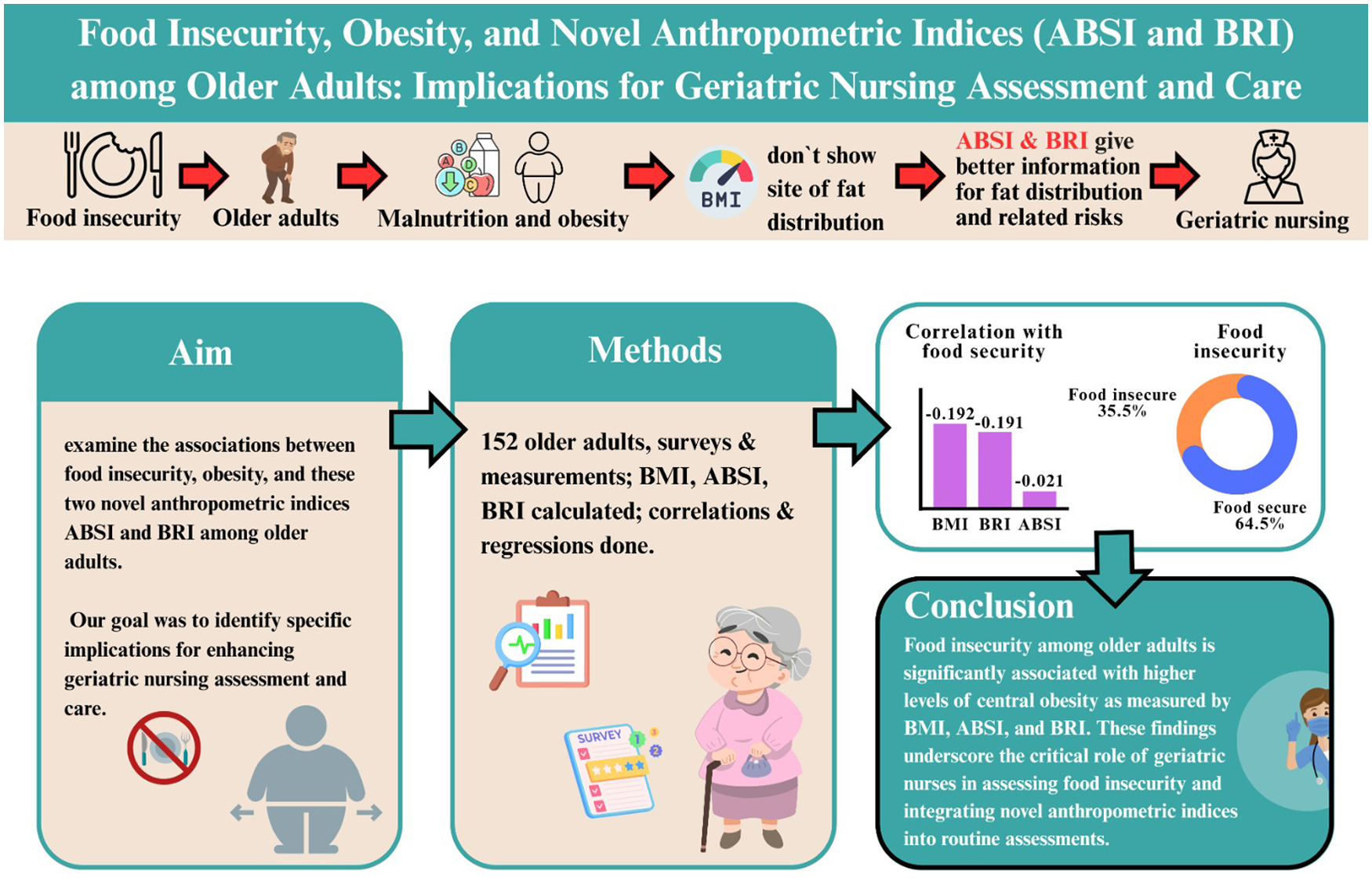
Food insecurity and obesity often coexist in older adults, leading to complex health issues. Standard obesity measures, such as Body Mass Index (BMI), do not adequately capture central adiposity, which is a more accurate predictor of metabolic risk. Newer anthropometric indices, such as the A Body Shape Index (ABSI) and the Body Roundness Index (BRI), offer improved precision in measuring central adiposity but are not commonly used in geriatric nursing assessments. To examine the associations between food insecurity and advanced anthropometric indices (BMI, ABSI, and BRI) in older adults, and explore implications for clinical nursing practice. A cross-sectional study was conducted with 152 older adults aged ≥65 from outpatient clinics at Assiut University Hospital, Egypt. Data were collected using the United States Department of Agriculture Food Security Survey and structured anthropometric measurements. BMI, ABSI, and BRI were calculated. Pearson correlations and multivariable regression identified predictors of food security status. Food insecurity was reported by 35.5% of participants. We found significant negative correlations between food security scores and BMI (r = −0.192, p = .018), BRI (r = −0.191, p = .019), and ABSI (r = −0.021, p = .023). This indicates that higher levels of adiposity and central obesity are associated with poorer food security. Regression analysis showed that gender, marital status, education, income, BMI, ABSI, and BRI were significant predictors of food security (p < .05 for all). Our findings demonstrate a significant association between central obesity, particularly as measured by ABSI and BRI, and food insecurity in older adults. We recommend that geriatric nurses integrate these advanced anthropometric indices into routine assessments to more accurately screen for food insecurity. This approach would allow for more effective and targeted nursing interventions for this vulnerable population.
Keywords
Get full access to this article
View all access options for this article.