



Abstract
Muscular dystrophy is a terminal muscle-wasting condition, whereby families face continuous challenges as their child’s health deteriorates. This research explored accounts of parenthood following bereavement of their child to muscular dystrophy. Narrative inquiry was used to analyse interviews with four couples. Findings suggest an importance in narrating adversities (waking up to different futures) and positive influence (creating legacies). The research highlighted how humour is often used to support others to witness painful accounts (humour through the struggle). Parents appeared to co-regulate the painfulness of narrating loss (storytelling together). Further research is needed on conjoint narrative interviews and how these may enable participants to address shared loss experiences. Practitioners who support bereaved parents could consider the potential value highlighted in this study of meeting with parents conjointly, which include that, through co-regulatory, collaborative processes, families seemed to be supported to reach narrative cohesion, sensitively and safely, when facing loss and bereavement.
Over 30,000 people are said to be diagnosed with Muscular Dystrophy (MD) or related conditions within the UK (Muscular Dystrophy Campaign, as cited in Cunniff et al., 2015). The condition causes wastage, damage, and eventual death of skeletal muscle cells, which leads to increasing physical impairment over time as a result (Gagliardi, 1991a, 1991b). Signs and symptoms that indicate the need for diagnostic assessment include delayed walking, a difficulty in rising from the floor or sitting up, a waddling gait, odd posturing, frequent falls, becoming easily tired, and over-developed calf muscles (Bendixen & Houtrow, 2017; Daack-Hirsch et al., 2013). Wheelchair dependency often occurs between the ages of 10 and 12 years (Erby et al., 2006). To date, there is no curative treatment known for the condition, with individuals often dying in their late teens due to respiratory complications or heart failure (Samson et al., 2009). Despite technological advances such as ventilation machines improving care provisions over time (Erby et al., 2006), it still remains the case that few individuals with Duchenne MD live beyond the age of thirty (Tomiak et al., 2007).
MD is chronically life-limiting, terminal and degenerative in nature. The disease phases, particularly in relation to ambulation and mobility, are associated with significant increases in pain. When children are not informed of their diagnosis, they often perceive themselves to be ‘different’ from their peers, as ‘incompetent’ and ‘personally responsible’ for their ‘weakness’ (Buchanan et al., 1979). Even with continued advancements in care provisions, some young people are reported to adopt identities as ‘futureless persons’—a perception that is said to have ‘damaging’ implications (Gibson et al., 2009). In line with this, previous evidence suggests the diagnosis of MD is often linked with mental health difficulties, particularly clinical depression (Fitzpatrick & Barry, 1990). Such diagnoses may well represent the labelling of a complex web of social, environmental and relational contributory factors—rather than something necessarily biological in nature. Indeed, in Gagliardi’s ethnographic research, they observed that “the boys withdrew into their own worlds, apparently so as not to confront the limitations imposed by their illness [sic]” (Gagliardi, 1991a, p. 163); or put another way, the limitations imposed by their society. For example, on leaving the education system, those living with MD often lack meaningful activity and vocation thereafter, due to societal barriers (Abbott & Carpenter, 2014).
Families often reach out to community groups and the charitable sector as they face the disease together; becoming strong advocates for the rights of young people with MD over time. The parents interviewed within this research were no exception, and all had sought the support of a charity called the Muscle Help Foundation. This charity offers advice, support and community to young people and their families through a broad range of engagement events, psycho-social support networks, educative programmes, publications, and more. An example of this work includes Muscle Dream events, in which families become ordained into the ‘muscle warrior tribe’ (for further discussion and research on Muscle Dream events, please see: Nolte et al., 2017; Randall et al., 2019). As MD is a terminal condition, the Muscle Help Foundation has found itself in a unique position of having been curators for ‘pockets of smiles’ (Nolte et al., 2017) and not only an escape from the omissions or imposed limits of society, but an important opportunity for transformational restorying and remembering, for families facing significant deteriorations in health and painful trajectories (Randall et al., 2019). Indeed, as the Muscle Help Foundation roots its approach and practices in building relationships and delivering on promises, families often continue to be active participants within the ‘muscle warrior tribe’. In the context of bereavement then, the Muscle Help Foundation appears to play a significant part in the ‘re-membering’ of their lost loved ones; a narrative therapy approach that looks to explore the continued influences, impact and connection with individuals—particularly those who are estranged or have passed away (e.g. White, 1988).
There is limited research on the experience of parenthood in the context of muscular dystrophy. Where there is, this has tended to be rooted in cross-sectional snapshots of a person’s journey, rather than branching into investigations of context, discourse, or more broader, macro studies of identity, change and narrative production. This study sought to change this and uniquely contributes to the literature through a narrative inquiry of the accounts of parents whose children have died from MD.
Aims
This research aimed to explore how parents would narrate their experiences of parenthood following the death of their child to MD. Explicitly, we aimed to explore what would be talked about by the parents when constructing their accounts, how the individuals would talk about these experiences (including the ways in which they contribute and ‘perform’ their accounts), and to understand why—the underlying purposes and functions of narrating.
Methods
This study is a qualitative narrative analysis (Riessman, 2008) using semi-structured interviews, which were administered with couples conjointly. Narrative analysis allows for the depth of understanding at the experiential level through an analysis of a retelling of experiences and the meanings placed upon these accounts. The approach also looks to situate narratives in context, thus enabling a broader, fuller and richer analysis.
Ethics
This research touches upon an emotive, sensitive, and potentially distressing topic area. The research proposal was reviewed and ethical approval granted by the University of Hertfordshire, UK. It was important that the research included an ethnographic component, in which the first author directly supported a family during a Muscle Dream event—witnessing some of the socio-environmental differences experienced when living with MD. A pilot interview was also conducted with a bereaved mother and father in order to trial out procedures, and to seek feedback on the acceptability of interview questions.
The literature on conducting research with bereaved parents was consulted to help guide the ethical approach of this research (with adaptations made in accordance with guidance from Hynson et al., 2006). The literature helped ensure that this study was delivered in accordance to best practice when researching in the context of bereavement. In addition, a clear protocol was developed to ensure psychological safety within interviews, which included options to discontinue interviews and to signpost for therapeutic and emotional supports. Accessible research summaries were made available to participants and published by the Muscle Help Foundation soon after completion of the research, online and in print.
Sampling and Recruitment
Purposive sampling was used in order to recruit parents who had experienced the death of a child to MD. As this research aimed to explore parental accounts of living with MD, following the death of a child, the following inclusion criteria were applied:
To self-identify as parents of a child who was diagnosed with MD; For the death of their child to have been at least 8 months prior to involvement.
Parents were recruited through the Muscle Help Foundation charity (described above) and followed the ethical guidance of Hynson et al. (2006). An invitation to participate in the research was sent out to the mailing lists held by the charity, and included a participant information sheet, and a more informal, user-friendly article and profile of the lead-researcher published on the charity’s website. Interested individuals were subsequently sent participant information packs, provided time to consider their potential involvement, and given the opportunity to ask questions to any of the research team in advance of their consent being requested.
Six couples expressed interest in being involved in the research, however one couple later withdrew from the study due to concerns about potential upset it could cause. One of these couples were involved as a pilot interview and thus not included in the data presented here.
Demographic information was gathered through interview and detailed further in Table 1. Narrative inquiry seeks to contextualise accounts as far as possible, however due to the small size of the charity in which participants were recruited, to include any further demographic information would compromise participants’ rights to confidentiality and contradict our professional ethics (British Psychological Society, 2014, p. 22). To mitigate the risk of breaching confidentiality, but to situate the data as far as possible, ranges have been used instead of exact data. All personally identifiable data was anonymised at the point of transcription and individuals allocated pseudonyms.
Participant Details.

All interviews lasted between 100 and 150 minutes each, across one to two interview dates per family. The ages of the individual parents who participated ranged from 29–68. Two of the fathers within the sample were step-fathers. The parents had a range of occupations, including professional and computer consultancy, education, labouring, and care working. The ages in which the parents’ children were diagnosed ranged from 2.5–5 years of age.
Data Collection and Analysis
Although all participants were given the choice of location, all opted to be interviewed within their own homes. Interviews were semi-structured using questions designed in line with the research aims, previous literature, service-user consultation and the pilot interview. The questions focused on a number of areas, including diagnosis (e.g. What changed when your son was diagnosed with MD?) and experiences around death (e.g. please tell me about the time you found out that your son was near the end of their life). Interviews were video-recorded and transcribed verbatim; including pauses, expressive utterances, non-audible speech, overlapping conversation, interruptions, and the use of 'voice'/parodies of others (Wells, 2011). Personal identifiable information was replaced with pseudonyms. All raw data was stored on an encrypted device.
The narrative analysis conducted incorporated three layers (Riessman, 2008): thematic analyses explore the content of what is actually spoken about in interview; structural analyses explore the use of language, and how this is presented and organised; and performative analyses, which looks at how narratives are co-constructed and interactively created within the interview context. This study employed all three layers of analysis in order to depict what the parents retold, how the retelling was presented, and why this was; that is, the context and meaning of the retelling. These layers should be considered as synergistic components of one overall, coherent process of narrative analysis.
Reflective notes made following interviews were re-read and the interviews were then watched back, in order for the lead researcher to familiarise themselves with the accounts. The researcher then re-read each account in order to familiarise themselves further. Following this, each transcript was then read in turn for each layer of analyses, with notes and themes being documented. Once the accounts were fully analysed, an additional document was created to reflect on and draw out initial threads between the individual accounts.
Credibility in qualitative research is said to be achieved in part through degrees of reliability, replicability, consistency, in owning one’s position, and ensuring transparency of process (Elliott et al., 1999). To ensure the analyses and findings generated in this research were credible, we committed ourselves to a reflexive approach throughout. For example, the lead researcher kept a reflective journal, convened workshops for analyses to be reviewed/critiqued, and explicitly explored their own epistemological stance (e.g. the perspective that our knowledge of the world and experiences are co-constructed, albeit rooted in material/objective realities).
Results
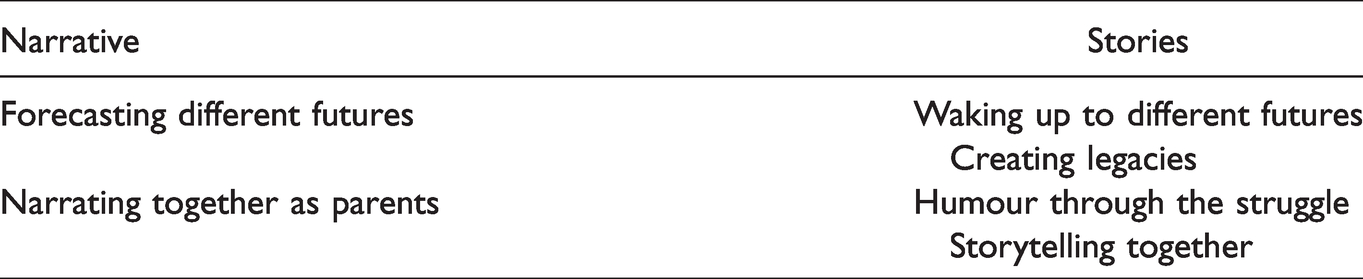
Narrative accounts were initially constructed for each parent couple and then analysed alongside other accounts within the sample as part of the broader narrative inquiry. In doing so, forecasting different futures and narrating together as parents were key components to the ways in which the parents storied their experiences. These narratives contained multiple stories within, as demonstrated in Table 2. A third narrative on living the dream has been reported elsewhere (Nolte et al., 2017; Randall et al., 2019) and will not be repeated here.
Narratives and Stories Within.
Forecasting Different Futures
Throughout the interviews, all parents described the ways in which their sense of future parenthood and identity was shaped or challenged in some way. When retelling their experiences of becoming a parent and adjusting to the diagnosis of MD, the interviewees narrated waking up to different futures. In building their accounts, the parents also talked of how their child’s life continued to influence and impact their sense of identity, community and influence (creating legacies).
Waking Up To Different Futures
All parents detailed how difficult they found it when their sons were diagnosed with MD. They all described changes in their sense of self, realising that envisioned futures of who their son could become and the parent they could have been for them, altered through the life-altering arrival of a diagnosis. For example, Ricky and Ellie juxtapose the ‘death sentence’ of diagnosis to the ‘mourning’ and loss of what their son could have become. In doing so, they demonstrate how the layers of content, structural and performative storytelling synergistically construct and convey a narrative of loss in terms of selfhood, child and future. Ricky: It was almost like, it was a death sentence. It, it’s described erm, life limiting … in the first sentence, Duchenne muscular dystrophy, life limiting, muscle … Ellie: … wasting neurological condition, isn't it? [R: yeah] But I think erm, we mourned the loss of Bond then, that’s how I feel. [R: yeah] Because … we couldn't see the wood for the trees at that point, could we? [R: No] We just saw the fact that he’s gonna get weaker and weaker and weaker and that’ll be it. Jim: We just did not stop, I just did not stop crying, didn’t stop crying, it was almost, it was, it was like losing him and after all the hard work we’d had to get him … you know, and the joy we had when he was born, aah, it, and- and I remember sitting on the sofa in here ‘cause I, you know, I couldn’t, I couldn’t even finish off the decorating, I was in so much bits. And I thought to myself, “Jim, you’re either gonna fight this and do the best by that boy or you’re just going to lie down like this” and, and so the decision was made, “Come on, you’ve got to get strong now” and er, but God it was awful, wasn’t it?” Beth: I was in this bubble and erm, I didn’t really get upset, didn’t really get mad, I didn’t really feel much, I was quite numb and then I broke, just oh God, cried like a baby … I had to sort of pull myself together … I was diagnosed with depression, so they put me on tablets because I couldn’t sleep, I couldn’t switch off at night erm, and throughout the day I had panic attacks, anxiety, just totally did not feel me at all … I changed that day, that diagnosis come and I, I’ve never been right since to be honest, erm, only now Owen’s no longer with us, I'm different again, do you know what I mean? All these things in life, the impact it has, it- it changes you, inside and out, erm and I don’t, I can’t remember the last time I truly felt like Beth. Kim: It was different. That was—that wasn’t the plan, the plan was that we would be joint parents and that we would share everything, and make sure that we were on the same track, and that, you know, we were doing the same thing. But, in fact, it didn't quite work out like that, did it? Derek: No, it didn’t. And, I mean, yes, you, you really don’t know whether it would have worked out differently if Samuel hadn’t been disabled.
Creating Legacies
The parental accounts also detailed how many had pursued change in society and made a difference to other people’s lives. Beth and Lenny’s account detailed how Owen’s approach to life in the context of his prognosis, offered inspiration for those around him: Lenny: I don’t think we’re ever gonna meet anyone as inspirational … It was just unbelievable, honestly, what a guy … even though he was like the younger of everybody else, everybody looked up to him, didn’t they? He was like … the leader, so to speak. Beth: He was the core, weren’t he? Yeah, he was the cog … the inspiration from Owen I think is the sheer love for life, knowing … in his little head, there’s not much ahead of him, but it didn’t stop his, erm, his, you know … Lenny: Goals in life. Ellie: He did more in his life than a lot of people are doing who live a lot longer … Ricky: … The legacy that Bond has left, is the fact that his friends who have similar disabilities have found motivation in their own lives to go and do something. They saw Bond as an inspiration … Bond’s best legacy was that he proved to people that, uhm, you can do stuff … . Ellie: Don’t let your wheels hold you up … Jim: [Kieran] actually blazed a trail everywhere … the adaptations that all the schools made … that legacy Kieran left behind for the other kids coming through, disabled kids, you know; the things were in place for them. Kim: I was determined, and, as Samuel got older, he was also determined that we would fight for everything we needed. Erm, and from Samuel’s point of view, it was because if we couldn't get it, then how could any other child get it, and he wanted to do things better for those coming after him … what he enjoyed was that he felt he would make a difference for people coming after him. That's what mattered to him.
Narrating Together as Parents
Throughout the interviews, the ways in which accounts were retold were infused with process, delivery and ‘performative’ aspects of testimony; namely it seemed important to witness how narrating together as parents gave the accounts further meaning. All accounts included the use of humour, in content and process—whereby the humour through the struggle was communicated as both a part of the parents’ life story (content), whilst also served a function in the retelling (performative). Additionally, storytelling together enabled accounts in the context of loss and bereavement to be voiced, negotiated and meaningfully narrated.
Humour Through the Struggle
Throughout all narrative accounts, humour appeared to be a binding motif and was key to the performative delivery of the parental accounts. Humour was used to present the character and strength of the individuals within the narrative, alongside a familial thread of perseverance through change, social challenges and deterioration: Kim: You know, it’s all—it’s, it’s a forever process of struggle and laughter. Sarah: Because it, teenagers, they, their empathy goes, when they hit a certain age … Jim: I say they become dehumanised and they, I mean that in the nicest way and a joking way because as Sarah just said they, a year before, before all those hormones kicked in, you know, they were, they were, Kieran was in the room, a year after when they’re then becoming pretty boys and pretty girls … Sarah: It wasn’t cool to be seen with a disabled … person! [laughs] Jim: I think when they get to 18 or 19, they become human again … Sarah: [laughs].
Ellie and Ricky’s, and Derek and Kim’s accounts demonstrate that humour was also construed as an active choice the family made—perhaps representing underlying principles about how one faces adversity: Ellie: We always tried to turn a negative into a positive because that’s the only way you can survive … it’s hard sometimes though, isn’t it? Kim: From an early age I fostered in him the feisty, erm, difficult side of him, you know, because to get on as a disabled person you’ve got to be a bit of a pain in the arse … .But I could have done without him being that with me! [laughs] Beth: “They’d took him to a room, erm … And had the talk about erm, “we don’t think he’s gonna pull through” etc., this that and the other. Lenny: Where he’s come to in his life now … [shaking head] … “He is dying”. Beth: Yeah and its always the same talk … they tell you these things but each and every time, Owen … Lenny: He proved them wrong … [laughs] Beth: Showed them the middle finger basically! [laughs] And … always pulled through and so it was a case of, “oh you know, yeah, get on with it, you know what you’re on about. He’ll be all right” … Only this time he weren’t”
Storytelling Together
In order to tell their stories, the parents interviewed would often lead each other to the next part of the story with pauses, direct invitations (e.g. “remember that time … ”), subtle gesturing or glancing for the other to join or ‘chip-in’ at that point. This collaborative storytelling approach was particularly noticeable during emotionally potent accounts, where partners appeared to offer the other a chance to distance themselves from becoming overly distressed. For example, in the story of Kieran’s passing, Sarah confidently offers a delay and break to Jim when he appears to be becoming distressed: Jim: I’ll never forget that. Sarah: And just, it was just amazing but I mean … Jim: Oh, it was. Very emotional, yeah. Sarah: … and very emotional. Jim: It’s still very raw. That, that last couple of days [of Kieran’s life], all the conversations that we had and … it’s all still so emotional, I can feel myself going now … Sarah: I know … We’ll talk, obviously talk about that maybe a bit later [in the interview] ‘cause it, it is very upsetting … Derek: At the time, the [hospital] were not at all helpful … they just said, “no”, yeah, “we’re not going to talk to you about what even, what the implications might be, because he might not have muscular dystrophy” … Kim: And the then medical advisor felt that they shouldn’t, we shouldn’t talk to people until the diagnosis was in place. Derek: Which we felt wasn’t particularly helpful, because, you know, we, we wanted to know what the possibilities, probabilities were? Erm, and, yeah, we were—we were quite prepared to say, “yes, okay, this is what it might be” … and then for them to say, “no, it's not muscular dystrophy” and we’d feel “thank goodness it’s not that!” You know?”
Couples also used their bodies as tools to present their accounts that seemed to add to the emotional meaning and/or sense of time, urgency and proximity. These interviews captured moments of integrated gesture and narrative, including pointing (direction or object orientation), rolling fingers in a circular motion (time, kinetics, motion, representing hopes of ‘getting on with things’), and facial grimacing, head shaking, and clenching of fists (representation of pain/frustration). For example, in Ellie and Ricky’s account, Ellie snapped her fingers to symbolise the suddenness of a friend’s death, conveying a sense of shock and lack of preparation—but also used her body to convey humour, such as observed in the following extract: Ellie: Bond was there going [pulls ‘feel sorry’ face] with this look … [laughs].
Discussion
This research involved a number of bereaved parents sharing their accounts. We found that although parents narrated waking up to different futures that were often painful and challenging, we also found these accounts were married up with legacies, humour and togetherness in content and process.
Waking Up To Different Futures
Within this study, parents narrated their adaptation and discursive adoption of battle narratives, to fight for ‘normalcy’ and for society to ‘enable rather than disable’ their sons. Often at the point of diagnosis, parents were faced with the “the loss of an emotionally important image of oneself, one’s family, or one’s situation; the loss of what might have been; abandonment of plans for a particular future; [and] the dying of dreams” (Bowman, 1999, p. 181). Not only do families have to adjust to MD, but parents are thrust into uncertainties about themselves and who they are or are to become. Due to the continued challenges of parenting a child with MD, couples talked of having to adapt swiftly, and would claim new identities, adapted to the presence of MD in their lives. Indeed, the parents within this study narrated shifts in their sense of selves, whereby this notion of ‘shattering’ did not necessarily result in the ‘bits’ being left out of the account—just re-storied within the context of new meaning and purpose. At the same time, ‘older selves’ appeared to play an important part, both structurally and performatively through juxtaposition; different selves were warranted a deeper and richer purpose through acknowledging and remembering those lost (yet influentially anchoring) parental dreams. Interestingly, it may well be that by having the chance to talk frankly about lost envisioned identities, that the actual lived reality of parenthood is emboldened and championed in a much greater sense.
Creating Legacies
In the presented accounts of parenting, couples narrated long-lasting legacies that surpassed death. Stories were shared of their children making a significant difference to others’ lives; often leaving a legacy for generations to come. Such changes included inspiring peers to live their lives as fully as possible, to pursuing permanent changes to increase access to buildings, and campaigning to change legislation.
It could be argued the narrative construction of legacies and ‘no regrets’ provided meaning to otherwise incomprehensible loss. The retelling of ‘legacies left’ seemed an important aspect of parental bereavement. It is important then, to consider the ways in which we create platforms for stories of legacy within clinical and community practices, alongside those of loss and bereavement.
Interestingly, within this research the participants described the ways in which they had become more involved in charitable work and advocating for others with MD; continuing a sense of belonging, community and celebration. Some, such as Beth, talked explicitly about these legacies as being therapeutic and necessary in order to shape other people’s experiences and seek societal change. Further research would benefit from exploring the relational dynamics of retelling legacies within bereavement, with various possible impacts on teller, listener and communities more broadly (e.g. discourses, stigma).
Storytelling Together
Another interesting finding from this study involved a closer look at how parents performed their narratives together; that is, how they co-constructed their accounts through their interaction and negotiating of storytelling.
Joint storytelling appeared pertinent to how the parents could tolerate distress and enabled a relational-regulation of emotions throughout. Hooghe et al. (2012) used an anology of couples cycling around emotional pain; drawing one another closer or further away at particular moments. Within their study, couples regulated one another through not necessarily talking directly about loss at all times, but cycling around this intermittently. The research context as a result was understood to invite a depth and richness to the dialogue—as an independent space, without perceived drive to ‘make things okay’; just to witness and document. This was observed in the current study and could also be applied to understand some of the moments in which parents re-directed the storytelling or used humour to reminisce over situations or character, rather than grief or pain.
Many participants were grateful to have the opportunity to discuss their relationship with their sons in much greater depth, reporting that this was therapeutic in nature (Randall et al., 2021). This suggests that some contexts and audiences present differing opportunities to establish narrative coherence and that through relational techniques and interactions, couples will make attempts to manage this through togetherness. This construing of a coherent and cohesive narrative through partnership is encouraging and provides reassuring evidence that conjoint narrative interviews are not only acceptable and feasible, but arguably more effective and ethical when investigating shared experiences that are potentially distressing.
Humour Through the Struggle
This study suggests that in the context of family relationships, humour is used in the retelling of some of the most painful of situations, such as discrimination and death. In addressing how the parents survived times of change, humour and laughter were both expressed/enacted, and woven into the content and structure of the narrative. There were times of significant hardship, pain and relentless losses—but these adversities were often greeted with, or processed by, a playfulness that bonded the parents in unity—often with their child in mind, envisioned as a collaborator or instigator of the laughter (i.e. a ‘ghostly audience’). Societal discourses around disability and injustices were utilised to draw the listener in; to build an understanding of the pain of discrimination experienced, but in a way that was buffered by humour, so as not to become overwhelming to the listener. This extends the relational-regulatory nature of conjoint narrative interviews to a tenderness of the audience’s emotional experience.
There were occasions in which humour appeared at odds with the context of talk, as if to confront a harsh reality that would otherwise be too painful—observed at times through shocked laughter or sarcasm. At times, this appeared to be less protective of the audience and more aligned to a compelling ‘call to arms’ in reflection of the frequent use of discourses around ‘battles’ and ‘fights’ for equality and quality of life for their sons. Indeed, Dean and Major (2008) suggest that humour helps to foster relationships between parties, eases tensions, manages emotions and helps communication. In a sense, this dissonant painful-laughter had the function then, of fostering empathy as opposed to sympathy between parties, whilst communicating issues that are potentially difficult to hear. Such humour in the context of injustices then, could arguably enable pained-discontent to lead to hopeful-action beyond those immediate contexts.
Strengths, Limitations and Directions for Future Research
This research was novel in focus and content, and in process and delivery. Given the significance of identity reformation narrated by parents within this study, further investigation into the impact of MD-related changes and challenges on the wellbeing of parents will be necessary. It may be important to screen parents for their own wellbeing at points of contact, and to offer pre- and post-diagnostic counselling. By focusing on the parents, the experience of siblings and grandparents are not included in this research on bereavement, and points to further necessary research to take this work forward.
To the authors’ knowledge, this is one of few narrative studies conducted with couples conjointly. This is beneficial for the participants, emerging evidence-base, and for methodological considerations. In brief, this presents the opportunity for potentially traumatic and painful topics to be explored in depth, with participants’ spouses as potential resources for relational-regulation. Additionally, this study evidences that such a method of inquiry is feasible and the data yielded arguably becomes richer and more ecologically valid (as one observes a ‘live’ co-constructing and performative layers enacted, negotiated and collaborated in the moment). However, as narrative inquiry is a heterogeneous method which lacks a more prescriptive analysis, the novelty of conjoint narrative interviews cannot be distilled into a clearly defined protocol for usage elsewhere. As such, future research should explore the experience and mechanisms of conducting conjoint narrative interviews in a more explicit manner, in order to further understand, document, scrutinise and improve this fruitful and novel approach.
Conclusion
MD is a condition that not only impacts on the individual diagnosed, but touches the lives of family members, as they navigate what is often an unanticipated, yet future-altering condition together. Here, we demonstrate that such changes, albeit limiting in many ways, also teaches families new ways of living, often out-reaching to communities and rooted in relationships. This research demonstrates a small number of parents narrating such experiences through the lens of research and context of bereavement, and as such should be understood in such a light. This research emphasises the importance of creating platforms for accounts of both challenge and celebration—as voiced by those who have lived and trialled such journeys. If narrating together enables for complex griefs and losses to be shared, in ways that call on listeners for not only understanding but their commitment to action, then this perhaps informs us of just one small act we as clinicians can take to make our practices more collaborative and courageous in the face of distress.
Footnotes
Acknowledgments
We would like to thank Michael McGrath, Sue McGrath, Sonali Kumarakulasinghe and Kate Barnbrook of the Muscle Help Foundation for their invaluable support in the completion of this research and Marianne Blomerus for her help in completing the report.
Declaration of Conflicting Interests
The authors declared no potential conflicts of interest with respect to the research, authorship, and/or publication of this article.
Funding
The authors received no financial support for the research, authorship, and/or publication of this article.
