



Abstract
The death of a parent's child is a particularly devastating form of loss, and there remains a need to further understand bereaved parents’ experiences to inform the support offered to them. This study makes a unique contribution to this field by focusing on latter stages of grief. Using narrative inquiry, bereaved parents’ stories of grief over time was explored, enriching our understanding of how parents adjust to life following the death of their child. Eight UK-based bereaved parents recruited via a peer support organization participated in semi-structured interviews, which were analyzed using narrative analysis methodologies. Findings are presented using a landscape metaphor, with parents initially navigating “treacherous terrain” in early grief, and then “flat terrain” in later grief which brings new challenges, including feeling less connected to their child, as well as pressure to “put on an act” around others. Findings have important implications for clinical practice and future research.
Introduction
In recent decades, the grief process is often conceptualize as non-linear, enduring and idiosyncratic, such as through the dual-process model (Stroebe & Schut, 1999), and the continuing bonds model (Klass et al., 1996). The literature also suggest that a complex intersection of individual, cultural, and contextual factors affect the grieving process over time (Wijngaards-de Meij et al., 2005; Walter, 2010).
The death of a parent's child is associated with a uniquely devastating form of grief (Rando, 1985), and bereaved parents are at risk of a number of long-term physical and mental health problems (Song et al., 2010). Bereaved parents have described feeling that their experiences are poorly understood by others (Calderwood & Alberton, 2023; Denhup, 2019), and there remains a need to further understand parental grief as experienced by parents themselves (Denhup, 2019; Waugh et al., 2018).
Research has highlighted the ongoing nature of parental bereavement and the importance of maintaining a relationship with the deceased child (Calderwood & Alberton, 2023; Malkinson & Bar-Tur, 2005; Tan & Ketola, 2013). However, there is a scarcity of studies into this area conducted in the UK, and literature suggests that British social narratives around being reserved with one's emotions may have unique effects on grief (Walter, 1997). Furthermore, few studies have used narrative methodology to explore bereaved parents’ experiences over time or focused on latter stages of grief. This study therefore aimed to address these gaps through investigating: (1) How bereaved parents story their experiences of grief over time, and (2) What these stories suggest about how parents have adjusted to the death of their child.
Context
This research takes a social constructionist position, seeing knowledge as shaped by historical and cultural contexts (Riessman, 2008). The research was conducted in the UK between September 2021 and June 2023. The lead researcher was a trainee clinical psychologist with interests in child and family mental health. Second and third authors are clinical psychologists with significant research and clinical experience within the field of bereavement. The research team included researchers with personal experience of sibling bereavement. The research was conducted alongside London-based charity SLOW: surviving the loss of your world (SLOW; https://slowgroup.co.uk/), who provide support to bereaved parents, primarily through the facilitation of peer support groups. Staff at SLOW, who are bereaved parents themselves, supported this study by facilitating recruitment and providing expert-by-experience consultation throughout the research process. Ethical approval for the study was obtained from the University of Hertfordshire ethics committee.
Method
A narrative inquiry was conducted (Riessman, 2008), with stories gathered from bereaved parents via semi-structured interviews, and analyzed using narrative analysis methodology. This approach has been shown to be particularly fitting for bereavement research (Bosticco & Thompson, 2005). Narrative analysis allows for rich in-depth story co-construction between teller and receiver within a particular context and time, allowing for researcher self-reflexivity, and tracking evolving meaning-making over time.
Recruitment
Purposive recruitment was used to recruit bereaved parents who self-identified as having “gradually adjusted to living life” following the death of their child (phrasing developed with experts-by-experience). There were no exclusion criteria regarding the cause of death, age of child, or time since death, as previous research found similarities in the experiences of bereaved parents irrespective of their circumstances (Calderwood & Alberton, 2023; Tan & Ketola, 2013).
The study was advertised via SLOW's online platforms and an e-leaflet was sent to a mailing list of bereaved parents who have had contact with the charity. Six participants were recruited from advertising, and a further two were recruited via snowballing methods. Following completion of eight interviews, data was deemed sufficiently rich and coherent for narrative analysis to be conducted (Wells, 2011). Information regarding participants is reported in Table 1. Participants could choose to use either their real names or pseudonyms for dissemination, as bereavement literature suggests that participants often value using their real names to take ownership of their words and memorialize their deceased loved ones (Scarth, 2016).
Participant Information.
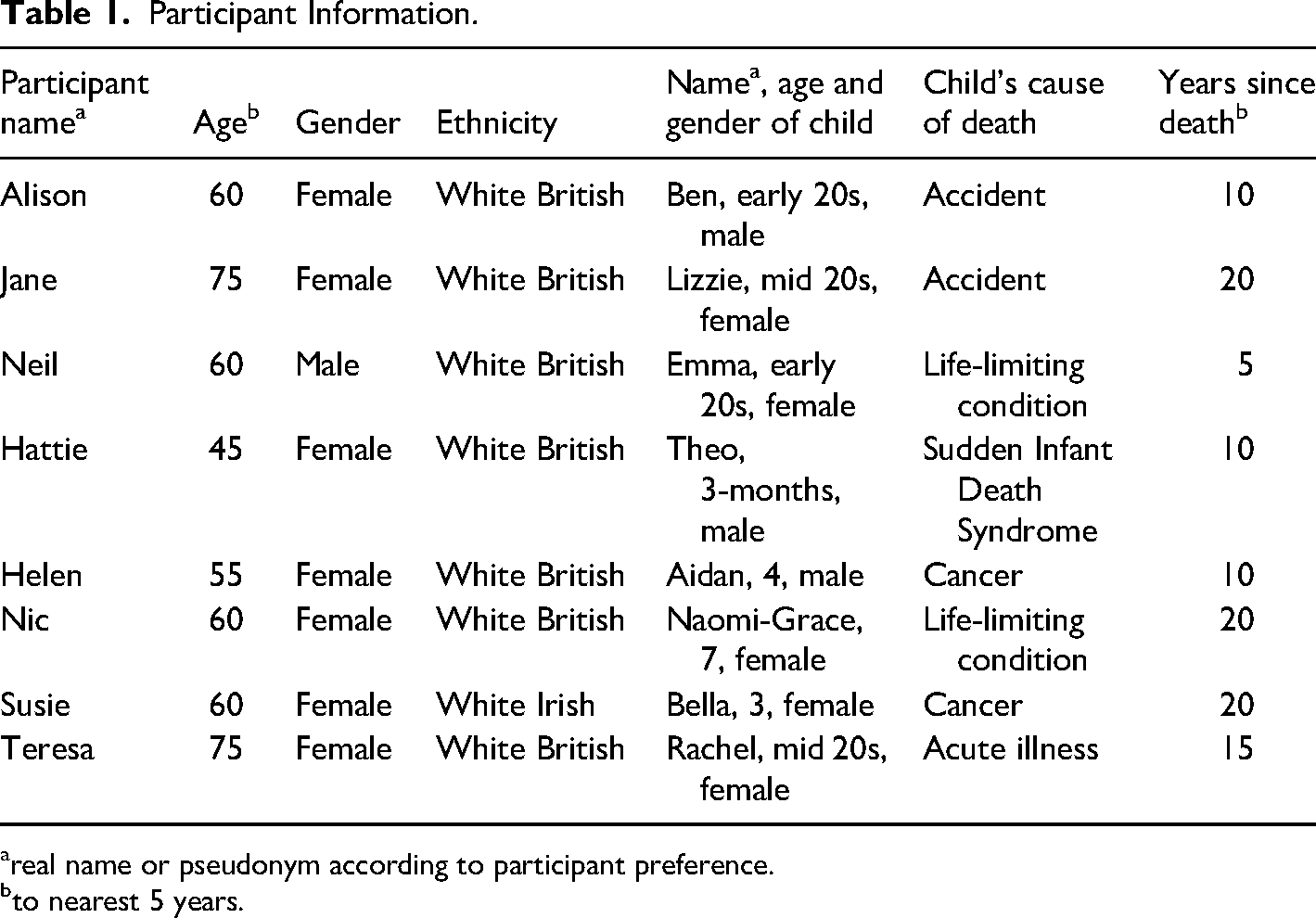
real name or pseudonym according to participant preference.
to nearest 5 years.
Data Collection
An interview guide was developed by the lead researcher, facilitated by consultation and a pilot interview with experts-by-experience. In line with narrative analysis principles, the interview guide was kept brief—participants were asked to narrate their child's death story from before the event to the present, with follow-up prompts used as needed.
Four interviews were conducted remotely via Zoom, and four were held face-to-face in participants’ homes, based on participant preference. Interviews lasted between 75 and 115 min and were recorded and transcribed by the lead researcher.
Data Analysis
The lead researcher coded all interviews using an “integrative” approach to narrative analysis (Bamberg, 2020) combining three analysis approaches (Riessman, 2008): Thematic (analyzing stories’ content), structural (analyzing how stories are put together), and performance (analyzing how and why stories are told, considering context and audiences). The lead researcher first wrote about their overall impression of each individual account, before reviewing the accounts collectively, which were then further refined though reflexive conversations in the research team.
Reflexivity and Quality
In line with recommendations by Etherington (2006), the lead researcher used a reflexive journal throughout all stages of the research process and regular reflective conversations took place in the research team. Peer debriefs were held after interviews, and journal extracts, along with anonymized transcript excerpts, were shared in the research team and a peer research group to consider the resonance of interpretations and reflect on researcher biases.
Findings and Discussion
Overall, the findings of this research are consistent with what other authors such as Calderwood and Alberton (2023) have found, particularly regarding parental grief being never-ending. However, unlike previous research, parents described the transition from early to later grief not as “progress” but as introducing new challenges, such as feeling more distant from their child and facing societal pressures to re-engage.
To illustrate this, and drawing on participants’ language, the collective stories are presented as a journey through the “landscape” of bereaved parents’ grief, as shown in Figure 1.

Visual representation of collective stories.
The journey begins before the children's deaths in a thriving landscape (“Before the Fall”), which is devastated by the child's death (“Devastation Day”). Parents navigate “Treacherous Terrain” (initial grief, perceived as overwhelming) before moving into “Flat Terrain” (later grief, described as sparse and enduring). Over time, they adapt to their surroundings, supported by the “Oasis in the Desert” of peer support. Gradually, new life emerges in the landscape (“Learning to Live in New Surroundings”), though parents express that this new world does not replace the old one, which they continue to long for.
“Before the Fall”
All participants chose to begin their story at a time prior to their child's death, integrating the time before into their grief narratives. Parents told sub-stories of happy memories and feeling totally unprepared for the child's death.
Jane: “She lived life to the full… in every respect” Alison: “He was a lovely boy… had a lot of friends, as I’m sure everyone says, but he did” Hattie: “He was really well, really, really well… very healthy, very fine”
These stories create sharp contrast with later events and emphasize the shocking and tragic nature of each child's death. Stories of happy lives were further added to when participants spoke about their relationships with their children: Teresa: “I used to go ‘round to her flat every week, and I’d get a nice fresh roasted chicken and a bottle of wine and I’d say ‘oh your flat looks nice’… just that whole thing” Nic: “We had a very, very happy life… we went camping, we went to Spain… we were outdoors with her all the time” Susie: “A lovely time of just being like a normal family”
These “small stories” (Georgakopoulou, 2006) tell of the now treasured everyday and ordinary recollections of family life, providing a “before” narrative of family life beyond the stories of the death and grief, which may at times silence or dominate the narrative of the child's life. The importance of talking about the happy times may reflect how these memories can be sustaining for parents and facilitate coping (e.g., Wheeler, 2001).
Helen: “Living in my world, where it never, ever occurred, and what a wonderful place to be really, it never occurred to me that a really bad thing… it always happened to other people… it wasn't going to be my story”
These stories communicate the stark contrast between participants’ previous and current lives and portray life expectations being completely shattered by the children's deaths. Three parents had children who were born with complex health problems; however, Susie said she “never really believed” her child would die, Neil described believing his daughter was “indestructible,” and Nic explained that “you cannot prepare” for the death of a child, emphasizing that their losses still caused total shock and disruption.
“Devastation Day”
All participants described the death of their child as a catastrophic and life-altering event, likened to natural disaster or the world ending: Jane: “Our world fell apart… our world shattered” Helen: “It felt like we were in this maelstrom kind of descent into hell” Teresa: “I call it devastation day… it's like your house is built on these solid foundations, and all of a sudden… like an earthquake… they just get blown up… your whole house crumbles” Nic: “Your world is decimated inside and out… like the tectonic plates of the earth shattering”
By conceptualizing their child's death as a physical disaster, parents are able to communicate the magnitude of their loss, capturing the enormity and permanence of their loss (similar to Feigelman et al., 2020; Malkinson & Bar-Tur, 2005; Tan & Ketola, 2013).
Treacherous Terrain
Participants’ accounts of their early grief constructed a story of having to survive in a world permanently altered by disaster, drawing parallels with navigating a dangerous and unpredictable landscape.
Helen: “It was… mind explodingly difficult really… it's like you’re through the looking glass, I’ve passed into this world, and I can't go back” Hattie: “It's like I've just taken a pill, and I can't un-take it…that's me, forever”
Reference to one's “entire world” being impacted helps to communicate the gravity of participants’ loss, connecting with previous descriptions of the child's death as a disaster as well as research describing the parental grief process as never-ending (Calderwood & Alberton, 2023; Malkinson & Bar-Tur, 2005).
Teresa: “Imagine it's raining down all these different emotions, all coming down on you, and you’ve got this little umbrella and you’re trying to dodge all these emotions”
Participants’ words communicate the severity of emotional impact, conveying the intensity of their early grief (Calderwood & Alberton, 2023; Tan & Ketola, 2013). Other participants spoke about experiencing feelings that were hard to articulate: Nic: “I don't even know how to describe it to you, impossible to describe the pain I was feeling” Teresa: “I can't even say the enormity of it”
These accounts communicate feelings that are hard to justly capture with language, perhaps particularly important for parents to highlight to non-bereaved audiences, with an implication that this experience can only be understood by those who have encountered it.
Nic: “Like, living in a world where I thought, I will not survive. I’m gonna die. I’m gonna die of pain”
The reference to survival along with participants’ uses of repetition emphasize the level of distress, described as feeling non-survivable (Snaman et al., 2016; Tan & Ketola, 2013). Participants described how their efforts to survive took up all of their time: Hattie: “the job of surviving takes up 100% of your time… you are really occupied with just trying to get through each day” Nic: “It was just about surviving really, mentally and physically, that was the first few years of grief… just surviving”
Susie and Teresa also spoke about being unable to do “anything,” connecting with research findings regarding bereaved parents experiencing hypoactivity in early grief (Calderwood & Alberton, 2023; Malkinson & Bar-Tur, 2005).
Neil: “They don't know what to say… some people would cross the street to avoid you” Helen: “I think you represent something that terrifies them… you were kind of the manifestation of other people's horror”
These accounts create a strong sense of alienation and isolation in early grief, also reported elsewhere (Calderwood & Alberton, 2023; Feigelman et al., 2020); however, in this study, participants described this experience occurring not only because others did not know what to say, but also because bereaved parents might represent something “terrifying” to others (i.e., mortality, and child mortality in particular). This connects with wider Western death-denying discourses, but may be particularly relevant to this study's British context, with some participants referring to “Britishness” when telling stories of others’ discomfort: Neil: “that British thing when we don't talk about our feelings” Jane: “British society… just can't cope with death”
This connects with literature suggesting that British culture expects grief to be a particularly private experience (Walter, 1997) and is an important finding considering that studies exploring British bereaved parents’ experiences of grief over time are scarce.
Participants described the helpfulness of “people who kind of could bear witness to the grief and the pain, and who didn't want to make it better” (Helen). Participants spoke about valuing practical support and people simply being with them in their grief, for example, Alison spoke about the helpfulness of a friend who “just sat with me on the sofa… just put her arm around me” and Hattie described appreciating relationships when “I didn't have to talk… I could literally just lie there… and they’d just come… and like, make sure there was food in the fridge.” These accounts challenge societal discourses of “moving on” and powerfully highlight what support parents might find most helpful.
“Flat Terrain”
Participants’ stories of their later grief were conceptualized as having to navigate what Hattie termed a “flat terrain,” making what might outwardly be viewed as “progress” with their grief (i.e., returning to a normal routine, and experiencing a reduction in intense emotions), but in fact having to endure a number of new challenges, including coming to terms with the permanence of their loss, feeling more disconnected from their child, feeling totally changed but under pressure to “put on an act,” and feeling socially alienated and misunderstood.
Nic: “You think you’re better but you’re not, you’re constantly treading in territory you don't understand” Hattie: “There's this kind of flat terrain you have to learn to navigate… instead of being in crisis mode, there's this permanence that kicks in that is really flattening, and the adrenaline that has kept you going starts to wane, and you’re left with this weird story just going ‘Where have they gone? They’re not coming back, and I have to live with this dreaded grief for the rest of my life’… there's a sort of expectation that you should be feeling lighter, but weirdly, you’re feeling heavier” Helen: “Sometimes I miss the white heat of it, because it was so simple”
In the previous story of “treacherous terrain” parents’ only focus was survival, which may have been “simpler” and aided by increased “adrenaline.” The “flat terrain” may represent parents’ realization of the enormity and unending nature of their loss. This was powerfully captured by Alison: “sometimes I feel like there's a lot of life left without him.”
Parents described not being able to feel genuine happiness for years after their child died, and feeling surprised, exhausted and frustrated with their apparent lack of “progress.” Hattie described the “boring” nature of bereavement, saying “you feel so awful, you don't want to feel like this anymore… you end up getting bored of yourself.” Susie spoke about her grief going “on and on, I couldn't believe it,” and Teresa spoke about feeling “trapped” in her grief and feeling “cross” with herself for not feeling better a few years after her bereavement.
This sub-story suggests grief that does not get better after the initial response, diverging from staged models of grief and inviting reflection on what is considered “progress” for bereaved parents, as the participants in this study suggest that the reduction of intense emotions is not always experienced by them as progress, but instead a different challenge to endure.
Sub-story— Neil: “Friends were good initially, but then it's strange how quickly they’d fall away” Susie: “Everyone just disappears… everyone just gets back on with their lives, which is of course natural, people have a life to live, but it's like they forget that you’re going through this dreadful time”
Continuing with the “flat terrain” metaphor, the reference to people “falling away” or “disappearing” may suggest a sparse and lonely landscape, with others assuming that now parents are on “flat ground” they do not require support. Participants told stories of a continuing disconnection between how others perceived them and how they felt inside: Jane: “The majority of people will never know how upset I can be… and you sometimes get weary of that” Neil: “Sometimes people will say… ‘what's wrong?’… well, do you remember something happened to me five years ago? To them it's an eternity ago, to me it was yesterday.” Helen: “I look the same but I will never be the same… actually I’m an utterly, completely, badly put together version of the person that I was, that is all I am really”
These stories imply a tension caused by others perceiving parents as their “old selves” and not recognizing the gravity of the identity change they have undergone as a result of their loss. Participants communicated that despite time elapsing since their losses this experience remains ongoing and burdensome for them.
Neil: “If I need to cry about something… I know the places I can go, and the thoughts that I need to have” Helen: “I can so easily access the tears, and… the utter being gutted, but, it's less powerful”; “That absolute white heat of intensity, I think I can't access that, and I do miss it… there's a little bit of me that thinks ‘oh I wish I could feel that again to reconnect’ because I think then you end up a bit numb”
These accounts suggest a missing of intense grief emotions at times in the later phases of grief and an appreciation of such intense grief moments as ways of re-connecting, challenging what may be considered “progress” for bereaved parents in the existing grief literature as well as highlighting specific grief challenges of the later stages of grief.
Overall, the “flat terrain” story may connect to non-linear models of grief such as the dual-process model (Stroebe & Schut, 1999); however, here parents seem to communicate being in-between a loss-oriented or restoration-oriented state, implying they felt neither connected enough to their child, nor able to fully distract themselves.
“An Oasis in the Desert”
Across all accounts, participants spoke about the value of peer support from other bereaved parents, described by Teresa as “an oasis in the desert.” Participants described finding relief in peers who could be “alongside” them: Teresa: “It was like having this great big boulder between me and the world. It was like a great big boulder, and the only time I felt that boulder was removed was when I was with other bereaved parents” Nic: “You feel very isolated and very alienated, like you’re from a different world… there's very few people you can spend time with, and often its bereaved parents”; “it's coming alongside each other… and it's facing the horror… we can say things you can't say to anybody”
Participants told stories of social pressure being alleviated when with other bereaved parents and spoke about the value of peer support, similar to Feigelman et al. (2020). These stories connect with previously mentioned stories related to needing others to “bear witness” to grief, and contrast with stories of having to “put on an act” around (non-bereaved) others. The descriptions of feeling from a “different world” or separated from the world by a “boulder” construct a sense of alienation and emphasize the value of peer support in offering relief from this. These stories communicate a shared identity with other bereaved parents: Jane: “You really only, to me, have 100% understanding if you yourself have experienced it” Alison: “it was that whole feeling which I think is very important for people like us is that, to be in a room with people who actually know and feel the same”
Alison's reference to “people like us” was echoed by most parents who also used “we” and “us,” referring to bereaved parents as a collective and emphasizing a sense of belonging to an in-group that non-bereaved audiences are unable to access or understand. Overall, these stories gave the sense of “bereaved parent” as an identity—one that can cause feelings of alienation but can also provide means of connection with others who share this identity.
Learning to Live in New Surroundings
This story focuses on participants’ experiences of surviving and growing post-bereavement, likened to adjusting to living in a new environment despite ongoing challenge and longing for ones’ old “world.”
Neil: “You’re never gonna get over it, or move on, all you do is move to a different place… it doesn't go away, it just moves further down the track” Jane: “It changes, but the reality never goes away… and it's not gonna get any better”
Participants’ communication of the gravity of their loss may chime with research suggesting that parental bereavement is a uniquely devastating type of loss (Rando, 1985), which was named by several participants, for example Alison: “with a child, I think it's a very specific kind of pain.” Across accounts, participants spoke about experiencing continued longing for their child: Jane: “Every day I’m missing her. There's something every day that I wish she was here for. So that hasn't changed” Alison: “You know when you’re homesick, you’re desperately, desperately homesick… it's that feeling I feel a lot now. I just want to see him, I miss him. And that missing, just makes everything not comfortable”
Alison's reference to feeling “homesick” might imply the loss of an old world or old life. Other participants also told similar stories such as “my whole world has changed” (Teresa) and “I now live in a different world, an altered world… I breathe different air” (Nic), communicating the magnitude and permanence of their grief.
Participants also described a profound physical change to themselves, with Hattie and Helen both describing their “DNA” changing as a result of loss, and Nic and Helen, respectively, describing their grief as a “brain injury” and “brain damage.” This narrative also connects to participants’ sense of themselves being totally changed, which may differ from others’ perceptions of them, and this expands existing literature in bringing long-term identity transformation more into view.
Participants communicated that the idea of their grief being “resolved” was offensive or jarring to them, because it would insinuate they had forgotten their child: Hattie: “The idea of (a point when your grief is) all gone… no bereaved parent ever wants that to happen, because that would mean their child is back there (points behind)” Nic: “Grief and love, they’re exactly the same, they’re intertwined, you’re never gonna stop loving your child, so therefore you’re never gonna stop grieving your child”
While clearly communicating never “getting over” their loss, parents did talk about ways they have grown or adjusted to their new life over time: Jane: “We get on with life”; “(it's not easy) but it's fine because we’re living” Teresa: “You keep going, but you stagger and limp through life” Helen: “You just kind of put yourself back together, but what you put back together is a really kind of ill-fitting, badly fitting, version of the person that you were before”
These narratives starkly contrast with parents’ descriptions of their happy lives “before the fall” and suggest adapting and surviving in a continually hostile environment, as opposed to returning to a “happy” or “normal” life.
This narrative is possibly indicative of coping with grief through sense-making, consistent with a meaning reconstruction model of grief (Neimeyer, 2001), highlighting how bereaved people undergo a process of sense-making, in order to adjust to living life post-bereavement. Helen added to this narrative when she spoke about this process more directly: “I had to sort of learn those skills of being really grateful, and having joy in what you’ve got rather than what you haven't got.” This communicates gratitude as a “skill” that must be practised and might suggest that bereaved parents have to put effort into upholding their thankful narratives.
Teresa: “I don't let her be the elephant in the room, I talk about her” Susie: “I want my life to be and feel normal. And that means that my child who has died is still present in my world” Neil: “(it's helpful) when people want to know… and will talk to you about it and expand on that… it gives me the opportunity then to talk about her, which I like to do”
Each parent told stories of the unique ways they maintain relationships with their children, including continuing to talk to their children, visiting their children's gravesites, keeping their children's belongings, and displaying photographs of their children around the home. Each parent had idiosyncratic ways of continuing a relationship with their child, but all of them emphasized the importance of their child remaining present in their life: Hattie: “I’m doing everything I can to deal with it, in the best way that I know for me, which is to bring him into my everyday life”
These stories challenge the notion of reaching a stage of “moving on” from or “letting go” of the deceased, aligning with the findings of previous research (Calderwood & Alberton, 2023; Wheeler, 2001) and models such as the continuing bonds model of bereavement (Klass et al., 1996), which emphasize the importance of an ongoing and lifelong attachment to the deceased.
Hattie: “You’ve got to find something that gives you a focus and a feeling of forward motion” Susie: “It's growing your world. And once your world grows it's bigger… the loss is still there, but there's so much more going on in life”
Participants spoke about the ways they have invested in life outside of grief, with most naming surviving children as a particular source of purpose. Participants told stories which suggested having to actively distract themselves to prevent their grief from becoming overwhelming: Jane: “I know that I would fall apart if I didn't fill my head with other things.” Neil: “I run at running club, if I wasn't doing that for my mental health I don't know where I would be”
This narrative aligns with Tonkin's (1996) model of growing around grief, which suggests that an individual's grief does not shrink or disappear, but that their life outside of grief grows larger over time.
Hattie: “I don't really kind of stress out about the small things anymore. I'm much more, I suppose able to see what matters” Helen: “I do live much more in the moment and feel the utter joy of our kids, I really really do, because I kind of know how tomorrow it could all be different, and you only have what you have today”
Other participants spoke about positive changes to their selves as a result of their loss, such as feeling “stronger” (Hattie) and “more confident” (Susie), as well as more motivated to listen to or engage with other people following their bereavement: Neil: “I would (previously) prefer to be in the background… on the edge of the conversation, now I like to be in the centre, and engage… especially if it's things about how you feel and about mental health”
Some described personal growth and learning: Susie: Grief is a lifelong learning process. It's not just about being sad and devastated that your world got turned upside down, but… your pain will bring you to a better place eventually… it’ll bring you to a different place… pain is hard, but it's also learning.”
Overall, this sub-story aligns with findings related to bereaved parents experiencing post-traumatic growth over time (Waugh et al., 2018).
Conclusions and Recommendations
This research aimed to explore the stories bereaved parents tell about their experiences of grief over time, and to consider what these stories might suggest about how they have adjusted to the death of their child. Overall, participants communicated that while they identified as having adjusted in some ways to living life post-bereavement, their loss has permanently changed their world and sense of self. This study conceptualized this through the use of landscape metaphor, and rather than returning to a lush, green landscape similar to the one left behind, participants’ stories constructed the sense of having to find ways to adapt and survive in a new environment that remains hostile. The use of the landscape metaphor brings the long-term grief experiences of bereaved parents into view in a new and evocative way, highlighting the ongoing and never-ending nature of the experience, with new challenges at every stage.
Strengths, Limitations, and Directions for Future Research
This research contributes to the literature by exploring bereaved parents’ experiences of grief over time, and of the latter stages of grief in particular, within a UK context using narrative methodologies. While findings align with existing literature, they offer new insights, particularly highlighting the challenges faced in later grief, even when others perceive progress, and conceptualizing these challenges through a landscape metaphor.
The study has limitations regarding sample diversity, as all participants were white, with only one male. Recruitment through a peer support charity may have led to shared experiences and possibly influenced participants’ grief narratives.
Future research should aim for more diverse samples, including parents from racially minoritized backgrounds and those who have not accessed bereavement support. Additional qualitative research in the UK could further explore the impact of British societal narratives on grief. Investigating the concept of “progress” in bereavement and the evolving support needs of bereaved parents in later grief would be valuable. Finally, addressing the silence surrounding parental bereavement through collaborative participatory action research led by bereaved parents could help challenge stigma, promote open conversations, and inform health practitioners and society.
Clinical Implications
This study highlights the need for practitioners to be aware of the enduring nature of parental grief and conceptualizes the particular challenges parents face in latter bereavement. Practitioner awareness of these challenges is essential, moving away from “progress” narratives of “acceptance” or “moving on.” Training related to this could be valuable for primary care services (e.g., GPs) and practitioners supporting adults who experience psychological distress, in order to facilitate formulation and intervention planning for individuals with a history of losing a child, no matter how long ago this occurred. Any material shared with professionals should be informed by bereaved parents, either through sharing qualitative research findings or involving bereaved parents more directly in training.
Participants noted that in early grief, practical support was most valued, with advice often unhelpful. Psychological interventions may thus be most effective during the “flat terrain” phase, when emotions are more stable and support from others has waned. This aligns with trauma literature, which suggests that a "stabilization" phase is necessary before addressing trauma (Herman, 2001).
Another significant finding was the construction of “bereaved parent” as a collective identity which offers relief and understanding. This finding highlights the limitations of non-bereaved professionals’ support and suggests that mental health practitioners could best contribute to bereavement support by providing supervision, consultation, or training to peer support networks. The value of peer support is established in the literature and ensuring bereaved parents have access to peer support organizations like SLOW (https://slowgroup.co.uk/) is therefore essential (see e.g., Davies et al., 2015; Morrissey et al., 2024).
Conclusion
This research is unique due to its British context, use of narrative methodology, focus on latter bereavement and metaphorical approach to conceptualize the parental grief journey. Findings align with previous research such as Calderwood and Alberton (2023) in highlighting the enduring nature of parental bereavement. Furthermore, findings challenge the view that parents “move on” by conceptualizing specific new grief challenges in later stages of grief, described as “the flat terrain,” where parents miss the intense emotions of early grief and sometimes evoke them to feel connected to their child. Parents also face pressure to meet others’ expectations that they have “moved on,” while feeling permanently changed. This study therefore invites a new awareness in practitioners and wider society of the lifelong need to engage with parents’ grief experiences. Findings support the value of peer support.
Footnotes
Acknowledgements

Declaration of Conflicting Interests
The author(s) declared no potential conflicts of interest with respect to the research, authorship, and/or publication of this article.
Funding
The author(s) received no financial support for the research, authorship, and/or publication of this article.
Ethical Considerations
Ethical approval for the study was obtained from the University of Hertfordshire ethics committee, protocol number LMS/PGR/UH/05012.
Consent to Participate
All participants in this study provided full, written informed consent, including for publication of the research.
Data Availability
Due to the ethical considerations related to the sensitive and personal nature of the data, the dataset has not been shared in a public repository.