




Abstract
Sanctification is an important phenomenon and should be of keen interest to those studying religious and spiritually oriented coping. Oddly enough, this phenomenon has not received a great deal of attention. One reason may be that sanctification does not directly apply to institutional religious involvement. Moreover, the sacred cannot easily be discerned in people’s coping experience. On important issue is also the lack of attention to the role of culture in coping. One of the researchers who has paid considerable attention to the concept of sanctification and has developed it from different perspectives is Kenneth Pargament. The aim of this article is give rise to a vital discussion on the role of sanctification in coping from a cultural perspective. In doing this, we will first introduce Pargament’s approach to religion and spirituality and then his view on sanctification and then we will put forward our own critique of some discussions on this subject, concluding with our own view.
Definitions of Religiosity and Spirituality
Zinnbauer and Pargament emphasize two alternative definitions of religion and spirituality. Both researchers criticize modern approaches that polarize religion and spirituality. They also believe that definitions of both religion and spirituality should be embedded in a context, and that the context can be used to distinguish between these two constructs. Both researchers view the search for the sacred to be an important component of religion and spirituality. However, while Zinnbauer considers spirituality the broader construct, Pargament sees religiosity as the broader one (Zinnbauer & Pargament, 2005). Pargament views spirituality as a search for sanctity, whereas religiosity constitutes a search for meaning in relation to the holy (Zinnbauer et al., 1999). Zinnbauer defines spirituality as a personal or collective search for holiness, whereas religiosity is defined as a personal or collective quest for the sacred that manifests itself within a traditional sacred context (Zinnbauer & Pargament, 2005).
Pargament’s definition of spirituality is based on his view of religion, significance and the sacred. According to Pargament (Zinnbauer et al., 1999, p. 909), spirituality is As such, spirituality is the heart and soul of religion, and religion's most central function. Spirituality has to do with the paths people take in their efforts to find, conserve, and transform the sacred in their lives. Whereas religion encompasses the search for many sacred or nonsacred objects of significance, spirituality focuses specifically and directly on the search for the sacred. As with religion, spirituality can take individual and institutional, traditional and nontraditional, and helpful and harmful forms.
What, then, is the relationship between religion and spirituality in Pargament’s perspective? His own answer is that: From Pargament’s perspective religion is a broader and more general construct than spirituality. If the sacred is involved in either a pathway or a destination then that search qualifies as religious. Thus, religion encompasses not only the search for sacred ends (spirituality), but the search for secular ends through sacred means (Zinnbauer et al., 1999, p. 910).
Sanctification in a Religious Context
According to Pargament and Mahoney (2005, p. 179), “sanctification offers a powerful personal and social resource that people can tap throughout their lives; and the loss of the sacred can have devastating effects”.
Considering sacred qualities as manifestations of God, the divine and the transcendent, sanctification can be defined “as a process through which aspects of life are perceived as having divine character and significance … .a process of potential relevance not only for theists but nontheists as well” (Pargament & Mahoney, 2005, p. 183). Here, sanctification is viewed as a “psychospiritual” construct. This is explained in the following manner: It is spiritual because of its point of reference – sacred matters. It is psychological in two ways; first, it focuses on a perception of what is sacred. Second, the methods for studying sacred matters are social scientific rather than theological in nature. (Pargament & Mahoney, 2005, p. 183)
Sanctification occurs not only in relation to theistic interpretations of various features of life, but also indirectly, implying that perceptions of divine character and significance can develop by investing in objects qualities that are associated with the divine (Pargament & Mahoney, 2005, p. 185).
As concerns theistic sanctification, the authors mention that, according to religious education and tradition: God’s powers are manifest in many aspects of life … the God of most religious traditions is not removed from the workings of the world. The divine is said to be concerned with earthly as well as heavenly matters. Furthermore, the religions of the world encourage their members to see God as manifest in their lives. (Pargament & Mahoney, 2005, pp. 183, 185)
The sanctification process can affect coping, because sanctification may influence key dimensions of human functioning, including: (1) how people invest their resources; (2) the aspects of life people preserve and protect; (3) the emotions they experience; (4) the individual’s sources of strength, satisfaction, and meaning; and (5) people’s areas of heightened personal vulnerability (Pargament & Mahoney, 2005, p. 192).
When confronted with a difficult situation, people invest different available resources in an effort to cope. Sanctification may play an important role (negative or positive) here. Through sanctification of different objects – for instance, one’s job, children, marriage, etc. – people redirect their attention during times of crisis. Changing one’s focus from the problem to the sacred object may offer a sense of security.
It is not unusual for people who are facing a crisis to make extraordinary efforts to preserve certain objects, phenomena or aspects of life. In this connection, one preservation method is to sanctify these objects or parts of life. Becker (1998, p. 34) provides an example of a women sentenced to life imprisonment who invested an old chair with sacred qualities. Sanctification of the chair played an important role in bringing her comfort and security, helping her cope with her difficult situation in prison. The woman offered and explanation: With persistence and hard work I managed to get the chair sanded down, stained, and nailed back together, the chair was the beginning of the long, slow process of putting my life back together … It is difficult for me to describe the comfort and security my chair has brought me. Because of all the times I have prayed or meditated in it, it has become a sacred object. Throughout the years and all the changes they have brought, it is the one thing that has remained the same (Becker, 1998, p. 34). These concepts can take myriad forms ranging from monotheistic views of a personal God to polytheism to non-theistic perspectives on a transcendent reality, such as those articulated within Buddhism. From this point of view, people from diverse religious traditions – eastern and western—as well as those unaffiliated with any tradition can have a perspective on the sacred core.
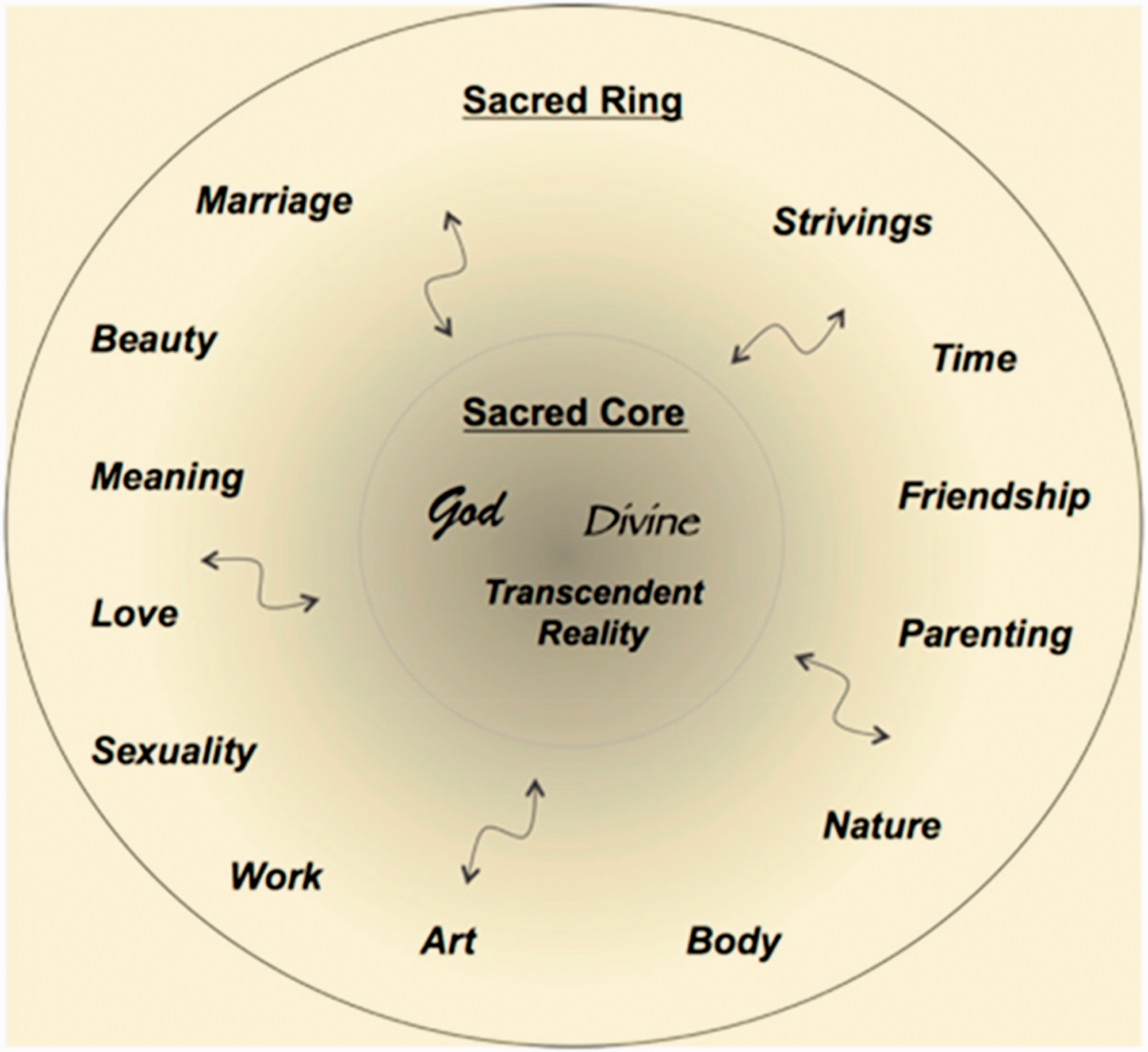
Sacred Core and Ring (Pargament et al., 2017, p. 3).
As mentioned before, Pargament and Mahoney (2005, p. 183) regard sanctification as “a process through which aspects of life are perceived as having divine character and significance.” As Figure 1 shows, the ‘divine character and significance’ “encompasses not only theistic notions of the divine as a personal god(s), but also non-theistic views of the divine as a transcendent reality, and qualities that are often associated with theistic and non-theistic concepts of the divine” (Pargament et al., 2017, p. 3).
As the above discussion indicates, Pargament is trying to keep spirituality – as well as all endeavors in people's existential search for meaning or understanding of the life situation – within the realm of religiosity and transcendentally. It is precisely this point that we will comment on in the next section.
Comments on the View of the Sacred in a Religious Context
We introduced Pargament’s approach to religion and spirituality and his view on sanctification. In this section, we offer some comments on his approach to religion, spirituality and sanctification.
Comments on Pargament’s Definitions
Let us restate the key issues in Pargament’s approach to religion and spirituality, presented above.
1
Religion is a search for significance in ways related to the sacred. Significance means a wide range of things that may be important for the individual, institution or culture. It may concern the sense of satisfaction, value and importance that accompanies goal pursuit and attainment (subjective significance) or the goals people strive for in life (objective significance). The sacred refers to the holy, and the core of the sacred consists of concepts of God, the divine and transcendence. The sacred also includes objects that have been sanctified due to their association with, or representation of, the holy. Sanctification is connected to aspects of life that may be perceived both as manifestations of God and as embodiment of divine or transcendent qualities. For this reason, sanctification is considered a process that may be relevant not only to theists, but also to non-theists. Spirituality refers to a search for the sacred. Whereas religion includes the search for many sacred or non-sacred objects of significance, spirituality focuses explicitly on the search for the sacred.
By focusing on three terms – search, significance and sacred – Pargament offers new definitions of religion and spirituality. Although his definitions of these two terms broaden the realm of religiosity and spirituality beyond traditional concepts of God, they nonetheless remain within the realm of traditional approaches, in that they regard religion as a broader, more general construct than spirituality. Religion encompasses spirituality. Besides restricting spirituality to the realm of religion, Pargament’s definitions also become problematic when we attempt to apply them to research on religion and health.
´
Pargament’s definition of religion and the sacred, as he himself (Zinnbauer et al., 1999, p. 908) points out, contrasts with narrower and more polarized views on religious experience. It not only incorporates substantive and functional approaches into one approach, but also includes the positive and negative aspects of religious life. And although it distinguishes religion from spirituality, it does not regard them as polarized. People’s personal and social experiences are also included. Religion involves not only the search for sacred ends (spirituality), but also the quest for secular ends using sacred means (Zinnbauer et al., 1999, p. 910). This is enabled by his broad definition of sanctification, which can embrace God, the divine as well as transcendent qualities and is considered a process of potential relevance to both theists and non-theists. One problem with Pargament’s definition of religion is that he does not clearly define what constitutes a religious pathway and what does not; nor does he clarify who is a religious person and who is not. This is because he, in his endeavor to overcome the problem of polarizing religion and spirituality – an endeavor we find interesting from a philosophical perspective – makes the definition of religion so broad that religion loses its divine characteristics. We will try to demonstrate this using an example from the study of Ahmadi (2006), which identified several cancer patients who did not believe in God or any other higher power, but who experienced a spiritual feeling, a unity of existence, when they were in natural landscapes. Note that if we accept Pargament’s perspective on religion and the sacred, we must regard these atheists’ search for significance through the sanctification of nature as a transcendent experience of the unity of existence, that is, as a religious pathway! According to Pargament, we should do so because we have here a case of “nontheistic sanctification,” indicating that individuals can conceivably attribute sacred qualities to significant objects without espousing belief in God or a higher power (Pargament & Mahoney, 2005, p. 185). Moreover, the fact that the object of significance is not directly related to God or the divine is not a problem, because it is related to a transcendent quality.
Staying with Pargament’s perspective, not only are the pathways of our atheists – who admit to having had spiritual experiences and feelings – considered religious, but the atheists themselves can also be considered religious. This is because Pargament (Zinnbauer et al., 1999, p. 908) tells us that “when an individual seeks out a sacred destination in life, or takes a pathway that is somehow connected to the sacred, we describe that individual as religious.” Our atheists have taken pathways that are in some way connected to the sacred – here thought to be a transcendent quality – which in this case consists of an experience of unity of existence through the sanctification of nature.
The question that arises here is whether an atheist’s search for significance by means of the sanctification of nature makes him/her a religious person. If so, how can we distinguish a religious person from a non-theist or even from an atheist? This question is of more immediate importance and becomes more crucial in the context of empirical studies. For instance, if we wish to study the use of coping methods among different groups – such as religious individuals, non-theists and atheists – how should we categorize the atheists mentioned above? Do they belong to the “theist group,” the “non-theist group” or the “atheist group”? Can we simply ignore how individuals see themselves – as a religious person or an atheist – and choose to categorize them according to our own definition? Certainly, there are often discrepancies between informants’ and researchers’ understandings of certain definitions, but definitions, although human constructions, cannot be arbitrary. They should not conflict with informants’ own understanding of their affiliation with, e.g., a certain political, social, religious group. Moreover, definitions should be based on historical and social grounds (a given religion’s history and social attributes).
In our view, regarding religion and spirituality as polarized is not merely a theoretical “problem.” Moreover, this polarization reflects the spirit of our time, in that people no longer regard religion and spirituality as a unified phenomenon. Some studies (Smith, 2007; Zinnbauer et al., 1997) have supported this notion of polarization.
According to Pargament (Zinnbauer et al., 1999, p. 902), “religiousness and spirituality have acquired specific valences in popular and scientific writings.” Here, he is referring to negative religiousness as opposed to positive spirituality (Zinnbauer et al., 1999, p. 902). He also reminds us that “Previously undifferentiated from religiousness, numerous forms of faith under the label ‘spirituality’ have risen in popularity from the 1980s to the present” (Zinnbauer & Pargament, 2005, p. 24) and that these changes “have occurred against a background of decline in traditional religious institutions, an increase in individualized forms of faith expression, movement from an emphasis on belief towards direct experience of the sacred, and an American culture of religious pluralism” (Zinnbauer & Pargament, 2005, p. 24). Thus, if the focus of research has changed from religion to spirituality, it is because, as Pargament points out, “Spirituality has also replaced religiousness in popular usage” (Zinnbauer & Pargament, 2005, p. 24). Looking at the citations above, it is clear that people not only differentiate between religion and spirituality, but also self-identify as being either spiritually oriented or religiously oriented. Clearly, many people today take exception to what they understand as religion and seek other sources of “sacredness.” Many associate religion with dogma, churches, priests, institutions and political meddling. These people are seeking something else. We cannot, merely by changing how we define religion, change the historical background of religion or its social attributes. Moreover, we cannot change the fact that religion no longer attracts people to the same degree and that many people would rather not be identified as religious. This last point is very important, because if we are to carry out studies on religion and health, we must base our categorization of people into groups on how they view themselves. If a person self-identifies a non-theist, we can hardly classify her/him as a theist just to suit our definitions.
Pargament can hardly disagree with this point. With reference to several studies, he emphasizes the following: “individuals have clear ideas about the meaning of these terms [religion and spirituality, author’s note], are able to describe their beliefs in a reliable fashion, and are able to distinguish religiousness and spirituality from other constructs and phenomena” (Zinnbauer & Pargament, 2005, p. 22).
Pargament is well aware of the risk researchers take when they fail to consider the various ways in which people relate themselves to what they find sacred and the ways in which they classify their philosophy of life. He (Zinnbauer & Pargament, 2005, p. 30) states: On the other hand, should researchers define the terms in ways that are fully removed from popular uses, or in ways that narrowly exclude great sections of the religious and spiritual landscape, the legitimacy or relevance of the field may be questioned? The varieties of religious and spiritual experiences provide remarkable examples of human diversity. Universalist assumptions about the religiousness and spirituality of all people obscure important variations in the belief and practice of different people (Moberg, 2002). At worst, they have the potential to insult or oppress minority groups.
If our approach to studying the psychology and sociology of religion, especially in relation to health, is not theological in nature, but instead sociological or psychological, then we should take into account the changes experienced by people across the globe during the “postmodern era.” We should accept that decreasing interest in attending church and participating in services as well as dissociating from religion and God is a sign of the growth of new approaches to the self and the other – new approaches that in turn have given rise to new understandings of what are called sacred values. According to Luckmann (1996), we are witnessing the development of “postmaterialist values” as the sacred values of our time, and this development goes hand in hand with individualization. Postmaterialist values are linked to present-day humankind’s need for self-actualization. Pargament (Zinnbauer et al., 1999, p. 903) maintains that the tendency toward polarizing spirituality and religiosity is not the result of scholars’ limited understanding of religion and spirituality, rather it mirrors the real changes occurring quite apart from scholars’ definitions and ideas. Pargament (Zinnbauer & Pargament, 2005, p. 27) emphasizes the following: “It is no coincidence that the popularity of spirituality has grown in a culture that values individualism, and risen during a historical period in which traditional authority and cultural norms were being rejected.”
We agree the notions that the polarization between religion and spirituality is sometimes naïve and simplified and that the relationship between these two phenomena is much more complicated than: “spirituality is cool, and religion is uncool.” However, we do find it difficult to start from Pargament’s definition of religion in the research field of religion, spirituality and health without running the risk of neglecting informants’ own understandings of their religious and spiritual feelings and lives.
The second problem we see with Pargament’s discussion on sanctification is that it is not clear how he distinguishes between “manifestations of God,” “embodiments of divine” and “transcendent qualities” when he stresses: “Sanctification may occur both directly and indirectly; that is, aspects of life may be perceived both as manifestations of God and as embodiments of divine or transcendent qualities” (Pargament & Mahoney, 2005, p. 186). Because Pargament’s definition of religion is linked to the concepts of the sacred and sanctification, it is critical to clarify what God, the divine and transcendent refer to. In our view, the first problem, i.e. defining religion too broadly, is partly due to the ambiguity surrounding what exactly is meant by “manifestations of God,” “embodiment of divine” and “transcendent qualities.”
Grasping Pargament’s understanding of God, the divine and the transcendence is important to comprehending not only his view of religion, but also his view of spirituality. Pargament defines spirituality as a search for the sacred, and the core of the sacred consists of the concepts of God, the divine and transcendence.
On the one hand, as stated, Pargament defines spirituality as a search for the sacred. On the other, he emphasizes that the sacred refers to the holy and includes objects that come to be sanctified owing to their association with, or representation of, the holy. By connecting the sacred to the holy and by substituting the term “spiritual” with “divine” in his new definition of sanctification, Pargament ensures that the sacred will remain within the framework of religiosity and, thus, that spirituality will remain a part of religion. This allows Pargament to overcome the problem of polarizing these concepts, which we find in modern approaches. Nonetheless, we have some problems with Pargament’s definition of spirituality.
If Pargament’s definition of religion is too broad to allow us to distinguish between religion and non-religion and between a religious and a non-religious person, then his definition of spirituality is also too narrow to embrace many experiences non-theists or atheists describe as spiritual. In other words, in Pargament’s definition, spirituality is still an integrated part of religion and its domain does not extend beyond the framework of religion. Consequently, pathways that do not refer to the holy or are not based on a belief in God or a higher power are still outside the realm of spirituality. This may cause serious problems in empirical studies when individuals self-identify as spiritual but not religious and claim to follow thus defined pathways.
Another problem is that Pargament’s definition of spirituality does not consider one of the most important dimensions of spirituality: connection. In all spiritual pathways, even those focused on detachment from terrestrial life, the ultimate goal is connection with a transcendent source, a kind of unity. A definition that equates spirituality with a search for the sacred focuses on the means, but not the ends. As we saw earlier, in defining religion Pargament proceeds from a “goal-related view of human nature.” This is because he believes that, “people are proactive, goal-directed beings searching for whatever they hold to be of value in life. Every search consists of a pathway and a destination” (Pargament & Mahoney, 2005, p. 181). If this holds, then why, in defining spirituality, is the most important goal – that of connection – left out? Pargament is well aware of the importance of connection in spiritual life. He (Zinnbauer & Pargament, 2005) refers to studies showing that informants tend to characterize religiousness in relation to formal/organizational religion, and spirituality in relation to nearness to God or feelings of interconnectedness with the world and living things. However, if we accept the notion that individuals’ feelings of interconnectedness with the world and living things are spiritual in nature, then we must pose the question: Where is the “reference to the holy” here? Where is religion’s place in this picture? Once again, as in the example above, we have a problem with atheists or non-theists who are searching for the unity of existence in nature. These people may well report feeling connected with the world and things in the absence of belief in God or any other holy source. If we consider these feelings to be holy experiences, then we, once again, have the problem of defining what constitutes religion and what does not.
In the discussion above, we have tried to demonstrate that Pargament’s definitions of religion, spirituality and sanitation, although rich and comprehensive, are problematic in that they draw a line between theists and non-theists as well as neglect the spirit of our time. As we see it, one of the reasons for this is that the studies on which Pargament and many other researches have based their definitions of religion and spirituality have been conducted in the United States, where the majority of people self-identify as religious and where, as Pargament (Zinnbauer & Pargament, 2005, p. 28) mentions, even those who regard themselves as spiritual admit to being committed to a religion.
Our studies in different cultural settings, including non-religious cultures, have revealed that there are other secular theories, such as attribution theory (Fölsterling, 2001), that can also been applied when studying coping in societies where religion does not strongly affect people’s ways of thinking. Salander (2015) takes up this issue when explaining Frankl’s perspective on meaning, according to which meaning is not of ‘divine,’ but of cognitive origin. From this perspective, if individuals are to avoid feelings of meaninglessness, they should find some kind of contrasting rational (meaning) that can play an essential role in restructuring their ‘worldview.’ These new experiences can then be assimilated, allowing life to become more comprehensible and predictable, and thus more trustful. Here we revisit a quote from Salander (2015, p. 18), who writes: In more secular terms, the process of giving a special meaning to objects may well be encompassed by Winnicott’s Winnicott (1971) intermediate area as well as attribution theory (Fölsterling, 2001). According to Winnicott and object-relational theory, people are, from early childhood to death, able to “play with reality” (Salander, 2015). The intermediate area is the mental area of human creation: in childhood in the doll’s house or sandpit, in adulthood in the area of art and culture. It is the mental space between the internal world and external reality and it is thus both subjective and objective. Being human is being in between and thus being able to elaborate with facts, especially when confronted with unexpected negative facts such as a cancer disease.
Our View of Sacred Matters
Proceeding from the comments on viewing the sacred as a “divinity matter,” we do not believe we should regard God, the divine, and the transcendent as the Sacred Core of all phenomena, which people “sanctify” when coping. Instead, we should differentiate between sacred objects that are theistic and those that are nontheistic. If we do so, we will have different “sacred rings”, one with the outwardly transcendent as its sacred core (theistic sanctification), the other with the inwardly transcendent as its sacred core (nontheistic sanctification).
In this vein, we find the sacred ring below more appropriate for discussing nontheistic sanctification.
Our sacred core and ring can be found in the Figure 2 below. It should be mentioned that when talking about theistic and nontheistic sacred cores, our focus, like that of Pargament et al., “is not on the ontological reality of the sacred, but rather perceptions of the sacred.” And the term object “is not restricted to interpersonal objects as is customary in object relations theory. Rather is used more broadly to refer to any aspect of life” (Pargament & Mahoney, 2005, p. 25).
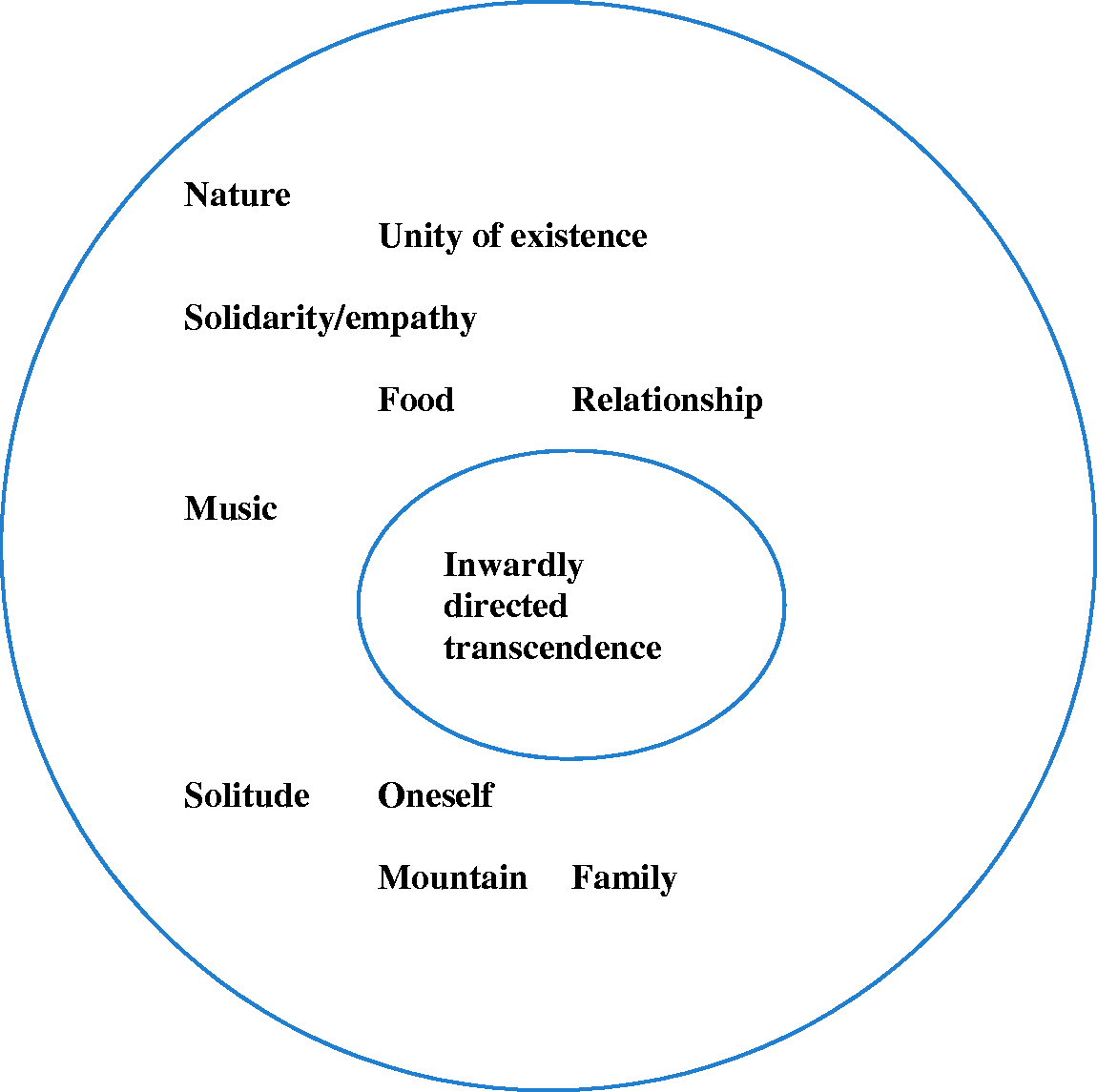
Alternative Sacred Core and Ring.
2: Sacred core, inwardly transcendent and ring (Ahmadi & Ahmadi, 2018).
The Figure 2 shows the sanctification of nontheistic coping resources found in our studies in different countries. They consist of different aspects of life and different objects that are imbued with non-theist sacred qualities created by individuals and become sacred resources.
In our studies, sanctification of nature is found among Swedish and Malaysian cancer patients (Ahmadi et al., 2018a), sanctification of family and relationships among Chinese, Turkish and Malaysian cancer patients (Ahmadi & Ahmadi, 2018), sanctification of mountains and food among South Korean cancer patients (Ahmadi et al., 2017a; Ahmadi et al., 2016a; Ahmadi & Ahmadi, 2018), sanctification of music among Swedish and Chinese cancer patients (Ahmadi & Ahmadi, 2018), and sanctification of oneself among Swedish, Turkish and Malaysian cancer patients (Ahmadi et al., 2016b; Ahmadi et al., 2017b; Ahmadi et al., 2018a; Ahmadi et al., 2018b; Ahmadi & Ahmadi, 2018). Feelings of empathy seemed to bring about the sanctification of suffering people among Swedish and Turkish cancer patients (Ahmadi & Ahmadi, 2018; Ahmadi et al., 2018a), and sanctification of moments/positive solitude is found among Swedish cancer patients (Ahmadi, 2015; Ahmadi & Ahmadi, 2018) and sanctification of connectedness with deceased ancestors (Ahmadi et al., 2019a).
Note that none of these “objects” is explicitly linked to God or a transcendent power, but this does not mean the people who sanctify these “objects” during the process of coping are not religious.
For example, one of the Swedish informants, who self-identified as an atheist, pointed out: “When I’ve been out in nature, first and foremost, I felt I was myself, that there was time for thoughts, it was peaceful, everything else disappeared. Whatever happens in the world for me or others, nature is still there, it keeps going. That is a feeling of security when everything else is chaos. The leaves fall off, new ones appear, somewhere there is a pulse that keeps going. The silence, it has become so apparent, when you want to get away from all the noise. It is a spiritual feeling if we can use this word without connecting it to God, this is what I feel in nature and it is like a powerful therapy.” Here our atheist gives the sacred quality of timelessness to nature by pointing out that whatever happens in the world for me or others, nature is still there, it keeps going (Ahmadi, 2006).
Sanctification and Culture
Sanctification has an individual as well as a cultural face. Yet the sacred is conceived of differently across cultures. As Pargament and Mahoney (2005, p. 187) point out: People differ in the aspects of life they hold sacred. These differences may be tied in part to an individual’s particular religious identification. After all, members of religious traditions are taught to confer sacred status on different figures, present and past. They are also taught to sanctify other objects differently, such as physical objects, be they the sacred mountains of some Native American traditions, the idols and statues of Hinduism and Buddhism, or the various holy sites of Judaism, Christianity, and Islam. Within pluralistic, individualistic cultures we would expect important differences in sanctification among people more generally, irrespective of their religious affiliations.
The fact that some Swedish informants perceived a sacred value in nature may be explained, as mentioned in Chapter 3, by recalling the prominent position of nature in Swedish ways of thinking and culture as well as that people living in Sweden are spiritual as opposed to religious and therefore more likely to describe even their religious lives in spiritual terms. We observe, therefore, two important tendencies among people in Sweden – seeking closeness with a supreme force and seeking a natural romanticism – both of which render nature a sacred object and accessible source for coping.
Sanctification of oneself is also a cultural orientation in Sweden. In analyzing the use of spiritual connection with oneself and meaning-making coping among Swedish cancer patients, we used Fromm’s view of humanistic religion and notion that, in such an ideology, each individual achieves the highest degree of strength, not the highest degree of powerlessness, and that virtue is self-realization, not obedience (Fromm, 1950, p. 37). Sanctification of oneself can then be seen as a result of the fact that Humanist religion has a strong prevalence in Sweden, where there also exists a relatively high degree of individualism.
Sanctification of solitude can be consider as sanctification of moments (Lomax et al., 2011; Pargament et al., 2014). Respecting other people’s need for solitude is one of the cornerstones of Swedish culture, reflecting its strong tendency toward individualism (Barinaga, 1999, p. 5). In an individual-oriented culture where solitude is valued, it is highly likely that people with a serious illness like cancer will not fear being alone with their thoughts and will sanctify moments of solitude, through which they find themselves.
Sanctification of family among cancer patients in China, Malaysia and Turkey is probably a result of having been socialized in cultural settings where social relationships tend to be group-oriented.
The sanctification of mountains and food among cancer patients in South Korea can be also explained from a cultural perspective. Koreans think that human life came from nature and must return to nature when the body and mind malfunction, and thus they have strong convictions concerning the healing power of nature. It may well be beliefs in these ideas that lead cancer patients in South Korea to sanctify mountains and food when trying to cope with their illness.
Summing up, we have tried to show that sacred matters are not only the products of religious beliefs, but also of cultural beliefs. As Pargament (2017) mentions (p. 18), “Religions are not the sole source of beliefs and perceptions about the sacred … Human understandings about sacredness are firmly rooted in collective life (Durkheim, 1915).”
Our studies in different cultural setting show that cultures imprint their views of the sacred onto people facing a life-threatening crisis collectively and individually.
Religious Struggles and Culture
People who face difficult life events, such as life-threatening illness, may feel that they have been abandoned by God, begin to challenge trusting in God or begin to believe in supernatural powers, like black magic. Previous studies have framed some religious and spiritual (R/S) struggles as negative religious coping responses, such as blaming God, the Devil or one’s own sins for serious problems, or viewing problems as divine punishment. According to some researchers (Stauner et al., 2016; Wilt et al., 2017), R/S struggles that lead to negative coping strategies can have various health outcomes, such as more medical diagnoses, functional disabilities, depression, poorer cognitive functioning and subjective health, and negative effects on quality of life.
Stauner et al. (2016, p. 1) mention that R/S struggles involve tensions, conflicts, or anxieties regarding sacred matters. These struggles might focus on the supernatural domain (God, the Devil), on other people, or on the self (doubts, moral conflicts, lack of meaning in life). Key points regarding R/S struggles are (Exline, 2013; Stauner et al., 2016): Conflict, tension, and turmoil around sacred matters within oneself, with others, and with the supernatural; over the course of life, people can be shaken spiritually as well as physically, socially, and emotionally; people struggle with challenges in their lives to attain meaning.
According to Pargament (2017), the following types of R/S struggles are recognized: Supernatural, Divine, Demonic Intrapersonal, Moral, Doubt, Ultimate Meaning, and Interpersonal. When struggling, people may feel God has let them down, feel angry at God, feel as though God has abandoned them, feel as though God is punishing them, and question God’s love for them (Exline et al., 2014, Wilt et al., 2017).
But an R/S struggle is not merely a personal matter, it is effected by the cultural setting in which the individual is socialized. Inozu et al. (2012) mention that obsessive belief characteristics can lead to subjectively recognizable R/S struggles, such as fears of God and sin, which vary across individuals and cultures. Studies indicate that religious struggles are common in theist countries. One study (Balboni et al., 2013) among advanced cancer patients in the US shows that 58% experienced a spiritual struggle, 30% wondered why God allowed this to happen, 29% wondered whether they had been abandoned by God, 25% were angry at God, 25% questioned God’s love for them, and 22% felt cancer was a punishment from God. However, Sedlar et al. (2018), studying atheists from three universities in the US, found that the prevalence of R/S struggles was lower among this group than among believers. A team of researchers from universities in Oxford, Coventry, Royal Holloway, Melbourne and Otago conducted examinations of 100 studies on the topic published between 1961 and 2014, containing information on around 26,000 people worldwide. They (Jong et al., 2017) found that atheists struggle less with existential questions, especially anxiety over death. Fear of death was also lowest among atheists.
Stauner et al. (2016), citing Inozu, suggests that “The greater moral struggles among religious people may reflect tendencies of scrupulous cultures to express more concern about sin or of guilt-prone individuals to endorse more scrupulous beliefs” (Inozu et al., 2012).
Our studies (Ahmadi, 2006; Ahmadi, 2015; Ahmadi & Ahmadi, 2018), conducted in different cultural settings, show that cancer patients who are socialized in non-religious cultures tend not to believe their illness is a result of their own sinfulness or of God’s anger. In these studies, we asked informants some questions about negative religious coping methods, which constitute an expression of “a less secure relationship with God, a tenuous and ominous view of the world, and a religious struggle in the search for significance” (Pargament et al., 1998, p. 712). Only 3 percent of Swedish respondents answered that they thought God had abandoned them or felt anger toward God and that this had helped them feel better “to quite a large extent” when they felt stressed, sad, or depressed during or after their illness. A few (1%) responded “to a large extent.” Nearly nine in ten (88%) answered “not at all” to the question about having been abandoned by God. Only 2 percent of respondents reported feeling that God had caused their health problems because of their actions or because they had not been sufficiently faithful. Asked whether they felt their own sinfulness was the reason for their illness, nine of ten (90%) responded “not at all” (Ahmadi, 2015).
In response to the question about whether evil power was the cause of their illness, only 1 percent of respondents chose a positive answer. Nineteen of twenty (94%) responded “not at all.” As the study shows, very few informants (1 to 3%) used any of the negative coping methods. There is no doubt that having been socialized in a culture that is non-religious and characterized by a high degree of rationalism has affected the informants in our Swedish study. Besides, as explained previously, the prevalent view of God in Swedish Protestantism is of a Creator God – one who has left humans to determine their own destinies and shape their own history (Ahmadi 2015).
In contrast, we have found belief in evil power among informants in Malaysia. They reported believing in Black magic and therefore used the coping method of Demonic Reappraisal. Black magic or dark magic refers to the use of supernatural powers or magic for evil and selfish purposes. Malaysian folk religion advocated animistic and polytheistic beliefs. There are many in the Islamic-majority country of Malaysia who engage in Shamanism and other supernatural rituals, despite the fact that such ideas and rituals are against Islamic teaching and considered to be shirk (the sin of practicing idolatry or polytheism) (Ahmadi et al., 2018b)
These examples highlight the crucial role of culture in the use of coping methods oriented toward R/S struggles. However, for some interviewees, the role of culture in coping may be even stronger than that of fundamental religious axioms. Believing in black magic and getting help with alternative treatment from shamans or the like show that cultural beliefs can be stronger than religious axioms.
Relation between Religious, Spiritual and Secular Meaning-Making Coping
In this book, we have focused on three domains of existential meaning-making coping methods: religious methods, spiritual meaning-making methods and secular meaning-making methods. Before summing up our discussion, we need to put forward our views on the connection between these three coping methods.
La Cour and Hvidt (2010, p. 1294) present a model of how the three domains (secular, spiritual and religious) of existential meaning-making are related. In this model, these three domains have points of connection, i.e., the concepts and topics of each domain overlap to some extent, as shown in Figure 3. According to the authors, “Situating a given phenomenon in the figure will be dependent to some degree on conceptual and cultural context, rather than the phenomenon itself” (La Cour and Hvidt, 2010, p. 1294).
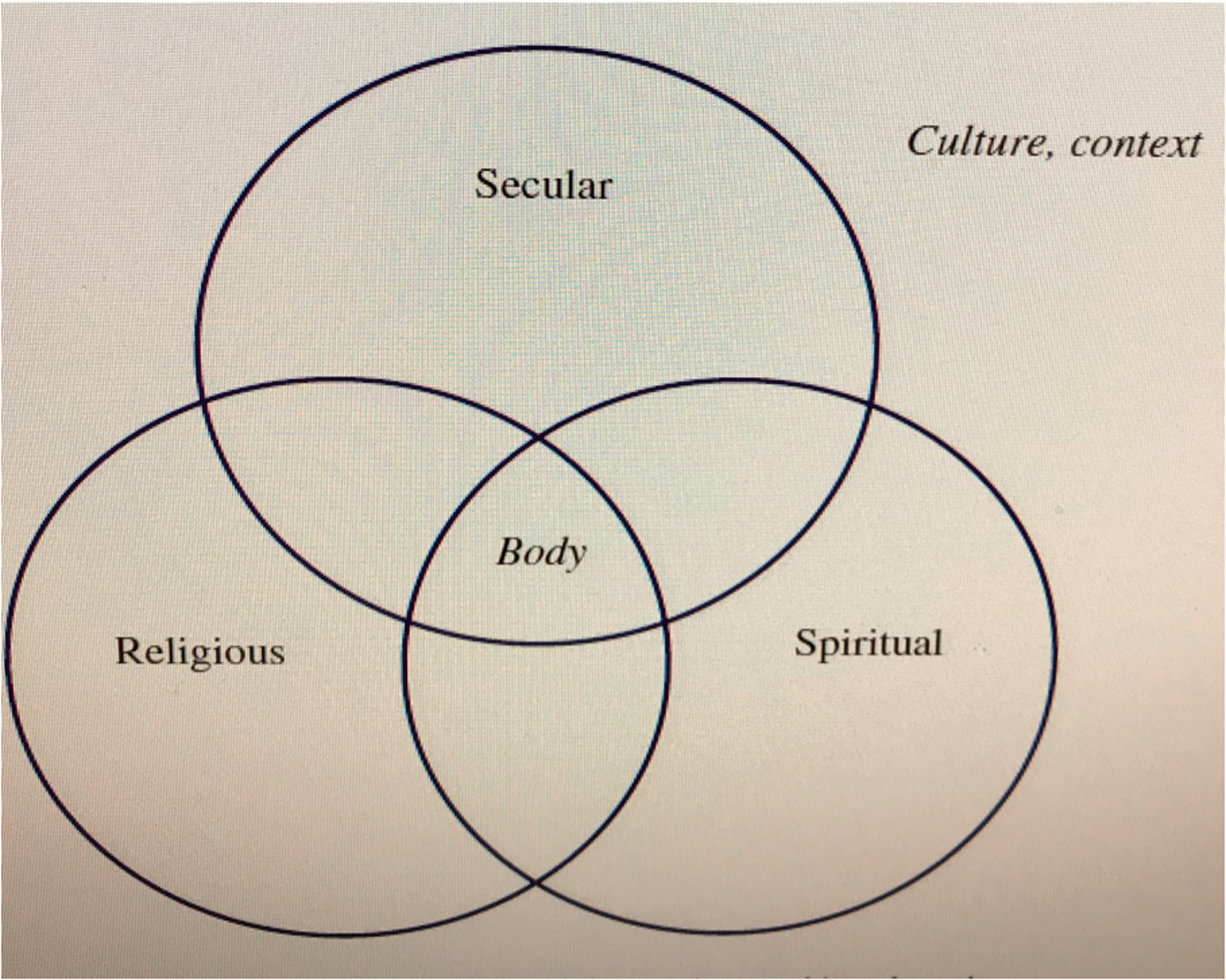
Relation of Existential Meaning-Making Domains (La Cour and Hvidt (2010, p. 1294).
It would seem that this figure is based on the above-presented view of religion and spirituality advocated by Pargament, i.e., a definition of religion and spirituality that is problematic because it draws a line of demarcation between theists and non-theists and neglects the spirit of our time. As mentioned before, one reason for this problem is perhaps that, in the studies on which this definition is based, non-theists and atheists are not included and the cultural perspective is neglected.
With regard to the critical view we presented above, and based on our studies in both religious and non-religious societies, we suggest a new model of how the three domains (secular, spiritual and religious) of existential meaning-making are related. In this model, as shown in Figure 2, the concepts and topics of the religious and spiritual domains overlap to some extent. The concepts and topics of spirituality and secular meaning-making coping also overlap, but there is no overlap between secular and religious concepts and topics. The reason for this is that, as mentioned before, our definition of religion is “a search for significance that unfolds within a traditional sacred context (Ahmadi, 2006, p. 72). We define spirituality a search for connectedness with a sacred source that is related or not related to God or any religious holy sources (Ahmadi, 2006, pp. 72–73). Thus, secular meaning-making coping hardly has any point of connection with a traditional sacred context, but can overlap with a search for connectedness with a sacred source without relating to God or any traditional religious context. As mentioned before, sacred here is not defined in a religious context, but an inwardly sanctification context. This is illustrated in Figure 4 below.
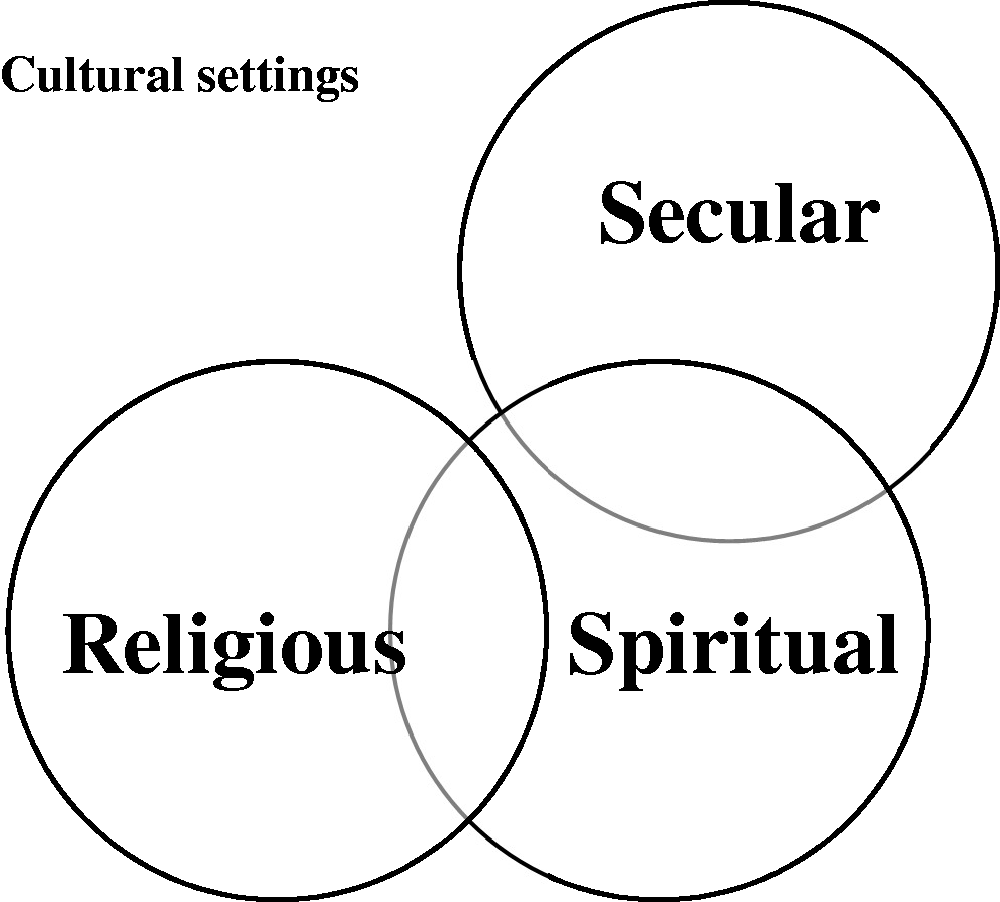
Alternative Relation of Existential Meaning-Making Domains.
Summary
Summing up, the strategies that people employ when they are stricken by disease, accidents, misfortune, etc., are cultural and historic constructions. As such, they are valid in concrete contexts and time periods. People in different societies have always used some methods, objects, belief systems – including faith in God or other supreme powers, religious sacraments, destiny or other similar products of their own or others’ imagination – to find relief from the anxiety and stress caused by various misfortunes. Some of the employed strategies can be characterized as passive acceptance and others as active resistance.
Regardless of the employed strategies or the secular or religious characteristics of these strategies, coping is about consoling. The coping methods individuals choose depend on where and when they live – and on what trends dominate their life context. In secular societies, religious or spiritual coping methods do not thrive to the same extent as they do in religious societies. Nevertheless, in secular societies, too, some people try to find a meaning in what is happening and to put it into a larger framework. However, the quest for meaning does not necessarily involve a belief in God or religion. Like spiritual and religious coping strategies, secular coping strategies are often employed to console the individual with the belief that she/he is part of a greater or supreme project – that she/he is a small cog in a bigger machinery. The individual tries to look at her/his problems from above, from the perspective of a greater whole and see how small and unimportant she/he and her/his maladies are in relation to this whole.
As the studies (Ahmadi & Ahmadi, 2015; Ahmadi, 2006; Thurfjell, 2020) show quite clearly, nature may just as well function as the supreme entity, the whole or being in light of which the individual’s own misfortunes lose, to some extent, their imposing definiteness and irreversibility. The insight that one’s own life is transitory causes some people to look for the permanent, or at least something that is long-lasting. The forest, stones, trees, the soil itself and all the life that is captured in and around them comfort individuals with a permanency that goes beyond their personal crisis. This insight can console some and give strength to others in dealing with their situation.
Nevertheless, we should not forget that not all individuals who actively try to comfort and console themselves when stricken by a disease like cancer turn to an absolute or Supreme Being. Some try to achieve something they have always dreamed about while they still have time – a coping strategy that can be characterized as a conscious effort to neglect and forget the disease as much and as long as possible. Some people in secular societies with a relatively high level of economic prosperity adopt an extreme trust in scientific achievements and follow the most recent medical developments relevant to their disease, using money and medical technologies to resist their so-called fate, while others reach a level of transcendence at which they revaluate everything that has mattered to them earlier and try to make new priorities. Here even nature offers a possibility to individuals who are facing a crisis.
To what extent the secular or religious or spiritual coping methods can be chosen as a coping method depends on, among other things, the cultural context into which the individuals have been socialized. In other words, culture provides one’s grounding in the search for meaning as well as in understanding and interpreting a stressful situation. In a stressful situation, the individual and culture are related to each other.
As we mentioned above, in secular societies, religion is not the only available resource in the individual's orientation system. Religion would seem to play an important role as a coping resource for those with limited options. In cultures with large non-religious resources and where religion is less a part of individuals’ everyday life, it plays a minor role in the coping process. The tendency to “turn to religion in coping” is primarily a question of religion's position in the culture in which the individual has been socialized. In societies where religion is less prominent in the orientation system, and less relevant to life experiences, it loses its importance for coping, while other existential meaning-making coping methods related to nature or an inner “force” or positive solitude are the kinds of resources that provide meaning and comfort to individuals facing a serious crisis.
Culture can affect the coping process in four ways: First, the cultural context shapes the type of stress individuals are likely to experience. Second, culture may affect assessment of the stressfulness of a given event. Third, culture affects selection of the strategies individuals use in a given situation. Finally, culture provides the institutional mechanisms individuals may use when trying to cope with stressful situations.
The findings of several studies (Ahmadi & Ahmadi, 2018; Cetrez et al., 2020; Ahmadi et al., 2018a; Ahmadi et al., 2018b; Ahmadi et al., 2017; Ahmadi et al., 2016a; Ahmadi et al., 2016b; Ahmadi et al., 2019a; Ahmadi et al., 2019b) confirm the third way, i.e. “culture affects selection of the strategies that an individual uses in any given situation.” Based on the results present in this book, hospital cancer therapists, social workers, psychologists and patient navigators (crisis managers) can strengthen the fourth aspect, that is, they can promote the role of culture in providing institutional mechanisms that can help individuals cope with stressful situations. It is therefore crucial that these professionals, especially cancer therapists, turn more of their attention to the importance of existential meaning-making coping methods in different cultural settings.
Footnotes
Declaration of Conflicting Interests
The author(s) declared no potential conflicts of interest with respect to the research, authorship, and/or publication of this article.
Funding
The author(s) received no financial support for the research, authorship, and/or publication of this article.
