



Abstract
Outdoor adventure (OA) programs are popular for workforce education and training. Despite the demand, there remains limited research evaluating their effectiveness for occupational training. Using a prospective mixed methods design, this study explored the effects of OA training on work-related outcomes through validated questionnaires and interviews. Measures were also taken immediately before and after engagement to capture change in participants’ subjective reactions to the program, with further appraisals collected 1-week after. Twenty-seven participants were recruited from three different organizations. Generally, participants responded favorably to the program and reported positive affective and cognitive states after participation, although appraisals varied across the sample. The program had a small effect on teamwork self-efficacy at 1-week (g = 0.36) and medium effect at 2-month follow-up (g = 0.69). A medium effect size was observed for workplace self-efficacy at 1-week follow-up (g = 0.63), but this diminished over time (g = 0.48). No meaningful effects were found for workplace performance, motivation, and engagement. Findings from the qualitative data suggested the experience enhanced team dynamics, provided a sense of accomplishment, and offered an outlet to disconnect from the workplace. The results offer insights into the benefits, limitations, and practical applications of OA training in occupational settings.
Keywords
Introduction
In today's competitive work environments, organizations are increasingly searching for opportunities to promote the competencies and wellbeing of their workforce (Tonkin et al., 2018). Off-site adventure programs, incorporating natural outdoor environments alongside experiential learning techniques, physically challenging pursuits (e.g., rock climbing, mountain biking, high ropes courses) and team-building exercises, represent a promising approach for enhancing both the wellbeing and work-relevant skills of workforces (Gritzka et al., 2020; Pomfret et al., 2023; Tyne et al., 2024a). However, currently, there remains a notable gap in research evaluating their relevance and effectiveness as a viable form of occupational training.
Based on a growing scientific evidence base, outdoor adventure (OA) programs have gained a reputation for serving as highly relevant experiences for fostering personal growth and supporting psychological wellbeing across multiple populations (Gillis & Speelman, 2008; Hattie et al., 1997; Holland et al., 2018). Notably, OA programs are characterized by their diversity and encompass a broad range of experiential designs that involve different combinations and “dosages” of four essential elements: physical exercise, nature immersion, taking perceived and real risks, and group work (Priest, 2023). While literature has employed varied terminology to describe these elements, there is widespread recognition that their intricate combination is essential in explaining how outcomes are achieved through adventure-centered experiences (Pomfret et al., 2023; Priest, 2023). The extent to which program leaders will focus on each element is contingent upon both the program objectives, which should be clearly established prior to the program commencing, and the needs of the participants. To illustrate, an OA program aiming to enhance employees’ intrapersonal skills (e.g., self-confidence) would prioritize elements such as the physical challenges, perceived risks, and reflection activities geared toward deriving meaningful insights from these experiences.
Programs specifically tailored for workforces have attracted attention due to the anecdotal claims of outcomes which are achievable post-program, such as increased teamwork, leadership, problem-solving, and self-confidence. These types of psychosocial skills are considered essential 21st-century competencies, as recognized by the World Economic Forum (WEF, 2016). They are highly sought after by employers as these skills empower individuals to not only cope but thrive in today's increasingly complex work environments (Sarfraz et al., 2018). Existing research on OA training for workforces has generally supported prior anecdotal claims and documented positive effects. Through mostly quantitative inquiry, benefits have been reported for group-level outcomes (e.g., teamwork competencies, leadership skills, and collective-efficacy) (e.g., Bronson et al., 1992; Eatough et al., 2015; Kourtesopoulou & Kriemadis, 2020), positive psychological states (e.g., self-efficacy and psychological capital) (Eatough et al., 2015; Lee & David, 2021; Tyne et al., 2024b), and work attitudes and behaviors (McEvoy, 1997; Rhodes & Martin, 2014). Though limited, these findings showcase the potential for OA programs to enhance 21st-century skills and positively shape employees’ mindsets, how they interact with colleagues, and sense of wellbeing,
However, challenges arise when attempting to draw definitive conclusions from this evidence base. Validated work-related measures are rarely used to assess study outcomes, rather, generalized constructs or outcomes specific to adventure-based contexts are captured (Tyne et al., 2024a). Thus, relationships with work-related variables remain relatively unexplored. For example, a key question is whether employees’ new found perspectives of themselves and others, frequently reported as a benefit (e.g., Eatough et al., 2015; Mutz & Müller, 2016), can influence beliefs and attitudes in workplace contexts. In addition, knowledge concerning the extent to which effects can be sustained is limited (Rosa et al., 2023), and, specifically, whether benefits reported for individuals or teams translate into relevant workplace outcomes. Notably, investigations have largely adopted a reductionist, positivist confirmatory approach and assessed the impact of OA experiences solely through pre- and post-program questionnaires (Jones & Oswick, 2007).
To effectively demonstrate return on investment, the occupational training literature advocates for a more comprehensive assessment methodology to better understand the effectiveness of training programs. In particular, the importance of extending assessment beyond immediate effects, and exploring the broader implications for the participants and workplace context. For example, one well-known framework that has guided many occupational training evaluations is the New World Kirkpatrick model (Kirkpatrick & Kirkpatrick, 2020). The model recommends evaluations to encompass participants’ immediate reactions and program appraisals, identify if learning outcomes were achieved and behavioral changes resulted from participation, and assess the program's impact on performance and broader work-related metrics (Kirkpatrick & Kirkpatrick, 2020). A previous version of this framework has been applied to OA contexts (Cooley et al., 2016; McEvoy, 1997; Rhodes & Martin, 2014) and findings enrich our understanding of the value of OA programs and the degree to which outcomes transfer to different contexts. Hence, this study draws upon the existing body of literature on occupational training to offer a thorough assessment of the impact of OA learning on workforces.
Research Questions
To the best of the authors’ knowledge, there is a distinct scarcity of evaluations assessing the effectiveness and appropriateness of OA programs within workplace contexts, particularly in terms of measuring work-related constructs. Three research questions were developed to address some of the pertinent gaps in the literature. First, to what extent does the participants’ engagement in a 1-day OA program influence changes in work-related attitudes and beliefs (e.g., self-reported workplace performance, motivation, engagement, self-efficacy, and teamwork self-efficacy)? It was hypothesized that participants’ scores would improve in the work-related variables from baseline to follow-up assessments. Second, what are the immediate reactions and appraisals of the training program among employees, and to what extent do these reactions explain variability in program outcomes? Third, what are the lived experiences of participants in the program, and what are the key factors in its design and implementation that contribute to these experiences?
Method
Study Design
To answer the research questions, this study used a prospective mixed methods design, aligned with the philosophical stance of pragmatism. Pragmatism, with its emphasis on practical outcomes and real-world application, provides an ideal framework for studies in applied organizational settings (Kelly & Cordeiro, 2020). The study design is characterized by a concurrent quantitative data collection phase and nested qualitative component (Kroll & Neri, 2009). To quantify the effects of participation in the OA program on work-relevant outcomes, self-report instruments were administered at three time points (baseline, 1-week, and 2-month follow-ups). Brief self-report scales were also administered before and after the program to capture participants immediate reactions, additionally program appraisals were collected 1-week post-program. Acknowledging the phenomenological nature of attempting to understand participants’ experiences and the transferability of outcomes to the workplace, semistructured interviews were undertaken at 2-month follow-up. Institutional ethics approval was granted for this study by Loughborough University Ethical Advisory Committee (2021-4589-3740).
Study Sample
Companies registered to participate in the program with the anticipation of full employee involvement. To recruit for the study, an email was sent to participating employers providing them with the study information sheet describing the aims and measures involved along with an informed consent form. Employers then distributed the information to their employees and provided them the opportunity to volunteer for the study by completing the consent form. The eligibility criteria included working full or part-time, aged at least 18 years old, and participating in the activities involved in the program.
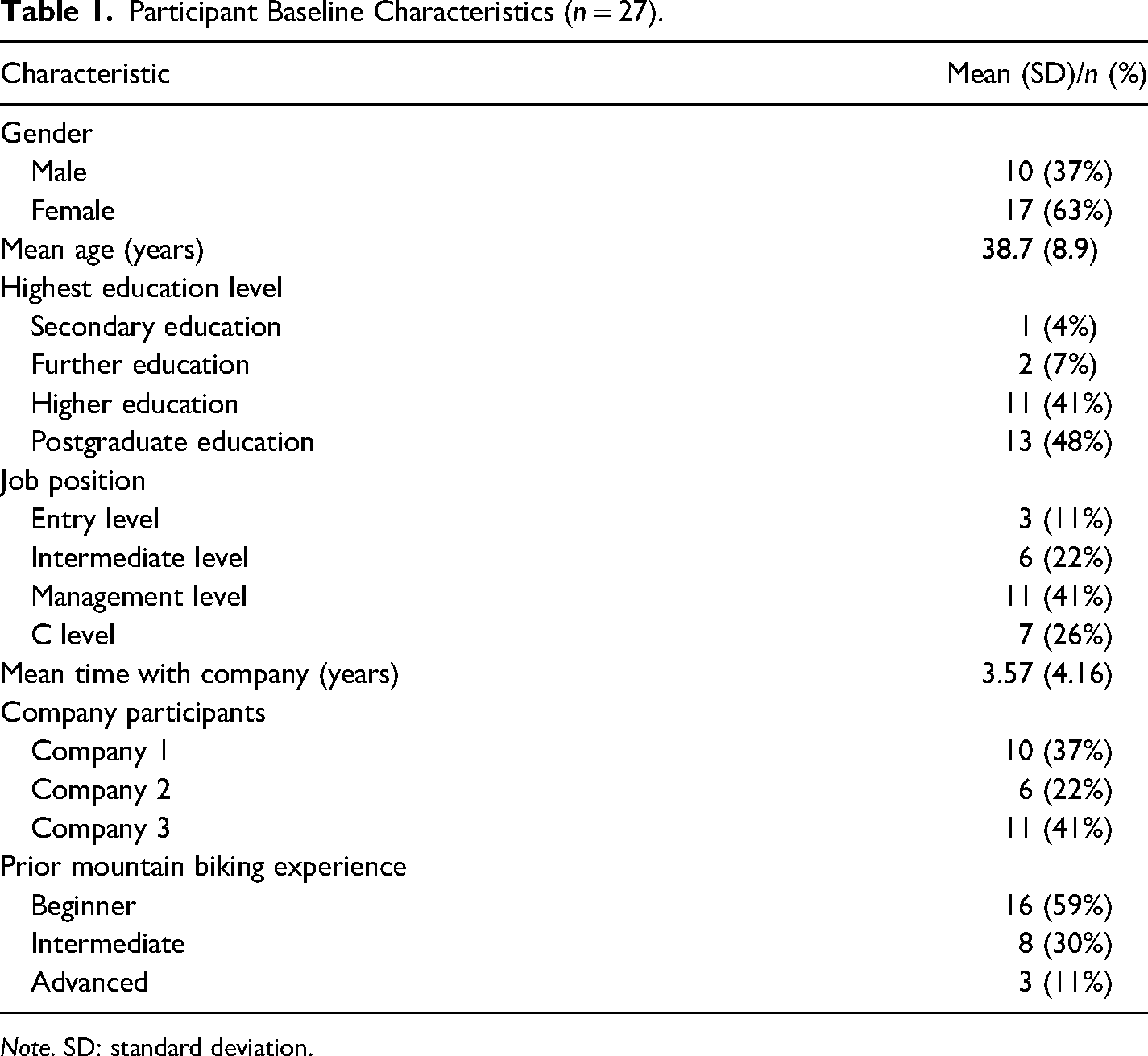
Three workforces in pharmaceutical and healthcare industries signed up for the program which they each completed on separate dates. In total, 30 employees consented to participate in the study. Three subsequently withdrew from the study due to being unable to attend the program. Table 1 displays the characteristics of the 27 participants who took part in the program. Employees were all working full-time, ranged from entry-level positions to C-level executives, 37% were male (n = 10) with a mean age of 38.7 years, and had been with their respective companies for 0.5 to 11 years. At follow-up assessments, one participant did not respond at t4 (n = 26) and a further two participants did not provide a response at t5 (n = 24), giving an attrition rate of 11%. At t5, five senior team members volunteered to participate in an interview.
Participant Baseline Characteristics (n = 27).
Note. SD: standard deviation.
The Program: Elevate
Supplementary Material 1 provides a detailed description of the Elevate program, according to the TIDieR (Template for Intervention Description and Replication) checklist (Hoffmann et al., 2014). Briefly, the program was delivered by The Leadership High (see funding details), a UK-based company that provides experiential occupational training and development programs. The experience was designed to promote team cohesion and self-confidence through a blend of experiential educational tools and outdoor recreational challenges. The physical activities were mountain biking (∼10 km) and hill walking (∼6 km) which were delivered by professionally qualified (through British Cycling) instructors. An important component of the course was to create parallels between the experiences and the workplace using isomorphic metaphors, reflection activities, and group discussion tasks. Participating teams had one 2-hour virtual follow-up session approximately 1 month after the intervention to reflect on the experience and key learnings to facilitate transfer of learning.
Data Collection
Baseline (t1) psychological data and sociodemographic data were collected via online software, Qualtrics, 2 weeks before the program. On the day of the program, participants completed visual analogue scales (VASs) (via Qualtrics) relating to their mood, arousal, and self-esteem immediately before (t2) participation and upon the conclusion of the day (∼10 hour apart) (t3), to capture any immediate changes in affective and cognitive states. To examine short-term effects, self-report questionnaires were administered (via Qualtrics) 1 week (t4) after the program where participants also had the opportunity to appraise their experience. To examine sustained effects, questionnaires were administered 2 months (t5) after the program, a time frame recommended in previous studies (Rhodes & Martin, 2014). Participants were also invited to participate in a qualitative, semistructured interview held online via video conferencing software. Interviews took place 2 months after the program.
Self-Report Measures
Workplace Self-Efficacy
Workplace self-efficacy was assessed with the shortened version of The Occupational Self-efficacy Scale (Rigotti et al., 2008). The scale consists of 6-items (e.g., “When I am confronted with a problem in my job, I can usually find several solutions”) and requires participants to respond using a 6-point scale ranging from (1) “not at all true” to (6) “completely true.” The scale has shown adequate internal consistency (a = 0.78) in various workplace populations and is highly correlated with job-related attitudes; job satisfaction, commitment, and performance (Rigotti et al., 2008). The Cronbach alpha value for the current sample was 0.91.
Teamwork Self-Efficacy
Teamwork self-efficacy was assessed using the Personal Efficacy Beliefs Scale which was adapted by McClough and Rogelberg (2003) to measure teamwork self-efficacy and has been used in previous research in the field (Cooley et al., 2016). The scale consists of 9-items (e.g., I have confidence in my ability to work in teams) requiring participants to respond on a 5-point scale with the anchors (1) “strongly disagree” and (5) “strongly agree.” The scale has been shown to have acceptable internal consistency with Cronbach alphas ranging from 0.84 to 0.86 (McClough & Rogelberg, 2003), comparable to the current sample (a = 0.85).
Motivation to Work
Motivation was assessed using the Motivation to Work Scale (Liu & Li, 2018). This is an 8-item scale (e.g., I am willing to exert considerable effort to complete my job tasks) requiring participants to respond on a 5-point scale, ranging from (1) “strongly disagree” to (5) “strongly agree.” Participants were instructed to answer each item considering their motivation to work over the respective time frame when the survey was administered. Liu and Li (2018) reported satisfactory reliability (a = 0.93) and construct validity and in the current sample, the Cronbach alpha was 0.90.
Workplace Engagement
Work engagement was assessed using the shortened-version of The Utrecht Work-Engagement (UWES-9) (Schaufeli et al., 2006). The UWES-9 is a 9-item scale which assesses employees’ feelings of vigor, dedication, and absorption in the workplace (Schaufeli et al., 2002). Participants are required to respond to each item (e.g., “at my work, I feel bursting with energy” and “I am immersed in my work”) using a 7-point scale with the anchors (0) “never” to (6) “always.” The scale has shown strong reliability and validity across various work populations (Seppälä et al., 2009). In the current sample, the Cronbach alpha was 0.92.
Workplace Performance
Workplace performance was assessed with the Individual Work Performance Questionnaire (IWPQ) (Koopmans et al., 2013). The instrument comprises 27-items and assesses three dimensions, task performance (e.g., I managed to plan my work so that it was done on time), contextual performance (e.g., I kept looking for new challenges in my job), and counterproductive work behavior (e.g., I complained about unimportant matters at work). Previous studies have shown the IWPQ to have satisfactory construct validity and functions as a reliable and valid measure of perceived workplace performance (Koopmans et al., 2013). In the current sample, Cronbach alphas were 0.70 (task performance), 0.74 (contextual performance), and 0.72 (counterproductive work behavior).
Visual Analogue Scales
To capture the participants’ subjective cognitive and affective responses immediately before and after the experience, six VASs were administered measuring anxiety (e.g., “how anxious do you feel right now?”), excitement, tiredness, happiness, confidence, and perceptions of team cohesion. Participants were instructed to answer the scales in relation to how they felt in the moment (regardless of the cause of their feelings). Participants responded to each item on a scale from 0 to 100 with the anchors (0) “not at all” and (100) “as high as possible.” VASs are commonly used in social science research and are a reliable method for assessing subjective outcomes (Hasson & Arnetz, 2005).
Program Appraisals
At 1-week follow-up, a feedback form was included within the online questionnaire pack. Participants were asked to reflect on how challenging (physically and psychologically), enjoyable, satisfying, fatiguing, and positive they found the program and indicate via VASs (0–100). Higher scores indicate stronger perceptions. Participants also reported on their level of prior experience in the program activities and whether they were able to complete all the activities on the day (yes or no).
Semistructured Interviews
At 2-month follow-up, participants were invited to participate in a qualitative semistructured interview via video calling software. A semistructured interview guide was developed with the research team who, collectively, have extensive experience in qualitative research. The guide included various open-ended questions and probes to gain an in-depth understanding of the participants’ experience (e.g., how did you find the activities on the day?), how it affected them in the workplace (e.g., when you returned to work, how did you feel?), and develop a broader awareness of the implications of adventure-based programs for organizational settings (e.g., how would you say this type of physically active, experiential course compares to other leadership courses?). Interviews were conducted by the lead researcher and were all digitally recorded. The duration of interviews ranged from 35 to 70 minutes.
Quantitative Data Analysis
Statistical analyses were conducted using IBM SPSS V.25 (IBM, Chicago, USA). Quantitative data were initially checked for parametric testing through normality tests and visually through histograms. Primary analysis comprised of examining differences between baseline data and follow-up scores at t4 and t5 using generalized estimating equation (GEE) with an autoregressive correlation structure, linear scale response, and main effect model. Pairwise comparisons with Bonferroni adjustment were performed to further examine the mean differences between data collection phases.
Secondary analysis was conducted to examine the relationships between program appraisals and significant outcome changes via generalized linear models (GLMs). Bivariate correlations were performed to assess associations between challenge perceptions and affective appraisals. Paired-sample t-tests were also performed to explore immediate changes in participants’ affective and cognitive states from t2 to t3 and to assess change in perceived performance from t1 to t5. Due to the small n in the study, we do not solely discuss statistical significance, but focus on effect sizes. Accordingly, we calculated within-group Cohen's d with a Hedges g correction to account for the bias created by contrasting sample sizes. Effect sizes are interpreted as small (≥0.2), medium (≥0.5), and large (≥0.8) (Cohen, 2013). Effect sizes were calculated with statistical software R (R Core Team, 2020) using the “ESC” package.
Qualitative Data Analysis
Qualitative data were analyzed with digital software, NVIVO, using an inductive content analysis approach, and it was conducted by the first and last authors. This analysis approach has been recommended when there is limited former knowledge about the phenomenon (Elo & Kyngäs, 2008). First, the interviews were transcribed verbatim and re-read several times to gain familiarity with the data. The transcripts were then analyzed inductively using manifest coding. Manifest coding refers to looking at the appearance of particular words or content in the textual material to develop an understanding of what exactly the participant is saying or feeling, rather than subjectively interpreting the data (Hsieh & Shannon, 2005). Open codes were then combined with other codes that included similar content or concepts to form subcategories. Codes were then aggregated to create main categories which serve as the basis for reporting the content analysis results (Elo & Kyngäs, 2008).
The researchers approached the analysis through a pragmatic lens, which prioritizes producing practical and actionable knowledge (Hall, 2013). Specifically, exploring the participants’ lived experiences of an OA program to better understand their practical relevance for organizational settings, as well as produce actionable findings to inform the design of future programs. Consistent with pragmatist discourse, which views research as an active and iterative process (Kelly & Cordeiro, 2020), the researchers regularly convened to review and refine the identified codes and themes, ensuring alignment with research objectives. This collaborative approach promoted effective reflexivity (Braun & Clarke, 2019) and ensured that the identified themes were aligned with the research questions (Tracy, 2010).
Results
Program Appraisals
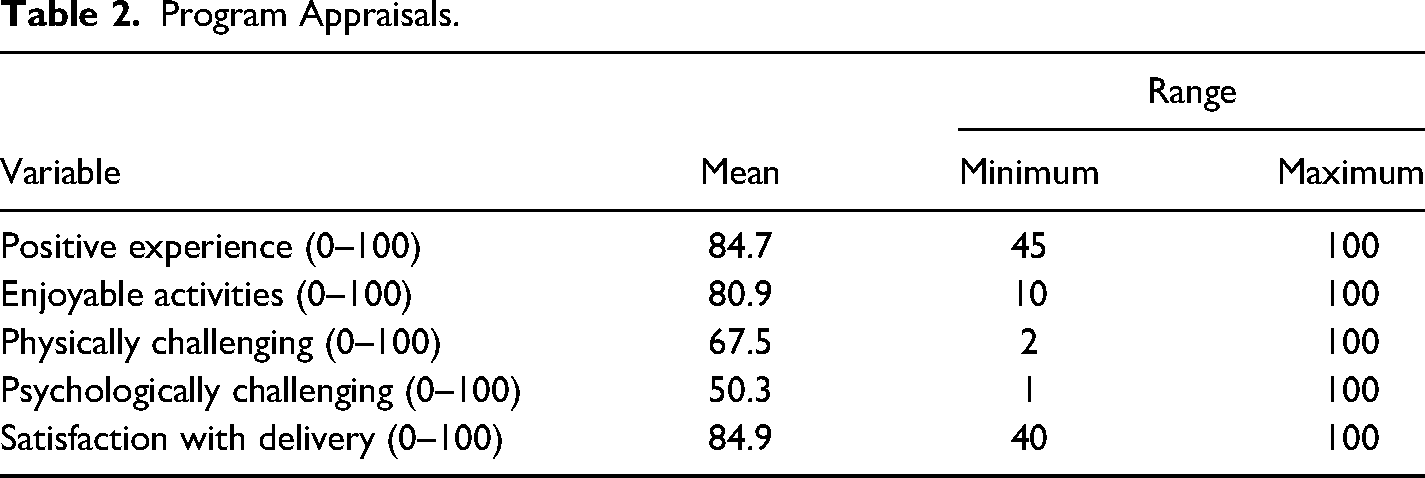
Participants’ perceptions of the program are reported in Table 2. To summarize, across the three organizations, participants generally reported having a highly positive experience and were satisfied with the delivery of the program. Activities were appraised as highly enjoyable and moderately physically and psychologically challenging. Bivariate correlations revealed greater ratings of both physical and psychological challenge were negatively associated with positive (r = −401, p < .001; r = −274, p = .015, respectively), enjoyment (r = −561, p < .001; r = −319, p = .004, respectively), and satisfaction (r = −451, p < .001; r = −231, p = .024, respectively) ratings.
Program Appraisals.
Primary Analysis
All GEE models are controlled for gender, respective baseline values, and age. The results are displayed in Table 3. A significant time effect was found for teamwork self-efficacy (Wald x2 = 14.713, p = .001). Posthoc analysis revealed a positive small effect for mean change in teamwork self-efficacy (Mchange = 1.73, p = .042, g = 0.36) from t1 to t4, a small mean change from t4 to t5 (Mchange = 0.98, p = .425, g = 0.22), and a positive significant medium effect (Mchange = 2.72, p ≤ .001, g = 0.69) from t1 to t5. The time effect of workplace self-efficacy (Wald x2 = 5.676, p = .059) was not significant, but the observed mean changes are meaningful. Accordingly, posthoc analyses revealed a positive medium effect for mean change in workplace self-efficacy (Mchange = 1.60, p = .061, g = 0.63) from t1 to t4 and a positive small effect (Mchange = 1.23, p = .168, g = 0.48) from t1 to t5. The time effects for workplace engagement (Wald x2 = 4.154, p = .125) and motivation (Wald x2 = 0.930, p = .628) were not significant, with negligible mean changes observed. The results of the paired samples t-test examining the mean differences from t1 to t5 in the IWPQ subscales revealed small positive effects for task performance (t(23) = 1.42, p = .170, g = 0.21) and contextual performance (t(23) = 1.65, p = .112, g = 0.39). Additionally, a small negative effect for counterproductive work behavior (t(23) = −1.67, p = .071, g = −0.35), indicating a positive shift in reducing counterproductive behaviors.
Changes in Workplace Outcomes From Baseline to Follow-Up Assessments.
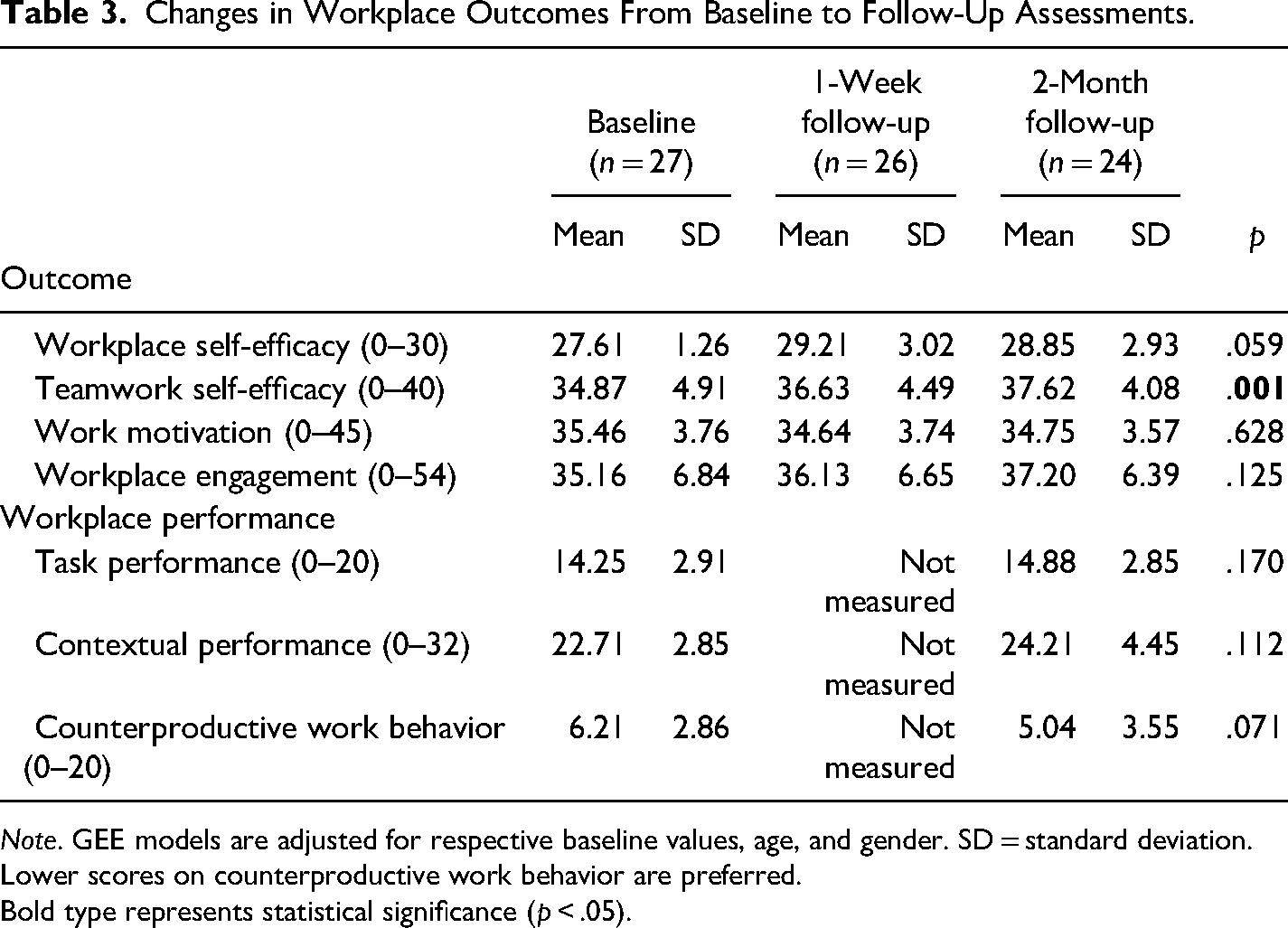
Note. GEE models are adjusted for respective baseline values, age, and gender. SD = standard deviation. Lower scores on counterproductive work behavior are preferred.
Bold type represents statistical significance (p < .05).
Secondary Analysis
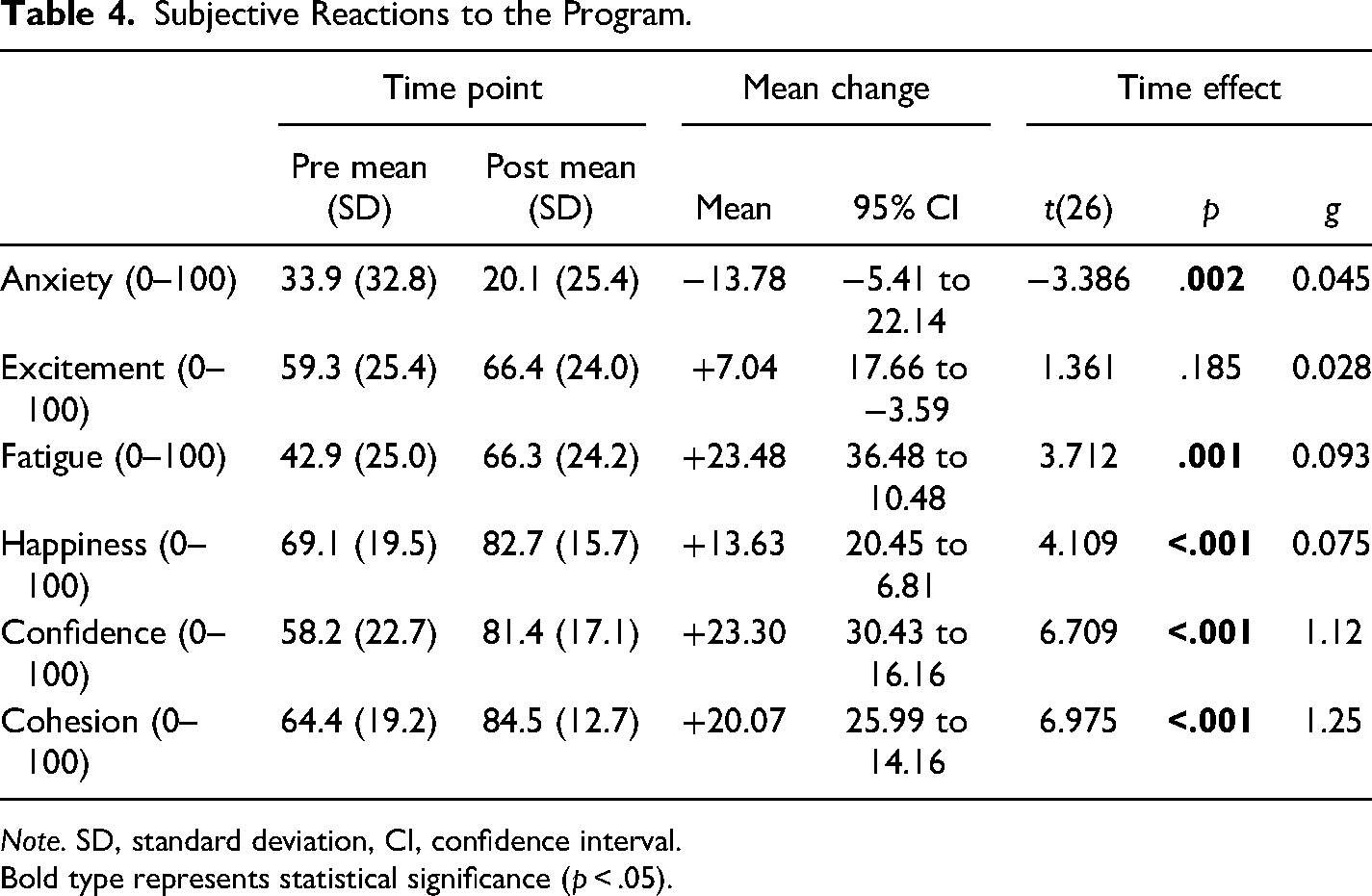
GLMs were performed to examine associations between teamwork self-efficacy and program appraisals. Participants’ ratings of how positive they found the experience were significantly, positively associated with change in teamwork self-efficacy from t1 to t4 (B = 0.111, 95% confidence interval (CI) = 0.055–0.167, p < .001). No other appraisals were associated with outcome change. Paired samples t-tests were performed to examine pre- to post-program mean change in affective and cognitive states (Table 4). Pertaining to affective states, participants reported feeling less anxious, happier, and physically and psychologically tired. Additionally, participants reported feeling more confident in their abilities and better connected to the group members on the day (all ps ≤ .002).
Subjective Reactions to the Program.
Note. SD, standard deviation, CI, confidence interval.
Bold type represents statistical significance (p < .05).
Qualitative Content Analysis
A total of 184 raw codes were generated which ranged from one-worded statements to multiple sentence long answers. In total, 167 codes were then collapsed into four main categories and four generic categories. The remaining 17 codes were considered miscellaneous and did not fit under an appropriate category.
Category 1: Challenging Experiences, Two Sides of the Same Coin
“I Felt a Sense of Accomplishment”
The notion of challenge, and the role that it played in the experience, was a central theme. Participants discussed their attitudes toward challenging oneself and how it can enhance learning. For participant 3, confronting challenge provides the foundations to build mental fortitude. “I think it [sense of challenge] provides me with an outlet and a resilience, actually a sort of a mental resilience. Perhaps the fact that the muscle is a brain or brain is a muscle, right, and you're exercising it.” Participants also recognized that engaging in challenging endeavors provided opportunities to enhance their sense of efficacy. For example, participants commented, “if you push and challenge yourself, then you can increase your confidence,” “I love the challenge of pushing myself forward,” and “you sometimes think that this is the limit, but then if you don't put any limits on yourself, you can grow even higher.”
“I Didn’t Think It was Going to be as Intense as It was”
While the novelty and thrill of challenging experiences can yield positive outcomes, it is evident not all team members appraise or experience these situations the same. There is a delicate balance between the level of challenge which can foster growth or lead to potential harm and negative consequences. Although interviewed participants did not necessarily suggest they encountered negative experiences, they spoke about the appropriateness of the program for the wider group. Participant 4 commented that the “valuation of what people are really physically able for, I don't think was probably exactly where it needed to be, if I'm honest.” Also, “if we were to do it again, I think I would like it to be maybe just like 10 to 20% less tough.” There appeared to be a disconnect between the expectations and what the program delivered as participant 5 further explained. “[The cycling] just terrified everybody, there was definitely a gap between what I thought we were signing up to and what the actual day looked like.”
Category 2: Team Cohesion
“The People Turned Up, Not the Worker”
All interviewed participants consistently highlighted how engaging in challenging activities together in unfamiliar environments allowed them to form bonds that extended far beyond the workplace. As articulated by participant 3, “the people turned up, not the worker.” Particularly, participants noted the experience encouraged them to “bond on a more personal level” and to view team members “not only as professional colleagues but as well, like friends from the working place.” Participant 1 further spoke on how relationships had moved beyond the confines of the workplace: I would say collaborative, which reflects that professional life. So, I would say, before we met, we were quite professional with each other, helped each other whenever we need etc., but I think that after the event we started to become closer. (Participant 1) I think it just accelerated the onboarding for those newer starters and it definitely gave me a perspective on the characters that we're working with, maybe in a way that would have taken me a lot longer to get to know them otherwise. (Participant 4)
“We Feel More Energized”
One area discussed by all participants was how the teams felt reinvigorated and energized by the experience. As stated by participant 2, “I think even in the team we notice, we were like, more energized” and participant 3 mentioned feeling “fueled,” “it fueled my joy for quite a long time.” When asked what the interviewees meant when they referred to an enhanced sense of collective energy, participants referred to a “relief of pressure,” “ready for coping” for future challenges, and, most frequently, a lift in the teams’ mood. Participant 4 suggested that the group, particularly, found joy and a greater sense of connectiveness in sharing their vulnerabilities and triumphs to one another: I saw what people had to put in and I thought people were amazingly courageous with how much vulnerability they shared. But I also thought that the team responded amazingly to that vulnerability and really wrapped themselves around each other to support each other. (Participant 4)
Category 3: Opportunity to Disconnect from the Workplace
A pivotal theme that permeates throughout the participants’ experiences is the beneficial effects of the outdoor environment in which the program took place. Participants expressed how the outdoors provided “a stress relief for the team” and enabled them to “disconnect from the workplace.” As stated by participant 5: You were able to disconnect from work a bit more. I feel like previously on, these kind of team building days, an activity we have to do for example in a previous company is work on your personal blog. So, write a little description of yourself and it was still quite work-related. So, it was nice to do something very different. (Participant 5)
Participants suggested engaging in physical pursuits in the outdoors induced feelings of “excitement,” and “joy.” For participant 2, the outdoors also provided an outlet to escape the pressures and monotony of the workplace: Yeah, for me it's about the being not in like in a cage. Not being in the office or not being at home, because I’ve been working from home. So, it's more about the air the, I don't know, everything that is in the outside, you know, that you feel more free and that it's that feeling, I think. (Participant 2)
Category 4: Program Duration
While it appeared the 1-day program was a valuable experience for participants, it was mentioned that it may not provide sufficient time for long-term effects or for outcomes to truly transfer to the workplace. Participant 1 suggested, with “a longer duration, you would have a bigger goal… and that would eventually have given you like a bigger sense of achievement.” When discussing the long-term impact of the experience with participant 5, they stated, “I thought it would be like a nice activity, like a team activity, things like team building, getting to know people etc… but it's just the one-day activity. Is that really going to have much of an impact?” Of course, longer duration programs require greater resource allocation, and this was stressed by several of the participants. For instance, participant 4 stated: I think where I've done things before and they've really had an impact, there'll be a weeklong, but a business like ours could never afford to do that. We couldn't afford to take the team out for a week. (Participant 4)
Discussion
This study presents a small-scale prospective evaluation of a 1-day OA program in workplace settings, informed by occupational training literature. We employed quantitative assessments of participants’ reactions, program appraisals, and prospectively captured changes in work-related variables. A nested qualitative component contextualized these findings and offer nuanced insights for program design and implementation. Adopting a pragmatic philosophical stance anchored the research in participants’ experiences, producing actionable knowledge (Kelly & Cordeiro, 2020) and ensuring relevance for OA-based stakeholders, including educators and program users (Morgan, 2014). The findings contribute to scholarly discourse and provide a deeper understanding of the benefits, limitations, and implications for incorporating OA learning in training and development programs.
Learning and Change in Work-Related Outcomes
Regarding the primary aim of the study, to examine the impact of the training program on work-related variables, null time effects and nonmeaningful mean changes were observed from baseline to 1- and 2-month follow-up assessments for motivation, engagement, and performance variables. One explanation for these null findings is the duration of the program, which participants questioned as to whether 1-day is sufficient time for effects to be sustained over the long term. Short-term OA experiences (1- to 3-day course formats) are becoming more prevalent, which coincides with the increasing commercialization of adventure-based experiences (Rushford et al., 2020). While previous research has offered some support for shorter duration programs (e.g., Gillis & Speelman, 2008; Tyne et al., 2024a), reviews have generally found larger effects in longer duration programs (e.g., Bowen & Neill, 2013; Hattie et al., 1997). It should be questioned whether the same outcomes can be expected and marketed by providers of these short duration programs. It is important to note, however, that long course formats require significant resource allocation and as outlined by the qualitative data, this is not financially feasible for many organizations operating in today's financial environment.
It was observed that participants reported significantly greater beliefs in their ability to work as part of a team postprogram and these effects were greatest at 2-month assessment. The qualitative findings enrich these data by providing additional context, indicating that the heightened sense of team cohesion and trust among the group emerged as key outcomes from the experience. Participants found the far-removed experience conducive to fostering relationships outside of the workplace, providing opportunities for sharing personal stories and vulnerabilities, which effectively broke down barriers within the group. These findings are congruent with previous research which suggests that the social contexts embedded within OA programs can stimulate change in attitudes and beliefs toward teamwork (e.g., Bronson et al., 1992; Cooley et al., 2016; Eatough et al., 2015; Kourtesopoulou & Kriemadis, 2020). The study findings enrich these ongoing discussions by illustrating that the positive outcomes related to teamwork can endure beyond the program context and continue to impact employees upon their return to the workplace.
Although a nonstatistically significant time effect was identified for workplace self-efficacy, a meaningful, positive medium effect was observed from baseline to 1-week follow-up and a small effect at 2-month follow-up. Previous research has provided support for the impact of adventure-based experiences on improving general self-efficacy beliefs (Eatough et al., 2015; Mutz & Müller, 2016; Tyne et al., 2024c), but rarely have studies investigated if such beliefs generalize to other domains of life. The present study showcases that employees may feel more confident in their abilities to carry out work-specific tasks and tackle work-related challenges after engaging in an OA program, where the focus is placed on translating the experience to workplace settings through the use of metaphors, appropriate activities, and developmental discussions. Representative of Bandura's sources of self-efficacy beliefs (Bandura, 1982), qualitative findings suggest that participants’ confidence can be enriched through experiencing a profound sense of accomplishment in overcoming the various challenges and activities presented in OA experiences, both individually and as a collective endeavor. Recent research in the OA literature has presented similar themes (e.g., sense of accomplishment) in student populations (Down et al., 2023), suggesting these fulfilling and rewarding experiences can be efficacy-enhancing opportunities, which may extend beyond the program context (e.g., the workplace).
The evaluation did not detect change in bottom-line organizational results (e.g., perceived performance), but these findings do emphasize the value in OA experiences with workforces in shaping desirable work-related beliefs and skills, particularly concerning teamwork. Such attributes are representative of contemporary 21st-century skills which are necessary for individuals’ effective and successful engagement in the present-day workforce (Sarfraz et al., 2018). For example, the increasing emphasis on collaboration within workforces, driven by a noticeable rise in the allocation of time to team-related tasks, underscores the importance of developing positive attitudes and beliefs toward teamwork (Lacerenza et al., 2018). Moreover, in organizational research, self-efficacy beliefs represent a vital personal resource that can buffer the effects of stress, enhance job satisfaction, and contribute toward one's performance (Rigotti et al., 2008). To some degree, these findings help to soften prior criticisms of off-the-job experiential programs as mere fun recreational pursuits devoid of theoretical grounding (Tews & Noe, 2019).
Program Reactions and Appraisals
The program generally had a positive impact on affective reactions as participants reported feeling happier, physically and psychologically tired, and less anxious. Additionally, participants reported feeling more confident in themselves and better connected to their team members. The extent to which these positive changes lasted is unknown. Many researchers have proposed that the most sensitive period for detecting outcome change following an adventure-based program is immediately after (Eatough et al., 2015; Gillis & Speelman, 2008; Hattie et al., 1997). However, concerns of participants’ experiencing a “post-euphoric high” upon conclusion of the experience have been well-documented (Ewert & Sibthorp, 2009; Hattie et al., 1997; Scrutton & Beames, 2015). Specifically, because participants often leave training programs while still experiencing heightened emotions, their immediate reactions tend to be more positive than the responses gathered at later follow-up points (McEvoy, 1997). This highlights the need for measures to be administered away from the program context (e.g., days or weeks later). Nonetheless, these findings align to prior research which suggests OA learning can provoke positive emotional and mood states, potentially facilitating flow-like states and peak learning experiences (Pomfret et al., 2023).
Employees generally appraised the experience as positive, challenging, enjoyable, and were satisfied with the delivery of the activities. Strengthening prior findings, these types of training programs are clearly well-received by employees and deemed appropriate forms of training approaches (Cooley et al., 2016; Jones & Oswick, 2007; McEvoy, 1997). Additionally, similar to findings presented by Cooley et al. (2016), we found positive evaluations of the program statistically predicted some of the variance in change in teamwork self-efficacy, highlighting the importance of course design. The qualitative findings also highlight the positive appraisals of the program's environment. The natural outdoor environment provided participants with an outlet to disconnect from the workplace and escape the pressures associated with their job role. The beneficial effects of outdoor environments involved in adventure-based research have been well-documented (Pomfret et al., 2023; Kerr & Houge Mackenzie, 2018). These findings further highlight the distinct impact of such environments in work contexts and add to the growing literature accentuating the value of nature-based programs for occupational settings (Gritzka et al., 2020).
Noticeably, however, the participants’ appraisals ranged considerably, suggesting the program was not experienced uniformly, especially concerning perceptions of challenges. Participants who reported feeling extremely challenged generally found the experience unenjoyable, dissatisfied, and negatively appraised their overall experience. This was reinforced by interviewed participants commenting on the importance of balancing the level of challenge with the physical abilities of the group, as for one of the teams, there appeared to be a disconnect between these factors resulting in negative reflections of the experience. Evidently, an adventure-based experience which has an overemphasis being placed on the components of risk and challenge can be counterproductive or even harmful for the participants (e.g., participants experiencing overwhelming anxiety) (Brown & Jones, 2021). Participants may experience feeling isolated and marginalized when they struggle to effectively engage with the emotional responses (e.g., fear) elicited by such experiences (Reed & Smith, 2023). These findings contribute to the ongoing discourse in the literature regarding whether the components of challenge and risk should be inherently viewed as positive and integral to learning, or if a paradigm shift in practice is warranted (Reed & Smith, 2023).
Practical Implications
Our findings have practical implications for organizations looking for brief intervention designs to target improving teamwork competencies and confidence levels among their personnel. However, based on the study findings, organizations should set realistic goals and recognize what is achievable by short-term OA experiences. To maximize work-related results, the integration of OA learning into a broader occupational training program, combining both on-the-job training and complementary experiential learning techniques, may offer a promising avenue for fostering employee development and skill acquisition. This could entail the implementation of several 1-day OA learning experiences spread out over an extended duration, which allows for the gradual reinforcement of skills over time and transfer to the workplace. Understanding the effectiveness of this longitudinal program design represents a fruitful area for future research. Additionally, it is highly recommended for leaders to carefully assess the suitability of these physically orientated training programs for their workforce, a process that can be facilitated by conducting a training needs analysis (Lacerenza et al., 2018). As well as the provider ensuring the program objectives align with both the participants’ and organizations’ expectations of the experience and training and development goals.
Findings also highlight the importance of program design and the role of educators in achieving outcomes. Particularly, educators must aim to balance the level of challenge with the physical abilities of the group. Educators should adhere to the well-established principles of “challenge by choice” to prevent an overemphasis on risk and challenge (Brown & Jones, 2021). This approach allows participants to set their own goals and maintain agency over decision-making processes related to engaging in challenges and risks (Brown & Jones, 2021). Finally, these insights offer guidance for how OA learning should be marketed. It is recommended to emphasize the participant's experience, such as difficulty level and degree of challenge, rather than solely focusing on post-course outcomes to ensure the effectiveness of the program.
Strengths
The strengths of the present study include the combination of quantitative and qualitative research methods to provide a broad evaluation of OA programs in occupational settings. First, the effectiveness of the program was examined through work-relevant validated questionnaires, as well as participant appraisals and immediate reactions which were examined to better understand the employees’ experiences. We have also reported important null findings, negative/adverse events, and delineate implications for program integration into occupational contexts, as recommended by prior reviews (Holland et al., 2018; Rosa et al., 2023). Future research should continue to document null findings to reduce publication bias and adverse events that occur during or after program participation. This will enhance our understanding of the true effectiveness of OA programs and help in assessing the risk–benefit profile (Rosa et al., 2023).
Limitations
A notable limitation of the study surrounds the small sample size and lack of control condition to isolate the effects of the program. Concerns of small samples when evaluating such programs are permutated throughout the literature, due to the practicalities of hosting/researching these types of experiential programs (Ewert & Sibthorp, 2009; Scrutton & Beames, 2015). Naturally, we recommend for future studies to assess the impact of OA learning in larger workforce samples and, when possible, incorporate randomization procedures to determine whether a cause–effect relationship exists. In the context of the study, the planned series of multiple program evaluations was unexpectedly reduced to only three organizations due to the social restrictions of COVID-19. While this certainly limits the generalizability and rigor of the present findings, we tried to mitigate these effects by using advanced statistical analyses, adjusting for appropriate covariates, and including multiple data collection methods and phases to allow the participants to act as their own control group.
Conclusion
To conclude, the study offers insights into the potential benefits, limitations, and practical applications of OA learning in occupational contexts. Findings suggest these programs may positively impact participants’ self-efficacy in working in teams and perform their job role, and these effects may extend beyond the program context. However, it remains inconclusive whether such experiences directly impact bottom-line organizational outcomes. Generally, the program was well received by participants and appraised as a positive and valuable experience. Participants particularly appreciated the opportunity to disconnect from the workplace and immerse themselves in outdoor natural environments, which positively influenced emotional and mood states post-program. Yet, appraisals ranged considerably, with some participants finding the experience unenjoyable and too physically demanding, which may have thwarted follow-up learning outcomes. Organizations seeking to enhance the functioning of their teams could explore incorporating OA learning into their training and development initiatives.
Supplemental Material
sj-docx-1-jee-10.1177_10538259241268998 - Supplemental material for A Prospective Evaluation of the Effects of Outdoor Adventure Training Programs on Work-Related Outcomes
Supplemental material, sj-docx-1-jee-10.1177_10538259241268998 for A Prospective Evaluation of the Effects of Outdoor Adventure Training Programs on Work-Related Outcomes by William P. Tyne, David Fletcher, Nicola J. Paine and Clare Stevinson in Journal of Experiential Education
Footnotes
Data Availability Statement
The data that support the findings of this study are available from the corresponding author upon reasonable request.
Declaration of Conflicting Interests
The authors declared no potential conflicts of interest with respect to the research, authorship, and/or publication of this article.
Funding
The authors disclosed receipt of the following financial support for the research, authorship, and/or publication of this article: This research was supported by the School of Sport, Exercise and Health Sciences, Loughborough University, and The Leadership High organization. The views expressed are those of the authors and not necessarily those of Loughborough University or The Leadership High. The funders had no involvement in designing the study; in the collection, analysis, and interpretation of data; in the writing of the report; and in the decision to submit the article for publication. The Leadership High designed and helped in the delivery of the program which is evaluated in the study.

Supplemental Material
Supplemental material for this article is available online.
Author Biographies
References
Supplementary Material
Please find the following supplemental material available below.
For Open Access articles published under a Creative Commons License, all supplemental material carries the same license as the article it is associated with.
For non-Open Access articles published, all supplemental material carries a non-exclusive license, and permission requests for re-use of supplemental material or any part of supplemental material shall be sent directly to the copyright owner as specified in the copyright notice associated with the article.
