



Abstract
Keywords
Introduction
In the mid-1800s, the world population passed the one billion mark; however, today, the population is on the verge of eight billion people (Department of Economic and Social Affairs, 2019). Today, the rate of population growth is growing exponentially. The time it took for the population to grow from seven billion to almost eight billion was approximately one decade (Sperling et al., 2020). Sperling et al. (2020) argue that humanity is in danger of becoming a victim of its own success because there is evidence that there have been reversals in the advances made to achieve global food security. The consequences of increasing food production through scientific advancement and agricultural policies have created numerous global issues, including but not limited to food security, water, the environment, energy, and public health (Cole et al., 2018; Nagarajan & Overton, 2019).
However, people are not naturally inclined to view things from a holistic perspective and prefer to view things in simple linear terms (Anderson & Johnson, 1997; de Langhe et al., 2017). Linear thinking presents obvious limitations because it assumes simple cause-and-effect relationships without consideration of confounding factors. As an example, in a food security example, linear thinking could lead people to only consider economic solutions without considering other important factors like culture and impacts on the environment. McKim and McKendree (2020) argue that people need to conceptualize complexity to address wicked problems. Wicked problems are “those that are complex, intractable, open-ended, unpredictable – seem to be proliferating” (Alford & Head, p. 397). Systems thinking has emerged as a model for thinking differently (Cabrera et al., 2008) and is well suited to address interconnected interdisciplinary issues (Hurst et al., 2019). Systems thinking can be defined as “a set of synergistic analytic skills used to improve the capability of identifying and understanding systems, predicting their behaviors, and devising modifications to them to produce desired effects. These skills work together as a system” (Arnold & Wade, 2015, p. 675). Individuals who adopt a systems thinking paradigm can conceptualize the nonlinearity, linkages, tipping points, and tradeoffs characteristic of wicked problems (Hynes et al., 2020). Despite the many benefits and applications of adopting a systems thinking paradigm, it is not the dominant paradigm view (Barton & Haslett, 2007). While Ison (2008) states that people generally have an idea of what systems are, they are not systems thinkers since they often struggle to view an issue from a holistic view. Research often focuses on developing systems thinking skills and competencies. However, for meaningful progress, a paradigm shift towards systems thinking needs to occur (Bawden, 1991; Hynes et al., 2020). The concept of a systems thinking paradigm was advanced by Checkland (2005), who proposed a dichotomy between hard and soft systems thinkers. Hard systems thinking is rooted in a positivist epistemology and focuses on solving problems. Soft systems thinking is situated on a constructionist epistemology and focuses on the role humans play in problem-solving. Emerging research (Alford et al., 2024) expands this dichotomy into a continuum of Hard, HARDsoft, SOFThard, and Soft systems thinking.
We live in a very complex world, but our educational system largely focuses on preparing people to be linear thinkers. Individuals who have a systems thinking paradigm will be better prepared to tackle the complexity in the world, but there is little knowledge about how individuals develop a systems thinking paradigm and if specific experiences can assist in this development. Our study seeks to begin filling this gap.
Preparing College Graduates to Succeed in a Complex World
Interdisciplinary approaches to teaching and research are needed to address global problems (Nagarajan & Overton, 2019). However, according to Molderez and Fonseca (2018), higher education institutions are highly compartmentalized due to the emphasis on disciplinary thinking. Most classes are structured to teach content segregated by subject or within disciplinary silos (Roberts et al., 2018). However, this approach does not reflect how problems are addressed in the world and is unsatisfactory in equipping students with the skills to address these issues (Goldstein et al., 2019). Curriculum and educational practices will need to innovate if higher education institutions are successful in preparing graduates to succeed in this complex world (Dooley & Roberts, 2020). Crawford and Fink (2020) discovered that employers have recognized that graduates are ill-prepared to handle situations filled with ambiguity and change. A paradigm shift towards systems thinking is needed to support efforts to promote interdisciplinary teaching and work (Ferguson-Patrick et al., 2018; Paschalidou et al., 2022; Raven, 2020). There is a pressing need for research universities to respond to the challenge of ensuring global food security by 2050 (APLU, 2017). Understanding the experiences of teaching faculty with a systems thinking paradigm can serve as a model for helping other faculty develop this way of thinking.
Systems Thinking Development
There is no single best way to tackle complex problems because numerous factors such as time frame, location, cultural values, and competing visions ensure that situations are constantly changing (Molderez & Fonseca, 2018). Meadows (2008) argues that humans need to understand a complex system before acting; otherwise, they create even more challenges and issues. Since systems thinking evolved from the cognitive principles of understanding wholes, parts, and their interactions (Caulfield & Maj, 2001), it is well suited to addressing constantly changing complex issues (Randle & Stroink, 2018).
Grohs et al. (2018) created a framework to assess system thinking centered around three dimensions: (a) problem, (b) perspective, and (c) time. Each dimension has various constructs, such as incorporating stakeholder knowledge (problem) and differential framing (perspective) that require the development of specific competencies and skills. According to Mambrey et al. (2020), specific cognitive activities can be used to develop an understanding of complex systems. Grohs et al. (2018) proposed different dimensions of systems thinking, and the development of systems thinking skills may move individuals toward a systems thinking paradigm. It may be tempting to assume that the right experiences can lead to the right skills, which can be filtered through the systems thinking dimensions and lead to a systems thinking paradigm. However, Monroe et al. (2015) caution that experience alone is not enough to develop systems thinking; individuals need opportunities to frame information within a system's context. These opportunities need to be structured and, ideally, to have a longer duration than a few classes to create cognitive change.
Experiential Learning, Real-World Experiences, and Systems Thinking
Jickling (2003) argues that learners need to be exposed to a variety of thinking to be allowed to explore, reflect, and develop their own perspectives and paradigms. However, the well-structured bounded problems presented in formal education do not reflect the ill-structured environment that comes with working in the professional world (Grohs et al., 2018). Monroe et al. (2015) advocate for providing a variety of learning situations that convey systems thinking concepts and provide the framework for contextualizing these concepts. Using experiential learning as a framework, if students are provided with the opportunity to utilize systems thinking within a realistic setting, this will bring more relevance to the content they are learning (Reynolds et al., 2018). Experiential learning has been proposed as a great model for using complex issues to frame learning (Higgins, 2009). Experiential learning has also been shown to be a great model for faculty development (Estepp et al., 2012; Myers & Roberts, 2004; Rodriguez et al., 2024)
Students should be actively participating in the construction of their knowledge to make learning purposeful (Dewey, 1910/1997). Kolb (1984) formalized this idea into an often-cited experiential learning model in which a learner engages in concrete experience, reflects on the experience, conceptualizes what was learned, and then actively engages with the new knowledge. Tilbury and Wortman (2004) support the idea that the types of experiences students engage allow them to interact with the content in ways that support reflection. Experiences can vary depending on the context; Roberts (2006) suggested that four factors need to be considered when describing an experience: (a) duration, (b) intended outcome, (c) setting, and (d) level. It is also important to acknowledge the role educators play in facilitating meaningful experiences for their students. For faculty to teach their students to be systems thinkers, they first must be systems thinkers themselves. But how did faculty become systems thinkers? Clevenger and Ozbek (2013) stated that real-world experiences are the best way to develop systems thinking paradigms but when taking into consideration the experiential learning models of Kolb (1984) and Roberts (2006), a question remains. Considering the context, what types of experiences promote the development of systems thinking in faculty?
Purpose
The purpose of this study was to explore the experiences that contributed to the development of a systems thinking paradigm of faculty at a land grant institution. Three research questions guided the study:
To what extent did real-world experiences contribute to college of agriculture faculty members’ development of systems thinking? Which real-world experiences contributed to college of agriculture faculty members’ development of systems thinking? How did these real-world experiences contribute to college of agriculture faculty members’ development of systems thinking?
Methods
This study employed a phenomenology design (Creswell & Creswell, 2017). A phenomenology allows researchers to understand and describe the lived experiences of research participants. A phenomenology assumes a constructionist epistemology (Creswell & Poth, 2016) whereby individuals develop their own meanings of the world around them.
Participant Selection
Due to the nature of phenomenological research, purposive sampling is commonly used to identify and select individuals who have experienced the phenomenon under investigation (Etikan et al., 2016). Criterion-based purposive sampling was utilized to select participants for the study. The inclusion criteria were faculty who work in food, agriculture, or natural resources and, due to their interest in interdisciplinary work, voluntarily chose to affiliate with the University of Florida (UF) School of Natural Resources and the Environment (SNRE) and had a teaching appointment of at least 30%. The sample was determined by cross-referencing the SNRE directory (as it was on 8/1/21) with the Institute of Food and Agricultural Sciences Human Resources Directory List to determine teaching appointment percentages to establish eligibility. An invitation was sent to all eligible faculty members, and 11 who self-identified as systems thinkers based on their own understanding of the phenomenon volunteered to participate in this research.
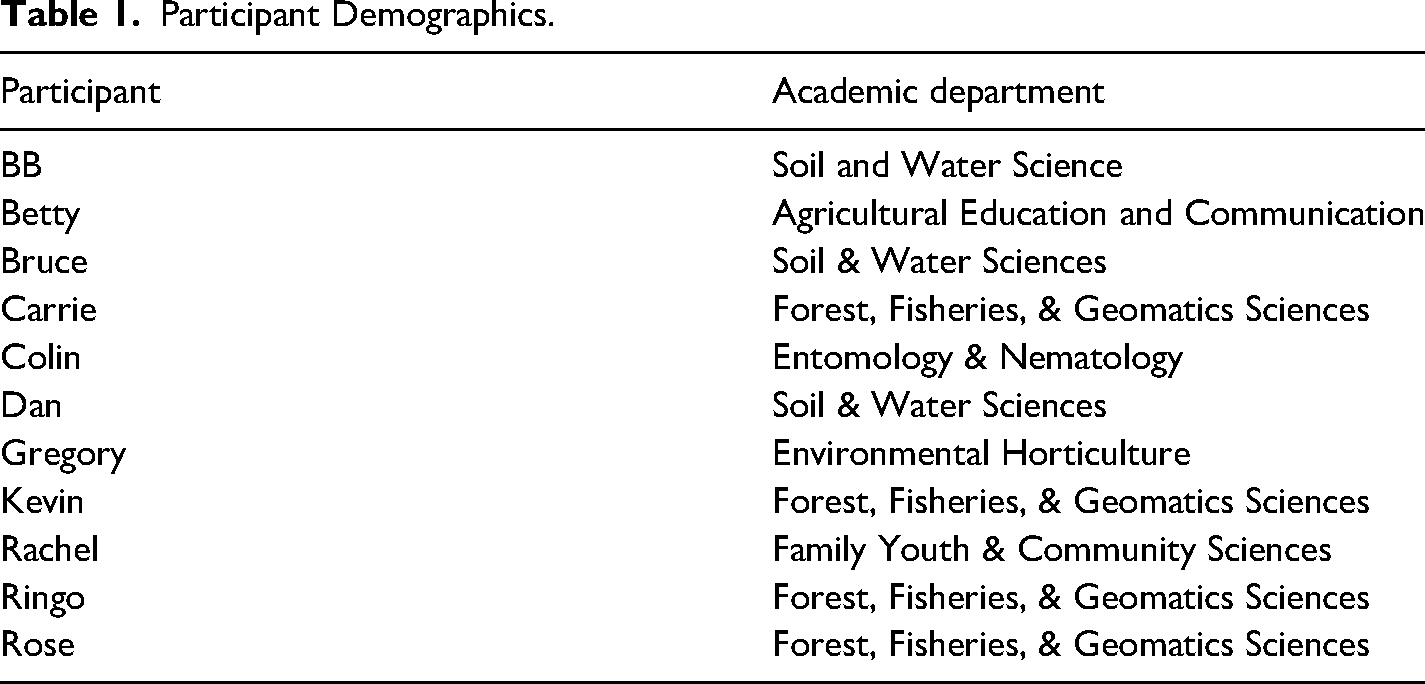
The 11 participants interviewed in this study represented six different academic departments: (a) Agricultural Education and Communication; (b) Entomology and Nematology; (c) Environmental Horticulture; (d) Family, Youth and Community Sciences; (e) Forest, Fisheries, and Geomatics; and (e) Soil and Water Science (see Table 1). There were four female participants (Betty, Carrie, Rachel, and Rose) and seven males (BB, Bruce, Dan, Colin, Gregory, Kevin, and Ringo). There was an almost even split between assistant professors (five participants) and professors (six participants), with no associate professors or lecturers represented.
Participant Demographics.
Data Collection
Interviews are the desired method for phenomenological research because they allow for the investigation of the meaning of the experience (Polkinghorne, 1989). The lead researcher created a semi-structured interview guide developed from a review of the literature and focused on experiences associated with developing a systems thinking paradigm. The eight questions on the interview guide focused on contextualization, apprehending the phenomenon, and clarifying the phenomenon (Bevan, 2014). Contextualization questions allow the participant to describe the lived experience in their own words. Apprehending questions give the participant an opportunity to add meaning to their descriptions of their lived experiences. Clarifying questions allow the researcher to focus on the essence of the lived experiences.
After approval gained from the University of Florida Institutional Review Board, data were collected via in-depth interviews, which lasted between 1 h and 1 h 45 min. Each interview was conducted over Zoom and automatically transcribed, although the transcriptions were scrubbed of all identifying information and edited for clarity.
Data Analysis
Colaizzi (1978) proposed a seven-step approach to analyzing qualitative data that is based on first-person accounts of the phenomenon under investigation. These steps are designed to create comprehensive descriptions of the phenomenon, which are then validated by the participants (Edward & Welch, 2011). Due to the breadth of data collected, we chose to use Colaizzi's (1978) approach since it provided more structure than Moustaka's (1994) approach, making our analysis easier for other researchers to replicate. Colaizzi's (1978) approach requires researchers to:
Transcribe and familiarize yourself with the data by reading through the transcripts numerous times to get a broad understanding of the data. Identify and extract significant statements that relate to the phenomenon being investigated. Create formulated meanings from the identified significant statements. Aggregate and categorize the formulated meanings into common themes. Develop comprehensive descriptions of the findings of the study. Identify the fundamental structure that describes the essence of the phenomenon. Return the fundamental structure to participants for verification of the interpretation of their experiences.
Data were analyzed using a combination of deductive and inductive coding. Our first round of coding used deductive coding, which used predetermined codes based on the existing conceptual framework guiding this study using what Saldaña (2021) called directed content analysis coding. Our first round of coding also included inductive open coding (Saldaña, 2021) to identify emergent codes not in our initial set of codes. Our second round of coding used axial coding to construct linkages between the data and identify themes (Saldaña & Omasta, 2016).
Operationalizing Real-World Experiences
Real-world experiences are typically thought of as having authentic experiences rather than remaining in the theoretical or idealized sphere of the classroom or laboratory (Beames & Brown, 2016). These experiences appear to provide opportunities for various cognitive activities to occur, although it should be noted that, within the realm of academics, there are multiple classifications of what can be considered real-world experiences (Beames & Brown, 2016). As noted by Beard and Wilson (2006), experiences can be classified based on their unique characteristics. The researchers chose to view these different real-world experiences as a continuum depending on the degree of separation from a strict traditional classroom environment.
Trustworthiness
In qualitative research, validity is harder to measure because of the subjective nature of the research (Denzin, 1978) and, therefore, should only be applied to those studies focused on making causal claims (Yin, 2018). Hammersley (1990) suggests that rather than focusing on validity, the researcher should establish trustworthiness by demonstrating how they arrived at their conclusion using supporting evidence. Credibility is the term used by researchers to demonstrate that they have used appropriate measures to establish trustworthiness; we utilized member checking, a thick description of the phenomenon, prolonged engagement, and an audit trail to establish credibility (Lincoln & Guba, 1985). Member-checking allowed participants to review their data. A thick description provides the reader with enough detail to determine if the results are transferrable. Prolonged engagement was obtained with the lead researcher's multiple interactions with participants throughout the conduct of this study and related studies. The lead researcher also kept a detailed audit trail throughout the development, implementation, and analysis stages of this research, noting methodological considerations and capturing her observations. A researcher's background and beliefs may influence the research approach; therefore, reflexivity is a crucial component in establishing the researcher's position and perspective (Snape & Spencer, 2003). Below is the lead researcher's reflexivity statement as it pertains to the research topic: As a first-generation Jamaican American living in a southern urban city with no prior agricultural background, I felt like an outsider in the traditional agricultural field. These life experiences have required me to look at situations from all angles and gather as many viewpoints as possible, which was further reinforced during my teaching of agriculture in a suburban middle school. As a result of having an outsider's perspective while working within the dominant field, I have developed of a systems thinking paradigm, which underpins my beliefs that there are multiple ways to view the world. As I have benefitted from systems thinking, I highly value it and believe there should be a more concentrated effort to develop this cognitive level. As I conducted this study, I was cognizant of how my experiences and beliefs impacted this study, particularly how they influenced the interpretation of the data.
Results
Based on our participants who self-identified as systems thinkers, we found that real-world experiences contributed to their development of systems thinking in different ways. Because they all tied back to academia in some capacity, it made sense to us to organize emergent themes based on their degree of separation from academia (Figure 1), which include: (a) fieldwork and laboratory experiences, (b) immersive academic experiences, and (c) nonacademic work experiences. In addition, a fourth theme was developed that focused on the importance of autonomy in real-world experiences (see Figure 1).
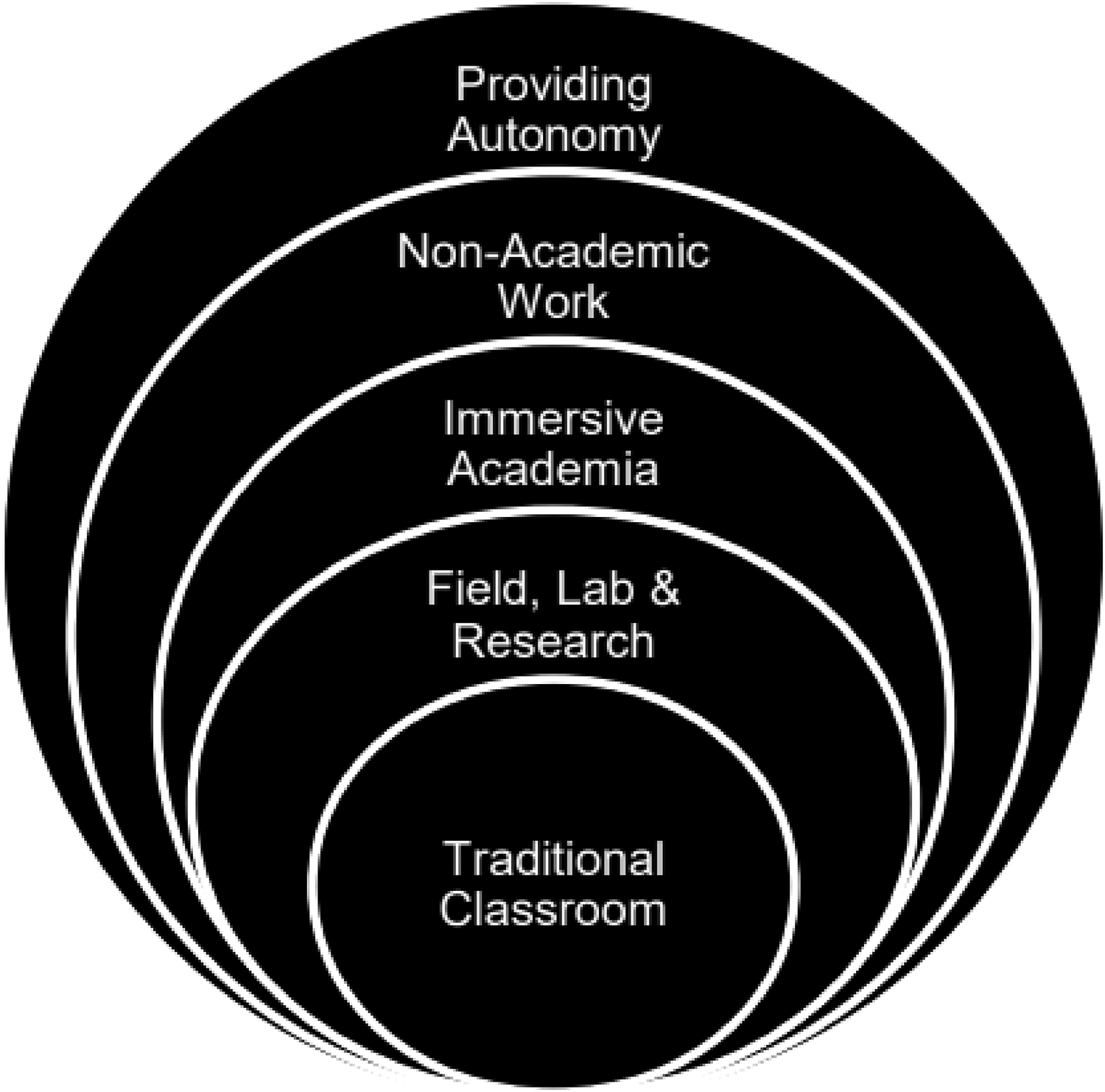
Themes of real-world experiences and the development of systems thinking paradigms based on degrees of separation from the classroom.
Fieldwork, Laboratory, and Research Experiences
Five participants found that conducting research and fieldwork provided a real-world experience that helped develop their ability to think about things from a systems perspective. Although still within the sphere of academia, these experiences allowed participants to gain hands-on experiences that moved their development of systems thinking beyond the theoretical. Dan made a point to mention that “sometimes we use ‘lab’ as a generic term, which some people still do a lot of fieldwork and do very little lab work, but they still call their lab.” This statement is important because it reminds us that regardless of the term being used, they are still experiences that take individuals out of the classroom environment.
For example, BB noted that volunteering in a research lab was where he began to associate systems thinking with complexity. In the lab, he saw predator-prey modeling and the core message that introducing different agents or different types of species created interactions that made things super complex. This experience exposed him to systems thinking, and he found himself preferring real-world experiences where he was able to “see the different things and different processes.”
Dan commented that he felt that learning during his degree was “very traditional textbook and auditorium and exams” where he “just regurgitated” information, “like you know you learn kind of the foundations or the blocks.” It was not until he started researching that he found his thought processes were broadened. He noted that he split his time between greenhouses and lab work, which allowed him to see multiple processes related to his field of study. Gregory supported the notion that lab work broadens thought processes because: lab work, the lab research, you know, a lot of that was making the connections with some of these important concepts that we were learning… so it was like this manifestation of the things that you’re learning right. It's actually getting to do it, you know, it's not just sitting there learning about. It's actually doing it, being active. I think for me, that's super important, so it kind of lets you see the whole process all the way through.
BB made a point to explain that the hands-on experience was more valuable than “just sitting in front of a computer going through Excel or other databases and trying to do statistical things.” BB explained how research and fieldwork helped him develop his systems thinking when he stated: I could have some first impression about the ecosystem. How are things that I’m studying? But then, once I got through the literature, because most of my work is laboratory-driven, I can start to make sense in the field and see the relevance of that. That has been really helpful.
The above statement echoes Gregory's view that these types of experiences allow individuals to see the whole system as they interact with the various components. Colin, too, said, “Especially during my master's degree, when I was in charge of my ecological research project, I think that helped me be aware of systems thinking.” Kevin did not explicitly mention any fieldwork or laboratory work contributing to his development of systems thinking, but he did allude to his work in modeling, allowing him to see more processes and how he could apply this to his content. These participants felt that their real-world experiences in the field and the laboratory helped them develop their systems thinking paradigm by stepping beyond the classroom.
Immersive Academia
Aside from laboratory and fieldwork, four faculty in academia can have more immersive real-world experiences that involve doing similar work as academics, but outside of a university. These experiences differ because faculty operate in a sphere that blurs the line between academia and the real world. For example, Bruce worked as a National Science Foundation (NSF) program officer, a position that is cycled among different academics in two-to-three-year rotations. In his capacity, he oversaw managing a substantial multi-million-dollar grant operating in numerous states. Bruce noted that because of this experience, he had to work not just with academics from NSF but also with those who would be funded through the grant, which included various stakeholders from K-12 teachers to parents to university faculty. He described how seeing the work being conducted at all levels of society really helped him understand systems thinking.
Rose also experienced growth in her systems thinking when she was working internationally. She said: Working internationally, has really influenced some of my thinking because here [the United States] you know our purposes, our reasons for what you do are much different than other places…it's very cultural, it's a very different relationship, and they have a very different connection and interaction with their land than other people do. And so that's taught me a lot about how I think about land and interact with the land that I work on. And viewing it more as a whole, as a living system, as something that provides, is something that needs to be nourished.
Rose also spent several weeks working with indigenous peoples, both international and domestic, which she said pulled her in and made her think about the various connections revealed through the different perspectives.
Similarly, Rachel's decision to move to Detroit to immerse herself in her research topic allowed her to make connections that otherwise would not have been explored had she stayed in the sphere she already knew. Gregory spoke of how a summer-long internship at an extensive botanical garden allowed him to work and gain experience in multiple spheres of his field. He spoke about how this work and conversations with supervisors broadened his mind and helped him see how different specializations connected.
Nonacademic Work
Four participants were involved with private sector work outside of any academic settings: Gregory, Carrie, Betty, and Rachel. Gregory had several nonacademic experiences, including working in the corporate world and running a plant nursery business. Carrie, too, had multiple nonacademic work experiences, including jobs in nature centers, residents’ facilities, being a program coordinator at an environmental education center, and volunteering with state committees. Betty worked in broadcasting and held several communications jobs for over a decade. Rachel's work experience spanned from her childhood picking oranges in the orchards to teaching union workers at an outreach education program.
Interestingly several of the participants noted that their dissatisfaction with how these work experiences limited their ability to make stronger connections to their work sent them back into academia. Gregory was dissatisfied working in the corporate world because “I didn’t feel like there was really much room for, you know, developing ideas, free-thinking, and solving problems that were meaningful.” Through her work experiences, Carrie realized that she wanted positions that involved more strategic thinking that would give her more influence to make decisions and solve problems. Similarly, Betty was frustrated that she would produce communication products but did not know if they impacted the audience they were trying to reach. It appears that this dissatisfaction may stem from the fact that these experiences did not fully allow them to develop a systems thinking paradigm.
When Gregory went back into academia, he felt that he “was fortunate because I had lived experience in having a business. I worked at a nursery as well; I could see how important it was to be able to make these kinds of connections.” He referred to the connections between the theoretical work and his work experience and how that helped him develop his systems thinking paradigm. He also added that those who “can’t make these basic connections, it might be a challenge for them to be successful.” These connections may not be possible, though, unless there are real-world, nonacademic work experiences to provide context for the content.
Carrie's academic experience allowed her to utilize systems thinking, but her development came from her work experiences instead of her formal education. She felt that the classes and experiences in higher education were traditional (read a textbook, take the exam) and linear, and, therefore, not reflective of the real world. However, her nonacademic work experience required working in teams; facing obstacles; regrouping and rethinking; and learning by doing things. To Carrie, these activities allowed her to develop critical components of systems thinking, something she would not have been able to develop within the sphere of academia. Rachel noted that working in various settings exposed her to different perspectives. She then reflected on them by contrasting them with previous experiences. A component of systems thinking is analyzing and making connections between system components, and Rachel attributed her work experiences to developing this ability. Betty, too, found that her work experience allowed her to take the content she was learning in school and see how it could be applied and the consequences that arose with each decision. In essence, participants who had real-world experiences outside of academia found that it provided them with opportunities to develop their systems thinking paradigm in some capacity.
Providing Autonomy to Enhance Real-World Experiences
Real-world experiences provide the hands-on activities that help individuals make connections. However, five participants also mentioned the importance of autonomy during these experiences, which helped their systems thinking development. Colin said, “especially during my master's degree when I was in charge of my own ecological research project, I think that helped me be aware of systems thinking.” Similarly, when Betty's instructor allowed the students the freedom to design her class, she was finally able to sit down and make connections between the various components of content she had been taught previously.
BB mentioned that while he liked having hands-on experiences working in a lab, what was more critical was hands-on experiences where he was working on his own projects. He said that it was empowering to be given autonomy to explore his topics. Ringo said, “I had two wonderful advisors for my master's and PhD, and they gave me so many opportunities to kind of see what they do.” Ringo's master's advisor allowed him to work on a variety of projects, which led to him writing his own proposal for research. He reflected that even though it got rejected, the experience was valuable. He elaborated further that as he progressed through his academic career, he appreciated that his PhD advisor “gave me the flexibility to just say figure this out.” Dan, too, appreciated being able to do the lab work himself because he was able to try to “understand kind of the mechanisms, you know, going beyond just getting a pattern.”
Those participants who had real-world experiences with three degrees of separation also noted the importance of autonomy and independence. At least three of the five expressed discontent with not being allowed to go beyond their job description and not being given opportunities to develop their thinking. This lack of autonomy was an impetus for many of them to return to academia to further elaborate and explore the information they had gathered during their work experiences.
Discussion
The value of out-of-class experiences has been lauded in the experiential learning literature for quite some time (Beames & Brown, 2016). Our results extend this well-known position to specifically show the types of real-world experiences in a tertiary education context that can help develop systems thinking abilities. Participants shared that three types of experiences contributed to developing their systems thinking paradigm: (a) fieldwork, laboratory, and research experiences; (b) immersive academic experiences; and (c) nonacademic work experiences. In addition, a fourth theme was developed that focused on the importance of autonomy in real-world experiences.
Several participants mentioned that their real-world experiences profoundly developed their systems thinking paradigm. Depending on the definition, real-world experiences could exclude research and fieldwork because it is still operating within the sphere of academia; however, many academics view these experiences as hands-on learning designed to represent the real-world. Rather than debate semantics, we chose to classify real-world experiences based on their degree of separation from a traditional academic classroom. Mambrey et al. (2020) postulate that different activities can have differing impacts on systems thinking development, and the same may hold true regarding the types of real-world experiences faculty engage in.
Fieldwork and research were determined to be the experiences that had one degree of separation from academic classwork because they include a hands-on component that moves beyond theoretical content. Participants who engaged in these types of experiences benefitted from having a more holistic view of the topic they were studying, in part because they could see the process (not just the product). These experiences also introduced participants to complexity and required them to make connections between the parts and wholes, which is considered a crucial part of developing systems thinking (Arnold & Wade, 2015; Paschalidou et al., 2022). However, it should be noted that these types of experiences were most effective when there was an element of autonomy included as part of the experience. Arndt (2006) mentioned that there needs to be a ratio between independence and guidance. However, we advocate for providing students with the opportunity to work independently, as this allows them to reflect on past and future learning. Similarly, Karaarslan-Semiz (2022) documented how outdoor education can provide a great context for developing systems thinking in youth. It appears that this logic can also be applied to research and fieldwork and if these experiences are to be used to develop systems thinking, there must be an element of autonomy included.
Regarding immersive academic experiences, for the second degree of separation from academia, participants develop their systems thinking paradigm centered around the idea of gaining perspective. In their own way, participants all gained different perspectives regarding their respective study topics, which Grohs et al. (2018) identify as a fundamental systems thinking competency. As an example, Taoube et al. (2023) described how an immersive community-based learning experience provided a great way of developing systems thinking. Since many problems intersect with differing perspectives, these experiences exposed participants to this concept while allowing them to further reflect and extrapolate it to the larger picture. This immersive work, where interaction with various people, alongside the time component, allows for the development of different aspects of systems thinking. Without these aspects, the development of systems thinking may not be possible strictly from fieldwork and research.
Participants who had real-world nonacademic experiences were (third degree of separation) the furthest removed from academia and did not directly connect to the classroom during their experiences. Oliver (2015) states that the traditional model of working full-time for a company or organization does not allow employees to engage in meaningful work that benefits the community as well as the economy. Oliver (2015) explains that the traditional work model focuses on task completion, but emphasis should be placed on providing employees with an environment that allows them to acquire, adapt, and enhance skills that can be utilized to contribute to society. It is reasonable to think that working for a company that operates under a systems approach may be more conducive for helping employees become systems thinkers.
Participants noted that their experiences allowed them to gain knowledge and competencies within their work, as expected in a traditional work model. However, the participants did not feel that this model allowed them the autonomy to develop a systems thinking paradigm. Interestingly, it appears that their nonacademic experiences were most potent in developing systems thinking when they had a connection with academic content and experiences. When participants were able to connect their real-world experiences to academic content, this intersection profoundly impacted the development of their systems thinking paradigm. This may be because systems thinking involves looking at the overall system and being able to narrow down the details without losing sight of the broader understanding (Caulfield & Maj, 2001). By working in nonacademic settings, participants were able to see the entire system and connect specific content to the broader context.
While real-world experiences play an essential role in developing systems thinking, it appears that it is more nuanced than simply providing these experiences to develop systems thinking. Due to the varied nature of systems thinking and its competencies, some experiences may be better suited to developing different components of the systems thinking paradigm. Participants highlighted how autonomy in their learning experiences created a more conducive opportunity for developing systems thinking. The importance of autonomy has been highlighted in a broad range of educational literature (Beames & Brown, 2016; Deci & Ryan, 1987; Ryan & Deci, 2000). Real-world experiences, such as research and fieldwork, internships, working internationally, or even working in a nonacademic setting, can all provide a means to develop a systems thinking paradigm. These experiences can assist in the development of the paradigm by contributing to specific competencies and skills, whether this involves being able to understand the concept of processes, having the skill to recognize the influence of different perspectives, or being able to take a holistic approach to address an issue by being able to make connections between various components (Davidz & Nightingale, 2008). Ultimately, this will make people better prepared to tackle wicked problems (Alford & Head, 2017).
Recommendations for Practice
Colleges and universities should provide multiple opportunities for students to have real-world experiences to assist in developing their systems thinking, beginning early in their academic programs and continuing through their professional lifetime. Building laboratory and fieldwork into academic programs should be considered, and connections to real-world issues should be emphasized. If laboratory and fieldwork are not possible, other experiential activities like internships, study abroad, and job shadowing would also be beneficial. Although beyond our work, Patiño et al. (2023) propose that virtual experiences can also be used to stimulate the development of systems thinking. Regardless of the type of experience, faculty should prepare students to work independently, and when they are sufficiently prepared, step back and give the students autonomy. Furthermore, faculty should encourage students to design and implement their own projects to experience the whole process.
It is also recommended that faculty incorporate more immersive real-world experiences into their research and teaching agendas. Many faculty are provided opportunities for faculty development. We recommend they seek immersive experiences that could further develop their systems thinking. These experiences should be designed so that individuals are exposed to various perspectives on their chosen topic to get a more holistic view of the issue.
In addition, it is recommended that faculty who have previous nonacademic real-world experience intentionally incorporate them into their academic experiences. Faculty should make a point to highlight the connections between the theoretical and practical natures of the topic and spend time in discussion with faculty who lack real-world experiences. There should be robust dialogue that focuses on how the connections gained from real-world experiences can be transferred into teaching and research and how this can be replicated in an academic setting.
Recommendations for Research
It is recommended that further research be conducted on the role that real-world experiences play in developing a systems thinking paradigm. This study is limited in scope in that it cannot be generalized, so it is recommended that the study be repeated in different settings (i.e., non-U.S. based educational systems), different populations (i.e., other academic disciplines), and different types of institutions (i.e., technical vocational education and training programs) to develop a more robust picture of the phenomena. This research should also be replicated in nonacademic settings like the private sector, government, and Non-Governmental Organizations (NGOs). Understanding the role of real-world experiences play in developing a systems thinking paradigm in these settings will help paint a much clearer picture of this phenomenon.
It is recommended that researchers look at how and what real-world experiences can be utilized to develop different components of a systems thinking paradigm. Furthermore, there may also be a compounding effect of multiple types of experiences that may lead to developing a systems thinking paradigm (ex., working in a lab, having an immersive experience, and working outside of academia). Future research can explore whether this may be the case and how this may influence the rate of development. Research can also be conducted to determine whether the types of experiences influence how an individual conceptualizes their systems thinking paradigm. Are some experiences more-impactful than others?
Conclusion
The essence of the study was that real-world experiences contribute to the development of a systems thinking paradigm. Fieldwork, laboratory, and research experience develop the knowledge needed to understand the concept of complexity. Immersive academic experiences create opportunities for people to interact with others who have varying perspectives. Nonacademic work in the real world allows people to obtain a holistic view of the system.
Footnotes
Declaration of Conflicting Interests
The authors declared no potential conflicts of interest with respect to the research, authorship, and/or publication of this article.
Funding
The authors received no financial support for the research, authorship, and/or publication of this article.
