



Abstract
Keywords
In the late 18th century France, upon hearing that her people were starving and were out of bread, Marie Antoinette infamously offered her pragmatic solution: “then let them eat cake!” (Fraser, 2002). While famines fortunately have long left Western Europe, what has remained a challenge to this day is teaching empathy to people who are unfamiliar with the hardships of a life lived in poverty.
Since the late 1990s, some teachers have turned to the use of poverty simulations as an experiential pedagogical tool for trying to elicit such empathy among university students. Simulation-based learning is a well-established experiential learning practice (Kolb & Kolb, 2017). Its history is rooted in the health sciences, where simulations were first used as a way to train future professionals on risky procedures. Subsequently, it was expanded and adapted into the fields of pharmacy and nursing to train students in important social skills, like bedside manner (Aspden et al., 2016; Patterson & Hulton, 2012; Yang et al., 2014). Poverty simulations have traveled to many other fields, like education, development studies, and social work, to help prepare students to work effectively and ethically with people living in poverty (Davidson et al., 2009; Nickols & Nielsen, 2011; Shirer et al., 1998; Vandsburger et al., 2010). Like other experiential learning practices in higher education, simulations can engage learners in all four modes of Kolb and Kolb's (2017) learning cycle: feeling, reflection, thinking, and action. One of their more unique features, however, is that they can allow students to fail safely and learn from their (repeated) mistakes without causing harm to themselves or to others. But do they actually work?
The efficacy of poverty simulations is reportedly mixed. On the one hand, several studies claim positive results; students that have undertaken such simulations score better on knowledge tests, they better recognize conditions of poverty, and they self-report improved understanding and critical thinking (Edwards et al., 2018; Gabarda, 2019; Hitchcock et al., 2018, Smith-Carrier et al., 2019; Todd et al., 2011). Student attitudes toward those living in poverty have reportedly shifted. They become less judgmental and more empathic, as they learn to see poverty less as a personal deficit and more as structural constraints. This helps prepare them to effectively engage and assist those who live in poverty, by “bridging the gap” between middle- and upper-class students and the people they will serve (Thompson et al., 2020).
On the other hand, some studies have exposed certain risks of using poverty simulations to teach empathy (Steck et al., 2011; Browne & Roll, 2016). Gonzalez (2019) warns of the dangers of traumatizing participants, on the one hand, and trivializing hardship on the other. Others report that simulations may reinforce negative attitudes of people living in poverty, “othering” them by emphasizing personal deficits (like laziness or ineptitude/ignorance) rather than the structural and societal constraints that render their lives challenging (Sachs, 2017; Steck et al., 2011). Participants may walk away apathetic, more convinced than before that the real problems of poverty are personal, not systematic and societal.
While the literature on simulations recognizes these risks, there is a substantial gap when it comes to explaining why, and under what conditions, poverty simulations fail. The purpose of this study is to help fill that gap by investigating how the dispositions of university students may have an important mediating effect on what they experience and learn from simulations. In particular, we were interested in exploring if a heightened sense of agency stemming from financial, human, cultural, and social capital privileges might make it difficult for students to experience and empathize with constraint and hardship (Bourdieu, 1986).
We explored this question by implementing our own 6-week role-play resource allocation simulation among five different cohorts of Liberal Arts and Science undergraduate students in the Netherlands, studying carefully their experiences and their learning outcomes. We conclude that, indeed, students’ heightened sense of agency can stand in the way of eliciting empathy. There is a strong tendency to approach the simulation as a challenge to fix and solve and, unwittingly, to make use of their capital privileges to do so. This includes not only naïve responses to insecurity and vulnerability of financial capital, but, perhaps more importantly, taking for granted and making use of cultural, social, and human capital resources that are at their disposal but not necessarily relevant to the lives they are trying to simulate. We concur with Yosso and Solorzano (2005) that it is not merely a matter of lacking such capitals, but also of assuming their values in particular forms (p. 128).
In this paper, we present and explore the different capital concepts, assess the capital dispositions of our students and illustrate the ways in which these have mediated decision-making in our poverty simulation. Our findings suggest that, in order to make experiential learning through poverty simulations effective tools of empathy, participants need to be made aware not only of their attitudes toward poverty prior to the simulation experience (Steck et al., 2011; Browne & Roll, 2016), but more profoundly, they need to confront and reflect on a range of potential privileges. Specifically, we argue that attention needs to be paid to their capitals and how these often taken-for-granted deeper dispositions can interfere with their ability to empathize. In the discussion, we offer some strategies to improve simulations accordingly, including further developing research on their practical applications, and suggesting how such simulations may be valuable complements to other experiential learning practices.
Study Setting
This study took place at Leiden University College, one of the nine International Honors Liberal Arts and Sciences University Colleges in the Netherlands. This college has a Global Challenges curriculum, aimed at preparing students to engage in pressing societal problems. Archambault (author 1) is an assistant professor and anthropologist in international development and teaches several courses in the Global Citizenship part of the program. Among other courses, she teaches an 8-week course twice an academic year on poverty and social protection in The Hague. The objectives of the course are to provide opportunities for students to explore the multi-dimensional nature and experience of poverty, vulnerability and struggle in their city of residence. The course engages with multiple conceptualizations of poverty and social protection, and emphasizes a view that is multidisciplinary, dynamic, and inclusive of informal institutions and arrangements (Spicker, 2007; Cammett & MacLean, 2014). The course aims to facilitate an understanding of the complex ways those who struggle try to navigate various sociocultural, political, and economic landscapes in search of social protection, poverty alleviation, and upward mobility. Throughout the course, students engage critically with the politics of representation and the ethics of engagement. They are challenged to recognize different narratives for representing struggle and encouraged to confront conservative narratives that blame the victim and seek ones that place voice, resistance, and agency within environments of constraint and structures of repression (Krumer-Nevo & Benjamin, 2010).
An integral part of this course has been the specially designed Human Security (HS) Poverty simulation, a 6-week financial resource allocation role-play simulation based around the life of the fictional Özkara family from Turkey, who moved to The Hague several years ago. This composite family has been created based on years of research from the project on various struggles in the city and social protection efforts. Specifically, we drew from several group studies on the struggles faced by immigrant groups in the Netherlands, including economic inequality, and social and cultural marginalization. We made use of demographic data from the Central Bureau of Statistics in order to decide on, for example, the family composition, occupations, and income. The simulation is designed to include important differences from the majority of our student population: inter-generational dependency, minority race and ethnicity, language barriers, low income, low education, and lack of bodily integrity (disability). This simulation is considerably more involved, longer and more dynamic, than typical resource allocation poverty simulations that are conducted in secondary and higher education classroom settings. Typical simulations last a class period. To the best of our knowledge, no other classroom simulation is conducted over 6 weeks and devotes as much group/peer reflection in and out of class time to the experience.
In groups of four, students role-play 1 year in the life of the Özkara's, each course week representing 2 months in the life of the family. Students are given (on paper and read aloud) the monthly circumstances and need to make decisions for their family (how to allocate their resources) without knowing the consequences. They submit their decisions to Archambault who then determines the consequences on an individual group basis. The decisions and consequences of each group are presented and discussed in the weekly class session. Archambault makes use of two decades of research on urban and rural poverty and protection in East Africa and 7 years of work in the Netherlands, The Hague specifically. Much of Archambault's work has been aimed at challenging development discourse from a personal and life course perspective, revealing how gender and generation and other markers of social difference tell different stories (i.e., Archambault, 2011). As such, she is deliberate in attempting to evoke the “counter-narrative” storyteller role in the simulation (Solorzano & Yosso 2002). She tries to make students reflect on the decisions they made and the extent to which they are able to empathize with the family by asking them to consider whether the family would make (or be able to make) the same choices.
Students begin by choosing their starting setup following a brief description of their family's background and circumstances, which reads as follows:
Father Emre, 29, has lived in the Netherlands for several years and was recently joined by his wife Emine and their 7-year-old twins Haktan and Fatma. Emre Özkara has one registered job in the industrial cleaning business for the Dutch minimum wage, and tries to supplement his income by working an additional unregistered overtime job at the company of an acquaintance. Emine Özkara, once a hard-working bakery assistant in Turkey, was in a car accident several years ago and can only work few and irregular hours at her friend's Turkish bakery market stall due to her resulting back injury. The twins attend one of the neighborhood's primary schools—dad's mother lives close by and tries to help out when Emine cannot take care of the kids due to her injury or work. All in all, the family has to get by from a monthly income of 1,470 euros—an amount below the Dutch poverty line (HS Poverty simulation instructions).
Based on this description, students must make mandatory budget decisions on housing, utilities, transportation, food, healthcare, and childcare. Each category has three options: low/budget, middle, and high. There are also optional categories for spending, which always include mobile phone and expenses related to the particular month and circumstances. These may include birthdays, school trips, vacations, religious holidays, etc. In these categories, students decide on the amounts themselves. They can also decide to try and supplement their family income. They can search and apply for other jobs or for state benefits. Some students have also proposed to start up their own businesses. They can also take risks and gain income through illegal means (selling drugs or stealing) and can panhandle. All proposals and decisions are submitted (on paper) to Archambault, who determines the consequences. If applying for benefits or jobs, the students have to go through the motions of completing all necessary paperwork and budget all of the costs that this would require, including, for example, getting official ID pictures taken or photocopying passports.
We want the simulation to cover an entire calendar year in the life of the family in order for students to experience the different seasonal challenges and opportunities. We only have 7 weeks in the course, so we skip every other month and budget and make decisions on the given month in detail each week. We start in August. Every week, we devote at least 30 minutes to the simulation. Archambault begins by sharing the previous decisions each team made and discussing with the teams why they made certain choices. These parts of the session often involve a great deal of debate, with students defending their choices, as they are challenged to reflect on the extent to which they are empathizing. Archambault also shares her uncertainties and the challenges she experiences in trying to decide what is “reasonable” and what consequences to give. Such decisions are sometimes efforts to realistically teach likely outcomes using evidence-based research as justifications. But often they are lessons to the students to confront their assumptions and get them back into the life of the family. Archambault then presents, group by group, the consequences of their choices and presents (reads aloud) the new monthly circumstances.
Methods
To assess the ways in which student capitals constrain their empathy, this study employs a qualitative approach. We make use of classroom observations and discussions and students’ written decisions over several iterations of the simulation. Archambault has run the course and simulation five times over the past years, with a total of approximately 18 students each time. For this paper and our focus on agency and capitals, we draw heavily from one particular iteration that ran in the academic year of 2017–2018. We had 18 participants in the course. Verduijn (author 2), who was a previous student in the course, undertook this study for her senior capstone research thesis and led the data gathering and analysis effort. In addition to the classroom observations and discussions, this included a presimulation questionnaire on these 18 participants, observations on their group discussions, and a postsimulation individual interview with each of these students.
Our 18 participants were either in their second, third, or fourth year. The majority were female (67%) and had chosen a major in Governance, Economics, and Development (89%). Only two students had different majors. One was part of the Sustainability Major and the other was an exchange student studying History and Public Health in the United States. Despite including students of 10 different nationalities, a little more than one-third of the class originated from the Netherlands (36%), followed by Turkey (11%), and the United States (11%). All the Dutch nationals spoke Dutch, and the others had varying degrees of fluency or familiarity. Prior to starting the simulation, the participants completed a questionnaire with two goals. The first was to collect information on the participants’ background, specifically information that would help us assess some of the students’ capitals. This included, for example, the educational background and income level of their family and how many languages they spoke. Secondly, we wanted to assess students’ individual sense of agency. To do so, we employed Pearlin and Schooler's (1978) “Mastery scale.” This scale consists of seven statements focused around agency and a sense of control and employs a Likert scale from “strongly disagree” to “strongly agree.” Examples of the statements include: “what happens to me in the future mostly depends on me” and “I often feel helpless in dealing with the problems of life.” (Table 1).
Items in Perlin and Schooler's (1978) Mastery Scale.
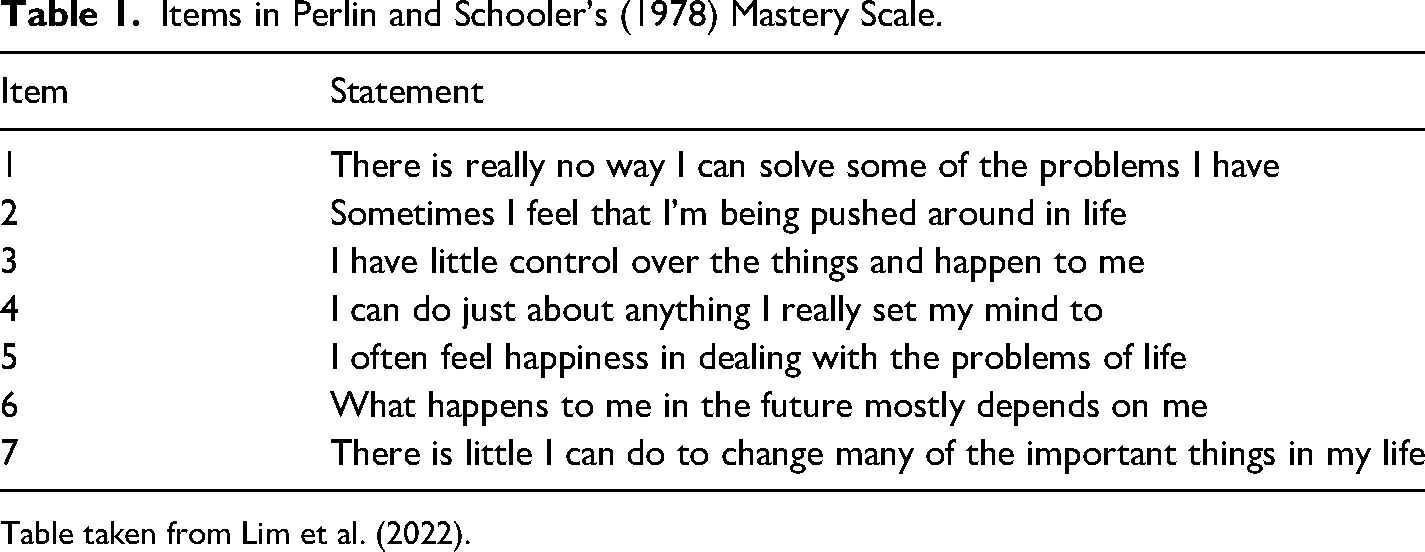
Table taken from Lim et al. (2022).
These data were supplemented by group and class observations. Verduijn observed the weekly simulation debrief sessions. She also joined the groups’ deliberations and decision-making sessions that were outside of class. She also pursued individual postsimulation evaluation interviews with the student participants. All data were analyzed using directed content analysis (Hsieh & Shannon 2005). An initial coding framework used key terms around four capitals: economic, human, social, and cultural (Becker, 1962, Bourdieu, 1986, Schultz, 1961). Additional relevant codes were identified throughout the reading process and inputted into the qualitative software package Atlas.ti (version 7.5.12).
Importantly, this study also draws from a wealth of experiences, students’ decision-making, and simulation evaluations by students in the four other iterations of the course.
Ethical approval for this project was given by Faculteit Governance and Global Affairs Ethics Committee, Reference Number 070-8009002.
Results: Empathy or Apathy?
By the end of the simulation, during the oral evaluation, the majority of students in all five iterations claim it to be a valuable learning tool. They believe that it has improved their knowledge retention. They offer several examples. They better understand the calculation and significance of a poverty line or the unemployment rate. They better recognize conditions of poverty in The Hague and their causes and consequences. They now see the often-hidden inequalities in capitals that can compromise educational opportunities, decent employment, and quality housing. This form of experiential learning, they report, helps them to feel the weight of poverty, the emotional difficulties of coping with scarcity and having to make tough decisions and trade-offs as well as the physical and mental labor required to stay afloat. They also emphasize that the simulation experience helps them to recognize how interconnected poverty can be, how oppressions can be interlocking and overlapping, the ripple effects of decisions and deprivations can be far reaching, and can cycle viciously and be hard to escape.
In addition, we have seen that, for many, their attitudes toward poverty in The Hague, the Netherlands, and in other high-income countries, do change, as clearly stated by a participating student: Before the course I didn’t see the poverty here really. After, when we had to make the decisions that were so hard for us, we were like “crap, these people have a hard time…” It is very hard to make it at the end of the day, and you have to pay for so many things. There's no room for extra things, or often for eating well, even. (Interview, Student, February 27, 2018)
But most students don’t get there right away, and some don’t get there at all. They often arrive into the simulation doubting that there is “real” poverty in this well-functioning welfare state. Recall that many of these students are international and, especially those who come from lower-income countries, find the comparison hardly appropriate at first. Most change their mind, but some don’t. For example, this Turkish student struggled with accepting the difficulties a Turkish family would have here in the Netherlands compared to in Turkey, wondering if the simulation family was a bit lazy.
“I think if you try hard enough in the Netherlands you can escape poverty, yes. If you think about it: if you go to school, primary school is free, high school is not that expensive, in Turkey that's not the case.”
“How is it different?”
“In Turkey, if you go to public schools, it's still difficult to get a good job.”
“So here, if you have a high school education you can get out of poverty?”
“I guess. If you have an education, you can get a job, but if you’re lazy you can’t. Actually: my grandpa was living in poverty, didn’t have shoes and walked to school in snow and somehow worked hard, and as the youngest the others took care of him, so he finished school and even went to Germany to do a PhD, so I mean, it is possible.”
“Do you think the [Ozkara] family was a bit lazy then, because they didn’t succeed?”
“Maybe, yes… I don’t know… I feel like also in the Turkish culture there is laziness - someone has to push you.” (Interview, Student, March 1, 2018)
A Colombian student found the support system in the Netherlands to be so good that maybe being poor was not very hard here: Maybe it is not that bad to be poor in The Hague, [the simulation] gave [me] that idea a bit. There seem to be a lot more resources available than in other countries. And actually, if you want to get out of poverty you can… Which is not that easy, and I mean, of course in class we touched on language and stuff that did make it hard, but still! […] I constantly kept on picturing, “what if we did this simulation for Colombia?” There wouldn’t be aid from the government, they wouldn’t pay for your kids’ trips to the Rijksmuseum… (Interview, Student, February 27, 2018)
There is a real risk that students come out of the simulation with reinforced misconceptions that poverty in wealthy countries is due to personal deficits as there appear to be ample opportunities for help and protection. Our students, charged with boundless youthful energy and agency and a multitude of resources, take off to find this support and to fix their family.
Unsurprisingly, the presurvey indicated a heightened sense of agency among the students. All but one student agreed or strongly agreed with the statement: “I can do just about anything I really set my mind to” and the majority agreed “what happens to me in the future mostly depends on me.” Other research Archambault has conducted in this educational setting confirms an agentive student body (Ehrhardt & Archambault, 2022). It is hardly surprising as we select them on this basis. With more applicants than places available each year, our college's admission staff is able to choose students with the highest motivation to change and improve the world. Ready to take the next step at building their future, students often start our Honors Degree program with CV's readily filled with impressive extracurricular activities, debate club chairmanships and international volunteering experience. Archambault's class on poverty and social protection fits within these ideals, attracting students by promising to hand them initial “tools to contemplate the contours for promising approaches toward alleviating global poverty” (Course syllabus, 2017).
Heightened agency among students is not unique to our college. Arguably, we can expect it to be present in most undergraduate student bodies, as tertiary education is both a privilege and, often, derived from privilege. Several scholars have established a connection between a high degree of agency and being (relatively) privileged (Vincent et al., 2012; Maxwell & Aggleton, 2013). And while the concept of privilege is deeply contested and multifaceted, for our purposes, we find it useful to employ concepts of capitals, centrally brought forward by Bourdieu, as a foundation of privilege and as an instigator of heightened agency (Maxwell & Aggleton, 2013; Bourdieu, 1986). Specifically, we look at how economic, cultural, social, and human capitals mediate students’ decision-making within the simulation and impact their ability to “experience” poverty and to empathize. In the next section, we take up each in turn.
Capital Constraints
Economic Capital: “I’m Not Constantly Involved With Money”
Defined by Bourdieu as capital which is “immediately and directly convertible into money and may be institutionalized in the forms of property rights,” economic capital refers to the ownership of any kind of money, property, or different assets (Bourdieu, 1986, p. 47). While scholarships and a relatively flexible Dutch student loan system might account for some socio-economic variation in our student population, the average student's background is one with a comfortable amount of economic capital. Typically, our students pay more than twice the average cost of state-subsidized Dutch universities. The presimulation survey data on family income and postsimulation interviews suggest that very few of our students have struggled with financial poverty. Even though some have become financially independent for the first time and live on a small income, it appears that for the majority, this has not resulted in high stress, constant worry (“involvement”), or the feeling of difficult compromises. I wasn’t affected if there was money stress in my house. I don’t even know if there was… Probably not. […] And now, since I came to university I realized “ok, you need to take care of what you have and keep track of your spending and where you get your money from, to not get in trouble.” Yet the past months for some reason I suddenly got 200 euros less per month from the government and I didn’t even notice until recently! For many people that would be dramatic, it wouldn’t work for them at all. I didn’t grow up in that, and I’m not constantly involved with money. (Interview, Student, March 6, 2018)
Perhaps as a result of their own financial security and/or confidence, students tend also to be highly risk taking. For example, groups skip paying their utilities to use that money for something else. They seem to be fearless of the possible future implications, such as a bad reputation. Many groups have also started risky business ventures or dappled in high-risk illegal activities. This stems from the fervor with which they take to solving the financial constraints of the family. From the start, they are completely absorbed in increasing the family's income by finding better employment and government subsidies. They don’t allow for values, or cultural capital, to stand in the way.
Cultural Capital: “Another Child Would Be Too Costly”
Defined as the “knowledge, skills, and behaviors that are transmitted to an individual within their sociocultural context through pedagogic action […] in particular by the family” Bourdieu's notion of cultural capital refers to all the mannerisms, know-how, and cultural knowledge one derives from their upbringing within a particular social class (Bourdieu, 1986; Claussen and Osborne, 2013, p. 59).
While we have a very international student body, we also largely have a student body that would self-report an upper-middle or high-class family background. The presimulation survey indicated that all but one student had at least one parent with a university degree. Given that our students are in an honors college, they all have aspirations of professional success, careers that will have an impact on the world, which often comes with important know-how on how to move up in the world.
Students have a difficult time navigating the Özkara's family values as their relentless quest for income repeatedly revealed. Some groups found jobs (or created ones) that were not realistic for the different members of the family, underplaying the importance of language barriers, age, and disability as well as discrimination. They drafted elaborate business plans, for example, a home bakery for mom, even a craft company for grandma. They built elaborate CVs and polished motivation letters. They saw opportunity everywhere. Frustrated at the prospects of having to support their unemployed sisters’ boyfriend, one group vented: “Then work! It's easy. With Thuisbezorgd.nl you can get ten Euros an hour!” Another group proudly shared their plan to have dad (who was already working a 60-hour/week manual labor job) apply for five jobs in the cleaning business, meanwhile signing him up for Dutch classes at the library—“he will work on his CV and motivation letters after the holidays” (group 3 simulation form, December 8, 2017).
Most groups supplemented their work searches with fervent research of the Dutch social security system. They were determined to apply for every possible subsidy. Students didn’t question what this might mean to the family in terms of status, how they might fear their treatment due to discrimination, or whether they might be apprehensive about relying on the state. With a full sense of entitlement, confidence, and trust, they forged ahead with their applications. This was difficult to temper, and Archambault made countless groups frustrated with bureaucratic delays and rejections. One group found a loop hole and (angrily) made claims to retroactive subsidies that were hard to deny. They were approved and their financial pay out put the family in a comfortable position. To bring them back into the simulation, Archambault had to make them victims of an apartment fire. Without insurance and having stored much of their savings in cash, they lost their foothold.
In addition, their fervent quest for financial security made many groups lose sight of their values. Many teams start selling drugs or proposing jobs that would likely be demeaning, for example, an escorting service. They ignore that this is a devout Muslim couple raising two young daughters. One group justified their decision to grow marijuana simply “because it was legal in the Netherlands.” Almost every team decides that mom will panhandle, even if it only brings in a paltry sum of 3 Euros (latest simulation, 2021). In the most recent iteration, even after reading them testimonies on how dehumanizing the experience of panhandling is, one group still insisted to put mom out on the street so that they could afford a better health insurance.
The religious life of the family also tends to be ignored or circumvented. Very few spend their scarce resources on celebrating religious festivities, and they have little problem making the parents work on days of spiritual rest or celebration. Even Muslim students, well aware of the great diversity in beliefs and practices among those that share a religion, are uncertain about how the Özkara family would approach celebrations. A recent student, a Muslim from Sudan, felt conflicted and regrets that he did not do proper research into Turkish Sunni religious practices before making decisions (Reflection essay, Student, November 2021).
In many ways it appears that, for our students, investments in cultural life and the promotion of values comes only after basic needs are met and, in this way, are separate from or do not constitute basic elements of what it means to live life. Tellingly, one group, on their own initiative (it was not raised as a decision in the simulation), sent mom to the hospital for an intrauterine contraceptive device, as “another child would be too costly and therefore better to avoid” (group 4 simulation form, November 9, 2017).
Social Capital: “Without Him, I Would Have Totally Failed the Class!”
Bourdieu's simplest interpretation of social capital is “membership in a group” (Bourdieu, 1986, p. 51). OECD's definition brings forth the benefits of this capital more explicitly, by defining it as “networks together with shared norms, values and understandings that facilitate co-operation within or among groups” (Healy & Côté, 2001, p. 41). One's degree of social capital, in other words, is determined by the size and usefulness of their social network.
Opportunities for building and enjoying such a social network at LUC are abundant, with a student body consisting of around 600 students—400 of which live in the same on-campus residential building—and a thriving online network of several hundreds of alumni and university staff. Every few minutes, a question is posted on the “LUC Central” or “LUC Academics” Facebook group, an answer often delivered within seconds. Students are eager to help each other out with translations, essay proofreading, job opportunities, or missing recipe ingredients, and the student body takes great pride in emphasizing the joy and use of its community. Apart from the convenience of a university network, several students also readily stressed their dependence on relationships back home.
The privilege of enjoying such a vast social network also translated to the way students participated and made decisions in the poverty simulation. For one, they used their social networks to undertake the simulation. One group was keen enough to ask about the subsidies and benefits the Özkara family would be eligible for on LUC Central, receiving their answer within several minutes (interview, Student, March 8, 2018). In class, when we discussed decisions, groups were searching for insights and ideas from each other, sometimes creating the feeling of competition but also sometimes just wanting to help each other out. In the latest iteration, one group contacted Turkish friends in The Hague and asked them about the best strategy to find jobs without knowing the Dutch language. They posted the answer on the shared course blackboard: Hello everyone, I completely forgot over the weekend but I wanted to let you know that through some friends of mine in the Turkish community the suggestion of learning German at a b2 level was quite frequent! This is because there are a lot of call center services in Turkish needed from companies with HQ in Berlin! Hope this might help and for the specific job description look for home call center positions (many in Amsterdam and Tilburg but also quite a few in Rotterdam which is close by). (Class Simulation, 2021)
They were also very intentional in thinking about and making use of the Özkara's social capital. Usually in the first round, there are questions about grandma. “What can we do about grandma? Does she have her own home? Does she have AOW [basic state pension]? If we were to ‘use’ grandma for other things than babysitting could that work?” (Class observation, Student, November 10, 2018). Many groups engaged grandma intensely. Similarly, even though sister arrives into the simulation as a dependent, requesting shelter because she has been thrown out of her apartment, many groups see her (and even her troublesome boyfriend) as important social capital. Some groups have only accepted her to live with them under the condition that her boyfriend works and contributes rent.
Students have also tried to create social capital for the Özkara's, signing them up to community activities or justifying social expenses for the children based on the importance of social capital. One group even invested some money into throwing a party, to build community solidarity and “better protect ourselves from future financial threats” (simulation form group 4, December 8).
Human Capital: “We Want to Create a Business That Starts Both With the Kitchen and With the Heart”
Following Schultz, “much of what we call consumption constitutes investment in human capital” (Schultz, 1961, p. 1). Pursuing an education, keeping up a healthy lifestyle, or learning a new skill are all examples of such investments—attempts to increase the skills and qualities that people can put to productive use in the future (Becker, 1962).
Besides an education at LUC being a substantial investment in human capital in itself, the amount of skills students bring with them upon arrival is impressive. Despite the fact that the LUC curriculum is demanding and intense, almost all students are involved in a wide range of extracurricular activities ranging from Model United Nations debate clubs, sports teams, language and culture clubs, special interest committees, and the student newspaper (Fortuna, 2018). Following the presimulation survey, all but two HS Poverty students are fluent in at least two languages (presurvey, November 8, 2017). In the most recent iteration, one student offered an insightful summary of how human capital mediated their engagement with the simulation: I think every student in this class possesses an impressive array of skills, knowledge and experiences that helped them through the simulation. For example, my teammates’ fluency in the Dutch language helped us navigate local websites and other resources. Furthermore, our knowledge of effective search strategies meant that we could easily find information online in relation to jobs, subsidies, discounts, etc. But by taking advantage of our human capital, we failed to accurately imitate the reality that faced the Özkara family. Compared to any LUC student, the Özkara family is less educated, less tech-savvy, and less multilingual. Instead of trying to constrain ourselves (a thought that never actually crossed our minds), we enthusiastically decided to invest in their human capital. We considered sending the parents to language courses, sending the kids to sports classes (with the Ooievaarspas), and sending mom to a program for entrepreneurs to help her start her business. (Reflection Essay, Student, 2021) We want to create a business that starts both in the kitchen and with the heart. For the longest time, our families have passed from generation to generation, delightful recipes that are enjoyed by kids and adults alike. We want to be able to integrate this part of our heritage and share it with our Dutch neighbors. (Group 5 simulation form, November 22, 2017)
They appended a detailed inventory of all items that they needed to purchase to start, including pricelists and links to the online stores where they could be purchased. They do this all the while managing a heavy workload, including other assignments for this course and two other courses. This requires a great deal of ingenuity and energy.
Would the Özkara family have similar time and levels of energy? Most likely not, given their responsibilities. To date, no group, on their own, has devised ways of constraining themselves. And while they recognize that the Özkaras have less human capital (less education, less technological know-how, less energy/time) instead of trying to temper themselves, they immediately try to develop this in the simulation family. They are fond of educating the family, investing in classes, whether they be language or skills (like computing). Almost every group sets out to simultaneously fix moms disability and invest in her education.
Implications: Capital Cut-Offs
The power of simulations lies in its experiential properties. Most simulations are designed to embed participants in the world of others and to make them feel what it is like to be in such a place. Simulations can be effective learning tools because they are visceral, different, and captivating (Costello et al., 2018). Poverty simulations (and experiential learning more broadly) are, arguably, most effective when they are challenging and surprising, in such a way that participants experience a real break with their own realities (Hsieh et al., 2018).
As presented above, our students’ own evaluations of the HS poverty simulation suggest that it works to improve their understanding and change their attitudes toward poverty in The Hague. Our analysis of the HS poverty simulation suggests how it works: making them falter (even fail) by disarming them of their taken-for-granted capitals and exposing their privilege. We have repeatedly witnessed “hitting points,” moments in the simulation when students were hit by a realization of difference. These were often experienced as mistakes or failures, confrontations of privilege, and inability to empathize. Students had to be reminded of language barriers, religious and moral values, parental responsibilities, fear, mistrust, and fatigue. In these moments, they were slowed down, cut off from their capitals, or made to question their values, and, subsequently, made to regret their decisions.
The simulation ends with a capital cut-off that runs deep, a situation where their capitals not only fail to protect them but, conversely, help lure them into the trap. They are told that mom is visited by a government representative going door to door to inform citizens in poor neighborhoods of The Hague about a microfinance program for social entrepreneurs. The Özkaras are eligible, and if they draw up a convincing and realistic business plan, they will receive 6% of their rent payments toward the loan as a bonus. They must reroute their rent payments through the program's website.
They all sign up. They are then told that it was a scam and have lost significant amounts of money. They are surprised. They feel “stupid” and “ashamed.” They feel injustice (“that's so unfair!”). It is a powerful ending for many as it elicits the realization “it can even happen to me.”
From the HS Poverty simulation, we have learned that having students fail empathic moments and confront these mistakes are the essential learning moments. Poverty simulation designers should pay close attention to students’ capitals, how they are mediating their decisions and whether these capital conditions are relevant and appropriate to the lives being simulated. If they are not achieving empathy, they should find ways to make students feel and experience this failure and make space for recognizing and recovering safely from these mistakes. This is no small task, as simulation designers themselves face their own challenges of capital privilege mediating their empathy. We recognize that the HS poverty simulation is unusual and, perhaps, impractical in its length, intensity, and personal attention and customization to be easily replicable in other educational contexts. Archambault has been exploring ways to retain these powerful capital confrontations in shortened and more standardized simulation forms, like serious games. She has also developed a method where students themselves become the simulation designers. In addition, she is conducting further research on how poverty simulations in various forms can be complimentary to other forms of experiential learning practices. In particular, they can be valuable as preparatory trainings for experiential learning opportunities in which student failures can have real harmful consequences. Such practices include community-embedded learning opportunities like field courses, and service-learning programs like internships, where real relationships and lives are at stake.
By creating a safe environment to falter and to fail with peer and teacher interaction and learning, the HS Poverty simulation seems to succeed in sending some of LUC's students—a generally highly agentive and privileged group—on an initial journey to explore and acknowledge some of their privilege and the limits of their empathy. And, while more might be done to meet all of its teaching goals, these achievements are highly valuable on their own. For what is a Global Challenges graduate without any awareness of their own relative fortune, if not a modest 21st century version of Marie Antoinette?
Footnotes
Declaration of Conflicting Interests
The authors declared no potential conflicts of interest with respect to the research, authorship, and/or publication of this article.
Funding
The authors received no financial support for the research, authorship, and/or publication of this article.
