




Abstract
Presence in Outdoor Education
Outdoor educators need a range of outdoor leadership skills and an understanding of the theories that allow them to use those skills appropriately (Thomas, 2021). However, good teaching cannot be reduced to a set of behaviours and skills (Rodgers & Raider-Roth, 2006). Outdoor education programs also need facilitators who can be authentic and fully present with their groups (Thomas, 2019). Research investigating how facilitators are trained and developed has emphasised the importance of facilitators ‘being with’ and ‘being present’ (Thomas, 2019) in any learning process. One key to being an effective outdoor educator is in part determined by their ability to attend closely to the individuals in the group and the complex range of interactions they have with each other. In this paper, we explore the views of outdoor educators on the potential for digital technology to distract and enhance the presence that both facilitators and their learners may experience in outdoor education programs.
It is our contention, that in an outdoor education program, the safety of students and the learning outcomes the students realise are impacted by the capacity of facilitators and students to be present with each other and present to places and their natural and cultural histories. This focus on presence in the learning process is not new. For example, Rodgers and Raider-Roth. (2006) explained, Presence is defined as a state of alert awareness, receptivity, and connectedness to the mental, emotional, and physical workings of both the individual and the group in the context of their learning environments, and the ability to respond with a considered and compassionate best next step. (p. 265)
There are many barriers to the challenge of being present in the learning process (Rodgers & Raider-Roth, 2006), and they impact outdoor educators and their students. Clearly, the nature of these barriers vary depending on the program and how it is facilitated. Students’ presence may be impacted by environmental conditions which may distract them (e.g., heat, cold, wind, darkness); fear for their safety; the excitement of participating in particular activities; technical activities that demand high levels of focused concentration; social conflict and/or distractions on the program; external factors outside the program; and their general mental health (Thomas, 2019). Outdoor educators can be distracted by all these things too, but they also must contend with the challenge of managing complex interactions between participants; managing student safety; monitoring environmental conditions; managing themselves; and facilitating the learning activities (Munge & Thomas, 2021). This non-exhaustive list illustrates that there are many challenges to keeping educators and students ‘on task’ to increase the likelihood of achieving intended learning outcomes.
In addition to managing the intrapersonal and interpersonal challenges of working outdoors, the outdoor educator can enhance student learning by attending closely to the place and the educational opportunities that places afford. Wattchow (2021) explained that outdoor education could provide “opportunities that engage us sensually, cognitively, symbolically, empathetically, even spiritually with a place” (p. 106). However, not all activities in the outdoors necessarily provide opportunities to learn from the place, and what is required is a deliberate intention to design programs and facilitate them in such a way that both outdoor educators and their students experience a place empathetically (Wattchow, 2021). Likewise, Baker's (2005) landfullness approach encouraged participants to become more deeply aware of places to create a “collective connection to landscapes and a more sustainable future” (p. 276). This attention to place promotes a broader view of what it means to be present in an outdoor education program.
Australian Indigenous educator David Spillman encouraged outdoor educators to also be mindful of learning on Country and from Country (Karulkiyalu Country et al., 2021). He explained that Country incorporates “everything that dwells within, upon, above ground: including rocks, plants, waterways, animals, fire, weather, seasons, sun, moon, and stars, our ‘Earth-kin’ in recognition of their uniqueness and diversity, and our connectedness and one-ness” (p. 216). Sadly, some outdoor education practices reduce the land to a passive, neutral surface for our outdoor activities; worse still, some outdoor education practices view land as a barrier, obstacle, or enemy to be overcome (Plumwood, 2003; Spillman, 2017). As outdoor educators ourselves, we concur that quality outdoor education programs can inspire students to commit the time and energy to connect more deeply with the places where we facilitate our programs (Karulkiyalu Country et al., 2021).
Outdoor educators’ ability to be present can also significantly affect the safety of outdoor education programs. A commitment to fatality prevention, advocated by Brookes (2021), requires a focused effort that can “identify and deal with specific, narrow sets of circumstances that have resulted in deaths in the past” (p. 298). North and Brookes (2017) explained that the outdoor educator might be “the only person in a position to recognise, assess and act on a safety-critical situation” (p. 195). Adopting a strict aversion to fatalities highlights the importance of place-based knowledge, acquired over numerous previous visits, to improve outdoor educators’ capacity to “recognise not only potential fatal hazards, but also how fatality prevention factors . . . come to bear at a particular moment in time” (Morse et al., 2021, p. 314).
In recent times, the increased prevalence of digital technology in outdoor programs provides a new range of challenges and opportunities for outdoor educators and students. Research has identified numerous ways that digital technology may be used intentionally by outdoor educators to enhance learning (Hills & Thomas, 2020, 2021). For example, digital technology may provide more focused observations of nature; opportunities to record experiences for later reflection and analysis; increased safety by providing accurate location information; and reliable communication between staff and emergency services. Several researchers have argued that outdoor educators have a responsibility to use digital technology intentionally so that its use facilitates the achievement of learning objectives (Edwards et al., 2021; Hills & Thomas, 2020). However, sometimes digital technology may have unintended consequences that outdoor educators did not anticipate. The capacity for digital technology to be a distraction is a prime example. In this respect, digital technology has been described as a double-edged sword with the capacity to both enhance and detract from outdoor education programs (Cuthbertson et al., 2004).
One of the strongest distractions for both students and outdoor educators is social media. While many outdoor education programs may restrict students’ use of mobile phones to limit immediate access to social media, it is much harder to restrict the focus students may still place on recording digital media in the field. For example, taking selfies, posing for profile pictures, posing for group pictures, or creating fabricated ‘lifestyle’ shots for posting on social media after the program. The insidious potential for social media to steal our attention and presence in outdoor education learning experiences seems poorly understood.
Over the last decade, increased use of apps and social media is transforming the way we live. Many of these changes are driven by the practice of surveillance capitalism: the invasive and controlling data collection practices that technology companies use to develop strategies that will predict and modify human behaviour in order to maximise their profits (Zuboff, 2019). Hari (2022) explained that surveillance capitalism is the driving force behind the rapid rise of social media and the impacts it has on us. The greatest concern for Hari (2022) is the impact that these processes are having on our ability to focus. The power of an individual's motivation against such forces has little chance of counteracting the strategic, informed, and targeted strategies of social media software engineers. We conclude that outdoor education is uniquely placed to provide authentic face-to-face experiences that allow for engagement with people, places, and cultural histories. If intentionally implemented by the facilitator, an un-networked experience in the outdoors may be one of the last places to practice being present, free from the pervasive influence of surveillance capitalism.
To explore the impacts of digital technology on the presence experienced by both outdoor educators and their students, we now report on two doctoral research projects conducted independently. Research Study One was completed by David Hills and Research Study Two was conducted by Imre van Kraalingen. We specifically focus on the parts of our overall findings that explored the impacts of digital technology on presence, and then discuss some of the implications for outdoor education practice and future research.
Research Study One
This first study, investigated digital technology (mobile devices) in outdoor education by focusing on three key research questions: 1) Which devices and functions of digital technology are being managed in the field by facilitators of outdoor education? 2) What are the pedagogical considerations that should be considered by facilitators of outdoor education? 3) What are the pedagogical consequences of digital technology in outdoor education? Following a brief description of the study's methodology, some of the key findings are presented, particularly those that relate to this paper's focus on presence.
Methodology
Research Study One adopted a mixed methods approach collecting data from 185 outdoor educators over 14 different countries. The investigation collected qualitative and quantitative data via surveys and online interviews. The survey consisted of 20 questions on digital technology and outdoor education including 15 multiple-choice questions, three short answer questions, and two Likert scale responses. The semi-structured interviews consisted of five main questions with three sub questions.
A purposeful sampling strategy was adopted for the interviews and participants were chosen not for their representativeness but for their expertise in the research questions (Seale, 1999). All data were collected online as the study was conducted during the peak of the COVID-19 pandemic which presented challenges for the study and the profession (Quay et al., 2020). The quantitative data were analysed using the statistical package SPSS and the qualitative data were coded and thematically analysed using a reductionist approach with the NVivo software package. Informed consent was obtained from all participants and ethics approval was gained before any data was collected. The limitations of this study included the sole focus on online surveys and interviews with outdoor educators as Covid-19 restrictions prohibited observations in the field (Quay et al., 2020).
Findings
In this paper, only the findings that relate to the potential for digital technology to enhance or disrupt the presence of both outdoor educators and/or their students is discussed. The key results of the survey are highlighted first before presenting the findings of the interviews.
Survey Results
The results of the survey revealed that outdoor educators use digital technology before, during and after the outdoor experience, with the highest usage occurring before the experience. When including digital technology, outdoor educators primarily use recording and communication devices and functions. Music players, laptops, smartphones, and smart glasses were the most commonly excluded devices by the outdoor educators. When making decisions about whether to include or exclude technology, outdoor educators primarily consider the learning outcomes and their organisation's policy. The research evidence about technology only influenced these decisions for a minority of the outdoor educators. For many of the outdoor educators, the findings suggested that digital technology is not part of an outdoor education pedagogy. There was no evidence that younger outdoor educators were significantly more familiar with technology and an outdoor educator's age, years in the profession, or educational qualifications had no apparent impact on the inclusion or exclusion of technology. Outdoor educators delivering outdoor education experiences more frequently had a higher technology familiarity than those delivering outdoor education less frequently. The more familiar outdoor educators were with technology, the more they used it in their programs, both for themselves and with students. Outdoor educators excluded digital technology to remove distractions for students, connect to the environment, and disconnect students from the digital world. Outdoor educators included technology to redefine the task, create more learning opportunities, and encourage independent learning.
Themes From the Interviews
Three themes emerged from the analysis of the interviews of interest to this paper: excluding physical devices to achieve presence; capturing digital media and presence; and the development of augmented reality and presence.
Theme 1: Excluding the physical device to achieve presence
Many of the outdoor educators in this study reported that technology is deliberately excluded on programs so that learners can: “be learning here and now, in nature” (Survey #44), “deepen their environmental observations” (Survey #68), and “open their minds to the best experience available” (Survey #45). One outdoor educator explained, I often ask [the learners] the question, ‘Are you present?’ If they have their phone and you’re looking at it when we’re all doing something and we’re in an outdoor setting the students almost invariably acknowledge no, I’m actually not. (Interview #18).
For outdoor educators cited above, it was their view that the exclusion of technology increased learning by being more present in the moment, having a direct connection to the environment, removing distractions, and allowing students to focus on themselves. This study also found that wearable connected devices (e.g., smart watches and glasses) may be the biggest direct threat to being present in the experience. This leads to the question, “Can an outdoor educator or student be fully present if any connected digital technology is used for learning and teaching during the in-field experience?” For the outdoor educators in Research Study One, who could be characterised as ‘anti-technology advocates,’ the response would almost certainly be ‘no.’
Theme 2: Capturing digital media and presence
The interview participants also focused on the issue of when it is appropriate and inappropriate to capture digital media. This was especially a concern, when the outdoor educator was on their own, and responsible for a group during an in-field experience. Some outdoor educators maintained that during ‘life critical’ (Brookes, 2021) parts of an activity, for example when paddling a major rapid on a river or moving on an exposed part of a mountain climb, it is not appropriate to risk distraction caused by recording digital media. Some prior research has found that the acquisition of digital media comes at a cost to either the students or outdoor educators being fully present (Bodsworth & Goodyear, 2017; French, 2016). This was certainly a common theme in the literature whereby if an outdoor educator or a student is looking through a lens as opposed to engaging directly with the environment, it is seen as a barrier to being fully present in the in-field experience (Beames, 2017). The ideas discussed here suggest that the primary opportunity for digital technology to add value is in the pre- and post-experience windows of engagement. It is possible that facilitators may then also decide to intentionally use less technology in the in-field experience of their program to enhance a stronger presence and connection with the hand-on experience. Furthermore, we concluded that devices that it may be beneficial to exclude network connections for devices used to capture experiences as opposed to excluding the devices themselves.
Theme 3: The development of augmented reality in the field
Some outdoor educators in Research Study One were aware that large technology companies will launch the mass adoption of augmented reality through smart glasses in the coming years (Apple, 2022). These devices have hands free options to check weather and safety information without having to produce their smartphone in front of the students. The outdoor educators felt that this would overcome the perception of not being present whilst still being able to monitor weather conditions. However, participants in Research Study One described concerns around students having access to the same technology and being unable to disconnect from this technology especially if their smart glasses were prescription glasses. This would again, create distractions and impact their ability to be present which concurs with recent research highlighting this issue (Henderson, 2021).
Summary of Findings
Overall, this study suggests that to avoid unintended consequences that might impact presence, any decision on the inclusion or exclusion of digital technology in outdoor education should be intentional, systematic and evidence-based. A framework for making these decisions is currently in development, but an earlier version has been published (Hills & Thomas, 2020).
Research Study Two
Research Study Two aimed to investigate educator and learner perspectives on, and experiences with, the use of mobile technologies in undergraduate outdoor education programs in Norway. The study was guided by the following research questions: 1) How are mobile devices utilized in the planning and application of teaching and learning activities in undergraduate outdoor education programs? 2) What are the perceived benefits and pitfalls of mobile learning in undergraduate outdoor education programs?; and 3) How are learner-learner and learner-nature interactions mediated by and through mobile devices in outdoor learning activities? The next section offers a brief description of the research methodology, after which some of the key findings that relate to mobile technology and presence are presented.
Methodology
Research Study Two draws on the findings of a collective case study involving three undergraduate programs in friluftsliv studies in Norway. Friluftsliv is the Norwegian outdoor life tradition, and friluftsliv studies, are the equivalent of outdoor education programs at the higher education level. A collective case study approach typically includes multiple individual cases that are designed to be intentionally integrated to provide a detailed and in-depth examination of a particular phenomenon (Goddard, 2010). The collection of cases in Research Study Two aimed to explore educator and learner perspectives on, and experiences with, the use of mobile technology in undergraduate outdoor education programs. The research participants included educators (N=12) and learners (N=12) from three different undergraduate programs. After receiving ethical approval from the Norwegian Centre for Research Data (NSD), data was gathered through two types of qualitative research interviews: First, semi-structured interviews (Marshall & Rossman, 2006) were conducted with educators individually; And second, focus group interviews (Williams & Katz, 2001) were conducted with learners in groups of three. The data were analysed following an extensive process of reflexive thematic analysis as outlined by Braun and Clarke (2019). The collection of cases provides elaborative data on the use of mobile technology in undergraduate outdoor education programs in Norway. The limitations of this research include the study's sole focus on undergraduate programs, which may limit the transferability of the findings to other target groups in outdoor education. Furthermore, the study was conducted during the COVID-19 pandemic, which led to the decision to collect data through interviews instead of in-field observations.
Findings
The impact of mobile technologies on the research participants’ sense of presence was not the primary focus of this study but emerged as a theme throughout the processes of data collection and reflexive thematic analysis (Braun & Clarke, 2019). Three sub themes were identified in relation to presence: 1) Misconceptions about the amount of time learners spend on mobile devices during outdoor learning activities; 2) Personal communication and the use of mobile devices during unstructured time; and 3) Learners express interest in outdoor learning activities without the use or presence of mobile devices.
Theme 1: Misconceptions about the amount time spent on mobile devices
Amidst various issues that are raised in relation to the use of digital technologies in outdoor education, one aspect that seems to be easily overlooked and that was mentioned repeatedly in interviews is that educators and learners are generally quite occupied with teaching and learning activities while outdoors and thus do not have much time to be ‘scrolling’ on their phones. The following quote by one of the educators illustrates this: Usually when we are in the outdoors, the students are quite occupied. And the environment can often be quite harsh, so we need to have gloves, and they are working together on activities, and so there is not that much time to be alone with your phone. (Educator interview, #P0221)
Similarly, another educator said: “my impression of the students, at the moment, and the groups that I work with, is that they don't have their phones out, not much” (Educator interview, #P0322). They explained further, This is just my personal impression, that the students use their phones to take pictures and probably they communicate with others when they are in their sleeping bags. But . . . when we are together as a group, I don't feel that I’m competing for their attention with phones. (Educator interview, #P0322)
Multiple participants indicated that the debates and concerns around mobile technology and outdoor education can give the inaccurate impression that the presence of mobile devices poses a constant challenge and that learners are regularly busy with their phones. The quotes above showcase that neither educators nor learners have much spare time to be on their phones during the day. Furthermore, the use of phones is not always convenient, particularly during trips in coastal areas or in winter landscapes. That said, there are certainly times where mobile technologies are in the foreground, in particular during moments in-between pedagogical activities. This is discussed in the following section.
Theme 2: Mobile device use during unstructured time
The findings indicate a consensus that the use of mobile devices for the purpose of personal communication in unstructured time poses the main challenge regarding the use of technology outdoor education. Both educators and learners indicated that learners tend to use their phones more often during moments of unstructured time, than during structured time or pre- and post-trip time. North et al. (2022) explained that such unstructured moments during outdoor education trips can include time “around the camp, in tents, designated ‘free time’ and transport time” (p. 193). The use of mobile phones in unstructured time can pose a barrier to what Oldenburg (1999) identified as important benefits students might gain, such as spontaneous experiences or social issues that might emerge from unstructured time. Indeed, concrete examples given by participants of undesired or distracting use of phones frequently concerned moments in unstructured time.
An example of the distracting potential of mobile phones was provided by one educator who spoke of a situation where a couple of learners were checking football results on their phones while the group was enjoying social time around the campfire. The educator stated that “in those rare occasions where people pick up their phones, it is a distraction. In 99% of the situations, they are texting, checking football results, or using it for other social stuff. They are not using it as a tool” (Educator interview, #P0905). One of the learners commented on a similar situation, saying that, “If you want to take a picture then of course, whatever, but maybe don't just sit on the phone for the next 20 minutes when everyone is talking and trying to have a good time” (Focus group interview, #04/PF204).
The examples above illustrate that the use of phones is perceived as disruptive for those who are not using phones. Most educators and learners agreed that using phones to take pictures or do a quick information check (e.g., about a plant or animal) does not directly interfere with people's sense of presence, but that using the phone for personal communication or interests, or for a excessive periods of time, can disrupt the presence of the individual as well as the group dynamics in the social setting. However, it is difficult for people who are not using phones to distinguish what others are doing when they are using their phones. It would seem that both actual and perceived use of phones can be distracting.
While most participants considered the use of mobile devices to take pictures as unproblematic, one educator had a slightly different opinion regarding photography and stated that they do not see the need for learners to be taking pictures of all experiences or activities. I don’t mind people taking pictures and posting it on Instagram or wherever they post it, but it can take away focus from being present in the now with what we’re doing if everything needs to be documented. (Educator interview, #P0521)
Nonetheless, taking a photo here and there was not the main cause for distraction, but, as the educator explained, the ‘bling, bling, bling’ and ongoing notifications can keep learners tuned into their phone (Educator interview, #P0415). On a similar note, another educator stated that “it's easy to get drawn into the phone and then time just passes” and that “it is not just tempting for students, but for us all’ (Educator interview, #P0322). As described by Hari (2022), social media and surveillance capitalism have a strong pull factor that is easily habitualised and shifts people's awareness to a place ‘elsewhere’ where time seems to pass unnoticeably. Indeed, one of the educators confessed, “Yeah, then I sometimes take the mobile up and just disappear elsewhere for 15 minutes, going on Facebook or whatever” (Educator interview, #P0221). The phrasing ‘disappear’ again indicates an absence and disconnection from the present moment.
Theme 3: Learners’ interest in outdoor learning activities without the use of mobile devices
The issues of personal communication and incoming notifications on outdoor education trips, is not just experienced as distractive by educators. Interestingly, the majority of the learners explicitly stated that they enjoyed moments or activities where their phones were not present or in use. The following description given by a learner illustrates this, I feel like when we’ve been out on trips for a week, and you’re like in your regular life used to being on your phone all the time. And the trips feel like your detox kind of. And you just forget that there's a world back home. I think it's really nice, then you’re just there in the moment all the time. (Focus group interview, #05/PF204)
Simultaneously, learners agreed that it is convenient to have a mobile device when they are out on trips. In one of the focus group interviews, three learners (Focus group interview, #01/02/03/PF118) discussed that while they would be interested in having more activities without mobile devices, the convenience and habit of having their phones nearby prime them to bring devices along unless educators explicitly state that they should leave them behind. Another learner described how their peers would walked around the camp to see if they could find a spot with 4G or 5G reception before deciding where to put up their tent (Focus group interview, #04/PF204). Subsequently, it can be interpreted that people's behaviour and presence are not only influenced by the use of mobile devices, but also by the mere presence of devices. The examples above shed light on a contradiction between learners’ desire to have more activities and time outdoors without mobile technologies, yet their choices and behaviour exemplify the embeddedness of mobile phone use in people's habits.
In summary, there are three key findings derived from Research Study Two. First, the use of mobile technologies in the outdoors was considered overemphasized in extant literature and in practice there was typically not a lot of spare time to spend on mobile devices, at least in the context of undergraduate outdoor education programs. Second, there was a consensus that the use of mobile technologies for personal communication and in unstructured time poses the main barrier to learners’ sense of presence. In particular, incoming notifications from social media applications pose the biggest challenge to presence. And finally, learners expressed interest in spending more time outdoors without the use of mobile technologies.
Discussion
The two doctoral research studies provide important insights into the impacts of digital technologies on the presence of educators and learners. Broader presentations of the findings of both Research Study One and two have been provided elsewhere and we direct interested readers to those works (Hills & Thomas, 2020, 2021; van Kraalingen, 2022, 2023). In this section of the paper, we provide a synthesis of some of these findings and interpret them in line with the literature that has been discussed. Research Study One has confirmed that outdoor educators have a range of positions on using digital technology ranging from early adopters to anti-technology advocates. We encourage readers to be critical, intentional, and evidence-based in their use of technology in their programs to enhance the prospect of positive and constructive outcomes for learners. When faced with the question, “Should we use digital technology in our programs” we encourage outdoor educators to consider both the intended impacts and unintended impacts, as recommended by Thomas and Munge (2017).
In this paper, we have identified some of the challenges that digital devices and social media create for our modern, digital society. Research Study Two indicated that while in the midst of an outdoor education program educators and learners are unlikely to be distracted by digital technology because they are busily engaged in learning activities. The distraction potential of digital technologies is higher in those unstructured moments described by North et al. (2022). Educators of school-aged students can limit the distraction potential in these unstructured moments by not allowing students to have access to any networked devices whilst on their outdoor education programs. This action is less practical with adult students in a higher education context who would likely expect to be given responsibility to manage their own use of technology.
Both research studies in this paper confirm that outdoor educators believe that digital technology can be used to improve educational outcomes and enhance safety and logistical functions in a wide spectrum of outdoor learning contexts. We acknowledge other research that supports these claims (e.g., Davies et al., 2019; Fletcher et al., 2022) however, what is sometimes not considered are the obvious and subtle impacts on presence. If being fully present means being present with each other, present in the place, and present with the cultural histories that exist in places then digital technology can become both an obvious and subtle distraction. For example, when digital technology interrupts our focus, that is an obvious distraction. If the digital technology use is focused on recording media for use later, that may also prevent learners’ from being fully present in that moment. This is a more subtle form of distraction. Even with the removal of the networked functions of mobile devices, allowing students access to cameras or other digital media recording devices may do little more than delay the distraction of social media use. Furthermore, removing mobile technology can at times create significant anxiety and perceived vulnerability (Bolliger et al., 2021) particularly, in generation Z.
It is important to acknowledge that social media has infiltrated most of our lives, it competes for our focus and attention (Hari, 2022), and can negatively impact academic learning (Dontre, 2021). It is less clear what role outdoor education may have to play in countering this battle for our focus and attention. We contend that outdoor education can provide a physical space and a supportive environment where the influence of digital technology (at least for a short time) is minimised or greatly diminished. This idea that spending time in natural environments may improve our ability to concentrate and be present is not new. Attention restoration theory (ART) was developed by Kaplan and Kaplan (1989) and they postulated that our capacity to direct attention may be enhanced by spending time in natural environments rich in stimuli. Stevenson et al. (2018) conducted a meta-analysis of 42 studies exploring the efficacy of ART and found that attentional control can be improved with low to moderate effect sizes after exposure to natural environments. This body of research appears to support our contention that outdoor education programs in natural environments may provide unique opportunities for learners to expand their capacity to pay attention and be present.
Some authors have argued the futility of trying to create learning opportunities entirely free from the influence of digital technologies. We recognise the view expressed by Reed (2022) that networked spaces are an inescapable part of both the experience and consolidation of learning outdoors. Furthermore, we acknowledge that networked spaces may offer young people a living archive, or memory bank, for their outdoor education experiences. However, we would like to offer an alternative view that feels less defeatist. So, as an example of how we could rethink our use of digital technology we would like to carefully discuss the issue of how media is recorded on outdoor education programs. Figure 1 shows a spectrum of different recording processes on the potential for educators and learners to be fully present based on the findings of the two studies described in this paper and the research literature.
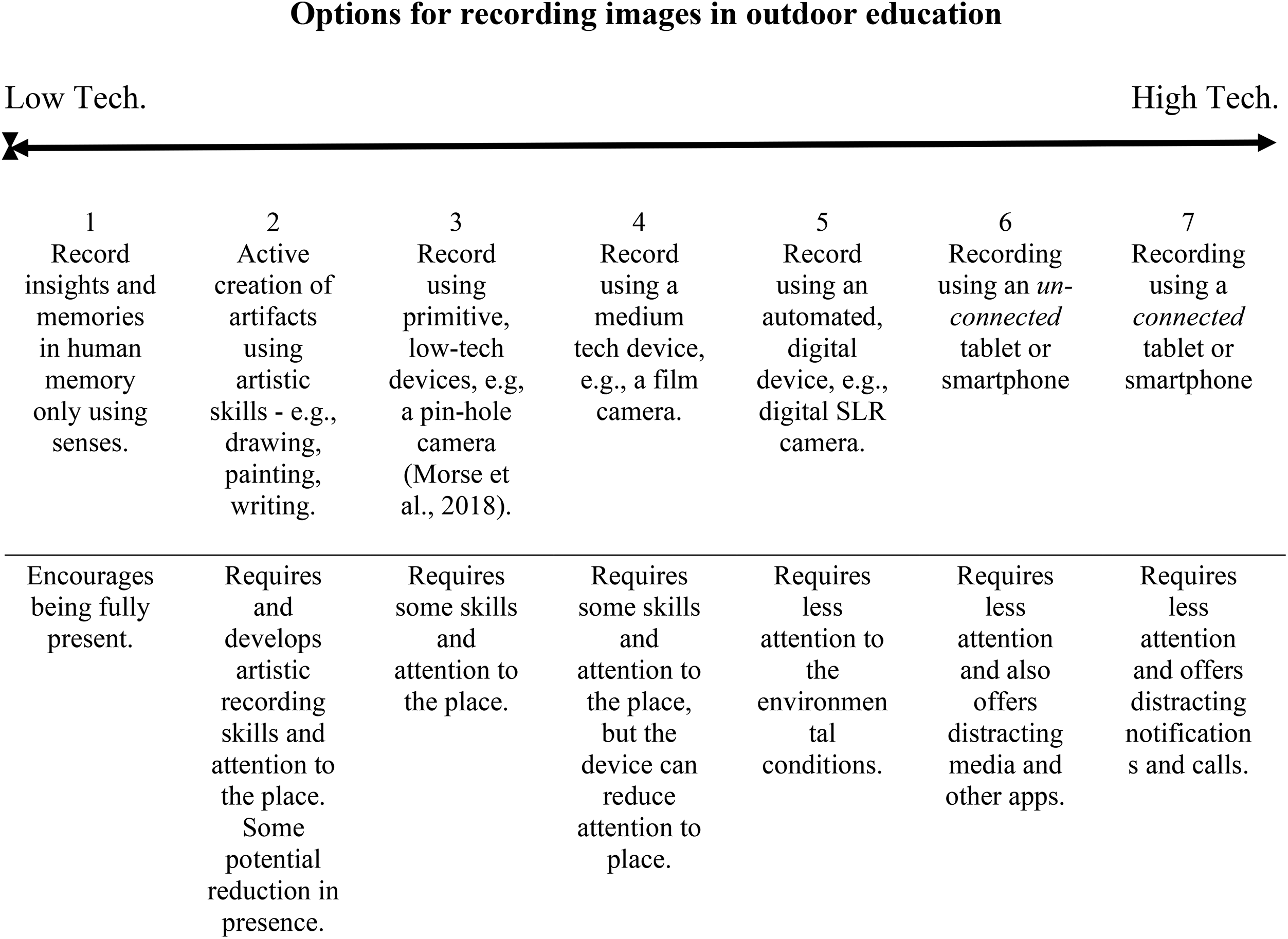
A spectrum of how using different technologies to record experiences can impact on presence.
On the left end of the spectrum in Figure 1, only our senses are used to ‘record’ experiences which provides no distractions, but the memories are only held in our brains and cannot be easily shared. Further along the spectrum, artistic mediums (such as drawing, painting, sculpting) can be used to record perceptions. These technologies provide the positive benefits of forcing the learner to pay close attention so they can creatively record an interpretation or expression of their experience. Some unintended consequences may be that the artists get distracted by the equipment or techniques needed. Further along the continuum, the use of a low-tech pinhole camera, as described by Morse et al. (2018) provides many of the same positive benefits by forcing learners to make careful readings of the light levels and exact positioning of tool to effectively capture images. Using a primitive camera like this, requires both skill and close attention to the environmental conditions. On the right end of the spectrum, learners use networked recording devices to capture their experiences. In our view, the more automated the camera is, the less the learner needs to pay attention to features of the place to effectively compose the picture. To explain this spectrum further there has been some research studying the impacts of taking photos on our ability to remember experiences.
Henkel (2014) conducted research on people taking photos on a museum tour and noted the “photo-taking-impairment effect” (p. 396). Put simply, she found that unless the visitors were asked to use the camera to really focus or engage on particular things, the process of photo-taking meant that visitors remembered fewer details about the objects when compared to just observing them. She continued to explain that “The act of photographing the object appears to enable people to dismiss the object from memory, thereby relying on the external device of the camera to ‘remember’ for them” (p. 401). We would argue that the act of taking photos in a passive (less careful) manner (as per the right-hand end of the spectrum in Figure 1) appears to make learners less present to the experience. If the camera being used in the outdoor setting is a digital camera with a large memory card, educators and learners can literally take thousands of pictures in short periods of time. There is little consequence for not paying careful attention to the construction of the photo. Hence, at the far right of the spectrum in Figure 1, the digital recording device (mobile phone) is the simplest to use, requires the least amount of attention from the user, and hence the least amount of presence when recording media. Plus, mobile phones come with the complexity of being a potential source of distraction as described in Research Study One and Two in this paper.
A key point of the spectrum in Figure 1 is that even when we believe digital technology is enhancing our ability to record memories, it may also be unintentionally preventing us from being fully present. As with any spectrum, we are not arguing exclusively for the merit in operating at only one extreme or the other. In fact, we would encourage intentional experimentation with a variety of approaches to recording media to see what helps or hinders the achievement of intended learning outcomes. Loeffler (2004, 2005) provides one such example of how photo-elicitation can be a powerful process to achieve intended learning outcomes. Obviously, we caution outdoor educators to be mindful of recording media during an adventurous activity (the exact time we tend to take photos), as this may stop the outdoor educator from being fully present in their role of managing the safety of their group.
Finally, we acknowledge the important role that digital technologies can play in improving learning outcomes and enhancing program safety. However, when a networked mobile phone device is used to access this data, the capacity for distraction for educators and/or learners is very high. Even with notifications turned off in relevant apps when a mobile phone device is accessed it is easy to become distracted by emails, news, and social media. As indicated in Research Study Two, it is easy for educators and learners to become absorbed into the vortex of checking things on their phones. We can attest to this because as outdoor educators ourselves we all deal with this challenge. Even if the distraction from being fully present is brief, what is often poorly understood is the time it can take to restore focused attention and return to being fully present (Hari, 2022).
Future Challenges
There is growing evidence that the concerns about digital technology negatively impacting presence in outdoor education are going to increase in the future (Pelletier et al., 2022). The research studies described in this paper indicate that the mobile phone is the main device being used in outdoor education programs. However, the device still needs to be intentionally taken out of a pocket or a backpack to be a distraction. In the future, this may not be the case. Large technology companies are developing smart watches (Apple, 2022) and smart glasses (Oakley, 2022) that are designed to entirely replace the mobile phone with a camera on your wrist and the augmentation of screens through your field of vision. Furthermore, these devices will also provide other essential health services such as ECG monitoring and vision correction (Apple, 2022). These devices will be constantly part of the user's field of view, and if they become commonplace, their influence will be pervasive. It may become difficult to ask a participant to remove their smart glasses if those same glasses are being used to correct their vision. Will outdoor educators be liable if a participant experiences health conditions that would otherwise have been detected by their wearable technology?
In conclusion, we maintain that what makes outdoor education unique is the experiential and sensory-rich nature of the learning opportunities it provides. Our ability to optimise the potential of these learning experiences is shaped in part by our ability, as educators and learners, to be present with the place and present with each other. We have argued that digital technology might improve the presence educators and students experience in the outdoors, but there is also a strong chance it detracts from the presence they attain. It depends on how that digital technology is used, and the way it is managed. If we accept Reed's position on accepting the omnipresence of digital technology and the inevitable arrival of these new devices (van Kraalingen et al., 2022), further research is required to explore the impact that these wearable, externally connected, smart devices may have on outdoor learning pedagogies. In doing so, we can hopefully monitor how digital technologies impact our abilities to be present with places, ourselves, and other people in outdoor education experiences.
