




Abstract
The landscape of higher education is changing rapidly, a phenomenon driven in part by increased employer demands and expectations. For instance, a national survey in the United States of America (USA) in 2010 highlighted that 91% of employers were expecting their employees “to take on more responsibilities and to use a broader range of skills” (The Association of American Colleges and Universities, 2010, p. 6). In addition, employers tend to rank “application of knowledge in real-world settings” as one of the most important among various skills (The Association of American Colleges and Universities, 2021, p. 11). As such, how content is taught in undergraduate degrees has moved from focusing on acquiring knowledge alone, to the need to be equipped with real-world skills from related experiences (Liberal Education America's Promise, 2021). This has thus contributed to the increasing adoption of experiential learning in higher education (Wurdinger & Allison, 2017).
Kolb's theory of experiential learning states that “learning is a process in which knowledge is created through transformation of experience” (Kolb et al., 2001, p. 227). This entails that learners create meaning from experience by following these steps: concrete experience, reflective observation, abstract conceptualization, and active experimentation (Butler et al., 2019). Experiential learning thus differs from didactic learning, where the learner has to play an active role (Beard, 2010). Experiential learning activities (ELAs) come in many forms, including service learning, internships, academic research, or study abroad. It belongs to the subset of high-impact educational practices (HIPs), which are institutionally structured experiences and activities that deepen learning (Conefrey, 2021). Participation in HIPs is associated with higher levels of student performance (Kuh, 2008) and provides an opportunity for hands-on experiences.
Despite the importance of experiential learning in higher education, there are still a few gaps in the literature. First, the bulk of studies explored experiential learning as a framework for educational innovation (Kolb et al., 2001) in higher education, and reviews on experiential learning remained limited. Among those available, most chose to critique the experiential learning theory (Hickcox, 1990; McCarthy, 2010; Morris, 2020) rather than review the adoption of ELAs. For example, Morris (2020) explored a key issue in what constituted a concrete experience with Kolb's model, while McCarthy (2010) examined accounting students’ learning style preferences.
Second, to the best of our knowledge, there is no review identifying the types of ELAs specifically in public health undergraduate education which has undergone recent rapid development (Kiviniemi & Mackenzie, 2017). Public health has traditionally been taught at a graduate level but is increasingly being offered to undergraduate students in the last 2 decades (Luu et al., 2019). This development aligns with the 2003 Institute of Medicine report recommending all undergraduate students have access to public health education (Hernandez et al., 2003). Educators have had to address pedagogical needs beyond the mastery of introductory competencies to bridge the development of students into future public health leaders and thus, experiential learning has been integrated into many undergraduate public health programs (Chorazy & Klinedinst, 2019). While Norman (2012) and Kaakinen and Arwood (2009) conducted reviews on the use of simulation (a type of ELA) on nursing students, focusing on one type of ELA and one student group is insufficient to understand the experiences of experiential learning in public health higher education.
Third, while reviews focusing on the evaluation of ELAs have been conducted in other fields such as accounting (Gittings et al., 2020), there is no such similar one in public health higher education. Without examining the evaluation results in a review, one cannot conclude whether ELAs are also useful in public health undergraduate education. In addition, the implementation of ELAs in public health undergraduate education would commonly involve other stakeholders, including faculty, employers, and community partners. Exploring the perspectives of faculty is crucial to understanding the structural elements, such as challenges faced, or revisions made when implementing ELAs within the course or the program. Similarly, as public health is often centered around improving health in population groups, and certain types of ELAs (e.g., community-based research, community-based outreach education, simulation involving role-playing of real-life public health issues) typically take place in the community, examining the feedback of community partners can give insights to their experiences of training students in community settings. Apart from students, it would be useful to compare the evaluation results from these various stakeholders using meta-analysis or meta-synthesis, where applicable in a review.
This scoping review addresses these main gaps in existing literature, with the primary aims to (1) identify the different ELAs used in public health undergraduate education and (2) compare and assess the perceived experiences of ELAs to not only students, but other stakeholders involved in the experiential learning partnership.
Methodology
This review was conducted following the Preferred Reporting Items for Systematic Reviews and Meta-Analyses extension for scoping reviews (Tricco et al., 2018).
Literature Search
A combination of computerized and manual searches was performed to identify all relevant data for the review. We searched the following six electronic databases using the date ranges from January 1, 2000, to December 31, 2020: Education Resources Information Centre, ProQuest Central, PubMed, Scopus, STM Source, and Web of Science. These databases were chosen because they were distinct from one another and to maximize available data by considering all relevant literature sources. In addition, we also manually searched the reference lists of all studies included in this review to identify additional relevant studies.
The electronic database searches were conducted using abstract and title terms. The following were entered for searches in the six electronic databases: (“public health student” OR “public health education” OR “public health pedagogy”) AND (“experiential learning” OR “service learning” OR “community-based learning” OR “internship” OR “project” OR “dissertation” OR “thesis” OR “practicum” OR “capstone”). No language or publication status restrictions were specified.
Inclusion and Exclusion Criteria
To be included in the review, a study had to meet the following criteria: (1) the students receiving public health education had to be undergraduates. There was no restriction on the Major of these students; (2) used experiential learning in the delivery of public health undergraduate education. There was no restriction on the type of experiential learning used; and (3) evaluated the experiences of experiential learning from the perspective of students, faculty, or community partners. The evaluation could be conducted using quantitative, qualitative, or mixed methods. Studies were excluded if: (1) it was not possible to isolate the evaluation results to undergraduates alone in the event where the same type of experiential learning was delivered to both undergraduates and postgraduates and (2) only a description of the experiential learning was available without evaluation results.
Study Selection and Data Extraction
The first two authors, with previous experience in conducting reviews, carried out the study selection and data extraction independently. Citations from the databases and reference lists were merged and duplicates were removed. We adopted a two-stage exclusion process, in which the first screening was based on the titles and abstracts using the pre-specified inclusion and exclusion criteria. If at least one of the authors evaluated the title or abstract to be relevant, the second screening would be conducted, where the full texts would be read. Both authors reviewed all the titles, abstracts, and full texts. There was a good inter-rater reliability of Cohen's kappa coefficient of 0.81 for the inclusion/exclusion of studies. Figure 1 shows the number at each stage of the study selection process.
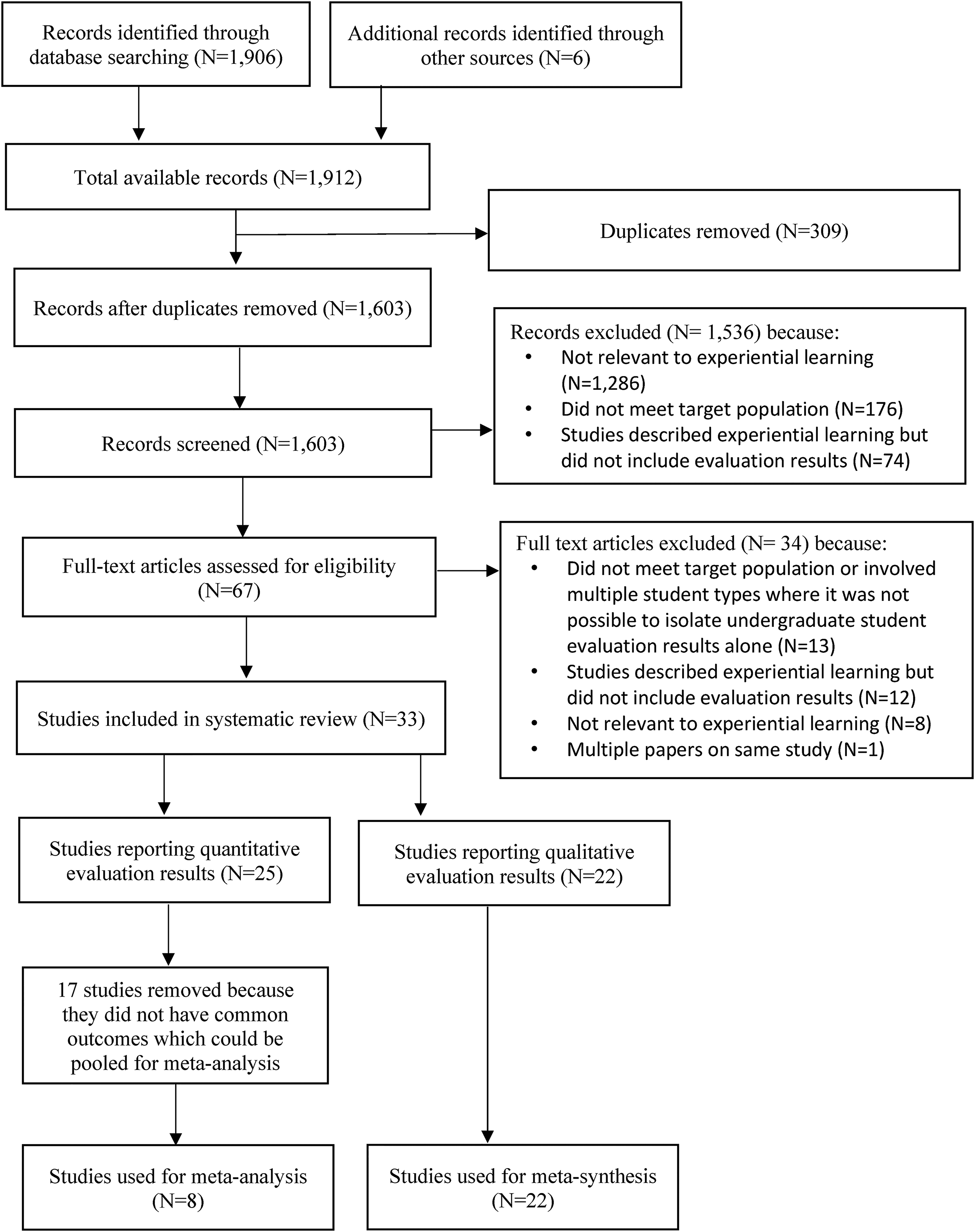
Article selection process.
The subsequent data extraction focused on study design, setting, type of student, sampling/assignment technique and sample size, type of experiential learning used, outcome measurements, method of data collection, evaluation results, and study limitations. There was a good inter-rater reliability of Cohen's kappa coefficient of 0.78 for the extracted data from the included studies. Any discrepancies in eligibility assessment or data extraction were resolved through discussion between both authors.
Quality Assessment of Included Studies
The methodological quality of the included studies was independently evaluated by the first two authors using the Mixed Methods Appraisal Tool, MMAT (Hong et al., 2018). This was because the review contained qualitative, quantitative, and mixed methods studies. We applied the two screening questions, which yielded an answer of “yes” for all studies. Next, for each study, we determined the type of design before using the corresponding criteria to appraise the study's quality. For example, if the study was qualitative, we used the five criteria in the qualitative category for appraisal. For each criterion, there were the responses of “yes,” “no,” or “can’t tell.” We referred to the explanation and algorithm for each criterion to come to a response. The “can’t tell” response meant that the study did not report appropriate information to answer “yes” or “no,” or which reported unclear information related to the criterion. There was a good inter-rater reliability of Cohen's kappa coefficient of 0.83. Any discrepancies were resolved through discussion to reach a consensus between both authors. We did not obtain an overall score for each study, since this was discouraged in the latest version of the MMAT (Hong et al., 2018).
Addressing the First Review Aim Using Descriptive Findings of All Included Studies
We used the descriptive findings of all 33 included studies to identify the different ELAs used in public health undergraduate education.
Addressing the Second Review Aim Using General Findings of the Quantitative Evaluation Results
We described the general findings of the 25 included studies reporting quantitative evaluation results. Out of these 25 studies, eight were eventually used for meta-analysis because their reported common outcomes on students’ perceived experiences could be pooled.
Addressing the Second Review Aim (Partial) Using Meta-analysis
Most of the outcomes pertaining to the evaluation of experiential learning from the quantitative and mixed-methods studies in this review were too heterogeneous to be combined. There were only three similar outcomes on student satisfaction, problem-solving skill, and communication skill respectively that could be pooled for meta-analysis. That is, the meta-analysis provided partial insight into the second aim of the review by only addressing the perceived experiences of ELAs from the perspective of students.
A total of eight different studies were used across the three outcomes. Four studies were pooled for the outcome on student satisfaction, three for problem-solving skills, and four for communication skills. Satisfaction referred to how satisfied the students were with the ELAs in meeting their learning needs. Problem-solving skills referred to the student's ability to address public health challenges or problems. Communication skill referred to the student's ability to communicate effectively in both oral and written forms with public health stakeholders. All three outcomes—satisfaction, problem-solving skill, and communication skill—were measured using a 5-point Likert scale (strongly disagree, disagree, neutral, agree, and strongly agree) self-reported by students post-learning. The higher the value reported, the more favorable the outcome.
The Inverse Variance method was used to pool the overall mean values of these outcomes across studies (Fleiss 1993, Higgins et al., 2019). For studies which published the mean values of outcome with more granular detail than required (e.g., student's satisfaction with stratification by course from Chastonay et al.), the overall mean value was derived using the average of the given mean values. For studies which published the proportions in the Likert scale (e.g., student's problem-solving skill from Mackenzie et al.), the overall mean value was derived using the given sample size, proportions, and Likert scale values. As for studies which did not publish SD of outcome, this was imputed using sample size, interquartile range, and range, where available (Higgins et al., 2019; Walter & Yao, 2007; Wan et al., 2014). The SDs were converted to standard errors to estimate the 95% CI of pooled effect. To assess the extent of variability across the studies, which could be due to variation in the true effect sizes, that is, heterogeneity and sampling errors, the absolute total observed variance T2 was estimated. I2 was calculated to estimate the proportion of the total observed variance from heterogeneity (Cheung, 2019; Higgins 2003; Higgins et al., 2019). Since I2 ranged from moderate to high, the random effects model with the restricted maximum likelihood method was used for the three outcomes.
As publication bias (i.e., failure to publish the results of a study based on the direction or strength of the study findings) is an inherent limitation in most meta-analyses, the Egger test was used to detect the possibility of publication bias for each outcome. A statistically significant result would indicate that publication bias could not be excluded. Aside from performing the univariate meta-analysis for each of the three outcomes, a multivariate meta-analysis was also done to analyze the outcomes jointly. However, as there was at most one study for student's satisfaction that overlapped with each set of studies pooled for student's problem-solving skill and communication skill respectively, a multivariate meta-analysis could only be performed on the latter two outcomes. A multivariate meta-analysis was performed instead of a network meta-analysis since the intention was to evaluate the three common outcomes after the implementation of ELAs in students (Riley et al., 2017). The meta-analysis was conducted using STATA SE 16, and the results were presented using forest plots.
Addressing the Second Review Aim Using Meta-synthesis
In addition, we conducted a meta-synthesis on the evaluation of experiential learning from the qualitative and mixed-methods studies involving students, faculty, and community partners. A thematic synthesis approach was used to gather information and identify all themes. We adapted the inductive analysis by Sandelowski & Barroso, 2006 which involved three stages: (1) extraction of findings and coding of findings for each article; (2) grouping of findings (codes) according to their topical similarity to determine whether findings confirm, extend, or refute each other; and (3) abstraction of findings (analyzing the grouped findings to identify additional patterns, overlaps, comparisons, and redundancies to form a set of concise statements that capture the content of findings). All stages were performed simultaneously, as recommended (Sandelowski & Barroso, 2006). All data under the headings “Results,” “Discussion,” and “Conclusions” were read several times, and line by line. Relevant quotes were extracted, and these were analyzed and organized into codes and groupings. We used the process of constant comparative analysis. Emerging groupings from early codings were checked with ongoing coding and used to guide later coding (Strauss & Corbin, 1994). Final groupings were reviewed to ensure codings were similar in all groups and that no potential groupings were missed during the process (Strauss & Corbin, 1994).
We used inductive rather than deductive coding to identify the themes, given the exploratory nature of the review. This would also be a more appropriate way to produce new insights and to address the broad research aims. Prior to coding, the first two authors discussed, agreed upon, and demonstrated competency in the coding structure. After independently coding, both authors met to discuss coding inconsistencies. Cohen's kappa coefficient yielded a good agreement of 0.84. Any disagreement was resolved by consensus between both authors.
Results
Study Selection Process Results
Referring to Figure 1 which shows the study selection process results, our database and manual searches identified 1,912 citations. This eventually came to 33 studies which were included in our review. Of the 33 studies, 25 reported quantitative evaluation results, and 22 reported qualitative evaluation results. Eight studies were used for meta-analysis, and 22 were used for meta-synthesis.
Table 1 shows the characteristics of the included studies in our review. Fourteen out of 33 studies (42.4%) were mixed methods, where the predominant design was convergent. Eleven (33.3%) were quantitative, where the predominant design was one-group post-test-only. The remaining eight (24.2%) were qualitative, where the predominant design was qualitative descriptive design. On the type of students, about half of the studies involved were healthcare professional students, such as medical, nursing, or allied health students taking public health as part of their curriculum. The other half were undergraduate students from other disciplines taking public/global health as a minor, major, or degree program.
Characteristics of Included Studies.

Quality Appraisal Results
The quality appraisal of the included studies is presented in Appendix A. Three-quarters of the included studies had at least half of the criteria assessed to be at low risk of bias.
Results of the First Review Aim: Identify the Different ELAs Used in Public Health Undergraduate Education
There was a diverse range of ELAs used. This could be categorized into four broad groups: (i) community-focused (n = 17), (ii) classroom-focused (n = 13), (iii) work-focused (n = 5), and (iv) others (n = 3; Table 1).
The most common community-focused ELA was service-learning (n = 9) involving multiple visits or attachment to a community site to contribute to health service delivery there. Next was community-based outreach education (n = 3) involving the provision of health advice to the community members to prevent diseases and to modify unhealthy lifestyles. Other community-focused ELAs included community-based research, community-oriented, and community-based training activities.
For classroom-focused ELAs, one of the most common was project-based learning (n = 3) that typically involved conducting a needs assessment on a target population to propose interventions to address a public health problem. The other most common was simulation (n = 3) involving role-playing real-life public health issues, such as outbreak investigation or infectious disease prevention. Other classroom-focused ELAs included interactive photo essays and reflection, problem-based learning, case-based learning, photovoice assignment, video creation assignment, and deliberative pedagogy.
The most common work-focused ELA was internship (n = 3) where students participated in scheduled and supervised public health related work for their mentor or employer.
The other category included short-term study abroad (n = 2) and local study tours (n = 1).
Results of the Second Review Aim: Compare and Assess the Experiences of ELAs From the Perspectives of Students, Faculty, and Community Partners
General Summary of the Quantitative Evaluation Results
Appendix B shows the summary of 25 out of 33 included studies with quantitative evaluation results. All 25 studies assessed quantitative outcomes from the students’ perspective. Examples included an enhanced interest in pursuing healthcare professions or graduate studies, increased self-reflection, making a difference in the community, increased advocacy, and the activity reflecting real-world experience. These were highly positive and in support of experiential learning.
The two studies evaluating faculty perspective reported that educators perceived students have achieved the pre-defined learning objectives or were able to apply the relevant skills in their coursework (Chastonay et al., 2012; Nelson-Hurwitz et al., 2019).
The one study evaluating community partners’/external agencies’ perspective reported that the public were more satisfied with the performance of students in the intervention group participating in the ELA than those in the control group (Kristina et al., 2006). The community members also felt students in the ELA contributed more positively to the community's health than those in the control group (Appendix B).
Meta-analysis results
The meta-analysis of the common outcomes involving eight studies reported by students post-learning is shown in Figure 2. The low T2 and moderate to high I2 of the three outcomes indicate that the total observed variance was low and there was more heterogeneity than the random error from the studies. While the heterogeneity across studies for each of the outcomes is substantial, the results from the studies corroborated, that is, the mean score for each outcome from all studies is >3 out of a total score of 5 in the 5-point Likert scale, indicating positive sediment. The pooled mean for student satisfaction was high at 4.14 (95% CI [3.88 to 4.41]) using the 5-point Likert scale. The pooled mean for students' problem-solving and communication skills were also high at 4.34 (95% CI [4.21 to 4.48]) and 4.38 (95% CI [4.09 to 4.66]) respectively. As the correlation between student's problem-solving skill and communication skill was low at .09, there were only minute differences between the pooled results from the univariate and multivariate meta-analysis of these two outcomes (Appendix C). While no publication bias was detected for the outcomes on student's problem-solving skill (p for Egger test = .614), the same could not be excluded for student satisfaction (p for Egger test = .038) and communication skill (p for Egger test = .013; Figure 2).
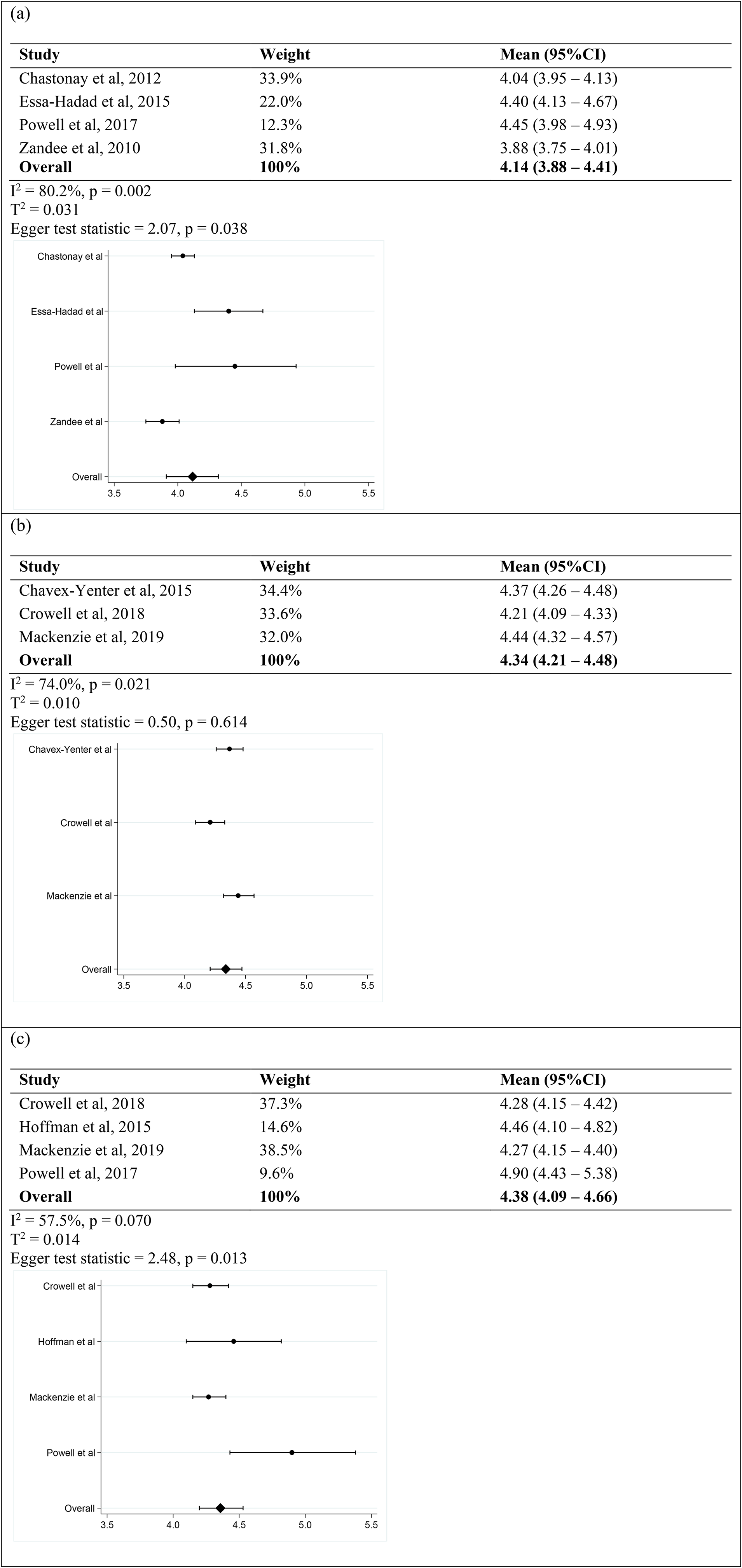
Forest plots illustrating the pooled mean value for student's (a) satisfaction, (b) problem-solving skill, and (c) communication skill.
Meta-Synthesis Results
Table 2 shows the themes and subthemes of meta-synthesis based on 22 studies with qualitative evaluation results. Qualitative results on each stakeholder's perspectives were split into two overarching themes (Table 2): (1) positive experiences and (2) negative experiences, each with a myriad of subthemes. Appendix D shows the illustrative quotes for the themes and subthemes of the meta-synthesis.
Themes and Subthemes of Meta-Synthesis.
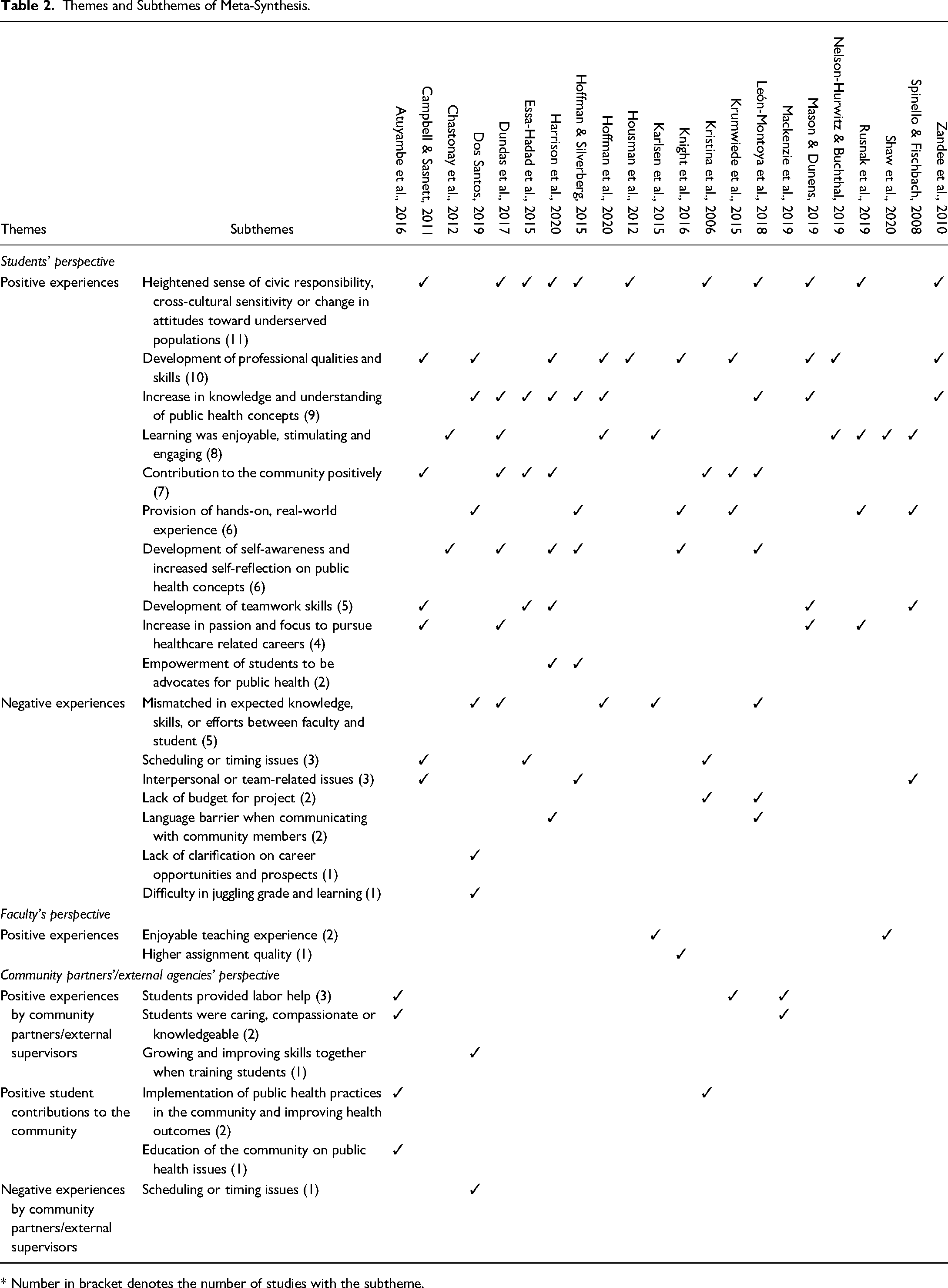
* Number in bracket denotes the number of studies with the subtheme.
Student Perceived Experiences—Positive
Twenty out of the 22 qualitative/mixed-methods studies described positive student experiences. The prominent subthemes included:
a heightened sense of civic responsibility, cross-cultural sensitivity, changes in attitudes towards underserved populations, “The interaction … increased my competency to be aware and react sensitively to cultural differences.” (Student perspective, study abroad), development of professional qualities and skills, “Textbook teaches us the nature of each communication, hospital allow[s] us to use the skills.” (Student perspective, internship), the increase in knowledge and understanding of public health concepts, “The work gave knowledge that cannot be acquired in a standard lecture dealing with an organisation…” (Student perspective, service learning). learning was enjoyable, stimulating or engaging “The learning experience is so different from being in the classroom, and the benefits are extraordinary.” (Student perspective, study abroad), students contributed to the community positively, “It was a great experience and I felt like I was making a difference.” (Student perspective, service learning), students developed self-awareness and increased self-reflection on public health concepts, “In my self-assessment, I noted that the community practicum had contributed to my personal growth.” (Student perspective, project-based learning).
Other common subthemes described that the
Other subthemes included the appreciation of the hands-on, real-world experience, development of teamwork skills, the renewed passion to pursue professions in health or a clearer focus on career goals and the increased empowerment of students to be advocates for public health.
Student Perceived Experiences—Negative
Eleven out of the 22 qualitative/mixed-methods studies described negative student experiences. The most common subtheme was a mismatch in expected knowledge, skills, or efforts between faculty and student, “The tasks were too simple—too little was expected from us. We want greater challenges. Not leading the tasks, but challenging us more to find the solution ourselves” (Student perspective, simulation). Other subthemes included scheduling or time-related issues, interpersonal issues related to having to work in teams, a lack of budget for the project, having to navigate language barriers with community members, and the difficulty in juggling grades and learning.
Faculty Perceived Experiences—Positive
Three studies qualitatively evaluated the faculty's perspective. Only positive experiences were reported. The subthemes were an enjoyable teaching experience, “Working on this project was a pleasure for me” (Faculty perspective, simulation), and higher assignment quality, “Better than average” (Faculty perspective, project-based learning; Knight et al., 2016).
Community Partners/External Supervisors’ Perceived Experiences—Positive
Five studies evaluated the community partners’/external agencies’ perspectives. Under positive experiences by community partners/external supervisors, common subthemes were that,
students provided labor help (Atuyambe et al., 2016; Krumwiede et al., 2015; Mackenzie et al., 2019), “Students have helped us … when we are short on staff … keeping the facility running…” (Site external supervisor perspective, service learning; Mackenzie et al., 2019), students were caring, compassionate or knowledgeable (Atuyambe et al., 2016; Mackenzie et al., 2019), “They bring a certain sensitivity … that sometimes you can’t teach…” (Volunteer coordinator perspective, service learning; Mackenzie et al., 2019). trainers were able to grow and improve their skills while instructing students, “My trainees taught me public speaking skills from the textbook knowledge” (Site external supervisor perspective, internship; Dos Santos, 2019). implementation of public health practices in the community and improving health outcomes (Atuyambe et al., 2016; Kristina et al., 2006), “The [students] helped us a lot to keep clean in our homes, to dig rubbish pits…” (Community member perspective, service learning; Atuyambe et al., 2016), education of the community on public health issues, “They gave good health education every morning as the patients waited for services to start” (Community member perspective, service learning; Atuyambe et al., 2016).
For positive student contributions to the community, subthemes included:
Community Partners/External Supervisors’ Perceived Experiences—Negative
Dos Santos (2019) reported the only negative experience by faculty/external supervisors which was scheduling or timing issues, “How to prepare materials, teach the materials, and prepare for materials … it is impossible to teach them in two months…” (Site external supervisor perspective, internship).
Discussion
Findings and Connections to Broader Literature
This is the first review consisting of a meta-analysis and a meta-synthesis to highlight the wide variety of community-, classroom-, and work-focused ELAs used in public health undergraduate education. Community-focused ELAs are common to undergraduate public health, as these programs strive to educate students to improve the health of communities (Mackenzie et al., 2019; Mason & Dunens, 2019). They provide opportunities for students to interact with populations with a range of needs and perspectives, training them to engage respectfully while thinking critically and reflecting on their roles in the communities they are serving (Mackenzie et al., 2019; Mason & Dunens, 2019). Some ELA types (i.e., service learning, internships) appear to be more commonly applied in the studies reviewed, but the presence of other less common ELA types (i.e., photovoice, deliberative pedagogy) indicate the versatility of experiential learning to be applied and adapted to many situations. This review further illustrates that the use of experiential learning to teach public health was not limited to only public health students, but also extended to healthcare professional students. This is in line with the recommendation to integrate public health training within medical, nursing, and allied health academic programs (Thibault, 2020; World Health Organization [WHO] 2013). Other than training healthcare professional students to provide direct patient care, there is an increased need for these programs to direct their education, research, and service activities toward addressing and understanding the health concerns of the community, region, and/or nation they are serving (Thibault, 2020; WHO 2013).
We compared the results of our study with the broader literature based on experiential learning. The skill development reported by students after engaging in ELAs based on this review (e.g., communication skills, self/professional confidence, and problem-solving skills) corroborated with similar reviews conducted in other disciplines such as accounting (Gittings et al., 2020). Employers look for both soft and hard skills in their workforce. While hard skills are domain-specific, soft skills often focus on attributes and personality traits such as communication and self/professional confidence (Babu et al., 2020). Soft skill acquisition which is a commonly reported beneficial student outcome from ELAs is potentially transferable. This means that these skills are applicable across a variety of fields, although the specific skills that are most helpful differ based on the job market. That said, the board applicability of transferable skills also makes them particularly useful for a rapidly changing world economy, with plenty of uncertainty and disruption, which is the current and possibly future economic climate (Collins-Nelsen et al., 2022).
Similar to the other studies in the medical sciences (Sarkar et al., 2022) as well as the arts and social sciences (Wurdinger & Allison, 2017), faculty expressed a positive inclination toward the use of ELAs to make their classes more interesting. These studies also highlighted the challenges faced by faculty in implementing ELAs in their disciplines, such as the problem of large classes, not having enough time or funding to do so, and having to cover the required amounts of the curriculum. Our meta-synthesis did not pick up any themes or subthemes pertaining to the negative experiences of faculty toward ELAs in the public health discipline. While it is understood that students are the direct recipients of the ELAs, there is clearly a need to consider the perspectives of these other important stakeholders in the evaluation of ELAs. Faculty supervision is a crucial but labor-intensive part of the experiential learning experience, where high-quality supervision requires constant collaboration between faculty and students (Suryani & Widyastuti, 2015). One way to do this is by assessing the perspective of faculty so that teachers could reflect and share with others. This not only brings advantages for teachers’ self-development but also benefits the delivery of the ELAs to improve the experience of all the stakeholders who are involved.
Our study findings are also consistent with the positive experiences reported by community partners in business, nursing as well as the arts and social sciences (Chika-James et al., 2022; Karasik, 2020). Positive experiences included benefits to the community organization, the community members, and the students, and mutual benefits. Negative experiences included a mismatch between community organization and students, as well as time and funding constraints. Community and agency partnerships are an essential component of many ELAs, and like any relationship, they are built on time, trust, and experience (Marriott et al., 2015). These external agencies and community partners are often involved in supervising, training, guiding, or assessing the students on-sites (Marriott et al., 2015). Our meta-synthesis results also highlighted this in the subtheme of “growing and improving skills together when training students.” Therefore, where possible, the goal should be to foster a continuous and reciprocal partnership (Marriott et al., 2015), and one way to do that is to obtain their perspective in the evaluation of ELAs.
Contributions to Literature and Implications for Practice
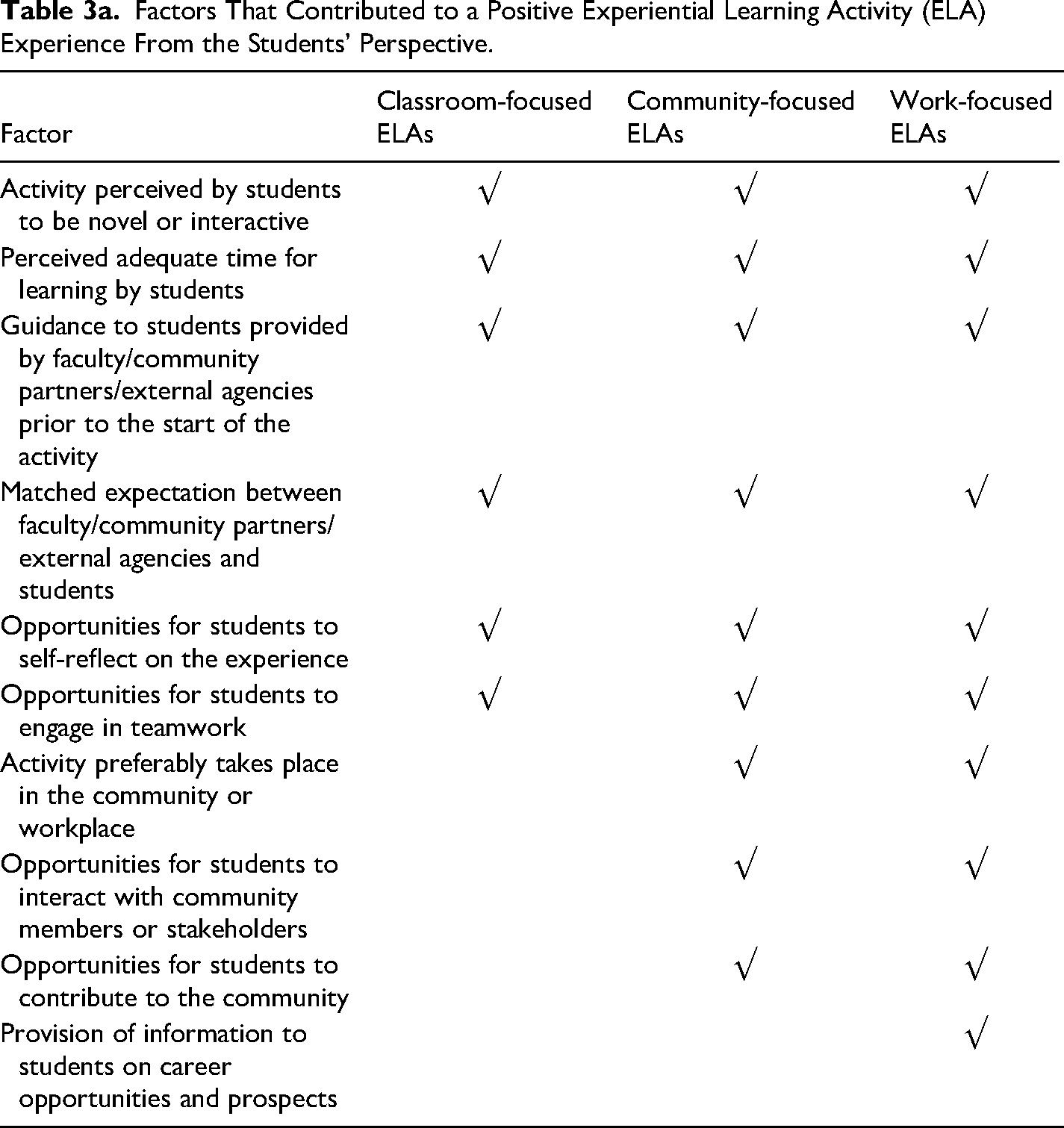
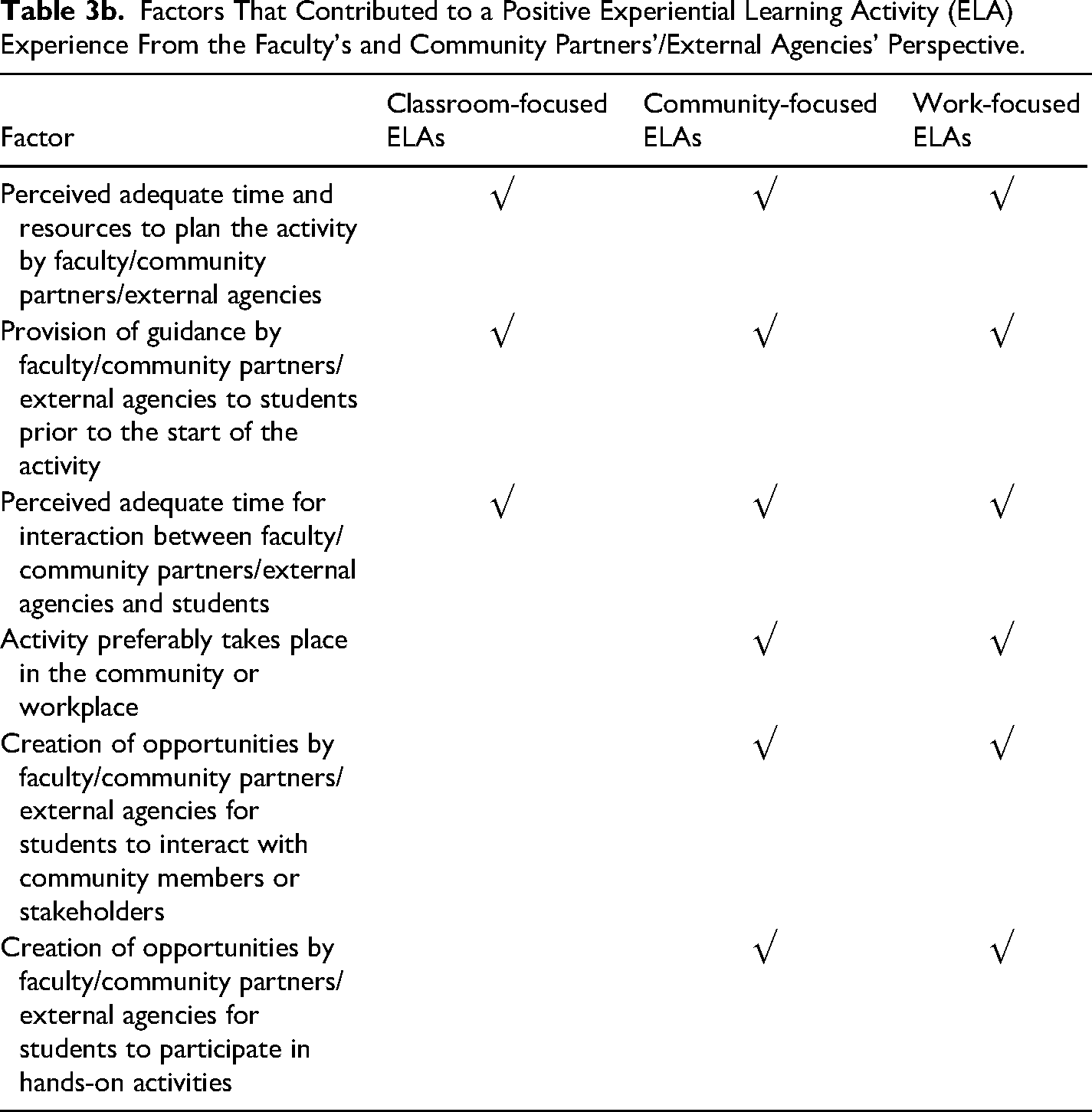
Our meta-analysis and meta-synthesis results indicate that ELAs were perceived to be highly positive by students, faculty, and community/external agency members. Our study elicits the factors that contributed to a positive ELA experience from all three stakeholders’ perspectives. Educators, researchers in pedagogy, higher education curriculum, or program developers could get to know these factors so that they could take these into account when developing ELAs in the future. Table 3a shows the factors that contributed to the positive experiences from the student’s perspective, and Table 3b shows the factors that contributed to the positive experiences from the faculty and community partners’/external agencies’ perspective. Common factors highlighted by all three stakeholders included providing guidance to students prior to the start of the activity, holding the activity preferably in the community or workplace (especially for the community- or work-focused ELAs), and providing opportunities for students to interact with community members or stakeholders (especially for the community- or work-focused ELAs).
Factors That Contributed to a Positive Experiential Learning Activity (ELA) Experience From the Students’ Perspective.
Factors That Contributed to a Positive Experiential Learning Activity (ELA) Experience From the Faculty's and Community Partners’/External Agencies’ Perspective.
Providing guidance, especially prior to the activity, is also crucial to address the major challenge highlighted in the meta-synthesis, which is the mismatch in expected knowledge, skills, or efforts between faculty and student. Educators who design the ELAs typically see the world through the lens of their discipline (Ghodbane & Hamazaoui-Elachachi, 2019; Hatcher & Bringle, 1997). They can conceptualize the connections between content and the experiential learning experience. For students, however, the connection is not always as apparent (Ghodbane & Hamazaoui-Elachachi, 2019; Hatcher & Bringle, 1997). Therefore, a gap emerges between what students and faculty expect from experiential learning. Because students may desire one kind of learning experience while faculty expect and prepare for another, this disconnect can foster students’ disengagement and hinder their motivation, while also creating a suboptimal learning environment for students (Ghodbane & Hamazaoui-Elachachi, 2019; Hatcher & Bringle, 1997). In addition, disparities in communication between faculty and students can exist, with faculty typically being more assertive and students rarely articulating their expectations.
To close the gap between expectations and improve communication, faculty can adopt a more learner-centered approach, which can positively impact the student learning experience (Ghodbane & Hamazaoui-Elachachi, 2019; Hatcher & Bringle, 1997). One way to do this is to employ student-centered facilitation techniques to both guide the experience and students’ subsequent reflection on the experience. Some examples included letting the teacher take the role of a resource person instead of being the authority in the learning activity, allowing students to set their own goals on what they need to learn and what they need to work on to achieve their goals, or using real-world issues or problems in the learning activity (Estes, 2004). Other than adopting a more learner-centered approach, the teacher should seek to engage in a meaningful dialog with their students. To increase student satisfaction and to close the gap in expectations, teachers could first identify where the gaps exist between the experience and expectations of students. This not only reveals specific areas where improvements can be made to raise the level of student satisfaction, but also allows both the teacher and the students to moderate their expectations accordingly. Specifically, the teacher could invite student feedback about a course, and share and discuss the results with students. This would improve the teacher-student working relationship, student engagement, and students’ awareness of how they think and learn (Zimmerman et al., 2014).
Strengths and Limitations
There were several strengths and limitations of our current review. One strength was the moderate- to high-quality of the included studies, with three-quarters of the included studies having at least half of the criteria assessed to be at low risk of bias. Another strength was the inclusion of various stakeholders in assessing the evaluation results of ELAs. The other strength was the use of both meta-analysis and meta-synthesis results to achieve methodological triangulation. Nevertheless, there were also a few limitations. Publication bias could not be excluded since there was a likelihood that interventions without significant or positive evaluation results were not published. In addition, as we focused on electronic databases, many ELAs conducted by Schools of Public Health or universities might not be reported in journals or published.
Conclusion
In conclusion, this is the first review consisting of a meta-analysis and a meta-synthesis to illustrate the various ELAs used in public health education to teach a range of undergraduate healthcare disciplines. While ELAs were perceived to be largely positive by all three stakeholders (students, faculty, and community/external agencies), future educational programs should consider the factors that contributed to the positive experiences from all three stakeholders’ perspectives, address the various challenges highlighted in this review to refine the experience, and assess the negative experiences of faculty, and community/external agencies in greater detail.
Supplemental Material
sj-docx-1-jee-10.1177_10538259231171073 - Supplemental material for A Scoping Review of Experiential Learning in Public Health Education From the Perspective of Students, Faculty, and Community Partners
Supplemental material, sj-docx-1-jee-10.1177_10538259231171073 for A Scoping Review of Experiential Learning in Public Health Education From the Perspective of Students, Faculty, and Community Partners by Raymond Boon Tar Lim and Dana Wai Shin Chow, Huili Zheng in Journal of Experiential Education
Supplemental Material
sj-docx-2-jee-10.1177_10538259231171073 - Supplemental material for A Scoping Review of Experiential Learning in Public Health Education From the Perspective of Students, Faculty, and Community Partners
Supplemental material, sj-docx-2-jee-10.1177_10538259231171073 for A Scoping Review of Experiential Learning in Public Health Education From the Perspective of Students, Faculty, and Community Partners by Raymond Boon Tar Lim and Dana Wai Shin Chow, Huili Zheng in Journal of Experiential Education
Supplemental Material
sj-docx-3-jee-10.1177_10538259231171073 - Supplemental material for A Scoping Review of Experiential Learning in Public Health Education From the Perspective of Students, Faculty, and Community Partners
Supplemental material, sj-docx-3-jee-10.1177_10538259231171073 for A Scoping Review of Experiential Learning in Public Health Education From the Perspective of Students, Faculty, and Community Partners by Raymond Boon Tar Lim and Dana Wai Shin Chow, Huili Zheng in Journal of Experiential Education
Supplemental Material
sj-docx-4-jee-10.1177_10538259231171073 - Supplemental material for A Scoping Review of Experiential Learning in Public Health Education From the Perspective of Students, Faculty, and Community Partners
Supplemental material, sj-docx-4-jee-10.1177_10538259231171073 for A Scoping Review of Experiential Learning in Public Health Education From the Perspective of Students, Faculty, and Community Partners by Raymond Boon Tar Lim and Dana Wai Shin Chow, Huili Zheng in Journal of Experiential Education
Footnotes
Declaration of Conflicting Interests
The authors declared no potential conflicts of interest with respect to the research, authorship, and/or publication of this article.
Funding
The authors received no financial support for the research, authorship, and/or publication of this article.

References
Supplementary Material
Please find the following supplemental material available below.
For Open Access articles published under a Creative Commons License, all supplemental material carries the same license as the article it is associated with.
For non-Open Access articles published, all supplemental material carries a non-exclusive license, and permission requests for re-use of supplemental material or any part of supplemental material shall be sent directly to the copyright owner as specified in the copyright notice associated with the article.
