



Abstract
Executive functions (EFs) are cognitive skills that begin developing in early life and are crucial for children’s overall development and daily task performance. Generally, EFs are assessed through standardized neuropsychological tests, which may not always accurately capture real-world application. To overcome this limitation, alternative methods such as authentic assessment have emerged. A scoping review was conducted to map the information available regarding the authentic assessment of EFs in children under 6 years of age from 2010 to 2021. Out of 790 documents, 32 met the eligibility criteria after full-text revision. Two rating scales emerged as the most used EFs assessment instruments. The documents did not explicitly mention the term “authentic assessment.” Four commonly assessed EFs were identified. Findings highlight the need to develop multidimensional authentic assessment instruments to assess early EFs skills in all children. This includes children at risk or with developmental disabilities, and children from families with incomes below the poverty threshold.
Executive functions (EFs) refer to a broad range of mental processes and behavioral skills that help link and categorize information. These cognitive skills are necessary for, among other things, retaining and using information, resisting interference, solving problems, dealing with novelty, planning, carrying out goal-directed behavior, and tolerating frustration (Blasco et al., 2020; Burgess & Simons, 2005; Chan et al., 2008; Diamond, 2013; Zelazo et al., 2016). EFs are crucial for mental health and accomplishing everyday activities (Diamond, 2013; Zelazo et al., 2016). These cognitive processes play a fundamental role in children’s cognitive, behavioral, social, and emotional development from an early age (Isquith et al., 2005).
There is a lack of consensus on the conceptual models and components of EFs (Fish & Wilson, 2021; Hall & Marteau, 2014; Iampietro et al., 2012). According to the dichotomous model (Chan et al., 2008; Grafman & Litvan, 1999), EFs have two main categories: hot EFs and cold EFs. The first category (hot) refers to the functions that represent responses to emotional situations (e.g., decision-making, inhibitory control, and theory of mind). In contrast, the second category (cold) involves processing logical and mechanical cognitive information. It does not include emotional factors (e.g., working memory, planning, and cognitive flexibility; Salehinejad et al., 2021). Other authors (Diamond, 2006, 2013; Diamond & Ling, 2020; Miyake et al., 2000) propose the multidimensional model, in which the EFs are understood as a global structure divided into subcomponents. This model includes three core EFs (working memory, inhibitory control, and cognitive flexibility) and two high-order EFs (problem-solving and planning). Another system to describe EFs is that of Anderson (2002) and Anderson and Reidy (2012). This model states that the executive control system has four main components that interact with each other on a bidirectional basis: (a) cognitive flexibility; (b) goal setting; (c) attentional control; and (d) information processing. Although there is ongoing disagreement in the literature regarding the conceptual model of EFs, the following components are usually present in the different models: working memory, inhibitory control, and cognitive flexibility (Hall & Marteau, 2014).
Working memory refers to the capacity to store information in the mind and manipulate this information for more complex cognitive tasks (Cowan, 2014; Diamond & Ling, 2020). To illustrate, a child can participate appropriately in a conversation by remembering what others have said and commenting accordingly. Inhibitory control refers to the ability to control attention, behavior, thoughts, and emotions toward an internal or external stimulus and do instead what is considered appropriate or necessary (Diamond, 2013). In a classroom activity, for example, the child raises their hand and waits for their turn to participate. Cognitive flexibility refers to the ability to modify a thought or an action in response to demands or requests (Blasco & Acar, 2020; Diamond & Ling, 2020). This can occur when the child agrees to change from one activity to another at the teacher’s request. Planning is the ability to organize thoughts and actions in goal-directed behaviors (Hoskyn et al., 2017). For example, a child is able to complete a multistep task without assistance, such as getting dressed without help.
Development of EFs
EFs begin to develop during childhood and reach full maturity in adulthood (Diamond & Ling, 2020). Early childhood is one of the most fundamental and sensitive periods of life. During this first stage of life, children have crucial occasions that nurture the development of EFs (Thompson & Steinbeis, 2020). In the first years of life, there is an exponential growth of EFs due to prefrontal cortex development, the support of parents or caregivers, environmental factors and, in some cases, targeted interventions (Carlson, 2005; Diamond, 2006, 2016).
Although these functions begin to develop early in life, EFs are frequently studied in adolescent and adult populations, and detailed EFs research in preschool children remains limited (Anderson & Reidy, 2012; Juric et al., 2013; Martins et al., 2016). Most developmental delays are the result of a complex combination of factors, including low birth weight, premature birth, and genetics, among others (Schieve et al., 2016). Impairments and difficulties in EFs have been identified in populations at risk of developmental delays or with developmental disabilities (Willoughby et al., 2017).
Furthermore, socioeconomic status, including factors such as family income and parental education, can significantly affect children’s EFs (Ursache et al., 2016). According to the work by Haft and Hoeft (2017), children’s EFs are adversely affected by poverty. As described in the work by Blair and Raver (2016), children in poverty face challenges related to lower language stimulation and increased stress, which affect executive functioning and overall development. In addition, Low et al. (2021) highlight that the development of EFs is not solely determined by a child’s economic circumstances but is also shaped by their social and cultural environment. However, a more comprehensive approach is needed for assessing EFs in children, particularly those living in families with incomes below the poverty threshold or whose parents have less than a high level of education.
Assessment of EFs
Although EFs are considered fundamental in daily life routines, behaviors, and activities, professionals tend to assess them in clinical settings with standardized neuropsychological performance-based tests. Standardized neuropsychological performance-based tests are the conventional way of measuring EFs and are considered the gold standard of measurement in this regard. This assessment approach often focuses on a single discipline with a single examiner scoring the replies of the individual being assessed (Isquith et al., 2014).
Working memory is assessed via instruments that require mental manipulation of information, such as the backward digit span (Diamond, 2013). This test assesses children’s capacity to manipulate verbal information by asking them to repeat the numbers in reverse order (Wahlstrom et al., 2016). Inhibitory control is assessed by tasks such as the go-no-go task, which aims to determine the ability to respond to a desired stimulus (go) and to suppress the response to an undesired stimulus (no-go; Spechler et al., 2016). Cognitive flexibility is assessed by tasks, such as card sorting, where children must sort cards according to multiple criteria (color, shape, etc.) and adjust sorting along the assessment process (Levine, 2017). Planning is assessed by tasks, such as the Tower of Hanoi, a puzzle requiring participants to arrange disks in order by moving them from a left peg to a right peg following simple rules, such as moving one disk at a time and not stacking larger disks on the top of smaller ones (Schiff & Vakil, 2015).
The applicability of the results from these instruments is generally viewed as limited in real-world settings (Moreno et al., 2017). This is often attributed to their low ecological validity, as they are typically administered by an examiner in an artificial environment (Anderson & Reidy, 2012; Barkley & Murphy, 2010; Zelazo et al., 2016; Ziemnik & Suchy, 2019). Furthermore, most standardized neuropsychological performance-based tests have not been validated in children with disabilities or preschool populations (Isquith et al., 2005). This assessment method often relies on a single discipline’s contribution which might hinder collaboration between professionals (Isquith et al., 2014).
Alternatives to Assessment
To address some of these difficulties, rating scales have been developed, including the Behavior Rating Inventory of Executive Function Preschool (BRIEF-P; Gioia et al., 2003) and the Childhood Executive Functioning Inventory (CHEXI; Thorell & Nyberg, 2008). However, this type of assessment still encounters challenges, namely (a) low respondent agreement (e.g., parents vs. teachers) (Silver, 2014) and (b) lack of convergence between questionnaire and performance-based test results. Other efforts have been made, such as the Minnesota Executive Function Scale (MEFS), which allows the assessment of EFs from the age of 2 years using an electronic device application (Carlson & Zelazo, 2014).
The combined use of various assessment methods can help detect more children at risk. According to the work by Loe et al. (2015), different methods offer complementary insights into identifying challenges and potential intervention strategies. By employing diverse approaches, it is possible to gather additional information to pinpoint children who require support. Efforts are required to enhance comprehension of the nature and content of EFs during early childhood. Given the significance of early life experiences, various forms of research, including laboratory-based investigations and studies conducted in real-life settings, are instrumental in advancing this understanding.
Within this conceptual framework, it is worthwhile to investigate how authentic assessment methods can help gather essential information about the manifestation of EFs in daily routines. Authentic assessment approach developed in early intervention is strongly recommended by the Division for Early Childhood (DEC, 2014). Authentic assessment refers to a comprehensive approach to assessment that systematically identifies young children’s behaviors and functional skills in their daily routines. Beyond providing a profile of the child’s strengths and needs, authentic assessment facilitates the identification of functional goals that can guide intervention (Bagnato et al., 2010). This type of assessment involves the use of natural assessment tactics, such as observation rather than testing. It also requires and implies that this observation takes place in natural environments, such as the home, the classroom, the child care center, and the playground (Macy et al., 2016). Furthermore, in this type of assessment, families, caregivers, teachers, and professionals record observations of young children’s behaviors in their natural environments (Bagnato et al., 2010).
Authors have documented the importance of family and familiar adults, such as teachers in the observation, assessment, and intervention process because they are the ones who are best able to identify children’s current behaviors, strengths, and challenges based on day-to-day interactions (Bagnato et al., 2010). In addition, Blasco and Acar (2020) maintain that the authentic assessment of these functions can help with the early detection of EFs strengths and difficulties, and the development of appropriate interventions to enhance child outcomes. Specifically, when it comes to intervention, authentic assessments encourage the involvement of parents, teachers, and familiar adults, as assessment results highlight the skills that are functional and observable in everyday life activities and contexts (Josman & Meyer, 2019; Macy & Hoyt-Gonzales, 2007).
An example of authentic assessment is the Assessment, Evaluation, and Programming System for Infants and Children, Third Edition (AEPS-3), an authentic developmental assessment and intervention program for children 0–6 years old. The assessment offers a developmental profile of the children’s skills in eight developmental domains (Bricker et al., 2022). The authors of AEPS-3 aligned the developmental domains described in the Head Start Early Learning Framework with the items in the AEPS-3. These alignments identified items in the AEPS-3 instrument that can be used to assess the skills described in each domain of the Head Start Early Learning Framework (Brookes Publishing Co., 2023). Notably, one section of the alignments identified expected executive behaviors in children aged 0–6 years. This segment aims to identify observable behaviors related to EFs that manifest in the day-to-day activities of a child’s life. This is a first step in promoting the use of authentic assessment instruments developed in early intervention, such as the AEPS-3, for the identification and assessment of EFs used by children below the age of 6 years in everyday life activities and routines. About 20 items of the AEPS-3 were identified to describe EFs in early childhood. To date, there are no studies available that have used the AEPS-3 to identify EFs in early childhood.
Scoping Reviews
Given the importance of EFs in daily life and the advantages of an authentic assessment, a scoping review of the literature available was conducted. A scoping review is a research approach for synthesizing data (Pham et al., 2014). Scoping reviews and systematic reviews both employ meticulous and transparent methodologies to thoroughly identify and analyze pertinent literature (Munn et al., 2018). These two approaches diverge in purpose: scoping reviews aim to provide an overview of a topic, determine the extent of a broad topic, and outline the main concepts at the core of a research field (Peters et al., 2020), while the purpose of systematic reviews is to provide a concise summary of available research related to a specific question (Mackenzie & Greenwood, 2012). Thus, scoping reviews attempt to address a broader and diversified body of literature on a topic, whereas systematic reviews focus on gathering information on a narrower and more specific topic. Therefore, the scoping review, as it is broader, can subsequently lead to a systematic review (Peters et al., 2020).
This scoping review follows the Joanna Briggs Institute (JBI) guidelines (Peters et al., 2020). The JBI is a research organization located in the Faculty of Health and Medical Sciences at the University of Adelaide in South Australia (Jordan et al., 2022) that has developed comprehensive guidelines offering a systematic and transparent approach to conducting scoping reviews. These guidelines are aligned with the Preferred Reporting Items for Systematic Reviews and Meta-Analyses (PRISMA) Extension for Scoping Reviews (PRISMA ScR), ensuring consistency.
Purpose
The purpose of this scoping review is to provide an overview of the literature on the authentic assessment of EFs in early childhood based on documents published in the last 11 years concerning the authentic assessment of EFs in early childhood. This article also provides a general portrait of the different instruments used in assessing EFs of children in early childhood. As well, this review highlights the EFs usually assessed in children below the age of 6 years. Finally, it identifies the individuals involved in the EFs assessment process (e.g., parents, teachers).
A preliminary search for existing scoping reviews on the subject was conducted in July 2020 and May 2021 using several databases and search engines (Google Scholar, PsycINFO, and PubMed). The topic of interest was not the subject of any other scoping reviews, either published or in progress.
Scoping Review Questions
The following research question was formulated: What literature is available regarding the authentic assessment of EFs in early childhood?
Method
Protocol and Registration
The scoping review protocol was developed in accordance with JBI guidelines (Peters et al., 2020). Researchers formulated and revised an a priori protocol before undertaking the review. The protocol outlines the plan for conducting the review, including rationale, purpose, and methodology (Peters et al., 2020). For example, the sections of the protocol for this study include the title, research question, introduction, inclusion criteria, search strategy, study selection process, a draft of the plan for data extraction, and another draft for the presentation of results. The final version of the protocol is available on request from the corresponding author.
Eligibility Criteria
This review focuses on literature that includes human participants, especially children from birth to 6 years of age. This population was selected because of the dearth of information regarding the development of EFs in the first years of life. Participants include typically developing children and children with special needs (children at risk of developmental delays, intellectual impairment, global developmental delay, autism spectrum disorder, or physical, sensory, or language impairments).
The present scoping review includes children of any gender. The core concept studied is the authentic assessment of EFs. The review includes articles on one, some, or all EFs and consideres all studies found that followed an authentic assessment or assessment instruments having some characteristics of authentic assessment. No country, region, or socioeconomic status factors were established as inclusion or exclusion criteria; all geographic locations worldwide were considered. However, regarding the assessment settings of EFs, only children’s natural environments (e.g., home, child care center, school) were considered.
The documents covered 11 years, from January 2010 to May 2021. In database searches, the language limiters were English, Spanish, and French, as these are the languages the researchers were familiar with. This scoping review includes literature from primary research studies, systematic reviews, scoping reviews, meta-analyses, guidelines, handbooks, books, book chapters, theses, dissertations, and the gray literature. No book type or document type limiter was applied.
Researchers excluded articles that did not comply with the framework of the study. Furthermore, articles regarding chronic diseases, streptococcal diseases, infectious diseases, sexually transmitted infections, autoimmune diseases, immune systems, immunization, vaccines, health, nutrition, health guidelines, World Health Organization recommendations, or mechanisms of prevention and control of different types of diseases were excluded.
Information Sources
The following databases were consulted to identify the relevant documents for this review: EBSCO and PubMed. From EBSCO databases: APA PsycINFO, ERIC, CINAHL, MEDLINE, SocINDEX, and Educational Source. Google Scholar was consulted to search for unpublished studies. Three extensive research waves were conducted during June and July 2020. The final database search was done in July 2020, and the Google Scholar search in May 2021. All search results were exported into Endnote.
Search
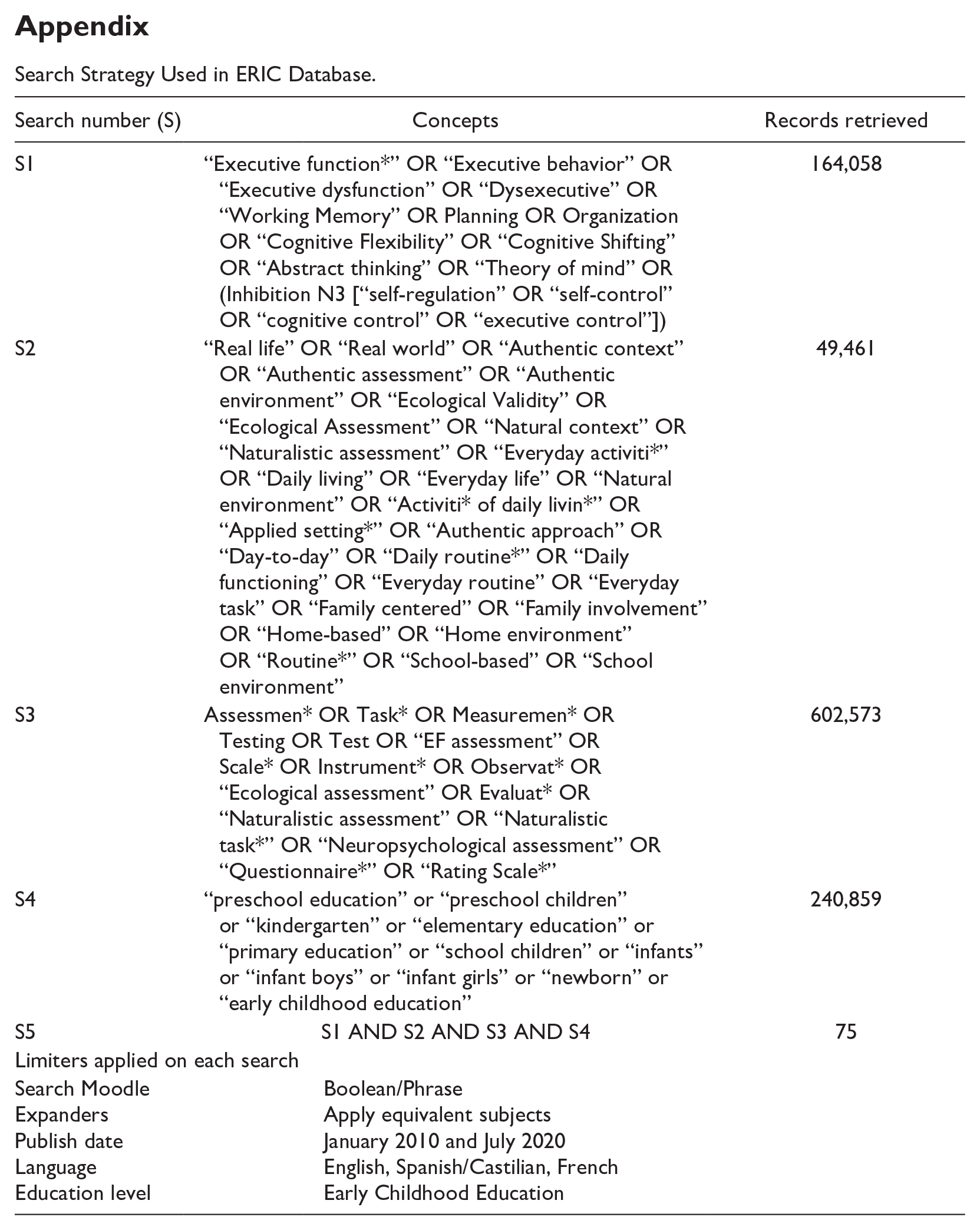
Researchers performed an initial limited search of four databases (APA PsycINFO, ERIC, CINAHL with Full-Text “EBSCO,” and MEDLINE with Full-Text “EBSCO”) using three keyword groups related to EFs and authentic assessment. This first search led to the detection of new keywords and helped clarify inclusion and exclusion criteria. A complete search strategy in the ERIC database is available in Appendix, and the other databases’ research strategies are available from the author on request.
A second search was conducted of seven databases (APA PsycINFO, ERIC, CINAHL, MEDLINE, SocINDEX, Educational Source, and Psychology and Behavioral Sciences collection), and the two reviewers identified the relevance of the first 50 articles.
A third database search was performed based on many irrelevant articles in the second search. For this third search, researchers modified the truncation symbols used in the databases and made a new selection of databases (EBSCO and PubMed. From EBSCO databases: APA PsycINFO, ERIC, CINAHL, MEDLINE, SocINDEX, and Educational Source). Because prior attempts to identify documents with early childhood populations relied on the limiters supplied by the databases, the fourth set of keywords regarding the early childhood population was included. When using the database limiters, some of the documents found contained items that were not relevant to the target population.
Reference lists of the relevant studies were screened for additional articles. Articles were then assessed for relevance to the review, based on the titles and abstracts, by two independent researchers. One researcher then retrieved and reviewed the documents, while the other verified the collected data (Peters et al., 2020). According to the JBI, other approaches, such as the one in the present scoping review, can be used if it is not feasible for both reviewers to extract the information (Peters et al., 2020). If the two reviewers disagreed on the relevance or the information extracted, the issue was resolved through discussion.
Selection of Sources of Evidence
Regarding the final (third) search, all identified documents were uploaded to EndNote software. Duplicates were automatically removed, and those not automatically identified were hand-removed. A list of all titles and abstracts in the studies was exported. The titles and abstracts of the first 50 documents in the list of articles obtained from the databases were screened independently by two researchers to increase the reliability of the screening process.
During this process, there was a 2.0% disagreement (one article of 50) that was resolved through discussion. This trial process helped clarify the appropriate way to interpret and classify the documents. The remaining titles and abstracts of the documents were reviewed by the two researchers; the 10.2% disagreement in the inclusion of certain documents was resolved through discussion.
The reference lists of the relevant studies were screened for additional articles. A manual search of these documents in the databases was performed when relevant articles were found in the reference lists. The researchers exported the titles and abstracts to screen them independently. The full-text examination of the relevant articles was made based on the inclusion criteria.
Data Charting Process
Researchers developed an extraction grid in the Microsoft Word processing software for the data extraction process. Two researchers developed the extraction grid and a third one reviewed it. The reviewers determined the basic information to extract from the relevant documents in the study selection process.
Data Items
The information extracted from the pertinent articles included: (a) document reference (author, year of publication, title); (b) language of publication; (c) objectives, research questions, and hypotheses; (d) context (geographical location and assessment setting); (e) participants’ characteristics (population, number of participants, age, diagnoses, gender); (f) design; (g) data collection (assessment instruments used); (h) EFs assessed; and (i) individuals involved in EF assessment process (parents, teachers, etc.). The data extraction process was based on an iterative approach (Peters et al., 2020). This means that an extraction grid was created initially but was modified and updated in the process.
Synthesis of Results
For the analysis and report of the scoping review findings, the data extracted were presented in a narrative and graphic format. Findings were grouped according to the research question and the study’s objectives in accordance with JBI guidelines (Peters et al., 2020). These categories were established after a full review of the articles. No categories were determined in advance. The results of this review were organized into three categories: (a) assessment instruments; (b) literature available on authentic assessment of EFs in early childhood; and (c) EFs assessed in the early childhood population.
Results
Selection of Sources Evidence
The PRISMA flow diagram extension PRISMA-SCR presents a graphic representation of the screening process (see Figure 1). A total of 724 documents were identified. Specifically, 690 articles were identified in the databases consulted, and 34 were found in Google Scholar. After duplicates were removed, 589 remained for screening. Of the 589 documents screened, the reviewers disagreed on the classification of 60 articles, which corresponds to a discrepancy of 10.2%. After reviewer agreement, 549 out of 589 articles were excluded.
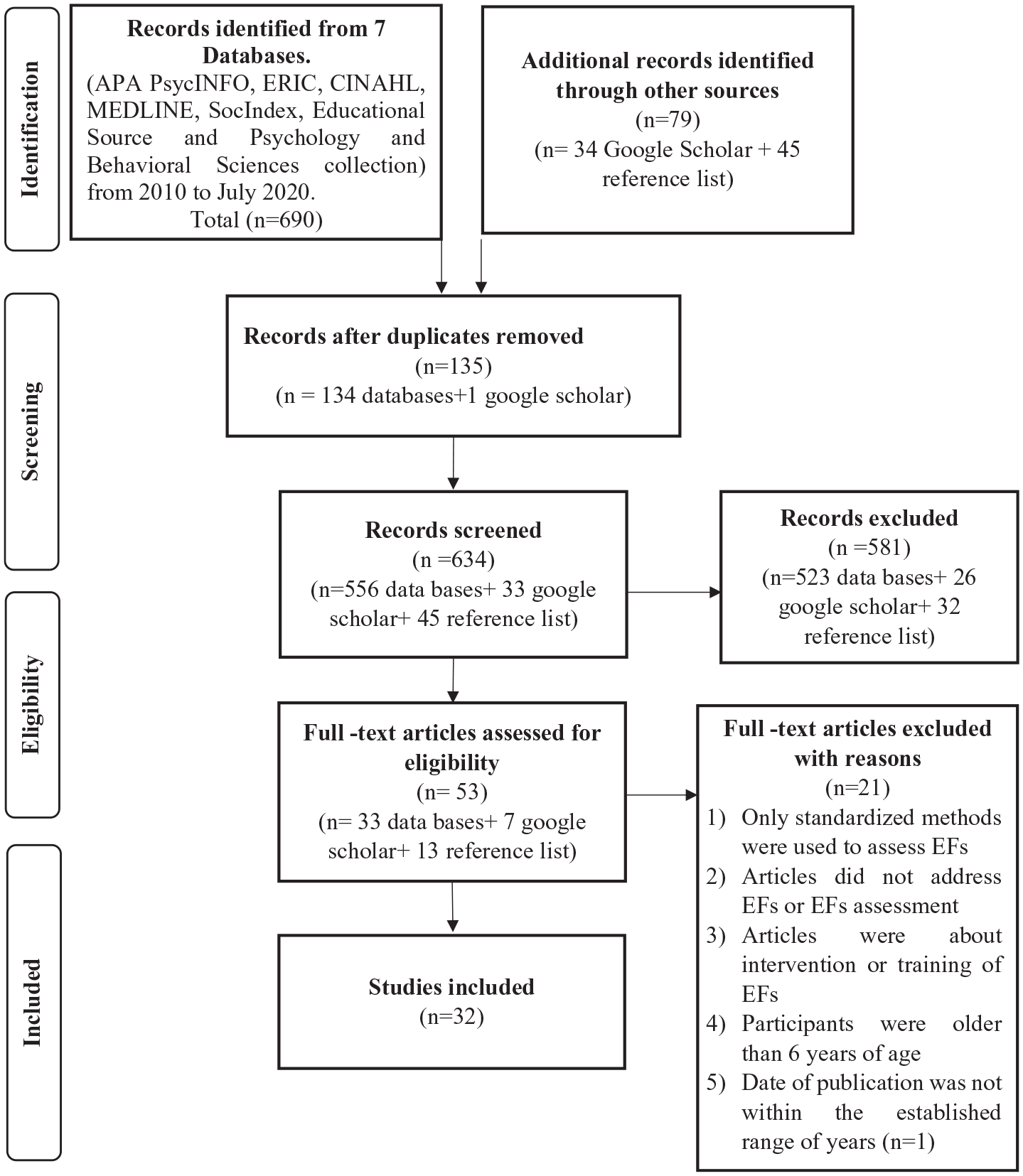
PRISMA Flow Diagram for the Scoping Review Process.
Notably, 45 new articles were identified by reviewing the reference list of the 40 relevant articles. The researchers reviewed the titles and abstracts of the 45 identified articles independently. Of the 45 additional articles, 13 were considered relevant and 32 were considered not relevant. In this first screening process, a total of 53 relevant articles (33 from databases, 7 from Google Scholar, and 13 from reference lists) were identified for a detailed assessment of the entire document.
One researcher did a full-text review of the document and reviewed the data extraction of the articles deemed relevant (n = 53). The second researcher verified the data extracted (Peters et al., 2020). A total of 53 articles were fully reviewed, of which 32 were considered relevant, and 21 documents were excluded and the reasons for exclusion specified. Researchers excluded the articles for the following reasons: (a) Only standardized neuropsychological performance-based tests were used to assess EFs (n = 8); (b) the articles did not address EFs or EFs assessment (n = 5); (c) the articles were about intervention or training of EFs (n = 4); (d) the participants were older than 6 years of age (n = 3); and (e) the date of publication was not within the established range of years (n = 1). The reasons for excluding the documents after a full review are available on request from the corresponding author.
Characteristics of Sources of Evidence
All studies included were published in English between 2010 and 2019, and were conducted in 12 countries: the United States (62.5%), England (6.3%), Colombia (3.1%), Belgium (3.1%), Germany (3.1%), the Netherlands (3.1%), Ireland (3.1%), Australia (3.1%), Italy (3.1%), Canada (3.1%), Sweden (3.1%), and Spain (3.1%). The 32 included documents comprised quantitative research studies (n = 24), qualitative research studies (n = 1), and theoretical publications (n = 7). Of 32 articles, 25 were primary research (78.1%) and 7 were theoretical publications (21.9%).
Children represented the population of the 25 primary research documents, and their teachers and parents in some articles. The children’s sample size ranged from 37 to 2,367 participants. The age range of the children was 24 months to 192 months. More than half of the primary research had a maximal age below 75 months (n = 17). The other primary research articles (n = 8) had a maximum age above 75 months and a minimum age between 24 and 60 months (Note: Researchers only extracted data about participants between birth and 75 months.). Of the 25 primary research articles, 14 studies (56.0%) had children with typical development as participants, and 11 articles (44.0%) included children at risk or with a diagnosis. The diagnoses of the participants in the articles were attention-deficit/hyperactivity disorder (27.3%), childhood-onset fluency disorder (9.1%), global developmental delay (9.1%), autism spectrum disorder (9.1%), specific language impairment (9.1%), traumatic brain injury or orthopedic injury (9.1%), developmental difficulties, (9.1%), perinatal arterial ischemic stroke (PAIS; 9.1%), and sickle cell anemia (9.1%).
Results of Individual Sources of Evidence
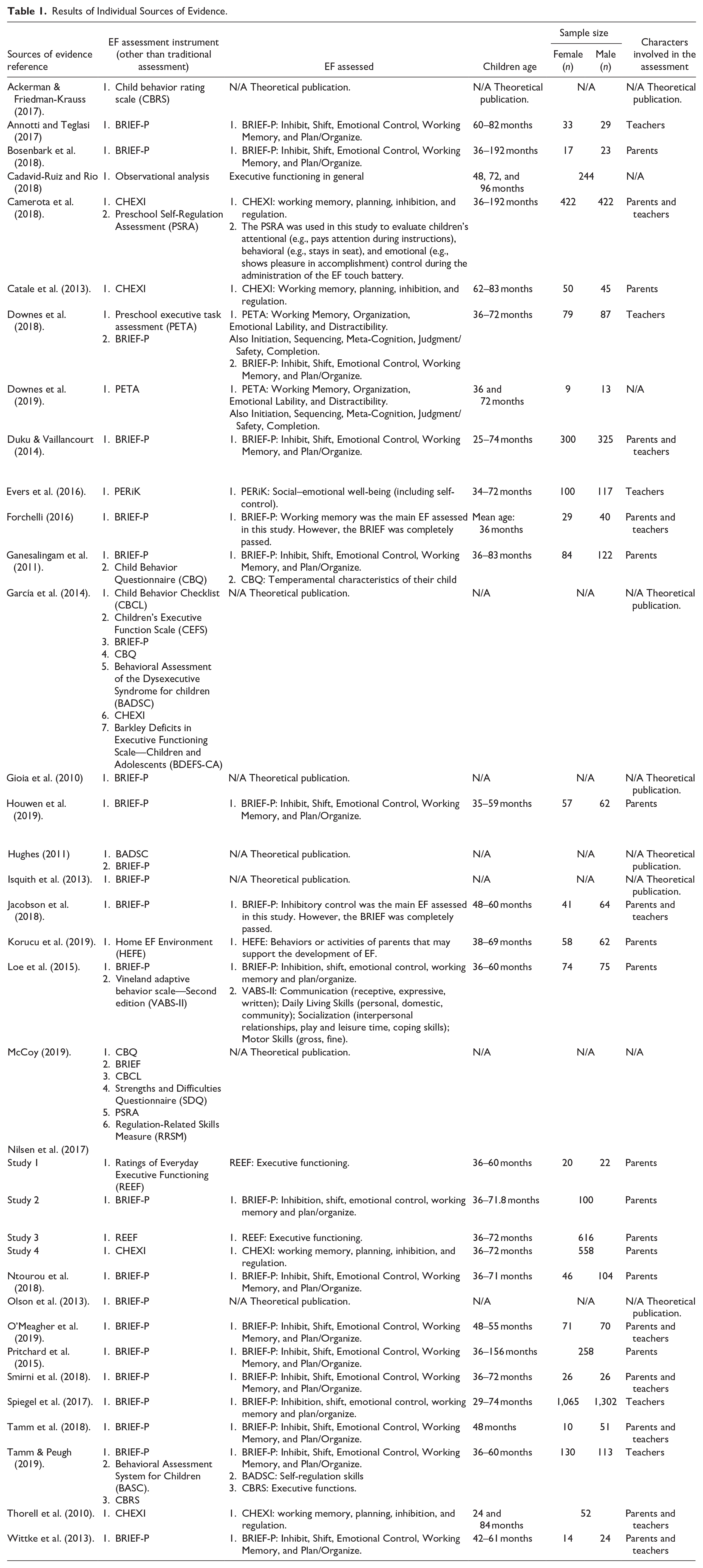
Information from each of the 32 eligible documents regarding the assessment of EFs in young children is presented in Table 1.
Results of Individual Sources of Evidence.
Assessment Instruments
In the 32 documents considered relevant, a total of 17 instruments other than standardized neuropsychological performance-based tests methods were identified. Of the 17 assessment instruments identified in the relevant documents, 10 were used for assessing EFs, 6 for assessing child behavior, and 1 for assessing parental activities and behaviors at home. The instrument most widely used is the BRIEF-P (Gioia et al., 2003). This rating inventory was used in 18 of 25 primary research studies and was mentioned or described in six of the seven theoretical publications. The second most commonly used is the CHEXI (Thorell & Nyberg, 2008), which was administered in four primary research studies and mentioned in one theoretical publication. Other assessment instruments were used, mentioned, or described in the 32 eligible documents (see Table 2). Standardized neuropsychological performance-based tests were also used in 20 of the 32 documents to assess one or more EFs. These 20 articles were not excluded, as they also used instruments other than standardized neuropsychological performance-based tests.
Frequency Count and Total Percentage Frequency of the Assessment Tools.
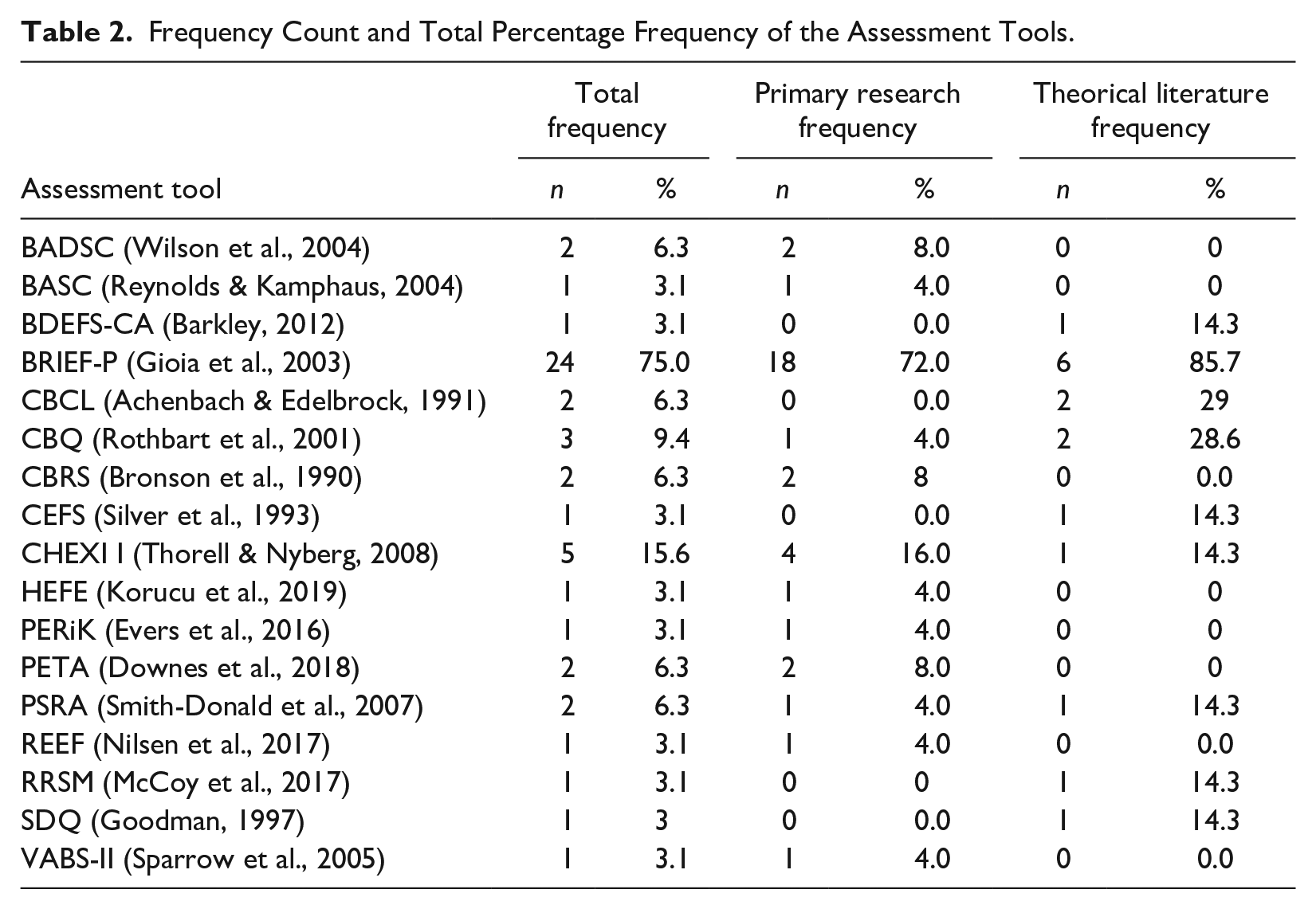
Among the 17 assessment instruments outlined in the relevant documents, 16 employed rating scales. In contrast, a single instrument, the Preschool Executive Task Assessment (PETA), used an observation method that diverged from rating scales to assess EFs in children within their natural environments. Developed specifically for assessing EFs in preschool-aged children, PETA was designed with the goal of establishing a scoring system that is unaffected by linguistic abilities or motor fluency (speed and accuracy). Emphasizing the process rather than mere accuracy, the design of PETA was detailed in the work by Downes et al. (2018).
Literature Available on Authentic Assessment of EF in Early Childhood
The term authentic assessment did not appear in any of the 32 documents. However, assessment methods used or mentioned in the documents included some authentic assessment characteristics, such as assessments carried out by familiar adults, such as parents or teachers and assessments done in real-life environments. Notably, 16 out of 17 instruments used are rating scales, and most were answered by parents, teachers, and caregivers to assess children’s EFs or behavior in their daily environments. Regarding those involved in the assessment of EFs, in 5 articles, only teachers participated; in 11 articles, only parents participated, and in 9 articles, both parents and teachers participated.
As for the assessment context, most of the assessment instruments were applied at home and in the school context. Specifically, in 11 of the 25 primary articles, the assessment instruments were applied at home. In 6 articles, the instruments were administered in the school or preschool context. Seven articles used instruments in both home and school or preschool contexts. Finally, one article applied the instruments at home or in a hospital context.
EFs Assessed in Early Childhood Population
Of the 32 documents considered relevant, 8 documents (7 theoretical publications and 1 primary research article) provided information about EFs in general. Of the remaining 24 articles, 1 article assessed behaviors or activities of parents likely to support the development of EFs, 6 articles assessed only one EF, and 17 articles assessed more than one EF. As for the 6 articles, only one EF was assessed; 3 articles assessed working memory, and the other 3 assessed inhibitory control. Regarding the 17 articles that assessed more than one EF, 1 article assessed two EFs (working memory and inhibitory control), 2 articles assessed three EFs (working memory, planning/organization, and inhibitory control), and 14 articles assessed four EFs (working memory, cognitive flexibility, planning/organization, and inhibitory control; see Table 1).
Discussion
This scoping review aimed to examine the literature on authentic assessment of EFs in early childhood. The purpose was to offer an overview of the literature on the authentic assessment of EFs in early childhood, focusing on documents published between January 2010 and May 2021.
This scoping review identified various assessment instruments used to evaluate EFs in early childhood. Most assessment methods identified were rating scales completed by parents, caregivers, and teachers. Two commonly used assessment instruments in the pediatric population are the BRIEF-P (Gioia et al., 2003) and the CHEXI (Thorell & Nyberg, 2008) rating scales designed to assess the EFs of preschool children. This finding is consistent with previous studies (Mashhadi et al., 2021; Thorell & Catale, 2014). Only 1 study among the 32 reviewed employed direct observation rather than rating scales, highlighting a scarcity of instruments promoting direct observation in natural environments, such as homes or preschools during daily routines (Downes et al., 2018).
In addition, even if the term authentic assessment was not used, most instruments included some authentic assessment characteristics, namely that (a) instruments involve the family, parents, caregivers, teachers, and other familiar adults in recording important information; and (b) assessment methods encourage the assessment of EFs in their daily environments. Even though the authentic assessment method is not explicitly mentioned, some instruments acknowledge the significance of involving families and considering daily contexts in the assessment process. The child’s daily activities provide a lot of information. Observing the functional skills that the child uses daily could be another way to assess EFs. This approach can complement other research methods, such as laboratory-based investigations and the use of standardized neuropsychological tests. Integrating observations of daily activities alongside these methods facilitates the attainment of a more comprehensive understanding of the child’s EFs.
Regarding EFs assessed in children below the age of 6 years, results reveal that the most assessed are inhibitory control and working memory, followed by cognitive flexibility (Karr et al., 2018; Lerner & Lonigan, 2014). These results support the findings of previous studies indicating that inhibitory control, working memory, and cognitive flexibility are the EFs usually present in different models (Hall & Marteau, 2014). These findings are consistent with the multidimensional model (Diamond, 2006, 2013; Diamond & Ling, 2020; Miyake et al., 2000), which proposes three core EFs (inhibitory control, working memory, and cognitive flexibility) followed by three high-order EFs (reasoning, problem-solving, and planning). In this model, the three core EFs are those that develop from the first years of life, while the high-order EFs start developing later on during adolescence and adulthood. However, in some studies, the high-order EFs were also assessed. This reveals a lack of consensus in both practice and the literature regarding EFs that should be assessed in the child population.
Although there was anticipation of finding authentic assessment instruments for evaluating EFs in children below 6 years old, the search only uncovered instruments applicable from 24 months onward. For example, the BRIEF-P (Gioia et al., 2003) and the CHEXI (Thorell & Nyberg, 2008) are tailored for assessment starting at ages 24 and 48 months, respectively. This highlights a notable absence of multidimensional and authentic assessment instruments designed specifically for children aged below 24 months in the current scientific literature. This finding is consistent with prior research (Anderson & Reidy, 2012; Martins et al., 2016).
One possible explanation for the lack of multidimensional and authentic assessment instruments for children’s EFs is that existing instruments often rely on motor skills, verbal comprehension, and language abilities. These skills can be limited in children younger than 24 months (Hendry et al., 2016). An illustrative example of an instrument that could guide the development of EF assessment is the PETA (Downes et al., 2018). The PETA tasks simulate real-life challenges for children. The task involves drawing a caterpillar using provided materials. The PETA (Downes et al., 2018) enables the assessment of EFs without being influenced by the motor fluency or linguistic skills of the children. Although the PETA is designed for children as young as 3 years old, it serves as a model for developing EF instruments in younger children without relying on linguistic abilities and motor fluency. This instrument prioritizes the observation in everyday contexts. Evaluators collect both qualitative and quantitative data during the assessment to understand a child’s EFs. Qualitative data include observational notes detailing the child’s behavior, problem-solving, and interactions. Quantitative data involve scoring performance based on metrics, such as cues needed and time taken. These scores help to assess task efficiency and support needs. The PETA serves as a prime example for guiding the development of instruments for EFs due to its emphasis on incorporating both qualitative and quantitative data from observations. This approach offers a comprehensive perspective on children’s EFs.
The absence of authentic instruments to assess EFs in children below 24 months can also be explained by the early developmental stage of these cognitive functions during early childhood. Essentially, EFs are in a nascent state during these years, making accurate assessment challenging (Escobar-Ruiz et al., 2023). Nonetheless, a viable approach is to pinpoint early indicators that offer insights into EFs. For instance, Blasco et al.’s (2020) research demonstrates this potential avenue.
Blasco et al. (2020) exemplify an endeavor to identify executive functioning indicators in the first months of life. Their findings reveal that distinct components of EFs could be identified using established developmental measures as early as 6 months of age. Moreover, the study established correlations between assessments for infant and toddler development and dimensions of EFs, offering valuable insights into the early development of EFs skills in children. This study offers a potential solution for identifying aspects of EFs in early childhood. By viewing development as global and integral, the utilization of developmental instruments, as demonstrated in the work of blasco et al. (2020), can furnish insights into EFs and associated challenges. Furthermore, the assessment should not attempt to dissociate the behavior, cognitive functions, and child development to assess them.
Recommended practices by the DEC (2014) suggest that professionals should conduct assessments that cover all areas of development and behavior. Performing such assessments enables a comprehensive understanding of behavior and development, and help identify the strengths, needs, preferences, and interests of the individual being assessed (Gargiulo & Kilgo, 2018). According to the work by Blasco and Acar (2020), in accordance with the assessment practices recommended by the DEC, assessment procedures should encompass all areas of development, including EFs.
For further research on this topic, one solution, as shown in the work by Blasco et al. (2020), is to identify whether it is possible to find indicators of executive functioning based on developmental assessment instruments. Following this approach, a consensus method such as the Delphi technique is proposed. Authentic assessment experts and EFs experts can be brought together to collectively identify items of instruments that are tailored specifically to the early childhood population and can serve as indicators of executive functioning. For example, existing authentic assessment instruments such as the AEPS-3 and the Head Start Early Learning Framework (Brookes Publishing Co., 2023) can serve as a basis for this effort.
Limitations
This scoping review has limitations that must be addressed. Although the search method was broad, examining other databases would have allowed to include more articles or documents, and considering them may therefore have provided access to additional information on the subject. This was not done because databases relevant to the topic were prioritized. The scoping review provided international evidence, including studies from different countries. However, most of the documents were from the United States and a smaller portion from other countries, in North, Central and South America, Oceania, and Europe. There was no available evidence from countries in Africa or Asia.
Implications
There are some implications for further research following this scoping review. This study demonstrated the advances already made in early childhood for the assessment of EFs. The review revealed the existence of instruments that allow the involvement of families, parents, caregivers, teachers, and other adults, and the existence of assessment methods that encourage the assessment of EFs in their daily environments. However, the need for the development of multidimensional authentic assessment instruments for all children from an early age is evident. To foster the optimal development of EFs, teachers, caregivers, and parents need an understanding of the specific EFs in need of support. Acquiring such understanding necessitates systematic monitoring of EF development.
Regarding the lack of consensus in practice and the literature on EFs that should be assessed in the child population, considerable research remains to be done to accurately identify, define, and classify EFs in the early childhood population. It is necessary to develop a theoretical model of EFs in early childhood instead of adapting models that have been designed and tested in adolescents or adults. For example, the development of each EF since birth must be studied to create a theoretical model targeted to the young population. This could provide better baseline knowledge for developing assessment instruments designed specifically for children. Further research is required to fully understand the mental processes underlying the development of each EF, starting at a very young age. While advocating for the adoption of authentic assessment methods, this review acknowledges the significance of ongoing laboratory studies, exemplified by Diamond’s work (Diamond, 2020), in advancing the understanding of EFs in everyday life.
Conclusion
EFs play a crucial role in successfully navigating everyday tasks, activities, and behaviors. It is imperative for researchers to recognize the significance of aligning assessment instruments with the behaviors and skills essential for overcoming the challenges encountered in daily life (Bagnato et al., 2010; Moreno et al., 2017). This scoping review shows there is still much work to be done in research to authentically assess EFs in the childhood population. Increasing the amount of research on the infant population from birth is necessary. Further information needs to be gathered on executive functioning in the daily environments of children from an early age as these cognitive functions are the determinants of children’s cognitive, social, academic, and emotional development.
The findings of this study emphasize the need to use and develop instruments that are practical, sensitive, and representative of the needs of children and their families. In this sense, it is crucial to rely on observational instruments to assess children’s EFs in their natural environments, such as home, preschool, or childcare centers. Furthermore, these instruments should encourage the participation of parents, teachers, and other familiar adults in the assessment process.
Moreover, it is crucial to ensure that these instruments are applicable to all children, including those at risk or with developmental disabilities and children living in families with incomes below the poverty threshold or whose parents have less than a high level of education. Although the primary emphasis of the study does not center on intervention, it is important to highlight that the development of multidimensional authentic assessment instruments can play a pivotal role in shaping customized interventions. This insight can significantly contribute to addressing the distinct needs of individual infants, children, and families.
Footnotes
Appendix
Search Strategy Used in ERIC Database.
| Search number (S) | Concepts | Records retrieved | |
|---|---|---|---|
| S1 | “Executive function*” OR “Executive behavior” OR “Executive dysfunction” OR “Dysexecutive” OR “Working Memory” OR Planning OR Organization OR “Cognitive Flexibility” OR “Cognitive Shifting” OR “Abstract thinking” OR “Theory of mind” OR (Inhibition N3 [“self-regulation” OR “self-control” OR “cognitive control” OR “executive control”]) | 164,058 | |
| S2 | “Real life” OR “Real world” OR “Authentic context” OR “Authentic assessment” OR “Authentic environment” OR “Ecological Validity” OR “Ecological Assessment” OR “Natural context” OR “Naturalistic assessment” OR “Everyday activiti*” OR “Daily living” OR “Everyday life” OR “Natural environment” OR “Activiti* of daily livin*” OR “Applied setting*” OR “Authentic approach” OR “Day-to-day” OR “Daily routine*” OR “Daily functioning” OR “Everyday routine” OR “Everyday task” OR “Family centered” OR “Family involvement” OR “Home-based” OR “Home environment” OR “Routine*” OR “School-based” OR “School environment” | 49,461 | |
| S3 | Assessmen* OR Task* OR Measuremen* OR Testing OR Test OR “EF assessment” OR Scale* OR Instrument* OR Observat* OR “Ecological assessment” OR Evaluat* OR “Naturalistic assessment” OR “Naturalistic task*” OR “Neuropsychological assessment” OR “Questionnaire*” OR “Rating Scale*” | 602,573 | |
| S4 | “preschool education” or “preschool children” or “kindergarten” or “elementary education” or “primary education” or “school children” or “infants” or “infant boys” or “infant girls” or “newborn” or “early childhood education” | 240,859 | |
| S5 | S1 AND S2 AND S3 AND S4 | 75 | |
| Limiters applied on each search | |||
| Search Moodle Expanders Publish date Language Education level |
Boolean/Phrase Apply equivalent subjects January 2010 and July 2020 English, Spanish/Castilian, French Early Childhood Education |
||
Declaration of Conflicting Interests
The author(s) declared no potential conflicts of interest with respect to the research, authorship, and/or publication of this article.
Funding
The author(s) received no financial support for the research, authorship, and/or publication of this article.
