




Abstract
Early intervention (EI) provides requisite support to address the developmental needs of infants and toddlers and assists families in understanding how to meet their child’s needs. However, at age 3, those services are no longer offered and families are required to transition to school services. To date, there are limited studies about families’ perceptions of their child transitioning from EI to school services. To address this gap in the literature, a qualitative study, with semi-structured interviews, was conducted with 14 parents. The study examined the transition process from EI to school services. The findings suggest that parents had positive experiences in EI, particularly with the EI team. Notably, participants expressed feeling elevated levels of stress during the transition from EI services to school services and relied on EI and school professionals to secure services with minimal input in the Individualized Education Program (IEP) process. Implications for research and practice are discussed.
Keywords
The purpose of early intervention (EI) is to address the developmental needs of infants and toddlers (i.e., children from birth through 3 years of age) with developmental delays or disabilities and to provide support for families to further assist them in understanding how to meet their child’s needs (Individuals with Disabilities Education Act [IDEA], 2004). Such EI services may include speech and language therapy, behavior therapy, occupational therapy, physical therapy, and other types of services that can meet the developmental needs of children. Although the federal government terminates EI services at age 3 (IDEA, 2004), each state has the option to extend EI beyond age 3 until they enter kindergarten (§303.211). IDEA (2004) requires states to ensure that all children receiving services under Part C, who are eligible for Part B, have Part B services in place by the child’s third birthday. Part B includes provisions that assist states in providing children with disabilities, ages 3 through 21, a free appropriate public education (Early Childhood Technical Assistance Center [ECTA], 2022; IDEA, 2004). Specifically, at least 90 days prior to a child’s third birthday, a transition meeting should take place to determine the child’s next program. Transition services assist a toddler with a disability, and their family, to experience a smooth and effective transition from the EI program, under Part C, to the child’s next program or next appropriate services, including services under Part B (Division for Early Childhood [DEC], 2014). Specifically, DEC emphasizes the eight domains of best practices: leadership, assessment, environment, family, instruction, interaction, teaming and collaboration, and transition.
In addition to ensuring that young children with disabilities receive appropriate services, the premise of IDEA (2004) is that parents are equal partners in the EI process, including the transition from EI to school services. Effective collaboration and partnership with families are recommended practices for service providers working with families (Division for Early Childhood [DEC], 2014; Early Childhood Technical Assistance Center [ECTA], 2022). As such, a bulk of empirical research demonstrates the positive impact of parent involvement on student outcomes (Aceves, 2014; Howard et al., 2021). Parental involvement with school is linked to a multitude of positive outcomes for students with disabilities such as improvements in academics, fulfillment of Individualized Education Program (IEP) goals and benchmarks, an increase in attendance rates, and a decrease in at-risk behaviors (Ishimaru et al., 2016; Jeynes, 2007). However, despite ample research-based evidence that links parental involvement and student success, many studies indicate that parents are not treated as equal partners by school professionals (Buren et al., 2018; Rios et al., 2020; Shapiro et al., 2004). Parents of young children with disabilities are especially vulnerable to less participation in decision making with professionals (Vora et al., 2016) and report greater struggles to access disability services (Mueller et al., 2009). In addition, parents often face systemic barriers when accessing services for their own children with disabilities. Such barriers include inaccessible procedural safeguards (Mandic et al., 2012) and logistical challenges (e.g., lack of transportation and childcare to attend IEP meetings; Leiter & Wyngaarden Krauss, 2004).
Although best practice recommendations for successful school transition from EI to school services promote increased communication and collaboration between EI personnel, school personnel, and the child’s family (Fontil et al., 2019; Pianta & Kraft-Sayre, 2003), families’ perceptions of transition from EI to school services remain unclear (Brandes et al., 2007; Grygas Coogle et al., 2013). Research suggests that families feel supported during the EI transition to school services when they have enough information to make informed decisions (Smalley & Reyes-Blanes, 2001) and when families report having a strong family–school partnership (Burke & Hodapp, 2014). However, many parents want to be more involved in the transition process for their children but face multiple barriers (e.g., inability to navigate the jargon, limited understanding of the school systems, information, or resources needed to participate as equal partners in the transition process, Rios et al., 2020; Smalley & Reye-Blanes, 2001; Waters & Friesen, 2019).
Extant research demonstrates a link between special education experiences and parent stress (Rios et al., 2020). For example, due to these systemic barriers, many families report struggling to access school services (Shapiro et al., 2004). Such barriers may lead to parents lacking the time, effort, or ability to collaborate with the school (Geenen et al., 2001). Specifically, working parents of young children with disabilities have reported stress on their time, lack of resources, and ability to manage parenting and homeschooling (Fontanesi et al., 2020).
Given the unique needs families of young children with disabilities face (i.e., caregiving burden; Suarez-Balcazar et al., 2021), it is important to understand the needs of families transitioning from EI to school services. Surprisingly, minimal attention has been paid to the role of transition meetings on parental stress (Podvey et al., 2013; Waters & Friesen, 2019). With respect to stress, IEP meetings, including the initial IEP meeting, may be especially important because they are the primary forum wherein educational decisions are made (Fiedler & Danneker, 2007; Zeitlin & Curcic, 2014).
Problem and Significance
To date, there is limited research about parent’s experiences transitioning their children from EI services to school services (Brandes et al., 2007; Grygas Coogle et al., 2013; Waters & Friesen, 2019). Thus, the purpose of this study was to examine how parents perceive the transition process from EI services to school services for their children with disabilities. To these ends, we conducted semi-structured individual interviews to answer the following research questions:
Method
Researcher Identity
Previously, each of the authors have taught students with IDD which was a strength to the study because they had prior experience with parents, including Latinx parents of children with intellectual and developmental disabilities (IDD). Both authors are qualitative researchers, have conducted previous research with parents of children with disabilities, and have utilized member checks to ensure accuracy when representing and analyzing the experiences of research participants. The authors recognize their position of power as interpreters of participants’ lived experiences and thereby use member checks to address such power differentials. Another strength is that the first author is Latina and native Spanish speaker. As such, she conducted all the Spanish interviews. In addition, the second author is a parent of a child with a disability and a former teacher with the ability to analyze the data from multiple perspectives. To minimize bias, both authors kept detailed field notes throughout the research process (Maxwell, 2005). The second author listened to the audio recordings of each interview to ensure the detailed notes were accurate and to further reduce author bias. Finally, the first and second authors consulted with each other regularly.
Participants
Altogether, 14 participants from Illinois were included in the study. For families to receive EI services in Illinois, the family must contact a Child and Family Connections (CFC) Office. After meeting with a service coordinator, the family member participated in the evaluation and assessment process to determine whether the child is eligible for EI services (Illinois Department of Human Services, 2020). The inclusionary criteria required participants to: (a) have a child with IDD who received EI services within the last 2 years and went through the EI transition process; and (b) have a child who is currently receiving school services. On average, participants were 39 years of age. The majority (78.6%; n = 11) of participants were married. The majority of participants (57.1% or n = 8) identified as White and were female (92.8% or n = 13). The majority of participants had a college degree (78.6% or n = 11). The majority of children (92.8% or n = 13) were 3 years old, ranging from 3 to 4 years of age. The majority of participants’ children were male (64.3%; n = 9). In addition, most of the children had a speech and language impairment as their primary disability (57.1%; n = 8). Some children had additional disabilities. All participants lived in Chicago and the surrounding suburbs; subsequently, 44.3% of the families who receive EI services in Illinois live in the Chicago area and surrounding suburbs (Illinois Early Childhood Asset Map, 2021). Although participant recruitment did not target a specific race or ethnicity, the participant sample was not racially and ethnically representative of the families who utilize the statewide Illinois EI system when 35% of the families who receive services in Illinois identify as Latinx compared with 52% of the Latinx families in the study (Illinois Early Childhood Asset Map, 2021). In addition, there were discrepancies in other racial and ethnic categories; 33% of the families receiving EI services in Illinois identified as White compared with 57% in the study and 13% of the families identified as Black/African American in Illinois compared with 7% in the study (Illinois Early Childhood Asset Map, 2021). All participant names and child names were replaced with pseudonyms (see Table 1).
Participant Demographic Information.
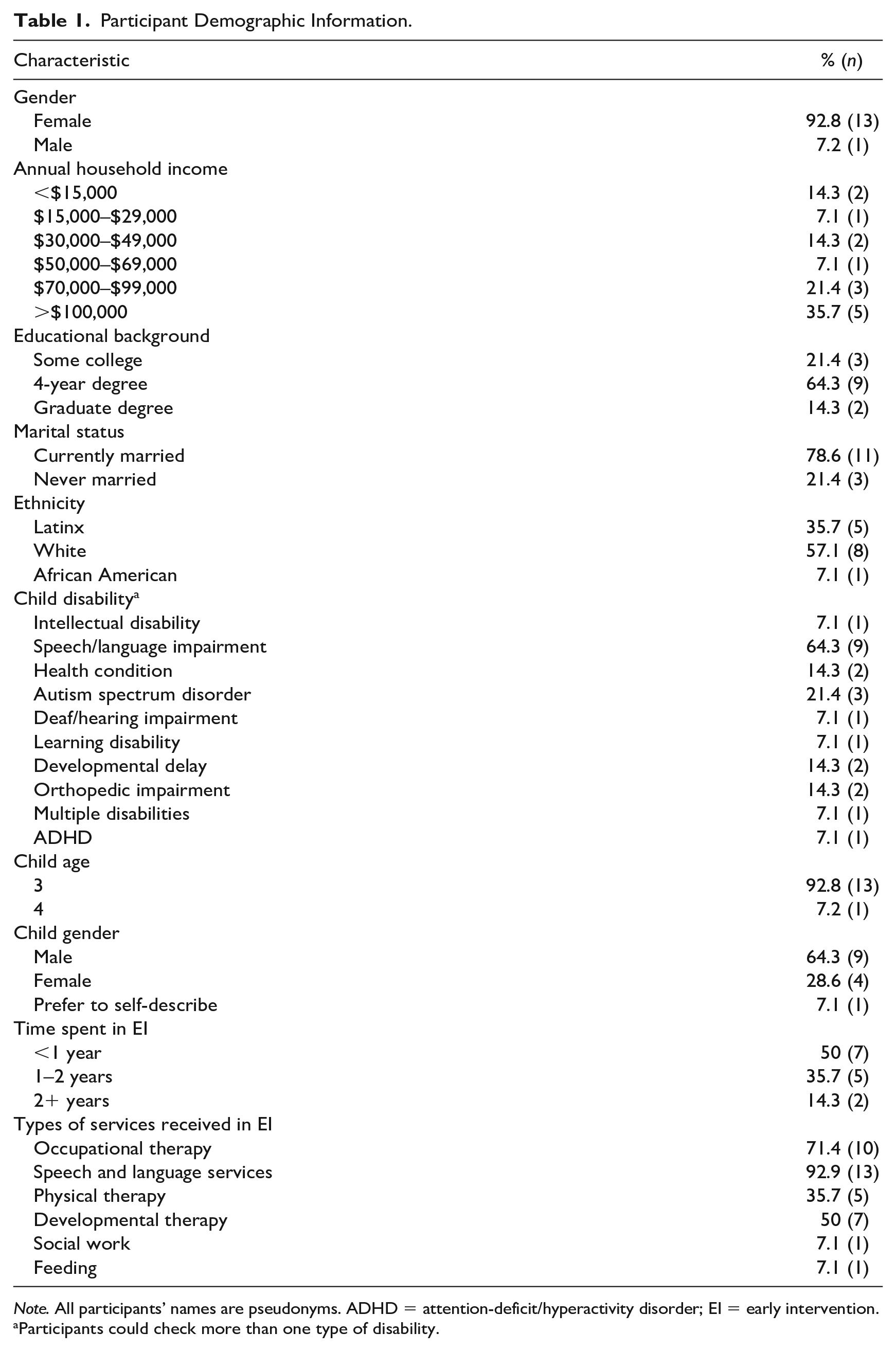
Note. All participants’ names are pseudonyms. ADHD = attention-deficit/hyperactivity disorder; EI = early intervention.
Participants could check more than one type of disability.
Themes, Codes, and Data Examples.
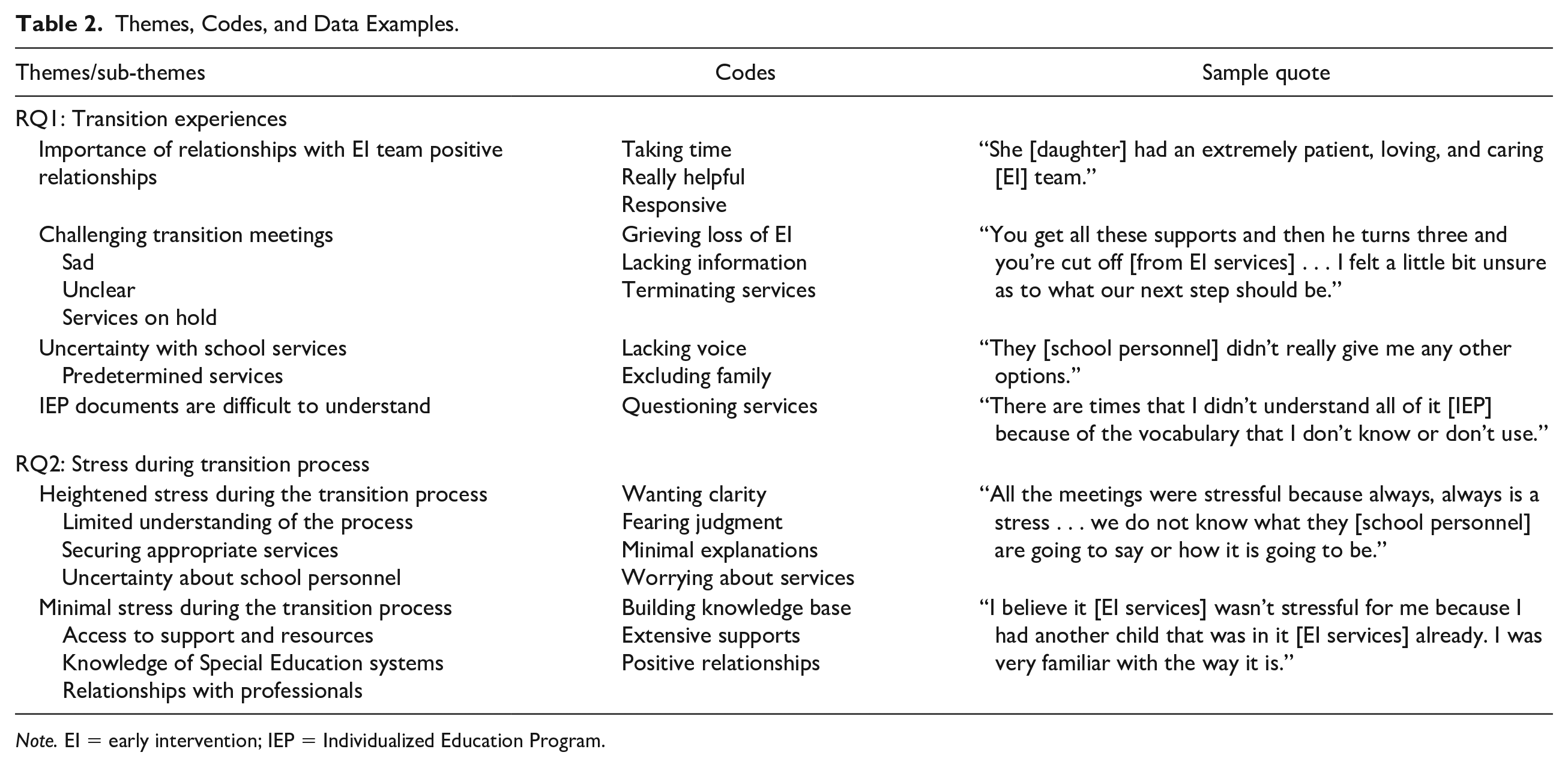
Note. EI = early intervention; IEP = Individualized Education Program.
Recruitment
Participants were recruited through a variety of methods, including social media, word of mouth, and email. We collaborated with parent and disability organizations and special education programs in Illinois including the Parent Training and Information Center (PTIs), Illinois Early Intervention Clearinghouse, and parent support groups. These agencies shared the recruitment flyer with their constituencies. All recruitment materials were available in English and Spanish.
Potential participants contacted the first author using the contact information on the flyer. All participants who agreed to be part of the study were given a $20 stipend. Specifically, participants received a $10 stipend after completing the interview and a $10 stipend after completing the member check. The number of interviews was determined by saturation (Fusch & Ness, 2015). With 14 participants, data saturation was reached as indicated by redundancy of themes. Specifically, during data analysis, saturation was reached when new codes were no longer emerging in the data.
Measures
Family Demographic Questionnaire
The family demographic questionnaire was used to collect information about the participants and their children. For example, the questionnaire asked about types of services their children with IDD received during EI, participation in parent support groups, and household income. The questionnaire included 26 items and took around 10 to 15 min to complete.
Interview Protocol
The interview protocol was developed based on an extensive literature search about transitioning from EI services to school services among parents (e.g., Brandes et al., 2007; Grygas Coogle et al., 2013) and their experiences in EI services (Waters & Friesen, 2019). The interview protocol included questions related to experiences in EI services, the transition meeting from EI to school services, and the parent’s first IEP meeting. Specifically, the interview protocol included 50 items with 33 open-ended questions and 17 forced questions. Three experts in EI research reviewed the protocol and provided feedback.
Based on their feedback, minor revisions were made (e.g., small word changes, revising the order of questions, and adding additional questions). All expert feedback was addressed in a revised version of the protocol, which was then piloted with a parent of a child with IDD. No further revisions were suggested. During each interview, the first author followed up when necessary (e.g., “Can you tell me more about your early intervention experience?”), with additional probes based on information that participants provided in the family information questionnaire. Some of the questions included the following:
Can you walk me through the process of your transition from EI to school services (IEP)?
How would you describe your relationship with the EI team?
How did the transition team respond to your concerns?
How would you describe your stress levels during the IEP meeting?
Procedures
Prior to conducting the interviews, this study was approved by the University Institutional Review Board. The first and second authors conducted all the interviews over the phone. Research indicated that in-person and phone interviews may generate the same results (Sturges & Hanrahan, 2004). Each interview lasted between 30 and 100 min and was designed to last about 45 min. The mean length of the interviews, across participants, was 40 min. The participants chose the time and date of the interview. All interviews were conducted over the phone after participants signed the consent form and filled out the demographic questionnaire. In addition, participants also consented to have their interview recorded. Participants chose their preferred language for the interview. All participants chose to conduct their interview in English. Each individual interview was audio-recorded using Voice Record software.
Field Notes
The field notes were written by hand during and after the interview and immediately typed into the authors’ password-protected laptops. Field notes included descriptive information, such as the date and time, setting, and conditions of the interview. Field notes also included reflective information about coding ideas.
Transcription
Each interview was transcribed verbatim. After each interview was transcribed, the Spanish interviews were back translated into English. The first author then compared the transcript with the Spanish audiotape. The forward/back translation is a commonly used method with interviews recorded in another language to ensure the quality and accuracy of each interview (Brislin, 1970). The first author checked each transcript for accuracy by listening to the audio recording while she read the transcript.
Family Demographic Questionnaire
The questionnaire was completed by participants prior to the interview. Participants were asked whether they wanted assistance in completing the demographic questionnaire over the phone by reading the demographic questionnaire to them.
Member Checks
For a level-one member check, summaries were created at the end of each individual interview. The first author briefly read the summary and participants offered no changes. After the categories and themes for the interview data were identified and finalized, a second-level member check was used to help authenticate the analysis (Brantlinger et al., 2005). Specifically, after reading the transcript and the notes, a summary of each individual interview was developed. Then, each summary was sent to the individual participant via email or phone to determine whether the summary was accurate. All participants responded and agreed with their respective interview summaries. No changes were made to the interview summaries.
Data Analysis
The interview data were analyzed by the authors. All analyses were completed using the transcripts and field notes. First, they independently read the transcripts to familiarize themselves with the data (Tesch, 1990). Then, independently, they used constant comparative analysis to sort and organize data into groups (Glaser & Strauss, 1967) and emergent coding to look for evolving patterns in the data (Patton, 2002). Using a line-by-line approach, they examined each piece of data (i.e., each line) and compared it with other data. Each piece of data was highlighted and annotated with a phrase. If the data represented a single concept or idea, it was given a code. Next, they compared codes, resolved differences, collapsed emergent codes, and developed a codebook with focused codes. Focused codes are used in the second iteration of coding to search for larger explanations of the data and are created using the constant comparative approach (Glaser & Strauss, 1967). After finalizing the codes, the codes were then defined in the codebook. Each author returned to the data; using the codebook, they independently re-analyzed the interview data. After the second-level member checks were completed, the first author read each transcript again to confirm the categories and ensure that the codes were accurate. The authors met to discuss and compare the codes. Finally, they grouped the codes into categories and organized the categories into themes grounded in the data (Braun & Clarke, 2006).
For example, to deepen understanding of parents’ experiences and feelings during the initial IEP meeting, the authors first developed a list of descriptive codes such as helpful, positive, responsive, and supportive. Next, to further analyze the findings, the authors used process coding, or the method of using gerunds to observe and conceptualize actions in the data (Miles et al., 2014) to develop focused codes. Altogether, there were 28 open codes and 30 focused codes. Focused codes included navigating services, providing tools for parents, wanting more explanation, and communicating. After confirming and analyzing the codes, they created broader categories and themes (Braun & Clarke, 2006). For instance, they developed the following categories: perceptions of EI team, stressful situations, and experiences during transition meeting. Via a careful appraisal, they reviewed patterns in the data and ensured the themes were distinct.
Reliability in this study was established using intercoder agreement (i.e., the use of two coders to analyze data in hopes of attaining agreement on the code names and coded passages; Creswell, 2013). Intercoder agreement was calculated for all codes, during all coding iterations, and again with the final themes. To measure reliability, the first coder divided the number of agreements by the sum of the agreements plus the disagreements (Miles et al., 2014). On average, across all coding categories and themes, 98% intercoder agreement was achieved.
Trustworthiness
This study met several of the quality indicators for trustworthiness (Brantlinger et al., 2005). For example, triangulation was used between the family demographic information and the interview data to measure data validity and to ensure that the results were valid and reliable. Second, member checks were employed after data analysis to confirm the accuracy of participants’ views. The authors listened to the audio-taped recordings of each participant. Detailed notes of the participants during the interview were used to further ensure the trustworthiness of the findings. Third, the authors identified their potential bias. To minimize potential biases, the authors kept detailed field notes throughout the research process and consulted with one another regularly. Finally, the authors listened to the interviews’ audio recording to ensure the detailed notes were accurate and to further avoid biases (Maxwell, 2005).
Findings
RQ1: Experiences With the Transition From EI Services to School Services
Three themes emerged from the parents’ experiences with the transition from EI services to school services: (a) relationships with EI team members are important, (b) the transition meetings with school personnel were challenging, and (c) parents felt uncertain about the school services offered and the judgment of school personnel. Notably, four participants reported joining parent support groups to learn from other parents transitioning from EI to school services.
Importance of Relationships With the EI Team
Before transitioning out to school services, participants reported having a positive experience with their child’s EI services and team. Parents reported that EI teams were helpful, caring, and communicated often, and in a timely manner.
Positive Relationships: “My EI Team Cared. .”
Linda, the mother of a 3-year-old daughter with a developmental delay, reported that her entire EI experience was positive. Linda further stated that her EI team was very informative and supportive. Linda further reported, “I think it [EI experience] was really great. They [EI team] were very open and quick and helpful with anything that I would have questions on.” Similarly, Narla, the mother of a 3-year-old son with autism spectrum disorder (ASD), stated how pleased she was with the EI team and the services her son received. Narla further explained, They [EI team] were very helpful. Very helpful. If I had any questions or concerns that I had, I could go ahead and reach out to them [EI team], and they [EI team] will go ahead and try to contact me as best as they can. They [EI team] were really nice.
Melanie, the mother of a 3-year-old daughter with multiple disabilities, reported how the EI team cared for her daughter. Melanie further explained, “She [daughter] had an extremely patient, loving, and caring [EI] team. My EI team cared about her [daughter].”
Challenging Transition Meetings
During the transition process, participants reported feeling sad and unclear. In addition, some participants reported being put on hold for services after their child aged out of EI services.
Sad: “Oh My Goodness Bye . . .”
Many participants reported feeling sad that EI services were going to end for their children. Julissa, the mother of a 4-year-old boy with a speech and language impairment, reported feeling sad that for three years, the EI team provided services for her son but after he aged out at three, he no longer was able to receive these services. Julissa further stated, “I was sad to see them [EI team] not be a part of our life all the time and thankful for them [EI team], very thankful for all of them [EI team] advocating for Timothy.” Similarly, Linda, the mother of a 3-year-old daughter with a developmental delay, reported that she felt sad during the transition meeting. Linda further stated, “[I felt] a little sad just because it was nice having the extra supplemental work to have somebody come and really show me a little bit more with the speech side of things of how to help my daughter.”
Unclear: “I Felt a Little Bit Unsure . .”
Some participants reported feeling unclear about information transitioning from EI to school services. Specifically, participants reported feeling unsure of what they needed to do during the transition meeting to help their child receive support. Kimberly, the mother of a 3-year-old son with a speech and language impairment, reported, You get all these supports and then he turns three and you’re just cut off [from EI services]. It’s just strange. I felt a little bit unsure as to what our next step should be or what would best support my son [transitioning to school services].
Similarly, Hannah, the mother of a 3-year-old son with a speech and language impairment, reported feeling unclear about the transition process from EI to school services. Hannah further stated, I feel like everything was done for me . . . They were just there to answer my questions and they gave a preview like, “this is what’s going to happen. This is what we’ve set you up for.” They filled out their ends of the paperwork to pass on to the next team . . . and that’s it . . . it was very unclear.
Services Placed on Hold: “They Stopped EI . .”
Some participants reported that their child’s services were put on hold because they turned 3 years old and were no longer eligible to receive EI services. However, participants were either waiting on the school to provide school services or they were waiting for school to start for their child to be able to receive school services. Alicia, the mother of a 3-year-old son with autism, stated, They [EI personnel] stopped EI services because he [son] turned 3. He [son] already got evaluated to be transferred to school. The principal told me that he [son] is going to need some services but we have to wait . . . I’m not sure for how long.
Similarly, Camille, the mother of a 3-year-old son with a speech and language impairment and health condition, stated that her son turned 3 in the summer, but the school did not offer to provide services for her son in the summer. Camille further stated, “He [son] has a July birthday, so he [son] was going to be lacking services about a month before school starts.” Another participant, Alicia, reported that during her transition meeting, the school did not offer immediate school services because the school was busy providing services to their current students. Alicia further stated, No [son is not receiving services], because I think they [school personnel] are trying to finish this school year. She [special education director] said that there’s some people [children] that they’re [school personnel] are trying to cancel, and she [special education director] asked me if I wanted to put myself on that waiting list [for my son to receive school service]. They [school personnel] should have an answer by the end of this month.
Uncertainty About School Services and Personnel
During the initial IEP meeting, participants reported relying on school personnel and feeling as if services were predetermined. Furthermore, some participants expressed having difficulty understanding the IEP documents.
Predetermined Services: “They Have Done Everything.”
Some participants reported feeling as if the school had previously decided on the school services that were going to be provided for their children prior to the meeting. Specifically, participants reported feeling as if the school personnel did not ask for parent input during the initial IEP meeting. For example, Martin, the father of a 3-year-old, reported that at his son’s initial IEP meeting, the school had the services and number of services his son was going to receive prior to the meeting. Martin further reported, “They [school personnel] suggested everything. We [wife and I] had no idea about any of those things [e.g., school services]. They [school personnel] have done everything.” Similarly, Alicia stated that at her initial IEP meeting for her son, the school presented the information of the services her son was going to receive at school. Alicia further explained, “They [school personnel] didn’t really give me any other options. They [school personnel] were like, ‘Yes, that’s what we [school personnel] decided.’” Another participant, Kimberly, reported that the IEP documents and services her son was going to receive through the school were ready prior to the IEP meeting. Kimberly further reported, “They [school personnel] had it [IEP documents] all ready and presented it [IEP documents] to me.”
IEP Documents Are Difficult to Understand: “They Are Confusing to Read.”
Many participants expressed having difficulty understanding and reading the IEP documents. Specifically, participants reported that the jargon was especially difficult to understand and follow. Angie, the mother of a 3-year-old with an intellectual disability, whose primary language is Spanish, reported, There are times that I didn’t understand all of it because of the vocabulary that I don’t know or don’t use. Yes, I had to review it line by line. It was very difficult trying to understand all the vocabulary and all that they were trying to say.
Similarly, another participant reported that the organization of the IEP documents made it difficult to understand the IEP. Bianka further explained, “They [IEP documents] were not as well organized. It felt like a lot of the questions on the [IEP] document were repetitive and just not as well organized . . . it made it difficult to understand [the IEP documents].”
RQ2: Experiences With Stress During the Transition Process
Two themes emerged from parents’ experiences with stress during the transition process: (a) some participants experienced heightened stress during the transition while (b) some participants had minimal stress during the process.
Heightened Stress During the Transition Process
Several participants reported feeling stress when they did not understand the process of transitioning from EI services to school services nor how to secure necessary special education services for their child. In addition, some participants expressed concern over how school personnel would treat their family and how the teachers and students might react to their children with disabilities. Participants reported feeling worried their child would be judged by school personnel and ostracized in the classroom.
Limited Understanding of the Transition Process: “I Wasn’t Really Sure How It Worked.”
When asked about stress levels during the transition from EI services to school services, multiple participants reported feeling confused about the steps of the process and the timeline of events. Ruth, the mother of a daughter with a speech and language impairment, whose first language is Spanish, corroborated, “I didn’t know what they were going to tell me and also because I didn’t know.” Other mothers, who were born in the United States and speak English as their first language, reported similar feelings of stress concerning the transition process. Similarly, Kimberly explained, “I guess the biggest barrier was just, I was new to the process [EI and transition to school] I wasn’t really sure how it worked.” Correspondingly, Hannah reported, “The only part of the stressfulness was just not really knowing what’s going to happen next.” In addition, Bianka, the mother of a 3-year-old daughter with a speech and language impairment, further elaborated, “[stress] Fairly high, just because we still didn’t quite know exactly what to expect. They gave us an idea of expectations, but having never experienced it, we weren’t still quite sure.”
Securing Appropriate Services: “It Seems Like They Shorted Him on the Service Time.”
Several participants reported feeling a heightened amount of stress when they attempted to secure the necessary supports and services for their children. Camille described her experience with school personnel, “It’s just the most stressful part is trying to get your kid what they need.” She further explained, “It seems like they [school personnel] shorted him [son] on the service time.” Similarly, Molly, the mother of a 3-year-old son who lived in a small, rural school district, described her experience with school personnel, “I’ve been waiting months and months and never heard anything [from the school].” Molly elaborated on the situation, “He [son] didn’t start seeing an IEP until this week, when he’s [son] already been in school for about a month or little more than a month.” Concurrently, Kimberly’s experience mirrored Camille’s experience and both families were offered limited speech services by the school. Kimberly explained, They [school personnel] were super nice but he [son] would have only gotten 30 minutes of speech therapy a week and like no OT [occupational therapy], and they were like, “He’s fine.” I was like, “Okay, well, that’s not helpful but all right.”
Finally, Ruth provided yet another example of challenges faced securing services and the subsequent increased stress. She explained, “I think they gave me some [school services], but no, not enough, not enough for me to be able to support my daughter more and be able to decide what’s best for her.”
Uncertainty About School Personnel: “We Do Not Know What They Are Going to Say.”
Some participants reported feeling additional stress when they met with school personnel because they worried what people would think about their family and their child with disabilities.
Martha, the mother of a 3-year-old son with a speech and language impairment, explained, “I can say that I was a little bit more stressed . . . you had to meet with so many of the ladies [school personnel] and they each had their own questions.” Ruth described similar concerns, “All the meetings were stressful because always, always is a stress. Of course, we do not know what they [school personnel] are going to say or how it is going to be.” In comparison, Alicia, the mother of a 3-year-old son with autism, reported feeling nervous, rather than stressed, thinking about her son’s transition to school. She explained, Not stressful but nervous because this is my first child with autism or anybody in our family who has autism. I’m scared for him if he [son] goes to school, how he’s going to react, how teachers react to him [son] or the students to his autism?
Throughout the study, participants described specific factors that contributed to a decrease in stress during EI services and the transition process.
Minimal Stress During the Transition Process
Participants reported having resources, a strong knowledge of the special education system, and relationships with professional EI staff helped decrease their stress levels.
Access to Support and Resources: “We Have Good Resources in Our Lives.”
Some participants reported access to resources, such as childcare, reduced stress during EI services. Sylvia, the mother of a 3-year-old daughter, explained, I didn’t feel like it was overly stressful. I think that we’re really fortunate that we have good resources in our lives, like grandparents who could be at home with her [daughter], so we didn’t have a daycare thing to have to worry about, trying to plan services around.
In addition to Sylvia, Martha also reported the support of grandparents for childcare as a stress reducer, “We don’t have to stress out about paying for childcare, because my son goes to grandma and grandpa’s house every day. Our situation, thankfully, has not caused us to be so stressed.”
Knowledge of Special Education Systems: “I Was Very Familiar With the Way It Is.”
Other participants attributed their experience with special education systems to their lack of stress. Melanie, the mother of a daughter with multiple disabilities, explained, “I believe it [EI services] wasn’t stressful for me because I had another child that was in it [EI services] already. I was very familiar with the way it is.” Camille, the mother of a 3-year-old son with a speech and language impairment, interpreted her lack of stress during EI and the transition to school services in a similar way to Melanie. She explained, “I do not find it stressful, but I work with kids with global deficits and massive medical needs. An IEP is part of my normal routine at work, so it’s not intimidating to me.”
Relationships With Professionals: “We Had Such a Good Relationship . . With Her Therapists.”
When asked about their stress levels during the transition from EI services to school services, many participants attributed the professionalism of EI therapists and school personnel to a lack of stress. As such, participants further credited positive relationships with professionals to the elimination of their stress. Martin, the father of a 3-year-old with a speech and language impairment, explained, “There wasn’t anything in the meeting which was stressful. They [school personnel] said everything with the utmost respectful and honest way.” Flor, the mother of a 5-year-old with a developmental delay, whose first language is Spanish, explained a similar experience with professionals, “I did have the interpreter and they did answer all the questions, the concerns that I had.” In addition, Bianka, the mother of a 3-year-old with a speech and language impairment, explained her experience with professionals, “We did not find it [transition to school services] stressful. We found it an exciting thing to look forward to because we had such a good relationship, I think, with her [EI] therapists.”
Discussion
In this study, we examined how families of children with disabilities characterized their experiences transitioning from EI to school services. We had three main findings: (a) parents had positive experiences with EI, (b) parents experienced stress during the transition process, and (c) parents relied on school professionals to secure school placements and services with little input in the process. First, we found that parents had positive experiences in EI. Despite the challenges of receiving EI services remotely during the pandemic, parents in this study felt supported by EI professionals. Specifically, parents felt the EI staff maintained frequent communication, offered resources and assistance with school placements and services, and generally treated parents with respect. Currently, many studies in the extant literature support these findings and suggest when families and professionals maintain regular communication, parents feel supported (Buren et al., 2021; Burke & Hodapp, 2014). In addition, when parents have positive relationships with their EI team, parents can better support their own children during parent–child interactions (Kelly et al., 2008).
Second, participants experienced heightened levels of stress during the transition from EI to school. Prior research suggests parents feel supported when they have access to information to make informed decisions and strong relationships with schools (Burke & Hodapp, 2014; Smalley & Reyes-Blanes, 2001); however, parents in this study did not have personal connections with school personnel nor clarity on the IEP evaluation process. Thus, parents reported feeling heightened stress levels during the transition. Not only did parents lack relationships with school professionals, but they also worried teachers and students would judge their child. In addition, parents who did not feel stress during the transition process accredited the positive experience to their knowledge of the special education system and strong relationships with school professionals.
Finally, although the law guarantees parental participation in the IEP process (IDEA, 2004), parents in this study had minimal opportunities to provide input on the IEP and relied on EI and school professionals to secure services. Thus, parents reported that services included in the IEP were often predetermined by the school. Furthermore, parents reported that school teams cut and dropped services once families transitioned out of EI. These findings are significant because they contradict IDEA (2004) that protects parents’ rights and guarantees equal participation in the determination of school supports and services.
Limitations
Although we found that overall parents had a positive experience from EI to school services, this study had a few limitations. First, we conducted one interview with each mother. Because perspectives may change over time (Cheatham & Ostrosky, 2009), multiple interviews may have provided richer data about the transition from EI to school services. Second, the findings may have limited transferability given that the participants were only from one state. Participants in other states may have different special education transition experiences given the variability in state special education regulations. For example, according to California special education regulations, EI teams are required to create the transition plan with families and review available program options for the child between their third birthday and the remainder of the school year (California Department of Developmental Services & the California Department of Education, 2013). The findings from this study may not be transferable to such states. In addition, a few participants in the study represented culturally and linguistically diverse parents and thus is not representative of the racial and ethnic diversity of the state.
Implications for Research
This study has relevant implications for future researchers and practitioners. With respect to research, we do not know how parents’ knowledge of the special education system and IEP process may have affected the amount and type of services their children received and the child’s academic performance. Future researchers should conduct a longitudinal study to look at variables such as special education services and goal attainment, areas of academic improvement, and long-term academic performance over the course of a parents’ journey from EI services to preschool services into elementary school services. While research demonstrates a coaching model that is based on parent training, intervention research is needed to examine parental stress in relation to the transition from EI to school services (Connelly, 2007; Lovett & Haring, 2003). Finally, there is a dearth of research on the experiences of school professionals working with families transitioning from EI services (Curle et al., 2017; Hanson et al., 2000). We know little about the training nor experiences of school professionals in the EI transition meeting, during initial evaluations, or in the first IEP meeting. As such, future research is needed to investigate how school professionals are trained to work with families during the transition process. These studies could identify barriers that prevent parent participation in the transition process and increase parental input when determining school services for their child. Particularly, research is needed to determine the effect of having a pre-written draft of the IEP provided to parents before the IEP meeting. The draft of the IEP may offer a preview of what the IEP may look like and help reduce parental stress before the initial IEP meeting or the draft may exacerbate feelings of exclusion by outlining supports and services ahead of the meeting.
Implications for Practice
There are many critical implications for practice gathered from the data. First, school professionals should consider forming strong partnerships with families during the initial IEP meeting, as this is the first encounter many families have with the school. Notably, extant research suggests parents value collaborative partnerships with school professionals (Buren et al., 2021; Burke & Goldman, 2018) and believe in the importance of personal, caring relationships with teachers (Hughes et al., 2008; Rueda et al., 2005). Second, when parent participants were asked how EI and school teams can better support families in the transition from EI to school services, several suggestions emerged. To begin, school teams should help parents feel included in the decision-making process with frequent communication and updates on service and placement decisions. Specifically, parents reported that EI providers offered clear communication and information on EI. Consistent with the literature, families report feeling like equal partners on a collaborative team when communication is reciprocal and happens on a regular basis (Buren et al., 2021; Hughes et al., 2008). In addition, participants suggest that practitioners increase communication among each other; EI teams and school teams should share information such as previous services provided, evaluation data, and professional opinions. Finally, parent participants suggest the use of a representative, specifically a parent who experienced the transition process, to act as a guide. Research suggests that when parents form advocacy groups and teach one another how to navigate the special education system, parents feel supported (Burke & Goldman, 2018) with increased empowerment (Burke et al., 2016; Magaña et al., 2017). In conclusion, this study provides key insights about the challenges facing families transitioning from EI to school services and the importance of communication and professional support during the experience.
Supplemental Material
sj-docx-1-jei-10.1177_10538151231159634 – Supplemental material for Parents’ Experiences Transitioning From Early Intervention Services to School Services
Supplemental material, sj-docx-1-jei-10.1177_10538151231159634 for Parents’ Experiences Transitioning From Early Intervention Services to School Services by Kristina Rios and Molly Buren in Journal of Early Intervention
Footnotes
Declaration of Conflicting Interests
The author(s) declared no potential conflicts of interest with respect to the research, authorship, and/or publication of this article.
Funding
The author(s) received no financial support for the research, authorship, and/or publication of this article.

Supplemental Material
Supplemental material for this article is available online.
References
Supplementary Material
Please find the following supplemental material available below.
For Open Access articles published under a Creative Commons License, all supplemental material carries the same license as the article it is associated with.
For non-Open Access articles published, all supplemental material carries a non-exclusive license, and permission requests for re-use of supplemental material or any part of supplemental material shall be sent directly to the copyright owner as specified in the copyright notice associated with the article.
