




Abstract
An integrated multi-tiered system of support (I-MTSS) framework facilitates the implementation of practices across academic, social, emotional, and behavioral wellness (SEB) areas. Integrated multi-tiered systems of support allow schools to support all students efficiently and effectively in a manner that best meets their comprehensive needs. This approach is especially critical for students with multiple or complex learning and SEB needs. Although there is great promise in improving the effectiveness and efficiency of supporting students through an I-MTSS model, there is a need to help educators understand how an integrated approach can be practically implemented. In this article, we share information on practical applications of I-MTSS that can be implemented in elementary school settings.
Schools face increasing challenges with student academic performance and social, emotional, and behavioral (SEB) outcomes. Recent data from the National Assessment of Educational Progress show declines in proficiency in reading and math across all levels (U.S. Department of Education, 2022). Compounding academic struggles, students are increasingly facing SEB and mental health challenges (U.S. Department of Education, 2021). Chafouleas (2020) suggests that social skills describe how we relate to others, emotional skills describe how we feel, and behavioral skills describe how we act. Social skills are interdependent with emotional skills, and together, influence and build on one another. As such, schools must be equipped to support student needs across multiple areas and levels of need. Frameworks like multi-tiered systems of support (MTSS) can be beneficial for schools that need to address various student needs at multiple levels of intensity.
Tiered frameworks for academics (e.g., response to intervention [RTI]) and behavior (positive behavior intervention supports [PBIS]) have long been recommended as strategies for improving outcomes among students (Berkeley et al., 2020; Horner et al., 2017). Evidence suggests that multi-tiered frameworks can result in improved student academic outcomes (Berkeley et al., 2020), SEB outcomes (Lewis et al., 2017; Simonsen et al., 2022), and school climate (Bradshaw et al., 2023). However, implementing separate frameworks for academics and behavior can overwhelm educators, waste school resources, and be challenging to sustain over time (Sugai & Horner, 2009b). In response, the field has shifted to the conceptualization of MTSS as a framework agnostic to a specific academic or SEB area that ensures students’ comprehensive needs are met in a way that reduces the burden of implementing separate tiered systems (McIntosh & Goodman, 2016).
Schools across the country widely report implementing tiered systems of support, with nearly half of states specifically implementing MTSS (Berkeley et al., 2020). Theoretically, a well-executed MTSS system supports student needs across all areas (i.e., academic and SEB). However, we recognize that many schools do not yet have a robust enough infrastructure to support this type of implementation. In fact, deeper reviews of state systems have since revealed that academic aspects of MTSS remain wholly disconnected from SEB elements (Berkeley et al., 2020). As a result, there are heightened calls to draw more attention to one comprehensive, overarching tiered system that intentionally combines academic and SEB supports for all students. This framework, called Integrated MTSS (I-MTSS), recalibrates MTSS back to its roots to combine—or integrate strategically—academic and SEB supports. This strategic integration is critical in meeting students’ needs and essential for reducing implementation burdens (Lewis et al., 2017; McIntosh & Goodman, 2016).
Integrated MTSS
Focusing on I-MTSS highlights the purposeful integration of academic and SEB supports within MTSS. Integrated MTSS is not a new concept. Instead, it is an important refinement of MTSS that highlights key practices as schools work toward integrated implementation. Therefore, I-MTSS is not novel; it is what should happen in effective schools: Staff members consistently assess and address the varying academic needs of all students while simultaneously ensuring students’ SEB needs are met. To help draw focused attention to the importance of integration, a recent project established an I-MTSS Fidelity Rubric (IMFR; Gandhi et al., 2024) that outlines four domains of I-MTSS: (a) instruction and intervention, (b) assessment, (c) data-based decision-making (DBDM), and (d) infrastructure. Collectively, these four domains include 14 items that contribute to the high-quality implementation of I-MTSS in elementary schools, defined below (see Figure 1).
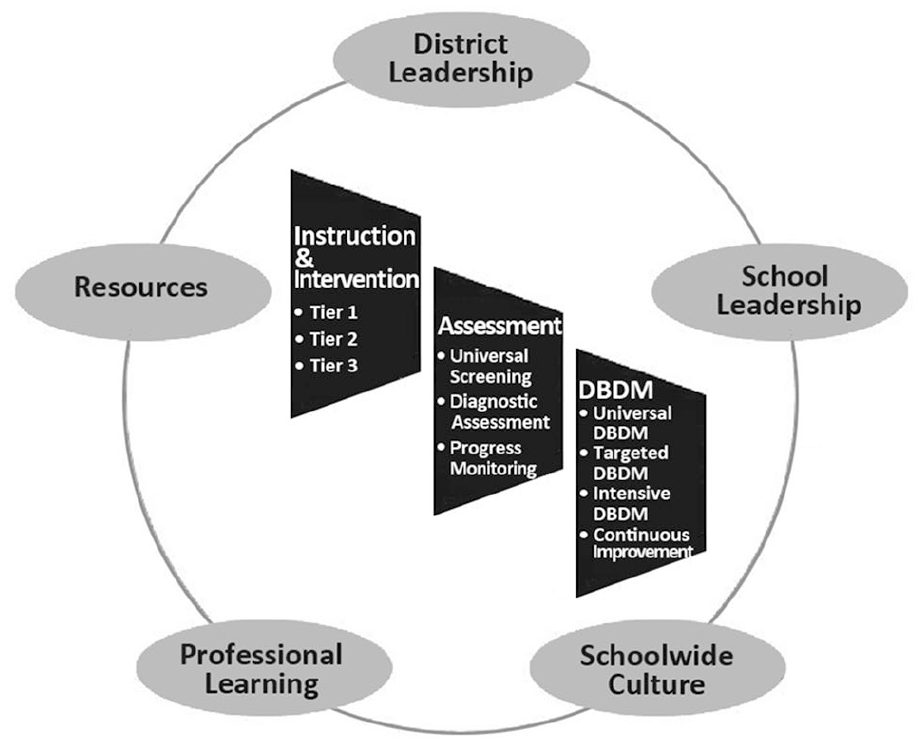
I-MTSS Domains and Items.
Defining Domains Within I-MTSS
Integrated Instruction and Intervention
The first domain includes instructional and intervention practices and materials strategically combined across academic and SEB areas. Within instruction and intervention, schools should evaluate the quality of instruction at the Tier 1, Tier 2, and Tier 3 levels. Criteria indicating effective instruction in each tier include using evidence-based materials, differentiating instruction based on data, and monitoring implementation fidelity. While ensuring each tier is effectively implemented across academic and SEB areas is critical to student success, strategically integrating practices within each tier enhances the effectiveness and efficiency of the instruction and intervention occurring at each level.
Integrated Assessment
The second domain ensures that all relevant staff have access to academic and SEB data simultaneously. Assessment practices—including universal screening, diagnostic assessments, and progress monitoring—should be conducted using tools deemed reliable and valid by an external source and used with fidelity. Furthermore, data gathered from all assessments should be stored and organized to allow relevant staff to access academic and SEB data simultaneously. Relevant staff includes those who need to use the data for decision-making. For example, a teacher may need to view academic and SEB data for students in their class, while an instructional coach will likely need to view data across multiple grade levels.
Integrated DBDM
Data-based decision-making is a systematic process for making and communicating data-based decisions regarding the level of support students need and intervention planning. While integrated assessment facilitates staff access to data, integrated DBDM refers to reviewing and using academic and SEB data to make decisions about instruction or intervention. Integrated DBDM includes processes across four levels. First, universal DBDM includes reviewing screening data and other student-level data (e.g., attendance records, grades, office discipline referrals [ODRs]) to determine whether students are adequately responding to Tier 1. Targeted DBDM and intensive DBDM processes include reviewing diagnostic, progress monitoring, and other student-level data to monitor progress and make decisions about Tier 2 and Tier 3 interventions, respectively. In addition to these three student-level DBDM processes, I-MTSS includes DBDM at the school level, which is called continuous improvement. This process includes reviewing school-level data to monitor and improve the effectiveness of I-MTSS. For example, a school leadership team may review subgroup data to identify disproportionality in schoolwide discipline patterns. The decision-making practices across all four levels of DBDM should strategically and purposefully rely on data from academic and SEB areas to meet the needs of students most effectively and efficiently.
Infrastructure
Infrastructure is the fourth domain and includes mechanisms for successful, long-term implementation of I-MTSS. District and school leaders who have a vision and are actively engaged in I-MTSS practices can help cultivate a schoolwide culture that promotes and consistently uses I-MTSS. Without staff buy-in, I-MTSS, like many initiatives, is not likely to be effective. Furthermore, I-MTSS should not be branded as “new” or “trendy.” Instead, it is a way to implement practices that support student academic and SEB development more efficiently. Aside from developing a culture to support I-MTSS, staff need adequate resources and training to implement core components of I-MTSS with fidelity.
Gladstone Elementary School’s principal, Ms. Frederick, attended a conference and heard about I-MTSS. She wondered if this would be a way to leverage and improve their current MTSS practices. Ms. Frederick brought this information to her school’s leadership team. At first, the staff balked at another “new” acronym and practice. “How can we be expected to implement a new version of MTSS if we don’t even have the first one in place yet?” remarked the instructional coach. The principal explained that I-MTSS was not something new to implement but a way to strengthen their current system by intentionally finding ways to address the reading, math, and behavior needs of students across all components of their system. Furthermore, the school in the neighboring town had been using an integrated approach and noticed the efficiencies it gained early in its adoption. The team remained skeptical but agreed to discuss ways to refine their MTSS system and incorporate more integration during their upcoming annual summer planning retreat (see Vignette Note at the end of the manuscript for information on how this scenario was developed).
Readiness for I-MTSS
As a systemwide framework, I-MTSS relies on staff’s shared attitudes, beliefs, and commitment to implement (McIntosh & Goodman, 2016). Furthermore, it relies on sufficient resources and infrastructure from school and district administrators (McIntosh & Goodman, 2016). While this article is about implementing I-MTSS, we recognize that establishing a baseline of current functioning is the first step to enhancing the implementation of schoolwide procedures. Understanding current implementation levels can help school teams more deeply understand their system’s strengths and areas of improvement. While measuring baseline functioning is beyond the scope of this article, Figure 2 provides a list of evaluation tools that have been psychometrically evaluated. These tools can help schools discover any “holes” in their current systems that may need bolstering before fully rolling out I-MTSS.
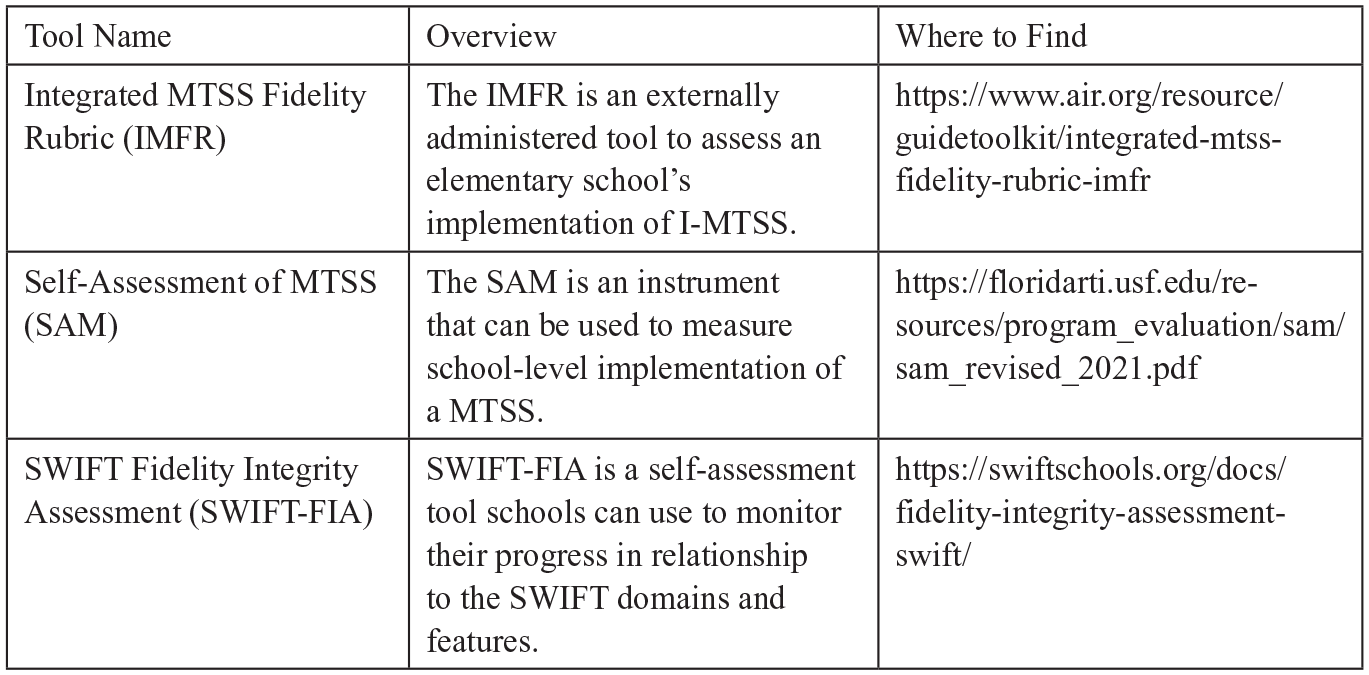
Tools for Assessing and Monitoring MTSS Practices.
Like each of the other domains, ensuring there is an effective infrastructure in place to support I-MTSS is a journey that involves many stakeholders (e.g., district leaders). However, schools need not wait to begin I-MTSS until infrastructure is entirely in place. Growth in implementation of I-MTSS occurs as schools purposefully plan, execute, and monitor essential components within an I-MTSS framework. In addition, schools need to prioritize one to two areas of focus during the I-MTSS rollout. These should be areas the school is already partially implementing or areas they are immediately ready to implement and build from there.
Practical Applications for Implementing I-MTSS
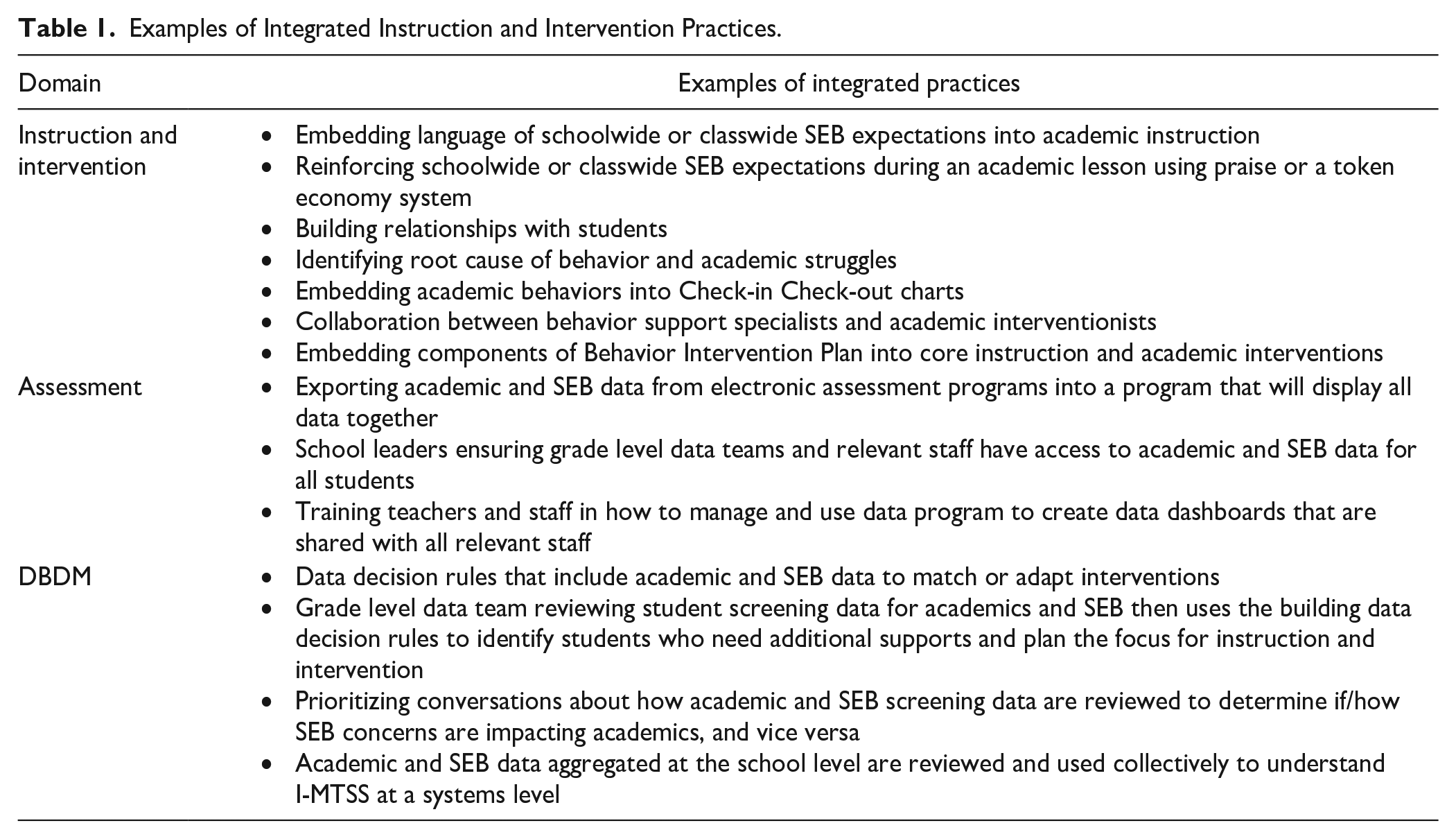
Below, we provide key processes for establishing or refining elements of I-MTSS with a lens on purposefully integrating practices. Tiered frameworks have been implemented effectively in elementary school settings (Coyne et al., 2018; Fien et al., 2021). Therefore, we base our descriptions of I-MTSS practices at this level. We also share practical applications for how school leadership teams and teachers can embed these practices in their settings. Schools can use these procedures to get started with I-MTSS or to refine and strengthen pieces of a current system. Figure 3 shares reflection questions that school leadership teams can use to plan and promote buy-in for each practice discussed below. We summarize additional examples of integrated practices in Table 1.
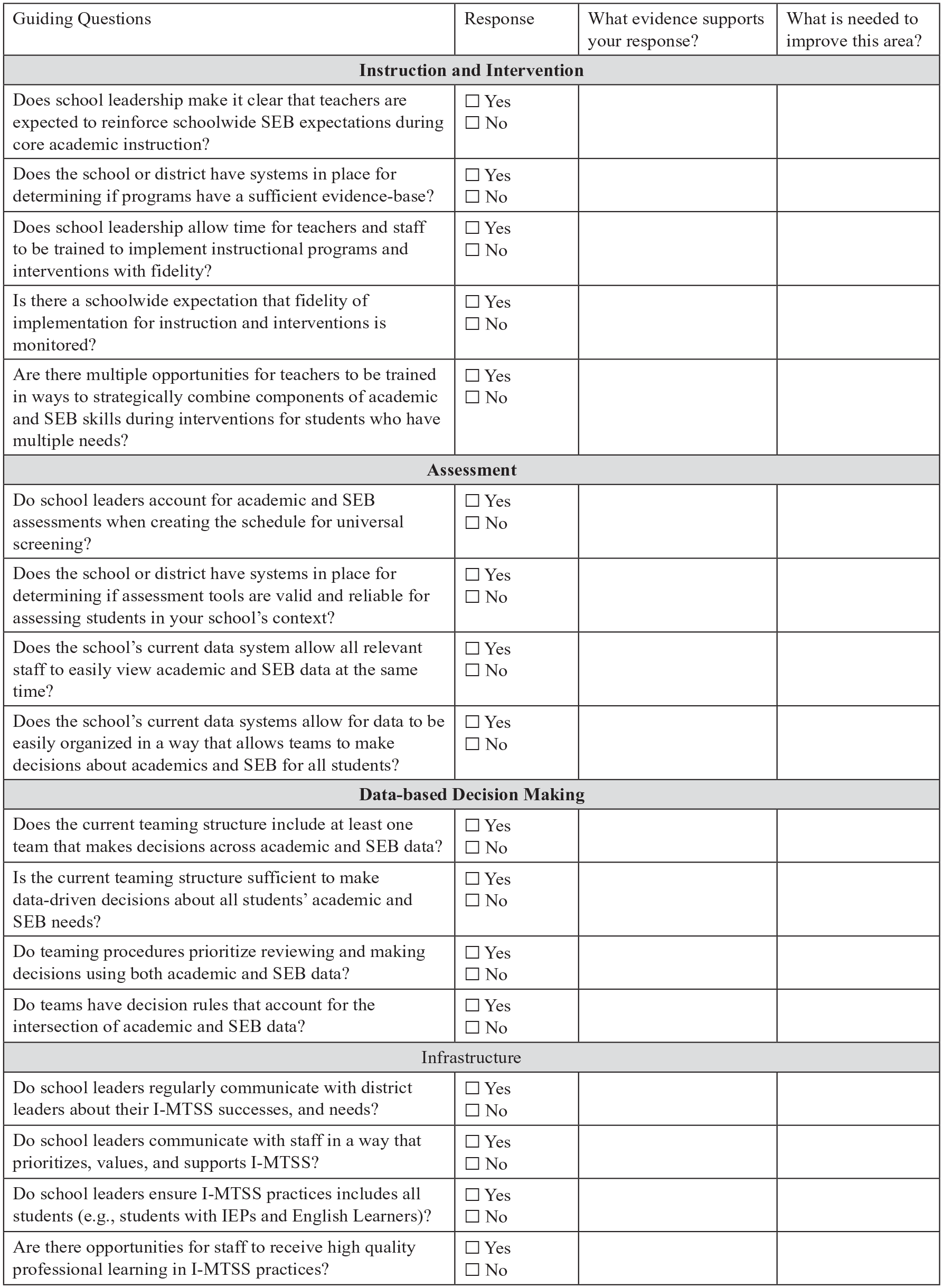
Guiding Questions for School Leadership Teams
Examples of Integrated Instruction and Intervention Practices.
Ensure Universal Instruction Incorporates Schoolwide SEB Expectations
When planning core instruction, students benefit from programming that addresses SEB expectations and learning goals. The core curriculum can be delivered using high-quality instructional practices that explicitly teach, promote student engagement, and provide feedback on academic skills and SEB expectations (Aceves & Kennedy, 2024). Schoolwide and/or classwide SEB expectations should be defined and posted in the classroom in a way that is easy for all students to see (Sugai & Horner, 2009a). While explicit teaching of expectations may occur with more intensity at the start of the school year and after school breaks, modeling and reinforcing them should be routinely part of instructional sessions. These practices help ensure students receive high-quality academic instruction paired with regular feedback and reinforcement of SEB expectations.
At Gladstone Elementary, the schoolwide expectations are Be Safe, Be Responsible, Be Respectful. The school leadership provides quarterly training and resources on the SEB expectations to all teachers. The trainings include opportunities for teachers to plan ways to teach and reinforce these expectations during their academic lessons. In addition, Ms. Frederick uses her walkthrough observations to record and provide feedback on the explicit modeling and reinforcement of SEB expectations during core instruction.
Mr. Watley, a third-grade teacher, has done an excellent job integrating schoolwide expectations into his lessons. For example, at least three times per week, before a whole group math lesson, Mr. Watley spends 5 minutes reviewing, modeling, and providing opportunities for students to practice respectfully engaging with the teacher before the lesson. Once the math lesson begins, he praises and provides points for students who are respectfully engaged. To end each lesson, he praises the whole group and shares examples of respectful behavior he noticed.
Create Systems to Gather and Organize Academic and SEB Screening Data Together
Universal screening helps identify students at risk for academic failure (Stanley et al., 2019). Screening tools exist for academic skills (e.g., reading, math) and SEB. To gather comprehensive assessments of student skills and risk levels, screening data must be gathered across both domains (Kilgus et al., 2019). School leaders can create a screening schedule to ensure there is time allocated for assessments in all areas. In addition, other student-level data can be gathered alongside formal screening measures. This information may include grades, classroom summative or formative assessment data, attendance, records of nurse visits, and ODRs.
Data are most useful for I-MTSS purposes when organized in a way that allows relevant staff to access data across all areas simultaneously. Data storage practices range from low to high-tech and can be adjusted based on available resources. At the low-tech end of the continuum, procedures include academic and SEB data in documents or databases that relevant staff can view simultaneously (e.g., a binder with printouts from assessments, multiple Excel spreadsheets, or different tabs in one Excel spreadsheet). Another example is a document, spreadsheet, or database showing data from academics and SEB assessments on one page. This often requires Excel formulas or manual entry of these data to show everything on one page. While printouts or spreadsheets are simple ways to view academic and SEB together, it is important to remember that it is difficult for more than one person to view data at the same time. These approaches rely on teachers to update and maintain records over time.
A higher-tech example might be using a program that exports academic and SEB data to a data dashboard. These programs can often support displaying multiple types of display data from multiple assessment tools. In addition, the data can be quickly sorted by student, class, or grade level. While these programs require fiscal resources and personnel training to manage data, they allow for efficient data access across multiple views. This is particularly beneficial for generating reports for individual students or, in aggregate, across groups of students. No matter the data storage system used, school teams must ensure the program complies with the Family Educational Rights Privacy Act (FERPA).
Regardless of how schools integrate assessment data collection and storage, these practices aim to ultimately facilitate easy access to academic and SEB data for all students by all relevant staff. This access sets the stage for staff to engage in the DBDM process described in the next section.
As principal, Ms. Frederick sets the school screening schedule. Based on the renewed focus on collecting academic and SEB data, she revises the screening schedule to allow teachers to collect reading, math, and SEB screening data for all students three times per year. In her monthly newsletter, Ms. Frederick discusses the importance of these data and the supports she is putting in place to ensure data collection happens with minimal disruptions to instructional time. In addition, she leverages the district’s data dashboard system to allow teachers to access screening data for their students across all areas tested.
Based on these changes, Mr. Watley and his team of third-grade teachers now have more regular access to their student data (that used to live in multiple binders and spreadsheets). The third-grade team meets three times per year for a “data dive” after screening is completed. The team projects the data dashboard on a screen to show screening data for reading, math, and the SEB screener. The team views data aggregated for the entire grade, by class, and by performance level (e.g., at risk or proficient) by clicking on various views that meet the needs of the team’s discussion. Access to all the data primes them for the DBDM part of their data dive.
Review and Make Decisions About Academic and SEB Data Together
Simply having access to data is insufficient. Teams must use data to make timely and meaningful decisions about students. For example, screening data can be used to identify students needing targeted or intensive interventions. Furthermore, diagnostic data allows teams to match students with programs and ensure they address needs across all areas. In many schools with a tiered system, separate academic and SEB teams review and decide about data. While we recognize that this teaming structure capitalizes on collective expertise in each area, it likely misses opportunities to make informed decisions that comprehensively account for student performance at any given time and across all academic and SEB areas. Therefore, within I-MTSS, it is essential that teams make student-level decisions:
include individuals with expertise across academic and SEB areas;
review of all relevant student-level data considering each student’s language and cultural background;
use validated decision rules that function in a manner that is intentionally combined across academic and SEB areas;
use data to plan targeted and individualized interventions.
Regularly monitoring student progress and reviewing data ensures students receive effective support in each targeted area. The DBDM procedures should leverage diagnostic, progress monitoring, and other student-level data to select and adapt interventions and monitor student progress regularly.
Historically, at Gladstone, the teaming structure included a school leadership team (focused on continuous improvement), a schoolwide RTI team (focused on Tier 2 and Tier 3 reading and math), a schoolwide PBIS team (focused on maintaining the school behavior systems), and grade level teams. While each team had some overlap in members and was supposed to have access to all relevant data, the teams primarily met and functioned independently. In the spirit of going “all in” on I-MTSS, Ms. Frederick and the school leadership team combined the RTI and PBIS teams into one Problem-Solving Team (PST). This team engaged in DBDM for students at risk or receiving Tier 2 and Tier 3 interventions. The grade-level teams stayed intact. Ms. Frederick asked all teams to create or revise procedures for how the team operates and create a series of decision rules for how they will use academic and SEB in conjunction with each other to make student-level decisions.
Mr. Watley, now a member of the new PST, helps his team develop data decision rules. For example, if a student is identified as potentially at-risk, at-risk, or at high risk on an academic screener, the team will cross-reference with at least two other types of data (e.g., SEB screener, ODRs, attendance) to understand the extent of the needs. They will use these data to ensure the intervention approach identified for each student comprehensively accounts for needs in all areas.
Use Data to Select and Adapt Interventions Based on Student Academic and SEB Needs
If a student has needs across multiple domains, these needs are not separate. Integrating DBDM practices that help teams understand student needs across multiple areas better prepares the team to select an intervention approach that addresses all student needs. Teams will benefit from considering the influence and interaction of academics with SEB concerns by developing an intervention plan that addresses both needs holistically (e.g., Vaughn et al., 2022). This allows academic behaviors (e.g., engagement, asking for help, following directions, work completion) to be seamlessly incorporated into an intervention that supports SEB development (Commisso et al., 2019; Majeika et al., 2020). Furthermore, teams can consider scheduling and sequencing interventions in a way that promotes expected behavior and allows students to receive the total amount of time in an academic intervention.
Mr. Watley has a student who was at risk on an SEB screener and potentially at risk on the math screener (in fact, fluency) in the fall. The PST recommends that this student participates in check-in/check-out (CICO) to teach and reinforce schoolwide SEB expectations (Hawken et al., 2020). In addition, based on the math screening data and formative classroom data, the team notes that the student can benefit from additional practice for his math facts and additional time with his CICO mentor. Mr. Watley and the PST created a plan to combine efforts to address both needs strategically. Specifically, the morning CICO check-in time with his mentor will be extended by 10 minutes. During this time, the student’s mentor will engage with the student in a structured math fact practice game aligned with core instruction. This revised CICO plan allows the student to spend additional time with his mentor while engaging in needed academic practice.
In another example for a different third grader, the student was receiving a Tier 3 phonics intervention and was identified as at high risk in the anxiety domain on the SEB screener. Teacher observations also indicate that the student’s anxiety is at its peak when entering and exiting classrooms. For this student, the anxiety during transitions to new classrooms is so severe that it is impacting the amount of time spent engaged in learning. To ensure reading and SEB needs are met, the classroom teacher and interventionist work together to ensure the student has an explicit schedule for their day, can transition to an intervention classroom during a natural break in the schedule, and can immediately go to the Calm Corner (e.g., area of the room where students can have time alone to decompress, have access to fidgets, listen to music) when she enters the intervention room to start her first activity. These practices allow the student’s SEB needs to be met while maintaining full access to academic instruction during her intervention period.
Monitor Student Progress
With integrated interventions in place, it is essential that student progress within these interventions is monitored and instruction adjusted as needed (Zumeta-Edmonds et al., 2019). When an intervention is selected, the team should also select a progress monitoring tool or tools aligned with the target skills. This may mean using multiple measures to gather info on relevant academic and SEB skills for integrated interventions. Ideally, these data points are kept in graph form with a predetermined goal for use during the DBDM process.
Ms. Frederick and the school leadership team created an expectation that teachers providing Tier 2 and Tier 3 interventions collect progress monitoring data at least once per week on all skills being addressed, including SEB skills. In the past, progress monitoring efforts have been focused on academic skills. Now, school leaders are providing support and training to equip teachers better to measure and monitor student progress in SEB skills. The PST meets every 6 weeks to review the progress monitoring data and make additional decisions about student progress within their interventions.
Additional Considerations for I-MTSS
Across all elements of I-MTSS, it is essential to avoid integrating just for the sake of integrating. By this, we mean that integration should only happen when a student has a data-indicated need. Ensuring students’ needs are addressed through integrated approaches to instruction and intervention support processes that are efficient and likely more effective. For example, if a student receiving a Tier 2 math intervention does not have any SEB needs, then it is not appropriate to force addressing SEB during this very focused intervention time. For many teachers, appropriately integrating academic and SEB practices when planning instruction and intervention often comes very naturally. When using an I-MTSS framework, teachers and staff can ensure intervention integration is intentional and systematic rather than an afterthought.
An additional consideration for I-MTSS is to create a plan for regularly monitoring implementation fidelity over time. Monitoring fidelity can occur across all system elements (e.g., using a tool like the IMFR; Gandhi et al., 2024) or for specific components as they are rolled out or refined.
Conclusion
Schools are often expected to do more with less in today’s educational climate. As student needs continue to increase (U.S. Department of Education et al., 2021, 2022), schools have no choice but to be more purposeful in using resources to ensure students receive requisite levels of support. In addition, district and school leadership play a pivotal role in the rollout, monitoring, and sustainability of practices. Integrated MTSS facilitates strategic and purposeful allocation of support across academic and SEB areas to help schools efficiently allocate resources while addressing increased complexity in student support needs.
Footnotes
Authors’ Note
The vignette described in the article is a fictionalized account drawn from several authentic situations as an aggregated scenario.
Declaration of Conflicting Interests
The author(s) declared no potential conflicts of interest with respect to the research, authorship, and/or publication of this article.
Funding
Funding for this project was provided by U.S. Department of Education (R324N190007).