




Abstract
Students who require intensive individualized intervention often demonstrate needs in both academic and behavioral domains. However, practices around assessment and development of interventions are often siloed and separate, which can be a barrier to implementing intensive individualized support in an integrated manner to maximize efficiency. In this article, we provide a blueprint for educators to work collaboratively to complete an integrated assessment that can lead to developing a truly integrated individualized intervention. We also share a vignette demonstrating how team members might create a team to complete an integrated assessment and create a corresponding intervention plan.
Keywords
Max is a second-grade student who spends most of his day in an inclusive general education classroom, with specialized instruction in reading, writing, behavior, and executive functioning skills documented on his individualized education program (IEP). Ms. Kim, an elementary special education teacher, knows Max as a friendly, outgoing student who loves his friends and recess and finds ways to positively connect with adults. Ms. Kim also knows that Max reads at a Kindergarten level and demonstrates high rates of challenging behaviors during reading instruction.
Several times a week, Ms. Kim is pulled in to support Max in his classroom during Tier 1 reading instruction in his inclusive classroom. Even with planned supports to enable Max to access Tier 1 reading instruction (i.e., pre-teaching content, providing a range of response options), Max’s behaviors disrupt students’ learning and his teacher’s teaching. Ms. Kim has also struggled to engage Max during his small group reading intervention in her resource room. Although Ms. Kim feels confident in the evidence-based Tier 3 intervention approach (an explicit phonics program) she implements to support Max’s progress toward his reading IEP goal, instructional time is often lost due to behavioral disruptions.
Ms. Kim is preparing for Max’s upcoming IEP meeting, where his IEP team will review his academic data and the results of a recent functional behavior assessment (FBA). The team has already been collaborating with Max’s family to draft measurable goals, a behavior support plan (BSP), and other individualized supports included in his IEP. As Ms. Kim reviews Max’s FBA, she notices that Max missed 60% of his reading instruction due to disruptive behaviors across 1 week and that the perceived function of his behavior is escaping or avoiding reading tasks. Ms. Kim can’t help but wonder if there is a way to support Max’s behavioral and academic needs in a more integrated, systematic, and comprehensive manner.
She sees that each area of need creates a difficult cycle: (a) Max’s disruptive behavior interrupts reading instruction and interferes with his reading growth, and (b) gaps in Max’s reading skills make reading difficult and increase the likelihood that he will engage in disruptive behaviors to escape instruction. Ms. Kim sent an email to the team. She suggested that it may be beneficial to look deeper into how Max’s reading and behavioral challenges may interact with one another rather than considering them separately. She recommends that they use a more efficient approach by developing and implementing integrated academic and behavioral supports in Max’s IEP.
It is common for students like Max to have comorbid academic and behavioral needs. An estimated 30% of students with learning disabilities also have co-occurring behavior difficulties (Sahoo et al., 2015). These students require intensive intervention to promote both academic and behavioral skill development—both of which are vital in early grades. Strong early reading skills can set students up for future reading success and improve long-term trajectories related to educational attainment and teenage and adult adjustment (Kern & Friedman, 2008). Similarly, students exposed to evidence-based school-wide behavioral practices show an overall increase in emotion regulation and prosocial behaviors (Bradshaw et al., 2012) and improved reading achievement (Horner et al., 2009).
Academic and behavioral needs often co-occur and, without effective support, may result in poorer student outcomes—especially among students with intensive and individualized needs in both areas (e.g., Gage et al., 2014; Kern & Friedman, 2008). With effective support, however, students with intensive and individualized needs can experience academic and behavioral success (National Center on Improving Literacy, 2023). In a multi-tiered system of support (MTSS) framework, students with intensive and individualized needs receive Tier 3 support and targeted Tier 2 and universal Tier 1 support. An integrated approach to assessment may help teams determine how best to support a student with individualized academic and behavioral needs and support the process of an integrated approach to intervention, which will allow student-specific Tier 3 teams to efficiently and effectively support both areas of need. The purpose of this article is to provide a blueprint for supporting students with intensive behavioral and academic skill needs through integrated assessment to support team-based development of an integrated intensive intervention approach. In this article, we assume background knowledge of Tier 3 reading and behavior support. For readers with less background knowledge, we provide suggestions (and hyperlinks) for additional resources that provide foundational knowledge about Tier 3 reading or positive behavior support.
Review of Intensive Reading and Behavior Research
Diagnostic academic and functional behavioral assessment strategies are well-established approaches to assess a student’s reading and behavior needs. Using validated methods to assess needs concurrently and reviewing assessments in an integrated manner may help a team develop an intervention that integrates academics and behavior. In the following sections, we briefly review common approaches to providing intensive reading and behavior assessment and intervention, and we suggest additional resources to learn more about how to implement each approach.
Intensive Reading Assessment and Intervention
Students with significant reading needs often require intensive Tier 3 intervention to develop literacy skills. These are students who, within an MTSS framework, show minimal academic progress after receiving high-quality Tier 1 instruction and additional targeted Tier 2 support (Gersten et al., 2008; Wanzek & Vaughn, 2007). A Tier 3 approach requires the school team to conduct a diagnostic academic assessment to clearly define that student’s academic needs, develop individualized goals, select an evidence-based intervention to meet those goals, monitor student progress, and adjust the intervention as needed (Wanzek & Vaughn, 2007). This process, known as a problem-solving process or data-based individualization (DBI; Lemons et al., 2014; National Center on Intensive Intervention, 2013), is a particularly valuable method for interventionists to address persistent reading difficulties for students with disabilities (Lemons et al., 2016).
When intensifying and individualizing a reading intervention, a Tier 3 team considers the different dimensions that may be used to intensify the intervention such as the strength of the intervention, the dosage or number of opportunities to respond (OTRs) and receive feedback, alignment with student need and standards, attention to transfer or generalization of skills, the use of explicit instruction principles, and the incorporation of behavioral strategies (Lemons et al., 2014; National Center on Intensive Intervention, 2013). Several organizations offer resources on intensifying reading interventions, such as online courses (see, for example, https://intensiveintervention.org/reading-course-intervention-programs-reading) and intensification lessons and articles (see https://improvingliteracy.org/kit/instructional-intensification#framework). Based on these recommendations, intensive reading assessment and intervention will likely improve outcomes for students with individualized reading needs. However, students with co-occurring individualized behavior needs may also require intensive behavior assessment and intervention to experience success.
Intensive Behavior Assessment and Intervention
Positive and proactive classroom behavior support practices promote improved academic, social, emotional, and behavioral skill outcomes for students with and without disabilities (Center on PBIS, 2021). Similarly to the MTSS model in reading, although most students respond to preventative and proactive Tier 1 strategies in their classroom, some students require targeted (Tier 2) and/or individualized and intensive (Tier 3) intervention to address persistent contextually inappropriate challenging behaviors (Center on PBIS, 2023). Interventionists use an FBA—a systematic evidence-based process for students who require an individualized intensive response to behaviors—to assess student behavior and guide the development of an effective, efficient, and function-based BSP within a PBIS framework.
FBA
An FBA is a process for determining the function of a student’s target behavior by allowing educators to gain insight into what the specific contextually inappropriate behavior looks like, what triggers the inappropriate behavior (antecedents), and what reinforces or maintains it (consequences; Ingram et al., 2005). For detailed guidance on completing an FBA, see Center on PBIS guides for brief (Center on PBIS, 2022a) and comprehensive (Center on PBIS, 2022b) FBAs. Determining the function of a student’s behavior allows educators to adapt the environment to minimize instances of behavior, prioritize teaching replacement skills to help the student meet the same function acceptably and safely, and respond in a way that minimizes access to the perceived function and reinforces appropriate use of replacement skills (Simonsen & Myers, 2015).
Development and Implementation of a BSP
Using information gathered during the FBA process, educators can develop a competing behavior pathway that summarizes the current context and outlines alternative and replacement behaviors, as well as related evidence-based contingencies (McIntosh & Goodman, 2016; O’Neill et al., 2014). Using the competing behavior pathway model, the team can design a BSP that includes antecedent, teaching, and consequence strategies to make the contextually inappropriate behavior irrelevant, inefficient, and/or ineffective (Crone et al., 2015). Teams are prompted to consider the following:
1. Setting event strategies to reduce the likelihood of the setting events (that increase the probability of disruptive behavior) or to support the student if a setting event has occurred;
2. Antecedent strategies to arrange the environment to set the student up for success (e.g., predictable posted schedule), provide choice (e.g., order of tasks), and prompt desired behaviors;
3. Instructional strategies to explicitly teach the desired behaviors (i.e., social, emotional, and behavioral skills), including both (a) short-term skills to replace the disruptive behavior by meeting the same function and (b) long-term desired skills, like academic engagement during instruction;
4. Consequence strategies to ensure (a) desired behaviors result in specific praise and function-based reinforcement and (b) disruptive behaviors are supportively redirected and do not result in function-based reinforcement.
Finally, the team plans to collect data and monitor the fidelity of BSP implementation to ensure that it is being implemented as designed. Developing a BSP with highly operationalized behaviors, interventions, and roles supports the successful implementation of the BSP (Horner et al., 2000). In addition, implementing the BSP with fidelity allows the team to evaluate the effectiveness and efficiency of the interventions accurately (Crone et al., 2015). For additional guidance on developing a BSP, see the Center on PBIS (2022c) guide on Student-Level Systems, which includes information and examples to guide teams in developing a BSP.
For students with intensive behavioral needs, a function-based approach to assessment and intervention is likely to be effective; however, this approach may be insufficient for students with co-occurring academic needs. For students needing academic and behavioral support, we encourage teams to consider an integrated approach to assessing student needs and developing interventions.
An Integrated Approach
Evidence-based, intensive reading or behavior interventions may be effective for students with intensive reading or behavioral needs, respectively. However, implementing separate reading and behavior interventions can be overwhelming for students with co-occurring reading and behavior needs. Interventions are often developed in a way that may take significant time and effort (e.g., separate reading intervention and social skills groups vs. an intervention group that addresses both skill needs) and/or be counterproductive (e.g., a BSP may recommend extended breaks from instruction, which may interfere with students’ engagement in reading intervention), resulting in potentially less efficient and effective support for the student. Studies focusing on improved academic outcomes from behavioral interventions have shown mixed results (e.g., Chitiyo et al., 2011), demonstrating a need for strong behavior support interventions and corresponding academic support. Early research into integrating interventions has shown more promising results in both domains at the individual student and school-wide levels (McIntosh & Goodman, 2016). However, there is less research to support the integration of assessment tools to guide intensive intervention development using a truly integrated approach to the development of the intervention.
To address this need, the Institute of Education Sciences (IES) within the U.S. Department of Education funded a Research Network involving teams from various universities to develop and research the use of practices, assessments, and systems that integrate academic and behavioral supports within an Integrated-MTSS framework (see www.mtss.org). As part of this network, researchers have partnered with local schools to support the development of individualized, intensive, and integrated reading and behavior assessments and intervention plans. Our truly integrated approach involved a diverse student team with targeted expertise that concurrently assessed and examined diagnostic data related to reading and behavior to create an intervention plan that comprehensively addressed all aspects of the student’s intensive needs. In the following sections, we describe four key steps a student-specific Tier 3 team can use as a blueprint for concurrent assessment and collaborative intervention planning.
Step 1: Start With an Integrated Team
To enable integrated assessment and intervention, a student-specific team must include individuals with relevant expertise, including diagnostic academic assessment, FBA, academic intervention, behavioral support, student-specific knowledge, and other relevant areas. If a student already has an IEP team, check to ensure members have all relevant areas of expertise (in addition to district and state requirements). If the team needs more expertise in a given area, be sure to add the appropriate school staff members to the team. If a student is referred for Tier 3 support, start by forming a student-specific Tier 3 team that includes all areas of expertise (see Center on PBIS, 2023 for guidance).
Once formed, members of the student-specific team work together to assess the student’s skills, analyze data, and develop a comprehensive plan based on expertise from all members. For example, school psychologists or other interventionists can conduct and interpret individualized assessments to inform student-specific supports. General education teachers provide details about the student’s current academic performance and routine skills, while providing expertise in the general education curriculum. Special educators share insight into the student’s performance and progress toward academic, social, emotional, and behavioral skills given specialized instruction, including modifications and accommodations that promote the student’s success. Related service providers (e.g., occupational therapist and school social worker) help the team understand how the student accesses their environment, the curriculum, and/or relationships with themselves and others. Family members provide valuable insight into their child’s strengths, challenges, and preferences because they bring expertise to the child’s entire history. Students should be included when appropriate (i.e., in older grades) so that their voice is prioritized. To enable student-specific teams to have integrated (rather than siloed) conversations about students’ needs, members of the team conduct and summarize an integrated assessment in the next step.
Step 2: Complete and Summarize an Integrated Individualized Assessment
Each student-specific team develops a plan to assess students’ areas of need (in this case, reading and behavior). Although typical approaches to assessment and evaluation require examining each area of unique need, an integrated approach requires examining areas of need in concert. After collecting data in both reading and behavioral domains, the team determines the student’s complementary strengths to guide an integrated intervention approach. Identifying skills in both domains allows team members to build upon students’ strengths, target specific reading and behavior skills, and plan explicit instruction and supports in an integrated way. Discussing the student’s needs as a team highlights the context of specific skill deficits. For example, team members with expertise in multiple areas may recognize that a student who frequently engages in escape-maintained behavior during reading lessons avoids a reading task that does not match their current reading skills.
To facilitate an integrated assessment, teams may use an Integrated Intensive Assessment Summary template (see Figure 1). Using this template, educators highlight students’ strengths and needs, as well as the context in which these strengths and needs are typically observed. Documenting and analyzing the data from multiple sources in an integrated manner serves as an outline for the Integrated Intervention Plan (next step) and allows the team to evaluate the student holistically rather than with a siloed approach. To use the Integrated Intensive Assessment Summary, the team should first identify strengths and current supports with input from relevant staff or families and refer to relevant documents such as existing IEPs, FBAs, or BSPs. The team should then review the assessment data in both academic and behavioral domains, being sure to discuss how needs or difficulties in these areas might affect one another (e.g., determine which target behaviors typically occur during which specific reading activities or determine what foundational reading skills need to be taught so that the student is more likely to tolerate reading activities without exhibiting target behaviors).
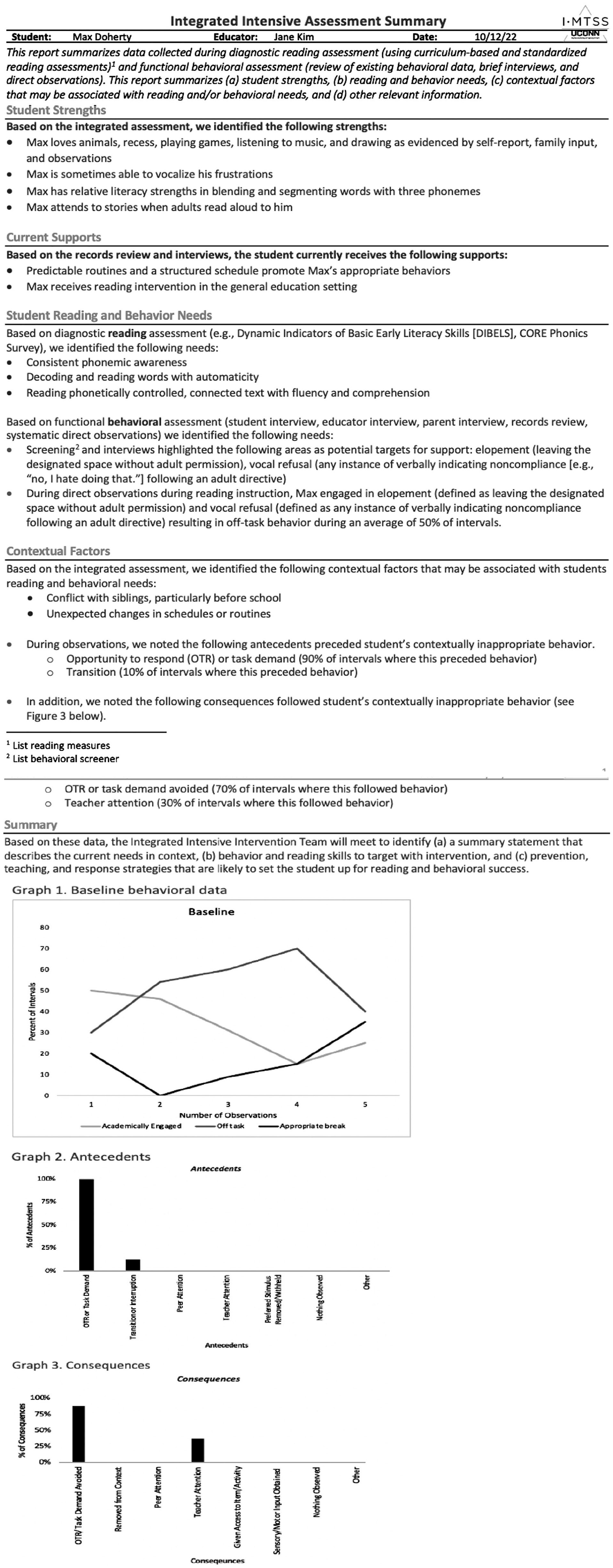
Integrated Intensive Assessment Summary.
Step 3: Develop an Integrated Intensive Intervention Plan
After reviewing the Integrated Intensive Assessment Summary, teams use the Integrated Planning Document (see Figure 2) based on the competing behavior pathway to facilitate an integrated approach to efficiently support reading and behavior needs (McIntosh & Goodman, 2016). With this approach, student-specific teams consider the student’s diagnostic reading and behavior needs in context and complete the summary statement (boxes 1–4 in the competing pathway) to describe the setting events (box 1), antecedents (box 2), reading and behavior needs (box 3), and current consequences (i.e., function; box 4). Then, they identify (a) the short-term behavior skill that meets the same function and can replace the disruptive behavior (box 5); (b) the reading skills (e.g., phonemic awareness) to be supported with intervention (box 6); and (c) the long-term behavior skill(s) that will enable the student to access instruction (box 7).
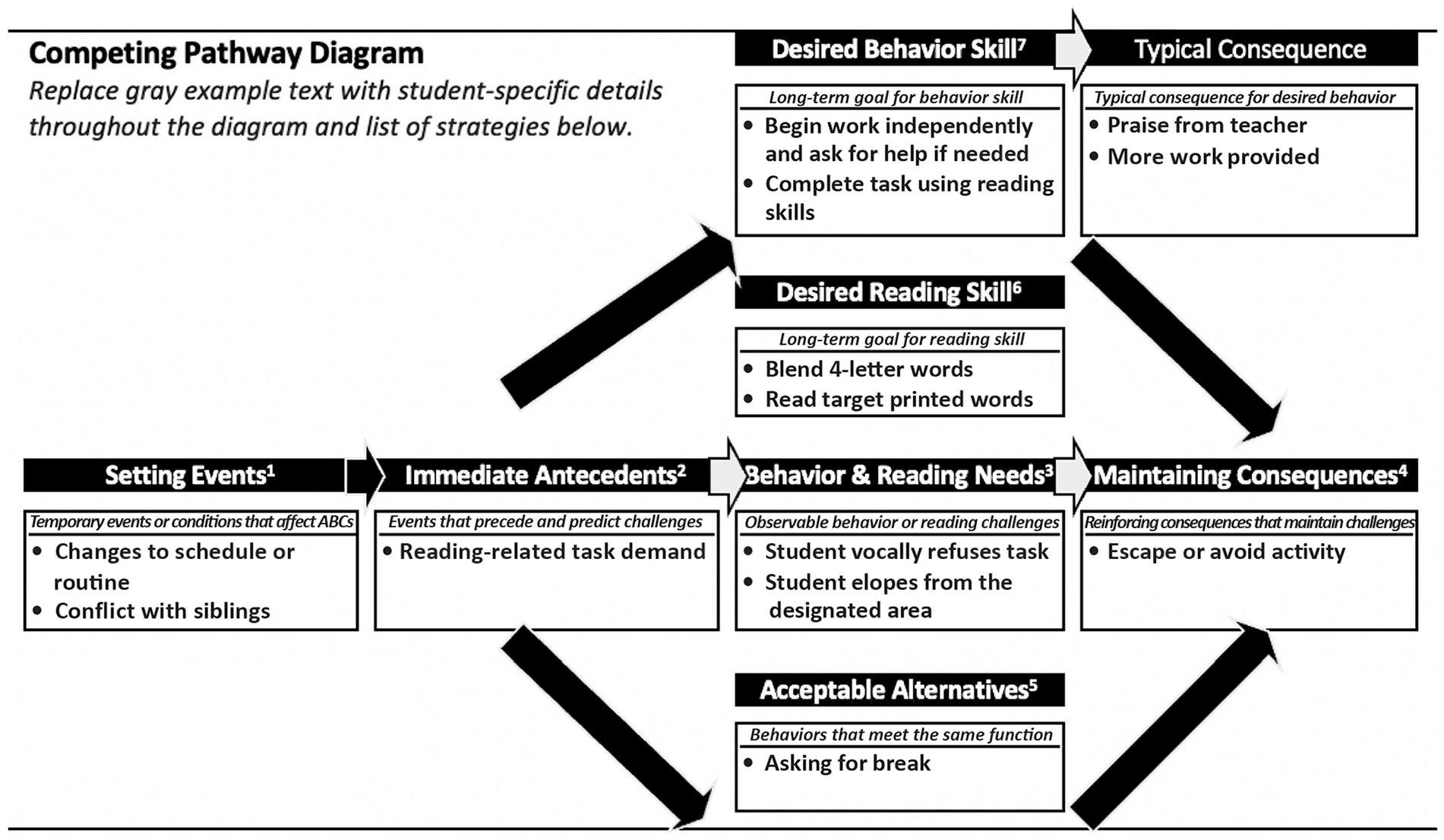
Integrated Planning Document, based on Competing Pathway Diagram.
Next, student-specific teams consider the specific setting event, antecedent, instructional, and consequence strategies and incorporate additional strategies to prompt, explicitly teach, and praise desired reading skills. As the team discusses potential strategies, they consider (a) what is likely to work (i.e., evidence-based practices implemented in an individualized and culturally relevant way, such practices recommended by the What Works Clearinghouse Practice Guides; see https://ies.ed.gov/ncee/WWC/Resources/ResourcesForEducators) and (b) what is likely to be implemented (i.e., strategies that match the context, skills, and preferences of the educators). The team members use the Integrated Intensive Intervention Plan (see Figure 3) to document a small number of strategies in each area that are likely to work and be implemented. Then, they develop specific integrated intervention materials to support reading and behavior. For example, teams may use the integrated lesson plan template (Melton et al., 2024) to design an integrated intensive intervention lesson to explicitly prompt, teach, and provide specific feedback on key reading and behavioral skills. The team should consider how to best embed evidence-based behavior supports such as behavioral prompts or explicitly teaching social skills into the academic intervention materials to create a cohesive, structured lesson plan that supports both areas of need.
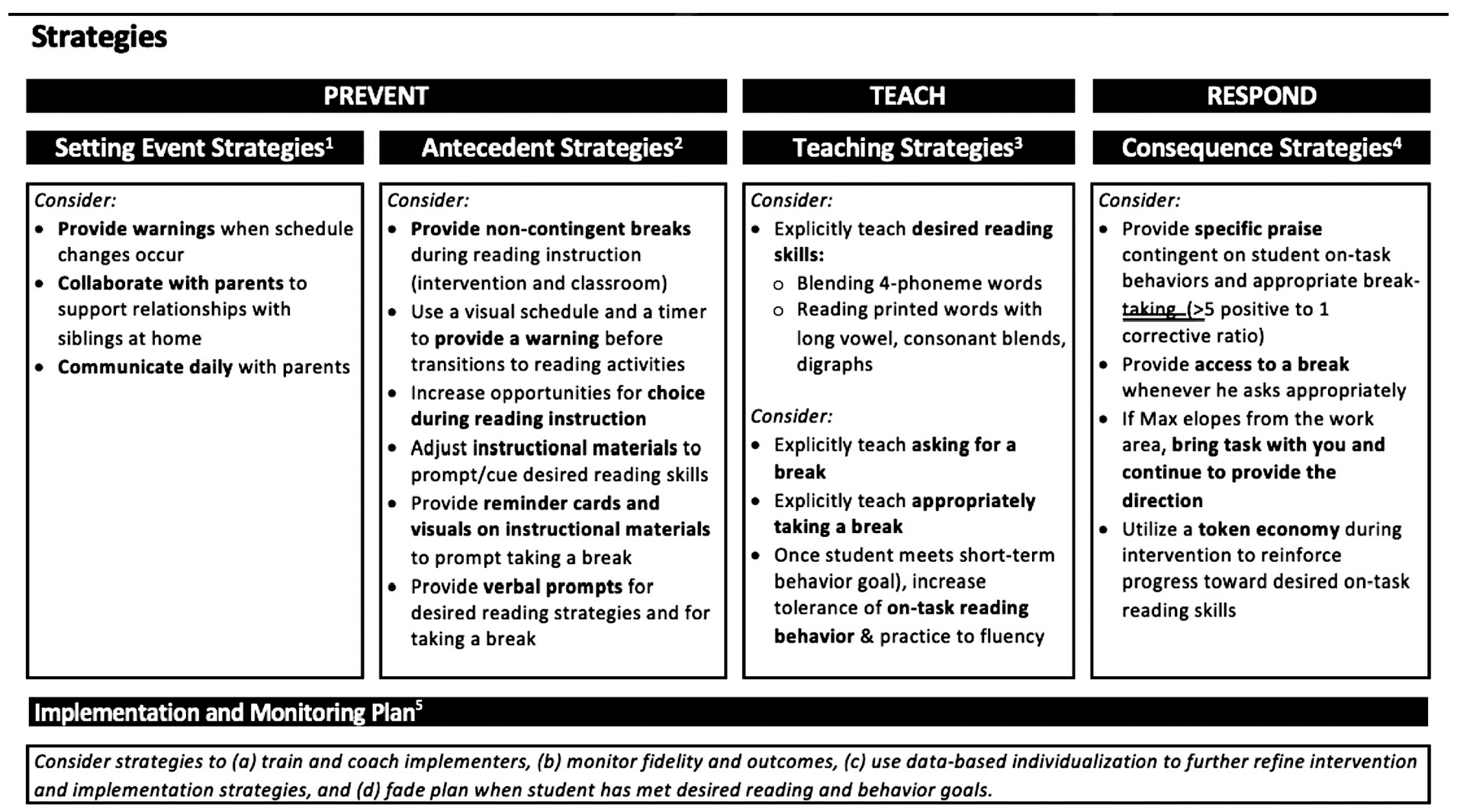
Integrated Intensive Intervention Plan.
Step 4: Implement and Monitor Integrated Plan
Once the plan is developed, the focus shifts to supporting implementation. To guide adjustments to student practices and implementation supports, team members collect reading and behavior data concurrently to monitor the student’s progress or lack thereof (see Figure 2, box 5). Behavior data are collected using frequency counts and/or duration of targeted behaviors. Reading data are collected using progress monitoring probes. Both data are graphed so that shared team members can visually analyze them together to evaluate progress. During implementation, the integrated team should meet biweekly to share data and discuss the student’s progress. The data-based individualization process continues, and intervention adjustments are made in response to the student’s behavior and reading outcome data, allowing this intervention to be highly individualized to all of the student’s needs. Team members also regularly monitor intervention fidelity, using teacher self-reporting and observation checklists. Evaluating fidelity data will allow the team to consider several aspects of the Integrated Intervention Plan as it is implemented, such as the contextual fit, the effectiveness of the intervention, and whether the team members are implementing the intervention as designed (Crone et al., 2015; Horner et al., 2000).
Following these four steps allows a team to avoid a siloed approach to assessment and plan development, building an intervention that can efficiently and effectively address both aspects of student needs. In the next section, we return to Max’s case study to see how his team implemented these four steps.
Integration of Assessments and Developing the Integrated Intervention for Max
After Ms. Kim requested that the team take an integrated approach, they discussed four main steps to integrated intensive assessment and intervention: (a) start with an integrated team, (b) conduct and summarize an integrated intensive assessment, (c) develop an integrated intensive intervention plan, and (d) implement and monitor the integrated plan.
First, Ms. Kim ensured that Max’s IEP team included individuals with relevant areas of expertise. His team included Mrs. Brown (Max’s classroom teacher), Ms. Kim (a special educator who collaborates with Mrs. Brown to support Max in and outside of his inclusive classroom setting and has expertise in reading), Max’s mother, and Dr. Keys (the school psychologist who conducts and interprets results from academic assessments and FBAs). Thus, his team has academic and behavioral skills expertise, and multiple people know Max across school and home settings. Although each of the team members had independently completed some aspects of the assessment (e.g., Ms. Kim completed academic assessments, and Dr. Keys completed the FBA), Ms. Kim knew it would be vital to have input from each of these team members during the integrated intervention assessment planning meeting to design an intervention that could be effective and implemented with fidelity (Center on PBIS, 2022c).
Second, the team discussed the importance of their integrated approach at Max’s IEP meeting. They compiled their assessment (academic and FBA) data to complete the Integrated Intensive Assessment Summary (see Figure 1). Specifically, Ms. Kim and Dr. Keys worked together to summarize Max’s strengths and interests (identified in FBA interviews, reading assessments, and direct observations). Next, they summarized the reading assessment results, noting Max’s current progress and the skills Ms. Kim determined should be targeted with this intervention. Then, they described the behaviors that interfere with Max’s learning and included baseline data from Dr. Keys’ observations, which show the current levels of his disruptive behavior and the most common antecedents and consequences of Max’s behavior. During this discussion, Mrs. Brown shared classroom data, which supported the assessment information related to Max’s complementary strengths and needs in reading and behavior domains. Together, team members decided that Max may benefit from (a) predictable instructional and classroom routines that set Max up for success, (b) explicit social skills instruction to support his engagement during instruction, (c) explicit reading intervention to target foundational reading skills, (d) integrated behavior supports that prompt and provide specific feedback for targeted behavior and reading skills during instructional routines, and (e) brief (20 second) breaks interspersed throughout instruction (enabling him to stay engaged in reading instruction for more extended periods of time).
The team decided to use Enhanced Core Reading Instruction (ECRI) as a framework for providing intensive reading intervention. ECRI uses evidence-based reading routines and scripts to support the learning of foundational reading skills (Fien et al., 2015). This framework was selected for its use of explicit instruction techniques and alignment with the student’s needs (National Center on Intensive Intervention, 2013). The team decided that key routines to target were phoneme blending, segmentation, letter sounds, decoding and reading words, and spelling. After the team agreed on the content of the Integrated Intensive Assessment Summary, determined the hypothesized function of his behavior, identified a replacement skill, and agreed on an academic scope and sequence for the reading intervention, they discussed the lesson plans for his intervention and utilized the Integrated Intervention Plan to document specific ways to integrated intervention strategies. For Max, this included considering how his difficulties with reading in the past have created a pattern of behavior that allows him to escape reading time by exhibiting his target behaviors. See Max’s Integrated Intervention Plan (see Figure 3).
To implement this plan, the team decided that Ms. Kim will use the agreed-upon scope and sequence to develop daily lesson plans integrating an empirically-supported social skills program (e.g., Skillstreaming; McGinnis, 2012) and reading intervention (e.g., ECRI; Fien et al., 2015). The team determined that Max would participate in integrated intervention 5 days per week in a one-on-one setting to increase the strength and dosage from the existing academic and behavioral support (National Center on Intensive Intervention, 2013).
To set Max up for success, Ms. Kim would develop a predictable schedule, provide reminders for expected behaviors, teach in an environment that supported his focus and minimized distractions, and intersperse prompts and brief (~20-second) breaks throughout each 30-minute lesson (antecedent strategies). The team determined that daily lesson plans would include mini social skills lessons (<5 min) and six reading routines focused on foundational skills (phoneme blending, segmentation, letter sounds, decoding and reading words, and spelling) to address behavior and reading skill needs (instructional strategies). Throughout each lesson, the team discussed how Ms. Kim would provide specific positive praise and supportive and instructional corrective feedback to encourage the correct use of reading and behavioral skills (consequence strategies). In addition, they planned a token economy so Max could earn access to preferred activities that provided a brief break after each reading lesson (e.g., 1-minute game, fun conversation, detour to a preferred location on his return to his classroom) by earning tokens for responding to questions, staying in the intervention area, and asking for breaks appropriately (another consequence strategy included in his plan).
Max’s teacher commented on the importance of these skills transferring to her classroom, so she planned to welcome him back from his intervention with a brief discussion of the skills he learned (e.g., asking for a break, new letter-sound), prompt for those skills in her classroom (i.e., has him tape his skill card to his desk, provides verbal reminders to use the skills), and praise him (and gives him a break) when he uses his skills in class.
Finally, the team developed a plan to review Max’s progress and the team’s ability to implement the plan with fidelity. To track Max’s progress, Mrs. Brown and Ms. Kim will continue monitoring Max’s frequency of behavior skills and needs across settings. To track his academic progress, Ms. Kim will complete the Dynamic Indicators of Basic Early Literacy Skills (DIBELS; Good et al., 2003; see https://dibels.uoregon.edu/)—a curriculum-based measure of students’ basic reading skills—to assess the targeted skill at the end of each intervention lesson. The team plans to collect fidelity of implementation data using a checklist to ensure that the intervention is effective and efficient. They will monitor the implementation of the plan weekly, alternating between Ms. Kim self-assessing her fidelity and having Dr. Keys observe the session. Dr. Keys will graph and summarize Max’s reading and behavior data, along with the team’s fidelity data, and share these data at each team meeting, where Max’s progress is also discussed.
Conclusion
Tools to assess individualized student needs in reading or behavior are well-researched. However, assessment and development of interventions are often done using a siloed approach. This approach to an individualized, integrated intervention, which considers the function of a student’s behavior and its tie to specific academic skill needs, allows educators to develop a truly integrated plan that is most likely to result in positive academic and behavioral skill outcomes for students who require Tier 3 support. The tools included in this research project and article are meant to encourage a team-based approach that capitalizes on individual expertise and strengths, uses evidence-based behavior and academic approaches, and allows for increased collaboration to develop an individualized, integrated intervention to best support student needs.
Footnotes
Authors’ Note
The vignette presented in this paper is a fictionalized account drawn from the research literature and is not based on actual people or events that were observed by the authors or used in research.
Declaration of Conflicting Interests
The author(s) declared no potential conflicts of interest with respect to the research, authorship, and/or publication of this article.
Funding
This article is based on research conducted by the Integrated Multi-tiered Systems of Support Network, funded by IES Grant # R324N190012. The opinions expressed are those of the authors and do not represent views of the Institute or the U.S. Department of Education.
