




Abstract
There are many integrated Multi-tiered Systems of Support (iMTSS), which we refer to as integrated-tiered systems. These systems hold benefits for students with disabilities, as such systems have the potential to facilitate inclusion and focus the collective expertise of educators committed to meeting students’ multiple needs. The Comprehensive, Integrated Three-Tiered (Ci3T) prevention model was designed to meet student’s academic, behavioral, and social and emotional well-being needs within one integrated system. Using lessons learned over decades of research, we present a step-by-step approach to building educators’ capacity to implement integrated tiered systems through data-informed professional learning. We illustrate how school leaders can use this approach to onboard new faculty, plan coordinated ongoing professional learning for all educators, and facilitate the use of data to inform instruction—all of which are intertwined through the design, implementation, and evaluation of Ci3T models.
Ms. Rabadi is very excited about starting her new position at Lincoln Elementary School. She and her family were recently transferred to a military base in Kansas. Ms. Rabadi interviewed for a fifth-grade general education teaching position at a local district that prioritized inclusive programming for students with disabilities. The job position description said it was a Comprehensive, Integrated Three-tiered (Ci3T) model of prevention district with all 21 schools implementing Ci3T. She followed the links to the district and school websites, where she read more about Ci3T, which she learned was a type of integrated tiered system. Her previous district implemented schoolwide positive behavioral interventions and supports (PBIS), so she was familiar with tiered systems and was interested in learning more about a comprehensive, integrated framework.
Before Ms. Rabadi’s interview at Lincoln Elementary School, the principal, Mr. MacMillan, sent her a copy of the school’s Ci3T Implementation Manual. He asked her to read through the entire plan and come to the interview with any questions about faculty and staff roles and responsibilities in academic, behavioral, and social and emotional learning domains. Ms. Rabadi was relieved that the Ci3T Implementation Manual clearly listed everyone’s responsibilities. She also felt she had a good sense of how to support students with diverse learning needs using available Tier 2 and Tier 3 interventions. The interview went well, and she was offered the position, which she accepted! Mr. MacMillan explained that they had a formal, year-long onboarding process and that a member of Lincoln’s Ci3T Leadership Team would reach out shortly to help her prepare for the coming school year.
This vignette illustrates how school leaders can use their integrated tiered system, like the Ci3T model of prevention, to welcome new educators as early as during recruitment. The goal is to provide transparency and clarity into the school’s mission, roles and responsibilities of members of the school community, and strategies, practices, and programs to support learners across all tiers and learning domains in an integrated way. Across the United States, many school systems have adopted integrated tiered systems to meet students’ academic, behavioral, and social and emotional well-being needs effectively and efficiently (Gandhi et al., 2021; Lane, Menzies, et al., 2020). Drawing on decades of research and practice promoting three-tiered prevention logic in education settings (e.g., Greenwood et al., 2008; Lane & Menzies, 2005; McIntosh & Goodman, 2016; Walker et al., 1996), there are now a host of such systems including multi-tiered system of supports (MTSS; American Institute for Research, 2023), Integrated Systems Framework (ISF; Barrett et al., 2017), and Comprehensive, Integrated, Three-tiered (Ci3T; Lane et al., 2014) models of prevention, with each prioritizing various learning domains. These systems feature validated strategies, practices, and programs to prevent challenges from occurring and respond educationally and respectfully when challenges do arise in the various learning domains (Lane & Walker, 2015).
Integrated tiered systems hold particular benefits for students with disabilities, as such systems have the potential to facilitate inclusion and focus the collaborative, collective expertise of individuals committed to meeting students’ multiple needs (Lane, Buckman, et al., 2020). Central features of such tiered systems provide clarity for educators and consistency for students, educators, and families alike. One such feature is data-informed decision-making efforts related to implementation efforts and student outcomes. For example, school leaders facilitate the collection of data to determine the degree to which educators implement Tier 1 practices as designed (treatment integrity; Buckman et al., 2021) and how educators view the goals, procedures, and outcomes (social validity; Allen et al., 2023). In addition to these programmatic measures, educators use screening data collected in fall, winter, and spring to determine how students are faring academically by benchmarking reading and math skills (Ma et al., 2021). Likewise, educators use behavior screening data during these same timeframes to assess both significant challenges of childhood and adolescence—internalizing and externalizing behaviors (Achenbach, 1991). Educators use screening data in conjunction with other data collected in regular school practices, such as office discipline referrals (ODR), attendance, grades, and nurse visits to inform instruction. For example, these data are used to examine the effectiveness of the overall tiered system, teacher-delivered strategies to maximize engagement and limit disruption, and the impact of Tier 1 support on individual student outcomes. Educators and school leaders work with these multiple sources of information to connect students to validated Tier 2 (for some) and Tier 3 (for a few) interventions when Tier 1 efforts are insufficient (Weist et al., 2023). In short, all school community members may benefit when integrated tiered systems are implemented by creating a transparent framework for general and special educators, administrators, families, and students to create positive, productive learning environments. These same systems also create clarity for welcoming new teachers and other professionals (e.g., substitutes, auxiliary services) into a school system. Recognizing the value of integrated-tiered systems, the Institute of Education Sciences (IES) funded the Integrated Multi-tiered System of Supports Research Network (i-MTSS Research Network), which is comprised of four funded projects dedicated to the design, implementation, and evaluation of these complex integrated systems (see mtss.org).
Project ENHANCE is one such project focused on developing and testing enhanced professional learning resources to facilitate the implementation of the Ci3T model of prevention (Lane et al., 2014; Lane & Menzies, 2003). In Ci3T systems, data are used to examine outcomes at the school, classroom, and student levels and inform educators’ ongoing professional learning efforts (Briesch et al., 2022; Common et al., 2020). These efforts include onboarding faculty and staff (Royer et al., 2022) into these data-informed, positive, productive, and safe learning environments.
In this article, we illustrate a step-by-step approach, featuring some of the practical applications and benefits of building educators’ capacity to implement integrated, tiered systems with integrity (Buckman et al., 2021), using lessons learned within the context of Project ENHANCE and earlier Ci3T inquiry (Lane et al., 2011). First, we provide an overview of how schools like Lincoln Elementary design and implement their Ci3T model. In doing so, we also explain the purpose of Project ENHANCE in supporting school and district leadership efforts guiding the implementation of integrated systems. Then, we detail a three-step process for engaging in data-informed professional learning and instruction in integrated tiered systems. In this article, we feature one teacher’s journey as she transitions into her new teaching experience in a district implementing Ci3T. In this journey, we highlight onboarding into a Ci3T system, data-informed professional learning for adults, and data-informed instruction for students—noting how these three features of Ci3T are intertwined.
Ci3T Design and Implementation: A Brief Overview
The Ci3T model was developed in the late 1990s to meet students’ multiple needs in an integrated fashion and prioritize data-informed decision-making practices (e.g., Lane & Menzies, 2003; Lane, Wehby, et al., 2002). As part of a fully manualized Ci3T Professional Learning Series, district leaders establish Ci3T Leadership Teams from each school to attend a six-part series spanning an academic year (Lane et al., 2019). Ci3T Leadership Teams include the principal, two general education teachers, a special education teacher, another school-site professional (e.g., school psychologist or counselor), a family member, and the family member’s child who attends the school. As part of this data-informed professional learning series to design their Ci3T model, information is gleaned from faculty and staff to determine expected behaviors as well as identify validated resources for teaching academic content (e.g., reading and math instruction) as well as social and emotional well-being as part of Tier 1 practices. For school districts implementing Ci3T district-wide, district leaders create a district-level leadership team comprised of diverse expertise and decision-making authority, including individuals who make curriculum and assessment decisions, coordinate and lead district professional development (e.g., Ci3T Trainers), and act as a liaison to school sites and can provide feedback and in-depth support (e.g., Ci3T Coaches). This team guides school Ci3T Leadership Teams through the Ci3T Professional Learning Series. It provides ongoing support to ensure infrastructure is established for successful implementation (e.g., installation of systems to collect data, ensuring availability of adequate curricular resources).
Leaders at the school and district levels use the Ci3T framework as a tool to align strategic goals and initiatives and as a means to make purposeful and efficient use of available resources. Of these resources, few are more valuable than the time and talent of educators. Therefore, an important value of Ci3T is added focus and increased alignment of the vision, strategies, practices, and programs used across the district, which allows for more efficient use of precious professional learning resources to onboard, train, and coach educators working in these systems. In the subsequent sections, we introduce Ci3T structures built during the Ci3T Professional Learning Series, followed by an introduction to the concept of data-informed decision-making to guide Ci3T implementation.
Primary (Tier 1) Prevention Efforts
As part of this building process, the Ci3T Leadership Team drafts roles and responsibilities for community members (i.e., students, faculty and staff, families, and administrators) for academic, behavioral, and social and emotional well-being learning domains (see www.ci3t.org for downloadable Ci3T Implementation Manual exemplars). For example, in terms of academics, responsibilities include the expected dosage for implementing validated curricula as well as the use of low-intensity, teacher-delivered strategies to maximize engagement and limit disruption (e.g., behavior-specific praise, precorrection, and instructional choice; Ennis et al., 2017; Royer et al., 2017). Positive behavioral interventions and supports (PBIS) are at the core of Ci3T, with expected behaviors determined by faculty and staff using the Schoolwide Expectations Survey for Specific Settings (SESSS; Lane et al., 2010). The Ci3T Leadership Team drafts the Expectation Matrix based on the SESSS data and other input from educators and family members. During implementation, all adults teach expectations to students, facilitate practice opportunities, and provide reinforcement using school-wide reinforcers (often tickets) paired with behavior-specific praise. Districts use a vetting process to select and install validated curricula to explicitly teach skills to facilitate social and emotional well-being (e.g., Second Step; Pérez-Clark et al., 2023), using integrated lesson planning to keep social skills instruction embedded throughout the day, addressing multiple learning objectives at Tier 1 (Lane et al., 2017, 2018). The Ci3T Leadership Team members collaborate in drafting Tier 1 procedures for teaching, reinforcing, and monitoring the plan for all school community members, featuring integrated lesson planning as a key process for addressing multiple learning objectives at Tier 1 (Lane et al., 2017).
Reactive Plan
The Ci3T Implementation Manual also includes a reactive plan, with clear instructions on responding respectfully when challenging behavior occurs. Specifically, districts incorporate a six-step process for responding to challenging behavior respectfully at Tier 1, which includes:
show empathy,
maintain the flow of instruction,
acknowledge other students meeting expectations,
redirect and reteach expected behavior,
allow time and space, and
recognize and reinforce appropriate behavior when demonstrated.
The reactive plan also includes definitions for challenging behaviors—minor and major—and a flow chart illustrating what types of behaviors are managed in the classroom using the six-step approach versus those managed with additional support. It also includes a copy of the district office discipline referral form so that people know how and when to keep track of behaviors that could impede instruction.
Assessment Schedule
When designing their Ci3T model, Ci3T Leadership Teams work with district decision-makers, Ci3T Trainers, and Ci3T Coaches to select universal screening tools for academics and behavior. These screenings take place in fall, winter, and spring. Ci3T Leadership Teams also provide input to district leadership on the selection of treatment integrity (e.g., Ci3T Treatment Integrity: Teacher Self-Report (Lane, 2009b); Ci3T Treatment Integrity: Direct Observation (Lane, 2009a); Tiered Fidelity Inventory [TFI; Algozzine et al., 2014) and social validity (e.g., Primary Intervention Rating Scale [PIRS]; Lane, Robertson, & Wehby, 2002) measures, which are scheduled for fall and spring. These measures enable faculty and staff to provide input at multiple time points. In later sessions, the Ci3T Leadership Teams develop a comprehensive Assessment Schedule featuring student-level (e.g., screening, attendance, office discipline referrals, nurse visits) and program-level (e.g., treatment integrity, social validity) data.
Secondary (Tier 2) and Tertiary (Tier 3) Interventions
To complete their Ci3T model, the Ci3T Leadership Team develops Secondary (Tier 2) and Tertiary (Tier 3) Intervention Grids illustrating a range of validated interventions offered to students at the school (see Figure 1). Often, district decision makers identify interventions required at all schools across the district and prioritize other interventions according to specific site-level needs. Grids include (a) the name of the support, (b) a brief description, (c) entry criteria (school-wide data indicating students who might benefit from this support), (d) data to monitor progress (i.e., social validity, treatment integrity, student performance), and (e) exit criteria.
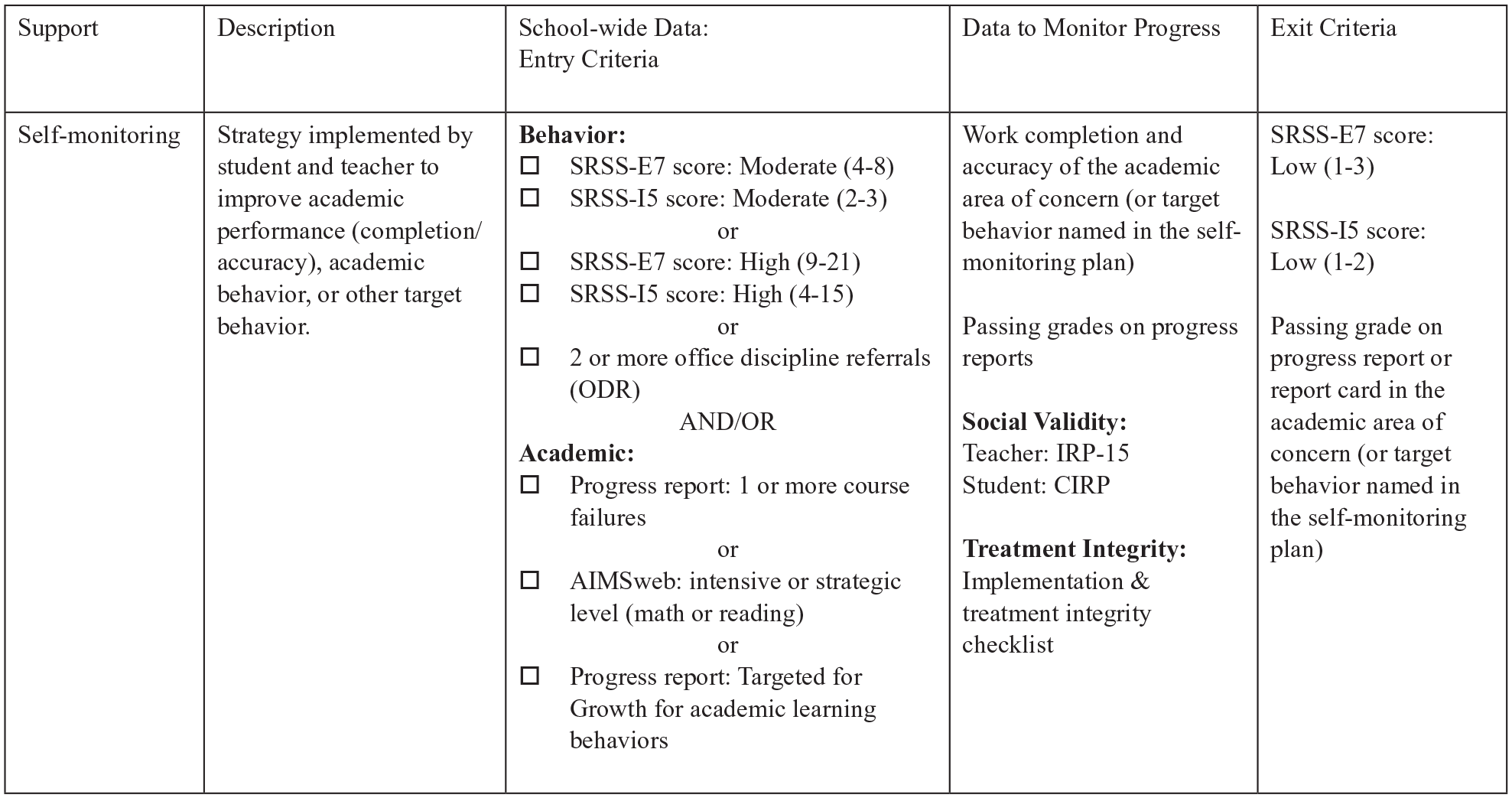
Example Secondary (Tier 2) Intervention Grid.
Data-Informed Decision-Making
Building and implementing a Ci3T model is driven by data-informed decision-making. For example, Ci3T Leadership Teams use the PIRS social validity measure (Lane, Robertson, & Wehby, 2002) to collect input from faculty and staff during the building process. Previous studies suggested that social validity data during the training process predicted the degree of implementation fidelity during the first year (Lane et al., 2009). Social validity data, collected after the fourth and fifth training sessions, are used to inform plan revisions, yielding a fully developed Ci3T Implementation Manual ready for use the following academic year. In essence, Ci3T is a data-informed tiered system that guides the school’s progress.
Multiple professional learning experiences are also built into the building and implementation years to support the efforts of the Ci3T Leadership Teams. After Ci3T Leadership Teams complete the six-part Ci3T Professional Learning Series, they guide implementation in their school the following year. As part of Ci3T implementation efforts, Ci3T Leadership Teams attend a five-part Ci3T Implementation Professional Learning Series (typically 2-3 hour sessions) throughout the academic year and continue this work during monthly Ci3T Leadership Team meetings supported by a district Ci3T Coach.
As part of Project ENHANCE, our research team has learned from current Ci3T implementers in four states representing three geographic regions about what is needed to enhance the traditional Ci3T implementation professional learning processes. We learned about perceived enablers and barriers to implementing a Ci3T system (Royer et al., 2022), desired professional learning content (e.g., managing acting out behavior, supporting students with internalizing issues), and preferred delivery mechanisms (e.g., in-person offerings during the school day and on-demand resources; Common et al., 2021) as well as the desire of Ci3T Leadership Team members to learn how to use systematic screening data better to shape instruction for the system as a whole as well as for students who may need more than what Tier 1 has to offer (Briesch et al., 2022). During the past 3 years, we built and tested on-demand professional learning resources called Enhancing Ci3T Modules, which feature an array of materials, including e-books, interactive resources, infographics, and other multimedia-based content. Enhancing Ci3T Modules are designed by Ci3T Leadership Teams, faculty and staff, administrators, and families to support initial implementation through advanced installation (Fixsen et al., 2005).
Ci3T Leadership Teams use data collected from Ci3T implementation to decide which Enhancing Ci3T Modules to use and how to use them. For example, during sessions three and five of the Ci3T Implementation Professional Learning Series, Ci3T Leadership Teams review treatment integrity and social validity data to identify implementation strengths and focus areas. Using item-level treatment integrity data from sources like the Ci3T Treatment Integrity: Direct Observation tool (Lane, 2009a), Ci3T Leadership Teams may determine specific Tier 1 practices like low-intensity, teacher-delivered strategies (e.g., behavior-specific praise, instructional choice, opportunities to respond) are not implemented as frequently as intended. From this, the team may prioritize professional learning for their faculty and staff on one or several of these strategies, each with a dedicated Enhancing Ci3T Module. These modules include materials that can be shared during faculty and staff meetings (e.g., training presentations), emailed out during normal staff communication (e.g., infographics), and include detailed, step-by-step descriptions that can be used as a basis for initial or advanced learning (e.g., eBook, interactive resource).
As we conclude this overview of the Ci3T building and implementation processes (see ci3t.org/building and ci3t.org/imp to learn more about each of these data-informed professional learning series), we now pivot to describing a step-by-step process engaging in data-informed professional learning to support educators’ implementation of integrated tiered systems of support. In the first step, we begin with onboarding into a Ci3T system.
Step 1: Develop a Clearly Articulated, Comprehensive Onboarding Experience
Shortly after completing her hiring paperwork with human resources, Ms. Rabadi received an email from Mr. Allen introducing himself as a special education teacher serving on the Ci3T Leadership Team. He congratulated her on being hired and offered to meet her at the school to show her around, meet the office staff, and walk through the logistics of their Ci3T implementation plan. He also shared an Enhancing Ci3T Module entitled Ci3T as a Structure to Create Positive, Productive, Safe Learning Environments with her. Mr. Allen suggested that Ms. Rabadi review the module’s e-book to gain some background information about Ci3T. They scheduled a time to meet the following week before students returned to discuss the module and Ms. Rabadi’s beginning-of-the-year plans. In addition, Principal MacMillan also sent an email welcoming Ms. Rabadi to their faculty and providing information about their onboarding and mentoring activities for the coming year. She felt more confident in her new position with the clear information in the Ci3T Implementation Manual, the onboarding process, and personal contacts.
Step 1.1: Establish Ongoing, Data-Informed Professional Learning for Each Aspect of the Integrated Tiered System
Investing in the setup of an effective onboarding program can be a proactive way to retain faculty and staff. Effective onboarding in a school implementing an integrated tiered system like Ci3T is not a single orientation event but a dynamic, ongoing process. It features a series of relevant professional learning activities from the initial interview (where leaders can select educators with compatible philosophies to tiered prevention models) to connecting with school insiders (e.g., principal, Ci3T Leadership Team leader, and parent organization representative) to ongoing mentoring. This process takes place over an entire year or two to not overwhelm teachers with too much information all at once. Onboarding also includes more than just teaching the needed knowledge and skills; it also focuses on school culture (i.e., formal and informal school norms) and social belonging, with mentorship and two-way feedback opportunities (National Association of Colleges and Employers, 2016). A Ci3T school’s formal onboarding includes:
Ongoing data-informed professional learning on everything Ci3T,
Purposeful and interactive activities for learning the school’s context, culture, social norms, and values,
Social events fostering a strong sense of belonging,
Mentorship, and
Opportunities to both receive and give feedback (Daniel, 2016).
Step 1.2: Create Purposeful, Interactive Activities for Adult Learning and Belonging
A Ci3T school’s formal onboarding process may take the form of a calendar indicating each planned activity for new educators to make transparent the multiple activities and resources available to them over the year. They do not have to learn everything all at once; rather, a plan is strategically placed for ongoing learning. This would include activities unique for new educators, experienced educators new to the school, and activities the whole school faculty and staff attend. Professional learning can be calendared intentionally to support what’s happening now and next within a school building. For example, August might include a 2-day introduction covering a Ci3T overview, the why of Ci3T for the district and school, common vocabulary, data collection and analysis, and an in-depth review of the Ci3T Implementation Manual (described above). This could be followed a few days later by the first mentorship activity and completion of an Enhancing Ci3T Module, which will provide background on the science and vision behind the model.
Other days could involve professional learning for core academic, behavioral (e.g., PBIS setting lesson plans, reinforcement system), and social skills curricula, community activities, social activities with faculty and staff, mentor meetings, and integrated lesson planning. September could then focus on professional learning around behavior screening and using data to connect students to support, more mentor meetings, learning one or two low-intensity strategies, completing one or two more Ci3T implementation modules online, and attending Ci3T Project EMPOWER online (see ci3t.org/pl). Each subsequent month would continue similarly, with regular mentoring meetings, professional learning on low-intensity strategies, attending Project EMPOWER sessions, social activities with staff celebrations and Ci3T shoutouts, and booster learning sessions on curricula.
At their first meeting, Mr. Allen opened a digital copy of Lincoln’s Ci3T Implementation Manual and discussed faculty and staff’s key roles and responsibilities. He explained that the instructional schedule was designed to ensure students received a daily 90-minute uninterrupted reading instruction block, with additional English and Language Arts (ELA) instructional time devoted to listening, speaking, and writing. He provided Ms. Rabadi with curricular materials for ELA, math, and science. He also explained that everyone who provided instruction and interacted with students received ongoing professional learning on how to use a variety of strategies to maximize engagement and limit disruption (e.g., behavior-specific praise, precorrection, active supervision, high-probability request sequences, opportunities to respond, instructional choice, instructional feedback). After discussing these academic roles and responsibilities, Mr. Allen explained how faculty and staff used PBIS to teach expected schoolwide behaviors and respond respectfully when behavioral challenges occur. There were sections within the Ci3T Implementation Manual summarizing each of these practices. He handed Ms. Rabadi two large posters that included expected behaviors for each school setting to display in her classroom. Mr. Allen explained that all faculty and staff gave input to building the expectation matrix by completing the School-wide Expectation Survey for Specific Settings (SESSS) to determine which expectations were prioritized by the majority of adults in the building. He also gave Ms. Rabadi a brief overview of a six-step process for responding to challenging behaviors that all adults are expected to follow. He shared an Enhancing Ci3T Module on this subject to assist her in learning what to do during each step. Finally, he explained that the school faculty and staff adopted Second Step™ as a research-based resource to meet students’ social and emotional well-being needs. Mr. Allen also explained how they had planned time in the master schedule to match the Tier 1 plan. He scrolled to Appendix C, which included an instructional schedule for each grade level, and showed Ms. Rabadi where to find the fifth-grade schedule.
Mr. Allen explained that the Ci3T Leadership Team attends professional learning sessions five times a year with other teams across the district and that he and other team members would share back what they learned and provide Ci3T-related professional learning and updates at each faculty and staff meeting. He also shared dates for the monthly onboarding, mentoring activities, and stand-alone EMPOWER professional learning sessions designed for any faculty and staff to support Ci3T implementation through the school year.
As she walked out of the school, Ms. Rabadi felt like she learned a ton about her new school and was relieved to see that everything she needed to know about what to teach, how, and when was all explained in the Ci3T Implementation Manual. It was also a relief to know she would be meeting with others new to the district and her mentor in monthly meetings and with other teachers and staff within the district at the EMPOWER sessions.
Step 1.3: Provide Ongoing Mentorship
Onboarding often utilizes mentor teachers to assist new educators entering the system. In school implementing Ci3T, Ci3T Leadership Team members ensure new faculty and staff have a social connection with colleagues that provides professional and social support. Mentors are available for an academic year to assist with each facet of implementation.
During the second monthly onboarding meeting, Ms. Rabadi learned about systematic screening tools used to see how students were performing in fall, winter, and spring. She also learned about other data sources used to guide implementation and assess overall school goals. The district Ci3T Trainer, Mrs. Johnson, began the monthly meeting by asking each person to pull up their Ci3T Implemental Manual for their respective schools. She asked everyone to scroll to the Tier 1 section, which featured monitoring procedures and their school-wide goals. Ms. Rabadi reviewed Lincoln Elementary’s goals, which read:
Ensure that 100% of students are benchmarked on reading performance using AIMSweb in the fall, winter, and spring.
Ensure that 100% of students are benchmarked on math performance using AIMSweb in the fall, winter, and spring.
Ensure 100% of students enrolled for at least 30 days are screened by their homeroom teacher using the Student Risk Screening Scale–Internalizing and Externalizing (SRSS-IE) in fall, winter, and spring.
Implement Tier 1 procedures with a school mean of 80% or greater treatment integrity for procedures for teaching, reinforcing, and monitoring, as measured by the Ci3T Treatment Integrity: Teacher Self-Report.
Implement Tier 2 procedures with a school mean of 80% or greater treatment integrity, as measured by Tiered Fidelity Inventory scores.
Implement Tier 3 procedures with a school mean of 80% or greater treatment integrity, as measured by Tiered Fidelity Inventory scores.
Ensure that 100% of faculty and staff have completed professional learning offerings for one or more low-intensity, teacher-delivered strategies and have received a check for an understanding score of 80% or better.
End the year with 80% of students scoring:
(a) at or above the benchmark for reading at or above the benchmark for math, (b) in the low-risk category for externalizing behaviors, (c) in the low-risk category for internalizing behaviors.
After reviewing these building goals, Mrs. Johnson provided an overview of screening tools utilized by the district. She shared information about why these tools were selected and how they would be used within and across academic years. Mrs. Johnson then used a coaching protocol to explain the details of how both academic and behavior screening tools would be administered, scored, and used to inform instruction. She provided links to the National Center for Intensive Intervention (NCII) for those new to the district to learn more about AIMsweb and ci3t.org/screening to learn more about the SRSS-IE.
Step 1.4: Incorporate Opportunities to Receive and Give Feedback
Some data sources used to inform implementation efforts may be familiar to most educators (e.g., academic screening), whereas others may be new or described in novel terms (e.g., behavior screening, treatment integrity). Access to onboarding professional development to help new educators learn about these data is essential. It allows all educators to develop a collective understanding of school-wide goals, including how they will be monitored and what action plans exist to help meet them.
During the third monthly onboarding meeting hosted at the district office, Ms. Rabadi learned how data were collected to work toward the building-level goals reviewed in the previous mentoring meeting. The district Ci3T Trainer, Mrs. Johnson, explained that each school collects information from all adults employed at that site to learn how well the planned Ci3T teaching, reinforcing, and monitoring procedures were implemented. She invited each person to open their school’s Ci3T Implementation Manual to locate their assessment schedule. At the same time, Mrs. Johnson projected this same section from the district’s Ci3T master blueprints to show when treatment integrity information would be collected in fall and spring, including Ci3T Treatment Integrity: Teacher Self-Report, Ci3T Treatment Integrity: Direct Observation, and the Tiered Fidelity Inventory.
Mrs. Johnson explained why this information was collected from both faculty and staff perspectives and how it was used to shape professional learning offerings and instructional practices within each school and district. She also shared how all adults could complete the Primary Intervention Rating Scale (PIRS) in the fall and spring so faculty and staff could share their views on the goals, procedures, and intended outcomes of Tier 1 efforts. She explained how this social validity tool gave faculty and staff a voice in Ci3T implementation efforts, and this information was also used to shape professional learning efforts.
At the end of this meeting, Mrs. Johnson sent a follow-up thank you email to those new faculty and staff who could attend and sent all new hires an infographic summarizing the key points of treatment integrity and social validity.
Throughout these experiences, providing and receiving feedback to facilitate future professional learning is essential. Educators need to know that their voices are important in refining not only their onboarding experiences but also the onboarding of others in the future. This is one of the reasons why districts implementing Ci3T invite faculty and staff to complete district-administered treatment integrity and social validity surveys. These data provide feedback to school leaders, which is used to shape adult professional learning.
Step 2: Design a Coordinated, Data-Informed Professional Learning
Ms. Rabadi signed up for a Project EMPOWER session to learn more about providing integrated academic, behavioral, and social and emotional well-being instruction using an integrated lesson plan that Mrs. Johnson mentioned during one of the monthly mentoring sessions. Ms. Rabadi felt this was a good session for her as she reflected on her responses to the Ci3T Treatment Integrity: Teacher Self-Report. She felt confident in her abilities to support students across the three learning domains; however, she wanted to learn additional strategies to integrate the lessons in Second Step throughout the instructional day. During this EMPOWER session, Ms. Rabadi learned more about specifying lesson objectives for academic, behavior, and social and emotional well-being learning domains and using various teacher-delivered, low-intensity strategies throughout instruction. She found the integrated lesson plan a useful tool for planning instruction. She valued the animated video examples shared during the session about what integrated instruction looks like in a Ci3T school. Ms. Rabadi thought it was very helpful that she could access this information in several ways, including:
Attending the Project EMPOWER session
Participating in the book study taking place at her school focused on teacher-delivered, low-intensity strategies
Attending an “ignite” session as part of a district-wide professional learning day.
Visiting ci3t.org, where she could access an Enhancing Ci3T Module on this topic, which included both an eBook and an interactive resource
Reading practitioner articles available thanks to open science practices
She made a mental note to sign up for the ignite session at the district-wide. professional learning day in the spring to learn more about low-intensity strategies. In the meantime, she decided to increase her knowledge and skills in low-intensity strategies by completing the Enhancing Ci3T Module on behavior-specific praise. She selected this module as she had rated herself lower than she liked on items related to procedures for reinforcing in the portion of the Ci3T Treatment Integrity: Teacher Self-Report assessment and knew it would be important as a daily practice to acknowledge students who were meeting expectations and applying new skills learned as part of their Second Step instructional time (e.g., showing empathy, perspective taking).
Implementing and sustaining system shifts, like adopting integrated-tiered models, can be challenging (Datnow, 2005). However, data-informed professional learning can help facilitate high-fidelity implementation. Professional learning efforts help faculty and staff understand why the change efforts are being adopted, learn new practices that constitute the system, and interpret data on implementation efforts and student outcomes. Equally important is that this professional learning is appropriate for the audience’s learning needs and interests. For example, novice or new-to-the-district teachers will need a different professional learning plan than those faculty and staff implementing Ci3T models at their current or prior schools. Inappropriately designed professional learning can leave educators feeling stressed (i.e., presenting advanced topics to novice or new teachers) or frustrated (i.e., presenting basic concepts or initial understandings to experienced teachers; Guin, 2004).
Offering choices in how faculty and staff access professional learning is one way to ensure the goals of need and interest can be met (Common et al., 2021). As in the illustration, Ms. Rabadi has multiple ways to access professional learning to increase their knowledge and skills to design and facilitate integrated lessons that attend to students’ academic, behavioral, and social and emotional learning in one lesson (Lane et al., 2017, 2018, 2020, see ci3t.org/imp for a template). She can attend a session with other educators outside of the school day, participate in a book study with her colleagues, or engage in asynchronous learning at her own pace using the Enhanced Ci3T learning module, Embedding & Integrating Ci3T Domains into Daily Instruction, using the resources in her classroom and then discussing implementation and student outcomes with her colleagues during their professional learning community (PLC) time.
Faculty and staff working in schools implementing Ci3T have a range of data-informed professional learning options (Common et al., 2021). As mentioned previously, Ci3T Leadership Teams participate in five professional learning sessions throughout the year designed specifically to support them in their Leadership Team roles (Lane, Royer, et al., 2020). Session dates are scheduled to correspond with when screening and implementation data are available at each time point throughout the year. Then, Ci3T Leadership Team members review data, plan to share data with their school faculty and staff, and plan professional learning activities based on results. Again, they attend to the needs of different individuals through choice.
Step 3: Facilitate Data-Informed Instruction
A foundational component of integrated tiered systems is data-informed instruction in the classroom. To guide this process, school leaders provide educators with relevant data. Frequently used data sources include academic screening, behavior screening, treatment integrity, and social validity. Educators use these data in an integrated fashion, meaning that they look across multiple sources simultaneously to allow for consideration of data from multiple angles. For example, when reviewing behavior screening data to determine if students may benefit from additional support, educators are encouraged to review treatment integrity data reflecting their implementation of Tier 1 practices. Doing so ensures that student responsiveness to primary (Tier 1) prevention efforts is not assessed without considering whether students have full access to well-implemented Tier 1 supports. This type of decision-making is applied across the tiers to ensure a fully data-informed approach to instruction. Specifically, these multiple sources of data are used in three ways. Namely, data inform instruction at Tier 1, empower teachers with low-intensity strategies, and connect students to validated Tier 2 and Tier 3 intervention grids when Tier 1 is insufficient.
Step 3.1: Review Tier 1
At Tier 1, Ci3T includes instruction on academic, behavioral, and social and emotional well-being domains. School leaders encourage educators to teach these components with high levels of treatment integrity (i.e., with fidelity) and provide multiple data sources, coaching, and resources to assist educators in achieving this goal. To determine how well Tier 1 practices implemented as planned influence student performance, Ci3T Leadership Teams typically begin by graphing school-wide data for the school to look at the entire system. For example, Ci3T Leadership would examine the percentage of students in the low-, moderate-, and high-risk ranges for internalizing and externalizing behaviors. If they notice more than 20% of students are screening into the moderate- or high-risk levels, they might adjust their Tier 1 instructional schedule for their social and emotional well-being curriculum. In this case, they might feature lessons focused on strategies to notice anxious feelings and use positive self-talk or bring in other lessons focused on other self-regulation skills. Next, Ci3T Leadership Teams unpackage these data further by examining overall student performance for various grade levels to determine if there are specific concerns for a given grade level. For example, if a substantial percentage of third-grade students were performing below benchmark on oral reading fluency scores, the Ci3T Leadership Team might adjust the instructional schedule to add 30 min of reading instruction to meet this need (see pbis.org for other illustrations; e.g., Lane, Powers, et al., 2020; Oakes et al., 2021).
Step 3.2: Consider Low-Intensity Strategies
Beyond teaching these components as planned, educators can also subtly use data to shift their instruction in their respective classrooms. For example, if educators note patterns in their classwide data—which could include high levels of externalizing behaviors, common skill deficits in reading or math, or challenges with a specific social and emotional competency—they may respond by making small shifts in instruction. Using an integrated lesson plan (Lane et al., 2019), a teacher can leverage all aspects of the Ci3T implementation plan to address these needs. Integrated lesson plans involve embedding behavioral and social-emotional goals, vocabulary, and practice opportunities into academic instruction (including differentiation). This offers a framework for teachers to insert intentional re-teaching, precorrection, and feedback into daily instruction for skills needed by multiple students in the classroom. The benefit of this approach is that it adds another opportunity to meet students’ needs at Tier 1 and can be fully customized based on an individual class’s needs.
Integrated lesson planning also assists educators as they use low-intensity strategies to address established objectives (academic, behavioral, and social and emotional well-being), promoting engagement and decreasing disruptive behavior. The integrated lesson plan form prompts teachers to determine when to use strategies, including behavior-specific praise, instructional choice, precorrection, and active supervision at strategic points throughout a lesson. Beyond making lessons run smoothly, these strategies also serve another critical role. In some cases, when educators review behavior screening data, they may note that an unexpectedly high proportion of students struggle with externalizing and/or internalizing behaviors. In this case, the educator may add a related objective (e.g., listening to others’ ideas with an open mind and showing empathy). If educators review treatment integrity data and find Tier 1 is implemented as planned, they may be inclined to initiate Tier 2 or Tier 3 interventions for these students. However, attempting to implement too many interventions simultaneously may be impractical. In such a case, educators in Ci3T schools lean on teacher-delivered, low-intensity supports to intensify the Tier 1 experience. Educators may seek professional learning to deepen their implementation knowledge of these supports and then install those practices strategically throughout the day. For example, if a teacher finds externalizing behaviors are particularly heightened during transitions, they may increase the use of precorrection, active supervision, and behavior-specific praise classwide around transitions.
Step 3.3: Connect Students to Validated Tiers 2 and 3
The final way instruction is data-informed is by providing Tier 2 and Tier 3 interventions. As previously mentioned, educators use available screening data alongside implementation data (e.g., treatment integrity) to locate students who may need more than Tier 1 has to offer and confirm that Tier 1 practices are implemented with sufficient treatment integrity. Having done so, teachers review available interventions by referencing the sections of the Ci3T Implementation Manual entitled the Secondary (Tier 2) Intervention Grid and Tertiary (Tier 3) Intervention Grid. These documents indicate what interventions are available and what school-wide data can be used to connect students to those supports. Additionally, they provide direction on what data are collected to progress monitor the intervention once initiated, including how to collect data on intervention treatment integrity, social validity, and student outcomes.
As with Tier 1, we encourage educators to collect social validity and treatment integrity data to guide the design, implementation, and ongoing progress monitoring of implemented interventions. For example, suppose social validity is low for the classroom teacher or student when introducing the support. In that case, this may suggest additional training on why it may be important or alternative interventions should be considered. The district collects Treatment integrity data (fall and spring) regularly. We recommend forms that facilitate the possibility of looking at treatment fidelity data by day (e.g., total percent of intervention components delivered each day) and by component (e.g., total percentage of each intervention component delivered across days).
Regular progress monitoring of student outcomes is also important to determine how students progress (e.g., increased use of story writing elements, high rates of oral reading fluency, greater percentage of assignments completed). Some Tier 2 and Tier 3 interventions have a clear introduction and conclusion of support, whereas, with others, it is important to assess how the student is performing over time and use the Tier 2 or Tier 3 Intervention Grids to determine when the student meets exit criteria, and supports can be concluded. Other times, additional Tier 2 or Tier 3 supports may be considered if data suggest more intensive supports are warranted.
Data-informed professional learning and data-informed instruction are interrelated, as developing skills around data-informed instruction are essential to successfully implementing Ci3T. These skills include understanding and using data in a nuanced manner and the ability to implement a variety of research-based practices including teacher-delivered, low-intensity supports (e.g., behavior-specific praise), as well as components of Tier 2 (e.g., Self-regulated Strategy Development for Writing; Harris & Graham, 1996; Check-in/Check-out; Maggin et al., 2015) and Tier 3 interventions (e.g., intensive reading instruction; Functional-assessment based interventions; Umbreit et al., 2007). Although teachers are not expected to implement these interventions single-handedly, they require a working knowledge of the aspects of these interventions and how they can be supported and implemented in the classroom. For this reason, having access to a robust set of synchronous and asynchronous professional learning resources is an essential asset to empowering teachers to implement Ci3T to its fullest in their classrooms.
In January, when Ms. Rabadi returned from winter break, the Ci3T Leadership Team shared summarized graphs showing overall levels of performance for the school and by grade level for reading, math, and externalizing/internalizing behaviors. During this full-day, site-based professional learning, Principal MacMillan shared successes from the fall and noted a couple of areas for refinement. Specifically, he wanted people to provide instruction using the Second Step resource and weave the vocabulary and practice opportunities into instruction. He shared two samples of completed integrated lesson plans to help everyone get started with this goal, and then teachers worked in grade-level teams to brainstorm ideas and draft objectives for either ELA arts or science instruction. Before he moved teachers to collaboration time, Mr. MacMillan invited Mr. Kai, a school counselor and member of the Ci3T Leadership Team, to demonstrate where to find brief animated videos illustrating how to provide integrated instruction at Tier 1 within Ci3T systems. Ms. Rabadi watched as Mr. Kai pulled up the same resources shared by Mrs. Johnson during one of the monthly mentoring sessions.
After lunch, Mr. Allen and Mr. MacMillan invited all teachers to pull up their data dashboard for their homeroom students and the Secondary (Tier 2) and Tertiary (Tier 3) Intervention Grids in their Ci3T Implementation Manual. These grids feature all supports—including enrichment opportunities—for students needing more than Tier 1. Mr. Allen and Mr. MacMillan provided a refresher for teachers on how to use school-wide data they had available on all students (which was listed in the Assessment Schedule in the Ci3T Implementation Manual) and how to use information from their data dashboard to determine which students might benefit from Tier 2 and Tier 3 interventions listed in their school grids. They also shared a link to one of the modules on ci3t.org for additional guidance and an illustration of how to use data to inform instruction across the tiers in a Ci3T system.
After this review, teachers were given the first hour to work in grade-level teams to examine student data and explore possible Tier 2 (e.g., reading instruction groups with self-monitoring) and Tier 3 (e.g., individualized de-escalation plans) interventions. During this time, Ms. Rabadi connected with Mr. Allen, her mentor, to ask a few questions about how to contact parents to collaborate on possible Tier 2 and Tier 3 needs of her students.
Professional learning to support the successful implementation of integrated tiered systems is rarely a one-size-fits-all approach. Fortunately, the district offered a range of professional learning offerings, some of which included:
District-wide professional learning days featuring ignite sessions for brief overviews, one-hour sessions for more detailed discussions, and half-day workshops,
Tips for success in each faculty and staff meeting,
Weekly communication from the principal featuring reminders and successes,
And stand-alone, web-based offerings for faculty and staff to access as part of the district-developed Ci3T Professional Learning Series and Delivery offerings.
Providing a range of entry points to access professional learning is essential. Teachers will require access to various learning opportunities as they engage in this data-informed implementation process to meet students’ multiple needs.
In addition to having a school site professional learning day in January, the district hosted a district-wide professional learning day before students returned. As part of her ongoing mentoring and onboarding activities, Ms. Rabadi attended a 30-minute Ignite! session with other new teachers in the district.
During this session, the Ci3T district trainer, Mrs. Johnson, provided links to the district’s professional development tracking system and a second link to the district-developed professional learning journey punch card designed for faculty and staff to create their own professional learning journey. This punch card provided an overview of the various offerings provided during this January professional learning and future professional learning topics available at the Empower dates and the Ci3T Summer Symposium (hosted just after students left and before teachers’ contracts ended for the academic year).
Mrs. Johnson explained that these professional learning journeys are self-paced, with many professional learning offerings, including traditional “stand and deliver” options and web-based opportunities. Ms. Rabadi appreciated the reminder about the wide range of options available to her and was pleased that she could already record several professional learnings that she had participated in during the first half of the year, such as attending the Project EMPOWER sessions and completing the Enhancing Ci3T Module on behavior-specific praise.
For today, she decided to attend the ignite session on low-intensity strategies. The description said it would include 10-minute overviews of four strategies: behavior-specific praise, precorrection, instructional choice, and instructional feedback. Ms. Rabadi thought it would be nice to get a refresher on behavior-specific praise and hear about three other strategies.
Then, for her second section, she signed up for a session on one of the Tier 2 interventions listed in her school’s Ci3T Implementation Manual: self-monitoring.
By offering professional learning that is both data-informed and allows for choice, school and district leaders provide new and continuing educators with an opportunity to direct their learning on a range of relevant topics. Furthermore, by aligning all professional learning opportunities with schools’ Ci3T Implementation Manuals, school and district leaders consistently orient faculty and staff to where new information fits within the Ci3T model. This supports educators in building their knowledge about bringing together knowledge across all aspects of their Ci3T implementation, including Tier 1, 2, and 3 practices. This framework provides a structure for organizing the content of all regularly scheduled district- and school-site-based professional learning offerings, which assists leaders in making the most of whatever professional learning time is available.
One of the district Ci3T coaches, Mrs. Green, was leading the session on self-monitoring, titled Self-monitoring for Success. She began the 1-hour session with a picture of the Ci3T triangle with an arrow pointing to the yellow portion of the triangle. She explained that this was where they would be working for today and then clicked on the next slide, which included an image of the Tier 2 intervention grid featuring the self-monitoring intervention. A note on that slide asked each person to open up their school’s Ci3T Implementation Manual and scroll down to the Tier 2 intervention grids to find the row detailing self-monitoring specifics. Mrs. Green gave people time to review all parts of the intervention grid: (a) the name of the intervention, (b) a description in easy-to-understand language, and (c) which school-wide data would be reviewed to determine whether or not students might benefit from this additional support. She also spent time explaining the data to monitor progress. She explained the importance of assessing social validity before getting started to get the student and family’s views of the goals, procedures, and intended outcomes. Then, she explained the importance of measuring treatment integrity to ensure the intervention was implemented as planned and student progress for the specific behavior of interest (e.g., engagement, work completion, positive social interactions, positive self-talk). Then she reviewed the exit criteria and how determinations would be made as to whether or not the intervention “worked” or if students might need something even more intensive, such as a functional assessment-based intervention (FABI), which was a Tier 3 support offered at each school across the district. Ms. Rabadi thought it was so helpful to have everything in one place in the modules on the Ci3T website, including all instructions and forms and even videos she could review. She was even more relieved to hear that her school’s Ci3T coaches would be available to review her winter screening data with her to see which students in her class–if any–might benefit from this Tier 2 Support.
Summary
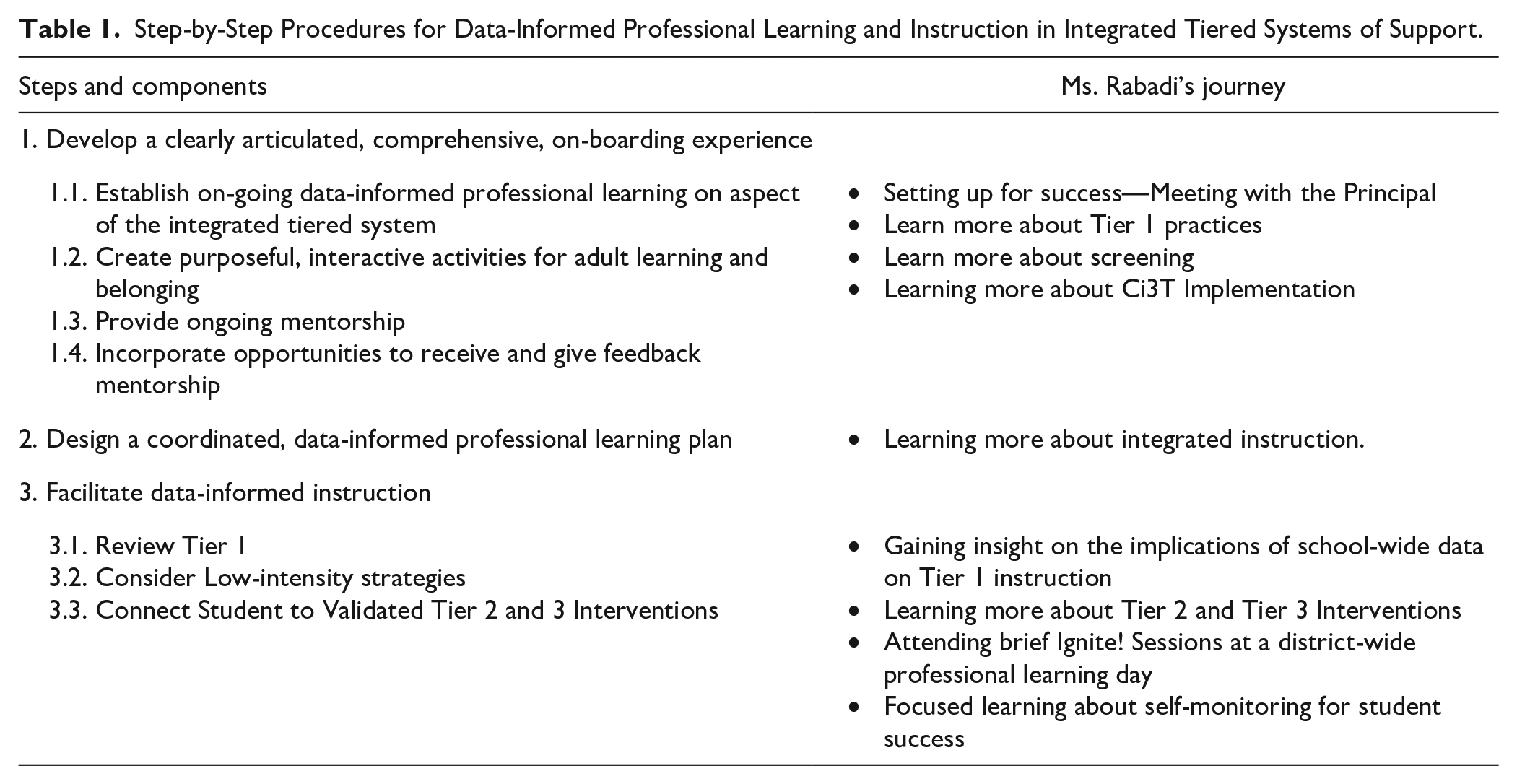
In this article, we illustrated a step-by-step approach featuring some of the practical applications and benefits of building educators’ capacity to implement integrated, tiered systems with integrity (Buckman et al., 2021), using lessons learned within the context of Project ENHANCE and earlier Ci3T inquiry (Lane et al., 2011). After discussing the process for designing an integrated-tiered system with input from faculty and staff and overviewing the practicalities of professional learning to support implementation in complex, integrated-tiered systems, we describe and illustrate three critical steps for data-informed professional learning and instruction (see Table 1).
Step 1. Develop a clearly articulated, comprehensive onboarding experience.
Step 2. Design a coordinated, data-informed professional learning plan.
Step 3. Facilitate data-informed instruction.
Step-by-Step Procedures for Data-Informed Professional Learning and Instruction in Integrated Tiered Systems of Support.
Ci3T is an integrated tiered system that benefits educators, staff, and students by creating a transparent and systematic framework incorporating formal onboarding to teach new faculty and staff, data-informed professional learning for all faculty and staff, and data-informed integrated instruction to meet all students’ needs—all of which are intertwined through design, implementation, and evaluation of Ci3T models. Throughout these facets of Ci3T, integrating data into professional learning and using multiple data sources to monitor outcomes is key, as they allow school leaders to target those skills educators need to best support their students’ multiple needs with precision. In addition, Ci3T models hold particular benefits for servicing students with disabilities as it has the potential to facilitate inclusive programming and capitalize on the collaborative expertise of general and special educators, as well as family members, to create positive, productive learning experiences for all students.
Footnotes
Author’s Note
This article presents a hypothetical scenario following a new teacher, Ms. Rabadi, through her first year at an elementary school implementing a comprehensive, integrated, three-tiered (Ci3T) model of prevention. This scenario illustrates how data-informed professional learning can support teachers through the onboarding process to support implementation of effective practices across three tiers of support.
Declaration of Conflicting Interests
The author(s) declared no potential conflicts of interest with respect to the research, authorship, and/or publication of this article.
Funding
This article was supported by funding provided by the Institute of Education Sciences, U.S. Department of Education (R324N190002: PI Lane). Opinions expressed herein do not necessarily reflect the position of the U.S. Department of Education, and as such, endorsements should not be inferred.
