



Abstract
To create the change necessary to dismantle educational inequities, school leaders need to involve faculty in the change process. Faculty involvement ensures that equity-based interventions are designed with diverse input to maximize their efficacy and helps to secure faculty buy-in to carry out those interventions. Prior research outlines how schools use committees, department meetings, and other methods to involve faculty in change; however, there is limited research on the efficacy of these structures. This study fills that gap by examining the relationship between the use of the structures to involve faculty in decision-making, and the perceived degree of faculty involvement in equity-based decision-making. This research took a quantitative approach, utilizing a survey of 206 independent school teachers to examine the usefulness of six decision-making structures (committees, open forums, faculty meetings, department meetings, informal conversations, and surveys). Multiple regression analysis showed that committees, meetings, and forums each predicted a higher perceived degree of faculty involvement. However, it did not support that correlation for department meetings, informal conversations, and surveys. School leaders should continue their frequent use of committees and expand their use of full-faculty meetings and open forums to effectively involve faculty in equity-based decision-making.
Introduction
American educational institutions were built on exclusionary practices that limited access to privilege and power, and independent schools, which are non-profit, privately funded K-12 institutions, have been especially complicit in these practices (Gulla, 2021; Spring, 2016). The @blackat___ movement in the summer of 2020 exposed the inequities still entrenched in the fabric of these schools. During this movement, Black students and alums shared their stories on various social media platforms about attending primarily white independent schools and facing both implicit and explicit racism from their peers, teachers, and administrators (Weiner, 2022). In response, many independent schools have recommitted themselves to a vision centered on equity and inclusion (Kumar, 2021; Weiner, 2022).
School leaders have been central to leading these equity-based changes. However, leaders often make these changes in silos without gaining input and buy-in from the faculty (Evans, 2009). Independent schools often hire diversity coordinators or directors to lead this work (Hall & Stevenson, 2007), but given the scope of the change required, it is unlikely that one or two individuals can successfully implement equity-enhancing interventions by themselves. Instead, “schools must explore ways to integrate diversity work into the mainstream culture of the school rather than simply make ‘diversity’ the task of a special committee” (Hall & Stevenson, 2007, p. 20).
Involving faculty in decision-making creates longer-lasting and systemic change by building the support of the people who are instrumental in carrying out and sustaining the change (Berg, 2021; Gant, 2021; Teitel et al., 2021). Teachers who are involved in decision-making are more likely to support the change efforts (INandi and Gilic, 2016; Lin, 2014). Culturally responsive school leadership theory contends that for schools to become more equitable, change processes should involve the community and include multiple voices and perspectives (Khalifa, 2018).
While schools recognize the theoretical need for faculty to participate in change processes to create equity-based change, they have had difficulty involving faculty in practice (Evans, 2009; Maral, 2022). The methods leaders use to involve faculty in decision-making vary greatly, and not all methods effectively ensure that faculty feel included (Conley et al., 1988). Further, administrators see teacher involvement as time-consuming and are concerned about an increased teacher workload associated with their involvement in decision-making (Maral, 2022). Printy et al. (2009) contend that for participative decision-making to be effective, schools need formalized structures in place. Toward this effort, schools have implemented models such as committees, department meetings, collaborative staff meetings, open meetings, and teacher leadership teams (Evans, 2009; Louis, 2007). Scholars have described these structures and given examples of the ways schools use them (Lambert, 2002); however, there is little research on the efficacy of the structures themselves (Lindahl, 2008).
This quantitative study aims to identify the usefulness of structures used to involve faculty in equity-based decision-making. The study examines the following question: To what extent do different types of structures used (committees, open forums, faculty meetings, department meetings, informal conversations, and surveys) predict the degree of faculty involvement in equity-based decision-making?
Literature Review
Many researchers have found that teacher participation in decision-making can lead to higher rates of job satisfaction and increased support for the decisions being made (Duyar et al., 2013; Lin, 2014; Sarafidou & Chatziioannidis, 2013). Researchers have also found that teachers want to participate more in decision-making (Sarafidou & Chatziioannidis, 2013). While participative decision-making can occur through informal collaboration, the research also shows that there is a need for institutional structures to allow for faculty to formally participate in decisions (Printy et al., 2009). Scholars have outlined various structures used by schools such as committees and collaborative staff meetings (Lambert, 2002); however, there is limited research that compares the structures and examines the extent to which they effectively involve faculty in change (Lindahl, 2008).
Value of Participative Decision-Making
Involving teachers in decision-making at an early stage increases the likelihood of lasting change. In research on schools, group decision-making is often referred to as participative decision-making. As Bouwmans et al. (2017) explain, “Participative decision-making implies that the decision-making process is not regulated by and reserved for team leaders and a few teachers, but that each team member has the opportunity to participate in decision-making,” (p. 73). Through participative decision-making, innovation becomes a collective process. Instead of being individual actors, teachers become joint developers who take ownership of the change and feel responsible for its success (Fred et al., 2020). Hence, researchers have found that participative decision-making increases job satisfaction, commitment, and trust (Duyar et al., 2013; INandi & Gilic, 2016; Lin, 2014).
In addition to promoting job satisfaction, scholars have found that participative decision-making strengthens teachers’ commitment to the decisions being made, which improves the outcomes. Lin (2014) explains that there is a positive relationship between teacher involvement in decision-making and their commitment to carrying out those decisions. Because they are a part of the decision-making process, the teachers feel more responsible for successful outcomes from those decisions, meaning they are more likely to implement them. Similarly, INandi and Gilic (2016) explain that because teachers are often responsible for carrying out the decisions they need to be committed to these decisions. In a quantitative study of 597 primary school teachers, they found a positive relationship between teachers’ level of participatory decision-making and their cognitive readiness for change. Likewise, Sağnak (2016) studied the relationship between participative management and change-oriented behavior in a survey of 850 elementary school teachers. He found a significant relationship between participation in decisions and both intrinsic motivation and change-oriented behavior. Involving teachers in decision-making increases the likelihood that the teachers will be motivated to carry out the change.
When teachers are committed to the decisions being made, they have a greater ability to control their work environment, and so there are improved school and teacher outcomes (Ingersoll et al., 2017; Shen et al., 2020). Shen et al. (2020) conducted a meta-analysis of quantitative studies associating teacher leadership with student achievement. They identified a positive correlation between teacher leadership and student achievement (r = .19). Particularly, the meta-analysis found a statistically significant relationship between engaging in policy and decision-making and student achievement (r = .18). Louis et al. (2010) conducted two national surveys of 4,491 U.S. teachers and 3,900 U.S. teachers. Their regression analysis demonstrated that shared leadership was positively correlated with a professional community and trust. Subsequently, having a professional community and trust in the principal had a significant positive relationship with student outcomes. Ingersoll et al. (2017) found that teacher participation in decision-making around school discipline procedures was strongly associated with school achievement.
Smoech (2010) conducted a critical analysis of the literature surrounding participative decision-making and found the research to be inconclusive. She argued that while participative decision-making has an intuitive appeal, the empirical evidence of its value is not generalizable. Her central finding was that the links between participative decision-making and teacher and school outcomes were context specific. She found that the variety of structures and processes used by different schools yielded different outcomes. While the research consistently shows that faculty inclusion in change can create a higher level of commitment to the initiatives (Lin, 2014; Sağnak, 2016), not every approach to faculty involvement in decision-making produces this outcome (Smoech, 2010). Thus, there is a need to study the efficacy of structures used to involve teachers in change.
Involving Teachers in Equity-Based Change
The pursuit of equity is a “commitment to ensur [ing] that every student receives what he or she needs to succeed” (Blankstein & Noguera, 2016, p. 3). Equity-based change involves differentiating support, expanding access to students from a variety of backgrounds, and creating a more inclusive environment (Blankstein & Noguera, 2016).
Scholarship on equity-based change in schools calls for school-wide commitment to an equity-based agenda guided by a clear vision (Gant, 2021; Teitel et al., 2021). Castagno and Hausman (2017) conducted a qualitative study on the relationship between shared governance and a school’s ability to advance equity-based change. Issues frequently arose when there were district-wide mandates but a lack of commitment from the school-based leaders. In these cases, the teachers would blame the district office for the policies, and the district office would blame the teachers for being unable to implement the policies. One central finding was that individual school leaders need to be committed to an agenda of advancing equity. While Castagno and Hausman (2017) concluded that top-down directives from district leaders were most effective in the short term, this was only because the schools within the districts were not committed to a shared vision of equity. They explained, “we hold on to the hope that at some point there may be a shift in the culture of schools and districts such that equity becomes a shared agenda, a condition which might enable a gradual shift to more democratic forms of governance that may enhance sustainability of an equity agenda,” (p. 108).
In addition to this shared vision, the leader needs to hold people accountable to the vision and work toward it through critical reflection and dialogue (Ward et al., 2015). In a qualitative study of 16 teachers from 14 different countries, Gozali et al. (2017) examined the ways teachers discuss equity and access. They found that teacher perspectives varied significantly but demonstrated the necessity of including teachers in these discussions. Several teachers identified issues that arose from top-down state policies intending to promote equity that ended up backfiring because of a lack of understanding of the school context (Gozali et al., 2017).
Berg (2021) contends that involving teachers in equity-based change is essential for the change to be effective. She states that “the inequitable systems… have become part of the wallpaper,” so teachers need to engage in collaborative inquiry to transform our schools (p. 42). She explains that through collaborative inquiry cycles, teachers commit to addressing a specific inequity and analyzing data together to both change the targeted inequity and build a stronger understanding of inequities in education as a whole. Further, without these systems for investigating educational inequities, teachers often avoid making suggestions around equity-based change because they fear they will be viewed as complainers or as failing to take accountability for what is happening in their classrooms (Berg, 2021). In sum, systems through which teachers can intentionally investigate inequities are essential to involving them in this change.
Independent Schools
Independent schools are private institutions operating as tax-exempt 501(c) (3) nonprofit organizations funded primarily by tuition and donations. While private schools may be religious or governed by another corporation, independent schools are governed by an independent board of trustees and thus are allowed significant latitude (Gulla, 2021). Regulations on independent schools vary by state and are limited to broad oversight standards such as subjects being taught, length of the school year, and teacher requirements, leaving most operational and curricular decisions to individual schools (U.S. Department of Education, 2025). Independent schools operate without significant outside interference over curricular decisions, program offerings, and school policies, and thus, have the opportunity to experiment in a way that is not always possible with governmental mandates (Gulla, 2021).
Ingersoll (2006) studied Schools and Staffing Survey data and found that teachers in independent schools reported a higher level of control over school decisions than teachers in public schools. This difference was particularly consistent when school size was taken into account. In large public schools, 41% of teachers reported having a great deal of influence on decisions regarding academic instruction, and 14% of teachers reported having a great deal of influence over social decisions. On the other hand, in small independent schools, 51% of teachers reported having a great deal of influence on academic instruction, and 21% of teachers reported this level of influence on social decisions.
Independent schools rarely have teacher unions (Gulla, 2021). In public schools, teachers’ unions play an important role in the way decisions are made and are one mode through which some teachers are involved in decision-making. Teachers’ unions make collective bargaining agreements with administrators which regulate many aspects of teachers’ work and school operations. Collective bargaining agreements cover topics such as teacher assignments, teacher evaluations, class size, student placement, curriculum, preparation periods, the frequency of meetings, the school schedule, and non-instructional duties (Cowen & Strunk, 2015). However, teachers in independent schools still report a somewhat higher level of influence on decision-making than their counterparts in public schools (Ingersoll, 2006). This difference may also be due to the lack of state and federal policy influence on independent schools, which allows for greater decision-making flexibility.
In the 2021 Survey of Independent School Innovation Leaders conducted by the National Association of Independent Schools, 56% of the 388 administrators surveyed cited teacher resistance as a barrier to implementing new programs (National Association of Independent Schools, 2022). Thus, there is a need for additional research to support teacher involvement in decision-making and, ultimately, enable schools to innovate and lead change that is supported by all constituencies. This research fills this gap by examining the extent to which various factors support faculty participation in decision-making in independent schools.
Methodology
The purpose of this quantitative study is to identify the usefulness of various decision-making structures in engaging faculty in equity-based decision-making. The decision-making structures examined include committees, open forums, full faculty meeting discussions, informal discussions, department meetings, and surveys. These structures were identified through research on common structures used in schools to involve faculty in decision-making (Dougherty, 2008; D’Entremont, 2016). Committees are groups of faculty and administrators who come together to work on a particular issue, task, or topic for the school. Open forums are opt-in meetings for faculty focused on a particular topic or issue. Full-faculty meetings include the entire school faculty or the full faculty for one division (lower, middle, or upper). Informal discussions are conversations teachers have with administrators either one-on-one or in groups outside of a structured forum. Department meetings are meetings between all faculty who teach in the same discipline. Surveys are forms sent out to the faculty to gain feedback or ideas.
First, I determined the perceived usefulness of the decision-making structures being used at independent schools. Next, I examined the relationship between the decision-making structures being used and perceived faculty involvement in equity-based decision-making through a quantitative approach. The following question guided the research: To what extent do different types of structures used (committees, open forums, faculty meetings, department meetings, informal conversations, and surveys) predict the degree of faculty involvement in equity-based decision-making?
Sample and Population
While all schools face equity-based challenges, this study is focused on independent schools because of the autonomy independent schools hold in their decisions and the structures used to make decisions. For this reason, there is an increased opportunity for experimentation and design that may not be possible with federal, state, local, and union policy influence (Gulla, 2021). Because my focus is on the involvement of teachers in equity-based change, I focused my research on the experiences of the teachers themselves. While school leaders are most often the ones designing the structures for involvement, these structures are designed to ensure that faculty feel heard and involved in the decision. Thus, it was important to study the teachers themselves to determine the relationship between the use of these structures and perceptions of involvement in decision-making.
Frequency Distribution of Participants (N = 206)
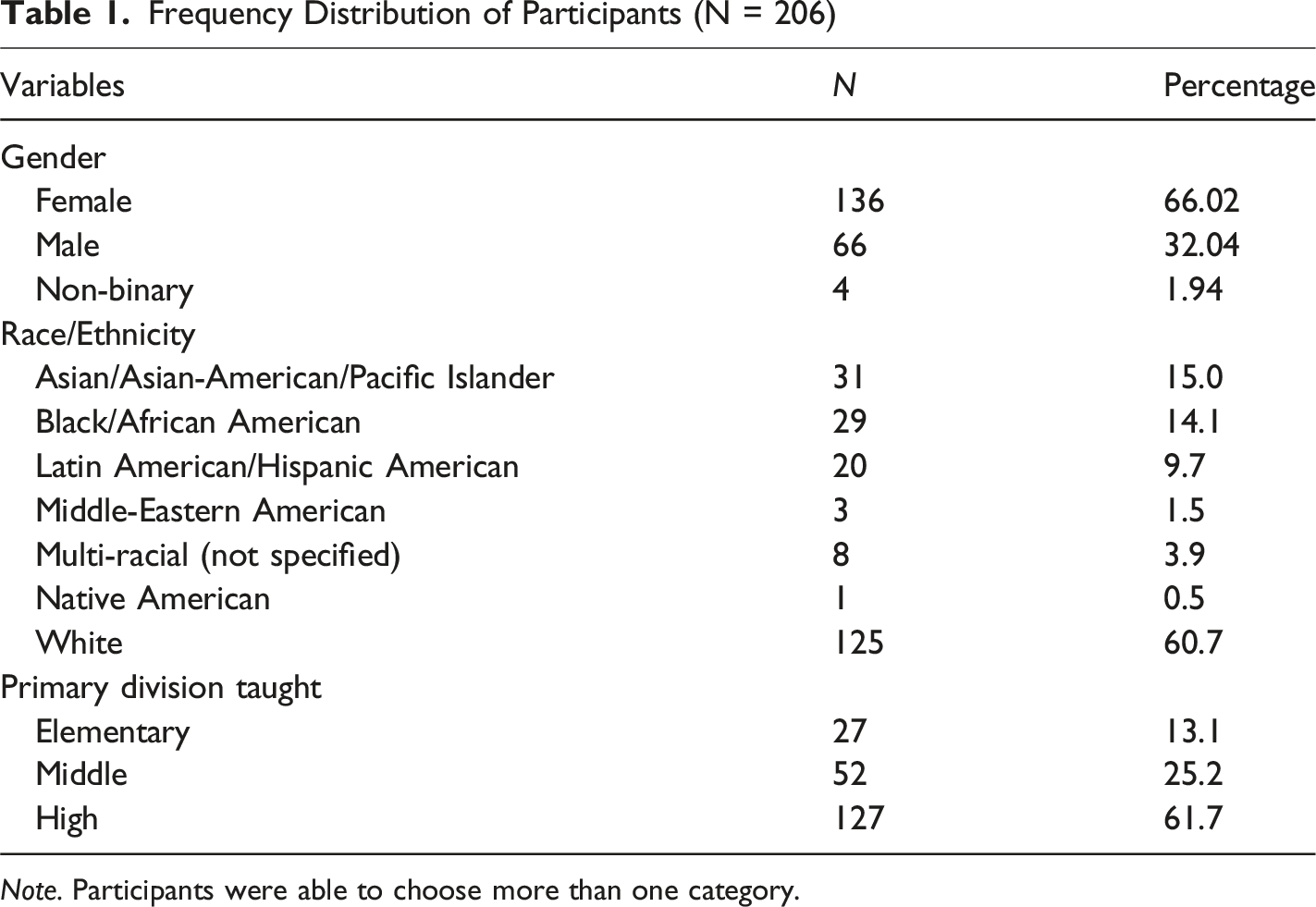
Note. Participants were able to choose more than one category.
Instrumentation
The primary data collection instrument was a 15-min Qualtrics survey. To measure the degree of faculty involvement in decision-making, the survey utilized an instrument adapted from Wahlstrom and Louis (2008) ɑ = .78. This shared decision-making scale instrument develops the dependent variable, the degree of involvement in equity-based decision-making. The instrument is useful because it measures faculty perceptions of the way school leadership involves faculty. For example, the original tool asks teachers to rate their agreement with the statement, “Teachers have an effective role in school-wide decision-making.” I adapted this statement to fit my research question, so it read, “Teachers have an effective role in school-wide equity-based decision-making.” While many instruments measure the degree to which the respondent feels involved in decision-making, few others focus on the faculty as a whole in the way Wahlstrom and Louis’s (2008) tool does. For the adapted scale, ɑ = .918.
The survey was also used to identify the relationship between the independent variables, the decision-making structures used, and the dependent variable, perceived involvement in equity-based decision-making. On a six-point Likert scale, participants indicated how often their school used each structure to involve faculty in equity-based decision-making. Participants were also asked to rank the structures from most useful to least useful in involving faculty in equity-based decision-making. The decision-making structures measured include committees, open forums, full faculty meeting discussions, informal discussions, department meetings discussions, and surveys.
Data Analysis
To analyze the quantitative data, I used SPSS. I created a codebook to assign numeric values to each data point. I standardized the dependent variable values for the adapted Wahlstrom and Louis (2008) perceived degree of involvement scale. Numbers were assigned as an average based on the six-point Likert scale.
I first conducted descriptive statistical analysis on the perceived usefulness of the six structures and their frequency of use. I found the mean and standard deviation of the usefulness ranking for each structure. I then determined the frequency at which each structure was ranked first. In addition, I examined the data for how often each structure was used and found the mean and standard deviation for each one. I described the frequency of use so that I could compare it to the faculty rankings of the usefulness of each structure.
My central research question is quantitative correlational and examines the relationship between the use of a decision-making structure and the degree of faculty involvement in equity-based decision-making at the school. To examine this question, I used a multiple regression analysis relating the frequency at which a structure was used to the degree of perceived faculty involvement. The independent variable was the frequency at which each structure was used, measured on a six-point scale from 1 (never) to 6 (always). The dependent variable was the degree of perceived faculty involvement in equity-based decision-making (DFI). The DFI was measured as an average of the three components from the six-point Likert scale adapted from Wahlstrom and Louis (2008). A lower score indicated that the teacher perceived that faculty were less involved in equity-based decision-making. A higher score indicated a perception that faculty were more involved in equity-based decision-making. While the initial descriptive statistics identify faculty perceptions of each structure, the regression analysis examines whether greater use of a particular structure predicts higher feelings of faculty involvement in decision-making.
Findings
Finding 1: Committees and Department Meetings Are Perceived by Faculty to Be Most Useful and Are the Most Commonly Used Structures to Involve Faculty in Equity-Based Decision-Making
Mean Rankings of Decision-Making Structures
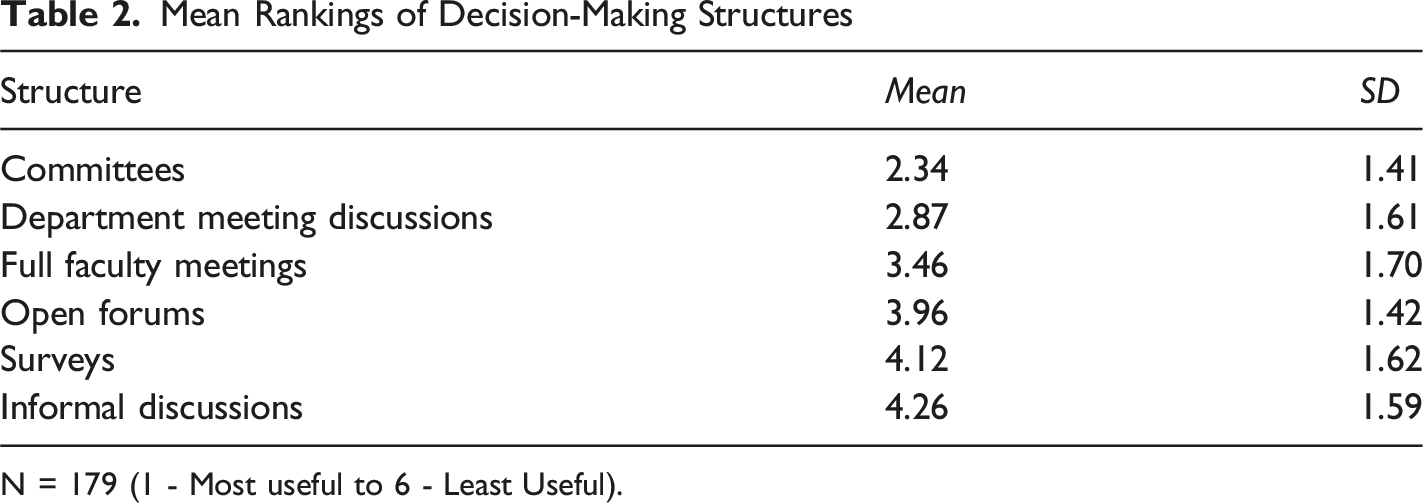
N = 179 (1 - Most useful to 6 - Least Useful).
Frequency of Structure Use
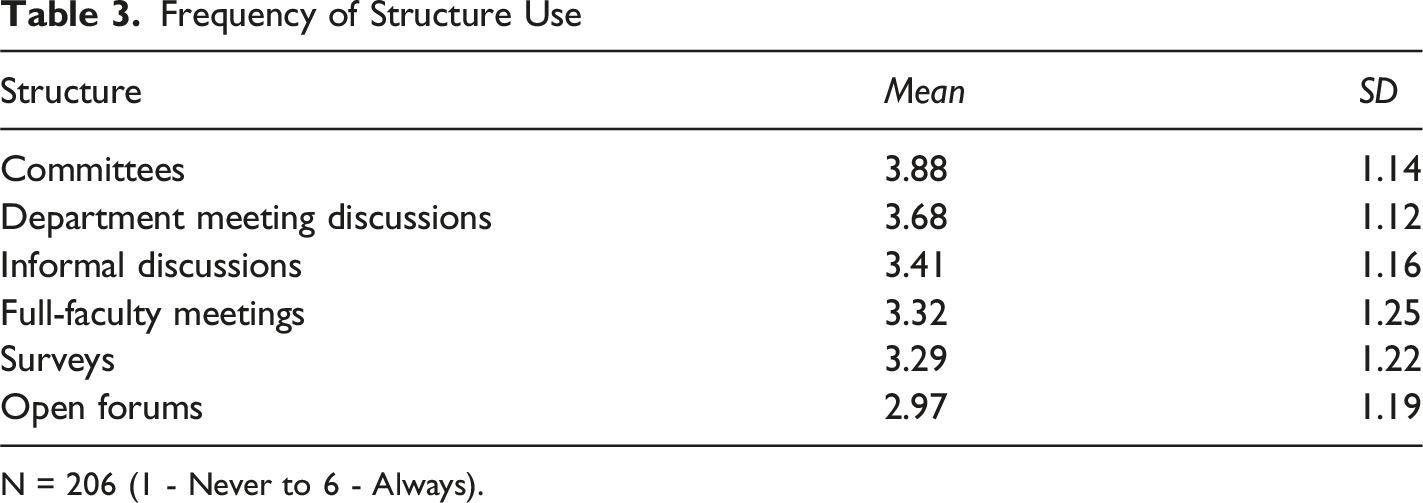
N = 206 (1 - Never to 6 - Always).
Faculty perceive committees and department meeting discussions to be the most useful for involving faculty in equity-based decision-making at their schools. These structures were also the most frequently used at their schools. Thus, the current structure utilization aligns with faculty perceptions of which structure is most useful. However, to examine which structures are most effective in involving faculty in decision-making, it is important to assess the relationship between these structures and the perceived faculty involvement in decision-making.
Finding 2: The Use of Committees, Open Forums, and Full-Faculty Meetings Each Predicts a Higher Perceived Degree of Faculty Involvement in Equity-Based Decision-Making
The central research question examines the relationship between the frequency at which each structure is used at a school and the degree of faculty involvement in equity-based decision-making. A multiple regression analysis was conducted to determine if the frequency of use of each structure predicted the dependent variable, the degree of perceived faculty involvement in equity-based decision-making (DFI).
Summary of Multiple Regression
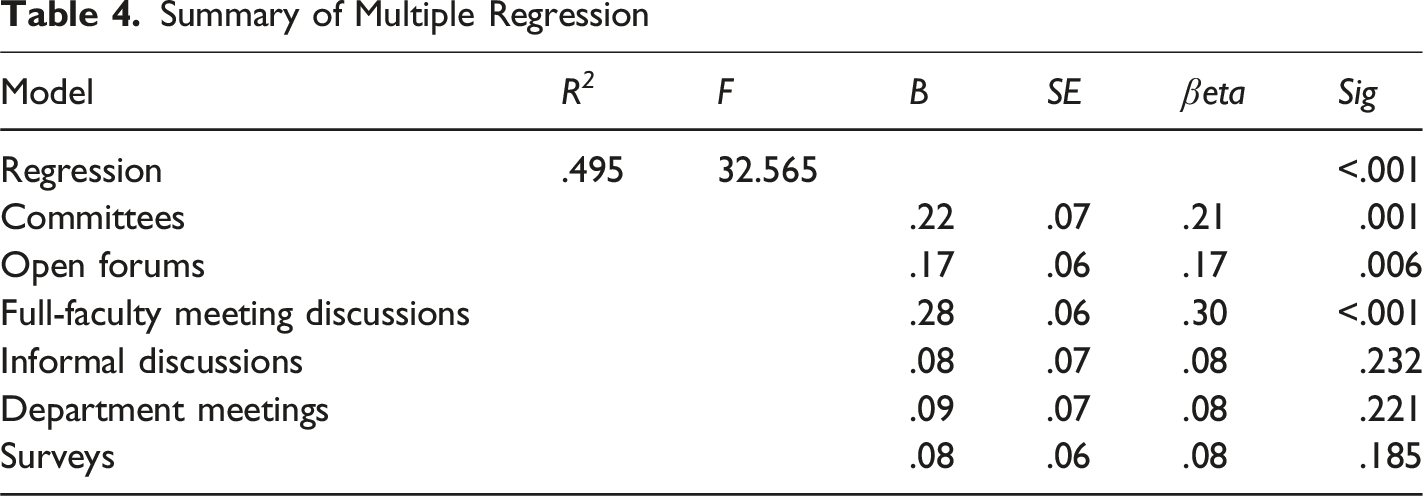
Among the six decision-making structures examined, three were significant predictors of DFI: committees, open forums, and full-faculty meetings. The betas revealed that committees accounted for 21% of the variation in DFI (p = .001). Open forums accounted for 17% of the variation in DFI (p = .006). Full-faculty meetings accounted for 30% of the variation in DFI (p < .001). Teachers at schools that used committees, open forums, and full-faculty meetings more often were more likely to indicate a higher degree of overall faculty involvement in equity-based change. Informal discussions, department meetings, and surveys were not found to be statistically significant predictors of DFI.
Discussion
Prior research on school decision-making structures has primarily been qualitative (Louis, 2007; Printy et al., 2009). This research fills that void by conducting quantitative analysis to identify the relationship between the use of particular school decision-making structures and higher levels of faculty involvement in equity-based decision-making.
To involve faculty in equity-based decision-making, independent schools primarily utilize committees and department meeting discussions. Faculty also identify these two structures as the most useful in involving faculty in these decisions. Generally, the order in which faculty ranked each structure aligned with the order of how frequently each structure was used in schools. Prior research identified committees as a commonly used structure to involve faculty in decision-making (Printy et al., 2009). Department meetings are also discussed in prior literature as a way to involve faculty in change (Louis, 2007). These prior studies on the frequent use of structures such as committees and department meetings have been qualitative. This first finding provides quantitative support for prior qualitative research.
The multiple regression analysis only identified a relationship between the use of committees, full-faculty meetings, and open forums and perceived degree of faculty involvement. While committees were found to be used frequently to involve teachers in decision-making, open forums and full-faculty meetings were not. Further, there was no statistically significant relationship found between the use of department meetings, informal discussions, and surveys and perceived degree of faculty involvement in equity-based decision-making. However, department meetings and informal discussions were the second and third most frequent ways schools involved teachers in equity-based decisions. Thus, current practices at schools do not fully align with the results of the regression analysis in this study.
Committees, Full-Faculty Meetings, and Open Forums
This research demonstrated that the increased use of full-faculty meetings, committees, or open forums at a school predicts a higher perceived degree of faculty involvement in equity-based decision-making. Schools frequently use committees, and this practice is associated with a higher degree of perceived faculty involvement. However, schools use full-faculty meetings and open forums less frequently, though these structures were found to predict higher degrees of faculty involvement in equity-based decision-making.
Of the structures, committees were used most often in schools and ranked the highest. The multiple regression analysis demonstrates that their use accounts for 21% of the variation in the perceived degree of involvement. This correlation demonstrates that committees are not only popular in schools but also predict a higher perceived degree of faculty involvement.
Full-faculty meetings and open forums were not used as often in schools as the other structures; however, full-faculty meetings accounted for the highest level of variation in the DFI (β = 30%), and open forums structure accounted for 17% of the variation in DFI. Consequently, teachers at schools that used full-faculty meetings or open forum meetings more often were more likely to have a higher perceived degree of faculty involvement in equity-based decision-making. However, full-faculty meetings were only the fourth most frequently used of the six structures. Similarly, open forums were used the least often at schools.
Scholars contend that equity-based change requires a school-wide commitment to change and systems through which teachers can intentionally investigate inequities (Berg, 2021; Teitel et al., 2021). Participatory meetings with the whole faculty centered around issues of equity are a clear way that leaders can show their commitment to an equity-based agenda and involve faculty in realizing that agenda. It is logical that schools that dedicate time to discuss issues of equity with all teachers present would also have teachers who feel like their school involves teachers in change. In addition, scholars frequently cite committees as a way that schools involve faculty in change, and equity-based change in particular (Poekert et al., 2020; Printy et al., 2009). While committees vary in structure and in authority, they give teachers an option to be involved in change processes. Even if teachers are not directly involved in a committee, the existence of such committees may help to remind teachers that the school has an equity-based agenda and it seeks to involve teachers in pursuit of that agenda. Committees also provide structures for discussions of inequities, so teachers can involve themselves in these discussions if they care about a particular issue.
Open forums are not used frequently in schools, but they blend many of the positive attributes of using full faculty meetings with those of committees. Thus, it is logical that these were also found to be predictors of higher feelings of faculty involvement. When a school hosts an open forum on an issue, it invites all teachers to share their voice on inequities and potential solutions in a structured manner. As with committees, teachers can choose whether to be involved in these discussions. As with full-faculty meetings, they give school leadership an opportunity to demonstrate commitment to an equity-based agenda and an examination of a particular inequity.
Prior research has described how schools utilize committees and full-faculty meetings to involve the faculty in change (D’Entremont, 2016; Printy et al., 2009). However, prior research has not yet identified a relationship between the use of these structures and higher levels of faculty involvement in equity-based decision-making. These findings fill that void and show a strong link between the increased use of committees, full-faculty meetings, and open forums and higher perceived degrees of faculty involvement.
Department Meetings
Department meetings were the second-highest ranked structure and were used second most often by schools to involve faculty in equity-based decision making. However, in this study, they were not found to predict a higher perceived degree of faculty involvement. Prior research also identified department meetings as a commonly used structure to involve faculty in decision-making (Louis, 2007; Printy et al., 2009). However, these prior studies on the frequent use of department meetings were qualitative. When the utilization of these decision-making structures was compared with the perceived degree of faculty involvement in equity-based decision-making at the school, only committees, full-faculty meetings, and open forums were significantly associated while other decision-making structures were controlled for.
While further research may yield different results, there are several plausible explanations for the lack of a statistically significant relationship between department meetings and perceived degree of faculty involvement in this study. Unlike department meetings, which are led by middle-level leaders, full-faculty meetings, open forums, and committees often involve higher-level school leaders directly. In full-faculty meetings and open forums, the agenda is set by the school leaders responsible for school-wide change. Committees include school leaders or are tasked with making proposals directly to school leaders (Printy et al., 2009). Gant (2021) contends that equity-based change is most effective when leaders and teachers have a shared vision of what educational equity means and how the school can move toward this vision. The three structures correlated with a higher perceived degree of faculty involvement are also those where the leaders and teachers work closely together on a shared vision. Department meetings, on the other hand, are more disconnected from the higher-level school leaders, and these leaders rarely are in attendance (Feeney, 2009). The lack of a statistically significant correlation may be due to this disconnect. When teachers discuss an issue in a department meeting, they are not speaking directly to those who are making the changes. Teachers in these meetings may feel like they are discussing equity issues with colleagues but are not directly involved in making change at the school-wide level. The ideas discussed may also have less of an effect on the changes that end up being made. Further research could be done to understand the dynamics of these meetings as a possible barrier to faculty feelings of involvement.
In addition, this research was focused on school-wide equity-based change rather than change at the classroom or departmental level. The survey started by defining equity-based change as “school-wide change made with the purpose of expanding access, creating a more inclusive environment, or increasing diversity,” and asking teachers how often their school discussed equity-based change in areas such as hiring practices, behavior/discipline practices, curricular practices, and grading practices. These decisions may be more frequently made by higher-level school leaders rather than at the department level. Further research may find department meetings to be more useful if focusing on change at the classroom level rather than school-wide policy.
Informal Discussions and Surveys
Informal discussions were the structure used third most frequently in schools but also did not have statistical significance in the multiple regression analysis. Informal discussions were also ranked to be the third most useful structure by the teachers in the study. Prior researchers have found that well-defined structures for involving faculty in change create stronger feelings of involvement in change (Berg, 2021; Printy et al., 2009). Informal discussions are not defined structures. Their lack of statistical significance in this study may be because they do not provide an opportunity for all teachers to feel involved in change, but just those in the conversations. School leaders may still find these helpful in building a culture focused on equity or in further understanding the views of key stakeholders. Further research could be done to examine their value for equity-based change.
Surveys, on the other hand, were not found to be used frequently by schools or ranked highly by teachers as a mode to involve them in equity-based decision-making. The multiple regression analysis also did not reveal a significant relationship between the use of surveys and higher perceptions of faculty involvement in equity-based decision-making. The lack of frequent use may be the reason for the lack of a statistically significant relationship. Further research could be done on schools that use surveys more frequently to determine if there is a relationship or to examine how survey results are used in equity-based change processes.
Implications
To involve faculty in equity-based decision-making, school leaders in all types of schools should utilize structures that give teachers direct access to school leaders. This direct access helps teachers feel like their voices are valued and they are directly impacting the decisions and change. The ideas discussed through these forums may also be more likely to be implemented because administrators are involved in the conversations with teachers. Ideas reported back to leaders through others, such as department heads, may not end up being taken as seriously. Leaders need to demonstrate that they hear and give attention to teachers’ ideas. Structures that give teachers opportunities to share their ideas directly with leaders, help leaders to more seamlessly acknowledge teacher input, and apply it as they see fit. This could be done through committees that investigate an issue and make a proposal directly to administrators. School leaders are often already using committees for this purpose. Hence, school leaders should move beyond just utilizing the committee model and use faculty meetings and open forums as a means for teachers to discuss inequities and share potential solutions directly with school leaders.
Structures that directly connect teachers and leaders in equity-based discussions may create a stronger school-wide commitment to identifying and addressing inequities. These structures give opportunities for teachers and leaders to engage in inquiry and solution-finding together. Berg (2021) explains that because inequities are in the “wallpaper” of our schools, school leaders need to build a culture where teachers and school leaders engage regularly in inquiry cycles to address them. In addition, the ideas discussed through these forums may also be more likely to be implemented. Further research should be done to identify which structures result in the most change. When teachers feel involved in decision-making, they are more likely to feel committed to carrying out those decisions (Berg, 2021). This is especially important for equity-based decisions, which even more so require the commitment of the whole faculty (Hall & Stevenson, 2007).
Limitations and Further Research
This study is limited in scope as it is focused on independent schools. Independent schools can be helpful settings for research because of the flexibility in the governance structure. However, the findings could vary in another context, so this research could be expanded to better understand how these findings would apply in public or charter school settings.
Further, this study was based on self-reported survey data limited to teachers in schools that were already committed to engaging in equity work. The data was based on teacher perceptions of what structures were in place at their schools. Teachers may not have been fully aware of the inner workings of their schools. In addition, since this research focused on schools with a commitment to equity in their mission, vision, or strategic plan, further research could be done on schools that are less holistically dedicated to equity work.
Finally, there is variability in the way these six structures are implemented in schools. Further research could be done to examine how these structures function and how they can best be used to involve teachers in equity-based decision-making.
Conclusion
Many school leaders state that they want to involve faculty in change processes at their schools. However, there has been limited research on how to effectively do so. Prior research outlines how schools use committees, department meetings, and other methods to involve faculty in change (D’Entremont, 2016; Printy et al., 2009). This study expands the prior research by identifying a relationship between the use of these structures and higher feelings of faculty involvement in equity-based decision-making. Specifically, the increased use of full-faculty meetings, committees, and open forums to involve faculty in equity-based decision-making was found to predict higher perceived degrees of faculty involvement in equity-based decision-making at the school as a whole. Further, department meetings, surveys, and informal discussions were not found to predict higher perceived degrees of faculty involvement.
This study affirmed that having structures in place to support faculty involvement in decision-making was related to higher levels of faculty involvement. A higher frequency of use of the six structures examined together was correlated with a higher perceived degree of faculty involvement in decision-making. Making educational institutions more equitable is a responsibility that cannot be fulfilled by any one committee or faculty meeting alone. However, creating the systems and structures in our schools to support effective equity-based decision-making can provide the foundation for this change to occur.
Footnotes

Funding
The authors received no financial support for the research, authorship, and/or publication of this article.
Declaration of Conflicting Interests
The authors declared no potential conflicts of interest with respect to the research, authorship, and/or publication of this article.