




Abstract
Keywords
Scholars of educational leadership traditionally have defined school leadership as an adult-only space. Originally, discussed as how school leadership can be expanded among adults within schools (Elmore, 2000; Spillane, 2006), the concept of distributed leadership considers how school leaders can embody a stronger vision of social justice by including other adults and students in school leadership (Bertrand & Rodela, 2018; Brasof, 2015; Lac & Cumings Mansfield, 2018). Distributed leadership in these broader interpretations thus helps us to analyze how power is shared and protected within schools.
Expanding this definition of distributed leadership includes ways to amplify “student voice,” which we define as opportunities to participate in and influence the educational decisions that shape students’ lives and the lives of their peers (Mitra, 2018). In recent years, many school administrators, researchers, and funders have begun to consider the notion that student voice practices can lead to powerful student and schoolwide outcomes, such as: (a) supporting school administrators, teachers, and students in addressing root causes of inequities in education (Biddle, 2019; Davis & Hall, 2020; Warren & Marciano, 2018); (b) helping students develop important social–emotional competencies (e.g., social awareness and responsible decision-making; Caetano et al., 2020; Dobson & Dobson, 2021; Graham, 2018; Toshalis & Nakkula, 2012) and academic competencies (Conner et al., 2022; Kahne et al., 2022); and (c) improving educational change efforts, including shifts in classroom teaching as well as school policy and culture (Brasof & Spector, 2016; Mager & Nowak, 2012; Mitra, 2018; Zeldin et al., 2005).
The need for student voice is particularly salient in current contexts. Despite growing appreciation for the importance of student voice, the majority of students feel as if they have few opportunities to have a say in decision-making in their classrooms and schools (Conner, 2020b). Which students are given opportunities to partner with adults is particularly important. For students who have been historically marginalized within classrooms and schools (e.g., students of color, low income, LGBTQ+, students receiving special education services, bilingual emergent learners, recent immigrants, or refugees), such opportunities are particularly lacking. Marginalized or struggling students are rarely asked to share their ideas for how schools or teaching can be improved, let alone invited to engage in collaborative work to redesign education (Alonso et al., 2009; McFarland & Starmann, 2009; Rodriguez & Brown, 2009).
For students to feel that educators truly value student voice and to believe that these commitments extend beyond rhetoric to tangible practices in classrooms and schools, teachers, school administrators, and academic scholars need more clarity on what it means to “do” student voice (Hill, 2020). This lack of clarity about the practice of student voice may stem from inconsistencies in the research base, which both reflect and contribute to variability in practice of student voice in classrooms and schools (Conner, 2015). Striving to address the need for more clarity within the student voice research base, this article explores one central research question: What are the components of student voice in classrooms and schools?
This article proposes a framework that identifies the core components of student voice in classrooms and schools. We explain each of these components in detail and then conclude with a call for further research to operationalize and test the components of the framework, both in relation to one another and in relation to student, classroom, and school outcomes. By identifying the components of student voice, we hope to support students, teachers, school administrators, and academic scholars in understanding and explaining how leadership at the school and classroom levels can envision and design student voice practices.
Student Voice as Critical Distributed Leadership
The paucity of student voice in U.S. schools might be surprising, since it has the potential for such strong outcomes for young people; yet the lack of empowerment of teachers or students in most U.S. educational spaces points to the ways in which school systems implicitly and explicitly impede opportunities for social justice. Research increasingly addresses concerns about “adultism” as a form of oppression (Bertrand & Lozenski, 2023; Mitra, 2006; Mitra, 2018; Rodela & Bertrand, 2022; Salisbury et al., 2020). Indeed, positioning students as change agents requires pushing against the expected power dynamics to create “radical collegiality” (Fielding, 2011)—creating counter-normative ways of acting between young people and adults. Scholarship on involving students and youth as change agents goes by many names and takes many forms. We choose to use the concept “student voice” to bound our research, limiting our focus to work happening within school boundaries.
We situate ourselves in the field of “student voice” work, building on its development since the 1990’s (Cook-Sather, 2002; Rudduck & Flutter, 2000). Internationally, this field has built a solid foundation for investigating many forms that involve students working on improving schools from within the system by participating in governance and traditional decision-making processes. According to Mitra & Serriere (2012), the work of student voice can include the incremental work of operating within school governance structures (an “insider” approach) or the critical work of questioning structures of oppression (an outsider approach).
Working within schools, an “insider approach” almost inherently requires a youth–adult partnership (Biddle & Mitra, 2015; Camino & Zeldin, 2002; IES, 2020; Larson et al., 2005; Sussman, 2015; Zeldin et al., 2017), as U.S. laws require adult engagement in the core aspects of school budget, disciplinary processes, and curricula. Some states in fact prohibit young people under the age of 18 from sitting on decision-making boards. These laws stand in stark contrast to all other nations in the world, which, under the United National Convention on the Rights of the Child (CRC) (UN, 1989), give students the legal right to “participate” in decisions that affect them. Within schools, student voice work thus requires great energy focusing on the positioning of young people and how they interact with adults in partnership—a literature that often is called youth–adult partnership (Camino & Zeldin, 2002; IES, 2020; Zeldin et al., 2017).
Student voice work also can take an “outsider approach” questioning structures and underlying systemic injustice. Often described as “activism” (Ballard & Ozer, 2017, Conner & Cosner, 2016; Nellie Mae Foundation, 2018; Taines, 2014), this lens of critique might occur at the classroom level through Youth Participatory Action Research (YPAR). In YPAR activities, teachers instruct students on how to question and critique the world around them and to collect data to document and seek to address inequities in their schools and communities. At the school level, student organizers might develop critiques of school policies and practices and demand change from administrators (Conner, 2015; Taines, 2014).
Critique of student voice scholarship has increasingly focused on how student voice practices may be co-opted to reinforce oppression rather than to focus on social justice (Balakrishnan & Claiborne, 2017; Holquist & Walls, 2021a; McNae & Cowie, 2017; Mayes et al., 2016, 2021; Bertrand & Rodela, 2018; York & Kirshner, 2015; Robinson & Taylor, 2013; Rodela & Bertrand, 2021). For example, Lac and Cumings Mansfield (2018) identified three levers for effective student voice in educational leadership: (a) positioning of students as change agents, (b) school administrators who support the centering of student voice, and (c) the actual creation of opportunities for student voice to occur. Attending to student voice as an aspect of a social justice approach requires administrators to intentionally disrupt power structures and work with students as legitimate partners. Previous research has examined contexts that can enable a focus on social justice in schools. Administrators must work to build trust and to flatten the power dynamic between students and adults in decision-making processes (Conner, 2020a). Adults need to buffer criticism of fledgling student voice efforts, as well as to work to be the bridge between students and power brokers in decision-making processes (Mitra, 2004). Research also recognizes the necessary link between teacher and student empowerment; rather than power as a zero sum game, teachers speak of needing to feel trusted and heard to be able to extend such opportunities to students (Conner et al., 2022; Mitra, 2003).
Some scholars believe strongly that the term “student voice” should shift to “youth voice” (Bertrand & Rodela, 2018). We view youth voice as the broader practice of youth activism that can occur in a range of settings (Augsberger et al., 2018). This activist work often originates outside of school institutions, even if it includes a vision of radical school change. In outsider settings, youth-led change has greater possibility. The construction of change as fundamental rethinking of the purpose and structure of schools to focus on third-order change (Conner & Cosner, 2016; Kirshner, 2015; Mitra et al., 2021).
For this research, we purposely use the term “student voice” to help to bound the research scope of the work. We focus on “student voice” as the practice of involving youth in decision-making within schools. Even by bounding this work, we find that conceptualizations of student voice lack a shared definition of what student voice looks like and how it impacts policy and practice. We intend for this review to broaden, deepen, and refine understanding and interpretation of student voice within school decision-making. We, therefore, intend for this article to serve as a blueprint for educational leaders interested in building up and leveraging the leadership of their students.
Method
This study grew out of the question, What are the components of student voice in classrooms and schools? To address this research question, we used a novel grounded theory methodological process, simultaneously combining previous research with new data, to develop a framework for understanding student voice in classrooms and schools. We, therefore, hope that in addition to articulating student voice components, this article also can offer methodological contributions as demonstrating ways to build strong frameworks based on previous research and new data. Our process drew upon two different data sources in parallel: (a) a review of the literature and (b) interviews and focus groups with students, teachers, and school administrators with knowledge of student voice practices in classrooms and schools. We designed our process in this format to draw upon what has been done before (i.e., the literature) and to understand whether the past still aligns with current practice through conversations with students, teachers, and school administrators who could affirm or counter the literature through their lived experiences (i.e., the interviews and focus groups). Therefore, our findings build from multiple evidence points simultaneously, rather than solely a literature review or empirical data.
In simultaneously analyzing our data sources, we used the principles of grounded theory (Creswell & Poth, 2016). While each member of our team has previous experience researching student voice, our goal was to allow ideas or concepts to emerge from the data to gain a deeper understanding of how researchers, students, teachers, and school administrators understood the concept. Although the design of qualitative research is necessarily emergent (Lincoln & Guba, 1985), the grounded theory method provides an iterative process for synthesizing data and creating a set of criteria against which to evaluate results (Creswell & Poth, 2016). Moving from raw data to conclusions involved a process of “data reduction” that involved breaking data down, conceptualizing it, and putting it back together in thematic categories that best fit the text (Miles & Huberman, 1994).
While grounded theory tends to be used mainly for qualitative research (e.g., the analysis of focus group data), we used the principles of grounded theory to analyze data from both our review of the literature and interviews and focus groups to allow for the generation of shared findings across data sources. We, therefore, include our method of how we conducted our literature review in this section along with a description of our interviews and focus groups. By offering our process in parallel, we seek in this section to show how we conducted our work. Future sections then give the results of this process.
Literature Review
Rooted in grounded theory principles, rather than starting from a predetermined framework, we began by examining all of the previous reviews of student voice research to identify consistencies and inconsistencies in how student voice is conceptualized (including Conner, 2015, 2020a; Gonzalez et al., 2017; Laux, 2018; Mager & Nowak, 2012; Mitra, 2018). These previous reviews provided a foundation for understanding how researchers approach and conceptualize student voice. Previous reviews of student voice research were identified through academic scholarly search engines (ProQuest, ERIC, JSTOR, and SAGE) using the search terms “student voice” and “review.”
We each reviewed between one and two articles. First, we each independently coded these articles for: (a) how student voice is defined and (b) the core components of student voice practices studied. We then began a second stage of coding using a pattern approach with the intention of “pull[ing] together a lot of material into a more meaningful and parsimonious unit of analysis” (Miles & Huberman, 1994, p. 69). During this time, we reviewed the codes of the first stage for each article and engaged in frequent written and oral communication about emerging consistencies and inconsistencies in definitions of student voice and the core components of student voice. Discrepancies were discussed until we were in agreement.
Across the literature reviews examined, we found inconsistencies in how the concept of student voice was defined. Each of the literature reviews acknowledged a range of definitions of student voice. This confusion makes it difficult to categorize student voice practices. Mager and Nowalk (2012) referred to student voice as student participation, which was defined as “student involvement in collective decision-making processes at the school or class level that included dialogue between students and other decision-makers” (p. 40). Conner (2015) defined student voice as “a strategy that engages students in sharing their views on their school or classroom experiences in order to promote meaningful change in educational practice or policy and alter the positioning of students in educational settings” (p. 5). Though similar, these definitions emphasize different core elements. Mager and Nowalk's definition centers the practice of “collective decision-making,” while Conner's definition focuses on intention to effect “meaningful change” and shift student positioning. We anticipated that it would be important to review definitions of student voice because these definitions may shape the components of a student voice practice that emerged.
Despite inconsistencies in the definitions of student voice, several consistencies in the core components of a student voice practice emerged. We found that researchers were consistent in highlighting two core components: (a) structures and (b) relationships. Researchers found that the structure, or basic design features, shaped the “what,” “where,” and “why” of the practice (Conner, 2020a, 2020b; Mager & Nowalk, 2012; Mitra, 2018). Examples of structures of a student voice practice include: (a) whether it is occurring at the classroom or school level; (b) the types of student participation (e.g., surveys, committees, and youth-led participatory action research); and (c) the purpose of a student voice practice (e.g., student leadership, teacher professional development, and schoolwide improvement). Researchers also shared that relationships, or the power dynamics between students and adults within a student voice practice shaped the “who” of the practice (Conner, 2015; Gonzalez et al., 2017; Laux, 2018; Mager & Nowalk, 2012; Mitra, 2018). Examples of relationships within student voice practices include: (a) who has access to participate, (b) the roles students and adults take in decision-making (e.g., adult or student control of decision-making), and (c) the responsiveness of adults to the changes desired by students. While researchers highlighted common core components of student voice, there were inconsistencies in the elements (or smaller components) that comprise the structure and relationships components. These inconsistencies were likely due to the literature reviews being focused on providing an overview of student voice, rather than diving into the multitudes of ways in which student voice exists in classrooms and schools.
Due to these inconsistencies in the central definitions and elements of student voice, we decided to conduct a systematic review of the literature on student voice from 2011 to 2021 to see how the most recent scholarship enforces or contradicts our findings. This systematic approach consisted of finding all of the articles on student voice in academic scholarly search engines (ProQuest, ERIC, JSTOR, and SAGE). Given inconsistencies in defining student voice, we included the following abstract and title search terms within our review: “student voice” OR “pupil voice” OR “youth–adult partnership” OR “student participation in decision-making” OR “pupil participation in decision-making.” The research examining student voice in schools spans all education levels from pre-school to higher education; however, we focused on peer-reviewed, empirical journal articles addressing middle and high school contexts (6th to 12th grade), as these are the most common venues for implementing student voice practices (Conner, 2015). Our review includes international studies published in English with no geographic bounds. The database search identified 196 results. We extended our collection of articles by asking colleagues to identify promising emerging research to include in our review. Through peer conversations, we identified an additional 17 articles that did not appear in our systematic scan, but which we included in our literature sample.
Each of the articles in our sample was independently reviewed by one of us. Articles lacking adequate information in the abstract to make a determination for inclusion or exclusion were given full-text reviews and discussed by at least two of us. We further limited our review through several decision trees. We only considered research published between 2011 and 2021, as previous reviews provide a strong foundation for decades prior. Within 2011 to 2021, we eliminated articles that use the words student voice to mean gathering data from students. For example, Annetta et al. (2014) examine “student responses to the Science Interest Survey (SIS) and through student voice from written blog prompts” (p. 381). Other studies focused on the concept of voice as participation in class or strong writing habits, which we excluded from our study as this concept of voice did not align with definitions of student voice used in previous literature reviews. We wanted to review studies that hewed most closely to previous definitions, even if they did not parrot it exactly. We also eliminated articles that did not include an empirical lens, such as thought pieces. Our final sample was 70 articles.
We then engaged in the same process that we used to code the previous literature reviews to see if new themes emerged. Similar to the findings from the review of the literature reviews, we found inconsistencies in student voice definitions. Over half (62%) of the articles included defined student voice. Of those that defined student voice, most noted that student voice can encompass a host of activities, ranging from student feedback to students’ inclusion in school-level decision-making to student-initiated and led research into school conditions and students’ experiences. Other definitions sought to differentiate meaningful from superficial student voice (Biddle & Hufnagel, 2019; Howley & O'Sullivan, 2021; Robinson & Taylor, 2013). Some studies, however, operationalize student voice more simply as students exercising “choice about what and how they learn” (Fitzpatrick et al., 2018, p. 256) or as “dialogue with students about matters that affect their lives” (Simmons et al., 2015, p. 131).
Further mirroring our findings from the literature reviews, we observed consistencies across the sample in the core components of the student voice practice(s) studied, which aligned with the core components (i.e., structures and relationships). Further, because a majority of the articles reviewed (94%) examined specific student voice practices in classrooms or schools, and detailed how these practices were constructed, we were able to identify consistencies in the elements (or smaller components) that comprise the two core components. If more than 10 of the articles referred to an identified element as a defining feature of student voice, we included the element in our synthesis. Based on their purpose (e.g., whether they relate to the structure of a student voice practice or relationships within a student voice practice), these elements were then organized within the two core components identified from the previous literature reviews. This analysis was conducted concurrently with the interview and focus group data analysis.
Interviews and Focus Groups
To understand whether the previous research still aligns with current practice, we interviewed students, teachers, and school administrators about their experiences with student voice practices in classrooms and schools. Following a similar process we used for the literature review, we used grounded theory to iteratively analyze data and explore findings. This approach is a valuable way to investigate the varied experiences of students, teachers, and school administrators by summarizing key perspectives, reporting comparable and divergent viewpoints, and uncovering unexpected insights (Creswell & Poth, 2016). This analysis was conducted concurrently with the literature review.
Sample
The analytic sample included middle and high school students, teachers, and school administrators who have experience with student voice practices in their classrooms and schools. Participants were identified for the study through personal relationships with Samantha Holquist, Dana Mitra, or Jerusha Conner. Personal relationships with participants fell into one of three categories: (a) participants of previous studies on student voice who indicated they would like to participate in future studies; (b) participants who previously worked with us in our volunteer work; and (c) participants who were friends or acquaintances of ours. After identifying roughly 50 potential participants for the study, 30 were purposefully selected based on their (a) role (i.e., student, teacher, or school administrators), (b) school level (i.e., high school or middle school), (c) geographic location (e.g., state), (d) gender, (e) race/ethnicity, and (f) known experiences with student voice practices (e.g., limited to extensive experiences with student voice in classrooms and schools) to ensure a diverse sample (Creswell & Poth, 2016). Fourteen students, five teachers, and five school administrators were purposefully selected. Based on personal connections to the participants, Samantha Holquist, Dana Mitra, or Jerusha Conner reached out to potential participants (and their parents/guardians if under the age of 18) via email to ask if they wanted to participate in the study. Ultimately, 17 of the 30 purposefully selected participants took part in the study. Ten students, four teachers, and three school administrators participated. Table 1 provides sample demographic information, including participants’ previous experience with student voice.
Sample Demographics.
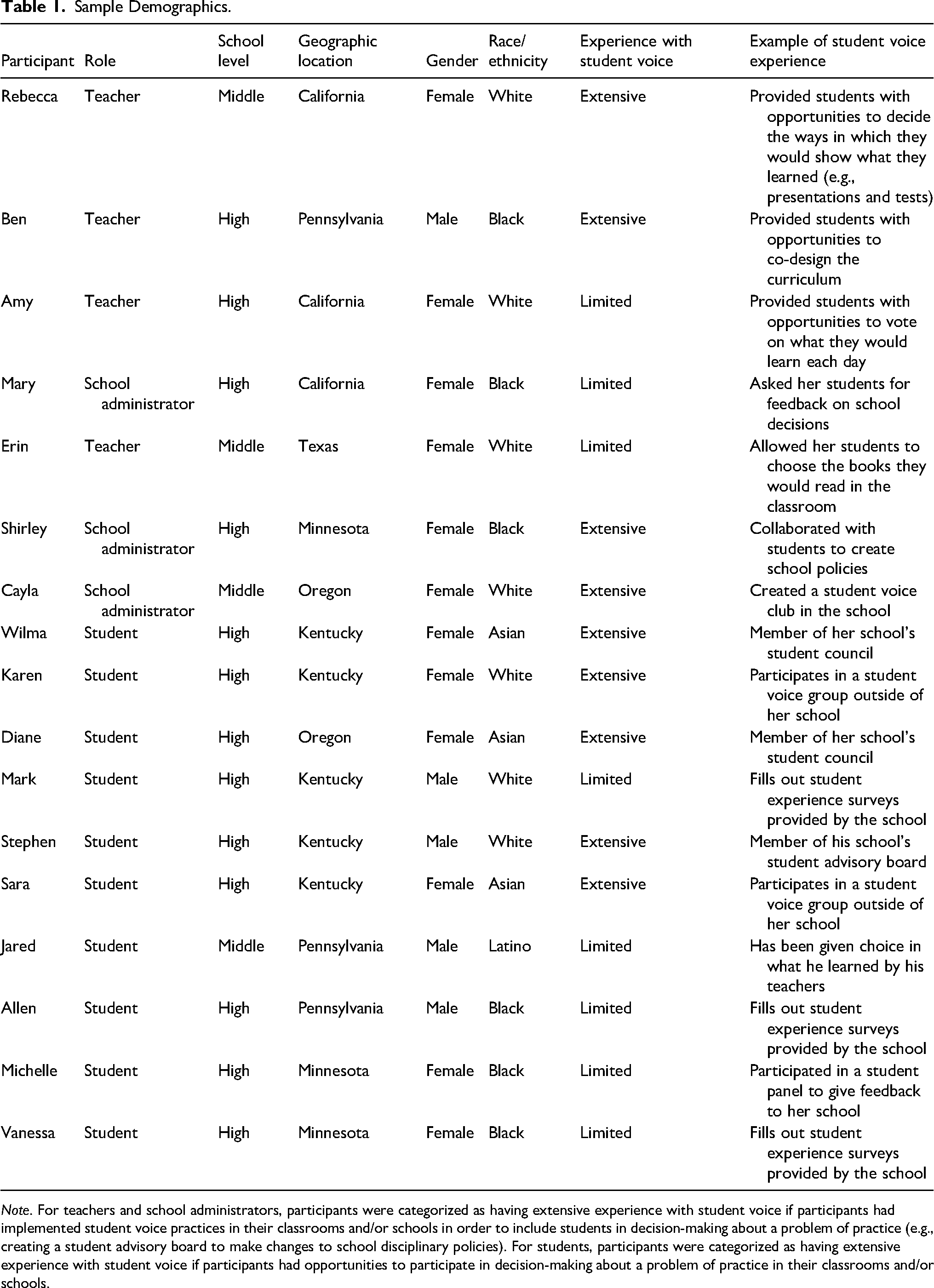
Note. For teachers and school administrators, participants were categorized as having extensive experience with student voice if participants had implemented student voice practices in their classrooms and/or schools in order to include students in decision-making about a problem of practice (e.g., creating a student advisory board to make changes to school disciplinary policies). For students, participants were categorized as having extensive experience with student voice if participants had opportunities to participate in decision-making about a problem of practice in their classrooms and/or schools.
Data collection
Focus groups and interviews formed the primary data sources for this study. Two 90-min focus groups (five participants per group) were held with student participants. One focus group was held with students who had limited experience with student voice and another with students who had extensive experience. We conducted 60-min interviews with teacher and school administrator participants. Protocols were designed to understand student, teacher, and school administrator perceptions of and experiences with student voice practices in their classrooms and schools. Responsive interviewing was used to allow for flexibility in changing questions in response to what was learned (Rubin & Rubin, 2012). Questions were intentionally designed to not directly align with the framework to ensure that we were not leading participants toward a specific response. Sample questions included, “Tell us about the opportunities that students have to participate in classroom and school decision-making.” and “How do adults support students in participating in decision-making?” Focus groups and interviews took place via Zoom during August and September 2021. To enhance trustworthiness, Nikki Wright led a majority of the focus groups and interviews, as she did not have a previous relationship with any of the participants. When Nikki Wright was unavailable, Samantha Holquist led focus groups and interviews when she did not have a previous relationship with the participants.
Coding strategy and data analysis
In alignment with the analytical approach for the literature review, the coding structure that guided the data analysis was developed using a grounded theory approach (Creswell & Poth, 2016; Strauss & Corbin, 1990). We drew upon the grounded theory process of data reduction to analyze the data. The data reduction process has three steps: open coding, axial coding, and selective coding.
Using Dedoose, we coded interviews to identify themes. The analysis began with open coding where we each coded two transcripts to examine the ways in which participants articulated student voice. Based on themes emerging from the data, the main coding bins that emerged for this study included: (a) conditions and contexts for student voice, (b) the power dynamics between adults and students within student voice, (c) concrete examples of student voice practices, and (d) outcomes of student voice. After the first round of coding, we switched transcripts to review codes and add new codes. Discrepancies were discussed until we reached 100% agreement. This process was exhausted when saturation was achieved; that is, it continued until no new categories emerged and no further variations within categories could be determined.
Based on the initial open coding, we conducted axial coding by developing a series of data displays to show the relationships among the codes (Miles and Huberman, 1994). From these data displays, selective coding was used to identify the central theme around which the themes fit. Selective coding occurred during a series of six meetings. Discrepancies were discussed until we reached 100% agreement. In alignment with the literature review, a focus on structures and relationships within student voice practices emerged as the key two categories that summarized the substance of the work.
Simultaneously Analyzing Literature Review, Interview, and Focus Group Data
Once we identified these two main categories within the literature review and interview and focus group data, we began to move back and forth between the interview, focus group, and literature review data to create an explanatory framework for student voice in classrooms and schools (Miles & Huberman, 1994, Strauss & Corbin, 1990). We reviewed and collectively discussed interview, focus group, and literature review codes through a series of eight meetings. Leveraging literature review, interview, and focus group data enabled us to triangulate, ensuring that findings were corroborated by multiple data sources. Components or elements were not included in the framework unless they were identified in both the literature review and interview and focus group codes. Discrepancies in components or elements to include were discussed until we reached 100% agreement. Once the framework was developed, Samantha Holquist and Nikki Wright member-checked findings with interview and focus group participants. To the extent possible, we employed “participant-oriented” member checking by acknowledging the personal relationship between Samantha Holquist, Dana Mitra, or Jerusha Conner and the participant, and courting debate or disagreement with our findings (Hallett, 2013, p. 36). During these member checks, participants offered additional insights, but did not disagree with the findings.
The most notable distinction between the interview and focus group data and the literature review data was that students, teachers, and school administrators discussed the absence of student voice as much as the presence. We noted missed opportunities and disappointment as much as success. The theme of the need for feedback loops and validation of student voice work also came through in this part of data collection—not just the focus on a reform idea, but the work of circling back to students to see how their input was used and affirmed.
Positionality and Trustworthiness
Our approach to conducting this research was inherently affected by our positionality (Creswell & Poth, 2016). Samantha Holquist currently works as an education researcher dedicated to empowering youth voices in research, school, and out-of-school time settings. Prior to this role, she helped launch Oregon Student Voice, a non-profit organization dedicated to advancing student voice in Oregon, and served as a school district administrator. She identifies as a white female who is committed to student voice in part because of problems she perceived in how youth policy was developed and implemented at the state and district level. Dana Mitra identifies as a white female and currently works as a professor in education policy. Her work as a teacher, a leadership coach, a mother, and a researcher informs her interest in student voice and civic engagement. Jerusha Conner identifies as a white female and currently works as a professor in education policy. Her experiences as a high school English teacher informed her interest in student voice and agency, topics on which she has focused a stream of her research agenda. Nikki Wright also identifies as a white female and is a former classroom teacher who became passionate about student voice when collaborating with her fifth graders to revamp their approach to readers’ and writers’ workshops. She recently finished her dissertation focused on engaging teacher voices in policy and plans to continue work as a researcher interested in how to engage those closest to education experiences in decision-making. We are thus normatively committed to the potential of student voice.
As educated, white, middle class, female-identifying individuals, our intersectionality “look like” people who have power and traditionally participate in education change efforts. This may have made us more hopeful about the possibility of students participating in education decision-making. To help manage our individual subjectivities, we divided the work so that we each contributed our perspectives and experiences within data collection and analyses. This division helped ensure that our collective perspectives and experiences were captured in the findings, and one perspective or experience did not outweigh the group. Samantha Holquist led the data collection and analyses of the focus groups and interviews. Dana Mitra led the data collection and analyses of the literature review. Throughout data collection and analyses, we met weekly to discuss similarities and differences in our perspectives and experiences that may influence data collected, analyses, and findings. Differences were discussed until we were in agreement. We strove to manage our collective subjectivities by using multiple data sources (i.e., previous research and interview and focus group data), implementing iterative coding strategy (described below), and in our commitment to thorough member checking to ensure that participants’ perspectives were represented.
Results
In this section, we synthesize the findings from the literature, interview, and focus group data collection to present a framework of the components and elements of student voice most relevant to a leadership perspective. From the data, we identified that any student voice practice consists of two core components (i.e., structures and relationships) and seven elements (i.e., setting, focus, intent, access, representativeness, roles, and responsiveness). Table 2 summarizes our framework. The remainder of the section further details each of the components and elements.
Summary of Components and Elements of a Student Voice Practice.
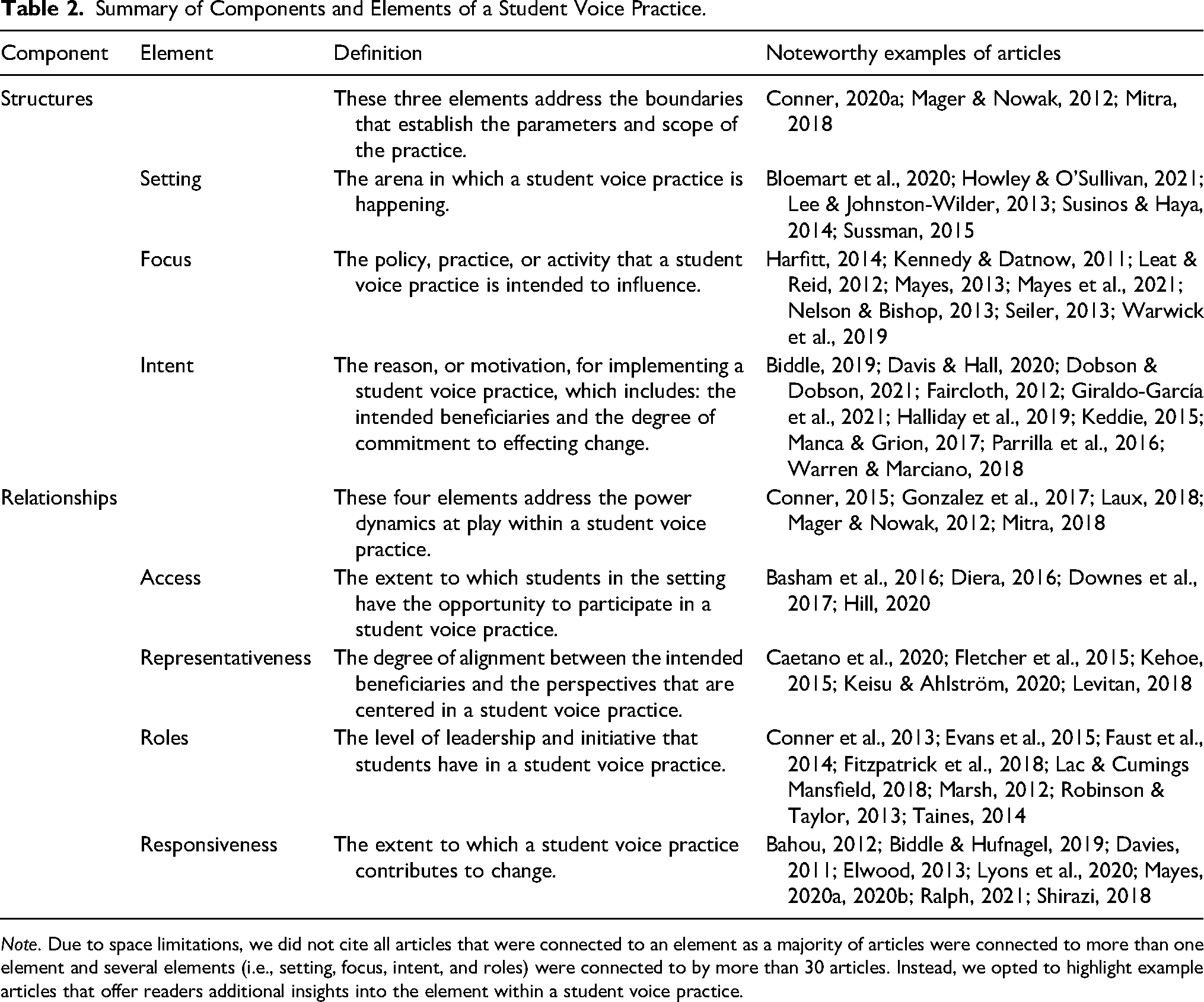
Note. Due to space limitations, we did not cite all articles that were connected to an element as a majority of articles were connected to more than one element and several elements (i.e., setting, focus, intent, and roles) were connected to by more than 30 articles. Instead, we opted to highlight example articles that offer readers additional insights into the element within a student voice practice.
Structure
Structure refers to the basic design features of a student voice practice, which shape the boundaries of a practice in terms of where the work is occurring, what it is targeting, and why it is being undertaken (Conner, 2020a; Mager & Nowalk, 2012; Mitra, 2018). Below, we discuss three elements of structures that emerged from our analyses: (a) setting, (b) focus, and (c) intent.
Setting
We define setting as the arena in which student voice practices are happening. In this article, we limit settings to school or classroom. Although student voice practices also occur in state, district, and extracurricular contexts (e.g., clubs and sports), student voice as distributed leadership is best exemplified in the school or classroom. A majority of articles reviewed (82%) and every student, teacher, and school administrator discussed the setting in which student voice was occurring. In schools, students had opportunities to participate in and influence decisions about school improvement efforts, in such areas as discipline policies, curriculum standards, and teacher hiring or training (Demetriou & Wilson, 2010; Taines, 2014). Mary, a high school administrator from California with limited experience implementing student voice practices in her school, highlighted how she approached her student voice practices: We did a ton of surveys. We asked kids survey questions at least every two weeks or so about what they wanted and how they were feeling. The surveys happened for each grade and across the school. So for example, a grade level survey, I might ask them where they want to go for a field trip. I would ask them where they want to go and give them a list of choices and then whichever one gets the most votes is where we go. Everything from creating the culture of the working agreements, the norms for the classroom, developing common goals, being able to provide feedback on—if I do a written feedback, or a survey, those kinds of things. I think it's not as formal, but when you build positive relationships with students, you create an environment where students will come and feel comfortable saying, “This isn’t working for me,” or “Why don’t we try this?” So I also worked to build those positive relationships, so that that kind of culture and reciprocal relationship existed. It wasn’t a hierarchy of the teacher as the authority.
Focus
Focus refers to the target (e.g., the policy or practice) that a student voice practice is intended to influence. A majority of articles reviewed (85%) and every student, teacher, and school administrator discussed the focus of the student voice practice being described. General categories of focus were disaggregated by: (a) “teaching and learning,” which include pedagogy, curriculum, assessment, course placement, scheduling, and teacher hiring and training policies and practices; and (b) “student life,” which includes student code of conduct, rights, and responsibilities, disciplinary policies and practices, bathroom and cafeteria conditions, and school climate matters. Specifying the focus of a student voice practice helped participants understand the purpose of their work and the bounds of their influence within a student voice practice (Harfitt, 2014; Kennedy & Datnow, 2011; Mayes et al., 2021; Seiler, 2013; Warwick et al., 2019). In describing the focus of her student voice practices, Shirley, a high school administrator from Minnesota with extensive experience implementing student voice practices in her school, shared: [Students] did more work than the adults to change policy and practice. We worked together on the attendance policy…we changed the policy for dress code and also worked with staff on [being] more welcoming to students and making that actually part of the job description…instead of having a security desk, we had a welcome desk. So instead of “take off your hat” it would be “thank you for coming to school today.”
Examples of Focus for a Student Voice Practice.
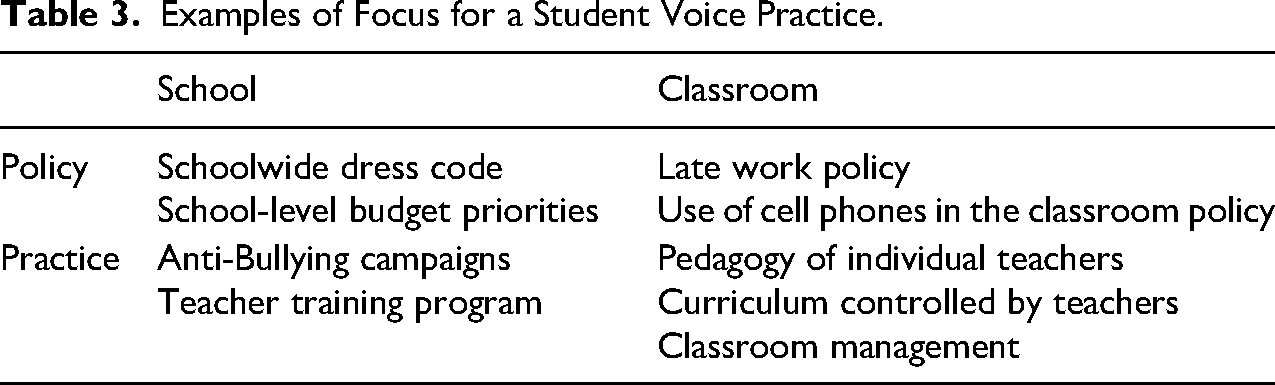
We found that setting can dictate focus. Although examples exist of student voice practices set in the classroom that focus on effecting school or even district policy (Cohen et al., 2020; York & Kirshner, 2015), most of the examples of student voice practices within the literature and shared by students, teachers, and school administrators showed alignment between setting and focus; that is, classroom student voice practices focused on classroom policy and practice, while school student voice practices focused on school policy and practice.
Intent
We define intent as the reason, or motivation, behind a practice. Based on our synthesis of the literature and qualitative data, we conceptualized intent as a two dimensional construct with one dimension (i.e., degree of change) reflecting the degree of (commitment to) change expected, and the other dimension identifying the intended beneficiaries (i.e., intended beneficiaries). To fully assess intent, one needs to determine both the intended beneficiaries and the change expectations reflected in the goals of a student voice practice.
[Student voice is] very superficial because I think there's really two avenues you can go. You can go informal or formal. So like say you choose to run for class president or something. I feel like those are very performatory roles, especially in our school, because you don’t get any actual say. Maybe you get to choose what color all students get to wear to football games, but it's not anything that actually plays a role in school education. And then informally, I can only think of a couple of teachers in all of my years of schooling who would have actually changed their teaching schedule or their ways based on what students have said.
In between these two poles of performative and transformative are efforts aimed at tweaking policy or practice (Harfitt, 2014; Seiler, 2013). Usually this type of intent focuses on using feedback to strengthen what is generally working well or to make minor adjustments to improve practices. For example, teachers may administer a student self-report survey to capture feedback on how to improve their classroom curriculum. Based on survey results, teachers may make slight modifications to their existing practice to address students’ needs (Conner, 2021; Harfitt, 2014). Over half of the articles (63%) included in the literature review explored student voice practices that were meant to tweak current policy or practice. Similarly, students, teachers, school administrators described their student voice practices as tweaking current policy or practices. In discussing how classroom student voice practices were mostly tweaking, Allen, a high school student from Pennsylvania whose experiences with student voice practices was limited to taking surveys, expressed: It feels like when student voice really does get introduced in the classroom, it feels, in my experience, pretty much after the fact, to where it's always at the end of the year. “Here's a survey, how did this class go for you? What was your grade? How did things go? Were there things that you liked? Were there things that you didn’t?” And you never got to see any of the changes made from that.
Over a quarter of the articles (30%) described the intended beneficiaries of a student voice practice, typically targeting either a subset of students or all students in the classroom and/or school. In interviews, teachers and school administrators predominantly described the intended beneficiaries as all students in their classrooms and/or school. In describing intended beneficiaries, Cayla, a middle school administrator from Oregon with extensive experience implementing student voice practices in her school, stated: We often say [student voice opportunities] were for all students…One of the things we tried to include all students was for student council to host quarterly meetings where they got input from all the students about changes they want to see in policies and then they created subcommittees out of those groups of students and they work on getting that policy or practice or activity changed. It's all student run and student led and they did this work.
Relationships
We define relationships as the power dynamics at play within a student voice practice (Conner, 2015; Gonzalez et al., 2017; Laux, 2018; Mager & Nowalk, 2012; Mitra, 2018). In schools and classrooms, students historically have little say in what they are taught, how they are taught, how they are assessed, and how their behavior is governed. Therefore, students may be loath to question adults for fear of retaliation (Kehoe, 2015). Student voice practices, however, disrupt these traditional power imbalances by authorizing students to voice their concerns, critiques, or alternative proposals (Halliday et al., 2019; Kennedy & Datnow, 2011; Lac & Cumings Mansfield, 2018; Mitra, 2018). Therefore, understanding the relationships between adult–student and student–student power dynamics is critical to understanding a student voice practice (Holquist & Walls, 2021b; Marsh, 2012; Silva, 2001).
In addition to being seen as a central element of student voice practices, relationships have been conceptualized in the literature as precursors to students’ willingness to engage in student voice practices (Biddle, 2017; Faust et al., 2014; Mitra, 2019). Scholars argue that trusting relationships are an antecedent or enabling condition for effective student voice practices. Strong and supportive relationships between students, and teachers or school administrators help students feel comfortable to participate in student voice practices and cultivate trust that their expertise and knowledge will be respected by teachers and school administrators (Anderson & Graham, 2016; Davies, 2011; Leat & Reid, 2012).
Additionally, stronger student–teacher relationships have been identified as an outcome of student voice practices. Studies find that student voice practices can build understanding, trust, and a sense of care between students and teachers (Beltramo, 2017; Conner, 2021; Demetriou & Wilson, 2010). Below, we discuss four elements of relationships that emerged from our analyses: (a) access, (b) representativeness, (c) roles, and (d) responsiveness.
Access
Access refers to the extent to which students in a class or school have the ability to participate in a student voice practice. Less than half of the articles reviewed (41%) discussed the access students had to participate in the student voice practice being studied; conversely, students, teachers, and school administrators all discussed access to student voice practices within their schools. Access ranged from broadly inclusive, involving all students in the school, to limited, engaging only a narrow subset of students (Downes et al., 2017; Hipolito-Delgado & Zion, 2017; Holquist & Walls, 2021b; Keisu & Ahlström, 2020). As an example, a student voice practice with high access might be a schoolwide student voice survey. A student voice practice with low access might be a ten-person student–teacher climate committee that investigates and implements ways to improve student and teacher morale and sense of belonging. Low access may be a function of feasibility; that is, the time and resource constraints that limit how many young people can be involved. In describing the challenges that she experiences with students’ access to student voice practices, Rebecca, a middle school teacher from California with extensive experience implementing student voice practices in her classroom, stated: We aim to have all students be included, but we don’t…if a student has a specific interest that is not being served by the current curriculum or the current extracurricular program, then there is definitely an opportunity [for them] to create [a student voice practice to initiate change]. That said, the quiet seventh grader who is not on the leadership team and doesn’t have the initiative, I don’t think that they’re heard.
In addition to feasibility concerns, access may vary based upon the intent of a student voice practice (Hipolito-Delgado & Zion, 2017; Holquist & Walls, 2021b). For example, a practice emphasizing the voices of historically marginalized youth might not offer wide access to all students (Hipolito-Delgado & Zion, 2017). Given the history of schools silencing, excluding, and devaluing students who have been historically marginalized within classrooms and schools, prioritizing these students’ access to a student voice practice may be important for ensuring practices lead to school reforms that meet these students’ needs (Kehoe, 2015).
Representativeness
The element of representativeness can come into play when intent goes beyond the goal of benefiting only the students involved in the practice. Representativeness concerns whose voices are centered in a student voice practice and how well they represent the intended beneficiaries of the practice (Caetano et al., 2020; Fletcher et al., 2015; Keisu & Ahlström, 2020; Levitan, 2018). Representativeness ranges from strongly aligned with the intended beneficiaries to misaligned (Kehoe, 2015). Less than a quarter of the articles reviewed (16%) discussed whether the student voice practice being studied had a representativeness element. Meanwhile, students, teachers, and school administrators interviewed mostly discussed representativeness in terms of student voice practices that involved student leadership positions within the school (e.g., student government/council or similar student group).
Further, in discussing representativeness, students, teachers, and school administrators described the challenges of ensuring participants represent those intended to be served by the student voice practice. Wilma, a high school student from Kentucky who holds a student-elected position and has extensive experiences with student voice practices, shared: We constantly talk about [including] the least heard or marginalized students. Having all students represented, I think that would have an enormous effect to have that kind of representation. Even when we try to make sure we have a representative population, I think any of us could tell you it's still so hard to make sure every student is heard and usually it's not possible. So, for all students to be represented like that would be really big.
In cases where a subset of students are chosen to represent the perspectives not just of themselves, but of their peers, it may be important to implement trainings, supports, or even other student voice practices to ensure these students can effectively represent the needs and desires of their fellow students (Caetano et al., 2020; Downes et al., 2017; Holquist & Walls, 2021a). For example, if a student advisory committee is established to participate in and influence decision-making, student representatives on the committee may benefit from administering surveys, conducting interviews, and/or leading focus groups, as these tools will enable them to understand the perspectives and priorities of their peers (Fletcher et al., 2015). The student representatives can then use the information collected to guide their decision-making and more effectively convey the needs of their peers.
Roles
We define roles as the level of power and initiative that students have in a student voice practice. Due to the separate roles of students, teachers, and administrators in classrooms and schools, teachers and school administrators have historically held the power to make classroom and school decisions, respectively (Caetano et al., 2020; Lac & Cumings Mansfield, 2018; Robinson & Taylor, 2013). Therefore, student voice practices often require teachers and school administrators to share power with students (Holquist & Walls, 2021a). A majority of the articles reviewed (68%) and each student, teacher, and school administrator interviewed discussed the roles of students, teachers, and administrators within a student voice practice.
In the literature review and qualitative data, the roles within student voice practices were largely constrained by the power given to and/or initiative taken by students to participate in and influence decision-making (Caetano et al., 2020; Halliday et al., 2019; Kennedy & Datnow, 2011). In discussing the importance of having power within student voice practices, Sara, a high school student from Kentucky with extensive experience participating in student voice practices, stated, “I think the reason that it's emphasized is because in schools, I feel like adults are very much tied to legitimacy. And so for student voice to actually be taken seriously especially in schools, [adult] collaboration is necessary.” Based on our synthesis of the literature and the qualitative data, roles in decision-making can be viewed on a spectrum, between adult-led and student-led decision-making. Table 4 outlines the decision-making spectrum of a student voice practice.
Spectrum of Roles in Decision-Making for a Student Voice Practice.
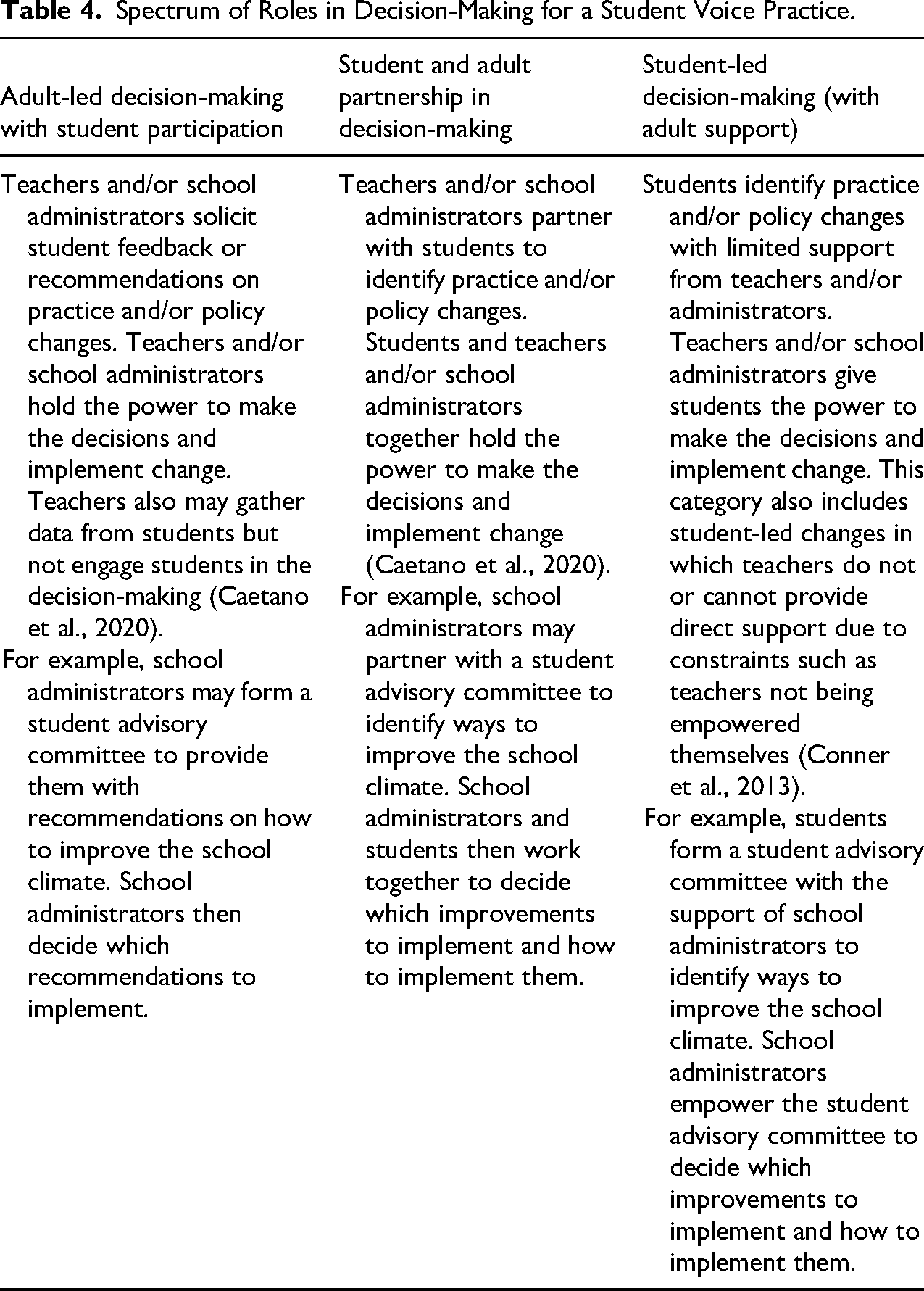
Roles are probably the most important facet of a student voice practice to examine when trying to understand student voice as a form of shared leadership. In the adult-led scenario, students tend not to experience opportunities to demonstrate leadership. They are positioned passively, as data sources rather than active stakeholders. By contrast, in youth–adult partnerships and student-led student voice efforts, students assume clear leadership roles, contributing their ideas and influencing decisions. Whether students are invited to serve in this capacity or they claim such authority for themselves through activist means, adults must negotiate decision-making with them. It is in this negotiation that distributed or shared leadership can be seen and its potential realized or suppressed. In discussing this negotiation, Ben, a high school teacher from Pennsylvania with extensive experience implementing student voice practices in his classroom, shared: My personal philosophy is that the role for adults is just get the hell out of the way, in simple terms. But structurally, how do you do that? How do you structurally get out of the way? Structurally getting out of the way is providing platforms for students to learn together and then literally as much as possible getting out of young folks’ way. And then using their passions and approaches for addressing concerns as other platforms. So if a kid is an illustrator, allow him to do his advocacy through illustrating. If he's a rapper, allow him to do it through spoken word or poetry.
Responsiveness
Responsiveness refers to the extent to which a student voice practice contributes to change. Over half of the articles reviewed (54%) and each student, teacher, and school administrator discussed the responsiveness of teachers and administrators to student desires for change within the context of a student voice practice. Typically, responsiveness hinged on the person or people who have the authority to approve decisions that are desired by those participating in a student voice practice. In schools and classrooms, this authority is held by teachers and administrators (Caetano et al., 2020; Lac & Cumings Mansfield, 2018; Robinson & Taylor, 2013); however, in some cases decision-makers enable students to play a role in implementing the recommended changes, not just in calling for or designing them (Bourke & Loveridge, 2014; Cobbett et al., 2013; Kornbluh et al., 2015; Mitra, 2019). In these cases, distributed leadership can be a function as well as an outcome of a student voice initiative.
The research indicates the importance of teachers and school administrators demonstrating responsiveness to the changes desired by students within a student voice practice (Lyons et al., 2020; Mayes, 2020a, 2020b; Shirazi, 2018). Otherwise, students report feeling frustrated, manipulated, disillusioned, disengaged, or tokenized by teachers and school administrators (Biddle & Hufnagel, 2019; DeMink-Carthew, 2018; Manca & Grion, 2017). In the qualitative data, every student reported feeling frustrated by the student voice practices in their classrooms and schools because they lacked responsiveness from teachers and school administrators. In summarizing this frustration, Mark, a high school student from Kentucky with limited experience participating in student voice practices, shared: [Student voice practices] come without any agency on behalf of the student. And really, if there isn’t any reporting on how the data is being used or what's coming of it, it really shows negatively on the amount of agency that students have once again. So having an adult created survey reduces agency, not being able to control the questions reduces agency, and not knowing happens because of all that data all reduces agency. It may still be voice…but there's no control on behalf of the student.
Discussion and Implications
In this article, we attempt to define student voice as a process of distributed leadership within schools. We design this framework with the intent of maximizing rigor by drawing on both extensive review of previous scholarship and checking this scholarship for validity in current contexts. The process of this framework development therefore seeks to raise the bar for how theory is constructed and tested in educational leadership research.
The framework seeks to contribute to the broadening call for sharpening a lens of social justice in educational leadership scholarship (Bertrand et al., 2020; Conner et al., 2013; Lac & Cumings Mansfield, 2018). This article bounds its work to define the ways in which young people can have a voice in shared decision-making in school settings—“insider” approaches to student voice (McMahon & Portelli, 2012). With “student voice” practice being a term used to describe a broad range of work in recent years, it is our intent to allow this framework to help to focus on what student voice work can be.
This framework provides ways to get inside the idea of student voice to understand how students, teachers, school administrators, and academic scholars can envision and design student voice practices. Given the dearth of opportunities that students have for student voice in classrooms and schools, we hope that this work will push the boundaries of what teachers and school administrators perceive as the potential for student voice to generate more substantive and meaningful actions. Teachers and school administrators can and should go beyond asking students for feedback on surveys.
The framework broadens the scope of possibility of what student voice practices can look like. Teachers and school administrators can implement student voice practices that use forms of shared leadership where both students and adults participate in and influence decision-making (Mitra, 2018). For example, teachers can provide opportunities for students to co-teach lessons in the classroom and school administrators can create space for students to form student advisory groups dedicated to addressing challenges in the schools. These practices can lead to powerful student outcomes (e.g., helping students develop important social–emotional competencies) and have the potential of leading to deep, structural transformations within classrooms and schools that lead to powerful schoolwide outcomes (e.g., addressing root causes of inequities in education; Biddle, 2019; Blad, 2016; Brasof & Spector, 2016; Mager & Nowak, 2012; Mayes 2020b; Sussman, 2015).
With the acknowledgement of the challenges of partnering with young people in student voice practices (Conner, 2020b; Lac & Cumings Mansfield, 2014, 2018; Welton et al., 2015), the framework offers a starting point for broadening the range of possibility for student voice practices in classrooms and schools. We started by distinguishing the “what” of the work—structures—and the “how” of the work—relationships. Within these larger two components, we found important distinctions relative to work with students. In structures, we identified three elements: setting, focus, and intent. In relationships, we identified four elements: access, representative, roles, and responsiveness. Each element is intended to provide insights into how a student voice practice could operate in a classroom and/or school, and how it could be experienced by students, teachers, and school administrators. Our hope is that students, teachers, school administrators, and academic scholars use this framework to envision new ways to think about student voice in their school and design student voice practices that empower students and adults to share leadership in classroom and school decision-making.
While understanding all seven elements of a student voice practice is important to understanding the mechanisms by which a practice could exist in classrooms and schools, we argue that two elements are particularly relevant to understanding shared leadership practices in classrooms and schools: roles and responsiveness. Within the data, researchers, students, teachers, and school administrators explicitly discussed these elements in relationship to shared leadership practices. These two elements, together, help us see how leadership practices are distributed across various actors in classrooms and school. Responsiveness acknowledges that in most settings, adults will retain control over decision-making; however, roles help us see that students can play vital parts in developing, implementing, and evaluating an agenda for change. In the adult-led roles scenario of student voice, leadership is distributed less equitably than in the youth–adult partnership or student-led scenarios. We hope that future work on roles and responsiveness could help to deepen the ways in which administrators can create space for and strengthen student voice practices.
Future research could use this framework as a basis for developing measures for correlating student voice practices with student and organizational outcomes. Most of student voice research has been qualitative, in part due the scope and cost of creating valid quantitative measures. This framework offers the first step in developing a process to define student voice in relation to outcomes. By knowing which components to measure, researchers can design instruments to relate these components to student and organizational outcomes. Future research could also use this framework, and particularly the interplay between intent, access, and representativeness, to explore how historically marginalized voices are included and affirmed. It could also be a way to compare the opportunities young people encounter within school settings (student voice) to the broader range of opportunities to engage in social justice that are described in the broader youth voice literature.
Footnotes
Declaration of Conflicting Interests
The author(s) declared no potential conflicts of interest with respect to the research, authorship, and/or publication of this article.
Funding
The author(s) disclosed receipt of the following financial support for the research, authorship, and/or publication of this article: This work was supported, in whole or in part, by the Bill & Melinda Gates Foundation (INV-031504). Under the grant conditions of the Foundation, a Creative Commons Attribution 4.0 Generic License has already been assigned to the Author Accepted Manuscript version that might arise from this submission.
