



Abstract
In this article, I examine how a sample of principals in Texas and West Virginia made sense of the learning experiences of kindergarteners and how such sensemaking appeared to affect them as instructional leaders. Examining these issues creates the opportunity to consider the types of support school leaders might need to address the changing kindergarten as well as how they might work with teachers, children, and their families so that all students are on a trajectory for school success. I employed case study methodology using sensemaking theory to examine: a) how twelve principals made sense of the learning experiences kindergarten students are and should be having as they begin elementary school, and b) how such sensemaking appears to affect them as instructional leaders. These principals appeared to make sense of kindergarteners’ learning experiences in a complex manner that was shaped by their own beliefs about the purpose of kindergarten as well as the neoliberal contexts in which they worked. Yet, such sensemaking did not appear to translate into their decision-making as instructional leaders, even though these principals worked in different state-level policy contexts and had varying resources available to them within their schools. Instead, policymakers’ neoliberal demands for academic achievement in the later grades seemed to dictate their point of emphasis in their decision-making process. To address these issues, I provide several suggestions to support principals in developing their understanding of early education so that they can instructionally lead these programs in a manner that supports children’s success in school.
Keywords
In the United States (US), policymakers’ neoliberal reforms have and continue to promote a framing of schooling in which school leaders and teachers are to standardize their practices while being held accountable for improving student performance on standardized measures of academic achievement that typically begin in the third grade (Falabella, 2021). In doing so, elementary school principals must often allocate much of their effort towards ensuring their students are prepared to achieve on these exams to demonstrate their instructional leadership skills (Rivera-McCutchen, 2021). As such, the early grades, which often do not have the same standardized testing requirements as those found in upper elementary school, are often overlooked by administrators (Brown, 2011; Grissom et al., 2017). Yet, the teachers within the early grades are still expected to amend their instructional practices so that they are preparing students for the academic achievement expectations awaiting them in upper elementary school (Brown et al., 2019b; Minicozzi, 2016).
An example of this dilemma that principals in the US face can be found in kindergarten (Graue, 2017). Kindergarten is now considered the new first grade where students are expected to learn advanced literacy and mathematics skills (Bassok et al., 2016; Brown, Barry, et al., 2021; Engel et al., 2021). These changes in kindergarten are significant because empirical research has consistently demonstrated that kindergarten matters for students (Burchinal et al., 2020). For instance, how children begin and experience kindergarten has long and short-term impact on their success in school (e.g., Weiland et al., 2021). Thus, to ensure a successful year occurs for kindergarten students and their teachers requires school leaders to “mentor, model and coach [teachers] to improve their practice” (Sims et al., 2014, p. 149).
However, little is known empirically about how elementary school leaders are making sense of these changes, particularly in relation to what they expect kindergarten teachers to be “doing” with their students to ready them for school success, and how principals are fostering instructional practices that support the learning of young children within their school communities (Kauerz et al., 2021; Kirby et al., 2021). In this article, I begin to attend to this gap in the research literature by presenting findings from an instrumental case study (Stake, 1995) that investigated: a) how a sample of school principals in Texas and West Virginia made sense of the learning experiences kindergarten students are and should be having as they begin elementary school, and b) how such sensemaking appears to affect them as instructional leaders (Brown et al., 2019; 2021). Examining their sensemaking of these issues creates the opportunity to consider the support school leaders need in addressing the changing kindergarten as well as how they might work with teachers, children, and their families so that all students are on a trajectory for success in school.
Examining the Changing Kindergarten and Principals’ Sensemaking
A Changing Public Education Context
Policymakers neoliberal reforms frame governance through economic principles that position citizens as consumers (Apple, 2001). In doing so, policymakers in the US and across the globe (e.g., Roberts-Holmes & Moss, 2021) seek to eliminate “(welfare) state services” while calling for increased “‘personal responsibility’ and ‘self-care’” (Lemke, 2001, p. 203). Such a framing of governance has led policymakers to position the ‘state’ as a “regulator and auditor of the ‘learning market’” (Biesta, 2006, p. 175) where public education systems provide citizens with the credentials needed to participate in the market (Ailwood, 2008). Furthermore, by applying “the correct human technologies,” public school systems are expected to produce “high returns” that lead to “improved education, employment and earnings and reduced social problems” of their students” (Moss, 2014, p. 3).This has led to public school administrators ensuring that educators, including kindergarten teachers, provide children with the necessary “inputs” so that they can attain the required “outputs” on specific standardized achievement tests (Ball, 2007, p. 28).
A Changing Kindergarten
Policymakers’ neoliberal reforms have changed kindergarten significantly in recent years (Brown et al., 2019b). Kindergarten teachers now center their instruction on policymakers’ mandated standards that outline specific knowledge and skill all children are to acquire by the time they leave this program (Bassok et al., 2016; Brown, 2007; Christopher & Farran, 2020; Engel et al., 2021). This has led to kindergarten programs in which teachers emphasize “literacy and numeracy, and paper and pencil tasks” in place of “learning through language and hands on activities” (Costantino-Lane, 2019, p. 585).
This focus on academics in kindergarten not only represents policymakers’ continued neoliberal focus on improving children’s academic achievement through standardization and accountability (Brown, 2007), but it also reflects increased expectations from (Russell, 2011) and investments by families in their children’s learning prior to kindergarten entry (Kornrich & Furstenberg, 2013) as well as the expansion of preschool opportunities for children, meaning they are bringing more academic and social skills to kindergarten (Friedman-Krauss et al., 2019). The worry is that this emphasis on academics in kindergarten is that researchers have found that teachers who engage in more traditional early childhood focused and child-centered instructional practices, such as guided-play (e.g., Toub et al., 2016), which requires them to implement instructional approaches that reflect the developmental needs of the children in the classroom, not only improves academic performance but also their desire to learn (Pyle & DeLuca, 2017; Weisberg et al., 2013). For instance, Lerkkanen et al. (2012, 2016) found that in kindergarten and first-grade classrooms in which the teachers placed greater emphasis on child-centered teaching, the children not only were more interested in reading and mathematics but also improved their academic achievement in these content areas at a greater rate than children in teacher-directed classrooms. Educators engage in such practices as guided play by offering a range of child-led activities where the teacher guides and scaffolds student learning during those play-based interactions (Wallerstedt & Pramling, 2012; Weisberg et al., 2013). Such guidance entails the teacher to “support and subtly guide children’s learning through setting up the learning environment, commenting on the play, [and] asking questions that encourage deeper thinking, discovery, and reflection” (Ilgaz et al., 2018, p. 1251). For teachers to engage in these early childhood instructional practices effectively, they must attend simultaneously to children’s developmental needs and the academic content they are expected to know. Researchers found that guided play can improve children’s language skills (Tsao, 2008), literacy skills (Stone & Christie, 1996), math skills (Stipek et al., 1995), and socioemotional skills (Berk & Meyers, 2013).
This is not to state that the debate over kindergarten is simply about whether teachers should engage in child-centered practices or strictly teach academics; early childhood stakeholders’ conceptions of teaching and learning in the early years are more nuanced (Brown, 2007; Brown et al., 2018) and appear to reflect a continuum of practices within each classroom (Little & Cohen-Vogel, 2016). For example, Engel et al. (2021) and others (e.g., Cohen-Vogel et al., 2021) have found that kindergarteners are often taught skills they already know. Furthermore, Le et al. (2019) “found positive associations between exposure to advanced content and academic achievement for both math and ELA [English Language Arts], but contrary to expectations, we did not find negative associations between advanced content and social-emotional skills” (p. 1273). Thus, as kindergarten evolves, stakeholder groups (Miller & Almon, 2009) and researchers (Engel et al., 2021) continue to question and examine the effects of these changes on students, teachers, and administrators.
Why Kindergarten Matters
As these neoliberal policies and other societal factors change kindergarten, it is important to point out that, historically, researchers have (Duncan et al., 2007) and continue (Burchinal et al., 2020) to demonstrate where children begin their academic careers as kindergartners affects their short- and long-term success in and out of school (Amadon et al., 2022; Lee & Burkham, 2002). For instance, children entering kindergarten at age 5 who are perceived to be trailing their peers in cognitive and social measures are less likely to be successful in grade school, more likely to drop out of high school, and likely to earn less as adults (Dagli & Jones, 2013; Halle et al., 2012; Vergunst et al., 2019). In kindergarten, how children perform on reading, math, and social–emotional assessments provide insight into their later school achievement and chances for success in adult life (Claessens et al., 2009; Duncan et al., 2007; Pace et al., 2019; Quirk et al., 2017). Often, this variance in children’s academic and social achievement found in kindergarten tends to increase across their time in school (Alexander et al., 2001; Campbell et al., 2002).
Principals and Kindergarten
As kindergarten programs in the US continues to respond to policymakers’ neoliberal reforms (Brown, 2021), policymakers, national organizations, and advocates who recognize the importance of the kindergarten year in children’s schooling are calling for principals to become effective instructional leaders of the early grades in public schooling to improve students’ early learning outcomes (Lieberman & Bornfreund, 2019; Mead, 2011; Nicholson et al., 2022). For example, the 2015 revision of the Elementary and Secondary Education Act, Every Student Succeeds Act, states that Title II dollars can be used to support the development of principals’ understanding of instruction in the early grades (Bornfreund, 2015). Additionally, the National Association of Elementary School Principals (NAESP) put forward its “Pre-K-3 Leadership” initiative (e.g., Kauerz et al., 2021), which includes Pre-K-3 professional standards and a leadership academy training program, to support principals in learning how to implement developmentally appropriate instructional leadership practices in their schools (https://www.naesp.org/prek3-leadership); NAESP advocated for principals to attain six competencies to improve and sustain early learning communities, such as understanding how children develop and learn and its implications for teaching as well as fostering positive relationships with students families and their communities (Kauerz et al., 2021; Lee et al., 2012).
Such strategies reflect an empirical understanding that instructional leadership, which focuses on “principals’ practices directly related to teaching and learning” matters (Wu et al., 2020, p. 319). For example, Tan (2018), who examined the impact of principal leadership on 254,475 15-year-old students mathematics achievement across 10,313 schools in 32 OECD economies found that principals contribute to the learning of students by “exercising instructional leadership via empowering teachers so that they can make the best instructional decisions in their professional capacities and feel motivated to address student learning needs” (p. 32). Goddard et al. (2019), who examined student achievement data from the Michigan’s standardized assessment across 95 high poverty, rural elementary schools in Michigan, also found that “instructional leadership was positively and significantly related to teachers’ reports of differentiated instructional practices regardless of school demographics and prior student achievement” (p. 197).
With these findings in mind, to be effective instructional leaders of early childhood programs, elementary school principals must understand not only how children develop and learn but also how the acts of instruction and assessment differ in the early years (Nicholson et al., 2022). For principals to be effective at this complex task, they must transform and organize these complex understandings of child development and learning into a set of leadership practices that guide schoolteachers and other personnel in implementing instructional practices that foster the growth of all children while balancing a set of complex and often competing outside influences (Brown, 2007; Kirby et al., 2021; Rigby, 2015), which include policymakers’ demands for increased academic performance (e.g., Reid, 2021).
These political and practical calls for change in the training of school leaders reflects researchers’ findings that principals’ instructional leadership can increase student achievement within their school communities (e.g., Wu et al., 2020). Furthermore, researchers examining the relationship between principals and prekindergarten (Cohen-Vogel et al., 2020; Graue et al., 2017) have found that how these administrators view the programs and its role within the school affects its inclusion and alignment with the other grade levels (Brown & Gasko, 2012; Garrity et al., 2021; Little, 2020).
Yet, very few principals were trained in or required to study early childhood education and/or child development as part of their licensure program (Brown et al., 2014; Douglas, 2019); Lieberman (2017) found that only nine of the 50 states require principals to take courses on child development or early learning as part of their licensure program. Furthermore, there are very few higher-education faculty specializing in education leadership who have formal training in the early education process (Nicholson et al., 2018). However, Nicholson et al. (2018) and Shue et al. (2012) found that both principals and education leadership faculty appear to believe training in how children learn and develop as well as the early education process should be a part of the licensure process. Combined, there appears to be a clear understanding among education stakeholders of the importance of principals understanding how children learn and how to lead early educators, like kindergarten teachers (Keung & Fung, 2020; Kim & Jin, 2020), in supporting their students as they begin their academic careers in elementary school (McCormick et al., 2020).
Conceptual Framework: Sensemaking
In this article, I employ the conceptual lens of sensemaking to examine how a sample of principals in Texas and West Virginia made sense of the learning experiences of kindergarteners and how such sensemaking appears to affect them as instructional leaders (Allen & Penuel, 2015; Brown et al., 2019b; Coburn, 2005; Lipsky, 1980). Sensemaking is a dynamic, interactive, and never-ending process (Coburn, 2005; Rigby, 2015). School leaders cognitively and emotionally make meaning of the world around them through their prior knowledge and experiences, their social relations with others, the context in which they operate, and their future goals (Reid, 2021; Spillane et al., 2002).
Making sense of kindergarten, or any grade level, is a process in which school leaders “mental models act as filters through which the data are understood, a process that may (re)form or reify the models” they have about how children should be taught in school, what they should be taught, and how success in school should be determined (Bertrand & Marsh, 2015, p. 866). This means that how principals make sense of what and how students should be taught directly impacts how they interact with and lead school personnel instructionally (Ganon-Shilon & Schechter, 2017; Rigby, 2014; Wu et al., 2020); simply put, a principal who defines knowledge through the academic content found on standardized achievement tests and believes children learn through direct, teacher-led instruction would engage instructional leadership activities that prioritize the academic content found on such tests and promote a vision of teaching in which school personnel instruct students through direct, teacher-led practices.
This ongoing and dialogic process of sensemaking as instructional leaders within their school community requires principals to bridge and buffer competing demands (Ganon-Shilon & Schechter, 2019; Mansfield, 2014; McDonnell & Weatherford, 2016), such as national, state, and local policy initiatives (e.g., Mavrogordato & White, 2020), institutional norms (e.g., Mavrogordato & White, 2020), and the needs and interest of teachers, other staff, and the families they serve (e.g., Farrell & Marsh, 2016). This is significant because as Wu et al. (2020) and others have demonstrated (Farrell & Marsh, 2016; Ganon-Shilon & Schechter, 2019; Grissom et al., 2017; Rigby, 2015; Sims et al., 2014) how principals make sense of such leadership skills as goal setting, teacher mentoring, and collaboration while also balancing the competing demands their role entails can positively affect teacher development and student learning.
However, within the complex process of leading a school, little research has been done around kindergarten and school leaders (Douglas, 2019). What is known is that principals play a pivotal role in the alignment between such programs as prekindergarten and the rest of the school (Brown, 2015; Graue et al., 2017), and they often struggle to make sense of and/or support early educators in providing child-centered instructional practices to their students in the face of increasing demands for increased academic achievement (Brown, 2013; Cohen-Vogel et al., 2020). Thus, examining how principals made sense of the learning experiences kindergarteners and how such sensemaking appears to affect them as instructional leaders offers the chance to consider how better to support administrators in addressing the needs of kindergarten teachers and their students (Erickson, 1986; Kirby et al., 2021).
Methods
The data examined for this instrumental case study (Stake, 1995) come from a larger video-cued multivocal ethnographic (VCME) research study (Adair et al., 2018; Tobin et al., 2009) that investigated education stakeholders’ conceptions of the changing kindergarten at the local, state, and federal levels of policy formulation and implementation (Brown, 2021; Brown et al., 2019b, 2021a). Unlike those previous pieces, I focus my investigation solely on elementary school principals, the bounded case (Merriam & Tisdell, 2016). As Stake (1995) noted, instrumental case studies “start and end with issues” (Stake, 1995, p. 16). The issue I examine in this article is how a sample of school principals in Texas and West Virginia made sense of: a) the learning experiences kindergarten students are and should be having as they launch their academic careers, and b) how such sensemaking appears to affect them as instructional leaders?
To capture these principals’ understandings of these issues, I shared a 23-min video of a day in one kindergarten classroom in Texas to stimulate a conversation concerning their beliefs about the types learning experiences children are and should be having in kindergarten and how that impacts their decision-making as instructional leaders (Adair et al., 2018; Tobin et al., 2009). Tobin et al. (2013) noted, “The core assumption of the [VCME] method is that the video material … is richer, better contextualized, and less abstract than a verbal question asked in an interview. Being able to comment on scenes in a video is [a] more concrete, less daunting task [than] being asked to answer abstract questions,” and “by providing a common object for attention … the differences in how people respond to our [video] reveal differences in their beliefs and worldviews” (p. 24). By employing a variation to Tobin’s method, I was able to engage in conversations with these principals about the video so that I could gain insight into their sensemaking about the learning experiences of kindergarteners and how such sensemaking appears to affect them as instructional leaders.
The Video
When seeking out a classroom to video for the study, I had several conversations with personnel from a range of schools and districts in Texas about finding a classroom that reflects the common experiences they expect teachers and students in kindergarten to engage in daily (Patton, 2015). The selected Title 1 1 kindergarten 2 classroom was taught by a state certified kindergarten teacher who had taught kindergarten within the same school district for 18 years. She taught 21 kindergartener students without an assistant. The population of the eight kindergarten classrooms located within the school where I shot the video was: 77% low SES; 22% English Language Learners; 18% African American, 60% Hispanic, and 22% White. 3
To prepare making the video, I spent three days a week in the selected classroom for three months before filming it in the spring of 2015. This allowed me to come to know this kindergarten teacher and her students as well as the routines this classroom and the other seven kindergarten classrooms in the school followed (Tobin et al., 2009). The film was made using two video cameras (Tobin et al., 1989). Then, a draft of the video was put together and shared with the teacher with the intent to capture the flow of the seven-hour day. Using the teachers’ feedback, I winnowed the movie down to 23 minutes so that it provided “a balance of shots that best reflected the program’s approach to working with” kindergarteners “and shots that we anticipated would function effectively as cues to stimulate informants to explicate their beliefs and philosophies” about kindergarten (Tobin et al., 2013, p. 25). The video was then shared with other kindergarten and Pre-K teachers and assistant teachers in the school to make sure it reflected what happens in kindergarten. From there, I shared the video with other stakeholders within the school district in which it was shot. Next, I shared it with other education stakeholders in Texas, West Virginia, and at the national level (Tobin et al., 2009).
In brief, the video provides a coherent narrative that captures each of the activities children participate in across a day in kindergarten in Texas (Adair & Kurban, 2019; Tobin et al., 2013). It traces twenty-one children from their arrival to their departure. In that time, they engaged in 14 whole group, teacher-directed learning activities with their kindergarten teacher. They also engaged in teacher-selected reading and math small group work that day. At the end of the day, they participated in 15 minutes of recess, and then, 15 minutes of choice activities that included Legos, dramatic play, blocks, etc.; however, those children who had unfinished work from earlier in the day had to use that time to complete their work. Scenes from each of these activities were shown in the video. Additionally, that day, and every day, children participated in what are termed ‘specials’, which included library and music once a week and physical education three days a week. In the video, they participated in library. These specials were structured in ways like their classroom activities. For example, the library teacher often instructed the children through a whole group lesson geared towards an instructional topic being taught in their classroom. In all, the experiences of the kindergarteners in the video mirror the findings of Bassok et al. (2016) that kindergarten teachers have increased their use of “rote, didactic tasks” to teach children the skills and knowledge covered in kindergarten (p. 10).
Participants
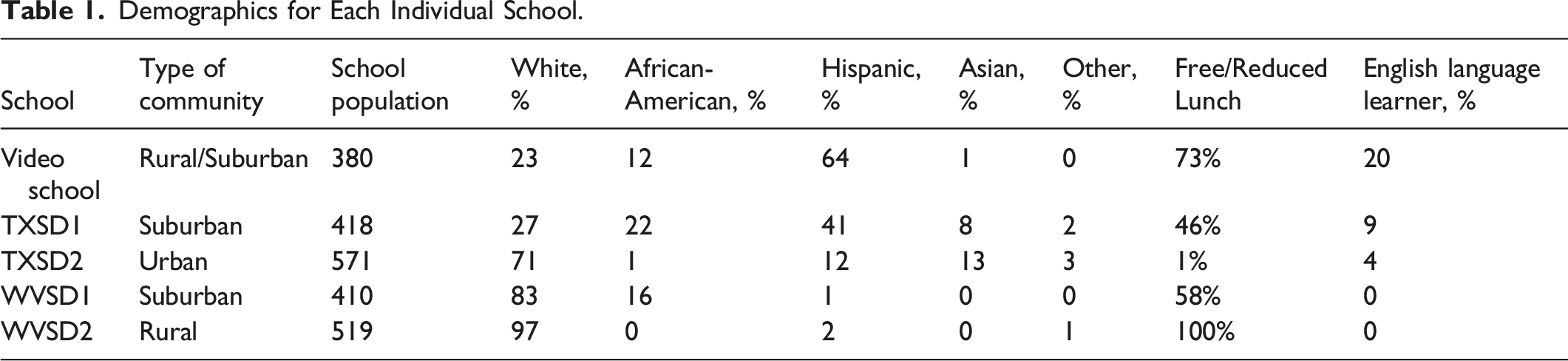
Demographics for Each Individual School.
School Principals (n = 12).
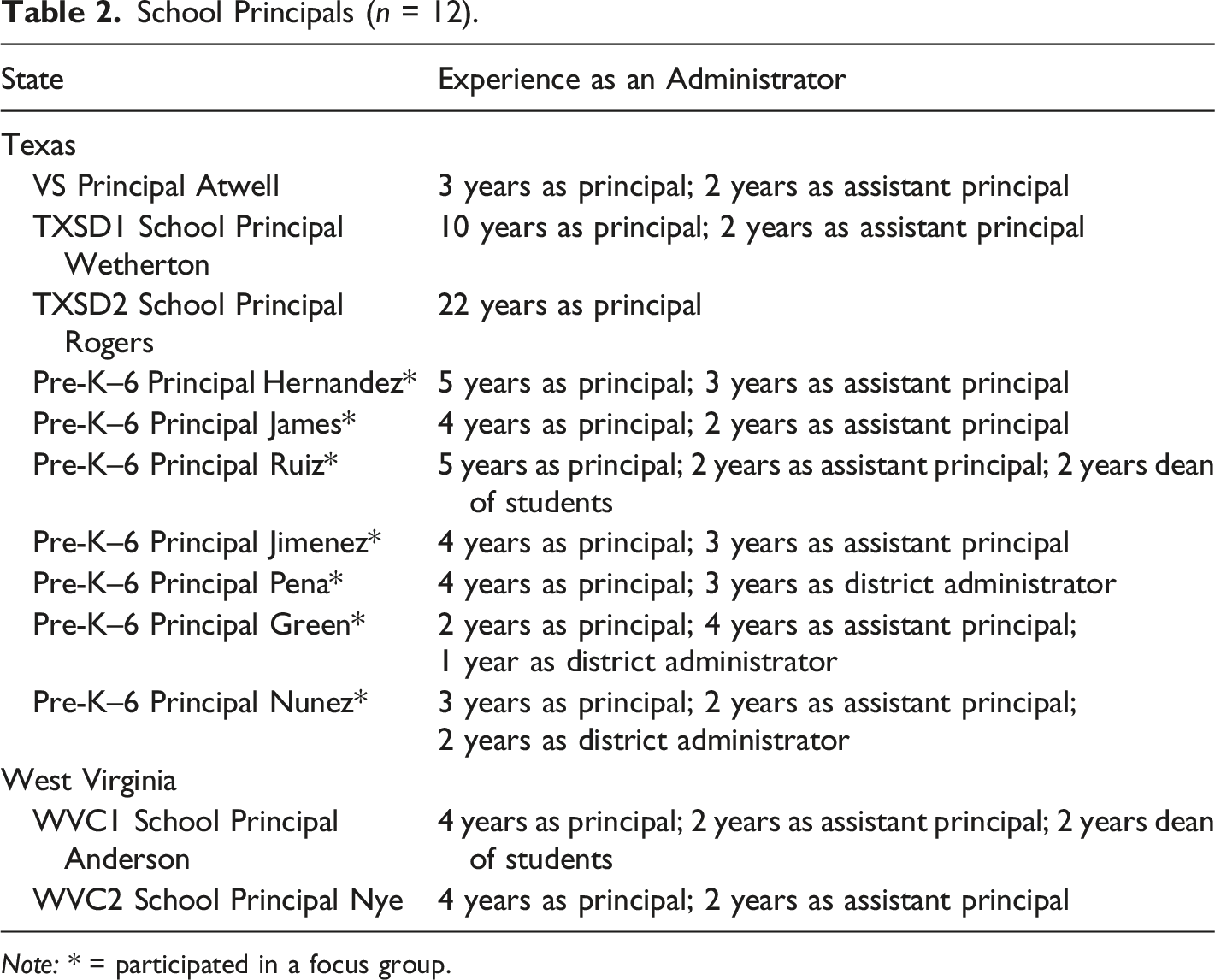
Note: * = participated in a focus group.
Differences Between Texas and West Virginia.
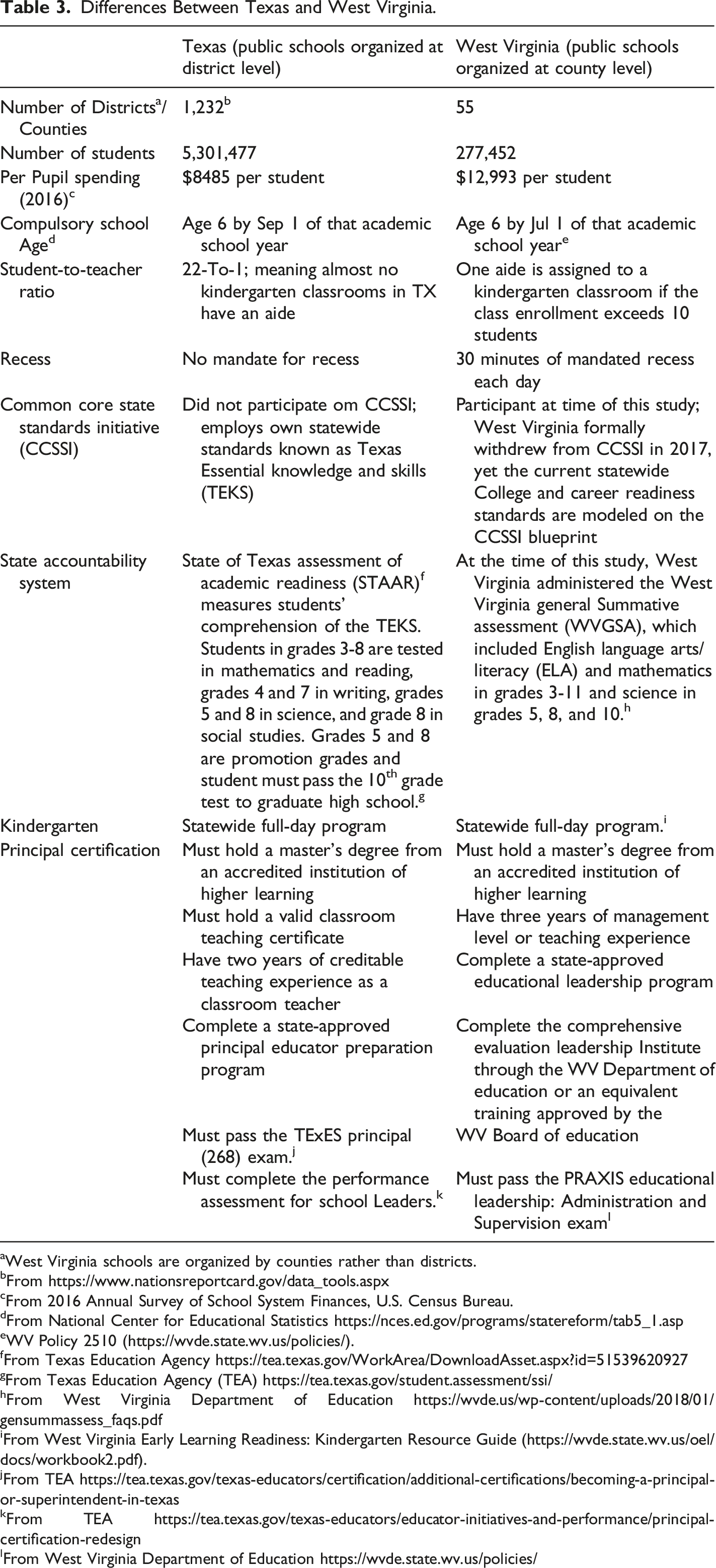
aWest Virginia schools are organized by counties rather than districts.
cFrom 2016 Annual Survey of School System Finances, U.S. Census Bureau.
dFrom National Center for Educational Statistics https://nces.ed.gov/programs/statereform/tab5_1.asp
eWV Policy 2510 (https://wvde.state.wv.us/policies/).
fFrom Texas Education Agency https://tea.texas.gov/WorkArea/DownloadAsset.aspx?id=51539620927
gFrom Texas Education Agency (TEA) https://tea.texas.gov/student.assessment/ssi/
hFrom West Virginia Department of Education https://wvde.us/wp-content/uploads/2018/01/gensummassess_faqs.pdf
iFrom West Virginia Early Learning Readiness: Kindergarten Resource Guide (https://wvde.state.wv.us/oel/docs/workbook2.pdf).
From West Virginia Department of Education https://wvde.state.wv.us/policies/
Data Collection
I collected data for the larger study over a three-year period (Brown et al., 2020). The primary sources of data for this case study were interview data and analytic memos that I wrote after completing each interview (Merriam & Tisdell, 2016; Yin, 2018). Principals were interviewed after watching the 23-min video.
Interviews
Following the viewing of the video, I interviewed the principals either individually or in focus groups to gain insight into their sensemaking of a) the types of learning experiences children are and should be having as they begin elementary school, and b) how such sensemaking appeared to affect them as instructional leaders. The decision to use both individual and focus group interviews was done as part of the larger study. Focus groups are often employed in VCME research (Adair et al., 2018; Tobin et al., 2009) because they can generate “a more comprehensive understanding (expanding the breadth and/or depth of the findings)” of stakeholders’ sensemaking of kindergarten (Lambert & Loiselle, 2008, p. 230). Yet, depending on the participant group and the number of participants available at each research site, I might employ individual interviews instead of focus groups. For this study, there was often only one principal at each school, and as such, I interviewed them individually. However, I had the opportunity to share the video with and conduct a focus group interview with a group of elementary school principals in Texas who were seeking their superintendent’s license, and thus, I took advantage of that learning opportunity (Merriam & Tisdell, 2016).
As Stake (1995) noted, the interview is the “main road” for case study researchers to follow “to obtain the descriptions and interpretations of others” (p. 64). These principals were asked such questions as: Did the film reflect your understanding of kindergarten? What did you think about the learning experiences children were having in the film? Did those experiences align with how you thought children develop and learn? Were there any experiences you thought kindergartners should have that were not in the film? Why do you think that was? What practices do you think are important for kindergarteners to participate in? How have these changes in kindergarten affected you as an instructional leader? And, how do you relay your understanding of instruction to your kindergarten teachers?
Data Analysis
In this case study and the larger study (e.g., Brown et al., 2019b), I analyzed the data following the steps outlined in traditional qualitative analytic methods (Merriam & Tisdell, 2016; Miles et al., 2014). First, all interviews were transcribed by a research team.
4
I then went back and coded the transcribed data on my own using external codes that were based on the constructs of sensemaking, school readiness, and instructional leadership (Miles et al., 2014). For example, the following quote from Principal Anderson in in West Virginia County #1 was coded: changed kindergarten, teaching the test, how children learn, what kindergarten should be. School should be a happy time, but that’s not what kindergarten is anymore. We’ve put so much stress on kids that they can’t enjoy it. It’s just test, test, test constantly. It should be about learning and being able to apply what you learned and not just teach to the test. That bothers me as a principal. We have to have a combination of school that is learning and a part of school that is fun--and it can be done simultaneously.
After the data were read several times and coded using the external codes, I developed a set of internal codes (Graue & Walsh, 1998) that represented themes that emerged through this process, which included such codes as: stress on students, learning as fun, and kindergarten as learning and fun.
After I coded the data using these internal codes and reading these documents several more times, I developed themes to capture “the essence” of the data in relation to the research question (Thomas, 2021). These themes were read against the data in search of contradictory evidence and refined through further analysis (Wolcott, 1994). In the end, two themes emerged and are examined in this interpretive document that illuminate how these principals in Texas and West Virginia made sense of learning experiences kindergarten students are and should be having as they launch their academic careers and how such sensemaking appears to affect them as instructional leaders (Miles et al., 2014; Stake, 1995).
Limitations and Issues of Trustworthiness
The investigation discussed in this article addressed a limited set of issues with a small sample size (n = 12) across two states using a limited set of data (Yin, 2018). Unlike quantitative research, qualitative case studies employ a “small, nonrandom, purposeful sample” because the researchers seek “to understand the particular in depth” (Merriam & Tisdell, 2016, p. 257) with an emphasis on complexity (Thomas, 2021), which for this article centered on interview data seeking to address the complex sensemaking of principals about kindergarten. Still, studying principals in different states using other sources of data may have produced a different set of results (Stake, 1995; Yin, 2018). For instance, studying principals who had received training in early childhood education, led programs in other nations where ‘play-based’ learning might be more prevalent (e.g., Pyle & DeLuca, 2017), or worked in states that are considered more liberal politically may have produced a different set of results.
To address these limitations, I engaged in several strategies that qualitative researchers typically employ to enhance the trustworthiness of their work (Stake, 1995; Yin, 2018); the process of member checking, triangulation, peer debriefing, and reflexivity (Thomas, 2021). For instance, I employed an interview protocol to ensure each participant was asked the same set of questions so that I could triangulate findings around the core constructs that governed this study (Khan & Fisher, 2014). Additionally, as the study progressed, I was reflective about my work by “turning” my researcher lens back onto myself “to recognize and take responsibility for my own situatedness within the research and the effect that it may have on the setting and people being studied, questions being asked, data being collected and its interpretation” (Berger, 2015, p. 220).
Lastly, many are unfamiliar with collecting data through the VCME method. As Tobin et al. (2013) noted, this method of data collection “inevitably raises questions of typicality: how can [I] claim that one [kindergarten classroom] was typical … or that the day we videotape was typical of other days?” (p. 24). Following their suggestions, I attended to this issue by creating the video with kindergarten classroom teacher, and then, as I interviewed principals across Texas and West Virginia, I asked each whether the video reflected a typical kindergarten classroom. Each verified its typicality. For instance, Principal Atwell from the Video School noted, “It definitely looks like a typical day,” and Principal Nye in West Virginia County #2 (WVC2) added, “it reflects what you typically see in most kindergartens in West Virginia.” Moreover, this idea typicality was reiterated by teachers (Brown et al., 2020), district administrators (Brown et al., 2019b), teacher educators (Brown, Ku, & Barry, 2021), Brown, Ku, & Barry, 2021nd state-level policymakers across both states (Brown, 2021), which appears to point to the need for future research examining how kindergarten can appear typical to multiple stakeholders groups across states with different accountability pressures.
Findings
Theme 1: Fostering Student Learning is a Delicate Balance
To begin to understand how these principals made sense of learning experiences kindergarteners are and should be having, it is important to point out how they defined kindergarten. For instance, Principal Nunez in Texas commented, Students have to leave kindergarten reading. They have to read a certain amount of words per minute. In my school district, we get a report on how your school is doing, on how kindergarten is doing at the beginning, middle, and at the end. We have the TPRI [Texas Primary Reading Inventory] data, and we have DRA data. Kindergarten is very focused on student data.
Principal Wetherton from TXSD1 also defined kindergarten through this idea of student data. Principal Wetherton noted, “We have to get students to this level by the end of kindergarten, so we can get them to this level by the end of first, this level by the end of second, and reading by the end of third.” This focus on reading, which was expressed by all the principals in this study, meant, as Principal Anderson from West Virginia County #1 (WVC1) pointed out, “Starting on day one, kindergarten teachers are to focus on math and language arts curriculum and not much play time. By the time the children leave kindergarten, they should be able to read basic five-word sentences.” Combined, these principals appear to be making sense of what kindergarten is by what children must know, which means, as Principal Anderson and others have pointed out (Engel et al., 2021), kindergarten teachers must focus their instruction on teaching children academic skills rather than providing child-centered activities like play.
These principals defining kindergarten through what students should know seemed to create tension in how they made sense of the learning experiences kindergarteners are and should be having as they moved across this grade level. For example, Principal James in Texas stated:
The current emphasis on test scores at the upper grades has had an impact on the beginning of school. Some of that’s been good because it’s made the curriculum more focused and created alignment across the grade levels. But the anxiety that it places on the whole school system detracts students from learning, particularly from being able to engage in the discovery process.
Many principals highlighted this dialectical tension (Mansfield, 2014) that Principal James pointed out exists for principals who are expected to work with teachers to increase students’ test scores at the expense of focusing on the learning process. Principal Anderson in WVC1 noted, Kindergarten can’t be structured all day—they’re too little. We’re pushing our children to be universally competitive, and that’s creating so much stress on kindergartners that they develop tummy aches. Kindergarten should be a fun time for learning. They can learn and have fun at the same time.
Principal Rogers in TXSD2 added, “Kindergarten should have a lot more play than what we do now, and the primary focus should be social skills rather than academics.” Lastly, Principal Pena in Texas commented, “There’s accountability and expectations that are put on kindergarten teachers now, and I get that. It’s a tough balance, but we’re killing their joy for school in kindergarten—so what are we setting them up for later?” Across these statements, these principals appear to be placing an emphasis on teachers attending to students’ needs within their sensemaking of the learning process (Lerkkanen, 2012; Pyle & DeLuca, 2017; Weisberg et al., 2013). Such recognition was echoed by Principal Nye in WVC2: “Kindergarten needs to be more relaxed, more body movement for them and all that stuff. The kids should be playing but learning through play.” These statements seem to demonstrate that these principals understood the significance of their teachers fostering the whole child in their instruction, including their students’ physical and social–emotional well-being, through engaging prosocial learning experiences, such as play (Weisberg et al., 2013), so that their students could succeed in school as well as in life (Schweinhart, 2005).
Still, these principals seemed to recognize that providing a range of instructional activities within the classroom was difficult for kindergarten teachers to do. Principal Ruiz in Texas commented,
Kindergarten is hard, it’s a tough business--not only academically, but sometimes when a teacher is late, and I’m left in charge of a kindergarten classroom, I’m like “Ahhh, that’s tough. I don’t know what to do.” That’s a tough position to be in. Not to mention that teaching kids to read, it is a beautiful thing, not to make it romantic, but it’s also like a tough thing to do.
This identification of the “tough”-ness in this principal’s sensemaking of instruction and in creating a complex learning environment not only creates challenges in the process of instructional decision-making for administrators and teachers, but as Principal Green from Texas commented, these principals recognized it created challenges for children as they learn and develop: “We try to make them grow up too fast in kindergarten so that they can meet certain levels of proficiency by the time they get into third grade.” Combined, these instructional leaders’ sensemaking of what should be occurring in kindergarten classrooms seemed to demand that they “bridge” the expectations of policymakers with their own beliefs about how children learn while also trying to “buffer” both policymakers’ external demands as well as any romantic visions of the complexity of learning such skills as reading (Ganon-Shilon & Schechter, 2019).
Theme 2: Losing the Delicate Balance of Kindergarten Instruction in the Decision-Making Process
The apparent complexity in how these principals made sense of learning as a delicate balance within the kindergarten classroom appeared to create a range of challenges for them as instructional leaders. To begin, as these principals, like Principal Green in Texas, described the connection between their sensemaking of kindergarten and their decision-making as instructional leaders, they seemed to struggle between supporting their teachers with visions of complex teaching while attending to policymakers’ reforms that demand increased student achievement. Principal Green noted: We’re working in a system that where your schools are graded off your third and fifth grade students’ achievement, so there’s not as much emphasis on the early grades. As principals, we need to shift our focus to the lower grades, to show them how to make those outcomes, that there’s a way to get to them that is more fun and engaging. But let’s be honest, principals focus on grades third through fifth because of the tests.
While paying attention to outcomes appears to be important to Principal Green, he noted that he needs to refocus his leadership on the teaching that is occurring in kindergarten because as he, and others such as Principal Anderson in WVC1 recognized that, “School systems do not pay enough attention to kindergarten. It’s not an area where they’re tested, so it’s not focused on in the decision-making process.” Many have found and contend that principals, as instructional leaders (e.g., Farrell & Marsh, 2016
When principals were asked to explain further why their leadership decisions can often ignore what is occurring in kindergarten, Principal Ruiz, in the same focus group as Principal Green, noted,
Leadership in Texas is outcomes driven. There are a lot of kids that can’t read in fifth grade, so you have to ask, “What were they doing in kindergarten? Why isn’t there a sense of urgency in that kindergarten classroom?” I think that it’s up to the school leader to spin it positively, to make outcomes-driven work “fun,” and to let their teachers know you can still have fun teaching. It can still be an enjoyable classroom, even though there’s accountability. We’re all going to be held accountable.
Principal Ruiz’s statement appears to reflect an understanding that the outcomes generated through state tests do not provide a “straightforward pathway between data and instructional decisions that will improve student outcomes” (Farrell & Marsh, 2016, p. 424). Yet, principals are “under a barrage of external demands, which presses them to decide whether to truly carry out a process of change” (Ganon-Shilon & Schechter, 2019, p. 280), and because of this, any change in the instruction that is taking place in kindergarten or any grade level, even if it, as Principal Green noted, has a positive “spin” will have to address these accountability/outcomes issues.
Addressing this issue of outcomes in any form in kindergarten, be it positive or not, was difficult for these principals for several reasons. For example, Principal Nunez in Texas commented, I have to admit that my leadership is affected by standards and state testing. For me, I work at a small campus, and I only have a part-time assistant principal who is shared with another school. If have an issue with a teacher in a testing grade, and if it wasn’t me, who else would take care of it? I can’t be in my primary grades at all. I don’t have a coach. I don’t have any instructional support at all. So, I can see why kindergarten has become what it is; if you give teachers or principals the expectations for testing, or even just give the standards, they’re going to do whatever they think they need to do to meet those expectations at the expense of everything else.
Principal Nunez’s decision making appears to be dictated by both what affected their leadership, which this principal labeled as “standards and state testing,” and a limited set of resources provided to them by their district. No matter the school size or the resources, all the principals in the study, like Principal Nye in WVC2, noted that they “pa[id] more attention to the upper grades because that’s where the tests are.” Koyama (2014) noted that principals are “often negotiating multiple internal and external accountability policies, and mediating the actions of diverse actors, both in and out of schools” within their decision-making (p. 282). Yet, the instructional decision-making by the principals in this study diverged from their complex sensemaking of kindergarten due to issues of accountability, which seemed to be the most urgent need they had to address.
Even while policymakers’ demands for accountability appeared to dictate these principals’ decision-making process, these principals seemed to hope that this disconnect from kindergarten would be temporary. For example, Principal Nye in WVC2 stated, The state dictates what concepts teachers are to be covering, so when we do talk about instruction, we talk about how it relates to the curriculum. In West Virginia, the pendulum swings quickly, and when it gets to the really rigid instructionally point—where the teacher is dictating everything—that’s just not kindergarten to me.
Principal Nunez in Texas also pointed out, “All these changes in kindergarten and in school in general are an effect of the standards and testing, which are always changing.” Principal Anderson from WVC1 also commented, How can you have instructional consistency when the standards keep changing. The pendulum must stop swinging back and forth. You must have a combination where school is learning, and where school is fun. Policymakers need to recognize that it can be done simultaneously with structure.
These principals appeared to be aware of the negative impact of policymakers’ standards-based accountability reforms on their decision-making (e.g., Barker, 2010) and in relation to the learning environments being created in kindergarten classrooms (e.g., Kauerz et al., 2021). Thus, this continued policy churn (Hess, 1999) at the state level of governance that emphasizes accountability for increased academic achievement seemed to bracket these leaders’ decision-making process, and this did not reflect the complexity in which they made sense of what should be occurring in kindergarten classrooms.
Discussion
This sample of school principals in Texas and West Virginia appeared to make sense of kindergarteners’ learning experiences in a complex manner that was shaped by their own beliefs about the purpose of kindergarten and the contexts in which they worked (Coburn, 2005; Spillane et al., 2002). Yet, their multifaceted sensemaking of instruction did not translate into their decision-making as instructional leaders, even though these principals worked in different state-level policy contexts and had varying resources available to them within their schools (e.g., Principal Nunez in Texas). Instead, it seems the “outside pressures” from policymakers’ neoliberal reforms dictated their point of emphasis in their decision-making process (Ganon-Shilon & Schechter, 2019, p. 282).
Still, the first theme revealed how their sensemaking of the learning experiences kindergarten students are and should be having was tied to how they positioned kindergarten in relation to the rest of the schooling process (Garrity et al., 2021; Little, 2020). They wanted to improve their students’ learning, but as others have documented with Pre-K (Brown & Gasko, 2012; Cohen-Vogel et al., 2020), they struggled in envisioning how to implement early childhood-based instructional practices that focused on the whole child due to academic achievement demands of the testing grades. While these school leaders’ own values and their positioning within their school and local contexts can influence their sensemaking (Ganon-Shilon & Schechter, 2017), it seems the need for high performance in the later grades was a driving force in their understandings about the types of instructional activities that were to take place in this grade level and their goals for their students (Falabella, 2021).
This apparent uniformity in these principals’ sensemaking of the challenges in creating complex learning experiences for kindergarteners so that they are prepared for the academic demands of the later grades demonstrates that these principals were aware of the importance of the early years of schooling in children’s learning and development (e.g., Burchinal et al., 2020). It also seems to reveal that these principals had some insight into the early childhood-based instructional practices their teachers and students should engage in within the early grades. For example, the statements by Principal Nye in WVC2 for more child-centered learning experiences, like guided-play (e.g., Toub et al., 2016), align with Lerkkanen et al.’s (2012, 2016) findings of the positive impact of child-centered learning experiences on children’s interest and skills in reading and mathematics. So rather than make “different sense of the same thing,” these principals were struggling to find the space within their kindergarten classrooms to allow for more complex and child-centered teaching while attending to policymakers’ academic achievement demands (Coburn, 2005, p. 162). Furthermore, the apparent uniformity in their responses in wanting to change kindergarten appears to create the opportunity to consider how principals might alter their instructional leadership practices to support the learning experiences of kindergarten teachers, kindergarteners, and their families (Bertrand & Marsh, 2015; Coburn, 2005).
Because the instructional leadership of principals plays such a significant role in what occurs in the early years of schooling (Douglas, 2019) and at all grade levels (Grissom et al., 2017), the second theme of this study examined how these principals’ sensemaking of kindergarten appeared to affect them as instructional leaders. While others have shown that “school leaders exert substantial influence over how policy is enacted in their schools” (Mavrogordato & White, 2020, p. 35), which can lead to improved student learning (Reid, 2021; Sebatian et al., 2016), the principals in this case study appeared to direct their influence as instructional leaders to the grade levels they were held accountable for by district and state policymakers. One reason these principals may have directed their influence towards the upper grades and not kindergarten could be because, as documented by Mavrogordato and White, that the “contextual constraints” generated by neoliberal “policy and district-level issues,” such as limited resources (staff, time, etc.), negatively “affect[ed] the ways in which” (e.g., Principal Nunez in Texas) they made sense of and engaged in their role as instructional leaders towards early elementary school (Castro, 2010, p. 101). No matter the variability in these principals’ depth of knowledge about how best to support teachers in the early grades, policymakers’ neoliberal demands for demonstrating high academic achievement on standardized tests in the upper elementary grades appeared to lead these principals either to “abandon their commitments” to their kindergarten programs or simply align their focus towards those upper grade teachers and students because that is how they will be evaluated effective leaders (Schmidt & Datnow, 2005, p. 951).
These findings, which demonstrate not only the nuance in how these administrators were making sense of kindergarten (Brown, 2007; Little & Cohen-Vogel, 2016) but also their deference to the achievement expectations of the later grades, which appeared to drive their instructional leadership; this may be why others are finding that kindergarteners are often learning content/skills they already know (e.g., Cohen-Vogel et al., 2021). This repetition could be the result of kindergarten teachers not only receiving limited instructional guidance from administrators but also from working in neoliberal teaching contexts where achievement scores drive their and other stakeholders’ conceptions of learning, which may cause them to interpret their primary responsibility as teachers being to ensure students know the content they will be tested on (Brown, 2013).
Finally, this study appears to add to a growing body of literature (e.g., Rivera-McCutchen, 2021; Walls, 2022) that demonstrates policymakers’ neoliberal testing requirements and accountability policies, which have spread across the globe (e.g., Teng et al., 2020), “serve as a [significant] point of reference” and “source of power” in their decision-making process across varying states that have different accountability policies (Weick, 1995, p. 50). Thus, these principals do not seem to be simply “acknowledging [the] power relations” policymakers’ neoliberal reforms play in their sensemaking of the instructional practices that should be taking place in kindergarten (Mills et al., 2014 p. 190). Instead, policymakers’ demands for improved academic achievement appear to dictate their point of emphasis in their decision-making process (Falabella, 2021), which seemed to limit their ability to focus on the early grades. Rather than these principals making sense of and leading kindergarten in varying ways based on their individual contexts (e.g., Bros & Schechter, 2022), a sense of uniformity emerged among their apparent responses to and actions towards kindergarten. Such actions seem to reinforce how the current culture of standardization and accountability across the US, which has been in place for two decades (Brown, 2021), appears to override differences in states that have otherwise different policy mandates.
In all, these findings provide several opportunities to consider how to support principals as instructional leaders so that they can address these challenges while making kindergarten a better place for teachers, students, and their families so that children have a successful launch into K-12 education systems.
Conclusion
Being a school leader is a complex and difficult occupation. It requires principals to balance “between inner pressures emanating from school values, goals, needs and capacities and outside pressures such as external stakeholders’ expectations, goals and views” in their instructional decision-making (Ganon-Shilon & Schechter, 2019, p. 282). The findings from this study appear to demonstrate that while these principals were interested in developing complex learning environments for their kindergarteners, their point of emphasis in their instructional leadership leaned towards external stakeholders’ neoliberal demands for high test scores. This neoliberal logic rooted in standardization, increased academic achievement, and limited resources (Brown et al., 2019a), including the increased emphasis on academic instruction in the early years, seems to persist due to not only the disparities that exists in test scores within the US context among various populations of students but also when comparing US students to those across the globe (e.g., Tienken, 2020). Yet, policymakers’ neoliberal reforms have been in place for over two decades, and they have not created systems of public education in which all children are academically successful (Ladd, 2017), even as empirical researchers have (Cuban, 2013) and continue to document how these systems of reform will not achieve their stated goals
Nevertheless, school leaders must continue to lead their schools even in this flawed policy environment, and in doing so, the findings from this instrumental case study suggest that principals may possess what Loh and Hu (2014) identified as a “neoliberal literacy” of both how to manage these reforms and their impact on their instructional leadership. However, an apparent shortcoming in their leadership practices is how to use this neoliberal literacy in a manner that would allow them to be better instructional leaders of the early grades. Thus, it seems that elementary school principals should take a step back and rethink their points of emphasis in their instructional leadership of their early education programs so that they can consider how they might use this neoliberal literacy to better support their early educators with engaging in effective early childhood teaching practices with their students and their families (Garrity et al., 2021; NAESP, 2014). For example, school leaders can assess where or even whether the early grades factor into their instructional decision-making process. Doing so is important because researchers have shown a disconnect often exists between the instructional beliefs of school leaders and teachers in the early grades (Brown & Gasko, 2012; Cohen-Vogel et al., 2020). Moreover, principals’ engagement with kindergarten teachers influences their sensemaking and their instructional decision-making both directly and “indirectly as they participate with teachers in the social construction of the meaning and implications of policy ideas” and their priorities as leaders (Coburn, 2005, p. 500).
Principals should also evaluate their own understanding of early childhood education, how children learn and develop, and what that means for teaching young children in elementary school so that they are successful in school (e.g., Allen & Kelly, 2015). Most principals in the US, like those in this case study, do not have any formal training in leading ECE programs (Talan & Magid, 2021). As such, developing an early childhood literacy about the complexity of teaching, learning, and assessment in kindergarten (e.g., Nicholson et al., 2022) could help principals make sense of their early grades teachers’ knowledge of teaching young children as well as recognize what their teachers’ needs are so that they can better support them as instructional leaders as they work with their students both academically and socially (Garritty et al., 2021).
To do so, principals should reference such leadership guides as the six competencies NAESP put forward to improve and sustain early learning communities (Kauerz et al., 2021), which advocates for principals to structure teaching, learning, assessment, and home-school relations through an early childhood lens. Gaining such professional knowledge would help principals recognize that “children are experiential learners—they learn by doing rather than thinking,” and as such, teachers must offer instructional opportunities that are student-centered, such as play, where children have hands-on learning experiences that provide them with time for “trial and error” so that they can process and internalize the new skills they are learning (Walker & Wooleyhand, 2022, p. 23). Still, such instructional language as the term “play” can make principals uncomfortable, and as a result, Brown et al. (2018) contend that principals should reframe such learning opportunities through the construct of rigorous and developmentally appropriate practices so that they can support their teachers in creating “the conditions for all children to learn at high-levels by providing them with multiple learning opportunities to gain the knowledge and skills needed for success in and out of elementary school” (p. 10). In their work, Brown et al. (2018) outline these processes through the acronym of RIGOROUS DAP, which offers 11 principles of instruction in which early educators can engage with their students and their families daily. To be clear, within these principles, RIGOROUS DAP addresses the sociocultural and linguistic shortcomings of DAP (Bloch, 1991; Pérez & Saavedra, 2017) by turning to culturally relevant pedagogy (Ladson-Billings, 1995, 2006) to assist early educators in interacting with children from diverse backgrounds and engage in learning experiences central to them and their community (Brown et al., 2018). There are also other resources that speak to other forms of child-centered practice in the early years (e.g., Nicholson et al., 2022), such as guided-play (e.g., Hirsh-Pasek et al., 2022). The point is that as principals learn about the complexity of teaching and learning in the early years, be it in their principal training program or through professional development, they will develop and possess a deeper understanding of what children need to learn and how to instruct them in those skills that can then enhance their instructional leadership practices and support their early years school personnel in preparing children for school success (Coburn, 2005; Ganon-Shilon & Schechter, 2017; Rigby, 2014; Wu et al., 2020)
Another way for principals to move forward includes examining how other nations across the globe incorporate early childhood education programs into their elementary schools differently (e.g., Alexiadou et al., 2022). This can help them recognize, or possibly remember, that there are multiple ways to instruct children so that they are successful in school. For instance, in Aotearoa (New Zealand), Ritchie (2013) and Chan and Ritchie (2016) have documented how kindergarten teachers are employing Indigenous pedagogies of care and affect to counter “the global technicist, corporatist exploitation of human and natural resources” (Ritchie, 2013, p. 403) and are engaged in pedagogical practices with their students that are “restorative of an ethic of biocentric relationality” that reframes the learning process and what it means to lead schools (Ritchie, 2013, p. 404).
Yet, it is important to point out that many of the nations that typically outperform the US on a range of academic achievement measures (Tienken, 2020), either have (e.g., Singapore) or are now having to implement reforms (e.g., Finland) more aligned with neoliberal beliefs in accountability, standardization, and limited resources (Roberts-Holmes & Moss, 2021). For instance, Finland has historically supported high-performing strong publicly funded ECE and early elementary programs that implement child-centered pedagogies (Alexiadou et al., 2022). Yet, there is a growing focus on standardization as well as an increase among local municipalities offering vouchers and allowing private sector ECE programs to receive public funding, both of which are key neoliberal principles in education reform (Laiho & Pihlaja, 2022). Furthermore, Singapore, a nation with a strong neoliberal educational accountability system where students perform at high-levels, there is still an “increasing gap between the haves and have-nots and declining social mobility” (Teng et al., 2020, p. 464). As such, there may be a danger in looking elsewhere for educational reform ideas (e.g., Tienken, 2020). Thus, while principals can learn from other nations about instructionally guiding their early years programs, they should also employ their neoliberal literacy skills to ensure that what they are discovering does not simply create the same leadership issues found in this case study (e.g., Laiho & Pihlaja, 2022).
In sum, for principals to be instructional leaders who can address the challenges created by policymakers’ neoliberal reforms while making early childhood programs, such as kindergarten, a better place for teachers, students, and their families requires that they consider where their early education programs are positioned within their points of emphasis as instructional leaders. It also necessitates that they assess their own understanding of teaching, learning, and assessment in the early childhood years. After doing so, they should seek out professional (e.g., Kauerz et al., 2021) as well as local support (e.g., their school districts) to better understand how to lead these programs from an early childhood perspective so that they can ensure their early years teachers, students, and their families have a successful launch into the larger K-12 education system.
Future Research
As organizations, such as NAESP (Kauerz et al., 2021), and other researchers, like Douglas (2019), continue to advocate for and seek out principals who are engaging in and developing ECE instructional leadership skills, there is a need for additional studies documenting how elementary school principals can attend to policymakers’ neoliberal reforms that demand increased academic achievement while also advocating for early learning experiences that reflect how children learn and develop. Because context matters in how principals lead and teachers instruct their students (e.g., Ganon-Shilon & Schechter, 2019), there is also a need for empirical work investigating how principals address the changing kindergarten across varying schooling, licensure, political, and policy contexts, such as examining how principals are supporting kindergarten teachers in ‘low-stakes’ states, states that are considered more liberal politically, or states that have implemented a range of early literacy and kindergarten readiness tests 5 (Weisenfeld et al., 2020) 6
Footnotes
Acknowledgements
The author would like to thank the Spencer Foundation Small Grants Program (Reference # 201700116) and the Big XII Faculty Fellowship Program for their support of this study. He would also like to thank Dr. Joanna Englehardt, Dr. Da He Ku, Dr. David P. Barry, Dr. Melissa Sherfinski, Dr. Jennifer Adair, Natalie Weber, Hye Ryung Won, Dr. Karen French, and Robert Donald for their assistance in conducting this study.
Declaration of Conflicting Interests
The author(s) declared no potential conflicts of interest with respect to the research, authorship, and/or publication of this article.
Funding
The author(s) disclosed receipt of the following financial support for the research, authorship, and/or publication of this article: This work was supported by the Spencer Foundation Small Grants Program (Reference # 201700116) and the Big XII Faculty Fellowship Program for their support of this study.
