




Abstract
The importance of pedagogical leadership for instructional improvement is well-known in educational research, but for many principals challenging in practice. This study explores how principals, participating in a three-year research and development (R&D) collaboration in the Swedish context, made sense of and developed their pedagogical leadership to support instructional improvement. Drawing on principals’ written self-reflections and interview data, the results show that participating in the R&D-collaboration triggered their individual and collective sensemaking. While initially focused on organizational practices, their understanding of pedagogical leadership gradually developed to also include educating and coaching teachers and eventually working in collaboration with teachers as they took on the role of co-learner and co-creator to improve instruction. The paper provides insights on how collaboration between researchers and practitioners can challenge socio-historically embedded ideas of principalship, trigger sensemaking, and support principals’ professional agency in instructional improvement.
Keywords
Introduction
Research repeatedly emphasizes that if education is to provide students the best prerequisites for learning, principals need to support and participate in instructional improvement (e.g., Grissom et al., 2013; Leithwood et al., 2020; MacNeill et al., 2003; Robinson, 2010). Doing so requires a general knowledge of management and teaching and learning theory as well as specific pedagogical knowledge about how to teach different subjects and different curriculums (Robinson, 2010). Timperley (2011) also emphasizes the importance of being able to put knowledge into action by, for example, giving teachers relevant feedback on their teaching. However, giving this priority to pedagogical leadership is challenging for many principals, who cite lack of time as an obstacle, although lack of knowledge, prevailing norms, and uncertainty about their relationship with teachers can also be hindrances to effective leadership (Ärlestig and Törnsén, 2014; Emstad et al., 2021; Leo, 2015). For example, Jerdborg (2023a) has stated that novice principals’ lack of knowledge of the school's practice limits their possibility to engage in teaching and give qualified feedback. Moreover, Le Fevre and Robinson (2015) conclude that, all too often, principals who observe teaching try to convince teachers to teach in different ways. Rather than collaborating with teachers to explore the validity of different teaching methods, principals tend to prioritize their own preferred method.
Many countries prioritize instructional improvement in their national policy agenda. Despite this, support for principals to develop sound pedagogical leadership is not emphasized (Liljenberg, 2021; Sahlin, 2025). Professional development for principals based on general assumptions about contents and methods tends to dominate, although it is well-known that collegial networks for consultation and context-embedded activities are needed to promote effective learning (Liljenberg et al., 2023; Klar et al., 2024). Adopting the sensemaking perspective (Weick, 1995), this study aims to contribute to knowledge about principals’ professional development and pedagogical leadership. Focusing on principals who participated in a three-year research and development (R&D) collaboration, the study explores the following research questions:
How did principals make sense of and develop their pedagogical leadership during the R&D-collaboration? What courses of actions were taken and how can they be understood from a socio-historical perspective on pedagogical leadership in Sweden?
The next section gives a broad overview of the history of principalship in Sweden. The sections that follow outline the theoretical framework of the study, including the methodology used and a condensed presentation of the R&D-collaboration. Thereafter, the results are presented, followed by a concluding discussion outlining implications for educational policy and practice.
Background
The context of this study is Swedish public education. While part of the Nordic welfare system, education in Sweden was decentralized in the late twentieth century with the economy and market influences playing a key role in lessening state involvement (Lundahl, 2002). To better understand principals’ challenges in exercising pedagogical leadership within the current system a historical retrospective is necessary. Up until the 1950s, principals were appointed based on their teaching skills, regarded as ‘the first among equals’, and considered members of the teaching profession. With the introduction of compulsory schools in 1962, principals’ administrative duties increased. As they began to take on a more administrative role in education, the distance between principals and teachers increased (Jarl et al., 2012). In the 1990s, during the establishment of new public management in the education sector, many principals started to identify themselves as managers of education and part of the local education authority (LEA), rather than as colleagues of teachers in the local schools (Jarl, 2013). The fact that Swedish principals nowadays do not have any teaching responsibilities but extensive responsibilities for finances, employees, and administration may have reinforced this development (Leo et al., 2020). The demands placed on principals are now high when it comes to both management and instructional improvement (SFS 2010:800).
The introduction of positions such as deputy principals and teacher leaders (e.g., Andersson and Sälj, 2024) might have also contributed to distancing principals from teachers. In Sweden, it has long been claimed that there is an invisible contract between principals and teachers not to interfere with each other's work (Berg, 1999). However, in recent years, under decentralized education, a ‘new leadership role’ has been proposed whereby principals, while still being managers and leaders, are now expected to work collaboratively with teachers for the common good of educating the students (Jerdborg, 2023b). Embracing this role tends to be difficult for principals as it requires new relationships with teachers and skills other than those previously valued. The three-year R&D-collaboration organized by an independent research institute was intended to support principals in their development of pedagogical leadership for instructional improvement by building agency for this new leadership role (Sannino et al., 2016).
Sensemaking perspective
The theoretical point of departure for the current study is Weick's (1995, 2001), Weick et al. (2005) sensemaking perspective. According to Weick (1995), sensemaking is an ongoing, retrospective, and social process through which people seek to make sense of what is unclear and answer questions such as: What does this mean? and What should be done now? Sensemaking is aimed at learning how to move on in new a situation without disruption. To make sense of triggers—issues, events, or situations—that cause ambiguity and/or uncertainty, people extract and interpret cues from their environment and connect them to prior experiences, knowledge, and beliefs. This process, socially constructed in interaction with others, reduces the interpretation options and thus becomes a way of handling the situation and finding ways to move on (Maitlis, 2005). In addition, Weick (2001) argues that when people have the opportunity to create meaning together, new interpretation alternatives can emerge that give perspective on the situation and invite a broader understanding. This theory has evident implications for principals in Sweden faced with the challenge of embracing a new role in education. The R&D-collaboration was intended to facilitate collective sensemaking and open up new avenues for leadership action. This study, which explores how principals responded to the triggers (i.e., tasks, situations, and perspectives) given by the researchers in the R&D-collaboration, gives valuable insight into how principals’ sensemaking of pedagogical leadership unfolds in practice. Weick et al. (2005: 417) emphasize that sensemaking is shaped by the rules, norms, and cultural-cognitive elements that prevail in the institutional context in which it takes place. It follows that principals’ sensemaking must be understood in relation to both the socio-historical development of principalship and the school context in which each principal operates. By inquiring into the results of the R&D collaboration and relating them to the history of principalship in Sweden, this study approaches sensemaking from both angles.
Research methodology
The context of the study is a three-year R&D-collaboration (October 2021–May 2024) organized by an independent research institute in which a total of approximately 170 teachers, 35 principals, and 10 LEA officials in five Swedish school organizations (four municipal and one independent organization) collaborated with three researchers to achieve an ‘inside-out’ perspective on instructional improvement. The R&D-collaboration thus had a transformative agenda (Kennedy, 2014; Virkkunen and Newnham, 2013) that aimed to improve instruction by taking its point of departure in the specific needs of the students in question (inside), through solutions found in the multidimensional knowledge of teachers (outside). This ‘inside-out’ perspective was intended to mirror that which is expected take place in instructional practice. When teachers carry out similar improvement work, teachers’ needs (inside) form the starting point for principals’ exploration of pedagogical leadership and actions that support instructional improvement (outside).
In the R&D-collaboration, the researchers’ role was not to share a predetermined method for teachers and principals to implement, but to guide a process of expansive learning, strengthening the transformative agency of the actors working with the changes in practice. As Sannino et al. (2016: 603) explain, expansive learning is ‘a creative type of learning in which learners join their forces to literally create something novel’, and transformative agency is a quality of expansive learning requiring the possibility of ‘break[ing] away from a given frame of action and taking the initiative to transform it’. Consequently, in the R&D-collaboration, the transformation process was led and owned by participating teachers and principals, while supported by researchers. During the three years of its operation, two-day conferences regularly occurred that offered research input, workshops, participant presentations of ongoing improvement work, dialogic reflections, and feedback from researchers to participating teachers and principals.
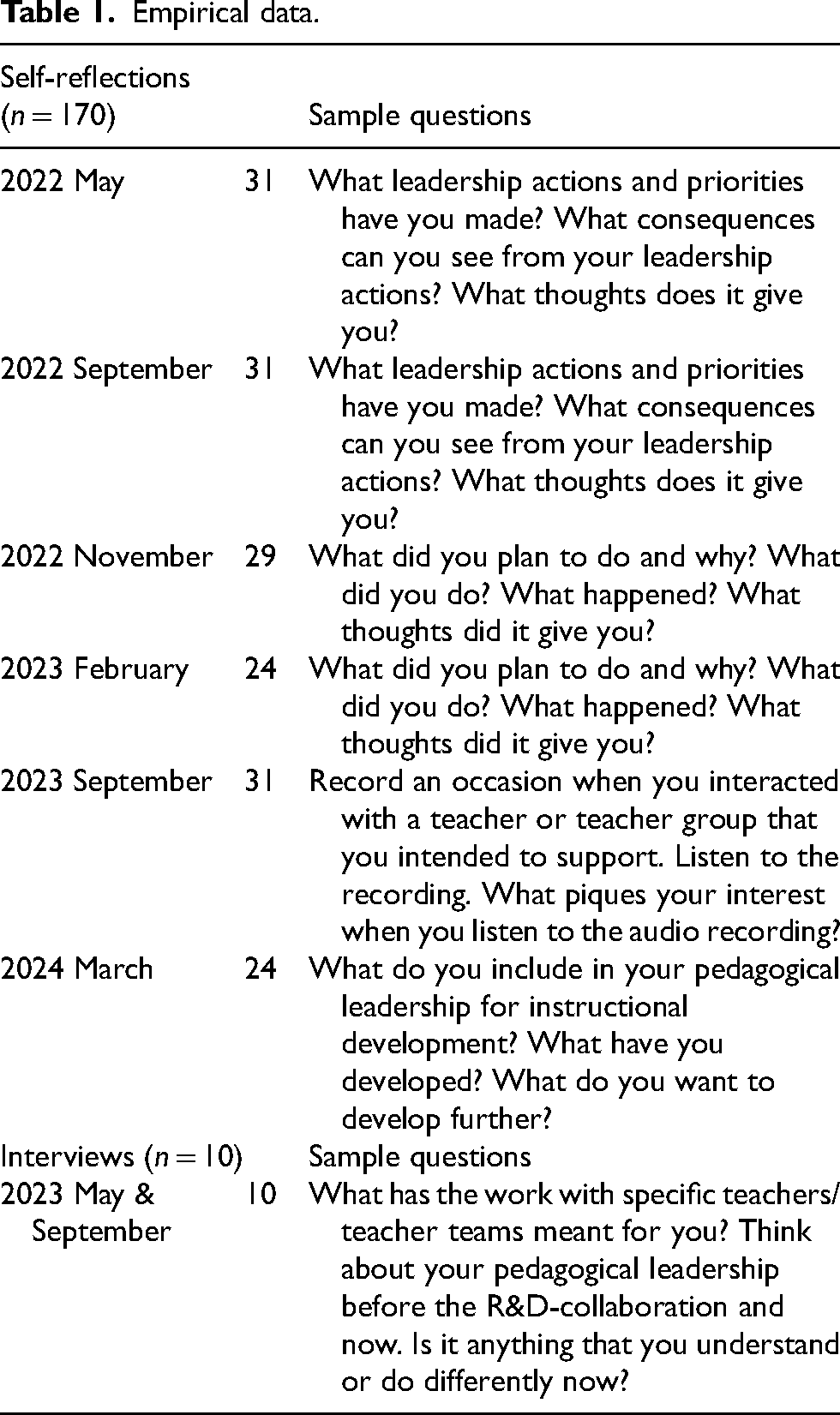
As indicated by the research questions, this study focuses on the participating principals. The empirical data consists of self-reflections (n = 170) written by the principals at six occasions throughout the R&D-collaboration and audio-recorded interviews with 10 principals conducted during the second half of the R&D-collaboration. The self-reflections were written in digital templates provided by the researchers during or between the two-day conferences (see Table 1). Collecting data over three years contributed to a process-oriented perspective that captured the development of principals’ pedagogical leadership and sensemaking. Since taking part in the research was voluntary, not all principals contributed self-reflections on all occasions. Written informed consent was obtained from all participants prior to data collection, and all names were omitted to protect anonymity.
Empirical data.
In the first phase of the study, qualitative content analysis with open codes was conducted (Hsieh and Shannon, 2005). This phase focused on aspects of pedagogical leadership that the principals highlighted in their written self-reflections and in the interviews, where those who participated also responded to the question of how their understanding is expressed in what they say and do. In the second phase, the theoretical construct of sensemaking (Weick, 1995) was added. This phase focused on themes relating to principals’ experiences and beliefs that were significant for their sensemaking and ultimately decisive for their leadership actions. It also focused on activities taking place in the R&D-collaboration that triggered principals’ sensemaking. Finally, their sensemaking and leadership actions were related to socio-historically embedded expectations of principalship in Sweden (Jarl, 2013; Jerdborg, 2023a, 2023b). The coding and analysis were thus data-driven and concept-driven (Kvale and Brinkmann, 2009).
Results
The following section presents the three main themes identified as significant for principals’ sensemaking and leadership actions during the R&D-collaboration and relates them to socio-historical expectations of principalship in Sweden.
Prioritizing organizational issues
The first theme relates to principals’ long-held understanding of not interfering with teachers’ work but rather being administrators of education. In the beginning of the R&D-collaboration, most principals, in line with the invisible contract (Berg, 1999), understood pedagogical leadership as pertaining merely to organizational practices. Hence, they focused on creating schedules for meetings, arranging teacher learning groups, providing tools for documentation, and appointing teacher leaders, all of which were seen as organizational prerequisites for teachers so they could learn collaboratively. As one of the principals wrote in their self-reflection, I have organized [meetings] so that the learning groups can meet every other week for two hours. I have regular meetings with the entire development group and make sure that the assistant principals have more frequent meetings with their teacher leaders and that they report back to me in our management group meetings. (Principal, Self-reflection May 2022)
Orienting pedagogical leadership towards organizational issues in the beginning of an improvement initiative is appropriate. However, it can also be regarded as ‘a safe card’ that does not challenge prevailing notions of pedagogical leadership. To trigger principals’ sensemaking, the researchers presented national and international research (e.g., Robinson, 2010; Timperley, 2011) highlighting how principals’ pedagogical leadership can align more closely with teaching practice. The researchers also presented their analysis of principals’ initial self-reflections as a mirroring strategy. Despite these triggers, a few principals continued to orient their leadership towards organizational issues. As the statement below shows, taking a step away from organization was perceived by some principals as difficult. I’ve been much more in that zone of being that service person for us to succeed than I’ve reflected on what I’m doing. What am I doing as a leader or as a principal? Yes, it's been difficult for me or challenging. (Principal, Interview May 2023)
However, for most principals, the R&D-collaboration initiated a sensemaking process that eventually brought their understanding of pedagogical leadership in closer alignment with teaching practice. How this was expressed will be further explored in the following two subsections.
Educating and coaching teachers
The second theme that emerged as significant concerns the knowledge principals had acquired from their previous and current careers as teachers and leaders. To additionally support them in orienting their leadership practices closer to teaching practice, the researchers emphasized the transformative agenda of the R&D-collaboration and the ‘inside-out’ perspective. They advocated that principals engage in the work of teachers, or teacher teams, to learn how to identify teachers’ needs and adjust their leadership accordingly.
Self-reflections from the second- and third-year related leadership actions to the needs of teachers. Some principals mentioned how they observed lessons and, based on their retrospective knowledge of teaching, tried to educate the teachers by giving advice and instruction on how to teach and build relations with students. I wrote down concrete actions and approaches based on the different roles that the employees have in the class, and everyone was asked to work based on my directives. (Principal, Self-reflection September 2023)
For some principals, approaching pedagogical leadership as ‘the first among equals’ (Jarl et al., 2012) made sense. For others, responses from teachers became cues that further triggered sensemaking and contributed to a reconsideration of leadership action based on aspects of power and agency: I am challenged not to give ready-made suggestions, but to take a step back and support the teachers so that they find new paths themselves. [Previously] I automatically reacted and gave suggestions, which do not develop teachers. I have come more and more to realize [the importance] of waiting and supporting the teachers to find their own ways. (Principal, Self-reflection February 2023)
In most cases, the principals were well-aware that most teachers knew just as much as they did about teaching and knew the needs of their students far better than they did. Thus, they concluded that acting as teachers for the teachers had its limitations. For new or unqualified teachers, this might be important but not for most other teachers. When relating to the latter, they had to act differently. Rather than relying on their prior knowledge as teachers, the principals considered their current competencies as managers of education and leaders of teachers, and they based their sensemaking of pedagogical leadership on these skills. Having all taken part in the National Principal Training Programme, they were familiar with coaching and the idea of not giving advice but supporting reflection.
In the second year of the R&D-collaboration, the researchers recommended that the principals record a meeting in which they were engaged in a conversation with a teacher or a teacher team, listen to the recording, and reflect on what they heard. With this recommendation, the researchers hoped for a shift in focus that would prompt the principals to reflect on their own leadership practices rather than on the practices of teachers. Listening to the recordings, the principals started to reflect on their own words and the impact of what they were saying: I brought with me a battery of coaching questions to bring depth to the discussion, which I will certainly continue with. When I listen to the conversation, it strikes me that I have developed as a conversation leader, just by turning the mirror at myself and thinking about what I can do in my leadership to bring about more qualitative meetings with a focus on making a difference for our students. (Principal, Self-reflection September 2023)
However, when listening to the recordings, some principals also expressed doubts about their coaching methods. They found the general questions they used to clarify, explore, deepen, and challenge various teaching practices to be insufficient for deepening conversations about instructional improvement. This became particularly apparent when they employed these methods to support and challenge the more experienced teachers. Realizing the inadequacy of this approach, the principals began to reflect more on their own knowledge and how it influenced their pedagogical leadership. Thus, the recordings worked as an additional cue that triggered sensemaking about pedagogical leadership for instructional improvement.
Joint learning and collaboration
The third significant theme emerging from the R&D-collaboration was an increased awareness among principals of the importance of joint learning and collaboration for achieving the real purpose of pedagogical leadership: meeting the needs of students. Over time, the transformative design of the R&D-collaboration contributed to strengthening both principals’ and teachers’ knowledge of instructional improvement and developing their capacity to work collaboratively in line with the ‘new leadership role’ proposed by research (Jerdborg, 2023b). Following the recommendations of researchers to ground leadership actions not only in knowledge but also in collegial expertise, some principals realized they needed to learn more themselves: I realize that I lack knowledge of how the learning of reading takes place. It arouses a curiosity in me, and I want to learn more. I have found some research to familiarize myself with, among other things, ‘teaching children to read’. I also realize that not knowing fully can be a strength as I [openly] ask my genuine questions. (Principal, Self-reflection February 2023)
For the most part, principals’ eagerness to meet the needs of students also triggered them to engage in teachers’ learning groups. Inspired by the transformative agenda and the idea of joining forces to ‘literally create something novel’ (Sannino et al., 2016: 603), they came to realize they were not required to have answers to all questions but could converse with teachers on equal terms: I've come to the conclusion that I really can't be an expert in everything. I'm not a superwoman in a tight suit. I've thought a lot about what my strengths are. It is to create an inclusive culture. (Principal, Interview May 2023) I turn the questions to the teachers more often, instead of coming up with the answers myself, which I feel has created a feeling of participation, a ‘we’ together. (Principal, Self-reflection March 2024)
All in all, the three-year R&D-collaboration activated collective sensemaking among the principals, enabling an understanding of pedagogical leadership as a collaborative practice in which principals and teachers learn with and from each other to co-create instructional improvement.
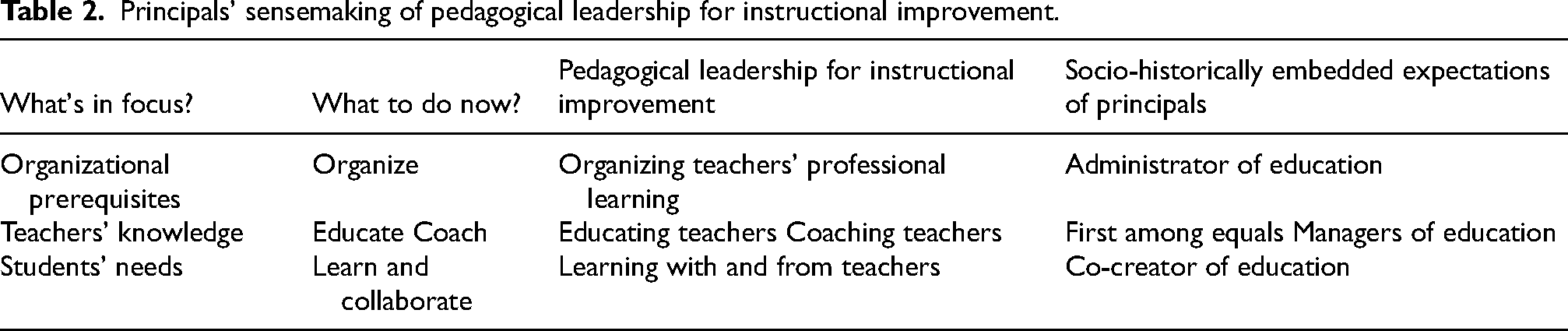
Table 2 summarizes the results. It lists the three themes significant for principals’ sensemaking and leadership actions during the R&D-collaboration and shows how each theme contributed to an idea of what pedagogical leadership implies. During the R&D-collaboration, triggers of various kinds prompted principals to challenge their preconceived ideas of pedagogical leadership. Starting out as organizers of teachers’ learning experiences, principals over time began to draw on their previous experience as teachers and, hence, to assume the role of educators and coaches. Finally, individual and collective sensemaking inspired principals to work collaboratively with teachers, acting as co-learners and co-creators of instructional improvement. These results demonstrate how socio-historically embedded expectations of principalship were challenged during the R&D-collaboration as principals’ transformative agency was strengthened.
Principals’ sensemaking of pedagogical leadership for instructional improvement.
Concluding discussion
This study aimed to contribute to knowledge about principals’ professional development and pedagogical leadership by exploring how principals made sense of their pedagogical leadership for instructional improvement in a three-year R&D-collaboration designed to guide and strengthen expansive learning and transformative agency (Sannino et al., 2016). The results show that this inquiry-based design, which involved dialogic reflections and feedback from teachers, other principals, and researchers, contributed to trigger principals’ sensemaking and allow a new concept of agency to emerge (Weick, 2001). While the principals initially viewed their agency as distanced from teachers and teaching practices, by the end of the R&D-collaboration they saw themselves as co-learners and co-creators, working alongside teachers to improve practices. The R&D-collaboration thus strengthened their transformative agency by challenging their given frame of action and enabling them to develop new ways to approach pedagogical leadership for instructional improvement. To enable this development, the role of the researchers is worth emphasizing. Their external position provided the opportunity to challenge established perceptions and everyday assumptions, thereby truly creating conditions for learning, which were crucial for development. However, achieving this required tactful actions to gain acceptance from the principals, which could not be taken for guaranteed. Importantly, the researchers’ contributions are in line with the framework of expansive learning (Sannino et al., 2016) that underpinned the R&D-collaboration. Within this framework, it is expected that researchers provide mediating input that can stimulate new thinking and shifts in action.
Vital to note, however, is that not all principals developed their leadership skills to the same extent. Some principals continued to view pedagogical leadership as primarily concerned with organizational practices, thereby distancing themselves from teachers. This view reflects socio-historical ideas about the role of principals that the R&D-collaboration and its design were unable to completely challenge (cf. Sannino et al., 2016; Virkkunen and Newnham, 2013). Lacking previous experience working closely with teachers, these principals who continued to prioritize organizational issues may have perceived their new role as too complex and demanding. Being made aware of their limited knowledge about how to discuss instructional improvement with teachers may have ‘forced’ these principals to subordinate sensemaking to long-standing expectations of principals as separated from teachers, which the invisible contract stipulates (Berg, 1999).
When encouraged to become more directly involved in instructional improvement, most principals made sense of this directive by relying on their prior knowledge as teachers; hence, they started educating the teachers. In combination with their current role as leaders, they also embraced coaching. Both courses of action reinforce managerial expectations of principals and their superiority over teachers (Jarl, 2013; Jarl et al., 2012). However, rather than exercising ‘power over’ teachers, leadership research stresses the need for principals to increase their knowledge and build ‘power-with’ teachers (Le Fevre and Robinson, 2015; Leithwood et al., 2020; Timperley, 2011). When, at the end of the R&D-collaboration, they were advised to relate their leadership actions to research, they were once again prompted to shift their focus. This time, they took a decisive step forward—they acted ‘together with teachers for the common good of educating the school's students’ (Jerdborg, 2023b: 19).
While more research is needed to support principals’ professional development, the results of this study expand knowledge of how principals’ pedagogical leadership can be developed through collaboration between research and practice. The main limitation of the study is that it relies on principals’ written reflections and interview data. Observations or teacher interviews may have provided additional perspectives confirming and/or contradicting those in this study. In terms of implications for practice, the results highlight the importance of challenging and empowering principals to develop professional agency so they can base their vision for instructional improvement on local needs. The results also demonstrate the importance of making principals aware of how they use the power that comes with their position. Giving teachers opportunities to develop their own professional agency so they can be co-leaders in instructional improvement is imperative. Only then it will be possible for principals and teachers to identify and meet the needs of all students for whom they are responsible, today as well as in the future.
Footnotes
Acknowledgment
The author acknowledges and appreciates the participants’ engagement, time and contribution to this study.
Data availability statement
Supporting data is not available. Sharing supporting data, i.e.,written self-reflections and full interview transcripts, would risk the anonymity of research participants due to context-specific circumstances.
Declaration of conflicting interests
The author declared no potential conflicts of interest with respect to the research, authorship, and/or publication of this article.
Ethical approval
According to the Swedish Ethical Review Authority guidelines ethical approval was not required for this study. All procedures adhered to National Institutional Guidelines and ethical standards.
Funding
The author disclosed receipt of the following financial support for the research, authorship, and/or publication of this article: This research was funded by the independent research institute Ifous (Innovation, research and development in school and preschool) and the participating preschool and school providers.
Informed consent
All participants provided written informed consent prior to participating.

Author biography