



Abstract
This qualitative study explores school leaders’ (principals and assistant principals) perspectives on crisis leadership roles and their competencies in responding to and managing a crisis. The role of school leaders has become increasingly disrupted by unexpected incidents that are diverse and complex in nature. As such, their knowledge of crisis leadership roles and competencies is critical for schools’ effectiveness in an era of crisis management. The study draws on complex adaptive system theory (CAST) to explore the roles necessary for school leaders to become crisis leaders and analyze school leaders’ experiences and responses to crises in the educational setting. This study investigates qualitative interview data from 20 principals and assistant principals who were knowledgeable of safety protocols and experienced a crisis in one southern K-12 school district in the United States. Data analysis yielded three main leadership roles: (a) agile decision-maker, (b) influencer, and (c) coordinator. Each role is supported with interview data and literature to describe the competencies that guide the action of leaders as they respond to and manage a crisis. The roles support school leaders in reshaping their understanding of a crisis leader, and the competencies explain the actions during crisis response for a school leader. Exploring school leadership roles to manage a crisis in the K-12 system contributes to the literature on crisis leadership in the educational setting during a crisis.
Keywords
Introduction
The educational environment is challenged with crises that include gang violence, natural disasters, active shooter incidents, and health emergencies (Cloninger, 2018; Gainey, 2009). These crises require school leaders to have competencies to manage processes and communication before, during, and after a crisis. A crisis is an unexpected critical incident that disrupts daily operations, threatens others' well-being, and destroys property (Holzweiss & Walker, 2018; Sutherland, 2017). In these critical incidents, school leaders need competencies to manage processes and communication before, during, and after these situations. In particular, principals and assistant principals are considered essential to managing the well-being of staff and students as they follow crisis protocols designed to lead to successful outcomes (Curtis, 2009; Gainey, 2009; Myers, 2014).
As school leaders labor through phases of crisis management in creating a safe learning environment, their role can be dynamic involving crisis managers and crisis leaders (Gainey, 2009; 2010; Schechter et al., 2022; Tokel, 2018; Virella, 2022). A crisis manager is preemptive in identifying and planning for a critical incident that may threaten or destroy lives and structure, as well as the balance of organizational normality that upholds the well-being of members (Booker, 2014). Inversely, a crisis leader views the crisis as a critical catalyst for driving the long-term development of their school organization (Schechter et al., 2022; Virella, 2022). It is essential to identify the core competencies of crisis leaders in school settings and, in doing so, take into consideration their dynamic role so they can effectively respond to and manage crisis incidents. These core competencies are actions that the school leader employs to move through the crisis and reach a crisis resolution.
Research literature both inside and outside education has suggested several critical competencies for crisis leadership, including agile decision-making skills (Albanese & Paturas, 2018; Oredein, 2010; Schechter et al., 2022), the ability to develop and maintain internal and external relationships through influence (Sutherland, 2017), and the ability to identify and disseminate resources in managing a crisis (Tipler et al., 2018; Waters-Johnson, 2013). While these studies have well documented each of these competencies, limited empirical research has considered the inclusion of these competencies when examining crisis leadership (Cloninger, 2018; Sutherland, 2017). Additionally, such empirical evidence is scant in educational literature that explores school leaders’ competencies to navigate a crisis in K-12 settings (Gainey, 2009; Schechter et al., 2022).
This study attempts to address this gap. Specifically, the study draws on complex adaptive systems theory to examine school leaders’ crisis leadership role by exploring the necessary competencies they employ in crisis management. Based on the crisis leadership practice, a theoretical framework is proposed that conceptualizes school leadership roles and corresponding competencies in crisis management. We used a case study methodology and grounded theory to formulate an understanding of crisis leadership and its competencies in one southern school district in the United States. The study is guided by one research question: How do the actions account for framing school leaders’ roles during crisis management? This study contributes to the field of school leadership by proposing a theory-informed conceptual framework of leadership roles and competencies in managing crises. Findings are transferrable to other settings for school leaders and districts as they manage a crisis in the educational system.
Conceptual Framework
Managing a crisis has become a significant issue for educational leaders. According to Estep (2013) and Hull (2011), school leaders are untrained in and unfamiliar with their leadership role during a crisis—a role often characterized by unpredictability, complexity, and ambiguity. Conventional crisis management literature often foregrounds management strategies and backgrounds the critical yet overlooked systems perspective that requires leaders to work jointly with and independently from different agents in the system (Palombo, 2013; Peerbolte, 2011). Nevertheless, using a systems perspective in developing a framework that addresses these features and challenges of a given crisis is warranted (Pagliocca & Nickerson, 2001; Tipler et al., 2018). Such a framework can guide school leaders to manage the crisis and will add to the existing limited knowledge base on crisis management.
One core mechanism of crisis management in the educational setting involves school leaders jointly and independently working with diverse agents to strategically prepare for, respond to, and recover from unexpected incidents (Schechter et al., 2022; Sutherland, 2017). The study draws on complex adaptive systems theory (CAST) to illuminate the phenomenon of such collaborative work. CAST originated from systems theory (Holland & Miller, 1991; Pohl, 1999), which describes how components or agents in a complex system achieve a common goal through their actions (Von Bertalanffy, 1972). In particular, CAST builds on systems theory that focuses on agents' co-evolution actions, diverse agents’ interaction, and further emphasizes the self-organizing of the system (Brownlee, 2007; Onik et al., 2017). Therefore, employing CAST in this study, allows us to focus on connectivity and the relationship of components working in a system struck by chaos (Dodder & Dare, 2000; Parsons, 2007).
CAST Key Concepts and Actions.
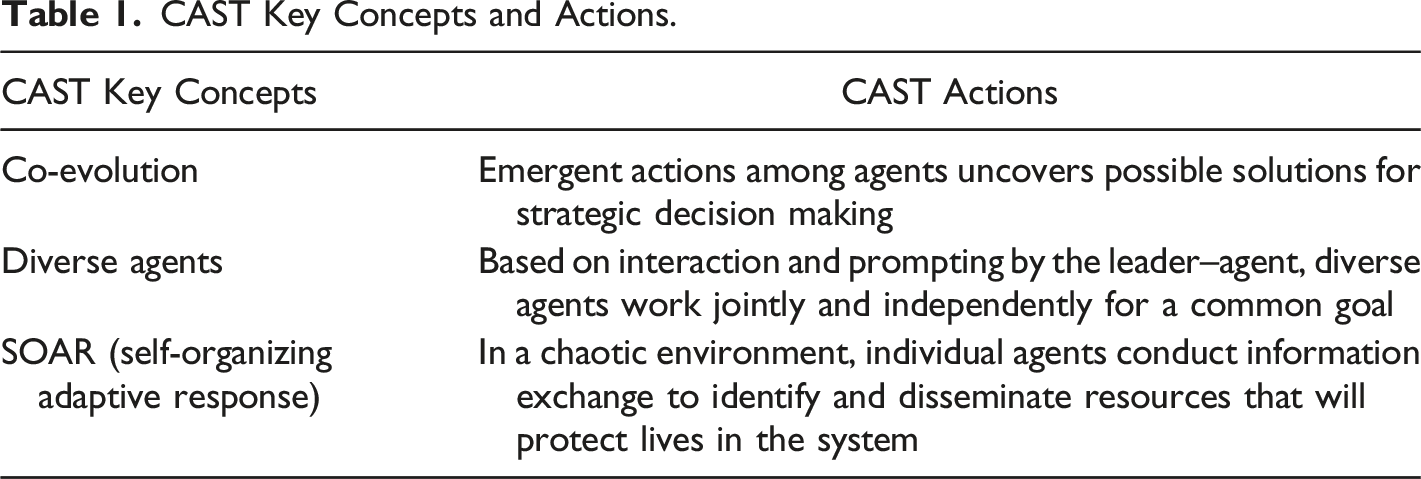
The co-evolution action involves agents interacting through communication at different levels in the system for the stakeholders’ overall well-being in the system. As agent–leaders interact and process events (good and bad), they strategically make decisions based on pre-established rules designed to provide insight into consequences (Eidelson, 1997). Hence, they must know the rules and be flexible and swift in their decision making. As leaders process rules, they can make rational decisions as they interact and manage emergent issues to produce a favorable outcome. Chang and Chuag (2018) suggested that rule processing is the engine that drives the system’s direction and consequences in the environment. Further, they argued that making decisions requires a holistic view and sense of the environment and all possible outcomes, because decisions impact others in the system (Chang and Chuag, 2018).
Likewise, CAST posits that diverse agents work jointly and independently through information exchange and guidance (Alaa & Fitzgerald, 2013; Brownlee, 2007; Eidelson, 1997; Gorman et al., 2020). Through the vigilance of information exchange, these agents diminish the crisis. Once the vigilance to determine the crisis decreases, the crisis will begin to rise because the vigilance exchange diminishes (Eidelson, 1997). As such, Chang and Chuag (2018) suggested that the continued collaboration among diverse agents will encourage the entire system to work toward a common goal. The agent action observed within the system is the catalyst for change and a favorable outcome. Hence, the agent–leader must be diligent in ensuring that diverse agents work jointly and independently to forge the entire system toward success. Similarly, the principal interaction and leadership with internal (staff, school administrators, and students) and external agents (parents, first responders, policy-makers, hospital) support crisis response and stakeholders’ overall well-being in the educational setting (Flaherty, 2012; Hull, 2011).
In CAST, the continuous adaption of diverse agents in the system provides an understanding of resources to allocate as needed to ensure the common goal is attained in the system (Brownlee, 2007). Gorman et al., (2010) found that self-organizing adaptive responses (SOAR) result from diverse agents in a complex environment exchanging information to identify and allocate resources to protect lives. CAST characterizes agents’ interactions within linear and nonlinear networks working in a chaotic system (Brownlee, 2007). The theory is viewed as an evolving organism that includes diverse agents whose interactions lead them to organize and adapt during an unpredictable time (Palombo, 2013). As agents interact in the system, they exchange information and manage the chaotic environment. As exchanges occur, agent–leaders observe and adapt, enabling them to manage a constant flow of information and adjust resource allocation if warranted (Alaa & Fitzgerald, 2013). In other words, as they evaluate the chaotic environment, they interact and adapt to the conditions to determine the resources they need to resolve the crisis.
In sum, as school leaders respond to and recover from a given crisis, they are tasked with swiftly making rational decisions in a chaotic environment as they work with diverse stakeholders (internal and external agents) to identify and allocate resources in the system. The three CAST components described above provide a lens for understanding the competencies that school leaders need to be effective crisis leaders in educational settings. This study will use the framework to identify roles and describe core competencies for school leaders to operate as crisis leaders when responding to and managing a crisis. Furthermore, the attributes of CAST will provide insight and clarity into the actions and how they develop school leaders into crisis leaders in the K-12 educational setting.
Research Design
This qualitative case study explores the crisis leadership competencies of school leaders in the K-12 school system, with a particular focus on the school principal and assistant principal. According to Yin (2018), exploratory case study research provides a holistic description of the phenomenon in its real-life context, when the boundaries between phenomenon and context are not clearly explained. This exploratory case study will examine school leaders’ roles as crisis leaders and their competencies based on data collected from school principals and assistant principals in one southern school district.
Participants
The study sample includes 20 K-12 school principals and assistant principals from one southern school district in the United States. The district serves a diverse student population with at least 20% whites and 80% underrepresented populations (Blacks, Hispanics, Asians, and Pacific Islanders) that encompass various social-economic levels between a rural–urban fringe area encompassing over 100 schools. The school district was chosen because of the rich population size that supports participants in understanding the phenomena through crisis education and their experience (Hancock & Algozzine, 2011).
Participants were selected using a criterion sampling method from a pool of 200 principals and assistant principals across the district. A criterion technique identifies and excludes participants based on a set of conditions. In this qualitative study, the conditions included (a) a job title as principal or assistant principal, (b) at least a 1-year tenure in the district, and (c) experience managing crises during their time in the district. Twenty participants were identified and interviewed in person, by phone, or via Skype. The sample included nine individuals who identified as male and 11 who identified as female. Of the 20 participants, 11 had been in their role for 3 years or more; nine had been in their position for 1–2 years. All participants had knowledge and experience with crisis management in the educational setting. According to Yin (2018), at least 15 or more participants are necessary for themes to emerge and for data to repeat. In this case study, the themes began to show initial convergence among 10 participants; the inclusion of 20 participants allowed us to gain a deeper and more nuanced understanding of school leaders’ experiences.
Interviews
The interview instrument used in this study was based on the School Crisis Management Competencies survey to explore school leaders’ familiarity with crisis leadership through questions that address crisis management and the school leaders’ roles (McCarty, 2012). The researcher modified the instrument to fit the research context. For this study, participants were invited to reflect on their roles and how they assume their roles when responding to a crisis in an educational system. Participants discussed how processes, communication, resources, and stakeholders frame the roles and competencies of school leaders as crisis leaders. The questions participants answered were centered on the following: explain actions taken to respond to and manage a crisis; define their role as a school leader managing a crisis; and describe how they assume their role in a crisis situation. Each subject described their actions in detail and identified processes that occurred when responding to and managing a crisis. Participants were emailed their responses after each interview to validate data for accuracy.
Data Analysis
The interview data were transcribed verbatim. The themes from Table 1 (co-evolution, diverse agents, and SOAR) inform the coding strategy. For instance, co-evolution data were identified through each response aligned with the school leader strategically making decisions and uncovering possible solutions to resolve the crisis. Likewise, the diverse agents’ data illustrates the school leaders’ actions of prompting a crisis resolution through their influential interaction in an unstable system. SOAR competencies were identified by codes demonstrating the school leaders’ identification, management, and distribution of resources within an unstable system to the agents. A three-stage process of simultaneously examining data, associating patterns, and grouping data based on themes from Table 1 (co-evolution, diverse agents, SOAR). Three interview questions provided pertinent data aligned with the theme results (Deterding & Waters, 2021). In the first process, responses were examined, followed by associating patterns and words to group align responses with theme results in Table 1 (Knafl et al., 1988; Morgan & Andreea, 2020).
Measures were taken to ensure the trustworthiness of data by employing methods of diversity and equity through geographical location, school levels, and gender of principals and assistant principals. Next, participants were requested to validate their responses through member checking (Cho & Trent, 2006). Specifically, members were sent their responses and asked to review them, and update or add data to the transcripts as needed. This action allowed participants to validate and endorse their interview responses. No participants requested updates or additions to their transcripts. Once validation and endorsement were complete, the data analysis was conducted (as described above) based on themes established in Table 1.
Findings
In the study, three themes emerged that are aligned with the CAST concepts as synthesized in Table 1. The findings are focused on the roles of school principals as a crisis leader: (a) agile decision-maker, (b) influencer, and (c) coordinator. The study participants indicated that the roles are essential in prioritizing information, maintaining a calm demeanor to influence members, and allocating resources through delivering instructions to ensure members’ safety in the system. Pseudonyms are assigned to study participants hereafter.
Principal’s Role as an Agile Decision-Maker
An agile decision-maker is clear, concise, and flexible in their actions to unveil a crisis resolution. As the agile decision-maker works with internal and external stakeholders to resolve the crisis, participants suggested they are flexible in their response when processing information based on pre-establish safety protocols. Comparably, complex adaptive system theory (CAST) co-evolution involves the agent–leader interacting with internal and external agents to prioritize data and make rational decisions (Allen & Varga, 2006; Galkina & Atkova, 2020; Tanriverdi et al., 2010). Additionally, these rational decisions are based on established rules that are designed with the flexibility to pivot based on circumstances in a chaotic environment (Chang & Chuag, 2018; Eidelson, 1997). The link between CAST co-evolution and the agile decision-maker role is the agent–leader (school leader) flexibility in prioritizing information and pre-established rules to resolve a crisis while working with diverse agents (internal and external stakeholders).
Prioritizing is a culmination of the principals having a clear and concise plan as they strategically gather and share information from internal and external stakeholders to make informed decisions. Agent–leaders have a clear understanding of safety procedures and protocols as they work to process information and strategically plan for a crisis resolution. Specifically, participants found that clarity—in the form of truthful, clear, and concise information (Sutherland, 2017)—is key to reassuring members in the system that they are equipped with the knowledge and experience to make informed decisions that will positively impact the overall safety and well-being of students, teachers, and staff. Indeed, Assistant Principal Kloe explained the importance of having a clear and concise plan for members in the system to follow: Make sure your plan is clear, no guesswork, and that anyone can follow it if they pick up the plan. The directions in the plan should be specific, detailed, and scripted so that anyone can follow the plan. It must be peculiar, detailed, scripted, easy to follow, and user-friendly.
Similarly, Principal Lacey underscored the importance of clarity, noting that when the leader is unclear, others will be unable to emulate procedures in the crisis system: My role is very integral to the actions of the staff. I have to be clear to follow the procedures that we have identified. If not, I veer from that; it creates a sense of incoherency or chaos in the response. The leader must be very coherent and succinct in following the plan. Be reflective in seeing what worked and what did not work.
Unclear communication creates an environment of chaos and panic, so members trust and follow the school leader’s directions. Assistant Principal Myra explains the importance of school leaders providing clear communication to prevent panic among stakeholders. Make sure that there is a line of communication between the school and home. You have to ensure there is a line of communication within the building, so everyone understands what is going on. That communication must be crystal clear, that there is no miscommunication. If there is a crisis, we get information out to people (stakeholders) as quickly with the correct information. The greatest fear is having the wrong thing communicated, which creates panic outside the building. We do not want panic outside the building.
In other words, providing clear and concise information regarding the crisis will incline members in the crisis system to trust the school leader’ (Grissom & Condon, 2021).
As an agile decision-maker, the school leader carefully assesses the environment and information to ensure they react appropriately with clear and concise instructions (Cicero et al., 2020; Oredein, 2010). As such, decision-making is ascertained through a clear understanding of the environment. Principal Flix suggested that the school leader must understand the critical environment to explain safety protocol as well as the justification for their response: Be aware of all the people we keep safe. We also clearly understand all moving pieces during a crisis– for example, the location and site of moving segments during a crisis. Also, a critical component is to explain, mean, and justify the actions taken during a crisis.
We know that school leaders are evaluated on their decisions (Oredein, 2010). Hence, it is critical that they know and understand the safety plan. This provides them with information to make decisions and pivot for the safety and well-being of members in the system. Assistant Principal Opal explained how critical knowledge and understanding of the plan and alternative plans support the school leader in making informed decisions: In the event of an emergency, a plan is in place to communicate to all staff that everyone understands the plan and knows their part in it. Having a plan B – As the safety coordinator, I need a plan B. What if there is a break in the plan? What will you do to cover that break? That everyone understands it. Everyone has a piece in acknowledging their role, and if you ask someone in the building: What is the plan if it is a soft lockdown? That people can tell you what to do.
Assistant Principal Ura shared similar actions when making informed decisions: “Keep calm, make informed decisions quickly, and err on the side of caution. My demeanor is to stay calm. It is critical, to provide clear directions, gather information, and react accordingly.”
Thus, the competency as an agile decision-maker ensures that the school leader prioritizes information, understands plan flexibility, remains calm, and reacts appropriately. Specifically, the plans are pre-established safety protocols that allow school leaders to pivot and respond to sudden changes in the environment. This competency drives school leaders to effectively make informed decisions that impact the lives of students, staff, and teachers. As such, we found that when the school principal functions as a crisis leader, they are laboring to make informed decisions based on their ability to be flexible, clear, and concise in their communication and to not cause panic among members in the system.
Principal’s Role as an Influencer
The actions and communication of the influencer are essential in a chaotic environment. As such, the school leader manages communication and resources between internal and external stakeholders for the overall safety and well-being of students and staff members. Members react based on the leader’s communication action of calmness and confidence to guide them toward a crisis resolution. In correspondence, complex adaptive systems theory (CAST), diverse agent, explains that members in the system react and are prompted based on the agent–leader authority and communication activities with other agents (Eidelson, 1997; Pryke et al., 2018). Members in the system observe the environment led by the agent–leader that prompts members to follow directives initiated in the system (Eidelson, 1997). As such, in the process of school leaders making decisions to protect members, they must maintain calm by influencing students, staff, and teachers to follow safety protocols. According to Smits and Ezzat (2003), when managing a crisis, a person should be calm and confident in leading others. In leading members toward safety, the school leader acts without force. By exemplifying calm and confident actions, they encourage members in the chaotic system, to follow safety protocols. For instance, Principal Tal described preparedness through safety protocol training: I believe that, prior to the Parkland shooting, our district looked into a protocol and procedures the district would adopt in the event of an open shooter. A presentation and research was referenced regarding the district’s new protocol. [Principals and staff] were given information and trained.
Assistant Principal Shar described similar preparation: We did an active shooting training [protocol] at the school. After [the Stoneman Douglas High School shooting], I started throwing in surprises in the drills, such as blocking exits, so they [staff and students] think quickly on their feet.
Following training at the district level to prepare staff and students in the event of a crisis, school leaders returned to their schools to convey these procedures through, for example, role play and drills. Throughout this process of training staff and students, these leaders remained calm in their delivery and explanation to staff and students. As Assistant Principal Nick described, school leaders’ action is critical to influencing members of the system: The role is to be ready to fly into action at any time, for any given situation. Our role is to remain calm and initiate the plan. Everyone has a job to do. Everyone is responsible for safety, not just the principal. If someone does not do their job, it will not work. It is the students, everybody. They must follow what they are supposed to do, but they will look to that leader. If that leader operates in a non-crisis mode, members will operate in a non-crisis mode. Once that leader operates in a crisis mode, the members will follow suit.
Principal Roe described similar action: “Our role is to remain calm and to initiate the plan that we have rehearsed many times.” Assistant Principal Ulysses described actions regarding communication and working with diverse stakeholders: “Communicate quickly to security on campus, medical responders (nurse’s assistant on staff), first responders, Area Superintendent, 911, and follow protocol.”
Calmness in a chaotic system is a critical state of mind that enables members not to panic and to follow safety protocols. Participants explained that a leader should retain a calm tone and ensure that their behavior is not reactive; rather, they must proactively manage the chaotic environment. According to Sutherland (2017), calmness sets the tone in the environment to unite members toward a common goal. Principal Eli further explained how a leader’s calm actions and emotions influence members in a crisis to remain focused: Every leader is different—everyone handles situations differently. I am a calm individual. I do not act off emotions. I know people look at my reaction, and they feed off of my reaction. It is your approach to a situation. You must keep your emotions intact because people feed off those emotions. In that leadership role, you are it. So, when it happens, everyone can spring into action.
Principal Blake described similar influencing actions: “You must be the calmest in the group. Ask the 1-2-3 steps. Access the situation. You must be able to take control of the situation.” Additionally, Assistant Principal Zion described influential actions: “I would make sure my superiors were informed and follow protocols. It is important to be calm, confident, and reassured.”
A non-reactive demeanor will influence calmness and ensure members’ emotions are intact to follow their instructions. A school leader’s role during a crisis is influential in instructing members in the chaotic system; the action is viewed as calm emotions and social actions of the principal with members in the system (Myers, 2014). Study participants explained how these actions weighed heavily on members’ responses in the chaotic system. For example, Principal Jamie highlighted how leaders’ calming action influences the response and support of members: “As a leadership philosophy, you model that you remain calm in a crisis communication situation and think about safety first.”
Principal’s Role as Coordinator
In the coordinator role, the school leader allocates and disseminates information and resources with internal and external stakeholders for the overall goal (Fidan & Balcı, 2017). As they do so, they assess the environment to ensure systemic communication occurs within and outside the system throughout the crisis management process. Systemic communication is the mechanism school leaders use to disseminate and coordinate efforts among different stakeholders during a crisis (Chung et al., 2009). This involves communication among many parts of a more extensive system; as such, cross-sector communication among internal and external stakeholders is critical (Gainey, 2010). Likewise, in the self-organizing adaptive response (SOAR) attribute of complex adaptive systems theory (CAST), the agent–leader interacts with various agents in the chaotic environment to systemically exchange information and resources for the overall goal (Eidelson, 1997). According to Pryke et al. (2018), SOAR is accomplished through trusted relationships between internal and external agents. As trust is established in the chaotic system, agents strategically exchange communication and knowledge with the agent–leader (Eidelson, 1997; Pryk et al., 2018). In the coordinator role, the school leader continues to employ agile decision-maker competencies to ensure cross-sector communication is concise and clear with internal and external stakeholders; so appropriate resources are allocated and disseminated throughout the chaotic environment. Assistant Principal Quin explained cross-sector communication in the system: We make sure the proper departments have the correct information so that it is accurate. Making sure I am providing the district with precise information promptly. The county does a good job of communicating with news media. Lawyers talk to lawyers. We ensure that the proper departments within the organization have pertinent information, so that when they communicate it out, it is communicated effectively and accurately.
Likewise, systemically organized communication is also key, as school leaders work jointly and independently with stakeholders to resolve a crisis. Assistant Principal Urie expressed how leaders employ these steps, so stakeholders are aware of and understand the activity taking place in a chaotic situation: First, we contact emergency personnel on campus and local first responders. Someone from the campus is assigned to escort them [emergency personnel or local first responders] to the issue. Once the situation is stabilized, parents are contacted. School Messenger is used to advising parents of the issue. It depends on the situation if the public is contacted. We do not want the news media contacted because we do not want to incite chaos. It would be someone from the district that contacts the media. The district is contacted immediately by the personal assistant for the principal.
A clear chain of command and cross-sector communication allows the school leader to have a clear communication channel to prioritize and disseminate instructions accordingly. Central to this process is the school principal directing crisis team members and conveying instructions that disseminate pertinent safety protocols in an orderly and swift manner. Members are assigned communication roles pertinent to internal and external stakeholders (Collins et al., 2016; New Jersey Department of Health, 2013). Principal Blair explained the process of disseminating safety protocol instructions using the crisis team [crisis communication team]: We have a crisis communication team that employs a safety plan. The crisis communication team shares information with the district. The crisis plan is a road plan that explains what you do next during a crisis. In other words, the plan causes you to think about your action steps from soft lockdown to hard lockdown instructions.
Coordinating protocol instructions facilitate the school leader’s ability to disseminate information and resources for the safety of students, teachers, and staff.
Discussion
As discussed, each crisis leadership role depicts the competencies of school leaders as they respond to and manage a crisis for the overall safety of students and staff. Through a complex adaptive systems theory (CAST) lens, we discovered three key crisis leadership roles and their competencies through an investigation of K–12 school leadership in crisis management. CAST attributes illuminated competencies centered on the actions of connectivity and relationships—that the school leader cultivates through communication and actions (Fidan & Balcı, 2017). Specifically, this qualitative examination of school leaders’ responses analyzed through a CAST lens highlighted agile decision-maker, influencer, and coordinator as key roles and corresponding competencies of crisis leaders in educational settings. Built on the CAST attributes, key roles and core competencies, we present a framework—CAST-informed crisis educational leadership framework (CICELF)—to refine the understanding of crisis leadership in education (Figure 1). CAST-Informed Crisis Educational Leadership Framework (CICELF). Note. C represents co-evolution; D refers to diverse agents; S refers to a self-organizing adaptive response.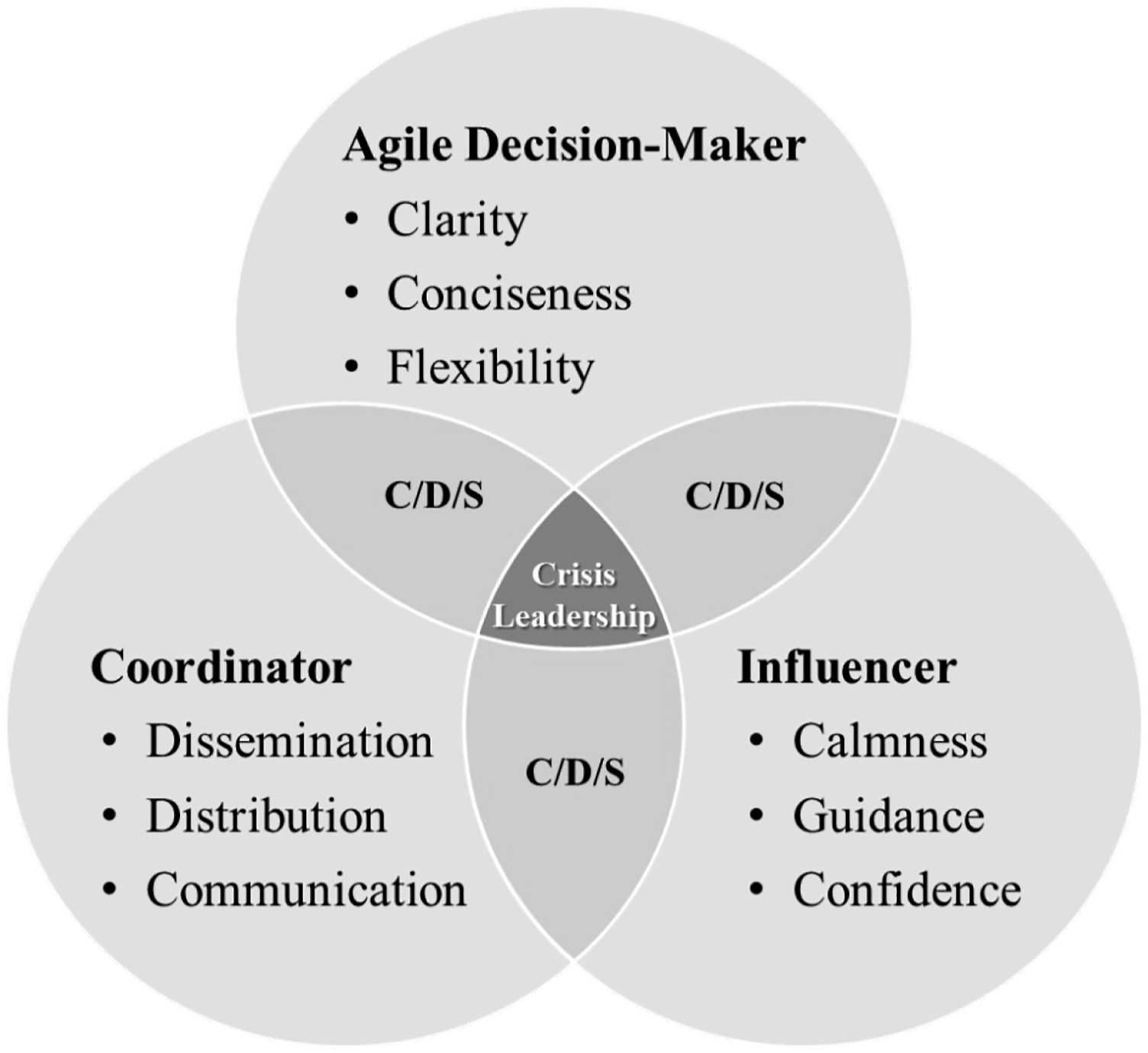
School leaders have a cycle of ongoing competencies that guide students, teachers, and staff toward safety. We found that competencies will overlap when responding to and managing a crisis. Participants expressed that their goal is to respond and be proactive in communicating safety protocol instructions. In the study, we found that school leaders took on the role of an agile decision-maker, influencer, and coordinator in a chaotic environment to provide clear communication, guidance, support, and resources to members throughout the crisis. These competencies are aimed to reflect the school crisis leadership roles, yet ongoing in moving members toward safety. The CAST-informed crisis educational leadership framework (CICELF) provides a guiding framework for understanding school leaders' roles and core competencies as they labor with internal and external stakeholders to protect students, teachers, and staff in a chaotic system.
The chaotic environment is led by a school leader placed into a crisis leadership role of an agile decision-maker, coordinator, and influencer. The roles are guided by core competencies that prompt school leaders to lead the system toward a crisis resolution for the overall safety of students and staff. The CAST-informed crisis educational leadership framework (CICELF) supports leaders in being effective crisis leaders as there is an ongoing cycle of strategic communication that the school leader initiates and coordinates jointly and independently with internal and external stakeholders. In CICELF, we found that the agile decision-making competencies are central because the participants suggested that the school leaders’ strategic information exchange actions (clear and concise communication) are vital throughout the role of influencer and coordinator in determining appropriate communication, guidance, and distribution of resources to reach a crisis resolution.
Agile decision making enables school leaders to strategically process information and make decisions as emergent issues arise (Kautz, 2012; Oredein, 2010). It encompasses solving problems swiftly, establishing roles, and executing safety protocols to limit potential impact and risks (Albanese & Paturas, 2018; Saltz, 2017). Our analysis found that the safety protocols are pre-established safety plans that school leaders have prior knowledge of and swiftly determine actions for the crisis resolution. These actions allow school leaders to make decisions swiftly, based on clear lines of communication between internal and external agents. In this study, participants suggested that during this process, school leaders strategically analyze information to execute safety protocols and ensure stakeholders have clear and concise instructions to make informed decisions for students and staff overall safety and well-being. Additionally, participants discussed school leaders maintaining a constant flow of communication between internal and external stakeholders working toward a common goal. Participants suggested that the school leader is prepared to pivot and swiftly change instructions based on pre-establish plans and the examination of information exchange in the system. Furthermore, participants indicated that it is critical for school leaders to use a constant flow of clear, concise, calming, and flexible instructions pursuant to a common goal. Corresponding to a previous study, the key to agile decision making is developing solutions quickly based on correspondence with internal and external stakeholders (Pashiardis & Brauckmann-Sajkiewicz, 2022). We found that school leaders believed that clear and concise communication enabled stakeholders to trust and follow their instructions (influencer role), as well as allowed school leaders to become effective crisis leaders through the role of agile decision making.
In the role of influencer, we found that the school leaders’ communication among diverse human agents—such as staff, teachers, students, district administrators, and first responders—is calm, confident, flexible, secure, constant, and offered guidance; it was coupled with the use of nonhuman agents, such as social media, computers, phones, and messaging services in the system. School leaders managing a crisis— working with diverse agents—in a chaotic system is vital because they provide the leader with communication channels and resources to achieve a crisis resolution. We found that in the communication channels, the influencer competencies (calmness, confidence, and guidance) emerged that enabled stakeholders to trust the actions of the crisis leader. During a crisis, school leaders’ rapid, calming, clear, and secure communication facilitates trust-building between agents involved in resolving the crisis (Javed & Niazi, 2015; Potter et al., 2021). Previous research suggests that creating secure comprehensive communication channels are crucial for school leaders to convey clear messages in a timely and flexible manner (Sutherland, 2017). Nevertheless, enacting the influencer competencies (calmness, confidence, and guidance), participants suggested that the school leader is gaining the trust of their stakeholders to continue making rational decisions (agile decision-maker role) for organization and dissemination of information and resources (coordinator role).
In the coordinator role, our analysis shows that school leaders organize instructions and resources using various stakeholders in the system. This finding corresponds to a previous case study by Myers (2014) that suggests that school leaders’ coordinating resources are essential. Identifying and allocating these resources include school leaders’ knowledge of which internal and external resources are needed to respond to and recover from a crisis (Booker Jr., 2011; Myers, 2014). In our study, leaders expressed how they work with internal and external stakeholders to obtain resources and information to disburse in the system. The school leader must assess the environment and the risks associated with the crisis to provide instructions to various stakeholders (Booker, 2014). Our study found that multiple internal and external stakeholders work with the school leader throughout the crisis to coordinate a crisis resolution. Participants indicated that school leaders’ action of calmness and confidence is vital for stakeholders to follow their instructions and allow school leaders to disseminate communication and resources accordingly. According to Potter et al. (2021), a leader who has a calming demeanor will effectively coordinate communication and resources during a crisis. Our study found that the school leader disseminates, distributes, and communicates safety protocols with various internal and external stakeholders using their influence for the overall safety of students and staff. In this role, not only are school leaders’ coordination and influential competencies essential, participants suggested, that their actions are vital in working jointly and independently to make rational decisions as they respond to and manage the chaotic environment. As such, participants indicated that the school leader’s coordination and influential competencies are paramount, yet significant throughout their response in determining a crisis resolution. Our findings suggest that calm and transparent communication displays confidence on behalf of the school leaders. As such, the stakeholders trust that the school leader will disseminate communication and resources appropriately, as well as navigate (guide) them through the crisis. This action transforms the school leader’s role into an influential leader that is confident and calm in steering stakeholders to safety.
Conclusion
Our findings provide important insights into crisis leadership in education, but additional research is needed. For example, we shed light on the role and core competencies of the principal and assistant principal during crisis management, but we need to address the role of students. A qualitative study of students’ perceptions would add to our understanding of school leaders’ competencies during crises. In addition, a quantitative survey of leaders in multiple school districts would further understand school principals’ and assistant principals’ roles and core competencies as crisis leaders. Likewise, a mixed-methods analysis of human and nonhuman stakeholders’ responses to and managing crises in educational settings would provide valuable insights.
As active shooters, pandemics, and natural disasters continue to disrupt the educational environment, school leaders have taken on the role of crisis leaders (Schechter et al., 2022). These leaders are aware that their approaches to crisis leadership in educational settings are vital, but there needs to be more data on what roles and competencies will ensure that they are up to the task. The CICELF framework is a useful starting point for identifying the core roles and competencies that educational leaders need to continue improving their crisis response and recovery in school settings.
Incorporating attributes derived from our CICELF framework in school leaders’ training programs could enhance existing understanding and practices of crisis leadership and response in the K–12 setting. Furthermore, the CICELF framework can guide the design of school districts’ safety protocol for students' and staff overall well-being and safety. School districts can work on formulating simulations that encompass the roles and core competencies to assist school leaders in implementing CICELF. In addition, integrating the CICELF framework as a valuable lens for understanding school leaders’ roles and competencies will help to support scholars in adding to the existing, yet limited literature on crisis leadership in the educational system.
Footnotes
Acknowledgments
I want to thank all the support and encouragement received from family, friends, and colleagues who supported in completing this project. Most importantly, it was a collaborative effort from both authors. We would like to thank the following research funding agencies that provide support for the research team to complete this work. Specifically, thank God for the fortitude to push forward.
Declaration of Conflicting Interests
The author(s) declared no potential conflicts of interest with respect to the research, authorship, and/or publication of this article.
Funding
The author(s) disclosed receipt of the following financial support for the research, authorship, and/or publication of this article: The research time of Yi-Hwa Liou is supported by the Ministry of Science and Technology, R.O.C. (MOST 108-2410-H-152-029-MY4).
