




Abstract
Dr. Wilson, Central Ridge High School principal, navigates an unfolding lockdown situation that is later revealed to be a hoax threat. While the school had extensive plans for coordinated responses to emergencies, they were varyingly adhered to when a threat was called in. Following the security sweep of the building, Dr. Wilson must determine how to proceed with the remainder of the school day. Students and educators are physically safe, yet emotionally shaken. Furthermore, Dr. Wilson must make immediate decisions about communication approaches with staff, families, and counseling services to best support the school community. This case highlights the nature of leadership practice in crisis situations and the breakdown of response and communication. Through this case, educational leaders can design coordinated plans for crisis management.
Keywords
School incidents and emergencies are at the forefront of school stakeholders’ concerns. From mass shootings to pandemics to bullying, school leaders must be prepared to respond to volatile, uncertain, complex, and ambiguous events that occur unpredictably and with alarming regularity in U.S. schools. Between September 13 and October 21, 2023, more than 150 schools across over 25 states received a call about a false threat (Yousef & McLaughlin, 2022). Unfortunately, advancements in technology such as the use of computer-generated calls and spoofing a phone number have made calling in false threats more accessible (e.g., Lang, 2023). Particularly in the era of fear of school shootings in the United States, swatting and false threats to schools create a uniquely traumatizing situation.
In this fictional case, we present readers with the case of a fictional hoax school shooting based on real-world events. This case is left open-ended for readers to determine potential next steps for the principal and compare with their own schools and districts.
Demographics/School Background
Central Ridge High School is a fictional traditional public high school in the mountains of central Pennsylvania. It has 1,000 students in grades 9 through 12 and 60 teachers. Approximately 40% of the students are on free or reduced lunch. Two students are American Indian, 5 students are Asian, 15 students are African American, 14 are Latinx, 5 are multiracial, and the remaining 959 students are White. Finally, 20% of CRHS students receive special education services and programs.
Dr. Sarah Wilson is starting her third year as principal of Central Ridge High School. She earned her principal certification while teaching middle school social studies. Then she started her first administrative position as an elementary school assistant principal for three years in a neighboring school district. Because of a sudden change in district leadership, she was transferred as the acting principal of that district’s high school for one year. Liking being a high school administrator so much, she applied immediately when the previous CRHS principal retired. Appreciating her commitment to equity and transparency, the Central Ridge School District hired her.
In her time as an assistant principal, Dr. Wilson participated in extensive training on emergency response. She has several FEMA Incident Command System course certificates and has attended training regionally and nationally on school safety. Her first priority when taking on the principalship of CRHS was to review and update the emergency operations plan. Over the last two years, she has engaged in detailed planning to prepare the school, staff, and students for how to respond to many different kinds of incidents and build relationships with the local emergency responders. Being in central Pennsylvania, the primary emergencies that occur often are winter storms so there are extensive resources for icing the sidewalks and parking lots along with an updated system to keep the pipes from freezing in the building.
Dr. Wilson has built a strong relationship with the local fire department, police department, and particularly her building’s School Resource Officer, Officer Emory Adkins. They have a strong rapport where both of them can easily have an open conversation about any potential concerns or threats to the building. Because of this work, Dr. Wilson knows her staff is well trained on the response protocols, specifically having adopted the Standard Response Protocol from the I Love U Guys Foundation during her first year as the CRHS principal. Indeed, Dr. Wilson has been an advocate across the district for school emergency response.
Even though the state-mandated school safety and security coordinator (Pennsylvania Act 44 § 1301-B, 2018) for the district is Assistant Superintendent Amy Boyd, Dr. Wilson took her role as principal seriously in overseeing any and all emergency planning and preparedness for her staff and students. As such, Dr. Wilson had regularly scheduled meetings starting her first year with the local fire chief, police chief, public health officer, and other heads of local emergency responding agencies to look over and update portions of the district emergency operations plan (EOP) that impacted her school specifically. As a part of this work, she had volunteered the use of her school when the Central Ridge township received a grant to host a large-scale community-wide functional exercise for a tornado disaster over the summer.
Officer Emory Adkins has been the school resource officer (SRO) at CRHS for 5 years. He was sworn in as a police officer and started his career on the Central Ridge police force 10 years ago. During that time, he has focused his training on community outreach and engagement, which led him to become the CRHS SRO when the position opened. He had a warm relationship with the previous principal but felt a little out of place until Dr. Wilson was hired. Officer Adkins had many early conversations with Dr. Wilson about his role in the school and especially about his role in discipline. They agreed that his job wasn’t to be an additional disciplinarian but to serve as a resource to the students and protect them while they are on campus. These conversations had prompted adjustments such as to the district’s threat assessment team where the SROs would still be a part of the team but take a more supportive role to the school counselors, social workers, and community mental health experts. Officer Adkins sits in a key position on the school safety and threat assessment committees along with organizing bi-weekly Breakfast With Cops events at the school.
Assistant Principal Victor Meadows is in his first year at CRHS. He previously served as an assistant principal at a middle school in Virginia before moving to Central Ridge for his wife’s work. In his previous school, he focused mostly on supporting the special education integration program and decreasing the number of exclusion classes. Mr. Meadows has a strong background in special education, least restrictive environments, and best practices for creating a fully integrated school. Although he participated in the required training and drills, Mr. Meadows does not have any extensive training in school safety and emergency response. His previous school exclusively used the run-hide-fight approach from the FBI in response to an active shooter situation.
Assistant Principal Randi Rosario started her assistant principalship at CRHS the same year Dr. Wilson was hired. Mrs. Rosario began her teaching career as a math teacher at CRHS. Seven years later, she had earned her administrator’s certificate and was hired into the open Dean of Students role. There she focused on student attendance and family engagement in the school. The same year that the principalship opened, the district decided to create a second assistant principal position at CRHS. Mrs. Rosario has approached the position as an extension of Dr. Wilson’s work in student engagement. Beyond her normal supervision and evaluation duties, she collaborates with the family engagement coordinator at the district to develop regular events for families including back-to-school nights and “Life After High School” events.
Julian Todd has long been the head administrative assistant at CRHS. He started at the school district 20 years ago in a part-time position and loved working for the district. Because of Julian’s longevity in the district, he is known across the school as the person with the answer to every question. He readily meets every concerned student, parent, and staff member with a smile and a mint. Julian’s upbeat nature with his in-depth knowledge of the school district has been a valuable resource to Dr. Wilson over her tenureship as he knows all the people, resources, and policies, especially in her work updating and revisiting CRHS’ emergency operations plan.
Narrative
It was a typical Tuesday morning for Dr. Wilson and her staff at Central Ridge High School. Dr. Wilson arrived early to school, intending to work through the latest emails, only to be intercepted by a substitute custodian with a water leak in a maintenance closet in the oldest wing of the school. Dr. Wilson immediately emailed the school’s head custodian and the district maintenance director before finishing getting to her office. Once there, she pulled out her radio to contact the regular custodian to turn the water off and determine the cause of the leak. As Dr. Wilson worked her way through emails from parents, teachers, and district administrators, the regular custodian checked in, saying the leak was caused by a broken pipe. Following the standard procedure, water had been turned off to the closet, which fortunately didn’t affect the rest of the building, and a maintenance ticket had been sent in to have the pipe replaced. The cold temperatures the night before especially concerned Dr. Wilson because she had overseen updating the plumbing insulation the year before.
With that issue effectively settled, Dr. Wilson began her typical morning walkthrough to greet the first arriving students. Walking down the fine arts wing, she noticed the auditorium doors were unusually open and the lights were on. Inside, she found the student government organization meeting. When asked why they were meeting in there instead of the band room with their advisor teacher, they said the door was locked and the band teacher wasn’t answering their emails. Dr. Wilson quickly called the band teacher to learn that there had been an unexpected illness with her family during the night and she would be absent that day. Dr. Wilson radioed to the front office, knowing her administrative assistant, Julian, would be in by then and would handle the emergency substitute. Wanting to be available to lock the auditorium after the meeting finished, Dr. Wilson settled in to oversee the rest of the meeting. She sent off a quick text to her Assistant Principals, Mrs. Rosario and Mr. Meadows, to see if one of them could finish her morning building walkthrough. Mr. Meadows promptly responded that he would.
Without any other major issues that morning, Dr. Wilson started her meeting during the second period with Mrs. Rosario regarding the school’s student engagement efforts designed to address chronic absenteeism, which had been significantly higher since reopening during the COVID-19 pandemic. Victor Meadows was doing his first observation after being hired this year. After a preliminary check-in with Mrs. Rosario about her husband and kids, Dr. Wilson was about to get down to business when she received a call to her cellphone. Specifically, the ring tone indicated that it was Officer Emory Adkins. Dr. Wilson was confused because he was out of the building for the morning at the local police department for a regular meeting. Moreso, they had agreed that Officer Adkins would only ever call Dr. Wilson’s cell if it was an absolute emergency, thus the reason she had assigned his number a unique tone. Quickly, she answered the phone.
Officer Adkins quickly relayed that a call had come into the 9-1-1 dispatch center while he was there saying that a shooting was currently occurring in a CRHS bathroom: an unknown student had already shot and killed four students and that the building needed to be put in lockdown immediately. With Officer Adkins still on the line, Dr. Wilson quickly left her office to Julian Todd’s desk to call for an immediate lockdown for the building; this wasn’t a drill. “Lockdown. Lockdown. Locks, lights, out of sight,” was announced over the intercom while Mrs. Rosario locked the front office doors. Dr. Wilson then followed protocol and directed everyone within her office, where they locked the door, turned off the lights, and shut the interior blinds.
Officer Adkins relayed that he was on his way with all on-call police officers to begin a sweep of the building. They would not arrive at the school for another 7 min. Julian and Mrs. Rosario quickly began enacting their responsibilities outlined in the EOP and that they had practiced in previous drills and exercises. Julian pulled up the emergency contact email folder and the EOP binder in Dr. Wilson’s office. Mrs. Rosario sent out a community message to all parents and guardians that the school was in lockdown, no students would be released from the building until the lockdown was released, and that parents and guardians should monitor the school alert system for updates.
As Julian was going through the check-in emails from staff, he mentioned that one room had not sent an email: Mrs. Campbell’s second period in Room 115. That was the class where Mr. Meadows had been doing his first observation that morning. Dr. Wilson looked over Julian’s shoulder at the collected information. No sounds had been heard in or near any of the classrooms between Room 115 and the nearest bathroom. All students and teachers except those marked absent during the first period were accounted for and no injuries had been reported.
Julian, then, received a notification on his phone for another school community alert. He pulled it up. A lockdown had been called in the neighboring town at his daughter’s middle school. Simultaneously, Officer Adkins mentioned that a call of a bathroom shooting had also come in for one of CRHS’s feeder elementary schools. Suddenly, Dr. Wilson’s office phone began to ring. Seeing that it was another elementary school, this one across the street, she directed Julian to answer it. It was the assistant principal informing them that one of their classrooms had successfully evacuated to the elementary school after the announcement, causing that elementary school to also go on lockdown. They were safely locked into the largest conference room at the school. Julian marked it on the reporting sheet. Dr. Wilson was confused and furious. The school had undergone training for the response protocol and the staff knew that when a lockdown was called, they would lock their rooms, not evacuate.
More phone calls, emails, and text messages started arriving on Dr. Wilson’s phone from parents and other community members looking for more information. Keeping Officer Adkins on the line, she ignored the messages until the police began sweeping the building. Because of the multiple lockdowns called in the district, the on-call police were being spread thinly. The police chief had elected to call in support from the state police, but they would not arrive for some time.
Five long minutes later, Officer Adkins arrived at the school with a handful of police. In accordance with the protocol, they entered the building with their weapons drawn and proceeded to Dr. Wilson’s office first. When they unlocked the door and confirmed their identification, she handed the lead officer the building’s master key and informed him that none of the reported information indicated in which bathroom the shooting may have occurred. Officer Adkins stayed with Dr. Wilson and the rest of the police headed toward the first bathroom to sweep it.
“I think this might be a hoax threat.” Officer Adkins said to her. Just as they were discussing what to do, Dr. Wilson heard the tires screech of an additional vehicle coming to a stop outside the building. She recognized the parent getting out of the vehicle and moved to intercept him outside the building. More calls and messages from parents were arriving on her phone. She had to figure out how to get the evacuated class back to her building and discuss with Mr. Meadows about why the classroom evacuated when it should not have. She also needed to decide if they were going to try to finish school for the day or dismiss early. Did she need to call on the district’s mutual aid agreements with the local counseling services center or rely only on her building’s counselors? Finally, she needed to communicate with parents about what was happening.
Post-Incident Vignette 1: Run-Hide-Fight or Lockdown Models
Dr. Wilson, Mr. Meadows, and the observed teacher, Alison Campbell, met before school the following day to discuss why the class had been evacuated. Dr. Wilson started the meeting by first asking about her two staff members’ mental health. When they both responded that they were doing well, she asked them to tell her what had happened the day before. “I followed the response protocol and evacuated the class to a safe location,” Mr. Meadows responded.
“Our response protocol is the SRP from I Love U Guys. When the lockdown announcement is given, staff are instructed to lock their doors and turn off the lights. Not evacuate.” Dr. Wilson clarified. “I tried to tell him that,” Alison murmured.
“Oh, well, at my previous school, we used run-hide-fight. When I saw it was safe to run, I had us run.”
While Dr. Wilson was still frustrated, she could understand how a misunderstanding about the protocol for responding to a school emergency had come about, thereby causing Ms. Campbell’s class to evacuate rather than lockdown. Dr. Wilson made a note in her journal to follow up privately with Mr. Meadows about training on the school’s safety protocols.
Post-Incident Vignette 2: Focus on Mental Health
On Friday, Dr. Wilson was working through some emails while eating lunch during the fourth period when Henry Kilpatrick, one of the guidance counselors, came to visit her office unexpectedly. She indicated for him to come in and shut the door. “I just came from a meeting with a student that I’m concerned about.” He started. “Marie Willoughby, a sophomore, has expressed a pretty severe emotional reaction to the hoax threat on Monday. While she hasn’t admitted it, I suspect that she’s been thinking about hurting herself.”
“Have you reached out to her parents?” Dr. Wilson asked.
“Yes and they’re on their way here to pick her up. But I think Marie’s reaction isn’t unique. All week, students have been stopping in more with concerns. Is there something we can do to reassure the students about their safety here?” Dr. Wilson paused to think for a moment. They had memorandums of understanding (MOUs) in place for crisis counselors to come in after an actual incident such as a fire or shooting. She thought that maybe she could activate those in this case as well.
Post-Incident Vignette 3: Open or Close With Continuing Threats
On Sunday afternoon, Dr. Wilson was in her kitchen with her husband meal-prepping together for the week ahead. They both used it as a grounding ritual to think about their busy weeks and spend time together. Unexpectedly, her cellphone rang with the caller ID indicating it was Mrs. Rosario. Before Dr. Wilson could say anything, Mrs. Rosario asked if Dr. Wilson had seen her email in the last 30 min. Dr. Wilson had not.
“Someone’s been posting threats about a shooting at CR tomorrow on social media. A bunch of students and parents have picked up on it.” Dr. Wilson thanked Mrs. Rosario for informing her. After asking her husband to finish, she went to her office to call the district superintendent and texted Officer Adkins. They needed to figure out if this threat was credible or another hoax. And she needed to decide if she was going to keep the school open the next day or close it out of precaution or an investigation.
Applied Scholarly Literature
In this section, we discuss the real-world events of hoax or fake school shootings, particularly as they occurred in Pennsylvania during the spring of 2023. From our case study, we highlight the practitioner recommendations and academic research around two key themes: (a) relationships and communication with local emergency responders and (b) incident command and communication plans. Then we move into ways professors and teachers of educational leadership can use this case study in their courses.
Real Events
In the case of Pennsylvania specifically, over 25 school districts were hit with hoax emergencies days after the real Nashville, TN, shooting on March 27th, 2023 (Rushton, 2023). Schools were in lockdown for up to several hours. Some schools returned to normal classes for the rest of the day and some schools sent students home. Officers from local and neighboring towns all responded to affected districts in the initial calls for a lockdown. Likewise, county and state officers and troopers in the vicinity also responded with sometimes 70 officers responding to any given district (Rushton, 2023). A common theme of the false threats was a call to a police station or 9-1-1 dispatch center rather than a call to the school (e.g., Blackley, 2023). The auto-generated calls were determined to have originated outside of the school districts where the threats were made (Roberts & Suttles, 2023). We understand the varying response to these hoax threats as dependent on the kinds of emergency planning—including communications plans—and relationships between schools and local emergency response agencies.
What and how schools should be prepared for the multitude of school incidents, including hoax incidents, vary from state to state and even within states. Pennsylvania, like many states, requires a safety or EOP that is reviewed by the school safety and security coordinator (Pennsylvania Act 44 § 1303-B, 2018; Pennsylvania Title 35 Chapter 77 Subchapter B § 7701; 2004). The details about what should be a part of the safety plan are left up to the Pennsylvania Commission on Crime and Delinquency (PCCD, n.d.). The PCCD (2024) assessment guide calls on schools and districts to have three things: (a) an all-hazards emergency preparedness plan; (b) “a policy regarding relationships with law enforcement agencies” (p. 1); and (c) assembling the information for local emergency response agencies such as fire departments and local police who would assist in responding to a school emergency. Outside of these requirements, the Pennsylvania Emergency Management Agency (PEMA, n.d.) provides a model EOP for schools but no other requirements about what the EOP should contain.
In addition, there is not a policy requirement about what the “relationships” between schools and law enforcement should look like nor how they should interact. In our fictional case, Dr. Wilson used her own agency to become educated about school emergency planning, develop an all-hazards plan, and build her own relationship with the local emergency responders. Finally, Pennsylvania Act 55 (2022) established training criteria for school safety and security coordinators (7 hours within the first year of appointment) and for all school employees (3 hours every year). Beyond these regulations and recommendations, school leaders decide what and how practices for responding to school incidents are implemented. While the state offers guidance about the kinds of relationships and planning, such as communication planning, each school or district ultimately determines what these look like.
In addition to swatting hoax threats, schools must also consider “non-credible” or “non-serious” threats by staff, students, and community members. In these cases, specific individuals issue a threat often over social media, email, or text message (Federal Bureau of Investigation [FBI], 2018). Sometimes these threats are made as jokes or in moments of anger or frustration without a serious consideration or plan in place. These threats must be considered as serious until determined otherwise thereby requiring time and resources for responding and reviewing the threat. These threats can also cause emotional trauma to the school community. Those who issue “non-serious” threats may even face local, state, or federal criminal charges. Finally, “non-serious” threats take away from moments of leakage by individuals who are seriously considering and planning a school attack where concerned family members and friends may not take the leakage seriously after experiencing a “non-serious” threat (e.g., Beneviat, 2023). Communicating leakages of credible threats or concerning behaviors is a key element to intervening and providing the necessary mental health services or judicial response to the plotter (National Threat Assessment Center, 2021). Behavioral threat assessments are a methodical process where a team including school administration, psychologists, counselors, social workers, and law enforcement review a reported threat and identify the credibility of that threat and resources or supports to intervene, thereby averting a potential real threat (e.g., Cornell, 2023).
Relationships and Communication With Local Emergency Responders and Beyond
In the case study, Dr. Wilson and Officer Adkins have a strong working relationship with open communication. Prior to the incident, they had established a clear delineation for Officer Adkins’ role in the school, especially in terms of student discipline. They represent what is recommended in terms of relationships, collaboration, and the role of school resource officers in the schools they serve. Relationships and ongoing communication between schools and local emergency response agencies (including law enforcement, fire, emergency medical services, and emergency management offices) are vital for creating and maintaining strong response practices to school emergencies (Goswick et al., 2018). Even outside of responding to incidents, relationships between school administrators and local emergency responders add to the larger framework for creating safe schools for all students. In the case of the fictional narrative, a different relationship between the SRO and the principal may have resulted in the SRO asking if any disturbances had occurred at the school before placing them in a full lockdown. This action may have prompted a different response that could have allowed for classrooms to keep teaching while still remaining secure in their rooms while the incident was investigated.
Relationships within schools and across the broader community are a key aspect of school crisis leadership (Striepe & Cunningham, 2022). In wider-reaching incidents, school leaders often act as boundary spanners with schools playing a role beyond instructing children (Bishop et al., 2015). In addition, knowing and being prepared to provide care for school and community members includes prioritizing the social, emotional, and psychological needs of staff, students, and families (Schechter et al., 2024; Striepe & Cunningham, 2022). This includes preexisting community bonds and connections that may become disrupted or empowered for community resilience during crisis response (Mutch, 2014). Leaders should identify support resources in the community from mental well-being and counseling services to potential volunteering opportunities for growing resilience before, during, and after the crisis and communicate them in a timely manner (Bishop et al., 2015). This includes formalizing relationships with counseling services and even neighboring organizations that may be used as evacuation and/or reunification locations through MOUs.
Trusting and empathetic relationships with school and community members allow school leaders to bring in ethics of care and compassion into their emergency response and decision-making (Bishop et al., 2015). Disasters have the capability to disrupt previously established community bonds (Mutch, 2014). Leaders should consider the plethora of relationships (such as those with first responders discussed more below) and take the time to invest in collective resilience during and after emergencies to strengthen the recovery process and relationships with the community as a whole (Schechter et al., 2024). In this case narrative, Dr. Wilson had a strong relationship with her local police through the SRO, but she was not as certain about her relationship with community-based mental health services that had been formalized in MOUs.
Policing and relationships with local law enforcement are a tricky issue for school leaders to navigate. In the case of a school emergency, local and regional law enforcement will respond whether or not their organization has a relationship with the school or district as evidenced by US Customs and Border Patrol agents responding to the shooting in Uvalde, TX (Ellgren et al., 2022). However, research also shows that school resource officer (SRO) programs correlate to disproportionate discipline outcomes for Black students, students with disabilities, and male students (Sorensen et al., 2023). In some cases, local school leaders may choose to implement, continue, or re-implement SRO programs either based on their local needs and goals or as an “easy” win to demonstrate creating safer schools (Turner & Beneke, 2020). Again, ongoing communication between schools and law enforcement (especially around SRO programs) will promote a continuous and reiterative understanding of the role of law enforcement in schools generally and in responding to crises specifically. Furthermore, a school’s crisis team may collectively decide that an SRO program is one facet within a larger framework of safety and positive school climate measures that help to create many prevention/intervention, mitigation, response, and recovery layers like the Swiss cheese metaphor often used during the COVID-19 pandemic.
Incident Communication Plans
How to communicate about a crisis is a difficult but necessary part of incident preparedness, response, and recovery that can grow or sever community-school relationships (Lambiase & English, 2021). Effective emergency management includes planning for “two-way communication that builds relationships with internal and external stakeholders” (Gainey, 2009, p. 268). Included in a school or district’s EOP should be a communication and warning annex (Readiness and Emergency Management for Schools Technical Assistance Center, 2019). How school staff and emergency responders will communicate internally and externally before, during, and after an incident should be explicitly defined in the communications annex of the EOP and then practiced to identify limitations or gaps in the plan.
Internally, among those involved during the emergency response, there should be a clear communication path across school staff and among the local emergency responders. In the case study presented here, the school staff were aware of and comfortable with communicating their location and status using email. School leaders should consider what the features and limitations of the available technology are in defining, implementing, and practicing particular communication methods. Radios are a common tool in schools and for emergency responding agencies. The communications annex may identify certain radio frequencies that school staff and emergency responders use to open immediate channels for coordination.
At the end of the case study, Dr. Wilson was left considering how to communicate the next steps both with her staff and with the school community at large. Like internal communication practices, external communication paths should also be included in the EOP’s communication annex. External communication methods can include physical letters, social media, email, text messages, press releases, and more. In the case of the Minnesota Department of Education (n.d.), because of the ongoing nature of the data breach crisis, they chose to create a website with the latest information for which they were nominated for an award for trust and transparency (Minnesota Department of Education, 2023). Crisis communications must be multidimensional to decrease miscommunication and be flexible based on the situation (Striepe & Cunningham, 2022). Ultimately, crisis messaging should promote community reassurance, support for response and recovery, and communicate contrition for the organization’s actions leading up to and during the response and recovery.
Communication plans must be developed and reviewed regularly prior to any incidents occurring (Gainey, 2009, 2010). Identifying who leads communicating with internal and external stakeholders designates the responsibility for this work. In the case of an emergency, the principal (for school incidents) or the superintendent (for district incidents) will likely be approached by the public as the chief communicator. School emergency plans with an incident command system may assign principals or superintendents as the public information officer (PIO) instead of the incident commander for this reason. Crisis communications should consider the audience (internal or external), the purpose of the messaging, and the best method(s) for communicating the message with the identified audience (National Center for School Safety, 2022).
School leaders should also consider what they can say about crises by consulting with their district’s lawyer or solicitor (Goswick et al., 2018). In the case of natural disasters, information about how the school building(s) were damaged, when school will reopen, and how students will be transported safely to and from the building(s) will be important information for families. In destroyed buildings, school staff may be concerned with if they are able to retrieve any personal items from the buildings or when they can set up new classrooms in the new space. For more sensitive incidents requiring an investigation, school leaders should collaborate with law enforcement and communication departments about what information can be shared with the public and how to share that in a human-centered manner. Schools must also consider local, state, and federal laws about student information such as the Family Educational Rights and Privacy Act (FERPA) in the United States. Partnering with local media prior to an incident can create and maintain a strong relationship for helping to communicate and raise awareness of threats and incidents (Readiness and Emergency Management for Schools Technical Assistance Center, n.d.).
Since the Columbine High School shooting coincided with the advancement of the 24-hr news cycle, the expectations for rapid, transparent communication have never been higher. An effective communication plan includes an explicit timeline for releasing updates. During crisis communication, school leaders should openly tell stakeholders when the next information release will occur (e.g., “in 2 hours”). In the case that there is no new information, a statement should still be released at the expected time with a new updated communication timeline. Within these communication releases, schools must consider accessibility for the information (National Council on Disability, 2014; U.S. Department of Education et al., 2013). Which languages should statements and messages be translated into? What accessibility features such as text-to-speech should be considered for designing digital messages?
Teaching Notes
The purpose of this case was to examine the complex decision-making that the principal had to do with limited information and very quickly. Even though the protocol was in place outlining how to respond to an emergency, not everyone followed that protocol and new information changed how the protocol could be followed. As a school emergency does not perfectly end once the police arrive, the post-incident vignettes can be used to address other open-ended decisions school leaders must make over time that relate back to a school emergency. The applied scholarly literature discussed in the previous section provides teachers and students of school safety and emergency management a starting point for considering and reflecting with literature on school preparedness and emergency response. In this section, we provide additional options for teachers and professors of school safety and educational leadership to use this case study in a single lesson or within a larger unit on school safety and educational leadership. The discussion questions may be used as a part of a shorter class session to spark an open dialogue about school safety practices. For longer class sessions, professors and teachers may choose to use a workshop activity to unpack and build artifacts that students can take and use in their own schools and districts. Finally, the unit of study is intended to be used across multiple class sessions to more intensely explore this complicated topic.
Discussion Questions
This case study ends with many open-ended questions for readers to consider as they review, reflect on, or build their own school safety plans. Here we provide some more discussion questions that may empower a reflective discussion about this difficult topic.
Next Steps
● What next steps or decisions should Dr. Sarah Wilson make in response to this emergency? ○ What different next steps should a building principal or leader consider compared with a district’s leader? ○ What are the next steps for teachers, students, and parents or guardians? How can school leaders communicate or prompt these stakeholders to act in this way? How could this be communicated prior to incidents?
● How will Dr. Wilson address the teacher and Mr. Meadows who evacuated their class during the lockdown? How will Dr. Wilson address this situation (a teacher and assistant principal not following the safety plan) with the entire faculty?
● If the responding police discovered that a shooting had occurred, what should Dr. Wilson and Officer Adkins do next?
● Based on the Post-Incident Vignette 1, how should Dr. Wilson proceed with addressing Victor Meadows’ incorrect understanding of the response protocols for CRHS? Should she follow up with the teacher?
● What are some student support services and resources Dr. Wilson could implement to address the concerns brought up in the Post-Incident Vignette 2?
● Should school be closed on Monday after the Post-Incident Vignette 3? If school remains open, are there special personnel like law enforcement or crisis counselors that should be invited to attend school?
Planning
● How does a false or hoax threat compare (similar or dissimilar) to other kinds of school emergencies? Consider preparation and planning before an incident, the response immediately during the incident, and short- and long-term recovery after the incident. ○ Natural emergencies such as hurricanes, winter weather storms, and tornadoes. ○ Human-made emergencies such as school shooters. ○ Acute emergencies such as heart attacks and other medical emergencies. ○ Cyber emergencies such as data breaches or ransomware. ○ Long-lasting emergencies such as pandemics.
● When was your school or district’s EOP last reviewed and updated? Who was a part of the review process? Are there any people who should be a part of the next review process?
● What methods, protocols, and plans are already in place for communicating internally and externally before, during, and after a school incident for your school or district? ○ Who is the “keeper” of the communication plan? ○ Who are vulnerable or special populations in your community to consider when communicating about a school incident?
● In this case, Dr. Wilson received the report of a threat from the SRO, Emory Adkins. What are different ways school or district leadership may learn about threats to students? ○ Do you have a designated system or tool for students, families, or community members to report potential threats to a school? ○ What is the process for supporting students who have threatened to harm themselves to school counselors or social workers? ● How will you as a school leader reflect and take care of yourself during a school incident?
People
● Who is responsible for or has the power to build relationships with community agencies: school building leaders or district-level leaders? ○ What are the benefits or downsides for having district leaders build the community relationships? School building leaders?
● Does your school or district have a safety committee, threat assessment team, or similar group? If so, who is on it and how often do they meet? Finally, what are their meetings typically about?
● Who are the emergency responders in your own community that you have or should have relationships with?
○ Consider the chief of police, fire chief, public health officers, and emergency management coordinators.
● What are the mental health, counseling, or social work/services resources inside your school or district that you can lean on? What are the resources outside your organization in the surrounding community?
Workshop Activities
In this section, we discuss potential workshop activities teachers and professors can use with this case study for students to reflect on and create takeaway materials for use in their own school or district.
Communication Planning
Communication planning is a key aspect to school safety and emergency management. In these activities, students will investigate and build a draft communication plan that they can use to develop, investigate, or reflect on their own communication plan.
Internal Communication Flowchart
In groups, have students diagram how communication will flow regarding a particular type of school emergency. It may be helpful for students to start with the first person who will know information about the crisis and how they will communicate the situation throughout the school community and/or with local emergency responders (e.g., is the first step to call 9-1-1, the school administrator, an SRO, etc.?). Also, identify on the flowchart how the information will be communicated (e.g., phone call, email, intercom announcement, etc.). From there, compare the flowchart with one of their schools’ or districts’ communication annexes.
Consider “What If”
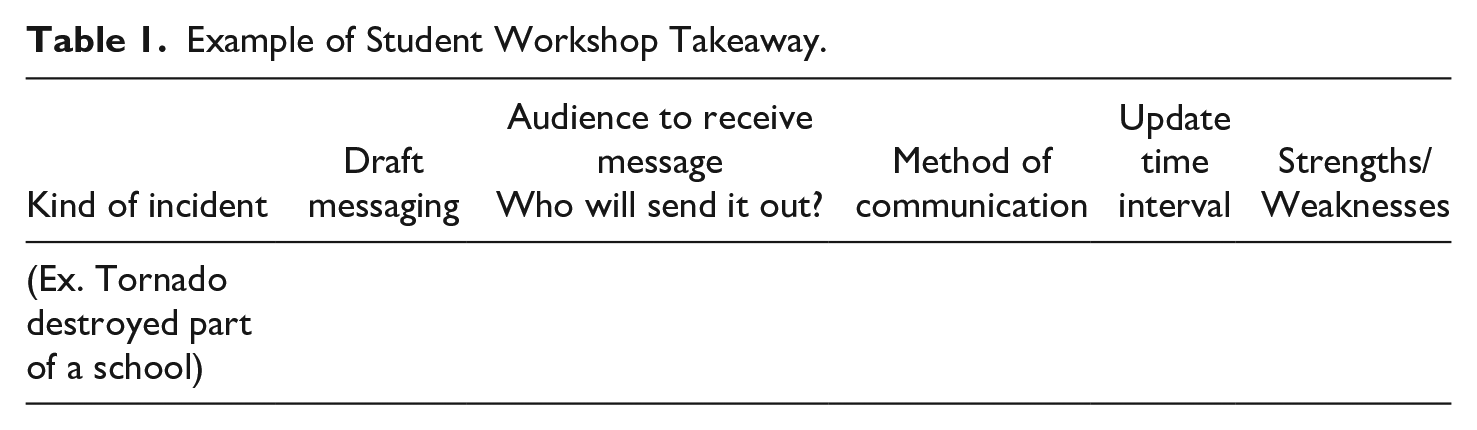
In groups, have students develop a draft communication for four different potential school emergencies and different audiences. For example, if a tornado is a potential emergency, consider how the school leader will communicate the aftereffect of a tornado destroying some of a school to staff, students, families, and the community at large. What method (e.g., email, text, and radio message) would be best for the audience and why? What will the draft of the message say? When can an update about the situation be expected (e.g., 1 hour later, the next day, or later that week)? What are some strengths and weaknesses of this particular messaging? Finally, consider how someone may be misinformed by the message or use the message contrary to the intended purpose. It may be helpful to have students build a table such as Table 1. Because every incident is unique, no message draft or template can be used without alteration. Develop a list of questions a leader should ask themself as they write and review incident messages to different audiences.
Example of Student Workshop Takeaway.
Information Collection
In groups, have students identify an information collection method for four different potential school emergencies. What information is needed for making decisions for that incident (e.g., weather patterns for a winter weather storm emergency)? Why is this information important (e.g., for communicating with families, to put in an insurance request)? Who will collect this information and how (e.g., principal, facilities manager, and head of human resources)? Who will analyze this information and how? Who will have access to this information (e.g., teachers, classified staff, students, and families) and why? How will this information be used in an after action report? Where will the information be stored? How long will this information be stored? What special considerations need to be made for school incidents that occur before or after normal school hours?
Two-way Communication Plan
A key element to a communication plan is for school community members to be able to communicate back to leadership. These can include things like asking questions or describing how a particular decision may affect or has been affecting them. In groups, have students identify two ways in which stakeholders can provide information back to school officials across different stakeholder groups (e.g., certificated staff, classified staff, students, families, emergency response agencies, and community members), how that information will be incorporated into the collected information, and how that information will be used to make decisions and learn from the experience of the incident.
Emergency Response Agency and Beyond Relationships
These workshop activities are designed for students to identify, build, and reflect on relationships with their local emergency response agencies and beyond. While some or all of these agencies may or may not be involved in responding to every incident as it occurs, being aware of and preemptively developing strong working relationships with these organizations creates a strong foundation to work from when responding to any incident.
Relationship Map
On individual pieces of paper, have students write their name and their role in their organization in the middle of the paper. Using the internet, have them identify the organizations and contacts at local, county, and state emergency response agencies including the police (or state troopers), fire departments, emergency medical services (EMS), public health officers, emergency management coordinators, etc. Draw a circle around those individuals or agencies that students already have a relationship with and a line connecting them to their name/organization. Under each circle, write down how often they have scheduled meetings with that person or when was the last communication with that person. Do the same for local, county, and state-level organizations that support mental and psychological services, counseling services, social work or services, or crisis counseling specifically. Finally, do the same thing for local, county, and state organizations that provide food and housing support regularly or acutely during emergencies. Have students discuss their relationship maps and add to their own during the discussion.
Relationships Timeline
Identify a kind of school emergency that is likely to happen in your community (e.g., weather incident, fire, and nearby violence). On a piece of paper (landscape), write that situation in the middle and put a box around it. Draw two lines from the box going left and right to the edges of the paper (see Figure 1 for an example). Next, across the top of the paper, write down all of the agencies that could be involved in the response either before or after the start of the event. Draw a line from the agency to when on the timeline they might start their involvement. On that connecting line, write down what that involvement might look like (e.g., crisis counseling, putting out the fire, evacuating students, etc.). Below the timeline, identify steps before the incident for building or sustaining a relationship with that agency (e.g., schedule a meeting to review the mutual aid agreement or memorandum of understanding).
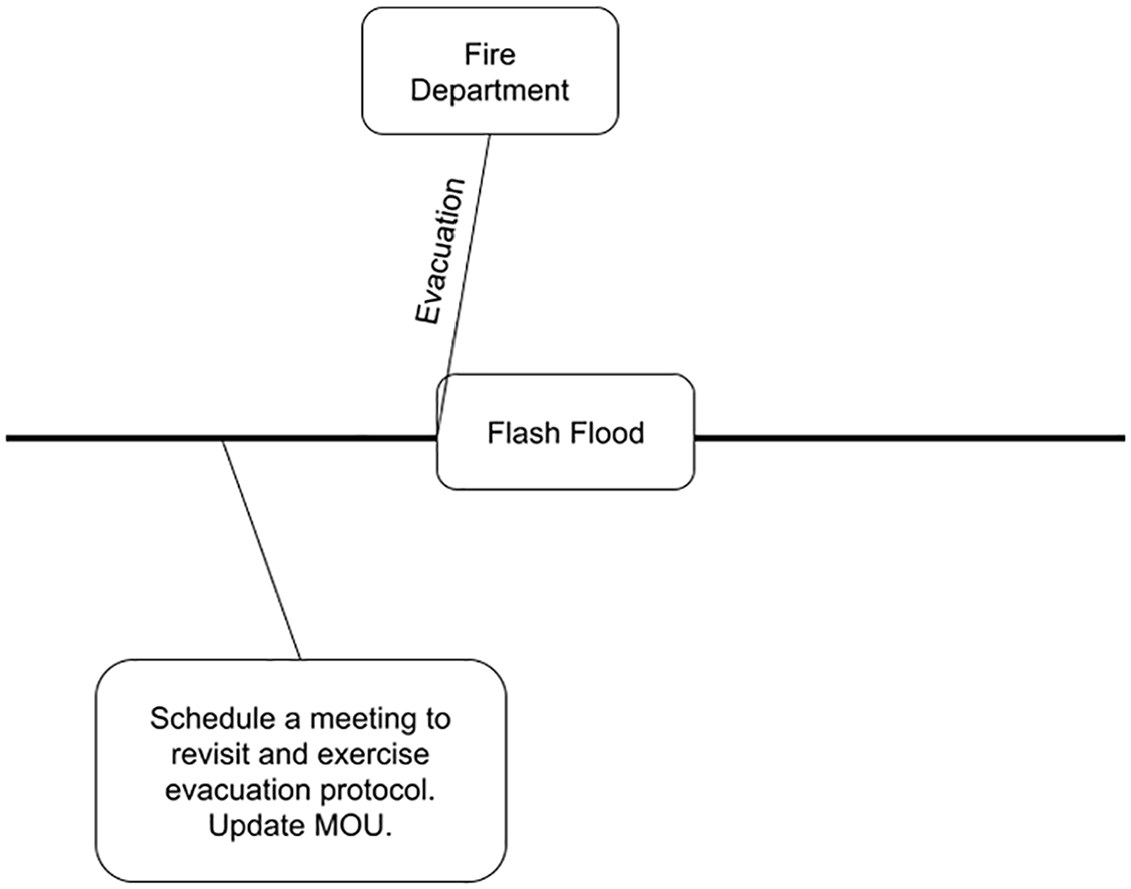
Example of Relationship Timeline.
Unit of Study
Education preparation programs may be facing increased interest and pressure to teach more on school safety and emergency management in their programs. Because of this, we propose one potential teaching unit that centers cases as conversation starters with additional resources for preparing future educators. We recommend a unit including the Barron Ausbrooks (2010) case on a school fight; the Brown (2018) case on a school shooting; the LaRoe and Corrales (2019) case on a suicide tragedy; and the Potter et al. (2021) case on a tornado disaster. Each of these cases highlights and examines various aspects of school emergencies and decisions educators will have to make.
The national standard for emergency management in the United States is the National Incident Management System and the Incident Command System (Federal Emergency Management Agency [FEMA], 2017). Therefore, professors and teachers should consider incorporating FEMA Emergency Management Institute courses such as IS-100, -200, -700, and -800 (FEMA, Emergency Management Institute [EMI], n.d.). This knowledge will provide a common understanding for educators and local emergency responders to talk about emergency management and response in schools.
In addition to the scholarly literature discussed above, we recommend the following books to supplement or support learning on school safety and emergency management:
● Brock, S., Nickerson, A., Louvar Reeves, M., Connolly, C., Jimerson, S., Pesce, R., & Lazzaro, B. (2014). School crisis: The PREPaRE model (2nd ed.). NASP.
● Cornell, D. G. (2018). Comprehensive school threat assessment guidelines: Intervention and support to prevent violence. School Threat Assessment Consultants, L.L.C.
● Cullen, D. (2009). Columbine. Twelve.
● Fox, J. A. & Burstein, H. (2010). Violence and security on campus: From preschool through college. Praeger: Santa.
Jimerson, S. R., Nickerson, A. B., Mayer, M. J., & Furlong, M. J. (Eds.). (2012). Handbook of school violence and school safety. Routledge.
● Kerr, M. M. & King, G. (2019). School crisis prevention & intervention (2nd ed.). Waveland Press.
● Lysiak, M. (2013). Newtown: An American tragedy. Gallery Books.
● Moore, P., Jackson, B.A., Leschitz, J. T., Wolters, N., Goode, T., Diliberti, M. K., Pham, P. F. (2024). Developing practical responses to social media threats against K–12 schools: An overview of trends, challenges, and current approaches. Homeland Security Operational Analysis Center, RAND Corporation.
● Sandoval, J. (2013). Crisis counseling, intervention and prevention in the schools (3rd ed.). Routledge.
● Schildkraut, J. & Nickerson, A. B. (2022). Lockdown drills: Connecting research and best practices for school administrators, teachers, and parents. The MIT Press.
For this teaching unit, teachers and professors may want to consider a culminating activity for students to develop useful materials and reflect on what they have learned. First, using the learning materials, have students develop a rubric based on research and recommended practices for evaluating school safety plans or EOPs. This rubric should consider the incident cycle (before, during, and after) as well as physical safety measures and mental and emotional well-being practices. Using this shared rubric, students will then go back to their building or district’s safety plan or EOP and evaluate it based on this rubric. Write up a report about the strengths and weaknesses of the EOP, areas of needed improvement, and next steps for improving the EOP. Then, have a conversation with your building or district’s administrator in charge of school safety or the safety committee to discuss your review. Finally, write a reflection paper about your experience doing the review and talking with the safety administrator or committee about it. What have you learned that you will implement in future leadership positions? What are some values you have developed that focus your work on creating a safe school? Finally, who are your critical friends and key collaborators in implementing school safety practices and learning from incidents?
Footnotes
Acknowledgements
We would like to thank Dr. Mark R. Landahl at Jacksonville State University for being an early thought partner with us as we began to conceptualize this fictional narrative.
Declaration of Conflicting Interests
The author(s) declared no potential conflicts of interest with respect to the research, authorship, and/or publication of this article.
Funding
The author(s) received no financial support for the research, authorship, and/or publication of this article.
