




Abstract
Student-led consultancy is widely used in management education to connect theory with real organizational practice, yet the identity transitions students undergo in these contexts remain underexplored. This article introduces identity shock to describe the disorientation that arises when learners are expected to perform a professional identity they have not yet internalized. Drawing on possible selves theory, role theory, and an autoethnographically informed reflective teaching practice, we conceptualize identity shock as a form of identity dissonance that becomes particularly salient in externally facing consultancy work. We position the construct in relation to reality shock, identity crisis and impostor syndrome, to clarify its developmental significance. The article outlines five pedagogical strategies that can help students navigate the cognitive, emotional, and behavioral tensions of adopting both student and consultant roles: role framing, mentoring and modeling, structured reflection, peer-supported identity work, and identity-aligned supervision and assessment. We argue that consultancy modules, and other practice-based curricula, should be designed as learning ecosystems that scaffold identity development alongside skills acquisition, enabling students to engage more confidently with emerging professional selves.
Keywords
Introduction
Practice-based learning initiatives like student-led consultancy projects are increasingly used in higher education to connect classroom theory with organizational practice (Agboma et al., 2026; Allen et al., 2022; Lozano et al., 2022). Student-led consultancy refers to experiential projects that are variously described as field projects, practica, or applied capstones, in which students work with real clients as part of a standard business or management curriculum. These programmes enable students to engage directly with businesses and develop analytical, interpersonal, and project-based capabilities that extend beyond consultancy careers. While only a minority of students ultimately enter consulting, the skills rehearsed in these settings – problem framing, managing ambiguity, and communicating across organizational boundaries – are foundational to a wide range of graduate roles. This broader relevance positions consultancy modules not simply as vocational preparation but as developmental spaces where students practise early forms of professional judgment and boundary-spanning communication. It also highlights why the identity-related dynamics explored in this article resonate across practice-based disciplines.
Alongside these benefits, consultancy projects often trigger complex personal transitions. Students must navigate the dual identities of learner and consultant, each carrying distinct expectations and behavioral norms (Islam, 2008). We use the term identity shock to describe the disorientation that arises when individuals are required to enact a professional identity they have not yet integrated into their self-concept. In consultancy settings, this may manifest as cognitive disruption, behavioral hesitation, emotional unease, and internal conflict as students respond to expectations typically associated with more established professionals. Although consultancy provides a highly visible site for examining these dynamics, the identity tensions discussed here are also characteristic of a wider range of practice-based professional education contexts – such as teaching, nursing, medicine, engineering, law, and social work – where students are required to assume responsibility or authority before they feel fully entitled to do so. Framing identity shock in this broader way strengthens its applicability while retaining consultancy projects as the primary lens for conceptual exploration.
While research has documented the pedagogical benefits of consultancy modules (e.g., Nikolova & Andersen, 2017; Richter & Schmidt, 2008; Robinson et al., 2010; Wysong et al., 2022), far less attention has been paid to the identity work that students must undertake within them. This is an important omission, as the externally facing nature of consultancy heightens the salience of identity transformation and amplifies role conflict. Understanding how students manage these tensions therefore requires shifting focus beyond competency acquisition toward the deeper identity transitions that accompany authentic professional role enactment.
To explore these dynamics, we draw on academic theory and an autoethnographically informed reflective teaching practice. The possible selves lens illuminates how students imagine their future professional identities and how these imagined selves collide with the ambiguity and responsibility inherent in consultancy work. Harrison and Waller’s (2018) concept of “horizons for action” helps explain how socio-economic background shapes what students perceive as attainable, while Vough et al.’s (2025) insights on identity conflict appraisal highlight why some students interpret identity tension as threat and others as opportunity. Our reflective insight is drawn from more than 5 years of supervising undergraduate consultancy projects. The narratives employed are reconstructed vignettes derived from accumulated teaching experience; they are not empirical quotations, but interpretive representations used to illustrate typical developmental dynamics witnessed across multiple cohorts.
Against this backdrop, this article asks: How can instructors best support students as they navigate the tensions between student and consultant identities? This question foregrounds instructional design rather than student outcomes, aligning with the theoretical and reflective orientation of the article. We offer conceptual clarification, practical insights, and a structured set of pedagogical strategies intended to help educators scaffold identity development alongside skills development. To ground this pedagogical focus, the next section outlines the theoretical foundations that explain why identity shock arises and how it shapes students’ early professional development.
Theoretical Foundations: Possible Selves, Liminality and Identity Shock
This section begins with possible selves to show how imagined futures shape students’ responses to consultancy work, drawing on liminality and communities of practice to explain their unsettled position between learner and consultant roles. It then considers how social background influences access to identity resources and uses role and appraisal theories to clarify how students interpret moments of identity misalignment.
The concept of possible selves provides a productive starting point for understanding identity shock. Markus and Nurius (1986) describe possible selves as individuals’ imagined futures, who they might become, hope to become, or fear becoming. These imagined identities act as motivational and evaluative standards. For students entering consultancy projects, the consultant identity may appear as a hoped-for self-associated with competence, credibility, and professional legitimacy, while a feared self may involve being exposed as unprepared or inadequate. When students are required to enact consultant behaviors before having integrated this identity into their broader self-concept, the tension between internal readiness and external expectations can trigger the disorientation we term identity shock. This possible-selves framing is particularly powerful because it highlights identity shock not merely as a momentary discomfort, but as a developmental conflict between present identity resources and imagined professional futures.
Practice-based learning frequently accelerates such transitions (Ewing & Ewing, 2017), particularly when learning encounters are externally facing and require authentic professional performance. Liminality further illuminates this process. Turner (1987) characterizes liminality as a transitional state in which established identities have loosened but alternative identities are not yet stabilized. Students in consultancy projects often occupy this “betwixt and between” position, no longer operating solely as learners yet not fully recognized by themselves or others as professionals. This unsettled position heightens sensitivity to issues of belonging and legitimacy (Baumeister & Leary, 2017; Lambert et al., 2013). Communities of practice research similarly shows how novices participate peripherally before attaining fuller membership, encountering ambiguity about role, authority, and social positioning in the process (Wenger, 1999; Young & Bunting, 2024). Importantly, liminality frames identity shock as part of an unsettled developmental journey rather than as an aberration, emphasizing that disorientation is an expected companion to early professional role experimentation.
Teaching practice frequently reveals these tensions through student behavior rather than explicit articulation. Students may hesitate during meetings, over-prepare for routine tasks, or defer excessively to instructor or clients – behaviors that may symbolize a lack of alignment between self-concept and the consultant role. These behaviors may not simply be signs of under confidence but expressions of students navigating unfamiliar identity terrain. Such identity transitions are rarely linear; rather, students oscillate among emerging versions of their professional selves as they test, discard, and refine possibilities. As Reissner and Armitage-Chan (2024) observe, professional identities evolve continually in response to changing demands and social cues. The consultancy environment amplifies this evolution by continually presenting students with situations that call for self-presentation, judgment, and the negotiation of competence.
These transitions are also shaped by social background. Harrison and Waller’s (2018) concept of “horizons for action” demonstrates how structural factors such as class, race, and educational capital influence what individuals perceive as attainable. First-generation and underrepresented students may aspire to consultancy but lack access to role models, tacit professional knowledge, or culturally familiar reference points, making the consultant identity feel more distant and increasing vulnerability to identity shock. Conversely, students from more advantaged backgrounds may enter with stronger identity resources, although they are not immune to identity dissonance. This uneven distribution of identity-supportive resources means that identity shock is not simply a function of individual readiness but reflects broader social and economic conditions that shape who feel entitled to “be” a consultant. Recognizing these asymmetries is crucial for designing pedagogical approaches that support all students rather than inadvertently reinforcing existing inequalities.
Role theory adds an important layer to this understanding. Role conflict arises when individuals face competing expectations attached to different identities (Anglin et al., 2022; Biddle, 1986). The academic role emphasizes correctness, structured progression, and approval-seeking, whereas the consultant role demands initiative, judgment, and comfort with uncertainty. The collision between these expectations generates behavioral and emotional strain. Role theory helps explain why even academically confident students can feel disoriented in consultancy settings; success requires behavioral repertoires not typically rehearsed in classroom environments. How individuals appraise this tension – as threat, challenge, or opportunity – further shapes their coping responses and developmental trajectories (Lazarus & Folkman, 1984; Vough et al., 2025). Appraisal theory thus provides a mechanism through which identity shock translates into either constricted engagement or forward identity movement. In this framework, identity shock reflects not only the demands of the roles but also the meanings students attach to moments of identity misalignment, making it both structurally imposed and interpretively negotiated. This theoretical grounding provides the basis for comparing identity shock with related constructs.
Identity Shock in Context: Comparisons With Related Concepts
Identity shock can be further clarified by comparing it with several related constructs – identity crisis, reality shock and Impostor syndrome – that illuminate its distinctive developmental role in practice-based learning. Erikson’s (1950, 1968) concept of identity crisis describes a broad developmental period marked by self-questioning and re-evaluation. Contemporary scholarship (e.g., Côté, 2018; Schachter & Galliher, 2018) shows how such tensions surface as young adults negotiate emerging professional identities. Identity shock shares this focus on identity questioning but differs in scale and specificity. Rather than capturing a broad life-stage transition, it describes a bounded disruption triggered by a particular role enactment – acting as a consultant while still anchored in the student identity. Its significance lies in its immediacy, a moment-to-moment interruption that reveals the fragile boundaries of students’ developing professional identities.
Kramer’s (1974) notion of reality shock provides a different comparison. Reality shock describes the disillusionment individuals feel when the expectations of a professional role diverge from its everyday realities, a pattern documented in professions such as nursing, engineering, and teaching (Riordan & Goodman, 2007; Voss & Kunter, 2020). While identity shock also involves a mismatch between expectation and experience, its emphasis is internal rather than external. The disruption stems less from organizational conditions and more from the tension between self-concept and role performance. Reality shock concerns situational misalignment; identity shock on the other hand concerns identity enactment and the meaning individuals attach to it.
Impostor syndrome (Clance & Imes, 1978) appears related through feelings of inauthenticity and self-doubt. Yet impostorism is conceptualized as a more enduring, trait-like pattern that varies by context and background (Gullifor et al., 2024; Tewfik et al., 2025). Identity shock, by contrast, is situational and often transient. It arises during early attempts to inhabit a new professional identity and typically diminishes as students gain experience, feedback, and support. Whereas impostor syndrome can persist despite evidence of competence, identity shock reflects the early stages of identity formation, where provisional professional selves are tested and refined.
Taken together, these comparisons clarify the conceptual boundaries of identity shock. Like an identity crisis, it involves questioning of the self; like reality shock, it emerges from confronting role expectations; and like impostorism, it contains feelings of inauthenticity. Yet its distinctiveness lies in its focus on the internal tension of student and professional identities within pedagogical contexts designed to simulate professional practice. This framing shifts attention away from individual inadequacy and toward the developmental and educational conditions that shape early professional identity work. To better understand how this unease can be understood in practice, we now turn to the cognitive and emotional challenges students face as they attempt to enact a consultant identity while still rooted in student hood.
Cognitive and Emotional Challenges in the Transition
Having established the conceptual boundaries of identity shock, this section outlines the specific mental demands, emotional pressures, and behavioral responses that arise as a result. Cognitively, students must reconcile the structured, answer-seeking mindset of academic work with the ambiguity and judgment required in consultancy (Papadopoulou, 2021). Classroom tasks often have clear parameters and evaluative rubrics; consultancy tasks rarely do. Students must define problems, tolerate incomplete information, and make decisions without authoritative guidance. This shift can be mentally demanding, requiring students to move away from familiar forms of certainty toward more fluid modes of reasoning. A common reaction is a sense that “the ground has moved,” particularly when clients expose knowledge gaps or require students to articulate judgments rather than rely on predetermined answers.
Emotionally, identity shock manifests through anxiety, self-doubt, and fear of failure. Because consultancy work is externally facing, students often perceive the stakes as higher than in typical coursework. Mistakes can feel like professional rather than academic shortcomings, and feedback from clients may be interpreted as a judgment on personal competence. Early in the project, one reconstructed vignette based on teaching experience illustrates this fragility: after a client meeting, a student described feeling “out of place” and worried that answering questions imperfectly revealed they “did not belong,” despite producing technically sound work. Such moments reveal how even competent students can become preoccupied with how they are being perceived, and how role-incongruent emotions can intensify even when performance is adequate.
These pressures echo findings from early professional role research which highlights heightened vulnerability during transitions into responsibility-bearing roles (Todd & Mcilroy, 2025). Consulting contexts amplify perceived exposure (Sachau & Naas, 2010). The gap between internal insecurity and external expectations becomes a source of acute stress, often producing hyper-vigilance or over-preparation. Students may rehearse extensively, qualify their statements, or avoid asking clarifying questions for fear of appearing unprofessional. For some, this manifests as over-identification with the consultant role, adopting overly formal language or rigid communication strategies in an effort to project competence. For others, it produces withdrawal, silence, or a reluctance to contribute during client interactions.
Interpersonal and behavioral challenges are intertwined with these cognitive-emotional tensions. Students must navigate shifting power dynamics within their teams, often taking on leadership or decision-making roles that conflict with established student habits. Some hesitate to direct peers or resist assuming authority, worried that doing so may disrupt social cohesion or expose their own ambiguity. Others act decisively but express visible discomfort, sometimes apologizing for leading or seeking repeated reassurance from peers. These patterns reflect a deeper identity tension, students have not yet aligned their self-concept with the assertiveness and autonomy expected of consultants. This misalignment can also surface in subtle ways, such as over-editing written reports to remove tentative language or hesitating before making recommendations, even when evidence supports them.
Feedback adds another layer of complexity. In academic contexts, feedback is structured, predictable, and usually private. In consultancy, it is fluid, sometimes ambiguous, and delivered through real-time interactions with clients. Students may interpret routine critical comments as confirmation of inadequacy rather than as part of normal iterative practice (Emerson et al., 2023). The dual-evaluation environment – meeting client needs while satisfying instructor expectations – can exacerbate confusion. Students may ask: should I prioritize the client’s preferences or the marking rubric? This tension complicates their understanding of successful performance. Moreover, because the consultant role requires visible confidence, students experiencing identity shock may feel unable to signal uncertainty, even when guidance would ease their cognitive load.
Despite these challenges, identity shock can be developmentally productive. Transformative learning theories (Illeris, 2014; Mezirow, 2000) emphasize that cognitive disruption and emotional strain can catalyze deeper self-reflection. Professional identity research similarly highlights the value of early role experimentation (Ashforth et al., 2007; Ibarra, 1999; Pratt et al., 2006). A reconstructed vignette from later in the module illustrates this arc: a student who initially felt fraudulent came to feel “more in command” after preparing thoroughly for client interactions and integrating feedback. This progression, from insecurity to growing confidence, is common when identity work is deliberately supported. Importantly, such development involves not only increasing competence but also reinterpreting discomfort as part of becoming rather than as evidence of inadequacy.
Such development, however, is not automatic. Without structured guidance, students may interpret their unease as a sign that they do not belong in professional spaces, potentially reinforcing self-limiting narratives. With appropriate framing and support, the same discomfort can instead become a signal of growth – less a failure to perform than a meaningful step in identity transition. Identity shock can therefore serve as a trigger for bridging the gap between technical competence and emerging professional identity, helping students recognize that uncertainty is an inherent and often productive feature of early professional practice. To understand how students navigate the behavioral implications of this tension, and why it intensifies in client-facing moments, we now examine how students navigate the simultaneous expectations of being both learners and emerging professionals.
Navigating Dual Identities: Learner versus Consultant
This section explains how the tensions between learner and consultant identities take shape in practice. It outlines the behavioral, interpretive, and developmental dynamics involved, and examines the strategies students use to manage, separate, or begin integrating these identities. Students engaged in consultancy projects must navigate two distinct identity worlds – academia and professional practice – each with its own norms and expectations. As students, they are accustomed to seeking guidance, asking questions, and working toward clearly defined assessment criteria. As consultants, they are expected to project expertise, manage ambiguity, and advise clients with confidence. Moving repeatedly between these contrasting expectations, a pattern documented widely in consultancy modules and capstone-based experiential learning (Nikolova & Andersen, 2017; Richter & Schmidt, 2008; Robinson et al., 2010), can create a sense of fragmentation and intensify identity shock. Across our teaching practice, signs of this disorientation are common – hesitation during client meetings, overthinking minor decisions, or performing while feeling internally uncertain. One reconstructed vignette captures this oscillation: a student who felt like “two different people,” a questioning learner in class and a guarded, overly careful consultant in client interactions. This internal split illustrates how role expectations can pull students toward competing versions of themselves and how quickly identity performances can shift in response to perceived social demands. These shifts often occur moment-by-moment, reinforcing how effortful and cognitively taxing identity switching can be.
Ewing and Ewing (2017) note that students arrive at university with deeply ingrained academic identities shaped by years of institutional socialization resulting in identities that emphasize correctness, deference, and structured progression. These norms become identity defaults that are difficult to suspend in client-facing environments, particularly for students who equate academic correctness with safety. The consultant role, by contrast, requires initiative, analytical autonomy, and comfort with uncertainty. The tension between these identities is therefore not merely behavioral but grounded in deep-seated assumptions about competence, authority, and what it means to contribute meaningfully. Some students may resist aspects of the consultant identity, not because they lack ability, but because the role feels inconsistent with how they see themselves or with the forms of confidence they have previously been rewarded for displaying. For others, the consultant identity exposes unfamiliar expectations around assertiveness and voice, prompting subtle forms of identity withdrawal.
Role theory helps clarify this dynamic. Individuals interpret and enact behavior according to the roles they occupy, and the presence of competing expectations generates role strain (Anglin et al., 2022; Biddle, 1986). Consultancy projects amplify this strain by requiring frequent, abrupt shifts between learner and consultant behaviors, often within the same day or even the same hour. Identity theory extends this insight by emphasizing that roles begin to shape self-concept over time as behaviors are repeated, tested, and socially validated (Stryker & Burke, 2000). Identity shock emerges at this intersection, when students can perform consultant behaviors externally but do not yet recognize these behaviors as congruent with who they are becoming. This helps explain why some students who outwardly appear confident may nonetheless experience a lingering sense of fraudulence, an indication that their internal self-understanding has not caught up with their external performance. This lag between performance and internalization is central to early professional identity development.
Students adopt a range strategies to manage this dissonance. One common approach is compartmentalization, the conscious switching into “consultant mode” for client meetings and reverting to “student mode” for academic tasks. While this can maintain functionality, excessive compartmentalization can prevent the formation of a coherent professional identity (Thomas et al., 2013). The cost of this switching can also accumulate, leading to fatigue, increased emotional strain, and a feeling of never fully inhabiting either identity. A more sustainable trajectory involves identity integration, in which elements of the student and consultant roles gradually merge (Petriglieri, 2011). Rather than toggling between incompatible selves, students begin to see themselves as emerging professionals who remain open to learning. This integration process is rarely linear and is influenced by feedback, peer dynamics, client reactions, and the level of psychological safety embedded within the learning environment. It aligns with evidence showing that participating in authentic professional tasks – client presentations, team leadership, problem framing – supports early professional identity formation (Booth, 2019; Lisovskaia & Kucherov, 2025; Reissner & Armitage-Chan, 2024; Tan et al., 2016). Integration often begins subtly, through the adoption of more confident language, greater ownership of client-facing decisions, or reduced anxiety when articulating provisional recommendations.
Students also rely on identity modeling, drawing on mentors, instructors, and confident peers. Bandura’s (1977) social learning theory suggests that individuals learn through observation, and Ibarra (1999) describes this process as “trying on provisional selves.” Students often experiment with professional behaviors, adopting a more assertive tone, presenting themselves more formally, or emulating an instructor’s communication style. These provisional selves are temporary but developmentally valuable, allowing students to explore what authentic professional behavior might eventually feel like. A reconstructed vignette illustrates this: a student who initially mimicked the instructor’s communication style experienced it as “borrowing someone else’s clothes,” yet it gradually became more natural as their confidence grew. Such modeling processes are especially significant for students with limited access to professional role models in their family or social networks. For these students, the consultancy environment may represent one of the first sustained opportunities to observe, practise, and inhabit professional identities, reinforcing the uneven distribution of identity resources across student groups.
Together, these dynamics reveal that navigating dual identities is not simply a matter of skill development but a complex process of identity negotiation. Students must learn to recognize when they are performing an identity, when they are resisting one, and when they are beginning to integrate a new sense of themselves as emerging professionals. Identity shock sits at the center of this process, surfacing the tensions that accompany early identity experimentation and revealing the interpretive, emotional, and behavioral work students must undertake as they move between the worlds of learner and consultant. These identity dynamics point directly to the pedagogical question of how educators can support students through this complex process of role negotiation, which the next section addresses. Building on this conceptual groundwork, we offer practical insights and a structured set of pedagogical strategies designed to help educators scaffold identity development alongside skills development.
Implications for Management Education: Supporting Students Through Identity Transitions
In response to identity challenges, we identify five interconnected pedagogical strategies – role framing, mentoring and modeling, structured reflection, peer-supported identity work, and identity-aligned supervision and assessment – that can help instructors support students as they navigate emerging professional identities. While familiar in experiential learning, these strategies become particularly salient in consultancy contexts where students engage in externally facing work that accelerates identity disruption. Moreover, because identity shock is unevenly distributed across socio-economic and cultural backgrounds, an identity-supportive pedagogy also performs an important equity function by broadening who feels entitled to participate confidently in professional spaces.
Orientation and Role Framing
Orientation in consultancy modules often focuses on project logistics and assessment criteria. In identity-shock contexts, it must also prepare students for psychological dissonance. Drawing on Adams and Zanzi (2004), early role framing should normalize ambiguity and signal that feeling unprepared or “in between” identities is an expected part of professional development. Explicitly contrasting student and consultant mindsets – students seek answers/consultants frame problems – helps students anticipate the unfamiliar demands of the consultant role. Clarifying this shift early on influences how students appraise subsequent tensions, shaping whether they interpret identity challenges as threats or opportunities (Vough et al., 2025). This is especially important for students with limited exposure to professional environments or who have internalized models of professionalism that feel culturally distant. A reconstructed vignette captures this challenge: a student who feels they “understand the brief” can still struggle to imagine themselves sitting across from a business owner without experiencing a lack of situational legitimacy. Role framing therefore performs both a leveling and a legitimizing function, acknowledging that identity discomfort is not a personal failing but a predictable feature of stepping into unfamiliar professional spaces.
Mentoring and Modeling
Mentoring plays an amplified role when students experience identity shock. Beyond guiding task execution, mentors help students interpret emotionally charged moments – hesitation, over-apology, perceived scrutiny – as part of identity formation rather than evidence of inadequacy (Bruni-Bossio & Delbaere, 2021). Storytelling is particularly effective. When instructors share early-career uncertainties, they model professional identity as evolving rather than fixed (Petriglieri, 2011). Mentors also provide behavioral templates, demonstrating how to manage ambiguity, handle client feedback, and communicate with confidence. Because consultancy exposes students to real clients early in their development, sensitive mentoring can alleviate the fear that initial struggle reflects unsuitability for professional work. This interpretive stance is especially important for students with limited access to professional role models through family or social networks. For them, mentoring not only builds skill but also expands their repertoire of viable professional identities, helping counteract identity narratives structured by classed or racialized assumptions about who “belongs” in professional settings.
Structured Reflection and Guided Identity Work
Reflection is central to practice-based learning but requires a more specific orientation in identity-shock contexts. Students are not only performing tasks; they are negotiating what it means to inhabit an emerging professional self. Identity-focused reflection helps students process dissonance, to recognize when they feel fraudulent, confident, overwhelmed, or unexpectedly capable. Drawing on Ewing and Ewing (2017), guided prompts for example, “What challenged my sense of competence today?” or “How did this interaction shift my sense of myself as a consultant?” connect emotions, behaviors, and identity. This deeper form of reflection positions identity work as integral rather than ancillary to professional learning. It also supports meaning-making as students begin to interpret uncomfortable moments not as evidence of inadequacy but as signals of developmental movement. Because consultancy work is public and client-facing, the emotional stakes attached to performance are higher, and structured reflection can help students translate these emotions into insight rather than avoidance. Reflection can also surface how social background shapes students’ interpretations of confidence, legitimacy, and belonging. Attending to these socio-economic dynamics helps ensure that reflection does not simply individualize what are, in part, structural barriers to professional identity formation. Integrating theoretical language such as possible selves or provisional selves gives students a vocabulary for articulating change, making identity transitions more intelligible and less isolating.
Peer-Supported Identity Work
Group-based consultancy naturally enables peer learning, but in identity-shock conditions peers also become co-narrators of each other’s identity journeys. Students look to peers to interpret ambiguous moments, validate emerging professional behaviors, or normalize self-doubt (Nikolova & Andersen, 2017). Structured peer spaces – facilitated discussions, anonymous input activities, small-group debriefs – create environments where students can express uncertainty without fear of judgment. Without such spaces, students may continue to perform confidence, reinforcing rather than alleviating identity strain. Peer-supported spaces play an important democratizing function as identity resources (e.g., knowledge of professional norms, access to role models, familiarity with organizational cultures) are unevenly distributed across student groups. When structured intentionally, peer spaces allow identity resources to circulate more equitably, reducing reliance on background-dependent forms of cultural capital. Alumni panels or contributions from more advanced students serve as near-term role models, demonstrating that confidence and authenticity develop gradually rather than appearing fully formed.
Identity-Aligned Supervision and Assessment
Supervision and assessment practices shape how students interpret their progress and belonging. Instructors should recognize identity-relevant cues like withdrawal, defensiveness, and excessive perfectionism not as performance issues but as indicators of identity struggle. A dialogic supervisory style asking, “How did that client exchange affect your confidence?” or “What part of this task felt unfamiliar?” helps students frame their experiences developmentally rather than evaluatively. Assessment should similarly acknowledge identity growth. Traditional output-focused rubrics can obscure significant developmental progress made by students who initially experience strong identity shock. Incorporating reflective journals, growth narratives, or self-positioning statements signals that identity work is valued. Such practices also help reduce socio-economic disparities in identity confidence; students who initially lack familiarity with professional norms can demonstrate developmental movement rather than competing solely on polished outputs. This aligns with Vough et al.’s (2025) argument that individuals’ appraisal of identity conflict shapes its developmental trajectory.
To support application, Table 1 maps common manifestations of identity shock to targeted pedagogical strategies.
Mapping Identity Shock Challenges to Pedagogical Support Strategies.
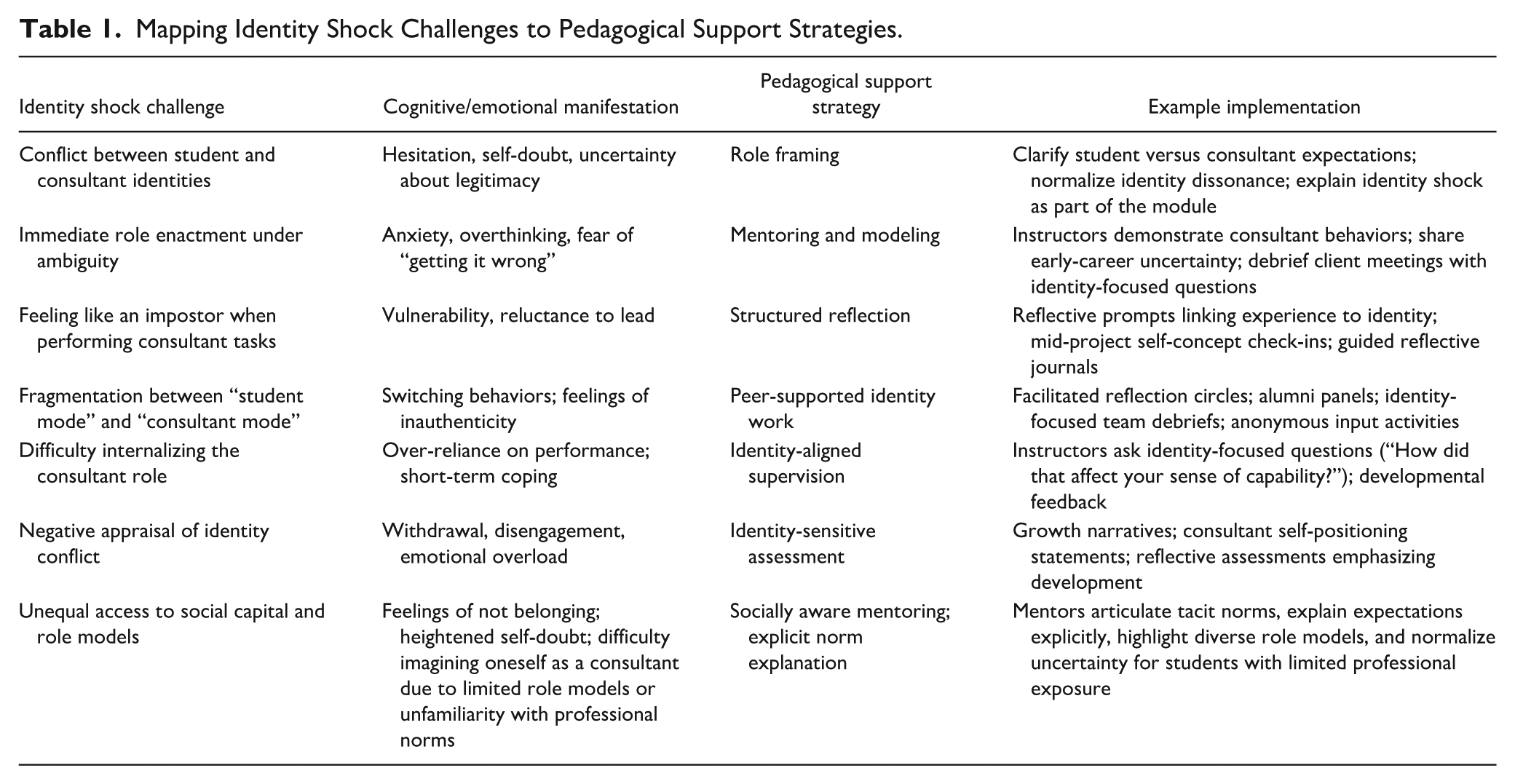
Taken together, these interventions reveal that helping students navigate early professional identity formation requires more than offering guidance on tasks; it demands designing learning environments that cultivate psychological safety, normalize identity uncertainty, and make identity work explicit. These strategies are therefore not discrete actions but interdependent elements that can only reach their full potential when embedded within a broader learning ecosystem. This positions consultancy modules as developmental ecosystems in which cognitive, emotional, and social transitions are made visible and supported, laying the conceptual groundwork for the next section’s focus on ecosystem design.
Designing Learning Ecosystems for Identity Development
This section elaborates how consultancy modules can function as identity-supportive learning ecosystems. It examines the structures, relationships, and interpretive supports that sustain identity development and shows how these ecosystem principles apply across practice-based learning contexts. The pedagogical strategies outlined above point toward a broader curricular imperative; student-led consultancy modules should function not only as sites for practice-based skill development but as learning ecosystems deliberately designed to support identity formation. In such ecosystems, identity dissonance is treated not as a problem to minimize but as a developmental signal that can be surfaced, interpreted, and integrated into students’ evolving professional narratives. Consultancy offers a particularly vivid case because it intensifies public facing responsibility early in students’ development. Framing consultancy modules as ecosystems also emphasizes that identity development is not the product of single interventions but of the coordinated influence of tasks, relationships, expectations, cultural norms, and interpretive support that students encounter over time.
Designing for identity development requires educators to recognize that identity shock is not experienced uniformly. Students’ social and economic backgrounds shape their professional confidence, horizons for action (Harrison & Waller, 2018), and access to tacit role cues. First-generation students or those from underrepresented groups may enter consultancy environments with fewer cultural reference points for professionalism, making identity dissonance sharper and potentially more destabilizing. Effective ecosystems should therefore incorporate compensatory structures – explicit role explanation, staged rehearsal opportunities, visible modeling, and low-stakes practice spaces – to help level the field and counteract inequities in access to professional identity resources. In this sense, identity-supportive ecosystems perform not only a developmental function but also a redistributive one, widening access to the identity resources students need to succeed in professional environments.
Structurally, learning ecosystems can sequence tasks to allow gradual increases in responsibility and exposure. Early low-stakes interactions, such as simulated meetings or peer-roleplay, help students practise consultant behaviors before facing external clients. Interpersonally, mentors and instructors provide interpretive scaffolding, helping students make sense of emotionally charged moments and reframe discomfort as part of identity growth. Reflectively, identity-focused journaling, guided prompts, or growth narratives give students structured opportunities to articulate who they are becoming, rather than focusing solely on what they are doing. These elements operate synergistically: practice without interpretation can entrench insecurity, whereas interpretation without practice may not shift behavior. Taken together, they shift consultancy modules away from a narrow competence-based model toward a holistic developmental paradigm that recognizes identity formation as a central educational outcome. Across the curriculum, these practices should be integrated into an identity-supportive ecosystem – one that coordinates roles, tasks, relationships, and interpretive support.
Although consultancy serves as a vivid case, the principles of identity-supportive ecosystems extend beyond management education into the aforementioned range of practice-based professional education contexts. These disciplines often require students to rehearse professionalism in front of real stakeholders, exposing them to identity shocks analogous to those experienced in consultancy. Consultancy modules therefore illustrate a wider truth: early identity enactment is emotionally charged and socially consequential, and students can benefit from ecosystems that help them navigate these transitions with confidence and coherence.
When learning ecosystems make identity work explicit – through staged practice, interpretive support, reflective integration, and assessment that values developmental movement – students gain not only technical competence but a more coherent and confident sense of emerging professional self. In this conceptualization, identity shock becomes a productive developmental tension for growth rather than a source of self-doubt. The task for educators is to design environments that enable students to move from tentative role performance to integrated professional identity. The concluding section synthesizes these insights, emphasizing identity shock’s conceptual contribution and its implications for designing practice-based educational experiences that support identity development as a core learning outcome.
Conclusion
This article has developed identity shock as a lens for understanding the internal dissonance students experience when asked to perform a professional identity, they have not yet fully internalized. In student-led consultancy projects, this dissonance becomes particularly visible because students must navigate abrupt shifts between academic expectations and externally facing client responsibilities. Rather than signifying deficiency, these moments reflect a developmental disruption triggered by the dissonance between learner and consultant identities and reveal the interpretive and emotional work required when students enter unfamiliar professional terrains.
We position identity shock as a form of identity dissonance rather than a wholly new construct, drawing on possible selves, role conflict, liminality, and identity appraisal theories to illuminate how cognitive, emotional, and behavioral tensions manifest during early attempts to enact professional roles. This theoretical integration highlights identity shock as a mechanism through which emerging identities are tested, stretched, and reconfigured. It moves explanation away from individual inadequacy and toward the pedagogical and structural conditions that shape students’ experiences of becoming professionals, including the uneven identity resources available to different student groups. In response, we outline five interconnected strategies that can help educators scaffold these transitions. When intentionally integrated, these practices can allow students test, narrate, and begin to inhabit emerging professional identities within psychologically safe yet challenging environments, supporting not only competence development but also identity confidence.
Although developed through the context of consultancy-based learning, the mechanisms of identity shock and the supports required to navigate it extend across practice-based disciplines in which students must assume responsibility or authority before feeling fully entitled to do so. Recognizing identity shock as a normal and meaningful component of professional learning repositions discomfort as a catalyst for growth, emphasizing the importance of identity-supportive ecosystems that attend to both competence development and the uneven social conditions that shape students’ sense of legitimacy. Learning designs that acknowledge, and support identity work can transform consultancy and other practice-based programs into developmental spaces where students gain not only technical capability but a clearer, more confident sense of who they are becoming and how they can inhabit professional roles with authenticity. In this way, identity shock becomes not a barrier to learning but a powerful entry point for rethinking how professional education prepares students for the interpretive, relational, and identity-rich realities of contemporary work.
Footnotes
Declaration of Conflicting Interests
The authors declared no potential conflicts of interest with respect to the research, authorship, and/or publication of this article.
Funding
The authors received no financial support for the research, authorship, and/or publication of this article.
