



Abstract
In this article, we introduce and discuss the potential benefits of structured shadowing, a distinct pedagogy in which the action-proximity of traditional unstructured job shadowing is supplemented by carefully designed pre-, intra- and post-shadowing pedagogical support. We suggest that structured shadowing is a promising yet under-utilized and overlooked pedagogy to enrich management learning and education. Drawing on an interview-based evaluation study of several cohorts of final-year undergraduates in a UK business school, we find that structured shadowing helps students to establish meaningful connections between theory and managerial practices, better appreciate management’s complexities and dispel existing myths and preconceptions. It also allows them to reflect on the types of managers they imagine or aspire to be and helps to model management as a reflective activity. Based on our teaching experience and our results, we argue that structured shadowing offers valuable lessons for our field. It helps to address the challenges of substance, contextual understanding and reflection, which we identify as central to current management education debates. We also acknowledge that while structured shadowing is a powerful resource, it demands significant investment and potential trade-offs, and may reflect certain professional privileges.
Introduction
In this article, we introduce and discuss the potential benefits of structured shadowing, a distinct pedagogy in which the action-proximity of traditional job shadowing is supplemented by carefully designed pre-, intra- and post-shadowing pedagogical support. Job shadowing, or shadowing for short, is broadly defined as an activity in which learner-observers follow particular workers for a period, witnessing their various tasks in the context of their roles (Watts, 1986: 1). We propose the concept of structured shadowing as a distinct refinement of the conventional view that equates shadowing with simple, unstructured ‘observation’ or ‘spending time in a workplace’ (e.g. Mader et al., 2017; Watts, 1986). Our core argument is that conceiving the shadowing activity as part of a structured process also involving critical examination of assumptions, focused analysis and carefully planned dialogical reflection, produces benefits for students, especially pre-experience ones. It also aids educators in responding practically to three questions that we often ask ourselves: (1) is our teaching relevant, and how; (2) what management do we teach; and (3) how do we teach it? In so doing, structured shadowing helps address the challenges of substance, contextual understanding and reflection, which identify as persistently relevant to management learning.
Our article makes two main contributions. First, we elaborate on the original concept of structured shadowing as a pedagogy, defined as ‘the whole approach or educational practice – content, methods, etc. – and the values and beliefs on which it is based’ (Reynolds, 1997), and illustrate how it can be mobilized in a business school learning setting. Second, we shed light on its potential impact, affordances and limitations for educators and our field. To this end, we draw on evaluations of four cohorts of final-year undergraduate students in a UK business school who attended a module on managerial work designed around structured shadowing. Our interview-based evaluation study reveals that structured shadowing helped these students to establish meaningful connections between theory and managerial practices and appreciate the complexities of management, while reflectively dispelling preconceptions and critically examining what types of managers they imagined they could be in the future.
Our two-pronged contribution is set against a surprising paucity of critical studies of job and work shadowing. Despite extensive use of job shadowing in various sectors (e.g. Kitsis and Goldsammler, 2013; Makovec, 2021; Reese, 2005), academic attention has been scarce. As Mader et al. (2017: 114) observe, the published literature yields ‘a variety of anecdotal entries in practitioner publications. Much fewer in number are entries in academic journals’. This is even more true of the management learning literature, which all but ignores shadowing, perhaps because it is taken for granted or not considered worthy of critical examination. Therefore, to critically examine job shadowing and develop it as a pedagogy, we draw on discussions in the research methods literature, which has successfully used shadowing to study managerial work (Mintzberg, 1973; McDonald, 2005; Quinlan, 2008). We take a step towards addressing this scholarly gap and (re)directing attention to this approach, which has the potential to make a meaningful contribution to management learning and address our broader concerns as educators.
Management education today: Three central challenges and the promise of (structured) shadowing
The nature and broader impact of management education have been the subject of continued scholarly reflection and critique, resulting in a rich and thriving literature (e.g. Adler, 2002; Anteby, 2013; Khurana, 2007; Mintzberg, 2004; Petriglieri and Petriglieri, 2015; Pfeffer and Fong, 2002; Starkey and Tiratsoo, 2007). Adler (2016: 186), for instance, summarized the aim of such conversations concerning ‘our teaching mission’ – and of subsequent pedagogical interventions within business schools – as a quest to expand students’ (and we would add future managers’) ‘productive capabilities while helping them understand the complexity and ambiguity of management roles’. Following a close reading of this literature, we focus on three challenges which we see as most relevant to structured shadowing: substance, contextual understanding and reflection.
Three central challenges of management education
The challenge of substance refers to the purpose, delivery and relevance of business school curricula vis-à-vis managerial work (French and Grey, 1996; Mabey et al., 2015). In contemporary business schools, this challenge relates to a perceived lack of coupling between classroom and workplace at undergraduate (Colby et al., 2011) and postgraduate levels (Hay and Samra-Fredericks, 2019; Mintzberg, 2004). For instance, Watson’s (1994: 455) graduate students seldom ‘consciously thought about these ideas’, such as motivation, when facing related issues as managers; they largely ‘uncritically “swallowed”’ teaching of related theories, predominantly for exam purposes. The result is a persistent problem of learning transfer from classroom to workplace, with complaints that ‘competence development and learning’ are not valued by educators (Alvesson, 2013: 84), especially regarding managing people (Rubin and Dierdorff, 2009). Customary ways of closing the gap, such as case studies, offer useful but limited solutions (Bridgman et al., 2016; Gosling and Mintzberg, 2004) that risk producing ‘surface learning’, focusing on ‘aimless accumulation’ of uncontested views and limited insights (Watson, 1994: 461–462). The challenge of substance thus motivates the search for novel ways of educating tomorrow’s managers relevant to today’s workplaces, without accepting entrenched norms.
The challenge of contextual understanding, in turn, refers to the nature of managerial work and its high context-specificity (Stewart, 1967; Mintzberg, 1973; Korica et al., 2017). Many observation-based studies of managerial work illustrate that managerial practice is increasingly understood as unfolding through moments of managing (Shotter and Tsoukas, 2014). From this perspective, managers rely mainly on ‘context, judgment, practice, trial and error, experience, common sense, intuition, and bodily sensation’ (Flyvbjerg, 2001: 24). This questions both the traditional view of managers as morally neutral technicians, and the resulting normative and technical idea of management education. According to Roberts (1996: 54), such ‘technicist approaches . . . typically leave students’ “practical consciousness” – the usually tacit and habitual knowledge that informs actual practice – both unquestioned and unreformed’. By downplaying ‘the dilemmas, contradictions, doubts, and changes of mind that are part and parcel of the experience of leading’ (Petriglieri and Petriglieri, 2015: 630), technicist approaches to management learning present students with unrealistic images of the lived realities of managing, which are often subsumed under broader discussions of leaders and leading (e.g. Mintzberg, 2004). At the same time, ‘the human characteristics’ are largely absent (Yanow, 2009) from their representations of corporate management. ‘Detached knowing’ reigns (Hay and Samra-Fredericks, 2019), predisposing future managers to adopt the morally detached view that lies at the root of many corporate scandals (Ghoshal, 2005; Khurana, 2007).
In contrast to the unhelpful orthodoxy of technicist approaches, which remain the norm despite notable exceptions (e.g. Clegg and Ross-Smith, 2003; Datar et al., 2010; Hay and Samra-Fredericks, 2019; Petriglieri and Petriglieri, 2015; Vince, 2002), scholars now increasingly argue that management is better conceived in terms of Aristotle’s ‘phronesis’. By this, they mean that management is a ‘discipline that is pragmatic, variable, context-dependent, based on practical rationality, leading not to a concern with generating formal covering lawlike explanations but to building contextual, case-based knowledge’ (Clegg and Ross-Smith, 2003: 86). However, developing and refining the practical rationality and wisdom of managing (Shotter and Tsoukas, 2014) requires ‘being there’: existing and aspiring managers must directly witness, confront, and experience its unfolding complexity in different settings. This implies adopting forms of experiential learning (Kayes, 2002; Kolb, 1984) that go beyond class-based critical management approaches, which give ‘voice in the classroom to some of the messiness and suffering that characterizes management practice’ (Grey, 2004: 505; Dehler, 2009), and encourage ‘managers in thinking questioningly about their roles and responsibilities and the purposes and social consequences of the organizations they work for’ (Reynolds, 1997: 312).
Finally, and relatedly, although ‘being there’ offers possibilities for learning, it does not guarantee questioning of the observed status quo. This brings forth the challenge of reflection. In particular, refining the phronesis of managing requires structuring and interpretation of experience through reflection: entering into dialogue with oneself and others, establishing connections and opening up alternative understandings (Dewey, 1922; Hibbert et al., 2017). However, defined broadly as ‘a generic term for those intellectual and affective activities in which individuals engage to explore their experience to lead to new understanding and appreciation’ (Boud et al., 1985: 19), reflection is frequently absent from business school curricula. When included, it rarely builds on direct contact with ongoing managerial practice, certainly at pre-experience levels (e.g. Statler and Salovaara, 2016). This often results from practical limitations; nevertheless, it risks reinforcing the idea that reflection is only done in cloistered classrooms rather than as a fundamental part of everyday work. Failing to marry thinking and situated action may thus lead to students’ failure to develop ‘habits’ of reflection in context, which are critical to developing wisdom as a necessary (re)orientation for education (Antonacopoulou, 2010).
The promise (and shortcomings) of traditional shadowing
To respond to these three challenges, we must adopt learning methodologies that foster richer understandings of managerial work and enable future action-based alternatives to instrumental management (Rhodes, 2016). These must also work to establish reflection as a habit (Hibbert et al., 2017), including learning to cope with the discomfort of questioning certainties (Watson, 1994). Job shadowing, whereby learners follow particular workers for a period of time, goes some way to fulfilling this need.
Traditional shadowing involves learner-observers learning about a job by following a worker’s workday in close proximity (Watts, 1986). They may be professional novices to that job, or researchers (Czarniawska, 2007; Gill, 2011; McDonald, 2005; Quinlan, 2008). The method is well established, and has been used to support career development, career selection and informal job learning in fields such as management, education, medicine and nursing (Fougner and Horntvedt, 2011; Simkins et al., 2009; Mader et al., 2017). Predicated on learning through direct observation, it plays an essential role in incidental learning, or acquiring skills and tacit knowledge as by-products of daily activities (Johan et al., 2019; Marsick and Watkins, 2001). In the workplace, shadowing may also be a deliberate strategy, for example, as visual circumspection (Grasseni, 2007) or ‘stealing knowledge with the eyes’ (Marchand, 2008). Its critical condition is contextual immersion.
Unlike site visits, job placements and shorter internships, shadows can observe (managerial) activity both from within unfolding action and from the perspective of the doer (expert), without being substantively involved in the activity – though like any observer, their mere presence also leaves a mark (Czarniawska, 2007). Put differently, they have access to their own account of observed activity and to the narrative accounts of the person(s) they are shadowing (McDonald, 2019) – a dual set of means for making sense at proximate distance. In that sense, a shadow is both an observer of actions and an audience for accounts, which may be co-constructed by the shadow and the shadowee over time (ibid). Precisely due to the specific nature of proximate distance it facilitates, shadowing does not allow novices to become legitimate participants in that activity (Lave and Wenger, 1991). However, it does enhance their sensorial awareness, defined as the capacity to intentionally direct attention to a specific sensory aspect of the body or outer or inner environment (Hurlburt et al., 2009), and tacit skills become available through vicarious learning from practising experts (Bandura, 1986).
In most existing literature, the suggestion is that once shadowing has been deployed, ‘being there’ and observing in situ will produce valuable learning outcomes. Reese (2005: 18) states that job shadowing consists of ‘observing an experienced employee at work’. Other authors refer to ‘witnessing’ (Mader et al., 2017) or ‘observational experience’ (Kitsis and Goldsammler, 2013). Occasionally, authors suggest that some structure should be injected into the activity, but this is neither foregrounded (Makovec, 2021) nor considered essential. For example, in Wilks and Ross’s (2014: 97) study, ‘there was no compulsion for students to use’ the reflective journal provided. Therefore, shadowing as learning by simply ‘being there’, which we would describe as ‘unstructured shadowing’, only goes so far, and has its pitfalls.
First, in professional settings, shadowers may fail to ‘see’, unless provided with sensemaking tools to help extract meaning (Goodwin, 1994). Unstructured and unreflective shadowing may also lead to ‘practice romanticism’, or acritical identification with and celebration of practitioners (Aadland, 1997). It may establish erroneous connections between observed actions and outcomes, leading to learning ‘bad practice’ (Levitt and March, 1988). This may be especially the case in shorter-term shadowing, where ‘the mundane, every day, unsaid, unsayable and taken for granted’ is more likely to remain opaque behind the expert practitioner’s skilled representations (McDonald, 2019: 9). Finally, especially in challenging contexts like medicine and high-pressure managerial work, students may easily be overwhelmed by the onslaught of impressions, making learning emotionally hampered (Kachur, 2003).
In summary, trying to learn through unstructured shadowing risks perpetuating the well-known problem that immersion alone is insufficient for learning (Kolb and Kolb, 2005; Schön, 1983). Experience must be elaborated and given meaning to produce learning (Kolb, 1984). To become a learning pedagogy, shadowing must thus be structured to enable students to make and give sense to their experience. This requires attending to three steps: preparation before the shadowing, active observation during it, and debriefing and reflection afterward (Boud et al., 1985).
From shadowing to structured shadowing
To avoid shadowing being emotionally rich but meaning-poor, we argue that it can be valuably conceived as a distinct learning methodology, that is, as structured shadowing. Structured shadowing implies more than simply watching others at work. It involves a particular method, as well as aims, epistemology, content and supporting structures. It is thus more akin to a pedagogy, engaged as ‘the whole approach or educational practice – content, methods, etc. – and the values and beliefs on which it is based’ (Reynolds, 1997). This relates to specific activities before, during and after shadowing observation, aimed at addressing the three critical issues of how to become an effective shadow, how to manage the shadowing process, and how to ensure that the shadowing becomes a learning opportunity.
We derive these ideas mainly from published reflective accounts on use of shadowing as a research tool, and from our extensive experience of the method as researchers observing managerial work (Nicolini et al., 2015; Nicolini and Korica, 2021). Popularized by Mintzberg’s (1973) seminal study of managerial work, shadowing as a research method has received more substantial scrutiny than shadowing as a pedagogy, with extensive recommendations for those embracing the approach (Czarniawska, 2007; Gill, 2011; McDonald, 2005; Quinlan, 2008). Although the two uses of shadowing are very different, and our aim was not to turn our undergraduate students into researchers, we reasoned that in both cases, the aim is to maximize the learning value of observations through conceptual and practical preparation. This warrants transferring researchers’ accumulated learning to the pedagogical arena.
First, structured shadowing requires suitably preparing students to take up their roles. Scholars have convincingly argued that professional vision is a learnable, practical skill (Goodwin, 1994), progressively acquired through participation (Lave and Wenger, 1991). The process entails expanding novices’ sensory awareness and helping them to see, hear, taste, smell and touch using ever-finer distinctions (Shotter and Tsoukas, 2014). This process can be ‘jump-started’ by providing novices with meaningful coding schemes and categories beforehand. We might thus invite novices to focus their vision by making the aims of the shadowing explicit (Herr and Watts, 1988), or introducing them to previous observational accounts, including by critical scholars, to enable structured and challenging comparisons. The aim is not to teach students a research methodology, but to provide them with categories and concepts that sensitize their attention and ‘help give them a general sense of what they might find relevant to attend to by suggesting where to look, like the mental templates that help birders and mushroomers notice a particular kind of bird or mushroom’ (Zerubavel, 2020: 3). In this way, structured shadowing also differs from research methodological approaches like ‘semi-structured shadowing’, which aim to affix a priori the focus of observations via set schema (e.g. time, activity, place, and interaction with), while remaining more open about subsequent interpretation, including via additional, more free-flowing interviews (Sirris et al., 2022). The structuring element of structured shadowing is instead focused on set wider supporting elements to ensure context-specific reflective learning (differently) meaningful to each student in relation to their specific manager, not in standardizing observation categories to enable comparison across managers and students.
Second, to maximize learning, shadows must be prepared in advance for what to do and ‘how to be’ during the shadowing. We derive this principle from the experience of those who have utilized the method for research purposes. For example, in this context, McDonald (2005: 460) stresses that one principle of successful shadowing, regardless of its aims, is that the researcher should ‘never go in cold’. Preparation must cover both cognitive and emotional aspects, and practical and embodied dimensions of shadowing, for instance, by modelling the shadowing activity, negotiating the contours of the relationship and addressing likely practicalities (Gill, 2011; Herr and Watts, 1988).
Finally, as already mentioned, a key affordance of shadowing is its capacity to offer opportunities for reflection as a ‘human activity in which people recapture their experience, think about it, mull over and evaluate it’ (Boud et al., 1985: 43) to produce learning. This is particularly important for undergraduates, who often lack in-depth experience to use as material for in-class reflection (Cunliffe, 2002; Vince, 2002). Structured shadowing requires careful management after coming out of the shadow, keeping in mind the embodied, sensorial and partial vista that shadowing provides. Specifically, scholars emphasize that learning from reflection builds on dialogue, psychological safety and the presence of an external person, such as a facilitator, to help participants push boundaries, question assumptions and explore alternatives (Gorli et al., 2015; Gray, 2007; Raelin, 2001; Vince, 2002). Therefore, to capitalize on the potential benefits, the embedded, reflective process of structured shadowing must centre around the embodied knowledge that shadows acquire, working explicitly to deconstruct critical incidents, including via expressive methods, to shift experience into learning. For example, shadows might be asked to put some order and distance between themselves and their sensory impressions through writing (Kayes, 2002) or dialogue (Cunliffe, 2002, 2003). As Hibbert et al. (2017: 608) stress, ‘interpreting our experiences in and through respectful dialogue is . . . a key formational practice for aspiring and practicing managers’. Shadows might also be invited to process their experiences through re-enaction, using expressive techniques such as drama or short videos. These allow students to access and unpack a wider variety of stimuli, make space for ambiguity and contradiction, and express observations without reducing them, thus preserving ‘the sense of instability between what has been, what is, and what might be’ (Neelands, 2004: 53).
In summary, structured shadowing, conceived as a holistic pedagogy, may be especially helpful in moving management education, especially for undergraduate and pre-experience students, towards a broader mission of developing wisdom (Shotter and Tsoukas, 2014), rather than instrumental, non-critical acquisition of a-contextual content and functional skills. It provides a direct link between classroom and workplace, and makes learning both ‘alive and embodied’ (Beyes et al., 2016: 14), and critically and practically meaningful.
Structured shadowing also requires substantial investment of human and material resources to ensure appropriate design and preparation, management of the student’s experience, and facilitation of reflective activities. Is this investment justified? Does structured shadowing produce benefits for the students? Does it help educators to make their teaching more relevant? To answer these questions, we conducted a formative evaluation of an undergraduate module involving structured shadowing in a UK university business school.
Examining the value of structured shadowing
To establish the value and shed light on the affordances of structured shadowing outlined above, we conducted a formative evaluation (Schwandt, 1998) of a structured shadowing-based module (course) which we ran for four consecutive academic years. The module, entitled ‘Managerial Work and Practice’, involved around 30 (maximum 32) final-year undergraduate students. Its aim was to examine the nature of managerial work in depth, reflecting on what managers do, why, how such work can be analysed, how it has been theorized and how it can be understood by reflecting on observed activity.
The students were each paired with local, usually senior managers from different organizations and industries for three to four days of shadowing. Before the shadowing, students familiarized themselves, through lectures led by the co-authors, with previous observational studies from the managerial work literature (content), and how to prepare for and conduct shadowing (method). Classes were interactive and discussion-based. Before the lectures, we also shared two extracts from our field diaries, kept during a previous joint research project that involved shadowing chief executives (Nicolini et al., 2014). Although we clearly explained that our aims had differed, the extracts allowed students to see what managerial work looks like and how shadowing can be differently conducted, recorded and experienced for learning. A 2-hour lecture on practicalities also introduced them, with rich examples, to what shadowing helps us see, how it may make us feel, what challenges it involves (e.g. knowing where to stand or sit), how it can be meaningfully supplemented (e.g. a phone call before the first day to discuss practicalities, brief chats at the end of the day to address any questions or record shadowee reflections), and what is required for learning (e.g. critically reflective diary notes, including assumptions before the start and at the end of each day).
The lectures also featured suggestions of what to pay attention to thematically, or ‘eye opening’ conceptual categories that would nurture their epistemic readiness, such as roles (Mintzberg, 1973), politics and morality (Jackall, 1988), identity (Watson, 2008), and the capacity to grasp opportunities offered by observation (Zerubavel, 2020: 4). These included ‘tensions and contradictions’ and ‘front versus backstage behaviors and talk’ (Goffman, 1959), as well as situations where they might feel personally uncomfortable. We stressed the latter because, as Shotter and Tsoukas (2014) discuss, phronesis or practical judgement is often prompted by emotional responses, and emotions may signal what matters. Students were encouraged to take copious notes, and were offered a shadowing clinic in which to reflect on and discuss emerging issues and reflections during their shadowing when no classes were held.
At the end of the shadowing, the students produced brief analytical reports for discussion in class. They were instructed to focus on critical incidents and arresting moments (Cunliffe, 2002): memorable instances when they noticed something unusual, unexpected or significant that had affective or cognitive resonance and that they felt were worth exploring further for meaning, including ‘in different ways’ (ibid: 42). This instruction reflected the insight that emotionally resonant experiences often contain potential for notable personal learning; they act as flags for ‘what matters’ (Shotter and Tsoukas, 2014: 230). A dedicated analytical session was devoted to structured comparison of field notes and analytical reports, in a joint attempt to make sense, contrast, and establish connections. Students were asked to discuss in small groups, identify lessons about managerial work, and consider potentially different outcomes.
After this session, the students started working on their assessed reflective essays, focusing on a topic of developmental interest. Their aim was to identify how what they had observed of ‘their’ managers might be applied to their learning and careers going forward. Our injunction to do so in conversation with the existing literature aimed to counter the risk that they might base their answers on pre-existing biases, rather than, as we suggest, seeing shadowing observations as a helpful point of entry to action-based, critically reflective learning. In parallel, the students explored and re-created selected critical incidents using drama-based techniques, led by a specialist. The aim was to help shadows literally bring their experiences to the classroom. They were asked to reflect on a selected incident, connect it to their lived experience and link with existing theory in terms of critical lessons learned, through a 15-minute creative presentation staged and discussed during the final class session. Presentations included a musical recreation of a manager’s personal challenge at work, a football representation of managers juggling tasks and a bedtime story representation of tensions arising from a merger. This combination of writing, dialogue and other rich media, including dramatization, images and video, aimed to suit different learning styles, and to help students make the most of the muddy waters of managers’ lived practice (Cunliffe, 2002: 41).
The evaluation study
To conduct our formative evaluation (Schwandt, 1998), we approached by email as many as possible of the 116 students who had taken the module since its inception (some had opted out of email contact so we were unable to contact them owing to General Data Protection Regulations on privacy, or their addresses were no longer valid). After multiple prompts, we obtained 24 responses, or 21 percent of the entire population. Figure 1 summarizes the sample. Though interviews were the primary data source for our evaluation, we also considered other insights into students’ experience and learning from the module, like student assignments and the shadowing clinic.
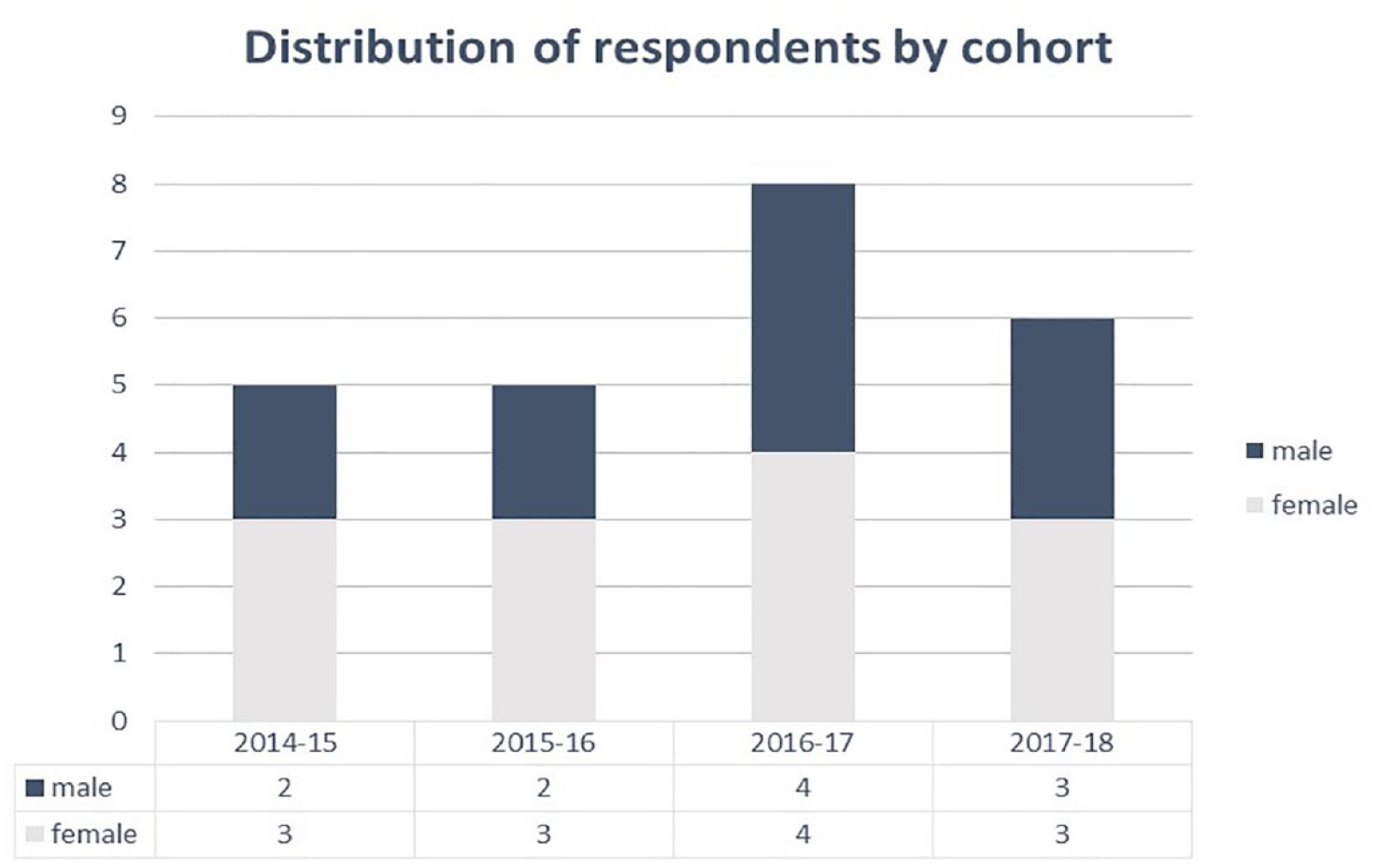
Sample for the study.
Data collection
We adopted a qualitative approach to the evaluation exercise to obviate some of the shortcomings of customary end-of-module, survey-based student teaching evaluation (Steyn et al., 2019). We wanted to dig deeper, despite (or possibly because of) having consistently received high student evaluations, with an average score of 4.87 out of 5 over the 4 years, with a maximum of 4.94/5.00 in 2016/17, based on a 56.7 percent response rate.
We based our interview protocol on Kirkpatrick’s (1979) evaluation model, a widely used approach for evaluating the results of training and learning programmes. This focuses on three aspects: ‘how well the students liked’ the module (Kirkpatrick, 1979: 78); how concepts, facts and techniques acquired during the educational activity are retained over time; and how the module produces long-lasting effects. We designed our model to allow us to answer our questions about whether and how structured shadowing adds value. 1 Kirkpatrick’s model also helps to address some known biases of immediate end-of-course student evaluations, which tend to capture satisfaction with the lecturers, their likability, and other personal aspects, rather than the value added by the course itself (Clayson, 2022; Clayson and Haley, 1990). Accordingly, having gained institutional ethical approval for our protocol, our open-ended questions covered the structured shadowing activity itself, insights derived from the module, including whether these challenged previous expectations, and the long-term effects of structured shadowing, if any. The interviews were conducted either face-to-face, or via phone or Skype. They lasted between 30 and 60 minutes, and all but two were conducted by the two authors/module leaders (further information below). All participants were promised anonymity and access to the results once analysed. No other inducements were used. All interviews were tape-recorded and transcribed professionally.
Analysis
Our analysis followed the ‘recursive, process-oriented, analytic procedure’ (Locke, 1996: 240) typical of robust interpretive research. Although we conducted a robust coding process supported using the Nvivo software, we did not use a rigid, proceduralist template like the so-called ‘Gioia method’ (Gioia et al., 2013), owing to increasing evidence that rigour is not necessarily linked to using templates (Pratt et al., 2022). In fact, some authors suggest that their rigid use may reduce, rather than enhance, the rigour of qualitative research, especially when conceived as substitutes for the deliberate reasoning process of inferring theoretical claims that lies at the core of interpretive research with formulaic steps (Harley and Cornelissen, 2022). Templates also implicitly suggest direct and univocal causal relationships between first- and second-order codes and aggregated theoretical dimensions. In reality, themes very often ‘bleed’ into each other, the same first-order codes may signify different constructs, and relationships between second-order codes and aggregate dimensions may be multiple. For example, in our case, nurturing of sensemaking capabilities is linked both to appreciating the complexities of management and modelling managers as reflective practitioners. These aspects are reflected in multiple relationships (arrows) between the second and third columns in our coding structure (Figure 2).
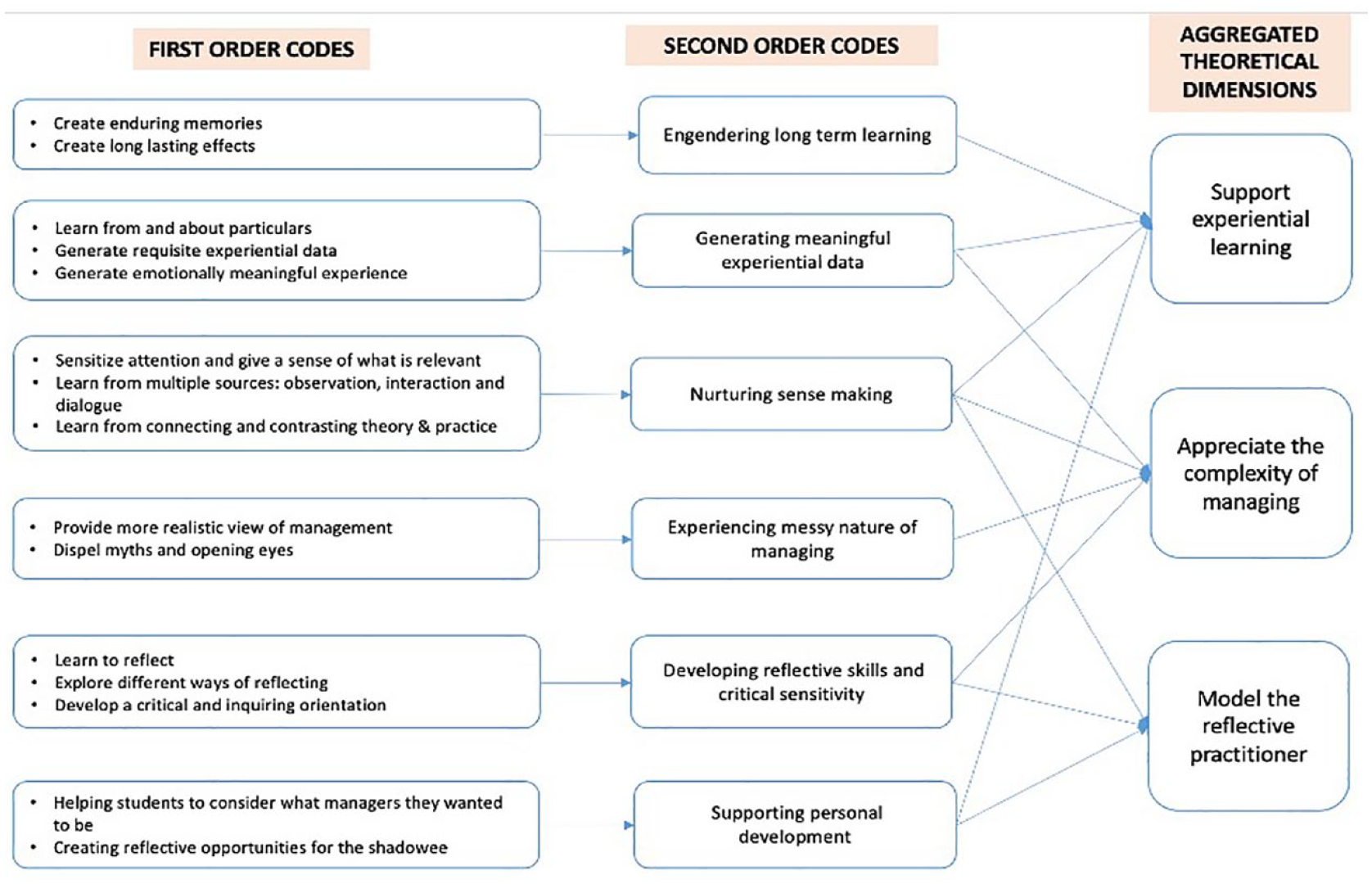
Coding structure.
We began our analysis with multiple readings of the transcripts to identify general themes. We met to discuss and compile a list of initial themes, and then coded the interviews line by line. When identifying first-order codes, we looked for distinct resonant insights which students highlighted as valuable, paying particular attention to language used. For instance, the first-order code ‘create long-lasting effects’ was initially termed as ‘still relevant today’, given multiple students mentioned some aspect still remained with them in their current jobs. Once we identified a number of references across students, we returned to the code and renamed it for greater clarity, as on secondary reading we detected that what they described was not just awareness, but impact on their practice, hence ‘effects’. We met regularly to discuss emerging coding, compare understandings, and jointly identify and resolve areas of conceptual confusion or disagreement. The coding structure continued to evolve until we were confident that it captured emerging theoretical relationships (see Figure 2). Representative quotes for first-order codes are summarized in Appendix 1.
Positionality, reflexive practices and possible limitations of the study
Evaluation activities always pose significant positioning challenges and require careful reflexive consideration (Van Draanen, 2017). This is even more true for teachers, who must traditionally juggle several potentially conflictual positions (Blasco et al., 2021). Given our dual roles as lecturers and evaluators, our evaluations would always raise challenges, ranging from recruitment of participants to the content of interviews. For example, who would accept our invitation, and would students tell us what they did not like, given that they knew how invested we were in this project? To circumvent some of these issues, we initially sought the help of a third person (an educational expert), who circulated a short survey, followed by a short interview with those who consented. This is a conventional practice when using structured approaches such as Kirkpatrick’s (1979) model. We reasoned that this would eliminate some potential sources of ‘bias’ arising from our positioning. However, the participation was disappointing, and on reviewing the transcripts, it became clear that students were producing very abstract responses, as the interviews lacked intimate knowledge of what had happened during the course. Therefore, we decided to switch to a full interpretive (‘qualitative’) mode. After reviewing the list of questions, we contacted the students directly and trialled the interviews ourselves. We obtained much richer accounts, and the students were happy to share information and examples on what they had liked and found valuable, and what they had not.
On reflection, an unexpected positive effect was derived from the potential limitation that our interviews were conducted a year after the conclusion of the last and thus 5 years after the first module iteration. The time lag certainly affected the vividness of the accounts (some students candidly told us that their memories were tentative and vague), yet it also put sufficient distance between the students and ourselves to reduce the effects of our previous relationships on the content of our conversations. We carried our reflexive stance into the analysis phase, when we used conversational ways to avoid ‘romanticizing’ our interpretation and story, for example, by questioning each other on whether the picture we were painting was a bit too ‘rosy’. We also deliberately tried to incorporate both positive and less enthusiastic feedback into the text, after explicitly encouraging students to share any negative feedback during the interviews. Of course, these issues, combined with the limited number of respondents and the associated risk of self-selection, are further limitations of our study and necessitate a cautious approach to the overall positive valence of our findings.
Findings: How structured shadowing makes a difference
Our analysis highlighted how our structured shadowing-based module had helped support students’ experiential learning, enabled them to appreciate the complexities of managing, and engendered reflective habits by modelling the reflective practitioner. Structured shadowing emerged as a critical, differentiating factor, confirming its value as a pedagogical approach. However, our analysis also revealed some notable boundary conditions and potential limitations, enabling a more realistic perspective on its usability and potential to make a difference.
Structured shadowing engenders long-term learning
For most students, the module created some enduring memories and vivid recollections. As Karl (2014/15; all names anonymized) shared: ‘A few things about the shadowing. . . They’ve sort of been etched in my memory’. Students explained this by referencing the course’s comparative uniqueness, given its interactive and experiential nature, and the shadowing itself. Others suggested that its memorable effects derived from the overall structure, although the shadowing clearly played a key role. Indeed, the module generated very positive short- and longer-term reactions: ‘Honestly, as I said, I’m not even just saying this because you bothered to ring me, but it was the highlight of my final year’ (John, 2016/17).
However, previous research has established that there is often no relationship between affective reactions and other types of learning (Alliger et al., 1997). Therefore, it was important that the module learning was still being used years later. Damian (2014/15) indicated that he had applied some of the managerial techniques he observed when he set up a start-up. Dorothy (2016/17) told us that before going into a client meeting, she would occasionally still ask herself, ‘how would [my shadowee] have acted in this circumstance?’ Mary (2017/18) said that she often ‘steps back’ during meetings and considers ‘what are the behaviours and relationships in the room’, which she learnt from the module. Others shared that how they used the learning was palpable but less specific. This included recognizing issues and becoming attentive. Although only one reported that the module had made them rethink their career, it had led to more realistic expectations of future managerial roles: ‘I didn’t have second thoughts [about becoming a manager]. However . . . those experiences just alarmed me, and made me realize that that’s what I’m going to have to put blocks against’ (Karl, 2014/15).
Structured shadowing generates meaningful experiential data
One of our aims was to encourage students to stay close to actual doings and sayings, and ground their reflections in concrete instances. This built on our research finding that, in managerial activity, paradigmatic differences between approaches, styles and orientations often hinge on mundane particulars (Korica et al., 2017; see also Shotter and Tsoukas, 2014). It was encouraging to find that this had been taken on board and that most students still recalled concrete examples. Dorothy (2016/17) had vivid memories of how her shadowee ‘completed her work and everything. . . and she didn’t portray it on her face’. Ben (2017/18) remembered a meeting when the manager had to tell a team that ‘if they didn’t do well in the next three months, she had to fire half of them’. Structured shadowing had thus allowed students to ground their reflections in concrete conduct in given situations, the type of granular detail that ‘is not possible to read in a paper or theory’ (Ben, 2017/18).
As previously discussed, the learning affordance of traditional shadowing is said to derive mainly from observation, mimesis and ‘being there’, as was true in our case: ‘Out of the classroom, I think, was the best classroom’ (Jo, 2017/18). However, our results indicate three equally important sources reflecting the specific nature of structured shadowing.
First, students reported that the shadowees were critical sources of information and understanding, an aspect we explicitly mentioned as helpful when setting up access. Some, albeit not all, managers had positioned themselves as interpreters of events and translators of observed complexity. For example, Danny’s (2014/15) manager gave him ‘a lot of advice, a lot of things to look out for, things to be aware of’. Holly’s manager ‘would talk to me about what he does, his view on managing people, etc’. Nelly (2014/15) described her manager as almost ‘a guide’.
A second notable source of learning was the other students. The course was designed so that students would compare notes during and at the end of observations. Our aim was to help them start to make sense of experience in dialogue. The students reported that this had indeed been effective. Comparing and contrasting had allowed them to access broader insights and nurture individual sensemaking by raising questions about similarities and differences: ‘not only did we get to talk about what we saw, but even understand what other people saw. So you get to learn from so many different managerial experiences and shadowing experiences’ (Karla, 2014/15). Not all students found this equally valuable. Some were more at ease reflecting individually and in writing, and found the conversations ‘superficial and puzzling’. Others showed up without re-reading their notes or preparing memos, thus limiting their learning. Inevitably, this reflects the required student effort, which we could not control.
The third notable source of learning was the constant effort to connect and contrast theory and practice, which was built into the architecture of the module. Specifically, we wanted students to learn by ‘connecting the dots’. From the initial lecture, students were constantly asked to establish connections between what they or others had observed and the theories they had learned during their degrees. This was also built into assessments: in both reflective essays and group presentations, students were asked to shift from the particular to the general, connecting theory and observations. For example, in the individual essay, students were asked ‘to focus and describe a particular event or challenge’, ‘bring in existing literature in order to better understand it’, and ‘discuss how the shadowing helps you answer your own questions regarding the chosen topic’ (from the module handbook, available on request).
Students told us that this back-and-forth movement successfully brought theoretical lessons to life. As Danny (2014/15) put it, ‘it was a very nice opportunity and break for us to apply what we were learning’. Nelly (2014/15) made an explicit connection: I agree with the fact that you need some theory, but at the end of the day it’s also the practice that showed me some insights, and I think that’s when you can draw a lot of theory from whilst there. So yes, it’s definitely good to have the theory and go into the field, and then reflect back on the theory.
However, making such connections was not necessarily easy. Some struggled to establish relationships, partly because they were not used to linking theory and activities. Others, perhaps conditioned by other modules emphasizing theory, remained more comfortable with abstraction. Some found the openness of the assignment, including the presentation, liberating yet challenging, partly because it was so different from the norm. Finally, some lamented that trying to derive meaningful connections in such a short period seemed somewhat artificial, especially if the experience had been less than ideal. In other words, the students reminded us that structured shadowing is a valuable tool, but not a panacea.
The evaluation study also corroborated our expectation that structured shadowing might be a source of emotionally rich experience and learning. For instance, one student had shadowed a manager grieving her husband, which they had not previously thought of as a challenge for management in practice. The potential effects of such powerful emotive experiences on students should be recognized and managed. For example, we shared specific directions beforehand, and students were also told where to find emotional support should they need it. Although none found themselves in extremely disturbing situations, their reports were strongly emotionally coloured, which may also explain their memory retention.
Structured shadowing’s capacity to allow students to reflect on emotions and behaviours was also reflected in their choice of essay topics, in which anger, calm, anxiety, discipline, self-assurance, burn-out and gender inequity figured prominently. Indeed, when asked to identify incidents that they considered meaningful, students followed emotional rather than ‘theoretical’ leads. This is an interesting finding, in that one might assume that their ‘on the fence’, observational position during shadowing might prevent them from appreciating the emotional dimension. In fact, the opposite seemed true. Unlike internships, shadowing allowed them to register behaviours and emotions without being overcome by them and their potential consequences, because ‘you don’t really have a stake in it’ (Jo, 2017/18).
Of course, this did not apply to everyone. Some students failed to engage and produced rather superficial accounts, and on one occasion a shadowee complained that the student had been visibly uninterested. Students also found themselves shadowing rather uneventful activities or struggled to connect emotionally, partly because they felt that the manager was presenting a ‘façade’. We suggested taking this as an aspect of managerial work on which to reflect critically (e.g. managerial work is sometimes boring; managers have to be inauthentic at times).
Structured shadowing nurtures sense making
Another aim of structured shadowing is to maximize the educational value of observations by helping students more critically perceive, aided by sensitizing, scholar-developed analytical foci (e.g. roles, identity). Although the academic theory was the least vividly remembered aspect for most students, some did use theoretical categories to make sense. For instance, for Karla (2014/15): The lectures actually really prepare you very well for what you are looking for, what you are trying to understand when you are shadowing. So it gives you the cues that you need to start looking for when you are sitting with the boss and just observing them.
The interviews also foregrounded the critical importance of our introduction to shadowing derived from our own (research) experience. Our guidance on how to take notes, engage with shadowees and deal with difficult situations helped reduce students’ anxiety and boost their confidence. Sharing our own field diaries was also appreciated, although we made clear that we did not expect them to collect material in the same level of detail as a seasoned researcher.
Some students also took very seriously our advice to prepare thoroughly. Many carried out extensive ‘intelligence’ work on the host companies, while others, like Holly, prepared an extended ‘cheat sheet’ that they used to guide the observations, a practice we encouraged. This is not to say that everything went smoothly. Many still reported having been anxious, disoriented, and uncertain, especially at the beginning of the shadowing: am I looking at the right thing; am I taking enough notes or the right ones? For some, there was also a discomfort arising from their positionality as shorter terms shadows who did not have the time to develop mutual trust and awareness with their shadowees (McDonald, 2019); as one student memorably put it, as a shadow you are ‘an outsider, basically, a stranger kind of creeping on you’. To ease such fears, we ran 2-hour ‘shadowing clinics’, which were open sessions to discuss emerging observations or pragmatic issues during that period. This included for instance reassurances about how their more junior student status might enable a distinct positionality to counter the limits of their shorter stays when it comes to building up trust. Specifically, managers might resultingly see them as unthreatening novices, making them more likely to share ‘back stage’ (Goffman, 1959) insights that their outsider, short-term ‘creeper’ status might otherwise discourage (McDonald, 2019) – as one of us previously experienced as well.
The other challenges most commonly reported were maintaining the role of an aspirationally detached observer, which Bobby (2016/17) described as ‘balancing being social and at the same time trying not to be too involved in things’, and dealing with uncommunicative managers. While the former is a well-known issue in observational research (Czarniawska, 2007; however, see Gill, 2011), the latter is less obvious. It highlights that students’ initiative is critical. Indeed, effective learning from shadowing requires students to act proactively, focus attention, ask questions and investigate their experiences, ‘do ask your manager ample questions if you don’t understand anything, and do ask the manager the back story of the whole scenario’ (Dorothy, 2016/17). However, preparation and proactive behaviours inevitably varied, despite our considerable efforts. For less engaged students, the shadowing may have been less meaningful: ‘the biggest thing I think [is] to get the biggest amount of learning from this course, you have to engage’ (Jo, 2017/18).
Structured shadowing helps experience the messiness of managing
Another aim was to provide a more realistic view of management through reflection on what students had learned in class and how managerial practice was manifested in actual settings. This was successful, as many reported that at the end of the course, they ‘definitely’ had ‘a better understanding of the nature of a manager’s job’ (Clare, 2015/16). Interestingly, some had been rather surprised by its ordinary nature: ‘it’s quite mundane!’ (Rowena, 2015/16). Luke (2015/16) confessed that he ‘didn’t really have much idea of how a manager filled their day 24/7’, while Milan’s (2014/15) assumption of a chief financial officer’s reality was directly challenged: ‘I had always imagined big offices’. Others foregrounded embodied and personal aspects. For Luke (2015/16), the most unexpected aspect was that everything impinged ‘on the personal level’, while for Karla (2014/15) ‘the biggest takeaway . . . was just how to interact with people . . . understand body language’.
As a result, structured shadowing also helped students to question common myths. For Nada (2015/16), this included bursting the bubble of the ‘romance of leadership’ (Meindl et al., 1985): ‘it just made me realize that being a leader doesn’t mean you come into a role and you know everything’. Jo (2017/18), like Clare (2015/16), found herself challenging generalist management: ‘There’s not only one way to manage. And I think that was the biggest learning for me’. Such reflections were particularly poignant for students with little prior work experience. Bobby (2016/17) told us that during the summer holidays he returned to his home country and worked in the family factory, so his only model of a manager had been his dad. Observing a very different manager in action had been a major eye-opener for him.
Structured shadowing develops reflective skills and critical sensitivity
Another aim of the module was to develop students’ reflective skills by modelling reflection in practice. Rather than teaching it as a standalone skill, we embedded it into the course design, by sharing our own shadowing experiences, asking the students to prepare memos, and our brief for the essays. This was based on our view of structured shadowing as including prospective, incidental and retrospective reflection. Our interviews with students indicated that this was reasonably successful. For example, the module had taught John (2016/17) ‘to think about things that had happened in my past, and things about my future as well, which I think is important’. Maria (2017/18) had also carried the reflective skills into her job: Stepping back and seeing the bigger picture, and just observing, like when you’re in a meeting, just sitting back and thinking of what are the relationships in the room, with the managers and the managers’ managers, and kind of seeing that – that’s definitely something from the course that I can still use today.
The module also successfully modelled different ways of reflecting, suggesting that this was not necessarily an individual introspective exercise. As noted above, some found reflecting by talking valuable, while others derived more benefit from writing and creative group presentations. Rowena (2015/16) stressed that writing had supported and cemented her sensemaking: ‘if the reflection is not done, I think a lot of things can get lost’. Ben (2017/18) identified ‘writing the memo [as] the most interesting thing . . . it helped me observe and get to conclusions on how the manager decided to do something, or whatever I had noted down in my diary’. Jo (2017/18) found the creative presentation most valuable, as it had allowed her to re-examine her case in a new light: ‘it made it come back to life’. Using a variety of modalities catered to different learning styles. For instance, Lydia (2016/17) was unconvinced of the value of the video dramatization: It’s a personal thing, but I reflect better when I’m writing. And that’s just from experience, that when you make a video, you focus more on editing the video and making it visually appealing than actually thinking about what’s in the video.
Structured shadowing was also helpful for developing a critical, inquisitive orientation, helping students ‘not [to take] things for granted, not just accepting how the situation seemed or was portrayed but questioning or evaluating such claims before deciding or acting’ (Mingers, 2000: 221). Using different voices, introducing critical authors, and constantly being invited to reflect on the shadowing to make connections between experience and past learning allowed students to develop this skill further. For instance, Rowena (2015/16) stressed its usefulness in helping her question motives and behaviour: It allowed me to understand why people take certain decisions; whereas I think, as a student, the experience is just missing, and it’s a bit seeing everything through rose-tinted glasses. . . So yes, I think it’s a sort of a constant looking at oneself, like reflecting if the decisions that have been made are the right ones.
In inviting students to ask themselves ‘how can it be otherwise?’, the module also facilitated suspension of judgement. The non-participant position was particularly beneficial here. As Rowena (2015–16) recalled, ‘at the time that was like “oh, I wouldn’t have done it that way”’. For Nelly (2014/15), the key lesson was to ‘always approach a conversation knowing that you are an educated, critical thinker . . . This is a line that really stuck in my mind’.
Structured shadowing supports personal development
Finally, by allowing students to observe and appreciate things from managers’ perspectives, structured shadowing offered them a potential role model with whom to compare themselves in their initial efforts to define what kind of manager they might wish to be, thus experimenting with provisional selves. As Nelly (2014/15) put it, ‘especially in your final year, it’s good to see a style of leadership that you can sort of aspire to and also take things from as well’. Nada (2015/16) was especially encouraged by observing a positive female leadership figure: ‘I think seeing a female leader that was empathetic and able . . . it was very good. And I don’t think you often see that’. While some derived inspiration, for others, this was a chance for self-reflection on their present and future selves. As Jo (2017/18) put it: I learned from them that I could reflect actually, yes, what does annoy me? What doesn’t work for me? What does? If I were to be a manager and I was under this much pressure or had all of these distractions, what would be the best way for me to function and actually be the best manager I could be? Or just the best employee I could be?
Some students told us that being exposed to different ways of managing had affected their personal development well after the end of the module, especially when transitioning into managerial positions: I used to see my dad working in a very different kind of manner. And I’d only seen that manner of working, so I was only used to that type of management . . . and the things [my shadowee] taught me about management in the UK, and how I used to compare it from India, was like great! (Bobby, 2016/17)
Others told us that they had returned to the module content when reflecting on current challenges: Even going forward to today, it’s definitely made me rethink the way I approach people, or that people need to be handled in different ways. And that’s kind of what came across in the module, that there are . . . many different ways of management, in practice and in real life. And I think it’s about moulding yourself to that. So I think even today it’s very relevant. (John, 2016/17)
Discussion
Our evaluation interviews with past students helped to shed light on the affordances of structured shadowing and foreground some of its longer-term positive effects. We argue that this is because it is a pedagogy that combines method (shadowing) with a distinct aim (developing students’ practices of wisdom towards becoming critically reflective managers), epistemology (student-led experiential learning), content (studies problematizing a-contextual, technical management knowledge) and support structures (the format of lectures, shadowing clinics, reflective/dramaturgical assessments, allocation of managers). In short, spending time in a workplace haphazardly watching what practitioners do is insufficient.
As summarized in Figure 3, structured shadowing, with its mutually reinforcing features, helped facilitate the students’ experiential learning, their appreciation of the complexity of management, and their reflective habits by modelling the reflective practitioner, some of which they retained going forward, giving a distinct answer to the questions we posed at the start: is our teaching relevant, what management do we teach and how do we teach it.
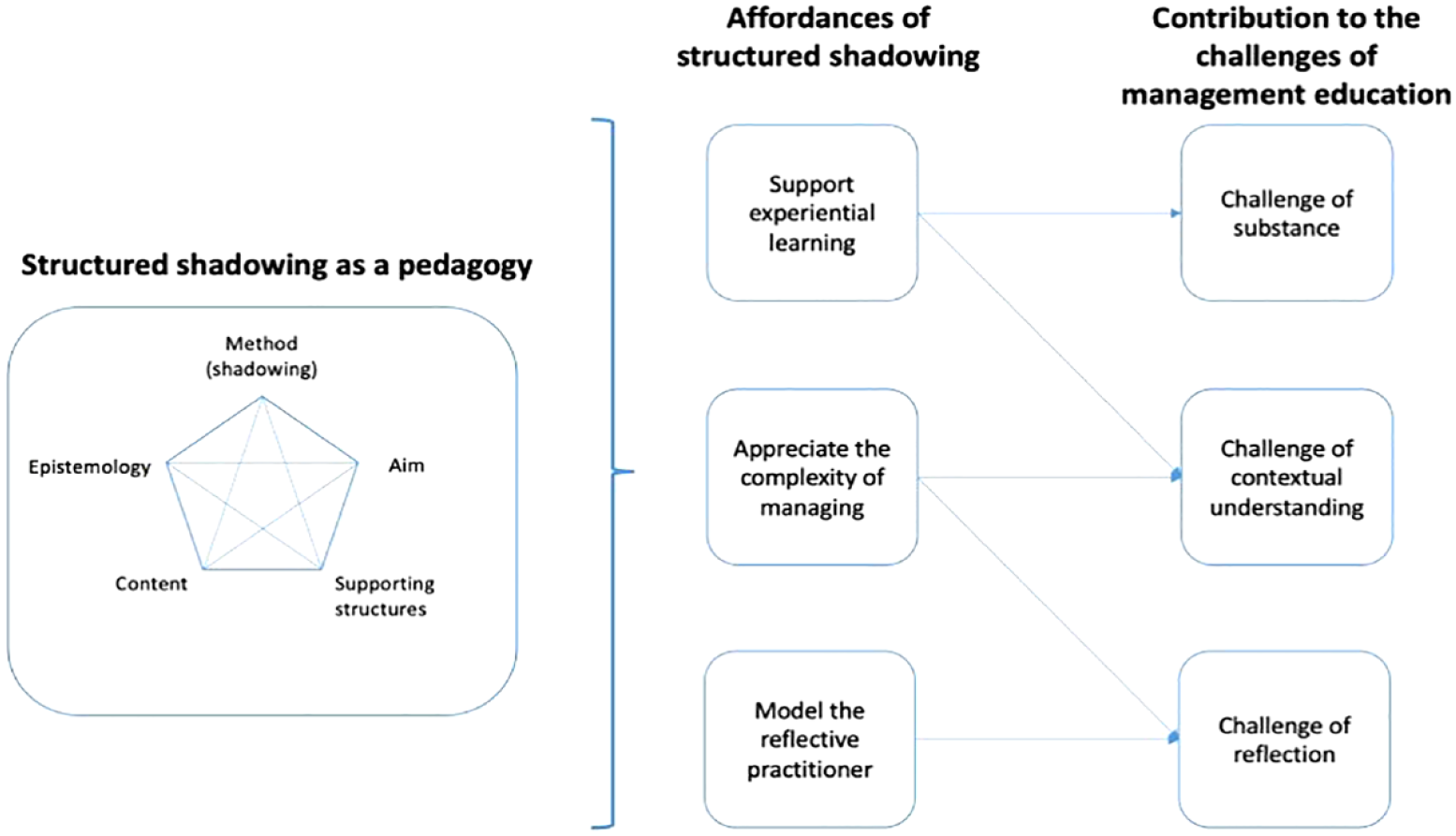
Affordances of structured shadowing and its contribution to management education.
Specifically, the actual shadowing activity appears to uniquely position learners in situated proximity with the core of the action and allows them to experience activities in their sensorial and affective dimensions. This generates experiential and emotionally meaningful materials that can then become the focus of reflective activity to produce learning which, according to our students, may be enduring. Our students recognized that the lectures, which provided sensitizing conceptual categories through critical examination of previous observational studies of managing (content), enhanced their capacity to ‘perceive’ during their shadowing (method) and gain meaningful experiential insights. Although appreciating the messiness of managing is key to the proposed pedagogy, as it helps to dispel unhelpful myths and idealized images of what managers do, the support structures built around the observation (both preparatory and reflective work) help students to cope with this complexity both cognitively and emotionally, before, during and after the shadowing itself.
The structured nature of the activity also seemed to help students to adopt a (nascent) critical stance: our students learned to see what the managers did and interrogate what they saw, thus preventing (or at least mitigating) the dangers of acritical mimesis associated with unstructured shadowing (Goodwin, 1994). This clearly reinforces the aim of structured shadowing to develop practices of wisdom towards becoming critically reflective managers, and also echoes a student-led experiential epistemology.
The critical sensemaking process is further nurtured by comparing and contrasting sources of meaning (theory and practice, students and tutors, self, and others) and using multiple expressive media (diaries, dialogue, drama), which may each appeal differently. This combination enables emotionally resonant learning, where nuances of managers’ context and humanity can be observed and made sense of in ways that resonate now and in the future. Importantly, the process, as a planned combination of prospective, incidental, dialogical and retrospective forms of reflection (Boud et al., 1985; Cunliffe, 2002; Vince, 2002), constitutes a model for becoming a reflective practitioner and developing reflective habits.
The outcomes of our evaluation study speak to the potential usefulness and applicability of structured shadowing within the current institutional and practical conditions of business school-based management learning and education. A persistent issue for experientially oriented educators is to combine going beyond the classroom with students’ concurrent commitments, including other classes and duties. Our students’ accounts suggest that, despite the short shadowing period necessitated partly by such commitments, structured shadowing enabled them to access sufficiently detailed experiential material to subsequently elaborate through reflective activities. Most suggested that the three days to a full working week was ‘just enough’. Students who shadowed for a shorter period found it too short; others stressed that a longer period would create problems elsewhere. The pedagogical approach thus constitutes a workable balance between time restrictions arising from students’ broader degree courses and the benefits of experiencing everyday managerial work.
Our study also reveals the potentially meaningful contribution of structured shadowing vis-à-vis the three broader challenges of substance, contextual understanding and reflection that we identified in today’s management education, especially for pre-experience students. As previously discussed, the intersection of these three broader challenges results in educational interventions that are too often divorced from the lived dynamics of workplaces, resulting in failure to appreciate how work happens in context, and insufficient reflection to translate generalized (including theory-centred) insights into personally meaningful learning. These represent a particular version of ‘surface learning’ (Entwistle, 2000), focused on memorizing material obtained through teacher-centred classroom interventions, from which critical reflection is largely absent. Necessary correctives to this approach involve ‘deep learning’, with ‘students drawing on personal experience and course material to create new meaning for themselves’ (Dyer and Hurd, 2016: 289). This includes locating and linking theoretical classroom material with contextualized spaces, discussion-based pedagogies focused on facilitating students’ development of new and potentially challenging insights, and reflective assessments centred around enabling personal meaning making. It is also important to give room for emotional responses to experiences, and reflection and dialogue to make sense of these differently (Cunliffe, 2002; Reynolds and Vince, 2020). Structured shadowing, as we conceive it and our students experienced it, offers at least some of these correctives, making it a critical, experientially rich pedagogy to enable better contextual understanding of managerial work, and contributing to reflection as an action-based, habit-building practice.
However, structured shadowing also has limitations. First, our student interviews reveal that it may facilitate ‘deep’ learning but cannot ensure it. Students’ own views will influence the extent to which ‘deep’ or ‘surface’ learning is practised, as will other priorities and educational trajectories. A uniform approach is no guarantee (Dyer and Hurd, 2016). Structured shadowing is thus not a panacea. Second, it takes time to develop reflexivity (Epp, 2008). Some students reported utilizing reflective habits learned in the module years earlier. A minority struggled to identify any reflexivity. We can speculate on what combination facilitated this, such as students’ receptivity to shadowing, emotionally resonant experiences linking with students’ development concerns, or passion for an essay topic, but students’ differing experiences prevent us from claiming more. Transformative learning from contradictory experiences, which prompts meaningful reflection, necessarily depends on personal biography. This is partly because one module alone cannot counter the entirety of students’ education and normalized habits, although it may be valuable precisely because it is unique (Mavin et al., 2023). Thus, in evaluating the longer-term impact of pedagogical methodologies, explicitly considering each student’s educational path up to that point may be highly relevant. We did not do so in our evaluation, representing an important avenue for future research.
Implications for educators
It is equally important to acknowledge practical considerations that may impact on the possibility for and nature of structured shadowing take-up. First, the module demanded considerable personal and institutional investment. This included beginning to recruit managers in October for a January start, reaching out to managers, convincing them, allocating students given their manager preferences (if any), dealing with dropouts, maintaining communication during shadowing, dealing with a large volume of email communication, meeting with students, addressing issues and organizing a 4-hour free manager feedback session in May. Considerable investments of effort and time were also required during the module to deal with the (few) students who failed to engage in the activity and with (rare) situations in which students might be negatively affected by circumstances they encountered while shadowing. We did so mainly by convincing the managers to adopt a ‘pedagogic stance’, and by discussing, agreeing and collaboratively implementing remedial strategies. This allowed us to address some of the cases and to facilitate continued involvement. In fact, managers complimented us on our efforts, even when the outcomes were less than ideal. We also decided to co-teach the whole course, even though we received credit only for the sessions we led. In our interviews, students often stressed that the uniqueness of two close collaborators teaching together was valuable precisely because it was so rare.
However, it did require additional effort, which we acknowledge we could afford to give, albeit to the potential detriment of other priorities. For example, one of the authors, an early tenure-track faculty member at the time, was often told, even by senior colleagues, to care less about teaching. Thus, the personal and professional costs of making such choices should not be underestimated (e.g. Korica, 2022). They also explain in part our decision to develop structured shadowing as solely a pedagogy, rather than experiment further, for instance by involving students as equal research partners in a co-created study based on their observations. Though this would bring challenges of its own, it also represents a potentially generative addition to existing scholarship on shadowing as a research method, for instance, by addressing the challenges of single shadow multi-sited studies through the inclusion of many (student) shadows (see Van Duijn, 2020), possibly following the same ‘semi-structured’ script to enable comparisons (Sirris et al., 2022).
Second, and relatedly, the course featured inevitable trade-offs. For instance, the 10-week term (with an institutional expectation of 27 hours of teaching) and our insistence on distinct support structures and assessments meant that we had to keep lectures to 2 hours, which limited both the theoretical content and our shadowing pre-guidance, although we spent considerable time supporting students outside of class. The schedule was inevitably packed, and we occasionally felt, and students fed back, that we could have gone much deeper into certain aspects given more time. Similarly, while our openness regarding the focus of assignments was methodologically purposeful, we could not ensure that they would be as critically reflective as desired.
Finally, the course reflected our position as scholars, both personal and institutional. For one thing, we were faculty in a well-funded business school with considerable teaching freedom. This meant that we could teach together, and the programme supported students’ travel costs and managers’ feedback session costs. We also had access to colleagues expert in dramaturgical techniques. Without this, the module as it was would have been impossible.
In addition, we were able to limit numbers to a maximum of 32. If we were to teach the module again today (it is currently paused), it would have to run with a minimum of 50 students owing to institutional requirements introduced amid rising student numbers. This would inevitably bring further work, and might well be impossible for us to manage alone as expected. We also had considerable experience of shadowing managers, had published on managerial work, and were experienced, interactive teachers. This made us comfortable and credible in front of students, which was significant given that the course was unique. Finally, although we attracted a number of motivated high-achievers, the students who took the module were self-selected. This meant that we could not remove students who would not invest as necessary.
Conclusion
It is often said that the most powerful tools are the simplest. Shadowing is a case in point. In this article, we argue that when engaged as a pedagogy, structured shadowing may be especially helpful in moving management education towards a broader mission of developing wisdom and a critical orientation, rather than instrumental, non-critical acquisition of a-contextual content and functional skills. The strength of structured shadowing is that it can produce all of this while building on a generally recognized and accepted activity. To support this, we outline the principles of structured shadowing as a student-centred approach, and show how it contributes to developing students as critically reflective future managers. We fully recognize that this pedagogy has limitations, including considerable practical investment, reliance on student effort and inability to ensure that ‘deep learning’ actually occurs. Nevertheless, it also promises to address – meaningfully, if not exclusively – management education’s central challenges today, notably overly detached pedagogies and a-contextual, non-reflexive learning. The scale, impact and continued relevance of these challenges and our detailed guidance make it worthwhile to try it out.
Footnotes
Appendix
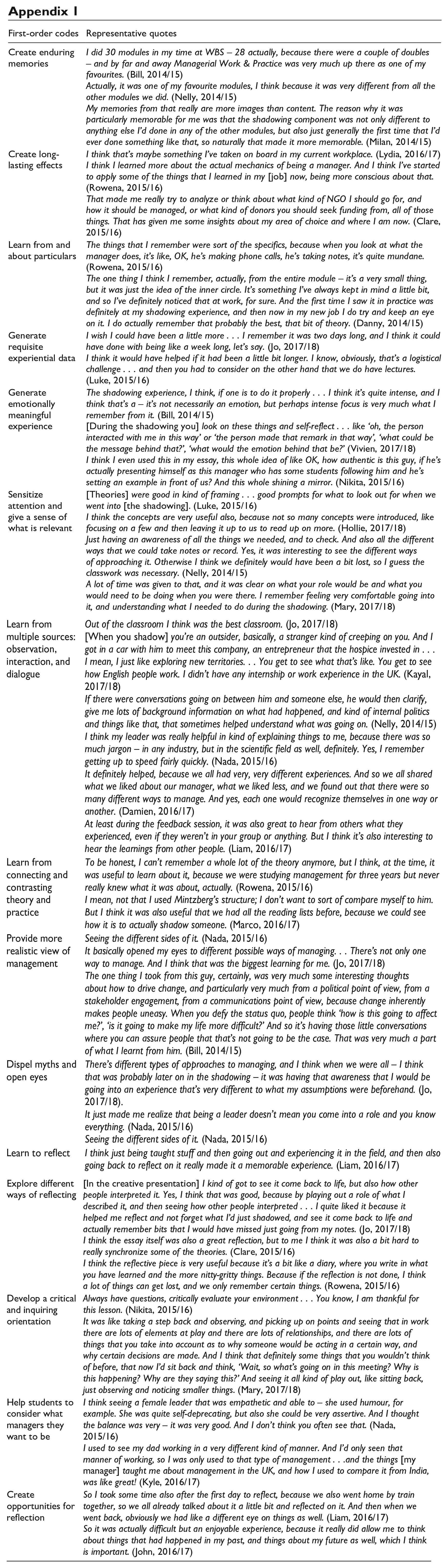
| First-order codes | Representative quotes |
|---|---|
| Create enduring memories | I did 30 modules in my time at WBS – 28 actually, because there were a couple of doubles – and by far and away Managerial Work & Practice was very much up there as one of my favourites. (Bill, 2014/15) Actually, it was one of my favourite modules, I think because it was very different from all the other modules we did. (Nelly, 2014/15) My memories from that really are more images than content. The reason why it was particularly memorable for me was that the shadowing component was not only different to anything else I’d done in any of the other modules, but also just generally the first time that I’d ever done something like that, so naturally that made it more memorable. (Milan, 2014/15) |
| Create long-lasting effects | I think that’s maybe something I’ve taken on board in my current workplace. (Lydia, 2016/17) I think I learned more about the actual mechanics of being a manager. And I think I’ve started to apply some of the things that I learned in my [job] now, being more conscious about that. (Rowena, 2015/16) That made me really try to analyze or think about what kind of NGO I should go for, and how it should be managed, or what kind of donors you should seek funding from, all of those things. That has given me some insights about my area of choice and where I am now. (Clare, 2015/16) |
| Learn from and about particulars | The things that I remember were sort of the specifics, because when you look at what the manager does, it’s like, OK, he’s making phone calls, he’s taking notes, it’s quite mundane. (Rowena, 2015/16) The one thing I think I remember, actually, from the entire module – it’s a very small thing, but it was just the idea of the inner circle. It’s something I’ve always kept in mind a little bit, and so I’ve definitely noticed that at work, for sure. And the first time I saw it in practice was definitely at my shadowing experience, and then now in my new job I do try and keep an eye on it. I do actually remember that probably the best, that bit of theory. (Danny, 2014/15) |
| Generate requisite experiential data | I wish I could have been a little more . . . I remember it was two days long, and I think it could have done with being like a week long, let’s say. (Jo, 2017/18) I think it would have helped if it had been a little bit longer. I know, obviously, that’s a logistical challenge . . . and then you had to consider on the other hand that we do have lectures. (Luke, 2015/16) |
| Generate emotionally meaningful experience | The shadowing experience, I think, if one is to do it properly . . . I think it’s quite intense, and I think that’s a – it’s not necessarily an emotion, but perhaps intense focus is very much what I remember from it. (Bill, 2014/15) [During the shadowing you] look on these things and self-reflect . . . like ‘oh, the person interacted with me in this way’ or ‘the person made that remark in that way’, ‘what could be the message behind that?’, ‘what would the emotion behind that be?’ (Vivien, 2017/18) I think I even used this in my essay, this whole idea of like OK, how authentic is this guy, if he’s actually presenting himself as this manager who has some students following him and he’s setting an example in front of us? And this whole shining a mirror. (Nikita, 2015/16) |
| Sensitize attention and give a sense of what is relevant | [Theories] were good in kind of framing . . . good prompts for what to look out for when we went into [the shadowing]. (Luke, 2015/16) I think the concepts are very useful also, because not so many concepts were introduced, like focusing on a few and then leaving it up to us to read up on more. (Hollie, 2017/18) Just having an awareness of all the things we needed, and to check. And also all the different ways that we could take notes or record. Yes, it was interesting to see the different ways of approaching it. Otherwise I think we definitely would have been a bit lost, so I guess the classwork was necessary. (Nelly, 2014/15) A lot of time was given to that, and it was clear on what your role would be and what you would need to be doing when you were there. I remember feeling very comfortable going into it, and understanding what I needed to do during the shadowing. (Mary, 2017/18) |
| Learn from multiple sources: observation, interaction, and dialogue | Out of the classroom I think was the best classroom. (Jo, 2017/18) [When you shadow] you’re an outsider, basically, a stranger kind of creeping on you. And I got in a car with him to meet this company, an entrepreneur that the hospice invested in . . . I mean, I just like exploring new territories. . . You get to see what that’s like. You get to see how English people work. I didn’t have any internship or work experience in the UK. (Kayal, 2017/18) If there were conversations going on between him and someone else, he would then clarify, give me lots of background information on what had happened, and kind of internal politics and things like that, that sometimes helped understand what was going on. (Nelly, 2014/15) I think my leader was really helpful in kind of explaining things to me, because there was so much jargon – in any industry, but in the scientific field as well, definitely. Yes, I remember getting up to speed fairly quickly. (Nada, 2015/16) It definitely helped, because we all had very, very different experiences. And so we all shared what we liked about our manager, what we liked less, and we found out that there were so many different ways to manage. And yes, each one would recognize themselves in one way or another. (Damien, 2016/17) At least during the feedback session, it was also great to hear from others what they experienced, even if they weren’t in your group or anything. But I think it’s also interesting to hear the learnings from other people. (Liam, 2016/17) |
| Learn from connecting and contrasting theory and practice | To be honest, I can’t remember a whole lot of the theory anymore, but I think, at the time, it was useful to learn about it, because we were studying management for three years but never really knew what it was about, actually. (Rowena, 2015/16) I mean, not that I used Mintzberg’s structure; I don’t want to sort of compare myself to him. But I think it was also useful that we had all the reading lists before, because we could see how it is to actually shadow someone. (Marco, 2016/17) |
| Provide more realistic view of management | Seeing the different sides of it. (Nada, 2015/16) It basically opened my eyes to different possible ways of managing. . . There’s not only one way to manage. And I think that was the biggest learning for me. (Jo, 2017/18) The one thing I took from this guy, certainly, was very much some interesting thoughts about how to drive change, and particularly very much from a political point of view, from a stakeholder engagement, from a communications point of view, because change inherently makes people uneasy. When you defy the status quo, people think ‘how is this going to affect me?’, ‘is it going to make my life more difficult?’ And so it’s having those little conversations where you can assure people that that’s not going to be the case. That was very much a part of what I learnt from him. (Bill, 2014/15) |
| Dispel myths and open eyes | There’s different types of approaches to managing, and I think when we were all – I think that was probably later on in the shadowing – it was having that awareness that I would be going into an experience that’s very different to what my assumptions were beforehand. (Jo, 2017/18). It just made me realize that being a leader doesn’t mean you come into a role and you know everything. (Nada, 2015/16) Seeing the different sides of it. (Nada, 2015/16) |
| Learn to reflect | I think just being taught stuff and then going out and experiencing it in the field, and then also going back to reflect on it really made it a memorable experience. (Liam, 2016/17) |
| Explore different ways of reflecting | [In the creative presentation] I kind of got to see it come back to life, but also how other people interpreted it. Yes, I think that was good, because by playing out a role of what I described it, and then seeing how other people interpreted . . . I quite liked it because it helped me reflect and not forget what I’d just shadowed, and see it come back to life and actually remember bits that I would have missed just going from my notes. (Jo, 2017/18) I think the essay itself was also a great reflection, but to me I think it was also a bit hard to really synchronize some of the theories. (Clare, 2015/16) I think the reflective piece is very useful because it’s a bit like a diary, where you write in what you have learned and the more nitty-gritty things. Because if the reflection is not done, I think a lot of things can get lost, and we only remember certain things. (Rowena, 2015/16) |
| Develop a critical and inquiring orientation | Always have questions, critically evaluate your environment . . . You know, I am thankful for this lesson. (Nikita, 2015/16) It was like taking a step back and observing, and picking up on points and seeing that in work there are lots of elements at play and there are lots of relationships, and there are lots of things that you take into account as to why someone would be acting in a certain way, and why certain decisions are made. And I think that definitely some things that you wouldn’t think of before, that now I’d sit back and think, ‘Wait, so what’s going on in this meeting? Why is this happening? Why are they saying this?’ And seeing it all kind of play out, like sitting back, just observing and noticing smaller things. (Mary, 2017/18) |
| Help students to consider what managers they want to be | I think seeing a female leader that was empathetic and able to – she used humour, for example. She was quite self-deprecating, but also she could be very assertive. And I thought the balance was very – it was very good. And I don’t think you often see that. (Nada, 2015/16) I used to see my dad working in a very different kind of manner. And I’d only seen that manner of working, so I was only used to that type of management . . .and the things [my manager] taught me about management in the UK, and how I used to compare it from India, was like great! (Kyle, 2016/17) |
| Create opportunities for reflection | So I took some time also after the first day to reflect, because we also went home by train together, so we all already talked about it a little bit and reflected on it. And then when we went back, obviously we had like a different eye on things as well. (Liam, 2016/17) So it was actually difficult but an enjoyable experience, because it really did allow me to think about things that had happened in my past, and things about my future as well, which I think is important. (John, 2016/17) |
Funding
The author(s) received no financial support for the research, authorship, and/or publication of this article.
