




Abstract
Management education is a storytelling endeavor. The stories told in case studies and textbooks often follow a hero narrative, where a manager or organization triumphs against the odds. However, this essay argues the structure of hero narratives removes complexity and disconfirming information, therefore failing to prepare students for workplace realities. I therefore explore possibilities of a form of story first developed in medieval Spain, known as the picaresque, as a pedagogical tool for management education. By comparing and contrasting hero and picaresque stories of Steve Jobs at Pixar Animation, I show how the picaresque presents a nonlinear and fragmented portrait of life in organizations, offering management educators a pedagogical tool for developing critical thinking skills and exploring the complex and ambiguous nature of life in organizations.
Management education can be seen as a storytelling endeavor (Nesteruk, 2015). The stories we use in textbooks and case studies typically follow a hero narrative type, where the protagonist is jolted from their ordinary world by an inciting incident to engage in adventures which establish them as morally good and successful actors (Rostron, 2022). In management education, heroic tales are told of businesses and their leaders, fitting a pedagogical model which presents students with “scripts and staging instructions for future performances” (Czarniawska-Joerges, 1997, p. 20). However, hero stories also have a shadow side. By forcing their content into a coherent beginning, middle, and end, they create assumptions, silences, and exclusions which sell a central vision, or a propaganda (Boje, 2001). The result is monologues which strip away complexity of the modern organization (Boje, 2008). It is therefore important for management education to create better fictions for teaching our students (Starkey et al., 2019).
This essay argues for the pedagogical promise of a form of narrative defined by Russian semiologist, Bakhtin (1986) as the picaresque story. Picaresque stories emerged in 16th century Spain, most notably evidenced in Don Quixote (de Cervantes, 1605) but also feature in contemporary western entertainment through characters such as George Costanza (David et al., 1989–1998), and Homer Simpson (Brooks et al., 1989-current). Unlike hero stories, picaresque stories typically present their protagonist as a socially marginalized outsider who challenges the lines and demarcations of society (Moenandar, 2017). While the hero is born into a world that seems to have been waiting for them, the picaro emerges into a world which is indifferent to their existence (Alter, 1964). Leveraging themes of the absurd, grotesque, and satirical, the picaro engages in adventures designed to illustrate inhumane and immoral aspects of society (Crittenden, 2004). Picaros do not often undertake the character metamorphosis which typifies the hero (Allison & Goethals, 2014), and they do not always emerge victorious from their encounters. Instead, they engage in a dream which is “more or less fulfilled” (Guillén, 2015, p. 73). Such contrasts with hero stories suggest picaresque stories can represent useful pedagogical tools for exploring the complexities of organizational life and create more realistic future performance scripts in the minds of key audiences.
This essay presents hero and picaresque stories of Steve Jobs as CEO of Pixar Animation. I show how grotesque, absurd, and satirical themes in picaresque stories provide disconfirming information to undermine certainty and provoke critical thinking skills in students. I also illustrate how the episodic progression of picaresque stories with its limited links between structural elements reflects the nonlinear, fragmented, and collective nature of stories in organizations to better prepare students for the confusing nature of workplace problems they will encounter.
The paper proceeds as follows. First, I discuss stories as pedagogical tools. I outline the hero story as the most prominent form of story in management education. However, I also identify how the reduced complexity inherent to the structure of the hero story might lead to pedagogical challenges in developing student skills in critical thinking and fail to prepare them for the ambiguous nature of workplace challenges. I then introduce the picaresque story and identify attributes of its structure which offer promise in meeting these pedagogical challenges. Next, I present a hero story and a picaresque story of Steve Jobs and his time at Pixar Animation. Comparing the form of these two stories, I contrast to show key characteristics of hero and picaresque stories. I conclude by discussing how management educators might leverage the promise of picaresque stories as a pedagogical tool and provide examples of how the genre might augment course syllabuses and learning of key topics.
Stories in Management Education
Learning in management education is often pursued by prompting students to think through stories which provoke their imagination and place them vicariously in the action (Colby et al., 2011). Research suggests three main reasons educators use stories in their teaching. First, stories are important to educational endeavors because they help us make sense of organizations (Savage et al., 2018). From a pedagogical perspective, stories have been shown as intertextual arenas which enable theories of organization to come to life (Rhodes & Brown, 2005). In this way, stories may stimulate different and more imaginative ways of learning about organizations (Alvarez & Merchan, 1992). By bringing organizations to life for students who may have no direct experience with work, stories therefore provide students with scripts for navigating their future performance (Czarniawska-Joerges, 1997).
Second, by challenging beliefs and unspoken assumptions, stories can encourage student skills in critical thinking (Stepanovich, 2009). Because stories represent struggles for meaning and to be heard (Brown et al., 2009) they can prompt the search for confirming and disconfirming information on which critical thinking rests (Powley & Taylor, 2014). Stories are therefore useful ways of learning how to engage in critical thinking because they enable us to contest meaning (Gabriel, 2015). Stories have been shown to help managers develop new understandings and insights because they undermine the certainty of a manager’s knowledge (Gold et al., 2002). Similarly, educators have used stories to generate critical thinking in their students. For example, Stepanovich (2009) details the Lobster Tale, a fictional story about the lobster industry designed to challenge student perceptions of economic assumptions and globalization.
Third, stories enable individuals to engage in identity formation, both for understanding themselves and as a rhetorical tool for constructing organizational identity. Hence, interest in founding stories as a construct for influencing organizational identity formation (Basque & Langley, 2018), and in organizational stories for assisting members understand who they are (Hatch & Schulz, 2002). Stories facilitate sensemaking by assisting individuals and managers to engage in identity formation (Myers, 2022). Because they can be molded to persuade key audiences, stories enable individuals to communicate their identities to others and rearrange them within larger narratives of organizational identity (Gabriel, 2015). In management education, the sensemaking characteristic of an individual’s own story has been used to assist students generate leadership stories for explaining their past decisions and generating future goals (Clapp-Smith et al., 2019), and in opening challenging conversations around diversity, equity, and inclusion (Lo, 2023).
Management education journals are filled with stories designed to prompt improved student learning, including fables (Short & Ketchen, 2005), Native American stories (Verbos et al., 2011), children’s stories (Billsberry & Gilbert, 2008), and biblical stories (Boozer, 1990). However, pedagogical tools such as textbooks, case studies, and lectures can also be considered as stories. For example, Odiorne (1976) identifies features of the lecture which bear similarity to stories, such as its role as a tool of persuasion and the inclusion of obstacles to avoid. Meanwhile, Gabriel (2019) explores similarities between case studies and stories, noting their shared structures of interwoven actions and events which are structured into beginnings, middles, and ends.
Management education typically leverages a hero story, as evidenced in case studies which present the organization and its leaders struggling for survival in quests and trials against life-destroying forces (Kostera, 2008). The prevalence of this form of story in management education is evidenced in textbooks. For example, case studies published in the first two chapters of the Strategy: Theory and Practice textbook (Clegg et al., 2020) represent either a hero-style narrative of success against challenges posed by fickle customers and ferocious competitors (e.g., Zara, Shabby Chic, and Ikea), or pose questions on strategy to prompt students on how they might heroically rescue a fallen company (e.g., Marks and Spencer).
Hero stories represent a long-standing tradition in western literature, often traced back to Homer’s The Odyssey (Crane, 1987) and serve as a staple of Hollywood movies, tv shows, and literature. As Mitroff and Kilman (1975, p. 18) note, organizational stories outline the life of the organization and the individuals within it in “a form strikingly similar to the great epic myths of the past.” Meanwhile, Rostron (2022) argues managers often construct themselves as the hero of their own story, and Allison and Goethals (2014, p. 167) note the identity formation aspect of hero story structures in being leveraged “to forge great leadership in eternity.”
Adopting a structure often known as Freytag’s pyramid, the trajectory of a hero story is: (1) the protagonist faces an ordeal (exposition-inciting moment); (2) the hero then encounters a series of trials (complication-rising action); (3) there is a climax-turning point where the drama is at its highest point; (4) there is a reversal-falling action, where the conflict unravels and the hero succeeds; and (5) there is a denouement or moment of release, where a resolution is established (c.f. Boje, 2008; Srivastava et al., 2023). Campbell (1949) summarizes this arc as one where an ordinary person leaves their familiar world, engages in a journey of personal discovery and transformation to overcome any personal shortcomings, triumphs over their challenges, and returns to their community.
Hero stories are popular in management education for several reasons. First, they expand our sense of what is possible and encourage students to see new ways of meeting challenging circumstances (Meisel & Mirchandani, 2024). Second, hero stories attempt to invite students into a dialogue by engaging them in tales which are direct and vivid and make a point (Gabriel, 2019). Finally, the social context of hero stories is set within a moral landscape which enables the reader to construct understanding of what it means to act well (Rostron, 2022). Reflecting on benefits of hero stories, Allison and Goethals (2014) declare that these tales fulfill important cognitive and emotional needs, such as our need for wisdom, meaning, hope, inspiration, and growth.
However, our argument is that while the Freytag Structure is useful for motivating student learning, it may also create pedagogical challenges. Through their beginning, middle, and end (BME) trajectory, hero stories remove any struggle for meaning (Brown et al., 2009) and present a one-sided stability and structure (Boje, 2001). This approach creates a tendency to discuss organizations and their leaders in overblown and remarkable ways (Alvesson & Gabriel, 2016). The structure also serves to remove much of the incompleteness which draws readers into dyadic and dynamic interaction with a story (Bathurst & Chrystall, 2019).
The pedagogical risk of the hero story is therefore that it strips away contradictory material by which students might generate questions and enables them to slip into a passivity which is antithetical to critical thinking (Powley & Taylor, 2014). Such tendencies can even lead hero stories to turn into propaganda (Boje, 2001). For example, management education textbooks have been shown to reproduce a Cold War narrative of US supremacy which delegitimizes noncapitalist forms of organization (Foster et al., 2014), while successful textbook authors acknowledge their content supports a managerialist ideology based on efficiency and productivity (Cameron et al., 2003).
The BME process of marginalizing and excluding contradictory accounts also has the pedagogical effect of overlooking much of the complexity which characterizes stories in organizations. While Boje (1991) illustrates how organizational stories engage multiple voices in conversation who extend and interrupt that which is being said, the typical BME structure presents a univocal perspective, which can often slip into patriarchal, masculine, rational, and purposive stories without alternative perspectives (Boje, 2014). While storytelling research recognizes the stories told in organizations are nonlinear, fragmented, and collective (Brown et al., 2009), the reductionist nature of hero stories serves to strip them of their ambiguity and complexity. Such effects therefore undermine efforts to prepare students for the messy and confusing workplace problems they will encounter (Banning, 2003).
Finally, hero stories also have the pedagogical effect of stripping key protagonists of their light and shade. Studies show that when the focus of these stories is on individuals in organizations, they slip into dichotomies based on success and high performance (Rostron, 2022), therefore marginalizing failure and underperformance. These stories are unlikely to be realistic. As Deslandes (2020) argues, most managers will experience more failures than success across their careers. There are also pedagogical implications to this move, because failure stories have been shown to improve learning transfer and more actively motivate and engage learners (Bledow et al., 2017).
Such complications lead us to argue that the heroic narrative in management education fails to prepare students for engaging with the complexities of organizational life and reduces their opportunity to engage in critical thinking. For these reasons, I believe it is important to consider other story types for management education (Starkey et al., 2019).
Russian literary theorist Michel Bakhtin identifies several types of stories, or chronotopes. Bakhtin characterizes these chronotopes according to how they structure time (the extent to which the protagonist evolves in the story) and space (the extent to which the protagonist and the story’s time and place influence each other). In the typical hero narrative, which Bakhtin calls the Bildungsroman, there is growth of the protagonist over time facilitated by interaction between the lead character and their environment. Hence, Bakhtin’s (1986, p. 19) categorization of the hero story as “the image of man [sic] in the process of becoming.”
The story type Bakhtin considers opposite to the hero narrative is the picaresque story. These stories are characterized by a marginalized main character, or picaro, whose adventures hold up a mirror to society (Moendar, 2017). The Spanish novel, Lazarillo de Tormes (Anonymous, 1554) is widely considered the first picaresque novel. The genre evolved to include works such as Guzman de Alfrache (Aleman, 1599) and Don Quixote (de Cervantes, 1605), before migrating to classic US literature including Moll Flanders (Defoe, 1722), and The Adventures of Huckleberry Finn (Twain, 1885).
While it remains an outsider in western literature, more contemporary picaresque works include The Adventures of Augie March (Bellow, 1953), A Confederacy of Dunces (Toole, 1980), and The White Tiger (Adiga, 2008). Modern western tv also features picaro characters such as Homer Simpson (Brooks et al., 1989–current), George Costanza (David et al., 1989–1998), Basil Fawlty (Davies & Argent, 1975–1979), and Felicity (Grazer & Howard, 1998–2002), while the movie Aladdin (Musker & Clements, 1992) is also considered a picaresque story. To assist the reader in identifying picaros with whom they might be familiar, Table 1 presents a list of characters from literature and entertainment who broadly represent the picaro type as outlined below.
Picaros in Literature and Entertainment.
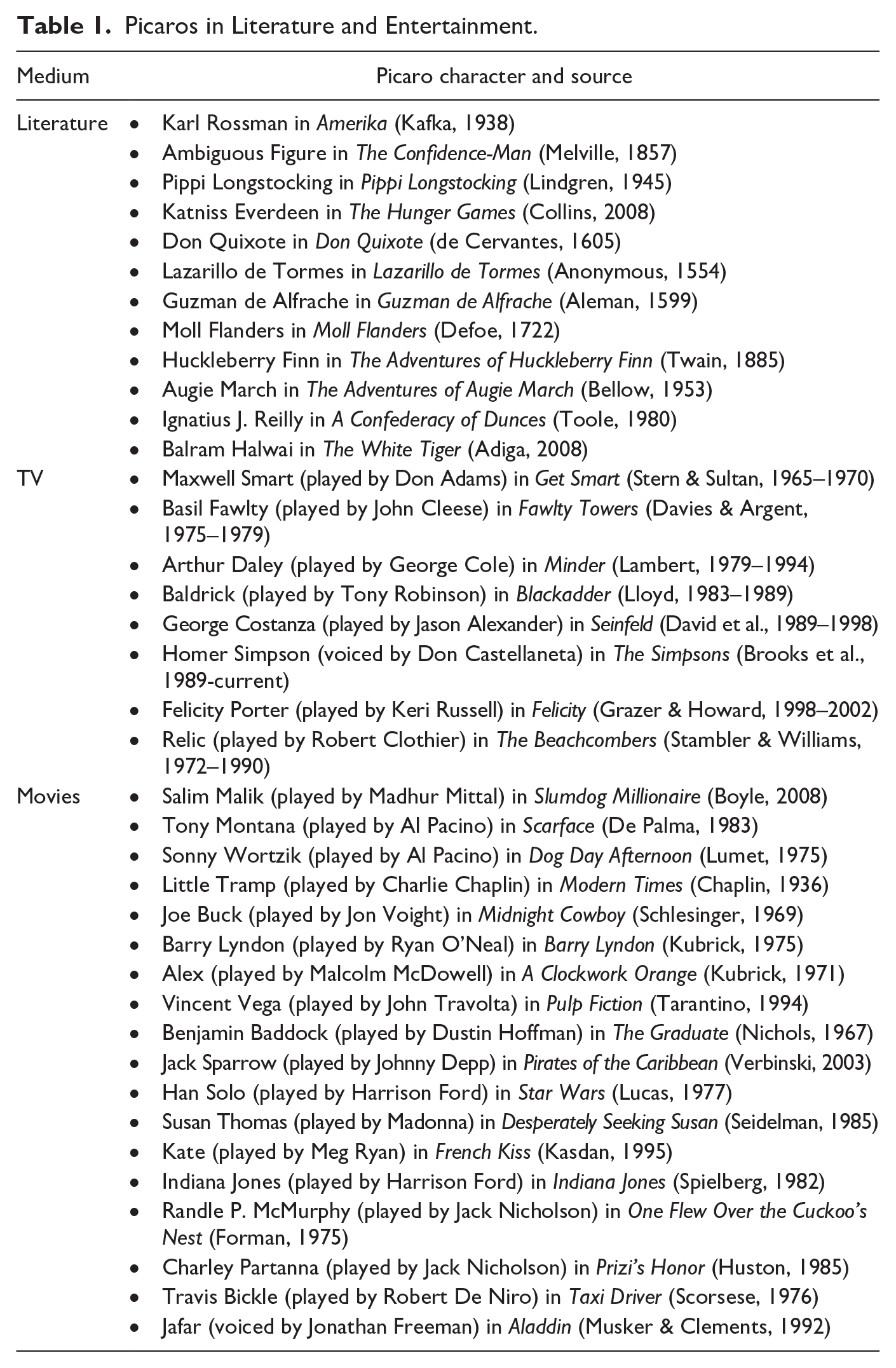
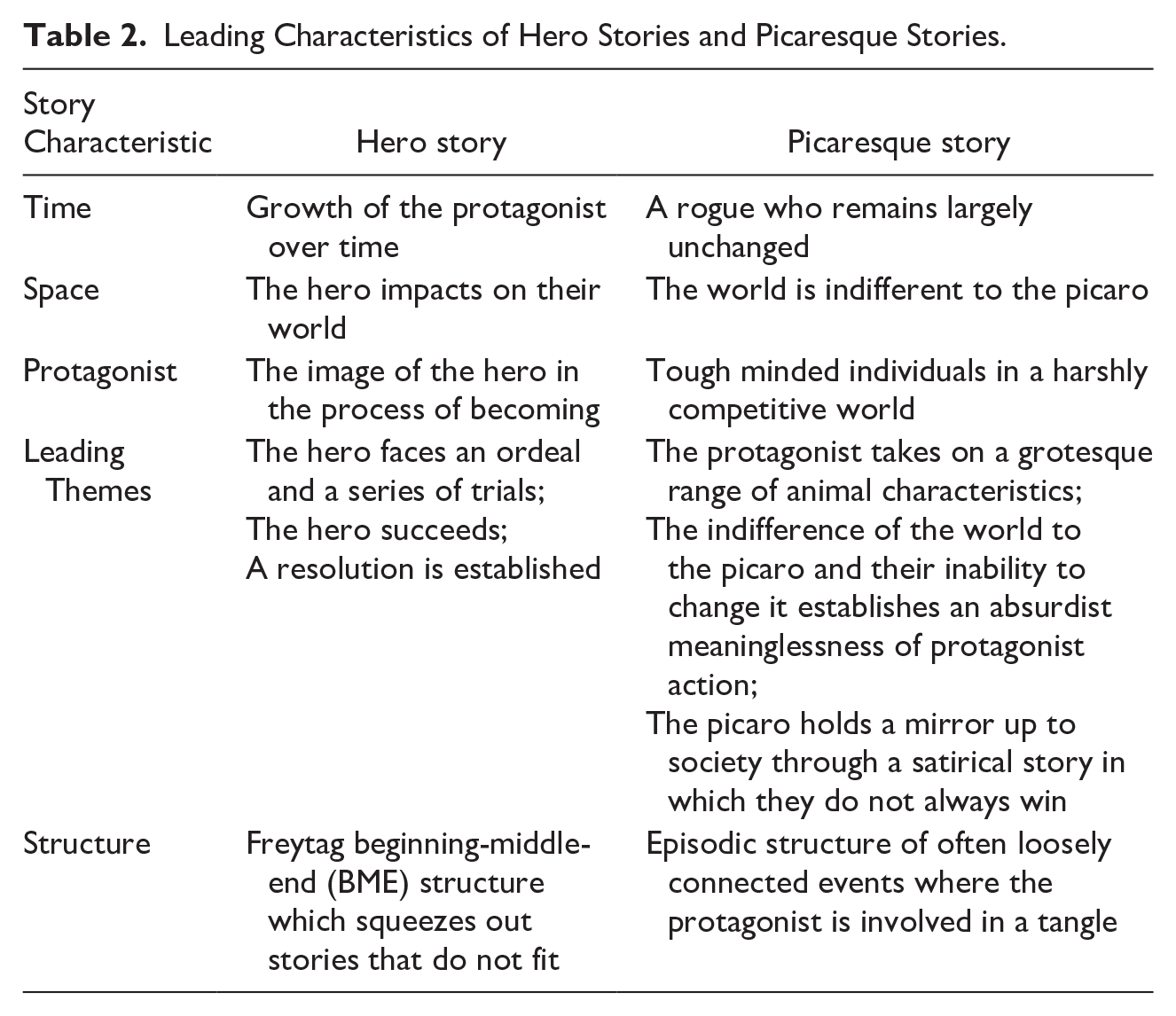
Bakhtin considers the picaresque as the opposite of the hero story because of how it uses time by portraying a ready-made or fixed character, and how it uses space by including a protagonist who does not influence their surroundings in any meaningful way. To illustrate literary features of the picaresque story and its time and space positioning, I reference Toole’s (1980) A Confederacy of Dunces. A posthumously published picaresque work, Dunces focuses on adventures of picaro Ignatius J. Reilly as he embarks on a series of misadventures around New Orleans in a “magnificent revolt against the twentieth century” (Toole, 1980, back cover).
One important feature of a picaresque story is that the protagonist picaro is a marginalized outsider who is estranged from society. Written in first-person format through the eyes of the picaro, the lead character typically emerges from a life of poverty (Cruz, 2004) and is often characterized as a rogue or delinquent (Crittenden, 2004). Hence, even though Reilly is a full-grown adult in A Confederacy of Dunces, he lives at home with his mother and is depicted as an unemployed and slovenly man who gorges himself on copious amounts of food and soft drink. The picaro also represents a pre-formed character who does not engage in the personal development arc typical in the hero story. Indeed, Reilly’s lack of character development in A Confederacy of Dunces is often held as a key reason Toole failed to find a publisher for the novel prior to his death. In one critical review, Bissell (2021) complains that “at every turn, Ignatius is exactly the character you expect him to be.”
Their outsider status means that Picaros are “tough-minded individuals in a harshly competitive world” (Alter, 1964, p. 12). To survive, picaros possess guile and a good sense of humor (Guillén, 2015). Their guile plays out in dubious acts such as stealing or breaking a moral code (Crittenden, 2004), therefore enabling the picaro to hold up a mirror to society and its taken for granted assumptions. For example, southern race relations in the 1960s are put under the microscope in A Confederacy of Dunces by the way in which Reilly’s attempts to denounce police graft to a crowd of New Orleans onlookers leads to ongoing exchanges involving racial undertones between Patrolman Mancuso and young Black man, Burma Jones.
Picaresque stories are characterized by grotesque, absurd, and satirical themes (Kline, 1999). Given the picaro often comes from a lowly standing, their actions can take on grotesque characteristics of animal character. For example, one of Reilly’s defining characteristics is his explosive belching and flatulence. Indeed, Reilly’s introduction to the reader in the novel’s opening takes on grotesque tones which include burgeoning hair in unusual places and the presence of food scraps on his face: The green earflaps full of large ears and uncut hair and the fine bristles that grew in the ears themselves stuck out on either side like turn signals indicating two directions at once. Full, pursed lips protruded beneath the bushy black moustache and, at their corners, sank into little folds filled with disapproval and potato chip crumbs. (Toole, 1980, p. 1)
Another core feature of the picaresque is absurdity, or that which is devoid of purpose so that all actions become senseless and useless (Esslin, 1961). The main absurdity in picaresque works is that while the hero emerges into a world which has been waiting for them, the picaro is born into a world which is indifferent to their existence (Alter, 1964). Picaros therefore have no impact on the society in which they live. As a result, absurdity is also evident in the aimlessness by which the picaro engages with their surroundings. Continuing with the example of Reilly, he is long-term unemployed, lives at home with his mother, has ventured only once outside of his hometown of New Orleans (and then only to Baton Rouge, some 82 miles away), and sits in his bedroom writing unpublished indictments against society. Kline (1999) argues it is this “ambivalent abnormality” which counterintuitively draws the interest of other characters towards Reilly in A Confederacy of Dunces.
The genre often also takes cynical or satirical perspectives as a means for exposing social hypocrisy (Crittenden, 2004). Reilly’s adventures are again indicative of this theme, such as his efforts to spark an uprising at a jeans manufacturing factory which fails when the workers decide they would rather undertake their work, and his attempts to sell hotdogs in the tourist strip of New Orleans which falter when he consumes his own product. Reilly’s final efforts to cause social breakdown by installing queer people in the military and the government holds up a satirical mirror to conservative 1960s power structures.
The nature of this satirical thematic element is that the protagonist doesn’t always win. A Confederacy of Dunces concludes with Reilly driving off into the sunset with his girlfriend, Myrna Minkoff, his plans for social upheaval not having come to fruition. However, while the satirical element of the story exposes a range of societal assumptions, it does not end with the neat resolution characteristic of a hero story. Simon and Schuster publisher, Robert Gottlieb, corresponded with Toole in December 1964 over this lack of resolution as a fatal manuscript flaw: “There is another problem: that with all its wonderfulness, the book—even better plotted (and still better plottable)—does not have a reason; it’s a brilliant exercise in invention, but unlike CATCH [22] and MOTHER’S KISSES and V and the others, it isn’t really about anything. And that’s something no one can do anything about” (in Nevils & Hardy, 2001, p. 131).
A final picaresque story element is that in contrast to the hero story with its structure BME format, the picaresque story moves episodically from situation to situation, sometimes with little relation between episodes. Guillén (2015) describes this situation as a tangle, or a chain of situations which leads to further situations or adventures. These episodic elements are captured in Reilly’s adventuring from being a manager at the jeans factory, his work in pushing the hot dog cart, attempts to prevent a pornography ring at his local bar, and his intentions to cause social uprising through championing army and government careers for gay people. Key differences between heroic and picaresque stories are summarized in Table 2.
Leading Characteristics of Hero Stories and Picaresque Stories.
While the picaresque story is uncommon in western literature, there is precedence for leveraging the genre in management education. For example, James March (in Augier, 2004) provides an account of his use of Don Quixote to teach leadership. March argues Quixote is a useful teaching resource because the main character is not successful and does not have realistic expectations. This reasoning ties in with picaresque themes of the absurdity of a world which is indifferent to its protagonist and the satire of a story which does not end in a perfect resolution. Importantly, March argues the unrealistic expectations of Quixote and his ultimate lack of success are ideally suited to teaching about leadership because failure and persistence serve as key capabilities in developing the self-knowledge required of modern leaders. Combining March’s observations on qualities of the picaresque and the pedagogical challenges associated with hero stories, our argument is the time is ripe for more formally considering how picaresque stories might inform management education.
Steve Jobs: Hero and Picaro
To understand how picaresque stories might serve as a pedagogical tool for management education, I present hero and picaresque stories of Steve Jobs at Pixar. Jobs was chosen as the focus of this storytelling analysis given his status as a business leader who often features as a hero-type character in management textbooks, but whose background suggests some features of a picaro. I provide readings of these two stories to compare differences between the hero and picaresque genres. To assist management educators in understanding these formats, an illustration is provided of how these hero and picaresque readings were developed. It is not suggested the process outlined is an exclusive technique for such an undertaking, rather an illustration of one approach educators might find helpful for developing their own hero and picaresque teaching materials.
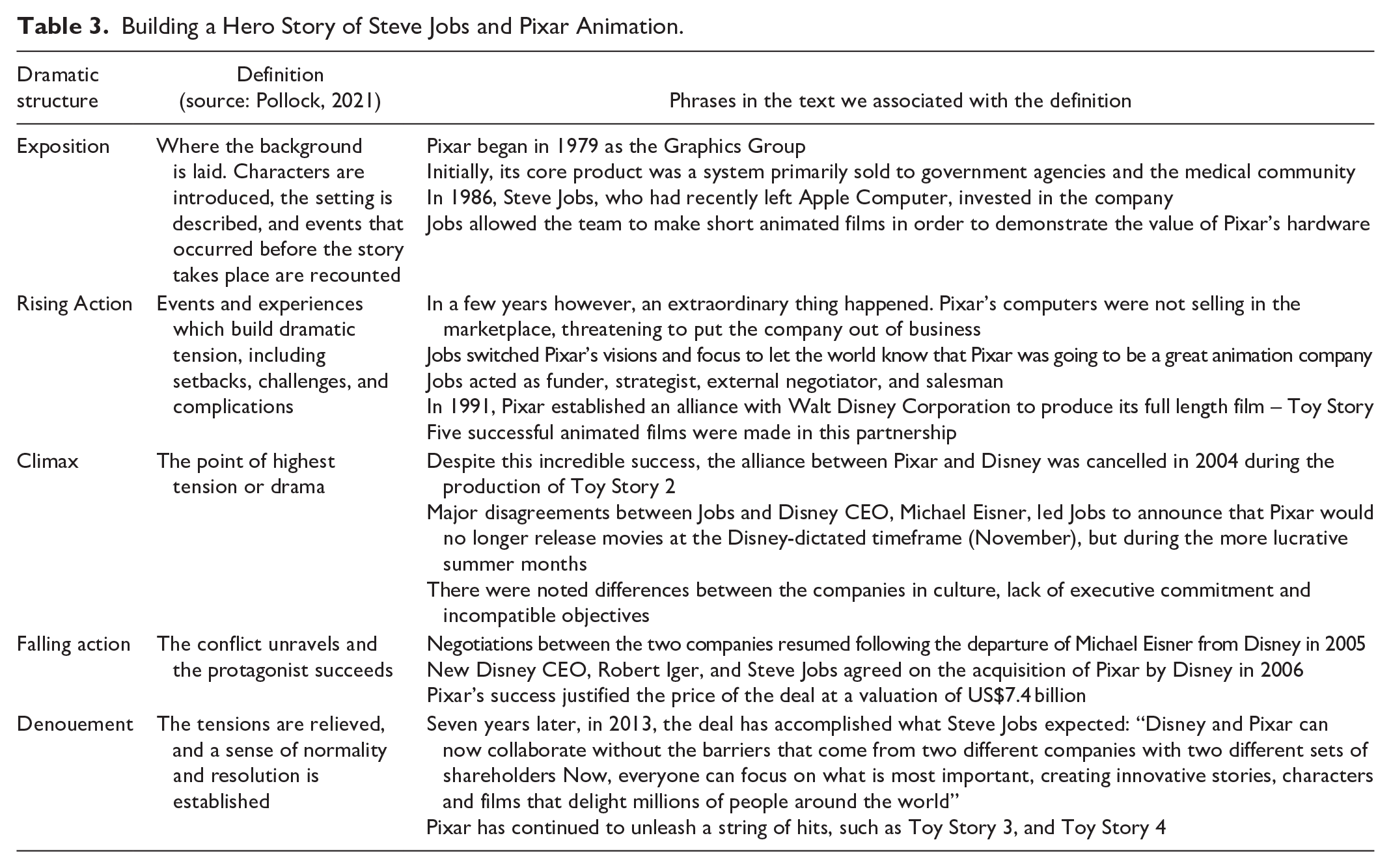
To construct the hero story, I leverage material from Clegg et al (2020, pp. 193–195) Strategy: Theory and Practice. Using Freytag’s pyramid to develop this story, I identified segments of the case study which appeared to represent: (1) exposition (inciting moment); (2) complication (rising action); (3) climax (turning point); (4) reversal/falling action; (5) denoument (moment of release). Table 3 identifies phrases in the text I associated with each element of the dramatic structure of the Hero Story.
Building a Hero Story of Steve Jobs and Pixar Animation.
Development of the picaresque story required a different text. Because the case study in Clegg et al. (2020) appeared to be written in the form of a hero narrative, it was difficult to identify grotesque, absurd, and satirical thematic elements which might form a picaresque storyline. I therefore leveraged material from Becraft (2017), whose biography on Steve Jobs contained wider perspectives for considering Jobs’ legacy. To construct a picaresque story of Jobs at Pixar I first read relevant sections of the text to identify grotesque and absurd themes.
For grotesque elements, I looked for passages of text which hinted at the fusion of human and animal aspects of character, for example, aggression, territoriality, tribalism, and a flight-or-fight response (J. Edwards & Graulund, 2013). For absurdist themes, I sought passages of text which hinted at Jobs feeling aimless, lacking direction, or experiencing a lack of meaning in his actions or existence (Esslin, 1961).
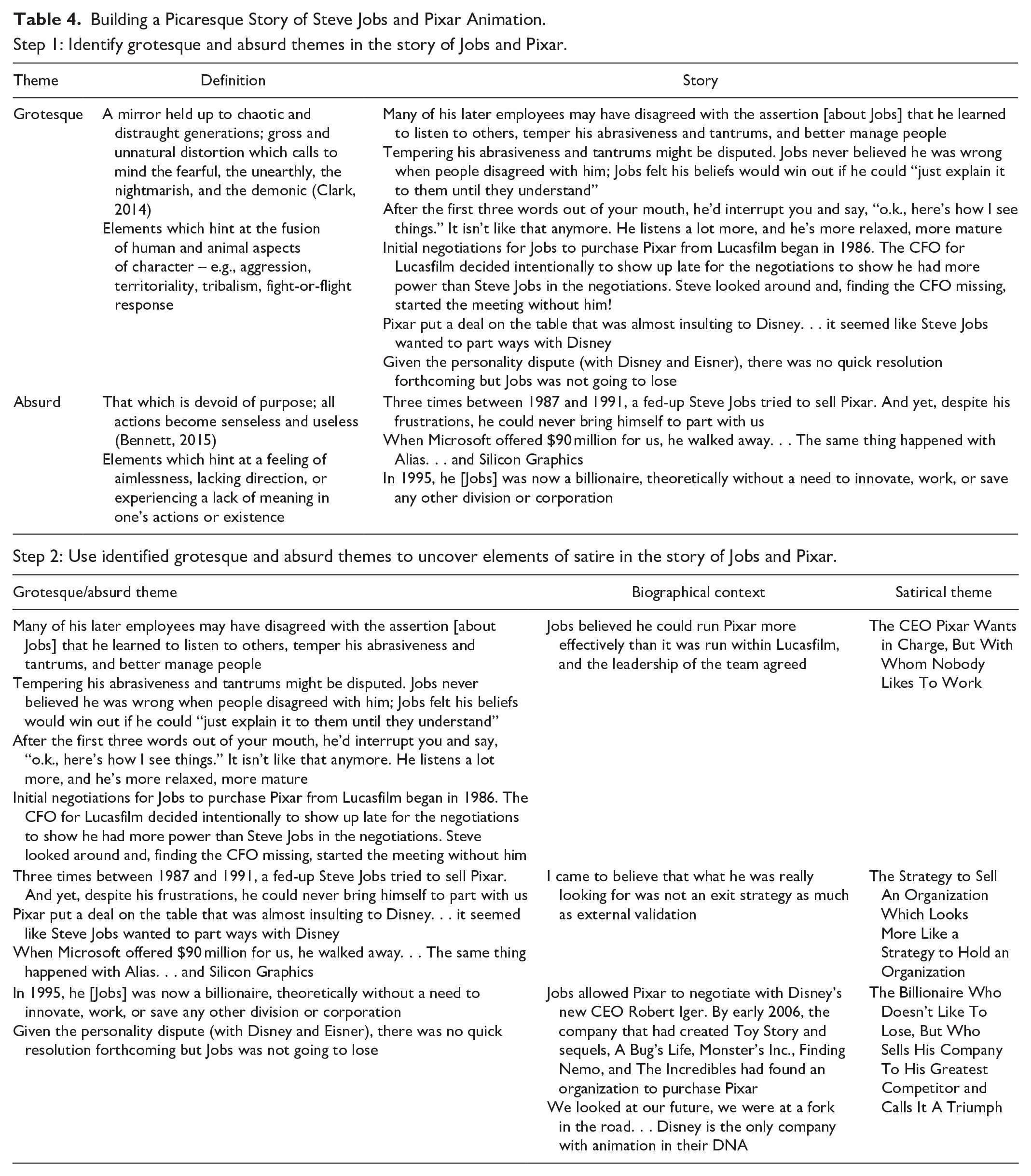
Once these grotesque and absurd themes had been identified I linked overall biographical context of Jobs’ story to discover satirical themes. For example, where Jobs was identified in the biography as an abrasive leader prone to throwing tantrums, the description was provided in the overall biographical context of Jobs being invited by Pixar management to take over the company (Becraft, 2017). By making relationships between absurd and grotesque themes and the wider biographical context, I were able to identify satirical contradictions such as where Jobs was the CEO that Pixar wanted in charge, but with whom nobody liked to work.
Table 4 illustrates our two-step process in identifying grotesque, absurd, and satirical themes in the text. Important to note is that while themes such as the grotesque, absurd, and satirical are all considered characteristics of the picaresque novel, “no work embodies completely the picaresque genre” (Guillén, 2015, p. 72). For example, the picaresque story of Jobs at Pixar presented here does not show him as being from a poor background. As such, the story is presented as indicative only of what a picaresque story of Jobs at Pixar might look like.
Building a Picaresque Story of Steve Jobs and Pixar Animation.
Step 1: Identify grotesque and absurd themes in the story of Jobs and Pixar.
In Table 5, I compare the hero and picaresque stories of Steve Jobs at Pixar Animation.
Heroic and Picaresque Stories of Steve Jobs and Pixar Animation.
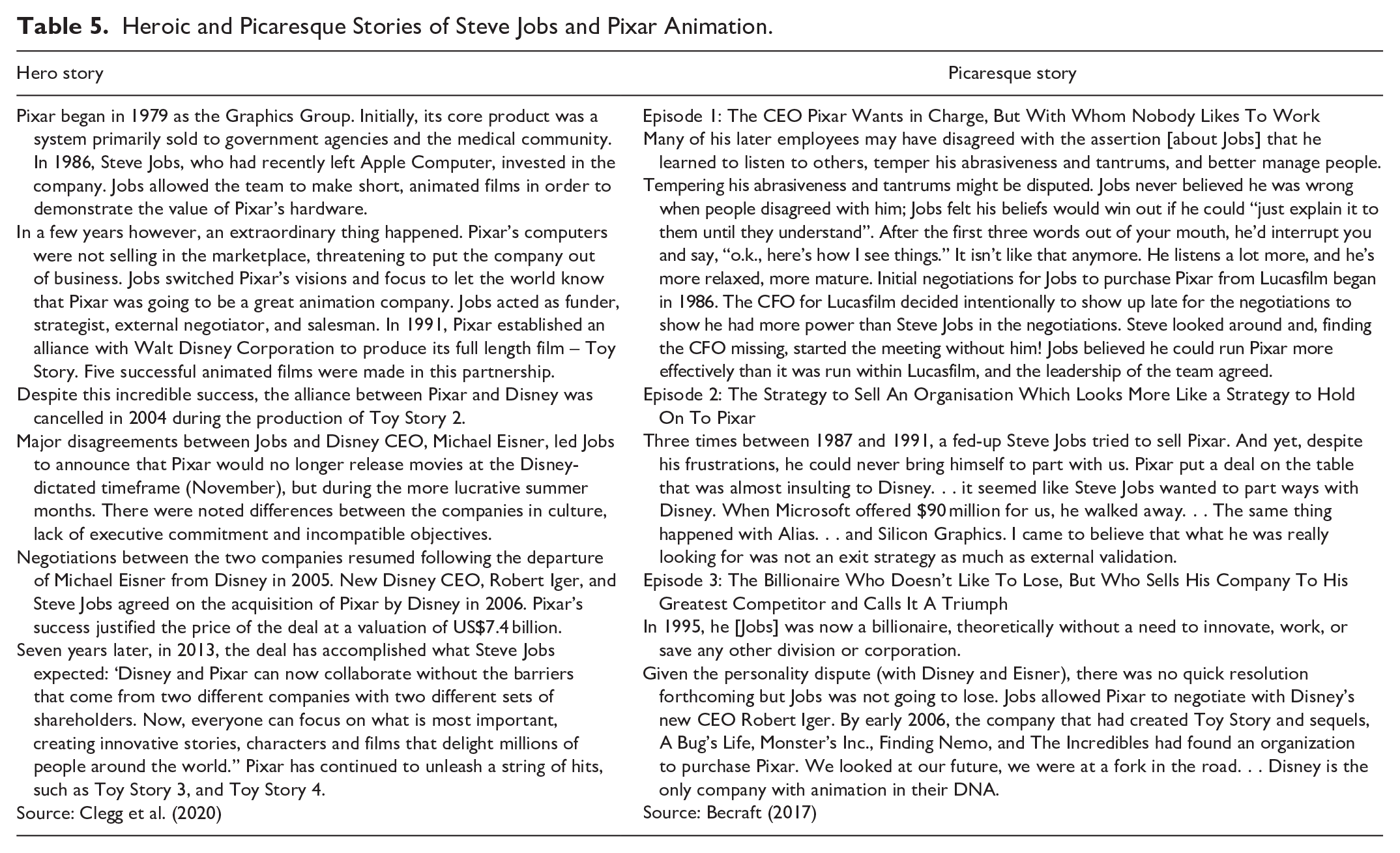
Comparing the two stories illustrates how the grotesque theme of the picaresque story enables an illustration of Jobs as a leader who embodies a range of negative emotions and management practices. In the hero story, Jobs is portrayed as a successful leader. He invests in Pixar as its chief funder, strategist, external negotiator, and salesman. Content in this story holds Jobs in a positive light. Where disagreement between Jobs and Disney CEO, Michael Eisner, might allow for light and shade to be thrown on Jobs’ character, the story progresses by illustrating how Jobs used the situation to hold up negotiations until a more favorable Disney leader emerged. This resolution in the story thereby leverages circumstances of the Disney dispute as another opportunity to demonstrate Jobs’ leadership capabilities, rather than cast doubt on his character.
In contrast, grotesque themes in the picaresque story identify Jobs as possessing a temper and abrasive personality. Accounts suggest Jobs never believed he was wrong when people disagreed with him and he therefore adopted a style in meetings where he would interrupt those with whom he differed. While this story suggests some people felt Jobs became better at managing people, there is also recognition that others would dispute whether he was successful in tempering his abrasiveness and tantrums. His tactics, such as starting meetings without key stakeholders, are held up as political ploys, and counteract claims that he learnt to listen to people.
The absurd theme of the picaresque story provides an illustration of an aimlessness of Jobs’ leadership which contrasts with his direct and purposeful nature in the hero story. In the hero story, Jobs is a visionary. He “allows” the Pixar team to make short, animated films. He sets out a vision for Pixar as a great animation company, and his foresight is validated in five successful films including Toy Story. Jobs’ relationship with Pixar in the hero story is also unconditional. He saves the company when it seems as though it might be going out of business, he acts in its best interests by withdrawing from the partnership with Disney when the firm is under leadership which seems averse to Pixar, and he then resumes negotiations when a new CEO takes over. Jobs’ ultimate success is in selling the company for $7.4 billion.
Meanwhile, absurdist themes in the picaresque story paint a more compromised picture of Jobs’ leadership. In this story, Jobs is indecisive. He sets out publicly to sell the firm, but he backs out of acquisitions by Microsoft, Alias, and Silicon Graphics. Jobs’ relationship with Pixar in this story is also less sure than in the hero story. He is a billionaire with sufficient funds and achievements to have no pressing need for owning the company. Where the hero story does not question that Jobs acts in Pixar’s best interests, Jobs’ occasional aimlessness in the picaresque story suggests his attachment to the organization might be more conditional.
Finally, the satirical theme of the picaresque story enables contradictions to emerge which are not evident in the hero story. In the hero story, the voice we hear is that of Jobs. Jobs is the one who invests in the company. He is the one who sets the vision of pursuing short, animated films. He is the one who withdraws from negotiations with Disney. He is the one who sells the company. The hero story also gives primacy to planning. Jobs sets the vision of animated film production, and the organization achieves success through pursuing it. Jobs establishes the partnership with Disney, and the two firms make award-winning box-office hits together. Finally, the hero story also provides a closed definition of success based on financial returns, where the firm is sold for $7.4 billion.
By enabling satire, the picaresque story allows for contradictions which are hidden in the hero story. Where the hero story gives voice to Jobs, the picaresque story gives voice to the Pixar workers. We hear these voices through the identified contradiction that Jobs is the CEO Pixar wants in charge, but with whom nobody likes to work. Through this episode in the story, we hear tales of Jobs’ tantrums and abrasiveness, and his failure to listen to others. The picaresque story also allows for strategic emergence. Where the hero story gives primacy to strategic planning and illustrates a context where Jobs achieves all that he sets out, the picaresque story provides a contradiction where Jobs’ strategy to sell the organization appears more like a strategy to hold on to Pixar. Therefore, we see failed takeover negotiations with three companies, and speculation that Jobs may not have been as interested in selling as his public pronouncements may have seemed. Finally, the picaresque story illustrates a contradiction of Jobs as the billionaire who doesn’t like to lose but sells Pixar to his greatest competitor and calls it a triumph. Where the hero story puts forward the $7.4 billion sale as a triumph, the picaresque story allows for a more nuanced and bittersweet understanding of success in that the firm is now owned by a company with whom Pixar had experienced previous relationship difficulties.
In comparing and contrasting the hero and picaresque stories of Jobs at Pixar, we therefore see the picaresque story is enabled through its grotesque theme to illustrate more shade in Jobs’ character, through its absurdist theme it allows greater indecision and uncertainty in Jobs’ relationship with the company, and in its satirical theme it gives voice to the workers, therefore allowing for strategies of emergence and nuance in understanding success.
Discussion
In contemplating our readings of Steve Jobs at Pixar and their implications for management education I also lean on experience in teaching the picaresque genre to an undergraduate strategic management course. These understandings combine to encourage us in providing the following insights for those looking to adapt the picaresque format in their classroom.
Our readings suggest hero stories work against the development of critical thinking skills by excluding the disconfirming information on which such skills are developed (Powley & Taylor, 2014). For example, where the hero story of Jobs at Pixar excludes the voice of the worker and removes reference to personality flaws in his leadership, grotesque elements of the picaresque story reveal negative aspects of Jobs’ character. The grotesque, absurd, and satirical themes of picaresque stories therefore create a surfeit of information and deficit of meaning which appear suited to provoking skepticism of both conventional wisdom and one dominant view (Gold et al., 2002). I therefore suggest that management educators seeking to develop critical thinking skills in their students might benefit from leveraging picaresque stories as pedagogical tools.
Our hero and picaresque readings also suggest that while the Freytag BME structure pushes hero stories towards a neat resolution, the episodic progression of the picaresque story offers a closer approximation to the nonlinear, fragmented, and collective nature of storytelling in organizations (Brown et al., 2009). By preserving a range of complex and sometimes inconsistent information such as an episode where Pixar wants Jobs in charge but no one likes to work with him, picaresque storytelling appears suited to developing the rich and detailed accounts of work likely to spur new perspectives and new ways of acting (Gold et al., 2002). Given failure stories have also been shown to improve learning transfer (Bledow et al., 2017), the picaresque story promises to open student learning by giving room for protagonists who have not always demonstrated success throughout their careers. I also suggest picaro accounts present a protagonist likely to be illustrative of some colleagues whom students might encounter in the workplace. The picaresque story therefore represents a pedagogical tool suited to exploring the complex and ambiguous problems and characters students are likely to come across in organizations.
I suggest it is helpful to introduce students to the picaresque story by incorporating an exemplar of the genre which can be compared with a hero-style story. For example, contrasting the structure of A Confederacy of Dunces (Toole, 1980) with a more typical hero-style story such as Danny, Champion of the World (Dahl, 1975) has proved a useful approach to exploring the genre with students. Because picaros and heroes both face challenging sets of circumstances, students may initially find it difficult to conceptualize key differences between the genres. Contrasting Dunces and a hero story such as Danny enables the educator to show how the picaro protagonist maintains the same character throughout the story and is unsuccessful in changing their environment, while the hero character evolves to impact on their world. Educators may find it helpful to leverage discussion on A Confederacy of Dunces (Toole, 1981) in this essay to contrast with a hero story of choice. However, another useful resource for introducing the picaresque genre is evidenced in Mackey and Mackey’s (2025) illustration of George Costanza in the tv show Seinfeld (David et al., 1989–1998). Table 1 identifies other picaros whom management educators may use for illustrating the format.
Management educators may also wish to explore picaresque stories by developing their own case material. The exemplar of Steve Jobs as a picaro at Pixar was developed using the process of identifying grotesque, absurd, and satirical themes in a text as illustrated in Table 4. Other exemplars are likely to be plentiful, given leaders featured as heroes in textbooks and wider media often evidence behavior suited to picaro-style depiction. Elon Musk is one whose character appears ripe for exploring through the nuances of a picaresque story given his successes can be balanced against events such as publicly taunting a rescue diver (Levin, 2018), the questionable process of his social media takeover (Snowdon Smith, 2022), and the multiple children he has fathered from different relationships (Wickman, 2025). Others with contentious back stories include Jack Welsh, and his battles at General Electric with the Environmental Protection Agency, and Jeff Bezos, whose Amazon company has faced allegations of human exploitation in third world and developing countries (Amnesty International, 2023). Management educators are encouraged to develop case studies for depicting business leaders through a picaresque lens.
I offer several suggestions of syllabus contexts where the picaresque story may be useful for exploring key concepts. First, by its grotesque theme, the picaresque genre shows promise in leadership courses for exploring topics on the shadow side and ethics of leadership, thereby potentially assisting students develop a practice of moral attentiveness (Hedberg, 2017). Similarly, the genre presents as a useful pedagogical tool in entrepreneurship courses, where the botched career and personal moments of picaros offer opportunity to reflect on social and emotional costs and potential benefits of the key threshold concept of failure (Bolinger & Brown, 2015).
The episodic nature of the picaresque story also offers opportunity for considering non-linear approaches on topics such as planning. Where rational linear approaches have served as the bedrock of teaching the planning function in Introduction to Management courses, the recognition now is that managing represents a bounded occupation of accomplishing variable results through other people (Donovan, 2017). Similarly, where Strategic Management courses put forward a formulaic strategy planning process, recognition is now that strategy implementation represents a more difficult task involving ambiguity and human-centered complexity (Lindsay et al., 2018). By following a sometimes-inconsistent developmental path, the picaresque story promises to highlight instances where a picaresque character’s best intentions did not work out as expected, thereby introducing students to the incremental and sometimes emergent processes of strategic planning (Mintzberg, 1977).
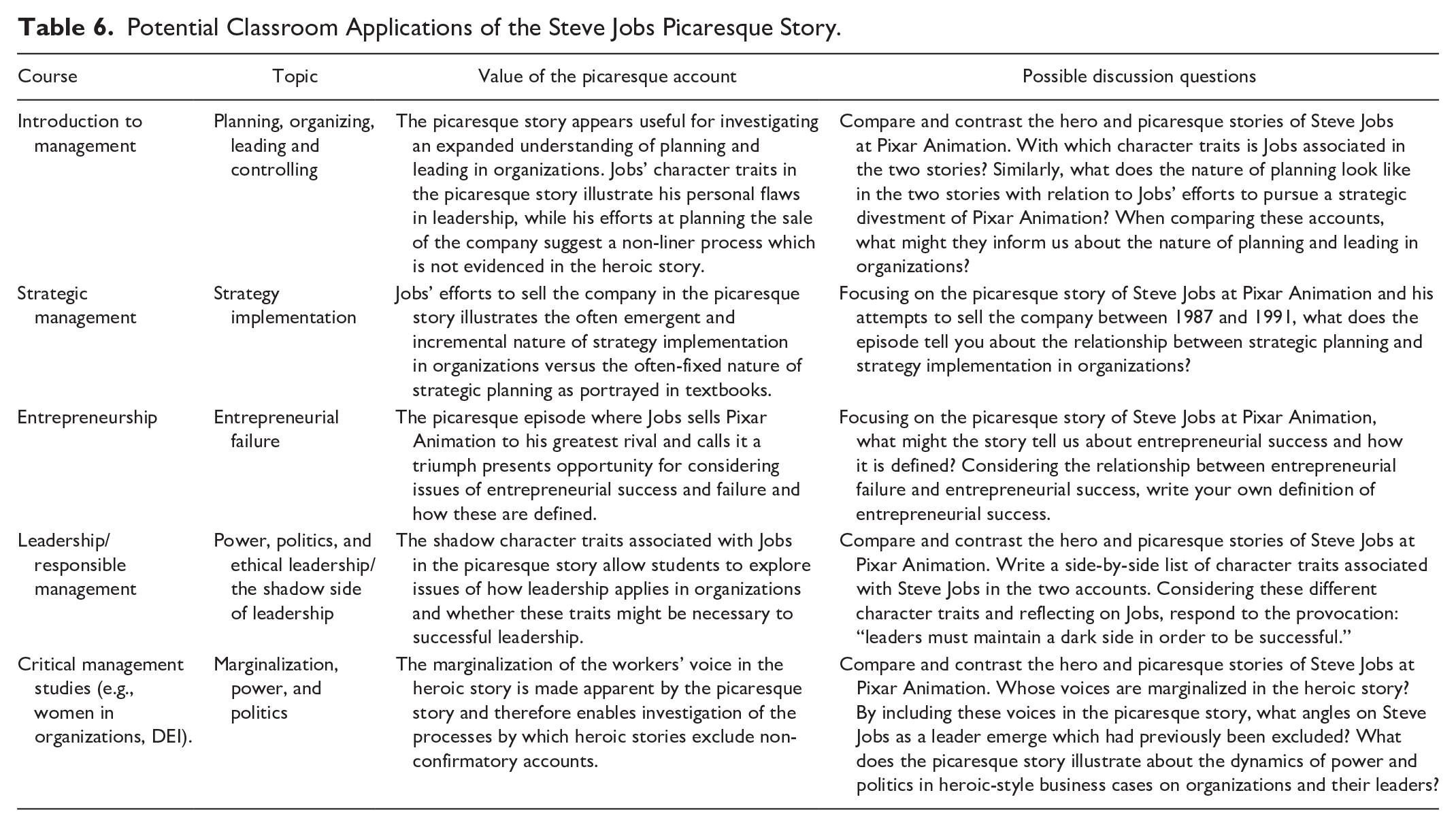
Because there remain pedagogical benefits to hero stories (Allison & Goethals, 2014), I suggest picaresque case studies could complement these more traditional case studies by being presented in a side-by-side format. A pedagogical approach of teaching hero and picaresque stories of the same business character alongside each other offers promise for courses in Critical Management Studies. Similar to Jermier’s (1985) use of different stories focused on the same protagonist to explore how actors confront the world and make sense of it, so too might contrast between hero and picaresque stories enable critical interpretive skills in students. In comparing, students can see which voices are left out of each respective version and understand how inclusion in one story affects their understanding of the protagonist. For example, where literary tools such as deconstruction attempt to break down the unity and structure of stories by including marginalized and otherwise silent voices (Boje, 2001) the technique is often a challenging one for participants to master (Wright et al., 2020). By contrasting hero and picaresque stories marginalized and oppressed voices become apparent by their presence in one text and absence in the other, creating conditions of critical reflexivity for texts to be reappraised and therefore surfacing diversity and power issues (Hibbert, 2013). Suggestions on management education courses, topics, and possible in-class discussion questions prompted by the picaresque story of Steve Jobs at Pixar Animations are outlined in Table 6.
Potential Classroom Applications of the Steve Jobs Picaresque Story.
Experience suggests picaresque stories can be effective in assessment items where students learn managerial development by reflecting on their own life experiences (Reilly, 2017). Students in our strategic management course are presented with an assignment where they: (1) contemplate a time where their life has not worked out as expected; (2) explain how they met this challenge; and (3) outline how they would manage a similar situation in the future. Students choose whether to outline their reflection in a hero or picaresque story style. The benefit of introducing the picaresque style is that not all students can relate to the hero type. Some do not feel as though they have been successful in their lives and the picaresque style appears to offer them an outlet where failure is a more accepted outcome. In this age of challenges around student mental health (M. S. Edwards et al., 2021), it may be the picaresque story offers comfort to students in building their own identity.
In terms of future research, this essay notes the abundance of male rogues and associated shortage of female picaro characters in popular literature and entertainment. Moll Flanders (Defoe, 1722) remains a rare female picaro, though it seems there are non-western examples as found in Poniatowska (2001). The lead character in the late 1990s television series Felicity (Grazer & Howard, 1998–2002), appears to adopt a picaro character in some of the show’s earlier seasons, before reverting to a hero character later. While the lack of popular female picaro characters does not appear to have diminished female students in our strategic management class from writing their identity assignment in a picaresque form, questions on why such characters are largely overlooked in western entertainment are important. It would therefore seem worthwhile to investigate possibilities for management education of a female picaro, as well as those of other minority groups.
Overall, our argument in this essay is that management educators would benefit from exploring picaresque stories as a pedagogical tool. By presenting more complex stories on management and organizations, picaresque stories provide key audiences with greater opportunity to engage in critical thinking, give exposure to the complex nature of organizations, and offer students a different template on which to build their own stories of personal identity. I encourage faculty to explore mechanisms for including picaresque stories via case studies and textbooks, and as a valuable tool for enabling students to think differently about management education.
Footnotes
Acknowledgements
I would like to acknowledge my kind colleagues Andrew Rixon, Liz Nichols, and Cindi Fukami for comments on earlier drafts of this paper, as well as Associate Editor John Stark and two blind reviewers who provided invaluable advice for improving the paper.
Declaration of Conflicting Interests
The author declared no potential conflicts of interest with respect to the research, authorship, and/or publication of this article.
Funding
The author received no financial support for the research, authorship, and/or publication of this article.
