




Abstract
In an essay published for the 40th anniversary issue of Management Learning, Reynolds reflected on the impact of, and reactions to, experiential learning to teach management. Fifteen years later, in honor of the journal’s 55th anniversary, we delve into the research published since that point to explore how experiential learning is invoked in Management Learning. To this end, we reviewed and coded 45 articles published between 2010 and 2024. This process pushed us to reflect on three different (often interconnected) ways in which experiential learning is examined in the journal, with articles that explore the experiential learning process, center on one or more specific dimensions of experiential learning, and attend to contextual elements that facilitate or hinder experiential learning. We also situate the methods and activities discussed across the sample within the clusters of experiential learning identified by Grain, allowing us to identify areas in which research in Management Learning overlaps with and extends the model. To close, we relate our findings to contemporary debates about experiential learning and education, both within the journal and the field, and propose future research directions.
In an essay published 15 years ago for the 40th anniversary issue of Management Learning, Reynolds (2009) reflected on the impact of, and reactions to, experiential learning (EL) to teach management. In line with the journal’s emphasis on “critical, reflexive scholarship on organizational learning and knowledge” (Durepos et al., 2020: 3), a scan of the research published in Management Learning since that point suggests that reflections on EL remain an important topic. Several authors, for example, have taken a critical stance, attempting to unpack reasons why some students may be less inclined toward EL, based on their preference for analysis over sensing (Bas et al., 2023), as well as reiterating key ethical considerations (Wright et al., 2019) and the instructor experience (Tomkins and Ulus, 2016). Indeed, Anderson et al. (2020) identified refrains of the EL conversations within the journal in a recent systematic review of research published from 1998 to 2014. Among the 19 themes that emerged, Anderson et al. (2020: 23) discuss several that have explicit and implicit links to EL, such as critical management education and pedagogy; reflection, reflexivity, and autoethnography; and arts-based and creative learning.
In honor of the journal’s 55th anniversary, we contribute to this stream of inquiry by exploring the different ways in which experiential education is invoked in articles published in Management Learning from 2010 to the present. To this end, we reviewed and coded 45 articles. This process pushed us to reflect on three (often interconnected) ways in which EL is examined within the journal, including (1) articles that center on the EL process, (2) research that specifically focuses on one or two of the dimensions of EL—such as reflection, and (3) articles that attend to contextual elements that facilitate or hinder experiential education (EE). In addition to the descriptive findings from our review, we reflect on and extend Grain’s (2019) conceptualization of the “messy field” of experiential learning (where the author identifies clusters of experiential learning in educational settings) by situating the EL foci and activities featured in Management Learning from 2010 to 2024 within this “messy field.” We then discuss how these insights inform contemporary debates on EL within and outside of the journal, as well as professional development practices.
Literature review
Just as Reynolds (2009) posed, “So how would you define experiential learning?” (p. 387) at the outset of his essay, we also grappled with this foundational question at the start of our project. Our initial reflections on what we considered to be experiential learning and education included many similarities, but were not as automatic and aligned as we expected. As experiential educators with approximately 35 years of combined experience and near-daily collaborators, we were both surprised by this realization and excited to delve into discussions.
Indeed, the literature suggests there are a number of perspectives on experiential learning and education (e.g. Fenwick, 2001). EE, in its broadest depiction, is “a generalized [way of describing] the idea that experience+reflection=learning” (Heinrich, 2024: 17). It encompasses a wide range of philosophical, disciplinary, and practice traditions that contribute to its richness and many conceptual debates (Seaman et al., 2017). Researchers have traced its lineage back to the Enlightenment, with links to Rousseau’s critiques of education in Emile, or On Education (1762/1956) and even back millennia to the ancient Greek philosophers Socrates, Plato, and Aristotle (Allison and Seaman, 2017; Meyer, 2024; Roberts, 2012; Stonehouse et al., 2011). More recently, the broad domain of EE has drawn upon a wide range of knowledge from contemporary educational theorists such as John Dewey and Albert North Whitehead, social psychologists like Kurt Lewin, renowned outdoor education practices like Outward Bound, and many others (Meyer, 2024).
Many consider EL as a subset of EE, focused on the individual, although a number of researchers and theorists also use the terms interchangeably. Whereas EE provides the philosophical and educational philosophy backbone that can guide the structure and design of learning, a narrow view of EL from Roberts (2012) defines it “as a method or technique that any teacher might employ to meet certain instructional objectives” (p. 4). Seaman et al. (2017: NP14) aptly diagnose the challenge of defining EL, noting that it simultaneously expresses an empirical phenomenon, a set of pedagogical strategies, and an ideology. Consequently, researchers have proposed many classifications to encompass this complex domain. For example, Saddington’s (1998) EL tree model of progressive, humanist, and radical branches; Jarvinen’s (1998) three-part EL model of phenomenological, critical theory, and situated and action theory traditions; and Fenwick’s (2000, 2001) five-part view of EL—describing constructivist, psychoanalytic, situative, critical cultural, and enactivist perspectives. More recently, Grain (2019) codified seven clusters (work-integrated, research-based, community-engaged, immersive, strategy-specific, land and place-based, and student-led) to offer a synthesis and visualization of EL’s ever-evolving and expanding “messy field.” This visual was developed as part of a 2-year research project led by the author at the University of British Columbia, based on data collected from a number of stakeholders (Grain and Gerhard, 2020). All in all, this multitude of models demonstrates that defining EL depends on one’s epistemological and ontological views, shedding light on our reflections and discussions at the onset of this project.
Since the 1970s, EL has been formalized and codified through the establishment of several learned societies. These include, for example, broad interprofessional and interdisciplinary societies like the Society for Experiential Education (SEE) and the Association for Experiential Education (AEE) in North America, as well as specialized disciplinary societies in business and management with the Management & Organizational Behavior Teaching Society (MOBTS) and the Association for Business Simulation and Experiential Learning (ABSEL). These associations support and foster EL research and scholarship through various sponsored journals. In the past 50 years, EL has entered a broad range of social science and management education scholarship of teaching and learning outlets, including Management Learning, which has led to disparate and loosely connected conversations. Given this, we aim to contribute to this literature by both synthesizing Management Learning’s vanguard, integrative, and holistic EL scholarship and situating it within the broader EL family tree.
Method
We conducted a search on the journal’s website in January 2024 for articles containing the keywords “experiential learning,” published between 2010 and our search date. Of the 92 results, 12 were immediately identified as either book reviews or editorials, and thus outside the project’s scope. We hired a Research Assistant to download the 80 remaining articles, as well as input the references, abstracts, and keywords for each into an Excel file.
To familiarize ourselves with these articles, hone key definitions for our project, and consider relevant elements to code, we independently read the same subset of 10 papers, as well as the remaining abstracts, and met to discuss our initial reflections. First, we realized that two of the abstracts were introductions to Special Issues—as such, we removed them from the database. Next, we discussed the definition of our focal construct, experiential learning. We noticed, for example, that some articles in the database pertained to part or all of the EL process, while others centered on one or two specific dimensions (most notably, reflection), and others explored contextual factors that facilitate or hinder effective EL. Using abduction, defined by the Sage Research Methods (2024) Methods Map as “a kind of reasoning developed by the philosopher Charles Sanders Peirce in which an observation or a case is related to a theory by means of plausible interpretation,” this pushed us to consider how to best represent the layers of EL across the articles and led us to construct a graphical representation of these relationships (Figure 1).
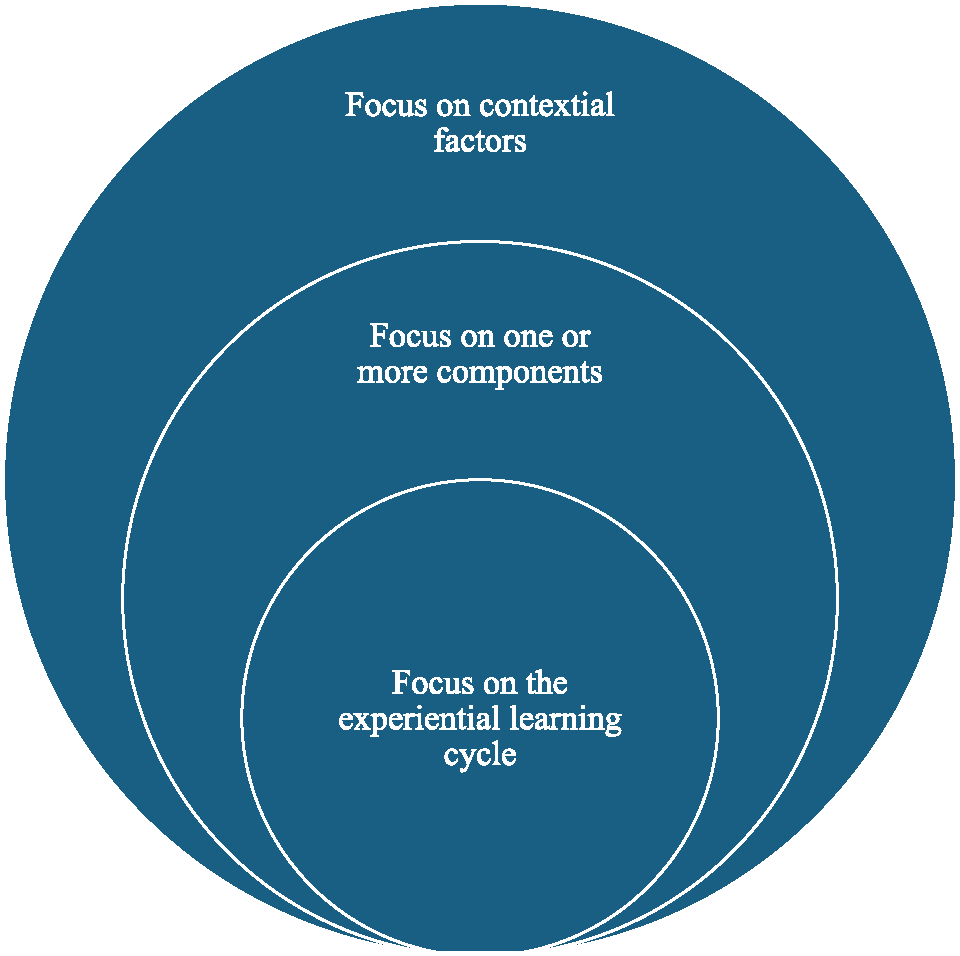
The interconnected layers of experiential learning.
This enabled us to better articulate the scope of our project—we would read and code articles in which EL was an important focus, allowing us to situate the article within at least one of the layers of Figure 1. With this in mind, we agreed that 3 of the 10 initial papers fell outside our scope. We then discussed relevant elements to code across articles, to allow us to present a portrait of this literature, and added four columns to our database: (1) article type (empirical—qualitative or quantitative, conceptual, etc.); (2) EL level (from Figure 1: either an EL-centric, component(s), or context focus); (3) instructional level (when discussing EL, what instructional level are the authors referring to—such as undergraduate, MBA, workplace learning, etc.?); and (4) given the prevalence of the EL process for many articles, we drew on Kolb’s (1984) seminal Experiential Learning Theory (ELT), which presents the EL process as four interrelated dimensions (concrete experience, reflective observation, abstract conceptualization, and active experimentation), to code the number of dimensions from Kolb’s model that could be identified within the article. We also included space to record key concepts and theories used in each article, though we recognized it was likely that these would vary considerably, given the breadth of topics explored by authors.
We then established our coding process. As our discussions helped to refine our definitions and, by extension, our inclusion/exclusion criteria, the next step was to independently (1) reread the abstracts of all articles, to determine their applicability to the project and (2) reread and code the seven articles (from the initial batch of 10) deemed potentially applicable to the project. Prior to each subsequent meeting, we read and coded a subset of the articles in the database, allowing us to discuss and reach a consensus on our evaluations of them. Although our research was not a systematic literature review, we drew on PRISMA (Preferred Reporting Items for Systematic Reviews and Meta-Analysis) guidance and prepared a flowchart (Figure 2) to transparently summarize our process and inclusion/exclusion decisions for the project (e.g. Page et al., 2021).
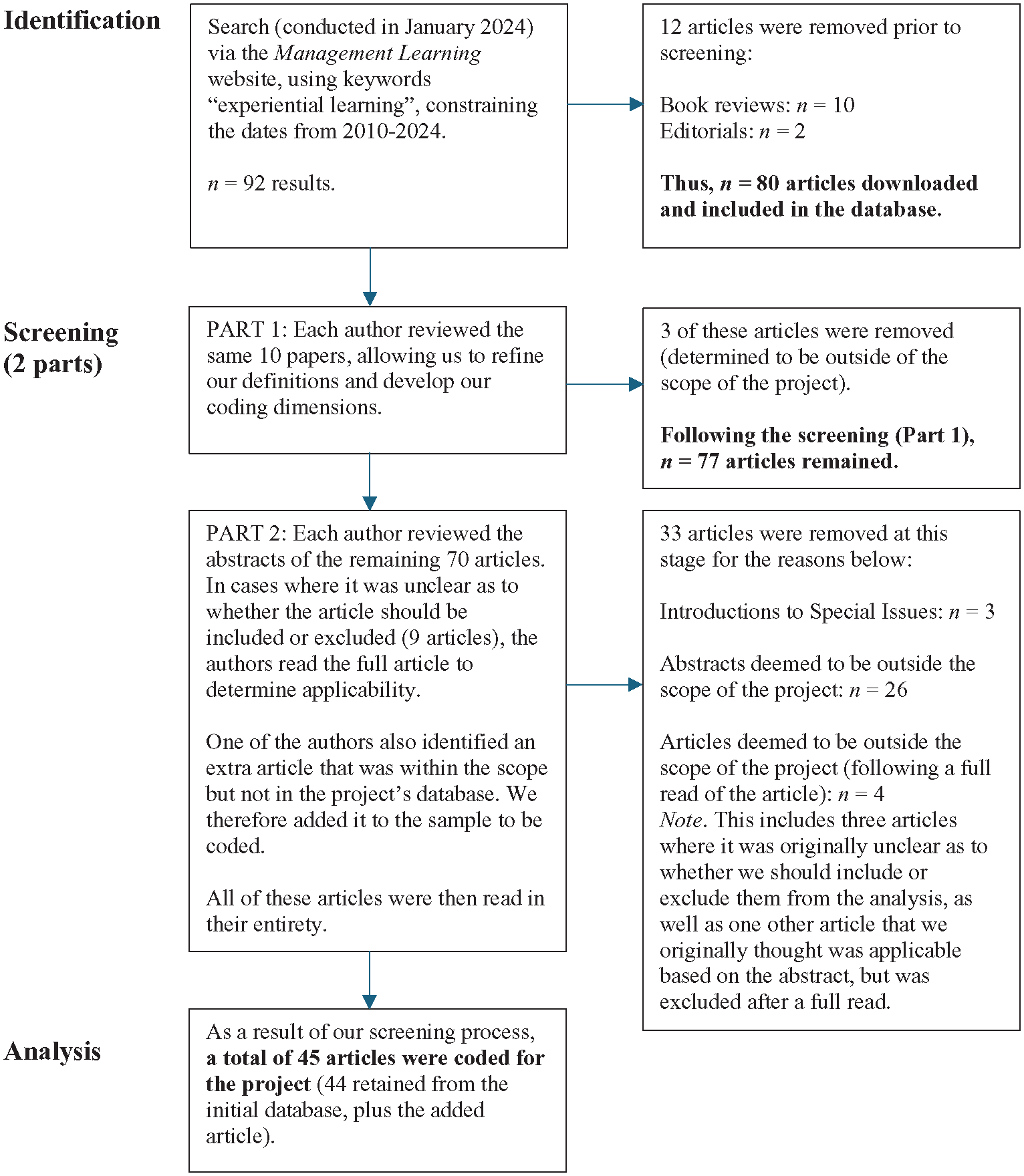
Synthesis of the identification, screening, and coding stagesa.
As we advanced in the coding process, we realized that our initial representation was too simplistic. While the code “experiential learning level” allowed us to pinpoint the main focus, it failed to capture the interconnectedness of the layers for many of the articles. Consider, for example, an article that centers on elements of the environment that can facilitate EL—while the overarching take-away may be context-related, our understanding of it is invariably positioned in relation to some EL process or component discussed by the authors. Thus, we added a column to the database that allowed us to take whether articles spanned multiple layers of the model into account.
Once the coding was complete, our final sample consisted of 45 articles that centered on at least one of three layers of EL (EL-centric, components, or context), published in Management Learning between 2010 and early 2024. Figure 3 presents an updated model with the associated articles.
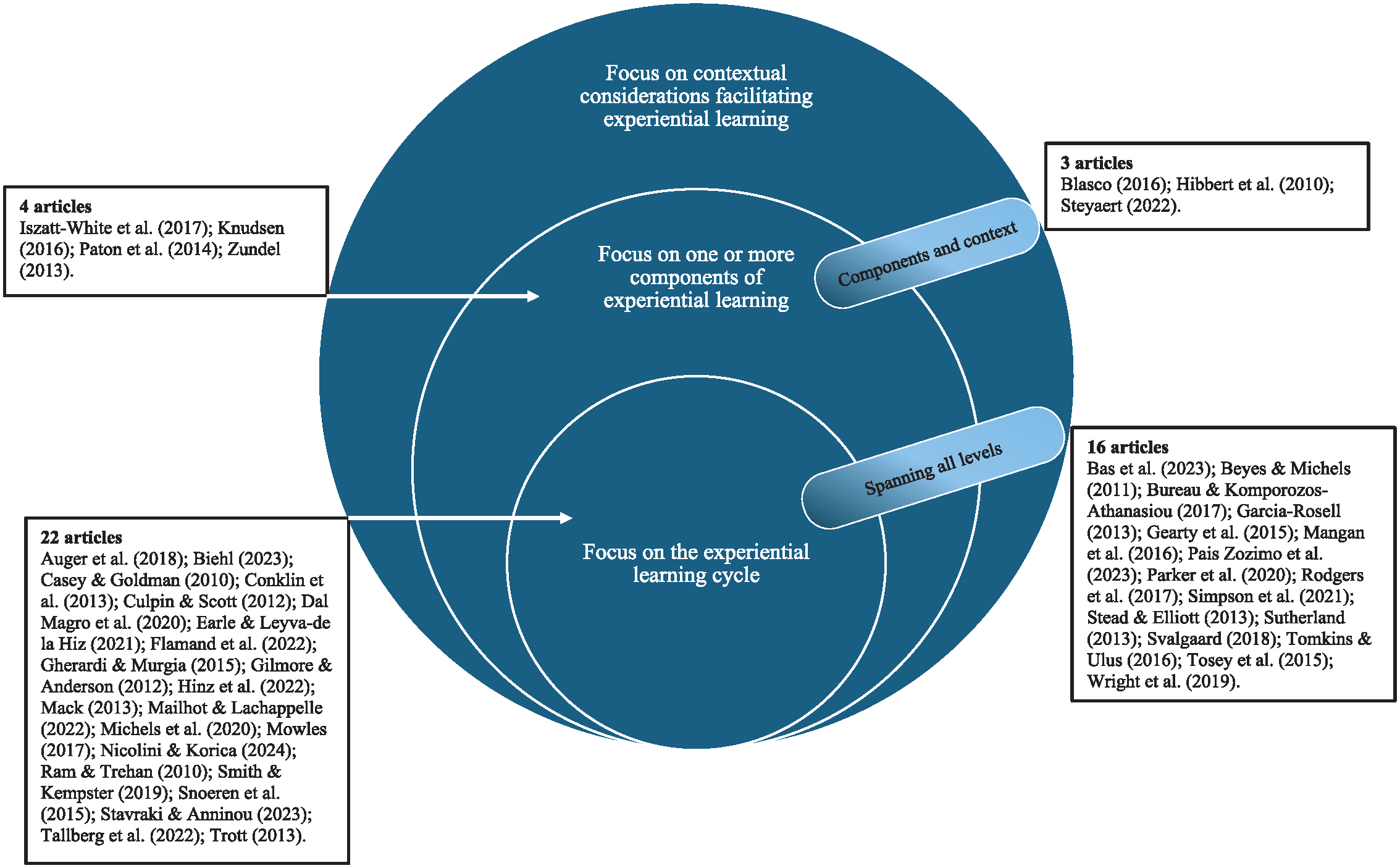
The interconnected layers of experiential learning in Management Learning (articles published from 2010 to 2024).
Findings
In this article, we use an onion as a metaphor to represent the three layers of research exploring EE published over the past 14 years in Management Learning. At its core (Figure 3) lies articles that reflect a comprehensive EL process. As examples, Flamand et al. (2022) argue the importance and usefulness of arts-based learning for students via a qualitative analysis of an experiential arts-based seminar in France, and Tallberg et al. (2022) chronicle the teaching methods integrated into an animal ethics course to encourage students to reflect on the topic, drawing on a concept they term “fierce compassion.” The second layer comprises articles that primarily focus on specific dimensions of the ELT model. While this does not mean that other parts of the EL process are not discussed by the author(s), we used this code when we felt that the heart of the take-away(s) rested with specific component(s), as in Zundel’s (2013) article exploring the concept of reflection. The outer layer includes pieces that focus on contextual factors that facilitate or hinder EL—Beyes and Michel’s (2011) discussion of educational space is an excellent illustration.
Our analysis suggests that the primary focus of articles in our sample is predominantly EL-centric (77.8%), with the remaining percentage evenly split between component(s) and context. As shown in Figure 3, a little over one-third (35.6% 1 ) spanned the three levels, such as Bas et al.’s (2023) piece that explores “why analytically educated learners may be reluctant to engage in sensory-based learning” (p. 489). Finally, 6.7 percent of the articles spanned both the component and context levels, 2 as exemplified by Blasco (2016), who weaves together insights on different types of curricular space and their influence on reflection and learning.
As shown in Table 1, most articles used a qualitative methodology (66.7%). In terms of instructional level, the authors discussed their research and innovations in relation to a variety of learners, highlighting the breadth of audiences for EL articles in Management Learning.
Descriptive summary of codes and frequencies.

Frequencies for the Kolb dimensions are based on 44 observations, as one article did not fit well for this code.
Although the extant literature draws on a number of perspectives to conceptualize EL (e.g. Fenwick, 2001), we opted to code the dimensions of Kolb’s (1984) ELT to explore the extent to which the EL process was discussed across articles. Admittedly, this was not an easy category to code, as authors can rely on different perspectives of learning to support their work and, as such, we sometimes had to infer dimensions of the model. With these caveats in mind, we found that most articles touched on the full EL process (72.7%).
Situating research in Management Learning within Grain’s (2019) “messy field” of EL
Next, building on Grain’s (2019) “Visualizing a Messy Field: Clusters of Experiential Learning” model, we reflect on our findings and offer a modified depiction of the domain that identifies areas where research on EL in Management Learning (1) overlaps with the broader field and (2) extends the model by pinpointing additional activities relevant to certain clusters. In so doing, we both differentiate the journal and highlight its strengths and distinctive elements.
At the broad level, EL articles mapped onto all seven categories identified by Grain (2019): Community-engaged activities (critical service-learning; e.g. Dal Magro et al., 2020), Research-based activities (fieldwork; e.g. Auger et al., 2018), Work-integrated activities (job shadowing; Nicolini and Korica, 2024), Student-led activities (student entrepreneurship; Tosey et al., 2015), Land and place-based activities (sustainability education; Tallberg et al., 2022), Strategy-specific activities ([art] exhibition; Bureau and Komporozos-Athanasiou, 2017), and Immersive-local & global (T-Groups; Conklin et al., 2013). See Figure 4, with the overlapping dimensions depicted in bold capitalization.
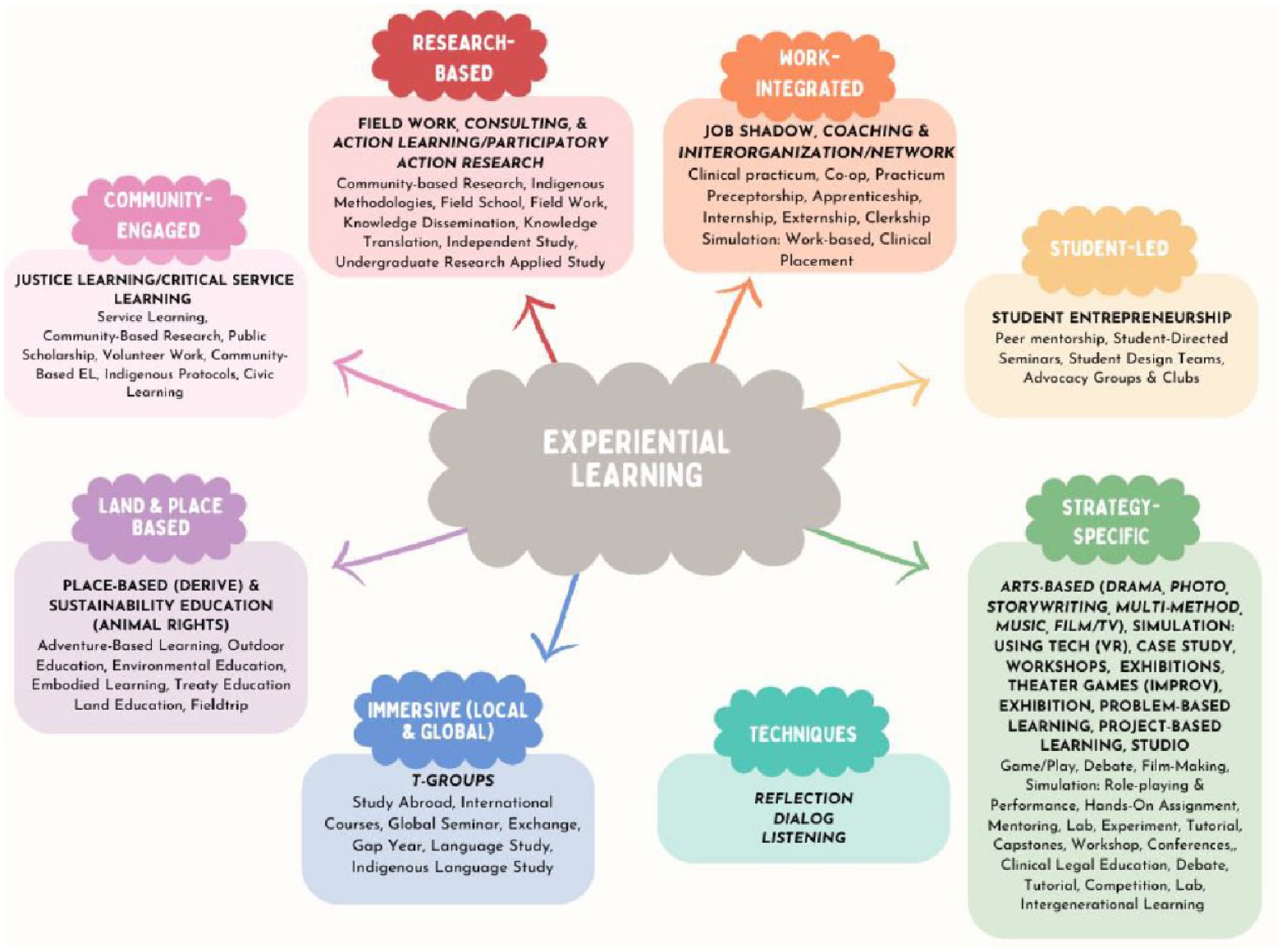
Situating Management Learning’s foci within Grain’s (2019) clusters of experiential learning.
Management Learning’s extensive EL scholarship also helps advance the field with several amendments, depicted in bold italics in Figure 4. The first is the new “Techniques” category, which underscores the attention to the core pedagogical components of reflection, dialog, and listening that are covered in the journal and relevant to the broader EL field.
Next, are four categories in the model where scholarship from the journal helps to extend the visual, by adding distinct and relevant components. These include Research-based activities (consulting and action learning, as well as participatory action research), Work-integrated integrated activities (coaching and inter-organizational/network), Immersive activities (“T-groups”-intensive group work dynamics training), and Strategy-specific activities (namely, a focus on arts-based EL). Within the arts-based extension, we can further distinguish subcomponents, accentuating the breadth and richness of this area for Management Learning, including drama, photo, story writing, music, film/TV, and multi-methods.
In mapping the research on EL in the journal to Grain’s (2019) work, we observed that some of the articles were multifaceted and, as such, linked to two components of the model. These include Mangan et al.’s (2016) article, with an arts-based drama approach using a workshop structure; Beyes and Michels’s (2011) piece incorporating both place-based dimensions and an (art) exhibition; Mailhot and Lachapelle’s (2022) problem-based learning anchored in a place-based approach; Michels et al. (2020) who integrated place and photography; and the articles by Mack (2013) and Bureau and Komporozos-Athanasiou (2017) that combine studio arts and exhibition. Although the interconnections among components are not depicted in the figure, these fusion approaches offer a glimpse into future research and opportunities for EL studies and innovations.
Discussion
The literature provides several lenses through which we can define and conceptualize EL (e.g. Fenwick, 2001), as well as recognize the vast array of experiential activities that can be used in the classroom and other learning settings (e.g. Grain, 2019; Wright et al., 2022). In this article, we review and analyze research and innovations on EL published in Management Learning from 2010 to 2024 and contribute to this conversation in two ways.
First, we elaborate on three layers of EL research in the articles published within that time period. When considered individually, our analysis suggests that the core (representing nearly four-fifths of the sample) comprises articles that center on the EL process, with the rest of the sample evenly split between the two other layers, focusing on component(s) and context. Taking interconnections into account, we find that 42.2% of the articles span multiple layers, with a little over one-third speaking to all three. This is a testament to the critical and nuanced discussions on EL present in the journal.
Second, we situate the research in the journal within the broader EL field conversations. Management Learning’s scholarship is clearly connected to this literature, as evidenced by the many links that can be made with the EL clusters identified by Grain (2019), as well as Fenwick’s 5-part model. Indeed, juxtaposing the journal’s EL scholarship within the larger domain highlights important distinctions. Reflection and the associated components of dialog and listening emerged as an important theme in our coding, inspiring us to propose adding the category “Techniques” to Grain’s (2019) model. Moreover, though a number of categories from the model were well represented in the articles, we also identified six components (i.e. consulting, action learning/participatory action research, coaching, inter-organizational/network, arts-based, and T-groups) to be added. Notably, the arts-based category yielded six sub-components of interest—this is clearly a strength of the journal and a resource for the field.
Another distinction was the expansion of EL beyond higher education institutions to other settings, learning stakeholders, and populations. For settings, this is seen in the Place-based and Community-engaged categories (service-learning). For learning stakeholders this is demonstrated in the addition of consulting (e.g. Svalgaard, 2018) as a Research-based activity, as well as the new action learning/participatory action research component (e.g. Gearty et al., 2015). Finally, for populations, this is evidenced in the rarely discussed inter-organizational setting (e.g. Hibbert et al., 2010; Ram and Trehan, 2010) and entrepreneurial networks (e.g. Pais Zozimo et al., 2023). This is relevant in preparing current students to engage with the complexities of “real” work and negotiate theory/practice, in addition to broadening conversations to EL within collaborative and network settings. Notably, in developing the model, Grain (2019) noted that “[t]his is only one way to visualize the field,” therefore inviting addendums such as the ones proposed in this article.
To close, we briefly reflect on our findings in light of Fenwick’s (2000, 2001) five-part view of EL, to recognize that the articles in our sample include links to each of the five perspectives: constructivist (evoked in nearly half of the sample in our theory notes), psychoanalytic (seen in a small subset of articles that moved us to extend the Immersive category to reflect this very longstanding element of the EL tradition; Meyer, 2024; Seaman et al., 2017), situative (indeed, the importance of “context” in our coding underscores the degree to which EL research in the journal often eschews EL as a solitary cognitive process, seeing it an interconnected holistic approach involving individuals, groups, and the learning setting), critical cultural (a hallmark of the journal, as seen in many articles, such as Tallberg et al.’s (2022) animal activism instructional innovation), and enactivist (as expressed in the distinctive new component inter-organizational/network). Importantly, authors sometimes drew upon more than one perspective. This suggests a fruitful avenue for future research, whereby authors may systematically examine the use of theoretical and philosophical frames within the journal.
Conclusion
Our analysis of the research on EL published within Management Learning (2010–2024) points to a rich and nuanced discussion of this learning approach. The articles analyzed clearly map onto broader conversations related to EL in management education, while also providing distinctive insights to extend them.
To conclude, we reflect on two areas that were only lightly present within the sample. First, few studies explored educational technology (with one exception in which Earle and Leyva-de la Hiz (2021) explore Artificial Reality/Virtual Reality). This is surprising in light of considerable pedagogical experimentation with online learning during COVID-19 and longstanding discussions on educational technology, now reaching a new fevered pitch in the face of generative artificial intelligence (e.g. Lim et al., 2023). Second, the EL-focused articles appeared to have limited direct and explicit integration with indigenous and post-colonial/decolonial pedagogical discussions, which are of lively debate in many countries and regions (Darley and Luethge, 2019; Verbos et al., 2011). These gaps, in addition to the aforementioned research opportunities, offer additional places for those in the Management Learning community to build upon the journal’s strengths, connect with the broader EL field, and develop new integrative and disruptive EL pedagogy, andragogy, and heutogogy for the next generation of students, organizational members, managers, leaders, entrepreneurs, activists, and network members.
