




Abstract
Profound changes caused by digital transformation are reshaping organizations in many sectors. This article presents a longitudinal exploratory case study of a project management office (PMO) in the banking sector, which participated in its organization’s digital transformation. The focus is on the evolution of the PMO’s participation during the transformation process. This study provides a rich understanding of the evolving tensions and challenges faced by PMOs and their connection as boundary spanners and contributors to the ongoing transformation from a multilevel process perspective.
Keywords
Introduction
We are honored to contribute to this special issue of Project Management Journal®, which pays tribute to our dear colleague, Ralf Müller. In this empirical article, our point of departure is clearly the research undertaken by Ralf in project studies on governance and governmentality (Müller, 2009, 2017; Müller et al., 2019). This article also builds on Ralf’s previous work on project management offices (Aubry et al., 2012; Aubry et al., 2010), where his bold leadership, energizing teamwork and, above all, his humor were greatly appreciated.
Project management offices (PMOs) are associated with the governance of projects (Riis et al., 2019) and regularly serve as an interface between programs, projects, and the rest of the organization. However, little is known about their evolution (Bredillet et al., 2018), least of all during an organizational digital transformation. Yet, the rapid development of digital technologies is prompting organizations from different industries across the world to engage in digital transformation to survive or maintain market dominance (Margiono, 2020). Digital transformation is the application of digital capabilities to processes, products, and assets to create innovative business products and processes (Nan & Tanriverdi, 2017). Consequently, digital transformation changes an organization’s strategy, structure, processes, and culture (Margiono, 2020). It also raises governance-related issues that few studies have addressed to date (Gimpel et al., 2018). Digital transformation programs and projects are complex and generally riskier than expected (Flyvbjerg & Budzier, 2011). They are notoriously difficult to execute (Reeves et al., 2018; Van Veldhoven & Vanthienen, 2023) and often require adaptive, agile approaches to handle their complexities and uncertainties (Conforto et al., 2016; Lappi et al., 2018). Moreover, the governance of projects, especially for agile projects, requires further research and theorization (Niederman et al., 2018).
Therefore, gaining a better understanding of the PMO’s evolution by studying their participation in this context should be very interesting for the following reasons: First, as integrator and guardian of the overall vision of wide-ranging programs, including digital transformation, the PMO should allow a single channel of communication upward and downward and also coordinate and control programs and projects (Artto et al., 2011). Second, the nature of projects in different industrial sectors impacted by digital transformation will have to change to integrate more technologies, which should have an impact on the PMO’s functions of training, supporting changes (Pemsel & Wiewiora, 2013), and innovating (Sergeeva & Ali, 2020). Finally, to obtain and maintain stakeholder engagement, PMOs could have a substantial impact as facilitators, given their close and long-lasting links with the various stakeholders (Riis et al., 2019).
The exploratory research design for this study is a longitudinal embedded single-case study of a PMO in the context of an organizational digital transformation, in a large banking organization in Canada. The digital transformation is shaking up the entire banking industry by fundamentally changing how banks operate (Lee & Shin, 2018); this provides a very fruitful context for research on digital transformation. The research data cover the first six years of this transformation, which is not yet completed. This qualitative approach allows us to consider several levels of analysis and thus understand in depth how the PMO participated in organizational transformation (Geraldi & Söderlund, 2018). This research draws on the processual perspective, which is particularly relevant for project studies (Brunet et al., 2021) and uses Simard et al.’s (2018) multilevel, process-based conceptual framework, which is composed of the concepts of governance, organizational design, and governmentality. The framework builds on Müller’s important work on governance and governmentality (e.g., Müller et al., 2019). This establishes the context for our two research questions:
How do PMOs participate in organizational digital transformation?
How do governance, organizational design, and governmentality interact to enable or hinder PMOs’ participation in organizational digital transformation?
The main contributions of this study are the following. First, we identify PMOs as boundary spanners and as suppliers of boundary-spanning experts during a digital transformation. Second, we characterize PMOs’ participation as having a stabilizing impact during a digital transformation. Third, we highlight the potential relevance of accepting paradoxes, in understanding the evolution of transformation strategies and PMOs’ participation in agile transformation programs.
In the following sections, we present the theoretical background and conceptual framework, followed by the research methodology, the case study, and the findings, and end with the discussion and conclusion.
Theoretical Background
We introduce the concepts of corporate governance and governance of projects in this section, followed by governmentality and organizational design. Then, the PMO is introduced in association with these concepts.
Corporate Governance and Governance of Projects
Corporate governance is the system relating to the management and control of organizations. Its structure specifies the distribution of rights and responsibilities among the various stakeholders and dictates the rules and procedures governing decision-making processes (OECD, 2004). The scope of governance is broadest at the corporate level and narrower at the levels of functional units, groups of projects, and individual projects (Müller et al., 2016).
The governance of projects refers to the governance of portfolios, programs, projects, and project management, all of which coexist[s] within the organization’s governance framework (Müller et al., 2021; Müller et al., 2014). The governance of projects engenders a governance structure that applies through organizational structures providing authority for its execution (Müller et al., 2014). Within this interface, mechanisms are usually put in place such as PMOs (Aubry et al., 2012) and steering committees for projects, programs, and portfolios (Müller et al., 2017). These elements are all part of organizational project management (Müller et al., 2019), which can be considered as a way to handle the relationships between different levels of governance, acknowledging that these relationships are not straightforward (Müller et al., 2021).
Project governance can be envisioned as a “[…] system by which a project is directed, controlled, and held to account” (McGrath & Whitty, 2015, p. 781). However, despite the importance of project governance (Musawir et al., 2020), little has been written about how it is designed, implemented, and adapted to manage the dynamics of projects (Song et al., 2022). There is also a need for further studies on the interaction between project governance and other levels of governance within organizations (Burke & Morley, 2016; Müller et al., 2021; Simard et al., 2018; Song et al., 2022), including specifically for agile projects and their governance (Lappi et al., 2018; Niederman et al., 2018; Stray et al., 2022). Moreover, the social dimensions of projects represent another aspect that has yet to be properly taken into account (Flyvbjerg et al., 2012). Recent research on the concept of governmentality in the context of projects, which addresses the human side of governing (Müller et al., 2014; Müller et al., 2016; Riis et al., 2019; Simard et al., 2018), has provided an interesting avenue to advance knowledge of project governance.
Governmentality
This concept is associated with the art and task of governance through the general and dispersed practices of governance, which are identified as the “conduct of conducts” (Foucault, 1991). Governmentality means both strategies of organizational governance, in a broad sense, as well as self-governance by those who are made subjects of organizational governance (Clegg et al., 2002). In the organizational context, governmentality concerns how to apply governance, whether through strict rules or through values that individuals share and respect (Clegg et al., 2002). Müller et al. (2015) suggested that governmentality can be positioned as the link between different levels of governance (e.g., projects, groups of projects). Overall, the practice of governmentality aspires to create a common sensemaking frame (Weick, 1995) at all levels.
Organizational Design
Organizational design represents a way of giving life to both governance and governmentality, as it is the framework that enables and allows collective action to occur (Greenwood & Miller, 2010). This concept can be associated with the structures of accountability and responsibility used to develop and implement strategies and human resource practices, and the information and business processes that activate those structures (Miller & Friesen, 1984).
However, little is known about how and to what extent projects, through their temporary structures and processes, are integrated or bounded within the parent organization’s more permanent structures and processes, including how this integration might evolve over the life of the project and what activities or linking mechanisms are required to connect temporary and permanent systems (Burke & Morley, F2016). A familiar and important example of such a linking mechanism is the PMO (Riis et al., 2019).
Project Management Offices (PMOs)
A PMO is defined as an organizational entity representing “a management structure that standardizes project-related governance processes and facilitates the sharing of resources, tools, methodologies, and techniques” (Project Management Institute [PMI], 2021, p. 245). “However, the character and function of a PMO may vary between organizations, and even within the same organization” (Project Management Institute [PMI], 2021, p. 211). The PMO’s participation in organizations is usually identified using three main governance roles: controlling, partnering, and serving (Aubry et al., 2012). While these roles are clearly exclusive, different PMOs within a single organization can exhibit complex mixtures of roles and can take on different roles simultaneously (Aubry et al., 2012).
However, recent research on PMOs has also shed light on more complex organizational arrangements whereby governance might need to become more dynamic to ensure better integration with various mechanisms, including coaching, facilitating, coordinating, and innovation strategies (Artto et al., 2011) and to activate creativity and innovation (Pemsel & Wiewiora, 2013; Sergeeva & Ali, 2020). Thus, the traditional models of PMOs must be expanded (Riis et al., 2019). In addition, environments characterized by uncertainties and constant change, such as the digital transformation (Conforto et al., 2016; Lappi et al., 2018), are increasingly using agile projects. In such contexts, issues involving PMO adaptation to agile approaches have been reported in the literature (e.g., Dikert et al., 2016). While PMOs show some signs of adaptation to the agile mentality, as indicated by professional project management associations (e.g., Project Management Institute [PMI], 2021), little is known about their evolution in this context, where the omnipresence of change may require a closer relationship between temporary and permanent governing and organizing.
However, PMOs often face two power system logics: hierarchy (vertical governance) and projects (horizontal project governance). While vertical governance is well known and essential to maintain coherence within the overall organizational governance, the horizontal type of governance dedicated to projects is temporary and less visible (Aubry & Simard, 2023). According to Aubry (2011), governance alone does not suffice to account for the complex power relations and decision-making characterizing projects. The examination of PMO governance at the interface of permanent and temporary organizing, and of formal and informal social structures (Riis et al., 2019), should contribute new insights and enhance our understanding of PMOs’ place in the governance of organizational project management (Aubry & Simard, 2023). Overall, PMOs can be considered to be socially constructed.
Conceptual Framework
The conceptual framework of this study is based on the work of Simard et al. (2018), who proposed a framework to establish the necessary complementarity among governance, governmentality, and organizational design in the governance of organizational project management, from a perspective that draws heavily on the theory of organizational processes (Hernes, 2014). Figure 1 illustrates the conceptual framework adapted to the research context for this article. The left side, which displays the adaptations made to Simard et al.’s framework, presents the multiple levels usually found in organizations, showing that PMOs can be found at various levels and that they can span and bridge different levels.
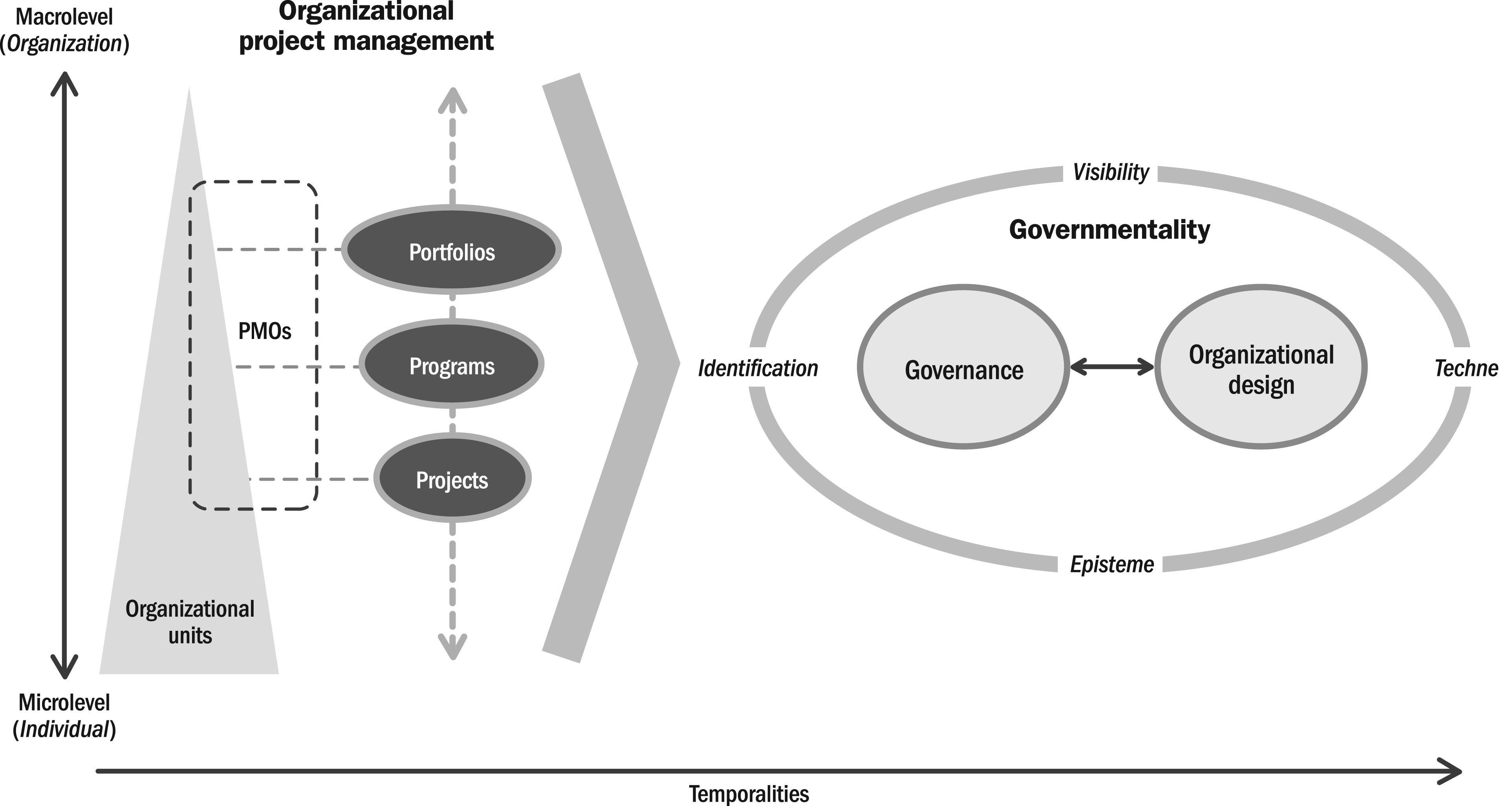
Conceptual framework adapted from Simard et al. (2018).
On the right side, governance and organizational design, shown in the center, interact at different levels (from microlevel to macrolevel) that represent the formal way of governing and organizing. Thus, each level is represented with its own governance and organizational design, both of which can also interact with governmentality, that is represented by an oval (see Figure 1) that is not specific to one level but instead surrounds the various levels. The idea of interaction between organizational levels, crossing their boundaries, applies not only at the project level (or at the management of projects level) but at all levels. The vertical Levels axis has a two-way arrow that represents these levels and potential interactions between the micro-, meso-, and macrolevels. The horizontal Temporalities axis signals that the concepts presented in this framework, including their interactions, evolve over time, since organizations are understood as being in constant movement—as becoming rather than being (Hernes, 2014).
Governmentality considers informal interactions within and between levels and refers to a social structure that is frequently modeled as a network that influences, and is influenced by, the different levels of formal governance and organizational design. This framework also considers the individual level to address the notion of self-governance arising from governmentality. Thus, governmentality can refer both to governance strategies, in the broad sense, and to self-governance of the subjects of this governance (Clegg et al., 2002).
For governmentality, the framework refers to Dean’s (2010) perspective, which has four dimensions:
These four dimensions are displayed in Figure 1 on the oval labeled Governmentality, implying that they interact. Each of these dimensions constitutes a vector of transformation and variation, and each presupposes the others without being reducible to them. Overall, the goal of governmentality is to consider how we govern and are governed, while incorporating how those who are governed perceive themselves to be governed. This view is useful for the study of the dynamic role of governance in the emergence of the informal social structure (i.e., emergent models of individual behavior and interactions between individuals).
This multilevel conceptual framework has the potential to capture the different mentalities involved in governing and their evolution over time, where organizations are understood as operating in a world on the move (Hernes, 2014). The governing/organizing dyad symbolizes the need for continual adaptation of governance and organizational design, including their relationships with other levels, where governmentality may play an important role. Thus, given that our aim is to study how PMOs participate in organizational digital transformation, this framework should be particularly applicable. Correspondingly, the research question using this framework is: How do governance, organizational design, and governmentality interact to enable or hinder PMOs’ participation in organizational digital transformation?
Research Methodology
Originally, our study focused on agile governance in strategic digital transformation programs, using Simard et al.’s (2018) conceptual framework. However, during this study, the PMO’s participation in the digital transformation attracted our interest and is the topic of this article. The following subsections introduce the research design and the data collection and analysis methods. Note that, for simplicity, the term programs will be used instead of projects and programs.
Research Design
This exploratory longitudinal case study has embedded units of analysis (Yin, 2017): the organization, the management of projects (e.g., PMO, digital transformation programs), and the events (related to the digital transformation). To study the evolution of the PMO’s participation during the transformation, we used a process perspective with a focus on the following units of analysis: the PMO and the events (Langley, 1999). Events should impact one of the following: (1) the governance or organizational design of the PMO or of digital transformation programs; or (2) informal social structures associated with the PMO or the digital transformation programs, based on the four dimensions of governmentality.
The main selection criterion established for the field setting was to identify a PMO in a banking organization that oversaw digital transformation programs and used an agile approach. This transformation had to have major impacts on both IT systems and business processes and be ongoing with a minimum remaining duration of one year. This last criterion was to ensure that transformation programs would still be under way in the event of delays accessing the field. The sampling in this case study was purposeful—specifically, exemplar—sampling because this case examines in depth and over time how a PMO was able (or unable) to participate in an organizational digital transformation while this transformation progressed. Therefore, it provides an exemplar of the phenomenon of interest over time (Patton, 2015). In addition, a case study is appropriate for research in emerging fields (Eisenhardt, 1989), such as digital transformation (Gimpel et al., 2018), and to study complex phenomena (Yin, 2017).
The PMO selected was especially created to organize and oversee a Canadian banking organization’s digital transformation. Executive management saw this transformation as strategic. At the time of the study, the transformation was under way. The most advanced transformation programs, in terms of progress and use of the agile approach, would last around two years more. Future programs were also planned to start soon.
Data Collection
Ultimately, three phases of data collection were carried out, but only the first two were initially planned. The first phase was executed in 2019–2020, over three months, and ended in February 2020, a few weeks before the outbreak of the COVID-19 pandemic in Canada. This first phase took place in the field; thus, the research data were collected on-site. The second phase, which was initially planned for four months later, actually took place 10 months later because of COVID-19. For that reason, this phase had to be performed remotely using Teams software. This phase occurred in 2020–2021, over a three-month period ending in January 2021. Two years later, a third data collection phase was added because the opportunity arose to collect data from an informant on major organizational changes affecting the digital transformation and the PMO. This phase, which was performed remotely using Teams software, began in early 2023 and ended in June 2023. The research data sources are presented first for phases 1 and 2, then for phase 3, followed by sources common to all three phases.
Specifically for phases 1 and 2, research data sources include semistructured interviews, observations of meetings (using a structured observation template), and documentation. The sampling method for interviews and meeting observations was typical case sampling (Patton, 2015) to select participants and meetings representing different groups and points of view. Thirty-three participants (16 in phase 1; 17 in phase 2) were interviewed. The participants were considered representative of different points of view; they had different roles, perceptions, and opinions about digital transformation programs and the PMO. Ten meetings were observed (4 in phase 1; 6 in phase 2). These meetings were representative of various types of committees (or groups) involved in the transformation. The interviews were conducted by the first author with open-ended questions using the same interview guide to ensure uniformity in the questions asked and the information gathered. The questions concerned the context and evolution of the digital transformation and the PMO since the start of this transformation, including their governance and organizational design and their relationships with the management of projects and organization levels using the four dimensions of governmentality. Interviewees answered questions based on their own context, which was usually associated with their level and role in the organization and in the transformation. Our aim was to identify the insight they had (or did not have) into the transformation and the PMO (e.g., governance mechanisms and rules, structure, events, tensions), what they recognized as accepted ways of working, and their representation and understanding of the transformation, including their own contributions.
Table 1 presents information on data collection for phases 1 and 2. Interviews are grouped by organizational level. There are four levels: (1) executive (president, senior vice president, vice president [VP]); (2) middle management (senior manager, manager, product manager, program manager, senior project manager); (3) line management (coordinator, team manager, project manager, senior adviser); and (4) staff. Meetings are also grouped by organizational level, which is determined by the level of the person chairing (or responsible for) the meeting. There are three levels for meetings, corresponding to the first three levels of interviews. In addition, for these two phases, the internal documentation obtained comprised status reports, governance and organization charts documents, and communications on the digital transformation and its impacts (e.g., major reorganizations), and performance appraisal templates.
Interviews and Meeting Observations for Phases 1 and 2
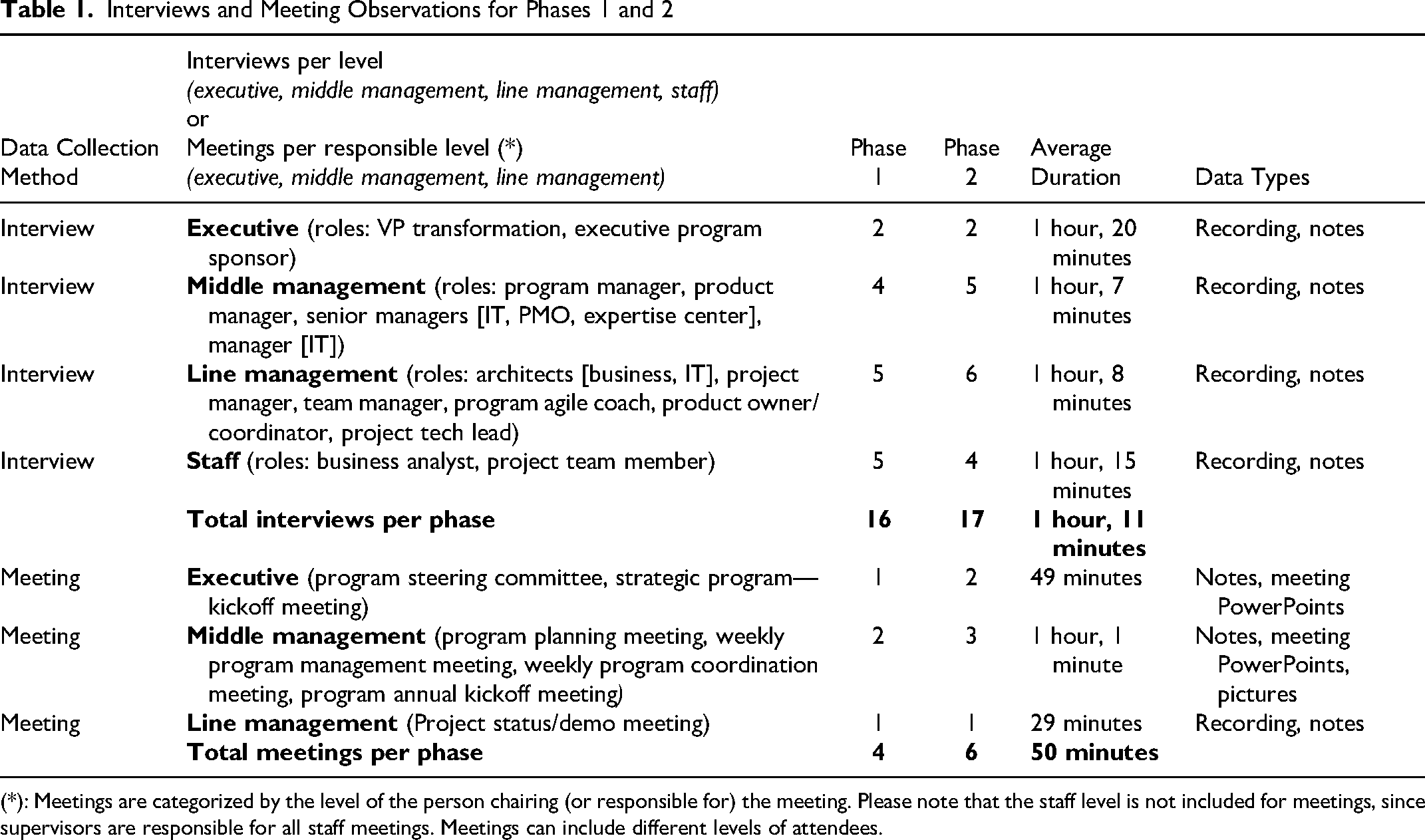
(*): Meetings are categorized by the level of the person chairing (or responsible for) the meeting. Please note that the staff level is not included for meetings, since supervisors are responsible for all staff meetings. Meetings can include different levels of attendees.
For phase 3, the research data sources were internal documentation and notes from our six discussions with an informant on major organizational changes concerning the digital transformation and the PMO. The documentation included governance and organization charts documents; and communications, mainly on the PMO, the digital transformation programs, and the organizational transformation, which provided detailed information on formal changes to the overall organization’s governance and organizational design to support the digital transformation.
Finally, a logbook, notes, and memos were also among the research data sources for the three phases, as was publicly available documentation on the Internet about the organization such as values and mission statements and the highest level governance structure.
Data Analysis
Our analysis took place in five steps. Note that the first two steps were carried out for phase 1 and then phase 2. Throughout our analysis, we used narrative strategy, temporal decomposition, and visual mapping to analyze and interpret the collected data. NVivo software (QSR International Pty Ltd, 2023) was used as a support tool for the management, processing, and analysis of research data.
The first step was coding the research data. This step was performed for phases 1 and 2. An initial list of codes was determined deductively based on the conceptual framework. Subsequently, this list was adjusted, and additional codes were created using open coding as needed (Miles et al., 2014). Thus, an abductive approach was used during the analysis. The coding was first done by two research assistants using a dyadic coding strategy. Any coding issues were discussed with the first author.
The coding was performed using a process perspective (Langley et al., 2013), in the following order: the interview transcripts in chronological order, then meeting observations, notes from field observations, and relevant documentation. Overall, five codes were removed and merged with other codes, eight code definitions were improved, and 10 codes were added (total: 79 codes). Then, by focusing explicitly on the research questions, we used axial coding combined with the drawing of relational schemas to identify relationships between codes and decide which codes and relationships were the most important, which resulted in 48 codes. This total was considered appropriate to capture the richness, complexity, and multilevel nature of this study (Saldaña, 2021). Note that the history of the case and the timeline of major events were updated throughout the analysis process, and special attention was also paid to identifying the levels involved.
Thereafter, the major themes were identified using pattern coding and the drawing of relational diagrams. For phase 1, three themes were identified: PMO is strategic for transformation, Maintenance of ambiguity and nonagile elements during transformation, and Maintenance of dualities within organizational governance and structure for the transformation. These themes highlighted the tensions triggered by the digital transformation and the importance of the PMO. For phase 2, the research data collected were especially rich because many tensions arose, and changes occurred before and during this phase. Participants were open to discussing these topics during interviews. The themes identified were Evolution of digital transformation from value chain to IT manufacture, Forcing of the traditional hierarchy into the transformation governance structure, and PMO is strategic for transformation.
The second step, which was performed for phases 1 and 2, was to further analyze the documentation and triangulate findings with observation and interview data. Following the analysis of phase 1, and just before the second data collection phase, we validated our preliminary results with two informants. Note that our validation process was similar for each phase; we validated the history and timeline of the case, as well as the results associated with the themes identified for this phase. For phase 2, we validated our preliminary results with an informant, and we also inquired about the progress of the PMO and the digital transformation. The timing was excellent, and a third data collection phase was added, as explained in the previous section.
The third step was to code phase 3, using the same coding strategy as in step 1, but the coding was done by the first author and the results were discussed with the second author. The research data enabled us to analyze the impact of the digital transformation on the overall organization’s governance and structure. The resulting themes were Evolution of digital transformation strategy, Tensions versus stabilization layers, and PMO is replaced by Transformation office as strategic hub. The fourth step was to triangulate findings with notes and documentation. Then, we validated our results with our informant.
Overall, our results revealed that, even though the PMO was no longer considered strategic, it had been an important player and made significant contributions during the first years of the transformation. Indeed, the transformation would not be at its current state without the PMO’s important past contributions. Finally, the last step was to validate our findings with the literature.
Case Study Presentation
The field of our research is a large banking organization located in Canada, which is a typical bureaucracy (Mintzberg, 1979); it started its initial digital transition around 2010. Some digital change projects were launched, using a traditional project management approach in weak matrix mode, and many failed. During this period, some initial experiments with agile approaches and new digital technologies took place. This initial digital transition gradually evolved from an information technology (IT) issue to a real organizational concern for executive management. Consequently, in 2017, substantial changes were made to start the organizational digital transformation. Our first data collection phase started around three years later.
Findings
Based on the research data analysis covering the first six years of the digital transformation, which is still in progress, Figure 2 presents a timeline of the five main transformation periods and three transformation strategies that were identified over time and also includes our three research data collection phases (RDC Phase X). For each transformation period, the formal changes in governance and organizational design for the digital transformation are presented with the symbol  and an ID number (1 to 9); for formal changes that were made at the organizational and management of projects levels, this symbol is white, whereas for those made only at the management of projects level, the symbol is gray.
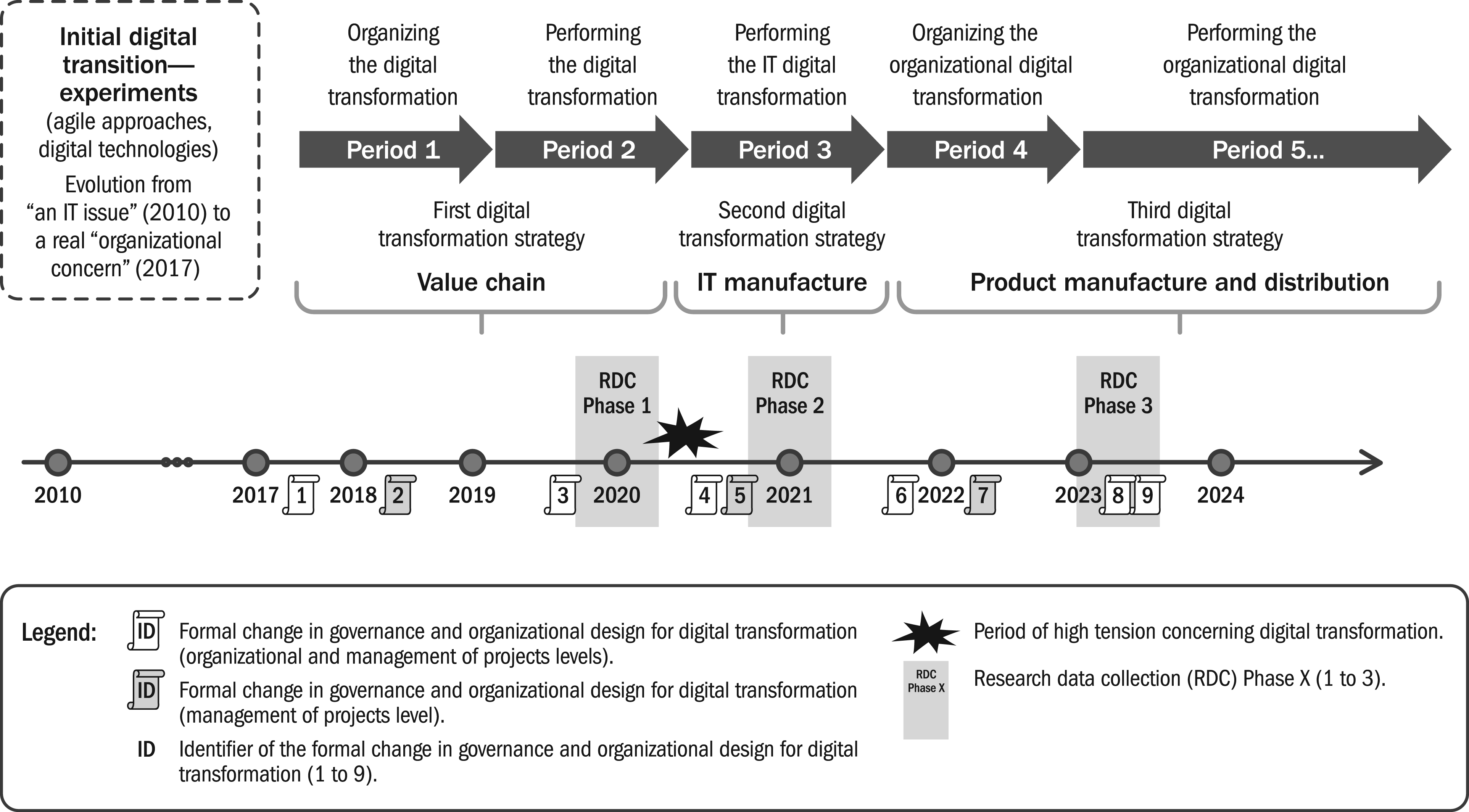
Timeline of the digital transformation periods and research data collection phases.
The following section presents the findings on the PMO’s participation in the digital transformation and the progression of the transformation strategy through a governmentality lens across these five periods. These findings were obtained by examining how formal changes identified for the digital transformation (see Figure 2) interacted with informal social structures using the four dimensions of governmentality. Next, we present the resulting digital transformation process from a governmentality perspective.
The PMO and the Evolution of the Transformation Strategy: A Governmentality Lens
Overall, four forms of governmentality were identified over time, each with four dimensions, as presented in Figure 3. The first form of governmentality, traditional hierarchy, was identified in the organization as a whole, representing this organization’s basic governmentality style: the traditional way of governing/organizing through a functional hierarchical structure—a bureaucracy—which facilitated vertical power recognition. Employees’ identification with their unit and manager was made visible and enforced through the structure and governance processes such as performance appraisals. The PMO was recognized as an expert in traditional project management. This first form of governmentality underlay the other three forms of governmentality, which are associated with the three transformation strategies identified during one or more of the digital transformation periods (see Figure 2), namely value chain, IT manufacture, and business product manufacture and distribution. For the sake of simplicity, each strategy is named after the form of governmentality (or mentality) on which it is based.
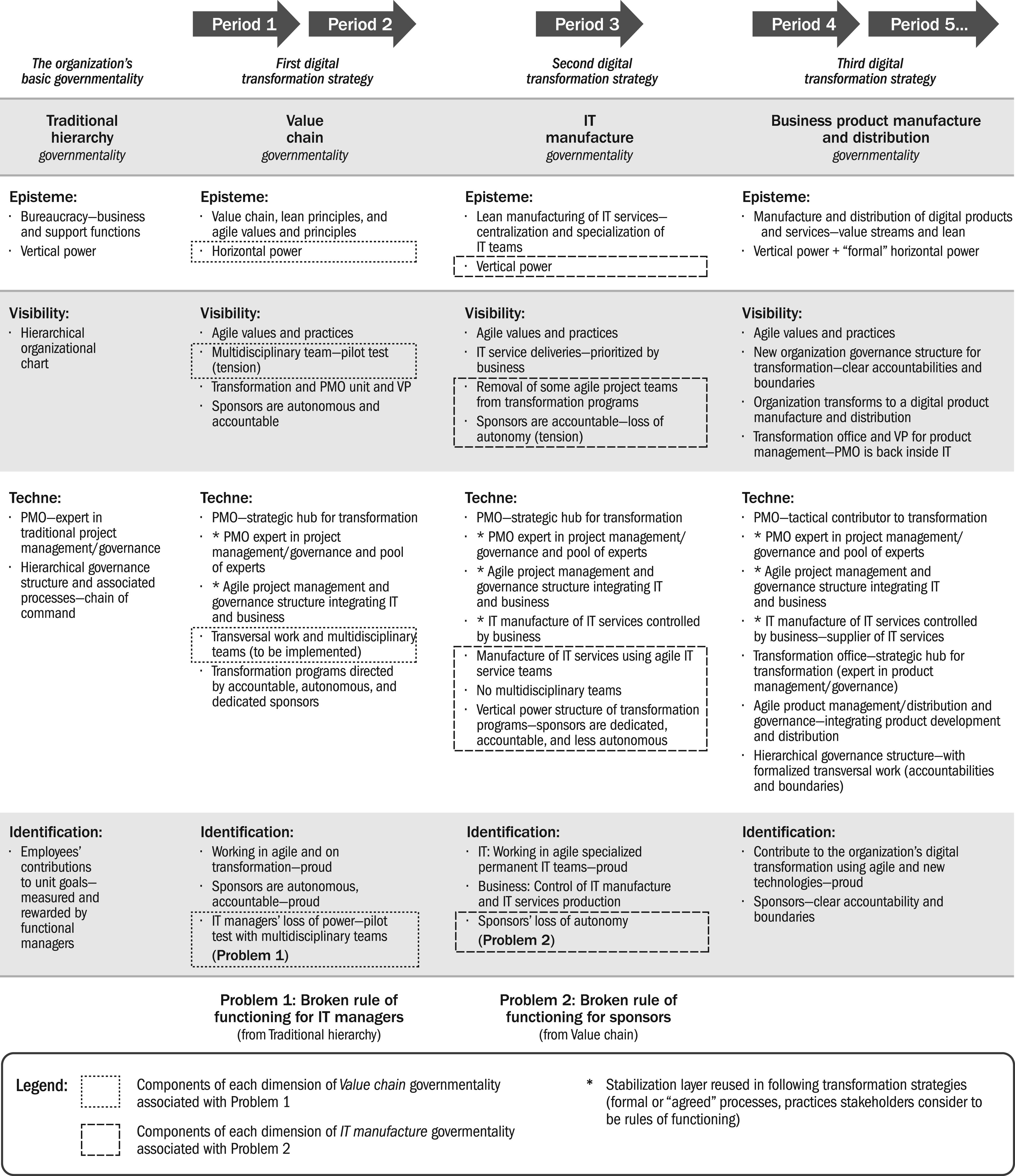
Organization and transformation governmentalities.
The following sections present the findings for each of these three forms of governmentality (see Figure 3) structured as follows: (1) events or activities or tensions triggering the development/execution of a new transformation strategy; (2) formal changes in governance and organizational design (refer to Figure 2); (3) impacts of these changes on the transformation; (4) impacts of these changes on the PMO; and (5) tensions observed (note: presented only for the forms of governmentality corresponding to the first two transformation strategies).
Value Chain Governmentality (Periods 1 and 2)
“We use digital transformation and all the projects in the digital transformation ecosystem to transform our way of doing things.” (Executive Manager)
Multidisciplinary teams meant that IT middle managers would not be able to truly oversee agile project teams, as each member of an agile multidisciplinary project team reported to various IT middle managers. “… Value chain, in fact, [in a transformation program], you’re going to have all the products that are going to be grouped into different [multidisciplinary] agile project teams [from various functional units’ managers]…. The challenge is that we try to orchestrate them all in a coherent way….” (Sponsor)
The PMO was also responsible for controlling the progress of programs and producing status reports on the overall transformation portfolio. And it had to build, develop, and manage a pool of agile project management experts for this transformation, including the creation of new roles. The main roles were agile program (and project) managers, business analysts, scrum masters, and other project management supporting roles. The PMO acted as the resource manager of these specialized resources through its PMO managers, who also served as its representatives in transformation program steering committees.
Even though these recent agility-related changes were still under development and their use was no cheaper than using a traditional approach (contrary to what was initially expected), they were well received and appreciated (contrary to the traditional approach). Employees were proud to work in agile teams and on the transformation. These changes provided flexibility, transparency, and results (small deliveries); enabling business stakeholders to participate, provide directions, and control programs, which built trust. “The value chain and agility… they really start with good agility approaches.” (Executive Manager) “Before using agile approaches, we worked on large analysis periods [using traditional approaches], … then we came up with figures that made no sense: tens of thousands of days to do projects. So multiyear projects, then… we did annual reviews, but not a lot of stuff was delivered.” (Business Line Manager) “Agility, what I really like is to succeed in giving a new rhythm to the work, then a regularity [frequent, regular deliveries] …. We are not there yet, but that’s what I really like.” (Sponsor) “Agility is definitely not cheaper [than traditional approach] … [but, at least] we deliver…. There was a small delay in time…. Then, when I say small, it is because in fact the deliveries arrive at the right time.” (Sponsor)
“My projects are agile [use agile approaches], but if you look at it, it’s more of a waterfall in agile mode [each team does its part as in an assembly line]…. The challenge we have is to move from a command-and-control organization, where people are assigned to teams of expertise [specialized knowledge] to an agile mode with multidisciplinary teams [strong matrix mode].” (Sponsor)
IT Manufacture Governmentality (Period 3)
“There is an issue… with the agile project vision [value chain]: there is a sponsor who establishes the vision, then there are IT people who work together, who ideally would be from the same middle manager. While there, we end up with a project with people who have a vision, which is to establish work with people who mix, from different specialties or expertise [multidisciplinary teams] …. So, there is also the IT service vision [IT manufacture], which says, ‘Well… we need experts [specialized teams] who will ensure, who will create an architecture that is robust [shared IT services].’” (Business Middle Manager )
“…We separated the groups in a clear way [created multidisciplinary teams for the pilot test] that worked for me…. I didn’t like that [pilot shutdown]. I was very vocal about that; I think the organization has gone backward. I said so.” (Sponsor) “They stopped it all [pilot test]… because it didn’t work…. Not that it didn’t work, management decided it wasn’t that…. Then senior management decided they no longer wanted those two [agile] teams dedicated [to the program]. They took them out completely [teams were assigned to IT manufacture]…. This is the new dynamic; it has changed everything [loss of autonomy]. He [sponsor] was not happy. We should still be prioritized for a large part of our requests because we are still one of the most important programs for the company.” (Program Manager)
Business Product Manufacture and Distribution Governmentality (Periods 4 and 5)
Digital Transformation Strategy Evolution Process—A Governmentality Perspective
In the previous section, two important findings emerged from the analysis of the transformation strategy evolution. The first was the problems provoked by breaking what groups of stakeholders considered their established rules of functioning during the implementation of a new strategy (e.g., see Figure 3, problems 1 and 2), which led to a change of strategy. The second was the contributions made by each transformation strategy to the subsequent strategies.
For example, for the first transformation strategy, the value chain, the PMO developed and implemented new agile project management processes and governance. It also developed a pool of agile project management experts to support the transformation while acting as their resource manager. These changes established the foundation, which can be conceptualized as stabilization layers (see Figure 3, stabilization layers) on which subsequent strategies were built. Overall, the last two transformation strategies would have not been feasible if the initial stabilization layers had not been created, and thus if the PMO’s expertise had not been recognized and applied. A similar comment can be made about IT’s contribution in becoming a manufacturer of IT services in the IT manufacture strategy. These findings illustrate the evolving nature of a digital transformation. Consequently, a process of evolution of digital transformation strategies could be induced, as shown in Figure 4.
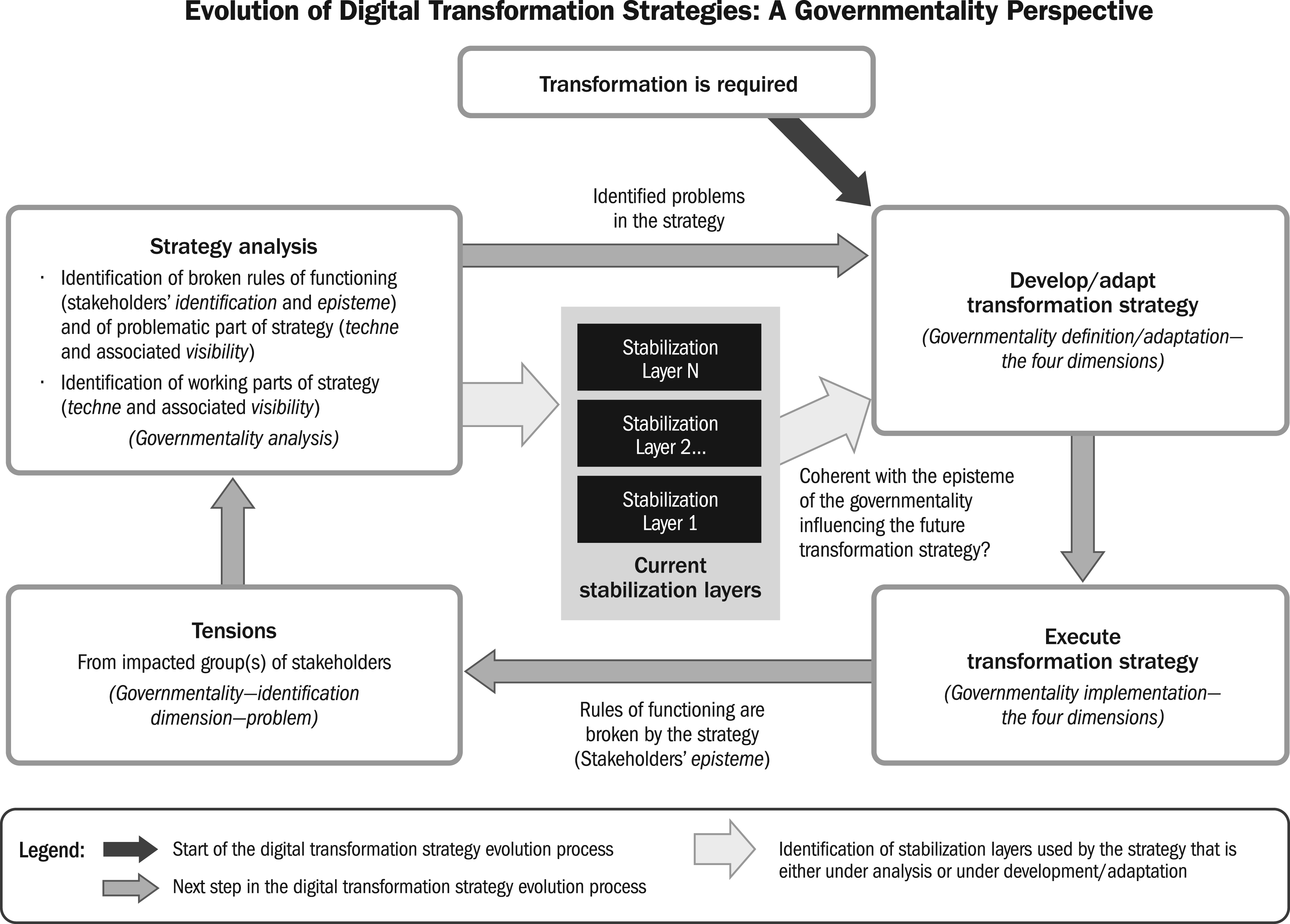
Digital transformation strategy evolution process.
Thus, a new governmentality might reuse some components of the existing governmentality that were considered well implemented and coherent with their vision (episteme). These components, which are usually associated with the techne and visibility dimensions of governmentality (i.e., formal or agreed processes, practices stakeholders considered to be rules), can be identified as stabilization layers, as they are already established and accepted by stakeholders, and therefore associated with how they think things should work (episteme). These layers (Cloutier & Couture, 2023) are sequential and cumulative. Over time, they stack up and provide a certain stability for overall governance.
Discussion
In the first section of the discussion, we will answer the first research question about the PMO’s participation in the digital transformation; then the evolution of the digital strategy will be further analyzed, leading to an answer to the second research question. Finally, the last section presents some unexpected findings from our study that led us to develop a theoretical and practical contribution on paradoxes and innovation.
The PMO’s Participation in the Digital Transformation as a Boundary Spanner
The first research question is: How do PMOs participate in organizational digital transformation? To answer this question, we followed a PMO’s trajectory through the evolution of digital transformation programs. Scholars have studied how PMOs constantly adapt to their context (Aubry et al., 2010; Bredillet et al., 2018). However, these authors mainly focused on high-level patterns of transition or change. In this article, though, we focus our attention on the activities related to the PMO’s changes in order to dissect and reveal more details about the PMO’s participation in the organizational digital transformation as it unfolded over time. The data analysis shows one main characteristic throughout the five transformation periods: the PMO’s active role is embedded within its boundary-spanning roles. The idea of a boundary-spanning role has been developed in project studies with the premise that “There is a significant barrier between a project and the organization it transforms, where dialogue between a project delivery team and organizational stakeholders requires work to cross this boundary” (Kier et al., 2023, p. 2). In this study, we investigated the PMO’s work in crossing the boundary between business and IT.
Before launching its digital transformation, the focal organization was best described as a hierarchical bureaucracy (Mintzberg, 1979). In the first two transformation periods, the PMO was assigned a strategic role and an agile approach was implemented. With its strategic position and its inclusion of agile experts, the PMO was connected with both business and IT units. Thus, the PMO itself and its pool of agile experts (e.g., program managers, business analysts) bridged both sides of boundaries and became boundary spanners. Experiencing and learning about agile approaches happens more easily when boundary spanners exist (Levina & Vaast, 2005). Moreover, understanding the PMO as a boundary spanner and as a supplier of boundary spanners opens up new theoretical interpretations of organizational digital transformation and, more broadly, any organizational transformation. So, the PMO transformed the organization as it was itself transformed by social dynamics. The answer to the first research question relies on the PMO being a boundary spanner and a supplier of a pool of boundary spanners (agile experts).
The Evolution of Digital Strategies and Governmentality
The second research question is: How do governance, organizational design, and governmentality interact to enable or hinder PMOs’ participation in organizational digital transformation? The answer to this question emerged from the results obtained regarding the evolution of digital transformation strategies (see Figure 4). These results revealed that the PMO was an important contributor in building the foundations—stabilization layers—of the digital transformation during the first two periods. These stabilization layers mainly concerned adapting and developing agile project management processes and governance and agile experts, which facilitated the digital transformation. Thus, the answer to the second research question is based on the PMO being an important contributor in building stabilization layers that facilitate an organization’s digital transformation.
Interestingly, this evolution process revealed some similarities with a process model examined by Cloutier and Couture (2023) in field-configuring organizations (an international industry association in their study). In both cases, processes explain how some adaptations to governance and structures accumulate progressively, like layers, to form an accepted new way of working. Acceptance of these adaptations is associated with consideration of the rules of functioning deemed important by groups of stakeholders affected by these adaptations. Thus, tensions can be caused by adaptations considered to violate important rules of functioning for certain stakeholders, which then require new adaptations.
The context of the two case studies is quite different. Our study investigated an intraorganizational digital transformation where specific groups of actors were making governance and structure decisions. The context of Cloutier and Couture’s (2023) study was an interorganizational field association in which the actors negotiated and made decisions. Despite these differences, in both studies, stakeholders and their acceptance of change were the core preoccupation and led to successive adaptations, which allowed already accepted layers to accumulate over time. These results underline the importance of considering the rules of functioning deemed essential by affected stakeholders when developing transformation strategies.
Organizational Tensions Between Traditional and Agile as a Stimulus to Innovate
The objective in this section is not to describe the traditional or agile approaches to project management in depth. Our intention here is rather to explore a digital transformation phenomenon from a paradoxical perspective (Smith & Lewis, 2011) and to offer a first reflection on it. This perspective, we believe, may provide an alternative explanation of the problems encountered in digital transformation projects.
In Table 2, we highlight the main characteristics of these two approaches, in which tensions may emerge along with their innovative potentialities. Tensions and paradoxes are not specific to the project environment. All organizations generate multiple tensions in their usual ways of working (Smith & Lewis, 2011). Table 2 presents three main characteristics of a project in the traditional and agile approaches, along with the category of organizational tensions from Smith and Lewis (2011) to which each characteristic mainly relates. Tensions emerge in organizations when the two approaches coexist, as in the case presented here. Indeed, as shown in Table 2, performing, organizing, and learning have different meanings and suggest different sets of solutions in traditional and agile thinking.
Main Characteristics of Projects in Two Different Approaches
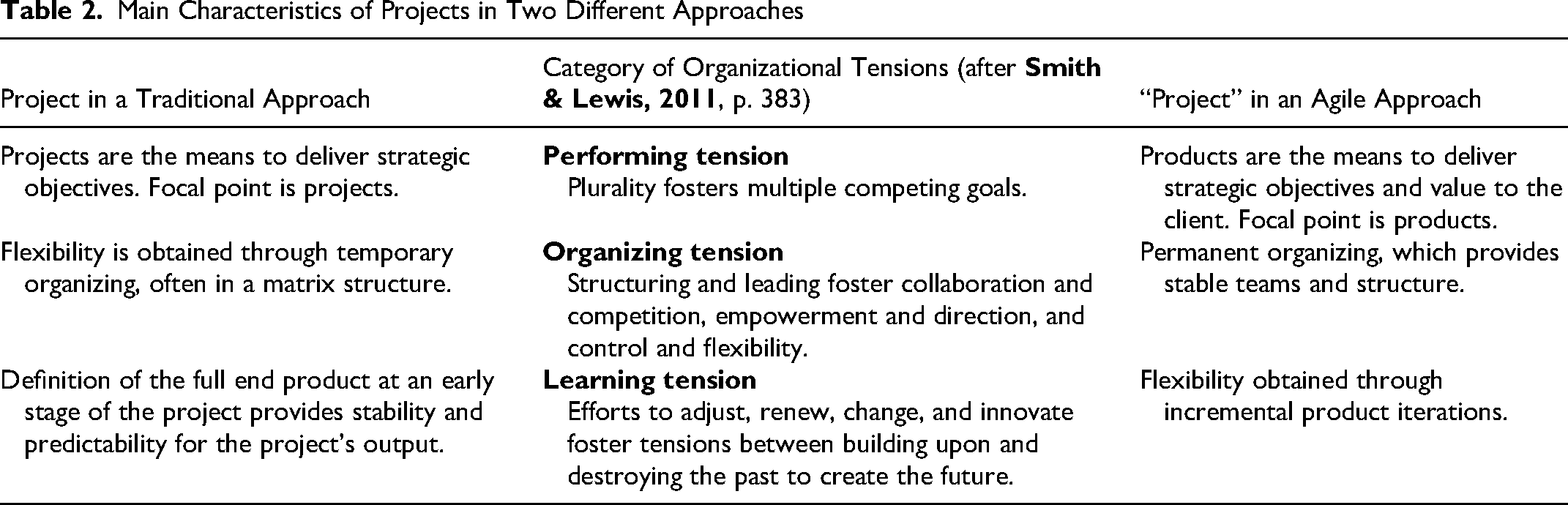
In complex and uncertain environments, could a PMO play on both sides—projects and products—in complementarity, to avoid conflicts and build positively on paradoxes? According to Smith and Lewis’s (2011) theory of paradox, acceptance of tensions and paradoxes may lead to a novel approach that would not be possible otherwise.
Interpreting the coexistence in organizations of both traditional and agile approaches as a paradoxical situation opens up new ways of thinking and acting. Theorizing with paradoxes encourages their acceptance, in an attempt to understand different points of view. It also encourages dialogue between actors so they can negotiate a managerial action, such as problem-solving, that will work and find a third, innovative, way to resolve their tensions. Smith and Lewis (2011) argue that this kind of managerial approach will lead to sustainability, here referring to organizational capabilities to develop products and projects by using the traditional and agile approaches together.
For practitioners, this paradoxical perspective may change the idea that they must choose one development approach or the other. Instead, practitioners should be encouraged to accept paradoxes and negotiate (and innovate with) a common solution. A good example of this is the PMO’s role seen as a managerial action within paradoxical situations. By definition, a PMO is traditionally dedicated to project, program, and portfolio activities or functions (Artto et al., 2011; Hobbs & Aubry, 2010). Conversely, in an agile approach, activities tend to rely on permanent and rather autonomous product development teams. Yet, this approach leads to questioning the relevance of a PMO. Some research on PMOs in a product environment has shown their value in the integration of a longitudinal life cycle, basically in managing the gaps between product development phases (Paton & Andrew, 2019). Other studies acknowledge that emerging roles in the agile approach will need to be negotiate such as having an agile PMO (Hobbs & Petit, 2017; Lappi et al., 2018). In the case presented here, the PMO both shaped and was shaped by the digital transformation’s organization yet followed its trajectory over time. Tensions and paradoxes lead to renegotiating a new dynamic equilibrium of organizing (Smith & Lewis, 2011). This is a first attempt to theorize PMOs through paradox theory. More exploration is needed to uncover this theory’s potential to better grasp the complexity of organizational agile transformation and to advance project studies.
Conclusion
Our results have revealed that a PMO can participate in an organizational digital transformation as a boundary spanner and a supplier of boundary spanners (agile experts). A PMO can also make a stabilizing contribution to the transformation (e.g., adapting and developing project management processes and governance), which is aligned with recent observations that organizations in this situation should focus on people and processes and not necessarily on technology (Kane et al., 2019).
PMO participation also depends on the acceptance of paradoxes and the negotiation of (and innovation with) a common solution by stakeholders involved in organizational decision-making for the transformation. Indeed, our results have revealed that a PMO’s relationship with product management becomes increasingly essential following the implementation of agile project management (Paton & Andrew, 2019), which should give rise to several areas of reflection. Like past observations of the need to broaden the traditional models of PMOs (Riis et al., 2019), these results highlight the rich potential for theorization about PMOs.
Contributions to Project Studies
This research has two main theoretical implications for project studies. First is the process perspective on a digital transformation project. This represents a major shift in viewing a project as a progressive activity where different governmentality, governance, and design solutions can be experimented with and adapted over time. The transformation project is socially constructed. We think that this perspective adds to Müller’s work (e.g., Müller et al., 2016) and builds on previous work by Simard et al. (2018).
A second implication is a contribution related to paradox theory. Tensions and paradoxes exist in all organizations, including projects. But what matters most is knowing how to navigate through these paradoxes to envision new, unexpected, and paradox-free solutions. This calls for negotiations between protagonists focused on solutions.
Overall, we hope this article will respond to the recent call for new concepts and cross-fertilization within and across project studies and related fields (Söderlund, 2023).
Implications for Practitioners
In line with the theoretical contributions, practitioners should take into account the context, including the political system, when undertaking a digital transformation project. This kind of project is not technical; it is an organizational change project. Also, as shown in this article, it might take several steps to achieve the final target situation. Practitioners need reflective capabilities to adapt throughout the duration of a project, make sense of tensions, and negotiate new solutions. Indeed, according to Hanelt et al. (2021), digital transformation is driving organizations to adopt malleable governance structures and designs that enable continuous adaptation. The digital transformation strategy evolution process identified in this study, which uses a governmentality perspective, could be used as a tool by practitioners to guide their reflections.
Limitations and Future Studies
The limitations of this study are mainly related to the variations among the three data collection phases. The first one occurred on-site, while the second was performed online (Teams software) because of COVID-19. The last phase was also performed online, and the collected data were mainly documentary since our key contacts for the transformation had either been transferred or left the organization. Thus, especially for the last phase, although the internal transformation documentation was rich, the research data were more limited and discussions and validations with an informant were used as a mitigation strategy.
Future studies should continue to explore PMOs’ participation in digital transformations across various industries, as well as the impacts of agile product management.
Footnotes
Declaration of Conflicting Interests
The author(s) declared no potential conflicts of interest with respect to the research, authorship, and/or publication of this article.
Funding
Dr. Simard would like to acknowledge the financial support of this research by the Fond de recherche du Québec - Société et culture (FRQSC), grant number 2020-NP-267586.
