




Abstract
The purpose of this article is to present an instructional innovation called the Structure-Culture Alignment Activity, which leads students through the process of aligning cultural values pertaining to diversity, equity, and inclusiveness (DEI) to two important structural elements, formalization and centralization. Using decision making, team cooperation, reflection of preferences, and practice in decision-making skills, students create a part of a strategic plan for a new organization. In this article, we offer detailed instructions, learning objectives, debrief questions, extensions, and variations for the Structure-Culture Alignment Activity. We also offer our suggestions from lived experience in running the Structure-Culture Alignment Activity as well as the findings from our statistical analysis. Our findings contribute to management education literature and suggest that participation in the Structure-Culture Alignment Activity improves knowledge pertaining to structural elements, diversity value attitudes, and attitudes towards aligning organizational structural elements with DEI cultural values in an undergraduate management class.
Keywords
Introduction: Overview
It is widely accepted that organizational structure and culture influence organizational outcomes (Zheng et al., 2010). Therefore, structure and culture, which affect the behaviors and attitudes of members within the organization (Dalton et al., 1980; Zheng et al., 2010), are often included as topics in management classes. Organizational structure is “the sum total of the ways in which it divides its labor into distinct tasks and then achieves coordination among them” (Mintzberg, 1979, p. 2). Organizational culture refers to the shared values and assumptions among organizational members (O’Reilly et al., 1991). One way to approach organizational culture is to consider core values that are essential to the organizational members’ identities or the organization’s central value system (O’Reilly et al., 1991).
Although organizations select different cultural values, employees, and job seekers in the United States are often interested in organizations that embrace values pertaining to diversity, equity, and inclusion (DEI) (e.g., Creary et al., 2021; Ferraro et al., 2023). The term diversity is used to describe visible or invisible differences within a group (Bopaiah, 2021). Visible differences include those which are physically apparent, such as skin color or an obvious physical disability. Invisible differences are those which are not readily observable or apparent yet exist and may be subject to bias or marginalization (Bopaiah, 2021). Examples include education level, personal experience, or values. The most common use of “diversity” references “race, ethnicity, gender sexual orientation, age, religious affiliation, disability status, social class, culture, and other identities” (APA, 2013, p. 12). Equity, as defined by Bopaiah, provides people in organizations what they need “to thrive and participate fully” (2021, p. 7) in the work environment and is thought of as fairness in contrast to equality because it recognizes individual differences and needs. Perceptions of equity have been found to play an important role in voluntary employee absence and turnover and organizational commitment (Ha & Moon, 2023). Inclusion creates an environment of belonging where members of an organization feel their presence is valued, acknowledged, and appreciated (Fuentes et al., 2021).
Organizations have been embracing values pertaining to (DEI); therefore, management curriculum often includes DEI. However, when teaching structure, culture, and DEI as topics, management instructors often facilitate learning by discussing topics separately, and then discussing the need for organizational alignment, which is “the degree to which an organization’s design, strategy, and culture are cooperating to achieve the same desired goals” (Sender, 1997, p. 23). By keeping structure, culture, and DEI separate in course delivery, the alignment needed to attain goals may be lost.
Students in management classrooms often agree that alignment is necessary. However, the process of determining or making decisions about alignment is rather complex. This is partially because researchers have yet to identify an ideal organizational structure or culture type. To complicate matters, research findings often support pros and cons for different structural elements (e.g., Andrews et al., 2008: Menon et al., 1997). Therefore, although management educators often emphasize the importance of alignment, there are few existing learning or reflection opportunities that address this alignment. Most of the prior experiential exercises and learning activities within the areas have emphasized an awareness or identification of various elements or values pertaining to structure, culture, or DEI. For example, Renard et al. (2008) created an exercise in which students identify elements of structure, Berger (2001) presented an exercise in diversity to create an awareness of bias, and Barclay and York (2001) developed a scavenger hunt activity, which leads students to identify cultural symbols and artifacts. Although Colakoglu and Littlefield (2011) recognize that most experiential opportunities focus on increasing awareness and identifying different cultural elements, the authors argue that existing experiential teaching methods may not enhance learning about the layers or depth involved in organizational culture.
One activity created by Black and Warhurst (2019) did explore the many layers of culture through photos and visual representations to determine the influences culture had on an organization. However, existing experiential learning opportunities and instructional innovations addressing the alignment between structural elements and cultural values (e.g., DEI) are still limited. Therefore, the purpose of this manuscript is to present an instructional innovation, called the Structure-Culture Alignment Activity, which enhances experiential learning and active learning methods literature in the areas of structure and DEI cultural values by utilizing a problem-based learning approach (Sherwood, 2004). This unique learning opportunity provides students with a deep understanding of two aspects of organizational structure—centralization and formalization—as they relate to the cultural values of DEI.
Active and experiential learning methods are valuable opportunities for undergraduate students with limited work experiences to critically reflect, evaluate, and make decisions about complex management topics such as structure-culture alignment (Bridgman, 2020) while developing interpersonal and self-management skills (Wright et al., 2021). These opportunities hold potential to engage and satisfy students while applying theory to real-life settings (Singh et al., 2022). When students are placed into problem-solving situations, a gap is being bridged between theory and practice (Sherwood, 2004) allowing students an opportunity for real-life approaches to business management practice. The Structure-Culture Alignment Activity allows students the opportunity to discuss pros and cons of structural elements and consider various ways to align them with the cultural values of DEI.
The Structure-Culture Alignment Activity is a 50 to 75-minute learning opportunity that can be used in any management course that discusses structural elements. The first two stages (Preparation Stage and Reflection Stage) of the Structure-Culture Alignment Activity have been used in an undergraduate management course for 10 years by more than 700 students and in an advanced undergraduate management course by more than 200 students. However, the idea for the final stage of the Structure-Culture Alignment Activity (Decision-Making Stage) emerged after discussing the pros and cons of various structural elements during class. An undergraduate student, who was interested in starting a business, asked which side of the structure continuum would be most appropriate for each structural element if the organization had cultural values pertaining to DEI. As a result, the idea for the innovative Decision-Making Stage of the Structure-Culture Alignment Activity emerged as a tool to help guide students towards relevant alignment and decision-making research while experiencing the interpersonal and team benefits of DEI in the process. The Decision-Making Stage has been used in an undergraduate management course for 2 years by more than 150 students. The learning objectives for the Structure-Culture Alignment Activity include:
Experience the value of group member DEI through an active learning opportunity.
Evaluate the pros and cons of different structural elements.
Reflect on personal preferences for structural elements.
Make decisions that consider the alignment between structural elements and DEI-related cultural values.
This article presents an instructional innovation which leads students through the process of aligning cultural values pertaining to diversity, equity, and inclusiveness (DEI) to two important structural elements, formalization, and centralization. Using decision making, team cooperation, reflection of preferences, and practice in decision-making skills, students create a part of a strategic plan for a new organization. Included are detailed instructions, learning objectives, debrief questions, extensions, and variations for the Structure-Culture Alignment Activity. Also included are suggestions from lived experience in running the Structure-Culture Alignment Activity as well as the findings from statistical analysis.
Background and Literature to Prepare for the Structure-Culture Alignment Activity
Organizational Structure
One common way to approach organizational structure is to assess structural elements (Burns & Stalker, 1961; Hage & Aiken, 1969). Although organizational structure is comprised of multiple elements, research studies often focus on centralization and formalization (Daugherty et al., 2011; Iranmanesh et al., 2021; Pereira-Moliner et al., 2016).
Centralization
Centralization refers to the level within the organization where decisions are made (Child, 1973). When organizations are highly centralized, managers at the highest levels of the organization make most of the decisions. Conversely, in highly decentralized organizations, employees at lower levels of the organization have more autonomy to make decisions. Findings from several earlier research studies promote decentralization to improve participation and other important outcomes. For example, findings suggest that decentralization may positively impact employees’ moral reflection (Bone & Corey, 1998).
Researchers have also supported the link between decentralization and outcomes related to DEI. For example, Schminke et al. (2000) supported the relationship between decentralization and perceptions of procedural fairness. Further, Menon et al. (1997) found that organizations with lower levels of centralization experienced less interdepartmental conflict and more interdepartmental connectedness. In sum, these findings offer support for the relationship between decentralization and important outcomes like DEI. For example, Park et al. (2022) recently reviewed and recommended measures pertaining to climates that include DEI. Some of the recommended measures included and emphasized fairness, relationships, and interpersonal interactions. Previous scholars supported the relationship between decentralization and perceptions of procedural fairness (Schminke et al., 2000). Further, Menon et al. (1997) found that organizations with lower levels of centralization experienced less interdepartmental conflict and more interdepartmental connectedness. In sum, these findings offer support for the relationship between decentralization and important DEI-related outcomes.
However, another body of research postulates that centralization might have advantages for the organization beyond efficiency and cost effectiveness. For example, Andrews et al. (2008) supported the notion that the relationship between perceptions of justice and job satisfaction is stronger when organizations are centralized. In the discussion about their findings, the authors speculate that although decentralization may be appropriate when employees are concerned about the decision outcome (e.g., workload, work processes, schedule), centralization may be more appropriate when decisions are made outside of the scope of the employees’ responsibilities and interests.
Formalization
Formalization is present when rules and procedures are used to standardize workplace behaviors or procedures and decision making (Colquitt et al., 2019; Parker, 2003). One perspective about formalization argues that it hinders adaptability, flexibility, and innovation because employees are less likely to participate in decision making. Albers et al. (2016) noted that formal rigidities could potentially suppress change management abilities if they limit a manager’s ability to adapt to changing environments. Indeed, the results from Parker (2003) aligned with the notion that formalization may reduce participation. This perspective suggests that high degrees of formalization could potentially result in less enriched jobs and, thus, prompt more negative outcomes (Parker, 2003).
However, a counter perspective about formalization also exists in the organizational behavior literature. Specifically, Juillerat (2010) argued that organizational leaders can enrich jobs by utilizing formalization to identify procedures and organize complex work. Kotlyar and Karakowsky (2014) provide additional support for this perspective. Specifically, the authors found that employees were more motivated and satisfied with highly formalized leadership potential identification programs (Kotlyar & Karakowsky, 2014).
The research also seems to support a positive relationship between formalization and outcomes related to DEI. For example, Kotlyar and Karakowsky (2014) found highly formalized leadership potential identification programs were perceived as more effective and fairer than programs with lower degrees of formalization. Further, Konrad and Linnehan (1995) supported the notion that a formalized HRM structure, which includes formal policies, procedures, and programs that impact personnel-related decisions, resulted in higher levels of employment for women and people of color.
As the aforementioned literature suggests, structural elements can direct behavior within organizations, which means that structure and culture are interconnected (Král & Králová, 2016). Therefore, management instructors often promote alignment between the two.
Organizational Culture, Climate, and Values of DEI
Diversity, equity, and inclusion are often recognized as important core values within contemporary organizational cultures. For example, Bernstein et al. (2020) argued that organizations that take ethical actions towards DEI within their culture, will have more advantages. This notion is supported by research findings that suggest organizational performance can improve when leaders promote inclusion and empower employees to make decisions (Sabharwal, 2014). The result is a workplace with a positive climate for diversity, one in which management supports and is committed to a diverse workforce, not because of legal compliance or concern over demographic numbers, but because an understanding of the benefits of diversity as well as employee perceptions of how the organization values diversity contribute to outcomes (Kaplan et al., 2011). Diversity can have a positive influence on an organization because people bring different resources like information, experience, and perspectives. Problem solving, innovation, and performance have been found to improve when people are exposed to dimensions of diversity (e.g., racial, gender, political) within their team or group (Phillips, 2014). A positive climate of diversity is not only beneficial to employee commitment (Buttner et al., 2010) and retention (Kaplan et al., 2011), but also helps in reducing absenteeism and aiding recruitment (Avery et al., 2007).
When an organization has a culture of inclusion, employees often feel loyal, satisfied, and happy at work (Byrd, 2021). From a metric standpoint, inclusive practices can prompt higher revenue, net income, profit margins and employee retention (Brown, 2019). Further, Downey et al. (2015) found diversity practices combined with perceptions of inclusion can prompt trust and engagement and can leverage an organization’s cultural capital. (Fuentes et al., 2021. p. 71).
Although the aforementioned literature supports the inclusion of DEI as core values within organizations, there are still questions about how organizations can promote or improve these values. For example, short or one-time standalone diversity training does not seem to have a strong impact on intended outcomes (e.g., Bezrukova et al., 2012, 2016), and can even be counterproductive if it is poorly designed training that activates trainees’ stereotypes toward specific groups (e.g., Dobbin & Kalev, 2017). Instead, Ameri et al. (2021) argued that participants involved in training sessions pertaining to diversity were more likely to remember activities within the sessions that require engagement (e.g., scenarios, perspective-taking activities, and discussions). The Structure-Culture Alignment Activity aligns with this perspective and is designed to prompt high levels of engagement using scenarios, perspective-taking activities, team discussions, and class discussions.
After students complete the Structure-Culture Alignment Activity and learn the importance and complexities of aligning cultural values with structural elements, we expect students’ attitudes about DEI-related values to improve. We also expect students’ attitudes between structural elements and cultural values will improve. In our research we observed that students seemed to perceive more positive outcomes of diversity cultural values and were more willing to adjust organizational structural elements to align with organizational cultural values after completing the Structure-Culture Alignment Activity.
Detailed Instructions for Running the Structure-Culture Alignment Activity
Preparation Stage—Foundational Knowledge (15–20 Minutes)
During the Preparation Stage, the instructor introduces the definitions, advantages, and disadvantages of each structural element. The instructor also introduces the concept of organizational alignment. Definitions as well as sample advantages and disadvantages are provided earlier within the introduction and literature review sections of this manuscript.
As part of the preparation, the instructor can also take the opportunity to address how each group has their own social system and that this system may be impacted by power and status within the group (Cohen et al., 2004). The instructor can explain that within this activity, they are delegating authority to the group and holding the group accountable for assuring all members are involved in completing the task. The instructor could preface the activity by suggesting methods to recognize each member’s contribution and make discussions safe and productive. One way to do this would be to introduce roles such as “timekeeper, peacekeeper, safety, and resource person” (Cohen et al., 2004, p. 173). This will encourage genuine engagement and skill development.
Reflection Stage—(5–10 Minutes for Students to Complete Individually)
The Reflection Stage is designed to help students consider pros and cons of the structural elements while thinking critically and reflectively about their own experiences and preferences regarding each element. The Reflection Stage supports two learning objectives. Specifically, students first evaluate the pros and cons of structural elements, then reflect on personal preferences for structural elements.
The instructor first asks students to consider an organization they are familiar with (e.g., current or previous workplace, university, student organization). Each student then determines whether the organization has high or low levels of centralization and formalization. For in-class discussion and/or polling purposes, it can be helpful to request students select one side of the centralization and formalization continuums, rather than opt for the middle.
The instructor then asks students to consider their ideal or most preferred organization after graduating. For this column (see Appendix A), students should select their preferred side of the continuum for each structural element in an ideal organization. The students then determine whether the ideal organizational structure would have high or low levels of centralization and high or low levels of formalization. It is helpful to inform students that there is no right or wrong side of the continuum for each element. Instructors may provide an example when introducing this task. For instance, an instructor may say, “If you are a manager at your ideal organization, would you prefer to make most of the decisions or allow your subordinates to make most of the decisions? Now consider the alternative perspective. As an employee at your ideal organization, would you prefer to make most of the decisions or have a manager who makes most of the decisions? Answers to these questions will help you decide whether you would prefer high or low levels of centralization.”
If time permits, the instructor can poll the class to determine how many students prefer high centralization vs. low centralization and high formalization versus low formalization. A poll can help other students see there are different perspectives and preferences about structural elements.
Decision-Making Stage—(15–20 Minutes for Students to Complete as a Team)
The Decision-Making Stage of the activity is designed to create alignment between structural elements and cultural values. During this Decision-Making Stage, students consider a scenario. In the sample scenario below, students assume the role of a founding team member for a new for-profit College of Business (COB) in Boulder, Colorado (USA). To generate meaningful discussions, three to four students work interdependently.
It is important to note that the nature of the organization or the location can be changed based on the instructor’s preference. The Structure-Culture Alignment Activity scenario example used a COB as an organization because students were familiar with that type of organization. However, to help prevent students from focusing on their own college’s values and structural elements, the scenario includes a city in a different state (e.g., Boulder, Colorado).
The mission of the new COB is to foster an innovative and inclusive community that develops respected leaders and effective team members. The founding team is part of the committee that is working on one specific objective of the strategic plan: Develop a (DEI) plan that encourages inclusive and respectful interactions.
The following three cultural values pertaining to DEI have already been established at the new COB:
We are fair: We are a transparent and trusted employer and educational institution. We treat colleagues and students fairly and respectfully.
We belong: We collaborate and work together to build and maintain interpersonal and working relationships with colleagues, students, alumni, and community members.
We are innovative: We respect and embrace individuals’ differences and value diversity. Colleagues and students are encouraged to bring their full self to our college and share their ideas. Diverse perspectives help us to continually improve and innovate our educational offerings and learning community.
Student teams consider the scenario presented above and complete the team worksheet in Appendix A. In total, students will make six decisions about the structural elements by considering each of the three cultural values separately. Specifically, for each cultural value, the student teams will decide whether high or low formalization might align best and provide a reason to justify the decision. Next, for each cultural value, the student teams will decide whether high or low centralization might align best and provide a reason to justify the decision.
Debrief (15–25 Minutes)
After completing the worksheet, the instructor can hold a debrief session to align the Structure-Culture Alignment Activity with the learning objectives. The objectives call for students to evaluate the pros and cons of structural elements, reflect on personal preferences for structural elements, and make decisions that consider the alignment between the structural elements and DEI-related cultural values.
During the debrief, the instructor can facilitate meaningful discussion and help students connect their experience with these learning objectives by first, reminding students of the steps they advanced through during the Structure-Culture Alignment Activity (e.g., evaluate pros and cons, determine preferences for structural elements, and make team decisions about alignment) and second, asking discussion questions like:
How many of you had a final team decision (e.g., low formalization) that deviated from one of your personal preferences with structural elements?
After polling students, instructors can ask follow-up questions like,
Was it difficult to justify your position on formalization and centralization to your group members?
These questions are intended to help the team members remember the individual preferences they identified during Reflection Stage, recall the pros and cons of the structural elements, and reflect on their decision-making process pertaining to alignment. It also allows the students to identify how they discussed and made decisions when their instructor delegated authority to them.
Students may mention that it was difficult for their team to decide or justify their position because team members had different preferences for structural elements during the Reflection Stage. This is a great opportunity to reiterate the pros and cons of structural elements. If the questions do not prompt this level of discussion naturally, the instructor may want to probe for more information by asking, “what might a devil’s advocate say about your final decisions?” Answers might suggest decentralization could help with connectedness and perceptions of fairness or, conversely, that the relationship between perceptions of justice and job satisfaction are stronger in centralized settings. These types of answers align with the previously presented literature (e.g., Andrews et al., 2008; Bone & Corey, 1998; Schminke et al., 2000). However, previous researchers have suggested that the impact of structural elements might depend on the level, or the type of decision involved. For example, Hempel et al. (2012) suggested that the outcome of formalization may depend on the level (e.g., organizational or job role) to which formalization applies. Therefore, during the debrief, the instructor may want to emphasize that formalization and centralization are broad topics. The instructor can then ask students if they believe that certain policies or decisions should be highly formalized or centralized (e.g., decisions and policies related to HRM, like promotions and hiring) while others (e.g., task-related decisions) should be less formalized and centralized.
Another learning objective for the Structure-Culture Alignment Activity is to have students experience the value of group member DEI through an active learning opportunity. While students may initially experience some of the challenges presented by diversity such as discomfort or a lack of trust, they may have experienced enhanced creativity and an ability to find and utilize new information and perspectives (Phillips, 2014). The Structure-Culture Alignment Activity is intentionally structured to overcome discomfort and lack of trust. Specifically, during the first two stages of the Structure-Culture Alignment Activity, students typically become comfortable with the content and feel safe selecting their personal preferences. After understanding there are pros and cons for each element, students often have confidence when entering the Decision-Making Stage. During the Decision-Making Stage, the students interact and work towards a shared goal, often with perceived equal status (e.g., members of equal status on the founding team). However, if the instructor would like to emphasize this alignment to students, the instructor can ask probing question like:
Considering your team interactions, would you describe them as high quality? Why or why not? Why might teams with repeated high-quality interactions have more positive perceptions of DEI?
Was there equal status in decision making, meaning did anyone have more power than another? Why might team members with equal status in the workplace perceive more inclusion and equity?
The instructor can focus the final portion of the class discussion and debrief on summarizing the importance of alignment, establishing cultural values pertaining to DEI, and structuring the organization and team member interactions in a way that supports DEI values.
Challenges and Implementation Ideas
Conflicting viewpoints may emerge and are encouraged during the Decision-Making or Debrief stages. For example, advocates for high centralization or high formalization may discuss that once a decision is made, the decision outcome can be implemented consistently, fairly, and transparently. Advocates for this perspective may suggest that high levels of centralization and formalization align especially well with the first two cultural values (we are fair, we belong). However, advocates for low formalization and/or low centralization may argue that more people can have autonomy and participate in decision making, thereby allowing for flexibility and enriched jobs. Advocates for this perspective may suggest that low degrees of formalization and/or low centralization might align well with the second two cultural values (we belong, we are innovative). If conflicting viewpoints do not emerge naturally, the instructor may want to encourage the students to consider alternative viewpoints by pointing them to some of the literature presented in the literature review section of this manuscript. The intent is to highlight the complexities of considering alignment and the need for future research to continue to investigate structural elements impacting specific organizational cultural values.
One issue that may arise during any of the Structure-Culture Alignment activities, particularly if teams sit near other teams and are able to hear the others, is groupthink. To minimize groupthink, we use a proactive approach by prompting students to list the advantages and disadvantages of each side of the continuum for each structural element and cultural value combination, then select the side they deem most appropriate. It is important to have students justify their final decision with a well-reasoned argument. If time permits, the instructor could ask students, especially advanced learners (e.g., graduate students) to use sources to support their contentions. Another approach we used to facilitate more active face-to-face discussion is to generate debate by assigning teams a side of a continuum and having them defend their position.
Extensions and Variations
Two common structural elements (formalization and centralization) were included in this active learning method because they are well-known and well-researched. The Structure-Culture Alignment Activity is designed to fit within a single class period for most classes (50–75 minutes). However, there are several potential extensions and variants depending on the instructor’s preferences and amount of time allocated to the topics of organizational culture, organizational structure, and organizational alignment.
Extensions for Advanced Learners
For advanced learners (fourth year advanced undergraduate classes or MBA classes), the Decision-Making Stage can be extended by asking students to support their decision with a peer-reviewed research study. This extension has been successful following a unit on academic literacy in management. Alternatively, instructors could ask students to find a peer-reviewed study to disconfirm or falsify their perspective. This option could allow students the opportunity to learn about confirmation bias. When using these extensions, it is important to ensure that students have familiarity with the search tools to find peer-reviewed research articles and practice reading and interpreting peer-reviewed research articles.
Another way to extend the Structure-Culture Alignment Activity for advanced learning is to have students select an existing organization and analyze the degree to which the structural elements align with the stated cultural values. This extended opportunity has also been used in an advanced organizational behavior class with success. If using this extended opportunity, it can be helpful if the instructor or students identify well-known organizations ahead of time. Although many organizations state their values on their websites, it is often more challenging to identify the structural elements.
One potential extension is to consider additional structural elements (e.g., specialization). When including additional structural elements, the instructor should add 10 to 15 minutes to the timeframe for the Structure-Culture Alignment Activity for each element.
Extension to Align With the Theory of Generative Interactions
Instructors may want to extend the Structure-Culture Alignment Activity by aligning the activity with theory. One especially relevant theory is the theory of generative interactions, which was proposed to help guide managers’ and organizations’ approaches to DEI improvements (Bernstein et al., 2020). The theory’s premise holds that sustained benefits of DEI are realized only when members of organizations no longer use exclusionary practices (e.g., stereotyping) and instead use cognitive processing, skill development, and interpersonal interactions. However, key to the theory is interpersonal interactions should not be superficial. Instead, team members should be allowed to challenge cultural assumptions and raise questions or provide alternatives to contemporary social actions (Bernstein et al., 2020; Gergen, 1978). When using this extension, the instructor can emphasize that the theory helped provide the foundation for the design of the Structure-Culture Alignment Activity, because team members are allowed to interact while challenging the cultural assumptions, raising questions, and providing alternatives to contemporary social actions. The instructor can teach the concepts and tenets of the theory of generative interaction during the Preparation stage.
The theory also calls for several necessary components when developing structured group activities that require cognitive processing, skill development, and interpersonal interactions (Bernstein et al., 2020). These components include feelings of comfort, safety, self-efficacy, shared goals, and equal status in decision making in groups (Bernstein et al., 2020). These perspectives were applied in the Structure-Culture Alignment Activity to allow students the opportunity to consider individual perspectives first and then work as members of the founding team to make decisions about structure-culture alignment pertaining to DEI.
The theory of generative interactions also calls for repeated high-quality interactions (Bernstein et al., 2020). The Structure-Culture Alignment Activity can meet this expectation when used towards the middle or end of the semester after student teams have had repeated high-quality interactions during previous team activities and discussions. When using the Structure-Culture Alignment Activity as part of a series of repeated high-quality interactions, the instructor can ask the following probing question during the debrief to emphasize the alignment between theory and the activity:
Did any of your previous team interactions help make your team environment a safe place to discuss alternative perspectives during the Structure-Culture Alignment Activity?
If instead, the instructor uses the Structure-Culture Alignment Activity as a stand-alone activity, the instructor can still have students consider the application of the theory of generative interactions, particularly the call for repeated high-quality interactions, by asking the following probing question:
What is an example of a team activity or discussion that could help to make the team environment a safe place to discuss alternative perspectives during the Structure-Culture Alignment Activity?
Variations
If time is limited, the instructor could ask the students to complete the Reflection Stage of the Structure-Culture Alignment Activity before the class begins. When this option is selected, the instructor may want to poll the students’ preferences about high versus low centralization and formalization to demonstrate that students have different preferences before moving into the Decision-Making Stage.
Another potential variant is to have students complete the entire Structure-Culture Alignment Activity individually. This might be a method to consider in a virtual or online class or in settings that might be less conducive for team or full-class discussions. If students complete the Decision-Making Stage individually, it is important that the instructor summarize the key reasons students provided when making their selections about high or low formalization and centralization. This summary will allow students to understand reasons for alternative perspectives.
Efficacy of the Structure-Culture Alignment Activity
After we used the Structure-Culture Alignment Activity for multiple semesters and felt confident in its effectiveness to help our students meet the learning objectives, we decided to run t-tests and look for attitude improvements by collecting quantitative data during an undergraduate management class in 2022.
Sample and Procedure
The average age of the participants was 20.28 years, with a range of 19 to 21 years. The class from which the data was collected was comprised of was 54% female (gender was coded as 1 = female and 0 = not female). Students completed a questionnaire containing the measures before the activity (t1) and following the activity (t2) in a manner similar to the experiential activities of Bull-Schaefer and Palanski (2014), and Pearlstein (2020). Responses to the questionnaires from t1 and t2 were matched, resulting in 26 participants (93% response rate). Participants were informed that their answers were confidential and would not have an impact on their grades. Pretest and post-test data were matched, and the dependent variables were expected to improve, so a paired samples (one-tailed) t-test was appropriate for analysis (Cohen, 1988). This type of analysis is often employed in social sciences when it is not possible to use randomization, for example when students self-enroll in a class (Krishnan, 2021).
Measures
One of the learning objectives of the Structure-Culture Alignment Activity is to “experience the value of group member DEI through an active learning opportunity.” We included two attitude-related measures to see whether students’ attitudes about alignment and diversity values improved after completing the Structure-Culture Alignment Activity in a team setting.
Alignment attitudes (attitudes about aligning organizational structure with organizational culture) were measured by modifying the wording in three items from Kielblock (2018) to address cultural values and structural elements (see Appendix B for modified attitude measures). For example, the item, “I am willing to adapt individual structural elements for organizational cultural values to take place,” was modified from, “I am willing to adapt the assessment of individual students in order for inclusive education to take place.” Students responded to the statements on a 5-point Likert scale (1 = strongly disagree; 5 = strongly agree). The Cronbach’s α was .60 for the pre-test and .88 for the post-test.
Diversity value attitudes were measured by modifying the wording in three items from (Kielblock, 2018). For example, the item, “Diversity organizational values will foster understanding of differences among employees,” was modified from, “Inclusion will foster understanding of differences among students.” Students responded to the statements on a 5-point Likert scale (1 = strongly disagree; 5 = strongly agree). The Cronbach’s α was .84 for the pre-test and .72 for the post-test. Further information related to the correlation for pre- and post-test data can be found in Table 1 below.
Descriptive Statistics and Correlations for Study Variables.
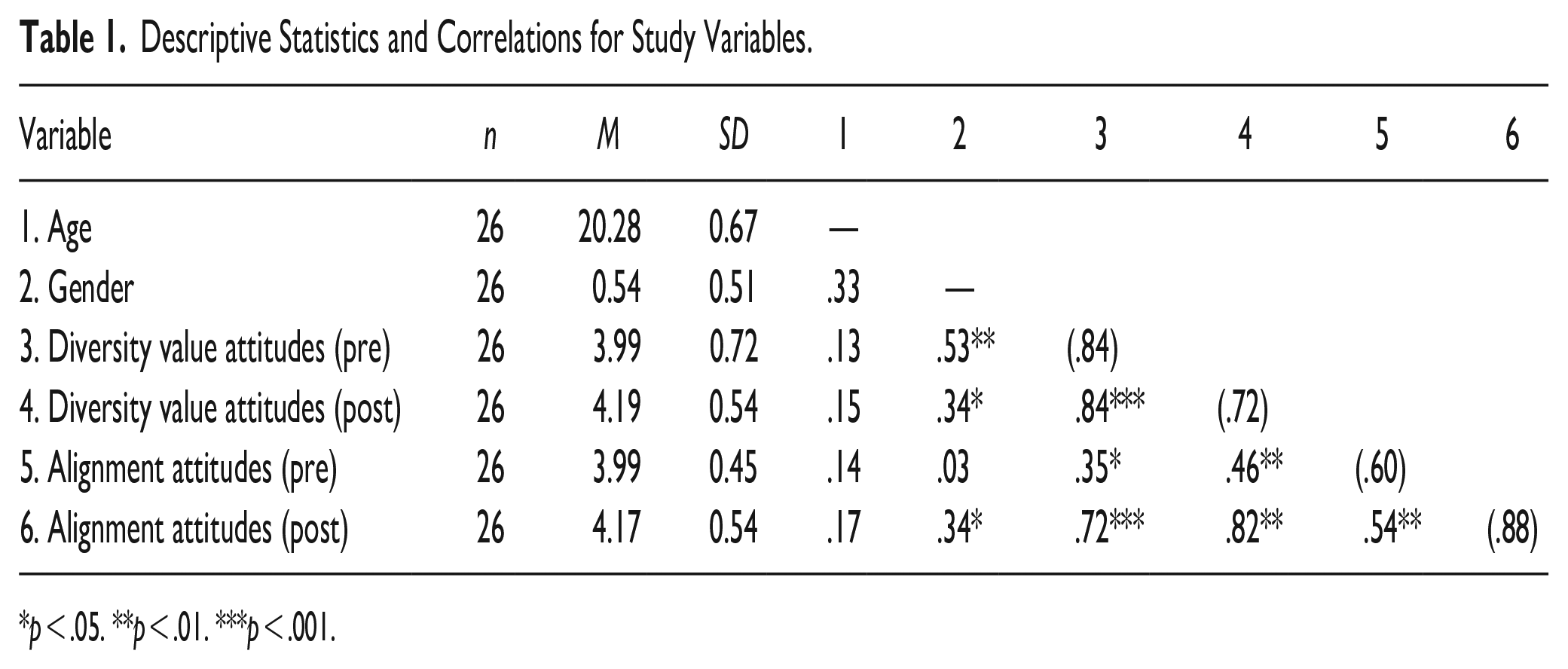
p < .05. **p < .01. ***p < .001.
Findings and Student Reactions
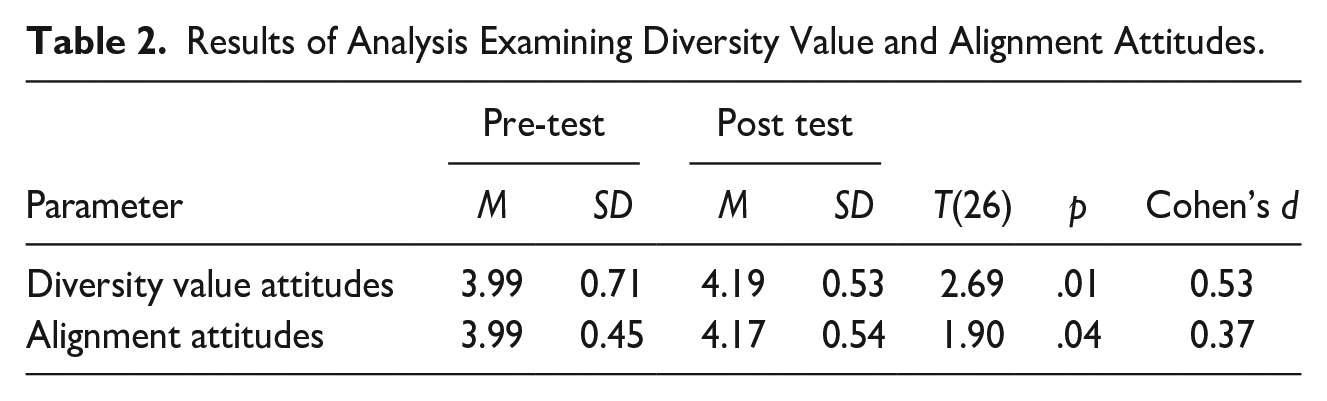
The findings from our analysis as well as the students’ reactions provide support for the learning objectives in the Structure-Culture Alignment Activity. Cohen (1988) provided commonly used benchmarks to interpret the effect sizes as small (d = 0.2), medium (d = 0.5), and large (d = 0.8). Students seemed to experience a small improvement (Cohen’s d was .37) in alignment attitudes after completing the Structure-Culture Alignment Activity, but a greater improvement (Cohen’s d = .53) in diversity value attitudes. Further, our findings presented in Tables 1 and 2, suggest that students’ attitudes about diversity values and alignment improved.
Results of Analysis Examining Diversity Value and Alignment Attitudes.
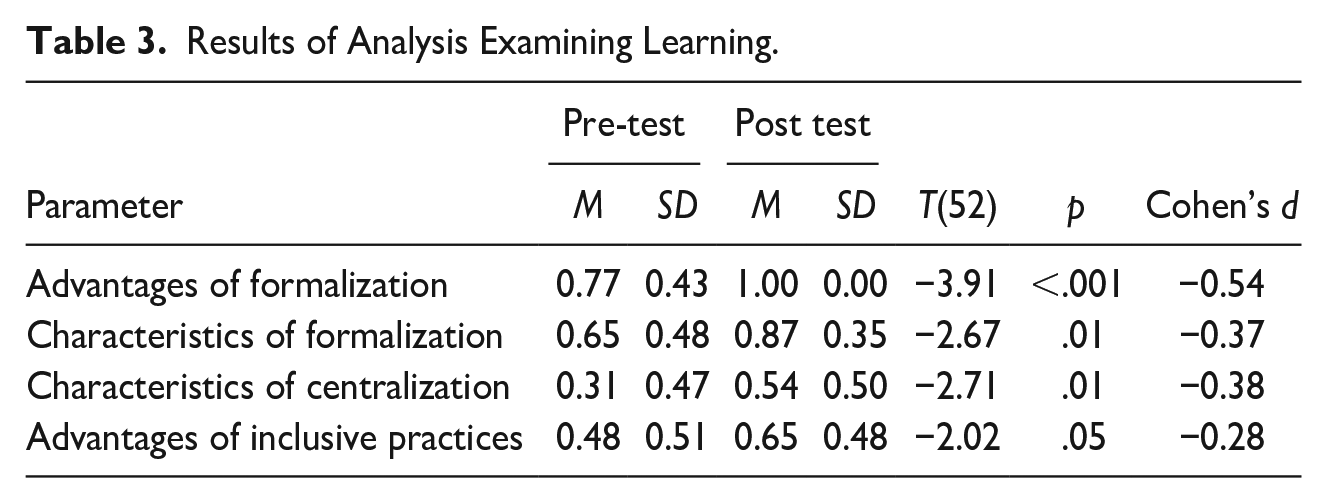
Since attitudes improved, we decided to measure improvements in learning by asking multiple choice questions about the advantages or characteristics of formalization, centralization, and inclusive practices during the following semester with a different sample of students. The multiple-choice questions aligned with the learning objective, “evaluate the pros and cons of different structural elements.” Fifty-two undergraduate students enrolled in an advanced organizational behavior course (senior level) were given a pretest and post-test quiz to see if learning improved. There were four multiple choice questions (coded 0 as incorrect and 1 as correct) designed to measure improvements in students’ learning pertaining to advantages and characteristics of formalization, centralization, and inclusive practices. A paired samples (one-tailed) t-test was used to analyze the data. Results, including the percentage of students who answered each question correctly, are presented in Table 3. The findings demonstrate significant improvements in correct answers during the post-test for all four questions.
Results of Analysis Examining Learning.
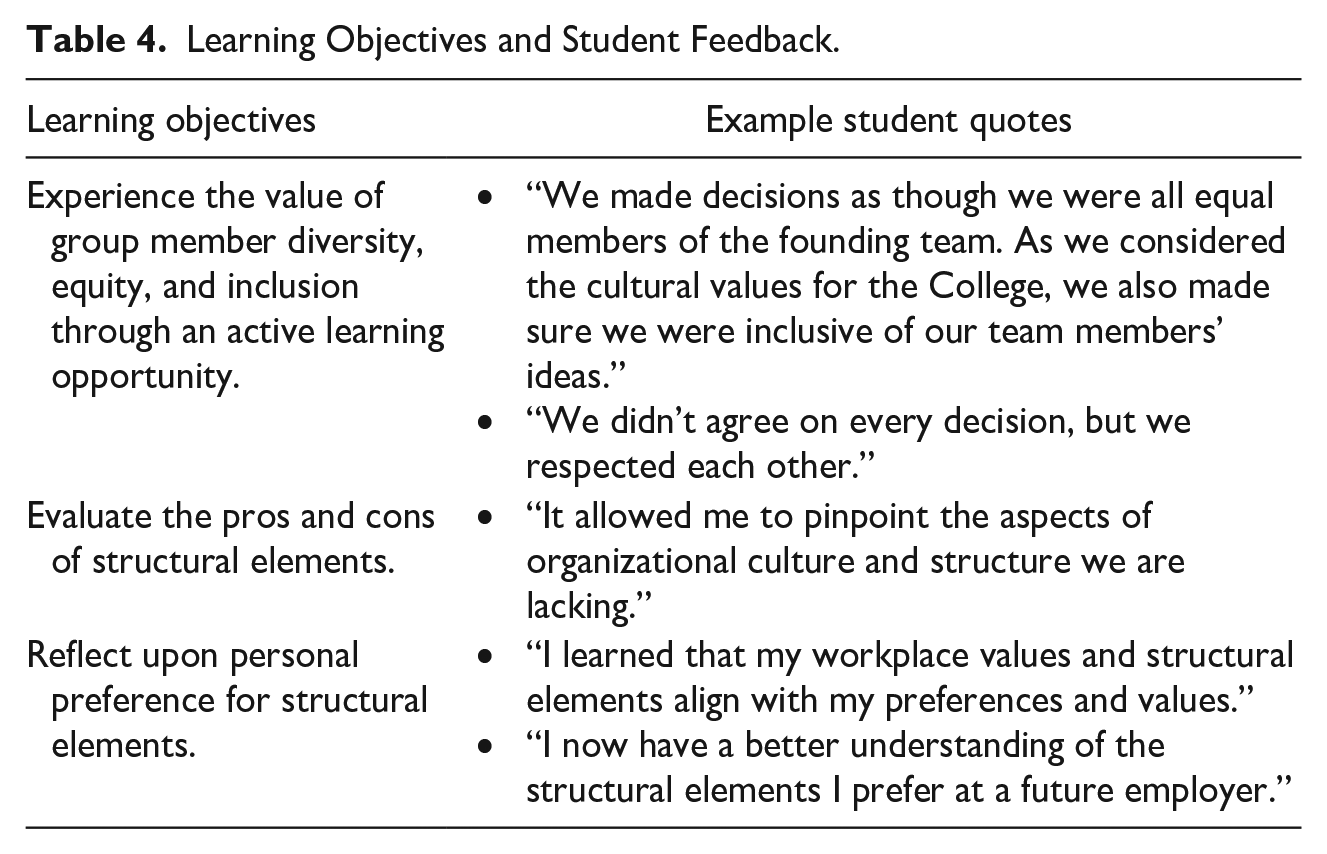
In Table 4 below, we provide some sample comments and findings for each of the learning objectives. Although anecdotal, student comments seem to provide additional support to our quantitative findings and support the notion that the learning objectives were met.
Learning Objectives and Student Feedback.
Taken together, we believe that the Structure-Culture Alignment Activity could help students consider their own preferences, evaluate the pros and cons of structural elements, and make decisions about alignment while working in a team and experiencing the value of DEI. Our findings along with students’ comments seem to support these sentiments.
Limitations
To date, the Structure-Culture Alignment Activity has been tested in undergraduate management classes with one professor. While the findings were very positive, the possibility that the instructor, the content, or the team members could have increased interest or attitudes cannot be ruled out.
Another limitation of this study is the difference in the Cronbach’s alpha coefficient values between the pre-test (.60) and the post-test (.88) for the alignment attitude measure. The items within the alignment attitude measure prompt students to assess their willingness to adapt structural elements. However, a few students who may have missed an earlier class or an assigned reading may not have a thorough understanding of the definition of a structural element during the pre-test. With a smaller sample size, a misunderstanding from even a few students could potentially have a strong impact on the Cronbach’s alpha coefficient value for the pre-test. A related limitation pertains to the Cronbach’s alpha coefficient value for the pre-test (.60) for the alignment attitude measure. Although the Cronbach’s alpha coefficients range from 0.0 to 1.0, values closer to 1.0 are typically considered to have higher internal consistency (Gliem & Gliem, 2003). George and Mallery (2003) provided a guide to help scholars determine the acceptability of the value of the Cronbach alpha coefficient. Specifically, the authors suggest that a value <.60 is considered either poor or unacceptable, but a value >.70 is considered acceptable. The range between .60 and .69 is more questionable according to George and Mallery (2003). The pre-test value of the Cronbach’s alpha coefficient for our 3-item scale measuring alignment attitudes was <.70, but scholars have argued that lower values can demonstrate acceptable interrelatedness when the scale is shorter (e.g., Zalma et al., 2015), like the alignment attitude scale. The Cronbach’s alpha coefficient value for our other measures, including the post-test scale measuring alignment attitudes achieved values >.70.
Conclusion
Organizational structure and cultural values are topics frequently included in organization and management courses, yet the complexity of aligning the two constructs can be challenging in a classroom setting. The Structure-Culture Alignment Activity emphasizes these complexities by encouraging students to consider the pros and cons of structural elements, reflect upon their preferences for these elements, and make decisions that consider alignment between structure and a culture that emphasizes DEI. This Structure-Culture Alignment Activity contributes to the students’ education by fostering critical thinking, team decision making, and personal reflection. Student comments and findings support the learning objectives. Specifically, results indicate alignment attitudes and diversity value attitudes improve after participating in the Structure-Culture Alignment Activity. As future organizational leaders, students will be better able to create inclusive cultures through identifying and aligning structural elements with cultural values.
Footnotes
Appendix A
Appendix B
Declaration of Conflicting Interests
The author(s) declared no potential conflicts of interest with respect to the research, authorship, and/or publication of this article.
Funding
The author(s) disclosed receipt of the following financial support for the research, authorship, and/or publication of this article: The author(s) received a summer research grant from the University of Wisconsin Eau-Claire College of Business to support this project.
