




Abstract
The United Nations Principles for Responsible Management Education (PRME) champion responsible management education and research globally by instilling social responsibility values in students through teaching, research, and service. As investment capital shifts toward sustainable opportunities and companies recognize the limitations of an exclusive focus on shareholders (to the exclusion of broader stakeholders), the demand for social responsibility focused students has increased. How can business schools meet the dual challenge of recognizing those students with strong global sustainability perceptions, while encouraging those without those perceptions to shift? Our empirical approach uses a freed measurement model to offer a holistic understanding of the precursors of students’ perceptions of ethics and social responsibility. We provide actionable steps for business schools in implementing new pedagogical interventions that provide individualized approaches for increasing students’ perceptions of social responsibility. For students without strong prosocial values, we propose improving their perceptions of social responsibility indirectly through changing attitudes or directly via value system rank order change.
Keywords
Introduction
The United Nations’ Principles for Responsible Management Education (PRME) (United Nations PRME, 2022) were established to inspire and champion responsible management education and research globally (Alcaraz & Thiruvattal, 2010). PRME is the implementation within business schools of the UN Global Compact, which is a call to companies to advance societal goals, which includes a set of sustainable development goals (SDGs) (c.f., Blasco, 2012; Sroufe et al., 2015). The underlying premise of PRME principles build upon the SDGs and focus on the need to instill values of global social responsibility, whereby companies must balance financial and societal concerns, in students through teaching, research, and service, so that students develop these same values and ultimately instill these values into the organizations they serve or create (Gentile, 2017; Moosmayer, 2012).
The demand for social responsibility focused students is amplified by the business community, where large firms have recognized the role of ethics and social responsibility through recent calls to action that include explicit recognition of broader stakeholders in addition to the traditional shareholder focus (Business Roundtable, 2019). There have also been important shifts in investment capital toward sustainable investing by firms like BlackRock (Henderson et al., 2020). However, it remains an open question how business schools will be able to meet this demand by identifying students who already have values that emphasize global social responsibility or how to shift students without those values toward sustainability.
We posit that a better understanding of the antecedents of students’ perceptions of ethics and social responsibility is needed on two fronts. First, to provide stronger theoretical guidance to personalize interventions that build upon students’ foundations of social responsibility when they are present, and second, for students without such prosocial values, to build upon their perceptions of social responsibility through shifts in their value system rank order. Specifically, we take two distinct approaches to changing perceptions that have thus far been treated separately in the literature and integrate them within a single conceptual model. The first approach aims to explain social responsibility perceptions through ethical ideologies, while the other stream considers the role of personal values in impacting perceptions of social responsibility.
While some management scholars have conceptualized the theoretical connection between ethical ideologies and personal values within the context of ethical decision-making (c.f., Hunt & Vitell, 2006; Simmons et al., 2013), this connection remains undertheorized and has not been empirically evaluated within the context of student perceptions of social responsibility (Yin et al., 2018). Thus, we propose that these approaches are complementary, and that including both of these antecedent theoretical pathways to increasing students’ positive perceptions of social responsibility has the potential to: (a) resolve some of the contradictory findings observed in the separate ethics versus values approaches, (b) explain aspects of the challenges experienced with current teaching methods that target values but are in fact rooted in ethical ideologies or vice versa, and (c) inform the design of new pedagogical interventions that increase students’ perceptions of the importance of social responsibility in an individualized manner that accounts for differences in ethical ideologies and personal values. The research questions guiding this study are: (1) What patterns of antecedents lead some students to perceive ethics and social responsibility as being more important than others, and (2) how can business schools and academics help improve students’ perceptions of the importance of ethics and social responsibility? To address these inquiries, we developed a research model (Figure 1) that combines aspects of personal values and ethical ideologies as antecedents—using the theory of planned behavior (Ajzen, 1991), which broadly connects attitudes with intentions that ultimately lead to behaviors, as the link between the two approaches. Specifically, we develop and test hypotheses relating students’ personal values (e.g., self-transcendence vs. self-enhancement) and ethical ideologies (i.e., idealism vs. relativism), combined with their social responsibility attitudes (i.e., stakeholder vs. shareholder) to their perceptions of the importance of social responsibility (i.e., balancing profits and social responsibility vs. social responsibility as a secondary concern).
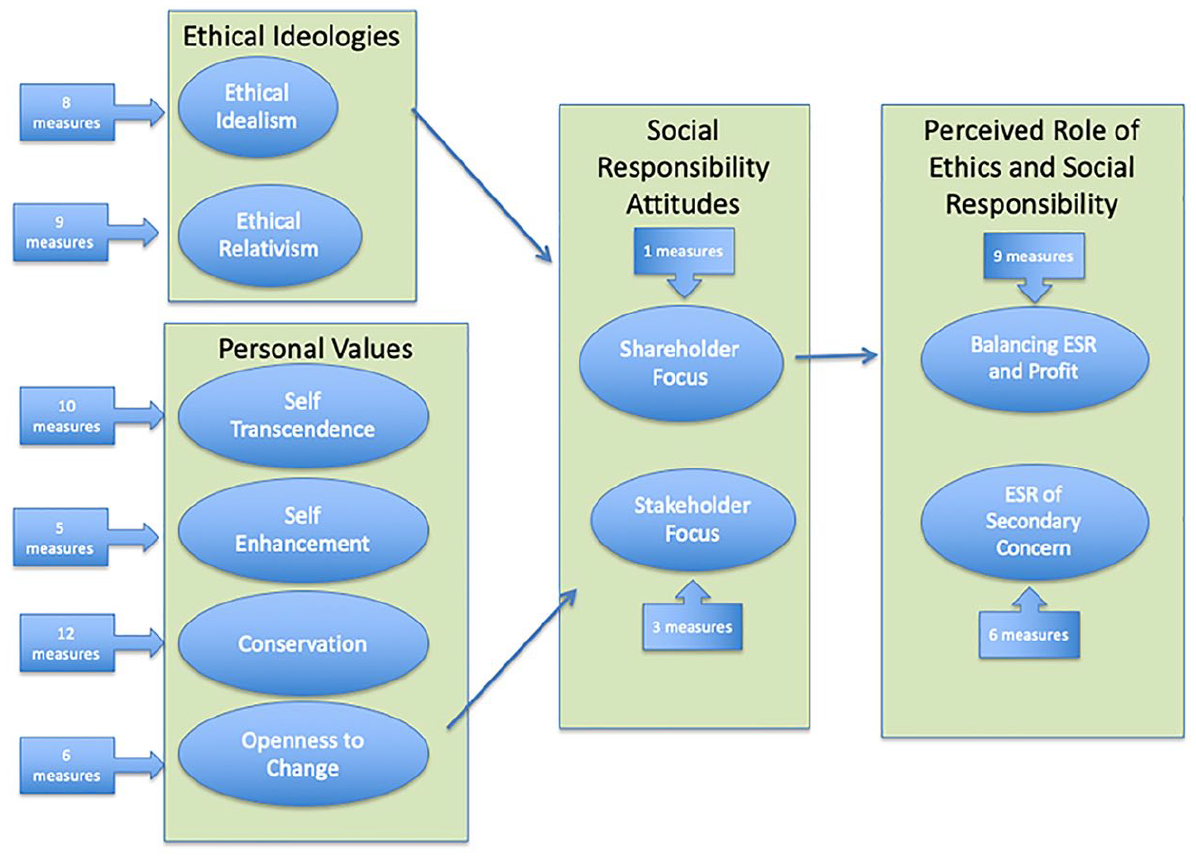
Research model.
We make several important contributions. First, we highlight the challenges that business schools face when attempting to instill values of global social responsibility as part of their PRME implementations. Second, we combine two theoretical approaches, namely personal values and ethical ideologies, which have thus far been treated separately, within an integrated conceptual model of how to increase perceptions of social responsibility. Finally, we provide preliminary theory-driven pedogeological guidance for increasing the importance that students place on social responsibility, while highlighting the need for future pedagogy research.
Hypothesis Development
Introduced in 2007, PRME is a well-established global initiative to modify business education considering changing ideas about corporate citizenship, corporate social responsibility, and sustainability (Alcaraz & Thiruvattal, 2010). At the core of PRME are six principles—purpose, values, method, research, partnership, and dialog—intended to guide teaching, research, and service. Critics of PRME point to the need for critical reflexivity and much stronger alignment between the espoused ethical values in their institutions and actual practices if these principles are to have any real impact on the next generation of business leaders (Bruhn, 2008; Millar & Price, 2018). Business schools must ensure that their own institutional practices serve as working examples of the values and attitudes that they want conveyed to their students (Kanashiro et al., 2020). Significant barriers remain in many institutions that believe strongly in profit maximization, lack academic staff to teach responsible management topics, or cave to the pressure on the business school to be a cash cow for their parent university (Doherty et al., 2015), while maintaining an inconsistent focus on responsible management across curricula (Beddewela et al., 2017).
While PRME provides a clear set of foundational principles that business schools should consider in increasing students’ prioritization of global social responsibility, PRME does not specify how to do so in practice in favor of providing flexibility in implementation for individual institutions that recognize their specific priorities and resource constraints. Accordingly, business schools have taken a wide variety of approaches to achieve this goal, including innovative teaching methods focused mainly on experiential learning (Alcaraz & Thiruvattal, 2010; Dickson et al., 2013), international service learning (Tyran, 2017), and role models (Baden, 2014). However, any perceived gaps between what the institution delivers (e.g., promising strong social responsibility culture but not delivering on that in practice) and what individual students expect (e.g., strong social responsibility culture) will continue to form a critical barrier to increasing students’ prioritization of global social responsibility (Bansal, 2003; Høgdal et al., 2021).
An organization-centered worldview places primacy on profit, and positions people in relation to serving the organization, ultimately de-emphasizing community and societal perspectives, thereby threatening to undermine individual efforts to behave ethically and in a manner that is socially responsible (Giacalone & Thompson, 2006). In contrast, within a human-centered worldview (where neither profitability nor business are central), individuals consider the business environment to be one of many components in a system, with profitability as simply one goal of many (Giacalone & Thompson, 2006). The values underlying this new worldview are humanistic and built on altruism, transcendence, and concern for community, social problems, and quality of life rather than just financial outcomes for oneself or society (Cameron et al., 2003).
The balancing of profit and people continues to be of critical concern in business education (Deer & Zarestky, 2017). On the surface, this new worldview appears to have gained a firm foothold within business, with the recent Business Roundtable of top companies redefining the purpose of a corporation to include benefiting not only shareholders but all stakeholders, including customers, employees, suppliers, and communities (Business Roundtable, 2019). This change represents an important shift for the 181 Business Roundtable CEOs who head companies like Apple, Amazon, FedEx, and Home Depot, collectively employ 15 million people, and have combined annual revenues of $7 trillion. These directional changes from the executive suites of some of the world’s largest firms are being mirrored by significant shifts in investment capital toward sustainable investing by firms like BlackRock (Henderson et al., 2020).
However, meeting the challenges posed by embracing a stakeholder perspective and leveraging the opportunities arising from the shifting capital will require a continuous infusion of new talent from business schools. It is therefore vital that business schools leverage the opportunity to provide current leadership to students so they can be the leaders for this movement toward broader values of global social responsibility in the future.
Empirical work on increasing the importance of social responsibility for business students bifurcates along two main theoretical approaches, one based on ethical ideologies and the other on personal values. Ethical approaches aim to increase ethical awareness and improve ethical analytical skills, while value-based approaches aim instead to impact specific values directly or increase recognition of value systems and shift the relative importance of the rank order of individuals’ values. However, both approaches lead to changes in behavior through the development of new attitudes and perceptions around the importance of social responsibility.
Personal Values Approach
Schwartz (1994) defined values as desirable trans-situational goals, which vary in importance and serve as guiding principles in the life of a person or other social entity. Schwartz and Bilsky (1987) defined values as concepts or beliefs about desirable end-states or behaviors that transcend specific situations, guide selection or evaluation of behavior and events, and are ordered by relative importance. In other words, what matters is not a specific value but how important a value is in comparison to other values (Krishnan, 2008). Krishnan (2008) found that values are stable over time and difficult to change, but a set of rank-ordered values, called a “value system,” can be changed through a rearrangement of the relative importance given to various values. The method of value self-confrontation can be used to change students’ value systems by first making them aware of their value systems and then presenting students with a contradiction in their value priorities and their ideal self-conception. To reduce self-dissatisfaction, students then change their value system rankings and, consequently, their value-related attitudes and behaviors (Krishnan, 2008).
Values can operate at an individual (e.g., student, manager, academic) or a collective (e.g., student cohort, community, department, company) level (Moosmayer, 2012). Other factors, such as attitudes and intentions, also influence behavior but the behavioral impact of values is particularly high as they act as antecedents to attitudes and intentions (Baden, 2014; Moosmayer, 2012). Dunn et al. (1994) attributed value development and internalization to socialization processes whereby an individual becomes a participating member of a group through the acquisition of the attitudes, beliefs, values, and skills needed to participate effectively in organized social life. Business school socialization involves both formal elements, consisting of defined curricula, and informal elements, wherein role models, peers, or mentors convey values and habits (Armitage, 2007). Verplanken and Holland (2002) identified the conditions under which values are transformed into behaviors, namely, when values are central to the self and important to the individual and activated through a stimulated application to a situation. Caspersz and Olaru (2015) evaluated why students differ in the value they place on prosocial activities and find that positiveness of prior experience and a breadth of experience increases the perceived feasibility and intention to further engage in prosocial activity. In short, those with a history of prosocial activity see it as feasible, especially when they have a variety of prosocial experiences.
Arieli et al. (2016) presented a study of the values purported in business school as compared to social work within the same institution, considering the role of organizational processes of self-selection and socialization that lead to and sustain the value profile of an organization. The authors found that the business schools studied expressed self-enhancement (power and achievement) values more and prosocial values (benevolence and universalism) less than the social work school (study 1). There was also evidence of value congruence for undergraduate students with their school in the first week of classes, suggesting value-based self-selection (study 2). Interestingly, when comparing freshmen to seniors, only small changes in students’ values emerged throughout their training, indicating minimal support for socialization.
Personal values guide and determine social attitudes and behaviors (Aguinis & Glavas, 2012; Rokeach, 1973). Unlike attitudes, they pertain to desirable end-states, transcend specific situations, and are prioritized based on the relative importance of other values (Schwartz, 1994; Schwartz & Bilsky, 1987, 1990). At the same time, values are an underlying foundation for attitudes, and behaviors are manifestations of both values and attitudes (Ajzen, 1991; Ajzen & Fishbein, 1980; Ng & Burke, 2010), with personal values playing a key role in the corporate decision-making process (e.g., Bansal, 2003; Bansal & Roth, 2000). Schwarz (Bilsky et al., 2011; Schwartz, 2009) extended earlier research (Rokeach, 1973) and developed the Schwartz Value Survey (Schwartz, 1992), which contains 10 value types that conceptualize an individual’s value system. These 10 values are in turn grouped into higher-order value types. The “openness-to-change” value predisposes the individual to independent thought, self-direction, and the need for stimulation. The “conservation” value focuses on self-restriction, preservation of traditional practices, and protection of stability through security, conformity, and tradition (Schwartz, 1994). “Self-enhancement” predisposes the individual to favor one’s own relative success and dominance over others through power and achievement, while “self-transcendence” predisposes the individual to favor acceptance of others as equals and concern for their welfare through universalisms and benevolence (Schwartz, 1994). The conservation and self-transcendence values were derived from prosocial views that emphasize individual and/or societal well-being (Schwartz & Bilsky, 1987, 1990), which potentially defer individual needs in favor of the expectations of society (Schwartz, 1994).
Stern and Dietz (1994) showed that values are important in that they are reasonably stable over time, and can provide social amplification, sensitizing individuals to certain information or causing them to filter information selectively depending on their values. In estimating utility, Stern and Dietz (1994) argued that individuals use rule-based methods and heuristics to simplify the process, examining a few options and several salient consequences, which are then assessed against a limited set of personal values. Stern and Dietz (1994) highlighted three broad types of values that are salient to environmental concerns: (1) egoistic, (2) altruistic, and (3) biospheric. Egoistic values predispose individuals to consider only those environmental issues that impact them directly and where personal costs appear high; in other words, they do not preclude environmental concerns, but they do limit their consideration to personal impacts. Altruistic values predispose individuals to judge environmental concerns on the basis of costs or benefits for a human group, such as a community, a nation, or all of humanity. Biospheric values consider the health of the broader ecosystem that incorporates all species and the biosphere.
Stern and Dietz (1994) modeled behavioral intention as the sum across value orientations of the product of beliefs about consequences for valued objects (e.g., environmental concern) and value orientation by drawing upon value types of (a) openness to change (self-direction and stimulation); (b) self-enhancement (power, achievement); (c) conservation (tradition, conformity, security); and (d) self-transcendence (universalism, benevolence) (Schwartz, 1994). Their findings indicated that self-enhancement (egoistic) and biospheric-altruistic (self-transcendence) value clusters are predictive of behavioral intentions, while openness to change and conservation are not (Stern & Dietz, 1994). The authors showed that biospheric-altruistic value orientation is associated with the belief that environmental changes negatively affect self, others, and the biosphere, while an egoistic value orientation only affects beliefs about negative consequences for the biosphere and not beliefs about consequences for self.
Fukukawa et al. (2007) contributed to our understanding of increasing the importance of social responsibility values for business students by introducing the concept of social and environmental accountability that encourages triple bottom line reporting, and includes social, environmental, and economic metrics. These authors revisited the impact of personal values explored by Stern and Dietz (1994), using Schwartz’s (1994) higher-order value orientations. They investigated the impact of specific value types—namely, universalism, power, and tradition—on student support for environmental accountability. For Stern and Dietz (1994), universalism was positively associated with support for corporate and social environmental accountability, but no significant relationship was found for the value types of power (egoistic) and tradition (conservation).
Simmons et al. (2013) considered the effect of a single business ethics course on undergraduate students’ attitudes toward the importance of ethics and social responsibility by drawing upon past work on personal values (Fukukawa et al., 2007; Stern & Dietz, 1994), Machiavellianism (Burton & Hegarty, 1999), and the perceived role of ethics and social responsibility (Singhapakdi et al., 1996). In Simmons et al.’s (2013) study, universalism (part of self-transcendence) was shown to have a significant positive effect on shareholder view (p = .028) and a marginally significant effect on stakeholder view (p = .09), with no significant effects for power (part of self-enhancement).
In summary, the personal values approach identifies self-transcendence as sensitizing students to social responsibility concerns (Fukukawa et al., 2007; Ng & Burke, 2010; Stern & Dietz, 1994), while also having a positive effect on shareholder focus and a marginally significant effect on stakeholder view (Simmons et al., 2013). Conversely, self-enhancement personal values: (1) filter out notions that human activities are harmful (Stern & Dietz, 1994), (2) are associated with increased concern for economic responsibilities (Fukukawa et al., 2007), and (3) have significant effects on shareholder or stakeholder views, and the importance of social responsibility (Simmons et al., 2013). Openness to change and conservation were not predictive of the importance of social responsibility (Fukukawa et al., 2007; Stern & Dietz, 1994). To maintain comparisons with prior work, we include self-transcendence, self-enhancement, conservation, and openness-to-change personal values in our research model (Figure 1). This leads to our first set of hypotheses:
Ethical Ideologies Approach
Our model draws upon ethical ideologies, built on Forsyth’s (1980, 1992) seminal 2 × 2 framework formed by high and low levels of idealism and relativism. Individuals with high ethical idealism anticipate that desirable consequences can always be obtained, while individuals with low ethical idealism recognize that desirable consequences are often accompanied by undesirable ones. Individuals with high ethical relativism reject universal moral rules or the use of moral absolutes when making judgments, like those with low ethical relativism. Individuals with high idealism will have higher social responsibility concerns. Skeptics are individuals with high ethical relativism, which means they recognize that there are many ways to view morality and are unable to specify moral appraisals exactly, while universalists are individuals with low ethical relativism, which means their views vary less by the situation and more by moral rules and broader concerns for society (Forsyth, 1980, 1992). While not considered in prior work on student perceptions of social responsibility, these groupings have been usefully employed investigating student perceptions generally as part of the original conceptualization (Forsyth, 1980). Thus, we anticipate that skeptics will have lower social responsibility concerns than universalists.
Singhapakdi et al. (1996) noted that individuals must perceive ethics and social responsibility as being important before they are likely to change their behaviors. The authors developed a scale of the perceived role of ethics and social responsibility (PRESOR) and argued that such perceptions are a critical determinant of whether or not an ethical problem is even perceived in a given situation and the importance of various stakeholders (Singhapakdi et al., 1996). The PRESOR scale contains three factors: (1) social responsibility and profitability, (2) long-term gains, and (3) short-term gains. The authors connected personal moral philosophies based upon the dimensions of idealism and relativism (Forsyth, 1980) and socially responsible attitudes (Hunt et al., 1990) to the perceived role of ethics and social responsibility. The idealism scale measures individuals’ acceptance of moral absolutes, while the relativism scale measures the rejection of universal moral principles, with those scoring high on idealism believing that morally right behavior leads to positive consequences and those scoring high on the relativism scale rejecting that absolute moral principles exist (Forsyth, 1980). Thus, based upon Singhapakdi et al. (1996) we anticipate that idealists will perceive ethics and social responsibility to be important in achieving organizational effectiveness and relativists will consider it less important or negatively related.
Hunt et al. (1990) purported that socially responsible behaviors are driven by socially responsible attitudes, leading to the expectation of a positive relationship between socially responsible attitudes and the importance of the perceived role of ethics and social responsibility (Singhapakdi et al., 1996). Their findings indicated that relativistic individuals perceive ethics and social responsibility to be less important to organizational success. While socially responsible attitudes were positively correlated with all three dimensions of PRESOR, idealism was only correlated with long-term gains; that is, individuals who have high socially responsible attitudes and low relativism tend to perceive the role of ethics and social responsibility as important in determining organizational effectiveness. Similarly, individuals who have high socially responsible attitudes and high idealism tended to perceive the role of ethics and social responsibility as important in determining an organization’s effectiveness. Perceptions are precursors to actions, and without positive perceptions, actions are unlikely (Singhapakdi et al., 1996). Singhapakdi et al.’s (1996) original 16-item PRESOR scale is well established in the educational context (Kolodinsky et al., 2010; Simmons et al., 2013; Singhapakdi et al., 1996) and therefore serves as a foundational outcome within our research model (Figure 1).
Singhapakdi (2004) studied the relative influence of perceived ethical problems and the perceived importance of ethics, idealism, relativism, and gender on students’ ethical intentions, while controlling for grade point average and education level. Singhapakdi’s (2004) findings demonstrated that this influence has a positive impact on the ethical intentions of students. While individuals with high relativism were found to be lower on ethical intentions, high idealism was surprisingly not predictive of high ethical intention. There was no observed relationship between idealism, grade point average, or educational level and ethical intentions.
Kolodinsky et al. (2010) revisited prior work on the impact of ethical ideologies (Singhapakdi, 2004; Singhapakdi et al., 1996) and spirituality (Albaum & Peterson, 2006) on PRESOR (Singhapakdi et al., 1996), while considering the role of materialism as a value that guides people’s choices in the acquisition of tangible possessions. Kolodinsky et al. (2010) found that ethical idealism was positively related to social responsibility attitudes and ethical relativism was negatively associated with social responsibility attitudes.
The intervening role of attitudes on perceptions appeared in the literature in various forms (c.f., Albaum & Peterson, 2006; Singhapakdi et al., 1996) where there is a broad distinction that emerges underlying attitudes that favor shareholders or a broader group of stakeholders (Eagly & Chaiken, 2007; Hunt et al., 1990). A stakeholder focus will predispose individuals to favor a broad set of societal concerns and social responsibility beyond the corporation. In contrast, a shareholder perspective will predispose individuals to focus exclusively on the corporation’s profitability, survival, and competitiveness to the exclusion of any consideration of ethical and societal factors. Thus, social responsibility attitudes are included in our research model (Figure 1) while excluding religiosity and spirituality, leading to the following set of hypotheses:
Methodology
Data Collection and Measures
Cross-sectional data were collected through a survey instrument completed by 261 undergraduate business students, representing a 10.5% response rate, at a polytechnic undergraduate institution based in Western Canada. To encourage participation, students were guaranteed response anonymity, sent two reminder emails, and their names entered a draw for one of two tablet computers. To check for non-response bias, we compared the responses of early and late respondents on key variables using an independent t-test (Dillman et al., 2014) and no significant differences were found. Students were 23.6 years (SD = 5.32) on average, with 71% of respondents falling between the ages of 18 and 24, and 55% of respondents were female. Respondents identified themselves as business students, distributed with 37.6% in accounting, 14.7% in finance, 16.2% in marketing, 17.3% in management, 9% in human resources, and 5.3% undecided, reflecting the business student population at the time. The mean number of years of work experience for participants was 5.82 years. The sample generally matched the school population at the time for age, gender, and academic programs.
Prior scales drawn from the literature were used for the construct measures. Specifically, (1) Forsyth’s (1980) ethical ideologies scales were used for ethical idealism and ethical relativism constructs; (2) Schwartz’s (1994) values survey was used for the personal values measures; (3) Hunt et al.’s (1990) social responsibility attitudes (SRA) scale was used to measure attitudes toward stakeholders and shareholders; and (4) Singhapakdi et al.’s (1996) original 16-item scale was used for measuring PRESOR.
Data Analysis
In this paper we use a freed, holistic partial least squares structural equation modeling (PLS-SEM) analysis that greatly improves the ability to replicate SEM-PLS findings and that works even when other SEM Maximum Likelihood (ML) techniques will not. This typically manifests in a study as the model not converging, forcing the researcher to aggregate scales (e.g., López et al., 2006, pp. 228–230) and consequently losing the ability to interpret constructs and measures simultaneously. Consistent with a holistic approach to theory development using structural equation modeling (Chin, 1998), we followed the exemplar gold standard in management literature of Hair et al.’s (2014) guide to PLS multi-group analysis (PLS-MGA).
SEM-PLS approach was conducted using SmartPLS 3.2.8 that is appropriate when developing theory. Goodness-of-fit measures intended for covariance-based ML-SEM are inappropriate for PLS-SEM since there is no global scalar function to optimize (Hair et al., 2014). Furthermore, we do not aggregate or average measurement scales because that restricts meaning taken from the measures during the estimation process (Chin, 1998).
The dataset has sufficient cases for PLS analysis based on guidelines identified in Hair et al. (2014), which is specified as 10 times the largest number of indicators, and in this study is 12 items for Conservation (i.e., 12 × 10 = 120); thus, our sample of 261 participants exceeds the 120 minimum criteria, which applies to the overall model and the two sub-groups. PLS-SEM analysis was conducted on the complete model and bootstrapping with 5,000 samples was used to determine the significant paths. We iterated through measurement model assessments and structural model meaning (Becker et al., 2018) allowing both constructs and measures to impute meaning into the results, and to discover learning for managers and educators (Perriton & Hodgson, 2013). Groups for skeptics and universalists were created by splitting at the mean of Ethical Relativism, and additional PLS-SEM analyses conducted with bootstrapping with 5,000 samples to determine significant paths. Multi-group analysis (PLS-MGA) was then conducted to determine if there were significant differences between groups. Common method bias or lateral collinearity is not evident in our model based upon variance inflation factor (VIF) collinearity all being under the five level cut-off value that applies within a PLS-algorithm that minimizes collinearity by design (Kock & Lynn, 2012, p. 552).
Model evaluation
Reliability was assessed using Hair et al. (2014) process as acceptable for measurement indicators. The measurement model is assessed by composite reliability, Cronbach’s alpha reliability, construct validity, convergent validity, and discriminant validity to demonstrate appropriate measures and constructs. Little’s Missing Completely at Random (MCAR) test was used in SPSS to determine the effect of the missing data (EM—expectation maximization selected). Each variable was not statistically significant therefore the null hypothesis is not rejected; the missing data are completely at random. The exception was the question on GPA as the majority of respondents did not answer this question (76%); therefore, this question was omitted from further analysis. Missing data were then replaced with the means of scales, which shows consistent performance that is better than case-wise deletion of missing values in PLS-SEM (Parwoll & Wagner, 2012). The reduction of variability is a trade-off made to handle the more difficult issue of missing values. Reverse coding for some items was necessary to align the direction of all scale items, and the Schwartz Value Scale was recoded from 1–7 to 1–9 in order to ensure scale consistency; this left 69 indicators for the final measurement scales, demonstrating composite reliability greater than .70 and Cronbach’s alpha above .62, which Hair et al. (2014) specify as acceptable for measurement indicators. During measurement assessment of two dependent constructs, the patterns of loadings suggested that the dependent constructs should both be split into two constructs, and hence they were assessed as such in our analysis. The meaning from the two constructs became clearer as we considered the wording for the measures and the definition of the constructs.
Perceived role of ethics and social responsibility scale
Singhapakdi et al.’s (1996) original 16-item scale for perceived PRESOR did not hang together. Item A16 was discarded because it loaded negative and below .35 on the constructs, which is far below the .70 suggested level. In order to achieve acceptable reliability, the measures were split in two, and when reviewing the meaning of the wording for the remaining items, the two emergent constructs created one construct with nine items for balancing ethics and social responsibility (ESR) and profit, and another one with six items for the other organizational considerations before ESR. The latter scale provides more “traditional” measures of organizational effectiveness (e.g., profitability, survival, competitiveness), while the former measures balance ethics and social responsibility with profit. This is consistent with prior work on improving the PRESOR instrument (Etheredge, 1999).
Social responsibility attitudes scale: Stakeholders and shareholders
Drawn from Hunt et al. (1990), the SRA construct also split into two constructs during the measurement assessment process because one item, namely item A38, loaded .26 when the other three indicators loaded together >.68. This implies that the item was not relating in the same way within our holistic assessment of constructs and measures. We created two SRA constructs, one with an SRA Stakeholder Focus (three items) and one with an SRA Shareholder Focus (one item), which then revealed consistent patterns.
Ethical idealism and ethical relativism scales
Forsyth’s (1980) ethical ideologies scale is based upon ethical idealism and ethical relativism components. Ethical idealism is defined as holding idealistic stances as expressed items such as, “A person should make certain that their actions NEVER intentionally harm another even to a small degree.” The original 10 item scale for ethical idealism was reduced to eight items that hung together in this study. Ethical relativism, defined as holding ethics relative to different situations, is reflected in items such as, “Questions of what is ethical for everyone can never be resolved since what is moral and immoral is up to the individual.” The original 10 item scale ethical relativism was reduced to only nine items that hung together in this study.
Personal values scales
We adopted the Schwartz Value Survey to assess personal values, as one of the most important, widely used, and extensively tested instruments (c.f., Fukukawa et al., 2007; Ng & Burke, 2010; Simmons et al., 2013). We used the constructs of Self-transcendence (original ten items), Self-enhancement (original five items), Conservation (original 12 items) and Openness to Change (original six items).
All constructs in the model displayed construct validity with an average variance extracted (AVE) greater than or approached the .5 threshold (Fornell & Larcker, 1981) capturing at least half of the scales’ variance (Chin, 1998). Convergent validity was demonstrated by the outer loadings of the indicators and the AVE correlating more highly with the other measures of its own construct than with measures of other constructs. Discriminant validity was established at the construct level for five of nine constructs: Ethical Idealism, Ethical Relativism, Self-enhancement personal values, SRA Stakeholder Focus, and ESR of Secondary Concern. For the remaining four constructs—Balancing ESR and Profit, Conservation personal value, Openness-to-change personal value, and Self-transcendence personal value—discriminant validity was established at the item-level (Chin, 2010). The one exception, B24, cross-loads from the self-transcendence personal value onto the openness-to-change personal value; however, we kept this measure since it was part of Schwartz’s original personal values scale and enables comparisons with prior literature.
Control Variables
Control variables were non-significant for gender, age, previous exposure to CSR, race, year of program, and work experience.
Gender
While several scholars found that females placed higher importance on ethical, social, and philanthropic issues than males (Ritter, 2006; Sleeper et al., 2006; Smith et al., 2001), more recent studies found no significant effect (Fukukawa et al., 2007; Kolodinsky et al., 2010; Ng & Burke, 2010; Simmons et al., 2013). Therefore, gender was not expected to have a significant impact on attitudes and the perceived importance level students place on social responsibility.
Age
Several authors found no differences in ethical judgments due to age (Kolodinsky et al., 2010; Ng & Burke, 2010), which is consistent with the notion that personal values are developed by the time an individual reaches adolescence (e.g., Inglehart & Welzel, 2005).
Previous exposure to CSR
While Haski-Leventhal (2012) showed that after being exposed to CSR in the curricula, MBA students had higher awareness levels and more positive attitudes toward responsible management education, other scholars showed that business schools can negatively affect students’ ethical views (e.g., Feldman & Thompson, 1990) and increase focus on profits over other CSR factors (Matten & Moon, 2004).
Race
Wong et al. (2010) found in a study on students’ perceptions of CSR in the United States, China, and India, that cultural differences were apparent. Similarly, Dusuki and Yusof (2008) found that the race factor contributed to differences in various CSR dimensions, especially economic and philanthropic dimensions.
Year of program
Dusuki and Yusof (2008) found relationships between level of education and some of Carroll’s CSR dimensions. However, because most of the business student population are in the 2-year diploma program, years in program is not expected to be a contributing factor toward CSR attitudes.
Work experience
Even though there are indications that work experience affects CSR attitudes (Dusuki & Yusof, 2008), work experience was not included as a factor in the model due to the limited work experience of most student respondents in an undergraduate program.
Results
The PLS-MGA structural differences shown in Table 1 represent statistically significant differences of the PLS path coefficients for the selected paths when p < .05 or p ≥ .95, as highlighted in the table.
Significant Paths for Complete, Skeptics, and Universalists.
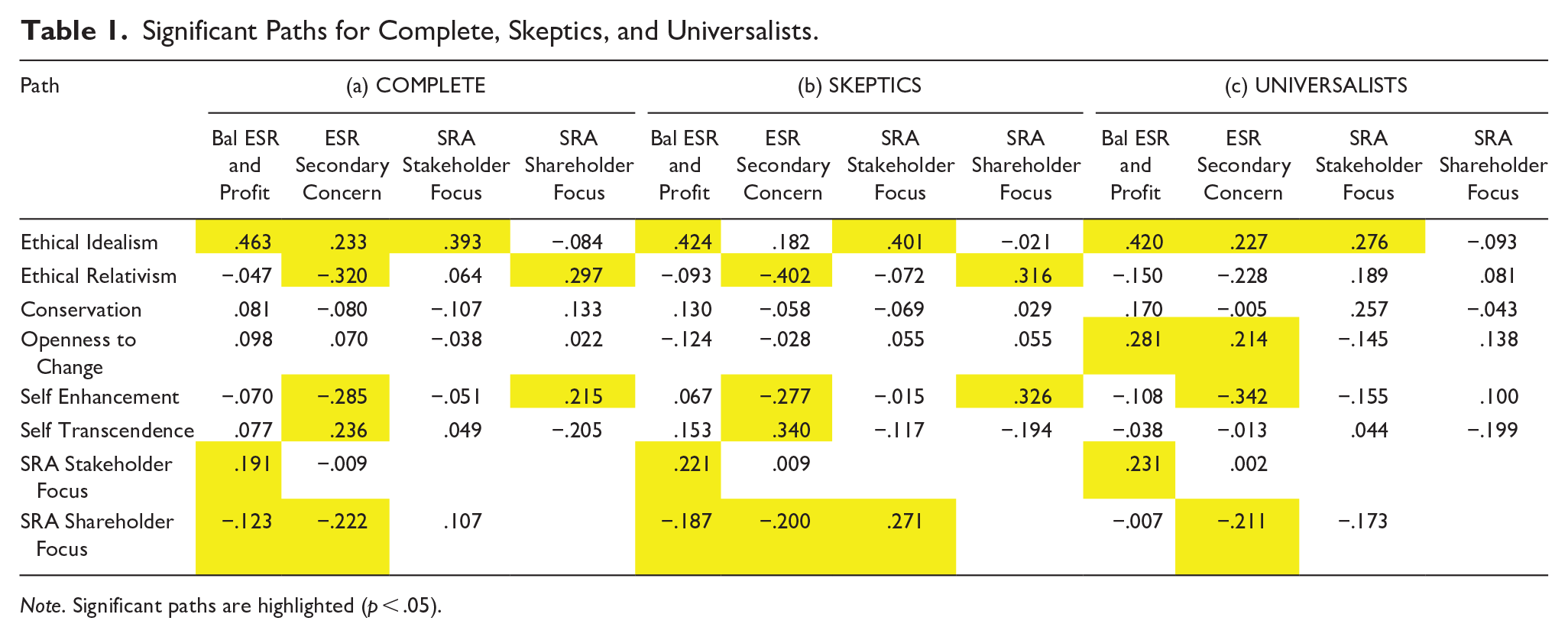
Note. Significant paths are highlighted (p < .05).
The findings indicate significant differences between skeptics and universalists for the path from Openness-to-change personal value and Balancing ESR and Profit with a p-value of .987, indicating that this relationship is stronger for universalists than skeptics. There is a stronger relationship for skeptics than universalists for the path from Self-transcendence personal values and ESR as Secondary Concern (p = .040). For the path between SRA Shareholder Focus and Balancing ESR and Profit, there is a significant difference between skeptics and universalists, with a stronger relationship for universalists (p = .972). For the path between SRA Shareholder Focus and SRA Stakeholder Focus, there are significant differences between skeptics and universalists with a stronger relationship for skeptics (p = .004). Thus, universalists are more likely to favor balancing ethics and social responsibility concerns with profit, guided by openness-to-change personal values and social responsibility attitudes that favor shareholders, while for skeptics, ethics and social responsibility are of secondary concern and driven by self-transcendence personal values. In sum, Hypothesis 5 is supported.
The complete model is presented in Supplemental Figure 1 and the significant findings across (a) the complete model, (b) skeptics, and (c) universalists are shown in Table 1. Significant paths (p < .05 are highlighted in yellow. The R-Squared for the complete model explains a moderately strong 46.9% of the variance in the dependent construct of Balancing ESR and Profit, and explains a moderately strong 50.2% of the variance in dependent construct of ESR of Secondary Concern. In addition to these strong results, it appears that the antecedent constructs further explain a weak 21.3% of the variance in the mediator construct of SRA Shareholder Focus and a weak 14.5% of the variance in mediator construct of SRA Stakeholder Focus. There is a small increase in R-Squared when viewed through the skeptic’s model across dependent and antecedent constructs. However, there is substantial improvement in R-Squared for the Balancing ESR and Profit (61.4%) and SRA Stakeholder Focus (27.8%) for the universalists model, although this is accompanied by a substantial reduction in explanatory power for SRA Shareholder Focus at 8% from 21.3% for the complete model. Thus, the models explain a substantial portion of how people’s perceptions relate to perceived concerns about ethics, profit, and social responsibility.
Self-transcendence personal values are moderately positive drivers for ESR of Secondary Concern in the complete model (.236) and this relationship is stronger for skeptics (.340) and non-significant for universalists (Table 1). Self-transcendence is a prosocial notion that emphasizes an individual’s or society’s well-being and this concern is stronger for skeptics than universalists. The literature suggests positive drives but not for skeptics (Arieli et al., 2016; Fukukawa et al., 2007; Ng & Burke, 2010; Simmons et al., 2013). Thus, Hypothesis 1 is not supported. This result was surprising because universalists were expected to be the ones relating more to society and balancing ideas, but our results show skeptics hold that position. While self-transcendence predisposes the individual to favor acceptance of others as equals and concern for their welfare through universalisms and benevolence, this might allow these individuals to instead account for broader considerations that extend beyond balancing CSR and profits.
The second most striking result for personal values is that the self-enhancement personal values helped tease out to whom people were relating. Self-enhancement personal values are moderately negative drivers for ESR as Secondary Concern (−.285) for the complete model, and this is a much stronger negative driver for universalists (−.342) than for skeptics (−.277) (Table 1). Self-enhancement personal values were also moderate positive drivers of SRA Shareholder Focus (.215) in the complete model and this increased substantially for skeptics (.326) but was non-significant for universalists. Thus, Hypothesis 2 is supported. The results where skeptics with higher Self-enhancement personal values held no significant relationship to Balancing ESR and Profit raised the question in our minds of what they were relating to instead. If they were not relating to society and organizations, then our conceptual models need to consider this strong role of self-focus and what it means for ethics and social responsibility. If people are focused entirely on themselves to the exclusion of all other considerations, the influence of the self-enhancement construct will need to be considered more fully or risk misalignment with current best practice. We refer to this egoistic aspect of self-enhancement personal value as a “themselves” focus for these students.
The Conservation personal value is a desire for self-restriction, preservation of traditional practices, and protection of stability through security, conformity, and tradition. Conservation was not expected to impact students’ concern for social responsibility and we did not find any significant relationship in our complete model or within the skeptic and universalist groups (Table 1). Similarly, we did not anticipate a significant relationship for openness-to-change personal values based upon prior work and did not find any significant relationships within our complete model. However, several significant paths emerged for the universalists that were not evident in the complete model or for skeptics. In particular, there was a moderately positive relationship between Openness-to-change and Balancing ESR and Profit (.281) and ESR of Secondary Concern (.214) for universalists. Thus, our MGA results provide further insight into where openness to change is an active driver for concern over social responsibility and profits.
SRA Stakeholder Focus provided a moderately positive and increasing drive for Balancing ESR and Profit in the complete model (.191), and for skeptics (.221), and universalists (.231) (Table 1). SRA Shareholder Focus is a negative driver for Balancing ESR and Profit in the complete model (−.123) and this is stronger for skeptics (−.187) but non-significant for universalists; as noted previously, this difference was significant between groups (p = .972). SRA Shareholder Focus is a negative driver for ESR of Secondary Concern across the complete model (−.222), and for skeptics (−.200), and universalists (−.211) (Table 1). Interestingly, SRA Shareholder Focus is a moderately positive driver for SRA Stakeholder Focus for skeptics only (.271) (Table 1). The surprising result for these mediator constructs is that universalists displayed a moderate negative driver from Shareholders SRA to ESR of Secondary Concern since this is the opposite direction than expected. The SRA Stakeholder construct mediates the positive driver to the perceptions of the need to balance ethics, profit, and social responsibility overall. Based on the literature, we anticipated that if you can get individuals to be highly concerned about stakeholders, they would relate to perceptions about balancing ethics and social responsibility. Yet, our results suggest there are many gaps where these broad statements are not shaping perceptions in the way managers and educators think they do.
Ethical idealism is a strong positive driver for Balancing ESR and Profit (.463) in the complete model and this is maintained for skeptics (.424) and universalists (.420) (Table 1). Ethical idealism is also a driver for ESR of Secondary Concern (.233) within the complete model although this appears to originate from the universalists (.227) as this path is not significant for skeptics. Ethical Idealism is also a strong positive driver for SRA Stakeholder Focus (.393) in the complete model and this is maintained for the skeptics (.401) but lower for the universalists (.276) (Table 1). Thus, Hypothesis 3 is supported. Interestingly, there were no significant paths between Ethical Idealism and SRA Shareholder Focus, which tended to relate more to Ethical Relativism and Self-enhancement personal values for skeptics but not universalists.
Ethical relativism is a moderate positive driver for SRA Shareholder Focus (.297) in the complete model and this relationship strengthens for skeptics (.316) but is non-significant for universalists (Table 1). Ethical Relativism is a strong negative driver for ESR of Secondary Concern (−.320) in the complete model and this relationship strengthens for skeptics (−.402) but is non-significant for universalists. Thus, Hypothesis 4 is supported. The literature suggests that students who are ethical relativists perceive social responsibility to be less important for organizational success (Forsyth, 1992; Kolodinsky et al., 2010; Singhapakdi et al., 1996). Skeptics favor shareholders and other ESR considerations or balancing ethics and social responsibility in organizations.
In the complete model, SRA Stakeholder Focus is driven exclusively by ethical idealism (.393) and this pattern is mirrored for universalists, albeit to a lesser degree (.276). The influence of Ethical Idealism is stronger for skeptics (.401) where there is the added positive driver of SRA Shareholder Focus (.271) (Table 1). In the complete model, SRA Shareholder Focus is driven by the moderately positive influence of Ethical Relativism (.297) and Self-enhancement (.215), and this is stronger for skeptics (.316 ethical relativism and .326 self-enhancement) but non-significant for universalists. As such, these findings offer additional support for Hypothesis 5.
In the complete model, Balancing ESR and Profit is strongly driven positively by Ethical Idealism (.463) and moderately by an SRA Stakeholder Focus that is tempered by a weak SRA Shareholder focus (−.123) and this pattern is mirrored for skeptics (Table 1). However, for universalists, the negative influence of SRA Shareholder Focus drops off and Openness to Change is an additional moderately positive driver of Balancing ESR and Profit. In the complete model, ESR of Secondary Concern is driven by a complex combination of moderate positive influence of Ethical Idealism (.233) and Self-transcendence (.236) and moderate negative influence of Ethical Relativism (−.320), Self-enhancement (−.285), and SRA Shareholder Focus (−.222) (Table 1). Yet, distinct patterns emerge for skeptics with an increased influence of Self-transcendence (.340), without any influence of Ethical Idealism, while for universalists it is the negative driver of Self-enhancement (−.342) and the emergence of positive influence of Openness to change (.214) that define these relationships (Table 1).
Discussion
The simultaneous holistic comparisons facilitated by our model and methods increase the quality of an acceptable measurement model analysis that, in prior studies and their subsequent structural analysis, would have been averaged or aggregated and constrained for interpretation within the conceptual structural model. In our analysis, the loadings were freed in order to consider greater meaning of the loading patterns within the structural results. This fixing of the measurement model of prior work potentially distorts and hides what happens in subsequent sub-group analysis. These aggregation practices of prior work would effectively treat all future students homogeneously. The freed indicators (measurement model) that we use treat students as heterogeneous groups and begins reliability and validity re-analysis in the sub-groups. Our conceptual structural model captured 46.9% and 50.2% of the variation in meaning for the conceptual structural model, but these results suggest directions for improvements. Our sub-group analysis (PLS-MGA) illustrates the split moderator constructs for stakeholder and shareholder focus SRA and the split dependent constructs of Balancing ESR and Profit and ESR of Secondary Concern.
Regarding the question of what patterns of antecedents lead some students to perceive ethics and social responsibility as being more important than others, our findings offer some unique insights. The direct impacts of ethical idealism combined with a strong stakeholder focus produce the most ardent supporters of balancing social responsibility and profits. However, strong self-enhancement personal values drive shareholder focus, which in turn undermines the importance of social responsibility for the student. Viewed through the universalists’ eyes, we see that openness-to-change values and increased focus on stakeholders are key in increasing the importance of social responsibility (Table 1). In other words, the desire to balance social responsibility and profits is largely driven by ethical idealism in the presence of a concern for stakeholders, unless you are a universalist, in which case openness-to-change personal values also emerge as important. The problem is that universalist represent only 50% of the students in the sample, thus a more nuanced approach is needed for the remaining students.
For our second question of how business schools and academics can help improve students’ perceptions of the importance of ethics and social responsibility, our findings provide a novel perspective that is necessarily personalized to the student, while adaptable for instruction to large cohorts. We believe that the value self-confrontation approach (Krishnan, 2008) and critical reflexivity (Millar & Price, 2018) offer a solid starting point for students and academics to critically evaluate their own values and value systems combined with an indication of their ethical ideologies. Versions of the instruments used in this study (Supplemental Table 1) could serve as the basis for this initial baselining and critical reflection on how to achieve balance. This in turn helps facilitate foregrounding ethical blind spots that students would otherwise be unaware of (Tomlin et al., 2017).
For those students who are idealists, the groundwork is in place for valuing social responsibility. Therefore, the training is about reinforcing what is already there while working to remove barriers for these students to act in a manner consistent with their current values and ethical ideologies. Similarly, if a stakeholder focus is already present within a student, then this will likely further amplify the importance they place on social responsibility. For the student skeptics with a prosocial profile, additional attention will need to be directed toward helping these individuals navigate the conflicts between stakeholder and shareholder perspectives since the skeptics can see the merits and faults of both approaches. Any educational methods that shift the focus from shareholders to stakeholders are likely to improve students’ perceptions toward social responsibility with the caveat of needing to overcome the focus on themselves for skeptics. In addition, for the skeptics in particular, interventions that lower the relative ranking of self-enhancement toward self-transcendence will likely lead to more shareholder focus. The skeptics appear conflicted as they can see both sides and more situationally determine a course of action depending on the context, including potentially only thinking about themselves. Universalists in contrast do not have any shareholder concerns and are driven purely by stakeholder considerations that drive their positive social responsibility attitudes. Thus, for skeptics changing the rank order of their self-enhancement values (without necessarily changing the value itself) would reduce their shareholder concerns that ultimately tempers their social responsibility attitudes (see Appendix).
There are several limitations of this study that should be noted. First, given the nature of the research, it is possible that social desirability bias may have occurred (Fisher, 1993), although Burton and Hegarty (1999) did not find evidence that this was active in social responsibility studies. Second, the length of the survey may have dissuaded some respondents from properly completing it; however, we believe that the incentive helped ensure reasonable engagement levels for those that participated notwithstanding the overall survey response rate. The constructs’ measurement reliability and validity require further work around which measures hang together, as could be seen in our AVE scores near .50, which indicate reasonable convergent construct validity but also indicate the need to improve item wording and grouping. Future research could extend the scales (e.g., multiple measures for shareholder focus) and extend the analysis presented here to the implications for actual behaviors following the students longitudinally once they enter the labor market.
Conclusion
The importance that students place on ethics and social responsibility represents a complex interplay among ethical ideologies, personal values, and perceptions. Our findings show that a far more nuanced approach is needed going forward, even for those students who already have strong prosocial values. While interest in PRME within business schools remains strong, we highlight the challenges that business schools face when attempting to instill values of global social responsibility in practice. By combining two theoretical approaches consisting of personal values and ethical ideologies, which have thus far been addressed separately, we provide new insights into how to increase perceptions of social responsibility in tandem. This approach offers theory-driven pedogeological guidance for increasing the importance that students place on social responsibility, while highlighting the need for future pedagogy research involving values.
Supplemental Material
sj-docx-1-jme-10.1177_10525629221077320 – Supplemental material for The Role of Students’ Personal Values and Ethical Ideologies in Increasing the Importance of Perceptions of Social Responsibility for Business Students: A PRME Directive
Supplemental material, sj-docx-1-jme-10.1177_10525629221077320 for The Role of Students’ Personal Values and Ethical Ideologies in Increasing the Importance of Perceptions of Social Responsibility for Business Students: A PRME Directive by Chad Saunders, Barb Marcolin and Jennifer Cherneski in Journal of Management Education
Footnotes
Appendix
Ethical Ideology and Personal Value Guided Pedagogic Interventions.
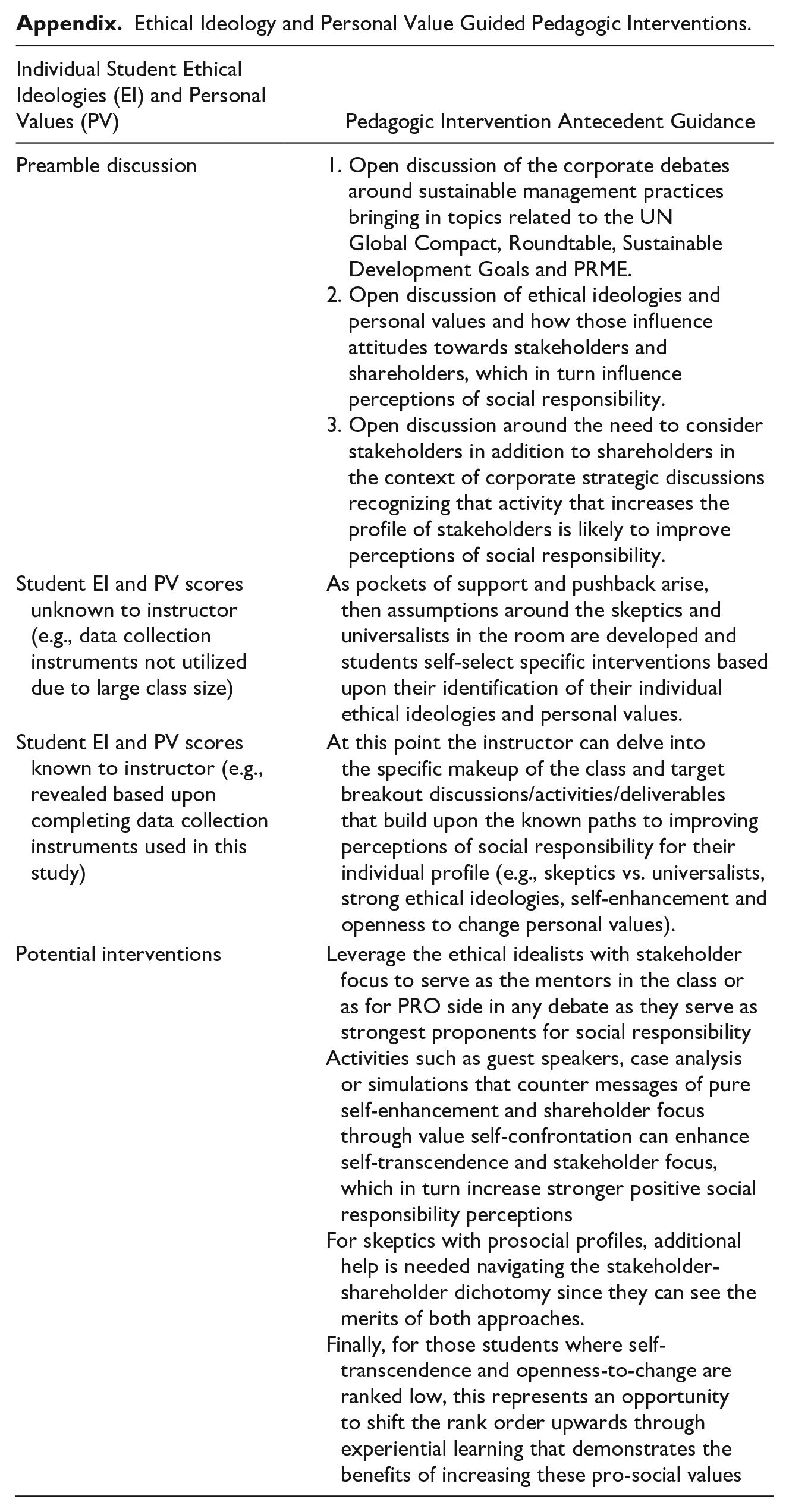
| Individual Student Ethical Ideologies (EI) and Personal Values (PV) | Pedagogic Intervention Antecedent Guidance |
|---|---|
| Preamble discussion | 1. Open discussion of the corporate debates around sustainable management practices bringing in topics related to the UN Global Compact, Roundtable, Sustainable Development Goals and PRME. 2. Open discussion of ethical ideologies and personal values and how those influence attitudes towards stakeholders and shareholders, which in turn influence perceptions of social responsibility. 3. Open discussion around the need to consider stakeholders in addition to shareholders in the context of corporate strategic discussions recognizing that activity that increases the profile of stakeholders is likely to improve perceptions of social responsibility. |
| Student EI and PV scores unknown to instructor (e.g., data collection instruments not utilized due to large class size) | As pockets of support and pushback arise, then assumptions around the skeptics and universalists in the room are developed and students self-select specific interventions based upon their identification of their individual ethical ideologies and personal values. |
| Student EI and PV scores known to instructor (e.g., revealed based upon completing data collection instruments used in this study) | At this point the instructor can delve into the specific makeup of the class and target breakout discussions/activities/deliverables that build upon the known paths to improving perceptions of social responsibility for their individual profile (e.g., skeptics vs. universalists, strong ethical ideologies, self-enhancement and openness to change personal values). |
| Potential interventions | Leverage the ethical idealists with stakeholder focus to serve as the mentors in the class or as for PRO side in any debate as they serve as strongest proponents for social responsibility Activities such as guest speakers, case analysis or simulations that counter messages of pure self-enhancement and shareholder focus through value self-confrontation can enhance self-transcendence and stakeholder focus, which in turn increase stronger positive social responsibility perceptions For skeptics with prosocial profiles, additional help is needed navigating the stakeholder-shareholder dichotomy since they can see the merits of both approaches. Finally, for those students where self-transcendence and openness-to-change are ranked low, this represents an opportunity to shift the rank order upwards through experiential learning that demonstrates the benefits of increasing these pro-social values |
Acknowledgements
We would like to thank our colleagues, Dr. Alain Verbeke and Dr. Mimi Hurt, for their peer review, which lead to significant improvements in clarifying our original hypotheses and contributions that in turn led us to include multi-group analysis (PLS-MGA) and make stronger contributions to the field.
Authors’ Note
Jennifer Cherneski is now affiliated to Northern Alberta Institute of Technology, Edmonton, AB, Canada.
Declaration of Conflicting Interests
The author(s) declared no potential conflicts of interest with respect to the research, authorship, and/or publication of this article.
Funding
The author(s) received no financial support for the research, authorship, and/or publication of this article.

Supplemental Material
Supplemental material for this article is available online.
References
Supplementary Material
Please find the following supplemental material available below.
For Open Access articles published under a Creative Commons License, all supplemental material carries the same license as the article it is associated with.
For non-Open Access articles published, all supplemental material carries a non-exclusive license, and permission requests for re-use of supplemental material or any part of supplemental material shall be sent directly to the copyright owner as specified in the copyright notice associated with the article.
