




Abstract
Recent trends in business school architecture and design have sparked significant interest in exploring the ways space is used to build organisational identity and reputation. In this article, we add to these conversations by exploring the ways in which spatial designs and practices shape student experiences of business school education. Drawing from Lefebvre’s theorisation of spatiality as simultaneously physical, social and imaginary, we conceptually link spatial designs and practices to the business school’s hidden curriculum. The empirical study we conducted at a UK business school predominately focused on student accounts of their experiences with and within the school. The findings point out three aspects of the relationship between spatiality and the student experience: (1) space is deliberately used to symbolically orientate the school, and to reflect organisational values and ideals; (2) the way in which spatiality shapes student experiences relies on the student contextualisation of spatial designs and practices; (3) student reaction to spatiality is framed by their ideal vision of business school experience. We add to the current conversations on business school spaces and the student experience by showing how spatiality plays an active role not only in student on-course experiences, but also in their conceptualisation of business school education.
Introduction
When you think of the business school when you sit at home, you think of that building. Therefore, it does shape my idea and my conceptualisation of the school. (Participant 2, Luxembourg)
UK business schools are increasingly investing in new facilities. Thirteen UK business schools featured in 2019 Financial Times MSc Management ranking (Financial Times, 2020) have all either undergone major refurbishment, or have moved into newly built spaces since 2000, with investments ranging from UK£12.5 m to UK£85 m. A predominant feature of these newly developed spaces is their distinctiveness from the traditional university architecture:
A rash of new [business school] buildings by the starriest of ‘starchitects’ is breaking out on campuses [. . .] creating a compelling landscape of academic architecture quite different from anything we have seen before, [in] a movement that seems to suggest the business school has arrived as a type in its own right, not as an adjunct to an existing institution. (Heathcote, 2011, emphasis added)
Business schools increasingly utilise architecture and spatial design to formulate their organisational identity (Lancione and Clegg, 2013), and to project organisational image and prestige to stakeholders (Berti et al., 2018; Lancione and Clegg, 2015). The distinctiveness of the built environment in business schools in comparison to traditional university architecture is also indicative of their central role in defining the image-driven future of universities (Pettigrew and Starkey, 2016).
This article adds to these conversations by exploring spatiality as a constitutive element of the business school environment. It seeks to answer the following question: In what ways do spatial designs and practices shape student experiences in a business school?
To address this question, we draw on Lefebvre’s (1991) spatial triad model and the subsequent developments of the approach to space as simultaneously physical, social and imaginary (Dale and Burrell, 2008; Taylor and Spicer, 2007). More specifically, we explore the mechanisms by which space as an element of the hidden curriculum (Margolis, 2001; Portelli, 1993) shapes student experiences of business school education.
In line with recent calls (Berti et al., 2018), in our empirical study, we placed students and their experiences of the business school space to the fore. To this end, we conducted a year-long ethnographic study with a cohort of students on a 1-year postgraduate masters (MSc) programme in Management at a UK business school (TBS from now on). Interview data was also gathered from institutional and external stakeholders involved in the design and maintenance of the building to explore the rationale behind the architectural and design decisions.
Our findings suggest that spatiality indeed has a fundamental impact on students; through conceptual entanglement with the institutional and individual aspects of the hidden curriculum (Portelli, 1993), spatiality provides a physical, social and symbolic context of student experiences (Gordon, 1983). Our analysis suggests three aspects by which this occurs. First, space is used to symbolically orientate the institution. While our findings support the notion of the institutional use of space to ensure a favourable institutional image (Lancione and Clegg, 2015), we argue it also acts as a mechanism by which business schools project organisational values and principles, and control the educational environment. The implications of spatiality on student experience, however, also relies on contextualisation, or the ways in which students interpret the spatial designs and practices in their day-to-day lives. Our findings outline examples in which institutional intentions and student interpretation of spatiality are misaligned, and leading to fundamentally contrasting experiences. Finally, the implications of spatiality on student experiences also very much rely on the student reaction to their physical, social and symbolic environment in light of the ‘ideal’ vision of the business school experience.
The article is structured as follows. First, we discuss the current literature on educational and business school spaces. We then consider Lefebvre’s (1991) theorisation of space as an interplay between conceived, perceived and lived spaces in order to create a conceptual link between spatiality and the hidden curriculum. We then introduce the setting in which the study took place and outline key methodological considerations. The findings, which are structured around the analysis of the physical, the social and the imaginary spaces (Taylor and Spicer, 2007), are presented next. The subsequent discussion draws upon the findings to theorise three factors determining the extent to which spatiality influences and shapes student experiences. The article concludes with an outline of contributions and identifies areas for further research.
Education spaces
One of the most distinctive features of university spaces is their durability over time. Kerr (1987) notes that of 85 Western institutions that were established prior to year 1520 and are still in existence, 70 are universities – most of which still operate in the same geographical area and at least partly in the buildings from the same era. University spaces define what the university is in terms of its principles and ideals (Ossa-Richardson, 2016; Thody, 2011). Practically, university spaces are multiple, catering to the requirements of students, staff and other stakeholders, each with different needs and expectations:
[Space] defines the university in a variety of ways, and to an extent conditions how interactions within the university take place, how people feel about themselves and others, and how interactions with the outside world occur. (Temple and Barnett, 2007: 6)
Recent work has raised the need for exploring space in the context of student learning and experience. Thody (2011) suggests that space is central to student learning as it creates the sense of ‘belonging to an intellectual home’, one that is shaped by the institution and the staff members as its permanent occupiers (p. 127). However, the impact of space on its inhabitants is never neutral (Dale and Burrell, 2008; Pauler, 1994): the structure, design and architecture of physical space is necessarily political and performative (Hershberger, 1970; Šuvaković, 2014)
More than a simple container, architecture is a place that shapes beings; it has a performative impact on whoever inhabits it: it works on its occupants. At the micro level; space prohibits, decides what may occur, lays down the law, implies a certain order, commands and locates bodies. (Pauler, 1994: 175)
Spatiality shapes student interaction with their peers and their teachers, as well as their perspective and approach to the process of learning and what is being learnt. Edwards (2000) suggests that universities ‘have the almost unique challenge of relating built fabric to academic discourse [. . .] the university environment is part of the learning experience and buildings need to be silent teachers’ (p. vii). A number of authors have focused on trying to define best practices for designing education spaces. Thody (2011) advocates for a balance between malleability of space to the needs and wishes of its inhabitants, and the preservation of ‘expectations that a university is traditionally something special and different’ (p. 128). Similarly, Jamieson (2003) calls for university spaces which are ‘softer, less rigid, more open to the indeterminableness of experience and where the character of the space is formed by the shape and identity of the relationships created within it’ (p. 121). Perhaps the most radical example of such university space is the iconic Building 20 at Massachusetts Institute of Technology (MIT) (Brand, 1994). With MIT placing little to no interest in managing the building, its inhabitants were given freedom to repurpose, redesign and use the building in ways that fostered creativity and independence of thought. The extreme malleability of Building 20 is considered to be central to the extent of ground-breaking research in a range of academic fields (Hill et al., 2010).
Recently, interest in business school spaces has also begun to slowly gain momentum. English architect and designer Edwin Heathcote (2011) argues that by commissioning celebrity architects such as Frank Gehry or Lord Norman Foster, business schools represent a new platform for fine architecture. More critically, Parker (2018b) sees the distinctiveness of contemporary business school architecture as a sign of its commercial success and wealth, and as defined by the concerns for organisational image, reputation and grandiosity (Alvesson and Gabriel, 2016). The empirical exploration of business school space has also recently gained more momentum (Berti et al., 2018; Lancione and Clegg, 2013; Naar and Clegg, 2018). These studies have outlined the transformative power of space, placing it in the context of innovation, organisational change and workplace dynamics by theorising it through the lens of actor-network-theory, sociomateriality and Lefebvre’s spatial triad model.
The current academic discourse, however, lacks theoretical consideration of the implications of business school space on student experience (Berti et al., 2018). Nespor’s (1994) comparative study on learning experiences between management and physics students represents an important step in this direction. In it, he argues that knowledge and learning are not only the result of social interactions and individual efforts but are necessarily influenced by the environment in which they take place. We expand on his argument by exploring how space influences student perceptions and experiences of business school education. To do so, we theorise space not only as an active factor in organisational life (Dale, 2005; Kornberger and Clegg, 2004) but also as a constitutive part of the business school’s hidden curriculum (Portelli, 1993; Margolis, 2001).
Theorising educational space
Space is increasingly seen as an active element of social and organisational life; it is ‘. . . socially produced and simultaneously socially producing; concurrently material and imaginary; intimately connected to embodiment; and irreducibly political’ (Dale and Burrell, 2008: 6). In his seminal work, Lefebvre (1991) suggests the existence of multiple, overlapping spaces. First, spatiality is produced by purposeful planning and design (Brand, 1994) to represent the values and goals of the organisation (Dale and Burrell, 2008). Considering their increased reliance on image and reputation, business schools are explicit in their intentional use of space to attract students from the management education market (Edwards, 2000; Heathcote, 2011; Parker, 2018a).
Next, spatiality is defined by the individual perceptions, interactions and engagements with the built environment (Dale and Burrell, 2008). A specific focus has been recently put on the relationship between the physical dimensions of the curricular space and the imaginary spaces fostering creativity and innovative learning (Blasco, 2016), as well as its power in creating heterotopic curricular practices that encourage critical and imaginative thinking (Beyes and Michels, 2011). Business schools were also theorised as identity workspaces for students in their preparation for the corporate world, by ‘providing reliable social defences, sentient communities, and vital rites of passage’ (Petriglieri and Petriglieri, 2010: 44). Finally, spatiality is produced by the individual’s imagined or ‘ideal’ notion of the physical, social and symbolic features of space. In other words, each individual inhabitant perceives and experiences spatiality in different ways (Berti et al., 2018), in line with their continuously changing expectations (Barnett, 2007).
Space and the hidden curriculum
While still relatively novel in organisational literature, space is recognised in education literature as an active factor constituting the hidden curriculum, or tacit features and practices of education that shape student experience and learning (Apple, 1971; Eisner, 1985; Martin, 1976), and help us to ‘. . . understand how society’s social, cultural, economic and political values are transmitted through educational structures which claim in the name of education itself to be value-free’ (Ward, 1990:10). The concept of the hidden curriculum was central to seminal studies in education over the past 50 years (Bowles and Gintis, 1976; Willis, 1974), all sharing a common view that it signals intentional manipulation of the educational environment (Giroux and Penna, 1979; Margolis, 2001). Business schools have been criticised for the intentional manipulation of the hidden curriculum to promote ‘the virtues of capitalist market managerialism [. . .] as if there were no other ways of seeing the world’ (Parker, 2018a: 46).
This understanding of the hidden curriculum has, however, attracted substantial criticism. Hlebowitsh (1994) suggests that the overt focus on the role of hidden curriculum in perpetuating capitalist ideas is problematic since education as a social process also requires reflection and individual agency. Assor and Gordon (1987) add to this point by suggesting a range of individual and contextual factors that play an important role in the inculcation of the hidden curriculum.
Portelli (1993) outlines a range of meanings ascribed to the concept of the hidden curriculum. On the institutional level, the hidden curriculum may relate to the implicit institutional expectations, or to wider political pressures on the educational institution. On the individual level, hidden curriculum may relate to unintended learning outcomes that are not prescribed by the formal curriculum. It can also be created by students themselves (Snyder, 1971), through (mis)interpretation of the formal curriculum and the cues in their educational environment.
Each of these meanings is also characterised by the level to which the hidden curriculum is intentionally created by the institution, and the extent to which it is visible to its stakeholders. In contrast to the common notion that the hidden curriculum is necessarily invisible to students and visible to the institution and the teaching staff, it may also be the other way around. Gordon (1983) suggests that perhaps the best way to think about visibility of the hidden curriculum is to consider its implications on learning; even if students are aware of the content of the hidden curriculum, it is their awareness of its influence that usually remains hidden.
While both the concepts of space and the hidden curriculum have attracted significant attention by both organisational and educational scholars, the links between two concepts are only fleetingly established. Space is considered ‘a silent teacher’ (Edwards, 2000); a ‘performative’ (Pauler, 1994) aspect of educational experience. What is missing from the literature is the understanding of how this occurs. To further shed the light on this question, we conducted an empirical study among postgraduate management students studying at a UK business school.
Methods
The ethnographic study was designed to embrace the fragility and complexity of the student position in a formative and transitional period of their lives (Barnett, 2007; Hlebowitsh, 1994). Over a period of 1 year, we engaged with students, business school management and its stakeholders through non-participant observations, informal interviews and in-depth, semi-structured interviews.
The study was conducted in a leading UK business school which granted us continuous access to the building and the students. While confidentiality prevents us from providing specific details, it is sufficient to note that TBS is a medium-size UK business school with around 100 academic staff teaching around 1100 undergraduate students, around 600 MSc and MBA students, as well as over 80 PhD students. Apart from being affiliated with one of 24 leading UK universities forming the Russell Group, it also holds accreditations from three recognised accreditation agencies – Association to Advance Collegiate Schools of Business (AACSB), The Association of MBAs (AMBA) and EFMD Quality Improvement System (EQUIS). The strategic focus of TBS has been set on the development of a diverse MSc programme portfolio, as well as MBA and Executive MBA programmes, all continuously featured in international league tables.
We focused on the experiences of a cohort of 59 students on the MSc in Management programme. The cohort spanned 19 countries: the largest proportion came from China (32%), followed by Germany (17%), with 10 percent from the United Kingdom. Students’ ages ranged from 21 to 29, with an average age of 24. The cohort was predominately female, with 39 female students and 20 male students. Various academic backgrounds were represented, including philosophy, languages, education, journalism, engineering and biology, with only around 20 percent of students coming from an academic background in business or economics.
Additional interviews took place with key stakeholders who were involved in the design of the current TBS building. We interviewed the School Manager on the project of designing the building, who had a crucial role in establishing the current spatial practices in TBS. We also interviewed Head Estates Manager, whose duties include both maintenance on a day-to-day basis as well as future development of the TBS building. Finally, we interviewed a key figure in the current design of the building, its Lead Architect, who in their career worked on a range of different university spaces, including business schools.
Data collection
Non-participant observations and informal interviews took place in the first stage of data collection. During observations, the focus was placed on student day-to-day interactions with space and their social surroundings, from the first weeks on the programme, to the periods of intense coursework towards the end of Semester 1. During this period, the first author also engaged in informal conversations with students. These student-led conversations were open-ended and changed over time as students prioritised different topics in different stages of their education. Information gathered during the informal interviews and observations provided important insights into student day-to-day lives in TBS, including their relationship with the built environment. It also aided the development of the interview guide, used in the next phase of the data collection.
In-depth, semi-structured interviews took place during Semester 2 over a period of 5 months with 20 students. Some were recruited during the informal interviewing phase and others through email invitations. The interview guide covered a number of topics over three themes: pre-application and application stage, the experiences during the programme and students’ thoughts about their future.
The topic of space was investigated through targeted questions such as ‘What are your views on the school’s exterior/interior?’, as well as more speculative questions such as ‘If this building did not have any indication that it is a business school, what would you think it is?’ Students also referred to space in their answers to other questions, particularly when discussing the purpose of the business school education, and their experiences of education in TBS.
Additional data were collected through interviews with TBS management, academic and support staff, and persons external to the institution with an active role in its design. The interviews were focused specifically on the TBS space, covering a range of topics surrounding its concept, design and intended use. A body of secondary data was also collected, consisting of historical information on the programme and the students, and textual and visual data on the building and its history.
The quality and the depth of the data collected during the interviews benefitted from the rapport built with the student participants in the first stage. The first interviewer was not a member of TBS staff, and participants felt comfortable speaking honestly about their experiences, sharing some sensitive information including their reflections on staff, their peers and their environment.
Data analysis
In order to capture students’ educational paths, we followed the ‘logic of discovery’ (Czarniawska, 2014: 24) as a guiding principle in the data analysis: instead of analysing the data after the long period of fieldwork, initial analyses took place during the process, as data was collected. This process also required a continuous discussion between the authors about the meaning emerging from the data, as well as further developments in the data collection process.
By the time the data collection process ended, the initial coding framework was established from the first round of data analysis, which aimed to allow the meanings to emerge from the data itself (Silverman, 1994). Field notes were analysed and used to contextualise the gathered interview data within the setting, and the information gathered through informal conversations and interviews with stakeholders. In line with the research focus, we concentrated on student narratives of space, contextualised within the secondary data on TBS space, and the interview data gathered from non-student participants.
Access to primary and secondary data sources had been granted on the condition of confidentiality of the institution and the students. While we were allowed to gather visual data, the confidentiality agreement prevents us from their use in publications. In light of this significant limitation, we used field notes to provide as rich descriptions of spaces as possible, while at the same time carefully maintaining confidentiality.
Findings
The findings are structured around three mutually related aspects of TBS space through which student experience is shaped – the physical, the social and the imaginary (Dale and Burrell, 2008; Taylor and Spicer, 2007). Within each section, we explore the perceived, the conceived and the lived spaces (Lefebvre, 1991), how they constitute the hidden curriculum (Portelli, 1993) and how they shape student perceptions and experiences of business school education.
Physical space: designing with purpose
TBS is situated in an urban university campus characterised by a mix of traditional and new educational architecture, in a building built in the 1960s and substantially refurbished about 10 years ago. The refurbishment process included substantial changes to the previous design in efforts to visually open up the space and make it more welcoming. Changes were made to the floorplan of the building to increase the size of the interior, through the addition of the basement and top floors. Creation of social spaces was an important part of the design process, as Lead Architect of the building asserts:
The old building didn’t have any kind of sense of a social centre. There was no sense of community. So, that’s where the design of [the extension] comes from. Just having a café in the building was quite an important thing. It becomes a social hub where people get together informally without having arranged to meet.
The refurbishment of the building was a result of extensive discussions and negotiations between TBS, the architects and the University. It was one of the first buildings to be refurbished in this area of the campus, and the TBS management was driven by the notion that the building’s design should reflect the distinctiveness of a business school: ‘We worked closely with architects and designers to really try to get them to understand that business schools were quite distinct from other departments’ (School Manager).
From the perspective of TBS, spatiality was seen as an active factor in shaping the school’s brand. Lead Architect recognised the TBS management’s effort to develop a specific environment in the newly refurbished building, further suggesting that the potential profitability of the business school model played a significant role in allowing the project to develop:
In terms of the atmosphere that the school wanted to promote was one of there being a slightly enhanced sense of this building as a not quite the same as other university buildings. There was more money available for finishes. There was another level of spend dedicated to this building over and above what another building might attract because of the degree to which this is going to be an income generator for the university.
Due to its small size, TBS building was designed for MSc, MBA and PhD student cohorts, with only limited use by undergraduate students. Most amenities and services dedicated to students and learning are situated on the basement and ground floors. These spaces also feature the main entrance, reception desks for guests and students, as well as most lecture theatres and computer labs, student meeting rooms, a library, and spaces for socialisation and study. Large glass surfaces dominate the area, functioning both as the exterior walls, and as walls dividing offices from the hallways. TBS featured little in terms of colour; white walls dominate the interior, with an occasional wall painted red. Floors were carpeted with grey or blue carpets, and areas with no carpeting were paved with grey stone tiles. Decorative lighting was used throughout the building, with no artwork or plants in any of the common areas.
A range of features were introduced in TBS that were not common in other university buildings at the time. Most of them were functional, from establishing regular cleaning schedules and clear rules for managing space, to having facilities such as the café:
The school was [designed] to be a real boutique experience. And kind of edge away from standard university feel. The rules are no posters on the walls, nothing on the walls. Notice boards are well managed. We do our comms digitally. We only keep to white walls, grey carpets, the odd red wall. (Head Estates Manager)
From the student perspective, the distinctive design of TBS did not go unnoticed. Students, many of whom explained that this was their first experience of studying at a UK university, suggested having different expectations from the business school space. For some, the space just did not feel like a university, and for others, it did not fit their expectation of a traditional UK university environment:
I am a very big fan of old buildings. When I’ve seen some of the university buildings here, I was overwhelmed [. . .] Here [in TBS] I think it’s nice, posh in a way. I think it looks very modern, it gives it a good appeal. But it’s very commercial, I think it’s the first thing I think when I look at it. (Participant 14, India)
Overall, the students found the TBS space appealing. Its design reflected the prestige of their school, and the difference from the traditional university environment was seen as a symbol of the success and affluence associated with business school education. The distinctiveness of TBS’ space was also indicative of the school’s position within the university:
The wealth that is in this building makes [TBS] seem particularly prestigious compared to other schools [. . .] I mean, it’s the infrastructure and also the [central] position on the campus. (Participant 2, Luxembourg)
Students recognised the particular position of TBS as a department of the university which could afford ‘another level of spend’ (Lead Architect) on design and finishes. Their perception of the distinctiveness of space was further emphasised by their surroundings on the campus: ‘I think that the [surrounding, old buildings] are charming and in a way beautiful, but it does not come as surprise that they teach religion there’. (Participant 17, Germany)
The findings so far suggest that TBS space was purposefully designed to project a specific image of the school. Moreover, space was used to distinguish it from the traditional university environment, further reinforcing the notion of uniqueness and relevance of business school education. In the next section, we will discuss the implications of spatial designs and practices on student day-to-day experiences.
Negotiating different perspectives on social space
Both the Lead Architect and the School Manager suggested a range of intentions behind the interior design choices. There was a clear intention to ensure that the design resembles a contemporary corporate environment:
This building [was conceived] as something of a bridge between academia and industry, and we wanted to create that slightly fresh, crisp, somewhat corporate environment, but without old-school connotations of dark boardrooms and white male patriarchy. (Lead Architect)
The corporate, clean environment was further enhanced by physical and symbolic separation between different student groups and organisational members. In line with its focus on supporting postgraduate students, TBS held only a few amenities for undergraduate students. For postgraduate taught students, however, the impression was that they had no access at all:
I think it’s built for the purpose or at least it sends a message that it’s been built and conceived for the purpose of separating people into different groups. And in separating MBAs and PhDs and postgrads, and not even giving undergrads access to the building, it’s obvious. (Participant 8, Germany)
From the student viewpoint, the layout indicated a purposeful division by which power relations are established between different student groups, and academic and support staff. The design of the building, however, was strongly influenced by its listed status and, more importantly, by its structural limitations; the ground and the basement floors were the biggest areas of TBS and, thus, most suitable for MSc students as the biggest user group:
The design was not consciously attempting to enforce hierarchy. Absolutely not. It was more to do with which spaces make sense next other spaces [. . .] We aimed to avoid conveying the sense of rigid, hierarchical, organization which is only accessible to those of certain background. (Lead Architect)
While seemingly unintentional, the clustering of different organisational members in separate areas of the building resulted with students feeling uneasy when venturing in areas that they deemed as not intended for their use, and particularly to the upper floors of TBS that were largely occupied by the staff:
When I first went [upstairs], I was thinking: Am I allowed to be here? For a few minutes, but since nobody said you’re not allowed here and there are no signs I’m not allowed here . . . (Participant 11, Germany)
The physical and symbolic separation between students and staff, however, was only assumed, as students are allowed access to most areas of TBS. The lack of sense of belonging in certain parts of the building indicates the extent of the influence spatiality has on student experiences and practices: ‘[I do not go upstairs] that often. I don’t know if I were allowed to do that, but no one was in there. We are encouraged to stay in these two levels’ (Participant 18, United Kingdom).
The students’ lived experiences of space were shaped and influenced by both the spaces intended for their use and other spaces in TBS which they had access to, but which were not purposefully designed for their use. This intent, however, was experienced in different ways; students recognised and appreciated the TBS’ efforts to provide them with a space that supports the horizontal networking and socialisation. At the same time, the functional separation between different groups was seen as detrimental to the vertical socialisation within TBS.
Nevertheless, the participants from the refurbishment project team were unanimous in the argument that the building was designed with postgraduate student experience in mind, and to promote the sense of openness, inclusion and socialisation. Student experience was key to the design decisions and the space was intended to support not only the formal but also the informal aspects of educational experience:
The space was designed to be like a place where you belong, as your home were you’ll work together and meet interesting people, and mingle. Where you’ll be challenged, where you’ll grow. (School Manager)
As previously discussed, the space was indeed characterised by concerns with functionality and usability. In contrast to other, more traditional university departments, however, students were not considered active users of space, and had little scope for making changes to their environment. When asked about the ability of students to make changes in their environment, Head Estates Manager remarked:
I would say no. It would definitely be frowned upon [. . .] From my experience visiting other buildings [in the university], I would say [their estates] are not as tightly managed. I quite like that you walk in here and you think, ‘I came here to do some work’. Not wearing a shirt and a tie, but I am here to work.
The findings so far suggest that, apart from their role in establishing reputation and prestige, spatial features and practices in TBS were active in shaping student everyday activities and experiences, most notably by establishing a contemporary corporate environment in the school. In this sense, spatiality was not merely acting upon students; it was also shaping the student perspective of social contexts and educational activities. It does so explicitly, for example, by defining the physical environment, and more implicitly, through the implications of power relations between different groups of inhabitants. As a result, spatiality is constantly and continuously contextualised and interpreted by the students in relation to a range of social, organisational and educational activities and contexts. The features of spatiality as conceived and designed by the institution can thus either be aligned or misaligned with the student perception of their social, organisational and educational experiences.
Imaginary space: space and the ‘ideal’ experience
As previously discussed, TBS space was generally seen as an important part of the school’s image. Design practices such as limited colour palettes, lack of artwork and strict rules about decorations, however, seem to have had a different effect; students commonly characterised the environment as somewhat clinical, unwelcoming and cold. This point was well argued by a participant who previously studied in another department of the same university:
. . . I felt more like at home in the previous building than I do now. I guess the [TBS] building is awesome, in terms of cleanliness and being very new and having a corporate feel to it, but to some extent it also makes it much less opened and you feel less welcome. It’s more like you are a visitor every day, than someone who hangs out here every day [. . .] it’s just, it doesn’t seem as welcoming as other places despite the really amazing infrastructure. (Participant 2, Luxembourg)
The particular ‘feel’ of TBS environment has also been noted by the Lead Architect, who characterised it as ‘quite crisp and quite clinical’, and School Manager further recognised the potentially unfavourable student views: ‘The look and the feel was meant to be clean, professional and uncluttered. Strong, but still related to university. I have been given to understand that this doesn’t now go down that well with students sometimes’.
The sense of workplace has been a recurring theme in student accounts on TBS space. This is not surprising considering the importance the refurbishment project team placed on emulating a workplace environment, and summarised by the Lead Architect: ‘The TBS building was designed to reflect the idea of personal responsibility, punctuality, things you associate with the world of work’. Students also recognised efforts to create an environment in which the built environment, coupled with the symbolism of wealth and prestige, was designed to reflect the workplace:
That is a very good thing about this school, the way it is structured. You almost feel like going to work, you see your colleagues all the time. It’s very nice. (Participant 10, Norway)
Student accounts suggest that this workplace-like environment had profound implications on their everyday practices. In line with the design focus on personal responsibility and punctuality, students gradually developed a range of practices such as a 9-to-5 work routine, and the informal understanding of who uses which shared workspace in the Library and in Computer labs:
I noticed that last December when, during the exam period, I went to the [TBS Library] every morning, and everybody had his or her seat. Everybody knew where I was sitting so my spot was always empty. We went in there, at like 8 or 9 am, and then went ‘morning’, ‘morning’, ‘morning’. It really gave the feeling of an office, and not the university. (Participant 4, Germany)
Such practices were particularly evident during intensive exam preparation periods and, to a lesser extent, during the dissertation preparation. Not all students, however, used the workspaces; some studied at home, others at the university library and some in cafés around the campus. A smaller number of students also extensively studied in groups. A good example of such joint work is the coordination effort between two participants, who both decided to work in one such space:
We were [in TBS] from 8am until 6pm (during term time). I used to sit here with [Participant 17] in the meeting rooms for the entire day. We were here so much we could have slept here. I did all my work here and nothing at home, so it can be compared to a work situation. (Participant 20, Germany) During the semester, I am in TBS every day. I study with [Participant 20], and we usually sit in the meeting room [. . .] I really see this as program as a job which I’m doing, but the moment I’m gone [for the day], I’m away. It’s a shame, I had different expectations. I thought that going back to university is going to be nice. I don’t know why, but I never imagined it will be this much like work. (Participant 17, Germany)
While TBS was commonly praised by the students for its cleanliness and functionality, the workplace-like environment was accepted with a more mixed response. Specifically, the resulting workplace-like behaviours commonly led to students dividing their educational experience into periods of ‘employment’, or work on formal deliverables, and periods beyond the formal curriculum and in times and places of their choosing:
I don’t know why but don’t feel I ever felt comfortable in this building. Probably because I study here, attend all the lectures, and do all the group work. Subconsciously, this space represents work in my mind, so when I’m here I just want to finish things and go. [TBS environment] is more like the work environment, like when you work in a company. No matter how magnificent it looks like, when you finish work, you want to get out of there. (Participant 15, Taiwan)
To conclude, our findings illustrate that spatiality is an active factor in framing the institutional and social environment, as well as in shaping the individual imagination of the business school experience. In case of TBS, it projected the school’s values, strategy and trajectory as prescribed in the social and the material environment. This prescription of institutional values was continuously scrutinised by the students within the organisational and educational environment, and in light of their personal notions of what constitutes an ‘ideal’ experience. In the next section, we draw from the findings to theorise the links between spatiality and the student experiences.
Discussion
This study set to explore the ways in which spatiality as a constitutive element of the hidden curriculum shapes the students’ perceptions and experiences in the business school. To examine this question, we structured the findings around three mutually related aspects of TBS space, namely the physical, the social and the imaginary (Dale and Burrell, 2008; Taylor and Spicer, 2007). We now draw upon the findings to develop a theoretical framework outlining the interplay between spatiality and the hidden curriculum in shaping student perspectives and experiences (see Figure 1).
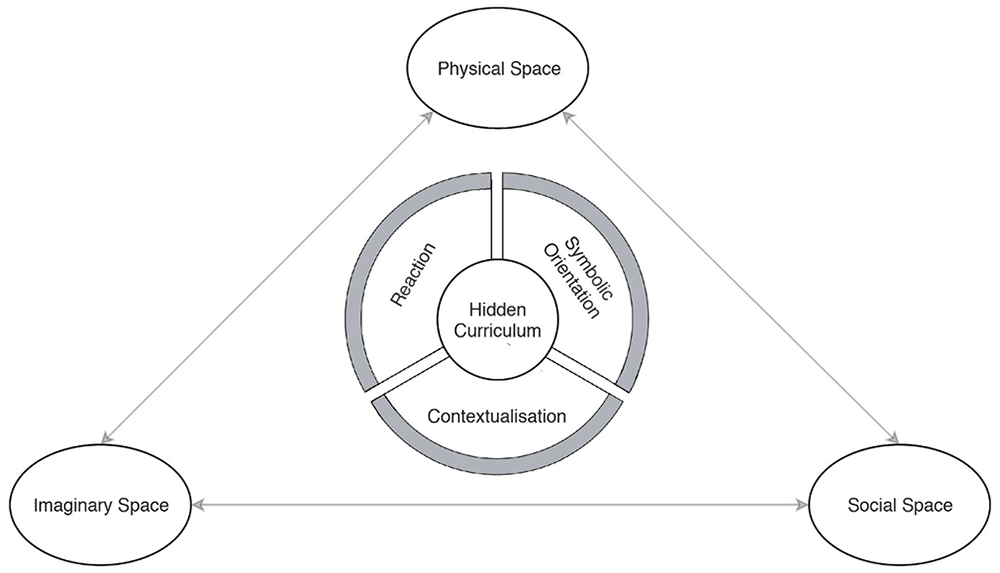
Interplay between spatiality and the hidden curriculum in shaping experience.
First, spatial designs and practices symbolically orientate the school; they reflect the school’s values and ideals (Ossa-Richardson, 2016), as well as frame the desired practices and interactions (Pauler, 1994; Temple and Barnett, 2007). In the case of TBS, space is designed to shape the student perspective on business school education as education for the world of employment (Edwards, 2000). The way in which spatiality shapes student experiences also depend on the students’ contextualisation of material and symbolic cues represented in spatial design and practices. Finally, spatiality also shapes the student reaction to their physical, social and symbolic environment in relation to their ideal vision of business school education. In this sense, the institutional values represented in spatial designs and practices shape not only the students’ ideas of business school education; from the perspective of business schools as ‘identity workspace’ (Petriglieri and Petriglieri, 2010), spatial designs and practices also shape the idea of the world of employment (Edwards, 2000) students are about to enter. We discuss each concept in detail next.
Symbolic orientation
In line with current trends in business school design (Heathcote, 2011), TBS was deliberately designed to draw attention to the school’s prestige, wealth and reputation, and to demarcate the type of experience it provides from the traditional university environment. Student recognition and praise of these features of business school space suggest their alignment with student expectations from business school education (Edwards, 2000).
The resulting implicit learning, however, is less apparent (Gordon, 1983); a clear alignment between the student expectations and the symbolism presented in spatial design suggest that space is used to reinforce the student presumptions surrounding the purpose of business school education. In other words, the intentionality and the symbolic orientation in spatial design brings space into the realm of the hidden curriculum; a mechanism of transmission of societal and institutional values to students.
Parker’s (2018a) critique of business school hidden curriculum follows a similar logic, and business school space can, from this perspective, indeed be considered as a factor in promoting the capitalist market managerialism. This view of the hidden curriculum as being fixed, top-down and imposed, however, neglects student agency (Hlebowitsh, 1994). In response, we suggest that the analysis of the implications of spatiality on student experience requires considering different ways students contextualise it in their daily experiences.
Contextualisation of spatiality
To explore the ways spatiality is contextualised by the students in their daily life, it is important to consider space beyond its physical design and conceived intentions (Lefebvre, 1991). The symbolic orientation of space is further established in spatial practices. In the case of TBS, these practices ranged from standardisation of furniture and colour palettes to strict rules on which behaviours are accepted, and which are not. Space, then, is no longer merely fixed in its representation and imposition of the school’s values; it is instead continuously contextualised within students’ social and educational surrounding. Spatiality, then, induces a broad range of potentially conflicting interpretations of physical, social and symbolic environment (Gordon, 1983). A clear, intentionally designed symbolic orientation of space is thus neither a permanent feature of the hidden curriculum, nor a presumptive factor in shaping student experiences of business school education, as its meaning changes depending on the context in which it is observed.
In the case of TBS, the intent to control student activities by functionally dividing the floor space has been interpreted as an institutional attempt to differentiate between different students by using space to generate a hierarchical order between different student groups. Here, a clearly defined institutional intention to control and manage activities through spatial designs and conventions resulted with an unexpected and, importantly, unintended interpretation by the students. This example suggests that, while spatiality may be used to transmit the specific values to students and other stakeholders (Ward, 1990), its implications on the hidden curriculum also depend on student actions. In this example, students themselves created the hidden curriculum, one which is outside the institutional control.
Reaction to space
The influence of space on the hidden curriculum and, ultimately, on the student experience is not limited to its role in the representation of organisational values and its contextualisation in the physical and social environment; it is also continuously assessed in relation to a constantly changing, ‘ideal’ image of the educational experience (Dale and Burrell, 2008). A good example of this is the case of corporate environment in TBS. Intentionally created to resemble a contemporary corporate environment, it was overwhelmingly praised for its symbolic orientation and representational value. Students, however, also considered it as clinical, cold and potentially unwelcoming. From the perspective of their day-to-day lived experiences, students recognised the intention by the school to provide them with a corporate environment and have repeatedly compared their experience to that of being in an office.
Student reactions to these experiences significantly varied across the sample. Those who chose to spend their time in TBS beyond the formal schedule embraced its environment as a part of their educational experience. Others avoided the school beyond the formal schedule, and instead used other university or public spaces. Regardless of the outcome of their reaction, the students in both cases overwhelmingly considered and treated TBS as a workplace, and their time in TBS as a time of work. In this sense, and in contrast to more malleable educational spaces such as Building 20 (Brand, 1994), spatiality teaches the individual’s limits of their relationship with the contemporary corporate environment.
Conclusion
In this article, we address the call for a more nuanced understanding of the ways in which spatial designs and practices in contemporary business schools shape student perspectives and experiences of business school education. We discuss space as a constitutive element of the hidden curriculum, or an assemblage of implicit or hidden factors shaping student experience (Eisner, 1985; Martin, 1976). We build on Portelli’s (1993) analysis of different conceptual approaches to hidden curriculum on organisational and individual levels, defined by a varying degree of intentionality and visibility (Gordon, 1983; Portelli, 1993). In our theoretical framework, we outline a conceptual entanglement of spatiality with the institutional and individual aspects of the hidden curriculum (Portelli, 1993) in shaping student perceptions and experiences.
We further suggest that both the intentionality behind and visibility of the hidden curriculum (Gordon, 1983) changes as the analysis moves from physical environment towards the imaginary (Dale and Burrell, 2008). Spatial designs and practices are deliberately used to ensure both the market-friendly image of the institution, and to control students and their activities, as well as to shape the desired educational environment. This intentionality is also continuously assessed against different lived contexts, and the changing idealised view of business school education. As a result, a clearly defined symbolic orientation of space may result with very different, often contrasting outcomes in the student experience. In this sense, the intentional management of student experience through ‘grandiose’ (Alvesson and Gabriel, 2016) and ‘shiny’ (Parker, 2018a) spatial designs and conventions characterising contemporary business schools may be misinterpreted or even directly rejected by the students. Here, spatiality both affirms and challenges student preconceptions of the business school education; it enables and limits students’ day-to-day experiences in the business school; it provides an insight into the realities of the workplace and the world of employment.
What makes business school spaces an interesting and important context arises from their distinctiveness from traditional university spaces (Heathcote, 2011; Parker, 2018b), as well as their potential to redefine the university landscape in years to come (Pettigrew and Starkey, 2016). As with any other area of the university, space represents a vital medium for establishing the fundamental principles and ideals of business schools (Ossa-Richardson, 2016). While our data only indicates that spatial features and symbolic orientation specific to business schools are also being translated in designs of other university spaces, we suggest that further work in this area would provide important insights into the role business schools have in shaping the built and symbolic landscape of the university for the future (Pettigrew and Starkey, 2016).
The contributions outlined above also indicate where further work on business school spaces should take place. While the recent conversations on business school spaces revolve around specific cases of physical spaces (see Berti et al., 2018; Lancione and Clegg, 2013), future works should consider exploring different types of institutions in which management education takes place, as well as the temporal aspects of the relationship between spatiality and the student experience both within and beyond the formal business school education curriculum.
Finally, it is important to take into consideration the upcoming fundamental shift in the higher education sector towards online and blended delivery, a move which many universities are facing both technologically and pedagogically unprepared (Batty and Hall, 2020). With universities all rushing to find alternatives to the face-to-face learning experience (see Batty, 2020), future work needs to explore the relationship between spatiality and student experience in virtual and other non-physical learning environments.
