




Abstract
In response to a need for improved training of business school teaching, this research explores US doctoral programs in management and finds a need to purposefully embed scaffolding—the process of gradually enabling the doctoral student to take on more challenging aspects of teaching—into doctoral program design. We also recommend a more influential role to be played by professional organizations to address doctoral educator development. As we followed a grounded theory approach, our methodology started with an analysis of program marketing documents and materials followed by behavioral event interviews (BEIs) and perceptual interviews (PIs) with doctoral students in management. Following coding, we reviewed the literature on doctoral education to explore how our emergent data mapped against prior research. By also taking into consideration the lived experience of students, the study data provides evidence that doctoral programs are not properly designed to support educator development. We discuss our findings related to what programs do to support students and what students do to support themselves. Theorizing from our data, we present our model that illustrates how programs could embed scaffolding to support programs’ commitment to develop future educators.
Keywords
Introduction
Imagine that you are a doctoral student in management who is excited about the wide range of organizational phenomena to be studied and taught. You are aware of the emphasis that business schools place on research both in their doctoral programs and in recruitment processes. Regardless of whether teaching, research, or practice is your primary motivation for pursuing a doctoral degree, you also understand that teaching is a significant component of your career. Within the field of management, however, there are growing concerns that successful knowledge transfer of management practice and excellence in teaching are not correlated with research acumen (Aguinis et al., 2019). So, you begin to examine your doctoral program for opportunities to enhance your teaching ability. Surprisingly, you do not find a clear pathway to assist your development as an educator. While you are being well trained in research, when it comes to teaching, you are thrust into the proverbial deep end of the pool with nothing more than a suggested textbook and last year’s syllabus.
Unfortunately, for new educators and the students in their courses this is not a rare scenario, and it is time to review how we educate doctoral students to teach (Austin, 2009). Questions about how academia trains future professors have grown across disciplines (Dunn et al., 2016; Schnader et al., 2016). This attention is driven by a sense of disconnect between not only what business schools think they are achieving and their actual performance (Giacalone, 2004; Harley, 2019), but also by a disconnect between theory and practice, regarding what and how we teach (Aguinis et al., 2019; Banerjee & Morley, 2013).
We lift the fog surrounding this disconnect by examining what programs currently do, and do not do, to aid in doctoral educator development. Our research explores how students take actions on their own to address deficits, and we contribute by proposing a model incorporating their informal actions with more formal elements. We recommend a scaffolding approach that links doctoral degree milestones to educator development opportunities and allows doctoral students to build strong teaching acumen alongside their research skills (Harpaz, 2020; Thompson et al., 2015). Scaffolding is a developmental program design that guides the apprentice from simpler tasks to more complex work as their confidence and competence are developed (Austin, 2009). It enables the transformation of behavior and interaction (Mair et al., 2016) and, therefore, supports students as they socialize into their doctoral context (Elliot, 2022).
Our contributions come first from an analysis of our data that allows us to suggest a model summarizing the need for both the formal program elements (teaching seminar, teaching assistantships, etc.) and informal elements (peer-to-peer networks, mentoring, etc.) as well as highlighting the potential roles of other stakeholders, such as professional organizations. Capturing the voice of the doctoral student in our research design is also an important factor in our contribution as prior studies in postgraduate research education have neglected the students’ perspective (Odena & Burgess, 2017). The student’s voice is relevant to the doctoral journey which is an intense learning process loaded with emotional challenges, in which students transform themselves as people and professionals via different events, experiences and practices (Mantai, 2015). An understanding of educator development from the perspective of students in management studies is timely given the increasing range of organizational phenomena to be taught, the worldwide growth of business schools, and the deleterious effect the pressure to publish has on teaching excellence (Harley, 2019).
Our article begins with a review of the doctoral education literature and an introduction of our research questions. We then present our grounded theory approach which incorporates a tri-partite model combining documentation analysis, behavioral events, and student perceptual data. After explaining our data collection and analysis techniques we provide a summary of our results, in two specific parts: what programs do and what students do. Our discussion outlines how programs can improve by integrating students’ perceptions into program design. Finally, we consider the limitations of the work and propose future research opportunities.
Doctoral Programs in Business and Management
While business schools have demonstrated significant success in boosting enrollment rates of graduates and undergraduates as well as the number of business education programs, concern is rising about their effectiveness (Harley, 2019). Although many schools have made efforts to expand their credibility, this has come at a cost to their relevance and the applicability of business school curricula (Mintzberg & Gosling, 2002). For example, Lewicki and Bailey (2009) illustrate that many schools are criticized for focusing on excellence in research productivity, assuming that research excellence will lead to the development of excellent teaching. Research shows this is not the case as doctoral programs continue to downplay the value of teaching (Harley, 2019; Mitchell, 2007). Additionally, although demand for faculty is most often driven by a need for teaching competence, hiring decisions are made based on research capability, assuming “nurtured researchers would naturally develop teaching skill” (Lewicki & Bailey, 2016, p. 517).
Faculty in business schools have consequently expressed concerns, arguing that societal change, and the needs of undergraduates and MBAs, require a transformation of PhD design (Lewicki & Bailey, 2009). The view is that programs omit important aspects that could improve teaching effectiveness (Giacalone, 2004). Mitchell (2007) suggests several reasons for this disconnect, including: (1) the explosion of programs that drive increased demand for professors; (2) an overemphasis on research skills relative to other needs; (3) a desire for more inclusive programs; (4) and the fact that funding models for many doctoral programs lose money.
Concerns have been expressed by Marx et al. (2016) who interviewed 50 PhD program directors across the US and Canada, concluding a strong need to enhance educator preparation. They also identified two high level outcomes: a lack of consistency in the development of teaching competency and a low amount of formal instructional training. Only 34% of programs provided formal teaching courses and 18% provided no teaching preparation (Marx et al., 2016). Subsequent analysis pointed to three inter-related causes: (1) inadequate motivation to foster teaching development due to benefits that accrue to research productivity; (2) a lack of ability of many doctoral program directors to build and balance a program with a strong teaching core; (3) and a lack of time to train for teaching given the demand and need for research training. Further, many business and management doctoral programs focus on content expertise and research practices, with the underlying assumption that content expertise is the foundation for being a qualified instructor (Bonner et al., 2020). Given the above constraints and concluding that there is a strong requirement to support educator development, there is a need to purposefully integrate formal elements of the program with informal activities as discussed later in this article. We view that a model of scaffolding can accomplish that objective, as scaffolding does not only assist students to become more competent in their learning activities as future educators, but also helps them to cultivate the value of relationships and become “more capable in modeling an ethic of care to others” (Hawk & Lyons, 2008, p. 316), which is very relevant to their roles as potential educators. This is due to the nature of scaffolding as a diagnostic approach relying on continuous and gradual feedback between the student and the coach/mentor/instructor (Spataro & Bloch, 2018).
Lewicki and Bailey (2016) admit that complete competencies across management may not be possible because of variations in the many subjects and courses within management, but they also emphasize that doctoral students still need to acquire foundational teaching principles and capabilities. Thus, when hiring, they argue that universities should screen for teaching competence and require certain components, such as teaching portfolios, instructional materials development, and a statement of teaching philosophy, in addition to simply providing teaching evaluations. In fact, during the recruiting process, faculty candidates are almost always required to make a research presentation but not always asked to teach a class session.
Despite these concerns, there is surprisingly little empirical research on doctoral educator development (Boman, 2013) and prior studies show a deep divide between the views of program directors, prospective employers, and PhD students (Allgood et al., 2018b). Additionally, only a few studies approached the topic from students’ perspectives, including one showing that doctoral students believe their training fails to prepare them for their professional careers (Golde & Dore, 2001). Research focuses on the views of doctoral directors and recruiters but largely ignores the voice of the student. While some have surveyed students, with rare exception (Odena & Burgess, 2017), these approaches do not fully capture students’ “lived experience.” As students are the recipients of doctoral education, and it is designed to prepare them for their professional careers, we argue that is important for researchers to gain a deep understanding from students themselves, going beyond the views of other stakeholders (Odena & Burgess, 2017). In part, this paucity of research from the doctoral student’s perspective drove our design, framework, and research questions.
Research Framework and Questions
To understand doctoral educator development from the student’s perspective, and enhance theory building (Clancy & Vince, 2019), we use grounded theory. Grounded theory is a “discovery methodology that allows the researcher to develop a theoretical account of the general features of a topic while simultaneously grounding the account in empirical observations or data” (Martin & Turner, 1986, p. 141). The purpose of grounded theory is to experience the problem from the respondent’s perspective (Clancy & Vince, 2019). The doctoral journey is a learning process that is accompanied by different emotions, such as anxiety, fear, and doubt (Golde & Dore, 2001; Vince, 1998); grounded theory enabled us to engage with students and capture the emotional dynamics in their responses (Clancy & Vince, 2019). As senior academics and previous doctoral students, we argue that the voice of the main stakeholder, the doctoral student, and their emotions are often missing when research examines the educator developmental aspects of doctoral programs.
Our grounded theory work generated data and helped us transform it into insights about how to improve doctoral programs by incorporating the concept of scaffolding. Scaffolding is one concept of cognitive apprenticeship in which the student does a few complex tasks earlier, then progresses to more complex ones over time (Austin, 2009). To date, literature has focused on PhD challenges (Mantai, 2015), and there are examples of best practices as these relate to building teaching competencies (Bonner et al., 2020), but to the best of our knowledge no research has discussed the integration of structured scaffolding into the stages/milestones of the doctoral program to enable educator development.
Austin (2009) argues that doctoral training is a form of socialization to teach, and that it should use a more systematic preparation, including focused guidance and a “scaffolded” design. Aspects of scaffolding can be found across the higher education literature. They include formal teaching seminars (Callahan et al., 2016), workshops (Jepsen et al., 2012), teaching observation (Allgood et al., 2018a), teaching assistantships (Boman, 2013), mentoring/supervision (Schnader et al., 2016), and teaching experience (Dunn et al., 2016). These components include activities that vary in their levels of complexity, diversity, and emotional activity. It is unclear, however, how and when these educator development elements should be introduced into doctoral programs. Further, programs vary widely, meaning that one model or archetype may not work for all programs (Lewicki & Bailey, 2016), though extant research suggests there are examples of good practice (Marx et al., 2016).
To explore the issue of doctoral educator development in the US, we pose three key questions. First, how do doctoral programs in management in the US currently support teaching preparation? Second, what do students do themselves to become more effective educators? As many previous studies show, programs often provide inadequate support for educator development, and yet students must still become effective educators (Walstad & Becker, 2010). The literature illustrates the value of open seminars, conferences, and doctoral symposia (Allgood et al., 2018b), highlights peer to peer learning (Fenge, 2012), and notes the importance of program culture for developing communities of practice (Lahenious & Ikavalko, 2012). It also shows that individuals are largely left to their own devices, and this can impact the cost of a doctoral education to the individual (Dunn et al., 2016). While some students may seek out support and opportunities to learn, others, especially with a reward system in favor of a focus on research competency, might not engage in such individual action (Lewicki & Bailey, 2016; Marx et al., 2016).
Given our first two questions, our final question asks, how programs can improve given the constraints noted above? It is evident from the literature that doctoral programs need to improve (Austin, 2002a, 2002b, 2009). This has been observed in multiple disciplines over many years (Allgood et al., 2018a). To answer this question, we analyze students’ responses and propose the concept of “scaffolding” as a way of framing recommendations. Thus, our study contributes to current thinking by incorporating the ideas that focal stakeholders have about improvements, and we explore how these tactical changes might be deployed (Rousseau, 2016).
Methodology
Our method takes a tripartite approach, which provided a form of data triangulation (Patton, 1990). Following the work of Marx et al. (2016), we first reviewed the websites and brochures of the 27 programs attended by the participating students. Following Jonassen et al. (1998), this foundational component of our methodology explored how programs were presenting themselves to prospective students.
Second, we conducted qualitative inquiry comprised of both perception interviews (PI) and behavioral event interviews (BEI). Our objective was to understand students’ expectations when they enrolled in their programs and how these expectations tied to their career interests. The PI was comprised of six semi-structured interview questions, embedded alongside the BEI (Yin, 2016) to answer our inquiries about what doctoral programs are currently doing and how they can improve. This consisted of a series of questions that sought the 32 students’ opinions on their expectations of programs, and their views on what aspects were designed to help them become better educators.
The other part of the qualitative inquiry was a behavioral event interview (BEI). The use of BEI enabled us to explore how the effects of a particular event go far beyond the event itself and into a longer lasting contribution to the student’s professional development. It is a modification of Flanagan’s (1954) critical incident interview which engages the interviewee in a conversation about specific events that are relevant to the focus of the topic. Each student was interviewed for about an hour. We asked each participant to reflect on three events, activities, or situations that had a significant impact on their professional development as an educator, and we collected 96 reflections. BEIs allow us access not only to information about the events, but also participant’s thoughts, feelings, behaviors, and outcomes (Camuffo & Gerli, 2018). BEIs provided us with deep data on students’ emotional experiences and their impact on making behavioral choices, to support a better understanding of our first and second research questions.
Sampling
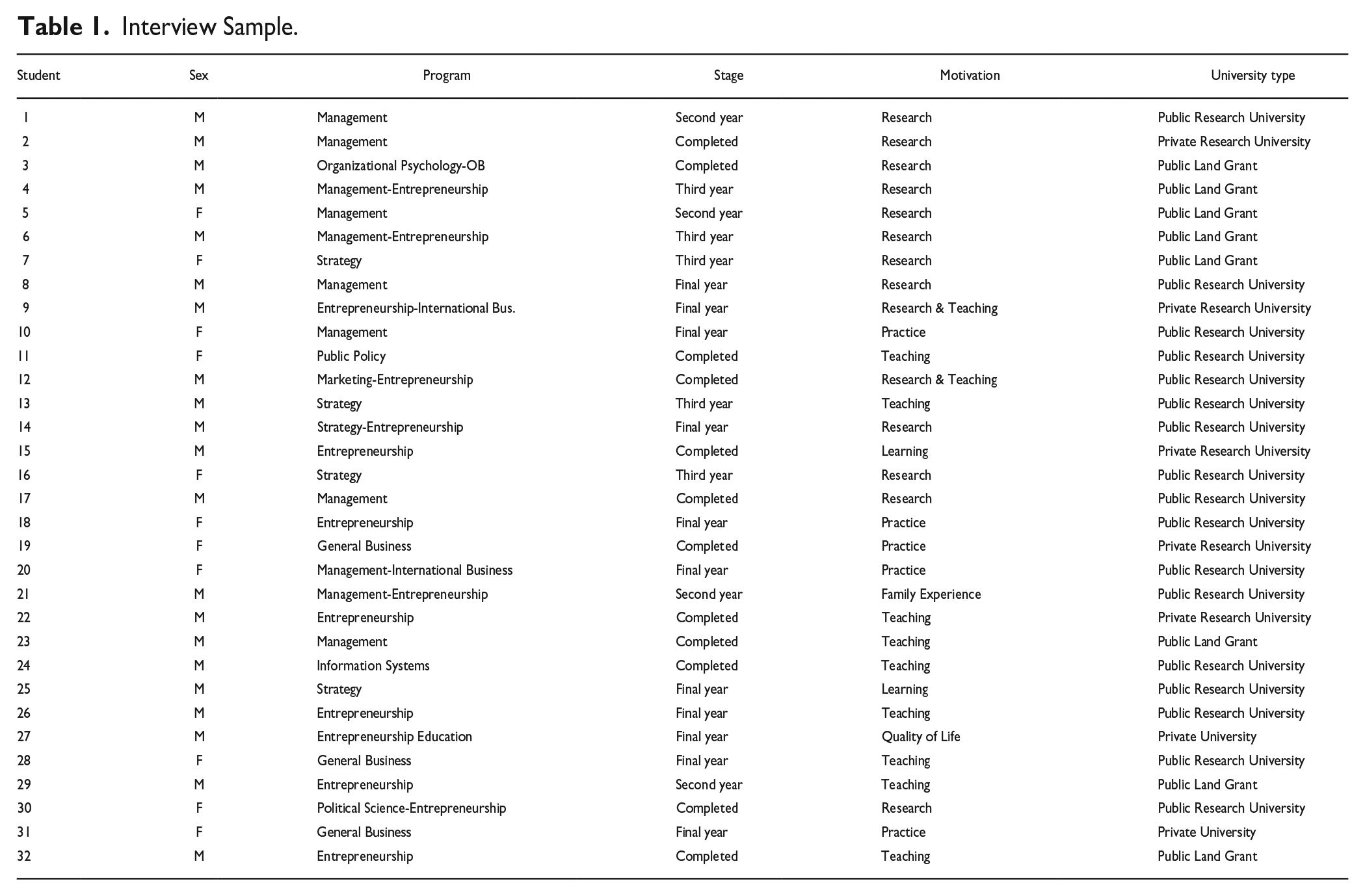
Like other studies (Sadler-Smith & Shefy, 2007), we used a purposive sample of students who had attended the doctoral consortium of the United States Association of Small Business and Entrepreneurship (USASBE), the world’s leading conference focused on entrepreneurship education research. As we were interested in students’ “lived experience” we chose to focus on doctoral students rather than other stakeholders, such as doctoral directors, research supervisors, and recruiters. To address possible weaknesses resulting from purposive sampling, such as positive response bias (self-identified as interested in teaching) and skewed selection of behavioral events toward consortia attendance, we engaged in snowball sampling by asking our first participants to recommend others (Goodman, 1961). Moreover, we excluded the doctoral consortium as an option when participants selected their behavioral events. Participants came from different US universities and all, except three, were studying disciplines within management, or were in management doctoral programs, often with different areas of specialization (Saunders et al., 2012). Some specialized in entrepreneurship (35%), some in strategy (13%), and the rest were in other management subjects, such as organizational behavior, international business, etc. (52%), but all respondents expressed a desire to teach entrepreneurship. They were in different years in their programs (second, third, final), and some had completed their degree. This diversity enabled us to obtain rich insights from diverse participants, in several programs and distinct stages of their doctoral education with “access to different information” (Köhler, 2016, p. 408) relevant for addressing our research questions. We present our interview sample in Table 1.
Interview Sample.
Data Collection and Analysis
Materials and website data were reviewed by the first researcher, and key narrative content was collected into a detailed spreadsheet. A second researcher used grounded theory coding to code the narrative data according to themes that emerged. The first researcher cross checked the emergent themes, based on their reading of the source material, and assured the inter-rater reliability of the themes. We recorded our interviews using Microsoft Teams. We loaded the recordings into NVIVO enabling the data to be directly coded, rather than necessitating interview transcripts. This approach allowed for a larger qualitative sample, and the inclusion of non-verbal cues. The lead researcher guided the data analysis, and the coding steps were monitored by a second researcher, who checked the validity of the process (Yin, 2016). Two forms of coding were carried out. The first stage used grounded coding to develop a thematic structure of the data (Glaser & Strauss, 1967), and the second stage looked deeper into the phenomenological content, which enabled the development of interpretive themes (Cope, 2005). In each step, concepts emerged from the data rather than the literature, and for this reason our literature review was conducted after the data were analyzed, rather than in the more traditional order (Glaser & Strauss, 1967). Figure 1 presents the structure of the BEIs as they emerged from this coding process.
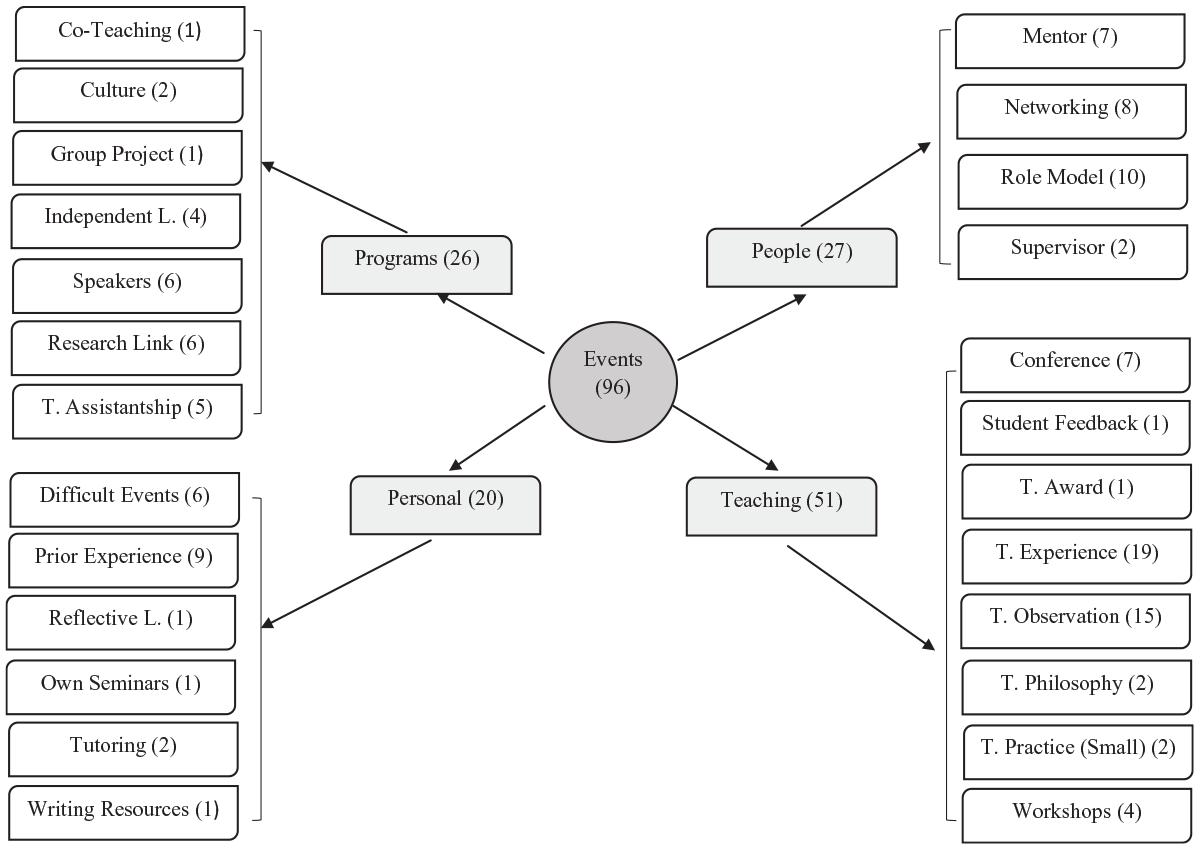
Thematic structure of the behavioral events.
Results and Discussion
What Programs Do and What Students Do
The results are organized in two parts. The first part explores the data addressing the question – what do programs do to support educator preparation? The second part addresses the question –what do students do themselves to become effective educators? Overall, students do not think that programs do a good job at preparing them to be educators. While 53% state a direct “no,” an additional 13% say programs are doing only an average job. Comments from the interviewees illustrate the point:
I think that I did a good job of preparing me. I forcibly took advantage of the stuff that was out there. As far as to whether the program encouraged me for that, I did not feel that. (Interviewee 10)
Students were asked about their perceptions of doctoral programs in a general sense, based on their interactions with other students, and their negative views became more pronounced. For example:
I would say no. I mean I started with every AACSB school that had a PhD program in entrepreneurship, and I went through all of them. There was overall very little focus on teaching, and I think part of that related to the fact that PhD programs tend to be at R1s that are at research universities. (Interviewee 21)
Although participants’ motivations for pursuing a doctoral degree varied ranging from research to teaching and practice, the majority of students emphasized that teaching is an important component of their careers, but unfortunately did not think their own program was doing a good job in that regard. So, what are programs doing? And what do students do to address the perceived deficiencies?
What Programs Do
The documentation analysis of the 27 programs included in this study summarizes what programs say they are doing. The review of the overall narratives revealed that doctoral programs fall into three categories; those that made a clear philosophical commitment to teaching preparation (22%), those that made tactical references to aspects of educator development (37%), and finally, those schools with little or no reference to educator development (37%).
The data show that most programs offer teaching assistantships (74%), and many expect students to teach (55%). Programs “sell” these as the main forms of educator development, although other forms are mentioned, for example, credit-bearing classes (19%) and mentoring (22%). In the documentary analyses, teaching seminars were less evident, with only 19% of programs including credit-bearing teaching seminars. The impression from our analysis concurs with Marx et al. (2016), most programs offered very limited opportunities for educator development.
What programs say they do, and how they do it may differ. Teaching assistantships may not be open to all doctoral students and how students are engaged can impact the quality of these opportunities. To probe deeper into these points, we explored the perceptions students held of their own programs (PIs) as well as explored other activities and events (BEIs). Example data are presented in Table 2.
Program Activities Designed to Prepare Students to be Educators.
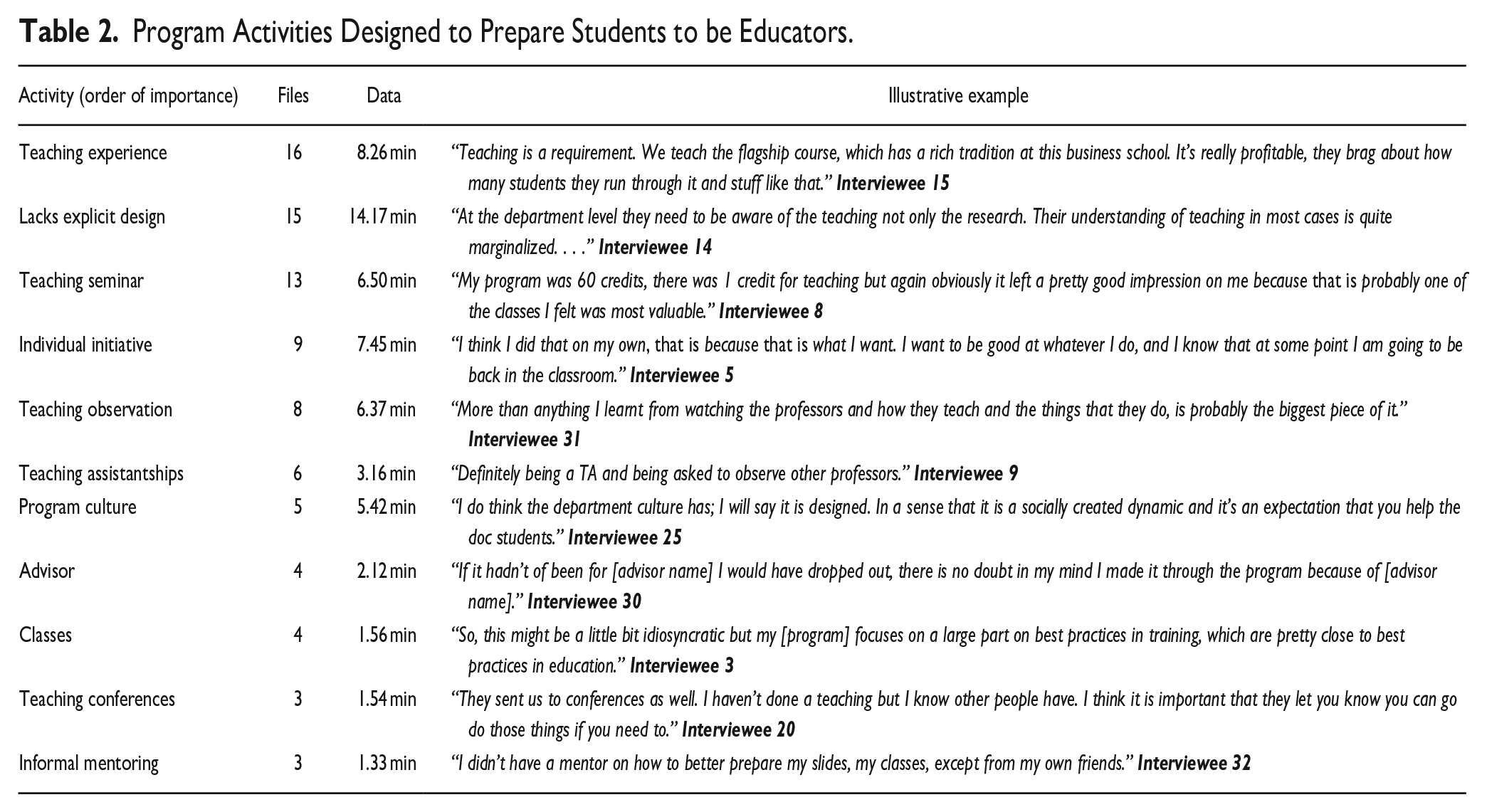
PI findings reflected an overall lack of preparation for educator development. For example, when asked explicitly what aspects of a student’s program were designed to help them develop as educators, 47% responded that the program lacked an explicit design, and others pointed to factors not associated with the program (e.g., personal initiative, conferences, and informal mentoring). From students’ responses, we find that within explicit program design, the value of teaching practice (classroom experience), seminars, observation, and assistantships are important. It is notable, however, that teaching assistantships are ranked much lower in importance than might be expected given their prominence in the program documentation data. To explore certain activities/events in the programs, we delved more deeply into the BEI data as it relates to each program component (see Appendix A).
Observation
One theme that stood out was the role of teaching observation. Sometimes, it was formally designed as part of the program, but often it occurred informally, following the personal initiative of the student, or serendipitously, because of some other event (e.g., a seminar). Events cross a spectrum and include observations of prior teachers; formal observation and interviewing of a professor; observations of an advisor’s or mentor’s class; informal shadowing of peers or professors; and observations of one’s own teaching practice. Students generally reported these methods to be of value and powerful in their learning process, and supervisors can play an important role.
My advisor allowed me to sit in on one of his [class name]. That was amazing because I was able to learn from him, through sort of vicariously like through social learning and observations. I would take extensive notes. More on his process and like how he managed the classroom. (Interviewee 13)
The role of teaching observations varies widely among programs. Some programs require observations or shadowing as part of a class, while others expect that students engage in observations of peers prior to teaching. Most programs do not require observation, however, and many of these events were driven by the student’s own desire to learn prior to actively teaching a class. Surprisingly, observation of a doctoral student teaching was a one-off rarity and not required by any of the programs reviewed.
Assistantships
Teaching assistantships (TA) are highlighted as one means through which doctoral students can be developed as educators (Boman, 2013). They often include observing the class, keeping track of class participation, assisting with grading, helping to prepare background materials for the professor and sometimes setting up course materials online, rather than actually teaching a class. Of the 96 behavioral events, only five students chose this as an important event. This suggests a disconnect between programs and students regarding the value of TA opportunities. As interviewee 9 points out, assistantships can be valuable when students can formally observe different professors, to reflect on the class, and converse with the lead professor.
Aspects valued by students include: (1) observations of classroom management; (2) insights into student engagement tactics; (3) experience with educational technologies; (4) experience with rubrics, grading, and assessment techniques; (5) awareness of course design and different pedagogic strategies; and (6) active opportunities to reflect with instructors.
The data also show that TA work can be menial, and students have different experiences in their engagement with instructors and how useful these are for professional development. Further, the nature of the TA is either enhanced or reduced because of the relationship that a student has with a professor while doing their work. As students are being socialized into their role as educators, the TA experience can provide role models for students and is thus important in the socialization process (Austin, 2009). Deliberate efforts to make TA experiences meaningful for professional development is something students value.
Some instructors naturally are very dominant, authoritarian and they hate to converse with their students. In such a case, they forward all the emails for any type of complaint to the TA. As a TA with zero authority over the course, I felt devastated and depressed because I could not do anything. At the same time when I work with good educators who naturally love to work with their PhD students and enjoy working with them, conversing with them and they empathize. (Interviewee 14)
Teaching Practice
The opportunity to gain actual teaching experience is highlighted across all data sources (Dunn et al., 2016). Likewise, we find this to be an important component, with 19 behavioral events citing specific teaching experiences as valuable during students’ development as educators. As illustrated by the interviewees (17 & 23), opportunities to gain experience differed substantially.
When you finish comps, the following semester you’re teaching one course, you’ll do effectively a one-one teaching load for those two years. I honestly don’t know how I could have come out of that program, or any PhD program, without doing that. (Interviewee 17)
[Doing adjunct teaching] Yeah, it was really, there wasn’t an opportunity. Some of my classmates had already snatched up the opportunities before I was able to. So, like I said I had close ties with my other university, and it so happens that [school & program] needed an adjunct professor. Since I had almost twenty years of experience. So, I was able to get an opportunity. (Interviewee 23)
The discussion of teaching practices surfaced many emotions experienced by students, such as fear and doubt that impacted how they engaged with these events. At least one student was thrust immediately into teaching almost on day one of their program, without any prior experience. Two students had teaching loads that were too heavy, preventing progression in their research. Some students had no way to gain teaching experience and as a result sought adjunct or other opportunities to address their gap. Programs varied regarding whether teaching experience was required, optional, or not expected.
Interviewees highlighted the need to ensure students were properly prepared to teach prior to being given teaching responsibilities. This varied across the sample, with some students required to engage in teaching seminars and other forms (e.g., observation, mentoring), other students offered voluntary options, and some students given little to no preparation before they taught for the first time.
Respondents indicated they hoped for personalized educator preparation based on the prior experience of the student. A range of prior teaching and professional experience was apparent amongst the participants, illustrating that individuals bring very different stocks of experience to programs. In some cases, doctoral students have significant teaching experience as professors, or as adjuncts, and many brought prior entrepreneurial or corporate experience to the classroom (Brush et al., 2003). Some were novices, who had little to no experience of teaching, and others were international students who need to cope with teaching in a second language.
Other nodes illustrate aspects of relevance to teaching practice including receiving student feedback. Interestingly, some responses revealed that students had to manage difficult events, including an undergraduate student mental health breakdown and violence in class, and a group plagiarism situation. These classroom specific events, in some cases, had transformative learning impacts. Other aspects with notable influences on individuals include co-teaching, engaging in teaching reflection, one-off teaching practice, and developing a teaching philosophy.
Seminars
Educator development seminars are highlighted in the literature as being important (Schwartz & Tickamyer, 1999), and 41% of the students noted that these seminars are provided. As with other components, the picture becomes more complicated when you look into the students’ “lived experience.” Seminars vary from three-credit hour intensive courses to one-off day long events. Programs differ on whether such seminars are required, and some point students to university provided support rather than engage in discipline specific training. Some embedded educator development components into other discipline content seminars, sometimes via the use of guest speakers.
First year that you are there they make you take this, this class that’s kind of like their teaching class but no one really takes it seriously. When I was there, it was a semester long class. We met four times, and the rest of the time was just ‘work on this project,’ which was developing a teaching portfolio, which none of us could do anything like. We made a mockup syllabus, but what do you have to put in your teaching portfolio, if you’ve never taught a class? (Interviewee 10)
The value of these activities was also mixed. Six students indicated seminars were important professional development events including involvement as a fourth-year student in helping to train other more junior students in the program; a focus on research seminars and how they helped create a collaborative approach to teaching; and a discussion about required classes for teaching.
Teaching development seminars were presented in multiple ways by the students. Many students felt they should be required and offered within their discipline, but often they were generic, university-wide, and optional. Some found them an important part of their professional development while others considered seminars to be poorly conceived and delivered. Interviewees felt the timing was often wrong, either too early in their program or offered after they had started teaching. So, while teaching seminars can be important components of educator development, the way in which they are incorporated into programs and delivered matters (Barney, 2019).
We had a class on teaching in higher education and that was very helpful. It happened to come early in my program and that was useful, although it would have been probably better to have it the semester immediately before I began teaching. (Interviewee 22)
What Students Do
Faced with generally inadequate support for educator development, the BEI data show that students use personal initiatives to identify events, create networks and attend developmental teaching events. This occurs particularly when they are motivated to become effective educators and is less evident when their motivations are focused elsewhere (Austin, 2009). Students who lacked opportunities to teach in their doctoral program sought out adjunct teaching elsewhere. When asked to teach without formal preparation, students looked for courses to observe or shadow, or they turned to their peers for support. When supervisors were uninterested in helping with educator preparation, students turned to professors who were exceptional teachers and they observed, shadowed, and conversed with those professors. To better understand what students do, we explored three aspects of this data through the lens of selected events: how students draw upon networks, mentors, and role models; and how students use workshops and conferences to address deficiencies, and unique personal initiatives that have significant learning benefits.
Networks, Mentors, and Role Models
Given the importance of supervisors in the career development of doctoral students and their emotional well-being (Sverdlik et al., 2018), it is surprising that only two students specifically chose significant events/situations where the doctoral-advisor relationship contributed to their educator development, a result that appears to support the observations of Lewicki and Bailey (2009, 2016). Supervisors and program directors are predominantly the leading researchers in their departments and consequently intensely focused on preparing students to be excellent researchers. In fact, the data reflect many examples of events where doctoral supervisors and directors actively downplay the importance of educator development, by for example, not sharing key opportunities with their students. Recognizing this issue, students developed their own networks, sought out mentors, and looked for role models. Our data suggests that social learning and communities of practice (Lahenious & Ikavalko, 2012), through interactions with other people, were important ways in which students addressed their needs (Holder-Webb & Trompeter, 2016).
Mentors and role models are important in our data (Holder-Webb & Trompeter, 2016). They are often either former professors at prior institutions, experienced professors at the current institution, or professors elsewhere that the students have met. Often these role models and mentors are selected by students, or the relationship develops serendipitously. It usually occurs because the more senior person has a passion for teaching and “connects” with the student. Mentoring arrangements were rarely established formally, though in some cases outstanding supervisors played the role. Though there was some crossover in the data between the nodes, role models were often retrospective and aspirational. They were people who had impacted the student, inspired them to pursue the career path they had taken, and/or provided a model of teaching excellence the student wished to emulate.
Eight students reflected on certain impactful events which involved networking with other peer students, not necessarily within the same discipline. Our findings align with conclusions from the literature review, pointing out that students develop peer support groups within the program and with previously graduated students (Lahenious & Ikavalko, 2012). Networks sometimes begin within the university across disciplines with groups of students who are interested in teaching. Students also sought to establish networks across institutions, within the discipline, while others joined established associations and conferences and used these events to develop peer networks. Regardless of how it is established, the peer-to-peer network is one of the critical methods students use to further their own professional development as educators (Lahenious & Ikavalko, 2012).
Workshops and Conferences
Our data show that when faced with a lack of formal training in educator development, students turned to other venues to gain knowledge they lack (Jepsen et al., 2012). Typically, these included university workshops offered by graduate colleges, teaching centers, and teaching conferences. The data illustrate that while on the one hand, supervisors and program directors actively promoted these opportunities, on the other hand, they may not have passed along information. Sometimes they were not encouraged to attend educator training events. Such workshops are usually available on most university campuses and can provide an immediate solution to lack of formal training. Students’ perceptions about these activities were mixed. Some found considerable value; others found the quality and the impact to be lacking. So, inevitably the quality of design and delivery of workshops impact their usefulness to students. Attributes that were highly valued included: insights into basic skills; observational techniques; peer to peer mentoring; and role playing with reflective learning.
Attendance at doctoral consortiums and teaching conferences is seen by doctoral directors as a way to outsource educator development to others (Brush et al., 2003; Marx et al., 2016). Indeed, teaching conferences were valued by students both to address educator development and to meet like-minded professionals, whether experienced professors or peers. Some interviewees, however, expressed concerns about how these opportunities were represented and shared by their programs. Participants reported being discouraged from attending such opportunities by professors, while students who were less motivated to focus on teaching, preferred to attend research conferences. This was particularly evident in the research-intensive universities. There are limited funds available for student professional development, and a preference is given to research focused events. So, while programs may seek to outsource their educator development responsibilities to professional associations via conferences (Brush et al., 2003), some programs are not recommending and funding students to attend such opportunities.
Individual Initiatives to Learning
The BEI data provide several examples of specific personal initiatives that had an impact on a student’s professional development. For example, students developed their own teaching resources, such as case studies and pedagogic papers, self-organized their own teaching seminars, volunteered to tutor other students, and deliberately adopted reflective practices when attending classes. One student’s development of teaching resources allowed her to produce publications that created a deeper understanding of role play games, which subsequently impacted her teaching philosophy and practice. Another student organized her own PhD workshops to gain both deeper peer interactions about teaching and more teaching experience from leading the seminars. Two students used tutoring to gain experience of one-on-one teaching that helped enhance their English language skills and gave them confidence. Another student engaged in reflective learning and applied formal observation and reflective practices to understand course designs, course layout, assessment strategies, and teacher engagement practices in courses she was attending. Each of these examples from the emergent coding shows that there are non-obvious options that students have adopted for engaging in educator development that are not highlighted in the literature.
Scaffolding as the Proposed Design for Educator Preparation
Our results show that programs lack consistency in the development of teaching competency and include a relatively low amount of formal instructional training. A prior AACSB (2002) report indicates that 31% of doctoral programs across all business disciplines had a mandatory teaching requirement. The emphasis to conduct research in high impact journals, and likely downplaying the value of teaching in business schools (Harley, 2019), is quite known. Within this context, our findings illuminate interesting insights. The first pertains to how professional organizations, such as the Academy of Management (AOM) and the Management and Organizational Behavior Teaching Society (MOBTS), can play a more prominent role in improving doctoral educator development. There are calls from longtime MOBTS members to highlight new thinking about how business schools should enhance and support teaching in doctoral education, recognizing that the doctoral program is incomplete without a rigorous teaching preparation (Lund Dean & Forray, 2020). Also, there are discussions in the Academy arguing that educators need to become more “ambidextrous,” meaning they are able to create effective research as well as disseminate innovative teaching techniques (Adler, 2016). In addition to platforms that offer free content for syllabi and experiential exercises that faculty can draw on (for example at USASBE), these organizations can foster mentorship programs and collaborative platforms in teaching to share teaching expertise. Doctoral students and junior faculty, therefore, can share both materials (Weaver et al., 2022) as well as insights and reflections. The second finding relates to how students address these deficiencies by playing an active role in their educator development process and taking creative initiatives to address deficiencies. It seems as they become more independent learners, they find their own tactics to cope. While all this is true, is it acceptable for students to be “left to their own devices”? While this can work for some, it is unsatisfactory for most, creating anxiety.
When we asked students about what aspects of programs are designed to help them as educators, 47% of the students argued that their program lacked an explicit design that walked the students through the different phases of the doctoral journey. Specifically, 41% of students stated clearly that there was a need for purposeful design. When reviewing formal program design, six of the programs had explicit educator development philosophies. Integrating students’ lived experiences with all its emotions, ranging from uncertainty and doubts to anxiety, into students’ perceptions about their programs, we arrived at the need to purposefully embed “scaffolding” into program design. A scaffolding approach intentionally guides the student through different phases, starting with easier tasks and gradually pushing them to more challenging aspects as their confidence and skills develop (Collins et al., 1991). It enables the transformation of behavior and interactions (Mair et al., 2016) as students progress in their doctoral journey. Based on students’ insights, what might this scaffolding look like? Figure 2 presents an approach emphasizing that learning occurs primarily when it is tied to an authentic activity and an overall supportive environment (McLellan, 1995).
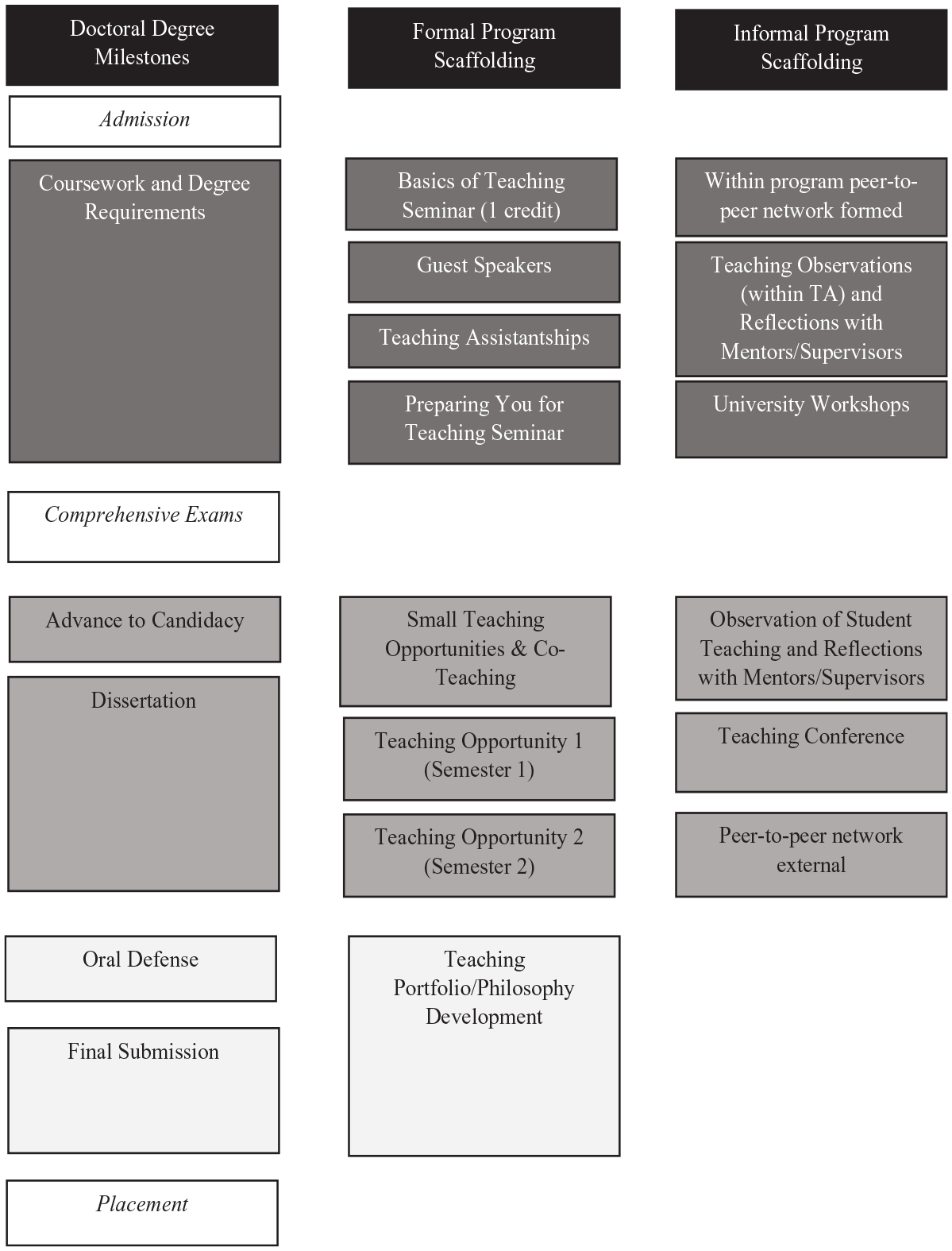
A scaffolding approach for educator development.
Our research suggests that program scaffolding designs should differ and adapt to individual student needs and be designed explicitly with educator development as part of the architecture (Marx et al., 2016). A scaffolding approach suggests that doctoral programs need to start with teaching the basics of educator development, then allow students to take on smaller components, and then eventually build into full teaching commitments. We propose three types of scaffolding: procedural, metacognitive, and conceptual (Hannafin et al., 2004) be integrated into a doctoral program. As Figure 2 illustrates this scaffolding may cross several forms, including: formal teacher education, classroom instruction, and access to informal support. Examples are provided by our interviewees include staggering the development of teaching practice, moving from small interventions to teaching an entire course, offering formal teaching classes, and moving from basic teaching skills to more advanced skills.
Both procedural and conceptual scaffolds can be embedded into the formal components of the program. Procedural scaffolds facilitate the initial orientation/navigation of the doctoral student to the program by providing tutorials and clear guidance for the available resources at different stages via program brochures, websites, and supervisors/program advisors (Hannafin et al., 2004). Conceptual scaffolds build on and change students’ perspectives as they engage in different tasks (Kim & Hannafin, 2011).
In formal instruction, a scaffolded approach could include a basic introductory class about teaching practice during a student’s induction and then progress to a one-credit hour seminar about classroom management tactics. During early stages, the program might offer master classes focused on different pedagogies and learning taxonomies provided by experienced instructors and conclude with a three-credit hour class on advanced instructional techniques that are relevant to specific classes the students will teach (e.g., the case study method; business planning; or strategy simulation). Students would thus only teach when they have expanded their experience and confidence.
Research suggests that metacognitive scaffolds addresses students’ awareness and monitoring of their own learning progress via a series of reflections and adaptive feedback (Janson et al., 2020). Given this, we propose to deliberately integrate it into the TA and informal activities of the program. One student mentioned that reflection occurs when they are engaged as a TA, helping with the class basics, observing, and reflecting on the class and teaching practices with the lead professor. The TA duty progressed to team teaching, and the student took on small teaching assignments within the class, which were observed by and discussed with the professor. So, the process began with reflections and discussions on teaching practices of lead professors, to reflections and feedback from peers and supervisors on one’s own teaching. This then progressed to the student teaching the class alone, and then finally, designing a new class. So, it is not just a matter of providing teaching assistantships, but how they can be explicitly designed to help students learn to teach. The same logic applies to teaching seminars and teaching opportunities which is usually driven by opportunity availability, the individual’s prior experience and competence, as well as economic factors driving doctoral programs to ask students to teach too much before they are ready to do so, rather than a purposeful strategy of developing teaching.
The concept of scaffolding can also be applied within the informal space. Here creating internal peer-to-peer learning networks and seeking out opportunities to observe established professors might form early steps. The seeking out of formal teaching mentors and signing up for existing teaching workshops on campus could follow. While later steps might expand to attendance at external teaching conferences and seminars, as well as the establishment of external peer-to-peer networks, focused on teaching support within the specific subject or pedagogy. At this stage when the doctoral student is advancing to candidacy, we see an opportunity for committees, such as the Teaching Theme committee of the Academy, to expand their roles in stimulating mentorship initiatives and assisting students find mentors (Adler, 2016)
Practical Implications, Limitations and Future Research
With the increasing demand for business doctoral education (Calegari et al., 2015) and junior academics’ growing doubts about the impact of their profession (Bothello & Roulet, 2019), we view a real need and an opportunity for improving student-educator development. We contribute to literature focused on management educator development in doctoral programs by going deeper into the lived experience of students. Based on our findings, we recommend doctoral programs deliberately embed and tailor scaffolding, with its three types in the formal and informal activities/components alongside the doctoral degree research milestones. We view scaffolding as playing a significant role in the cognitive development of students. It prepares doctoral students to be thoughtful educators reflecting a mindset that resonates with their students (Raelin, 2007; Welsh & Krueger, 2009). Although some of the aspects of scaffolding already exist in the programs we examined, our findings show that they do not deliberately shape the components of the program. They are usually not delivered at the right phase when students need them, in the right format, and are not available to all students when they most need them. For example, teaching practice is important, but how programs provide access to teaching opportunities diverges considerably. Readiness to teach also varies, based on prior experiences and backgrounds. So, while doctoral students often do get a chance to teach, the extent to which it is purposefully designed to help them become effective educators is negligible. Similarly, many of the informal components are not communicated to students or are not made available in the program structure. For example, programs can communicate to students about faculty members who are willing to be observed and mentor students, thus helping solve the coaching gap and widening the network of experts willing to share their experience with doctoral students. Given our conceptualization of scaffolding, we also believe that scaffolding adds to the experience of current educators by providing them with the knowledge and experience in engaging doctoral students (Burton et al., 2021), thus helping them develop “how” to teach rather than just “what” to teach.
There are some acknowledged limitations of our work. Though this is a comprehensive sample for a qualitative study and detailed grounded data were analyzed, it remains a smaller sample than can be achieved through other methods. As such, our work does present some opportunities for further research that utilizes a different approach to sampling. The study focuses on doctoral programs in the US but does so to isolate some of the variation in the design and delivery that exists across different doctoral training systems. Consequently, there is a scope to expand this work by focusing on programs in other countries, as well as examining how to improve educator training in programs focused mainly on DBAs.
Within the work conducted, we reviewed individual components (e.g., teaching assistantships; teaching experience) that supported educator development. There is a significant data set on each component, and future research could explore more deeply individual aspects of educator development within programs, and how these can be better designed to support doctoral students. Students come into programs with different stocks of experience as educators. They have different expectations and different career aspirations (Kabongo & McCaskey, 2011; Mitchell, 2007). Research could look more carefully at these different career paths and explore how programs can support different career objectives amongst students. Austin’s (2009) conceptualization of cognitive apprenticeships could be applied more deeply within a research study to explore aspects beyond the scaffolding concept considered. Studies could also expand this work by examining the outcomes and job satisfaction of new faculty that have benefited from educator development programs or could examine the teacher evaluation ratings of new faculty, and/or study the experiences of undergraduate students taught by doctoral students. Finally, research could look more deeply at the competencies that educators need and explore how programs can better develop these competencies (Rousseau, 2016).
Conclusion
Doctoral programs are designed to educate the next generation of academics, and teaching is at least 40% of the job in most universities (Lewicki & Bailey, 2009). Expecting doctoral students to “learn as you go” should no longer be accepted practice given current stakeholders’ expectations (Johnston et al., 2012; Milkman & McCoy, 2014; Schnader et al., 2016). Among these expectations are the career aspirations of some doctoral students who wish to be placed in teaching or balanced roles (Lewicki & Bailey, 2016). Also, the “do it yourself” usually works for the students who are motivated to excel at teaching but can be quite hard on international students who are navigating a new culture and teaching in a second language or other students who may be less motivated or are facing financial or time constraints. Our work calls for augmenting current management student doctoral training and argues for a scaffolding approach, combining formal and informal elements of the program, to better support educator development (Austin, 2009). Perhaps best of all, most of our augments would require little additional financial investment into doctoral programs. Enhancements such as tweaking how we use TAs as professional development experiences, being more deliberate in introducing teaching mentors, and utilizing existing activities, such as teaching seminars, are not inherently costly improvements. Rather these just require more explicit efforts to embed a scaffolded approach to educator development within program design.
Footnotes
Appendix
BEI Data Associated With Program Design.
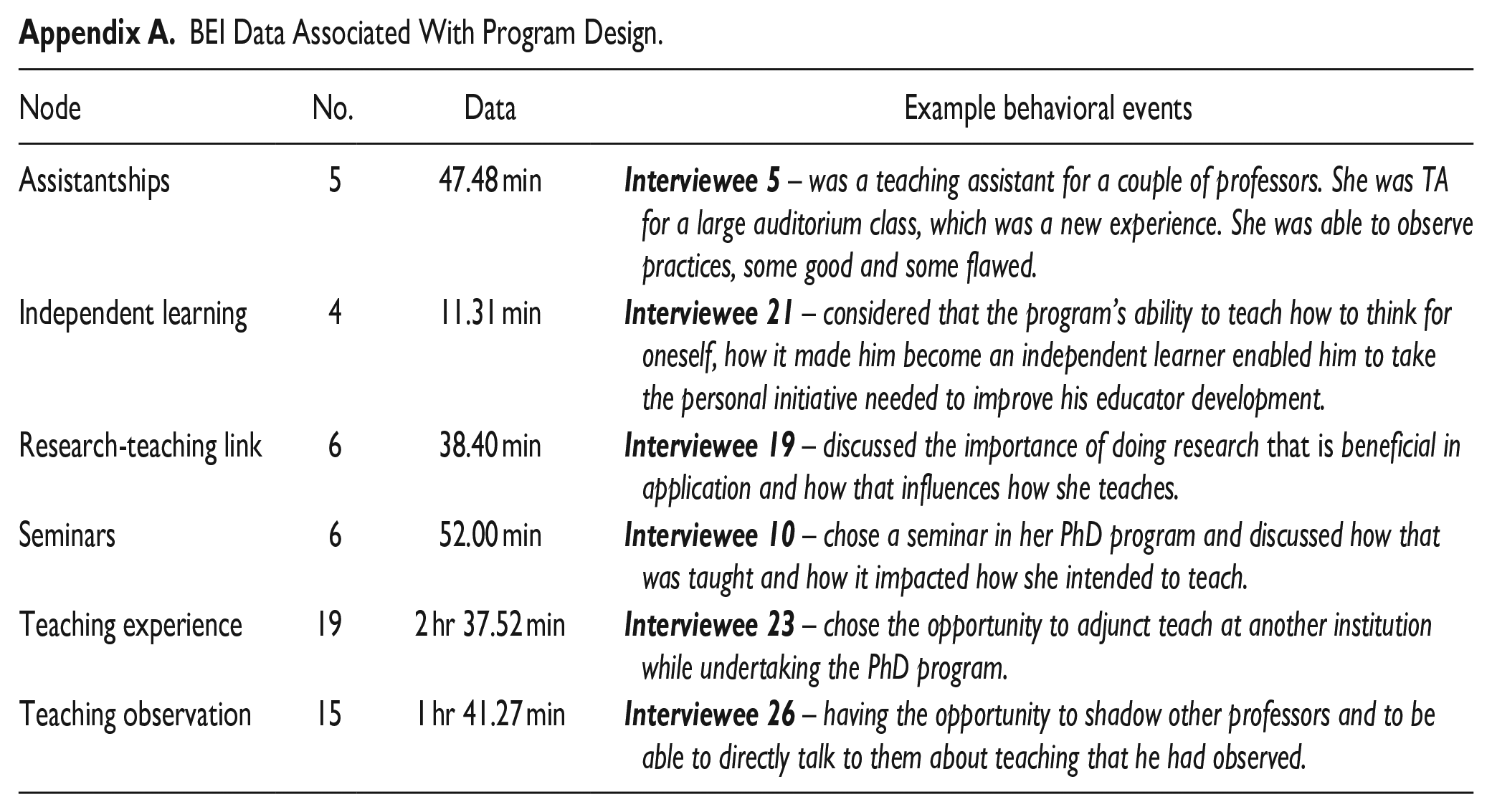
| Node | No. | Data | Example behavioral events |
|---|---|---|---|
| Assistantships | 5 | 47.48 min |
|
| Independent learning | 4 | 11.31 min |
|
| Research-teaching link | 6 | 38.40 min | |
| Seminars | 6 | 52.00 min |
|
| Teaching experience | 19 | 2 hr 37.52 min |
|
| Teaching observation | 15 | 1 hr 41.27 min |
|
Declaration of Conflicting Interests
The author(s) declared no potential conflicts of interest with respect to the research, authorship, and/or publication of this article.
Funding
The author(s) received no financial support for the research, authorship, and/or publication of this article.
