




Abstract
Humanity is facing multiple grand challenges, compelling a myriad of diverse actors to interact, coordinate, and collaborate like never before. Business schools have a role to play in equipping future leaders to tackle them and we posit that to do so, leaders must be able to take multiple perspectives into consideration and look to the future while being morally aware. We carry out an in-depth audit of how MBA programs currently fare in this regard. We find that despite the urgency and salience of these transnational and intractable issues, little attention is paid to preparing MBA students to address grand challenges. We identify three barriers that may prevent educators from facilitating student acquisition of these competencies and conclude by proposing potential models of MBA programs for grand challenges.
At the time this research began in the spring of 2020, we were facing a pandemic unlike anything that most of us had seen before—coronavirus disease (COVID-19). The pandemic emerged during a time of geopolitical turmoil, insistent calls for meaningful action on climate change, and a growing intolerance of social injustice globally. Against this backdrop, political and business leaders grappled with the crisis and were both hailed and heckled for their response to the wave of challenges that ensued. Business schools, including MBA programs, have a significant role to play in developing leaders who are able to plan for, navigate, and respond effectively to grand challenges (GCs). Although there is not a singular or agreed-upon definition of GCs, they are broadly acknowledged as important social and environmental challenges that have global impact, such as global health inequity, gender and race based violence, topsoil erosion, and insect-borne disease (George et al., 2016; Howard-Grenville, 2021). In the months following the first pandemic-related lockdowns in 2020, the first author, a Director of E/MBA programs at the time, questioned whether her alumni and students were equipped to lead through GCs—did the curriculum embed the content, foster the skills, and nurture mindsets to help leaders navigate the COVID-19 pandemic?
This question is important because management educators have a “special responsibility” to ensure students are equipped to grapple with the complexities of corporate decision making and to “tackle belief systems” (Smith & Rönnegard, 2016, p. 476) so that future leaders can operate effectively through instability and enact more sustainable solutions (Slater & Dixon-Fowler, 2010). This is not only a moral or societal imperative, but a business one too, as burning challenges such as geopolitical unrest, social inequality, and cybercrime are worsening (World Economic Forum [WEF], 2020), and how leaders respond to such events has financial and reputational implications for the firm (e.g., Varma, 2021). Developing the capabilities to anticipate and respond to GCs in MBA programs can therefore not be underestimated.
Despite a voluminous literature on how business schools perpetuate shareholder primacy (Leavitt, 1989; Smith & Rönnegard, 2016; Waddock & Lozano, 2013), there appears to be a transition on the horizon. More than 90% of CEOs recognize the importance of sustainability for corporate success (Hoffman, 2018) and some of the world’s largest investors and businesses are proactively altering their business strategies to align with the UN’s sustainability goals (Deloitte, 2017). In the fall of 2022, Patagonia founder, Yvon Chouinard caused a media storm when he declared that going forward, the firm’s profits would be used to combat climate change. Many business schools are likewise committed to change. They increasingly endorse responsible education (Christensen et al., 2007; Jack, 2020), and many are signatories of the UN’s Principles of Responsible Management Education that encourages the integration of ethics, corporate social responsibility (CSR), and sustainability into their core activities. Despite all this, critics still argue that students remain exposed to the same pedagogies and utilitarian business frameworks that contributed to the climate emergency, social inequities, and financial crises we now experience (e.g., Friedland & Jain, 2022; Ramboarisata & Gendron, 2019). Clearly, more is required if meaningful change is to be realized.
In this study, we sought to unearth how the MBA curricula prepares learners to tackle GCs. To address this, we analyzed the curriculum of the top 100 Financial Times global MBA programs. This research responds to a call to address “new ways of seeing” how GCs are addressed in business education (Montiel et al., 2020, p. 243). In what follows, we discuss GCs and their moral implications. Subsequently, we make theoretical connections between GCs and MBA education, followed by a review of research on the MBA curriculum. We then turn to the method, results, and discussion. We conclude by offering three pathways for MBA curriculum design.
Grand Challenges and Their Moral Implications
Although the term “grand challenges” (GC) is commonly used in academic and public discourse, there is no agreed-upon definition. There are two general ways that GCs are understood, and even then, there is ample plurality within them. On the one hand, GCs have been characterized by a narrow problem specification, a scientific and/or technological focus, and the provision of incentives (e.g., funding) that motivate actors to address a challenge (Brammer et al., 2019). Scientific institutions have drawn up bespoke lists of such GCs, whose foci varies depending on areas of expertise. The National Academy of Engineering (2021) has set a GC to “make solar energy economical” for instance, while the Bill and Melinda Gates Foundation (2021) seeks to build malaria modeling capacity in Sub-Saharan Africa as part of their global health initiative. A second way that GCs feature in academic and public discourse is, broadly speaking, as significant social or environmental challenges (Brammer et al., 2019). Supranational organizations, such as the United Nations (2018) and the WEF (2020) have identified many of today’s GCs using this framing, citing data fraud, biodiversity loss, infectious diseases, and poverty alleviation, among many others.
Unlike other scientific domains, management scholars have yet to articulate a definitive or specific list of GCs that the field of management can address. While for some, this is concerning (Brammer et al., 2019), for others, the very idea of compiling such a list is redundant (e.g., Howard-Grenville, 2021; Tuazon et al., 2021). The latter argue that management scholars bring limited value to the content of GCs; instead, their real potential lies in their knowledge of multilevel processes of organizing, relational interactions, and their consequences. Furthermore, they argue that GCs need to go beyond their origins as tractable problems in mathematics and science because a rational, scientific approach to solving GCs is insufficient to facilitate the kind of change needed to promote ground breaking learning and innovation. For these reasons, management scholars have focused on distinguishing common features of GCs. Although imperfect, pinpointing shared features is an attempt to unite seemingly disparate GCs so that we might find more holistic ways to research and address them (Brammer et al., 2019).
To find some common ground, Ferraro et al. (2015) looked across the literature and articulated three overriding features of GCs: complex, uncertain, and evaluative. These features (that we elaborate on later) serve as guideposts for researchers, and have largely been unquestioned (Brammer et al., 2019; Howard-Grenville, 2021). This is likely because these three key features have served as useful heuristics for examining GCs at the firm level of analysis. However, addressing GCs needs to happen at multiple levels of analysis, where needs and aspirations interact with barriers and opportunities within and across systems to shape action (Howard-Grenville, 2021). Even though addressing GCs typically requires individual behavioral change (George et al., 2016), management scholars have barely scratched the surface of what this implies at the individual level, for the agents on the ground—the “real persons, who form and function the corporation” (Miller, 2005, p. 220). Emergent literature in business ethics, on the other hand, has zeroed in on the individual level by highlighting the ethical dilemmas imbued in GCs (Larres & Kelly, 2023; Pless et al., 2022; Wakeman et al., 2022), where managers are faced with competing moral imperatives and need to choose between not “right versus wrong”, but “right versus right” (Zhang et al., 2018, p. 857).
We thus propose that the features that management scholars have put on the table—the complex, uncertain, and evaluative nature of GCs—are, in their current articulation, insufficient to help us build complete insights, and prompt questions regarding how management education can foster the requisite ethically attuned knowledge and capabilities to address GCs. In the subsequent section, we percolate Ferraro et al.’s features of GCs to the individual level, and we engage with business ethics scholarship to further elaborate on the ethical dilemmas that addressing GCs commonly evoke. Furthermore, although Ferraro et al. suggested that the three features are distinct, we show that at the individual level, they overlap, which offers a theoretical contribution to work that focuses on GC articulation (George et al., 2016).
Features of Grand Challenges: Implications for MBA Education
GCs are necessarily complex because they involve multiple, diverse actors with distinct knowledge structures who engage in intense coordination and collaborative efforts (Ferraro et al., 2015). Yet actors who are implicated in GCs have numerous goals, with varying priorities and potentially conflicting objectives within and among them (George et al., 2016). Indeed, stakeholder considerations are central to many GCs (Olsen et al., 2016) because the success of any solution depends on the acceptance and support of important and differently motivated stakeholders. While leveraging multiple perspectives is necessary, constraints are only partially visible to any actor at any time (Howard-Grenville, 2021). Gains for one stakeholder may result in losses for another, and consensus may appear difficult—or sometimes impossible—to attain.
In some instances, the mainstay stakeholder perspective may fall short in addressing GCs. Critics of the stakeholder perspective suggest that it reduces the decision options open to managers, forcing the prioritization of certain stakeholders’ interests over others, and potentially limiting broader societal advances (Bansal, 2019). An alternative is a systems perspective, where managers are asked to shift their attention from a collection of individual parts to the whole system, moving from short-term gains to long-term societal progress (Bansal, 2019; Werhane, 2002). What does this complexity mean for management education? Scholars have called for business schools to “lower their walls” and invite other disciplines and stakeholders into the classroom (Currie et al., 2016, p. 742) and help students to contribute to the “constitutive polyphonic discourse” that GCs require (Pless et al., 2022, p. 328). In short, we conclude that attention to integrating multiple perspectives is required.
The second GC feature is radical uncertainty; this feature suggests that it is not only difficult (and perhaps impossible) to accurately predict future consequences of our (in)actions, but we are also unable to accurately predict others’ future preferences given that they invariably change over time (Ferraro et al., 2015). For example, in predicting temperature increases, science can only provide us with a range of values (1.7°C–5.4°C by 2100; European Environment Agency, 2021), rather than an exact number. Further, it is impossible to predict how future generations will appraise the effectiveness of our (in)actions today, given the multitude of other unanticipated changes or technological advancements that are likely to come.
Decision analysis approaches to complex problems have focused on developing methods to minimize risk, and often employ forecasting activities that use existing data to project plausible futures (Rohrbeck et al., 2015). Such approaches have arguably grown in importance in today’s era of big data, characterized by an overwhelming amount of complex and heterogeneous data “pouring from any-where, any-time, and any-device” (Sivarajah et al., 2017, p. 263). The digital byproducts of human activity can all be harnessed to address economic and societal problems (Paliokaitė & Pačėsa, 2015; Rohrbeck et al., 2015). Yet, as some critics have noted, making projections about the future based on existing data assumes that the future is much like the past (Sharma et al., 2014). Furthermore, unintended consequences can arise when past data reflects, and therefore perpetuates, bias (Ebrahimi & Hassanein, 2021).
In contrast to forecasting, corporate foresight activities couple the use of evidence with collaborative imaginative processes to produce possible future alternatives (Paliokaitė et al., 2014; Rohrbeck et al., 2015). Foresight processes are therefore inherently transdisciplinary because they require participatory dialog between multiple stakeholders, enabling actors to generate new knowledge and consider possible future scenarios to formulate strategies capable of meeting the future needs of society (Paliokaitė et al., 2014; Rohrbeck et al., 2015). This requires knowing where and how to access and triangulate data with other sources, how to analyze it and extract insights, as well as understand potential causal inferences that can be made. The implication for MBA education is clear—we need to ensure that we foster students’ ability to mobilize the data at their fingertips and to look to the future both individually and with others.
The third and final feature is that GCs are evaluative, “implicating multiple criteria of worth, and revealing new concerns even as they are being tackled” (Ferraro et al., 2015, p. 364). This feature suggests the challenge is understood and approached differently by actors, based on their idiosyncratic perspectives, interests, and philosophies. For instance, Tuazon et al. (2021) found that actors who perceived that their values were similar to others’ values were more positive about inter-organizational collaboration and knowledge sharing about environmental GCs. This feature hints at the importance of morality in addressing GCs, yet since the focus of management research has been largely at the organizational level, we lack a thorough understanding of the moral reflection that GCs necessarily imply.
Business ethics scholars have recently initiated debate on the moral dimensions and tensions implicit in GCs (e.g., Larres & Kelly, 2023; Pless et al., 2022; Wakeman et al., 2022). For example, an organization that unreflectively applies global multi-national standards, rules, and policies can breed cultural arrogance and imperialism (Stahl et al., 2016), while an organization that tailors and adapts to local standards and customs runs the risk of moral blindness, low standards, and ignorance of ethical principles and norms (Pless et al., 2022). When organizations rely too heavily on ethical codes and standards, managers abdicate their ethical positioning to the firm, effectively offloading their personal moral responsibility onto corporate ethical rules and thus have been spared the necessity of ethically reflecting on their (in)actions (Larres & Kelly, 2023).
However, GCs often confront actors with ethical dilemmas that need to be resolved by individuals, often in the moment, or without personal precedent: equity or equality; individual freedom or public safety; data protection or efficient solutions; financial or physical health. If there is no precedent, or clear organizational policies regarding how to act, individuals rely on their own set of moral principles to make decisions in the moment (Bailey & Shantz, 2018). For example, in the spring of 2020, before the national government had made any decisions about lockdowns, a Provost of a European university closed the campus, giving on-campus residential students a mere 48 hr to leave. The dilemma he faced was the short-term disruption of students’ living arrangements versus their longer-term physical health. This leader chose to act according to what he deemed to be the “right thing to do.” We need to ensure that our students’ moral compass’ are just as fine-tuned.
Yet this may be challenging for business school professors who tend to hold epistemological orientations that do not make morally normative claims (Kim & Donaldson, 2018). Indeed, the amorality of business research (and likely teaching too) can be traced to the classic writings of Adam Smith and Edward Freeman, where individuals are expected to always act for the benefit of their material self-interest (Moosmayer et al., 2019; Norberg, 2018). The separation thesis in economics (Harris & Freeman, 2008; Hörisch et al., 2014) stipulates that economic issues should be kept separate from moral ones, and business activities reside beyond the domains in which we can make moral judgments. Many business theories build on the economic stance of amorality, essentially leaving moral questions unanswered (Ghoshal, 2005). However yet again business ethics scholars are beginning to offer ways to address ethical dilemmas. For instance, Pless et al. (2022) suggested ways to unleash “moral imagination,” which requires people to step back from the presentation of an “either or” what should be done mentality, and instead ask, what could be done? This allows for the emergence of alternative possibilities, which effectively expands the moral choice set that are at the disposal of actors. Turning to pedagogical application, when confronted with complex problems with no single solution, we need to create opportunities for students to practice making decisions with an informed use of moral self-awareness (e.g., Hibbert & Cunliffe, 2015).
Whereas Ferraro et al. considered the three features of GCs as discrete, when we percolate these to the individual level, observers likely see several overlaps. For instance, the overlap between multiple perspectives and looking to the future becomes salient as foresight activities involve more than one person, perspective, and type of expertise. Second, tensions in addressing ethical dilemmas become exacerbated because of different motivations and values of actors who are involved, and who may have different understandings of “what is morally relevant and thus worth addressing” (Wakeman et al., 2022, p. 325). Third, data without moral reflection is akin to the “cognitional myth that falsely presupposes that knowledge is merely the ongoing accumulation of facts”; managers who are morally aware critically reflect on their decisions regarding the relevance of data, what constitutes objectivity, and what is considered to be worthwhile (Kelley & Nahser, 2014, p. 633). Finally, the notion of foresight resonates with emerging business ethics arguments that urge the field to “look beyond our immediate horizon to imagine alternative viewpoints, extend our understanding of situation, and engender a willingness to act for the wider human good” (Larres & Kelly, 2023, p. 5). Some have even disavowed mainstay ethical decision-making models that leave “business ethics firmly positioned in the timeless present” (Larres & Kelly, 2023, p. 4) so that we can go beyond “understanding how the world is now” and instead focus on “how it might become” (Islam & Greenwood, 2021, p. 3).
MBA Curriculum
So far, we have defined and translated three features of GCs set forth by Ferraro et al. (2015) that can be leveraged to inform MBA education. We have shown that some of these capabilities overlap, and many are already on the radar of management educators. A pertinent question at this stage is the extent to which these features are actually embedded in the MBA curriculum. The broader literature on MBA programs provides a backdrop to this question. Navarro (2008) surveyed 50 top ranked US business schools for “ideal” MBA curriculum and found that programs are characterized by a cookie-cutter, functional approach, with insufficient emphasis on soft skills, social responsibility, or a global outlook. He found that only a small number of programs adopt a multidisciplinary approach, and fewer still contained experiential activities. Rubin and Dierdorff (2009) compared the MBA curricula of 373 AACSB-accredited programs with the O*NET model of managerial competencies, and much like Navarro, concluded that the curricula underemphasized human capital and decision making and overemphasizes administration and control. Both audits took place at the advent of the last great recession, and so more than a decade has passed since these worrying conclusions were first drawn.
Two recent studies suggest that some progress has been made. Costigan and Brink (2015) examined AACSB-accredited MBA programs and highlighted the close alignment of program learning goals with key competencies that lead to managerial success. Stoten (2018) studied the top 10 UK MBA programs and alluded to a “fundamental transformation” of the UK MBA over the previous decade, which involves student ownership over the learning journey, greater opportunities for specialization, and the provision of extra-curricular enrichment that enables a student-centered approach (p. 9). The findings show that although there is ample variety among MBA programs, most share a common core set of subjects and position themselves as student-centered programs that combine theory with practice.
The types of challenges that leaders face today are markedly different than in the past, and arguably, the design of programs should reflect this. Yet while management educators have provided some guidance on how to address GCs in the curriculum (e.g., Currie et al., 2016; Kelley & Nahser, 2014), not a single study has examined how well MBAs fare in this regard. While there is a growing body of research that outlines the features of GCs at the organizational level, there is a considerable gap in our knowledge of how this translates into the MBA curriculum.
Ferraro et al.’s features provide a useful starting point if we aim to translate scholarship on GCs into pedagogical insights. However, as outlined earlier, this theoretical framing has its limits, and has notably sidestepped the moral dilemmas that characterize most GCs. Our review of the literature suggests three key themes: managers must be able to take multiple perspectives into consideration, and look to the future while being morally aware. If management educators seek to prepare MBA students to address GCs, we need to inject our programs with appropriate learning opportunities that reflect these themes and create the conditions for educators to respond to topics in more experimental and agile ways. We currently know very little about the extent to which, where, and how these themes feature in the MBA curriculum and to what extent students are thus prepared for managing GCs. In this study, we bring together research on GCs in the management and business ethics literatures, together with MBA education, to address some of the gaps that extant literature does not yet address.
Method
Context and Data
We started this research in the midst of the COVID-19 pandemic, as business leaders cried out for advice on “what leadership should look like in a time like this” (Hoch, 2020). Business schools, particularly MBA programs, were scrambling to adjust teaching curricula to support students to respond to the unprecedented event. The authors of this paper experienced this, in their respective roles as directors, instructors, students, and employers of graduates from MBA programs in Europe and North America. It was against this backdrop, in the spring of 2020, that we set out to answer our research question: How does the MBA curriculum prepare students to deal with grand challenges?
Two members of the research team searched the Financial Times top 100 global MBA program websites for 1-year, full-time MBA programs (or other formats if a 1-year MBA was not available) to create a database of MBA curricula. The average duration of the MBA was 18.21 months (SD = 5.32), and the average number of courses was 16.88 (SD = 7.67). The MBAs were located in North America (54%), Europe (25%), China (9%), India (4%), Australia (3%), Singapore (3%), South Korea (1%), and France/Singapore (1%). Course descriptors were collected via university websites, program brochures, searchable course catalogs, and follow up emails to admission teams when required. Course descriptors are summaries of the purpose and content of courses, often including explicit learning goals; they identify the focus, tone, and core elements of a course. On average, the course descriptors contained 84 words. The final set of course descriptors were rigorously cross-checked for accuracy and completeness independently and then together by two of the authors. The final data corpus contained 1,688 course descriptors.
Courses were classified as either core (mandatory) or flexible core (mandatory selection among a pre-determined set 1 ) and credit or non-credit bearing. We excluded non-credit bearing courses that pertained to orientation, careers, and international trips because of their relatively low frequencies in the data (4, 14, 5, respectively). We found 1,363 core and 325 flexible core courses; 95.8% were credit bearing. The average number of courses per program is 16.88 (SD = 7.67); the average number of core is 13.63 (SD = 5.03), and flexible core courses is 3.25 (SD = 7.58). Electives were not included.
Analytical Procedure
To provide a detailed analysis of the content in these 1,688 course descriptors, we drew on Braun and Clarke’s (2006) deductive approach to thematic analysis. We supplemented our thematic analysis with qualitative content analysis, an approach that quantifies qualitative coding (Hsieh & Shannon, 2005). Our approach was iterative in that we went back and forth between qualitative and quantitative analysis, forcing us to question our assumptions throughout. By combining two or more approaches within mixed methods research designs, researchers maximize the strengths of each approach while making up for their respective weaknesses (e.g., Creswell & Plano Clark, 2011).
Four authors of this paper undertook a theoretically derived approach to our initial codes and focused on semantic (rather than latent) meanings in our data corpus (Braun & Clarke, 2006). We put together a codebook based on four initial candidate themes that we deductively developed: “grand challenges,” “multiple perspectives,” “looking to the future,” and “moral awareness.” We pre-tested the codebook by reading and re-reading course descriptors from 50 courses and engaged in preliminary coding. All authors engaged in the coding process and the lead researcher reviewed the first round of coding to check for shared understanding between coders. We met as a research team to clarify discrepancies (Grodal et al., 2021).
Next, we split the research team into alternating dyads, so that each descriptor was coded by two independent raters. Once all initial codes were complete, we entered the data into SPSS (i.e., if a course contained an initial code, then it was marked as “1”; courses could contain more than one code). Fleiss kappa 2 was computed to assess the degree to which the observed proportion of agreement between raters exceeds what would be expected if all raters made their ratings randomly. The counts for each refined code and inter-rater reliability statistics ranged from .65 to .88, demonstrating substantial agreement between raters.
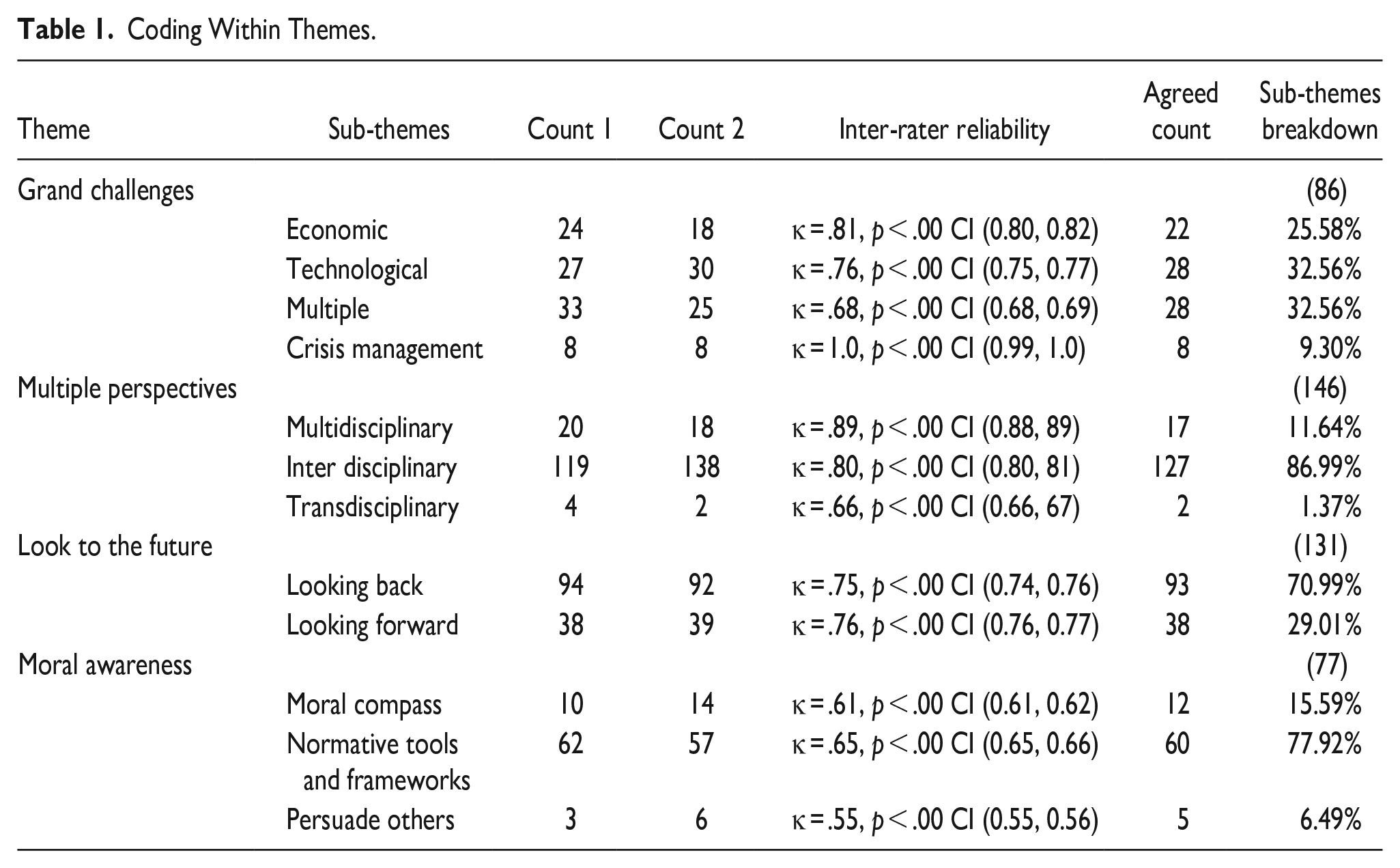
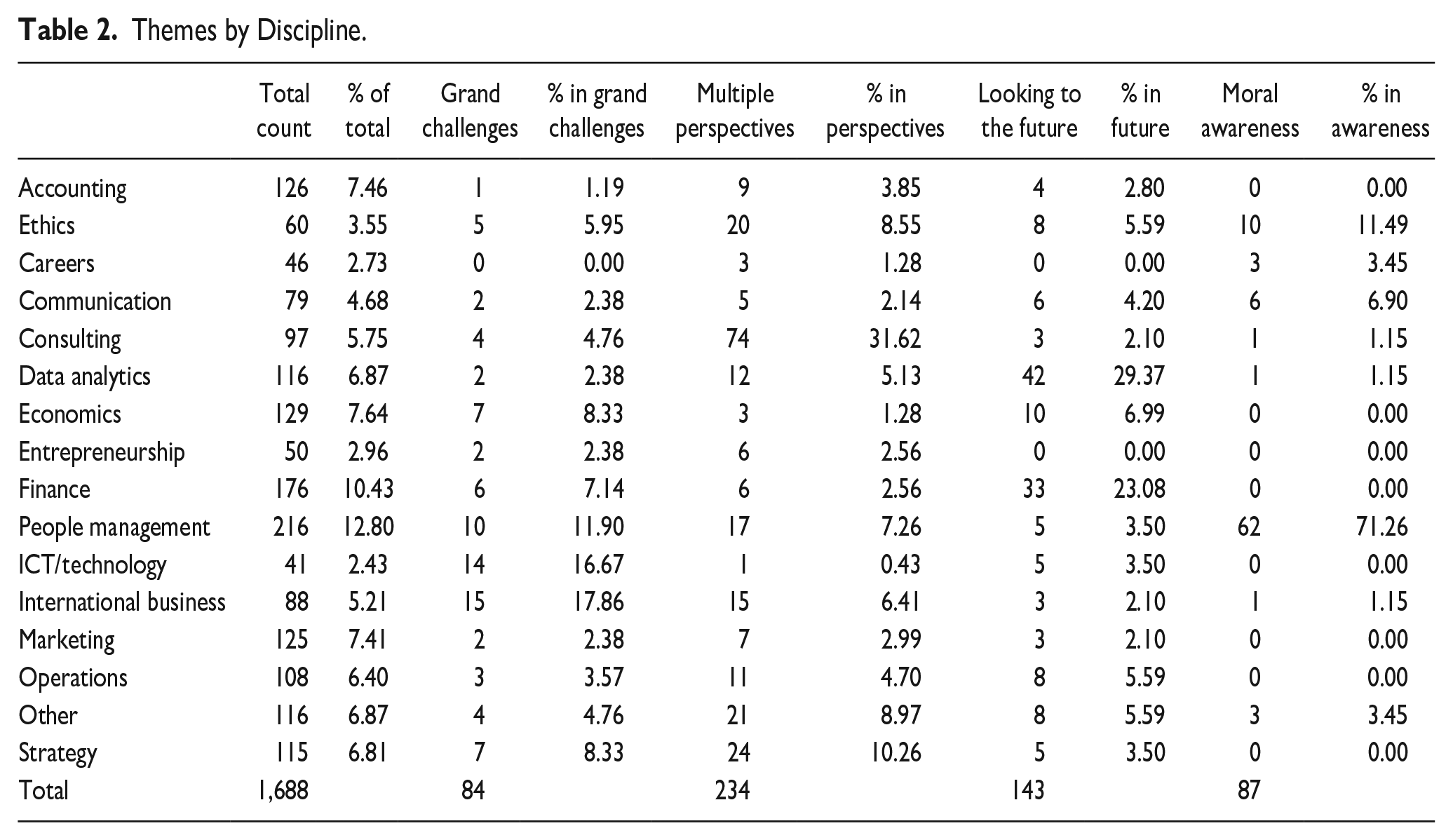
Next, we reviewed all collated extracts relating to each candidate theme. We wrote one to three memos on each theme (3–8-page reflections) to help clarify our thinking. This helped us to consider whether our representation of the data created a coherent and consistent pattern. Finally, we undertook an additional round of qualitative content analysis within each theme to provide a tangible basis for assessing what we claim are the important patterns within each theme. In this step, we inductively developed sub-themes (see Table 1 for themes, sub-themes, counts, and inter-rater reliabilities). The courses that fit each sub-theme were counted by two independent coders and courses could fit multiple sub-themes. We were also interested to see the disciplines that embedded these themes, and we show the findings in Table 2.
Coding Within Themes.
Themes by Discipline.
Findings
Grand Challenges
Approximately 5% of courses (86 out of the 1,688 total) focus on leading in complex and uncertain environments, and of those that do, over half of the descriptors in this theme focus on either economic challenges or technological disruptions. Those that focus on economic challenges invite learners to think critically through a macro-economic lens: “Why are sovereign debt crises costly both for firms and for the economy and how can we avoid them?” The purpose of these courses is to understand GCs so that shareholder wealth is safeguarded. They do not mention the role of leadership, nor how to prepare leaders to respond to GCs, beyond the technical transfer of macro-economic theory. Whereas economic challenges are typically positioned as something to avoid, technological ones were presented as a way for companies to be competitive; for example, “The course provides strategic and critical thinking tools that reveal how technology-driven market disruptions can threaten and undermine conventional business models but also create opportunities for new, innovative business models that create value.”
Aside from economic and technological challenges, a third of courses (28 out of 86) touch on multiple other challenges that are social, environmental, or geopolitical in nature. When these issues are addressed, they tend to be in the context of influencing shareholder outcomes. For instance, one course descriptor ties approaches to environmental changes to the success of the organization: “Companies that respond creatively to the challenges posed by technology, sustainability, demographic change, urbanization, civil society, and related issues are likely to be more successful than those that do not” and a course on Business Climate Change asks, “What does the climate economy mean for your career, your firm, your industry?” We point to two implications of this economic ethos: first, a focus on economic risk implies short-termism. For instance, Pacific Gas and Electric took a short-term, profit-oriented approach and subsequently failed to learn from the past, causing over 1,500 wildfires in California over 8 years due to its faulty and/or out-of-date equipment (Gold et al., 2019). The second implication is that it diminishes the salience of human and/or moral issues, which invariably accompany GCs. Course descriptors treat GCs as a business issue, rather than one that is also important for moral reasons.
Multiple Perspectives
This theme reflects the extent to which course descriptors evoked other disciplines and actors beyond the firm. Perhaps not surprisingly, we found that consulting courses were most strongly represented in this theme. Out of the 100 MBA programs, 93 include at least one mandatory course whereby learners are matched with an organization to address a business challenge. For instance, in one project, learners experience “An intense, four week-project that requires students to work in teams to devise a solution to a real business problem within a company, before presenting your recommendations to the company’s executives and other panel members.”
We took note of several features of these projects. First, although learners will, in the majority of cases, meet with companies to gather information, to “ensure their understanding,” and subsequently “present to clients,” learners are overwhelmingly encouraged to act “for” the companies rather than “with” them. In fact, we noticed that learners in consulting projects “take on the role of a team of consultants” and act like an “external think tank” to the company to bring about financial gains. This insight is mirrored in courses that mention stakeholders where the firm is nearly always the object, thereby acting on stakeholders, the subject. For instance, “Our collective objective is to solve, in the best possible way, the client challenge, and present the best findings to them.” Second, there is an assumption that learners should view the disciplinary content from the perspective of a profit-maximizing firm, as if leaders are always situated in this context, as opposed to leading an organization that has other priorities (e.g., health and safety) or the non-profit sector or government. Third, the rationale for paying attention to stakeholders is, in the main, to protect the organization, rather than work with stakeholders or on their behalf to overcome societal and environmental challenges.
Outside of consulting projects, we found some taught courses that involve approaching a societally relevant problem, rather than a business one. An example of this is a mandatory course in sustainability that draws “on a wide range of underlying theory and cases to show how the institutional aspects of decision-making, technology, and sustainable development are inextricably interwoven.” In such courses, learners learn about the importance of engagement with stakeholders, for example, “Students will assess alternative business models and management practices designed to enhance sustainability for an increasingly global array of stakeholders. . .(and address topics such as). . .serving ‘Base of the Pyramid’ markets, socially responsible investing alongside issues relating to social, environmental and economic ecosystems.” Although courses like this connect with broader societal issues, they stop short in engaging with non-academic actors. One notable exception is a problem-solving course where learners address challenging problems faced by society, such as the “opioid crisis, trade wars or the digitization of society.” In this course, learners “work with academics, non-profits, and community leaders to identify and understand complex problems faced by society.” This is one of only two courses that explicitly indicate that they are interdisciplinary in nature and actively integrate multiple stakeholders.
Looking to the Future
Course descriptors reassure learners that they will be able to “predict” and learn “how we can avoid” GCs and respond to the driving forces in the external environment. We were struck that the approach deployed to educate leaders on envisioning the future is largely built on what has happened in the past, and consequently overlooks the necessary leader foresight skills needed to anticipate possible futures. In fact, nearly one-quarter of courses in this theme focused on learning from past events such as the 2008 financial crisis. Learning from the past is important; for instance, Toyota learned from the 2011 Great East Japan Earthquake and, together with 11 union members, created a power grid that is more energy efficient and doubles as a back-up energy supply during periods of disaster (World Bank, 2020). However, solely looking back in time for clues about future strategic directions makes little sense when the present is entirely different (Scoblic, 2020). Additionally, it seems misguided to suggest that future turmoil and disruption can be avoided.
The largest proportion of courses that sought to promote looking to the future were in Business Analytics courses that emphasized “looking forward” by way of predictive tools and models. Consistent with the rational strategic approach to prediction where the primary outcome is control (Ansoff, 1991), predictive tools help “better management of business risks. Compared to traditional statistics, which often provide hindsight. . .predictive analytics seeks to find patterns and classifications that look toward the future.” Although predictive analytics may help leaders to consider market reactions to GCs, they are less effective when leaders have incomplete information and data. A large majority of these descriptors mention decision-making tools (e.g., decision trees, random forests, Markov chains) that can help leaders “make informed decisions under uncertainty,” yet these are linked to “business as usual” problems, with no reference to how and when to apply these tools to GCs. These are undeniably important skills to have, yet the responsibility to tie together the use of decision tools (e.g., decision trees) with GCs is left up to the learner, and it has the potential to isolate decision making from ethical tensions that may arise.
Framing the future based on predictive analytics and “probabilistic thinking” gives a (false) sense of certainty and control. Leaders are led to believe that “fore-warned is fore-armed” by looking to the past, and that the future can be controlled through statistical modeling. Most courses provide a sense of control because “statistical methods provide a direct way of dealing with a wide range of managerial problems” and statistics are promulgated to help students cope with uncertainty. There is scant acknowledgment that statistical tools need to be used with a healthy dose of skepticism, because they provide probabilities and scenarios not certainties.
Moral Awareness
We identified three prevailing assumptions in the courses that populated the moral awareness theme. First, course descriptors imply that students enter the classroom with a sense of what is morally “right” in the professional sphere, and that their moral compass is already finely tuned. Courses are designed to help learners make rational decisions that align with their pre-established ethical perspective. For example, one course descriptor promises “an analytic structure that enables students to identify ethical issues in business, analyze options and make choices consistent with their own values.” The implication is that MBA students are already aware of their own personal values and adept at navigating new environments that pose ethical dilemmas. There is little recognition of the need for moral introspection, so that one can question—or become attuned to—one’s own moral priorities.
A second assumption relates to how ethical dilemmas should be approached. Many course descriptors mobilize normative frameworks to facilitate students’ ethical decision-making. Course descriptors “defined and distinguished” ethical concepts and aim to arm students with “a tool kit of tactical options,” to tackle diverse organizational challenges. Students “study and apply the major normative ethical theories to business situations.” There is a sense that normative frameworks provide assurance and certitude, offering a veritable roadmap for navigating difficult issues.
Another way that course descriptors suggest that ethical dilemmas should be approached is via persuasion. The manager’s role is to defend their, and the firm’s, moral position by negotiating, convincing, or influencing other stakeholders. For example, “Business leaders are often called upon to make credible and persuasive arguments defending their products, their firms, their industries, or the capitalist system in which they operate.” Students are primed to convince or win over stakeholders to their way of thinking, helping them “persuasively communicate” their reasoning “to people who may not share similar beliefs and values.” Students are thus taught how to “defend their decisions to other stakeholders,” rather than to integrate diverse needs and perspectives. Course descriptors rarely evoke an empathetic mode of stakeholder understanding—fostering students’ ability to comprehensively adopt another’s position. Instead, the descriptors heavily feature talk of markets, shareholders, and competitiveness vis-à-vis mention of NGOs, ecological and societal groups. The “default” position of the MBA curricula is invariably instrumental—concerned with efficiency (economics) first, and citizens (society) second.
There were a few outlier course descriptors that hinted at paradigm change. For example, one MBA course entitled the “Disruptive Trend Project” entails students researching and presenting not only how future trends will impact business but also requires them to “create different future scenarios” that “incorporate different stakeholder views.” Another course alluded to provoking the necessary introspection that change requires: “We will . . .consider a broad range of trade-offs and controversies that business leaders often confront. Arriving at informed views that reflect your beliefs is essential to handling these trade-offs and controversies effectively, and in ways you can feel good about.”
Discussion
Our research reveals that few MBA programs explicitly address how leaders can effectively navigate GCs. Our examination showed that approximately 5% of courses focused on leading in complex and uncertain environments, and those that do tend to focus on either economic or technological disruptions; social, environmental, or geopolitical challenges are very much at the fringe. We searched the MBA curricula for three themes that are important to tackling GCs: adopting multiple perspectives, looking to the future, and moral awareness. Although we found pockets of opportunities for students to engage with these learning themes, our findings also reveal pathways for improvement. We thus unearth three corresponding barriers that prevent educators from tackling GCs in the classroom. Figure 1 maps the connections among organizational-level features of GCs (Ferraro et al., 2015), the individual-level features to address them, and the barriers for educators that our analyses indicate. We zero in on these barriers for educators next.
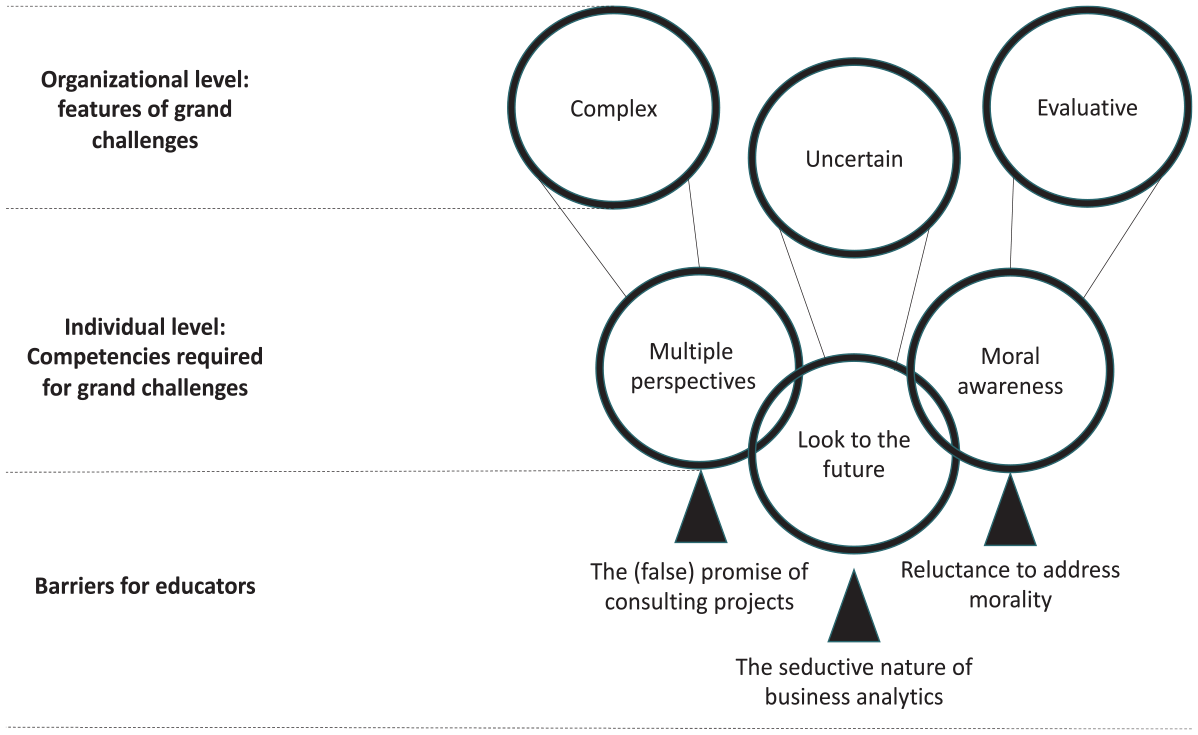
Linking grand challenge features, competencies, and barriers for educators.
Barrier 1: Consulting Projects: A False Promise of Multiple Perspectives?
We shine a light on the role of consulting projects, which can help students draw together learning from various courses to develop a multi-perspective viewpoint. Encouragingly, we found that 93% of MBA programs have at least one consulting project. Yet, when we peel beneath the surface, our analysis shows that many projects fail to integrate more than a few disciplines, and they explicitly position students from the perspective of a wealth-maximizing firm. The implication of the latter is that consulting projects are built around profit-maximization motives that leave little space for the kind of reflection or conscientization that are required to address GCs (Larres & Kelly, 2023). Furthermore, rather than acting with stakeholders to tackle problems, students are positioned to work for them. This is problematic because GCs are approached and understood by actors differently, cutting across boundaries, so that “different actors have different views about what the problem actually ‘is’ and therefore what constitutes an acceptable solution” (Ferraro et al., 2015, p. 366).
To maximize their potential for addressing GCs, consulting projects should encourage students to integrate program curricula, reach out to people at various levels of the company across various disciplines, and put themselves in the shoes of suppliers, customers, and other stakeholders. Although this may occur in practice, there was little explicit evidence in the module descriptors to indicate that consulting projects are designed with these objectives in mind. A potential barrier to this approach is the willingness of firms to participate in projects where the firm is not at the epicenter among other stakeholders, and where students’ recommendations balance financial and social gains. This comes with the risk of upsetting the firm or other stakeholders, and tarnishing relationships. Although some for-profit firms may welcome a multiple perspectives approach, not all will. Another potential barrier to this approach is the willingness of business schools to manage more complex stakeholder engagements.
It is important to note that we found clear exemplars of multiple perspectives in other types of courses: we found two courses driven by societally relevant concepts, where learners reach out to non-academic partners with the explicit goal of working together to address pressing GCs. Although such courses are outliers in our data, they provide an example of how courses can evolve to address GCs confronting society. By further engaging with a myriad of stakeholders (in collaboration as opposed to consultation), there is a greater potential for pivotal learning experiences.
Barrier 2: The Seductive Nature of Business Analytics
Our findings reveal a pervasive view in MBA curricula that sophisticated tools from business analytics—such as decision trees and statistical modeling—can be employed to plan for the future. A barrier for educators is that business analytics and big data are seductive topics, enticing learners to believe that the future can be predicted and controlled. Educators of business analytics are in a position of knowing the answers, using scientific evidence and tools to convince students that there is a right answer to complex problems, implying that modeling of existing data and forecasting plausible futures are effective and sufficient arsenal.
While business analytic capabilities can add value, it is not a foregone conclusion that they will. Indeed, the unquestioned promise of business analytic capabilities runs the risk of decoupling technology from humanity. For instance, unethical practices such as those deployed by Cambridge Analytics have raised serious questions about how organizations use customer data. The effectiveness of business analytics is therefore dependent on leaders’ decision-making processes—that are enabled by business analytics—as opposed to the sheer power of the tools themselves (Sharma et al., 2014). It is the unquestioned positive positioning of technical business analytics and the absence of leader foresight skills in MBA education that constitutes a potential road hazard on the journey to equipping students to solve GCs.
Barrier 3: Reluctance to Address Morality
To effectively tackle GCs, managers need to build awareness not only of their own morality but also that of their interlocutors. Yet only about 5% (77/1,668) of course descriptors addressed moral awareness. Further, our analysis revealed an assumption that students already have an established moral compass that they feel comfortable using in a work context, and rather than empathizing and integrating diverse views, they are tasked with defending their position.
Some business ethics scholars propose that the first step toward meeting sustainability challenges is to focus on developing students’ capacity for moral reasoning (Akrivou & Bradbury-Huang, 2015). Our analysis indicates that MBA curricula may therefore be missing a critical step, that is, the importance of helping students understand what is “right” or what is “good,” or to make what moral philosophers call, morally normative claims (Kim & Donaldson, 2018). To do so requires an introduction to epistemology, sensitizing students to “how we know what we know.” Although in some MBA programs, students may be explicitly exposed to epistemology, dominant approaches in business research fail to allow for morally normative claims (Kim & Donaldson, 2018). It is thus reasonable to assume that if management researchers fail to make morally normative claims in research, they are unlikely to do so in their teaching practice.
The implication for GCs in the classroom is clear. An economist may explain that their models can easily accommodate sustainability by modeling price changes; sufficiently increase the price of fossil fuels, and firms will stop using them. No moral questions asked. Yet when challenged on power, politics, and the morality of seemingly equally good causes that may be in conflict with one another (e.g., veganism for animal rights vs. environmental concerns), the amoral answer is that it is not our responsibility to tell the students right from wrong, good versus evil. For some, it may be more comfortable to ignore moral issues, and hide behind a veil of empiricism or relativism. In the same way that an epistemic orientation that embraces moral objectivity can benefit research (Kim & Donaldson, 2018), we believe that discussions of morality are also likely to enrich classroom discussion and inform students’ moral compass. Yet it is important to note that even if moral awareness is reached, this does not necessarily translate into ethical intentions or behavior. Schwartz (2017) showcases three moral rationalizations—denial of responsibility, denial of the injury, and denial of the victim—with corresponding teaching activities, to explain that even though individuals may have strong moral character, they may still behave in unethical ways.
Even if we do want to embrace these notions in the classroom, facilitating discussion and empathetic debate is far from facile; instructors may be fearful of the potential backlash from escalating moral tensions in the classroom. Indeed, bringing moral issues up in the classroom can be awkward, they imply social costs, and people are invariably unaccustomed to doing it. This difficulty is accentuated in increasingly diverse classrooms (Konrad et al., 2020). Faculty often lack the training, knowledge, and experience to facilitate the inevitable heated exchanges among students on highly charged moral issues, and consequently may be fearful of attempting to integrate difficult subjects like this into the classroom (Nash, 2008).
There are myriad ways to overcome the obstacles described that require both moral imagination and moral courage. To make a start, we offer three models of the MBA curriculum, summarized in Table 3, and elaborated upon next. These models were derived based on our collective experiences as directors, instructors, students, and interlopers of MBA programs and our immersive discussions as our research unfolded.
Three Models of MBA Curricula Design for Grand Challenges.
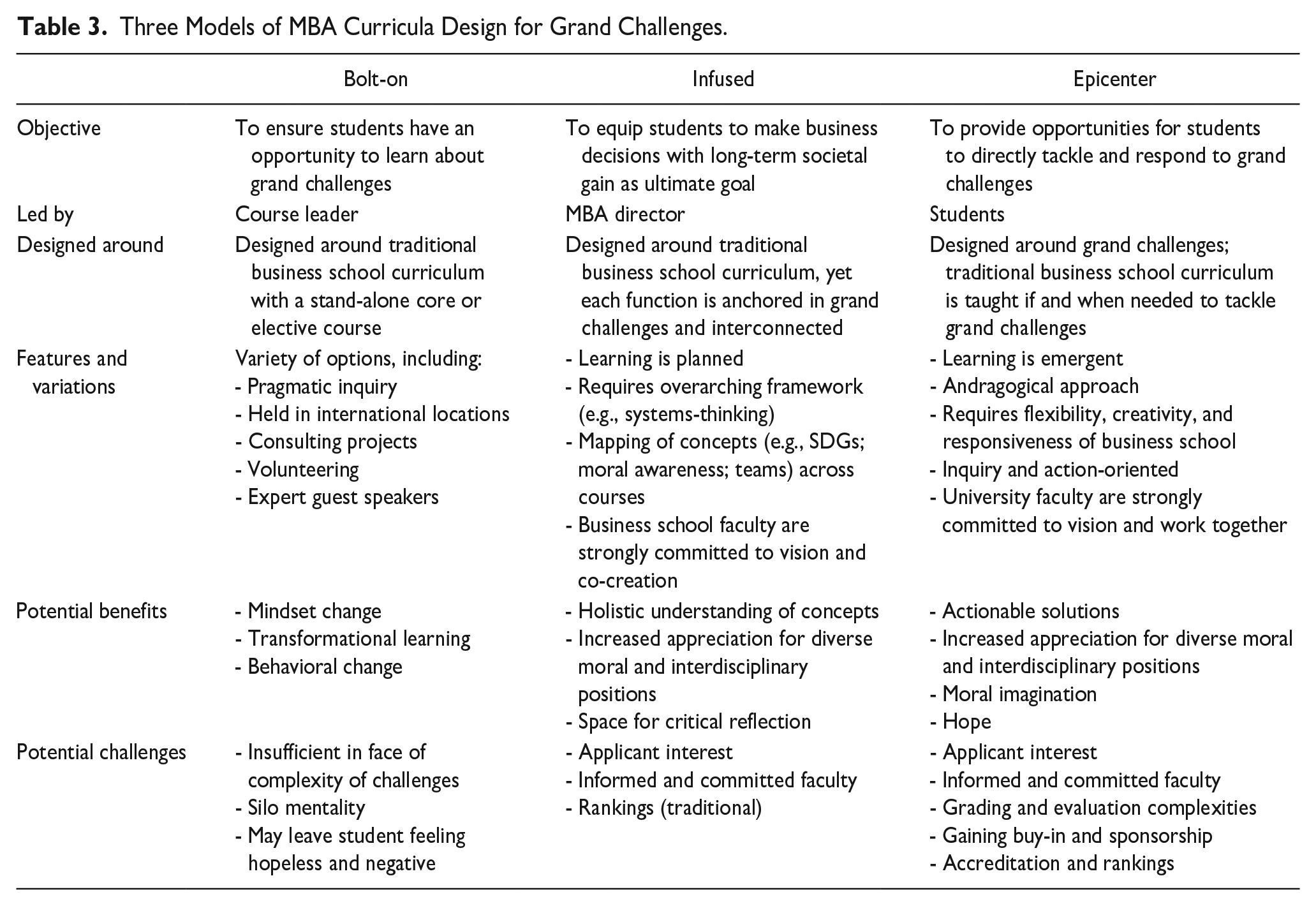
Three Models of MBA Curriculum Design
At the same time this research began, two authors of this paper developed a new elective course called Leadership and Crisis. This type of bolt-on approach is not uncommon. Our research revealed that many courses that focus on crisis sit within the elective suite, and we also saw some examples of mandatory courses that support students to develop ethical awareness and consider multiple stakeholders simultaneously. Variations of the bolt-on approach have been documented, including courses guided by pragmatic inquiry (Kelley & Nahser, 2014), held in international locations (Brower, 2011), and involve partnering with non-profits and the provision of consulting services (Chen et al., 2018). Research has shown the benefits of the bolt-on approach; for instance, students involved in non-profit consulting projects reported higher rates of servant leadership and meaningful mindset change compared to those involved in for-profit projects (Chen et al., 2018). These types of learning experiences may be particularly transformational for MBA students. Marques (2016) found that, compared to undergraduate students, MBA students internalized their project experiences more intensely and many engaged in subsequent behavioral change.
Although our new elective course was well received, we concluded that a bolt-on approach is still not quite good enough when faced with the complexities of a global pandemic. GCs should not be limited to specific courses or events, but instead should be woven throughout the curriculum (Ghoshal, 2005). There are dedicated MBA programs that strive for this approach, such as Bard’s MBA in Sustainability, that includes core courses such as “principles for sustainable management and strategy for sustainability”, or the Business School of Lausanne that offers an MBA in Sustainable Business, that blends the MBA and Diploma in Sustainable Business. Sustainability and societal themes touch on all major corporate functions, and should therefore be reflected within functional business concentrations. Rather than developing a course at the fringe, MBA designers could infuse the entire program with the knowledge and skills to tackle GCs.
The purpose of an infused program is to develop future leaders who think beyond immediate shareholder wealth and have the motivation and capability to make business decisions with long-term societal welfare as the ultimate goal. At the heart of the program and its structure is the traditional bread-and-butter of the MBA, with topics such as strategy, finance, and organizational behavior. However, these traditional subjects are taught through a grand-challenge lens, where students are encouraged to take multiple perspectives, look to the future, and consider their own moral compass and its impact on their decisions. Educators support students to recognize how seemingly disparate systems interact, identify meaningful connections in the world around them, and address the ethical dilemmas that invariably arise. The program design, and the way that it is articulated to students, is holistic, rather than a collection of different courses. A system perspective acknowledges that one course is limited in what it enables students to see, and so through the program’s design, students reflect on the links between courses to understand multi-dimensional issues. This involves the explicit creation of learning spaces where students, faculty, and other actors critically reflect on the differences and links between courses (Kolb & Kolb, 2005).
This version of the MBA comes with several challenges. One is applicant interest. An explicit focus on systems thinking, ethics, and/or sustainability inevitably attracts students who are already deeply committed to these issues. Student demand for sustainability is said to be on the rise (Jack, 2020), and when asked, general business students say that they want environmental sustainability embedded into business education (Cort et al., 2015). Although preferences for sustainability-related content varies by age, gender, and other factors that we do not yet fully understand (Cort et al., 2015; Haski-Leventhal et al., 2017), MBA students may be somewhat different from the general business school population. A GMAC (2018) survey showed that increased earning power was the most commonly cited value that alumni report receiving from their program. A QS (2018) survey showed that career influence and mobility, new skill acquisition, international experience, stronger professional network, and career changes were the top cited motivators to pursue an MBA; global challenges did not feature on this list. Perhaps one reason for these results is that the surveys did not prompt respondents about environmental or sustainability-related challenges. However, a study conducted by AMBA (2020) show that the primary motivation to attain an MBA is to gain knowledge and skills about the business world (70%); only 20% of graduates were motivated to learn about developing a sustainable business, and even less to run a business for the greater good of society (17%) or how to learn how to run an ethically sound business (13%). This research also showed that recent graduates were more inclined to cite financial motivation to pursue an MBA, compared to their counterparts who completed their MBA in the 1990s or earlier. This is compounded by the fact that rankings heavily inform candidate decisions, and more than half of the rankings (in many rankings) are based on graduate salaries. Although there might be a compelling societal need for this type of MBA, worryingly, there may not be a business case for MBA Directors to pursue it.
Another barrier is MBA faculty who need to be informed and committed to the philosophy of such an MBA. In most cases, this requires training, and potentially selecting faculty whose values resonate with this approach. Faculty need to have broad knowledge that not only spans different traditional business areas, but also of subjects that are not readily accessible in a business school. Yet, change is never easy, where battles over curriculum change are heated, departments are unwilling to cooperate, and professors are unlikely to have the interest, knowledge, or confidence to teach beyond their areas of expertise. Further, value alignment is not a foregone conclusion among faculty and other actors. Senior leadership of business schools need to have the moral courage to hire, train, and reward faculty for contributing to programs that can address the real problems facing humanity. This is particularly challenging, given the business case to do so may not be compelling. However, if business schools and their faculty fully recognize that we have less than a decade left to prevent irreversible damage from climate change (UN, 2019), we might as well go even further to design an MBA that places GCs at the epicenter, wildly abandoning the traditional curriculum, and instead supporting our students to make a significant difference to the world.
The purpose of an epicenter program is to directly help tackle and respond to GCs. Whereas the infused program has the classic MBA at its heart, central to this design are GCs themselves. Imagine a 1 year, full time MBA program that is interdisciplinary, team-based, action-oriented, and informed by evidence. At induction, students learn about responsible leadership, sustainability, systems-thinking, and a framework for categorizing grand challenges, such as the UN’s 17 sustainable development goals (SDGs). Collectively, the cohort select about five SDGs of focus. Each SDG is afforded 2 months in the curriculum, where faculty and experts provide co-created content-related information. Students meet with non-profits, government agencies, think-tanks, and other organizations that are already working to alleviate the GC, and gain a systems perspective on its importance. The curriculum is populated with action-based workshops on scenario-planning, moral imagination, teamwork, innovation, and business-related workshops that are relevant to the challenge at hand. Teams are supported by a faculty member and a leadership team coach, and they can create, co-create, or ask the program to offer workshops in topics or skills that they require to address the GC. Student participation, reflection, and action with the outside world is emphasized because, as recent research has shown, critical reflection is ineffectual for transforming students, unless it is coupled with “practical action where students enact their new knowledge in their everyday lives” (Walker et al., 2019, p. 199). At the end of 2 months, student teams step back in guided workshops to consider how the SDG they studied is interconnected with others (e.g., education quality can make a positive difference to climate change). Next, teams gain feedback on their project from an interdisciplinary set of panelists, and they have the opportunity to forfeit the subsequent course if the team is able to show that they can practically implement their idea. There are no individual grades because complex problems are solved by diverse teams, and students are evaluated based on the feasibility and impact of their projects. Flexibility on the part of the program is key to really make a difference in addressing GCs.
Realists might ask, is this an MBA, a Masters of Business Administration? In fact, some may argue that the epicenter approach is simply not what an MBA is designed to do. Traditionally, business schools have been inherently vocational, and support students to access better jobs. MBA programs are meant to foster students’ professional success, not necessarily have a broader societal or environmental objective. According to this line of thought, business schools should (and they are) crafting stand-alone MSc programs in sustainability. Some MBAs have sustainability “streams,” where students select a suite of electives in this area (e.g., Darden School of Business offers a concentration in Innovation for Sustainability), while others offer joint degrees in public policy (e.g., Pepperdine) and other related areas. It is students with a motivation to address sustainability who tend to self-select into these programs or streams. Those who choose a more classic style MBA (over one of the aforementioned alternatives) are exactly the students who we need to engage with. We need a cadre of business leaders who understand management and are able to grapple with GCs.
Limitations
We used publicly available data from the Internet and have no way of knowing who wrote the descriptors. Further, due to the international nature of the set of programs, English may have been a second or third language of the authors. We also acknowledge that the course descriptors do not fully explain what is taught in the classroom. However, unlike most prior audits of business school curricula, we went beyond an analysis of the title of courses—and took an in-depth look at course content descriptors—to bring fresh insights to bear on how MBA programs offer learners with the skills, knowledge, and mindsets to tackle GCs.
We also did not examine program-level activities that may have occurred outside of the formal curriculum. These might be important sources of information because they may involve cross-disciplinary or multi-stakeholder work to furnish the core. Our results should therefore be interpreted in light of this omission. Furthermore, our analysis stopped short at examining how GCs are assessed at the program level. This is a limitation because MBA programs require students to study a program of courses, which ideally complement one another (Costigan & Brink, 2015). This helps students to achieve not just individual course learning outcomes, but an overarching set of program goals and objectives. Future research is therefore needed on the program level to complement the current study (see Costigan & Brink, 2015 vis-à-vis Rubin & Dierdorff, 2009). Finally, we examined full-time MBA programs within the FT list. Future research could explore business school samples outside the FT list with a particular interest in the curriculum in emerging economy contexts (i.e., non-WEIRD countries) where GCs are differentially challenging. Future studies should also ascertain the extent to which our findings generalize to executive MBAs and other executive education programs.
Conclusion
At the 26th Conference of the Parties (COP 26) climate change convention, the Prime Minister of Barbados asked, “When will leaders lead? Our people are watching, and our people are taking note . . .. Are we so blinded and hardened that we can no longer appreciate the cries of humanity?” (Mottley, 2021). GCs require leaders to embrace complexity and uncertainty, and to build the capabilities and structures needed for coordination and cooperation among multiple actors to enable distributed problem solving (Ferraro et al., 2015). Narrow characterizations of GCs do not always appreciate the “cries of humanity,” or the ethical dilemmas associated with trying to address seemingly opposing goals. If leaders are expected to enable a culture that can tackle GCs, they need to be able to appreciate the needs of multiple stakeholders, look ahead to the future, and adopt a moral compass when considering the impact of strategic decisions on the world of tomorrow. Our aim here was to turn theoretical insights into pedagogical ones, and expose how management educators can better equip students to approach and grapple with GCs.
Footnotes
Declaration of Conflicting Interests
The author(s) declared no potential conflicts of interest with respect to the research, authorship, and/or publication of this article.
Funding
The author(s) disclosed receipt of the following financial support for the research, authorship, and/or publication of this article: This work was supported by Trinity Research in Social Sciences (TRiSS).
