




Abstract
Promoting the capacity for critical reflection is a pivotal part of management learning and education. Based on the concept of developmental learning, the purpose of this paper is to explore and outline two types of critical reflection: critique for improvement and critique for emancipation. Critique for improvement is based on a performative intent and is aimed at using critical reflection to improve organizational practices. Critique for emancipation is based on a critical performative intent and focuses on emancipation from repressive ideological and social conditions that place unnecessary restrictions on the development of human consciousness. In this paper, it is argued that managers and leaders enrolled in management education need to be exposed to both critique for improvement and critique for emancipation. A heuristic conceptual framework is therefore proposed, along with strategies for how to balance the two types of critique in management learning and education and propositions to be explored in further research.
Keywords
Introduction
Today, the competitiveness of organizations is contingent upon the ability to successfully manage challenges related to global, financial, and technological developments (Noe et al., 2010), an increased demand for innovativeness (Anderson et al., 2014; Bos-Nehles et al., 2017), and the necessity to navigate societal shifts, such as social movements and the emergence of the “post-truth” society (Knight & Tsoukas, 2019; Welcomer et al., 2021).
In this regard, the ability to create opportunities for innovative work behavior and learning has been identified as a crucial component in organizational and managerial strategies for developing human resources (Cangialosi et al., 2020; Dirani et al., 2020; McLean & Jiantreerangkoo, 2020; Wallo et al., 2020). A necessary ingredient in the creation of learning that can be innovative and developmental is critical reflection, that is, having the ability to “question established definitions of problems or objectives and to act to transform institutionalized ideologies, routines, structures, or practices” (Ellström, 2001, p. 424).
Consequently, the promotion of a capacity for critical reflection is emphasized as a pivotal part of management learning and education (Dyck et al., 2012; Gray, 2007; Reynolds & Vince, 2020; Rigg et al., 2021; Trautmann et al., 2007). For instance, according to Cunliffe et al. (2002), the ability to think “outside of the box” is an important skill for managers who seek to be creative or to find innovative solutions in a rapidly changing world. Moreover, the need to train managers’ abilities for critical reflection in their daily work has also been addressed in previous research (Cotter, 2014; Müller & Turner, 2010; Powley & Taylor, 2014). In particular, contemporary production concepts that emphasize the need for continuous improvement and critical reflection, such as Lean Production (Liker, 2004), have become widely used both within internal organization change processes and in leadership development programs (see, e.g., Emiliani, 2004; Ingelsson et al., 2020; Suárez-Barraza & Rodríguez-González, 2015).
However, the aim of using critical reflection and critical thinking performatively as methods to improve organizations—a pillar in the aforementioned Lean Production concept (Langstrand, 2012)—can also be contrasted with alternative theoretical traditions that take a more critical performative stance (e.g., Spicer et al., 2009). In line with what can be described as a “critical turn” in management research (Alvesson & Willmott, 1992a; Grey & Willmott, 2005), critical questioning that transcends issues of how to improve profit and efficiency has become important in contemporary social science where issues of sustainability, corporate social responsibility, employee voice, post-truth, and equality have risen up the agenda (Dal Magro et al., 2020; Eibl et al., 2020; Setó-Pamies & Papaoikonomou, 2020; Welcomer et al., 2021). This critical turn shifts the focus for managers onto questions of why the ethical and moral principles in working life that appeared self-evident only a short time ago are now being questioned and debated, paving the way for emancipation from naturalistic assumptions about leadership, which are often taken for granted in mainstream management literature (Adler et al., 2007). Examples of research traditions that attempt to pursue this type of critical approach to studies of management learning and education include critical management studies (CMS; Alvesson & Willmott, 1992a), critical management education (CME; Grey, 2002; Reynolds, 1999), and critical human resource development (CHRD; Callahan, 2007; Fenwick, 2004). By drawing on critical theories, these approaches attempt to denaturalize and dissect the popular and normative notions of leadership that currently dominate the management learning and education scene (cf. Fenwick, 2004; Grey, 2007).
Although the two views on what it means to be critical in management learning and education described above—referred to in this paper as critique for improvement and critique for emancipation—may come across as quite different and polarized, they share a common feature, namely a dependence on a form of learning that is creative and innovative. In this paper, we use the concept of developmental learning (Ellström, 2010) to describe this form of learning. Developmental learning presupposes the critical challenging of current working conditions and routines. Such learning encompasses critical reflection, experimentation, trialing, and sometimes even risk-taking (Ellström, 2001). However, neither the question of the role developmental learning plays in the two different notions of criticality nor the possibility of finding a balance between them have been addressed in previous research on management learning and education. We argue that a balance would be beneficial to strive for, because it would enable managers to utilize critical perspectives to work competently with both traditional managerial matters related to productivity and efficiency and the emerging managerial issues connected with growing social movements such as #MeToo, ethnicity, and sustainability.
The purpose of this paper is, thus, to explore and outline the concepts of critique for improvement and critique for emancipation, to discuss the role of developmental learning in these two types of critiques, and to consider how a balance between them can be facilitated in management learning and education. As far as the study’s potential significance for the research field of management learning and education is concerned, we propose a heuristic conceptual framework along with suggestions of strategies for how to balance the two types of critique.
The remainder of this paper is structured as follows: Firstly, the concept of learning is presented, drawing on literature from the field of workplace learning and with a particular focus on developmental learning. Secondly, the two types of “being critical” will be further explored and elaborated into the proposal of a heuristic conceptual framework, together with strategies for integration and a discussion of challenges for management learning and education. Thirdly, the paper ends with some concluding remarks.
Developmental Learning
Since management education aims to develop knowledge and skills that are applicable in a work life context, the theories and concepts used in this part of the paper mainly stem from the field of workplace learning research (e.g., Billett & Choy, 2013; Fuller & Unwin, 2011; Tynjälä, 2013), which implies a focus on organizations and workplaces as arenas for learning (Ellström, 2001). For the purposes of this paper, learning is defined as comprising permanent or semi-permanent changes in how individuals think and act (Billett, 2004), initiated by formal training activities or self-directed informal learning. Formal training activities refers to training and developmental events, and courses or programs that are organized (Noe et al., 2014). Informal learning, on the other hand, refers to learning that occurs regularly in ordinary work situations as well as in everyday life, but is subordinate to other activities (e.g., work practices) that do not have learning as a primary goal (Eraut, 2004). Informal learning is thereby a continuous activity that is inherently integrated into work (Ellström, 2001). We argue that because formal learning activities constitute a major part of traditional management education curriculums, they will be a key focus in this paper. However, the ideas put forth and discussed in the paper may be equally relevant in management education based more on informal learning settings.
There are many similar ways of conceptualizing different types of learning. Argyris and Schön (1978) established the influential concepts of single-loop and double-loop learning. Engeström (1987) developed restrictive and expansive learning. March (1991) proposed a difference between exploitation and exploration in organizational learning, and the dynamic between experience/action and reflection/conceptualization is central to Kolb’s (1984) notion of experiential learning. In this article, we draw mainly on Ellström’s (2001, 2006) distinction between adaptive learning and developmental learning, which builds on—and to some extent also elaborates on—these previous conceptualizations of learning.
According to Ellström (2001, 2006), developmental learning is characterized by a critical questioning that challenges previous assumptions, thus promoting new and creative solutions to problems or tasks. It involves innovative thinking, is driven by risk-taking, critical reflection, and experimentation, and leads to new knowledge and radical changes to routines and practices. This type of learning corresponds to what others have called double-loop learning (Argyris & Schön, 1978) or expansive learning (Engeström, 1987). By contrast, adaptive learning focuses on the mastery of known situations and recurrent tasks, and happens on a more routine basis when knowledge and abilities aimed at enhancing pre-existing skills are acquired. Adaptive learning is primarily instrumental and is valued when it promotes effective action, leading to a learning environment characterized by security, standardization, exploitation, and consensus. Adaptive learning concerns refining existing routines within organizations, in contrast to developmental learning, which instead transforms the prevailing situation (Ellström, 2001, 2006). According to Ellström (2001), these two types of learning can be seen as co-existing and complementary. Similar to Dewey’s (1933) and Kolb’s (1984) notions of learning, the learning process consists of several steps wherein reflective thought and action are interwoven. Beginning with some kind of disturbance or problem, a movement is triggered from habitual actions/adaptive learning, through the definition of a problem, analysis and understanding, toward new actions that both solve the problem and lead to new knowledge/developmental learning (Wallo, 2008).
However, in many organizations there appears to be a predominance of adaptive learning, since it is more aligned with an economic rationality, often manifested in performance measurements targeting short-term resource efficiencies and productivity increases. The instigation of developmental learning may, therefore, need some form of disruption or special attention and activities, either through the learning-oriented leadership of managers in daily work (Wallo et al., 2021), or, as is argued in the current paper, by being facilitated in different forms of management learning and education.
An important concept to consider is the conditions that determine whether a learning outcome is adaptive or developmental, that is, what is known as the learning environment (Coetzer, 2007; Fuller & Unwin, 2004). A learning environment consists of conditions that may be structural, that is, constituted by material, cultural or social structures, or related to the nature of work processes and practices (Coetzer, 2007; Fuller & Unwin, 2004; Skule, 2004). Of the various conditions that comprise a learning environment, the discretion of the learning subject is of particular interest in this paper. Discretion refers to the degree of freedom the learning subject has in determining the course of action (Archer, 2003), or the scope of action, with respect to how the task is defined, how the methods for solving the task at hand are chosen and how the results should be evaluated (Ellström, 2001). Depending on how task, method, and results are combined, the learning is adaptive or developmental (Ellström, 2001). To promote developmental learning, the learner must be encouraged to use their own authority not only to evaluate results or choose methods but also to define the task itself, that is, to diagnose the situation. In this type of learning, the learner is free to question the definitions of tasks and problems posed, for example with colleagues or management, and to act to transform standardized or institutionalized solutions. Developmental learning thus occurs when individuals or groups of individuals begin to reflect on and question established ideologies, routines, structures, and practices (Ellström, 2001). A similar view is presented by Engeström (1999), who describes innovative learning as occurring in a cyclical process, starting from critique of existing situations or dominating practices and proceeding through analysis and testing phases to the implementation and consolidation of stable practices.
Exploring Two Ways of “Being Critical” in Management Learning and Education
In recent years, increased attention has been given to critical approaches to the study of, and education in, leadership, management and organizations. There are many different types of critical studies and we have therefore chosen to broadly outline two contrasting traditions, referred to here as critique for improvement and critique for emancipation, which carry rather dissimilar notions of what critique can imply in management learning and education.
Critique for Improvement
The first tradition, critique for improvement, originates from the traditional, mainstream literature on leadership and management development, but with the addition of critical reflection as a means by which to improve and enhance current practices. Within this stream of literature, the knowledge interest could be described as mainly technical (Habermas, 1972), focusing on aspects of utility, rationality, and the need to develop specific technical or managerial knowledge. This tradition builds on a rationalistic view of organized activities as deliberately planned tools used to accomplish the objectives and goals of an organization (Ellström, 1992).
Within the critique for improvement tradition, a number of management and production concepts have had a major impact on organizations. Lean Production is probably one of the most widely recognized of these concepts (Buer et al., 2018; Langstrand, 2012). Due to the global spread and established nature of Lean Production, both in organizations and in management education (e.g., Glass et al., 2016; Höfer & Naeve, 2017; Netland & Powell, 2017), the concept will be used in this paper to exemplify how critical reflection can be understood within the critique for improvement tradition.
Lean Production was developed from the principles of Toyota’s production system (TPS) and has now spread throughout the world, not only to goods manufacturing companies but also to companies providing services and public sector organizations (Liker, 2004; Renström, 2021). Management education courses focusing on Lean Production are also well established and utilize both formal and informal educational settings (see, e.g., Halvarsson Lundkvist, 2019; Ingelsson et al., 2020). The adoption of Lean Production typically implies that an organization uses certain practices, methods, and techniques such as process focus, standardized work tasks, elimination of waste and systematic continuous improvement (Liker, 2004). However, Lean Production may take many different forms depending on the context and whether it is used as a philosophy, a toolbox, a strategic goal, or a change process (Pettersen, 2009). A key principle of Lean Production is the significance of learning during day-to-day work through continuous improvements (Kaizen), constant critical reflection (Hansei), built-in quality within the production processes (Jidoka), production flow optimization (Just-in-Time), and root cause problem solving such as 5 Whys analysis (Lee, 2009; Liker, 2004; Liker & Hoseus, 2010; Miller & Maellaro, 2016; Renström, 2021).
One challenge in Lean Production management education is the inherent tension between, on the one hand, the idea of exploring variation by developing and improving through Kaizen and adopting Hansei and, on the other hand, the idea of constantly trying to minimize variation, waste and poor quality by standardizing processes and optimizing flow and value streams through Jidoka and Just-in-Time. This tension between variation and standardization is well-known (Martin et al., 2018) and has received ample attention in research on organizations and learning in organizations. For example, March (1991) refers to this tension as a balance between exploration and exploitation (Ellström, 2010) uses the terms logic of performance and logic of development in organizations, and Gupta et al. (2006) describe it as a balance between being innovative and output-effective in order to “do the right things” on the one hand and being resource-efficient in order to “do things right” on the other. From a critique for improvement perspective, previous studies have shown that techniques from production concepts, such as Lean Production, can be applied in management education in order to introduce knowledge on specific tools to improve efficiency and encourage higher levels of thinking (Anderson et al., 2011; Higuchi et al., 2015). For instance, conceptual content in management education aimed at evening out workflows, reducing activities that do not create value (i.e., that do not contribute to reaching the learning goals) or standardizing administrative work to free up time for the actual teaching (e.g., Emiliani, 2004, 2005; Suárez-Barraza & Rodríguez-González, 2015). Management and leadership studies that are usually associated with the tradition of critique for improvement have been questioned for their underlying performative intent and for having an overly financially driven rationale for critical reflection. As used here, a performative intent is characterized by: . . . the intent to develop and celebrate knowledge which contributes to the production of maximum output for minimum input; it involves inscribing knowledge within means-ends calculation. (Fournier & Grey, 2000, p. 17)
In line with Fournier and Grey (2000), it can be argued that management education curriculums for production concepts such as Lean Production stand a risk of being governed by the principle of performativity. In management education this may, in turn, run the risk of subordinating knowledge and truth to the production of efficiency, thereby silencing difficult and complex ethical issues that may have a more gradual effect on production, such as sexism and abuse of power (cf. Grey, 2002; Soffe et al., 2011). The critique of the rather narrow focus on how critical reflection can be used to improve effectiveness and increase profits comes mainly from a research tradition that uses the notion of “being critical” much more broadly. This tradition is outlined in the next section.
Critique for Emancipation
The second tradition, critique for emancipation, adopts a critical theoretical position on management and leadership. This tradition originates from the critical theory developed by scholars of the Frankfurt School (Reynolds, 1999). In essence, critical theory is oriented toward critiquing and changing society. It often takes a negative stance against positivist research on social phenomena, since it questions the possibility of generating objective knowledge of a social reality that the researchers are themselves co-constructing (Benton & Craib, 2001). Instead, it is seen as necessary for the critical researcher to cast aside that which has been taken for granted in favor of dialectic reasoning on the study object at hand (Alvesson & Sköldberg, 2017). Critical theory is thus driven by an emancipatory knowledge interest (Habermas, 1972), and the primary objective of research is to awaken an awareness of those aspects of our society that we see as naturally given. In this context, emancipation refers to the process of becoming freed from repressive ideological and social conditions that place unnecessary restrictions on the development of our consciousness (Alvesson & Willmott, 1992b). The purpose of emancipation from limiting structures and beliefs is social transformation toward more sustainable organizations. In addition, “being critical” also involves questioning theoretical and practical assumptions that are taken for granted (Fournier & Grey, 2000).
Today, interest in emancipation through critical reflection is vital in research traditions such as CMS (Adler et al., 2007; Grey & Willmott, 2005), CHRD (Callahan, 2007; Fenwick, 2004), and CME (Grey, 2002; Perriton & Reynolds, 2004; Reynolds, 1999). In the latter tradition of CME, there has been previous discussion of issues concerning critical reflection in management learning and education (Perriton & Reynolds, 2004; Reynolds, 1999). For instance, Perriton and Reynolds (2004) argue that a critically aware management educator can step outside the dominant managerialist culture and engage management students in critical reflection about practice supported by critical texts. Grey (2002) problematizes business schools by discussing which issues are being given a voice and which issues are suppressed in MBA programs. Furthermore, Fenwick (2005) discusses the need to focus on ethical issues in critical management education, such as the positionality of the critical educator. In addition, there have also been calls for ways to introduce critical reflection in workplace settings. Cotter (2014) argues that it is necessary to view CHRD as acting “in concert” with practitioners, that is, co-creating criticality in mutually beneficial ways in praxis, rather than imposing critical reflection on managers.
But how, then, can a critical perspective be utilized in management learning and education more concretely? Reynolds and Vince (2020) and Reynolds (1999) suggest a number of aspects that need to be addressed and incorporated into the curriculum as well as into actual teaching processes. One aspect concerns critically questioning which theoretical framework and perspectives are included and which are left out. What is the basis of this selection and which interests are served by it? One way of doing this in practice is by critically selecting course literature in order to present and problematize different perspectives. Is literature included other than mainstream management thinking, such as studies of language, history and culture, or even novels and short stories, which might draw attention to personal and socioeconomic conditions from different viewpoints?
Another aspect concerns how power relations in social, political, and cultural processes are included in management education. Examples of questions to be asked include: Are theoretical frameworks introduced that support an analysis of power and its relation to social control as reflected in organizational practices? Which social and educational values are reflected in the structures, procedures, roles and relationships within the program and the methods it incorporates? Vince (2011) also points out the importance of getting emotionally involved in order to understand how political power relations feel. One way of doing this is by “challenging expectations and paying attention to the complex inter-personal emotions that are generated within a learning space” (Reynolds & Vince, 2020, p. 133).
Yet another aspect addresses moral and ethical dimensions through the use of critical reflection. Reynolds and Vince (2020) stress the importance of shifting attention from individual reflection toward reflection as a collective process to help broaden authority and accountability beyond the individual. This could help to illuminate and problematize different views and interests and the power asymmetry between these as a way to create a learning environment. Examples of questions to use in management education include: Do the methods used develop participants’ abilities to work with others and to develop confidence in their abilities to convey ideas? Who asks the questions and who gives the answers? How does this relate to roles, gender, race, experience, or age?
When these questions are taken together, “being critical” with the aim of emancipation often implies a rather harsh dismissal of the mainstream management and leadership literature. This is perhaps not so surprising, due to the different knowledge interests and rationalities characterizing emancipatory and technical-rational perspectives (Habermas, 1972). However, proponents of a critical theoretical perspective have been criticized for not offering any viable alternative solutions to the problems they uncover. Fournier and Grey (2000) even argue that CMS research should be conceived of as non-performative. This assertion is, however, not supported by everyone in CMS. Spicer et al. (2009) argue instead that it is very important that critical researchers also engage in, and actively work to change, the processes that they study. They suggest that critical performativity is a more suitable label for what CMS researchers are trying to accomplish.
For us, critical performativity involves active and subversive intervention into managerial discourses and practices. This is achieved through affirmation, care, pragmatism, engagement with potentialities, and a normative orientation. Engaging with theories of management provides a way for CMS to create change through productive engagement with specific theories of management. Critical performativity also moves beyond the cynicism that pervades CMS. It does so by recognizing that critique must involve an affirmative movement alongside the negative movement that seems to predominate in CMS today. (Spicer et al., 2009, p. 538)
Adopting this critical performative approach is, however, not necessarily easy. King (2015) argues that engaging critically with practice is quite often a messy and complex process and, according to Hibbert (2013), teaching reflexivity through critical reflection is often difficult because it requires the students to possess a body of rich experience.
Introducing a Heuristic Conceptual Framework
To further understand the relationship between criticality and creativity in leadership and management learning and education, the different strands revealed in our literature review are summarized in Table 1.
Summary of the Two Forms of Critique.
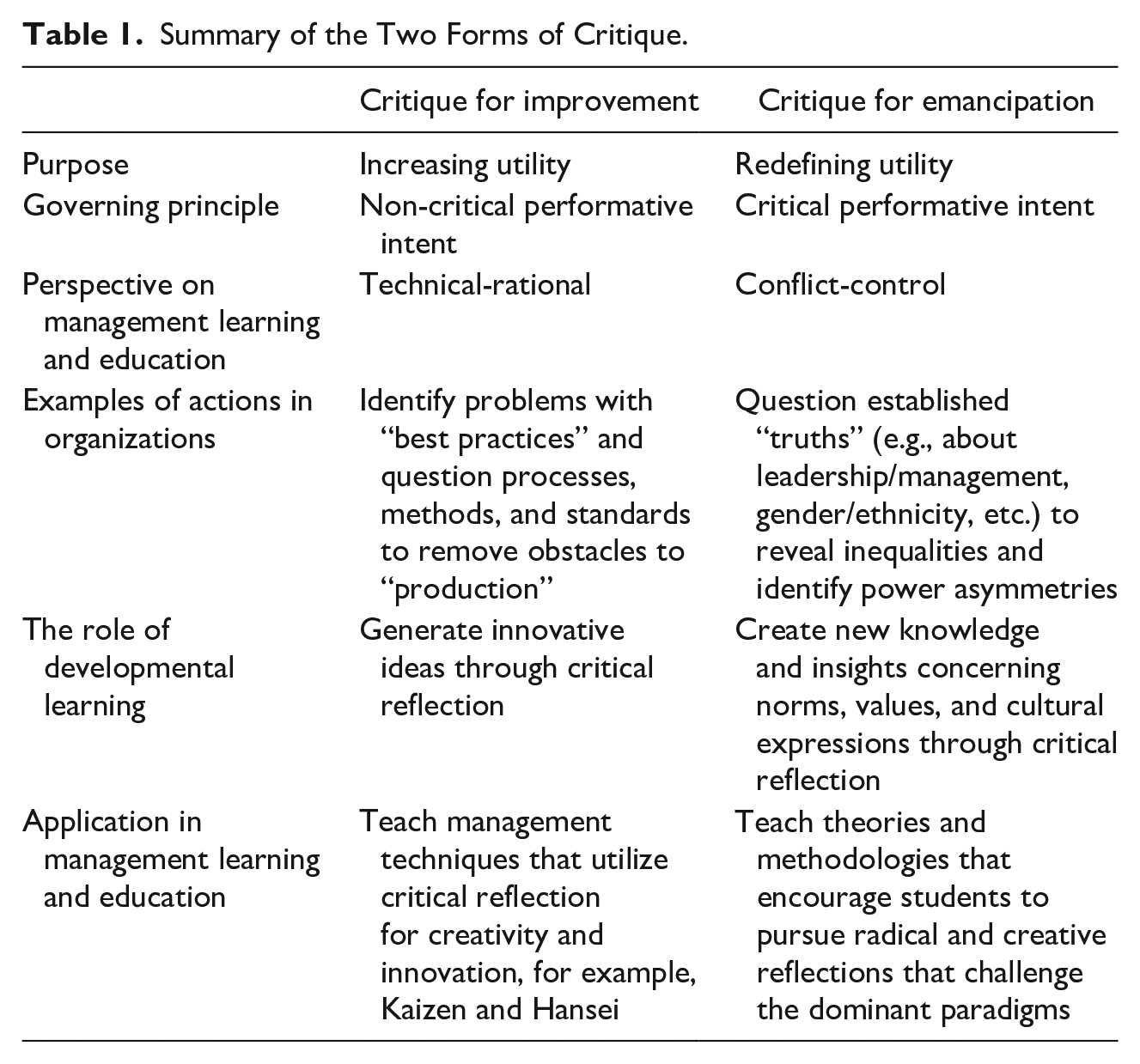
Based on this summary and the discussion so far, we further propose a heuristic conceptual framework in an attempt to bring together and conceptualize the perspectives discussed in this paper (see Figure 1). Our reason for this is that there is a need to overcome the divide between the different forms of critique and treat them as equally powerful analytical tools depending on the conditions and learning subject discretion in the management learning education context, that is, the learning environment (cf. Coetzer, 2007; Fuller & Unwin, 2004; Skule, 2004).
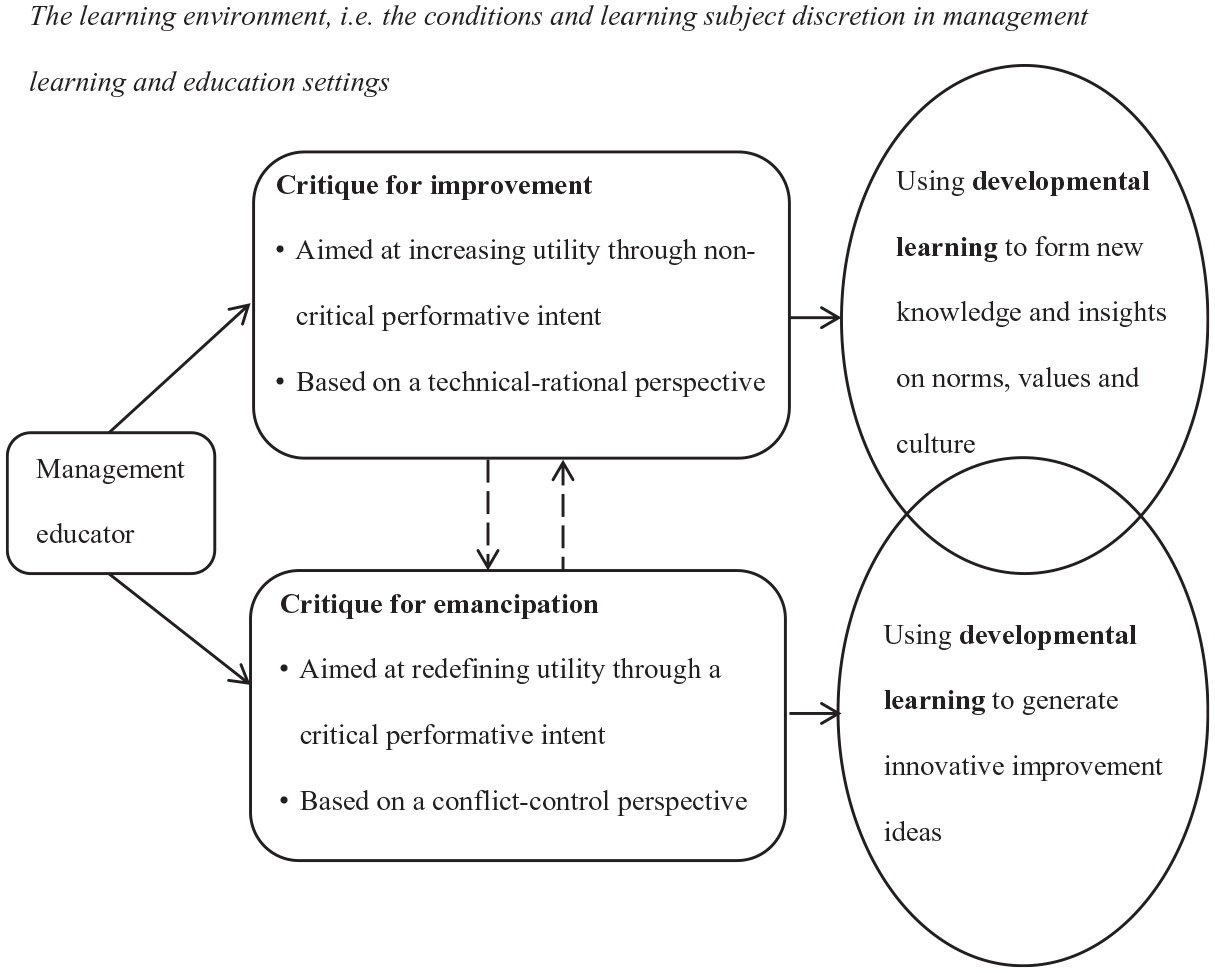
A proposed conceptual framework.
We argue that managers and leaders enrolled in management education need to be exposed to both critique for improvement and critique for emancipation, and also need to be helped to find ways to utilize both types of critique in their day-to-day working practices. In line with Perriton and Reynolds (2004), we would assert that managers need training in raising questions about management issues that are moral as well as technical in nature.
In the proposed conceptual framework, the prime purpose of critique for improvement is to increase some form, or forms, of utility. Its governing principle is a performative intent, that is, to use critique as a means for improving current organizational practices and minimizing input in relation to output (Fournier & Grey, 2000). This signals an inclination toward a more technical-rational perspective (Ellström, 1992), which in turn implies that the need for management learning and education is perceived as being driven by technological advancements and that decisions on investment in leaders’ and managers’ competence development are based on rational economic calculations whereby education is related to costs in terms of wages and production losses (cf. Becker, 1975).
Examples of actions undertaken that may qualify as critique for improvement are the questioning of current work methods and standards in order to identify ways of improving “production” in the organization, that is, to create value more efficiently. Actively searching for problems with the agreed “best practices” may lead to the development of the entire production system.
The role of developmental learning (Ellström, 2001) in critique for improvement could be described as a way to “think outside of the box” in order to generate innovative ideas about how current practices can be changed and developed (Cunliffe et al., 2002). In terms of possible management learning and education applications, this may involve teaching managers and students some of the specific reflection techniques mentioned earlier in this paper, for example, Kaizen, Hansei, or 5 Whys analysis (Liker, 2004; Liker & Hoseus, 2010; Miller & Maellaro, 2016).
Turning to critique for emancipation, and in line with the emancipatory perspective, the prime purpose is to question and ultimately redefine what constitutes utility. The governing principle is, therefore, a critical performative intent, that is, active and perhaps somewhat subversive intervention in discourses and practices that involve leadership and management (Spicer et al., 2009). The view of management learning and education is thus similar to the conflict-control perspective (Ellström, 1992), which is based on the assumption that contradictions and conflicts between different actors and interests in an organization are essential in order to enable the organization to function and to ensure that decisions on competence development are determined by interests of control and struggles for power rather than by rational cost-income analyses.
Ways to achieve critique for emancipation could include targeting unjust power asymmetries in organizations, questioning the truth about what constitutes constructs such as “effective leadership” (Alvesson, 2019), and discussing normative understandings of gender, race and sexuality in the management education classroom (Collins, 2013).
Developmental learning (Ellström, 2001) is a key ingredient for the creation of new knowledge and insights into norms, values, and other governing organizational practices that create, regulate, and shape the identities of employees (cf. Alvesson & Willmott, 2002). When considering how management educators can design learning environments that facilitate critique for emancipation, there are no best practice techniques available that can easily be applied. Instead, a meticulous study of theories and methodologies would be needed to encourage and equip students with the courage and skills to pursue more radical and creative trains of thought that can challenge the dominant paradigms in management research and practice (e.g., Alvesson & Spicer, 2012). However, by asking critical questions, such as those proposed by Reynolds (1999), the educator can be helped to reflect on the content and process of teaching in management education (see also Gray, 2007).
Three Strategies for Balancing Critique for Improvement and Critique for Emancipation in Management Learning and Education
To further elaborate on the framework presented in Figure 1, we here discuss how leadership and management educators can create learning activities that target and balance both types of critique. In this regard, three ideal-typical strategies are suggested, inspired by Poole and van de Ven’s (1989) methods for using paradoxes when building management and organization theories: separate, sequence, and synthesize. These strategies are intended as tools for reflection rather than roadmaps that could easily be implemented in practice.
The first strategy involves separating the two types of critique, for instance by addressing them on different management courses within a more extensive educational program, such as an MBA or a bachelor’s level program. In this strategy, critique for improvement will be included in courses on subjects such as quality management, production management, and organizational development. Critique for emancipation can instead be included in courses that target leadership theories, gender in organizations and other similar topics more generally. To achieve a balance, the educators would need to look at the entire MBA to ensure that both forms of critique are covered in the curriculum. The risk with this strategy is that the critique for emancipation elements of the program will be less extensive and less focused. An illustrative example of the first strategy is courses in production economics given as part of university programs in industrial engineering and management that one of the authors of this paper is regularly involved in. Within these programs, Lean Production is included in separate courses using both forms of critique. Within one of the initial courses, which features a general perspective on production economics, Lean Production is framed within a clear critique for improvement form. Basic lean tools, such as “5S”, the “5 Whys” methodology and value stream mapping, are featured with a strong focus on process improvement for efficiency and waste reduction. Within the same programs, an advanced course on Lean Production is also offered where a more holistic approach is taught. In this course, critique for emancipation as a tool for reflection is featured within course modules where improvement tools are evaluated from a more critical point of view. Students are offered more holistic perspectives, where social and environmental sustainability issues form important analytical perspectives in developing more long-term, strategically-oriented solutions for sustainable Lean Production efforts. For instance, a broadened view on stakeholder perspectives and the societal impact of Lean Production solutions is used to problematize a strict customer-oriented view which is often prevalent in Lean Production courses with more of a critique for improvement perspective.
The second strategy is built on the notion of progression within a management learning and education intervention. Employing this strategy, the two forms of critique will follow each other in sequence. For instance, critique for emancipation can follow critique for improvement with the aim of highlighting issues that need further problematization from a critical theoretical standpoint. This is often a preferred model on master’s level university courses in subjects such as quality management, leadership, human resource management, and organizational psychology. Because students on these types of university courses are typically trained in critical thinking, the risk with the sequencing strategy is that the critique for emancipation will supress the more technical-rational arguments for production concepts such as Lean Production. An example of the second strategy is a 10-week leadership course taught on a university master’s program in HRM where one of the authors of this paper has taught for several years. For the first 3 weeks of the course, the students are tasked with reading and discussing organizational theories that are more improvement-oriented. They apply the theories to case studies provided by teaching staff, and are told to analyze problems and find potential solutions. From the fourth week of the course, the students are faced with a series of lectures that introduce critical theories and perspectives. First, they work with institutional theory. They then tackle literature covering critical perspectives on leadership, before finally working with gender and ethnicity theories. The lectures and corresponding tasks in the course are designed to build on each other to achieve a progression in the students’ reflective thinking and developmental learning.
The third strategy—synthesize—is perhaps the one that demands the most of both the educator and the students, since it entails finding a balance by simultaneously integrating both types of critique while studying a specific phenomenon or solving a complex problem. In this strategy, students are trained in the ability to hold two opposing ideas in their minds at the same time while still retaining the ability to function. This strategy is, by nature, more difficult to employ than the previous two, and is probably best suited to more advanced management education. An example of this strategy is a series of workshops that one of the authors of this paper conducted with a board of directors at an industrial company. The members of the board were already highly trained in engineering and finances, but wanted to be challenged by critical academic perspectives to further develop their views on leadership and management. They had observed that their leadership policy, which had been developed within the context of a production system heavily influenced by Lean Production principles, did not take into account the competencies required to work with matters involving equality, an ethical code of conduct and corporate social responsibility. The board realized that the development of such leadership competencies would be paramount to attract the best potential applicants for job positions. During the workshops, the author used an action learning approach to identify problems arising from the daily work within the company and facilitated discussions on these problems, considering concepts and theories originating in the critical management studies literature. For example, considerable attention was directed to discussions of gender awareness, including hegemonic masculinity in the company’s leadership norms. After the workshops had been concluded, the board of directors tasked the global HR department with revising the company’s leadership policy and conducting a series of leadership development workshops with the operational management teams.
Challenges for the Field of Management Education
By drawing on the featured literature, it is possible to discuss potential implications of the proposed heuristic framework for the field of management education. In this section, we therefore discuss a set of proposed challenges concerning how critique for improvement and critique for emancipation are taught in management education, both at universities and in consultancy-driven leadership and management training. The rationale behind the discussed challenges stems from the idea that there is the potential for critique for improvement and critique for emancipation to converge and be integrated into management learning and education applications.
The literature suggests that, in many organizations, the logic of performance—which mainly stimulates adaptive learning—tends to dominate (Ellström, 2010). However, in order to remain competitive and innovative, organizations must handle logics of performance and logics of development in ambidextrous ways (Benner & Tushman, 2003). This is certainly something that graduates from management courses and programs must be prepared for. Expanding innovative thinking and facilitating developmental learning within the boundaries of performance logics takes skill and knowledge (Cunliffe et al., 2002). To increase creativity and innovation as a potential output of management learning and education, one challenge involves how to configure the degrees of freedom needed for management students in relation to task, methods, and results in order to create opportunities for developmental learning relative to both types of critique proposed in this paper.
According to the literature, a critique for emancipation can be said to have little or no focus on customers and key stakeholders (e.g., owners and shareholders). In Reynolds (1999) list of critical questions on content and process in management education, the element of context is also somewhat absent. It can, however, be argued that, for any emancipatory process to succeed, certain structural and contextual conditions must be considered (cf. Archer, 1995). In organizations, such structural preconditions must, to an extent, always be facilitated by key stakeholders and customers who, in turn, require both continuous returns and satisfaction. Another key challenge is that in order for management education to be able to convey relevant skills and adequate knowledge that contain both radical, emancipatory thinking, and actions that improve on the structures necessary to realize it, realistic context and relevant contextual preconditions for management must be a foundation for any educational setting. For management learning and education to balance the need for a critique of established “truths” with the need to satisfy customer and key stakeholder interests in a realistic contextual setting, radical redefinitions of “taken-for-granted” utility must also be allowed while still maintaining a focus on return on investment. This is quite the challenge, but is highly important to recognize and address if management education providers have the ambition of staying relevant and being progressive.
Concluding Remarks and Implications for Practice
To summarize, the purpose of this paper has been to explore and outline the concepts of critique for improvement and critique for emancipation, and to discuss the role of developmental learning in these two types of critiques and how a balance between them can be facilitated in management learning and education.
In terms of potential implications for practice that can be induced from this paper, both suggested forms of critique have relevance for the education of managers. Individual managers, their employees and their entire organizations would likely gain from more critical reasoning, aimed at improving specific practices and emancipation from norms, cultural expressions, and policy that constrict and subdue individual agency. Having the ability to reflect critically in the way critique for emancipation is denoted in this paper will likely be an important part of the managerial competences needed to deal with societal and organizational changes brought on by societal movements such as #MeToo and Black Lives Matter.
However, the challenge for practitioners—such as teachers and consultants who work with management learning and education—is to find a balance between improvement and emancipation, particularly in view of the fact that the latter form of critique appears to be rather difficult to implement in educational settings (cf. King, 2015). A contributing reason for this is that students usually need a lot of time to process critical theoretical thinking and it is common for management courses at universities and within businesses to last for only a few weeks or up to a semester. Critical emancipatory questioning can create confusion—and sometimes also anxiety, frustration, and discomfort (Hibbert, 2013; Raber Hedberg, 2009) —that needs to be processed carefully. In the short term, there is thus a risk that this kind of critical theoretical element could engender negative course evaluations that would reflect poorly on the education providers, making them reluctant to include these elements in the first place. However, when cautiously integrated into longer educational programs at advanced levels, activities and literature aimed at critique for emancipation can help prepare students and managers for a more in-depth analysis of their practices.
To conclude, this paper argues that in order excel at preparing management students for future managerial roles, any management course needs to adopt a reflective and self-critical stance in order to stay relevant and in tune with societal development. For this to happen, it is suggested that a basic approach for management courses shaped by an improvement orientation should be more welcoming toward adopting more emancipatory perspectives, and that management courses shaped by an emancipatory orientation should do the opposite.
Footnotes
Author Note
Henrik Kock was an Associate Professor in the Department of Behavioural Sciences and Learning at Linköping University, Sweden. Sadly, Henrik passed away during the preparation of this article.
Declaration of Conflicting Interests
The author(s) declared no potential conflicts of interest with respect to the research, authorship, and/or publication of this article.
Funding
The author(s) received no financial support for the research, authorship, and/or publication of this article.
