




Abstract
Can the philosophical foundations of spiritual practices inform management education pedagogy and in the long-run support emotional development and more ethical and responsible business practice? In this article, we introduce the essential aspects of three different spiritual traditions—Daoist inner work, Buddhist mindful reflexivity, and Quaker discernment—and lay out some foundations between these essential aspects and management education pedagogy. We offer examples of utilizing these concepts in teaching business ethics in order to offer a foundational discussion for future elaboration. Our experiences also illuminate that instructor preparation is a key ingredient if the kinds of teaching we advance are to gain traction and contribute to the repeated calls for pedagogical innovations that challenge dominant paradigms. We offer some concluding remarks, pathways for future research and indicate a list of resources that can support potential instructors.
Introduction
Management education critics (e.g., Ghoshal, 2005; Giacalone, 2004; Giacalone & Thompson, 2006; Mitroff, 2004; Neal & Finlay, 2008; Waddock & Lozano, 2013) lament the absence of an ethical and spiritual foundation. Giacalone and Thompson (2006), for example, argued that management education is often framed by an excessive materialism and a logic of economics that leaves “ethics and social responsibility subordinate [emphasis in original]” (p. 274). Giacalone (2004) similarly argued that the ‘scientific’ paradigm distorts student’s appreciation of nonfinancial goals such as love, forgiveness and integrity leading to ‘sadness’ and ‘nightmarish’ lives (pp. 416-418). Furthermore, Kelley and Nahser (2014) argued that pedagogical practices—such as the case study method and management simulations—continually reinforce this paradigm fostering a values-neutral and amoral perspective toward business behavior and an abandonment of spiritual development (Giacalone, 2004). On this reading, critical scholarship has argued that the current management education paradigm can lead to dehumanizing leadership (Petriglieri & Petriglieri, 2015), detached ways of knowing (Hay & Samra-Fredericks, 2019), an absence of concern for society (Khurana, 2007), and a selfish vision of human and organizational behavior (Mintzberg et al., 2002; Mintzberg & Gosling, 2002).
Possible answers to address these kinds of concerns include challenging accepted language, measurement techniques, and data analysis (Fornaciari & Lund Dean, 2001), and advancing pedagogical innovations balancing reason and emotions, such as whole-person learning (Barbera et al., 2015; Eriksen, 2009; Kolb & Kolb, 2005), positive management education (Karakas, 2011), and pedagogies that embed reflexivity (Sinclair, 2007), deep listening (Senge et al., 2004), consciousness (Mirvis, 2008), and heart and soul (Waddock & Lozano, 2013). While these important contributions lay out a generic foundation of an alternate vision, how the essential aspects of spiritual traditions might inform such a management education pedagogy remains surprisingly underexplored. While the management education literature provides accounts of how to teach spirituality (e.g, Barnett et al., 2000; Marcic, 2000), how instructors might use spiritual practices to teach a wider business and management education program or curriculum is less well-developed. Neal (1997), however, embarked on this task more than 20 years ago and offered self-knowledge, authenticity, respect for others’ beliefs, trust, and practicing one’s own spirituality (e.g., prayer, walking in nature) as essential aspects. In a special issue of the Journal of Management Education, Harlos (2000) developed these ideas further by adding humility, compassion, and simplicity to Neal’s work. Furthermore, Pielstick (2005) later argued that meditation, journaling, walking, and sitting in nature can form part of a spiritual pedagogy. More recently, Waddock and Lozano (2013) also suggested that mindfulness may encourage greater social consciousness in future leaders but did not elaborate further. Thus, examinations of how the philosophies of different spiritual practices might connect to a spiritual pedagogy—and the challenges in doing so—have not featured to the best of our knowledge. While a spiritual pedagogy may have benefits for both instructors and students, there are tensions associated with bringing an emotionally grounded pedagogy into the classroom that often go unacknowledged (Lund Dean et al., in press), and we shall highlight the importance of instructor preparation throughout this article.
Extending this work in a new direction, we introduce foundational ideas that explore the potential of three spiritual practices—Daoist, Buddhist, and Quaker—with the aim of inspiring future scholarship to cultivate the kind of ideals envisioned by recent scholarship. In this article, we offer some practical examples from our teaching of business ethics at both undergraduate and postgraduate levels that we hope will encourage potential instructors. We specifically chose these three traditions as, while they each have different philosophical roots, each emphasizes the idea of an inward orientation and prosocial normative commitments in the social world. We see these common characteristics as essential to the kind of pedagogical innovations prior scholarship has envisaged.
Our article is structured as follows: First, we situate our article within the literature on emotions in higher education teaching and learning and introduce the kind of instructor preparation that may be required in order to engage with pedagogies connected to the essential aspects of spiritual traditions. Following this, we introduce the context of our teaching practice. Next, and in turn, we briefly describe an essential aspect of Daoist, Buddhist, and Quaker practice and elaborate how we used these in our teaching of business ethics. We offer some concluding thoughts, pathways for future research, and offer further resources for potential instructors.
Emotionally Grounded Management Education Pedagogy
Each of three spiritual traditions we discuss in this article share an inner, yet prosocial, orientation and call on instructors and students to participate in personal developmental work that involves not only the intellect but also emotional development. Until recently, pedagogy, and in particular, management education pedagogy, focused on preparing instructors to educate the student mind and the intellect, disregarding emotions (Hall, 2002). Some have properly argued that bringing emotions into the classroom through experiential learning may cause harm without precautions and proper instructor training (Lund Dean et al., in press). However, it is also equally important to recognize that not working with emotions can be potentially harmful as emotions are one of the primary building blocks of intrapersonal development (Shrivastava, 2010), which is critical to help differentiate students in the competition for future leadership roles (Mintzberg & Gosling, 2002). Furthermore, Ghoshal (2005) and others have stressed the importance of emotions in developing more ethical and responsible students and eventually future leaders.
McGilchrist (2009) proposed that Western society’s emphasis on the left-brain orientation of logical intellectual thinking and the primacy of individual agency threatens our happiness and humanity. He held that the left-brain emphasis needs to be balanced with a right-brain orientation characterized by empathy, connection, and relationship with others. The right brain is where the sense of justice, and ability to behave selflessly lies. Furthermore, he proposed that “moral judgments are not deliberative, but unconscious and intuitive” (p. 86), consistent with the views of moral intuitionists (Bechara et al., 2007; Damasio, 1994; Greene, 2009; Haidt, 2001). McGilchrist (2009) also argued that much can be learned from contemplative and spiritual traditions to access right brain consciousness, providing a motivation for our teaching practice.
Due to an emphasis on educating the intellect, there is often a reluctance to address emotions in the classroom as historically emotions have been linked to pathology requiring trained professionals such as psychiatrists or psychologists. Alternatively, emotions were seen as responsible for poor decision making, and rational logic was seen as “the basis of sound decisions,” while “emotions can only cloud the mind and interfere with good judgment,” a point reinforced by Bechara et al. (2007, p. 273). According to Showry and Manasa (2014), Harvard and Stanford view self-awareness developed through inner work to reveal one’s “characters, traits, beliefs, values, strengths, abilities, motivations and desires” as fundamental to “managerial and leadership success” while “IQ and technical skills are far less important” (p. 17). Cohen (2009) also argues that to be truly effective educators must purposely work with emotions in the classroom because they are central to who we are as human beings. This is supported by findings in the field of positive psychology where positive emotions have been found to have the power to heal and enable transformation (Fosha, 2009a, 2009b; Fredrickson et al., 2008, Fredrickson & Losada, 2005; Garland et al., 2010).
Hogan and Warrenfeltz (2003) argued that among the four domains that management education can target—intrapersonal skills, interpersonal skills, leadership skills, and business skills—intrapersonal skills are the hardest to develop as they are “the province of one’s basic beliefs and assumptions, as well as strategies for regulating one’s impulses and emotional needs” (Kaiser & Kaplan, 2006, p. 464). How to regulate and utilize emotions effectively involves acquiring or modifying attitudes and behavior through processes such as self-awareness, emotional regulation, and the ability to learn from mistakes. Intense emotional responses can, however, distort a students’ perception and result in anger, fear, vulnerability, and panic, and therefore by encouraging emotional development in the classroom, potential instructors are required to develop skills and knowledge that may be unfamiliar. Many students may be sensitive, feel threatened, and react accordingly, thereby ultimately storing up problems in “interpersonal relationships, in fulfilling important leadership roles, and in applying basic business skills” (Kaiser & Kaplan, 2006, p. 470). Therefore, despite the risks and tensions that emotional development may bring, the need to address these challenges seems pressing (Bowen, 2014).
To effectively develop students’ emotions as an aspect of learning and development, the development of trust between instructor and students is a vital ingredient (Bevelander & Page, 2011). Trust is an interpersonal phenomenon embedded in social relationships and developed when there is “a willingness to take action in circumstances where such action makes one vulnerable to the other party” (Doney et al., 1998, p. 604) and where people share common values and norms. According to Rousseau et al. (1998), trust develops over time in response to prior actions. Thus, it is possible to promote trust by creating a learning environment where vulnerabilities can be shared (Berkovich, 2014), but it should be equally recognized that sharing personal experiences requires self-exposure that in turn requires a high-trust environment. Ladkin and Taylor (2010), for example, suggested that self-exposure is a key ingredient in authenticity as leaders convey their vulnerabilities to promote higher levels of engagement and trust. The relationship between a willingness to share and be vulnerable with others and generating interpersonal trust is likely to be self-reinforcing and is more likely to develop over time than be present immediately. Kaiser and Kaplan (2006) argued that instructors engaged in emotionally grounded pedagogies should engage in establishing a “peer learning community” where students can become comfortable to work on their emotional and intellectual development over time. A peer learning community, according to the authors, needs to be a trustworthy and safe place where individuals can freely share about themselves and their vulnerabilities and find support so that individuals come to understand each other, and mutual trust deepens.
In the pedagogies, we elaborate next, we show how learning communities can be developed in three different higher education contexts utilizing pedagogical practices drawn from three different spiritual traditions—Daoist, Buddhist, and Quaker. We particularly draw attention to showing how we encourage student vulnerability, which we address through our example of inner work from Dao practice; safe student self-disclosure, which we address through an example of mindful reflexivity from the Buddhist tradition; and, finally, on developing trust, which we address through utilizing collective discernment from the Quaker tradition.
Context
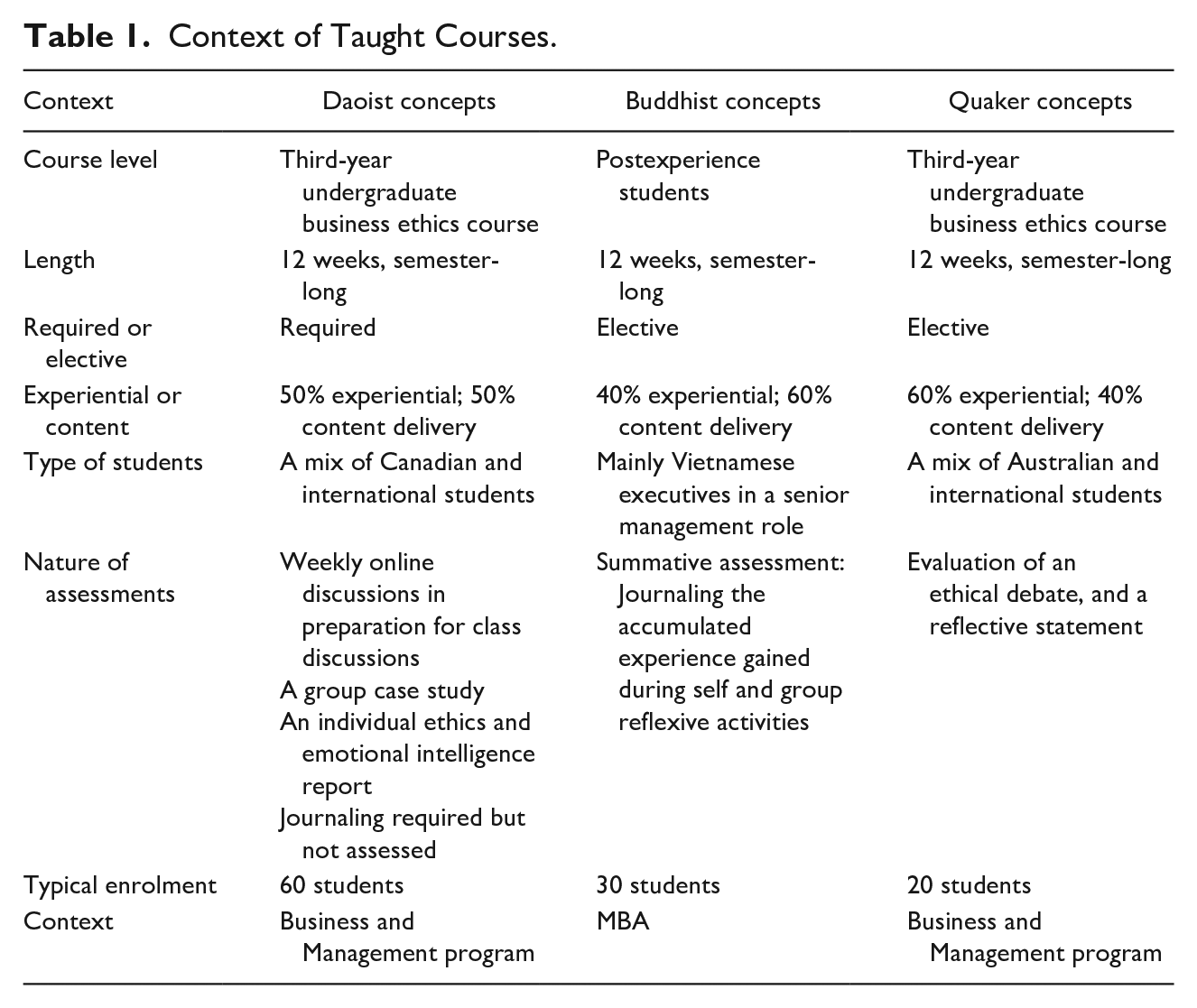
The teaching examples that follow are drawn from the Canadian, Vietnamese, and Australian higher education contexts. In all three examples, the context is a traditional “secular” university setting. The Dao case was utilized on a core, third-year business ethics module as part of a 4-year undergraduate business and management degree in Canada. The cohort size was around 60 and encompassed roughly of 40% home and 60% international students, respectively. The Buddhist example was drawn from teaching at a Vietnamese university using Buddhist concepts as part of an “ethics” subtheme within a corporate responsibility module. The corporate social responsibility module formed part of a 2-year MBA program, which consisted of about 25 part-time, postexperience, home students who held a senior management position. The context of the Quaker example is based on a final-year undergraduate elective business ethics module of around 25 students consisting of 60% home students and 40% international students. A summary of the educational contexts is shown in Table 1.
Context of Taught Courses.
Instructor Preparation
Many students are socialized to expect an intellectually oriented pedagogy and have not been exposed to pedagogies that address emotions. Ex ante student unfamiliarity with emotionally grounded pedagogies underscores the importance of instructor preparation and the need for careful and thoughtful scaffolding by instructors to gain knowledge and experience in engaging students. Teaching with unfamiliar pedagogies, thus, presents a central problem: Do instructors have the skills to be able to effectively pursue these pedagogies? Lund Dean et al. (in press), for example, highlighted the risks of teaching with experiential pedagogies without adequate instructor preparation and lamented the absence of a community of practice that supports instructor development in experiential pedagogy. Therefore, some words of caution are needed. We offer the following considerations for those who wish to engage in utilizing spiritual practice as an emotionally grounded approach to management education.
First, instructors need skills and knowledge that relate to psychological states such as emotional development and regulation. This suggests that potential instructors need to maintain an understanding of advances on topics related to emotions and other associated topics such as emotional intelligence (EI) that are applicable. A significant body of research has been conducted on the practices and business benefits of developing EI popularized by Goleman et al. (2002). In addition, much has been written on how individuals and organizations can develop EI; one such example provided by Boyatzis and McKee (2005). EI over the years has developed legitimacy and is well-known for providing an entry point in enabling a conversation from talking about emotions to working with emotions. According to Goleman (1995), EI was inspired by Aristotle’s virtue ethics and a comparison of the two conducted by Culham (2013) confirmed many important similarities. Virtue ethics was developed at a time when spirituality was more deeply integrated with all aspects of living. Furthermore, both Confucian and Daoist ethics have been conceived as forms of virtue ethics (Ivanhoe & Csikszentmihalyi, 1999; Slingerland, 2010). In particular, Daoists view emotions as the entry point to which one gains awareness of one’s Dao-given innate self, providing a direct connection between emotional awareness and spirituality. It was believed by Daoists that this emotional awareness would result in a transformation of the individual.
Second, potential instructors need to maintain an adequate knowledge of the “essential aspects” of the spiritual tradition(s) from which their teaching practice is drawn and originates. We stop some way short, however, of suggesting that potential instructors need to be experienced spiritual practitioners. In fact, we do not believe a deep philosophical and theological understanding of different spiritual traditions is required to use our teaching approaches. In fact, proselytizing is likely to be counterproductive. Our approach to working with emotions, however, does involve applying contemplative and spiritual practices in teaching such as meditation, silence, and reflexivity (which are supported by academic research) and instructors should maintain an understanding of their essential features and potential role in student learning and development. Entering this pedagogical space requires instructors to be familiar with the origination and benefits of spiritual practices such as meditation (Goleman & Davidson, 2017; Tsai et al., 2007), and other contemplative practices that may interest instructors such as yoga, tai chi, and qi gong (Gelles, 2015; Jabr, 2018; Streeter et al., 2012). It should be noted that instructors should also be motivated to transform themselves and learn through the process of engaging in these practices over a period of time to gain confidence with the varieties of emotional experiences that one may have (Cohen, 2009). To support potential instructors, an indicative list of readings and resources is provided in the appendix.
There is, however, a paradox, however, at the heart of the “instructor competency” debate. While we would encourage potential instructors to know their limits and stay within them, and would discourage instructors who lack these kinds of skills from engaging in the kinds of teaching pedagogies we shall describe, we also recognize that there is a need to overcome a general reluctance for instructors to innovate in their teaching and curriculum. This represents a challenge to both instructors and scholars alike (Shepherd, 2004). However, the philosophical content of many spiritual traditions foregrounds the idea of personal development through personal experience and experimentation, often referred to as a spiritual journey. In many spiritual traditions, personal development is conceived as a continuing and evolving iteration between personal experience that is subsequently tested by a wider group wisdom (e.g., Muers & Burton, 2019), and thus we recognize the importance for potential instructors to experiment with pedagogical innovations while developing knowledge, skills, and belonging to an appropriate support network or community of practice in which to share reflections and good practice.
Third, responsiveness to the student is a key feature of our approach. Participation by students in teaching using spiritual pedagogies must be voluntary and confidential and alternative exercises should be made available to students unwilling to participate. For instance, in a business school, participation should be elective and not mandatory. Furthermore, in a postexperience setting, there should be additional considerations that include commercial confidence and an acknowledgement that any personal vulnerabilities disclosed are not shared with the organization or with others outside of class unless personal consent is given. Another form of responsiveness is for the instructor to develop skills and knowledge in managing group dynamics to promote the kinds of virtues that underscore the essential aspects of many spiritual traditions, for example, honesty, integrity, equality, and so on. Magee and Galinsky (2008) suggested that group dynamics can be negatively affected when more powerful or assertive individuals speak longer than others or dominate proceedings, or instructors are seen to occupy a position of power and a gatekeeper of knowledge. Thus, instructors may wish to share openly first and set the tone for a more open and equal dialogue, relinquishing control of group outcomes and allow students to direct and cocreate learning.
Fourth, the instructors’ role is to provide a structure for teaching and to facilitate a process that emerges from student interactions. However, as Shepherd (2004) noted, it is important to know your limits. Shepherd suggested that instructors teaching with emotionally grounded pedagogies should be prepared to make a referral if a student shows signs of significant distress and recommends that instructors have a prepared list of support services available within the university.
We now move on to a discussion of teaching practice from each of the spiritual traditions in turn. In the teaching practice sections, the first person I is used to describe activities that each author shared with students.
Dao
Essential Aspect: Inner Work
Neuroscience research indicates that ethical decisions are made unconsciously and are related to emotions and the body (Haidt, 2001; Greene et al., 2001). This is an important assertion for business ethics education because ethical decisions are often believed to be made consciously, deliberately, and rationally. For example, Kohlberg’s (1981) theory of moral development exemplified the rationalist approach to ethical decision making. Education in general and business education, in particular, is known for teaching reason-based methods to support decision making, while discounting other aspects of human nature such as emotions and altruistic behavior (Frederick, 2008; Ghoshal, 2005). Neuroscience suggests an ethics pedagogy addressing not only the mind but also emotions, body, and the unconscious.
Scholarship posits that Daoists developed pedagogy for cultivating virtue that was holistic, engaging the unconscious, body, emotions, mind, and spirit (Culham, 2013; Ivanhoe & Csikszentmihalyi, 1999), and a similar approach known as intuitive ethics founded in neuroscience and psychology may support business ethics education (Weaver et al., 2014). The diversity of Daoist spiritual practices can be traced to the contemplative practices proposed in a 4th-century BCE text Inward Training (Kirkland, 2004). The overarching intent of Inward Training is virtue cultivation through contemplative and daily practices that return awareness to one’s innate self, assumed to originate in the Dao, the ultimate perfection and source of everything in the universe (Culham, 2013; Roth, 1999). Virtue cultivation involves a process of achieving tranquility holistically in one’s body, breath, emotions, vital energy (qi), mind, and spirit (Roth, 1999) by focusing on inner work and shutting out external stimuli (Major et al., 2010).
Successful cultivation of tranquility results in a values shift caused by a shift in perception of self and one’s relationship with others, and an intuitive awareness of the ultimate truth. Related to this, the ancient Chinese believed wisdom develops in two ways: rationally through cognitive means and nonrationally through intuitive means such as meditation and insight (Lloyd & Sivin, 2002). Therefore, in our teaching practice, Dao contemplative practices, along with experiential cognitive learning through developing EI, were incorporated into inner work as part of business ethics instruction. Inner work is defined as quieting the mind, working with inner reflective practices and observing “perceptions, sensations, memories and cognitions” to enhance self-awareness (Cohen, 2009, p. 31). Emotions are important as they provide knowledge of one’s innate self, and a path to better health (Major et al., 2010; Roth, 1999). Therefore, emotions must be acknowledged and managed effectively for living a “good life.” Tranquility is not complete stillness but rather it is a process of dynamically achieving equanimity in the presence of change or movement (Hall & Ames, 1998). An important insight for contemporary education is that the cultivation of tranquility involves acknowledging one’s emotions yet not being overtaken by them. While Daoists hold meditative practices as important for the development of virtue, it is included as part of business ethics instruction to improve ethical decision making because research has demonstrated it helps regulate emotions and improve self-awareness (Goleman & Davidson, 2017), which are foundations of ethical decision making (MacIntyre, 1984).
Teaching Using Inner Work
In this section, I discuss how I used inner work in an undergraduate class setting to address two interrelated matters: developing trust and working with vulnerability. Given instruction was delivered in a traditional, secular higher education setting, I have found through experience that an important element of developing student engagement is to locate the pedagogy within the broader context of contemporary forms of secular meditation and EI that have prolonged periods of academic legitimacy (Culham, 2013). Furthermore, Daoism as a spiritual tradition is never explicitly referenced, other than the connection between inner work and emotions and student learning and development. Another means of developing trust is to be open and vulnerable, which sets the tone for the characteristics of the learning community. This is the foundation I use to initially establish trust and the importance of being vulnerable but recognize that both trust and vulnerability must be supported with further scaffolding.
Many students are socialized to expect an intellectually oriented pedagogy and have not been exposed to the methods addressing emotions and the unconscious. Given this shift in orientation and expectations, careful scaffolding is required to engage students with the idea of inner work. Scaffolding can be divided into providing the reasons and benefits why one would learn in this way, and a carefully designed program that supports students and acknowledges their doubts as they progress with inner work.
Prior to engaging students with inner work, they learn about a virtue ethics decision-making framework illustrating how emotional self-awareness is integrated with decision making in an organizational context (Badaracco, 1997). Therefore, they understand the business context within which inner work is needed. They are also informed that the framework of virtue ethics used in the course is consistent with research indicating ethics are founded on emotions and their regulation, providing outcomes for practicing EI skills and meditation.
Since these skills are often seen as unusual activities by many business and management students, to support the perceived worthiness of the approach, I inform students as follows:
Neuroscience research indicates ethical decisions are made unconsciously and related to emotions and the body providing the reason for inner work to improve self-awareness (Haidt, 2001; Greene et al., 2001).
The brain changes in positive ways with meditation, in particular, helping with self-awareness and emotional regulation (Goleman & Davidson, 2017).
Personal development of EI has been documented as valuable for both business and the employee (Goleman et al., 2002; Lopes et al., 2006; Showry & Manasa, 2014).
In addition to learning about the external world, education can involve being scientists of themselves involving introspection of inner sensations, emotions and thoughts leading to the need for vulnerability.
Vulnerability is a healthy, courageous, and beneficial means of relating to others (Brown, 2010).
Many leading companies (e.g., see Jabr, 2018) support contemplative practices.
I demonstrate the value of inner work through instruction and coaching and foregrounding the importance and validity of student experience to the learning process. As mentioned, the desired outcomes of engaging in inner work are to improve emotional self-awareness and regulation of emotions, key foundations of ethical decision making. In addition, I acknowledge that meditation, and practicing EI skills is an unusual approach, and I extend an invitation to try out these activities as a personal experiment, and I request students to hold judgment until they have experienced the activity for a few weeks.
The meditation activity discussed next is specifically designed to improve student’s emotional awareness and regulation of emotions. Prior to meditation, I invite students to recall a positive or negative emotional experience in the recent past. Students are then invited to participate in an open meditation, for example, “a spacious awareness of whatever comes to mind” (Goleman & Davidson, 2017, p. 135), where I advise them to breathe naturally and observe their internal experience. Qualitative research indicates that initially students often find meditation weird or unusual (Culham & Shivhare, 2019). However, I find that persistence with meditation for around 10 minutes in each class throughout the semester helps students to become comfortable with the practice. Following open meditation, I invite students to pair up and discuss their experiences. Then, an open class discussion is held focused on exploring student’s physiological, emotional, and mental experiences related to the event they recalled. Sharing personal experiences is unusual for most students and I have found that a graduated approach of paired discussions followed by voluntary class sharing enables dialogue and encourages vulnerability. The primary purpose of engaging in postmeditation dialogue is to assist students to develop an awareness of physiological experiences and their related emotions, which contributes to self-awareness and emotional regulation as students learn to dispassionately observe emotional highs and lows. Students also learn from other’s experiences and the practice normalizes vulnerability as part of an inner experience. Finally, during the class discussion, I provide further guidance regarding meditation so that student meditation skills are scaffolded over time (Culham & Shivhare, 2019). Outside class, I ask students to journal about their meditation and EI skill development weekly, further providing the opportunity to develop their skills, reflect, and consolidate learning (Houghton et al., 2012; Pavlovich et al., 2009).
In the cognitive learning dimensions of the teaching, students are offered options to practice the skills of listening or speaking with others to develop their EI (Lombardo & Eichinger, 2002) and virtues. This activity provides the student with the opportunity to deliberately and consciously work with emotional experiences to develop emotional self-awareness and regulation. For example, those choosing speaking with others, may notice at first the emotion of fear, accompanied by sweating palms, and rapid heartbeat. If they persist, they are developing the virtue of courage, while those practicing listening when it is not comfortable are practicing the virtue of patience (Culham et al., 2020). Students select a skill to develop based on a review of descriptions indicating poor and ideal behavior related to each skill (see Lombardo & Eichinger 2002).
Based on self-assessment of their strengths and weaknesses, students choose one ideal behavior to practice outside of class a set number of times per week, weekly journal their experiences, and meet with a fellow student or someone close to provide friendly support and accountability to their commitment to the work. Students are encouraged to reflect and record their internal experiences in ungraded journals, which serve the purpose of documenting progress regarding their EI skill and meditation practices, and offer the opportunity for instructor feedback and guidance. Over the course of the semester, a change is often observed from a sense of stress and discomfort regarding practicing their EI skills to ease and calm over time contributing to confidence and self-awareness indicating a transformation has occurred in their experience (Culham et al., 2020). At the end of the semester, students are required to review their journals from beginning to end and summarize their experiences and development. This assignment is graded based on completion of the requirements and demonstration of the application of critical thinking in the evaluation of experiences. As part of the course students also complete case studies and tests to evaluate their ability to apply business ethics course knowledge.
Challenges
In the preceding section, I provided an example regarding students being encouraged to be vulnerable where they shared unusual experiences that occurred during meditation. Some students describe unusual experiences such as visions or mind states approaching oneness 1 that for other students in the class are perceived as weird, causing laughter or exclamations of surprise. My preparation and experience with using inner work has helped me recognize that I needed to do more than thank the student for their contribution. I reflected that I needed to acknowledge their statements and ask them to elaborate on their experience while only revealing what they felt comfortable doing. This conveyed to the student and the class that I valued the unusual insights they revealed by being vulnerable.
Engaging in inner work with students can also sometimes illuminate the instructor’s underdeveloped emotional skills. Instructors need to be comfortable with their own and student vulnerability and need the training and experience to address questions and experiences that surface through the practices due to the broader view of student life the course affords. I have become much more aware of student’s stress through conversations with them and reviewing their journals. Sometimes, instructors may need to address emotional issues that require skill to manage beyond their training and experience and need to know when and where to suggest students seek additional support. For example, I have had a few occasions where students have become overly assertive or derogatory in their comments; alternatively, students may display anxiety or stress. My preparation helped me remain calm and helpful in such situations and recognize my own limits. In situations like this, I found that engaging in a process of introspection and being able to discuss the matter with a supportive community of practice has helped develop the skills to meet these challenges.
Buddhist
Essential Aspect: Mindful Reflexivity
Mindfulness is widely used as a form of contemplative pedagogy in social work education (Birnbaum & Birnbaum, 2008; Lynn, 2010) and has recently featured in management education (Kuechler & Stedham, 2018), fostering student self-care (Bonifas & Napoli, 2013), developing knowledge and skills (Gockel et al., 2013; Raheim & Lu, 2014), and critical reflection (Chinnery & Beddoe, 2011). As a contemplative pedagogy, mindfulness can be accompanied by music, poetry, meditation, and art to nurture psychological wellbeing and deep awareness (Hoyt, 2016). Mindfulness can not only be used as a pedagogy to develop self-awareness and reflexivity but can also be used to enhance an instructors’ use of reflection and reflexivity in teaching (Lynn, 2010).
The practice of right mindfulness is one of the skillful means in Buddhist philosophy. As a practice in the Noble Eightfold Path, 2 right mindfulness encompasses wisdom and morality in such a way that it facilitates a “middle way”—a balance between extremes of desire and self-mortification to help students and practitioners to transcend excessive attachments, such as fixed perceptions or dispositions (Bodhi, 1998; Vu et al., 2018). It also encourages ethicality, and the consideration of relational others in thoughts and actions. The practice of “right mindfulness” can also foster mindful reflexivity (Vu & Burton, 2020) that can encourage transformational learning, instilling an ability to question who we are in the world, acknowledging that our interactions are contextually embedded, and how we can act responsibly and ethically to bring people together for the common good (Purser, 2015). Mindful reflexivity is attained through the Buddhist philosophical notions of dependent arising (the interdependence of all phenomena), and through the exchange of feedback, experiences, and dialogues from different perspectives. To facilitate the practice of mindful reflexivity, an understanding of the underlying philosophical foundations of right mindfulness is crucial—in particular, the three notions of dependent arising, impermanence, and nonself.
Understanding dependent arising facilitates collective mindfulness, allowing students to appreciate the multidimensional aspects of the learning experience as a way to encourage both self- and critical reflexivity (Cunliffe, 2009, 2016; Vu & Burton, 2020). Impermanence, on the other hand, refers to the temporal and changing nature of all phenomenon. Applying this principle in the classrooms can help students to move away from their own comfort zone with the understanding that an individuals’ status of knowledge is temporal rather than static. This encourages students to more actively engage in new and unexpected experiences and be more willing to be critical of their own views, learning to be less attached to their own ego and ideology. Willingness to face the unknown can encourage students to build up their resilience to unforeseen issues, which is crucially important in complex management contexts. Last, the notion of nonself can stimulate students to let go of attachments to selfish perceptions that may constrain their capabilities to transform and develop through reflexivity.
Teaching Using Mindful Reflexivity
The aim of the activity is to enable student learning by encouraging participants to critically rethink and question their way of managing and organizing (Alvesson & Willmott, 1992) to reveal the ethical and moral implications of management (Currie & Knights, 2003) in challenging situations. This requires reflexivity (Dyer & Hurd, 2016) and certain levels of self-disclosure to overcome surface learning (Entwistle, 2000). Effective self-disclosure can lead to increased intimacy (Bazarova, 2012), strong interpersonal bonds and enhanced trust (Harper & Harper, 2006). This can create a positive learning community based on such bonds, where instructors can generate deeper student learning (Borshuk, 2017). However, self-disclosure can also be sometimes painful to hear, too personal or too risky to share (Allen & Baber, 1992), and therefore self-disclosure should be offered as an approach to enhance student learning only where there are communal learning benefits for the discloser and others (Wheeless & Grotz, 1976). Instructors should also present themselves in such a way that it reduces their power and authority in the classroom and destabilizes their position as a gatekeeper of information (Thornton, 1991). For instance, Kelly (1986) suggested that instructors should remain as neutral as possible when discussing controversial issues. Cain (1996), on the other hand, claims that self-disclosure by instructors on relevant issues can reduce the power and status differential between instructor and students, which can nurture an environment where students feel more inclined to risk their own self-disclosure.
The intended learning outcomes of the session is to facilitate mindful reflexivity based on an individuals’ self-reflexivity and critical reflexivity (Cunliffe, 2009; Hibbert & Cunliffe, 2015) in order to extend student interpretations and understanding of business ethics and identify responsible business practices by allowing participants to exchange critical feedback and reflections. Prior to this session, students participated in lectures on theories of normative and descriptive ethics. The teaching activity involves inviting students to self-disclose an uncomfortable case relating to an ethical dilemma and engage in discussion to reveal how they dealt with it or could have dealt with it, utilized as part of a 3-hour MBA module for senior managers. The process I use involves encouraging self-reflexivity to help students learn from both successes and failures of the self and from others, and the ability to question means and ends (Lash, 1993) of the decisions made in managerial ethical dilemmas. It also involves inviting students to be critical reflexive—the ability of students to examine their organizational policies and practices to see whether their leadership/management genuinely guides responsible and ethical action.
To support students in feeling comfortable to participate, I emphasize the following points:
The importance of a peer-learning classroom: honoring personal experience as a valid, reliable, and significant source of knowledge (Forrest & Rosenberg, 1997)
Up-front agreement about the necessary boundaries, confidentiality, and reporting issues with guidelines for respectful classroom dialogue (Borshuk, 2017) subject to relevant context and culture
Encouraging students to use multiple materials (readings, movies, online sources, etc.) to ensure multiplicity of voices are presented to stimulate alternative conceptions
First, I encourage students to write down an ethical dilemma they have experienced in the workplace. This may be an ethical dilemma they have been personally involved in, or one that they have witnessed. The student examples are anonymized (unless the student wishes it not to be anonymized) and shared with the whole class by the instructor. I subsequently invite students to ask questions and reflect on any cases that interest them in small groups for about 45 minutes by reference to three elements of mindful reflexivity:
Dependent arising: Who were the involved stakeholders within the issue; relationships of those involved; motives, actions, outcomes, and consequences of outcomes?
Impermanence: Has this issue occurred before? If yes, are the reactions similar or different, how and why? What is the specific context of the issues? Would actions be different in other circumstances?
Nonself: What was the motive behind decisions to respond to the ethical issue? Was the decision to attend to the ethical issue instrumental? Whose end did it serve?
The Buddhist concepts are introduced in a prior lecture that covers spiritual-normative ethics. In the session here, students were invited to apply these concepts to their real-life cases by focusing upon the types of questions listed.
Following an initial discussion, each of the small groups are invited to select and critically evaluate one case for up to 1 hour. I have found that this activity helps students develop self-reflexivity by reviewing their own motives, end purposes, reflection of past experiences and the context and the context sensitivity of responses, and critical reflexivity by sharing their own experiences, weighing the consequences of actions and motives, and debating other perspectives
Following the small group work, I guide a plenary session to open up discussion for each table to share their experiences and present agreements and any remaining unsolved issues to discuss as a whole class. By opening up discussion to the whole group, unresolved issues are subject to wider group wisdom and critical reflection. After the plenary session, I put aside time for students to quietly reflect on their own management practice and past and present experiences of ethical dilemmas. Students are encouraged to journal how they feel, and to identify opportunities for learning and development, and to share any emergent feelings with the group if they so wish.
To assist the debriefing, collective sharing is facilitated by the instructor to allow opportunities for both self- and critical- reflection experiences to stimulate thoughts and feelings for students’ journaling. The importance of ongoing journaling is emphasized to encourage students to recognize their reflections, feelings of anxiety, or frustration and to identify possible reasons behind such feelings. They are also encouraged to share their learning journals with other students on the module or program if they wish since continuous learning can develop by further reflecting with and through others. I have found that this is an important part of the activity as if facilitates a safe therapeutic space for students to tease out their emotional responses to contradictions with their own personal understandings, values, beliefs, and experiences (O’Connell & Dyment, 2011).
Challenges
Bringing mindful reflexivity into classrooms can present challenges. The journals we have received from students show how the process of being mindfully reflexive may involve sharing painful or embarrassing experiences and being critiqued by others—albeit anonymously—which can introduce anxiety among students. Being open and vulnerable with and to others in class discussions can hurt feelings and egos and may lead to frustration. Thus, the application of mindful reflexivity can be challenging for some students. When experimenting with the approach in different contexts, I have noticed that especially in cohorts with international students from “face-saving” cultures, using mindful reflexivity can lead to an unwillingness to engage and ultimately to feelings of shame and embarrassment. It can take a deep courage to engage in activities that contrast with cultural norms. To overcome this challenge, the creation of a safe learning community is important. To facilitate such a learning environment, instructors play a vital role in facilitating interpersonal bonds to encourage participants to overcome their own boundaries. This may involve the instructor leading by example and sharing relevant managerial challenges and issues or even disclosing personal experiences.
In addition, there is a possibility of resistance to sharing ethical dilemmas, and the possibility of defensive reactions to the perspectives of others. Participants may be unwilling to discuss past experiences or failures. As the students in the MBA cohort all have senior leadership or management roles, I have found some resistance and defensiveness to listening to the perspectives of others, and some have found it difficult to avoid being ego-defensive. In this situation, I have found it useful to either reemphasize the “rules” of sharing, self-disclosure, and deep listening, and sometimes I have invited students to write these up on posters, which are then displayed around the class. At other times, a time-out or period of reflection can help recenter students. Sometimes this is as simple as inviting students to take a walk or read an inspirational quotation that speaks to them. In the final analysis, instructors may need talk to reluctant students in a private setting about their anxieties and offer alternative exercises should they wish not to participate.
Quaker
Essential Aspect: Discernment
Quaker spiritual practice—and especially its discernment process—has attracted interest from management scholars who have recently attested to its growing interest in non-Quaker and nonreligious organizations (e.g., Muers & Burton, 2019). Furthermore, Quakers have had a long historical association with higher education in the United States, sharing a concern for authenticity, care, love, trust, equality, and justice (Alton, 2018; O’Donnell, 2013). A “Quaker education” is commonly associated with the Quaker testimonies to peace, truth, integrity, simplicity, and equality (Rowe & Watson, 2018) that represents an outward expression of an inner orientation to love and compassion. At the heart of Quaker theology is the idea of the Light Within implanted by God in every person and a readiness to answer “that of God in every one” (Rediehs, 2016).
Among Quakers, silence is believed to create the ideal framing for spiritual attainment and development (Molina-Markham, 2014) and is perceived as a channel through which the divine can enter hearts and minds. Silence also acts as a form of embodied stillness that facilitates deep listening and connectedness among a group. Discernment is an essential aspect of the tradition and is experienced through introspection and approached through contemplative silence, pursuit of community belonging, and an abiding sense of unity (Benefiel, 2005). Discernment approaches ethical decision making as “the call of God as it comes to us in the midst of daily life” (Delbecq et al., 2003, p. 147). Once a group practicing discernment enters into silence, anyone in the group may then feel led to contribute to the matter at hand which “reveal[s] their attempts at understanding and forming their belief” (Kline, 2012, p. 286). Quakers’ recognize that members of a group have “different experience, different kinds of knowledge” (Ambler, 2013, p. 69) and as contributions are heard, periods of silence and spoken contributions are interwoven until eventually a position of unity emerges—Quakers call this finding the “sense of the meeting” (Burton, 2017). Through collectively seeking unity, each person is a constituent of the collectivized sense-making of the group. Through this process of sharing individual knowledge, members of the group expose individual knowledge to “collective testing” (Vu & Burton, 2020) in order to give primacy to an emergent group wisdom. Allen (2017) argued that collective testing requires Quakers to be open to a practice of individual “unknowing,” which then informs a wider group-wisdom.
For Quakers, while group wisdom is authoritative, its status, however, remains partial and uncertain. Dandelion (2004) noted that for Quakers doubt is a theological prescription. The glue that bonds together the group is not necessarily shared religious belief but rather a belief that all knowledge is cocreated and uncertain and represents the group’s best attempts at determining a group wisdom. To achieve this requires a willingness to eschew human expertise and authority, to be nonexpert, not-knowing. Dandelion (2004) has called this idea the “perhapsness” of Quaker epistemology. Thus, as opposed to relativistic arguments that everyone can be right, the Quaker view is that no individual person can be fully right (Dandelion, 1996).
Teaching Using Discernment
As part of a final-year undergraduate business and management program, I teach an elective business ethics module that encompasses a “leaders’ debate” centered on the moral role of universities. The leaders’ debate is located within the context of a 2-hour session about midway through a semester-long module. By way of student preparation, students attend a series of 1-hour lectures that explore various descriptive and normative approaches to ethics, such as deontology, utilitarian ethics, virtue ethics, and so on. A few weeks prior to teaching, students are invited to read a seminar brief in relation to the leaders’ debate and its associated learning outcomes—“To collectively appreciate different philosophical approaches to business ethics.” The group is typically divided into four smaller groups, and for each group, I provide
The debate motion: “To what extent does management education produce responsible students”?
Confirmation that four fictitious leaders will participate in the debate
A pen portrait and summary of the ethical views of the four fictitious leaders’ toward the motion
In the teaching activity briefing, I allocate one fictitious leader to each of four groups and confirm that the group is tasked with representing the ethical views of that leader in the debate. Undisclosed to students, the pen portraits of the four leaders are written in a way to represent different normative and descriptive traditions toward ethics.
The leader debate has two distinct phases. In Phase 1, each of the four groups nominates a speaker to debate the motion from the perspective of the leader they have been given. Given that the pen portraits of the four leaders reflect four different ethical traditions, there is often some areas of agreement and some areas of disagreement between the views of the students representing the “leaders.” For example, students debating using a deontological and virtue ethics approach may find some common ground but find little agreement with an egoist or utilitarian approach to the motion. During the debate, I often find that students recognize that the debate has been “set up” to reflect the key similarities and differences between the different ethical traditions. At this stage of proceedings, students will often ask me how consensus might be reached in an organization if members of the organization do not share an ethical viewpoint.
In Phase 2 of the debate, the teaching activity turns to discover whether the process of ethical decision making can enable a heterogeneous group to reach consensus or unity. While Quaker discernment is used as the process, the philosophical and theological content is not introduced, although further readings are made available. I advise students that the aim of the process is to reach a position toward the motion that they all find acceptable, although noting that arras of disunity may sometimes persist. Disunity is not a failure but rather should be perceived as a signal that the group is not yet ready to make a decision.
To facilitate the process, the seating in the classroom is changed into one large circle to reflect a Quaker meeting (Burton, 2017). The pen portraits of the leaders are now put aside and I advise students that they are no longer required to “stick to the script” of the leaders’ debate used in Phase 1. I also introduce a few simple discernment rules (adopted from Quaker practice and described in Muers & Burton, 2019). First, the room is organized into one circle to visibly reflect the idea of equality and connection. Second, given that silence is an important feature of discernment, students are asked to observe a short pause between contributions to signal that the contribution has been truly heard. Silence is therefore used to create a “space” to reflect on the contributions offered to the group, to reduce the risk of a heated or ego-based debate, and to develop an environment where students may feel comfortable with self-disclosure and vulnerability in order to create a high-trust context. Third, students are also asked to limit their contributions to avoid dominating proceedings, contribute only if it takes the understanding of the group forward, do not criticize a contribution but rather add to it, limit advocacy, and to not repeat what has been previously said.
In the discernment phase, I locate myself as part of the circle and my minimal role is to observe adherence to the “rules.” Importantly, once a sense of unity emerges, I ask for a period of silence and reflection as I draft a contemporaneous statement that reflects the group’s collective wisdom, which is then accepted or rejected by the group. Thus, discernment requires that instructors do not occupy a powerful or privileged position by virtue of their knowledge or academic credentials but act as a servant to the process. Like Quakers, instructors are attempting to do justice to the collective sense-making of the group within a trusting, equal and noncoercive relationship open to the emergence of new insights.
The debrief invites students to reflect upon how the process encourages or discourages reaching unity toward an issue, often despite significant cultural, social and ethical diversity in business school settings. I ask students to reflect upon the process of teasing out group wisdom, and the relative primacy of individual and collective ways of “knowing.” Students are asked to comment on if and how their own ethical views toward the motion changed during the process, and whether they found this inspiring or challenging. In situations where areas of disunity remained, students are invited to consider whether this is important, and if so, how this might be resolved over time. Should the decision proceed in the knowledge of disunity? Or should disunity be seen as a signal that further discernment is required? Students are also asked to consider the importance of the “discernment rules” and whether these were helpful, and if so, why? Last, students are asked to reflect on whether the process enabled or inhibited their willingness to contribute and to deeply listen to others.
One further objective of the seminar debrief is to relate the exercise to the module assessment. As part of the assessment, students are invited to submit a reflective statement relating to Phase 2 of the teaching activity, which articulates their perceptions and feelings toward the questions raised in the debrief.
Challenges
Quaker discernment emphasizes the relational aspects of learning and development and encourages “the learner not simply to think differently but to act differently” (Smith & Kempster, 2019, p. 305). Through sharing individual knowledge and beliefs toward an issue or problem, and by having an open mind, students can reflexively adjust or change their position in relation to others in a trusting and supportive environment, which can facilitate new understandings and learning. As Vu and Burton (2020) noted, Quaker discernment is “an active and continuous negotiation between individual knowledge and the ‘sense of the meeting,’ as individual knowledge, belief, and opinions are adjusted in contextually embedded ways” (p. 219). My review of students’ reflective statements strongly suggests that Quaker discernment may offer opportunities for groups to contribute to an ethical discussion, problem or issue in a respectful and nonjudgmental way that encourages a qualitative change in individual beliefs and knowledge (see also Anderson, 2006) and that can transform student learning about business ethics and managerial responsibility. Students also often reflect on the sharp contrast between the discernment process, and what they know about hierarchal decision-making in organizations.
However, Quaker discernment can also create anxiety, and can be uncomfortable and unsettling for some. I have found that the role of silence is particularly unsettling for some students. Fear of “breaking the silence” and “speaking out of the silence” can cause reluctance for some students to participate. I have found that clearly setting out the discernment rules at the outset is critical. Students should be encouraged to contribute to the discussion but only if feel led to do so. Furthermore, I have found that feeling comfortable with silence is an important student skill, and I would encourage instructors to resist breaking the silence if the conversation seems “stuck.” In circumstances when the discernment seems stuck, I find it helpful to briefly summarize my “sense of the meeting” so far, and to signal that the process is back in student hands by saying “the decision is back before you.” This often helps students take the discernment in new and unexpected directions.
Concluding Remarks
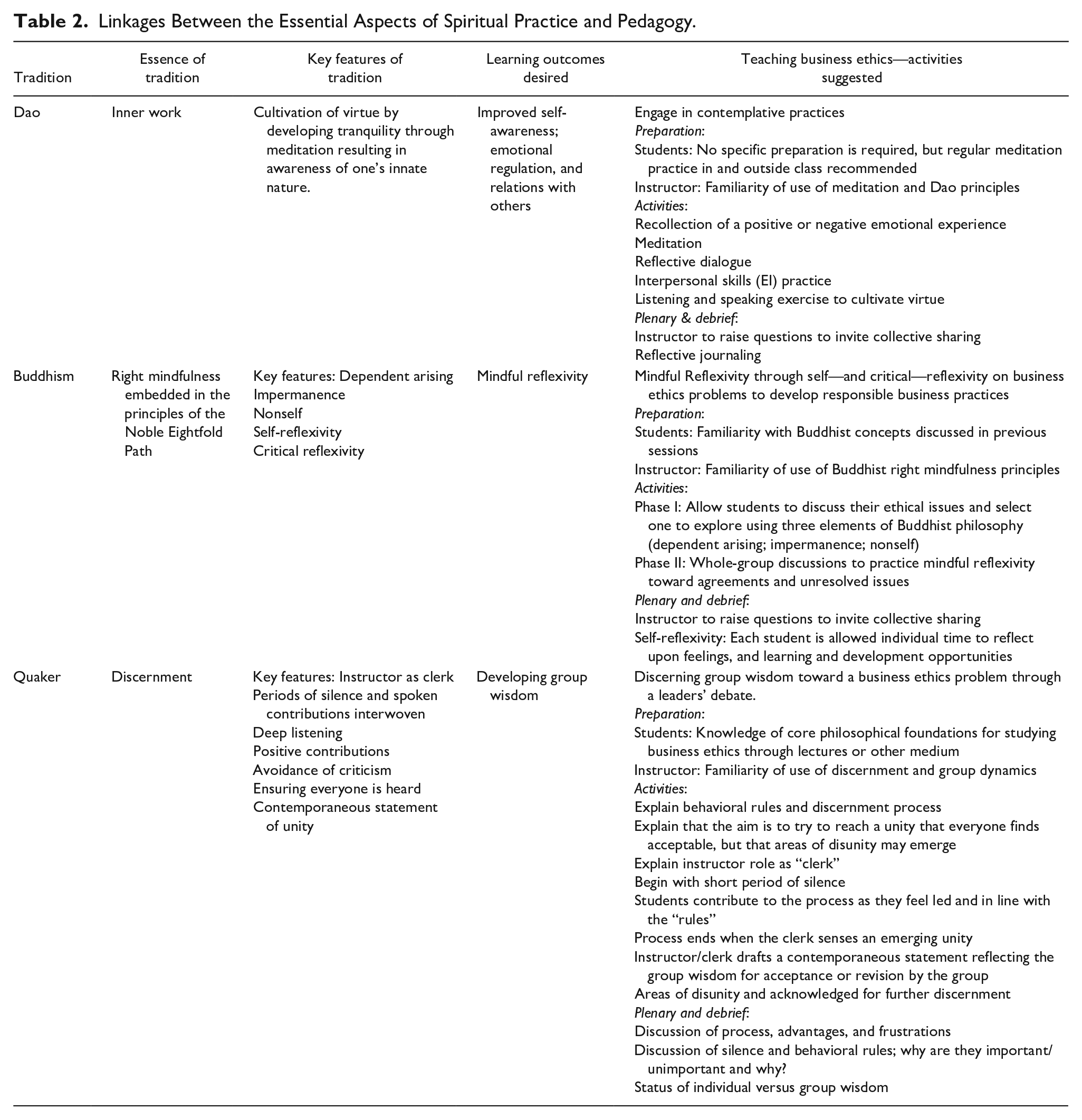
In this article, we have connected the essential aspects of three different spiritual traditions to management education pedagogy, and Table 2 provides a summary.
Linkages Between the Essential Aspects of Spiritual Practice and Pedagogy.
While our work is foundational, our contribution to the management education literature is threefold. First, we have illuminated the possibilities for a management education pedagogy that encompasses the essential aspects of three spiritual practices. We have illustrated how teaching using aspects of Daoist and Buddhist practice may support individual students in developing emotions and reflexivity. Furthermore, we showed how collective discernment may help students working in teams and groups cultivate relational awareness and group wisdom. Second, we have moved beyond treating spirituality as a “monoculture” to show how the different essential aspects of spiritual practices can be potentially utilized by instructors across undergraduate and post-experience classes. By doing so, we have responded to the calls for more “heart and soul” in management education (Waddock & Lozano, 2013). We have only scratched the surface, however, and opportunities for further research and practice abound. Third, addressing challenges in these experimental teachings in terms of vulnerability, trust-building, and self-disclosure, we reaffirm that the techniques and ethics of experiential teaching (Rosenbloom & Fetner, 2001) need to be reflexively reviewed and considered by instructors.
The approaches we have elaborated may represent a challenge to potential instructors. Inviting student’s emotional experiences into class both publicly and privately encourages an openness but also a vulnerability. Instructors need to acquire unfamiliar skills that relate to theoretical advancements on emotional development but also on the philosophical content of spiritual traditions. We have argued that instructors need not be spiritual practitioners, but they do need to share its normative commitments, and the ability and willingness to be open and vulnerable themselves. We have found that instructors who are willing and motivated to transform themselves through teaching and learning are well-placed to develop the kinds of skills required to create safe peer-learning communities.
We hope that our elaborations of teaching examples can be taken up by other potential instructors. We recognize, however, that further questions may arise, which we see also as pathways for future research. For example, deciding whether or how to disclose the spiritual and/or religious foundations of the essential aspects of the practices to students remains an intriguing question. We have found that, given the diversity of belief content (and none) in many higher education classes, this can sometimes be unhelpful. Nonetheless, there may be contexts in which it is helps support student engagement. This is an interesting idea for further research. Further research may also wish to explore how other essential aspects of the three spiritual traditions we have explored could be utilized. For example, the Daoist concept of cultivating emotional tranquility was linked to the exercises of inner work through meditation and EI, the latter of which is familiar to most students and educators. Further extrapolation of how tranquility could be nurtured through EI would be valuable. Further Buddhist principles, such as self-decentralization or karmic reasoning could be explored as a way to teach leadership. Karmic reasoning has some similarities, for example, to utilitarian ethics, based on social outcomes. In the Quaker tradition, clearness committees are often used to support an individual in finding clearness toward an issue or problem (e.g., Benefiel, 2004; Burson, 2002). Clearness committees may offer an interesting pedagogical innovation in mentoring, coaching, and tutoring. While beyond the scope of this article, we are aware that clearness committees have featured in a number of independent executive leadership programs, and yet universities have often ignored their potential (an indicative resource is listed in the appendix). Beyond the traditions we have explored, our ideas could equally be extended to other spiritual and religious traditions, and we hope scholars from other traditions and faiths can contribute their practice to the discussion.
Footnotes
Appendix
Declaration of Conflicting Interests
The author(s) declared no potential conflicts of interest with respect to the research, authorship, and/or publication of this article.
Funding
The author(s) received no financial support for the research, authorship, and/or publication of this article.
