




Abstract
Background
Employment outcomes for students with disabilities continue to lag behind those of their peers without disabilities. Although pre-employment transition services (pre-ETS) aim to improve these outcomes, communication challenges between pre-ETS providers (i.e., transition educators and vocational rehabilitation counselors) hinder effective coordination and progress.
Objective
Our study investigated communication-related challenges and support among pre-ETS providers.
Method
We used a qualitative approach, conducting 24 focus groups with 162 participants from six different regions across Texas, and analyzed the data using content analysis.
Results
Findings revealed five primary communication-related challenges: (a) Service Eligibility and Disability Definition and Understanding, (b) Information Gaps and Exchange Issues, (c) Resource Gaps, (d) Missing Stakeholders Contact Information, and (e) Lack of Clarity Regarding Professionals’ Roles and Responsibilities. In addition, we identified five primary communication-related supports: (a) Meeting Preparation, (b) Early Transition Planning, (c) Support and Resources Application, (d) Parent and Stakeholder Involvement, and (e) Integration of Educational Frameworks.
Conclusion
We discussed research limitations and provided recommendations for future research and practice, to help pre-ETS providers better prepare youth with disabilities for future employment.
Keywords
Introduction
Youth with disabilities face persistent gaps in post-school outcomes compared to their peers without disabilities in competitive employment (Lipscomb et al., 2017; Newman et al., 2011; Sanford et al., 2011). Each year, about half million of youths with disabilities graduate from schools (National Center for Education Statistics [NCES], 2024); however, many who wish to work encounter barriers to achieve successful employment outcomes (Carter et al., 2021; U.S. Bureau of Labor Statistics, 2025). Based on the most current data in 2025, the employment rate for individuals with disabilities is 37%; starkly lower than the 75.1% employment rate among their peers without disabilities (Office of Disability Employment Policy [ODEP], 2025). Moreover, among those who are employed, individuals with disabilities are about twice more likely to work part time compared to their counterparts (31% vs. 17%; U.S. Bureau of Labor Statistics, 2025).
To improve post-school outcomes, particularly employment readiness for students with disabilities, legislative measures have been enacted, most notably the Individuals with Disabilities Education Act (IDEA) and the Workforce Innovation and Opportunity Act (WIOA) of 2014. Under IDEA, schools are required to include transition goals and plans in individualized education programs (IEPs) beginning no later than age 16 at the federal level, though states may set earlier requirements (IDEA, 2004). In Texas, transition planning must begin by age 14, aligning with broader efforts to support early preparation for adult life. In addition, WIOA (2014) amended the Rehabilitation Act of 1973, focusing on promoting competitive, integrated employment opportunities as a primary goal of vocational rehabilitation (VR) services by allocating 15% of federal funds for pre-employment transition services (Pre-ETS). WIOA requires VR agencies to provide services to eligible students in five key areas: (1) job exploration counseling, (2) work-based learning experiences, (3) postsecondary enrollment counseling, (4) workplace readiness training, and (5) self-advocacy instruction (WIOA, 2014). These initiatives emphasize fostering students’ employment readiness as early as age 14 and establishing formal interagency collaboration among service providers. Given the interdisciplinary nature of transition services, effective collaboration between local education agencies (LEAs) and state VR agencies is not only required but is also an essential ongoing process (Awsumb et al., 2020; Riesen et al., 2014). Such collaboration relies on deep engagement and trust among professionals, necessitating continuous interactions and relationship-building over time (Gulac, 2023). For successful collaboration between pre-ETS providers (e.g., transition educators and VR counselors), it requires ongoing interactions; encompassing transition planning, information sharing, and resource coordination (Blalock et al., 2003; Mazzotti & Rowe, 2015; Oertle & Trach, 2007). However, building strong collaborative relationships between these pre-ETS stakeholders continues to pose challenges (Rooney-Kron et al., 2024).
Among the challenges, communication has been identified as the most frequently cited barrier to effective collaboration, highlighting the urgent need for targeted strategies to enhance communication among agencies (Awsumb et al., 2020; Carter et al., 2021). Despite this, research related to communication under pre-ETS remains scarce. To further explore how communication can be enhanced to facilitate pre-ETS, Awsumb et al. (2020) surveyed 164 pre-ETS providers from Tennessee to identify employment-related barriers for youth with disabilities. They discovered several related challenges; including approximately 70% of respondents indicating that students and families often receive conflicting information from schools and agencies, approximately 37% reported insufficient time to engage in effective collaboration, and approximately 30% noted difficulties coordinating services across different schools and agencies. These results demonstrate the importance of addressing the lack of consistency and clarity in messaging, limited opportunities for stakeholders to engage in meaningful dialogue, and insufficient communication channels and shared protocols to ensure that everyone involved has access to accurate and timely information.
Similar concerns were highlighted in another survey study that examined pre-ETS interagency collaboration from 596 middle and high school educators’ perspectives from Tennessee (Carter et al., 2021). Results found limited partnerships between schools and VR agencies, with most educators expressing dissatisfaction with current collaborations and the effectiveness of existing partnerships. This dissatisfaction was linked to constraints such as limited time and resources, rather than a lack of willingness or perceived importance of collaboration.
To expand on previous study findings, Lambert and colleagues (2023) conducted semi-structured interviews with 56 participants including VR counselors, educators, and families of youth with disabilities across Virginia and Kentucky. During the interviews, researchers asked participants to identify facilitators and barriers in implementing pre-ETS. Results highlighted the need for improved formal and informal communication between VR counselors and educators, along with greater family involvement in the pre-ETS enrollment process, to prevent service duplication and ensure ongoing support.
While prior studies have identified general barriers to collaboration and communication within pre-ETS implementation, there remains limited understanding of the specific communication-related challenges and supports needed to enhance service coordination. Notably, much of the existing research has been conducted in just three states: Kentucky, Tennessee, and Virginia, and primarily focuses on broad interagency collaboration issues rather than the communication processes, structures, and breakdowns that directly impact coordination (Awsumb et al., 2020; Carter et al., 2021; Lambert et al., 2023; Rooney-Kron et al., 2024). Moreover, few studies have incorporated the perspectives of stakeholders across service contexts, and there is a lack of in-depth exploration into how these stakeholders experience and interpret communication-related facilitators and barriers (Awsumb et al., 2020; Carter et al., 2021).
Methods
Purpose and Goals
The present study aims to explore communication-related challenges and support from perspectives of pre-ETS providers across service contexts (i.e., transition educators and VR counselors). To achieve this goal, we conducted an exploratory qualitative study, using focus groups and content analysis to explore participants’ experiences and insights through interactive discussion. This qualitative approach and analysis encourage open conversations, giving participants space to share their perspectives and helping researchers conceptualize the phenomenon (Elo & Kyngäs, 2008). Specifically, we addressed the following two research questions:
After obtaining the approval of the University Institutional Review Board (IRB), our research team conducted the study from April 26, 2022, to December 6, 2022.
Participants and Setting
Our pre-ETS providers (i.e., transition educators and VR counselors) were intentionally selected using convenience sampling from Texas. Although the broader transition-age range under WIOA spans ages 14 to 22, this study intentionally focused on students aged 14–16 based on guidance from the Texas Workforce Commission (TWC), a key partner of this project. TWC identified service gaps in early engagement, as their involvement with students often begins around ages 17–18, long after many students have missed key opportunities to access pre-ETS for which they are eligible starting at age 14. Under WIOA, students with documented disabilities who are enrolled in school qualify for pre-ETS as potentially eligible clients, without requiring full VR eligibility. Thus, the purpose of this study was to identify communication barriers and system-level challenges that prevent timely initiation of pre-ETS for younger students.
Basic participant demographic information was collected to determine their eligibility for this study. Participants who met the eligibility criteria as follows were recruited: (a) transition professionals who work for the state education agency or the vocational workforce rehabilitation agency, (b) availability to participate in a 1-day focus group, and (c) being in the same region where the focus group took place. The study included 162 pre-ETS providers from six regions in Texas, USA: 82 transition educators (51%), 58 VR counselors (36%), and 22 in other roles (13%). All participants identified as pre-ETS providers, with 52% having over 5 years of experience and 87% reporting formal or informal training. The sample was 84% female. In terms of race and ethnicity, 55% were non-Hispanic White, 26% Hispanic, and 19% non-Hispanic Black.
We held a total of 24 focus groups in conference rooms of local hotels in six regions of Texas; including Tyler, Lubbock, Houston, Austin, Arlington, and Corpus Christi. The average length for the focus group session was 94 min, ranging between 60 and 111 min. More details regarding participant recruiting process, participant demographics, and settings were captured in the Chang et al. (2024).
Research Team and Positionality
The research team included three faculty members and three doctoral students with backgrounds in special education and bilingual education/ESL. None of the team members reported experiencing a disability. In qualitative research, each team member's unique background contributes to data interpretation, which can introduce variation in perceptions and how meaning is assigned. To minimize bias in coding and findings, we held weekly reflexive discussions to examine how our individual perspectives might influence interpretation and address them in our coding. For example, a disagreement arose when two coders interpreted participant comments about pre-ETS eligibility differently, one emphasized policy language and legal definitions of disability, while the other focused on how cultural and linguistic misunderstandings shaped parents’ perceptions. To resolve the discrepancy, we invited a third team member to review the data, and the team reached consensus by incorporating both interpretations under a broader code, while documenting the rationale through analytic memos.
Procedures
An interview protocol was created, piloted, and updated by the research team (Chang et al., 2024). The research team asked four primary semi-structured questions along with probing questions in each focus group session: (a) What barriers or challenges make it difficult for you to provide pre-ETS for youth aged 14–16 with disabilities? What are the potential solutions to these challenges? (b) What obstacles do you encounter from the families of these students? What are the potential solutions to these obstacles? (c) What are the challenges within the school? What are the potential solutions to these challenges? (d) What difficulties have you had working with VR or other support providers regarding pre-ETS for youth aged 14–16? What are the potential solutions to these difficulties? Researchers took field notes to capture emerging themes and summarize interviews. All focus groups were audio recorded with an iPhone. More details were documented in a previously published article (Chang et al., 2024).
Preparation for Data Analysis
After completing interviews with the 24 focus groups, we transcribed and coded the data. Transcription was facilitated by Otter.ai (https://otter.ai/), an automated password-protected system. Two trained doctoral researchers reviewed the transcripts word-by-word for accuracy. Transcriptions were de-identified and segmented into 151 codable units across the 24 transcripts. These segments, defined as thematically coherent units of text relevant to our research questions, were identified during initial transcript review and refined within a web-based qualitative data analysis software- Dedoose (https://www.dedoose.com/). We used Dedoose to support our coding and analysis process. This software facilitated collaborative analysis by enabling multiple coders to apply, compare, refine codes, check quotes for each code, develop categories, and describe phenomena. We uploaded the relevant deidentified units data into Dedoose and coded with our finalized codebook (see section below for development details).
Coding Process
We conducted a content analysis of the collected data, adapting the inductive coding process outlined by Elo and Kyngäs (2008) in their Qualitative Content Analysis Process. The coding protocol involved: (1) engagement with the data, in which each coder independently read the transcripts repeatedly and thoroughly to gain a comprehensive understanding of the content, identified meaning units, and assigned preliminary codes; (2) development of a coding scheme and codebook, where coders consolidated their memos and codes into a structured coding sheet and refined it through multiple reviews; (3) grouping, in which similar codes were clustered based on shared meanings and overly broad codes were divided into more specific groups; (4) coding and reorganization, where categories were created by comparing similarities, differences, and relationships among groups to deepen understanding of the phenomenon related to the study; (5) interpretation and conclusion drawing, during which coders met to refine and synthesize categories into mutually exclusive classifications and develop an overall description of the research topic; (6) iterative refinement of all steps until codes and categories were clear and distinct; and (7) verification, in which results were applied back to the original data for testing and confirmation.
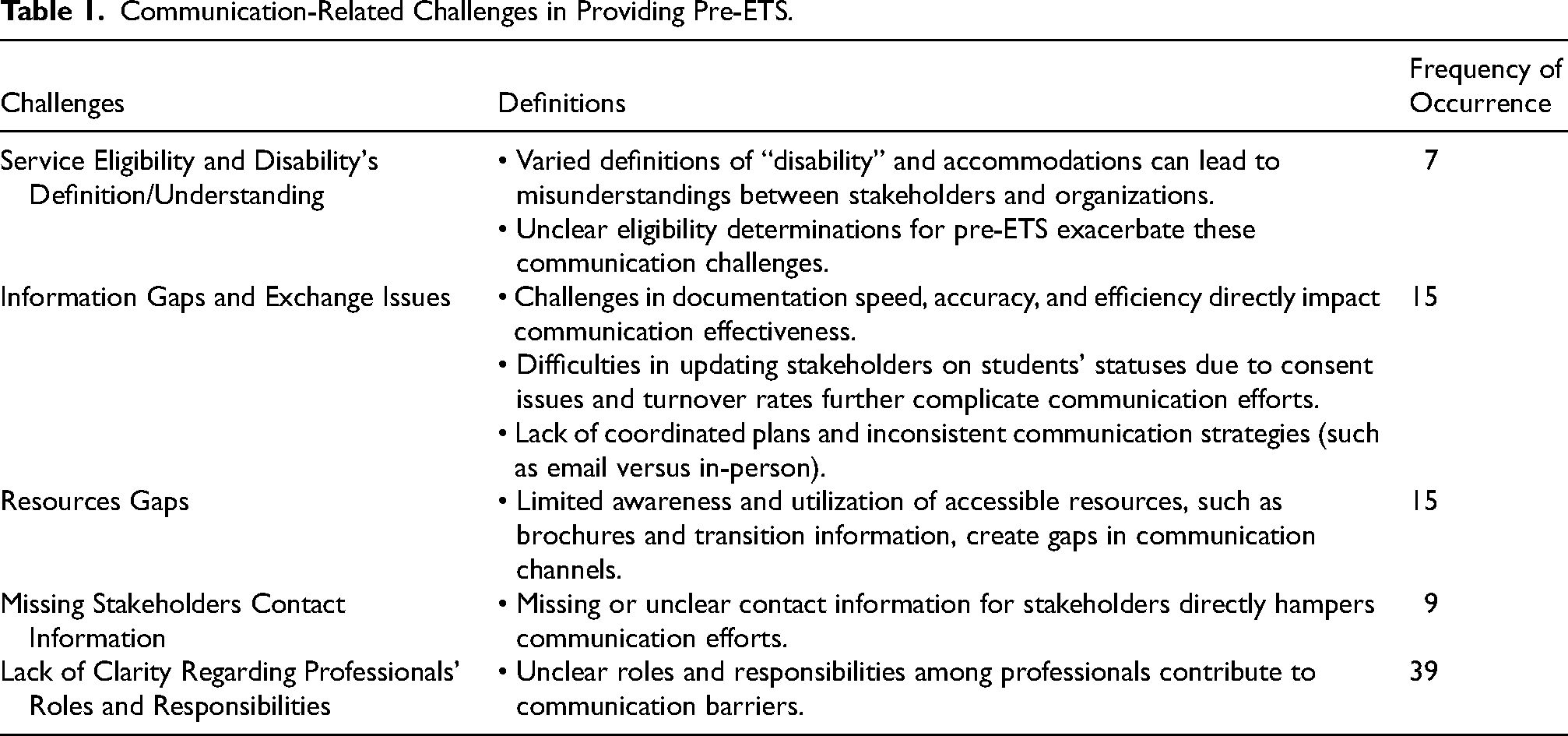
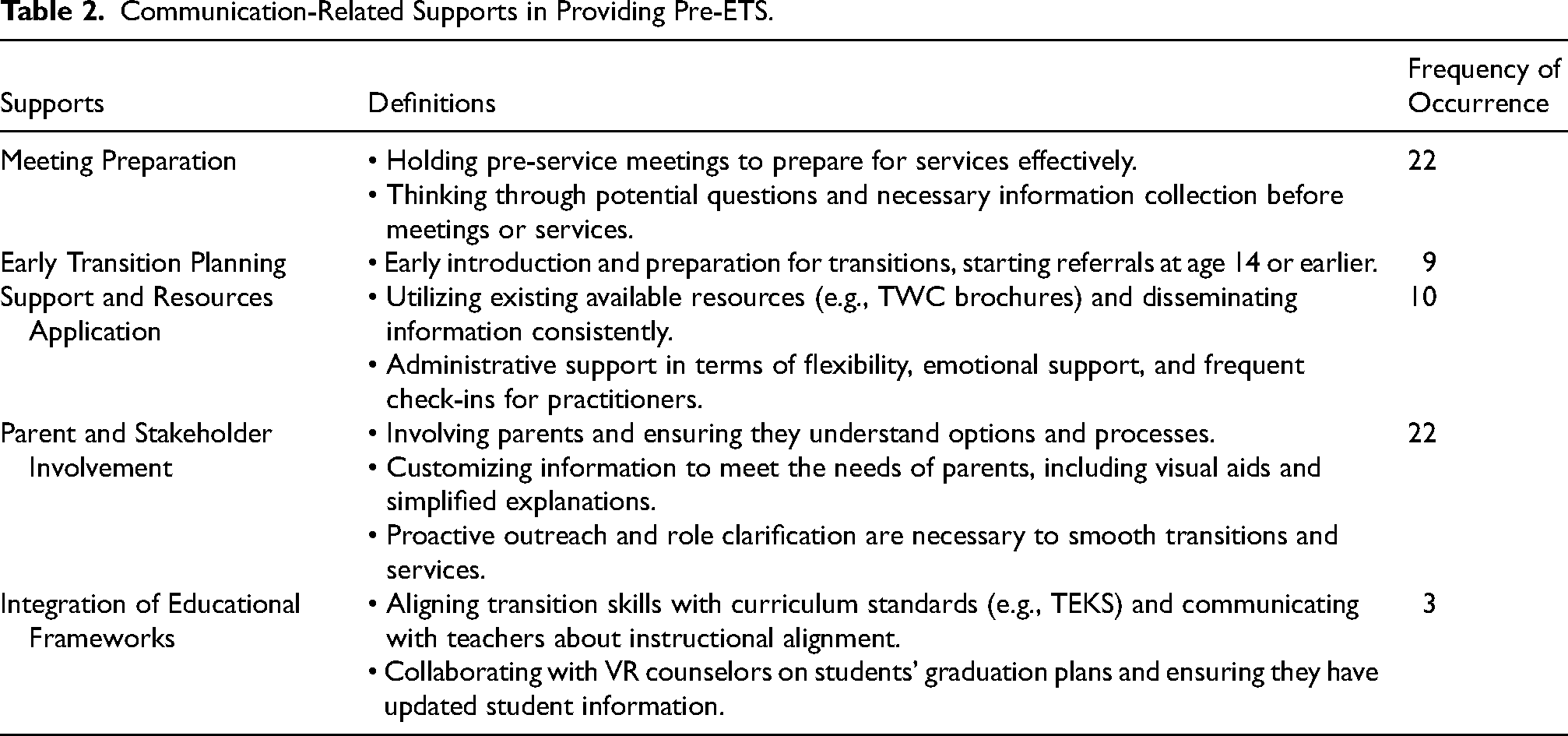
To organize participant responses, we developed two parent codes: one encompassing all codable content related to communication (the primary analytic focus of this study), and one designated as an “uncodable” category. The main parent code- Communication, served as an umbrella code and was systematically applied to segments aligned with our two research questions (challenges and supports). Within this analytic code, we identified ten subcodes, five reflecting communication challenges (see Table 1) and five reflecting communication supports (see Table 2). These subcodes captured patterns in how pre-ETS providers described barriers to, and facilitators of, effective communication. We also examined the distribution of these codes across the 24 focus groups to assess the frequency and breadth of each theme (see Table 1 and 2).
Communication-Related Challenges in Providing Pre-ETS.
Communication-Related Supports in Providing Pre-ETS.
The uncodable category included brief comments that were either procedural (e.g., questions about the session logistics), outside the scope of our research questions, or not sufficiently detailed for content analysis. These responses were not discarded but were set aside during analysis to maintain focus and transparency.
Trustworthiness
To ensure our study's trustworthiness, we applied several strategies including ongoing training, debriefing, and independent coding. During the focus group session, each session had at least one note taker to take field notes. These notes served as part of the triangulations during our later coding process. Prior to coding, the primary author facilitated coder training and evaluated inter-coder reliability. Specifically, following the training, one coder conducted a comprehensive analysis of the dataset, while a second coder independently reviewed 30% of the coded data, resulting in 85% of agreement. All discrepancies were discussed collaboratively until full agreement (100%) was reached among the coders. The research team shared and acknowledged each member's positionality and potential biases before analyzing the data and held weekly peer debriefings throughout data analysis and reporting process (Brantlinger et al., 2005). A specific example was provided under the 2.3 Research Team and Positionality above.
Results
Communication-Related Challenges That Providers Identified as Affecting Implementation of Pre-ETS
In this section, we present those insights alongside the challenges they were intended to address, where applicable. In some areas, particularly those involving systemic barriers such as staff turnover or role ambiguity, practitioners acknowledged the need for solutions but did not offer specific concrete strategies.
Service Eligibility and Disability's Definition/Understanding
Differences in definitions among stakeholders can lead to communication challenges and delays in providing necessary support for individuals transitioning from school to employment or further education. This category refers to the challenges practitioners encountered regarding how disabilities are defined within this context and interpretations determining who qualifies for pre-ETS. Practitioners highlighted the discrepancy in how the term “disability” is understood and used between the workforce VR counselors and schools. For example, one practitioner said, We use the word disability a lot …. That is our word. And that's how we determine services and qualifications, disability, just working with the schools, they don't really use the term disability …. You'll hear accommodations or modifications, co teachers, you may hear spare time or poor but that word is not really communicated a lot.
One practitioner echoed that although schools and VR programs aim to support the same students, they often use different terminology, such as focusing on “eligibility” versus “disability”, which can lead to confusion during the transition process.
Another practitioner gave an example regarding how the understanding differences in disabilities may impact on the communications, especially with parents, during pre-ETS. I know we didn't often define things as well as we thought we did …. I met [a student with disabilities] who has autism and intellectual disability and [we were] just going over all the support …. The mother was like, she's backing out the door. She's like, what, my son doesn't have a disability. We never really define [the disabilities] … she [the mother] just didn't know what I meant by intellectual disability.
The practitioners noted that how disability is understood can greatly affect whether students with disabilities receive appropriate transition services. Another example, one practitioner described a situation where a student was unaware of his autism diagnosis and misinterpreted his experiences: I had a student who didn’t know he had autism. He went to his mom thinking something was wrong with his hearing, because he couldn’t process sounds or information the way others did. After they talked, he learned that his experiences were related to being on the spectrum, and he said, ‘Well, that makes perfect sense.’
To address these challenges, providers shared insights on fostering clearer, more respectful communication and improving coordination between stakeholders.
Information Gaps and Exchange Issues
Smooth and effective information delivery and exchange is a key for ensuring seamless transition and timely delivery of pre-ETS for students with disabilities. Prior studies have consistently identified information gaps as a major barrier to implementing Pre-ETS effectively (Lau & McKelvey, 2023; Lau et al., 2024). This category refers specifically to gaps in information delivery and exchange, including incomplete or inaccurate documentation, delays in communicating student information, difficulties in updating stakeholders on student progress due to consent restrictions or staff turnover, limited awareness, or use of available resources (e.g., brochures, transition information, and support materials crucial for delivering pre-ETS).
Practitioners agreed that student learning can be enhanced by professional agreement on what skills should be emphasized, yet they found school educators might not have been aware of the employment skills needed. For example, one practitioner said, This is a translation to the real world, like, if they don't show up in school so that they're not gonna show up for work …., but it's hard to get the other teachers to understand like, now we have to work on these other skills, because they are going to translate to the job.
Even with strong motivation to coordinate between professionals, high caseload can hinder outcomes. One practitioner provided an example that demonstrates how one pre-ETS practitioner tried to help and coordinate; however, with a large number of target students the circumstances could be helpless. “I probably can't help them all the time … I would say 53 ARDs [Admission, Review, and Dismissal (ARD) meeting in Texas is also known as the individualized education program (IEP) team in other states] students called me, and we have been trying to make it easy.” Another practitioner echoed the similar challenge, “I have 14 schools [to work with]. So it's hard for me to remember to tell every one of my teachers.”
Practitioners also mentioned the waiting time for document exchange. One prominent situation is waiting for consent forms to begin pre-ETS services. One practitioner shared, “We've got all of these kids that can benefit from services … we've got the providers, we've got everything lined up, but we're waiting on parents to send back forms that we may never get back, therefore we can't access those services.” Another practitioner shared a challenging situation about service being delayed due to waiting for required documents from other stakeholders. That communication isn't there like we were supposed to start our credits last week … I have sent her all of the 1820 forms, with the social security cards and all the other stuff signed that they hadn't been processed yet. So, their provider hadn't been pre-approved for payment. So, we have put off until next October to start.
Resources Gaps
This category refers to limited awareness and utilization of accessible resources, such as brochures and transition information, creating gaps in communication channels. Practitioners pointed to the issue of “lack of resources.” In addition, practitioners shared the information gaps that exist and were provided by different stakeholders or between institutions, which might cause misunderstanding. … the person delivering the message, but he's like, I don't have a lot of information regarding things like the forms or what they have to do, right. So, we bring them back to the estate, and sometimes, you know, they don't get the right information. And then I'm in between, so it's so hard for them, it has been very, very hard.
Even when resources are available, the lack of effective ways to connect them with the people who need them remains a challenge. As one practitioner further shared, “They [practitioners] understand there's resources out there but even how to make sure that the students and the families are connecting ….”
Missing Stakeholders’ Contact Information
This category refers to the situation where essential contact details of individuals or organizations involved in providing pre-ETS are incomplete, inaccurate, or unavailable. This gap poses a great challenge to initiate or maintain crucial communication channels between stakeholders. Practitioners shared the challenges of exchanging contact information between professionals due to the instability of their roles. “I have no less than six VR counselors working with my campus right now. And it doesn't stay the same. Some of those have changed many times. They're all filling in.” Another practitioner echoed the turnover rate challenge, “We don't have a VR counselor. We've got a lot of temporary people.” Without specific contact information and assigned responsibilities, practitioners shared the difficulties of providing services to specific populations. “Because we're not assigning names, right? It's not fully connecting our students with VR services right now ….”
Practitioners continue to share the difficulties in connecting to the point of contact. “It's much slower because we have to try to contact the customer and or the parent. And if they're not answering, which happens all the time right? There, you're never gonna get them …. So, they have to keep trying and then all the other ones keep coming.”
Lack of Clarity Regarding Professionals’ Roles and Responsibilities
Clear roles and responsibilities enhance coordination, communication, and efficiency in providing tailored pre-ETS that meet the diverse needs of students preparing for employment or post-secondary education. This category has the most units (n = 39) across all focus groups, which indicates the majority of the practitioners brought up this topic into the discussion. This category refers to the challenges for practitioners to have clear understanding and delineation of duties among various professionals involved in delivering pre-ETS. This clarity ensures that each professional, such as educators, counselors, VR specialists, and service providers, knows not only their own but also other professionals’ specific roles, responsibilities, and contributions to the pre-ETS and transition process for students with disabilities. Practitioners mentioned stakeholders not understanding the practitioners’ role and responsibilities. For example, one practitioner shared, “Placing people at jobs is not the only thing that we do …. the counselors, come to the meetings, and present all the possibilities. I think having that introduction in this block of time, and then giving all the resources because it's not just, hey, I need you to help with job placement, there's more to offer.”
Practitioners expressed their frustrations regarding the requirements for coordination work that were exceeding their existing responsibilities. They expected to be respected with clear and specified working responsibilities. One practitioner said, “Do I have to know step by step? No, ma'am. I just need to know. I've done my three [required tasks]. I've done what I'm supposed to do. I followed my policy.” Under this reluctant situation, another practitioner also shared a way they dealt with the unclear role responsibility, “If the support is available, we can help that when we know. But when we don't know, then okay, I actually got documentation that I did my portion.”
Add upon the existing challenges, within each professional role, people may handle their “communication and caseload in their own independent way.” However, for the purpose of seamless transition service work, if one practitioner does not complete a referral form and does not reach out (which are critical), the other stakeholders will take over those responsibilities.
One practitioner pointed out that some schools are still unaware that VR services can begin supporting students as early as ages 14 to 16, stating that “schools that are still in a mindset” that services only start at a later age. This gap in awareness can limit early collaboration opportunities during critical transition years.
Communication-Related Supports That Providers Identified as Important to Enhance Pre-ETS to Students with Disabilities
In response to the communication challenges, participants also shared a range of strategies and supports they found helpful or promising in practice. The following subsections tried to align directly with the major communication challenges previously identified and expand upon areas where providers proposed ideas, workarounds, or practices they believed to be effective.
Meeting Preparation
Several practitioners emphasized that one way to reduce miscommunication and confusion, especially around eligibility and services, was through intentional meeting preparation (i.e., transition planning). As one practitioner was straightforward, “Just talking about a form that allows us to be able to talk to the students when we go into the schools and the parents have to sign it along with the students.” This category refers to ensuring that all relevant service providers have the chance to meet and are adequately prepared before meetings related to transition planning. It includes tasks such as setting clear agendas, gathering necessary documentation, outlining objectives, and anticipating potential questions or concerns, such as disability awareness. For example, one practitioner suggested, “I think if the schools once the kids enter into the special education program or 504 program, they make it very clear that you're eligible for this program based on your presence with an intellectual disability, you're having autism and make that information aware to them.”
Effective meeting preparation in pre-ETS aims to streamline communication, foster collaboration among team members, and maximize the efficiency and productivity of transition planning sessions. One practitioner shared, “They use a disability and that's one of those defenses that go up and so maybe yeah, they can do some sort of prep work and make sure that they do understand that we're saying eligibility…. I know we don't often define things as well as we thought we did, you know.”
Pre-meeting preparation also includes meeting stakeholders before the meeting. One practitioner shared, “As for at least for the school psychology team, we're expected to meet with parents prior to the ARD [IEP meeting] to explain to them what their eligibility needs.” Not just the school psychology team, practitioners also shared, “The diagnosticians also do the same thing [meet with parents prior to ARD]. They meet with parents, and they talk about what they're qualified for before we actually go into the ARD.” By doing these preparations, the parents already have some of the information before going into the official ARD meeting. These early conversations helped reduce confusion, set clearer expectations, and built trust between families and providers. Although not all providers reported using this practice, those who did felt it made a meaningful difference in how receptive families were to the services being discussed.
Early Transition Planning
Practitioners frequently linked effective communication to the timing of engagement in the transition process. This category refers to early introduction and transitions preparation, starting referrals at age 14 or earlier. Practitioners suggested that introducing transition services early can help both themselves and the populations they serve be better prepared in terms of resources and mental readiness for the next stage. One said, We'll start the conversation more introductory that high school training kitchen, in the eighth grade …. So, we've been doing screening and senior years old backed up our VR counselor to join their sophomore junior year, so we can catch them before they're 16 present possible seal opportunities that that's available. And then also it just gives us time for them to digest because just entering high school, for most of them, is more traumatic than it is for [previous schoolings].
This approach was seen as a way to proactively address the challenges of role ambiguity (See 3.1.5) and gaps in family awareness (See 3.1.1), before misunderstandings became barriers. However, its implementation was uneven across the practitioners, and no widespread system-level solutions were offered to ensure consistency across settings.
Support and Resources Application
As discussed in Section 3.1.3, practitioners frequently cited challenges related to resource accessibility and use. In response, several practitioners shared strategies they had adopted to make existing resources more usable and meaningful for students and families. This category involves effectively utilizing available resources and supports to assist students with disabilities in their transition from school to post-school activities. This support focuses on identifying and applying relevant resources such as VR services, educational supports, job training programs, and community resources. It includes ensuring that these resources are accessed and utilized consistently to meet the individual needs of students during their transition period. Additionally, administrative support, flexibility in service delivery, emotional support, and regular check-ins for practitioners are integral components of this support to optimize the effectiveness of support and resource application in pre-ETS initiatives. The goal is to enhance the comprehensive support system available to students, facilitating their successful transition into adult life.
To provide resources to the target population, some practitioners shared that they put brochures with transition essential information and forms in a folder for ease of access and sharing. Other practitioners stressed the importance of self-reflection on their own understanding that could be different from their target service population. For example, one practitioner shared, “People not knowing what they don't know, so many times we enter a conversation or start to share information about specific things and think that everyone has the same knowledge pool and base that we do, and they don't.” Practitioners identified several ways to address resource gaps. One is “having more broken-down information so that everybody is accessing it at the foundational level to understand it first, before moving forward to the next step.” Another way is to provide their target population with existing available resources, such as online links that contain relevant information. Yet, the practitioner admitted that regarding word-based content, “Most people don't want to read it. Other resources that were shared in the discussion include video clips, brochures, or transition newsletter; which are more accessible and easier to understand.”
Some existing available resources were brought up; one practitioner shared, “YouTube video. There's a transition internet page for VR services that if that's not something educators need to know, they can see it too.” One practitioner emphasized the importance of helping students and families understand the scope of available services. They explained that resources can offer “a general idea of what areas we can provide services in,” such as assistance with “payment for driver's education [or] transportation services,” while also clarifying the limitations of what supports are feasible.
Practitioners also shared some disseminating avenues, such as posting information on their institute's website and creating transition newsletter to share updates. Practitioners suggested providing inspiring stories from pre-ETS may motivate their potential service populations. One practitioner shared, “We get success stories. … we have to figure out a website and video or something …there was a lot of negativity … we have to come up with something to be able to share some chatter.”
Practitioners argued the importance of preparing a resources package including contact information for other stakeholders, such that everyone can be on the same page during their collaboration. One practitioner shared, You put folders or packets together to give to your diagnostician or your transition person. …. And that way, if I'm not able to be at the meeting or not invited to the meeting …. They have my information.
Despite these identified practices, no practitioners described a formal or standardized resource dissemination strategy implemented at the state or regional level, which indicates a gap in structured supports and highlights the potential value of co-developing family-facing materials
Parent and Stakeholder Involvement
Effective parent and stakeholder involvement in pre-ETS creates a supportive network around the student, fostering a smoother transition and enhancing outcomes in post-school life. This category refers to involving pre-ETS stakeholders proactively and ensuring they understand options and processes. Suggestions were made regarding the awareness of the services students are currently receiving from different stakeholders. One practitioner shared being proactively self-introducing themselves to other stakeholders and making connections, As a counselor, I would reach out to the therapists and say, hey, first, I would make sure that the customer has signs and sets for me to talk to the school. And I would say, hey, so I have this customer who just recently enrolled there from your campus, just wanted to let you know, so that you're aware, if you have any ARDS [IEP meeting], you can invite me on everything that we can share, like assessment, and you know, evaluations as being so that you guys can include that, in your art meetings, or you know, fit is whatever you guys want to do.
Practitioners pointed out the importance of recognizing parents’ questions and potential knowledge gaps in pre-ETS. One practitioner said, “A lot of parents don't know what we're talking about … they don't want to show their ignorance.” To address parental needs, practitioners shared their experience of treating the parents as an equal collaborator and showing their understanding of the parents’ needs in gaining pre-ETS-relevant knowledge. One practitioner said, “I've tried to make it a habit of making sure. I'm gonna tell them what it is. And they may not remember it, but we think that they all know it. Yeah. We are professionals, like the parents ….”
Regarding the contact information missing issues, practitioners suggested reaching out to supervisors or state level institutions for further assistance. One practitioner said, “So the state office number would be for everybody. … I think it would be best to just call his office because the state office will assign someone and so if for some reason there's nobody in that office.” Practitioners also mentioned that post-COVID19 transformed the way of engaging other stakeholders and providing services. For example, one practitioner said, “… now there's a lot of remote, you know, talking with remote coming in remotely talking to the families and the students and not as much face to face anymore. So, the relationship building has become somewhat of a problem in the refining, and I don't know if that's the policies and initiatives or you're also looking at it as a solution because it's always been a goal to get to those schools.”
Practitioners argued the importance of helping the parents and students to “see how it [pre-ETS] could benefit them, and I don't hear what I'm trying to explain to them about our services and what could help their child.” However, in many situations, parents think employment is still too early to be applicable to their children.
Integration of Educational Frameworks
This category refers to aligning transition skills with state curriculum standards (e.g., Texas Essential Knowledge and Skills; TEKS) and communicating with teachers about instructional alignment. An example is aligning existing classes and instructions with pre-ETS. One practitioner suggested, A lot of these things [pre-ETS focus skills] are already happening within the curriculum and the instruction that's going on and kind of like looking at aligning those to be able to see, okay, you know, what, this class has these pre-employability skills that we can work on… And because there is a lot of activity going on in instruction, that will lead to that, or that does have, you know, turning in assignments on time, communication, and all of these things. So maybe we just need to, you know, align ourselves in those areas. So then maybe we need to have conversations with the teachers that are teaching these TEKS and say, when you've taught this to students, make sure we document it, because then we can add it to his transition plan.
Discussion
This study explored communication-related challenges and supports from the perspectives of Pre-ETS providers, including transition educators and VR counselors across 24 focus groups. The analysis yielded ten primary categories that captured providers’ insights about what hinders or facilitates effective communication in Pre-ETS implementation. Practitioners emphasized challenges around language and terminology, inconsistent access to information, resource navigation, and a lack of clarity regarding professional roles. At the same time, they offered practical suggestions for improving communication structures and engagement strategies. Grounded in these provider-identified concerns, this discussion highlights three key areas that emerged most consistently across focus groups and have direct implications for improving policy and practice. The three areas are: (1) shared definitions and understandings of disability, (2) accessible and relevant information delivery, and (3) early engagement and coordinated communication across systems. These points reflect issues that practitioners returned to repeatedly and described as foundational to improving Pre-ETS implementation. It is important to note that the suggestions identified by practitioners were not framed as quick fixes, but rather as starting points for developing more sustainable and responsive practices over time.
Shared Definitions and Understanding of Disability
Practitioners frequently noted that inconsistent use of disability-related terminology between education and VR systems led to misunderstandings during eligibility determinations and service planning. Various understandings and perceptions of disability can be influenced by cultural and societal context (Munyi, 2012), and/or professional training backgrounds. To address this inconsistency, employing glossaries or standardized definitions among collaborative professionals is recommended (Robinson & Buly, 2007). Specifically, Robinson and Buly (2007) advocate for stakeholders to engage with literature from other fields and foster open, respectful, and purposeful dialogue to build mutual understanding.
In addition to standardizing terminologies, enhancing communication skills among service providers, such as embedding case studies, sharing practitioner experiences, and requiring fieldwork during pre-service training programs have shown promise (Riesen et al., 2014). Other measures include scheduling annual joint planning meetings between schools and VR agencies, reviewing roles and responsibilities, and providing training on effectively communicating pre-ETS processes to families (Wehman et al., 2024). Future research should explore the feasibility and effectiveness of implementing the above strategies in pre-ETS.
Accessible and Relevant Information Delivery
Another recurring concern was the difficulty families and providers face in locating and trusting Pre-ETS information. Despite the abundance of resources available from national centers, state agencies, and local organizations (e.g., the National Technical Assistance Center on Transition, the TWC), practitioners of our study expressed concern that these materials were often overwhelming or misaligned with the needs of their intended audiences. Some described how families “don’t want to read it,” while others pointed out that materials rarely accounted for language, literacy level, or cultural relevance. These challenges may result from a lack of relevant resources or limited accessibility for target populations, including service providers and families of youth with disabilities (Lambert et al., 2023). Future research should investigate how information is provided to the target populations, how they perceive and utilize these resources, and what platforms they use to access the resources. For example, understanding pre-ETS transition educators and the VR counselors’ perceptions of information gaps, their resource-seeking behaviors, and the influence of their training and demographics could help improve resource relevance and usability. As individual factors influence an individual's perceptions (Achola, 2019), to understand pre-ETS providers’ perceptions more precisely, future research should examine the relationships between providers’ perceptions, their demographic characteristics, and the outcomes of communication with other stakeholders.
Early Engagement and Cross-System Coordination
Practitioners emphasized that improving communication is not just about clarity, it's also about timing. Many advocated for earlier engagement in the transition process, starting way before the federally required age. They described how introducing Pre-ETS during middle school or early high school gave families and students more time to mentally prepare, digest information, ask questions, and build trust with providers. Early transition planning has been emphasized from multiple previous studies (Lambert et al., 2023; Williams & Price, 2024), as students with disabilities and their families need time to develop employment and independent living skills and to become familiar with available community services and adult agencies (Chun et al., 2023; Henninger & Taylor, 2014). To ensure the timely and effective implementation of pre-ETS, stakeholders need to have a clear understanding of its purpose and procedures, as well as establish consistent channels of communication. Families, in particular, require access to accurate information, reassurance about the process, and opportunities for meaningful dialogue with service providers (Lambert et al., 2023; Lau & McKelvey, 2023).
Limitations and Future Research
This study has several limitations. First, the participant sample lacked diversity, as all focus groups were conducted in a single state and included individuals with similar professional training and work experiences. While this homogeneity may have encouraged open discussion within established networks and among similar professionals, it may also have constrained the range of perspectives captured from providers in pre-ETS (Clark et al., 2019). As a result, the findings may not be fully generalizable to other regions or populations. Future research should engage a more demographically and geographically diverse sample of pre-ETS providers and include other key stakeholders, such as students, families, and administrators, to enrich understanding of communication dynamics.
Second, data collection occurred between April and December 2022. Given the evolving nature of transition-related policies, educational practices, and interagency service structures, the current findings may become less applicable over time. Longitudinal research is recommended to assess how communication-related challenges and supports shift in response to system-level changes (Caruana et al., 2015). Finally, although this study focused on identifying communication barriers and supports, additional work is needed to explore how specific communication strategies (e.g., digital tools, cross-agency protocols, cultural/linguistic adaptations) affect pre-ETS implementation. Future studies should examine the effectiveness of targeted interventions to improve communication between transition educators, VR counselors, and families. Investigating how factors such as organizational structure, workload, or provider demographics influence communication quality may further inform system-level improvements in pre-ETS delivery.
Implications for Practice and Policy
Our findings suggest several key strategies to strengthen communication across education and VR systems. First, agencies may benefit from collaboratively developing and disseminating clear, standardized definitions for core disability-related terms to reduce confusion during eligibility determinations and service planning (Lambert et al., 2023; Robinson & Buly, 2007). One practitioner noted, “We use the word disability a lot … working with the schools, they don't really use the term,” underscoring how misaligned terminology can confuse both professionals and families. Another provider remarked, “We didn’t often define things as well as we thought we did,” highlighting the risk of misinterpretation or rejection of eligibility labels, such as when a parent responded, “What, my son doesn’t have a disability.” Beyond semantics, effective communication depends on how language functions in real-world contexts and aligns with families’ backgrounds (Whitehouse et al., 2021). Misunderstandings about professional roles and expectations can also create frustration and inefficiencies. Addressing these issues requires investment in pre-service and ongoing training focused on culturally responsive communication, digital literacy, and family engagement (Povenmire-Kirk et al., 2018). Second, centralized resources are only useful if families know how to access and trust them (Riesen et al., 2014). Practitioners noted that simply handing out flyers is insufficient; information must be clear, relevant, and bridge to different literacy levels. Suggestions included using videos with relatable success stories to increase engagement. These perspectives point to the need for multimodal, user-friendly communication tools that reach diverse audiences (Schutz et al., 2022).
Finally, persistent delays in service delivery, often due to unclear processes or unreturned consent forms, highlight the need for cross-agency communication protocols. Tools such as digital consent systems and shared contact directories could improve coordination. Future research should examine current information exchange practices and platforms, and identify the barriers and improving areas from both practitioners and families.
Conclusion
Given the interdisciplinary nature of pre-ETS, addressing communication gaps among service providers is both crucial and complex. This study expands existing knowledge on communication-related barriers and potential facilitators for pre-ETS transition educators and VR counselors. Rather than offering prescriptive solutions, our findings emphasize the need for collaborative, context-sensitive efforts to improve information sharing, clarify professional roles, and build trust across systems.
Footnotes
Acknowledgement
n/a.
Ethics Considerations
n/a
Informed Consent
All participants were adults and provided informed consent to participate in this study.
Funding
The authors disclosed receipt of the following financial support for the research, authorship, and/or publication of this article: This study was supported by the Center on Disability and Development (CDD) # 90DDUC00780-04-00.
Declaration of Conflicting Interests
The authors declared no potential conflicts of interest with respect to the research, authorship, and/or publication of this article.
