




Abstract
Background
Sheltered workshops remain a common form of employment for individuals with mental health conditions in Switzerland. As there are currently no national requirements governing their design, it is crucial to examine how sheltered workshops can be improved to better meet the specific needs of this population.
Objective
This study aimed to explore the work experiences and conditions in sheltered workshops that contribute to the development of a positive work identity among individuals with mental health conditions.
Method
Two group discussions (n = 10) were conducted in a sheltered workshop in Switzerland. Data were analyzed using inductive thematic analysis.
Results
The analysis revealed three main themes central to promoting identity-enhancing work experiences: (1) Cultivating an egalitarian work environment that emphasizes the absence of stigma and actively promotes equality; (2) Enhancing motivational work design characteristics, with a focus on skill development and autonomy; and (3) Providing meaningful work through products with societal impact.
Conclusion
This study highlights critical factors related to work culture, work design, and work products that facilitate a positive work identity for individuals with mental health conditions in sheltered workshops. These recommendations help improve sheltered workshops to better support personal recovery and labor market reintegration.
Keywords
Introduction
According to the Federal Statistical Office (2023), 18% of the Swiss population is affected by mental health conditions. Such conditions can hinder an individual's ability to engage in regular work activities. Individuals with mental health conditions face major challenges in managing their health while meeting organizational expectations for performance and work engagement (Elraz, 2018). Although these conditions can affect employees’ cognitive and behavioral abilities, such as concentration or social interaction skills (Follmer & Jones, 2017), their capabilities and skills are also frequently underestimated (Boardman et al., 2003). This reflects a broader pattern of stigmatization toward individuals with mental illnesses, which encompasses stereotypes (i.e., widely held beliefs about such individuals), prejudice (i.e., personal endorsement of these stereotypes accompanied by negative emotional responses), and discrimination (i.e., behavioral manifestations of prejudice) (Corrigan, 2005). Stigma can manifest in both public forms and self-stigma (Corrigan, 2005).
Mental health problems account for more than 50% of disability pensions granted in Switzerland (Federal Social Insurance Office, 2023). The Federal Social Insurance Office (2023) offers various programs designed to support the reintegration of individuals with mental illness into the labor market, including vocational training initiatives, supported employment opportunities, and sheltered workshops.
Although sheltered workshops aim to facilitate reintegration, scholars argue that these segregated settings do not effectively contribute to positive outcomes for individuals with mental illness. The criticisms of segregated environments include cost inefficiency, poor employment outcomes, and the failure to meet the economic needs of participants, as those in segregated environments tend to earn less than those in integrated settings (Cimera, 2011; Cimera et al., 2012; Suijkerbuijk et al., 2017; Taylor et al., 2021, 2023). Furthermore, research has demonstrated that individuals in segregated settings experience lower levels of quality of life, self-determination, autonomy, self-esteem, and job satisfaction compared to those in integrated settings (Beyer et al., 2010; Griffin et al., 1996; Taylor et al., 2023; Wehmeyer & Bolding, 2001). This is reflected in the assessment of the participants: A significant majority of adults with an intellectual disability who recently began attending workshops would prefer employment outside of workshops in the regular, so-called first labor market (Migliore et al., 2007).
Despite these findings suggesting that sheltered workshops may not represent the optimal rehabilitation approach, the implications can vary across different local contexts. Notably, Switzerland presents a significant challenge for individuals with mental health conditions seeking entry into the first labor market due to high educational standards, few entry-level jobs and no prevailing hire and fire policy (Hoffmann & Richter, 2020). To evaluate supported vocational programs in Switzerland, Hoffmann et al. (2012) initiated a program at the Center of Psychiatric Rehabilitation at the University of Bern, demonstrating that individuals with mental illness, despite showing no differences in symptoms and quality of life, achieved significantly better work outcomes than those in sheltered employment. Nevertheless, the implementation of such programs is constrained by key structural barriers. First, the Federal Social Insurance Office requires that individuals demonstrate at least 50% of the functional work capacity of a non-disabled person to qualify for reintegration programs (Hoffmann & Richter, 2020). Second, employer reluctance to hire individuals with psychiatric disabilities remains a persistent obstacle (Baer et al., 2017).
As a result, despite their limitations and ongoing criticism, sheltered workshops continue to represent a common form of vocational integration for people with mental health conditions in Switzerland. To serve a genuinely rehabilitative function, sheltered programs should fulfill specific requirements that go beyond merely maintaining daily structure, encompassing a broader range of psychosocial functions important for individuals with psychiatric disabilities, such as opportunities for social interaction, meaningful activity, personal involvement, support, a sense of achievement and identity as well as access to meaningful work (Boardman et al., 2003). The latter can broadly be defined as work that is “personally significant and worthwhile” (Lysova et al., 2019, p. 374). However, in practice, there are currently no binding standards or regulatory guidelines at the national level to ensure that these rehabilitative goals are systematically pursued within sheltered employment settings, as the implementation and regulation of sheltered workshops fall under the responsibility of the individual cantons. The canton where this study was conducted has established specific criteria, primarily concerning infrastructure, staff qualifications, and certain fundamental rights of the supported individuals (Department of Education, Culture and Sport Canton Aargau, 2023). Nevertheless, these criteria do not sufficiently challenge the design and qualitative aspects of the workshops themselves. To inform the development of comprehensive guidelines, it is therefore essential to incorporate the perspectives and needs of individuals with mental health conditions who participate in sheltered employment.
To better understand how sheltered workshops can be tailored to meet the needs of people with mental illnesses, insights from related research may be drawn upon. The factors that contribute to the satisfaction of individuals with disabilities are often similar to those that affect non-disabled workers (Akkerman et al., 2014). These individuals desire to become part of a community and establish connections with others (Leufstadius et al., 2008; Lysaght et al., 2009). Furthermore, they seek support from colleagues and managers (Flores et al., 2011; Lukas et al., 2018; Ybema et al., 2020) and value aspects of their work such as autonomy, participation, opportunities for growth and satisfaction with their responsibilities (Akkerman et al., 2014; Flores et al., 2011; Leufstadius et al., 2008; Lukas et al., 2018; Lysaght et al., 2009; Ybema et al., 2020). However, compared to non-disabled employees, people with disabilities – especially in non-competitive employment – often face additional challenges in establishing their sense of identity and in making meaningful contributions to society (Netto et al., 2016; Voermans et al., 2021). As Liljeholm and Bejerholm (2019) argue, rehabilitation programs for adults with mental illness are often clinically oriented, with a focus on enhancing function and alleviating symptoms. However, the recovery perspective emphasizing the development of meaningful life roles and personal identities is frequently undervalued. In this regard, establishing a positive work identity has been shown to be of critical importance from a recovery perspective of individuals with mental illness (Blank et al., 2014). The concept of work identity refers to a work-based self-concept, composed of a combination of organizational, occupational and other identities that shape the roles adopted by the individual and the corresponding ways in which they behave when performing their work (Walsh & Gordon, 2008, p. 47). However, sheltered workshops can also pose risks to identity development, as they are often perceived as “not real work,” potentially leading to feelings of shame and social stigma (Sebrechts, 2023). This raises the critical question of how a positive work identity can nonetheless be fostered within sheltered workshop settings.
Research conducted in sheltered workshops has indicated that some factors, such as opportunities for skill development, perceived autonomy and prospects for growth, may be particularly important for employees in sheltered workshops (Akkerman et al., 2014; Flores et al., 2011; Lukas et al., 2018). As Panzano et al. (((2002) have indicated, motivational work characteristics such as using a variety of skills, completing whole tasks, having tasks seen as significant, having autonomy and getting feedback from the job are equally important for people with mental health conditions as for the general population. These factors contribute to a sense of competence and pride among workshop participants, which is connected to their sense of identity (Lysaght et al., 2009). However, previous research in sheltered workshops has primarily focused on disabilities other than mental health issues, particularly intellectual disabilities (Kocman & Weber, 2018; Nevala et al., 2019; Taylor et al., 2021, 2023). There is limited information available regarding the experiences of individuals with mental health issues in sheltered workshops. It is possible that the experiences of participants with mental health conditions in sheltered workshops may differ from those of other disability subgroups due to the distinct characteristics and needs across disability subgroups (Boman et al., 2015; Elraz, 2018). For example, people with severe mental health conditions often face greater social exclusion than those with physical disabilities (Richter & Hoffmann, 2019) and their abilities are often underestimated (Boardman et al., 2003). Against this background, the present study examines the work identity of individuals with mental health conditions as a potential resource for recovery within the context of sheltered workshops. The aim is to derive recommendations for designing employment settings that promote recovery-oriented outcomes. This leads to the following research question: What work experiences and conditions in sheltered workshops contribute to a positive work identity of individuals with mental health conditions? Previous studies involving individuals with mental health conditions working at sheltered workshops focused on analyzing their experiences using questionnaires and scales (Lukas et al., 2018; Ybema et al., 2020). We aimed to gather more detailed and richer information about participants’ experiences by conducting a case study involving group discussions.
Methods
Participants and Data Collection
The data in this study are based on two group discussions involving ten individuals conducted by the two authors. All participants are employed at a sheltered workshop operated by a Swiss foundation that offers various work and residential programs, as well as day centers and job coaching services. All participants have a mental disorder in accordance with ICD-10 criteria and receive disability benefits from the Federal Social Insurance Office. Participants were aged between 18 and 64 years, with 20% women and 80% men. Participants have all completed an apprenticeship, some in the first labor market, others in a sheltered setting. The participants included individuals who have been employed at the sheltered workshop for three or more years after having failed attempts in the first labor market. Other participants are currently in an initial build-up program, starting with day center activities and now transitioning to workshop employment. Half of the participants are employed in an area that handles industrial orders, engaging in tasks such as filling and packaging for large Swiss companies. The other half works in food production, manufacturing baked goods and pasta sold at Swiss supermarkets.
Recruitment took place on site through the sheltered workshop supervisor, who informed employees about the upcoming group discussions and explained that participation was voluntary. Interested individuals could directly express their willingness to take part and were then invited to the discussion. There were no exclusion criteria and no incentives for this study. Participants were informed that the purpose of the group discussion was to explore what they like and dislike about their current employment to gain insight into their experiences and perspectives. The group discussions were conducted in Swiss German and translated into English by the researchers for the purposes of this paper.
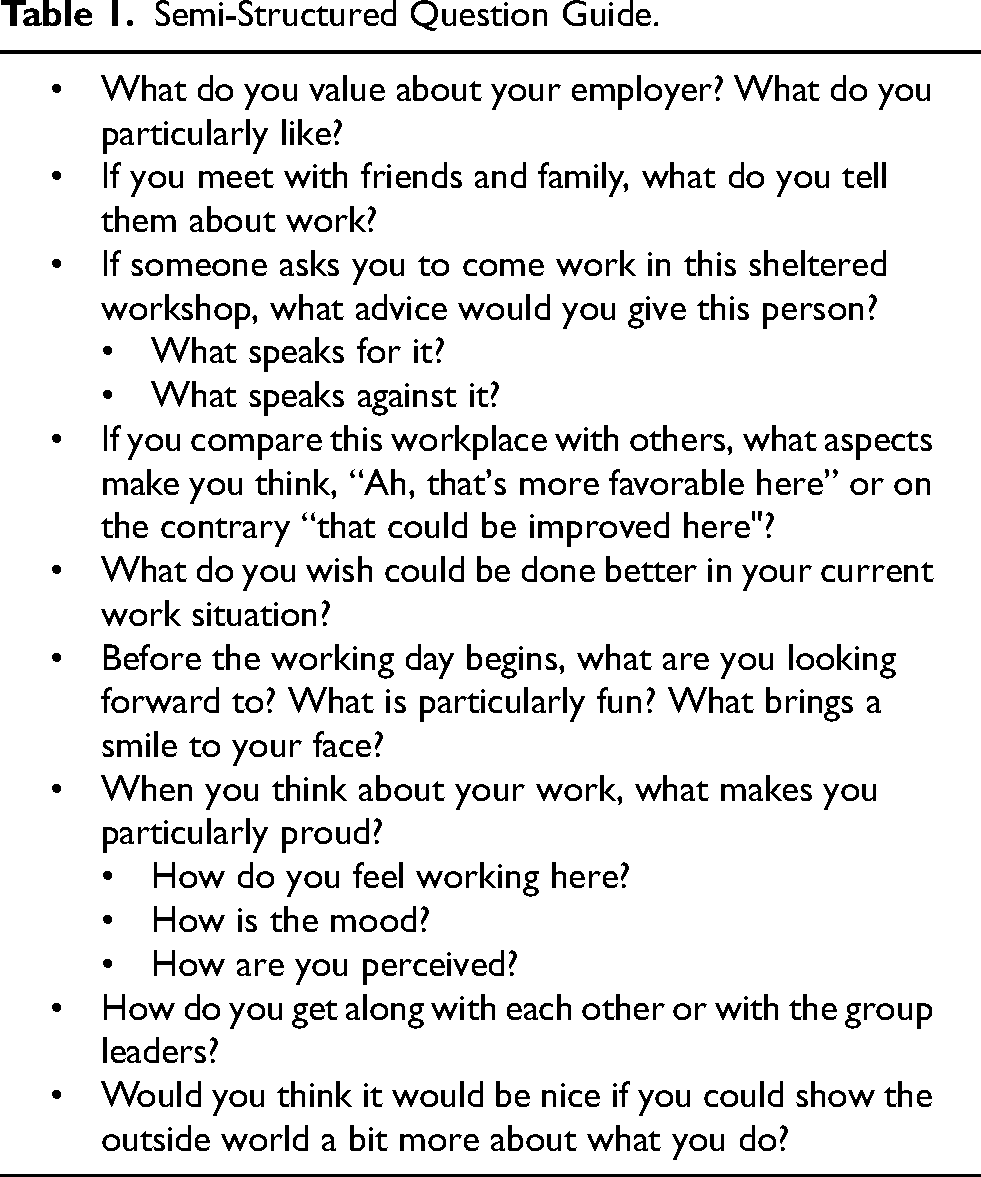
Group discussions were selected as a data collection method due to their efficacy in fostering interactive data generation through group interactions, thereby offering valuable insights into the social norms and dynamics within specific settings (Braun & Clarke, 2013). A semi-structured question guide was developed to investigate the day-to-day work experiences of individuals at the sheltered workshop, as well as their attitudes and valuations of different aspects of work. The details of the question guide are presented in Table 1. The group discussions were conducted jointly by both authors at the participants’ workplace and lasted between 50 to 58 min. Ethical approval was obtained from the FHNW School of Applied Psychology Ethics Committee (approval number: EAaFE230308). The participants provided informed verbal consent for the audio recording and publication of data. The foundation provided written consent for data collection, analysis, and publication. To protect the anonymity of the participants, actual names have been replaced by pseudonyms.
Semi-Structured Question Guide.
Data Analysis
Data were analyzed using an inductive reflexive thematic analysis adhering to the six-phase process outlined by Braun & Clarke (2006). Embracing a constructionist viewpoint, this study directs its attention towards the process by which participants’ experiences within the workplace are constructed in relation to their identity (Braun & Clarke, 2013). The transcription of data was carried out using MAXQDA software, simultaneously fostering familiarity with the dataset. The first author guided the generation of codes based on initial themes that emerged through systematic clustering of similar codes (Braun & Clarke, 2013). The second researcher scrutinized and refined these preliminary themes. This iterative process was repeated by the researchers, with further adjustments made after joint discussions during which any disagreements were resolved and analyses revised until both researchers reached full agreement on the results, culminating in the final analysis. The final analysis involved naming and defining the thematic categories. Data extracts that best exemplified each theme were selected.
After the analysis, the findings were presented to an established working group within the institution, composed of individuals from various positions and fields within the foundation, who were asked to assess whether the findings resonated with their experiences. However, the participants themselves were not given the opportunity to comment on the findings.
Both researchers received training in qualitative methods as part of their academic education, having completed a Master of Science degree in Psychology, and have participated in several research projects. One of the parties is a professor who holds a PhD and has extensive experience in conducting qualitative studies. The reporting of this study follows the Consolidated Criteria for Reporting Qualitative Research (COREQ) checklist (Tong et al., 2007).
Results
The analysis is divided into four main themes and seven subthemes that outline the work experiences and conditions that contribute to developing a positive work identity among sheltered workshop participants with a mental health condition.
Cultivating a Work Environment Based on Equality
When discussing the work environment, participants emphasized the importance of treating all individuals with equal respect and dignity, as well as actively promoting equality.
Working Environment Without Stigma
During the qualitative interviews, participants discussed experiencing stigmatization in wider society. They expressed deep appreciation for the absence of such incidents in their workplace. Their stories emphasized the importance of being treated in a manner that recognizes their inherent worth, promoting a sense of normality in their identity. For example: Oliver: “They treat us like normal people, as they say. So, you don't realize that there's something [different], nothing. Yes. So now in our department I don't notice anything.”
Equality is Proactively Lived
Not only did participants appreciate the absence of inequalities, but they particularly valued proactive advocacy for equality, exemplified by genuine efforts to ensure equal conditions for all individuals, regardless of their mental health status. Eveline and Luca note that the foundation is very “family-like” and everyone is on a first-name basis, from the sheltered workshop workers to the top management. Eveline also mentions that it is common for everyone to have fun together (including supervisors) and that they are sort of like a “work family”. This makes participants look forward to coming to work, for example: Severin: “When I get up in the morning, I look forward to the people I meet there. Sure, I like doing the work, I like producing, but I'm really looking forward to meeting the people.”
Fostering Motivational Work Design Characteristics
Another important aspect highlighted by the participants was the significance of autonomy and skill development in their work environments. These aspects comprise feelings of competence and confidence, which contribute to their sense of self-identity and positive self-esteem.
Promoting Skill Development in a Culture of Trust
Participants appreciated opportunities that enabled them to develop further and contribute to their sense of competence and pride. They expressed gratitude for these opportunities and stated that they receive them frequently, for example: Fiona: “Yes, well, when our supervisors see that you are independent, then they give you more assignments so you can take on responsibility yourself and yes, I also find that interesting. Yes, for example, for [one client] I'm allowed to write routing slips now, I like to do that…” Severin: “I stayed here because I really liked it and ehm yes, I was able to develop very well thanks to all the help and […] I think that plays a very big role for the foundation.” Another example of a task extension is the opportunity to train new employees, as Henry states: Henry: “Ehm, I guess I am a person who likes to pass on knowledge. I have the greatest joy when I can show something and it ‘works’.” Fiona: “When we are allowed to try something new again and we have done it and thought “well, we can't do that” and yet we have managed it. Yes, we can be very proud of that. We can be proud of our achievements, of what we do in here, yes.” Oliver: “That's also a thing, a small mandate that they gave me, where they simply knew “He can do this” and then it was clear to them that it would work with me.”
Valuing Autonomy and Task Organization Liberties
A sense of empowerment at work for participants also comes from having control over tasks and working methods. Anton states that the workshop participants, especially those that have been working there for a while, “can basically always choose what they want to do.” Not only can they decide on many of their tasks, but they can also choose how they want to do the task, for example: Fiona: “Yes, and above all they let us work when they see we can do the work, they let us work. They don't talk into it.” Robin: “I can act independently and, and eh, even make decisions and that suits me very well, it's very good here at the workshop. I've realized in the last few years, I haven't been here that long, three years, eh, that you're challenged here. I think that's very important.” Henry: “I realized that I needed a bit of responsibility and that was appreciated, and I think people saw that at some point. I was then also able to take on everything from A to Z, especially with one customer who is close to my heart. Of course, I still have the supervisors in the background, but ehm, I can act independently and, and eh, even make decisions and that suits me very well, that's very good here in the workshop.”
Providing Meaningful Work Through Manufactured Products
Although this theme is the last to be mentioned, it was in fact the most central theme in the group discussions. Participants expressed a general appreciation for the opportunity to pursue a job as well as an overwhelming sense of pride in the products they produce. Furthermore, the products serve as a revealing representation of their occupation, eliminating the need to state that they work in a sheltered work environment.
Appreciation for Fulfilling a Meaningful Role
Being able to go to work at all means a lot to the participants, as illustrated by: Victor: “I'm happy to be able to pursue a job. When you've been unemployed for almost 6 years because it just didn't work out, you're happy when you have a job again that's good for you and if the whole environment […] also suits you, then that's almost half the battle for me.” Hayden: “It makes me proud to know that I worked during the day. That I did something, that I wasn't just at home.” Fiona: “Yes, so you can really see some [individuals with mental health conditions in residential care] who are really under medication, so they are walking around like half zombies, yes. But in our condition, everyone is now in a good state, everyone works.”
Products with Societal Impact: Feeling Proud
The most appreciated point for the participants is that they are not doing just any kind of work, but meaningful work. Luca: “We have a job that makes sense yes. Not producing something that you can't sell afterwards.” Severin: “The fact that I can say “Today I made this many kilograms of pasta” […]. That makes me really really proud.” Anton: “Yes, eh, if you see a product in the supermarket for example […] and you see that it all went through our hands, you’re a little proud, eh, when you see your work in the store. You always think “this is my work”.”
The Work's Narrative is Shaped by the Products
Participants view manufacturing known goods as an advantage because they can easily explain their work without having to disclose that they work in a sheltered workshop and receive disability benefits.
When asked about what the participants tell family or friends about work when they meet them, Severin answered “I tell them I make pasta”, while Evelin said “I tell them I make pastry”. Robin further elaborates Robin: “When I met friends or family […], the first thing that I did was, that I brought them a present from the foundation for example pasta or chocolates […] and I said I work there. But I never really talk about the people here or the foundation itself.” Fiona: “My family knows that I am happy here, that I like it here. I already had false friends that said “Why do you need to collect disability benefits if you are able to work. You are not disabled after all so.” And since then, I am careful what I tell friends about the foundation and what not.” Anton: “Also, whether the general public needs to know this that we work in a sheltered workshop, I don't know. It's just that we are still being pigeonholed, yes.”
Compensation as a Secondary Concern
Compared to other topics, salary was only briefly discussed and emerged in just one of the two group interviews. Luca remarked that the pay is somewhat low and noted that, in some cases, even apprentices earn more. The others agreed that the wages could be higher but also emphasized the complexity of the issue, acknowledging that their productivity is lower than that expected in the primary labor market. Victor: “Well, you can't compare the second labor market with the first [Luca: ‘yes, that's true’; Emma: ‘totally’]. [‘that's really true’ L] We still have certain things here that you don't have in the first labor market. In the first labor market you have to go to work, if you're not feeling well – here, you don't have to.” Severin: “Well, I mainly come here to work not really for the money. For me, it's more about… well, that I can come here to work, that I enjoy being here. The wage I get here, sure, it's nice to receive something, but I actually see it more like pocket money, really.”
Discussion
The aim of this research was to examine the work experiences and conditions in sheltered workshops, that contribute to a positive work identity for individuals with mental health problems. Three aspects were identified: (1) cultivating an egalitarian work environment that emphasizes the absence of stigma and actively promotes equality; (2) enhancing motivational work design characteristics, with a focus on skill development and autonomy; and (3) providing meaningful work through products with societal impact. A fourth theme concerning the compensation was mentioned but did not emerge as central to participants’ work identity.
Given the stigma that people with mental health conditions often face in the workplace (Baldwin & Marcus, 2006), a stigma-free culture is central for participants. As previous research has shown, disability stigma is negatively correlated with job satisfaction (Kim, 2022) and plays a significant role in shaping a positive work identity. As Elraz (2018, p. 726) states “[…] the area of mental health and work represents an interface in which the nature of the illness and the social stigma that surrounds it can result in particular manifestation of identities at work”. It is notable that, in addition to the absence of stigma, actively promoting equality not only among the participants themselves but also among regular employees and supervisors fosters a positive sense of normalcy for the participants. This extends previous research emphasizing the importance of community and social connections (e.g., Leufstadius et al., 2008; Lysaght et al., 2009) by highlighting that it is not only the sense of community among participants that matters but also the creation of an inclusive environment characterized by equal and respectful relationships between participants, reintegration professionals, and supervisors. In their review on how stigma influences employment, van Beukering et al. (2022) pointed out that the attitudes and behaviors of healthcare and support professionals may act as significant barriers or facilitators for individuals with mental health conditions yet noted that this area remains underresearched. Building on this, our study contributes by emphasizing the importance of fostering inclusive climates not only among participants but also involving healthcare professionals from two key perspectives. First, given that individuals with mental health conditions often internalize the messages conveyed by healthcare and support professionals, these actors play a profound role in shaping their work identity (Netto et al., 2016). Second, considering that in conventional workplaces employees generally interact on an equal footing, it is reasonable to implement analogous principles in sheltered workshops.
The second aspect highlighted in the study is motivational work design characteristics. Providing individuals with mental illness opportunities to autonomously develop their skills can enhance personal confidence and self-esteem, thereby strengthening their positive work identity (Deng et al., 2023). These findings align with previous research emphasizing the importance of development opportunities and job autonomy in sheltered workshops (Akkerman et al., 2014; Flores et al., 2011; Lukas et al., 2018). Soeker et al. (2018) report that individuals working in sheltered workshops frequently experience a sense of stagnation and perceive limited opportunities for skills development. This is particularly concerning given that the capacities and skills of individuals with mental illnesses are often underestimated (Boardman et al., 2003). For instance, Lukas et al. (2018) identified the lowest job satisfaction scores in sheltered workshops regarding opportunities for autonomous participation and career progression. Similarly, Ybema et al. (2020), in a weekly diary study, concluded that creating a good match between the job and the individual's abilities is crucial not only for productivity but also for well-being in sheltered workshops. This study adds to these findings by illustrating the critical role of reinforcing motivational work design characteristics to foster an identity-enhancing work experience. Notably, a meta-analysis by Humphrey et al. (2007) identified autonomy and skill variety as two of the three most critical factors contributing to a sense of meaningful work. This underscores our findings, emphasizing that these factors are especially relevant for people with disabilities in non-competitive employment, who often face challenges in making meaningful societal contributions and establishing their sense of identity (Netto et al., 2016; Voermans et al., 2021).
Additionally, Humphrey et al. (2007) found that task significance was the third crucial factor for work meaningfulness. The present study also emphasizes the importance of the nature of the work itself for enhancing identity-enhancing work experiences. Not only is the mere engagement in tasks and the establishment of a routine crucial, as also highlighted by Leufstadius et al. (2008), but it is also vital that participants perceive their work as fulfilling and as making a meaningful contribution to society. This aligns with findings from studies such as those conducted by Goldberg et al. (2002), Hvalsøe & Josephsson (2003) and Leufstadius et al. (2008), which indicate that occupations deemed most satisfying for mentally ill individuals, are those perceived as necessary and socially impactful. Especially in view of the function of sheltered workshops in facilitating the transition to the first labor market, it is imperative to establish roles that align with these demands by placing greater emphasis on practical, real-world activities in contrast to tasks such as arts and crafts. Notably, the present results suggest that manufacturing recognizable products was a strategy used by participants to steer conversations away from the sheltered workshop and towards the products themselves. This approach is similar to observations by Sebrechts (2023), who reported that participants sometimes removed workshop logos or wore clothing from previous jobs to counter the stigma linked to sheltered employment.
In addition to the stigma associated with sheltered workshops, low financial compensation represents another potential disadvantage, possibly undermining the perceived prestige of such work and negatively affecting work identity (Hassler, 2017). However, in the present study, compensation did not emerge as a central aspect of participants’ work experience. This finding aligns with results from Netto et al. (2016), where individuals with mental illness indicated that they would engage in vocational activities even in the absence of financial incentives. Instead, individuals emphasized the importance of being able to use their talents and skills, which they saw as essential for building an authentic self and for engaging in meaningful activities. Therefore, if sheltered workshops cannot offer adequate compensation, they should, at the very least, meet participants’ expectations for motivational and meaningful work. Given their rehabilitative and recovery-oriented potential particularly through fostering a positive work identity, they should be purposefully designed to support these aims. Currently, however, there are no clear structural guidelines in place.
Based on our findings, we propose three practical steps to improve sheltered workshops and, more broadly, to enhance the work experiences of individuals with mental illness in competitive employment settings: 1) Promote an inclusive, stigma-free work environment encouraging equal interaction between participants and staff (Shore et al., 2018). This includes treating participants as colleagues, using first names (which is not a common practice in all Swiss workplaces), sharing breaks, socializing together, promoting open dialogue, and actively involving everyone in decision-making. 2) Enhance motivational work design characteristics by focusing on skill development and autonomy (Hackman & Oldham, 1976). Given that the abilities of individuals with mental illness are often underestimated (Boardman et al., 2003), we recommend mandatory development discussions and targeted measures such as skill training (Follmer & Jones, 2017) to build competence relevant for transition into the first labor market. 3) Provide meaningful, realistic work activities that mirror the demands of the first labor market, rather than low-stakes tasks like arts and crafts (Lysova et al., 2019).
The study's methodology presents several noteworthy limitations. The findings of this study are based on a small sample of individuals employed at a sheltered workshop in Switzerland and thus may not be generalizable to other populations or contexts. There may be potential data bias since participants in this study chose to participate so they might have different experiences compared to those who declined participation. While the study identified various factors contributing to a positive work identity for mentally ill individuals, it did not delve deeply into the mechanisms through which these factors operate or their specific effects on participants. Future research should explore concrete interventions and their impacts, as well as thoroughly investigate the underlying mechanisms driving positive work identities in sheltered workshops. Due to the anonymity of participants, concrete diagnoses cannot be reported; however, future research should examine how different mental health conditions shape experiences in sheltered workshops. Lastly, our findings should be interpreted in light of the fact that supported employment programs generally yield better outcomes and should therefore be prioritized and expanded (Hoffmann & Richter, 2020). Sheltered workshops should only be utilized when participation in supported programs is not feasible, and in such cases, they should adhere to guidelines that promote recovery and support long-term labor market reintegration, as proposed in this study.
Conclusion
In conclusion, the present study proposes that sheltered workshops should be purposefully designed to cultivate positive work identity as an integral component of a comprehensive recovery process, as articulated by Liljeholm and Bejerholm (2019). Presently, Switzerland lacks clearly defined criteria for the development of sheltered workshops. By incorporating the perspectives of individuals with mental illness who participate in sheltered workshops, this study provides insight on essential design features. The participants underscored the significance of an inclusive, stigma-free environment that engages all staff members, not solely participants, in addition to opportunities for autonomous work, skill development, and meaningful contributions to society. While supported employment remains the preferred and most effective pathway, when it is not possible, sheltered workshops should implement these recommendations to provide not only rehabilitative work that enhances work identity but also realistic opportunities for skill development and progression toward competitive employment.
Footnotes
Acknowledgments
We would like to thank all participants and the foundation Stiftung Töpferhaus for their cooperation.

Ethics Statement
Ethical approval was obtained from the FHNW School of Applied Psychology Ethics Committee (approval number: EAaFE230308).
Informed Consent
The participants provided informed verbal consent for the audio recording and publication of data. The foundation provided written consent for data collection, analysis, and publication.
Funding
This research was supported by funding from the FHNW School of Applied Psychology and the foundation Stiftung Töpferhaus, where the research took place (no funding number). The foundation was involved in inviting participants for the group discussions but had no role in the study design, data analysis, or manuscript preparation. The views expressed in this paper are those of the authors and do not necessarily reflect those of the funding organizations.
Declaration of Conflicting Interests
The authors declared no potential conflicts of interest with respect to the research, authorship, and/or publication of this article.
Data Availability Statement
Due to concerns regarding participant anonymity, the full transcripts of the group discussions are not publicly available.